




Abstract
COVID-19 shed light on persistent disparities among K-12 school districts, particularly regarding technology access, its use, and educational outcomes. Although resources exist to inform the design and delivery of distance education at the course level, there is a lack of resources to inform program-level decisions about equitable distance education that impact educators and learners across a school system. Drawing on existing literature on educational equity, this article discusses four ways schools may frame equitable distance education. This article also discusses critical lessons schools learned from the COVID-19 pandemic about sustaining equitable technology-supported learning environments during times of crisis.
The COVID-19 pandemic heightened chronic societal and educational inequities, as many local and national responses to COVID-19 had differential and adverse effects on marginalized and underserved populations regarding education, economics, and public health (Glover et al., 2020), as well as adverse effects on student well-being (Duckworth, 2021) and teacher burnout (Pressley, 2021). In response to COVID-19 and stay-at-home orders, schools globally and throughout the U.S. employed distance education (Kamenetz, 2020). Despite rapid growth of online instruction during the pandemic, many educators and students experienced challenges that impeded learning continuity, such as: electronic device access, lack of broadband access, disruption in special education services, limited resources for English learners, and lack of support for parents and teachers (Leiberman, 2020; Thompson, 2020). Variability in opportunities to learn through distance education disproportionately impacted students in low-income households, along with students on individualized education plans (Smith & Binkley, 2020).
Due to recommendations that schools maintain social distancing (Centers for Disease Control and Prevention, 2020) and educators’ safety concerns (Kurtz & Bushweller, 2020), many schools utilized distance education to expand e-learning offerings (Domenech et al., 2020; Fall & Tavares, 2020). With educators’ continued interest in capitalizing on the expansion of distance education during COVID-19 to rethink instructional delivery (Blad, 2020), it is crucial that thoughtful decisions be made concerning its impact on equity for students and their families and communities. There is, however, a lack of scholarship on how educators conceptualize equity when devising and implementing system-wide distance education programs. Their conceptualizations of equitable distance education may result in variability in students’ access to education, academic rigor, pedagogical practices, ongoing support, and educational outcomes. Given that educators make critical decisions about learning environments that could either diminish or exacerbate educational inequities, frameworks for equitable distance education may help advance equitable technology-supported instructional programs.
The purpose of this article is to present frames of equitable distance education. We also discuss how the frameworks may influence schools’ efforts to support instruction with distance education during times of crisis. Whereas much of the existing literature treats school crises as isolated events, during which instruction may be paused or augmented to address crises at hand, during the COVID-19 pandemic schools attempted to sustain teaching and learning over a prolonged period of crisis. We begin this article with a review of literature on distance education and educational equity. Next, we introduce four ways of framing equity in the context of distance education. Given that schools may continue utilizing distance education for instructional delivery in future years, we conclude by discussing lessons learned during the COVID-19 pandemic about supporting equitable learning environments (particularly equitable distance education) during times of crisis.
Review of Related Literature
This section reviews existing literature on distance education and educational equity. It outlines the four conceptualizations of equity we used as a conceptual organizer for considering equitable distance education.
Distance Education
Distance education entails instruction that is fully online or offered across blended learning environments. Blended learning is instruction that takes place across online and face-to-face environments. It can be implemented such that online learning supplements traditional face-to-face instruction, online learning replaces some face-to-face activities, or a variety of online and face-to-face instruction is made available to learners on demand (Stacey & Gerbic, 2009). Christensen Institute curators have identified seven blended learning models, such as the station rotation model or the flipped classroom model (Blended Learning Institute, 2020).
At the course level, there are guidelines for distance education that instructors and course designers can use to address inequities, such as using universal design to support accessibility (George-Walker & Keeffe, 2010). At the system or program level, resources exist for considering the relationship between technology access and student outcomes (Warschauer & Matuchniak, 2010; NCES, 2018), developing leadership competencies for distance education (Jobs for the Future & The Council of Chief State School Officers, 2017), and selecting blended learning models (Blended Learning Institute, 2020). However, there is a lack of scholarly-informed resources to assist educators with framing equity in the context of designing and implementing system-wide distance education initiatives.
Educational Equity
Scholars have conceptualized educational equity in multiple ways, including (a) equal treatment (Rousseau & Tate, 2003), (b) access to education (Coleman, 1990), (c) school outcomes such as patterns of disparities in student achievement across student populations by race/ethnicity, socio-economic status, ability groups, and English learners (Bauman et al., 2005; Every Student Succeeds Act, 2015; No Child Left Behind, 2001), and (d) school and community outcomes (Garces & da Cruz, 2017; Grant & Sleeter, 2006; Green, 2018). Drawing on scholarship on sensemaking and policy framing (Coburn, 2001, 2006), how educators frame equity influences actions they take (or do not take) to address identified inequities (Rousseau & Tate, 2003). The next section of this article, Framing Equitable Distance Education, elaborates on each equity frame and discusses implications for leading equitable distance education programs.
Existing literature offers at least three strategies educators employ in their attempts to address educational inequities, including (a) changing individual assumptions and behaviors that impact equity, (b) advancing organizational equity, and (c) working towards school and community equity. From an individual perspective, educators can develop equity-mindedness, which is awareness that race (and otherwise) neutral policies and practices can further disadvantage students, and it is an acknowledgment that educators have a moral and civic responsibility to help eliminate inequities (Bensimon, 2012). Educators who are not equity-minded may recognize student diversity on the surface (but be blind to systematic inequities) or they may hold a deficit view of students, leading them to attribute outcome differences to students’ and families’ lack of effort (Beard, 2013; Ching, 2018; Valencia, 1997).
Beyond the individual perspective, educators who advance organizational equity consider how individuals’ perspectives and behaviors collectively impact students (Ishimaru & Galloway, 2014). In such schools, educators share a commitment to social justice, they advocate for students, and they seek to eliminate practices and school conditions that marginalize diverse and underrepresented students and result in disparate educational experiences and outcomes (Ford & Grantham, 2003; Theoharis, 2007). In such schools, leaders promote social justice by broadening educators’ awareness of personal biases and systemic inequalities (Ching, 2018; McKenzie & Scheurich, 2004), conducting equity audits (Skrla et al., 2004), and practicing culturally relevant leadership (Khalifa et al., 2016).
Extending beyond organizational equity, leaders who view schools and communities as linked understand that students, families, and schools are impacted by inequities that persist in the broader society (Zeichner & Liston, 2014). Such leaders may work with community members to co-frame and co-construct solutions to address inequities in the school and broader community (Garces & da Cruz, 2017; Grant & Sleeter, 2006; Green, 2018; Milner, 2013).
Framing Equitable Distance Learning
In the sections below, we draw on existing literature on four education equity frames (i.e., equal treatment, educational access, school outcomes, and school and community outcomes) to discuss implications each of these frames have for system-wide distance education programs, policies, and practices. Our discussion about distance learning intentionally extends beyond focusing on new and emerging technologies (i.e., specific devices, services, applications) to consider broad and enduring implications for promoting equitable distance education.
Equal Treatment
Equity as equal treatment attempts to construct and apply “fair” policies, although such treatment may lead to inequitable outcomes (Crenshaw, 1988). In describing the research on teachers’ views of equity and race in mathematics classrooms, Rousseau and Tate (2003) describe a teacher who espoused a position of “color blindness” and attempted to respond to students equally regardless of race, yet the teacher dedicated less instructional time to Black students than White students. Rousseau and Tate found that teachers who held a perspective of equity as equal treatment did not consider student diversity or disparate outcomes as factors in their teaching practice.
Educators who frame distance education through the lens of equity as equal treatment may focus on equal distribution of limited technological services and resources across students (e.g., same devices, content, instructional strategies, assessments) and standard policies (e.g., cameras must be on during video conferencing) that apply equally to all students regardless of differential impact. Concerning teachers, distance education as equal treatment may provide all teachers the same number of hours of introductory training about teaching in fully online or blended learning environments. Equal treatment decisions may be informed by little, if any, data and thus often fall short of addressing inequities. Such decisions may even result in further increasing inequities, enabling their differential effects across students to continue as unacknowledged, under-interrogated, and woefully under-addressed.
Access to Education
Equity as access to education attempts to ensure that students are provided educational resources and quality learning experiences regardless of race, ethnicity, gender, language, or family income (Coleman, 1990) in hopes of improving each students’ opportunity to learn and to reach their full academic potential (Murphy, 1988). A long-time goal of national and local investments in educational technologies has been to increase students’ access to education (Fabos, 2004; U.S. Department of Education, 2017; Warschauer & Matuchniak, 2010).
Distance education initiatives conceptualized through the lens of access to education may be informed by data such as student attendance (e.g., percentage of students who log into the learning management system (LMS) during a given time period), student-to-device ratios, percentage of students with broadband internet access, or students reporting they are able to attend school gatherings and celebrations regardless of their primary mode of instruction. Depending on whether data suggest evidence of differential educational access, teachers and students may be granted access to digital devices, peripheral equipment, wi-fi networks (particularly in neighborhoods where students disproportionately lack broadband access), or online applications to support teaching and learning. Efforts to prevent or remedy inequities may include standardized school- or district-wide distance education policies and templates aimed at improving opportunities to learn (e.g., standardized templates for syllabi, LMS modules, lesson plans, and assessments). However, educational access efforts focused on technology devices and infrastructure fail to adequately address inequities for students who have been marginalized and underserved, especially if educational content and pedagogies lack rigor and relevance (Warschauer & Matuchniak, 2010).
School Outcomes
Increasingly, efforts to promote educational equity focus on examining disaggregated data and addressing disparities in outcomes across student groups such as by race/ethnicity, socio-economic status, eligibility for special education interventions, and linguistic diversity (Bauman et al., 2005). Such data serve as indicators of possible systemic inequities that result in students’ differential academic and psychosocial outcomes (National Academies of Sciences, Engineering, and Medicine, 2019). While data can be used to indicate patterns of disparity and raise educator’s awareness of necessary school changes to better meet students’ needs, data alone is not enough to prompt action to address inequities (McIntosh et al., 2020), as action requires critical reflection and commitment to improve students’ learning experiences and outcomes (Rousseau & Tate, 2003).
In the context of distance education, equity as school outcomes may involve collection and disaggregation of data that extends beyond measures of student achievement (e.g., grades or standardized test scores) to also include students’ and families’ selection and participation in various modes of instruction (e.g., fully online, fully in person, blended learning), student engagement (e.g., average time spent completing online modules, extent and nature of contributions to online discussions), student promotion to a grade level or to advanced coursework in a given subject, social and emotional learning data as indicators of students’ well-being and sense of belonging, discipline data (e.g., student academic misconduct or disciplinary action), students’ contact with other members of the school community across subgroups and modes of instruction (e.g., opportunities to interact with peers, teachers, intervention specialists, counselors), and students’ input on how they have been impacted by distance education policies and practices.
Through an equity as school outcomes perspective, educators draw on data to inform actions to address mitigating factors that lead to differential outcomes through changing the school’s culture, climate, policies, resources, and practices (Erickson, 2020; Theoharis, 2007). Action may necessitate additional data collection and analysis before determining change efforts (Kozleski & Smith, 2009). Following further data analysis, resulting changes may include distance education experiences that are more inquiry-oriented and learner-centered uses of technology that foster students’ agency and voice, critical thinking, problem solving, and creativity (Andrade Johnson, 2020). Additional actions in response to outcome data may include hiring teachers with identities and background experiences that resemble the students they teach, training for teachers and instructional designers to confront unconscious biases and create more equitable technology-supported learning experiences, using technology to support personalized instruction, and engaging content and teaching practices that address learning differences, accessibility, and cultural relevance. Schools may also plan a multi-tiered system of support (MTSS) for distance education to provide targeted support. Teachers’ professional learning opportunities may be expanded to further develop their sense of self-efficacy to teach using various educationally appropriate strategies (e.g., programmed instruction, station rotation, flipped classrooms, allowing students to dynamically choose whether to attend class in person or online on a day-to-day basis).
School and Community Outcomes
Recognizing that schools and communities are inextricably linked (e.g., relationships between housing discrimination, property taxes, education, employment, interactions with the criminal justice system, and wage gaps). As a result of this realization, schools may work to counteract and transform inequitable economic and social conditions in the broader community surrounding schools (Green, 2018; Milner, 2013; Zeichner & Liston, 2014). Such schools intentionally build relationships and collaborate with members of minoritized and underserved communities to identify contributors to oppression and co-construct creative and transformative solutions to interrupt discourses of marginalization and address interlocking dynamics of race, power, and privilege (Ball, 2000; Garces & da Cruz, 2017; Grant & Sleeter, 2006; Watkins et al., 2015).
Data that indicate disparities in school and community outcomes may include disproportionate under-employment of Black and Latinx individuals in IT and schools’ variability of technology-supported learning activities across student subgroups. Other data may include students’ and families’ voiced concerns about how technology may be used for over-surveillance of residents in low-income and racially and ethnically diverse homes and communities. Drawing on such data, educational leaders and their teams may consider how distance education initiatives might address raised concerns and work with students, parents, and community leaders to structure mutually relevant distance education policies and practices that seek to address educational and societal inequities. Responses may entail creating e-learning spaces that are not just welcoming to culturally and linguistically diverse students, but that also promote students’ rightful presence (Calabrese Barton & Tan, 2019) in technology-supported curricula and learning environments, providing students opportunities to learn and address inequities within and beyond schools. Educators and community members may also develop educational advocacy initiatives and programming that support universal and publicly supported broadband internet access to facilitate information literacy, digital literacy, and democratic participation.
Table 1 summarizes implications a school’s framing of equity may have for its distance education program. For each equity frame (equal treatment, access, school outcomes, and school and community outcomes), the table offers examples of data that may be collected to inform distance education policies, practices, and resources. Across the equity frames, data could not only be disaggregated across student subgroups (e.g., race/ethnicity, gender, SES, special education, English learners, or neighborhood/zip code), but school leaders could also examine whether interactions exist between student attributes and mode of instructional delivery. For example, if measures of student achievement or student engagement for English language learners differ across instructional delivery modes, then educators should further investigate students’ experiences across the instructional modes and consider necessary changes in distance education.
Applications of Equity Frames to Distance Education.
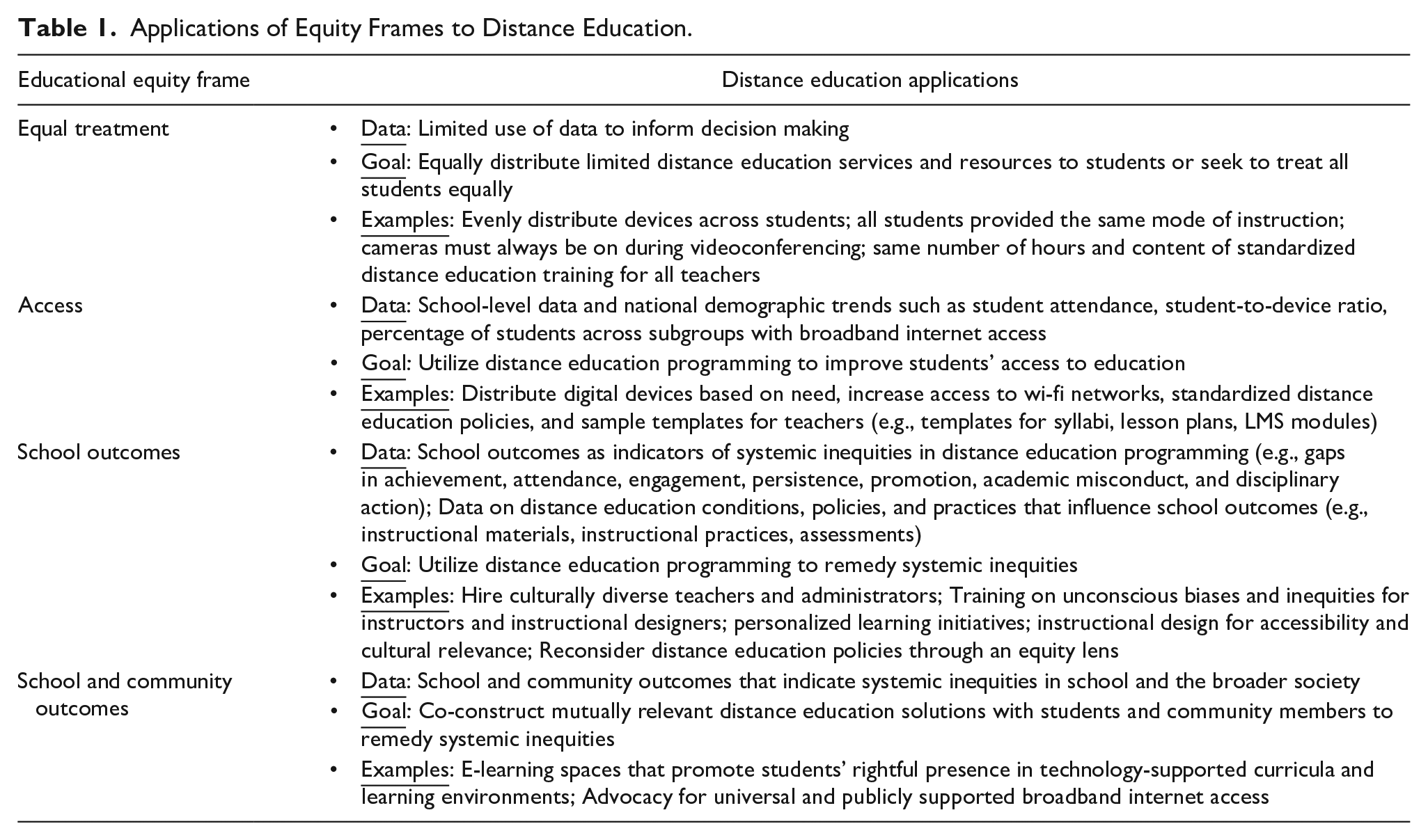
During the COVID-19 pandemic, many schools sought to employ distance education in ways aligned with equity as equal treatment and educational access and did not approach equity as school outcomes or school-community outcomes. Unfortunately, schools that framed equity as equal treatment may have further isolated and negatively impacted minoritized and marginalized students. The next section discusses lessons that can be learned about leading equitable distance education environments during a prolonged crisis that disrupts in-person instruction.
Leading Equitable Distance Education During Crisis
According to Atkinson (2002), crises are sudden, unexpected, and have the potential to negatively affect the entirety of a K-12 school population. To date, literature on what school leaders need to do in times of crisis focus on creating plans to address isolated, jarring events such as student suicide, safety emergencies (e.g., school shootings), weather emergencies, and public relations concerns (Brickman et al., 2004; Liou, 2015; Metzgar, 2020). These plans prioritize immediate safety of students, student and staff well-being, communication, temporary pause and appropriate restart of instruction, and ongoing personalized levels of support for all school stakeholders (Dolph, 2016; Johnson, 2000; Kingshott & McKenzie, 2013). The ability to develop crisis management plans in advance of emergencies gives school leaders a roadmap to provide stability in trying times.
The onset of COVID-19 in early 2020 manifested as a new type of crisis for school leaders to address. Unlike the static nature of most crises, this global pandemic presented a unique challenge for school leaders due to its abrupt, yet prolonged and wide-reaching, impacts. Although the effect of potential pandemics on school settings is not a new concept (e.g., bird flu, SARS), these previous threats did not materialize in ways that led to a substantial disruption to student learning environments. Unfortunately, the ominous nature of COVID-19 halted in-person learning and caused a significant disruption to educational settings and classroom routines. In short, school leaders and educators were not prepared to deal with such a swift adoption of distance education. As previously stated, traditional crisis plans are designed to navigate isolated events that can be addressed in seemingly systematic ways while temporarily pausing or modifying instruction. The progressive spread of COVID-19, on the other hand, forced schools to continue instruction throughout the crisis. This new reality exposed a significant gap in the preparedness of educational institutions to utilize distance education to deliver effective instruction to large numbers of students over an extended time.
The sections below summarize five lessons learned due to the COVID-19 pandemic forcing wide-spread and sustained distance education. Moving forward, educators may need to continue reflecting upon and refining these lessons, as many children have not been vaccinated and new variants are surfacing. Although the option to return to in-person schooling remains an end-goal for many educators impacted by the COVID-19 crisis, the K-12 community will need to continually monitor differential outcomes of distance education programming and adjust accordingly.
Lessons Learned
As previously noted, the development of management plans to be executed in crisis situations is not new to educational environments. However, these plans are designed for isolated incidents that can, with some variation, be dealt with in an organized step-by-step approach. The missing link from these plans is the support of ongoing instruction. As seen through COVID-19, schools may face future crises that render technology-supported learning and teaching over an indefinite period as mandatory. Crisis plans now need to more intentionally consider equity in the context of distance education, ensure students’ access to high-quality instruction, be informed by distance education equity audit data, and enhance relationship-building and communication with all stakeholders.
Lesson 1: School leaders should actively frame equitable distance education prior to and during a crisis
Leaders and their teams should engage in critical dialogue and reflection about educational equity and articulate how their framing of equity informs distance education initiatives prior to the next crisis that utilizes digital technology as a resource to sustain teaching and learning. Leaders who recognize that their school has not progressed beyond conceptualizing equitable distance education as equal treatment can interrogate school data and consider how to further advance equity. Centering equity as a part of instructional decisions (distance education decisions) necessitates shared instructional leadership and community engagement prior to and during a crisis.
Lesson 2: School leaders should prioritize universal access to digital technologies
One-to-one initiatives are not new to K-12 educational settings; however, many schools continue to operate without all students being issued an electronic device (e.g., laptops, e-Books). Although the COVID-19 pandemic created an influx of federal funding for schools to purchase additional devices (Office of Elementary and Secondary Education, n.d.), district leaders need to rework crisis plans to prioritize the availability of devices for all students. A student’s comfort in using an electronic device regularly in an in-person classroom setting better positions them to utilize that device across distance education environments as well.
Lesson 3: School leaders should conduct equity audits of distance education programs to strengthen crisis plans that incorporate technology-supported learning
Equity audits for distance education should address educational outcomes, use of technology, and teachers’ professional learning. Audit data should then inform well thought out contingency plans to sustain teaching and learning when in-person learning is not possible. The contingency plans should consider equitable access to education and opportunities to learn, school policies and practices, and outcomes for students, families, and communities. For example, the halt of traditional learning due to COVID-19 exposed wide variability in how LMSs were utilized in the classroom. This “hit or miss” approach exacerbated the ability of students, and educators, to utilize LMSs solely in an e-Learning environment. Crisis plans need to audit how LMSs are utilized during in-person schooling. Crisis plans need to address if there are gaps in how LMSs are operationalized in the classroom and how the transition to e-learning, if necessary, will unfold. Crisis plans should also consider teacher outcomes and experiences with distance education. An electronic device in the hands of each student and available LMSs do not ensure educators have the capacity, willingness, or comfortability to embrace distance education, thus teachers professional learning experiences for teaching with technology should be strengthened to ensure all educators are adequately prepared to lead culturally relevant, meaningful, and rigorous instruction across instructional modes and electronic platforms. As school systems increasingly prioritize students’ social-emotional learning (SEL) (Gimbert et al., 2021), crisis management plans should not overlook how distance education programs impact differential outcomes in students’ and teachers’ SEL (Kaul et al., 2020).
Lesson 4: Schools should build stronger relationships and collaborations with families and community leaders
The onset of COVID-19 forced parents and caregivers to become the primary facilitator of learning in the home. According to Ladson-Billings (2021), parents are often struggling to maintain jobs and coping with their own stressors in addition to raising children. The ability to embrace the role of in-home educator is stressful and support is needed from school leaders and educators. Schools need to ensure crisis plans adequately account for the needs and wants of parents and caregivers, especially as they pertain to e-learning. Plans should include easily accessible venues of communication as technology and instructional questions arise. Although challenging, working to provide supports for parents and caregivers when appropriate (e.g., child tutoring services, community recreational facility use, financial resources for internet service) also position these individuals to be as supportive as possible to their children during e-learning.
Lesson 5: School leaders should communicate regularly and in multiple ways
Communication during a crisis remains paramount (Liou, 2015). Crisis plans should address multiple mediums for communication to students, parents, and educators, especially in e-learning situations. Utilizing existing communication structures like email listservs, text messaging, automated phone dialers should be continued; however, other communication avenues like recorded videos, live chats, and large virtual town hall meetings can provide solace to anxious school community members during times of crisis (Kaul et al., 2020). Due to the unique differences of individual crises, opportunities for one-on-one communication should also be prioritized throughout the crisis and afterward.
Conclusion
In this paper, we outlined four of the ways that schools have framed educational equity (equal treatment, access, school outcomes, and school and community outcomes). Although an in-depth analysis of educational equity is beyond the scope of this paper, we offered descriptions of each frame and how they may inform distance education policies, practices, and resources. We also discussed the lessons schools learned about efforts to support teaching and learning during a prolonged time of crisis.
Future research can examine how administrators, teachers, and staff conceptualize equity when constructing and implementing building- and district-wide distance education initiatives and the extent to which their conceptualizations align with the equity frames discussed in this paper. Future research can also examine whether educators’ conceptualizations of equitable distance learning differ under “normal” versus crisis conditions. It may be that for some educators, crises during 2020–2022 (i.e., COVID-19 pandemic, economic and health crises, and deeper consideration of persistent racial injustices) prompted them to have more critical and nuanced stances toward leading distance learning programs (advancing from access to school-community outcomes). On the contrary, it could be that crises during 2020–2022 influenced leaders’ decisions to scale back efforts to confront injustice (focusing on equal treatment or access out of perceived necessity). It may also be that the frames for equitable distance learning outlined in this paper are not mutually exclusive, as some educators may have simultaneously held multiple frames of equity during the COVID-19 pandemic. Thus, it will be fruitful to understand whether educators experience value conflicts during times of crisis with integrating multiple frames of equitable distance education, and how they reconcile conflicting values and commitments.
Footnotes
Declaration of Conflicting Interests
The author(s) declared no potential conflicts of interest with respect to the research, authorship, and/or publication of this article.
Funding
The author(s) received no financial support for the research, authorship, and/or publication of this article.
