




Abstract
The term “life-related,” a significant characteristic of new political textbook(s) in China’s new curriculum reform at senior high school level, means that the textbook(s) should be based on the learners’ life experiences and designed to enhance learning in daily life. There has been little relevant research about student perspectives on how “life-related” a textbook is, especially on comparing students from urban and rural areas. This paper has two aims: Firstly, to compare the perspectives of the urban and rural students about how “life-related” a textbook is; and secondly, to concentrate on identifying the effecting factors on the student perspectives. In this study, the results of questionnaire survey (N = 569), with 285 students from a urban school and 284 students from a rural school, indicated that the political textbook (Politics and Life, in short P&L) is more related to urban students’ daily life. Findings from semi-structured interviews and content analysis of the textbook suggested that public resource, family background, and the urban-oriented textbook content may explain the urban-rural difference of students’ perceptions on political textbook.
Background
In mainland China, before the 2004 new curriculum reform, the political textbooks for senior high school students were filled with theoretical texts which were detached from students’ real life. Learning with such kind of textbooks, students could easily cope with the closed-ended examinations by memorizing those structured political knowledges; however, it was hard to get students interested in the political knowledges that were far away from their daily life, because they might feel that the textbook knowledges are useless in the real life. The goals of political education were to cultivate students’ civic consciousness and to prepare them for civic life, but the textbook contents that were out of touch with students’ life became a significant obstacle to achieving these goals.
With the implementation of the new curriculum reform, in 2004, many materials and elements adopted from students’ daily life were integrated and embedded to the updated political textbook. Based on the Curriculum Implementation Standards for the Secondary School Ideology and Politics Curriculum, one of the principles of the new curriculum is that: The curriculum should be established in students’ life experience, aimed at students’ demands of development in the future, integrating academic theories into the theme of daily life, and constructing the curriculum module of the effective combination of subject knowledge and everyday life phenomenon (Ministry of Education, 2004). According to this, the designing and organizing of the textbook should adopt meaningful and valuable cases and issues from daily life (see the textbooks writing recommendations part in the standards). There are four modules (four textbooks for four semesters) of the new curriculum ideology and politics: The Economy and life, the Politics and life, the Culture and life, and the Philosophy and life. The textbook we discuss here is the Politics and Life (P&L). The key feature of the new version is that more content is related to the daily life of students. In comparison to the old textbook, the new one used more life-related images, real cases, concise text, and field activities rather than the piling up of speculative and abstract concepts. Such efforts of forcing the content of the textbooks to be closer to the learners’ lives is reflected in the title of the textbook, which is politics and life instead of the knowledge of politics—This is to declare that the purpose of such changes is to establish a meaningful connection between students’ classroom learning and their daily life. Observing this signal feature, some authors have raised the term “life-related” to demonstrate the idea of relating student’s life experiences to their learning materials (Chen, 2013; Zhang, 2014, 2015).
Although this life-related trial was a real revolution, problems emerged when the new textbooks were used in an actual class. According to P&L, the activity of “visiting the hearing of a public affair” is arranged to provide learners with opportunities to participate in political life and to understand the concept of democratic supervision. This design is to integrate the theoretical political knowledge into the students’ experiences. However, this life-related arrangement may be easily achieved in a city school while it is difficult to implement in a rural school, because the most of political resources are allocated in the urban area. Therefore, this study aimed to investigate whether there are any differences between rural students and urban students’ perceptions on the contents of political textbook.
Literature Review
Experiential Learning
The importance of connecting the conceptual knowledge to students’ life experiences have been recognized by lots of scholars. John Dewey’s educational philosophy emphasizes on experiential learning, which regards knowledge as something that stems from individuals’ life experiences (Ord, 2003). Similarly, Piaget’s constructivism learning theory also argue that learners construct knowledge and form meaning based on experiences of interacting with their outside environment (Ackermann, 2001). Based on Dewey’s experiential learning theory and Lewin’s social psychology, Kolb presented a four-stage model describing the effective learning process, which involves concrete learning, reflective observation, abstract conceptualization, and active experimentation (Kolb, 1984). All these theories have profound influences on how people perceive the learning process. Learning is no longer simply regarded as a process of acquiring knowledge but a process of constructing knowledge, and personal experience is not isolated or separated but connected to students’ learning (Kolb et al., 2001; Ord, 2003). Previous studies have probed in using experiential learning methods to promote urban students’ achievements (e.g., Djonko-Moore et al., 2018; Henthorn, 2014). Nevertheless, previous works mainly concerned on the way of teaching, while the current study is interested in the textbook contents. It is because that, in the context of China, official textbooks play a significant role in directing teacher’s teaching.
“Life-related” of the Textbook
The term “life-related” was developed from experiential learning theories by some Chinese scholars (Chen, 2004; Lu, 2005; Zheng & Lu, 2011); and all textbooks and teaching strategies could be modified to be life-related. The current study discussed what is life-related about a textbook. As Zhang (2015) summarized, life-related for a textbook means that it should be based on the learners’ life experiences and designed to enhance learning in daily life. There are two main ideas behind this definition: (1) the textbook should be related to the students’ daily life, to be easy and convenient for comprehension; and (2) students should gain knowledge from the textbook as well as the world.
Regarding “life-related,” some evaluation criteria or analysis schemes revealed similar ideas. For example, in a review of published schemes for the analysis of curriculum materials, seven schemes and criteria of evaluating the curriculum materials were listed; and two of them met the requirements of life-related (Eraut et al., 1975). Specifically, one analysis model known as scheme 5 and produced by Peter and June, presented an evaluation standard to remind evaluators to keep in mind “to what degree are the learning objects common to everyday life?” (p. 75). In this review, scheme 6, which is the Learning Material Declaration for Grade 7 Mathematics, also concerns on whether the learning material relates to topical phenomena at home, at school and in working life, and whether it reflects a concerned attitude toward daily life. Al-Edwan and Hamaidi (2011) evaluated and presented reference criteria containing items of viability of scientific material for the application to everyday life and employment and strengthen life skills. What’s more, the Textbook Assessment and Usage Scale (TAUS), which was constructed by Gurung and Martin (2011) and used to identify student perspectives, contained the criteria for “life-related.” For instance, “How well are the everyday life examples used to explain the material?” (Item 14), and “How much do the daily lives examples help you understand the material?” (Item 15), and “How relevant are the everyday life examples?” (Item 16).
Reviewing the studies of other Chinese researchers showed that some have evaluated “life-related” levels by using descriptive analysis methods. For example, Chen (2013) has probed into the textbook economy and life, which is one of the modules for the ideology and politics curriculum; and analyzed basic concepts, situation settling (includes the images), cases, and questions by using a contents analysis method. Results indicated that the textbook economy and life was life-related to students. Similar studies about how life-related the political textbooks are, such as Zhang (2014), has also discussed the textbook philosophy and life. By adapting relevant frameworks of evaluating the life-related level of a textbook (Chen, 2013; Mi, 2011; Zhang, 2014), this study focuses on four domains of the textbook: Texts, images, cases, and activities.
Students’ Perspectives in Textbooks Evaluation
Those who are involved in textbook design, publishing, selection and use gave various perspectives on the evaluation of textbooks. A great many of related studies have adopted the views and perspectives of experts (Assaly & Smadi, 2015; Gunzel & Binterova, 2016; Hamidi et al., 2016); teachers (Alemi & Sadehvandi, 2012; Mukundan et al., 2011; Tarman & Kuran, 2015); and multi-perspective (Aghazadeh, 2015; Lalau, 2014; Salehi et al., 2015), while a few papers focused on student perspectives for textbooks evaluation (Bliss, 2014; Gurung & Landrum, 2012; Nitsche, 1992).
Exploring the handful of studies about student perspectives of using textbooks, we found that there were different views on the value of student voices. Some researchers believed that investigating students’ perspectives is meaningful. For example, Nitsche (1992) indicated that as a teacher of social studies who shared his experiences of selecting teaching materials and thought that it was important and valuable to look at student opinions and preferences for textbook selection. Also, Bliss (2014) identified the quality of digital textbooks from a college student perspective and suggested that students are crucial indicators of textbook quality. In contrast, a recent study of the relationship between students’ preferences for textbooks and learning achievement showed that learners’ ratings of textbooks were irrelevant to quiz scores (Gurung & Landrum, 2012). Though the results of this study showed the negative relationship between learner perspectives of the textbook and learning outcomes, the author still holds a favorable opinion about the significance of considering student opinions regarding textbooks (Gurung & Landrum, 2012).
Previous studies were mainly based on the analysis of contents and documents from the perspectives of experts and teachers, while students’ opinions and perceptions were overlooked. This study believes that students’ perspectives are significant in textbook evaluation as they are the users of the textbooks, therefore, it addresses the research gap by investigating students’ opinions and concerning on their voices.
Research Purposes and Questions
The current study was aimed to compare the perspectives of the urban and rural students about how life-related the textbook P&L is; and, to identify the effecting factors on students’ perspectives. Accordingly, two research questions were formulated:
RQ1: What are the differences of the perspectives between urban and rural students about how life-related the textbook P&L is?
RQ2: What are the factors that lead to these differences?
Method
Design
In this study, both qualitative and quantitative data were collected, analyzed, and interpreted, so that “the researcher makes inferences across both the quantitative and qualitative databases” (Creswell, 2014, p. 57). Specifically, quantitative method such as questionnaire survey, and qualitative methods such as semi-structured interview and content analysis, were employed in this study, aiming to provide a comprehensive understanding of students’ perceptions on the political textbook P&L.
Instrument
Questionnaire
To investigate student perspectives about P&L, a questionnaire that was composed of 21 items, was developed by the researchers of this study. The questionnaire contains four subscales regarding four key elements of the textbook P&L:
To identify the goodness of fit of the four-factor model, a confirmatory factors analysis was conducted by LISREL 8.7. Results indicated that the four-factor model fits good (χ2/df = 4.6 < 5, RMSEA = 0.076 < .08, NFI = .96, IFI = .96, CFI = .96, NNFI = .96). Moreover, the Standardized Regression Weights of each item were higher than .5, and the t-value was significant. In addition, the AVE values of four factors were .601, .593, .545, and .510 respectively, and all of them higher than 0.5. What is more, the CR value of each factor was higher than 0.6 (they were .817, .856, .826, and .757), and the square root of AVE of each factor was larger than the correlation coefficient of the factor and the others. In summary, good convergent and discriminant validity of this scale was identified.
Interview protocol
An interview guide approach was used to gather the data systematically for each respondent because the outline increases the comprehensiveness of the data (Cohen et al., 2011). Therefore, an outline of the interview was drafted according to the results of the previous stage. This interview was arranged to probe why a textbook is more related to urban students’ daily life. To explore the thinking about each participant, the interview was conducted by an individual. Based on the research questions, the individual interview was designed in two parts. The first part of this interview was to know the participants’ perspectives about the textbook more deeply; and the second part was to discover the possible reasons that influence participants’ perspectives.
Criterion of the textbook content analysis
Two high school teachers (one from an urban setting and the other from a rural setting) who had taught the P&L for more than 3 years were enrolled in this study for analyzing textbook content. There were three main tasks for them: (1) to select the major conceptual words from the P&L; (2) to distinguish and mark which images of the P&L are related to urban or to rural students’ life; and (3) to distinguish and mark which cases of the P&L are related to urban or rural students’ life. Therefore, the curriculum standards of the P&L were taken as reference criteria for this task (1). In addition to this, for tasks (2) and (3), to distinguish which images and cases of the P&L are related to urban and/or rural daily life, teachers followed the following three criteria: (a) Whether the scene of the images could be easily seen in (urban or rural) students’ daily life. (b) Whether the images could be comprehended by using (urban or rural) students’ daily life experience. (c) Whether the cases are talking about the things which were concerned to (urban or rural) students’ daily life.
Participants
The samples of the survey consisted of 569 respondents in total, 285 respondents from an urban school while the other 284 respondents from a rural school. Moreover, the participants of the interview were 20 students who were selected from the two high schools (10 students from each school) and 10 teachers (five teachers from each school). All the sampling students are year 1 students (their ages ranged from 15 to 16). Considering the stratified feature of classes and for homogenizing the distribution of sampling, the author selected the students using a stratified sampling method. Specifically, both urban and the rural school, one class from the Top layer, two classes from the Merit layer, and two classes from the Ordinary layer, were sampled. Those three layers (Top, Merit, and Ordinary) have been stratified by the school already; and there were approximately 60 students in one class. In other words, one school, students from five classes and three layers, participated in the survey. In addition, two students from each class were interviewed after surveying as part of the second stage. The selection of the student interviewee was at random.
The teachers who participated in the interview were the politics teachers of the sample classes. They can provide their observations about student responses when learning the P&L according to their teaching experiences. Namely, their observation and opinion were an indirect but valuable source of information for this study.
Setting
Both rural and urban schools were involved and were all senior high schools (from Grade 10 to Grade 12). Moreover, they are respectively considered the top school in the local area. Specifically, the urban school with the highest graduation ratio and the rate of admission into higher education schools are in an industrial city in Guangxi province. In addition, rural schools, which are in an agriculture-dominated county of Guangxi province are also famous for its high ratio of university admissions. Also, regarding the academic performance of the entrance examination before senior high school, the students’ quality of the urban school is the best in the urban area, while the rural school’s students are also with the best quality and learning achievement for the rural area.
Data Collection
Considering the questionnaire fitness to the purpose and to probe students’ perspectives of P&L, the delivery of questionnaires arranged at a time that students have finished using the textbook. According to the teaching schedule of both schools, students who used the textbook when it was the second semester of Year 1. At the end of the second semester (it was June 2016), the total 600 questionnaires were issued to ten classes of two schools by the author. The students of both schools completed the questionnaire, and 569 of 600 were returned (284 from the rural school while 287 from the urban one). The return-ratio was 94.8%. The semi-structured interviews were conducted after collecting all questionnaires. All interviews were recorded.
Data Analysis
SPSS version 19 was used for the quantitative analysis of this research, after coding and entering the data from the questionnaires. The interview transcripts were transcribed word by word from the recorded soundtracks. Coding is a major feature of qualitative research (Flick, 2009; Gibbs, 2007). Therefore, a coding list was made, and Nvivo version 11 was used for coding and sorting the data into the conceptual framework. Lastly, probing the generated reports from Nvivo, identifying the recurrent themes and noticing patterns in the data, the information abstracted from the data was synthesized.
For content analysis, quantitative content analysis, the most classical method, was adopted in this study. Though it is a quantitative procedure, it may also involve personal interpretation. Therefore, the criteria as mentioned before were crucial for controlling the bias.
Findings
Differences: The Textbook is More Life-related to the Urban Students
To compare the perspectives of different groups of students, the independent sample T-Test was conducted. Table 1 shows the descriptive statistics of each item. The results of T-Test (see Table 2) showed that, at the 0.05 level, there was significant differences between rural students and urban students with t(569) = −6.165, p < .001 (two-tailed), 95%CI [−0.462, −0.239]. The results for each subscale are also significant (p < .001). In summary, compared with rural students, urban students were more likely to perceive that the textbook P&L is related to their daily life.
Descriptive Data (Rural/Urban).

Results of Independent Sample t-Test.

Influence of Public Resources
In the interview, when asked “Has your teacher ever organized the activities of the textbook P&L?” and “Do you have enough resources to carry out the activities on the textbook?” students from the urban school gave positive answers. For example, the urban student responded: “Yes, the hall of hearing is near to our school. And one of my classmates’ parent is working in there.” (LG_Stu01). Also, another urban student, said: “The school provides us with the theater to hold the hearing. And, the computer room is also opened for us to search for the relative resource.” (LG_Stu05). What is more, when asked about the Cases, the urban student responded: “I usually learnt something about citizen on the TV or website or the bulletin board of the community.” (LG_Stu06).
It is can be seen that, urban students have chances to review the contents of the textbook when they were in their daily life, and the chances were given by public resources (i.e., the government resources, the school resources, community resources, etc.). On the contrary, the students living in rural areas might have less opportunities to use or encounter the textbook knowledge out of the classroom as they have a limitation due to inadequate public resources. For example, when asked the questions which are the same as the urban participants, the rural interviewee responded: “Our teacher never organized the activities of the textbook. I think it might be because of there is no resource for us to search the information for those activities. No computer rooms, and the papers usually are outdated.” (RZ_Stu04).
In addition, when discussed about the Cases in the textbook, the rural interviewee said: “I do not think the cases of the textbook are related to my daily life. For example, the case in page 57 is not life-related. I cannot understand what the ‘large-scale residential area’ is. I never heard of it.” (RZ_Stu05).
When talking about whether the contents of the textbook are “life-related,” student words revealed some facts about the public resource conditions of the area they lived in. The rural students expressed that the public resources are not enough. For example, they did not have electrical tools to search information for preparing the activities of the textbook: “If I have the chance to take part in the Model Hearing I would like to, but I do not know the others’ opinions. Preparing for it also needs the time. Besides, where can we search for the materials? There is no computer in my home. In school, we can only use the computer room when the computer class.” (RZ_Stu01). Moreover, they had no idea about the “community,” when asking “If you have the chance to do the community survey, will you do it?” a student from rural school responded: “But, Miss, the problem is there is no community. . .” However, the fact is, there is a community in the rural area, but the connection between the community and the students is weak because the community of rural areas provided few services for residents. Therefore, the presence of the community is tiny on rural students’ perspectives.
Another sample showed that students of the rural area had few chances to touch something concerning politics in their daily life. When asking “Are there some images that are not related to your life you think?” a student said: “Yup, the ‘citizen is reading the government documents’ on page 48. Is it real that the citizen can look up the government documents? Where to do so?” (RZ_Stu03) Actually, all citizens have the right and can look up the government document on the official website.
On the urban side, however, most students thought that the resources are adequate. For example: “We have gone to the theater of our school, to hold the Model Hearing. Also, the teacher has invited a member of the National People’s Congress to give us lectures.” (LG_Stu02). In fact, the school facilities for researching information were helpful for students achieving textbook activities. “The school provided us with the theater to hold the hearing. And, the computer room is also opened for us to search for the relative resources.” (LG_Stu05).
Influence of the Family Background
Family background can be evaluated through investigating parental occupations and family supports. For example, some answers from the urban students indicated a higher social status than that of their parents: “My father is working for the Local Tax Bureau. Section chief. My mom is a nurse working in the people hospital.” (LG_Stu01). Another similar example, “My dad is working for the government, and my mom is a journalist for a local newspaper.” (LG_Stu05). Their parents showed a positive engagement in their children’s learning process: “My mother is a journalist so that she may teach me something like how to do the survey or how to communicate with the neighborhood committee.” (LG_Stu05).
On the contrary, some parents of the rural students were far away from their children for making living. For example: “They are not here. They went to Guangdong to work, at the building site. I am live with my grandpa and grandma.” (RZ_Stu01). Their parents showed a lower level engagement in their learning because of the limitation of parents’ education level: “They do not know these things. . .They are not very literate. . .They have no time to concern my works. I can only do it myself.” (RZ_Stu03).
The Urban-Life Oriented Textbook
Both the data from interviews and content analysis showed that P&L has an urban-life orientation. In the interview, students’ responses for “Do you think the texts of the textbook are related to your daily life?” are diverse from one to another. Therefore, we could hardly abstract useful proof for discussing the students’ interview transcripts. However, teachers, adults with mature views, a third person relative to students and the textbook, were considered objective observers between the students and the textbook.
As for the teacher interviewees, some from the rural schools suggested that the textbook seems be disconnected from rural student life. For example, when discussing the following questions: “About the texts such as the concepts and theories in this politics textbook, do you think it is related to students’ daily life?” and “Can you point out some particular problems in this textbook which is not related to students’ life?”, the teacher said: “It is really hard to say. . . Probably no. This school students, you know, are from the countryside. Their living environments is all about the farm, the field, or this little county. Some of them have never been to the urban area. Therefore, when it is on the class, students read the textbook and felt confused. For instance, what is the neighborhood committee? What is the economic globalization? What is the ‘Online Government’? They cannot understand them because they never heard of them in their daily life. Besides, they doubted the meaning of learning those political concepts. They often complaint that ‘Why should I learn these useless knowledges since I do not need it at all in my daily life?’. Objectively speaking, this politics textbook is lack of something about the rural issue, though the new version textbook have added many rural materials. So, just according to my observation, I think this politics textbook is not related to our students’ daily life.” (RZ_T01).
The teacher’s words tell us that the students from the rural school regard the concepts in the textbook as “useless knowledges” because they had no chance to use them in their daily life. Some urban-life oriented concepts, such as was mentioned above, the neighborhood committee, economic globalization, and the “Online Government,” are disconnected from rural reality.
The images in this political textbook including the figures, photos, and pictures, were thought to be the key characteristic as a new version of the textbook. The image elements may make students feel “life-related” when using the textbook. However, to review and analyze all the images throughout the textbook, by content analysis and triangulation method, results showed that 27% of images in this book are about urban life, while 16% of images are about rural life. Also, as mentioned before, results from the questionnaire survey indicated familiar conditions, that is, the images are more related to urban student daily life, which also indicated an urban-life orientation. The same content analysis method as above was used for probing the cases throughout the textbook. The result indicated that 61% of the cases are about urban life while 35% of the cases are about rural life, which is also evidence for urban-life orientation in cases.
The textbook arranged a few activities such as the Model Hearing, community survey, debate competition, and so on. In reference to the interview, when asked “Has your teacher ever organized the activities of the textbook P&L?”, the responses from the two schools were opposite. All interviewees from urban areas said that their teachers had organized the activities from the textbook. On the contrary, all rural interviewees said that their teachers never organized any activities.
The teachers’ words may explain this phenomenon. Rural teacher told the interviewer about the reasons why they never organize student to carry out the activities: “Activities of the textbook are good for students’ capacity development, I know. We all know the significance of the activities for students. However, sometimes we should face some realistic problems. If you want students to practice, they should have relevant resource. The textbook just wrote down some sentences of activities and does not consider the possibility for us to achieve them. Especially for our rural pupils, where can we hold the model hearing? Where is the neighborhood committee? There is no neighborhood committee here. How and where to do the survey? How to find the relevant materials? It may easier for the urban student to carry out those activities, but for us, it is almost impossible.” (RZ_T04).
Discussion
Urban-life Orientation of the Textbook
The textbook plays a crucial role in the classroom, especially in China. It is significant for meaningful learning that the content of the textbook is related to students’ daily life. However, the reality in mainland China, urban students’ living environment is different from rural students’, but each area uses the same politics textbook. From the questionnaire survey, this study found that, compared with rural students, urban students were more likely to perceive that the texts, images, cases, and activities contained in the textbook P&L are related to their daily life. Additionally, in the interviews, students and teachers from the rural school have mentioned that some contents of the P&L are far away from their daily life. Namely, an urban-life orientation of the textbook was identified. Such an urban-life orientation of the textbook might hinder the effectiveness of teaching and learning in rural schools, because it is hard for rural students to connect the textbook knowledge to their experiences.
Living Environment: Where the Differences Began
Public resources
Public resources, such as the economic resources, politics resources, and cultural resources may influence student perspectives of the textbook and result in differences between students of different areas, because they offer the possibility for students to access them in real life. Specifically, students living with adequate public resources have more chances to take advantage of them (Guo & Min, 2006). Related literature has mentioned the gaps between urban and rural basic education development can be ascribed to differences of the public resources; especially, economic resources (Zhang, 2002). In conclusion, the researcher also found that public resources gave students more exposures to the real world and more opportunities to relate the textbook to their daily life.
Family background
Family background is measured with two main indicators: (1) parental occupations; and (2) parental engagement in student learning. Namely, the parents’ social status (reflected from their occupations) and their engagements can directly influence student learning opportunities as well as various perspectives when using the textbook. However, throughout mainland China, rural students usually come from lower-income areas while urban students mostly come from the middle-class (Shao, 2013). For example, a rural student with the blue-collar worker parents and are far away from home (the East region such as Guangdong, and Zhejiang), may not have local political knowledge. Therefore, students in rural area have mentioned that their parents would be unable support them to carry out activities in the textbook.
Parental occupations may reflect education levels, income levels, and social status (Brese & Mirazchiyski, 2013; Egalite, 2016). For urban students, their parents may have a higher income and social status occupation and seems to provide more supports for their children’s studies and in field work. Keys (2015) has compared parental engagements with students’ learning between rural and urban areas. It was discovered that urban parental engagement in students’ learning was higher than for rural parents. It is also noteworthy in this study and parental engagement was also a significant factor that influences student perspective on whether the textbook is “life-related.”
To sum up, the family background of students represents how many direct supports do parents provide and to what extent students have chances to relate the textbook to their daily life. Specifically speaking, two things are significant for influencing student perspectives and the use of the textbook. Firstly, parental occupations reflect their education levels, income levels, and social status from which parents have the means and capacity to provide support and resource for their children. Secondly, parental engagement positively corresponds to the level of help and support they can provide their children. Both occupation and engagement level are best summarized as directly supporting student learning. Additionally, it may influence student perspectives as to whether the textbook is life-related. For instance, students feel the textbook is related to their daily life when their parents could do some favors.
An Interactive Process: Textbook Contents and Living Environment
When discussing “life-related” for a textbook, student living environment should be taken into consideration. Also, when talking about student living environment, we cannot avoid a discussion as to why rural students had a harder time applying the textbook to their daily life while urban students had an easier time connecting the textbook to real life. Therefore, there was an interactive process between the living environment and the textbook.
Zhang (2015) indicated that in order to evaluate whether the textbook is “life-related,” at least two ideas should be taken into consideration. The first is source and it indicates whether the textbook provides context that originated from a students’ daily life. The second is practicability and it indicates whether the contents of the textbook can be applied to or encountered in a students’ daily life. Therefore, in summary, the interactive process between student living environments and the textbook contents has two sides. The first side is from the student living environment as applied to the textbook contents, that is, the source. The second side is from the textbook contents to the students’ living environment, that is, practicability. Consequently, these interactive processes are summarized as “life-related” and may influence student perspectives on whether P&L is “life-related” (Figure 1). Therefore, in response to our second research question, the two main factors are source and practically.
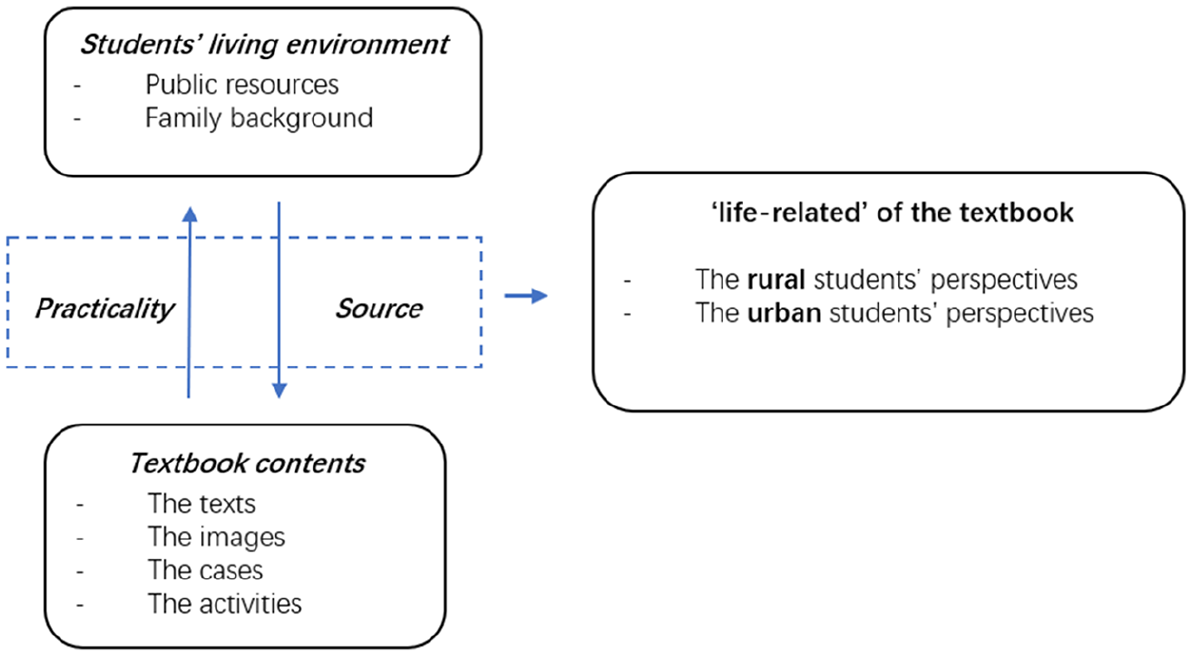
Interactive processes between student living environment and the textbook contents.
The source : From living environment to the textbook contents
Source is defined as whether the textbook contents originated from the students’ living environment. Through analysis of both students’ interview transcript and the textbook contents, this study found that the textbook contents were urban-life oriented, which resulted in the differences between urban and rural student perspectives. Urban orientation assumed that, all or most of the textbook users were urban students, and, as such, the contents of the textbook including the texts, images, cases, and activities, are designed with urban learner in mind. It is a typical phenomenon of the urban tropism (Yu, 2004) and resulted from urbanization. The new version politics textbook proposed the idea of “life-related,” and this is true for urban students. However, for the rural students, its “life-related” is a big question mark. Therefore, though the textbook editor has yet to consider the differences of these areas, for better fitness to student learning requirements, localization textbook or school-based teaching materials should be considered.
The practicality : From the textbook contents to the living environment
Practicality is defined as whether students have opportunities to practice knowledge from the textbook in their daily lives. This study found that urban students have more opportunities than rural students.
Conclusion
The quantitative data from the questionnaire survey indicated the significant differences between two groups in terms of the texts, images, cases, and activities in the textbook. It showed that the politics textbook is more related to urban students’ daily life. The new version of the politics textbook has an urban life cultural orientation, and the urban learner seems more easily to comprehend the contents when using the P&L.
The semi-structured interviews showed that both sides of the interactive process between the living environment (includes the public resources and family background) and the textbook contents (includes the texts, images, cases, and activities contribute to the differences between the two schools. Specifically, the living environment and the textbook contents cannot be regarded as two isolated factors. There is an interactive process between the living environment and the textbook contents. When discussing how life-related of the textbook contents, student living environments should be taken into consideration. Analysis of the data under the modified framework, shows the two factors lead to the differences of student perspectives: source and practicality.
Limitation and Recommendations for Further Studies
As always, this study has some limitations that should be considered when evaluating its results. For one thing, only two schools are involved, and the results are only able to represent the situation of that particular area. For another, there are few papers in the literature, which makes it hard to find firm evidence to support the conceptual framework. For further studies, firstly, the range of the survey should be widened, such as from the eastern coastal cities to the western ethnic minority region. Secondly, researchers should pay more attention to the relationship between student perspectives on the textbook and their learning achievement and motivation.
Footnotes
Declaration of Conflicting Interests
The author(s) declared no potential conflicts of interest with respect to the research, authorship, and/or publication of this article.
Funding
The author(s) received no financial support for the research, authorship, and/or publication of this article.
