



Abstract
Social impact assessment can greatly contribute to sustainable regional and urban planning. However, social impact assessment is used primarily in the context of pre-determined projects, while social impact assessment’s role in informing regional and urban plans before projects are even conceived is under-estimated. Moreover, a narrow understanding of the social impacts of projects leads social impact assessment practitioners to consider such impacts as being the outcomes only of the technical characteristics and risks of projects and their implementation, rather than also of broader social, cultural and political-institutional processes. In this article, we reflect on these gaps in social impact assessment. We expand the conceptualization of the social impacts of projects to better consider how social impacts are also influenced by the social dimensions of risk and resilience, and by the knowledge processes and governance strategies that inform and regulate projects. We conceptualize these processes and strategies and design new conceptual models to derive the social impacts of projects. Finally, we reflect on the strategic role social impact assessment can have in enabling social learning and sustainability transformation in localities (i.e. community resilience) and across multiple governance levels (i.e. social resilience). With this article, we contribute to building a key role for social impact assessment in disaster risk reduction, climate action and sustainable development.
Introduction
With the disastrous consequences of new pandemics and increasing climate change risks (Intergovernmental Panel on Climate Change (IPCC), 2022), building the capacity of all states to enhance disaster risk reduction (DRR) and climate action is crucial to achieve sustainable development and the 2030 Agenda (Birkmann and Von Teichman, 2010; Imperiale and Vanclay, 2021a). As demonstrated by a rapidly expanding literature, community resilience is crucial to reduce disaster risk and impacts (Imperiale and Vanclay, 2016a, 2016b; Sutton et al., 2022), and foster climate action (Amorim-Maia et al., 2022; Bond, 2010; Revell and Henderson, 2019). This was also evidenced by the many community resilience initiatives that spread across the world during the COVID-19 crisis, as reported by the more recent literature on community resilience and the COVID-19 pandemic (Fransen et al., 2022; South et al., 2020).
Community resilience is the proactive human agency that enables people to collectively learn from crises, disasters and past failures, and sustainably transform towards reducing local vulnerabilities, risks and impacts, and enhancing community well-being in localities (Imperiale and Vanclay, 2021a). This agency comprises: (1) social conditions (e.g. community resources, services, coping, adaptive and transformative capacities); (2) cognitive processes (e.g. empathy, caring, social responsibility, perception of shared vulnerabilities, needs, desires, capacities, local knowledge, values, narratives, sense of community, sense of place and sense of risk); (3) interactional processes (e.g. mutual aid and the key aspects of social sustainability, equity, inclusion, community well-being and awareness of sustainability); and (4) individual and collective actions and behaviours leading to sustainability transformation. Social learning and sustainability transformation are key processes at the core of community resilience and of any community resilience-building strategy in society (Choudhury et al., 2021; Berkes and Ross, 2013; Imperiale and Vanclay, 2021a).
Regrettably, techno-scientific approaches to risk and resilience still have a predominant role in regional and urban planning. Too often, this leads to over-engineered interventions that fail to understand, recognize and enhance the social conditions, processes and dynamics that make people and places resilient to climate crises and disasters. Rather than foster positive social learning and transformation and build resilience, these interventions often facilitate counterproductive learning (e.g. rent-seeking, elite capture, organized crime infiltration, disaster capitalism, corruption) and counterproductive transformation, creating environmental and social impacts and a downwards spiral of vulnerability, public debt and second disasters in localities (Bonilla, 2020; Imperiale and Vanclay, 2019a, 2020a, 2021b; Long and Rice, 2021).
To avoid such failures and overcome the barriers to DRR, climate action and sustainable development, any risk management strategy orienting planned interventions should also require the application of a social scientific understanding of the multiple dimensions of risk and resilience and of resilience-building in localities, rather than only require use of techno-scientific knowledge (Gaillard, 2010; Imperiale and Vanclay, 2019b, 2021a; Scolobig et al., 2015). Such a social scientific understanding should help decision-makers to better identify the kind of projects that are needed to: (1) address the needs and desires of local communities; (2) reduce their vulnerabilities and risks; and (3) enhance their well-being, resources, services, capacities and resilience in order to reduce disaster risk and achieve sustainable development in localities.
Social impact assessment (SIA) is a social science field of research and practice, and ideally provides the field of regional and urban planning with insights about the vulnerabilities, risks, capacities, well-being and resilience of local communities, and the planned interventions that can help to enhance DRR and resilience and achieve sustainable development (Gagnon et al., 1993; Howitt, 2011; Imperiale and Vanclay, 2016b; Mottee and Howitt, 2018; Vanclay, 2003). However, for this to happen, a paradigm shift should occur in SIA theory and practice, from focussing on ‘managing the social impacts of projects’ to focussing on ‘reducing the risks of projects and building resilience’ (Imperiale and Vanclay, 2021a). This shift can only be achieved by switches in SIA theory and practice: (1) from a project-based, to a community-based approach; and (2) from focussing only on pre-determined projects, to also focussing on the knowledge and governance strategies that influence regional and urban planning, the projects to be included in such plans and the ways through which such projects are conceived, decided, designed and implemented in localities.
In this article, we review the literature on SIA, DRR and resilience, and critically reflect on the theoretical and practical gaps in SIA theory and practice that need to be addressed in order to foster the paradigm shift in SIA, and build a leading position for SIA in regional and urban planning for DRR, resilience, climate action and sustainable development. To fill these gaps, we provide a broader conceptualization of social impacts, which includes understanding the interplay between social impacts and the social dimensions of risk and resilience in localities. We also provide a conceptualization of the knowledge production processes and governance strategies (i.e. institutional, financial, risk management, physical planning and risk management strategies, and participation strategies) that inform, orient, organize and regulate the conception, decision, design and implementation of projects, and ultimately influence the social impacts they create on local communities and their localities.
Finally, we conceptualize new pathways to derive the social changes and impacts of projects, and the contribution that SIA and the SIA Framework for Action (Imperiale and Vanclay, 2016b) can provide to the knowledge production processes and governance strategies that orient regional recovery and development plans and projects. We argue that the conceptual and methodological innovations in SIA theory and practice, which we introduce in this article, can help social scientists converge and find a common theoretical ground and a shared methodological pathway to inform regional and urban plans about the projects to be included in such plans in order to enhance DRR, climate action and resilience in localities and across multiple sectors and governance levels. This new SIA approach can help social scientists better support governments in undertaking the challenges of the 21st century and meeting the 2030 Agenda.
Progress and limitations in SIA theory and practice
SIA is a social science field of research and practice, and is part of the discourse and family of impact assessment (Vanclay, 2020). It originated along with the implementation of the US National Environmental Policy Act (NEPA) in 1969 (Burdge and Vanclay, 1996) and developed in a project approval context as a tool ‘to apply the knowledge of sociology and other social sciences in an attempt to predict the social effects of environmental alterations by development projects’ (Burdge and Vanclay, 1996: 62).
As currently understood, SIA is the set of processes of analysing, monitoring and managing the positive and negative social consequences that pre-determined projects may create on the well-being of local communities (Vanclay et al., 2015). Although SIA theory and practice have evolved over the last five decades, the conceptual advances gained so far have primarily presumed a project context in which the only thing SIA can do is to assess the impacts of the pre-determined projects on local communities and consider how to mitigate negative impacts and maximize benefits (Imperiale and Vanclay, 2023).
In some situations, SIA is still considered as only being a legal requirement within the national or local broader Environmental Impact Assessment (EIA) regulatory frameworks that project proponents have to respect and follow throughout the project cycle. Here, SIA is typically conducted by project proponents or their subcontractors alongside an EIA at the project feasibility stage. This ultimately results into an SIA report that, together with the EIA report (typically an Environmental Impact Statement), is submitted by project proponents to the relevant government agency to obtain project approval for construction (i.e. legal licence to operate). In these cases, SIA is rarely considered as being more than just as a ‘box ticking’ exercise that proponents provide to local and/or national governments showing: (1) what the negative social impacts created by the proposed project would be; and (2) what compensation strategies and/or grievance mechanisms they intend to implement to mitigate such negative social impacts.
In some other situations, SIA is conceived as the process of managing the social issues associated with projects, potentially even before rumours about the project begin. Here, SIA practitioners help project proponents and local communities to achieve better outcomes. For proponents, this means gaining a social licence to operate, and for communities, this means reduced harm, improved benefits and better community engagement (Esteves et al., 2012; Vanclay et al., 2015). Such a holistic approach to SIA is now being motivated by the need for companies to address human rights concerns throughout all phases of project implementation, and to meet the social performance standards of the international financial institutions.
Despite this evolution, the conceptual advances that have been achieved so far are confined to the context of project implementation (Imperiale and Vanclay, 2023). Conducting SIA remains primarily a responsibility of project proponents, and there still is no role for SIA in identifying local communities’ needs from a DRR, climate action and resilience perspective and in informing recovery and development planning accordingly, before any project is conceived (Imperiale and Vanclay, 2023). Moreover, at the theoretical level, typical understanding of social changes and impacts in SIA does not include understanding of how the social dimensions of risk and resilience, and the broader social, cultural and political-institutional processes that orient and regulate projects, ultimately influence the social impacts of such projects in localities. More precisely, the knowledge production processes and governance strategies (i.e. institutional, financial, risk management, physical planning and participation strategies) that inform, orient, organize and regulate the conception, decision, design and implementation of projects, and ultimately influence the social impacts of such projects in localities, remain little explored and conceptualized in SIA theory. Consequently, the preventive and enhancement role that SIA can have in informing, not only pre-determined projects, but also the knowledge processes and governance strategies that influence projects and their social impacts in localities, still remains little explored.
Building resilience as the nexus of DRR and climate action to meet the 2030 Agenda
DRR and resilience first appeared in the disaster literature in the 1980s and gradually became fully established in the early 2000s, at least in the methodological approaches being recommended by the international community and within the UN system (Davis, 1992; Davis and Lohman, 1987; Kelman, 2018; United Nations Inter-Agency Secretariat of the International Strategy for Disaster Reduction (UNISDR), 2004). Over several decades, various UN declarations led to the establishment of what can be called the ‘DRR and resilience paradigm’ (Imperiale and Vanclay, 2020b, 2021a, 2023; Wyss et al., 2022), which should inform all planned interventions, before and after disasters. The DRR and resilience paradigm has prompted a shift in the typical disaster management thinking from ‘managing disasters’ to ‘reducing disaster risk and building resilience’ (Faivre et al., 2018; International Decade for Natural Disaster Reduction (IDNDR), 1994; Imperiale and Vanclay, 2020b, 2021a; United Nations Office for Disaster Risk Reduction (UNDRR), 2005, 2015). This new paradigm emerged from the recognition that the occurrence of natural hazards cannot be prevented or controlled, and that the scope of DRR activities is not necessarily to prevent the occurrence of hazards, but rather to reduce vulnerability and exposure to hazards and disasters, and to enhance local communities’ capacities and resilience, thus enabling people to live with risk and thrive, turning risk into opportunities for sustainable development (UNISDR, 2004; UNDRR, 2022).
This shift in disaster management thinking has embraced recent theoretical evolution in the social scientific understanding of disasters (Perry, 2018). It was based on the recognition that local communities do have resources, services, coping, adaptive and transformative capacities, and proactive agency (i.e. community resilience) that can positively contribute to reducing disaster risk and achieving sustainable development in localities. Different to traditional disaster management approaches, which tended to perceive local communities as vulnerable and passive recipients of top-down social protection activities (Van Niekerk, 2008; Imperiale and Vanclay, 2019a, 2019b, 2020a, 2021b), the DRR and resilience paradigm stresses that, to enhance DRR and resilience and achieve sustainable development, genuine community engagement and empowerment strategies are crucial. According to this paradigm, community engagement and empowerment strategies should be operationalized by using decentralized disaster risk governance approaches and disaster risk management. This should lead local communities, decision-makers, project proponents and investors to a better understanding of the multiple dimensions of disaster risk and resilience, and of what projects are needed in order to enhance DRR and resilience and achieve sustainable development in localities and across multiple social-ecological scales.
Over the last two decades, the average number of natural-hazard-related disasters per year has been dramatically increasing (Wallemacq and House, 2018). Climate-related disasters became an increasingly prominent component, counting for over 90% of these disasters between 1998 and 2017 (Wallemacq and House, 2018). Various reports have described the dramatic consequences of climate change around the globe, including abnormal weather events, loss of biodiversity, rising sea level, increasing water stress, negative impacts on human health, displacement and migration (IPCC, 2022). The increasing disasters have further exacerbated the multiple, interconnected, cross-sectoral crises, which together characterize the new geological era in which we live, the Anthropocene. Our awareness of this era has been awakened by our increasing experience of how human activities influence earth systems by modifying climate, weather, land, ecosystems, oceans and the water cycle in fundamental ways, and of the hyper-connectivity and inequity that characterize the global risk landscape in which we live (Mathews, 2020; Ovink et al., 2023; Rockström et al., 2021).
To better understand the multiple, interconnected and cross-sectoral processes and dynamics of the global and local crises that characterize the global risk landscape in which we live, the DRR and resilience paradigm has integrated into its thinking and approach the perspective on resilience from social-ecological systems (SES) theory (Berkes et al., 2003; Berkes and Ross, 2013, 2016; Carpenter and Gunderson, 2001; Davidson, 2010; Folke, 2006; Folke et al., 2002; Imperiale and Vanclay, 2016a, 2016b, 2021a, 2023; Wyss et al., 2022). SES resilience thinking acknowledges that the overall resilience of social systems is positively influenced by: (1) the ability of sub-social systems to self-organize, learn and transform to better prevent, adapt to and cope with disturbances in localities (i.e. community resilience); (2) the ability of macro social systems to learn from the emerging, adaptive, transformative and coping capacities and resilience of sub-systems, and to include and strengthen this resilience in new and co-shaped sustainability trajectories. In nested intra-level and inter-level SES systems, resilience is therefore determined by the capacity of governments and institutions to learn from, and strengthen the social learning and sustainability transformation processes that occur at the local community level (i.e. community resilience agency), rather than by their capacity to control change in systems that they assume to be stable (Davidson, 2010; Folke, 2006; Imperiale and Vanclay, 2016a, 2021a, 2023).
The overall resilience of social systems (i.e. social resilience) to crises and disasters is the degree to which social systems are capable of learning, transforming and self-organizing at the local level; including and empowering local learning and sustainability transformation into regional and urban planning; and building the capacity of learning and transforming towards sustainability across all sectors and governance levels through national and international recovery and development planning (Folke, 2006; Imperiale and Vanclay, 2021a). From a social scientific perspective, therefore, the resilience of social systems (i.e. social resilience) is enabled by the capacity of flexible institutions and governance arrangements to recognize, engage and strengthen the bottom-up learning and sustainability transformation processes occurring at the local community level (i.e. community resilience), and to transform towards sustainability across all sectors and governance levels. From a recovery and development planning perspective, such a capacity of flexible institutions should be translated into decision-makers conceiving, deciding, designing and implementing projects that stem from, and foster social learning and sustainability transformation within and among local communities, and across multiple sectors and governance levels. However, cultural, political and institutional barriers still undermine effective integration of DRR and community resilience-building strategies into regional and urban recovery and development planning, and the scaling up of social learning and sustainability transformation into national and international recovery and development policies and plans (Biesbroek et al., 2013; Imperiale and Vanclay, 2019a, 2019b, 2020a, 2021b).
Towards a paradigm shift in SIA to integrate DRR, resilience and climate action
To overcome the barriers to DRR and community resilience, and fully integrate the DRR and resilience paradigm into SIA, a paradigm shift from focussing on ‘managing the social impacts of projects’ to focussing on ‘reducing the risks of projects and building resilience’ should occur in SIA (Imperiale and Vanclay, 2021a, 2023). To accelerate progress towards implementing this paradigm shift, transformations are needed in the ways SIA understands projects and their social impacts, and in the ways through which SIA is used to inform planned interventions. Below, we discuss these transformations and introduce new SIA pathways to derive the social impacts of projects.
Expanding the conceptualization of the social impacts of planned interventions
In the field of SIA, the understanding of social impacts is not limited to a narrow or restrictive perspective on the concept of ‘social’ (Vanclay, 2002, 2003). Social impacts are typically understood as being all kinds of impacts created by a planned intervention that affect people and community well-being, and are experienced by people at individual and higher levels of aggregation, in either a corporeal (physical) or cognitive (perceptual) sense (Vanclay, 2002). These social impacts can be direct, in that they may be directly created by planned interventions and the social changes they evoke, or they can be indirect, in that they may result from the environmental and social changes and environmental impacts created by such interventions (Slootweg et al., 2001). Recent theoretical advances in SIA (Smyth and Vanclay, 2017) conceptualized eight dimensions of people’s well-being (i.e. people, community, culture, livelihoods, infrastructure, housing, environment and land) to identify the social impacts that may be created by projects. Imperiale and Vanclay (2021a) adapted this model to conceptualize the social impacts of crises and disasters. They also emphasized that each dimension of local communities’ well-being is characterized by local communities’ vulnerabilities, risks, resources, services, capacities and resilience, which, together, influence the extent, intensity, frequency and distribution of risks and impacts in localities.
Current SIA practice tends to consider social impacts as only being the outcomes of the technical characteristics and risks of a project and of the implementation of all project-related activities (Vanclay et al., 2015). However, the social impacts of projects not only derive from the technical characteristics and risks of projects and their implementation, but also from how these technical characteristics and risks interact – across the planning and project cycles – with: (1) externally driven hazards, including climate change-related hazards; and (2) local communities’ vulnerabilities, risks, needs, desires, resources, services, capacities and resilience that characterize the social context in which projects are implemented.
Broadly speaking, externally driven hazards are all those hazards that characterize the place of intervention, including climate change-related hazards. Depending on whether and how these hazards are considered, and preventive and precautionary measures are adopted during the processes of conception, decision, design and implementation of projects, such projects may result in less or more extensive, frequent or intense negative social impacts, especially in terms of exposure to hazards and disasters over time. Furthermore, the extent, intensity, frequency and distribution of the social impacts that may be created by projects are also influenced by whether projects reduce or exacerbate local communities’ vulnerabilities and risks, address or neglect local communities’ needs and desires, and enhance or marginalize local communities’ capacities and resilience.
For instance, the social impacts that may be created by the construction of critical infrastructure in a location with high seismic risk not only derive from the technical risks associated with construction, but also from whether and how the conception, decision, design and implementation of such critical infrastructure include: (1) adequate and up-to-date preventive and precautionary anti-seismic measures; and (2) effective enhancement strategies to build the resilience of people who live close to, or depend on such critical infrastructure. Furthermore, a project can create social impacts even decades after implementation, especially because of its exposure and vulnerability to exacerbated environmental conditions. For example, a piece of critical infrastructure built more than 50 years ago may create negative social impacts depending on the adequacy of monitoring and maintenance, especially in the form of understanding: (1) the physical deterioration of such infrastructure due, for instance, to climate change-related hazards; and (2) how monitoring and maintenance themselves can become ways to foster the resilience of people who live close to and/or depend on such infrastructure.
Integrating climate action, DRR and resilience-building strategies into disaster management and development interventions demands having an adequate understanding, not only of the technical characteristics and risks of projects, but also of how such projects interact with externally driven hazards and the social dimensions of risk and resilience in localities, and how this influences the likely social impacts of projects before and after their implementation. Recent SIA research on likely strategies to integrate DRR into SIA theory and practice has advocated for better integrating the acknowledgement of hazards, related risks and impacts into any SIA baseline study to be conducted in the context of pre-determined projects (Kruger et al., 2022). However, to meaningfully integrate DRR, climate action and resilience-building strategies into SIA, the understanding of hazards should be accompanied by a thorough understanding of the social dimensions of risk and resilience in localities. Furthermore, to achieve effective DRR and resilience outcomes, such an understanding should inform regional and urban planning before projects are even conceived.
Understanding where the social impacts of projects come from
Depending on the knowledge and governance strategies (i.e. institutional, financial, risk management, physical planning and participation strategies) used, projects will be conceived, decided, designed and implemented in ways that will consider or neglect hazards, exacerbate or reduce local communities’ vulnerabilities and risks, marginalize or enhance local communities’ resources, services, capacities and resilience, and ultimately create more or less negative social impacts on local communities and their localities. However, over the last 50 years, apart from advocating for fostering ‘genuine community engagement and empowerment’ and building community resilience (IDNDR, 1994; Office of the United Nations Disaster Relief Co-Ordinator (UNDRO), 1982; UNDRR, 2005, 2015; United Nations General Assembly (UNGA/77/L.70), 2023), little has been said about what specific knowledge production processes and governance strategies are needed to meaningfully engage and empower local communities, and integrate effective DRR, climate action and resilience-building strategies when planning recovery and development in localities. Unfortunately, until now, the fields of impact assessment, in general, and SIA, in particular, have contributed little to advancing planning knowledge in this regard.
The knowledge production processes that orient and inform the conception, decision, design and implementation of projects
Understanding resilience in social systems as a social learning and transformative process demands, not only investigating how social learning processes occur and can be fostered in society, but also how sustainability transformation can follow from such learning, contribute to enhancing future DRR and climate action strategies in order to achieve a more sustainable future in localities and across multiple social-ecological scales. An emergent research strand on sustainability transformation (Brown et al., 2017; Coloff et al., 2017; Cornell et al., 2013; Feola, 2014; Imperiale and Vanclay, 2016a, 2016b, 2021a, 2023; Miller, 2007; O’Brien, 2012, 2016; Wilson et al., 2013; Van der Hel and Beirmann, 2017) emphasizes that, to understand resilience in society, it is crucial to also understand a set of social issues, including: (1) what social learning and transformation towards sustainability means in social terms, especially in terms of desirable future and desirable outcomes; (2) the main social and institutional drivers of, and constraints to social learning and sustainability transformation; (3) the deliberativeness implied by learning, and sustainability transformation; (4) the governance and politics of these processes; (5) the transformational knowledge and the transformative social (and institutional) learning processes they require; and, consequently, (6) the kind of science-based initiatives, assessment processes and set of actions they demand to adequately foster learning and transformation in localities, and scale these processes up.
Enhancing DRR, climate action and resilience and achieving sustainable development, demands that sustainability science should focus more on understanding the links between the knowledge it produces, the human agency that follows, how such knowledge can be transformative and how social learning and sustainability transformation can be enabled or hindered (Cornell et al., 2013). A knowledge system is ‘a network of actors connected by social relationships, formal or informal, that dynamically combine knowing, doing, and learning to bring about specific actions for sustainable development’ (Cornell et al., 2013: 61). Understanding knowledge through the concept of knowledge systems helps in visualizing how Science can support societies and strengthen people’s capacity to positively understand, act, learn and transform towards sustainability and the achievement of the 2030 Agenda. Knowledge systems are the societal arena where a range of actors produce the knowledge that orients decisions and actions, and where inclusive social learning and transformations towards sustainability can be enabled or hindered. By being problems that affect societies at all levels, sustainability issues (including DRR, climate action and resilience) require inclusive and socially sustainable knowledge systems which enable everyone to know, act, learn from action and transform towards enhancing sustainability knowledge and practices.
In sociological terms, understanding how projects can enhance DRR and resilience demands understanding the social and institutional capacities and processes that enable local communities and key actors to build socially sustainable knowledge systems, mutually learn from crises, disasters and past failures, and transform towards better reducing vulnerabilities, risks and impacts and enhancing local communities’ well-being, resources, services, capacities and resilience. Recent application of SIA in vulnerable and post-disaster areas (Imperiale and Vanclay, 2016b) has led to the development of an SIA Framework for Action, a methodological approach and process addressed to enhance inclusive social learning and sustainability transformation within and among local communities and across multiple sectors and governance levels (Imperiale and Vanclay, 2023).
The SIA Framework for Action comprises four processes: (1) co-producing with affected communities transdisciplinary and transformative understanding about the multiple dimensions of local communities’ wellbeing, vulnerabilities, risks, resources, services, capacities and resilience; (2) recognizing associated local needs, desires and proactive agency, especially of those most vulnerable; (3) engaging these capacities and agency in building a common vision about the projects that are needed in order to reduce local vulnerabilities, risks and impacts, and enhance local communities’ well-being, resources, services, capacities and resilience; and (4) empowering a broader constituency of society by building new deliberative and participatory spaces through which conceiving, deciding, designing and implementing projects, and enabling mutual and transformative learning (Imperiale and Vanclay, 2023).
We argue that the four processes comprising the SIA Framework for Action can inform not only the implementation of already pre-determined projects, but also the conception and design of regional and urban plans for recovery and development, and, consequently, the decision, design and implementation of the projects to be included in such plans and to be implemented in localities (Imperiale and Vanclay, 2023). Overall, the SIA Framework for Action can support regional and urban planning activities in: (1) building socially sustainable knowledge systems for regional and urban recovery and development planning; (2) building co-produced and transformative knowledge about local communities’ vulnerabilities, risks, resources, services, capacities and resilience; (3) developing a common vision about the projects that are needed to enhance DRR, resilience and climate action, and achieve sustainable development in the locality of intervention; and (4) the creation of a socially sustainable environment that enables inclusive design and implementation of such projects, and transformative and mutual learning among all engaged actors (Figure 1).
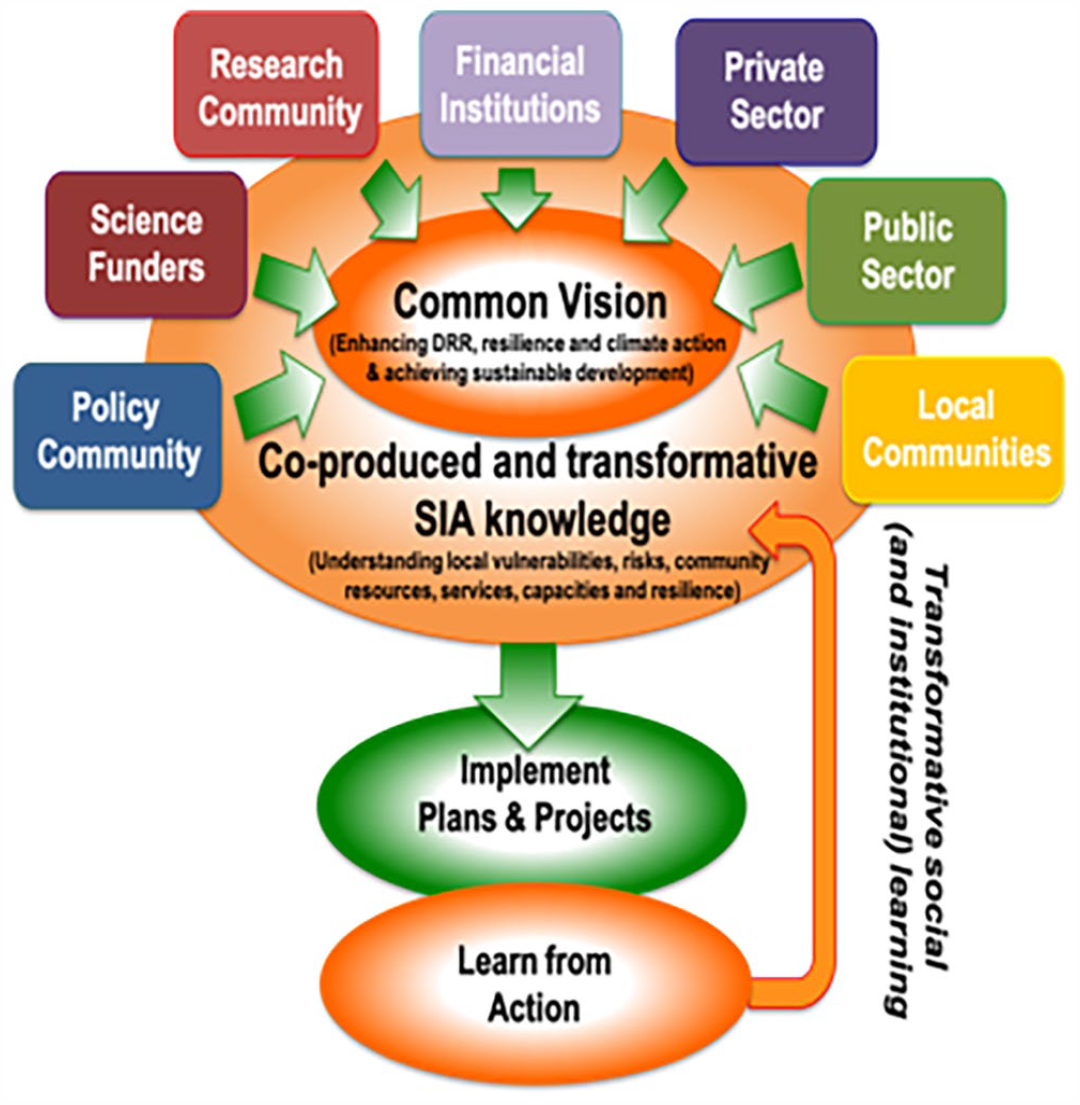
Building socially sustainable knowledge systems through SIA and the SIA Framework for Action.
The governance strategies that organize and regulate the conception, decision, design and implementation of projects
The knowledge systems that orient and inform the planning and implementation of interventions in localities are regulated by specific governance strategies, including institutional, financial, risk management, physical planning and community engagement strategies. These strategies are established by the policies through which principles, rules, methodological approaches, shared goals and intended outcomes of recovery and development are articulated. Depending on the arrangements implied by these strategies, the conception, decision, design and implementation of projects may exacerbate or reduce local vulnerabilities and risks, marginalize or enhance local communities’ capacities and resilience, and ultimately prevent or exacerbate the negative social impacts that can be created by project implementation.
The institutional strategy leading any disaster management and development intervention establishes who will do what, how the numerous local and external organizations are coordinated and work together, and the laws, regulations and institutional arrangements, both formal and informal, that will apply and regulate what development and disaster management agencies do. Accountability, transparency, coordination and the sharing of knowledge, resources and responsibilities for recovery and development among all actors are some of the key activities that should be enabled by the institutional arrangements being provided by such institutional strategy. These arrangements should ensure that, before and after projects’ implementation, socially sustainable knowledge systems are built, and that these have adequate time, space and legitimacy to: (1) enable inclusive and transformative learning from past failures, crises and disasters; (2) let a common vision for DRR, climate action and resilience emerge from such learning; (3) ensure that local communities play a key role in building such a common vision and that such decision-making is based on this vision; and, finally, (5) ensure that local communities’ vulnerabilities, risks, resources, services, capacities and resilience, and associated needs, desires and priorities are represented centrally, and that the plans and projects to be implemented in localities are accountable to them.
The financial strategy is the set of financial arrangements by which decision-makers organize public and private financial resources to design and implement disaster management and development interventions (Jha et al., 2010). The financial strategy orients mobilization, programming, tracking and allocation of these resources. It should orient projects towards implementing a common vision for DRR, climate action and resilience and, therefore, towards reducing local vulnerabilities and risks, enhancing local communities’ well-being, resources, services, capacities and resilience, and achieving sustainable development. To foster effective mutual learning and sustainability transformation, it is crucial for the financial strategy to include the principle of conditionality to make sure that any project to be funded derives from a common vision (see Figure 1), is informed by an adequate risk management strategy that embeds such a common vision and enables inclusive learning and sustainability transformation before and after projects’ implementation.
The physical planning strategy is the set of physical planning arrangements concerned with land use, the character and location of public buildings and infrastructure, urban layout, transportation systems and all other physical facilities necessary or desirable for community well-being (Pivo et al., 1990). The physical planning strategy influences the outcomes of any interventions in localities, including their social impacts. Such a strategy should provide a framework to ‘propose the optimal physical infrastructure for a settlement or area, including infrastructure for public services, transport, economic activities, recreation, and environmental protection’ (Jha et al., 2010: 110). It should include prevention of the negative social and environmental impacts that may be created by project implementation. Finally, it should also make sure that any project descends from a common vision and is addressed to: (1) reduce local vulnerabilities and risks; (2) enhance local communities’ resources, services, capacities and resilience; (3) foster social learning and sustainability transformation; and (4) achieve DRR, climate action and sustainable development outcomes in localities.
The participation strategy is the set of arrangements that establishes the role of local communities in conceiving, deciding, designing and implementing plans and projects in localities. This strategy should avoid capture and, instead, put a wider constituency of local communities, their well-being, vulnerabilities, risks, capacities, resilience and associated needs and desires, especially of the most vulnerable, at the core of any plan and project to be implemented in localities, thus capitalizing on the community members’ wisdom, experiences, energy and resources (Jha et al., 2010). To foster mutual learning and sustainability transformation in localities, local communities should be provided with new deliberative spaces through which they can participate in the knowledge production processes and governance strategies being used to conceive, decide, design and implement plans and projects in localities (Imperiale and Vanclay, 2016a, 2016b, 2023).
The risk management strategy is the set of arrangements that ensures that any plan and project to be implemented in localities would consider: (1) local hazards; (2) local communities’ vulnerabilities and risks; (3) environmental and social risks and impacts that may be created by such interventions, including governance and corruption risks; and (4) local communities’ capacities and resilience. Ideally, this strategy should lead all other strategies and descending planned interventions. The risk management strategy should lead to co-producing, with local communities, a transdisciplinary and transformative understanding of the multiple dimensions of risk, resilience and well-being in localities. Such an understanding should lead to building, and embed, a common vision of the projects that are needed to reduce local communities’ vulnerabilities and risks and enhance local communities’ resources, services, capacities and resilience.
Discussion: new pathways to derive the social impacts of projects
By reviewing the literature on SIA and drawing on DRR and resilience thinking, we identified the gaps that need to be addressed in SIA theory and practice to foster a paradigm shift in SIA from ‘managing the social impacts of projects’ to ‘reducing the risks of projects and building resilience’ in order to integrate DRR and resilience-building into regional and urban planning interventions. We identified the gaps as being theoretical and practical. At the theoretical level, the SIA understanding of social changes and impacts is still too narrow in that it does not include consideration of externally driven hazards and the social dimensions of risk and resilience in localities. At the practical level, SIA is primarily confined to project approval and implementation and conducting SIA still remain primarily a responsibility of project proponents during the project feasibility phase, while the full preventive and enhancement potential that SIA has to inform international, national and regional public policy and planning is overlooked (Imperiale and Vanclay, 2023).
These theoretical and practical gaps have resulted in poor conceptualization of the social impacts of projects, which, until now, have mostly failed to consider how these impacts derive, not only from the technical characteristics and risks of projects, but also from: (1) the knowledge and governance strategies that inform, orient, regulate and organize the conception, decision, design and implementation of projects in localities; and (2) whether and how such projects consider externally driven hazards, including climate change-related hazards, and the vulnerabilities, risks, capacities and resilience of local communities in the locality of intervention.
To fill these gaps, we provided a broader conceptualization of social impacts, one that recommends including a transdisciplinary, co-produced and transformative understanding of the complex interplay between social impacts, externally driven hazards and the social dimensions of risk and resilience in localities. We also provided a conceptualization of the knowledge production processes, governance strategies and planning activities that inform, orient, regulate and organize the implementation of projects, and that ultimately influence the social changes and impacts of projects in localities. However, traditional function evaluation models (Slootweg et al., 2001) that are typically used in SIA theory and practice tend to derive the biophysical and social changes and impacts of projects only from project implementation, its characteristics and associated technical risks.
These models omit the knowledge production processes, governance strategies and planning activities that inform projects and influence the social impacts such projects create on local communities and their localities. To fill this gap and include a better understanding of: (1) how the knowledge production process and governance strategies inform, orient, organize and regulate the conception, decision, design and implementation of projects; and (2) how all this ultimately influences the social impacts of projects in localities, we elaborate on the traditional function evaluation model proposed by Slootweg et al. (2001), and on the conceptualization provided in this article, and propose new SIA pathways to derive the biophysical and social impacts of projects (see Figure 2).
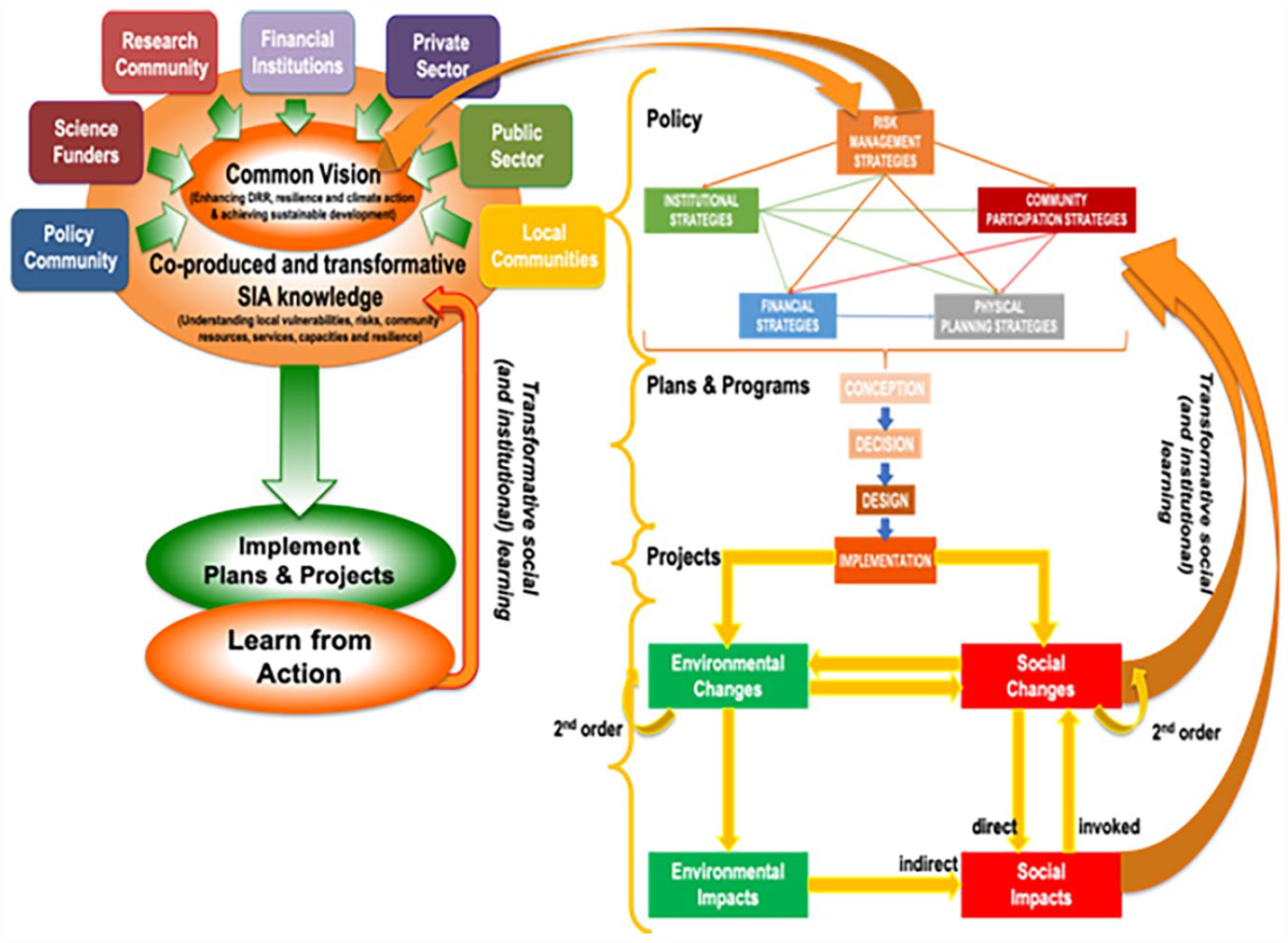
New SIA pathways to derive the biophysical and social impacts of projects. The orange arrows and circles represent, respectively, SIA’s role and action fields.
The conceptualization proposed in Figure 2 highlights the relevance for SIA and regional planning practitioners to assess, not only the implementation of projects, but also the knowledge production processes and governance strategies that orient the conception, decision, design and implementation of projects, and how they ultimately influence the social impacts of planned interventions in localities. Figure 2 helps to envision how the knowledge production processes and governance strategies that inform, orient, organize and regulate planned interventions, ultimately influence the biophysical and social changes and impacts of projects in localities. It helps to envision the knowledge system that informs the governance strategies of planned interventions, its structure, the actors and their agency. Figure 2 also helps to envision the specific SIA’s role and action fields, and, more broadly, the contribution that SIA practitioners can provide to planning activities. As envisioned by Figure 2, SIA practitioners can support local communities and external actors in: (1) building socially sustainable knowledge systems; (2) co-producing transformative and transdisciplinary knowledge about the social dimensions of risk and resilience in localities; (3) building a common vision about the projects that are needed to enhance DRR, resilience and climate action and achieve sustainable development in the locality of intervention; (4) developing a risk management strategy that embeds such a common vision and informs and orients all other governance strategies, and the subsequent conception, decision, design and implementation of projects in localities; and, finally, (5) enabling transformative social and institutional learning from the social changes and impacts created by projects and past prevention measures, recovery and development processes and outcomes.
Conclusion
We live in an era in which it is evident that recovery and development activities have often become disasters, irreparably affecting the well-being of local communities and their environment, and that, no matter what efforts are made to mitigate the impacts, these mitigation measures are never enough. Fostering social learning from such failures, and building socially sustainable transformation towards better reducing local community vulnerabilities and risks, and enhancing local community resources, services, capacities and resilience, is crucial to accelerate efforts to achieve DRR, climate action and the sustainable development goals in localities. The overarching field of SIA can greatly contribute to let recovery and development planning better integrate the DRR and resilience thinking. To build a leading position for SIA in regional and urban planning for DRR, climate action and sustainable development, we suggest that a paradigm shift from ‘managing the social impacts of projects’ to ‘reducing the risks of projects and building resilience’ should occur in SIA. To let SIA fully implement such a paradigm shift, two major switches should occur in SIA theory and practice: from a project-based to a community-based approach; and from focussing only on pre-determined projects, to also focussing on the knowledge production processes and governance strategies that influence regional and urban planning, the projects to be included in such plans and the social changes and impacts of such projects on local communities and their localities (Imperiale and Vanclay, 2023).
Overall, to establish a leading role of SIA in sustainable development, SIA scholars and practitioners should explore more the proactive role SIA can have in informing the knowledge production processes and governance strategies that orient regional and urban plans, before any project is conceived, rather than keep being stick to the traditional reactive role SIA currently has in mitigating the impacts of projects only once they are already conceived, decided and designed and have to be approved and implemented in localities. Finally, we suggest that the conceptualization provided in this article can serve future pilot application of SIA and of the SIA Framework for Action (Imperiale and Vanclay, 2023) in regional and urban planning, and that such pilot application will greatly help SIA scholars and practitioners to fully explore such a proactive role SIA can have in regional and urban planning and therefore establish a leading role for SIA in DRR, climate action and sustainable development worldwide.
Footnotes
Funding
The authors received no financial support for the research, authorship and/or publication of this article.
