



Abstract
This article asks whether we need a posthumanist sociology, arguing that such a perspective can export a good deal of useful methodological and theoretical insight into the sociological toolbox. A posthumanist sociology is not a flattened ontology, in which we find agency in all things living and non-living. A posthumanist sociology asks instead what we do with the fundamental question of becoming both more and less human, following a surge of interest in decentring human exceptionalism. Moreover, a posthumanist sociology returns to the question of what it means to be an intersectional being, to proliferate the involvement of entities at the intersections of histories and social structures. Thus, it is a perspective that emerges from within the conditions of related crises, such as the COVID-19 pandemic. This pandemic has highlighted the need to decentre human exceptionalism, raising a challenge for sociologists to return to the premises of what it means to be a social being. In some sense, management of the pandemic already assumes a decentring. This article builds an argument by first reviewing what broadly constitutes a ‘posthumanist’ sociological perspective, then moves on to a case study of the interrelated human and non-human actors that constituted the early days of the COVID-19 pandemic outbreak. The case study usefully marks the intersection between human and non-human bodies as nodes in the interpretive production chain of this global event – one that acknowledges human extensions and connections to multispecies and ecological systems. Such interlinkages become foundational to interrogating what it means to become human in a posthuman world. The article ends on this posthuman question: under the posthuman condition, if we do not discern a difference between the human and other-than-human entities, how will this homogenization affect the human collective ability to enact and maintain cross-species and cross-entity protections?
What could be a posthumanist sociology?
Do we need a posthumanist sociology? Multiple objections could be raised to the posthumanist – with its aim to decentre human exceptionalism by pursuing questions about the meanings and interpretations derived from the relationships between humans in their situated, other-than-human systems. Such a proposition suggests we have not yet decentred human exceptionalism. However, to the scientific community, this decentring is undeniable. The entire history of the sciences since the Copernican revolution, which secured the heliocentric vision of the universe, was a gradual dislodging of the notion that the human being stands at a static centre, as God’s witness to his own creation (Christian, 2003). The sun may well be the centre of this galaxy, but it is just one of millions of galaxies spread throughout the universe unfolding at different speeds and times. Theories of evolution, as Stephen Jay Gould (2007) has written, do not place the human at the top of an evolutionary ladder; rather, they situate the human among a vast and complex network of branches and growths that are all intertwined in one another. The emergence of human intelligence, Gould writes, was merely a contingency in the history of evolution, and likely an emergence irreproducible under even slightly varying genetic historical distribution.
Likewise, the foundations of the sociological imagination ask that we dislodge atomistic conceptions of humanity by embedding the human in a network of social forces (Mills, 2000): history is expressed in productive relations (Marx, 2000) and social forces are energies manifest in collective action (Durkheim, 2002). Postmodernists also sought to dislodge human exceptionalism, having argued that the purported universally generalizable narratives of humanism possessed explanatory power only, in fact, for those already in power (for example, see Jameson, 2005; Lyotard, 1984). Likewise, poststructuralists destabilized the grounds upon which our faith in texts is held, by deconstructing our belief in the centrality of meaning and of the author (Derrida, 1987, 2002). Finally, decolonizing literature has argued that many subjugated social groups around the world have not yet been recognized as human; hence, they justly protest at the scholarly privilege of those who can even pronounce a posthumanist age (Smith, 2012). Against this plethora of views, posthumanists appear to be late arrivals to the theoretical party. 1
What precede posthumanism are diverse interests regarding the agency of non-humans. For instance, Jane Bennett’s (2010) Vibrant Matter recognizes the material agency of non-human things as an expression of ‘thing-power’: the energy that entities transfer to other entities so that assemblages hang together.
2
The term is intended to cut through the binary opposition between things and non-things, and refers to the intangible qualities that things possess that engage them in relationships with other things. These things teeter between appearance and reality. In their appearance, the objects are real. But somewhere beyond our perception of them, they have a secret communicative tendency that is beyond our grasp, like the trees in the forest.
3
In terms of a complex network. Bennett explicates human assemblages as assemblages of thing-power: Each human is a heterogeneous compound of wonderfully vibrant, dangerously vibrant, matter. If matter itself is lively, then not only is the difference between subjects and objects minimized, but the status of the shared materiality of all things is elevated. All bodies become more than mere objects, as the thing-powers of resistance and protean agency are brought into sharper relief. . . . And in a knotted world of vibrant matter, to harm one section of the web may very well be to harm oneself. (p. 13)
As a relational system, the instability of one node throws the identity of all nodes into precarity since every thing is defined by and through its relations with other things in that network. This thing-power might exist in the concept of expressivity in genetics or the flow of the ocean current that moves the so-called Great Pacific Garbage Patch. Myriad other moves towards this decentring of human agency can be found in other literature with a concern for problematizing human/non-human relations. For example, Donna Haraway’s (2008) natureculture is a multifaceted hybrid narrative that expresses the fluidity of human/non-human relations. This is articulated, for instance, in Haraway’s study of companion species, which are not categorical beings, but are rather individuated through the very human/non-human relation she seeks to theorize.
Bruno Latour’s (2005) actor network theory aims to expand the concept of networks to include heterogeneous relations between the technological, the natural and social entities. Latour’s writing has identified the binary opposition between human/non-human as embedded in a system that dominates nature. The system that dominates nature comes to depend on that definition of a dominated nature to proceed. Furthermore, Karen Barad’s (2007) diffraction is an anti-representationalist methodology, derived from Haraway, that constructs elaborate meaning networks through the laws of quantum physics. Agential cuts are what Barad uses to describe the coming together of matter and meaning – for instance, Grit Höppner (2017) uses Barad’s agential cut to interrogate how interview respondents make sense of their own embodiments of ageing as at-once a discursive and material coming together of meaning and matter. And Tim Ingold’s (2011) anthropological theory of meshwork describes a situation wherein subjects recognize the interdependence of life systems that sustain human activity and remove the need for subject/object distinctions in meaningful, ecologically bound ethics and action.
Fundamentally, posthumanists remain focussed on the problematization of human/non-human relations, but are also committed to a critique of claims of human exceptionalism (anthropocentrism), framing it as a causal determinant in the overwhelming number of issues that we face today – asociality, widening economic divides, discrimination, environmental crises, surveillance (including dataveillance and coronaveillance), pollution and a disconnect from nature. As a vaccine against the problem of human exceptionalism, they deploy methods with diverse foci: for instance, Rosi Braidotti (2013, 2015, 2019) is largely subject-centric and Cary Wolfe (2020) is primarily system-centric; N. Katherine Hayles (1999) prefers media-centric investigations, but Stacy Alaimo (2010) offers her concept of transcorporeality to capture the body as entangled in and defined through its ecological relations.
Braidotti’s position is ontological insofar as she upholds a radical perspectivist approach – for her, the decentring gesture is an ongoing series of moves that widens the standpoint perspective from feminist philosophy. Wolfe’s epistemological posthumanism, meanwhile, decentres human exceptionalism by constructing a complex dynamic system and environment wherein a subject is but a fold among many, which mirror and intensify with environmental complexity. Meanwhile, Hayles finds a balance by linking emerging technologies with advances in the cognitive neurosciences. Finally, Alaimo’s well-known notion of transcorporeality is a strategic term aimed at displacing atomistic perspectives on the body. Instead of the body as an object, instead of a substance approach, she prefers a process-based approach. While a substance approach isolates and atomizes the body as an inert bit of matter, her process approach accounts for the flow of processes between the body and its environments, as it moves between various modes of scientific capture.
What does remain consistent among posthumanists is a speculative imagination about proprioceptive, affective, pre-cognitive relations. However, another broad tenet of posthumanism is an affirmative politics, epitomized by Braidotti (2019), which focusses on the new that emerges from the interplay between elements. In this sense, critical posthumanism is a discipline of emergence. It looks towards the conditions that enable a fresh sort of human to emerge and to identify itself as human: in the end, posthumanism asks what has emerged that is new, vivacious, political.
As demonstrated above, posthumanist analyses pursue foundational questions using as presuppositions various disciplinary texts that aim to decentre human agency. Such texts are found within the social sciences and humanities, but also within the sciences – such as current works that bridge literary theory and theoretical biology (Wolfe, 2020), or in new fields like biosemiotics (Von Uexküll, 2013). Unlike postmodernism or other movements that might be characterized as relativistic, posthuman movements are perspectival: they incorporate grounded, situated, concrete positions in which relationality generates perspectives on the meaning of human life that, crucially, are always in situ. Undoubtedly, the survival of humanity greatly depends on how we incorporate and interpret the ‘companion species’ of nature into our lives – which may be animal (Haraway, 2008), vegetable (Tsing, 2015) or exemplary of the ‘oceanic’ turn (Neimanis, 2017). Thus, posthuman sociology studies include humans’ participation in the social organization of non-human forms of life (DeFalco, 2020; Staunæs and Raffnsøe, 2019; Timeto, 2021), and the roles that these forms of life have in the social organization of humans and related governing policy (Fox and Alldred, 2018, 2020a, 2020b). Such research is affirmative, while being oriented towards the reinvention of community; as such, they ‘redefin[e] politics as living complexity’ (Braidotti, 2015: 30).
These strains of thought, along with many others, are what translate into a posthumanist sociology, most recently exemplified in a flurry of articles by health and environmental sociologists, such as Nick Fox and Pam Alldred (2020a, 2020b). As well, a recently published special issue of Health Sociology Review was devoted explicitly to the posthumanist movement (McLeod and Fullagr, 2021). Fox and Alldred cut through the binary logics that underlie the separation of humans from their social and environmental ecologies. They point to new policy directives that incorporate the continuum of nature, culture and technology, thereby translating the posthumanist continuum into a grounded, policy-based critique that finds relevance in concrete relations. So, what is the posthumanist sociological scheme that Fox and Alldred (2020a) develop in their unique attempt to mend the binary oppositions that position humans and nature as opposite one another?
Braidotti, Barad and Fox and Alldred describe a grounded, positional and concrete plan through which a posthumanist philosophy can be enacted, rooted in an inclusive policy framework. They enquire into the relationship that can be identified between climate change policy and the climate change event the policy is intended to have an impact on. They do not purport that a policy responds to a pre-existent event, but rather that it frames the very imagination through which the event is mediated by human-designed policy. Thus, policy and event are interdependent entities, their meanings derived from their imbricated relations through which they mutually inform one another.
Under a posthumanist framework – exemplifying a refutation of the split between subjects and objects, in favour of a perspectival and ecological continuum – climate change policy is not a thing but a process. No substance, per se, exists in the climate emergency that must be attended; rather it is a set of relations that come together in process. These coalesce in the way they frame the event that it is intended to be engaged with: policy is novel, insofar as it lays out a set of fresh recommendations and strictures ordained through the state, but it is also creative insofar as policy imagines the event along with its own formation. Fox and Alldred thus illustrate how this happens by laying out how climate change’s assemblage transforms under disparate policy regimes: liberal environmental, United Nations, green capitalism and no-growth economics:
• Liberal environmental regimes – use rewards and taxation systems to encourage individuals to adopt sustainable habits that are thought to produce a citizenship relation to the earth.
• United Nations policy assemblages – acknowledge economic disparity in climate change, especially regarding the unequal distribution of its disastrous effects against the poorest global nations, which are ill-equipped to withstand its effects; thus, they target worldwide offenders of carbon emissions.
• Green capitalist policy assemblages – involve new technological investment initiatives to subdue the effects of climate change, such as genetically modified trees that age quickly enough to capture the necessary carbon, as well as tax incentives for investments in green energy.
• No-growth economics – invoke a complete turnaround in the market economies, requiring strict governmental intervention.
My visualization of Fox and Alldred’s (2020a) policy assemblage (Figure 1) demonstrates the entities under each assemblage and the arrangement they make. However, what emerges is the consistent posthuman concern of all of them – an infrastructural emergence of the agencies of gas, sun and energy. The highest creative manifestation is the emergence of a new assemblage. These various examples demonstrate that material agency is not singular, but rather a complex synchronous distribution of thing-powers that move in their own unique tempos and speeds, much like the distribution of sounds among the instruments in a symphony orchestra.
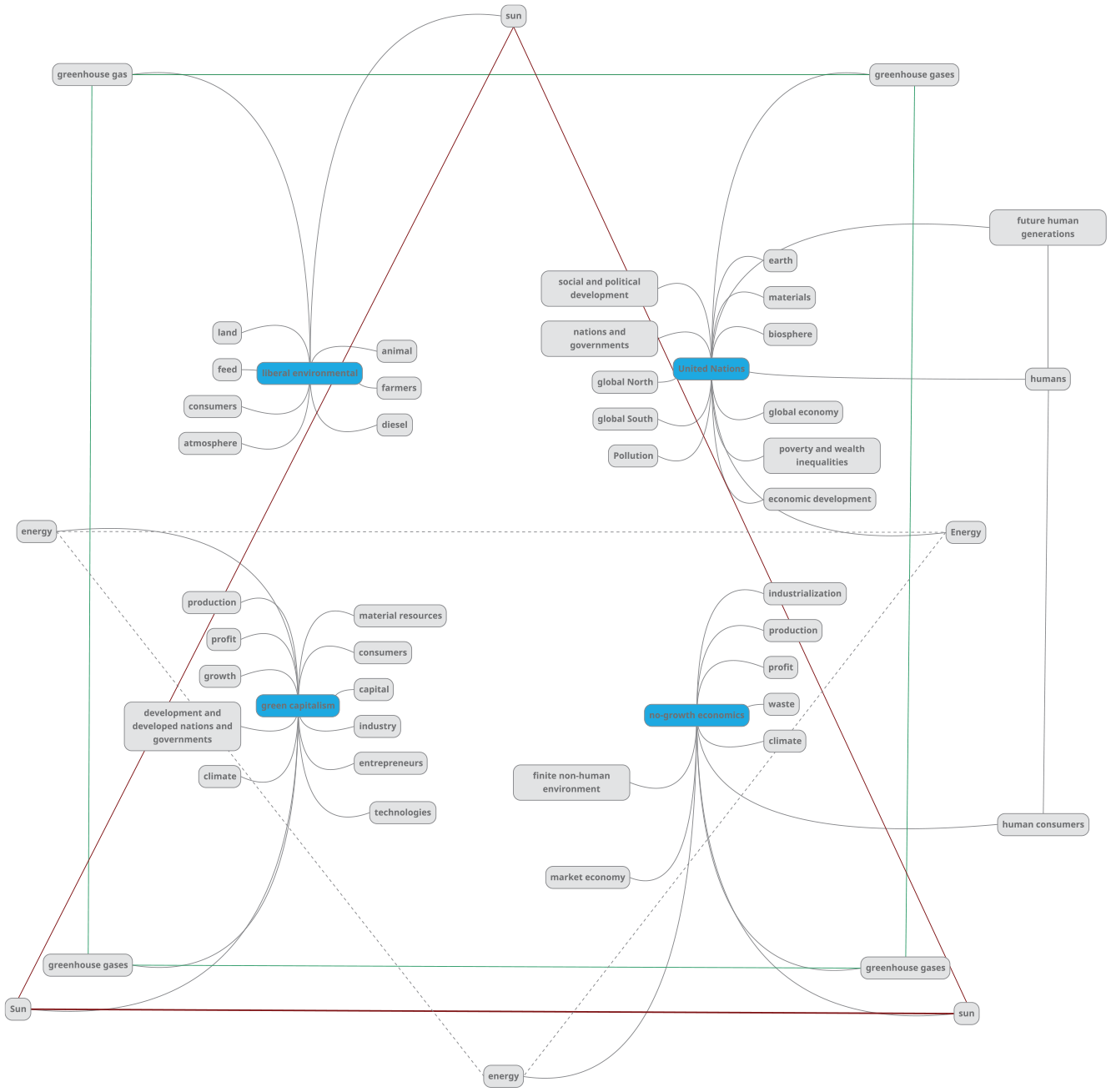
A visualization of Fox and Alldred’s posthuman policy assemblage for climate change.
A posthumanist sociology thus describes and elucidates the complex network of social and material forces that embed the body, as a concept, in history – as well as positioning it as an interstitial lining between worlds. This theoretical stance intertwines the political and the corporeal in the control and resistances of human bodies, while making a scholarly turn towards the distribution of all bodies, all relations, all entities. Importantly, it also unveils the historical conditions under which certain bodies have been taken as ‘normal’, in relation to other bodies characterized as ‘abnormal’ (Fox and Alldred, 2020a, 2020b). For instance, it has become apparent in this COVID-19 pandemic that the SARS-CoV-2 virus is a body that human society develops measures to control. Moreover, the virus has become very clever at evading such measures. Thus, a posthumanist sociology could start with the body as a point of entry and then consider the embodied distribution of animals, plants and dirt; this would be augmented by also considering the relevant elements, objects, things, ideas and affects that we do not often consider to be the focus of sociological analysis, but that are nonetheless subject to interpretive social processes. A posthumanist approach to the body takes into account the body as multiple instead of singular, many instead of one, connected instead of atomistic.
The world of the virus or the virus of the world?
The question of how to interpret the COVID-19 pandemic has been of concern to sociologists. Broadly, COVID-19 has brought to our attention the roles that viruses and other sources of illness play in the body – a key to understanding the body as embedded in ecological systems rather than being an atomistic object. This article examines the role that the SARS-CoV-2 virus played in the remaking of the human body: newly distanced, strangely mediated movements between screens, masks, Plexiglas and other hardware of the new pandemic era. The COVID-19 pandemic initially generated responses from the sociological community regarding human/animal/viral companionship (Erll, 2020; Giseke, 2020; Jennings, 2020), global solidarity (Meinzen-Dick, 2020; Perng, 2020), infodemics (Luengo and García-Marín, 2020; Mooney and Juhász, 2020; Stephens, 2020), food production (Alkon et al., 2020) and the amplification of risk society (Domingues, 2022), among many social issues. Indeed, a central aspect of concentrating on the sudden change of things in the pandemic was that it appeared to have changed everything; so where does one begin? It is proposed here that we begin with the body and its networks, since so much of the COVID-19 process was learning what we do with our bodies, and what our bodies do to one another. If the COVID-19 pandemic compels us to admit the vulnerability of human dependence on other-than-human relations, when does such a recognition turn towards cross-species and cross-entity policies of protection?
Sociological responses to COVID-19 initially focussed on the social and cultural organization of life under the existential threat of the virus. As Jeffrey C. Alexander and Philip Smith (2020) wrote, COVID-time has been suffused with mystery, superstition, and trauma; peopled with god-like heroes; generative of myth, new interpersonal rituals, but also iconic circulations of familiar imagery; and it has been haunted by a relentless search for both the blame and the salvation of charismatic authority (p. 264).
That is, as much as COVID-19 has become more manageable under advancements in science and medicine, much of the work to make it understandable has been decidedly cultural: it has required investing faith in leadership and expertise (Evans and Hargittai, 2020), connecting ritualistically through online platforms (Collins, 2020), transforming the mode of dissemination in the culture industry (Belfiore and Lee, 2020) and shaping our rhythm and sense of time (Erll, 2020).
That COVID-19 was characterized as a ‘breaching experiment’ in more than one venue (Collins, 2020; Scambler, 2020) speaks to the power that this extra-human agency held and continues to hold over our sense-making abilities. Thus, our sociological imagination must consider the import of human cultural systems with non-human cultural systems, since so much of social life was abruptly determined by this new, alien, viral agency. As the editors of Environmental Humanities wrote, ‘The COVID-19 pandemic reminds us that earthly interdependence is no fairy tale: in addition to bringing life together, it also will cleave it apart’ (Jørgensen and Ginn, 2020: 498). This then means that sociologists had the unique opportunity to expand the sociological imagination to intersections between human and other-than-human biographies and social structures.
Katherine Hayles (2020), for instance, made the sobering claim in the early weeks of the pandemic that the SARS-CoV-2 virus found, in the human, its most suitable environment to thrive. Specifically, the COVID-19 pandemic is posthuman in the degree to which it (1) co-evolved with the human species, (2) arose from human/animal encounters and (3) reflects the decentring of human exceptionalism by using human bodies as no more than carriers for duplication and replication. Hayles wrote that ‘in evolutionary terms, the novel coronavirus has hit the jackpot, having successfully made the leap from bats to the planet’s most populous large mammal, humans’. But viruses have always lived with us, and from time to time they dominate the lived realities of humanity. As Joost Van Loon (2002) has written on the topic of viruses generally, the ‘virus has always functioned as a label for that which cannot be named otherwise, a remainder of the known world, and a reminder of nature’s inherent unintelligibility’ (p. 108).
This is not to say that a virus is inherently more unintelligible than other infectious agents, but this virus provided us with a current epistemological model. Indeed, although the virus interrupted life, it is one of our many embodied extra-human companions, like hydrocarbons (Mackenzie, 2014), microbes (Schrader, 2017), bacteria (Hird, 2010), germs (Tomes, 1999) and antibodies (Landecker, 2016) – all other-than-human bodies that find their meanings from within human and other non-human bodies. The posthuman interpretation thus looks for the specificity of human agency in a global situation in which all of life has become transformed. Furthermore, this transformation is intensified under the extreme technological acceleration and digital mediation of our current moment, even while the planet’s uninhabitability is intensifying daily.
A posthumanist sociology begins with the body, broadly speaking, as a site of internal and external connections, while a more traditional sociological perspective would theorize the connection between an individual and its community. Certainly, a pandemic is a complex interdisciplinary and multifaceted phenomenon, and our understanding of it cannot be limited to research in the natural or medical sciences alone. A great many social and environmental issues have unfolded from the undetectable virus – from political failures (Coates, 2021) to the mass cancellation of cultural events (Banks and O’Connor, 2021), to the concentration of domestic violence (Taub, 2020), to the unearthing of pre-existing social inequalities (Finn and Kobayashi, 2020), and so on and so on. But some unexpected gains have also been noted, including improved air quality (Chen et al., 2021), a deepened awareness of and appreciation for nature (Rousseau and Deschacht, 2020) and a decrease in noise pollution (Parker and Spennemann, 2020; Zambrano-Monserrate et al., 2020). Zambrano-Monserrate and colleagues point out that the drawbacks will outweigh the benefits, but we are nonetheless also now caught in a moment where we can imagine a great benefit to revising our thinking about human/nature entanglements.
The COVID-19 pandemic resituates our question of what it means to have and to be a body in a posthuman event. I defend this position by, first, claiming that this repositioning plays at the divide between the individual and the community and thus elucidates deep-set political tensions between atomistic and collectivist visions of the self and society. The virus makes clear that we do not exist without our relations, but, as potential carriers of the virus, we are hosts for a community of non-human things. We accept our isolation for the sake of our human communities, since we are potentially teeming with embodied viral communities. However, these interruptions of community also remediate community, as the new non-relation of social distancing measures rearrange our attachments. Community is thus paradoxically strengthened through the virus – an event that we literally cannot have in common for the threat it poses to the members of a community. We have become strange to ourselves, acting in ways that would otherwise be unfamiliar or eschewed.
But the concern is not so much whether we speak for the virus or whether the virus speaks for us. Crucially, the virus has complicated how we interpret the ‘individual’ and the ‘community’, insofar as it challenges our understanding of what it means to be an individual, since the SARS-CoV-2 virus is activated by (1) inhabiting the body of its host where it can plant its own community and (2) transmission between human bodies in human proximities such that human communities become dangerous. COVID-19 has forced the question on sociologists about everyday life: Where is the individual? And where is the community? It is impossible to commune with, live with, the virus at the level of the individual because it is dangerous. But we also see that that we cannot commune with one another in the usual way because of the virus; we must resist coming together with the virus, just as we separate from each other. We therefore find means to protect one another in gestures that flatten the curve.
As such, our understanding of COVID-19 does not derive so much from our ability to fit it neatly into pre-existing explanatory frameworks. Rather, much of our understanding of pandemics derives from the complex narratives that are woven throughout the events they describe (Davis and Lohm, 2020). This pandemic constitutes an especially complex network of meaning between new spatial arrangements (travel bans and domestic lockdowns), temporal arrangements (living within the everchanging dynamics of models and forecasts) and the perennial reminder of the human race’s vulnerability to nature, despite our centuries’ long accomplishments in controlling nature.
The virus has caused humans to reinvent and reinterpret the tools of the body, facilitating a contact zone of social interaction. It is this basic element of reinvention that is of especial interest. Sylvia Gherardi has suggested we proceed with such analyses, as a means of ‘mending the social texture’ of interactions under the conditions of the COVID-19 pandemic (Cozza et al., 2021, emphasis in original). For example, a number of recent studies have suggested that simple human greetings have undergone significant redefinition under the conditions of social distancing. One study of human greetings (Mondada et al., 2020) observed that once-tactile and fluid greetings such as handshakes and hugs have been replaced with clumsy, hesitant and uncertain adoptions of properly distanced gestures, and an increased prevalence of air hugs and elbow bumps. Furthermore, Katila et al. (2020) observed, in their analysis of attempted handshakes among politicians during the outbreak, that people corrected their previous tactile greetings with humour and dignity, transitioning into the now-preferred socially distanced greetings.
More than repairs to the simple greetings of everyday life, adopting new routines of social interaction engage us ethically in accepting that things will not return to normal; in fact, what is considered normal now is a condition of increased transmission of viruses. We might therefore think of the virus as a non-human actant, since its intrusion into daily life has reorganized the actions that inform the fundamental premise of being human. The effect of the virus is felt in how the minute, taken-for-granted gestures of a previous life no longer make sense to the new dominant ethos. This shift operates in much the same way that the transistor radio opened new spaces of intimacy for teenagers in the 1950s (Williams, 2017), or the introduction of indoor plumbing facilitated routines of personal hygiene to curb the effects of water-borne diseases (Lechner, 2012). Presently, the extra-human agency of the virus interrupts and intrudes upon our normal everyday interactions, replacing proximity with distance, touch with circumvention, certainty with incertitude.
Of course, we cannot see the new actant, so we have laboured to both image it and imagine it. We have imaged it in three critical ways: through the body of the virus itself, in the visualizations of our transmission and in the iconologies of our new daily routines and interactions:
At the level of the virus
Everywhere in the visual field, the image of the virus is one of a silent threat, an intruder lurking beneath our detection. Julia Sonnevend (2020) has written recently on this, expressing a fascinating account of how the contours of the image of the virus emerge through the cultural performances, from city design to interpersonal dynamics to distant mediations. Specifically, the virus is represented through a particular kind of ‘scene’, in that we lack direct access to the virus through its representations, but we do have a broader set of scripts that foreground something else in the virus, which is social connectivity. As Sonnevend states, ‘While the pandemic’s heroes have been mostly “faceless” and nameless, covered by facemasks, standing for a broad and often abstract category, some particular iconic figures did emerge’ (p. 456). The virus’s grey translucent foamy body is teeming with red crowns (hence corona-virus). And its likeness is floating online, everywhere with its friends, on website banners as if a caricature of a gang on a street corner. It waits in silence to incubate a cell in the throat and then burrow into and multiply within the cells on the walls of the respiratory passage and lungs. Once incubation is complete, then they can duplicate. Notably, this coronavirus duplicates at a much greater rate than previous coronaviruses (Poon and Peiris, 2020). And it is presented in its visual manifestation as though it were not a part of us, as though it was unsituated; it is personified as an autonomous agent, an extra-human actant, waiting to infect the lungs of the host, when, in fact, it is a part of us.
At the level of bodily emission
We tend to think of the individual as an entity free of the community, but the virus reminds us that it is the binding force; it elucidates the fragmentation of our community by demonstrating how it lives in the substrata of our most basic communication mechanisms. Studies of turbulent gas clouds and pathogen transmissions reveal that people in proximity to others are in very intimate contact with one another (Bourouiba, 2020). Schlieren and Shadowgraph optical imaging demonstrate that vocal emissions bend and manipulate the air directly (Tang et al., 2011). It is well known among respiratory disease researchers, for instance, that bodies transmit viruses through the usual emissions like coughing and sneezing, but also through singing, laughing and speaking (Stelzer-Braid et al., 2009). A review by the National Collaborating Centre for Environmental Health (O’Keeffe, 2020) has revealed that choir rehearsals may still be considered superspreader events, despite participants avoiding handshakes and maintaining the recommended social distance. Singing, laughing and talking are thus included, along with physical touch, among activities that we must take stock of in our interactions, though these actions are deeply embedded in our sense of value in the very basic structures of communication.
Cormack et al. (2017) write that, from a sociological perspective, ‘laughter is a way of being heard and making us hear, recalling the simple fact that human life is made by and for humans’ (p. 397). However, while it one of our greatest affective signals of bonding and community, laughter was nevertheless added to the list of dangerous vocalizations that could spread the virus. This underscores how the virus threatens our very ability to connect, threatening community as much as it threatens individual well-being. Bars, restaurants, weddings and parties contain opportunities for close contact, talking loudly, singing and laughing. Randall Collins noted that COVID-19 has weakened the emotional benefits that attend these embodied interactional rituals; he suggests they could be refined to more closely mimic embodied presence, although such modifications may disrupt the emotional energy embodied interactions otherwise provide (Collins, 2020).
Much like the laugh, which has accrued new meaning as an intercorporeal threat of transmission, the cough has acquired new meaning. In fact, it has been weaponized by some through ‘cough attacks’ against police officers dealing with anti-mask and anti-vaccination protesters. This works because vibrating vocal cords are also a source of virus transmission and can project fluid from the lungs in ‘fluid film bursts’ (Asadi et al., 2020). Whether our interaction chains have changed or will need to be modified, the presence of the virus and the reality of transmission undermines the tendency to think the human atomistically.
At the level of social spaces and daily routines
The imaging of the virus is manifest in social spaces, now converted into new contactless zones that radically reinforce our relationality. There is no question that the COVID-19 pandemic has broken the sense of individualism and the autonomy of the subject, with spaces now mediated through a series of non-human technological interrupters. Nancy R. Lee (2020) has listed product strategies to encourage social distancing in businesses, medical centres and community organizations, including the implementation of a wide range of hardware that now fences our new contactless zones: hand sanitizer, soap, disinfectant wipes, masks, gloves, gowns, test kits, Plexiglas, personal protective equipment, single-use pens and buzzing wristbands (Lee, 2020: 262). In addition, the use of social distancing signage and floor tape transforms the leisurely flaneur, as the enactor of the modern gaze, into the new instrumental protocol that our bodies must be a certain length apart. Leisure culture has been changed into ‘queue culture’ (Mann, 1969) or ‘wait culture’ (Ayaß, 2020). The contactless zone of social distancing is a space-in-common or a being-in-common.
The detached, non-relation of social distancing measures is a rearrangement of our attachments. From a posthuman perspective, we thus return to questions about the fundamentals of human sociality and communication, built on two combined premises: (1) anthropocentric extraction and expansion has altered the direction of the planet and (2) communication between disparate disciplines lends credibility to social and cultural theories of extra-human agency. And the posthuman framework pivots to query what constitutes the human, given the effects of these conditions as they are manifest in the lack of touch and the new hardware of social experience. It is an interpretive human domain in which the dynamic between these extreme positions operates to recharge a sense of social and environmental responsibility.
What could be a posthumanist sociology?
The posthuman question decentres human exceptionalism in relation to nature and technology, primarily as a presupposition to a new fundamental question about the infrastructure of human social organization and communication: if we do not discern a difference between human and other-than-human entities, how does this shape or limit the human collective ability to form global policies aimed at cross-species and cross-entity protections? A posthuman question is an ethical question of what to do given an ecological (not atomistic) existence. This requires a commitment to the ‘I protect you to protect me’ attitude between humans, and between humans and other-than-human entities. Little need exists for a theorist to convince many that a virus can alter an entire global order of anthropocentric organization. Indeed, as little as 6% of respondents to an early pandemic, Angus Reid Forum poll report that they believe life will return to normal after a long struggle with the coronavirus; similarly, as many as 47% disclosed a belief that our lives will be permanently altered (Angus Reid Group, 2020) by this global event. As such, it is a question of what we do to admit that a world of our making is not of our making.
But such times are also opportunities to revisit the foundations of our social and collective work, and the disciplines of our collective imagination and organization, to build better times ahead. One thing is for sure: we have to relearn our social roles as actors whose individual actions have global consequences. In addition, we have to learn that simple actions like attending a social event have an almost immediate effect on the statistical rate of infection. The COVID-19 pandemic exemplifies the negative side of our ongoing exploitative encounters with nature as the gap between action and its worldly consequences starts to close. It has also, writ large, demanded that we significantly reorganize the social ballet of our bodies to accommodate this new image of our massively expansive bodies as merely hosts to the little virus. We can vividly grasp that the edges of the human body are more porous than contained, that it is vulnerable in its relations to a broader global ecosystem, and that much of what we take for granted about the human body can be undone in a relatively short amount of time.
The ontological and existential questions COVID-19 opened regarding the boundaries of the body suggest that we no longer need argue that our bodies affect and are affected by others. Medical imaging techniques definitely assert these interactions – through our breath and how much space our breath and its droplets can occupy. Concomitantly, over the last few decades, the sociology of the body has strongly advanced extra-human agencies (for example, see Landecker, 2016; Mackenzie, 2014; Schrader, 2017); this is evidenced by the rise of new materialism that incorporates the atmospheric impulses and unknown microbes of the body, endowing them with as much agency as our conscious organization. Similarly, the entire field of biosemiotics is built on the predilection that all entities, from cells to bacteria to animals to humans, have evolved through their complex communication mechanisms. Butterfly–ant mutualism works like this, for instance: caterpillars and pupae emit vibrations that have long enlisted ant colonies for protection from predators, while ants benefit by receiving nectar from those larvae, which encourages them to hang around and act as protectors (Travassos and Pierce, 2000).
But this is not a perspective limited to the academic discussion of the body. It is information (1) available by the minute on CNN and the BBC, (2) on advertisement banners on Google, (3) provided with assurances for accuracy on Twitter and TikTok and (4) the subject of memes. We are hyperaware that bodies leak, that they are in contact even when they are not touching, and that they are quite easily inside one another on a regular basis: the minute-by-minute news since the start of COVID has been decidedly ontological and existential. The COVID-19 shutdown has made it obvious to everyone that our bodies also leak information, that our bodies are not contained, that they are not atomistic, that they transmit much information between one another. Thus, ‘I wear my mask to protect you’. At best, our bodies are hosts for something much stronger than our bodies. It is in their capacity for transmission, in their interstitial spaces, that we find the significance of bodies.
Concluding remarks
I suggest here that a posthumanist sociology begins with the body in a much broader process of coding, going beyond the discursive and the linguistic. Such a sociology would be especially adept at building fruitful relationships across disciplinary boundaries, between departments in the sciences, the arts and the literature. If a posthuman tenet is to dislodge human exceptionalism from contemporary experience, contemporary experience has absolutely humiliated us with a hammer of insignificance. Seemingly unable to orchestrate a functional economy with simple public health directives to stay distanced and wear masks, we wander in a world pregnant with speculative data, rife with fears that range from irrationally displaced xenophobia to zoophobia to mysophobia. We are simultaneously exhausted and bored in our social isolation and social distancing campaigns. At the time of this writing, the pandemic is not over – and seems unlikely to be in the foreseeable future – despite the empty platitudes of some world leaders.
The posthumanist approach poses the opportunity to think through the body via a radical network of intersections and midpoints, meeting points and contact zones between actual entities. Ultimately, this approach pursues what it means to be human, thinking of the body in terms of its ongoing creative intersections. Like artists, writers, musicians, dancers, scientists and computer programmers, sociologists of the body are interested in how we can produce novel conceptions of the body that situate it in more porous socioecological configurations, between species and across spaces. These recent global events highlight that the body is an apparent site where all the forces of nature are reduced to a concrete entity. This current pandemic presents us with a crossroads: an opportunity for sociologists of the body to renew a focal concern with the posthuman question of the other-than-human relations of co-production.
Footnotes
Acknowledgements
The author would like to thank the collective of researchers in the Posthumanism Research Institute at Brock University for their continued engagement with and support of posthuman social sciences.
Funding
The author disclosed receipt of the following financial support for the research, authorship and/or publication of this article: This research was undertaken, in part, thanks to funding from the Canada Research Chairs Program.
Notes
Author biography
