



Abstract
The term femicide, while contested, focuses attention on women killed by men’s violence. This focus has generated work on its nature and extent much of which examines the lethal act and the lethal actor in which the death is counted. These counts are themselves incomplete. Despite their shortcomings, these ‘thin’ counts have contributed to the increasing impetus for a wide range of global and local prevention and response initiatives designed to draw attention to femicide. ‘Thin’ counts, measuring as they do, who does what to whom, while justified and justifiable, are a surface manifestation of the deeper embrace of social ecological theory within this field of work. This theory, originating in the work of Brofenbrenner, has functionalist tendencies which fail to assign explanatory power or salience to any one variable. This approach provides a narrow vision of what counts as femicide: a ‘thin’ count. However, if femicide was viewed through a wide-angled lens and incorporated all those lives curtailed and shortened as a result of living with men’s violence(s), that which Walklate et al. have called ‘slow femicide’, femicide counts might look somewhat different. Here, we explore why these might be called ‘thick’ counts. These counts would focus attention on not only who does what to whom but also on with what implement, in what place and at what point in time. Thus, ‘thick’ counts would broaden our understanding of the nature, extent and impact of femicide.
Introduction
Weil (2016) taking the lead from Durkheim’s work on suicide, made the case that for femicide to be visible and audible within sociology, it is important to treat it as a social fact. Her consideration of femicide as a social fact is clearly cognisant of the difficulties associated with the establishment of such ‘facts’ but nonetheless she makes the case that without such visibility the status of femicide as a global social problem will continue to be hidden from view. In the time since the publication of Weil’s paper, femicide (or feminicide as preferred in Spanish speaking countries) has risen in importance for both public and policy agendas as well as academic ones. While the term ‘femicide’ remains contested (Dayan, 2018; Howe and Alaatinoglu, 2019; Weil et al., 2018), there is growing agreement that definitions are important for measurement (Dawson and Carrigan, 2020) and measurement is important for policy (Walklate et al., 2020). Reflecting the importance of counting for policy, in 2017, the United Nations called for the establishment of femicide watches or observatories in every country arguing that Having clear data helps law makers and government officials win the public’s support for tackling it through targeted prevention and investigation resources. (Academic Council on the United Nations System (ACUNS), 2017: 1)
In the 5-year period since this statement, different counting practices have emerged at the local, national and regional levels. These include campaigns by feminist civil society groups such as ‘Counting Dead Women’ in Australia (Cullen et al., 2018; Destroy the Joint 2018), the ‘Femicide Census’ in England (Brennan, 2016) and the Canadian Femicide Observatory for Justice and Accountability (2019), alongside more institutionalised exercises such as domestic homicide reviews (see, for example, Dawson, 2017). The counts emerging from these activities arguably capture the tip of the iceberg as far as femicide is concerned. Nevertheless, they constitute a significant step towards developing a better appreciation of its nature and extent. Such counts, however, are not problem free nor do they represent the full extent of women who die as a result of men’s violence(s) (see inter alia Australian Institute of Health and Welfare (AIHW), 2019).
Counting femicide is fraught with difficulties (Walklate et al., 2020) though the nature and extent of these difficulties can differ. For example, if the practice of counting is framed by what is understood by femicide in law (which can differ across and between the Global North and the Global South, see Pierobom de Avila, 2018), this itself can produce different counts. This kind of data is typically focused on the specific act of killing, the sex of the perpetrator and the sex of the victim though not all such administrative data do this consistently in every jurisdiction (Walby and Towers, 2017). Other data sources, like those of femicide watches or femicide observatories, can be framed by an appreciation of the (gendered) social structures which underpin this act of killing. These data focus more attention on the perpetrator’s motives for such killings and might be termed broadly as constituting structurally informed data. These data are not necessarily informed by the law, (though may record legal outcomes in homicide cases) but is rather informed by what the watch or observatory judges to be an act of femicide killing within the context of (patriarchal) gendered social relations.
Whichever strategy is adopted carries risks. These include the risk of data gaps (missing cases) and the risk of epistemological gaps (a failure to grasp meaning and explanation). In this article, we advance the argument that administrative data reflect a tendency to produce ‘thin’ counts: counts that are devoid of context and/or meaning. These can be contrasted with what we conceptualise as ‘thick’ counts: counts which draw on a range of data sources and take into account the impact and consequences of the slow violence(s) present in women’s everyday lives (qua Shalhoub-Kervorkian and Daher-Nashif, 2013; Wonders, 2018). The terms ‘thin’ and ‘thick’ are used here as a heuristic device. This use is not intended to hide the complexities which lie behind different ways of counting but is intended to capture a feel for the spectrum of different counting practices and the knowledges they produce. Neither of these counting practices offers a complete picture of the nature and extent of femicide. However, given the drive to count is concerned with the prevention of such lethal violence, a pertinent question might be, what kind of data would provide sufficient evidence on which to base intervention and inform prevention efforts?
Developing the intervention of Walklate et al. (2020), this article excavates the theoretical and empirical necessity to consider the implications of their use of the term ‘slow femicide’. For them, ‘slow femicide’ draws attention to the ‘quality of life costs’, the ‘living death’ experienced in the lives of many women experiencing violence. The central question of this article is to reflect on what needs to be done to ensure measurements capture these lives and everyday impacts. Thus, the article considers what needs to be done to move from ‘thin’ counts to ‘thick’ counts, what the consequences of this move might be for understanding the nature and true extent of femicide, and what such a move might provoke in terms of improved intervention and prevention strategies. These are important considerations as organisations from the United Nations to the European Institute of Gender Equality and others engage in work extolling jurisdictions to engage in the counting of femicide. In developing these concerns, the article falls into three parts. The first discusses the problems and possibilities associated with ‘thin’ counts. The second part builds on these and discusses the possibilities for ‘thick’ counts and the kind of data that might be needed to develop such counts. In the third and concluding part, the case will be made for moving from ‘thin’ to ‘thick’ counts to not only render femicide visible and audible (qua Weil, 2016), but also to offer a more meaningful agenda and evidence base to inform effective policy interventions.
Thinking about ‘thin’ counts
Who and what counts as femicide is contested. Indeed, in pushing Weil’s (2016) invocation of Durkheim’s work a little further, there are several problematic parallels between suicide counts and femicide counts particularly in relation to how such acts are defined, the relationship between definitions and the resultant missing cases, and the additional problem of missing cases which never come to light. This is one of the data gaps referred to above. Indeed, the problem of ‘missing’ cases, is not an issue peculiar to femicide data. It is a problem which permeates a wide range of counting practices (see inter alia Stockl et al., 2013). However, there are some features of missing femicide data worthy of further exploration (see also Cullen et al., 2021).
One issue which arises is understanding the process whereby a death comes to be categorised as a femicide. It is important to note that there may be social, cultural, and other motivational factors informing and resisting such a definition for a death. Sometimes these factors can be inherent in how the death is defined (e.g. as in honour crime, see Shalhoub-Kervorkian and Daher-Nashif, 2013). Sometimes these factors are inherent in the motivation of the perpetrator wanting to avoid prosecution. For example, in cases of concealed femicide (see Bitton and Dayan, 2019) or in the case of staged murder (see Ferguson, 2015). These kinds of missing cases frequently involve female victims and male perpetrators (Hazelwood and Napier, 2004; Keppel and Weis, 2004). Further to these individualised acts of hidden femicide, there are documented instances in which groups of women have been killed but these killings are never counted as femicide. For example, in Ciudad Juarez (Leal, 2008; Livingston, 2004), or in the case of the missing and murdered Indigenous women and girls in Canada (see Corradi et al., 2016; Dawson, 2018; National Inquiry into Missing Murdered Indigenous Women and Girls, 2019). The failure to respond to some forms of killing as femicide (as distinct from a failure to count the act as femicide in the first instance) extends also to the invisibility of the missing cases of older women in femicide data (Roberts, 2021).
‘Thin’ counts can also be subjected to other forms of critique. True (2015), for example, argues that administrative data only represents the surface manifestation of gendered violence(s). Furthermore, Shalhoub-Kevorkian (2003) points out that the threats women live under, in Palestine in particular, effectively mean they live on death row. In other words, the constant stress of living with the threat of violence and/or death can contribute to a woman’s early death and denotes the sense of living with the knowledge of impending death whether as a result of the slow violence(s) at the hands of their intimate partners or the slow violence(s) at the hands of the state. For women living under these conditions, these slow violence(s), though not usually defined as femicide (AIHW, 2019), have the same consequence: slow femicide (Walklate et al., 2020).
Thus, the data gaps of ‘thin’ counts notwithstanding, the push for more accurate and globally comparative administrative data, including from global bodies such as the United Nations, speaks volumes about the seriousness with which femicide is increasingly considered. However, taking account of the nature of missing cases (or systematic exclusions as is the case of Indigenous women and girls) and their impact on global figures, does need some careful reflection. It is imperative to critically examine what femicide data currently capture and the extent to which this offers a sufficient basis from which to inform improved interventions. An exploration of the second data gap, the epistemological gap, probes the relationship between data and intervention a little more deeply.
As Walklate et al. (2020) have argued counting practices are ‘embedded within the gendered political projects of knowledge production’ (p. 65), This knowledge production process, and the use to which it is put, is referred to above as the epistemological gap. The privileged position afforded to quantification (numbers) and the knowledge generated by numbers has long been subjected to critique within sociology (see inter alia Oakley, 2000). The marriage of this preferred knowledge base with preferred modes of intervention has been depicted by Merry (2016) as expert inertia. In the context of counting femicide, the process of expert inertia is distilled in the domination of one way of thinking about and evidencing this kind of violence and also informs what might constitute appropriate forms of intervention. This way of thinking is the social ecological model. This model assumes that any violence is the outcome of how different factors relating to the individual, their relationships, the community and society interact with one another. Its value is that it turns the professional gaze away from a search for individual pathology, in either the victim or the perpetrator as the unit through which to make sense of the act of violence and directs attention to the role of the wider structural, cultural and historical inequalities in which the individuals involved live. When these different factors are taken together, this approach affords a complex picture of the interplay between these different factors and their relative contribution to the violence in people’s lives. Put simply, this view implies that change in one of these factors has a ripple effect on the others. This ecological gaze, however, has its limits and these emanate from its inherent functionalist view of society and social processes.
Historically, the ecological model derives from the work of Brofennbrenner (1977) who, as a developmental psychologist, was interested in how human development could be facilitated or held back by the social context in which individuals found themselves. For Brofenbrenner, human development was a process of mutual accommodation over the lifespan and unfolded in a series of nested structures (the micro, meso, macro; the family, community and society). The beauty of this thinking, for Brofenbrenner, was that it provides a series of intervention or leverage points from which it would be possible to conduct ecological experiments designed to promote change. In some ways, this work is not too dissimilar to that of Parsons’ view of society as a social system with interlocking parts or levels in which a shift in one has knock on effects for the other parts of the system.
The limits of functionalism are well known. Put simply, functionalism represents a view of society as a collection of interdependent parts whose consensual co-existence is a requirement for the adequate functioning of the whole. Society is seen rather like a biological organism in which interdependency is key. Functionalism lends itself readily to a social engineering approach to social change (intervention) and within it power relations are understood as the shared result of interdependence and cooperation. Individual members of society are socialised into the roles assigned to them in the interests of the functioning of the system as a whole. The parallels with the social ecological model are manifest. This model, and its actual and visual representation as nested ovals (qua Brofenbrenner), offers a vision of society and the social relationships within it as interconnected and equal. A tweak in one will produce change in another. This vision leaves untouched those underlying mechanisms which produce the shape, form and content of the nests themselves; the structures that cannot be seen as opposed to the ones that can. Thus, the functionalist tendencies inherent in the ecological model limit this model’s capacity to capture either power or power relations as contested and/or conflictual. Neither does this model have the capacity to see individuals as having agency: an ability to negotiate these relations. The inability of ecological theory to capture power is inherent in its functionalist tendencies and is critical when applied to how we understand and count femicide since these are acts which are usually underpinned by power and masculinised control (see, inter alia, Dobash and Dobash, 2015).
To summarise, the ecological model has grown in popularity and become deeply embedded in global thinking about violence and its prevention both generally and specifically in relation to femicide. This embrace has become increasingly evident as intimate partner violence has become ever more framed as a public health issue (see also Merry, 2016). While it is important to acknowledge that violence has health consequences, including death, it is not a health issue in terms of understanding its causation and prevention. While the ecological model can, and does, underpin descriptive data at the micro, meso and macro levels, it assumes an equality between these different levels (or nests) where there is none. Hence, it is well-equipped to see variables (like sex and ethnicity), however, it is not well-equipped to see wider contributing variables (like sexism, racism and so on). These are the features of social relations which are routinely and invisibly experienced but are not readily ‘seen’ in data counting processes. Critically, this model cannot measure power. This limitation, emanating from its functionalist overtones, results in a model and subsequently counts which cannot measure violence as both a male resource and a male reserve. This approach does not ‘see’ patriarchy and thus it results in a sense-making model which is good on base-level description but weak on detailed explanation. Concomitantly, it is a model which is good on individual intervention points but weak on holistic intervention. It reflects the tendency to produce ‘thin’ counts.
Thinking about ‘thick’ counts
Developing the work of Walklate et al. (2020: 101), this article considers what kind of conceptual and empirical work needs to be done to engage in meaningful counts of slow femicide and simultaneously retain accountability to these women’s lives. Furthering this position and following on from the logical implications of the work of Shalhoub-Kevorkian (2003) as explained above, there is a need to widen the counting vision and to think beyond those deaths recorded as femicide to incorporating counts resulting from slow femicide as suggested but not fully explored by Walklate et al. (2020). This vision demands ‘thick’ counts.
The search for ‘thick’ counts echoes the sentiment expressed by DeKeseredy (2019) on the need to re-centre patriarchy in both the theory and practice of counting violence against women (or women abuse as DeKeseredy prefers). This not only chimes with the work of Shalhoub-Kevorkian (2003), it also links back to the important interventions made by feminist informed work on the nature, extent and drivers of violence(s) against women. The work of Brownmiller (1975) through to Kelly (1988), Cockburn (2013) and Barberet (2014), among others refuses to see women’s different experiences of violence(s) as separate and separable from their lives under patriarchy. The concept of a continuum of violence(s), as found in all this work is central to the development of ‘thick’ counts and designed to capture the nature and true extent of slow femicide (Walklate et al., 2020). While the concept of patriarchy is contested, when articulated through the lens of hegemonic masculinity (which is neither simple nor straightforward, Messerschmidt, 1997), the door is opened for taking account of both intersectionalities (Potter, 2015) and the poly-victimisation of women’s lives (DeKeseredy et al., 2019). For example, Kelly’s (1988) work focused on a continuum of sexual violence as experienced by women in many different contexts with single and multiple perpetrators. Cockburn (2013) added to this further by suggesting continua rather than a single continuum: continua of force, scale, place, time and weapon. In criminology, Barberet (2014) has documented the importance of this insight further evidencing the nature and extent of gendered violence(s) across war-time, peace-time and post-conflict contexts. Others have adopted a similarly inclusive strategy in relation to sexual violence specifically (see Abrahams et al., 2014). The violence(s) at the centre of this work include (slow) femicide.
Combining the insights of this work pointedly indicates that acts of femicide occur, not just over and through time, but also as a result of a wider range of violence(s) occurring in a myriad of different places and contexts using different weapons than are captured by ‘thin’ counts. As Connell (2016: 15) has observed, patriarchal social relationships underpin all these experiences of violence. She states that Not just a power-oriented masculinity but also a cultivated callousness is involved in organizing abductions of girls, suicide bombings, femicide, beheadings, and mass addiction. It seems close to the callousness involved in drone strikes, mass sackings, structural adjustment programmes, nuclear armaments, and the relentless destruction of our common environment.
If these kinds of interconnections are taken as the starting point for quantification it follows that there are several points of measurement needed to fully capture both the nature and extent of femicide. These measurement points focus attention on some basic questions: who does what to whom but with the addition of where, when and with what implement. So, attention is drawn to the act (of violence), the actors (individuals and/or states), the place (public/private), the object (used to commit violence: from guns to gaslighting), the impact (immediate or slow death) and the context (war, peace, post-conflict). Taking all these points of measurement together produces what is called here: ‘the Measurement Hexagon’ (see Figure 1). This is a significant conceptual development emanating from the initial work of Walklate et al. (2020).
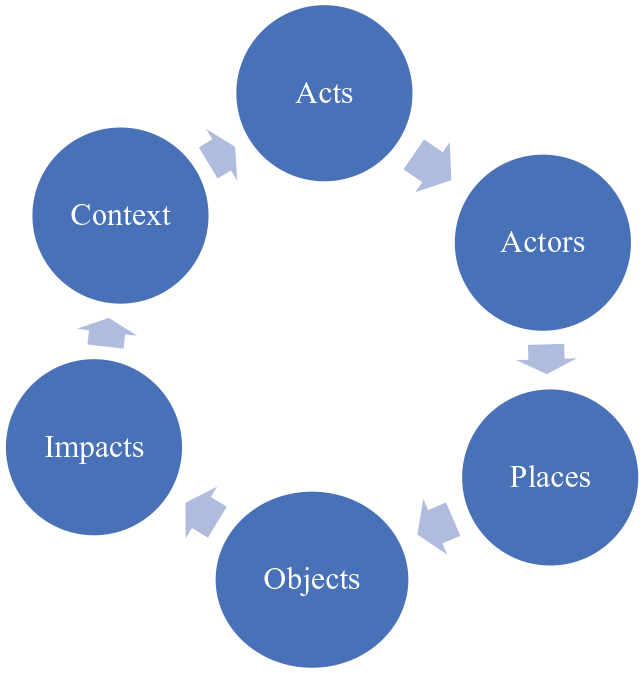
The measurement hexagon.
The measurement hexagon, as depicted above in Figure 1, conceptualises six points of interconnected measurement. These points are inclusive of the data currently collected in relation to femicide and take as a given the need to disaggregate the various variables that might be associated with each of these points (qua Walby and Towers, 2017). Importantly, explicitly recognising these measurement points in this way facilitates making visible some of the current invisibilities in ‘thin’ femicide counts. For example, a focus on objects might reveal what is presumed about certain violent acts and thus rendered invisible in the public debates surrounding them (see, for example, the recent intervention on the absence of gender in contemporary debates in England and Wales in relation to knife crime made by Cook and Walklate, 2020). Similar examples can be offered for each of the six points in this hexagon: the gendered and lethal violence(s) of war and genocide (Hagan and Rymond -Richmond, 2009; Mullins and Visagaratnam, 2015; Rafter, 2016); in relation to impacts, the early deaths of women following on from a life of abuse (Abrahams et al., 2009; Cullen et al., 2018); in relation to place, the private domain being equally as (if not more) dangerous for women as the public domain, (United Nations Office on Drugs and Crime (UNODC), 2018); in relation to actors, the role of the state in perpetuating violence(s) including the killing of women (Atuk, 2020; Dawson and Carrigan, 2020).
There is of course data available for all these measurement points from health statistics to criminal victimisation statistics, to the data gathered from such processes as the Small Arms Survey, to that available from country specific domestic homicide reviews, to the more obvious homicide statistics and data gathered by femicide watches and observatories. It is, of course the case, as others have argued, that such data are not gathered consistently or with the same robustness everywhere (see inter alia Palermo et al., 2013). The point of the measurement hexagon here, however, is not to engage in re-rehearsing these issues, but to encourage thinking about what femicide might look like if all these different points of data collection were put into the same measurement frame. What picture of femicide might be constructed if that were to happen consistently at the local, national and even regional and global level? Extending this further, and again furthering the work of Walklate et al. (2020), Figure 2 offers one vision of the kind of conceptual scaffolding that might be needed to more beyond the relative simplicity of the measurement hexagon and to build a ‘thick’ count of femicide. To do so, our conceptualisation of the measurement hexagon is expanded into a hexagonal pyramid (see Figure 2).
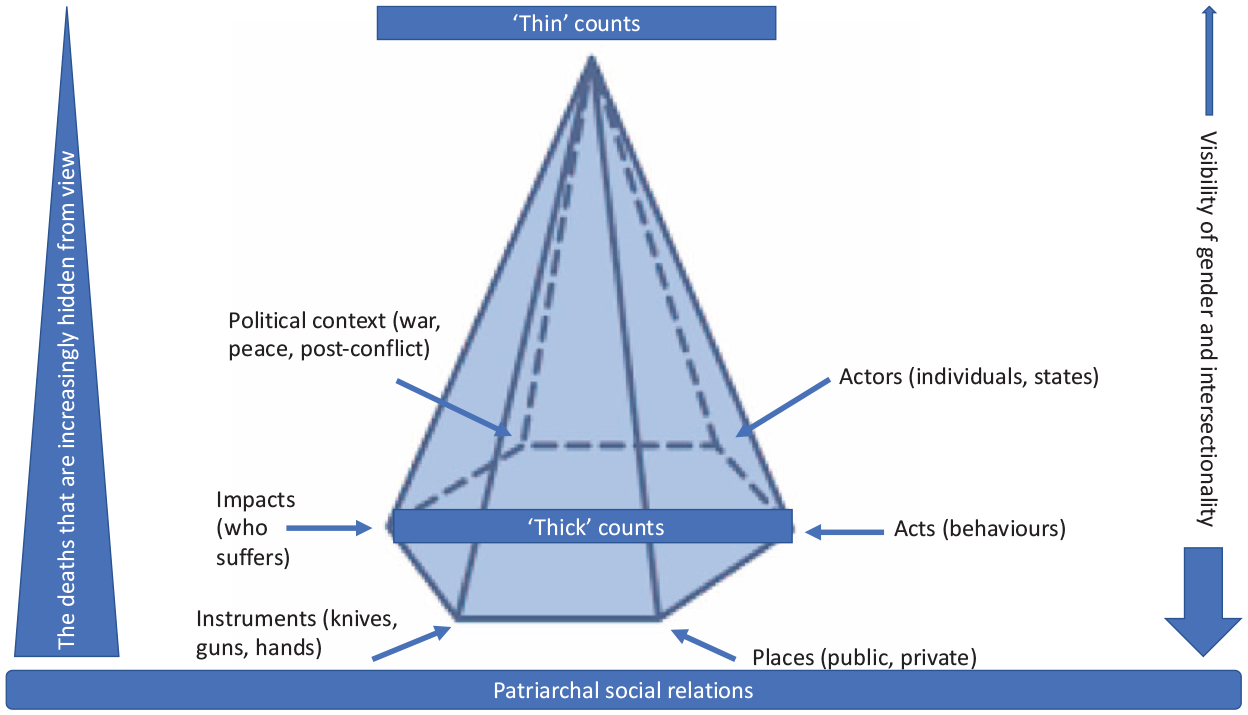
Visualising ‘thick’ counts through a hexagonal pyramid.
This visualisation of ‘thick’ counts sets out how femicide might be counted if framed, fundamentally, by patriarchal social relationships. Putting patriarchal social relationships in the frame, sitting at the heart (or the base as is the case here) of all femicides enables us to ‘see’ the way in which ‘thinner’ counts, can erase deaths from femicide as well as simultaneously render their gendered and intersectional underpinnings hidden from view. Thus, the social ecological model, in lending support to counts of acts and actors (where there is still considerable work to be done in disaggregating sex and gender as noted above) only acknowledges those acts of lethal violence that sit at the tip of this multi-dimensional hexagon. While any femicide counts are inherently recognised as the tip of the iceberg of the wider (and non-fatal) harms of violence against women, thin counts capture merely the apex of that tip.
The deeper the excavation, the ‘thicker’ the counts and the greater visibility is proffered for understanding the nature and extent of femicide (qua Weil, 2016) and its intersectional gendered features. In addition, the deeper the excavation the greater visibility is afforded to those groups presently erased from the ecological gaze, not only by counting practices but also in the extent to which their lives and their deaths are accounted for. The proposed measurement hexagonal pyramid facilitates a more nuanced appreciation of underlying features, place and context. For example, there are places in which femicide occurs with impunity (the Northern Triangle in Latin America, for example, see Lozier, 2018) and there are other places in which historical relationships between the colonisers and the colonised are a contributory factor in the patterning of femicide observed (e.g. in First Nations communities). ‘Thick’ counts facilitate a better appreciation and inclusion of factors such as these and in doing so allows for a more expansive (and we would argue accurate) understanding of the true extent and impact of men’s fatal violence(s) against women. The question remains of course as to why thinking about counting in this way matters.
Conclusion: counting for preventing?
To be clear, this article does not intend to discount the importance of quantification. On the contrary, following Merry (2016 208) the concern here is to think more deeply about the problem of data inertia commented on by her and to look for a way out of the difficulties such inertia might generate. Indeed, this article has sought to expand on Merry’s (2016) comment that ‘the indicators and the knowledge they create reinforce the theory they embody’ (p. 208). Moreover, our argument aligns with the call by Walby and Towers (2017) for a better conceptual base from which to make sense of the statistics on violence against women in order to take account of their gendered nature. However, indicators are not only reinforced by their theoretical origins, but they also inform the question of prevention. This raises the question of how this proposed measurement hexagonal pyramid, that which allows for a thick count to emerge, might inform improve prevention policy and initiatives.
McCulloch and Walklate (2020) have identified six models of prevention. These include the mechanistic (a simple cause and effect model), the ecological model (favoured by the World Health Organization among other), the spectrum of prevention model (a development of the ecological model), the responsive model (focused on what violence means for all individuals involved and how to respond on that basis), and the whole of family model (a newcomer to the field which prioritises working with all family members and is concerned not solely with the victim and perpetrator). As has been discussed in some detail already, the ecological model has been favoured globally and has become increasingly embedded in the prevention of violence against women. Indeed, recent iterations of the relationship between counting and prevention emanating from this model have become more complex. Heise (2011), for example, seeks to build a more dynamic, interactive and integrated account of how the different features of violence in people’s lives work differently in different contexts. Cohen and Swift’s (1999) spectrum of prevention also seeks to centre integration and collaboration between all the potential intervention points embedded in the ecological model. However, for any intervention strategy to be effective, it is necessary to think through the role and the driver of violence in people’s real everyday lives as opposed to how those lives might be imagined (and simplified) by policy makers.
Thus all visions of intervention, including the ecological model, need to embrace the thorny issue of the behaviour of men and the power relations that support ‘turning a blind eye’ to that behaviour. Otherwise, what results is ‘thin’ data and as a result ‘thin’ interventions that fail to resonate with women’s everyday experiences of violence, fail to mirror the safety and security options that women experiencing men’s violence want, and further, fail to tackle the underlying drivers and conditions which support the ongoing perpetration of this violence. ‘Thin’ interventions are a logical outcome of ‘thin’ counts. It is at this juncture that it might be worth reflecting on, and creating a space for, what might be called ‘thick intervention’, the prevention policies and initiatives stemming from ‘thick counts’.
Thick interventions represent an opportunity to build response and prevention approaches that reflect the totality of women’s experiences of men’s violence, the perpetration of that violence, the social conditions fostering acts of violence and the structures and institutions supporting it. ‘Thick’ counts seek to situate the numbers visualised in the measurement hexagonal pyramid within structure, culture, time and space. Lying behind these numbers are the cumulated outcome of those individual lives lost (if not fatally) because of slow femicide, as well the fatal consequences of femicide itself. This ‘thick’ counting would provide the basis for ‘thick’ intervention. Put simply, following from the work of Ackerly and True (2018), they would centre a gendered lens as the norm of and for intervention so that patterns of gender oppression, masculine privilege and entitlement are not hidden or obscured but illuminated and exposed in our understandings of the killing of women. This requires centring patriarchy in our theory and in our counting practice (DeKeseredy, 2019). Ultimately, as Walklate et al. (2020) have argued, ‘when we commit to “thick” counts and the “thick” prevention that follows . . . we may see some inroads into what in the twenty-first century seems to be an intractable global problem of [intimate] femicide’ (p. 102, our brackets). By adopting a ‘thick’ approach through the lens of the measurement hexagonal pyramid, the social facts of femicide may well become more visible and audible (Weil, 2016).
Footnotes
Funding
The author(s) disclosed receipt of the following financial support for the research, authorship and/or publication of this article: This article is an outcome from the Australian Research Council funded Discovery Project Securing women’s lives: Preventing intimate partner homicide (DP170100706).
