



Abstract
To problematise Western discourses of a homophobic Africa, there is a need to analyse evidence of homophobia and its interplay with other attitudes, in ways that explore contextual differences. Hence, this article offers an original sociological analysis of quantitative data on homophobia in African states, examining how this inter-relates with xenophobia. Social attitudes data are drawn from the Afrobarometer research project as a unique and important source, and compared in five diverse contexts: Kenya, Mozambique, Nigeria, Senegal and Zambia. Data are examined from Round 6 (2014–2015) and Round 7 (2016–2018). Findings are interpreted in light of specific national literatures on the relations between sexuality, gender and nationalism, as well as wider critical and postcolonial perspectives – especially conceptualisation of sexual nationalisms, and recent literatures on political homophobia. Whereas analyses of homonationalism in Western societies have explored alignments of lesbian, gay, bisexual, transgender and intersex rights affirmation with anti-immigrant attitudes, this study explores such relationships between homophobic and xenophobic attitudes in alternative patterns within specific African contexts. The analysis delivered not only challenges Western discourses of generalised African homophobia (especially discussing the counterexample of Mozambique) but also advances understanding of the complexity of how attitudes inter-relate in different postcolonial states.
Introduction
In analyses of African contexts, scholars of sexualities have identified a rise in homophobic political discourse over the past two decades while also challenging Western representations of a monolithically homophobic Africa and identifying differences between societies (Awondo et al., 2012). However, existing studies of such discrimination have focused on individual states or deployed literature reviews and qualitative sources for comparative analysis (Ekine and Abbas, 2013; Nyeck and Epprecht, 2013). By contrast, this article offers an original analysis of quantitative data on homophobia in African states, using a unique source: the Afrobarometer longitudinal survey of social attitudes. 1 Distinctively, we develop this through engaging critical perspectives on nationalisms and postcolonial Africa – hence providing an original sociological analysis of the relationship of homophobia to xenophobia, conceptualising patterns of prejudice in relation to sexual nationalisms.
Sociology has been learning from postcolonial analyses (Said, 1978) and feminist and sexuality studies, to better understand how national identities, states and societies are differently constituted in relation to colonial histories and geopolitics. Postcolonial and decolonial feminisms identified how European colonialisms exported gender binaries and a social system of heterosexuality, as Lugones (2008) relates to West Africa’s Yorùbá people. African sexualities scholarship is exploring these themes, problematising Eurocentric origins of the concept homosexuality while challenging homophobia (Nyeck, 2019; Tamale, 2011). However, there has not been systematic cross-national analysis of how homophobia inter-relates with discourses of nation.
This article thus offers analysis of social attitudes towards people outside heterosexual norms and explores this in relation to xenophobia (dislike or hatred of foreigners) and sexual nationalism – a concept used by Mepschen (2011) to conceptualise how sexualities form part of nationalist discourses (Jaunait et al., 2013; Mepschen and Duyvendak, 2012). While earlier researchers remarked on relations between nation and sexuality, a pivotal intervention by Puar (2007) introduced ‘homonationalism’. Homonationalism described a discourse primarily in North America and Europe which conjoins nationalism with ‘homonormativity’ that idealises certain same-sex relationships echoing heteronormative coupledom (Duggan, 2003). Homonationalism focused on discursive conjoining of support for gay and lesbian equality with racism and nationalism, generating critique of ‘liberal rights discourses’ (Puar, 2013; Zanghellini, 2012). While still debated, Puar’s homonationalism analysis highlighted that Western states and societies have selectively deployed human rights, for example, affirming lesbian, gay, bisexual and transgender (LGBT) 2 human rights while failing in respects to address racism or migrant rights. Yet while homonationalism analysis suggests examining relationships between homophobia and xenophobia, sexual nationalism provides a more flexible concept for analysis beyond Western societies. Moreover, while such literatures suggest the possibility of examining relationships between homophobia and xenophobia, it is literatures concerning homophobia’s invocation in African national politics – reviewed below (e.g. Bosia, 2013; Kaoma, 2013; Rao, 2020) – that provide the theoretical and political rationale to investigate patterns in how social outsider groups are regarded in Africa.
The research began with our learning of the Afrobarometer project’s unique published quantitative data, including on attitudes to homosexuality across sub-Saharan countries. The present authors are sociologists independent of Afrobarometer, although grateful for a supportive discussion with Professor Robert Mattes. Following exploratory data analysis and literature review, the research question was formulated: How do social attitudes to sexuality relate to sexual nationalisms in sub-Saharan Africa? This question avoided assuming homosexuality or sexual orientation as Eurocentric categories, yet was interpreted with a focus on same-sex or same-gender sexualities to explore anti-homosexuality evident in existing research.
In this article, the section ‘Research on homophobia in Africa and sexual nationalisms’ discusses the literature conceptualising homophobia in Africa in relation to sexual nationalisms. The section ‘Methodology’ outlines methodology. The section ‘Kenya, Mozambique, Nigeria, Senegal and Zambia’ reviews the literature on selected countries: Kenya, Mozambique, Nigeria, Senegal and Zambia. The section ‘Analysis’ exposes results, and section ‘Discussion’ provides discussion. Finally, conclusions highlight distinctive contributions, emphasising insights from Mozambique.
Research on homophobia in Africa and sexual nationalisms
The research question emerges from debates over rising homophobic discourses among many African state leaders since the 1990s. Our starting point is that commentators such as Awondo, Geschiere and Reid have begun to disaggregate levels and forms of homophobia in African states, challenging a homogenising picture by comparing Senegal, Cameroon, Uganda and South Africa (Awondo et al., 2012). These issues need exploring through engagement with African studies of gender and sexuality in relation to racialisation, ethnicity, nationalisms and colonialities (Ekine and Abbas, 2013; Nyeck and Epprecht, 2013). In African queer studies, ‘homosexual’ is a Western concept with a complex relationship to expressions of same-sex or same-gender sexuality through practices or identifications in different cultures (Edwards and Epprecht, 2020).
The task of interpreting attitudes to homosexuality requires consideration of how contexts relate to colonial histories and transnational discourses. Rao’s (2020) outstanding study Out of Time: The Queer Politics of Postcoloniality, providing deep historical contextualisation of Uganda’s discourses, is an important reference regarding how to interpret data from times and places – without drawing it easily into international frameworks. Critical postcolonial queer scholarship illuminates how distinct national discourses emerged.
There is an international literature on ‘political homophobia’ (Bosia and Weiss, 2013) applied in African contexts, which is valuable for understanding the relationship of homophobic discourses to nationalisms. Political homophobia assists analysis where state politicians deploy homophobia within wider nationalist strategies, especially where lacking economic power and utilising cultural politics for distraction. Bosia (2013) distinguishes between mainstream psychological theories of homophobia as irrational antipathy and political homophobia understood more broadly, concerning how discourses are utilised. Kaoma (2013: 89–91) relates the concept to Ugandan officials including President Museveni. Serrano Amaya (2018) extended the concept in South Africa. Overall, literatures by African scholars of homophobia, by critical postcolonial queer theorists and by political homophobia researchers all suggest the value of researching sexual nationalisms in Africa via interplay of homophobia with xenophobia, providing a theoretical foundation (although racial dynamics are profoundly different from Western immigration debates).
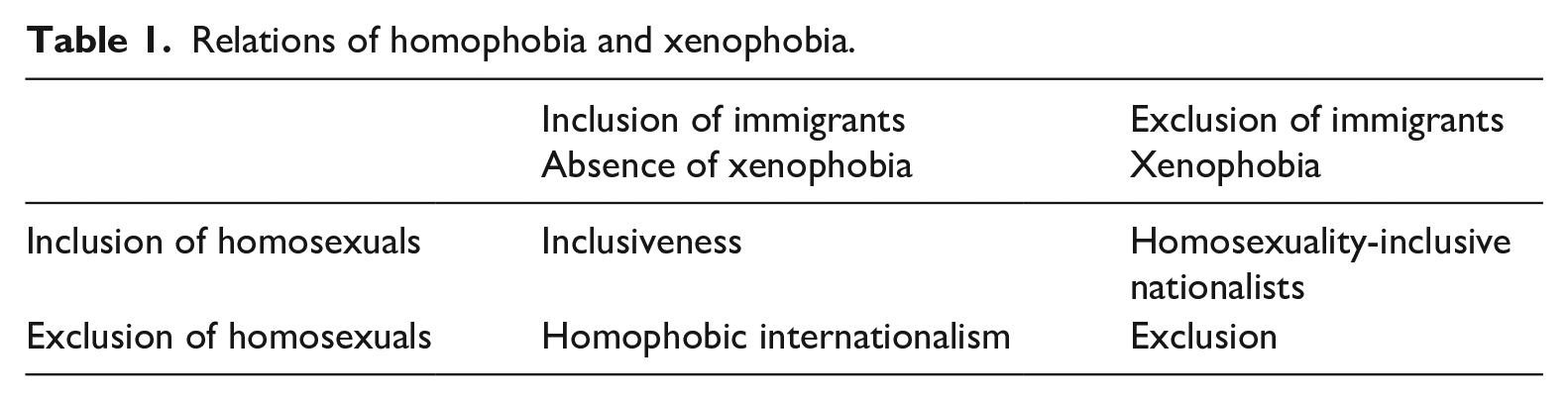
A first analysis of Afrobarometer’s 2014–2015 data on attitudes to homosexuals by Dreier et al. (2020) only examines the relationship to religious attitudes, suggesting religiously pluralistic communities are more tolerant of homosexuality. There remains a gap for analysing the relationship to nationalism and immigration. Our approach develops from first quantitative measurements of homonationalist values in other regions, though in Africa we conceptualise ‘homosexuality-inclusive nationalism’ instead, given Puar’s specific conception of homonationalism as an analytic. Working with secondary data, different approaches have juxtaposed items measuring attitudes towards immigrants and homosexuals, centring on homonationalists (Domínguez Amorós and Freude, 2021; Freude and Vergés Bosch, 2020; Spierings, 2020). Like Spierings (2020), we can explore binary distinctions between positive and negative attitudes as they inter-relate. Homosexuality-inclusive nationalism can be taken as implying three further combinations of attitudes to homosexuality and to immigrants/foreigners (see Table 1). The work of Domínguez Amorós and Freude (2021) considered the correlation between homosexual inclusiveness and xenophobia as an indicator for homonationalism (e.g. in Europe), arguing that homonationalists constitute a rising group reaching at most 20%. A general positive correlation – more lesbian, gay, bisexual, transgender and intersexual (LGBTI) inclusion, more exclusion of immigrants – cannot be detected; it works mostly the opposite way.
Relations of homophobia and xenophobia.
In a first explorative analysis using the World Values Survey (WVS), we were surprised about negative correlates in some African countries: those indicating least homophobia showed more xenophobia, affirmed by Bangwayo-Skeete and Zikhali (2011). This prompted interest in research. This article further analyses the homophobia/xenophobia relationship.
For our theoretical framework, it is important to examine the concept homophobia, potentially problematic in African contexts. Adam’s essay ‘Theorizing Homophobia’ provides a critical problematisation of the concept, noting how psychologising implications of ‘phobia’ often displace social structural and cultural explanations (Adam, 1998). We take this on board, while noting that homophobia is now often used with a wider meaning, as with racism. Africa’s sexualities literature shows that ‘homophobia’ has tended to be understood as relating to a specific category of homosexuals associated with being White and/or non-African (Nyeck and Epprecht, 2013). Use of the concept homophobia is justified since political discourses have often focused on ‘homosexuality’, as with Uganda’s notorious Anti-Homosexuality Act 2014; Rao, 2020), but needs careful interpretation; comments about homosexuals may not apply to all Africans engaging in same-sex/same-gender acts. State homophobia discourses translate into prejudices against various LGBTI and otherwise-identified people outside heterosexuality and cisgenderism.
Methodology
Our starting point is the only available quantitative data on social attitudes of homophobia across African states, from Afrobarometer, accompanied by wider attitudes data. We propose a descriptive and explorative approach to quantitative data, rather than hypothesis-testing, due to a complex theoretical background; for commencing quantitative analysis of sexual nationalisms in Africa, complex causal modelling is not appropriate. The research design draws together quantitative data with understanding of contexts from literature reviews, to develop analysis.
Feminist, queer and postcolonial scholars have contributed critically to social science methodology, often criticising quantitative methods because of rigidness and objectivity claims (Biglia and Vergés Bosch, 2016; Browne and Nash, 2010; Grosfoguel, 2011). Quantitative data must be handled through critical, sensitive examination.
Epistemology
At the epistemological level, our research question highlights a gap for investigation of relationships between attitudes to non-heterosexual people and xenophobia in Africa, especially quantitatively. We assume multiple structures of inequality as suggested in intersectional and decolonial feminist analyses (Lugones, 2008; McCall, 2005). As post-structuralism and queer theory suggest, we assume that discourses can constitute subjects (Foucault, 1979), informing data interpretation.
Methods
At the methods level, the research design involved different stages. First came country case selection: only five were chosen to enable reviews of literature on contexts and examination of interplays between homophobia and xenophobia in depth, avoiding decontextualisation common in quantitative analyses across countries. Case selection was followed by literature reviews for countries. The main analysis then involved using available data on attitudes towards homosexuals and immigrants (an indicator of nationalism), from the Afrobarometer (2020) survey. These data uniquely allowed quantitative analysis of attitudes to homosexuality collected recently in two rounds and comparison to xenophobia attitudes – also comparative analysis between states. A further stage, represented in the ‘Discussion’ section, was to consider how statistical findings can be interpreted with reference to literature, including on sexual nationalism. Overall, we offer a quantitative glimpse of attitudes to homosexuality and their relationship to xenophobia and sexual nationalism – arguing that quantitative data from representative survey studies, interpreted contextually, can generate insights.
The Afrobarometer survey asks questions about whether individuals would like or dislike to have a ‘homosexual’ or ‘immigrant/foreign worker’ as a neighbour. We refer to data from the question about attitudes to homosexuals as measuring ‘homophobia’ and data from the question about attitudes to immigrants as measuring ‘xenophobia’, recognising that this is a simplifying representation of data which capture positive and negative attitudes. Both homophobia and xenophobia have dominant psychologising meanings which from a critical sociological perspective we do not share, especially for African contexts. Data on homophobia or xenophobia should be understood as expressing dislike for homosexuals or foreigners that sometimes has some reasonable basis, for example, where groups are economically privileged (e.g. tourists). Nevertheless, both terms are useful in challenging negative attitudes and legitimate to use though needing careful contextual interpretation. We also recognise that data are from general populations, and hence our study only reveals discourses related to sexual nationalism in general social life; the relationship to discourses among politicians and the media is a second order issue.
Departing from the combination of xenophobia and homophobia (Domínguez Amorós and Freude, 2021; Spierings, 2020), we can follow the binary distinction between positive and negative attitudes. Four possibilities can be represented in a grid and labelled (Table 1). Another approach is to look for the relationship between xenophobia and homophobia, considering (1) no relation, (2) a positive relation and (3) a negative relation. Also, we will measure whether there is greater inclusion of immigrants or homosexuals.
The data are from the Afrobarometer, which describes itself as a non-partisan, pan-African research institution conducting public attitude surveys on democracy, governance, the economy and society in 30+ countries repeated on a regular cycle. We are the world’s leading source of high-quality data on what Africans are thinking. (Afrobarometer, 2020)
Afrobarometer has conducted surveys over seven rounds since 2001, becoming a prestigious source with representative samples for over 30 African countries. We used Afrobarometer (2020) data rather than the WVS because the former adopt a more contextualised view on African societies, also including more countries and more recent data – with a smaller interval of 2–3 years. Afrobarometer’s survey includes items on attitudes to homosexuals and to immigrants/foreign workers.
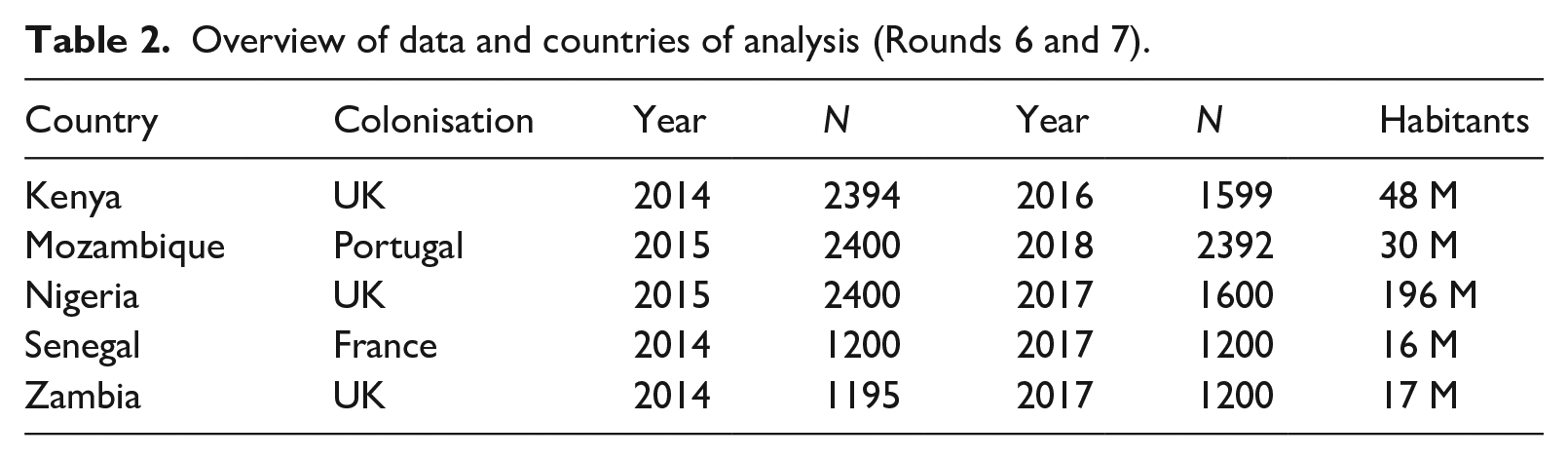
For cases, we selected five diverse sub-Saharan African states in two moments (2014–2015; 2016–2018), enabling measurement of change over time (Table 2). Selection of Kenya, Mozambique, Nigeria, Senegal and Zambia was designed to capture diversity in four respects. First, the states are from a variety of geographical locations – west, east and south. Second, the states are of varying population, ranging from 16 million in Senegal to 196 million in Nigeria. Third, states have been subject to different colonialisms: Portuguese (Mozambique), French (Senegal) and British (Kenya, Nigeria, Zambia). Fourth, the states have different religions predominating – Kenya, Mozambique and Zambia have Christian majorities, Senegal has a Muslim majority, and Nigeria is approximately half Muslim, half Christian; all also have forms of African spiritual belief. Summing up, we selected five countries to capture differences in four criteria: (1) locations, (2) population size, (3) colonialisms and (4) religions.
Overview of data and countries of analysis (Rounds 6 and 7).
Regarding Afrobarometer’s questionnaire, it is important to discuss the arrival of items measuring attitudes towards homosexuals. The question on homosexuality entered in Round 6 (2014/2015) and is still solitary. In this respect, the Afrobarometer itself may warrant discussion elsewhere by sexual nationalism scholars: in recent years, positive attitudes on homosexuality have become a perceived indicator of progress and ‘civilization’. However, we do not want to reproduce Eurocentric analysis, but rather to consider how homophobia is related to xenophobia and nationalism.
To measure homophobia and xenophobia, we focus on the single question posed concerning both homosexuals and immigrants/foreign workers, which is expressed with reference to ‘neighbours’: ‘For each of the following types of people, please tell me whether you would like having people from this group as neighbours, dislike it, or not care’ [Homosexuals] [Immigrants/Foreign Workers]. Respondents express degrees of appreciation of characteristics, on a 5-point scale: ‘strongly like’, ‘somewhat like’, ‘would not care’, ‘somewhat dislike’ and ‘strongly dislike’. However, the focus on attitudes to ‘neighbours’ means the question is not a straightforward measure of sexual nationalism, since it invokes experiences in everyday life rather than relating to the nation or state.
Regarding questionnaire terminology, a crucial aspect of our methodology is to appreciate the cultural specificities of how the concept homosexual will be interpreted in Africa. ‘Homosexual’ originates from European sexology and became used in Western societies during the 20th century but became debated in Africa from the 1990s. It is important to appreciate various forms of sexual practice or identification, and diverse gender identifications, which historically existed outside the framing of ‘homosexuality’. An example is the identity of ‘goor-jiggen’ (translating as ‘man-woman’) in Senegal, a male-bodied person ascribed a social role associated with spiritual abilities and presentation interpreted as feminine (M’Baye, 2013; Niang, 2004). So, anti-homosexuality in Africa excludes a colonial other but may not necessarily exclude indigenous identifications.
Techniques
For our analysis, we recoded the question into a dummy variable where 0 gathers the responses ranging from ‘strongly like’ or ‘somewhat like’ through ‘would not care’, while ‘somewhat dislike’ to ‘strongly dislike’ are collapsed in code 1. By this operation, we lose specificity, but gain interpretability and comparability (e.g. with analysis of the WVS). Taking into account the very unequal distribution of different categories, a recodification also makes sense for the different requisites of statistical procedures (López-Roldán and Fachelli, 2015).
Both variables of interest are dichotomic; hence, we code existence of homophobia or xenophobia as 1, whereas absence of homophobia/xenophobia is coded as 0. Hence, both of our dependent variables are dummies which can be treated as quantitative variables and we can compare means. The mean (e.g. 0.7) can be interpreted such that 70% of those interviewed do not want homosexuals as neighbours.
As we only have two different moments, we check whether there is a difference over time through a t-test. Significant differences between the sixth and seventh rounds are marked with * or **; if no significant differences are observed, the t-value is accompanied with ***. For differences between the countries, we did an ANOVA (analysis of variance); the F-value indicates any statistically significant differences between countries (López-Roldán and Fachelli, 2015: 5-37).
We also analysed how homophobia and xenophobia relate in different countries. Therefore, we expose the summary of the contingency tables on the relation of homophobia and xenophobia, categorising the four resulting cells from the juxtaposition of homophobia and xenophobia as inclusiveness, exclusiveness, homosexuality-inclusive nationalism and homophobic internationalism. We indicate the statistics measuring whether there is a relationship between the two variables, how strong it is and which direction it takes (López-Roldán and Fachelli, 2015: 28)

Finally, we calculate an indicator of differential inclusion (Domínguez Amorós and Freude, 2021) for each country: is there a differential inclusion/exclusion of homosexuals and immigrants or are they equally included/excluded?
Validity in exploratory research
Overall, we recognise limitations of an exploratory research design and especially what quantitative methods can offer, even where data consistency from two time periods indicates reliability and replicability. The methodology extrapolates meaning and tentative inferences from data through interpretation in relation to national literatures (some using qualitative methods) that document socio-cultural contexts. While qualitative data on how participants interpreted survey questions would be desirable, they are not available from Afrobarometer, but existing literatures such as on goor-jiggen in Senegal (below) give some indications. Further qualitative research is needed. Other independent variables such as ethnicity, age, sex, gender or educational level could be explored with more space. Comparison nevertheless generates some external validity to generalise interesting inferences beyond countries examined, including by reference to colonial histories. We next consider literatures on the five countries, space permitting only a glimpse of socio-political contexts.
Kenya, Mozambique, Nigeria, Senegal and Zambia
Kenya is a democracy, although beset by political divisions and violence under President Kenyatta of the Jubilee Party from 2013, with two ethnically aligned party groupings mobilising nationalism (Ossome, 2018). Regarding migration, Kenya is a destination country, with a million migrants (2% of population) often in encampments (Hargreave et al., 2020). Existing literature shows Kenya to be an African state characterised by ‘national heterosexuality’ in government and media discourse (Macharia, 2013), but where queer voices emerged early in Africa (Mwachiro, 2013). A plethora of LGBTI non-governmental organisations (NGOs) have formed, many within the Gay and Lesbian Coalition of Kenya (GALCK) (Thirikwa, 2018). Ground-breaking legal actions including for decriminalisation were initiated, although decriminalisation was defeated in the Supreme Court in 2018 (Gomes da Costa Santos and Waites, 2019). Overall, existing literature suggests state and societal homophobia contested by high levels of LGBTI movement activity.
Nigeria is a fragile democracy characterised by major ethnic conflicts and executive dominance, where President Buhari – a former General and a Muslim – won election with the All Progressives Congress in 2015 (Baba, 2018). Nigeria is a destination country for regional migration. Historically, it has been influentially argued that Yorùbá people did not have a gender binary before colonialism (Oyěwùmí, 1997). However, Nigeria in recent decades experienced a growth of homophobia influenced by rising Christian Pentecostalism in the south as well as some Muslim leader discourses in the North, originally colonial religions re-interpreted in new contexts (Pearce, 2012). Such homophobia was expressed in the Same-Sex Marriage (Prohibition) Act (2014) which contained measures outlawing LGBTI organising. This was accompanied by homophobic protests and violent public attacks, challenged by relatively few Nigerian LGBTI activists, including The Initiative for Equal Rights (TIERS) NGO (PEN Nigeria and PEN America the Leitner Centre, 2015).
Senegal is a democracy led by President Sall, whose Alliance for the Republic Party dominates, articulating moralistic national discourse in relation to influential Muslim brotherhoods – contrasting with youth cultures expressing Afropolitanism and hybridity (M’Baye, 2019). Historically, Senegal has been relatively hospitable to migration and tourism. Awondo, Geschiere and Reid have argued, ‘before 2008 this country was known as one of the most tolerant countries for homosexuality in Africa’ but that public controversies in 2008 and 2009 ‘sparked a sudden spread of homophobia’ (Awondo et al., 2012: 155–156). Specific Muslim religious leaders took prominence, for example, creating ‘The Islamic Front for the Defence of Ethical Values’ and calling for the death penalty, with ‘a broad impact on public opinion’, while public authorities tried to ease tension illustrating differences within Muslim populations (Awondo et al., 2012, 156; Broqua, 2016; Coly, 2019). Corpses were exhumed of goor-jiggen (Awondo et al., 2012, 156). Coly characterises these processes as ‘the invention of the homosexual’ in Senegal’s public discourses (Coly, 2019; Lamarange et al, 2009). LGBTI civil society activity seems rare.
Meanwhile, Zambia is a multi-party democracy led by President Lungu from 2015. Analysis of Afrobarometer’s Round 6 data by Dulani et al. (2016) showed dislike of immigrants in Zambia as the second highest (36%) among 33 countries, compared to 30% to 10% in our other cases (with Senegal 10%) (p. 9). Homophobia also seems strong. Human Rights Watch (2016) research reported emergent anti-homosexuality from government since 1998 and especially in 2013 an ‘anti-gay moral panic’ beginning from local media reports of same-sex marriages. Police arrests involved forced anal examinations. Van Klinken (2017) finds government opposing decriminalisation from 2011, emphasising how the ‘Christian nation’ in the constitution and rising Pentecostalism shaped changes.
Finally, Mozambique is a democracy ruled by the same party FRELIMO since independence, with socialist internationalist ideology that is a counterweight to religious influences – differentiating the country from the other cases imbued with moral conservatism (Gomes da Costa Santos and Waites, 2021; Tabengwa and Waites, 2020). Previous research highlighted a relatively tolerant social and political atmosphere lessening gender and sexual inequalities. Arnfred (2014), after qualitative fieldwork, suggested women having considerable power in matters of sexuality and relationships. Aboim (2009) explored changing masculinities in Maputo, noting 2003 family law reforms and men’s loss of earning power. A comparative analysis of Mozambique and Kenya emphasised different effects of colonial histories (Gomes da Costa Santos and Waites, 2019); in Portuguese colonialism, education occurred via the Catholic church addressing a small proportion of the population and focused towards civilisation through work, contrasting with emphasis on education among British missionaries, with less effective interpellation of Christian teaching making Mozambique less receptive to recent Pentecostalism. Decriminalisation of same-sex sexual acts occurred in 2015, whereas the other countries criminalise sexual acts between males and between females to varying extents (ILGA World, 2020). We reflect on such contextual differences when interpreting data.
Analysis
We are first going to present data for Round 7, with disaggregated responses to our two questions split by country. We then collapse the answers into two categories, homophobia (somewhat dislike and strongly dislike) and absence of homophobia (would not care, somewhat like, strongly like) or xenophobia (somewhat dislike and strongly dislike) and absence of xenophobia (would not care, somewhat like, strongly like), and calculate the different indicators outlined above.
Univariant analysis: homophobia in Round 7
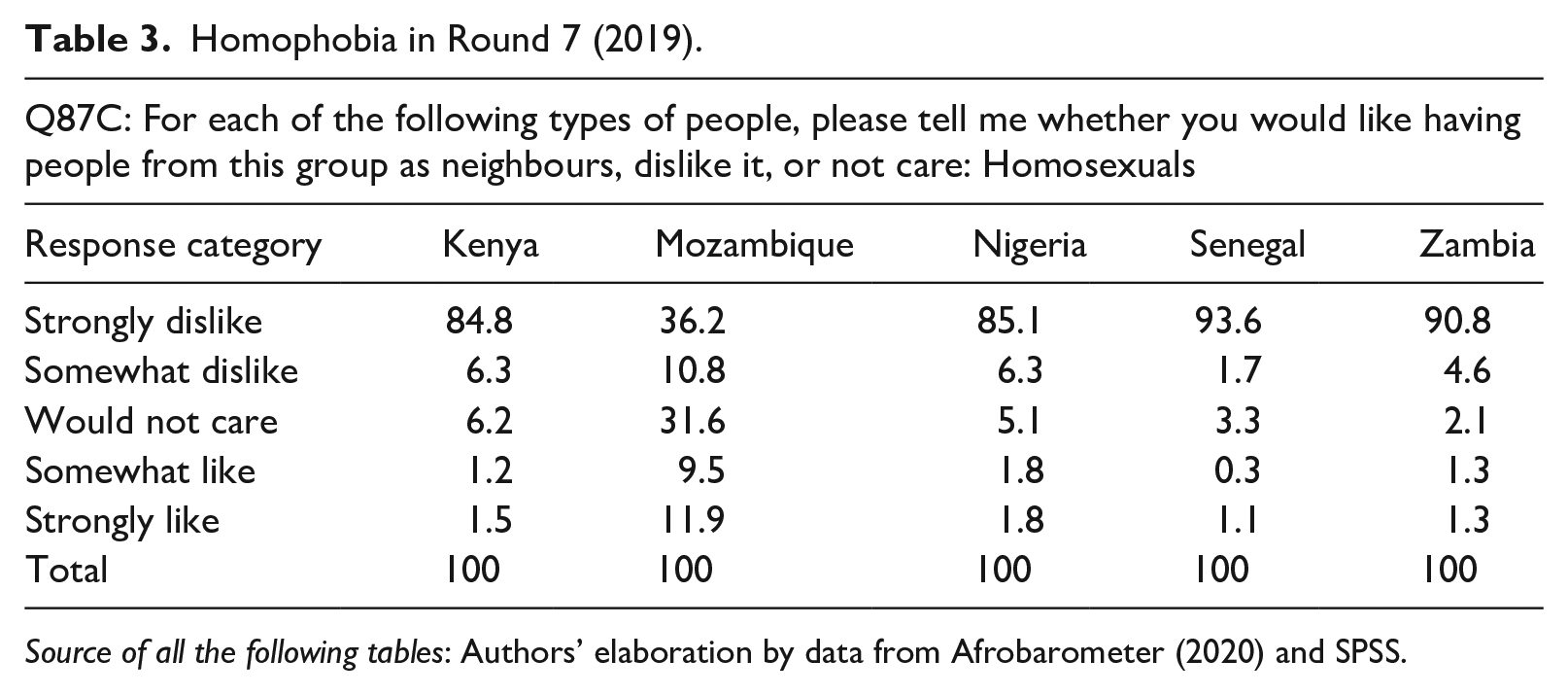
The data show dramatic differences destroying any perceptions of a generalised homophobic Africa (Table 3). While 93.6% express strong dislike of homosexuals in Senegal, only 36.2% express this in Mozambique. Our comparison using quantitative data not previously analysed in academic publications brings out differences, which could only otherwise be inferred from previous literature on particular states. Nevertheless, it is striking that four cases – Kenya, Nigeria, Senegal and Zambia – show high levels of strong dislike, 84% or above.
Homophobia in Round 7 (2019).
Source of all the following tables: Authors’ elaboration by data from Afrobarometer (2020) and SPSS.
The lowest level of homophobia is clearly in Mozambique, where 47% report ‘dislike’ of ‘homosexuals’ as neighbours. Mozambique decriminalised same-sex sexual acts without controversy in 2015 and is the only case where there is not such criminalisation. By contrast, Kenya shows the second lowest level of dislike, 91.1%, far higher than Mozambique. We thus argue that the comparative analysis of levels of homophobia between Mozambique and other states corresponds to other current research, highlighting decriminalisation of same-sex sexual acts in several former Portuguese colonies including Angola (Gomes da Costa Santos and Waites, 2021).
Kenya’s high level of homophobia is just below the other cases: Nigeria (91.4%), Zambia (95.4%) and Senegal (95.3%). In Nigeria, the high level of dislike corresponds to existing literature. In 2015, TIERS commissioned opinion research showing 87% of people were unwilling to accept a homosexual family member (NOI Polls, 2015). Meanwhile, Senegal and Zambia are approximately equal in having the highest levels of homophobia, again consistent with existing qualitative studies. However, if we disaggregate dislikes, Senegal has the highest level of ‘strong dislike’: 93%.
In light of the role of certain Muslim religious leaders in Senegal, Awondo et al. (2012) warn against interpreting negative attitudes to homosexuals as a consequence of politician-led ‘state homophobia’, as in Uganda: . . . for Senegal there is also good reason to reject an unnuanced idea of ‘state homophobia’ and to warn against a tendency to exaggerate the role of the politico-administrative elite [. . . ] in a country in which religious-political leaders have succeeded in mobilizing considerable ‘cultural anger’ against people suspected of homosexual acts, the government has attempted to play the role of negotiator, arbitrating between the demands of a rising tide of religious orthodoxy and the responsibility to protect a minority. . . (Awondo et al., 2012, 157)
Here, we note that Senegal’s ‘law of parity’ in 2012 made it an African leader for representation of women in the national assembly (M’Baye, 2019), suggesting that politicians are not practising uniform sexism. Interestingly, Gning (2013) has interpreted the rapid rise of homophobia from 2008 as a ‘panic’ in the context of the global economic crisis, though like Thoreson (2014) while introducing a political economy dimension, we interpret this as only one factor contributing to febrile discourses, alongside international, national and local dynamics.
Overall, the data on homophobia are showing us patterns of attitudes to be expected based on existing, mainly qualitative, state literatures. We next turn to xenophobia.
Univariant analysis: xenophobia in Round 7
Considering the same question, but this time for ‘Immigrants/Foreign workers’, the results are quite different (Table 4): first, immigrants and/or foreign workers are much more welcome as neighbours than homosexuals.
Xenophobia in Round 7 (2019).
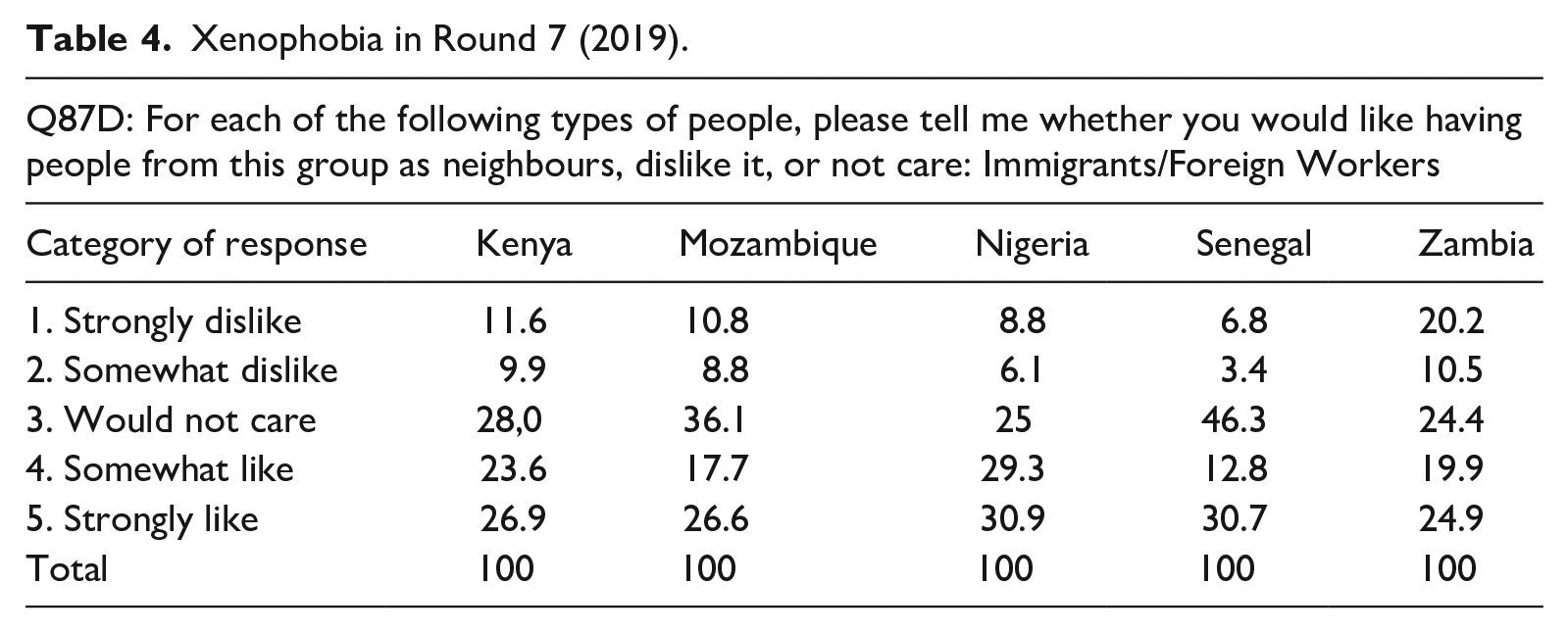
It is noticeable that Senegal has the lowest level of xenophobia, with only 6% expressing strong dislike. This is not surprising given that Senegal on the coast of west Africa has a long history of international social relations including trade and a substantial tourist industry. By contrast, Zambia has the highest level of dislike of foreigners – constituting an exception in Africa (Dulani et al., 2016). This might relate to it being a land-locked country but clearly reflects that peaceful Zambia has incoming migration from adjacent Congo which has seen poverty and violence (Flahoux and Schoumaker, 2016). Zambia experienced an unprecedented outbreak of xenophobic violence in 2016, triggered by ‘alleged ritual killings’ (Akinola, 2018, p. 31) but founded on ‘economic misfortune that led to locals attacking those that they regarded as competitors for economic resources’ (Akinola, 2018, p. 26).
Differences over time and between countries
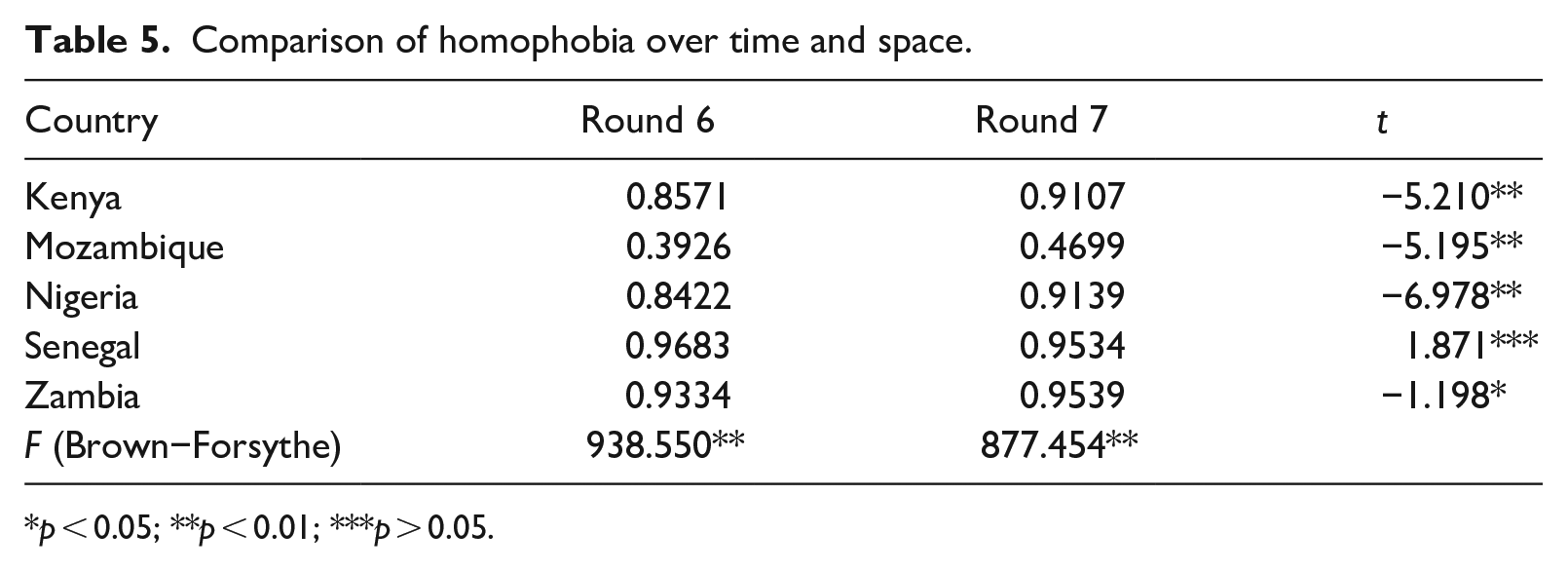
As commented above, we merged the categories ‘strongly dislike’ and ‘somewhat dislike’ into one category coded 1 and collapsed other categories into one category coded 0 (Table 5).
Comparison of homophobia over time and space.
p < 0.05; **p < 0.01; ***p > 0.05.
Considering now the changes over time, taking into account Round 6 (2014–1015), homophobia seems to be growing over time, except in Senegal where no statistically significant differences are observed. This might be attributed to several factors suggested in literatures: effects of the economic crisis from 2008 in promoting antipathy to those perceived as economically privileged (Thoreson, 2014); influence of specific religious forms including varieties of Christianity and Islam (Awondo et al., 2012); or growth of political homophobia (Bosia, 2013). These influences vary in effects on xenophobia, with economic effects more likely to influence feelings towards foreign workers; the interplay of specific factors in states is of interest.
Also, differences between countries can be observed in both rounds. The case of Mozambique calls attention, as in both rounds the country with less homophobia – as both colonial and postcolonial influences will help to explain. Kenya, Nigeria, Senegal and Zambia instead oscillate between 84% and 96% of homophobia.
Moving on to xenophobia (Table 6), we observe important variation over time in Mozambique, Nigeria and Zambia, where xenophobia is reducing; in Kenya and Senegal, no important change is observed.
Comparison of xenophobia over time and space.
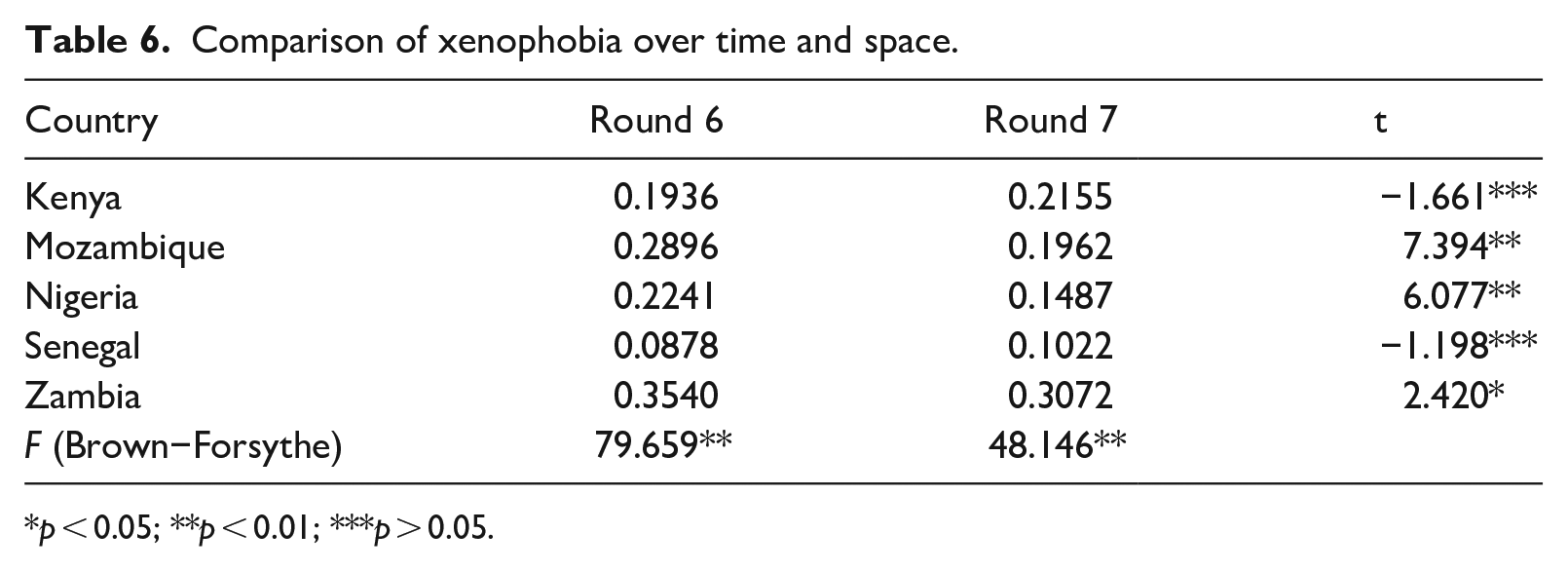
p < 0.05; **p < 0.01; ***p > 0.05.
To now explore how homophobia and xenophobia articulate in the countries, it is helpful to utilise the table of double entrance proposed in Table 1, operationalised in Table 7.
Juxtaposition of homophobia and xenophobia in % (2016).
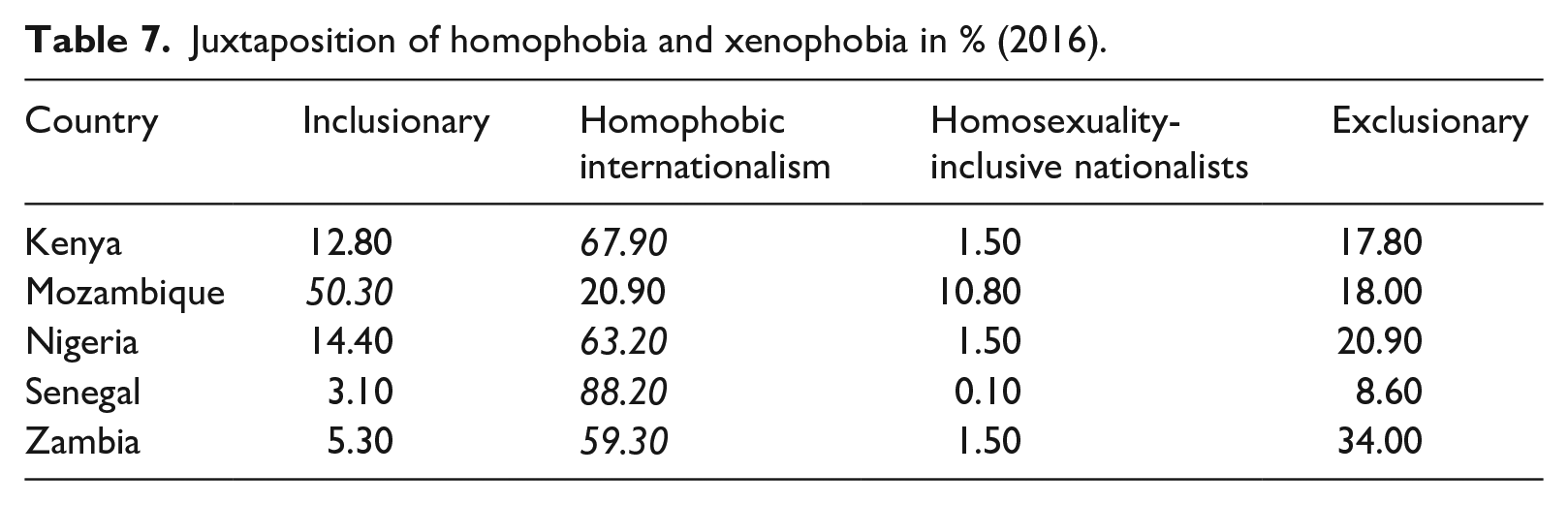
In 2016, we find that the majority of the respondents in Kenya, Nigeria, Senegal and Zambia can be located in the cell of homophobic internationalism. Only in Mozambique did half of the interviewed give inclusive responses considering both homosexual and foreign people.
Moving on, we apply a chi-square test to 2016 data (Table 8). According to the chi-square, homophobia and xenophobia are related in Kenya, Mozambique, Nigeria and Zambia, whereas no relation is observed in Senegal. Considering the direction and strength of the relation, we see the relation is positive (the more xenophobic, the more homophobic) and not very strong; only in Mozambique it reaches a medium level.
Relation between xenophobia and homophobia (2016).
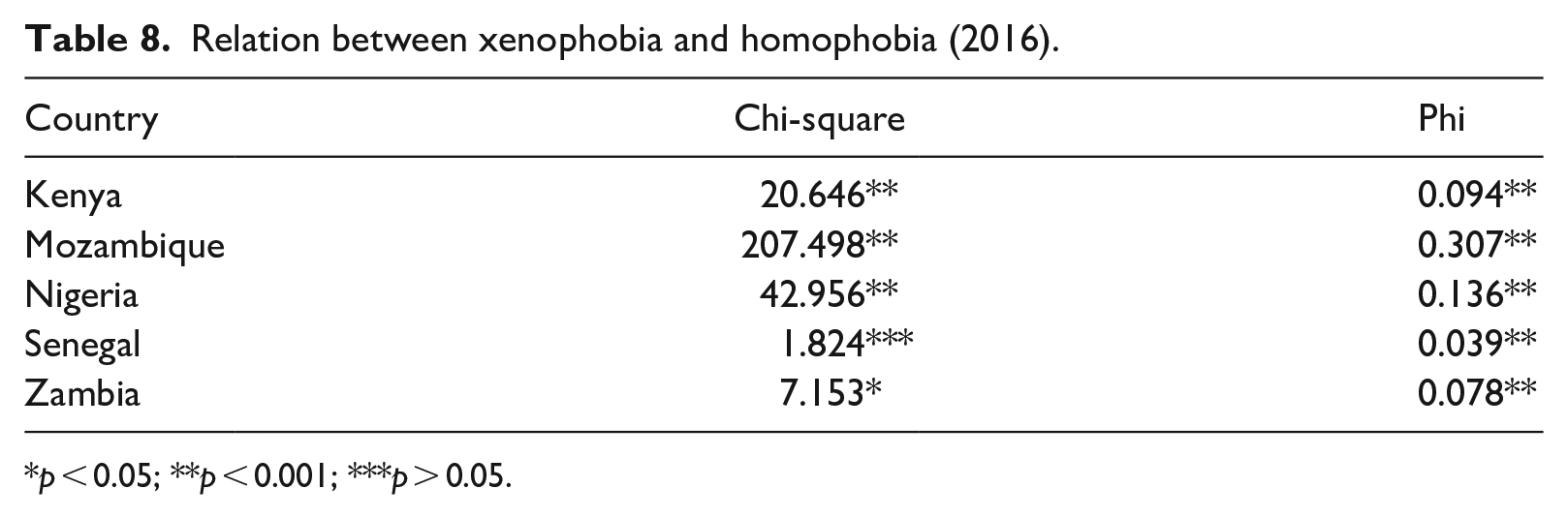
p < 0.05; **p < 0.001; ***p > 0.05.
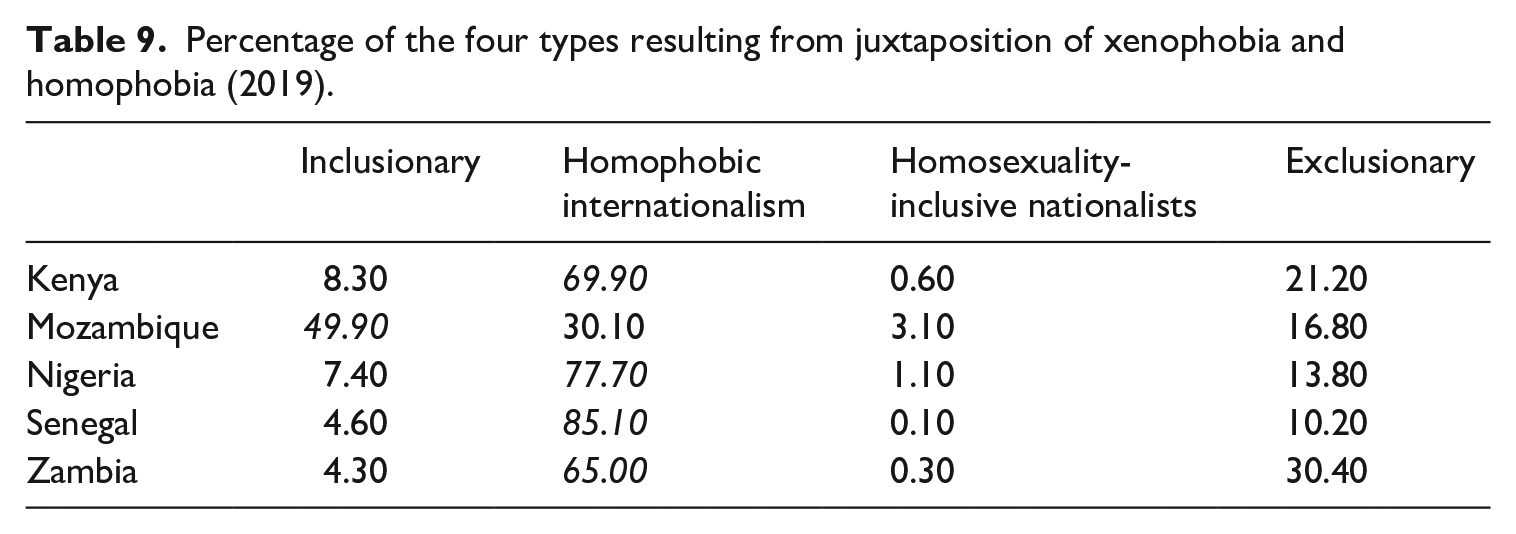
In the seventh round of 2019 (Table 9), the majority of the respondents in Kenya, Nigeria, Senegal and Zambia can be located in the cell of homophobic internationalism; in Mozambique, again almost exactly half of the interviewed give inclusive responses considering both homosexual and foreign people.
Percentage of the four types resulting from juxtaposition of xenophobia and homophobia (2019).
Considering the relation between the variables in Table 10, we can state that variables are related in all countries except Nigeria. The relation is positive (the more xenophobic, the more homophobic) and though still weak, stronger than in the sixth round.
Relation between xenophobia and homophobia (2019).
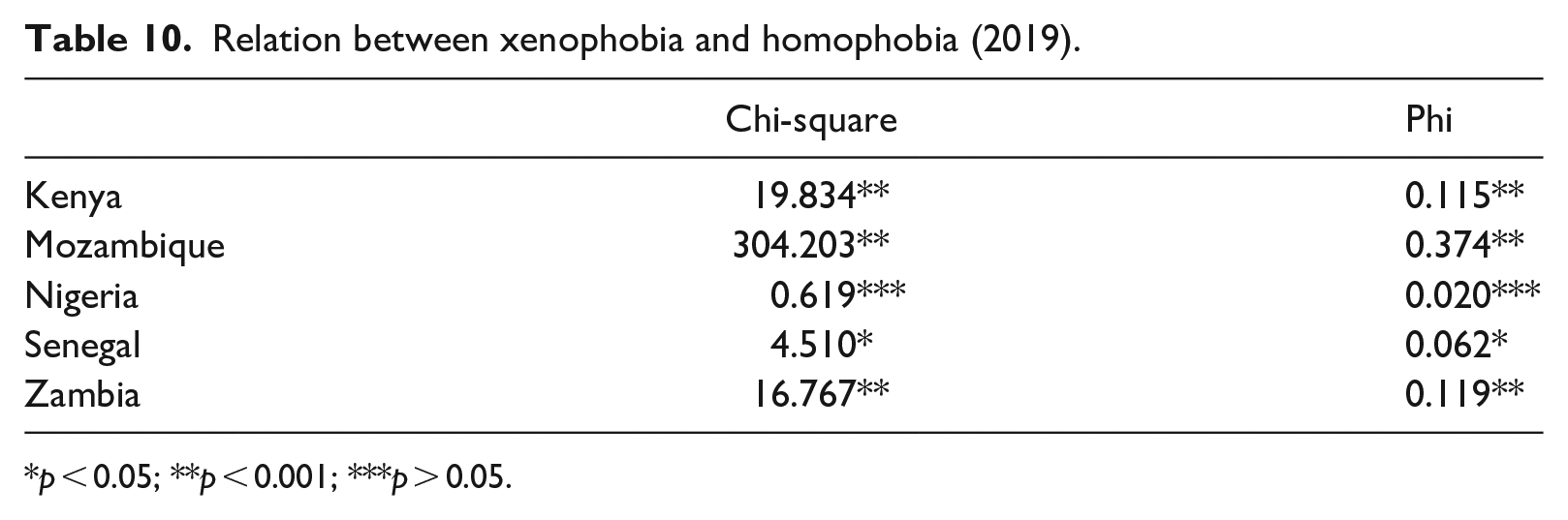
p < 0.05; **p < 0.001; ***p > 0.05.
Another way to relate homophobia and xenophobia is via the indicator of partial exclusion, measuring whether societies are similarly inclusive with homosexuals and immigrants or relate differently to these (Table 11). An indicator close to 1 implies that inclusion/exclusion is similar for both populations; close to 0 means the opposite. An indicator over 1 means there is more homophobia than xenophobia and an indicator under 1 means more xenophobia than homophobia.
Partial exclusion: % xenophobia / % homophobia.
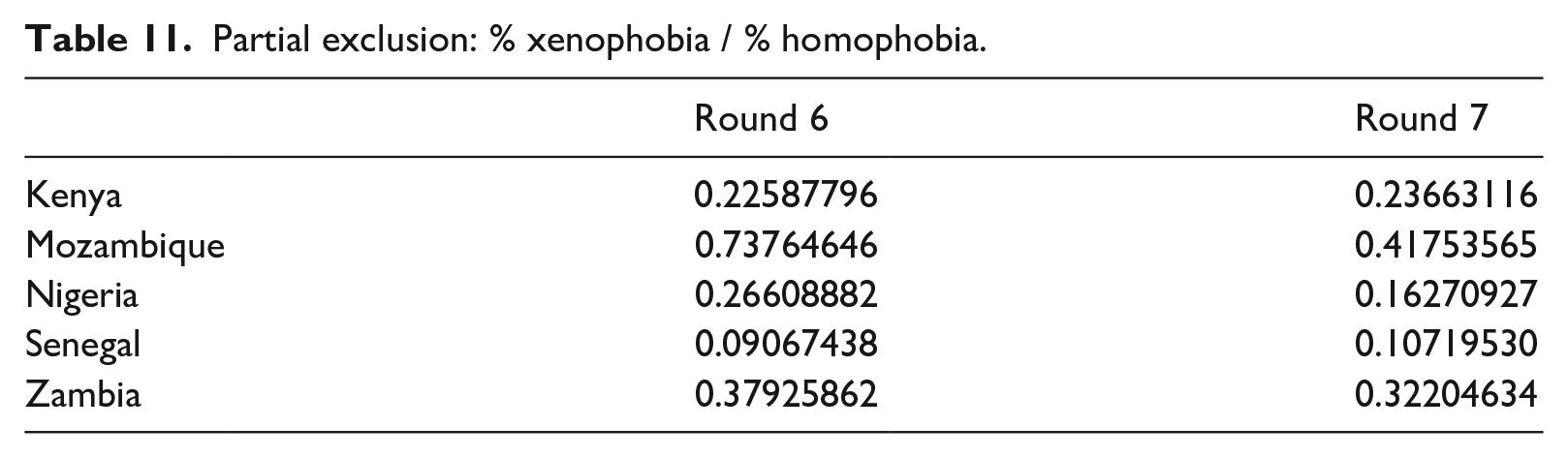
The table on partial exclusion shows there is more homophobia than xenophobia in the countries. It also shows an important difference between the extension of homophobia and the extension of xenophobia.
Discussion
Having examined the data, it becomes possible to reflect on relationships between homophobia and xenophobia, in light of existing literature. Ideology is important to consider, in political discourse possibly articulating with social attitudes.
It seems that regarding individual countries, anywhere embracing sexual diversity (i.e. Mozambique) also embraces immigration; yet on the other hand, the affirmation does not work the other way around: strongly homophobic answers do not imply xenophobic answers. Rather, homophobic cases may be very inclusive with immigrants and foreign workers, as in the cases of Senegal and Kenya. It is important to highlight, though, that all countries except Mozambique have very unequal distributions of responses regarding homophobia, with over 90% disliking homosexuals. So, when we talk about the association between responses liking homosexuals and responses liking immigrants, we are talking about very few cases, and therefore the relations described are very weak. In short, the attitude of a state’s population to immigrants has no clear discernible correlation with whether it is homophobic. Yet this leaves the finding that positive attitudes towards homosexuality are aligned with positive attitudes towards foreigners in the Mozambique case, implying there might be some relationship. While inclusiveness towards immigrants is not a sufficient condition alone for inclusiveness towards homosexuals, it might be one condition for such and might be a complimentary factor with some beneficial causal effect on attitudes towards homosexuals.
We were interested to analyse different associations between homophobia and xenophobia in Africa, with reference to the flexible concept of sexual nationalism. It seems useful to have developed a typology constituted by four types of relationship between homophobia and xenophobia (Tables 1 and 7). But the issue is how to interpret the categories in specific cases.
The starting point of our interest was negative correlations, whereby more homophobia appeared to align with less xenophobia, also detected by Bangwayo-Skeete and Zikhali (2011). However, following analysis, this seems to be explained by the very frequented cells which we conceive as the inverse of homosexuality-inclusive nationalism and label homophobic internationalism, that is, inclusion of immigration with exclusion of homosexuals. The weak negative correlates are due the importance of homophobic internationalism.
Relating to the specific country contexts, we can see that low levels of tolerance for gays and lesbians do not necessarily correspond to low levels of activism: as seen in Kenya, where homophobia scores are high but LGTBI activism is of relative importance (Macharia, 2013; Thirikwa, 2018). On the other hand, neither can we claim that a high degree of homophobia boosts LGBTI mobilisation, since in Senegal mobilisation is low and homophobia scores very high. However, we noted that religion is an important issue: strength of specific Christian and Muslim constituencies (Van Klinken, 2017) seems to relate to elevated levels of homophobia. The contingency of homophobia is notable, especially looking at Senegal: the literature review combined with data analysis evidences that lineally decreasing homophobia cannot be assumed.
We are particularly interested to interpret the distinctive Mozambique case, where state ideology seems a possible factor to explain different attitudes despite transnational influences like religion. Mozambique is strongly defined in the category of ‘Inclusiveness’, with almost exactly 50% (49.9%) of respondents there; it stands out dramatically from other countries in that respect (Table 9). Mozambique not only strongly challenges homogenising narratives of homophobic Africa, but also provides an example of a correlation between inclusiveness to immigrants and inclusiveness to homosexuals (see Table 8, chi-square test). This seems evidence of an inclusive example of sexual nationalism in Africa, opening the possibility that positive attitudes towards foreigners and homosexuals may be reinforcing (perhaps mutually) in certain causal respects in such contexts, for future investigation.
However, despite the impressive inclusiveness figure, only 21.4% of Mozambicans stated a liking for homosexuals, and 31.6% would not care, whereas 47% express dislike (Table 3). The majority of the inclusiveness category thus comprises neutral people who ‘would not care’. This suggests caution about characterising this as ‘inclusiveness’.
Other current research elaborates the history of governing party FRELIMO’s socialist ideology in Mozambique, supporting equality within the terms of a unified project, thus tempering interpretations of Mozambique as inclusive (Gomes da Costa Santos and Waites, 2021). The decriminalisation of same-sex sexual acts in 2015 was low key, as part of parliamentary reform of the penal code, occurring without public debate. The main LGBT NGO LAMBDA continues to be denied state recognition and the government maintains silence on the topic of homosexuality, consistent with its historical discourse on masculinity – and paradoxical effects of Portuguese Catholic colonial teaching, ineffective in transmitting Christian sexual morality (Gomes da Costa Santos and Waites, 2019). Therefore, our data demonstrate an inclusive sexual nationalism in Mozambican popular attitudes, in the sense of neutral acceptance and toleration rather than positive affirmation. This seems to correspond with the prevailing national political discourse, which is characterised by a silent tolerance towards private same-sex/same-gender sexual acts and relationships without affirming public LGBTI identities or comprehensive citizenship rights (Gomes da Costa Santos and Waites, 2021).
Conclusion
This article has made a number of contributions to sociological and wider social science analyses.
First, the article has presented for the first time in academic social science publications an analysis of important quantitative data on homophobia in Africa from Afrobarometer Round 7, with comparative analysis between states and some consideration of change over time.
Second, the article has presented analysis of the relationship between homophobia and xenophobia in African states, using examples. It has been demonstrated that there is not evidence generally that attitudes towards immigrants always shape attitudes to homosexuals, yet data analysis reveals that where positive attitudes to homosexuals exist (in Mozambique) they align with positive attitudes to immigrants. Positive attitudes to immigrants do not directly cause homosexual inclusion (c.f. Senegal), but could indirectly be one contributing factor, and specifically positive attitudes to immigrants and homosexuals could be mutually reinforcing.
Third, and perhaps most importantly, the article has emphasised the need to conceptualise and research sexual nationalisms in Africa. This has been developed through analysis of quantitative data on attitudes, and in dialogue with existing research literature, with an emphasis on the need to conceptualise sexual nationalisms contextually. A key strength of this contribution for analysis of sexual nationalisms in sub-Saharan Africa is to introduce results from quantitative values studies into postcolonial sexuality studies and advocate for methodological pluralism. At the same time, using secondary data represents the main challenge; developing quantitative data which gather situated values on sexual diversity with more complexity is desirable: for example, giving space for ‘goor-jiggen’ in Senegal alongside the modern and colonial category homosexual or opening up conceptions of gender beyond the gender binary (Lugones, 2008; Oyěwùmí, 1997).
We hope to have opened up new agendas for the analysis of quantitative data on homophobia in Africa, in relation to other social attitudes, and we hope this research may prompt further investigation in different regions on distinctive forms of sexual nationalisms.
Footnotes
Acknowledgements
The authors gratefully acknowledge supportive conversations with Professor Robert Mattes of Afrobarometer (University of Strathclyde). Matthew Waites gratefully acknowledges colleagues in the Strong in Diversity, Bold on Inclusion project for LGBT inclusion in Africa (funded by UK Department for International Development 2019-20), who supported work on a literature review that informed this later project. Thanks to all who gave feedback on an early version of the paper at University of Glasgow’s Sociology Seminar Series on 11 November 2020.
Funding
The author(s) disclosed receipt of the following financial support for the research, authorship, and/or publication of this article: Leon Freude acknowledges that his work is financed by a grant from the Ministry of Science, Innovation and University (FPU18/02501 and EST19/00149).
