




Abstract
This article provides better understanding of less-educated citizens’ underrepresentation in citizens’ initiatives. Based on in-depth interviews with less-educated citizens in Rotterdam, the Netherlands, the study discerned that the concepts of ‘feelings of entitlement’ and a ‘taste for politics’ are crucial for understanding their (non-)participation. The study uncovered that sub-dimensions of these concepts occur in different combinations, yielding four ideal types of (non-)participation: retreating non-participation, rebellious participation, potentially cooperating participation and pragmatic non-participation. In addition to well-known explanations as lack of time, money, social capital and political knowledge, the findings underline the fruitfulness of an approach that enables to uncover citizens’ perspectives for understanding their (non-)participation in citizens’ initiatives. Contrary to conventional understanding, this research also shows that a lack of feelings of entitlement does not necessarily inspire a distaste for politics, and that distaste for politics stimulates non-participation for some, while it inspires others to become politically active.
Introduction
In their shift from government to governance in recent decades, governments across the globe have experimented with increasing citizens’ opportunities for participation, deliberation and influence. In doing so, they aim to actively engage citizens in policy decision-making and implementation, for example through participatory budgeting, mini publics and referenda (Elstub and Escobar, 2019). Consequently, a new phase in the relationship between citizens and governments is signalled in West European democracies. A ‘third generation’ of citizen participation – following the 1970s civic policy consultations and the 1990s interactive policymaking – is about citizens doing public tasks themselves (Dekker, 2019). Prompted by democratic deficits and welfare cuts, governments expect citizens to actively take responsibility for the liveability of their communities. Propagating such ‘active citizenship’ – also referred to as ‘self-governance’ or ‘governing through community’ – quickly gained popularity after it was eagerly advocated by the then British Prime Minister David Cameron in 2010 (Newman and Tonkens, 2011).
An epitome of this trend is the ‘do-democracy’ as propagated by the Dutch Ministry of the Interior: citizens (co-)creating the public sphere, not by deliberating, voting or bargaining, but by realizing concrete public projects or initiatives. Local governments actively invite and stimulate citizens to develop citizens’ initiatives, that for example maintain public green spaces, take over public facilities or organize neighbourhood festivities that foster social cohesion (Visser et al., 2021). Governments facilitate such initiatives, for example, by offering financial and administrative support or by linking initiators to relevant actors (Dekker, 2019).
This ‘do-democracy’ is said to fit the Dutch context, characterized by high ‘active’ civic engagement (Dekker, 2019), political trust and voter turnout (Noordzij et al., 2019). However, beneath the surface of these overall high levels of trust and participation, the Netherlands is characterized by a striking educational divide: citizens with less than tertiary educational credentials 1 have significantly less political trust, and vote and participate less compared to more-educated citizens (Dekker, 2019; Noordzij et al., 2019). Hence, engaging less-educated citizens is one of do-democracy’s primary aims (Dekker, 2019), and citizens’ initiatives are frequently depicted as a democratizing force, giving power to ‘the people’ (Barnes et al., 2007). Nonetheless, less-educated citizens are substantially underrepresented in those initiatives as well, which hampers the latter’s democratic potential, and makes them potentially socially divisive (Newman and Tonkens, 2011).
This underrepresentation is predominantly attributed to a lack of time, money, social capital or political knowledge by studies primarily adopting an etic – i.e. experience-distant (Geertz, 1983) – perspective (e.g. Dekker and Uslaner, 2001; Pichler and Wallace, 2009). Inspired by recent studies that take an emic – i.e. experience-near (Geertz, 1983) – perspective to understand the life-worlds of less-educated citizens (e.g. Cramer, 2016; Hochschild, 2016; Jarness and Flemmen, 2019; Manning and Holmes, 2013; Noordzij et al., 2020) we aim to understand their underrepresentation by focusing on their perspectives, feelings and thinking related to citizens’ initiatives, as they formulate these themselves (Geertz, 1983). We draw on Bourdieusian ideas highly relevant for analysing stratified patterns in the political field (e.g. Jarness and Flemmen, 2019; Laurison, 2015), yet thus far not used for understanding the underrepresentation of less-educated citizens in citizens’ initiatives.
Below we describe our methods and data. Thereafter, and in line with an abductive research approach, we present our findings intertwined with theory; we theorize on the go (Tavory and Timmermans, 2014). Based on in-depth interviews, we developed four ideal types of (non-)participation, structured along two dimensions hitherto unaccounted for in research on citizen participation.
Methods and data
We took an abductive approach, which we understand as an iterative, creative and pragmatic process of problem solving aimed at theory construction based on novel empirical findings (Tavory and Timmermans, 2014). We selected the city of Rotterdam (the Netherlands) as a strategic case to recruit respondents, as it leads in advancing the ‘do-democracy’ through encouraging citizens’ initiatives (Custers et al., 2019). The resulting initiatives range from a one-time event to commemorate the dead to the co-created development of a land-use plan for a street suffering subsidence and free neighbourhood-based homework assistance.
Given the aim of our research, respondents were purposefully selected (Charmaz, 2006) based on their level of education, as this is the most salient determinant of various forms of political participation in strong ‘educationalized’ societies like the Netherlands (Spruyt and Kuppens, 2015). We included respondents with less than tertiary education, because the educational gap in political attitudes and behaviour in the Netherlands is one between those without and those with tertiary educational credentials (Van der Waal et al., 2017). We strived for variation in background characteristics such as gender, ethnicity and age. Respondents were interviewed in-depth by the first author. She asked for a respondent’s level of education once rapport was established. Initially, respondents were found via various entry points: e.g. a pub, grocery store and restaurant. We subsequently used snowball sampling. After the four ideal types crystallized, they were further empirically substantiated until 15 respondents were interviewed and theoretical saturation (Charmaz, 2006) was achieved.
Note that over 10 people were unwilling to speak to us about their city and the local government. Their reactions varied from ‘I’m simply not interested’ to ‘the topic of local politics frightens me’ and ‘ew, I’m not gonna talk to a college girl about that’. We will elaborate on this in the discussion. People who did agree to an interview were invited to select a location where they felt comfortable: eight took place at respondents’ homes, three at their workplace, two in the interviewer’s home and two at a respondent’s favourite bar. During the interviews we encouraged respondents to reflect on the three abovementioned examples of citizens’ initiatives, which vary in extent, duration and intensity of involvement of citizens and government officials. We ensured that the following topics were addressed: their opinions and images of the initiatives and their initiators, whether they would see themselves participating in initiatives, and their general opinions and experiences with politics and local governments. In addition, we invited them to express their associations with civil servants and politicians. In the interviews we paid attention to respondents’ perceived social position, their affinity with politics or politicians, and the social boundaries they experience and draw. Empirically recurring relevant themes were further explored and added when needed. All questions were posed as openly as possible, allowing respondents to add unforeseen topics.
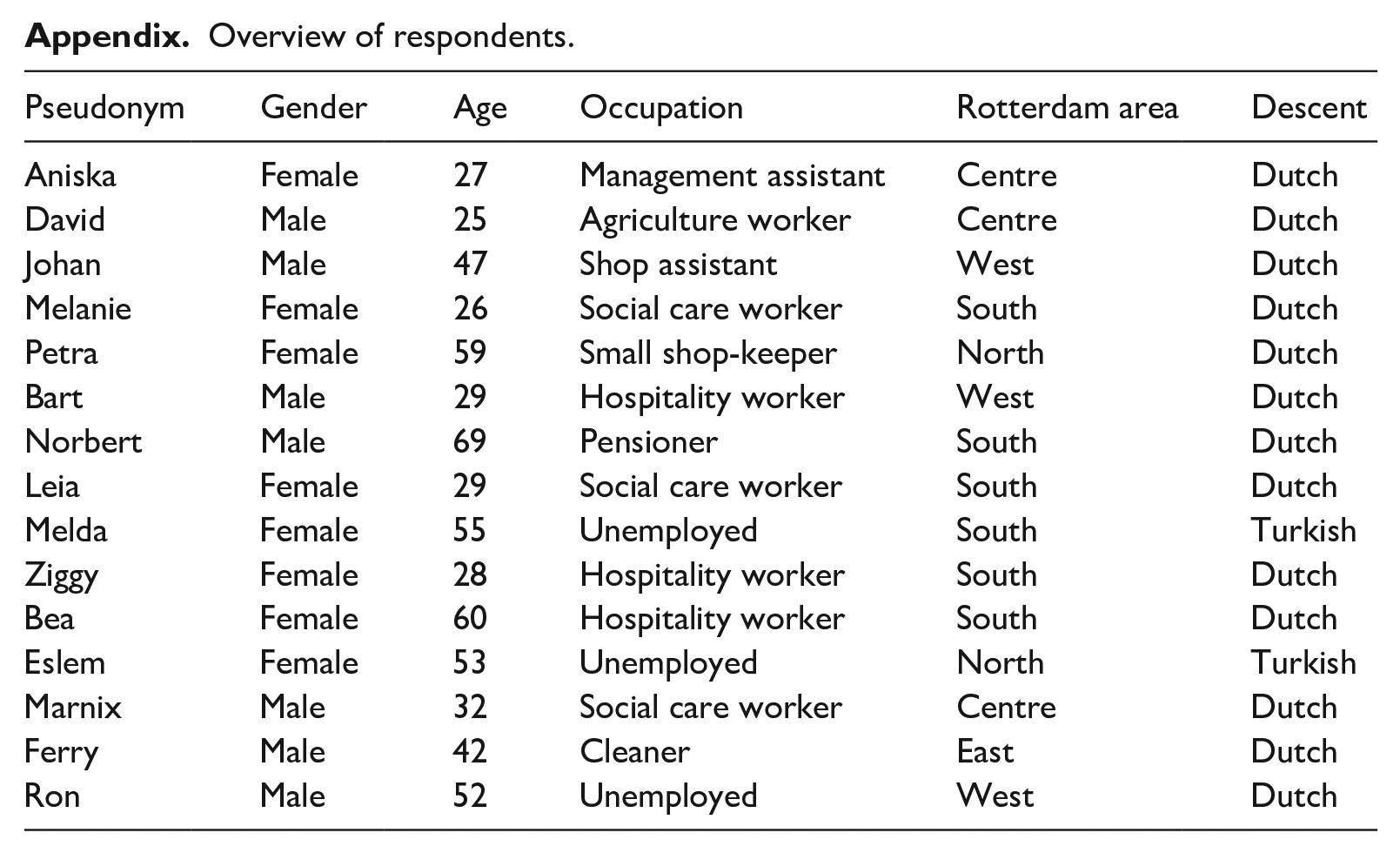
The interviews lasted for between one and two hours, save for one that took 30 minutes and another that lasted two and a half hours. Verbatim transcription of the interview recordings resulted in 228 single-spaced pages. We translated all quotes from Dutch, reflecting the original wording as accurately as possible. Pseudonyms protect the respondents’ privacy. The Appendix reports an overview of the respondents’ characteristics.
We analysed and coded the interview transcriptions using constant comparison (Glaser and Strauss, 1967) in order to identify underlying discourses. In doing so, we recursively moved back and forth between theories and our data (Tavory and Timmermans, 2014). We began with open coding of the transcriptions and continued by connecting and categorizing these codes, considering notions from the Bourdieusian inspired literature and our sensitizing concepts (Charmaz, 2006), related to social distinction and boundary drawing. During our analysis we discerned that ‘feelings of entitlement’ and ‘taste for politics’ were two important and distinct dimensions. We used this empirical insight to further explore the relevant literature and refined our interview topic list and sensitizing concepts accordingly. This iterative process resulted in selective coding of the (sub-)dimensions and ideal types discussed below.
Lack of feelings of entitlement, distaste for politics and (non-)participation
In line with previous research, respondents initially tended to explain their non-participation by referring to time constraints (Dekker and Uslaner, 2001), lack of local social connections (Pichler and Wallace, 2009) or the difficulty of completing the required paperwork (Galston, 2001). However, when we dug deeper, it appeared that there is more to the story than these well-established factors. Even if the respondents had enough time, connections and relevant political knowledge, many would not be very likely to participate. It is here that we see how social status affects (non-)participation in citizens’ initiatives.
Our analysis uncovered two dimensions – ‘feelings of entitlement’ and ‘taste for politics’ – that resonate with Bourdieusian (1984) ideas on how various strata relate to dominant institutions, as we will elaborate below. Each one has sub-dimensions, that come together in different configurations forming four distinct ideal types of (non-)participation in citizens’ initiatives.
Lack of feelings of entitlement
Feelings of entitlement indicate the feeling of being a legitimate agent in the political domain, a sense of having the right to speak and being entitled to participate in society’s dominant institutions (cf. Lareau, 2003; Laurison, 2015). The low status related to having lower educational credentials decreases people’s sense of entitlement: they perceive themselves as less legitimate societal actors (Lamont et al., 2014). The feeling that one is a socially recognized, legitimate agent in the public domain proves to be an important precondition for our respondents’ participation in citizens’ initiatives. Several of them stipulated that they lack these feelings, because they experience stigmatization and/or insufficiently master the legitimate style of speech and knowledge.
Stigmatization
Respondents stated that they lack feelings of entitlement due to experienced or anticipated stigmatization (Goffman, 1963). A recurrent theme was that they feel socially condemned because of their level of education and struggle with this: ‘It does matter in how I see myself, as someone who “only” has a vocational education, although that’s not that bad, it’s still the lowest level’ (Ziggy). Aniska, who works at a university, also expressed feelings of inferiority when she compares herself to the people around her: ‘In the beginning, I really struggled with that. Like “oh my God, I’m surrounded by smart people and here I come with my vocational education”.’ Melanie would ‘rather not talk about it with people [she doesn’t] know very well’ to ensure that they do not think she is ‘retarded’. This resonates with previous research showing that the low status accompanying low levels of education diminishes people’s sense of entitlement, especially in the political domain (Spruyt and Kuppens, 2015). Hence, less-educated citizens feel excluded from dominant political discourse because their preferences are not considered legitimate or appropriate (Myles, 2008), inspiring disengagement from politics (Noordzij et al., 2020).
Respondents also experience territorial stigmatization. Growing up or living in South Rotterdam, infamous for its levels of poverty and crime, is a source of this: ‘They say I live in a ghetto’ (Melanie and Ziggy). Respondents residing in South Rotterdam prefer to describe their neighbourhood instead as ‘working-class’ (Leia and Ziggy), with ‘hard working’ residents who ‘didn’t go to college’ (Leia). However, they think others see this differently: ‘If you say you’re from the South, people immediately have their opinion. They think I’m white trash. . . . It’s a shame’ (Ziggy). To avoid this stigmatization, Aniska admits: ‘Because it remains the worst part of the city . . . I simply don’t tell anyone I come from the South.’
Respondents who experience stigmatization sense that the authorities do not take them seriously: ‘If you’re from the South, everyone has an opinion about you, so yes I think civil servants too, they’re also human beings’ (Ziggy). She added that civil servants 2 look down on her, not only because she comes ‘from the South’, but also because of her ‘education’: ‘[They see me] as less educated . . . I think they think I don’t have the right knowledge, because I’m less educated, or that I don’t have an interest [in public issues].’
In sum, respondents’ perceptions of stigmatization induce a feeling that they are less entitled when it comes to dealing with public matters.
Insufficient mastery of culturally legitimate knowledge and language
Along with stigmatization, a lack of feelings of entitlement is related to respondents’ impression that they lack the ‘right’ capabilities to participate fully in the public domain. In relation to this, respondents explained to believe they lack expert knowledge and do not speak the right language. Here, it is all about the perception of the kind of knowledge and style of talking that is required in order to participate legitimately.
Many respondents stressed the importance of ‘knowing your stuff’ (Bart) or ‘know-how’ (Ferry), which they described as a kind of expert knowledge needed to successfully set up a citizens’ initiative. They emphasized that they are ‘merely practical’, and implied that their self-labelled ‘practical knowledge’ is inadequate when it comes to having a say in the public domain; that is, they sense that their knowledge is not culturally appropriate or legitimate, as David illustrates: ‘[People who] have studied for it, they probably know best.’
Additionally, various respondents referred to the significance of language. Melda, who is of Turkish descent, explained that civil servants ‘don’t like [her] ideas’, because she cannot speak the ‘full sentences’ they prefer. However, language is not only a struggle for non-native speakers; Melanie and Ron, for example, are insecure about the ‘way’ they phrase their ideas when communicating with the local government. When asked whether she expects to be taken seriously by the authorities, Ziggy underscored that the ‘style’ of language is vital. She has not been ‘raised in a posh way’ and thinks this could ‘work against [her]’. She believes she ‘might need to be a bit more decent . . . with a particular way of talking’, alluding to her Rotterdam accent, which she differentiates from the preferred ‘standard Dutch’ she associates with more-educated people.
Respondents who perceive that they do not master the ‘right’ style of language, anticipate that the authorities will take them less seriously. This perceived lack of familiarity with the appropriate knowledge and speech must not be confused with cognitive ability (e.g. Paterson, 2008); rather, it indicates that a perceived lack of acquaintance with culturally legitimate practices forms an obstacle when it comes to participating in citizens’ initiatives.
A distaste for politics
We also see that respondents actively draw boundaries between themselves and different aspects of the political field. Based on their tastes, respondents set themselves apart from the political domain. Unlike feelings of entitlement, a taste for politics concerns an affinity or connection with the political field that less-educated citizens often lack: they do not recognize themselves in the political field and its formal and informal ‘rules of the game’ (Bourdieu, 1984) and actively draw boundaries between it and themselves (Jarness and Flemmen, 2019; Noordzij et al., 2020). They oppose and disregard politics, in line with what Bourdieu once stated: ‘[In] matters of taste, more than anywhere else, all determination is negation; and tastes are perhaps first and foremost distastes, disgust provoked by horror and visceral intolerance (“sick-making”) of the taste of others’ (1984: 56). This evokes diverse reactions, ranging from dislike or disinterest to strong contempt for and opposition to legitimate culture.
Dislike of and contempt for bureaucratic red tape and a preoccupation with unimportant business
A recurring theme was the excessive red tape of bureaucracy. Bea briefly summed this up: ‘[From the local authorities], everything comes with a lot of ifs and buts.’ Some respondents expressed a dislike for red tape and feel discouraged by it. Petra recounted that she waited for months for an answer from her local government and, ultimately, just got her own documents back again: ‘So I said “that’s not what I mean! I want you to do something with it!” . . . I thought “whatever you ask from a civil servant, you just can’t get them to move.” Oh boy. . .’ With an aggrieved tone, Ziggy recounted how she contacted the local authorities to ask for a neighbourhood playground, but ‘then you receive an email that you’ll hear from them within four weeks, but after that you hear nothing, nothing!’
Others expressed contempt for red tape. Johan added: ‘It takes time and takes time, and at a certain point I thought “it can’t be this hard, right?”’ He explained this bureaucratic inertia by mentioning the ‘many rules and regulations’ and ‘different departments’ that he regards as ‘the biggest problem’. Norbert agreed with that: ‘Everything just gets bogged down between different departments.’
In their contempt these respondents also voiced a strong disdain for politics and the local government, and look down on politics, politicians and civil servants. They accused government bodies and officials of focusing on unimportant matters, which slows everything down: ‘If someone has a plan, you know in half an hour whether it makes sense or not, you don’t need to discuss it week after week. . . . But all they do is focus on rules and regulations. It’s nonsense. Come on, get a grip!’ (Bea)
Respondents who showed scorn for red tape and a focus on seemingly trivial matters contrasted this with their own lifestyle: they value hard work, being down-to-earth, a hands-on mentality and practical knowledge (cf. Jarness and Flemmen, 2019). Respondents prefer practical work and knowledge, and regard this as more valuable. Ferry argued that ‘people with practical experience, that’s the best’. Bea likewise argued that she ‘would like to see things differently’ and that civil servants ‘would know how things work in practice’ instead of being busy with ‘rules and handling stamps, from behind their desk, [while they] simply lack the practical knowledge’. She therefore had a ‘low opinion of civil servants’ and stated frankly that she would never want to become one, because: As a civil servant you stand apart from the people. And people look down on you. . . . Everyone looks down on civil servants right? . . . Imagine going to a birthday party and saying you’re a civil servant, oh my God, I think that’s awful. That’s a profession you wouldn’t reveal to others.
Ron also looked down on civil servants who, according to him: ‘Failed in business and then go work for the government where they can just sit in their ivory tower.’
We see that respondents dislike and express contempt for the attention paid to seemingly unimportant matters and the focus on inflexible rules and regulations; they prefer a practical approach as opposed to an abstract system.
Lack of affinity with and contempt for politicians
Another recurring idea was that local and national politicians ‘just come from a different background’ (Aniska) and ‘seem to come from a whole different world’ (Marnix). In this regard, respondents portrayed the distinct upbringing of politicians as stimulating, disciplined and aiming for the best that could be achieved. Politicians were described by almost all the respondents as ‘highly educated’ and coming ‘from a rich or good family’. ‘[A politician] is a frat guy . . . like a field hockey player’ (Bart). Aniska shared this observation: ‘You just notice that they’ve joined some fraternity. . . . And they’ve done everything that fits with it. They play an instrument and field hockey, you know.’ The perception that politicians are different from them results in a lack of affinity with and a disinterest in politics: ‘When I see them talking on TV, I just change the channel’ (Leia). That politics is largely populated by the higher classes, leads to disinterest (Noordzij et al., 2020).
For other respondents, the different background of politicians inspires contempt. They despise fraternities and the importance of the ‘right’ connections. Marnix viciously made fun of a politician who was pictured on his piano: ‘Pretentious highbrow. The epitome of arrogance.’ Aniska despises the ‘world’ that politicians come from, as social ties are crucial for their success. Ferry summarized this as ‘a scandalous old boy’s network’. Such contempt leads to the respondents making moral judgements; they value being ‘down-to-earth’ instead of highbrow lifestyles (Manning and Holmes, 2013).
Contempt for politics as a morally inferior performance
Multiple respondents described politics as a performance – more precisely, as a dirty play – for several reasons. Firstly, because competence is not seen to be important. Concerning this, respondents despised the fact that politics is all about selling yourself and your ideas: ‘It’s a bit like looking at who has the biggest mouth. Just to get attention’ (David) and ‘you just have to be able to be selfish’ (Bea). Or, as Ron put it: ‘They’re just wannabes, trying to be Mr. Popular.’ Marnix added to his joking about the politician who was pictured on his piano: ‘Well, he’s got a pretty face, so that sells. . . . That’s just dirty.’
Additionally, politics is described as dirty because civil servants and politicians are thought to do anything for power, including defeating others and changing their opinions. Various respondents consider this to be morally disgusting. Johan complained: ‘People will do anything to turn people against each other. . . . They get stuck in these power plays of politics.’ He would like civil servants and politicians to stay true to their ‘ideals’. Marnix referred to changes of opinion, which he loathes: ‘It’s incredible. This politician changed his standpoint completely, turned 180 degrees. In my view, then you’re a first-class deceiver. . . . How can you look at yourself in the mirror after that?’
Such contempt leads the respondents to draw moral boundaries between themselves and government officials. They would rather see an ‘honest face than a smooth tongue’ (Bourdieu, 1984: 467) and value fair play with honest people, namely those who are elected because of their competence and who stay true to who they are. As they perceive many politicians to be the exact opposite, these respondents set politics apart as ‘just a performance’ that is not to be taken seriously.
Four ideal types of (non-)participation
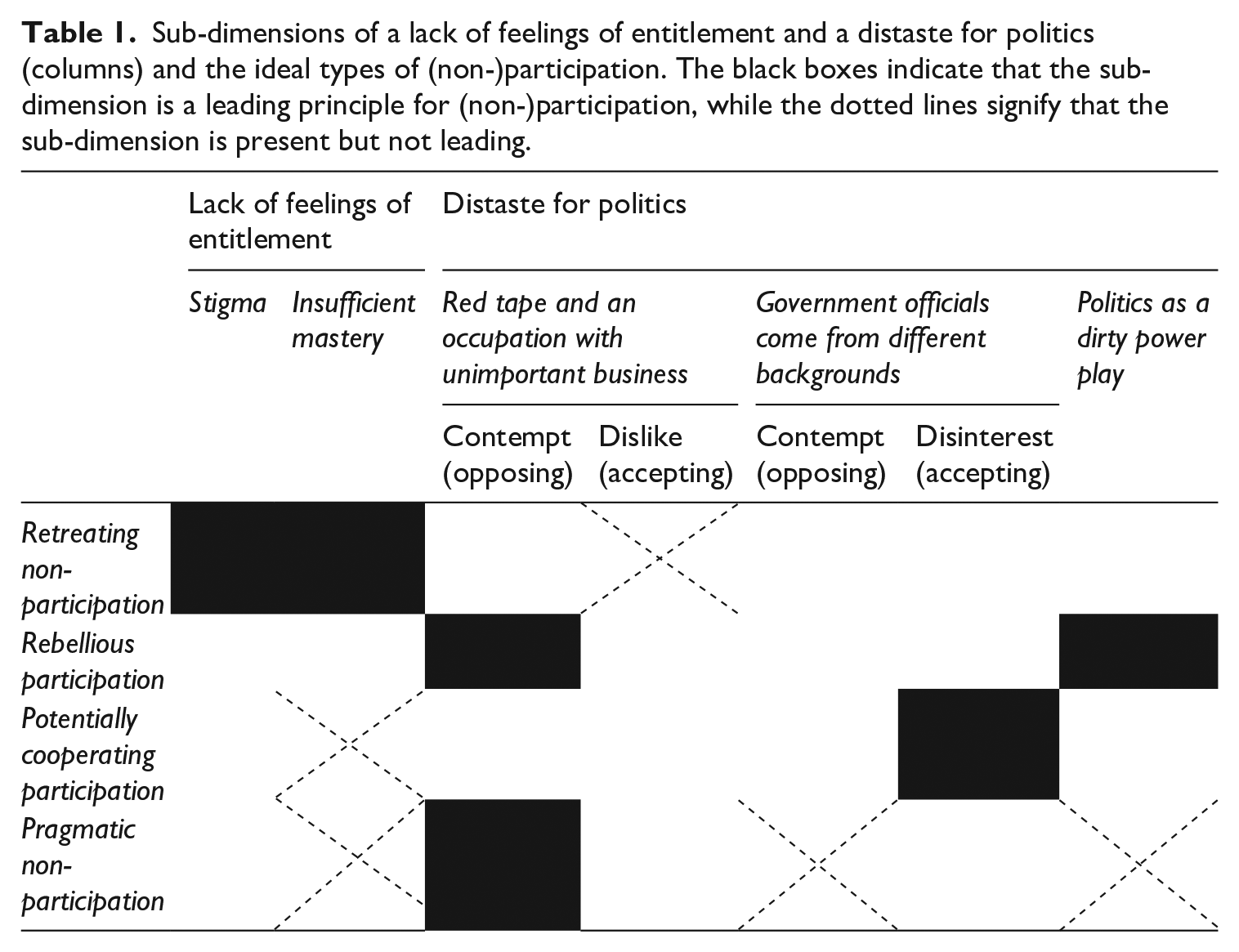
Our analysis indicates that the sub-dimensions of feelings of entitlement and a taste for politics presented above can be combined in different ways, and inspire four ideal types of (non-)participation, as Table 1 depicts.
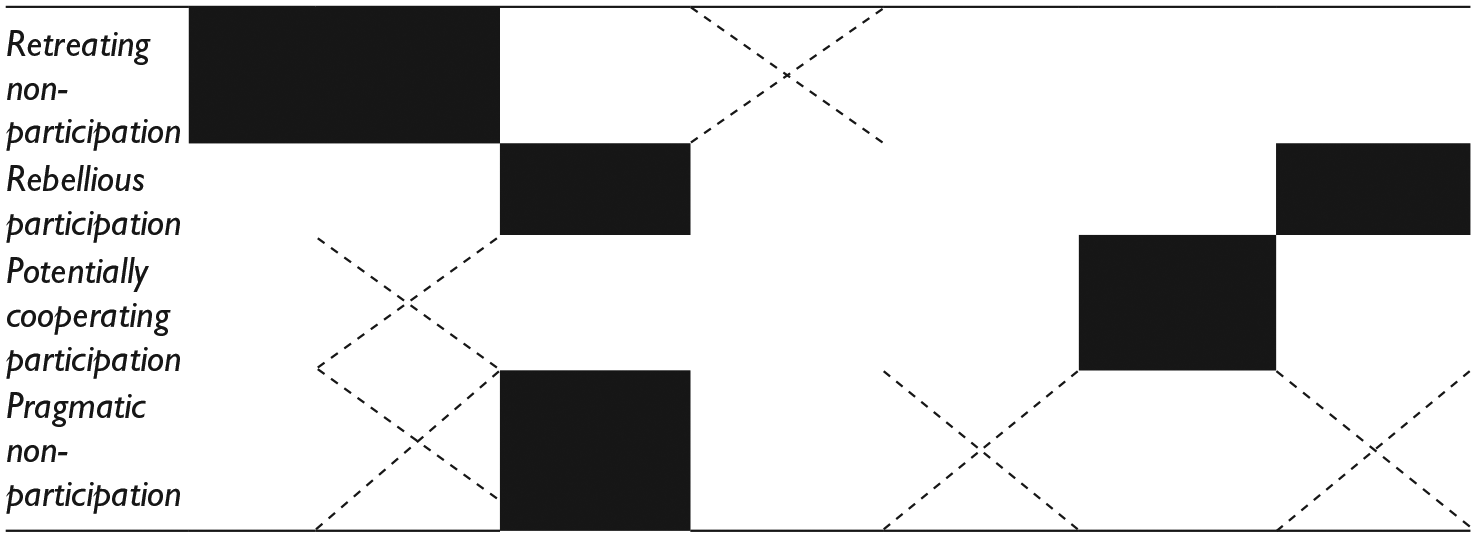
Sub-dimensions of a lack of feelings of entitlement and a distaste for politics (columns) and the ideal types of (non-)participation. The black boxes indicate that the sub-dimension is a leading principle for (non-)participation, while the dotted lines signify that the sub-dimension is present but not leading.
Retreating non-participation
The first ideal type is characterized by a strong lack of feelings of entitlement. Respondents experience that government officials and other citizens look down on them and will not take them seriously. Hence, they do not feel ‘socially recognised as entitled to deal with political affairs, to express an opinion about them or even modify their course’ (Bourdieu, 1984: 400). Their feeling of being excluded results in a retreat from the public domain and, therefore, non-participation in citizens’ initiatives.
When using the retreating non-participation discourse, respondents perceive that others look down on them – on aspects explained above – and as they do not master the ‘right’ style of language, they anticipate that the authorities will take them less seriously. As Ziggy explained, she would not go to the authorities if she had an idea for an initiative, because ‘usually, I’ve got a sharp tongue, but with those kind of people I think “never mind” . . . because I’m afraid I would embarrass myself. Or that they can just talk right through it so I can’t make my point.’
A third theme in retreating non-participation – although less prominent – was accepting but disliking red tape, which results in abstaining from participation. Respondents like Ziggy, Petra and Melda experience difficulties in cooperating with the authorities and come to a similar conclusion as Eslem: ‘all these damn rules and regulations’ exist because ‘they want to make things complicated for you, just to discourage me’. So, on top of stigmatization and insufficient mastery of the culturally appropriate knowledge and language, respondents feel excluded because of red tape.
These disappointments do not coincide with contempt for politics and government officials; the respondents dislike what happens, but do not revolt or condemn it. They would like to be regarded as legitimate agents within the system; they acknowledge and accept the status quo and aspire to belong to the group that gets heard. Ziggy, for example, expressed a desire to have had a different kind of upbringing, a more ‘stimulating’ one that would have enabled her to feel confident in the public domain.
In sum, retreating non-participation occurs because of the following: anticipating being not taken seriously because of experienced or expected stigmatization; perceiving insufficient mastery of the culturally legitimate language and knowledge; feeling discouraged by red tape.
Rebellious participation
The second ideal type is characterized by a strong distaste for politics. Unlike the first ideal type, the feeling of being entitled to participate in citizens’ initiatives is not absent in the case of rebellious participation. Based on their tastes, respondents set themselves apart from the political domain. They oppose and disregard politics. This strong distaste for politics does not result in refraining from participation, but instead inspires it, albeit in a rebellious way. Interestingly, in this discourse, respondents described their own participation as having nothing to do with the politics they despise. This dissociation between politics and one’s own participation is what Bennett et al. (2013) call ‘disavowing politics’. This particular relation to politics can facilitate civic engagement, even while cynicism towards the political system remains. Likewise, it may inspire participation, as is the case with these respondents.
The distaste for politics in this ideal type comprises two sub-dimensions: contempt for red tape and the pursuit of unimportant business, and the view that politics involves dirty power plays. We see that in rebellious participation contempt is expressed for the attention paid to seemingly unimportant matters and the focus on inflexible rules and regulations; respondents prefer a practical approach as opposed to an abstract system. Rather than experiencing a lack of feelings of entitlement and hence feeling discouraged by red tape but accepting the status quo, this rebellious ideal type is characterized by active opposition to red tape. We noticed earlier on that in case of retreating non-participation respondents feel less entitled because they perceive their practical knowledge to be illegitimate. However, respondents using a rebellious participation discourse disapprove of and actively challenge the dominant orientation. In this sense, we can understand this as a matter of distaste instead of feeling not entitled.
In this ideal type citizens’ initiatives are considered a positive thing, as these provide opportunities for ‘people on the ground’ (Bea) who know from practical experience what is needed. When adhering to the rebellious discourse, respondents think they can do better themselves because they do have practical knowledge. This motivates them to revolt via citizens’ initiatives. Bea explained her motivation behind initiating a local after-school playground for children that the municipality ‘refused’ to take care of: ‘We like to mess up the system, or at least to shake things up’ (Bea). Playing the role of a critical, rebellious citizen is enjoyed and respondents within this ideal type feel entitled to do so. Norbert is very happy when civil servants ‘start tiptoeing around’ him. The same is true for Bea, who proudly admitted that civil servants would describe her as ‘a difficult, very difficult person, terrible, when they hear my name they’ll immediately think “oh God, here she comes again”’. They are confident in finding their way around the administrative domain, and do not mind calling a ‘superior’ or ‘the alderman’ (Johan) when necessary.
In addition, the view that politics is a dirty power play motivates these respondents to revolt against the field that is despised in this rebellious discourse. Respondents refuse to play along with the political game. Johan, who participates in various citizens’ initiatives, explains that these initiatives have nothing to do with ‘dirty power plays . . . because we’re only a small group of people, and we all want the same things. . . . It’s that simple.’ Johan also illustrated how he will not change who he is, just to conform to the standards of the authorities. When he had to pitch his idea for a citizens’ initiative to the alderman, people asked him whether he was nervous and if he was well-prepared. He responded: Nervous? Why prepare? I know what I want to say and I’m gonna say that. And if I don’t express myself the way people are used to in terms of governmental language, well that doesn’t interest me. I speak from myself.
In short, in the rebellious participation ideal type citizens’ initiatives provide respondents an opportunity to rebel against a system they despise for the red tape and the pursuit of unimportant business and the morally disgusting, dirty power plays.
Potentially cooperating participation
The third ideal type is characterized by an intertwinement of the sub-dimensions of a lack of feelings of entitlement and a lack of taste for politics. This entanglement explains why respondents do not – yet – participate. The potentially cooperating participation discourse reveals a lack of taste for politics. The lack of affinity with politics goes with ignorance of the possibility of citizens’ initiatives. However, when introduced to examples of citizens’ initiatives, responses within this ideal type are very positive. Initiatives are described as ‘fun’ and ‘beneficial’ (Melanie) and initiators are characterized as ‘doers, people who get things done’ (Bart), ‘organizers’ (Melanie) and ‘go-getters’ (Leia). This optimistic discourse reveals a willingness to participate. Respondents chiefly explain their current non-participation by referring to their perception that government officials come from different backgrounds than themselves. This is accompanied by a feeling of not being totally entitled to deal with public affairs.
As opposed to a rebellious participation discourse, this discourse of potential cooperation is not characterized by contempt for politics. In fact, respondents feel that it is their responsibility to acquire affinity with the political domain and are willing to learn. When told about the opportunity for citizens’ initiatives, they indicate that they feel they should be better informed about local and national politics. Bart mostly skips over political content when he reads newspapers or watches television but conceded that he should ‘maybe just push [him]self . . . to go [and] watch it for a week or so’. When Leia sees political debates on television, she often switches to another channel because politicians use ‘fancy’ language. However, she continued: ‘[I don’t feel excluded by it], it actually motivates me to improve my vocabulary.’
Still, when using an optimistic discourse of potentially cooperating participation, respondents do not feel completely entitled to participate. They have various ideas for citizens’ initiatives, like a ‘day out for disabled people’ (Melanie), a ‘community bike tour’ (Bart) or a ‘reading afternoon for children’ (Leia). But they mentioned a lack of expert or theoretical knowledge and a fear of having responsibility for other people, which intimidates them: ‘Other people probably have more knowledge about the topic than I have, so I just don’t feel confident enough [to start an initiative]’ (Bart). This hinders them to participate.
They have not, however, lost hope and have identified a potential solution: cooperation. As Leia stressed: ‘Well, it would come in handy if you have a small group and you can take the initiative together.’ Bart, too, believed that it would help to have ‘multiple’ people to get an ‘initiative done’ and to ‘spread the responsibility’, while Melanie stressed that she would have people around her who ‘agree with [her]’ and ‘support [her]’, and so she looks forward to starting an initiative. Leia, Bart and Melanie do not see structural barriers. They agreed that by ‘working together’ anyone should be able to start an initiative and be taken seriously by the local government.
In summary, respondents using this discourse are willing to participate, but have not yet done so because of disinterest – caused by the perception that government officials come from a different background – and a closely related lack of awareness of the possibilities, combined with the feeling of not being totally entitled to participate due to a lack of the expert knowledge they deem necessary.
Pragmatic non-participation
The fourth ideal type is marked by a sub-dimension of distaste for politics, that is contempt for red tape and the pursuit of unimportant business. In the discourse of rebellious participation a disgust for politics understood as a power play overpowered a distaste for red tape and motivated respondents to revolt. This is not the case in the discourse of pragmatic non-participation. Here politics is seen as a dishonest power play because ‘a name’s more important than what you’ve done’ (Marnix) and politicians are identified as coming from a different background, ‘like coming from good families’ (David), but these views are less pronounced.
In addition, pragmatic non-participation is inspired by not feeling fully entitled to participate in initiatives. This is because respondents feel that they lack the right sort of ‘expert knowledge’: ‘Well, you kind of need to know what you’re talking about, like people who have studied about it, you know’ (David). Nevertheless, most salient for understanding this type of non-participation is contempt for bureaucratic red tape, inertia and the focus on seemingly unimportant business; this is the defining feature that distinguishes this ideal type from the other types.
When voicing the pragmatic non-participation discourse, respondents explained their non-participation by expressing an aversion to time-consuming bureaucracy, as elaborated before. Marnix would not start an initiative because of ‘the whole idea of bureaucracy. A form here, ticket office there and “we call you back but [you] will never be called”, well all that kind of red tape.’ David highlighted his solution: ‘If I wanted to organize a neighbourhood barbecue, I’d just organize it with some friends.’ Respondents prefer to do things their own, more efficient and effective way, by avoiding cooperation with the authorities: ‘[if the local government is involved] there would obviously have to be some sort of administrator involved who would get paid a lot, like really a lot’ (Aniska).
In expressing this discourse, the respondents see themselves as down-to-earth and hard-working and feel that participation in citizens’ initiatives does not fit their lifestyle. The impressions that some of them have of those who start citizen initiatives are revealing. Marnix, Aniska and David stressed that these people have ‘too much time on their hands’. David therefore assumed that they must either be ‘unemployed’ or ‘housewives’, while Ron presumed they are ‘probably on social benefits’. Aniska stated: ‘They must be one of those tree-hugging wackos.’ Marnix underscored this and elaborated: ‘I guess they’re older women without bras who vote leftist . . . those people who say they can see your aura.’ They vigorously draw boundaries between themselves and the political field and people who they perceive to participate in this field.
Given that social identification spurs people’s (political and collective) actions (Fowler and Kam, 2007), it comes as no surprise that respondents using this discourse do not participate in citizens’ initiatives. They see these initiatives as not something for pragmatic people like them. David argued that ‘you kind of have to look at what’s the fastest solution, that’s also kind of cheap’. They do not participate because they consider it impossible that initiatives will be the way they would like them to be: ‘immediately effective’ (David, Ron), delivering ‘a measurable success’ (Ferry) and having ‘real impact’ (Marnix). They want things to be quick and effective and prefer practical knowledge and a hands-on mentality over bureaucratic rules and regulations. According to them, citizens’ initiatives are inefficient and ineffective: ‘It is a waste of money’ (Ferry).
In short, an aspect of a distaste for politics, namely contempt for red tape, chiefly triggers this type of non-participation.
Conclusion and discussion
This research presents four ideal types of (non-)participation structured by feelings of entitlement and a taste for politics. The results show that these concepts are crucial for understanding less-educated citizens’ (non-)participation in citizens’ initiatives, next to well-known factors of lack of time, money, social capital and political knowledge. In addition, our study demonstrates that feelings of entitlement and a taste for politics are not only analytically, but also empirically different. A lack of feelings of entitlement does not always go together with a low taste for politics, and vice versa. This provides a more nuanced understanding of the different attitudes towards citizens’ initiatives. Our original findings contribute to prevailing sociological and political theories on (non-)participation in several ways.
Firstly, theories commonly used to account for the less educated’s political non-participation depict them as passive (Kemmers et al., 2016) and focus on a lack of resources such as time, money, social capital, skills and knowledge (e.g. Dekker and Uslaner, 2001; Galston, 2001). Notwithstanding their empirical merit, their dominance conceals that less-educated citizens may not feel socially entitled to participate and/or may actively refuse to do so, for instance because they abhor red tape or the smooth talking of politicians. Secondly, distaste for politics does not necessarily lead to political disengagement (Manning and Holmes, 2013): for some citizens it instead serves as an impetus to actually participate politically. Thirdly, feelings of entitlement and a taste for politics are often conflated (e.g. Manning and Holmes, 2013). For example literature on resentment typically suggests contempt for politics to be a response to a lack of feelings of entitlement (e.g. Cramer, 2016). However, our analysis revealed that such contempt can also be found among those who do feel entitled. In addition, less-educated citizens who do not feel entitled to participate politically do not necessarily exhibit contempt towards the political field. Therefore, it is important to both analytically and empirically disentangle feelings of entitlement and a taste for politics in future studies at the intersection of stratification and politics.
Our findings also have broader relevance. Governments should realize that non-participation does not necessarily mean apathy towards the democratic process or public cause. On the contrary, less-educated citizens may feel subordinate, be unfamiliar with and/or have no taste for the prescribed forms and hidden scripts, which undermines their participation (Williams, 2007) or inspires various kinds of informal (Verloo, 2017) or rebellious tactics to improve public well-being. Our findings may inspire governments aiming to enhance the democratic potential of citizens’ initiatives to break the cultural divide that less-educated citizens perceive between themselves and the political field, causing them to feel like ‘a fish out of water’ (cf. Franceschelli et al., 2016). For example, sensitivity training for government officials could create awareness of the cultural repertoires of less-educated citizens (Van der Waal et al., 2017). Additionally, policies could aim for destigmatization on the basis of education, occupation and place of residency (see also Lamont, 2018). Lastly, our findings suggest that reaching the full democratic potential of citizens’ initiatives calls for presenting them to the public in such a way that bureaucratic and governmental overtones are limited as far as possible.
Our qualitative approach proved valuable for developing an in-depth understanding of (non-)participation; our interviews provided a platform to citizens who are less likely to express their opinions in surveys (Laurison, 2015). Nevertheless, there also are limitations. Interestingly, we did not interview people who express a strong lack of feelings of entitlement and a strong contempt for politics. It is reasonable to assume that these citizens are among those who did not want to participate in our research (see ‘Methods and data’), as they would be reluctant to share their (negative) opinions towards established institutions like local government with people affiliated with an establishment institution like a university. While we attempted to minimize the social distance that less-educated respondents feel during recruitment and the interview, this is thus no panacea. Nevertheless, future research could benefit from doing so. Although this is challenging, we found that respondents were willing to share their views in circumstances in which they felt confident and superior to the researcher. For example during a bingo evening in a local pub where potential respondents were clearly more experienced and skilled in the game than the interviewer.
In addition, further research is needed to determine the generalizability of our insights on the relevance of feelings of entitlement and a taste for politics in relation to stratified patterns in political (non-)participation. Survey research could build on our study by including measures for the various sub-dimensions of feelings of entitlement and a taste for politics, and, for example, explore their relevance for well-documented differences in attitudes towards political authorities, sense of political ownership and understandings of the responsiveness of formal political mechanisms. In addition, such research could illuminate the role of context, for instance whether, and how, feelings of entitlement and a taste for politics play a part with respect to stratified patterns in political non-participation in less egalitarian countries than the Netherlands. Also, the relevance of limited formal political knowledge for civic and political participation might be different than often assumed (e.g. Galston, 2001), as our findings indicate that it makes some people feel less entitled which hinders them to participate, while it inspires disdain towards theoretical knowledge among others, which in turn motivates participation. Finally, we have concentrated on how respondents themselves perceive their social position with a focus on educational level, as extant research shows it the most salient aspect of stratification related to political participation in the Dutch context (Spruyt and Kuppens, 2015). Future research could uncover the interplay of educational level with other social background characteristics and structural conditions, and how these shape the perceptions and practices of participation in citizens’ initiatives. Such research could help explain why some less-educated citizens develop feelings of a lack of entitlement, while others develop contempt for or disinterest towards politics, and when, how and why they switch between different discourses.
Overall, we conclude that feelings of entitlement and a taste for politics play an important role in the low political participation of less-educated citizens in the Netherlands and we hope that our research will inspire follow-up studies addressing the pressing questions discussed above.
Footnotes
Appendix
Overview of respondents.
| Pseudonym | Gender | Age | Occupation | Rotterdam area | Descent |
|---|---|---|---|---|---|
| Aniska | Female | 27 | Management assistant | Centre | Dutch |
| David | Male | 25 | Agriculture worker | Centre | Dutch |
| Johan | Male | 47 | Shop assistant | West | Dutch |
| Melanie | Female | 26 | Social care worker | South | Dutch |
| Petra | Female | 59 | Small shop-keeper | North | Dutch |
| Bart | Male | 29 | Hospitality worker | West | Dutch |
| Norbert | Male | 69 | Pensioner | South | Dutch |
| Leia | Female | 29 | Social care worker | South | Dutch |
| Melda | Female | 55 | Unemployed | South | Turkish |
| Ziggy | Female | 28 | Hospitality worker | South | Dutch |
| Bea | Female | 60 | Hospitality worker | South | Dutch |
| Eslem | Female | 53 | Unemployed | North | Turkish |
| Marnix | Male | 32 | Social care worker | Centre | Dutch |
| Ferry | Male | 42 | Cleaner | East | Dutch |
| Ron | Male | 52 | Unemployed | West | Dutch |
Acknowledgements
We thank Roy Kemmers (Erasmus University College) and participants in the Culture, Politics & Society seminar (Tilburg University, KU Leuven and Erasmus University Rotterdam) for their helpful comments on earlier versions of this article.
Funding
This work was supported by Vidi grants awarded to Willem de Koster and Jeroen van der Waal by the Nederlandse Organisatie voor Wetenschappelijk Onderzoek (NWO) (Grant Nos. 016.Vidi.185.207 and 452-17-009).
Notes
Author biographies
 .
.
.