




Abstract
This article examines how the experience of childhood has changed in urban China against the backdrop of the wider political, social and economic transformations in the 20th century. Drawing on 95 life history interviews in three urban sites in China, it explores the nature, origins and impact of continuities and changes in childhood experiences across three generations. While expressive intimacy between the only-child generation and their parents increased, the three-generational comparison disputes previous theorizing about the modernization of childhood and the value of children based upon a Euro-American empirical reality. Rather than being trapped in a linear progression model, this article reveals that while the economic value of children as family helpers has dramatically reduced across three generations, the economic prospect of children as old age security goes hand in hand with the emotional value of children, which is shaped by the cultural tradition of filial piety, social welfare context and demographic structure. As a consequence, in contrast with the existing argument of an individualization of childhood in China, this article indicates that the youngest generation – the only-child generation – experienced an increasing regimentalization of childhood, exercised by their parents and driven by both neoliberal market and post-socialist state forces. This article also draws attention to the gender difference in childhood experience across three generations and reveals how the one-child policy has contributed to the increasing value of girls in urban China.
Introduction
It is generally argued that, as societies modernize, there is a shift from the economic value of the child for the family to an emphasis on the needs of the child (Kagitcibasi, 2007). Zelizer (1985) documented how the ‘sacralization’ and ‘sentimentalization’ of childhood related to middle-range changes in the occupational and family structures of the industrial revolution and traced the social construction of the economically ‘worthless’ but emotionally ‘priceless’ child in the United States between 1870 and 1930. Since Western modernization theorists predict a convergence in the diverse patterns of the world towards the Western prototype (Inkeles, 1969), following their logic, a shift from the economic value to the emotional value of children would take place in other parts of the world.
This article joins the debate on children and social change and explores it in the context of China’s development, political interference and economic reform over the past half-century. Drawing on life history interviews across three generations in urban China, it examines the impact of wider societal transformations, as captured in interviewees’ narratives of childhood and the changing value of children. The findings dispute the lineal model of Zelizer (1985) (from ‘economic usefulness’ to ‘emotional preciousness’); instead, through a contextualized and generational analysis of children’s role in three dimensions – utilitarian, psychological and social values – this article reveals a complicated and paradoxical mixture of continuities and changes, shaped by moral ideals of filial piety, practicalities of the social welfare context and the introduction of a one-child policy.
This article also highlights gender difference in childhood experiences – an underexplored area of Western modernization theory of family. Gender is particularly important in the Chinese context as the traditionally patrilineal culture cultivated a strong son preference, as sons were considered providers of old age support while married daughters were placed within the filial landscape of their in-laws (Ikels, 2004). However, the strict implementation of the one-child policy in urban China meant daughters received unprecedented care and investment from their parents (Fong, 2004). Through a comparison of three generations, this article documents how the value of girls has changed over the last half-century in urban China.
The Chinese context
The concept of filial piety (xiao) served as a guiding principle for socialization in Confucian families in pre-modern China (Ho, 1987). Children were generally ascribed a ‘subordinate, humble and inferior status’ (Hsiung, 2005: 21) and consequently a rigid and hierarchical structure was upheld and practised within the family. In the early 20th century, reformist intellectuals criticized Confucian protocols of hierarchical family relations as a cause of China’s defeat in the Opium Wars and a barrier to development. They attempted to promote the notion of individuality and encouraged young people to break free from the control of their elders (Schwarcz, 1986) – albeit with extremely limited impact. It was not until the Communist revolution in 1949 that major political and social campaigns were launched to reform family life in China. Whilst the Communist intention was to reduce the power of parents and transform children into loyal citizens of the party state (Diamant, 2000), contrasting studies have found that the political upheaval and lack of mobility may also have strengthened parent–child relations (Davis and Harrell, 1993). In the post-Mao era, the introduction of the one-child policy in 1979, alongside market and neoliberal reforms, had a series of demographic and social consequences for parent–child relations. These changes led to a shift in the priorities within Chinese families from favouring the elderly to child-centred relatedness (Fong, 2004; Goh, 2011; Naftali, 2016).
Existing literature on Chinese childhood and value of children
The intensified care and investment in children led scholars to focus on the experience of the only-child generation. Drawing upon the results of ethnographic fieldwork in Shanghai schools and homes in 2004–2005, as well as textual sources published in the past three decades, Naftali (2009) suggests that a new mode of speaking and thinking about children’s rights is emerging. This emergent child rights discourse casts children as ‘subjects’ rather than objects and as ‘independent’ persons rather than mere ‘appendages’ to their families, society or the nation. As such Naftali argues there is an emerging individualization of children in China. Similarly, Fengshu Liu (2016) argues that Chinese urban children have become emotionally precious, but economically useless, to parents with whom they enjoy, or at least long for, democratic relationships and expressive intimacy.
Other studies of post-Mao urban China cast a more cautious view on the empowerment and individualization of children in contemporary China. Drawing upon ethnographic data of five families and a purposive survey of primary schools in Xiamen, Goh (2011) found that, while single children enjoyed enhanced leeway in their expression of agency when interacting with the multiple caregivers who revolved around them, they were not spoilt. Binah-Pollak (2014) warns that the new discourse around children’s rights as ‘subjects’ promoted by the Chinese government does not always correspond to, and sometimes, even contradicts, actual practices in Chinese families.
The case studies of childhood in post-Mao China fit into a wider global discourse on the value of children and the modernization of childhood. On the surface, the attention and care parents gave to the only child seem to converge with the ‘emotionally priceless’ child pattern described by Zelizer. However, many of these studies considered children in terms of persons under 18 and overlook the Chinese cultural mandate, captured in filial piety, which views children as offspring responsible for their parents in old age. Ignoring this cultural context obscures the interdependent ties between parents and children embedded over a life course in Chinese society (see Liu J, 2014). Twenty-first century China has seen a strengthening of ties between conjugal family and wider kin in the face of economic and welfare uncertainties (Liu J, 2016a; Liu J et al., 2019). This interdependence of Chinese family members exposes the implicit premise of an individuated and disembodied subject underlying Western modernization theory. There is a need for a new conceptualization of family and change to examine non-Western cultures which do not have a liberal notion of self and individual.
To understand how modernization in non-Western societies impacts family structure, Kagitcibasi (2007) provides a model encompassing three different types of socioeconomic development. The first is the family pattern of interdependence common in less-developed, rural, agrarian contexts with closely-knit human ties. The contrasting (second) pattern of independence is more common in Western industrial urban settings with an individualistic culture. A third pattern is that of emotional interdependence, common in urban and more developed socioeconomic contexts which are embedded in cultures of relatedness. The three family patterns also correspond with three modes of family interaction and socialization: from an authoritarian parenting and obedience/dependence orientation, relatively permissive parenting and autonomy orientation, to a mode of authoritative parenting and control and autonomy mixed orientation (Kagitcibasi, 2007: 137–145). Overall, Kagitcibasi (2007) suggests that the utilitarian value of children diminishes with socioeconomic development.
The family life and social change model of Kagitcibasi (2007) provides an effective framework for interpreting cross-cultural survey data. Informed by this model as an analytical framework, this article engages with the debate on the value of children and contributes to global understandings of the modernization of childhood. It argues that a historically and culturally contextualized analysis of children’s value necessitates an understanding of the complicated processes of socioeconomic transformations beyond a simplistic notion of ‘modernization’ in the Euro-American context. This article challenges the Western modernization theory’s assumption that ‘industrialization in non-Western contexts will also engender the same changes in family patterns’ (Kagitcibasi, 2007: 128) by drawing attention to the wider sociocultural and economic context beyond industrialization. The socioeconomic changes in China (economic development, marketization, rapid fertility decline and population ageing due to the one-child policy), as well as the continuing influence of filial piety, have played a more dominant role in transforming the value of children. My qualitative study reveals a highly contextualized and richer account of changes in the value of children and adds theoretical nuances to Kagitcibasi’s model.
Generation is an established social structural variable because it embodies a particular set of formative and sociohistorical experiences that define life chances and circumstances, and shape familial relations (Alwin and McCammon, 2003). It is used here as a mechanism to capture the wider socioeconomic transformations. In China, the generation approach has proved effective in studies which recognize external influences on individual and family behaviours at particular historical moments. For example, those born in the 1950s grew up during the Cultural Revolution, when the norms of the traditional Chinese family were challenged by social upheaval. The post-1980s generation grew up during a period typified by ‘materialism and consumption, information and the Internet, urban civilization and globalization’ (Lian, 2014: 968). Focusing upon three generations of urban families, this study reveals how the experiences of childhood and practices of childrearing are outcomes of the particular structural context, including cultural as well as socioeconomic development.
Classical modernization theory has little to say about gender, although women were sometimes portrayed as an anomalous group, less easily made into modern economic or political participants than men (Parsons et al., 1956). Zelizer only briefly touches upon gender when discussing the different compensation for boys and girls in cases of accidental death. In Kagitcibasi’s model, son preference was considered part of the social value of continuing the family line. Kagitcibasi revealed the greater salience of the economic value of children in societies with greater son preference because they were expected to provide old age support in patrilineal family systems.
Gender is a key organizing principle of family life in China. The Confucian patrilineal and patrilocal kinship system meant the status of female children was devalued and a preference for boys was deeply instilled in Chinese culture (Mann, 2011). Dying without a male heir was one of the worst offences against the principle of filial piety. As a consequence, childhood socialization was gendered: with the exception of elite families, girls were denied access to education and confined to the domestic space while boys were educated to take civic examinations and prepared for paid employment in the public sphere (Mann, 2011). However, the strict implementation of the one-child policy in urban China since 1979 challenged the ideology of son preference; parents were devoted to the educational development of the child regardless of gender (Fong, 2004; Liu J, 2007). This article highlights how the value of girls has changed in urban China.
Methodology
Research shows the value of biography in capturing lived experiences and personal accounts of human agency (Nazroo et al., 2002). A life history biographical method is particularly useful in investigating intimate relations in their historical and contemporary context, enabling an examination of how different generations build intimate relationships over a life course and identifying how local sociocultural configurations shape individual trajectories of doing intimacy. This approach also enables participants to play a role in defining their own experiences and avoids preconceived categories.
This article draws upon life history interviews from a larger project which adopts a multi-sited and comparative research design, involving data collection across three generations in urban/rural China, Taiwan and Hong Kong. Between October 2016 and October 2018, the author led a team of local research assistants and conducted a total of 330 life history interviews in Xi’an, Guangzhou and Tianjin as well as in several villages of rural China. Through repeated visits, as well as frequent communication via social media, the author carried out ethnographic observations and followed the lives of one-third of the interviewees over a period of 36 months (October 2016 to September 2019). The ethnographic data added context and details to the narratives collected via life history interviews. Interviews were conducted with at least two generations in each family unit. The older generation was defined as aged 60 and over; the majority of interviewees were born in the 1940s and early 1950s. The middle generation was defined as aged 30–50; the majority of interviewees were born in the 1960s and early 1970s. The younger generation was defined as aged over 16; the majority of interviewees were born in the 1990s.
This article selects 95 interviewees from 25 urban Chinese families (see Table 1), including a mixed gender distribution among each generation, and families from different socioeconomic backgrounds. Families whose older generation was born in rural China but migrated to the cities when they were adults are excluded, but not cases where the older generation was born in rural China and moved to the cities before the age of 10 or cases where the older generation was born in suburban villages (jinjiaocun) which now form part of the expanded city. At least one spouse in the older generation had worked in a state or collectively-owned enterprise (unlike the excluded older generation who were born in rural villages far away from the cities [yuanjiaocun]).
Characteristics of interviewees from selected three-generational families and two-generational families.
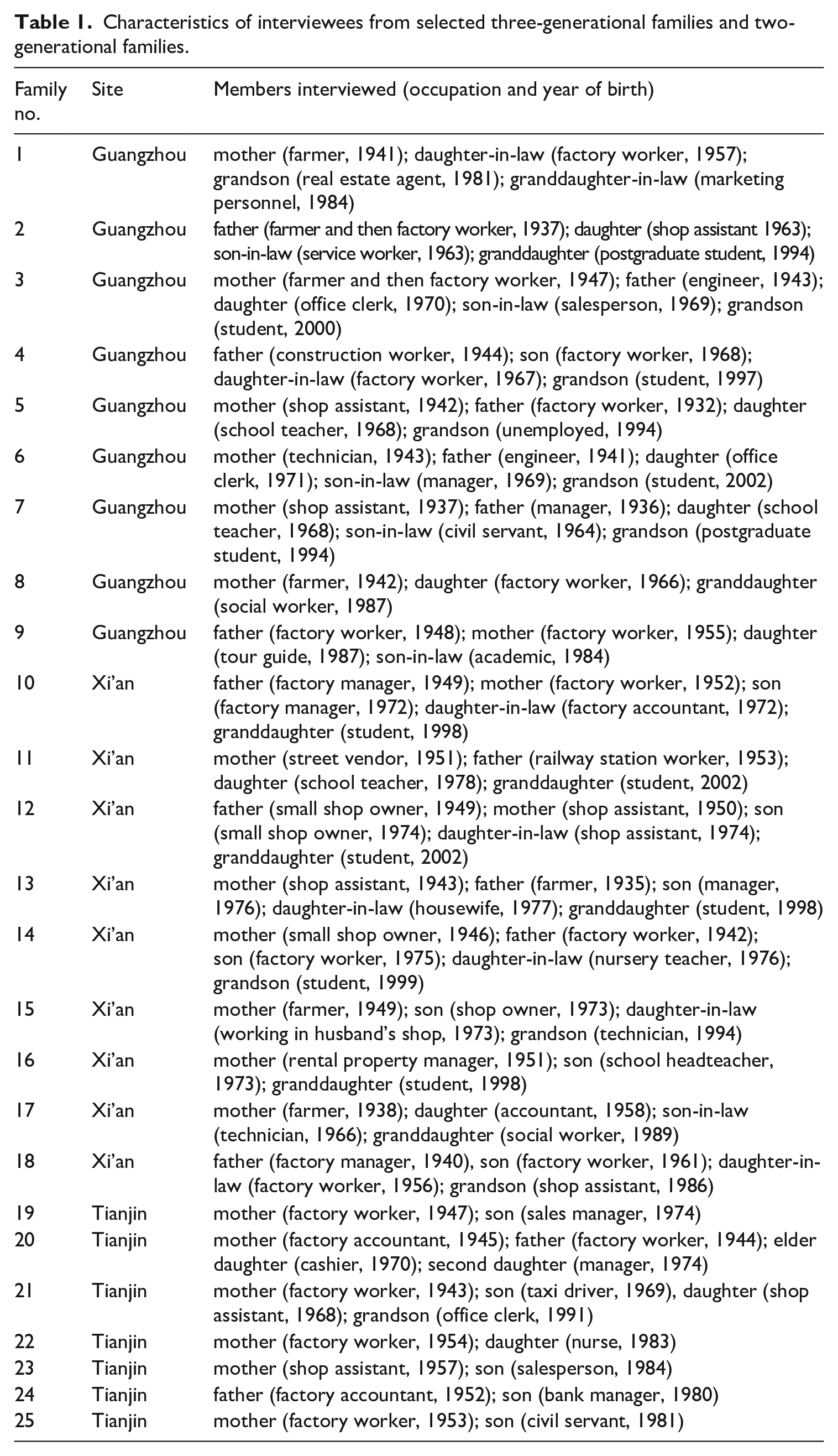
This article focuses upon urban families because the generational shift exacerbated by the one-child policy is mostly intensely felt in urban areas. The policy was strictly enforced in big cities and so over 90% of the urban interviewees born in the 1990s were the only child in the family. By contrast, the policy was modified in rural China in the 1980s to allow a family whose first child was a girl to have a second child. In the rural sample, interviewees who were born in the 1990s (over 95%) had at least one sibling.
Each interviewee was asked to recall his/her childhood first and then encouraged to take the lead. If not covered during the natural course of the ensuing conversation, specific questions relating to relationships with family members were asked. All interviews were recorded and fully transcribed. I applied a thematic analysis to each transcript to identify common issues that emerged from different transcripts in each generation. A further in-depth analysis of intergenerational relations was also undertaken for each household. Names and some identifying characteristics have been altered to maintain the anonymity of the interviewees. Childhood memories, as narrated by interviewees, covered a wide and broad range of experiences. The two themes that almost every interviewee touched upon were material circumstances and family members’ interactions – the focus in the findings below. Rather than presenting the stories of three generations from one single family unit, I present data from each generation across families in order to reveal common themes of generational shifts in urban families.
Findings – Childhood experiences
The older generation
The older generation recalled a childhood that consisted of a large family and was marked by poverty and hardship. Mother Wang, daughter of a factory worker, from Tianjin summarized: Ever since I could remember, life was harsh. Throughout the whole year, I hardly had any chance to eat stir fried dishes. When it was nearly Spring Festival, my mother bought some tofu and cooked it with sesame oil. That was indeed considered a treat. (born in 1943, four siblings)
The exception were children from elite families. Mother Zhou with four siblings, born in the same year and the daughter of a public servant in Guangzhou recalled: At that time [the 1950s] the Communist Party honoured technical talent so my father’s wage was relatively high. A worker earned 30 yuan per month but my father received over 100 yuan per month. In contrast with other workers’ families who hardly had the opportunity to have a full meal, we never experienced that. We always had food and clothes to wear and received education.
Because of the poverty and hardship most of this generation endured in childhood, the key function of the family unit was survival. Fei et al. (1992) described Chinese families in the 1940s as a cooperative economic unit with little space for expressions of feelings and emotions. This model confirmed the general childhood memories of this generation – when asked if he talked to his parents, Father Chen (Xi’an, born in 1942) replied: . . . [there was] nothing to talk about. How could we talk? Everyone was so busy making a living. There was hardly any time for us to sit down and have a chat. Every day was so tiring I just wanted to go to sleep when I had finished my chores, let alone chatting to parents. As long as parents didn’t scold us or hit us, that would be a luxury.
The pre-modern familial importance of age reverence also remained strong for this generation. Among both poor and elite families, a strict hierarchical relationship between parents and children was the norm. Mother Yuan, daughter of a government official (Xi’an, born in 1951) recalled: We were expected not to talk too much in front of parents. We were the junior generation, parents were the senior generation. My mother was extremely strict. All of us were beaten. I learnt how to raise my children from my mother. Her belief was that if you loved your children, you should beat them; if you spoil them, that is actually doing harm to them.
Although the majority of this generation recalled regular beatings from parents in childhood, in the context of a life lived at/below subsistence, there were moments in which they felt their parents’ love for them. Rather than in the expressive form, the general consensus of this generation was that love was represented in the act of giving and sharing. Mother Chen (Xi’an, born in 1946) recalled: ‘my mother brought home food from the community canteen; she gave the solid and better food to us children but she only ate soup herself’.
The middle generation
The majority of interviewees in this generation were born in the 1960s and early 1970s and, like the older generation, they also had four or five siblings. They grew up in a period of political chaos where class privilege was reversed; elite families now experienced upheaval. During the Cultural Revolution, Mother Zhou’s father was tortured and died in jail whilst she was sent to work in a chemical factory despite being a university graduate (something that would have otherwise guaranteed her a government bureau job). Mother Yuan’s whole family was sent to rural Shaan’xi for labour re-education and her sisters were forced to marry (unhappily) local farmers in order to survive.
Unlike elite families, interviewees born in ordinary workers’ families reported a relatively stable and carefree (albeit poor) childhood. Son Jing (Xi’an, born in 1972) was the youngest of five children: My father worked as a technician in a machine factory and my mother worked in a garment factory. At that time, we lived in the residential compound of the machine factory where my father worked. There were so many children in the family, we were poor but quite happy. I grew up in this compound, playing with the kids of our neighbours, who were my father’s colleagues. We were just like sheep herds, roaming around.
The Maoist period emphasized socialist production as well as various kinds of political and social movements, limiting the amount of time for family interaction. ‘I felt my mother’s main responsibility was to manage the household, to make ends meet. She didn’t spend much time with me because making a living was her No. 1 priority’ (Son Jing, born in 1972, four siblings). Son Jing also recalled that during the evenings both his parents were engaged in political study groups required by their work units. Unlike the older generation, almost all the mothers of this generation were engaged in waged occupation outside the home – an outcome of the Maoist mobilization of women into work (Liu J, 2007) and so older siblings generally looked after younger ones.
Like the older generation, age and generation reverence was still a very strong feature of this generation. Speaking of interactions with their parents, Son Yan (born in 1961, Xi’an, six siblings) recalled: If you have important things to report to your parents, you can speak to them. If not important and serious, you shouldn’t bother them. At that time, children felt seeing their parents was like a mouse seeing a cat. . . . I didn’t have many interactions with my mother. My mother worked in a textiles factory and also took some piecework home to do. After I came home from school, I often helped her to polish the scissors and knife and also massaged her legs to relieve her pain. Interactions with my father basically involved being beaten up. I was quite naughty when I was a child. At that time, parents didn’t have time to talk things through because they were so busy. If you made trouble, and others told your parents, they often hit you first without asking you to explain.
In this generation, children were expected to be obedient and follow parents’ orders. Communication was not a form of interaction deemed effective in raising children.
In contrast with the (generally) uneducated older generation, the middle generation did have some schooling by virtue of the Maoist drive to reduce illiteracy (although this was itself disrupted by the Cultural Revolution). For this generation, parental involvement in children’s academic work was non-existent or minimal. Son Yan (born in 1961) explained: Parents were only responsible for providing food and abode. We hardly communicated. Every day I went to school and then came home to help with household chores. At that time in school we didn’t learn much. Parents also didn’t pay attention to our academic study at all.
Similarly, Daughter Qin (born in 1963) recalled: All my siblings knew how to cook because our parents were so busy with their work. For my generation, we didn’t put emphasis on studies; everybody was the same. Parents were so busy, who could afford energy and time to pay attention to their children’s studies?
Younger generation
The interviewees from this generation were born between 1985 and 2002, with the majority in the 1990s. They were born in an era when China’s living standards improved considerably in contrast with earlier generations. It was also an era when the one-child policy was strictly implemented in urban China through workplace fines and punishment. These factors profoundly shaped childhood experiences. Parents invested whatever they had into the development of the only child they were allowed to have. As shown elsewhere (Liu J, 2007), those born in the 1980s became the pearl in their parents’ palm; a pattern which continued into the 1990s cohort. As Granddaughter Pan (Guangzhou, born in 1994) put it: What I remember deeply about my childhood was that every weekend, my parents took me to the park for play and then took me to eat dim sum afterwards. Ever since I could remember things, it was always like this. My parents bought lots of nice stuff for me to eat. They usually satisfied my ‘material’ requests.
In addition to the material investment in only children, this quote highlights that the concept of family leisure time had become a norm for this generation, an experience unheard of in the childhood of the previous two generations. Leisure time also implies an opportunity for more interactions between parents and children.
The Chinese media coined the terms ‘little empress’ and ‘little emperor’ for the spoiled urban only-child generation (Goh, 2011). Indeed, this cohort often did not need to do any household chores and never experienced the hunger or hardship that previous generations had encountered. However, whilst the material surroundings changed quickly, child–parent relationships were slower to develop. When asked to recall interactions with his parents, Grandson Dong (Guangzhou, born in 1994) said: During evening walks, I often asked my mother to buy me an ice cream; then she would make an offer – if I managed to recite several vocabularies, she would get me one. My mother was very controlling. For example, if I went to bed late, she would say that it was too late. If I stayed in my bedroom without going out, she would say that I was acting like a girl. My father really liked scolding me; perhaps he wanted to use this method to prevent me from being complacent in study. But one consequence is that I often feel insecure and lack confidence. After my parents scolded me, I felt awful. I was not allowed to answer back. Since I was little my father said to me, ‘you need to be filial towards your parents. You cannot answer back to your parents.’
Grandson Dong’s primary source of conflict with his parents centred around his passion for computer games, which the latter considered a hindrance to his academic studies. The concept of filial piety was cited by his parents as a mechanism to encourage him to comply with their request to study. Unlike the previous two generations who received beatings from parents because of their failure to perform household chores, the discipline and punishment experienced by this generation centred around academic study. This emphasis upon children’s academic study reached an unprecedented intensity during the growing up years of this generation (something common across families of different economic backgrounds) with children’s life routinized and regimented around the priority to study with everything else secondary and supportive of this ultimate aim.
The focus on scholarly endeavour is, of course, driven by job prospects. Prior to the 1990s, graduates of different levels were allocated jobs in work units by the state or inherited jobs from their parents when they retired, but since the 1990s, everyone must compete for jobs, and this concept of competition has left a deep mark upon the national psyche. Moreover, the neoliberal discourse around the knowledge economy (Kuan, 2015; Naftali, 2016) promotes the common understanding that good educational qualifications bring good job prospects with good economic returns and a good life.
An obsession with children’s academic studies clouded much of the parent–child interactions in this generation as they grew up and it shaped how individuality developed among this generation. Granddaughter Zhu (Xi’an, born in 1989) recalled: My parents were very strict with my study and didn’t give any space for my individual development. Every day as soon as I went home, I needed to study. If they saw me watch TV or play, they would criticize me. I really hated their approach to education. They criticized the way I sat, for example, if I didn’t sit straight with my head too low, or the way I held my pen. When I was not sure how low my head should be when studying, my parents tied my plaits to the ceiling light. They felt this would help me to avoid having a bent back or being near-sighted. I don’t know whether their way of educating was right or not, but I feel their approach was like a form of violence in my childhood.
In contrast with the previous two generations, talking was the main form of interaction between parents and children. However, the tone parents used to communicate with their children was still grounded in a ‘top-down’ manner which expected children to be subordinate and to take parents’ advice on their academic development. Like Granddaughter Zhu, many interviewees recalled that ‘criticizing/scolding’ featured far more than ‘complementing/praising’ in their communication with parents. Despite parents’ trying to satisfy children’s material requests as best they could, the majority recalled an authoritarian upbringing with an emphasis on academic study. Fewer than 5% of the interviewees reported that their parents adopted an egalitarian approach when supervising their studies.
Individuality was identified as an objective for children’s development by the intellectual elites in the early 20th century, although the achievement of it was compromised by other state agendas (Schwarcz, 1986). The introduction of the one-child policy, with the promotion of state policies designed to foster children as self-governing, individualistic labourers and consumers (Greenhalgh, 2011), led some to argue that contemporary Chinese childrearing and educational paradigms may reflect the construction of an increasingly influential ‘ethic of autonomy’ and individuality emerging among the one-child generation (Yan, 2011; Zhang, 2008). In contrast, the data indicate that this individuality is not cultivated by parents or state policies. Although children are cared for materially, the childrearing practices they experience reflect authoritarian methods.
A child’s path to individuality is varied and often arises from the processes of fighting against their controlling parents. Two ways of developing individuality were identified among the one-child generation. First, once they had satisfied their parents’ goal, the ultimate goal being to enter university, the child gained bargaining power for negotiating with their parents and exhibited a certain level of autonomy for how they would like to live their lives. The second was a process of constant negotiation between autonomy and obedience in the interactions with their parents. For example, Grandson Dong (born in 1994) recalled: I knew that I couldn’t use language to hurt my parents so I had to use the method of hurting myself in order to hurt them. Sometimes it was so awful. I couldn’t answer back so had to hit my head against my bedroom wall. Once I hit my head against the wall in front of them; my mother cried. Then my dad organized a family meeting and said that I need to be open and communicate with them. I said that they were too controlling. But after the meeting, nothing really changed.
Grandson Dong entered a cat and mouse game with his parents whereby he knew the time his mother would get home, and her habit of checking if the monitor of his games console was hot. He would make sure he switched off the monitor long enough for it to cool down in advance of her return. Granddaughter Wei (born in 2002, Xi’an) was contemplating studying outside China in order to satisfy her parents’ aspirations as well as her own desire to live independently: My mother hopes that I will stay in Xi’an. But I want to escape China. People around me always set a lot of requirements, including study and life path. One can never do a thing completely out of one’s own desire here. Therefore, I’d like to be away from home and as far as possible.
In the only-child generation, one-quarter of the interviewees did not manage to gain their individual autonomy beyond the childhood stage. Granddaughter Zhu (born in 1989) said: ‘Parents always think you have no autonomous thoughts, so they need to give you a direction and guidance or you will become bad. I was very obedient and didn’t fight. So they continue to dominate my life path.’ Her parents influenced her choice of occupation as well as decisions on dating and marriage. She wanted a divorce but dared not, because she knew her parents would not agree to it.
Discussion
The wider social, political and economic changes provide an important context for understanding the changes in the value of children in China. The following section employs Kagitcibasi’s analytical model to examine the three value types – economic/utilitarian, psychological and social values – to analyse the changing role of children in the family and highlights the gender differences in the value of children across three generations.
The utilitarian value
Utilitarian values are concerned with the economic/material benefits of children, both while they are young and when they become adults (Kagitcibasi, 2007). In China, the economic role undertaken by young children decreased dramatically over the three generations. The older generation revealed a variety of tasks undertaken by them from the age of five: helping with household chores, providing care to younger siblings/relatives, and assisting with parents’ work. Father Shen (Guangzhou, born in 1937) said: ‘At that time, the birth of another child meant another labourer for the family.’ For the middle generation, as children they cooked and cared for younger siblings, but were largely relieved from assisting their parents in labour outside the home since paid employment was allocated by the state work unit (see Liu J, 2007). For the younger generation, parents and their carers (mostly grandparents) took on household chores to maximize the study time of children; young children did not hold immediate utilitarian value to their families, and instead were an investment for the future.
The changing role of children is closely associated with the economic development and modernization of the infrastructure. In the 1950s and 1960s, there was no sink in the home and family members needed to fetch water from a local well. Most urban residents did not have access to a gas/electric cooker until the 1980s and needed to light a coal fire every time they cooked. With the introduction of modern facilities, such as mains connected water and electricity/gas, the time needed for household tasks reduced considerably, making it possible to relieve children of these duties. Further, the overwhelming emphasis on academic study in the younger generation meant the life of the only-child generation was completely oriented towards study.
While the economic value of young children decreased across the three generations, the economic value of adult children was non-lineal and far more complex. Many of the older generation lived on a Communist era pension which covered their food and living expenses. However, in times of illness and immobility, they relied on the instrumental support and personal care from their children – the middle generation. In a market economy, this care and support would have required money to purchase and thus the economic value of adult children was disguised by the unpaid familial care activities in parents’ old age.
When considering their expectations for old age, the middle generation expressed paradoxical desires, oscillating between relying upon their children and not relying upon them: I’ve been thinking about what I should do about my old age. I feel that I shouldn’t rely on my child. But I still have to rely on her. This is her obligation. If there is an old age home that suits me, I can go there but I will miss my child. I once said to my daughter that I will follow her wherever she is. She said that she wanted me to live with her so that I could clean her home and then her dad could help her with other chores. (woman from middle generation, Xi’an, born in 1974)
There are at least three layers in this reflection. First, the cultural norm of filial obligation required of adult children still played a role in old age arrangements. Second, the interdependence between adult children and aged parents is the dominant feature in Chinese families. The data indicated aged parents were not only expected to undertake household chores for their adult children, they were also important carers for grandchildren. Both parent and adult children interviewees agreed that since the concept of reciprocity was embedded in Chinese culture, there was an expectation that adult children should provide support and care for their ageing parents when needed. Third, the level of socialization of care remains low in China. Whilst there are stories of elite families (former government officials, fellows of the Academy of Science) having access to good quality institutional care, ordinary families find it difficult to access or afford an old age home of good quality. Further, there is still a general distrust of care services (including both childcare and old age care) provided by non-familial members; care by family members continues to be the preferred form of care in old age.
When considering their parents’ old age care arrangements, none of the younger generation hesitated in providing support as being filial is one of the most important personal virtues in Chinese society. For the younger generation, being filial entails providing all forms of support, including economic support. Whilst it is possible that declarations of filialness only arise in the context of an interview, as participants would like to project themselves as virtuous people, filial behaviours were revealed in the narratives; e.g. a 24-year-old young professional had already bought a private pension for his father as a gesture of gratitude for bringing him up after his parents divorced.
Psychological value
Psychological value is concerned with the joy, pride, love and companionship that children provide parents (Kagitcibasi, 2007). In both the older and middle generations, as their material circumstances were limited and families had many children, bringing children up was a burden which affected parents’ psychological attachment to their children. One interviewee said: ‘Hardships and poverty killed it.’ Another recalled: There were so many children so they were not precious any more. Sometimes we slept overnight outside in the summer, and if parents couldn’t find us at that time, they just let it be. As a fact, parents didn’t want to keep all their children.
In both generations, parents often sent away one or two children for a number of years to live with relatives who had fewer children or who were financially better off.
Because parents of the older generation were primarily concerned with their livelihood, and parents of the middle generation were so busy with their work, children recalled that their parents always seemed to be under great pressure. In this context, children became emotional outlets for their parents – not for parents to show their love, but to release their stress and anger. Many interviewees recalled that their parents ‘started to vent their anger and beat up the children over very trivial things when stressed or annoyed; children were the “Chuqi Tong” [outlet for releasing anger] for their parents.’
The poor psychological attachment to children was reversed in the younger generation following the introduction of the one-child policy. Daughter Dong (born in 1968) recalled: When my son was a baby, we were sleeping together in the same bed. . . . I often looked at him while he was asleep. I just felt that moment was so lovely. Perhaps this kind of emotional attachment towards him was a compensation for the lack of it when I was a child.
While she emphasized her love towards her son, this was the same mother who later in life pushed her son into a cat and mouse game over his use of the computer.
Related to the psychological value of children is the pride they give to their parents. In the Chinese context, this pride is closely associated with the concept of ‘face’ and the area in which children bring face to their parents in post-Mao China is academic attainment. Since academic achievement means good job prospects and good economic returns in future, the psychological value of children has become enmeshed with their economic value. The father of one of the only-child generation explained, ‘The child itself is the object of competition (panbi).’ The narratives of almost all only-child parents expressed emotional attachment to their children but for the majority, this was attached to him/her becoming a certain person according to the parents’ desires rather than loving the child as he/she is.
Whilst the psychological value of children in China has changed in the same direction as other modern industrial societies, the processes involved are quite different because the demographic transition behind the value change was the result of state interference. The number of children in each family dramatically decreased from an average of five or six in the first two generations to one in the younger generation so the changes in family life were compressed into a relatively short period of time. In another word, children in China have become emotionally precious, not as a result of the process of occupational and family change identified by Zelizer (1985), but more directly through the forceful implementation of the one-child policy. As an old Chinese saying puts it, ‘when things become rare, they become precious’ (Wuyixi weigui).
The social value
The social value of children refers to the general acceptance that married adults gain when they have children (Kagitcibasi, 2007). Across three generations, when asked ‘why did you have children?’ the consensus was that ‘after marriage, the next step in life is to have children’. If a couple did not have a child within a few years of marriage their relatives, friends and colleagues would gossip about whether they had reproductive issues. Culturally, being childless is considered unfilial in China and the social value of having children remained high across the three generations, albeit with a clear gender difference in the values attached to boys and girls.
Gender
The Chinese family traditionally prefers sons and in the older generation, son preference is most acute. One interviewee even reported that all his surviving siblings were boys, and all his sisters had died young. Girls took on a greater share of the care work and domestic chores at the expense of their own education. Mother Jin (born 1943) said: ‘I only studied until year 3 in primary school. This was because my brother’s wife had a child. I had to stop school and look after the baby.’ In the middle generation, son preference persisted. For example, daughters recalled that parents saved better food for their brothers and that boys’ education was prioritized. For the earlier two generations, boys were considered to have higher economic and social value than girls across all families – although the parents in these generations had a relatively poor emotional attachment to children. However, parents did have emotional favourites and the gender structure of children in the family played a part in this. If parents had both boys and girls, boys were more likely to be favoured due to the patrilineal tradition. But where a family had all boys, the birth of a girl would lead to a strong emotional attachment to the girl.
When the one-child policy was first introduced, sandwiched between familial patriarchy and state patriarchy, mothers who produced girls in the first cohort of the only-child generation still experienced some form of discrimination from their husbands and in-laws (see Liu J, 2007). However, son preference declined in the 1990s in the cities through the state’s strict implementation of the one-child policy. Studies have found no gender differences in educational achievement in single-girl and single-boy families (Tsui and Rich, 2002) and that urban girls have been empowered through unprecedented educational investment by their parents (Fong, 2004; Liu J, 2007). In this study, the majority of urban only-child girls had university degrees and held professional jobs. Over 95% of the urban only girls did no housework (like their male counterparts) and, after marriage, remained close to natal parents from both an emotional and practical perspective (e.g. their parents regularly assisted with cooking and everyday chores) (see also Liu J, 2016b). In turn, urban only girls were expected to provide old age support to their natal family when needed. As the economic value of daughters increased, their social value also increased. Among married interviewees from the younger generation, men and women generally had no gender preference for their only child. Following the introduction of the two-child policy in 2015, many interviewees commented that the best demographic picture is to have a boy and a girl.
The comparison of the three generations in urban China revealed a path that diverted from the model of total interdependence described by Kagitcibasi (2007). The interactions between the middle and younger generations were somewhere between the model of total interdependence and the model of emotional interdependence. From the middle to the younger generation, the immediate economic value of the younger generation dramatically decreased, son preference decreased and the psychological value of children increased – all of which conform to Kagitcibasi’s model of emotional interdependence. However, China does not fit with this model in four respects. First, adult children were still considered the main providers of care in old age for the middle generation – the outcome of the culture of filial piety, preference of familial care and low level socialization of care. Second, the causal link between the decrease in the economic value of children and the increase in their psychological value as described in Kagitcibasi’s model did not exist in the younger generation. The sudden increase in the psychological value of the only-child generation and reduced son preference were mainly driven by the state’s one-child policy. Third, instead of the psychological value of children being the main reason for having children, the social value of children determined by cultural expectations was the overwhelming drive for having children in all generations. Finally, in contrast to the authoritative parenting featured in this model of emotional interdependence, the younger generation in China predominantly experienced an authoritarian upbringing in relation to their academic study offset by greater material wealth.
Conclusion
There has been a profound and rapid transformation in the experience of childhood in urban China. The role of children in the family has transitioned from being labourers and domestic helpers to being aspirant academic achievers. While parent–child communication has increased from the middle generation to the only-child generation, the authoritarian nature of parental guidance and teaching has remained persistent across the three generations. Today China has become a child-centred society but the younger generation are hardly autonomous individuals. Instead they are under greater control and expected to follow a path designed by their parents. Overwhelmingly oriented towards academic achievement as conditioned by neoliberal market and state forces, the childhood of the only-child generation is increasingly regimented instead of individualized. These continuities and transformations provide the critical contextual background for understanding the change in the value of children in China.
This article challenges the assumption of industrialization as the dominant force impacting family life. The unique socioeconomic, political and cultural processes in China (economic development, marketization, one-child policy, filial piety and gender) are critical in shaping the value of children across three generations. The strict implementation of the one-child policy compressed the process of fertility decline to only one generation in urban China. Given only one child was allowed per family, the psychological value of children dramatically increased. In a society with the traditional Confucian ideology of son preference and ancestor worship, this brought about tremendous social and familial challenges, contributing to the increasing value of girls in urban Chinese families.
The persistence of moral ideals of filial piety, exacerbated by the economic and welfare uncertainties (see Liu and Cook 2020), witnesses the continuing economic value of adult children in parents’ old age support. Rather than being trapped in a lineal progression model, the urban Chinese case reveals a complicated and paradoxical mixture of continuities and changes: while the economic value of children as family helpers has dramatically reduced across three generations, the economic prospect of children as old age security goes hand in hand with the increasing emotional value of children.
Footnotes
Acknowledgements
This article draws upon data from a larger project ‘Doing Intimacy: A Multi-sited Ethnography of Modern Chinese Family Life’. I would like to thank Gu Xiaorong, Wei-Jun Jean Yeung and all the participants at the Value of Children in Asia workshop for their stimulating discussions, which helped me shape the article. I would also like to thank anonymous referees and Colette Harris for their constructive feedback when revising the manuscript.
Funding
The larger project on which this article draws, ‘Doing Intimacy: A Multi-sited Ethnography of Modern Chinese Family Life’, is funded by the European Research Council (no. 640488).
