




Abstract
The concept of assemblage has recently become fashionable in studies of cross-border, global and transnational relations. In addressing the most important elements of this approach, the article provides an analytical vocabulary for analysing the processes of societalization in the context of global and transnational realms. After critically reflecting on the classical sociological approaches to society and social differentiation, the article argues that, because of its poststructuralist basis, the concept of assemblage is the appropriate conceptual tool for studying societal macro-relations of power and inequality while avoiding the modernist heritage of classical social theory. Furthermore, by synthesizing poststructuralist thinking, intersectional theory and multiscalar approaches to space, the article suggests that the assemblage theory can be used to better understand the current forms of cross-border social inequalities in the multiple and partly overlapping contexts of postcolonialism, postsocialism and the EU political project. In a nutshell, it is not a plea to adopt the assemblage approach as a new ‘grand theory’ but rather as a flexible conceptual tool that allows an inductive theory-building.
Introduction: Starting a dialogue between theories of society and cross-border studies
In the increasingly interconnected, globalized world, theories of society and theories of modernity (Giddens, 1990; Luhmann, 2012; Meyer et al., 1997) seem to be losing their ability to reflect ‘general’ societal trends. Particularly the cross-border studies, such as those on global (Burawoy et al., 2000) and transnational relations (Faist, 2000; Levitt and Glick Schiller, 2004) including postcolonial (Chakrabarty, 1992; Go, 2013; Guha, 2002) and decolonial (Mignolo, 2011) approaches, have criticized the modernist heritage of the classical sociological vocabulary for its inability to approach cross-border entanglements, its intrinsically Eurocentric notions, and its functioning as hegemonic forms of sociological knowledge (Boatcă, 2016; Connell, 2007; Patel, 2018). At the same time, theorists of society cast doubt on the theoretical concepts to global, transnational and postcolonial relations, arguing that these approaches must still develop their full explanatory potential (Holzer et al., 2014; Weiss, 2017). Not only have they been accused of lacking the vocabulary to conceptualize societal processes on the macro-level, but they have also been criticized for the inconsistent and contradictory use of terms and definitions and for emphasizing cross-border relations over national variables.
This article introduces the concept of cross-border assemblages (Amelina, 2017) to offer a sociological toolkit for responding to the challenges of both theories of society and theories of cross-border relations. Assemblage theory goes back to the poststructuralist writings of Gille Deleuze and Félix Guattari (1987), who viewed ‘assemblages’ as processual yet structure-like social configurations that temporarily bring together various social layers and several quite dissimilar elements. As the notion of assemblage increasingly appeared in the different fields of social and cultural sciences (Puar, 2007; Rabinow, 2003) – despite its reception in social theory (DeLanda, 2002) and studies of global relations (Collier and Ong, 2004; Sassen, 2006) – it became particularly evident in studies in science and technology (Latour, 2005; Müller, 2015).
This article seeks to theorize cross-border assemblages while considering both the complexities of large-scale societal relations and the entanglements of cross-border practices. First, the article suggests using the notion of cross-border assemblages to approach societal macro-entities such as postcolonialism(s), postsocialism(s) and EU-Europe that include dissimilar and heterogeneous elements. This proposal aims to overcome specifically modernist conceptions of societal differentiation such as those exemplified by the (Bourdiesian) theories of social space and social fields, which often reconstruct societies as container-like (and/or internally differentiated) entities (i.e. Bourdieu, 1985, 1996). Second, the proposed view emphasizes processes over structures: the concepts of entangled and/or shared histories (Conrad and Randeria, 2002; Randeria, 2002) became essential for conceptualizing the processuality as well as the entangled histories of inequalities and oppressions in a cross-border realm. The third conceptual element is the analysis of cross-border assemblages as multiscalar configurations. The focus on spatial multiscalar constellations such as global–local and national–transnational became essential in order to avoid thinking of societies as container-like, territorially bounded entities. The mutual shaping of multiple spatial scales is studied as articulated within specific assemblages such as the postcolonial or postsocialist configurations or the societal context of EU-Europe. Finally, the concluding comments outline the methodological consequences of assemblage thinking. Despite approaching cross-border assemblages as societal entities located on the macro-scale of analysis, the inductive heuristics in empirical research call for equal attention to be paid to the meso- and micro-level processes. Such inductive heuristics are compatible with diverse epistemologies and multiple positionalities in studies of cross-border societal relations (Haraway, 1988).
However, before introducing the core elements of the sociological interpretation of assemblage theory in detail, I will briefly outline the modernist heritage of early theories of globalization and world society and then offer some insights into the use of assemblage thinking in studies of cross-border relations.
The modernist heritage in theories of globalization and world society
Why do many studies of global, transnational and postcolonial/decolonial relations contest the classical heritage of theories of society? One reason for this critical reflection lies in the modernist roots of many of the early theories of global societal relations. Anthony Giddens’ (1990) analysis of globalization as a ‘consequence of modernity’ is one of such prominent approaches: ‘“Modernity” refers to modes of social life or organisation which emerged in Europe from about the seventeenth century onwards and which subsequently became more or less worldwide in their influence’ (Giddens, 1990: 1). In a similar way, neo-institutional sociology has replicated the Eurocentric lens in its analysis of global social relations (i.e. Meyer et al., 1997). John Meyer (1987) has prominently argued that the dominant institutional ‘world culture’ of rationality does globally reproduce Western cultural patterns by providing meaning and legitimacy to social action. In particular, three forms of Western institutional culture have received global validity – the cultural models of nation-states, of organizations and of individuals – which have been transferred to different world regions via processes of global cultural diffusion, contributing to cultural isomorphism.
The transmission of the analysis of ‘Western’ societies to the analysis of ‘non-Western’ and cross-border settings is also evident in Niklas Luhmann’s theory of world society (1982, 2012). Utilizing the Durkheimian notion of societal differentiation, Luhmann imagines world society as differentiated into various (functional) subsystems/domains (politics, economy, science, religion, art, care, family, etc.), each of which is reproduced by building on its own internal logic. According to Luhmannian differentiation theory, spatial boundaries matter only for the political system, which is internally organized into nation-states, while other subsystems might have different forms of international differentiation (such as segmented or centre–periphery differentiation) (see the article by Anja Weiß, in this issue).
The Eurocentrism, and the modernist origins, of the differentiation theory was probably one reason why some scholars of cross-border relations were hesitant in transferring Pierre Bourdieu’s theories of society to the analysis of global and transnational relations, the main components of which are the concept of social space (1984, 1985) and the theory of social fields (1991, 1996). Though several attempts have been made (Faist, 2000; Pries, 2008) to build on the concept of social space to analyse, in particular, the transnational relations that emerge in the process of migration and that generate ties between migrant-sending and migrant-receiving countries, Bourdieu’s special interest in stratification of social positions within the social/societal space has not been adopted in these readings. In a similar vein, Pierre Bourdieu’s ideas of society as differentiated into multiple social/societal fields (though some interesting attempts have been made to use them, especially in analysing transnational social relations [Levitt and Glick Schiller, 2004]) have remained limited because of several analytical problems in modernist differentiation theory, such as the overemphasis on structures over processes, the underestimation of processuality of fields, and the underthematization of cross-border asymmetries in power and knowledge (Hilgers and Mangez, 2015). Such conceptual caveats have prevented an extended application of Bourdieusian social space or social field theories to the analysis of cross-border societal relations and the respective dynamics of power and inequality.
These brief, and by definition incomplete, insights indicate multiple problems in a deductive application of Western sociological theory to non-European contexts and cross-border (global, transnational, supranational) societal settings. The first challenge is the transmission of European concepts of societal structuration and differentiation to the analysis of cross-border societal relations, which implies a continuation of the modernist heritage of sociological thought and its Eurocentric notions. Use of the differentiation theory (in the way indicated) inevitably implies an overemphasis on structures over processes and agency. It suggests that ‘stasis’ is the conventional condition/state of the societal relations (Venn, 2006). The second problem with the approaches cited is their ignorance of the entangled forms of oppressions and inequalities (Boatcă, 2016). Though Western institutional patterns or forms of differentiation are considered dominant, the inequality-related consequences of their hegemony are somewhat underproblematized (Patel, 2018). A third challenge facing the early theories of globalization, world polity and world society approaches is the analytical confusion of large-scale societal processes and (socio-)spatial processes. Though spatial relations are elements of societal orders, societal orders cannot be reduced to spatial relations alone. Instead, scholars would benefit from a conceptual vocabulary that clearly differentiates between large-scale societal entities (approached here as ‘assemblages’) and processes of cross-border spatialization (i.e. ‘globalization’, ‘transnationalization’, etc.) (Amelina, 2017). A fourth problem with the abovementioned approaches is their hegemonic/top-down view of cross-border societal relations, which derives from the (male, white, middle-class, Global North–centred) positionalities of the respective authors in the ‘global’ academic arena (Connell, 2007). Not only have the cited scholars postulated the (partial) transfer of Western forms of societal relations to non-Western and cross-border contexts in the course of ‘globalization’, they have also implied that the analysis requires ‘Western’/classical sociological vocabulary, which prevents the consideration of non-Western sociological voices and the indicative ways of thinking when analysing cross-border societal relations. But why is the assemblage theory a fruitful tool for addressing these challenges when one is studying cross-border societal relations?
The theory of assemblage perspective in social and cultural sciences: Heterogeneity and processuality as core elements
In response to the question posed above, I will now present a brief genealogy of the assemblage theory (Deleuze and Guattari, 1987), its use in the interdisciplinary studies of globalization (Collier and Ong, 2004; Sassen, 2006) and urbanization (Farías and Bender, 2010), and its benefits for the conceptualization of large-scale societal relations as ‘cross-border assemblages’. Over the past three decades the assemblage theory has received attention in various disciplinary fields of social and cultural sciences, including social theory, science and technology studies, social-anthropological research and gender studies (e.g. DeLanda, 2002; Latour, 2005; Puar, 2007; Rabinow, 2003). Originally, the concept of assemblage was prominently coined by the poststructuralist thinkers Gille Deleuze and Félix Guattari in their seminal work A Thousand Plateaus (1987). Their philosophical construct of the assemblage aims: … to mediate the two classic varieties of modernist thought: the playful and critically aesthetic (of the ‘art and architecture’ tradition of modernism) and formal and technical (of math, set theory, topology). The one indulges and even celebrates the intractably unpredictable and contingent in rapidly changing contemporary life; the other hopes for the understanding of the structural principles of order (or disorder) within the play of events and processes. (Marcus and Saka, 2006: 103–104)
The first argument for adopting assemblage thinking for studying cross-border relations is its emphasis on the heterogeneity of elements that constitute an assemblage. In Deleuze and Guattari’s reading, the basic understanding of an ‘assemblage’ implies a continuously changing, temporary nexus of a variety of dissimilar elements, which form a relational nexus (Deleuze and Guattari, 1987). Thus, the logic of an assemblage is ‘the rejection of unity in favor of multiplicity’ (Nail, 2017: 22). Assemblages are therefore configurations defined ‘solely by their external relations of composition, mixture, and aggregation’ (Nail, 2017: 24). Consequently, if we adopt this reading, we can argue that large-scale societal relations that span the territorial borders of political communities (postcolonialisms, postsocialisms and EU-Europe being some examples) can be grasped according to the notion of ‘cross-border assemblages’. The latter can be seen as societal configurations consisting of heterogeneous but relationally linked elements – discursive utterances, institutions, configurations of social practice, patterns of inequality, bodies, technologies, material artefacts, etc. – that are temporarily coupled to each other.
The second useful aspect in theorizing about large-scale societal relations in the cross-border realm is the assemblage-theoretic emphasis on processuality. The logic of an assemblage as a ‘fragmentary whole’ goes hand in hand with the analytical ‘rejection of essence in favor of events’ (Nail, 2017: 22). This privileged treatment of ‘events’ as elements constituting an assemblage signifies the privileged treatment of processuality (Nail, 2017: 24). This way of thinking invites us to consider the temporary nature and the entangled histories of cross-border, large-scale societal relations. In other words, cross-border assemblages can be analysed as both ‘structure-like’ entities and processes of constant social change.
At the same time, global and urban studies have adopted and frequently used assemblage theory (Collier and Ong, 2004; Latour, 2005; Sassen, 2006). Despite divergences and inconsistencies in its interpretation, they all share two significant aspects that are fruitful in analyses of cross-border relations: the explicit theorization of spatiality. One of the most prominent examples of the study of cross-border spatiality in this theoretical realm to be mentioned here are the writings of sociologist Saskia Sassen (2006). Sassen utilizes assemblage thinking as a conceptual tool to denote hybridity, which accompanies global reconfigurations of power relations vis-a-vis various spatial settings. Although she claims to use ‘the concept assemblage in its most descriptive sense’, in the sense of ‘the dictionary term’ (Sassen, 2006: 18), she builds on this heuristic to approach the ‘epochal transformation’ in configurations between ‘territory’, ‘authority’ and ‘rights’ – from the national to the global configurations of assemblages. Accordingly, the global (digital) age is characterized by the ‘multisited, transboundary networks and formations’, with nation-states being part of globalization, since current states are ‘oriented towards global agendas and systems’ (Sassen, 2006: 18). This way of thinking benefits the analysis of cross-border societal relations, since it avoids the essentialist view on cross-border spatiality as a conceptual given.
Another important aspect we can identify among the assemblage-affine studies of global relations is the open, flexible and ‘opportunistic’ nature of assemblage vocabulary, since it has been used in research at various levels of analysis – macro, meso and micro. Whereas Saskia Sassen heuristically utilizes the assemblage theory to develop a large-scale analysis of globalization processes, the concept of ‘global assemblages’ put forth by Stephen Collier and Aihwa Ong (2004) proposes a ‘middle-range’ theorizing of cross-border processes. Collier and Ong’s global-assemblage approach introduces the category of ‘globality’, which serves as an analytical tool to mediate between the micro-level and the macro-level of analysis: ‘As a composite concept, the term “global assemblage” suggests inherent tensions: global implies broadly encompassing, seamless, and mobile; assemblage implies heterogeneous, contingent, unstable, partial, and situated’ (2004: 12, emphasis in original).
The last studies I will mention are the urban studies that focus mainly on the micro-level of analysis (Farías and Bender, 2010). Many of these have been inspired by Bruno Latour’s actor–network theory (2005) and its adaptations (Müller, 2015), which centre on ‘social associations’ between multiple human and non-human actors. In his writings, Latour uses mainly processual expressions such as ‘the assembled’, ‘assembling’, or ‘reassembling’ (Latour, 2005: 1) to highlight that the ‘social’ is ‘not a homogeneous thing’, but a ‘trial of associations between heterogeneous elements’ of human and non-human kind that are always temporarily stabilized (Latour, 2005: 1). 1 Inspired by this reading, proponents of ‘urban assemblages’ (Farías and Bender, 2010) draw attention to the various urban configurations of artefacts, technologies and spatial mobility, while criticizing researchers who analyse urban spaces as closed and coherent entities (Farías and Bender, 2010). Accordingly, urban spaces are co-constituted by ‘human and non-human aspects of cities – from nature to sociotechnical networks, to hybrid collectivities, physical artefacts and historical legacies’ (Farías and Bender, 2010: i).
To conclude, the diffusion of the assemblage vocabulary across different research fields – and, more importantly, different levels of analysis – can be interpreted with reference to the opportunistic and open nature of assemblage theory, which (as the concluding section will indicate below) is highly beneficial for the analysis of cross-border relations because of its affinity to the inductive way of thinking.
Cross-border assemblages link dissimilar elements to each other
How do we avoid the modernist heritage of the early globalization theories and theories of world polity/society that rests in the imagination of society as a coherent and consistent unit (with homologous subunits) and in the overemphasis on coherent structures and causal relations in the processes of societal organization? Addressing this question, I suggest that we approach large-scale societal configurations (such as postcolonialisms, postsocialisms and EU-Europe, among many others) as cross-border assemblages – flexible and temporary societal macro-settings that contextualize cross-border relations. Being incoherent and inconsistent, these settings link dissimilar elements – discursive utterances, institutions, sets of social practice, patterns of inequality, bodies, technologies, material artefacts, etc. – to a relational (though inconsistent) societal realm.
This emphasis on the relationality that conjuncts cross-border heterogeneous elements is, in my view, a great advantage for theorizing large-scale processes of societalization, since it allows us to reconceptualize the classical ways of approaching ‘society’ and ‘societal processes’ beyond the container-like concepts of society as a consistent unit, which either consists of vertically structured, hierarchically organized social (class) positions (e.g. Bourdieusian perspectives on social space) or is differentiated into more or less autonomous institutional domains (e.g. Bourdieusian perspectives on social fields). Loosely referring to Pierre Bourdieu’s concepts of ‘social space’ and ‘social fields’ in place of the many sociological theories on both types of societal structuration, this article suggests differentiating between (1) the domain-spanning assemblages, to reinterpret social space-like approaches, and (2) domain-specific assemblages, to rethink the social field-like theories that focus on differentiation in institutional domains. While ‘domains’ have conventionally been defined in a Durkheimian sense as separate institutional macro-configurations characterized by specific institutional logics, the proposed interpretation of the term attempts to avoid the notion of coherence and a homologous structuration/organization of ‘domains’. In other words, Bourdieusian (and similar) approaches (1984, 1985, 1987) to large-scale societal processes tend to highlight ‘causal determination within the logic of causal stability and linear causality’ (Venn, 2006: 107), while the assemblage perspective makes it possible to consider heterogeneity, temporality and change more explicitly.
Postcolonialisms, postsocialisms and EU-Europe as cross-border assemblages spanning institutional domains
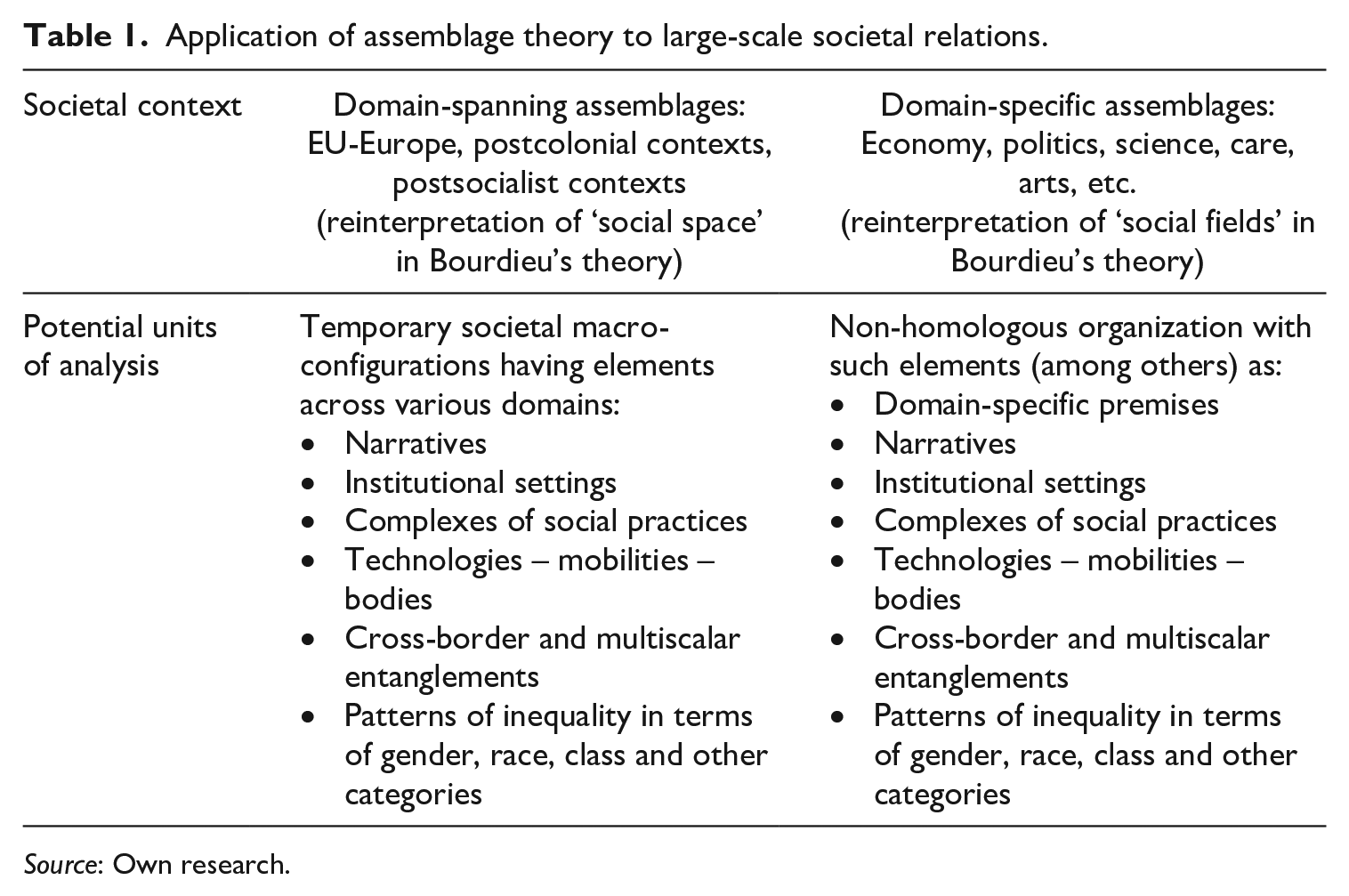
Re-reading Bourdieu’s notion of social space in a Deleuzian manner, I suggest replacing the former (and similar approaches) with the concept of domain-spanning cross-border assemblage, with postcolonialisms, postsocialisms and EU-Europe as some of its variants. This concept refers to temporary, relationally organized societal configurations, the elements of which may appear in various institutional domains (i.e. economy, politics, law, arts, science, care, etc.) and/or may span less institutionalized societal settings of informal social relations (Table 1). Such domain-spanning assemblages include (among many other elements) narratives, institutional settings, complexes of social practice, technologies, mobilities, bodies and cross-border/multiscalar entanglements, but possibly also domain-spanning patterns of inequality related to axes of gender, race, class and other categories (Amelina, 2017). Moreover, various types of domain-spanning assemblages can intersect. For example, approaching postcolonial relations as domain-spanning assemblage(s), we can pay closer attention to inconsistencies between its heterogeneous elements, since the postcolonial nexus includes racial and gender ideologies, continuously reproducing the relationship between domination and subordination, and complex multidimensional hierarchies that span borders and regions (Go, 2013). The dominant symbolic horizon of postcolonialism(s) is the imagination of the (past) supremacy of the colonizers, on the one hand, and the trauma of conquest of those colonized, on the other (Chakrabarty, 1992).
Application of assemblage theory to large-scale societal relations.
Source: Own research.
In a similar vein, multiple postsocialist relations can be grasped according to the notion of the domain-spanning assemblage(s). Postsocialism(s)’ symbolic horizon combines memories of socialist and simultaneously imperial projects of equality (Morozov, 2015). While socialist notions of equality go back to Marxist thinkers whose ideas were translated across the globe into real-life habits (for details, see Arnason, 2005), the imperial project has both the Eurocentric origins of the socialist project’s universalist claims and the imperial reproduction by the Soviet (and now the Chinese) empire (Arnason, 2005). The dissimilar elements that domain-spanning assemblage(s) link together include not only socialist ideologies of (gender) equality, but also a variety of authoritarian forms of governance – daily routines some of which might be quite similar in Cuba, Belorussia and North Korea – as well as hidden forms of resistance.
To add one more example, I do argue that the notion of a domain-spanning assemblage is also instructive for analysing societal relations of current EU-Europe. The symbolic horizon of the EU (as a domain-spanning assemblage) rests on tensions between the modernist discourse of equality (Rumford, 2008) and the neoliberal rhetoric of prosperity (Beck, 2006). This tension generates a continuous struggle over European membership that produces multiple (racialized, gendered and classed) inclusions and exclusions to be found in different institutional domains (Mezzadra and Neilson, 2013). The dissimilar elements related to the EU project are not only the discursive utterances mentioned, but also concrete institutional structures (i.e. polities and policies of open coordination), multiscalar forms of political governance, the technologies of surveillance and digital consumption, and (among many other things) bodies of the included and excluded (Mezzadra and Neilson, 2013). 2
This outlook questions the conventional Bourdieusian theories of social space, since they imply the notion of coherent structures and clear-cut casual determinants of societal relations. In particular, this allows us to more explicitly consider heterogeneity, temporality and change.
Why to approach domains as cross-border assemblages?
The subsequent reconceptualization of the field-like/domain-centred approaches suggests that ‘social fields’ (i.e. economy, politics, law, arts, science, care, etc.) can be rethought as domain-specific assemblages. These temporarily stabilized, relational macro-settings may include (among many other elements) domain-specific premises, domain-specific narratives, institutional settings, complexes of social practices, technologies, mobilities, bodies and cross-border and multiscalar entanglements, as well as patterns of inequality in terms of gender, race, class and other categories (see Table 1). To give an example, capitalist assemblage(s) are not only the nexus of markets, knowledge systems and logic of capital accumulation, but also multiple sets of technologies and bodies linked to gendered, racialized and class-related hierarchies. While some domain-assemblages may be more formalized/institutionalized than others and may include an explicitly articulated, specific logic (i.e. ‘rules of the game’, in Bourdieusian language), such a logic should not be seen as an essential, indispensable feature of all domains.
Of particular importance in the analysis of domain-specific assemblages is the analysis of cross-border inequality formation. 3 The emphasis on the heterogeneity of the elements of an assemblage makes it possible to consider the interplay of multiple dissimilar forms of inequality. Here we can think of hierarchies as constituting both (a) hierarchies in domain-related resources that result from domain-specific premises (i.e. capital accumulation in the capitalist assemblage, scientific reputation in the assemblage of science, or emotional proximity in the assemblage of care) 4 and (b) hierarchies that emerge through the intersection of multiple ‘axes of difference’ (in terms of ‘gender’, ‘ethnicity’/’race’, ‘class’, ‘space’ and many other categories). In other words, in many (but not all) cases, inequalities within domain-assemblages might be articulated as an unequal distribution of domain-specific resources; nevertheless, one can also view these domain-specific inequalities as being co-generated by gendered, ethnicized/racialized, class-related, and possibly other forms of hierarchical boundary-making (for details, see Amelina, 2017). Let me illustrate this point by returning to the example of the capitalist assemblage: the unequal social positions within this domain are formed by the unequal distribution of economic resources within and across state borders, by decision-making in the institutional settings of economy, by access to specific positions in the labour markets, and so on (e.g. Sklair, 2001), but at the same time they are related to the multiple markers of inequality in terms of gendered and racialized inclusions and exclusions (Becker-Schmidt, 2007). The formation of the latter can be seen, for instance, in the capitalist privileging of specific (male) forms of cross-border spatial mobility (the highly skilled male worker) and the accumulation of labour market disadvantages for mobile migrant women (Anthias et al., 2013).
This outlook allows us to rethink classical notions of the domain-centred approaches to societal structuration and differentiation as following the only dominant ‘European’ pattern. While the social fields are viewed as more or less coherent subunits of society or of social space, assemblages are configurations with no homologous nature (Nail, 2017), even though some of them might include something that (Western) sociologists would call ‘field-specific’ logics. The assemblage theory, however, allows us to pay more attention to the cross-border conjunction of dissimilar elements, such as those articulated in patterns of complex multidimensional hierarchies within and across domains.
Cross-border assemblages: Entangled histories and cross-border inequalities
One of the key advantages of the assemblage theory is its emphasis on temporality and processuality, which allows us to consider both entangled histories of cross-border assemblages (postcolonialisms, postsocialisms, etc.) and cross-border forms of oppression and inequality. On the one hand, Deleuze and Guattari saw ‘assemblages’ as ‘structure-like formation(s), a describable product of the emergent social conditions’ (Marcus and Saka, 2006: 102). On the other hand, ‘assemblages’ are constantly in the process of continuous change, producing ‘enduring puzzles about “process” and “relationship”’ (2006: 102). This notion of the duality of structure and process is an instructive attempt to ‘[think of] structure as well as multiplicity and indeterminacy within the same theoretical framework’ (Venn, 2006: 107). From this angle, the theory of cross-border assemblages proposed here can be conceptualized as non-static, changeable configurations, which implies an analytical emphasis on the processes of formation and change within the cross-assemblages. The emphasis on processuality has two significant implications for the theorization of cross-border assemblages. First, it invites us to think about a proper conceptualization of social change across borders – with the concept of the entangled histories being most helpful here – and second, to consider an analytical framework within which to grasp complex (intersectional) patterns of cross-border inequalities (in terms of gender, ethnicity/race, class, space, caste, etc.) that are linked to these processes.
The concept of the entangled history (e.g. Randeria, 2002) allows us to analyse historical processes as being of ‘networked quality’ through which a series of specific events bring together various (distant) actors, narratives and institutions, with slavery (Gilroy, 1993) and the Cold War (Arnason, 2005) being prominent examples. Accordingly, scholars are invited to reconstruct historical processes of entanglement from heterogeneous social elements that occurred at different points in time across borders of political entities (Epple, 2010). The heuristics of the entangled history can be applied to studies of both postcolonial relations (Chakrabarty, 1992; Guha, 2002) and postsocialist relations (Chari and Verdery, 2009; Stenning and Hörschelmann, 2008) and can also be used to reconstruct the cross-border history of EU-Europe (Rumford, 2008) that emerged from the interplay of complex, contradictory and entangled components. At the same time, entangled histories can be studied as shared histories in the sense that different social interpretations and memories might be attributed to the same series of events (i.e. colonization) by different social actors. To wrap up, by studying entangled histories, we can study ‘the conjunction processes of diverse and dissimilar elements to an assemblage’ (Amelina, 2017: 78).
What analytical framework will allow us to approach complex patterns of cross-border inequalities as linked to these processes of entanglement? Context-sensitive intersectional theory is a helpful tool here: in the main, it suggests analysing the interplay of various types of social inequalities/oppressions (in terms of gender, ethnicity/race, class, sexuality, health/disability, life-course/age, space and caste, and possibly some others) (Amelina and Lutz, 2019; Hancock, 2007; Walby, 2009). ‘Interlocking systems of oppression’ (Collins, 2000) and ‘multiple jeopardy’ (King, 1988) are the prominent heuristics for grasping the mutual shaping of ‘axes of inequality’. Although the origins of intersectional theory can be found in black feminism (hooks, 1991), and various versions of intersectional theorizing exist (for an overview, see Hancock, 2007; McCall, 2005), the reading preferred here centres more explicitly on processes of social classification and categorization (Amelina, 2017).
The main strength of combining the entangled-histories approach and intersectional theory is their interest in the emergence of hierarchical patterns within the context of cross-border entanglements. In this reading, many cross-border inequalities can be seen as spanning across institutional domains. Paradigmatic examples can be found in the research on contradictory social mobility (Goldring, 1998; Parreñas, 2001), which is experienced by mobile individuals, especially skilled migrants who belong to the middle class in the Global South or Global East but (simultaneously) confront the devaluation of their social position in the migration-receiving countries of the Global North. The term contradictory social mobility indicates the inconsistency in and multilocality of the social positions of mobile individuals in the cross-border realm who situate themselves simultaneously in the social stratification orders of multiple countries/contexts. Moreover, such an analysis of cross-border inequalities is not limited to analyses of transnational/cross-border linkages with regard to the class position of (mobile) individuals. Floya Anthias (2012) has used the concept of translocational positioning to show that in the cross-border realm (generated by transnational migration and other forms of entanglements), many (mobile) individuals are confronted with multiple positioning in terms of gender, ethnicity/race and class vis-a-vis the social stratification orders of the sending and receiving countries. Such transnational or cross-border hierarchies should be studied by paying particular attention to how (multiscalar) cross-border settings (such as those of sending and receiving countries and/or localities and/or between the global and the local spatial scales) co-produce specific stratification orders, the meaning of which sometimes loses clarity and fixity. Such patterns of cross-border inequalities can be studied in relation to both domain-spanning assemblages of postcolonialisms and postsocialisms, but also in respect to EU-Europe.
As the outcomes of entangled histories, cross-border inequalities can also be studied in respect to domain-specific assemblages (of economy, politics, science and many others; cf. Amelina, 2017: 78). To study such entangled hierarchies within the domains through the assemblage-theory lens implies that closer attention be paid to the conjunction of the domain-specific premises of hierarchization (i.e. scientific authority within science, capital accumulation within capitalist economy, collective decision-making within politics, etc) and ‘axes of inequality’ (i.e. gender, ethnicity/race, class, etc.) to trace the interplay of various/dissimilar logics in the processes of cross-border hierarchization. An example of these heterogeneous forms of inequalities was mentioned above in the discussion of capitalist assemblages. The latter are formed not only by the unequal distribution of economic resources within this domain (Sklair, 2001), but also by gendered and racialized inclusions and exclusions (Becker-Schmidt, 2007). However, the assemblage-theory perspective does not presuppose/predefine the structures of different domains as being of a homologous nature. Therefore, in the reconstruction of complex and contradicting hierarchies in domains, one should use a most careful analytical conceptualization.
To conclude, the process-oriented element of assemblage theory invites us, in my reading, to be sensitive to the processes of emergence of cross-border entanglements (as histories of assemblages), the hegemonic forms of knowledge, and the complex/contradictory forms and processes of inequality related to them. It not only hints at the formation of dominant forms of knowledge, but also is interested in determining how these forms generate and create inequalities across the (continuously changing) borders of political communities.
Cross-border assemblages as multiscalar configurations: Significations of spatial matter
Early theories of globalization and world society/polity tend to undertheorize spatial relations. Equating spatial (i.e. globalization) with specific forms of society (e.g. global society, world society) has contributed to the privileged treatment of spatial semantics in analyses of macro-scale societal relations and the naturalization of spatial relations. To avoid the analytical confusion of large-scale societal relations with spatial relations, I would like to plea (in line with Saskia Sassen’s research) for more explicit theorization of cross-border spatial relations. Therefore, this section conceptualizes cross-border assemblages as being organized on multiple socio-spatial scales (global, transnational, national and local/urban), paying specific attention to processes of signification of multiscalar spatial relations (that may vary across assemblages). I will now expand on this in three steps.
First, the proposed conceptualization of cross-border assemblages as multiscalar configurations goes back to the non-essentialist understanding of spatiality. One of the most prominent theories to address the social generation of cross-border spatiality is the socio-geographic scale approach (Brenner, 1998, 2004), which conceives of space in a socio-constructivist manner as a socially generated, multidimensional configuration (with ‘global’, ‘local’, ‘transnational’ 5 and ‘national’ elements), produced by the interplay of social practices and material artefacts. Being a historic-specific and changeable multilayered entity, space can be seen as generated by multiple (relationally interwoven) socio-spatial scales, which are ‘socially constructed rather than ontologically pregiven’ (Brenner, 1998, 2004; Marston et al., 2005).
In the second step, however, studying multiscalar spatiality within assemblages of postcolonialisms, postsocialisms or EU-Europe, one should more specifically consider the processes of the significations around the ‘global’, ‘local’, ‘national’ and ‘transnational’ in order to avoid analysing the spatial scales as ‘conceptual givens’ (Amelina, 2017: 64). This outlook is essential if we aim to consider the performative power of spatial narratives and semantics: spatial scales, such as, for instance, global or national, can be signified differently both in different points in time (i.e. the colonial or postcolonial periods) and in various societal settings (i.e. postcolonialisms and postsocialisms). Consequently, in line with both the spatial and the discursive ‘turn’ in the social sciences, this article calls for spatial scales to be approached as co-generated by processes of social categorization and narration. 6 According to this reading, socio-spatial scales are co-constituted by a web of meaning and meaningful forms (including categorical distinctions and systems of classifications) that are inscribed in social practice and not solely as the nexus between the social practice and the material. This way of thinking highlights not only the relationality and mutual shaping of spatial classifications with respect to ‘global’ vs ‘local’, ‘national’ vs ‘transnational’, or the other way around, but also the performativity of spatial narratives (which varies in specific periods of entangled histories).
The most important implication of the analytical emphasis on spatial significations, and this is the third step in my way of argument, is that cross-border spatiality (in particular that associated with the global, transnational and supranational categories) can be analysed as assemblage-specific. To give an example related to domain-spanning assemblages: EU authorities highlight the importance of the ‘global migration challenge’ affecting ‘national societies’ (European Commission, 2015), while the nexus between ‘global’ and ‘national’ is signified differently in the postsocialist settings of Putin’s Russia, where the notion of the ‘global’ is equated with ‘Western’, while the notion of ‘local’ refers to the seemingly ‘non-Westernized’ ways of life. In other words, the interplay between spatial narratives around global/local and national/transnational may vary according to the dominant significations and symbolic horizons of the respective assemblages.
A similar way of thinking can also be applied to analyses of multiple spatial scales (global, local, national, transnational) within specific domains (i.e. economy, politics, science, art, care, etc.): global–local, national–transnational, or other forms of mutual shaping of spatial scales might be linked to domain-specific premises. For example, the nexus between the ‘transnational’ and the ‘national’ is signified in science according to the premises of this assemblage (i.e. with current emphasis on the weight of one’s ‘transnational’ scientific reputation; cf. Ackers, 2008), whereas the interplay between the ‘transnational’ and the ‘national’ is narrated with reference to the ‘emotional proximity’ within the cross-border domain of care (cf. Amelina, 2017; Parreñas, 2001), which includes, among many other actors, elderly persons in the countries of the Global North and migrant domestic care workers from the countries of the Global South/Global East and their distant family members in the sending countries.
Summing up, the core argument here is that the term ‘assemblages’ is reserved for large-scale societal relations (while also considering meso- and micro-levels of analysis), while spatiality is conceptualized by the multiscalar relations, with the global, the local, the national and the transnational (and potentially some other spatial scales) constituting complex spatial configurations within (domain-spanning and domain-specific) assemblages. Most notably, the meaning of spatial significations attributed to various scales often varies according to the respective societal assemblages.
Instead of a conclusion: Methodological consequences for researching cross-border assemblages
As an ‘antidote to the dominance of classic traditions of European social theory’ (Marcus and Saka, 2006: 104), the proposed sociological reading of assemblage theory requires methodological sensitivity in three areas: inductive application in empirical studies, epistemological openness, and reflection of researchers’ positionality.
The conceptualization of the assemblage theory proposed here has affinity to inductive forms of research (i.e. Strauss and Corbin, 1997). In studying complex and partly contradictory process–structures between and within assemblages (in terms of heterogeneous configurations, patterns of inequality and scales), we should be careful about predefining elements and relational configurations between them, but should reconstruct them from the empirical research. Though the ideal stance of ‘theorization from below’ (Strauss and Corbin, 1997) is nearly impossible, assemblage thinking promises the most benefits in studies that encounter concrete (temporarily stabilized) elements of cross-border assemblages in field work. Methodological openness should not be misunderstood as an anything-goes position, but rather is a plea for research that is aware of the risks while applying theory to the empirical. It is a plea for the use of the empirical for the continuous (re)theorization of cross-border relations in line with other eminent research strategies such as global and multisited ethnography (Burawoy et al., 2000; Marcus, 1995). An inductive approach to analysis goes hand in hand with the special attention researchers must pay to meso-processes (networks, organizations, movements) and micro-processes (i.e. everyday interactions, subjectifications), even though, the proposed reading of the assemblage theory analyses cross-border assemblages as large-scale societal configurations. Thus, it is no coincidence that the assemblage heuristics have been frequently used by globalization scholars for fine-grained analysis of the meso- and micro-processes of the social (Collier and Ong, 2004; Puar, 2007).
Another methodological implication is that the proposed reading is compatible with multiple social scientific epistemologies. In other words, despite the poststructuralist origins (Deleuze and Guattari, 1987), the proposed conceptualization, if used heuristically, can be related to critical realism (relevant to the decolonial approaches, for example Mignolo, 2011), to Marxist approaches (relevant to current digital capitalism, for example Betancourt, 2015), or to new materialism concepts (of particular importance for science and technology studies, [Lemke, 2015]). The reading of assemblage at stake highlights the heterogeneity of societal elements, complex patterns of inequality and the relevance of multiple spatial scales; thus, it is careful with the normative articulation of the primacy of specific dominant societal principles: a relative openness of the concept is a great basis for its conversation with different epistemologies, which can be instructive for further research on cross-border relations in multiple disciplinary traditions.
Finally, in applying the proposed conceptual elements, we should be sensitive to questions of researchers positionality (Haraway, 1988). It is common knowledge in many fields of social scientific research that research outcomes are influenced by researchers’ positionality, both theoretical and biographical. However, the early theories of globalization and of world society/polity hesitated to reflect the positionality of the scholars involved, probably because it would disclose the correspondence between these theories’ hegemonic stance and their authors’ Global North-oriented, male, white, middle-class position. The writings of black feminism scholars (King, 1988) are instructive for reflections on positionality: they suggest that principally those scholars who are in disadvantaged societal position(s) can be most sensitive when analysing subordination and discrimination. Correspondingly, it can be argued that mainly those scholars of cross-border relations would be probably more reflexive to power asymmetries and inequalities, whose positionality is linked to experiences of multiple oppressions that span national realms.
All in all, the theory proposed – heterogeneity and processuality of the elements of cross-border assemblages, complex ‘entangled’ patterns of inequality and multiple scales – seeks to question the classical heritage of early theories of globalization and world society/polity. The particular appeal of this proposal lies in thinking of society as an incoherent but relational nexus and in combining the analysis of large-scale societal processes ‘from above’ with that ‘from below’. Thus, the assemblage theory ‘functions best as an avocation of emergence and heterogeneity amid the data of inquiry, in relation to other concepts and constructs’ (Marcus and Saka, 2006: 106).
Footnotes
Funding
The author received no financial support for the research, authorship, and/or publication of this article.
Notes
Author biography
 ).
).