




Abstract
Recent works see organizational sociology at the brink of irrelevance. Against this backdrop, in this article the authors want to explore the current state of organizational sociology empirically. They employ a variety of manual, automated and semi-automated content analyses to examine research articles published in generalist sociology journals since the 1950s. Contrary to contemporary pessimistic assessments, the results indicate that organizational sociology has not significantly declined over time. However, the study finds an increasing concentration on quantitative research designs, business-related topics, and only two dominant theory perspectives – neo-institutionalism and the network approach. A multifaceted decrease in variety rather than an absolute decline could be the right diagnosis.
Introduction
Is organizational sociology becoming obsolete? Organization-sociological work is said to have ‘largely disappeared’ (Gorman, 2014) from the sociological discourse. In the past century or so, many scholars have migrated from sociology departments to business schools, while sociology departments began to drop organizational sociology from their curricula (Scott, 2004). In turn, sociologists located at business schools have been faced with demands to produce work that is oriented primarily to managerial rather than sociological interests (Adler et al., 2014; Davis, 2015b). Against this background, recent assessments of the state of the discipline conclude that organizational sociology seems to be ‘on the brink of irrelevance’ (King, 2017: 131), which corresponds to a much observed stagnation in theoretical progress in organization theory (Adler et al., 2014; Barley, 2016; Colignon, 2007; Davis, 2015a).
From an empirical point of view, this development comes as a surprise. In fact, organizations have become more important in our society than ever before in history. Society is filled with organizations (Perrow, 1991) and their number is rising around the world (Bromley and Meyer, 2015). Meanwhile, organizations increasingly morph into new and unconventional forms, presenting scholars and modern society with new challenges (Barley, 2016; Brès et al., 2018; Dobusch and Schoeneborn, 2015; Grothe-Hammer, 2019b; King, 2017; Schreyögg and Sydow, 2010). Ever more organizations and forms of organizations are emerging – hacker collectives (Dobusch and Schoeneborn, 2015) or membership-less organizations (Grothe-Hammer, 2019a), to name but two – thus confronting sociology with the need to understand these new phenomena and their consequences for society. Nevertheless, the sociological attention paid to these organizational phenomena and therefore the discipline’s capacity to grasp empirical developments seem to be decreasing (Apelt et al., 2017).
Against this backdrop, we want to explore the current state of organizational sociology empirically. Building on a corpus of 2326 research articles in four top-tier sociology journals since 1955, we use both manual and semi-automated coding methods to assess the relevance of organizational sociology within sociology as a whole. Specifically, we map the development of the relevance of organizational sociology within sociology from 1955 until 2016 through manual content analysis, using decennial steps with two consecutive years of each decade. In addition, we use automated classification to map the overall development of organizational sociology in 16 journals since 1950 to contextualize our findings in a broader picture. We also examine the prevalent topics in organization-sociological works as well as the use of theories and methods.
Contrary to many pessimistic assessments, we find that organizational sociology has not significantly declined over time. Instead, our manual coding results indicate that the relevance of organizational sociology differs significantly between journals. While organizational sociology is, for instance, still of relevance in the American Sociological Review and American Journal of Sociology, it has virtually disappeared from Sociology and the British Journal of Sociology. This split finding is also mirrored in our automated results: organizational sociology is still present in many generalist sociology journals, while it decreased in others, notably management journals.
Moreover, we find an increasing concentration on quantitative research designs, business-related topics and only two dominant theory perspectives (namely, neo-institutionalism and the network approach). A multifaceted decrease in variety rather than an absolute decline could explain why so many scholars see the recent disappearance of organizational sociology. Our study adds to the ongoing debate on the state of organizational sociology by offering an empirical analysis of the historical development of the field. To our knowledge, this is the first empirical study of this kind. We highlight existing areas of high and low interest in organization-sociological research, as well as promising future research agendas.
The article starts with a review of the existing accounts of the state and development of the field of organizational sociology to derive five expectations about how different aspects of the field have developed over time. We then present our data and the methods used to examine our expectations in the results section. We end by discussing how our findings and the prevailing perceptions could be reconciled and how to extend research in the future.
Background and expectations
In the following, we will need some clarification of how we define the field of organizational sociology. Organizational sociology is usually treated as a synonym for organization theory (Scott, 2014: 535) and as such, scholars have repeatedly described and defined the field of organizational sociology by outlining a number of organization theory perspectives (see, for example, Colignon, 2007; Haveman, 2000; Scott, 2004). Accordingly, we understand this organization theory-related definition as organizational sociology in a narrow sense.
Although organizational sociology in this understanding draws on works by famous scholars such as Max Weber (1978) that date back to the turn of the twentieth century, a distinctive subdiscipline only started to emerge in the 1940s, when scholars such as Philip Selznick (1948) and Chester Barnard (1938) began to theorize organizations. The institutionalization of organizational sociology as a sociological subdiscipline thereafter took place during the 1960s, when a number of seminal works appeared (see Etzioni, 1969; Hofstede and Kassem, 1976). These works have in common that they began to theorize organizations as a distinctive social phenomenon. By creating a distinctive notion of organization, phenomena such as enterprises, militaries, associations, or monasteries could be analyzed and understood on a generalized theoretical basis. At this time, the structural-functionalist (for example, Parsons, 1956) and the strategic-contingency (for example, Lawrence and Lorsch, 1967) approaches are said to have dominated this new subdiscipline, which concentrates on internal aspects of organizations (Colignon, 2007). After these ground-breaking works, scholars attest to a stagnation in the 1970s (Collins, 1986). Randall Collins (1986) hypothesized that this stagnation could be because scholars ran out of adequate research questions within the existing theoretical perspectives. Following this stagnation, however, a diversity of theoretical perspectives emerged in the 1970s (Colignon, 2007; Scott, 2004), including new institutionalism (Meyer and Rowan, 1977), population ecology (Hannan and Freeman, 1977), resource dependency (Pfeffer and Salancik, 1978) and transaction cost economics (TCE) (Williamson, 1981). These new perspectives began to look at the relationship between organizations and their environments (Collins, 1986). They laid the ground for a prosperous diversity of organization-sociological works and became institutionalized during the 1980s (Colignon, 2007; Scott, 2004). At this time, organizational sociology also began to notice the importance of groupings of organizations, so that network- (see Podolny and Page, 1998) and field-level approaches began to develop, distinct from the aforementioned perspectives (Colignon, 2007).
In addition to these developments within the field of organizational sociology, a new, but related field developed in the 1980s, namely, ‘organization studies’. This field emerged because of a boost in the popularity of business schools in the United States and the United Kingdom during the 1970s and 1980s, attracting more and more scholars from different disciplines (including sociology) to migrate to those schools (Adler et al., 2014; Fournier and Grey, 2000; Hinings and Greenwood, 2002; Scott, 2004). As a consequence, a transdisciplinary field of organization studies emerged that brings together works from psychology, sociology, education studies, political science and economic and business studies (Adler et al., 2014; Augier et al., 2005). In this new field of ‘business school organization studies’ (Augier et al., 2005: 93) sociology is only one of several influences. Hence, scholars located at business schools became less likely to identify as sociologists, while at the same time, in many countries, sociology departments began to drop organizational sociology from their curricula (Adler et al., 2014; Scott, 2004). 1 While by the end of the twentieth century the field of organizational sociology was still perceived as ‘thriving’ (Haveman, 2000: 476), a few years later, assessments begin to notice a decline in relevance (Colignon, 2007; Scott, 2004) and even to regard the field as on the brink of irrelevance 10 years later (Gorman, 2014; King, 2017). Based on these developments as reflected in the existing literature, we therefore expected that empirically the worldwide number of works that can be categorized as ‘organizational sociology’ would increase from the 1950s, experience a drop during the 1970s, reach a peak during the 1990s and then drop substantially in the twenty-first century (subdiscipline-decline expectation).
However, despite the presumed decline in the relevance of organizational sociology, scholars note that organizations are still highly prevalent in sociological outlets. For instance, Brayden King (2014) stated that in 2013, 29% of the articles in the American Journal of Sociology and 32% of the articles in American Sociological Review were ‘primarily about organizations, occupations and work’. At first glance, this assessment might be confusing. However, it corresponds to the still rising empirical prevalence of organizations in society. In this sense, the prevalence of organizations in sociology could simply reflect the empirical development. This would not contradict a decreasing relevance of organizational sociology. On the contrary, due to the increasing relevance of organizations in society, it is more likely that other sociological subdisciplines are coming in contact with organizations. Consequently, if organizational sociology as a subdiscipline has become less relevant, we assume that ‘organizational talk’ and references to organizations are usually often only of secondary relevance in many publications and dominated by another sociological subdiscipline. Correspondingly, we expected that the relative frequency of references to organizations would remain the same or even increase in sociology articles over time (reference expectation).
The assumed growing irrelevance of organizational sociology is also thought to have led to a striking lack of theoretical progress in organization theory (Adler et al., 2014; Ahrne et al., 2016; Davis, 2015a). In particular, scholars take the view that a few perspectives from the 1960s (contingency theory), the 1970s (TCE; resource dependency; population ecology; institutionalism) and the 1980s (network approach; field-level approach) dominate the field (Colignon, 2007; Davis, 2015a), while new theories have not emerged in the past three decades. This stagnation is currently perceived as a problem because organizations are increasingly morphing into new forms, confronting scholars with new research challenges that cannot be adequately addressed by the old theoretical perspectives (Barley, 2016; King, 2017). Hence, we expected that in the works identified as primarily organizational sociology, a few perspectives emerged between the 1960s and 1980s and continue to dominate the field, while other theoretical perspectives cannot be discerned or remain marginal (theory-decline expectation a).
Among these dominant perspectives, the (neo-)institutional approach is widely regarded as the most dominant in organizational sociology (Ahrne et al., 2016), which leads us to the expectation that the institutional theory perspective is found most frequently within contemporary organization-sociological works (theory-decline expectation b).
As already noted, scholars correspondingly claim to discern a notable theoretical stagnation in organizational sociology (Adler et al., 2014; Barley, 2016; Davis, 2015a). We believe that one possible explanation for this stagnation could be a change in the methodologies used among organization-sociological works. Specifically, we assume that theory is crucially built by conceptual and qualitative works, while quantitative methodology is used mainly for testing theories. Accordingly, we expected that the number of organization-sociological works that use a conceptual or a qualitative approach decreased from the 1990s onwards (method-decline expectation).
Besides a decline in the number of works and the diversity of theoretical perspectives and methodological approaches, another possible form of decline could have happened in terms of topical variety. In this respect, many have wondered whether there is a growing bias towards business-related topics within organizational sociology. Because scholars have largely migrated from sociology departments to business schools, the view is that they have increasingly focused on business-related topics relevant to managerial practice (Adler et al., 2014; Augier et al., 2005; Hinings and Greenwood, 2002; King, 2014; Scott, 2004). Therefore, we expected that the diversity of topics in organizational sociology had decreased over time in favour of business-related topics (topic-decline expectation).
Data and methods
In the following, we employ several content-analysis techniques – including manual coding, dictionary-based search, automated classification and topic-modelling – on a corpus of top-tier journal articles to trace how sociology has dealt with organizations over the past six decades. These methods range from high to low human supervision, from high to low validity and from low to high reliability. They thus cover a broad spectrum of what defines current content analysis in the social sciences (Krippendorff, 2013). In addition, our choices in composing the coding scheme for the manual coding or the terms that form our dictionary are informed by our hermeneutical understanding of the subdiscipline in which one of the authors has substantial experience publishing and teaching. While we do have to make certain choices in data selection and the operationalization of variables, we justify those choices and make the reasons transparent.
Subdisciplines in sociology are often sketched historically in annual reviews or handbook chapters that trace several research streams and their developments. However, although such exercises often yield interesting overviews and helpful insights, they usually do not involve thorough empirical enquiries. Instead, they tend to be informed by an understanding of the relevant subdiscipline built on long years of experience in academic research. In contrast, we shall employ standard methods of content analysis in pursuit of comprehensive empirical insights into the development and state of organizational sociology. In this respect, we follow a long series of studies that have previously used content analysis of sociological journals to study trends in the discipline (for example, Becker, 1932; Hargens, 1991; Oromaner, 2008).
Data selection
In organizational sociology, scholars tend to publish more journal articles than books (Clemens et al., 1995; King, 2017). Hence, we use journal articles as a basis to enquire into the state of this subdiscipline. Our article is grounded in an extensive manual content analysis of 2326 research articles in the four dominant general-interest sociology journals worldwide between 1955 and 2016. In contrast to the majority of other sociological subdisciplines, organizational sociology does not feature a specialized journal, such as Work, Employment and Society for the sociology of work or the eponymous International Review for the Sociology of Sport.
Works that can be considered organizational sociology can be found in generalist sociology journals and in interdisciplinary organization and management outlets – like e.g. Administrative Science Quarterly. However, while organization and management journals do publish sociological papers, they are nevertheless primarily considered to belong to the field of business and management studies and rather detached from the broader sociological discourse (Adler et al., 2014; Augier et al., 2005; Bort and Schiller-Merkens, 2011). For our study we were mainly interested in the status of organizational sociology within the broader sociological discourse. Hence, we decided to concentrate on generalist sociology journals for our manual coding and include organization and management outlets only as a subsidiary aspect in our automated analysis. To achieve a journal selection for our manual coding, we decided to select only those journals that represent broader discourses in sociology in general. Accordingly, we filtered out all journals that focus on specific subdisciplines, regions, or methodologies and only selected journals that, according to their aims and scope, were broad in range, covering the whole spectrum of the sociological discipline and not restricted to the use of specific methodologies, theories, themes, regional focuses or formats. Out of the remaining eligible general-interest journals we had to make a further selection because of the limited amount of data that a person can handle in manual coding. We decided to choose the four that receive the most scholarly attention. Accordingly, we used the Journal Citation Reports (JCR) by Thomson Reuters (nowadays Clarivate Analytics) and selected the four journals in the category ‘sociology’ that were ranked highest according to their Impact Factors, namely, the American Sociological Review (ASR), the American Journal of Sociology (AJS), Sociology (SOC) and the British Journal of Sociology (BJS). These four journals are the four top journals in generalist sociology and cover the dominant debates in general sociology worldwide and are therefore suitable for assessing the state of organizational sociology within mainstream sociology.
We sorted out book reviews, editorials, reprints, online-only publications (in the case of SOC), sole publication lists, supplements, errata and corrigenda. We kept the following article types in our corpus: research papers, research notes, essays, trend reports, responses, rejoinders, comments and review essays. We used both manual and semi-automated coding methods to examine our outlined expectations, following the research design of similar studies in the sociology of sociology (Abend et al., 2013; Beckert and Besedovsky, 2009; Daoud and Kohl, 2016). Our article reveals the degree to which existing assumptions about the development of organizational sociology are accurate. Specifically, we map the development of the relevance of organizational sociology within sociology from 1955 to 2016, using decennial steps from 1955/56 2 for the analysis. Moreover, our study uncovers dominant theoretical perspectives and methodologies, as well as considering topics and issues in the 223 (of 2326) articles that use a framework from organizational sociology.
In addition to these articles from the four selected generalist journals, we used automated classification techniques to look beyond the four generalist top journals. In doing so, we drew on all English-language full-text research articles from both second-rank generalist journals and those specializing in organizational issues, provided by courtesy of JSTOR. 3 This sample of 16 journals 4 includes three journals from the area of organization and management studies to look for the development of organizational sociology in this area as well. We selected these journals because they have the best coverage by JSTOR over time, are either generalist in nature or specialize in organization studies and are listed in the SSCI.
Codings
Organizational sociology
We consider work as ‘organization-sociological’ in a narrow sense if it uses or develops organization theory. We define a theory as a set of grouped statements that connect different concepts denoting certain phenomena by defining specific terms (Turner, 2013: 842–865). Following seminal reviews of the subdiscipline, we further define organization theory as theory that focuses ‘primary attention on the organization as the unit of interest’ (Scott, 2004: 2). Therefore, we defined a binary variable (‘frame’) that was coded if the theoretical framework used is an organization theory or if the paper develops organization theory; in other words, if organization is one of the main units of analysis in the conceptual framework used or developed.
However, while organizational sociology is usually defined as organization theory, we are aware that there are works in sociology that take organizations into account as important variables, but do not refer to organization theory in a narrow sense. Therefore, we operationalized organization-sociology works in a broader sense in two additional ways. We coded whether the dependent or independent variable of an article is an organization or an organizational feature. ‘Dep’ was coded if the dependent variable (or explanandum) is an organization or an organizational feature. ‘Ind’ was coded if one of the main independent variables (or explanans) is an organization or an organizational feature.
Based on our review of the literature we decided that organizational features could be all aspects typically considered to be characteristic of the phenomenon of organization. This includes organizational hierarchies, organizational rules, organizational membership, organizational sanctioning mechanisms, organizational monitoring systems, organizational power, organizational actorhood, organizational identity, organizational culture and organizational behaviour (Ahrne et al., 2016; Apelt et al., 2017; Colignon, 2007; Etzioni, 1969; Haveman, 2000; Hofstede and Kassem, 1976; Scott, 2004). We coded ‘dep’ or ‘ind’ only if a feature is used as an organizational feature, for example, when the variable was about membership of an organization or power in an organization. We also did not code ‘dep’ or ‘ind’ if the term ‘organization’ is used to describe individual organization or the self-organization of an individual, or if the term ‘social organization’ (or similar) is used in the sense of general social order. We wrote a coding manual with detailed instructions on how to manually code the variables. We applied several test rounds in which we tested several variables and coding strategies. We relied on an expert coder, i.e. one of the authors who has a doctoral degree and a master’s degree in sociology with an organization-sociological profile. In order to check our coding scheme for robustness, a second coder was instructed and coded 40 articles independently of our main coder. The second coder is also a postdoctoral researcher with an organization-sociological profile. The correlation with the main coding for the variables ‘frame’ and ‘ind’ were 0.69 and 0.64, respectively. Cronbach’s alpha is 0.78 and 0.81, respectively, which is in the bounds of acceptable inter-coder reliability. For the variable ‘dep’, the measures cannot be computed as the second coder did not find a single instance, hence no variation. However, in the 40 articles coded, our coding disagrees in one case, so that in 39 of 40 cases both coders agree.
Prevalence of organization as an object of reference
We semi-automatically measured the usage of words that denominate organizations. During the coding work, we inductively built a dictionary of words denominating organizations of various kinds, such as ‘factory’, ‘enterprise’ or ‘hospital’. 5 Due to its polysemantic nature, we excluded variants of ‘organization’ itself. This dictionary aims to capture pre-theoretical references to organizations, devoid of any theoretical jargon such as ‘agency’ or ‘organizational work’. To compute relative frequencies, we relate these terms to all words in the documents, after removing punctuation, numbers and words of fewer than four characters.
Theories and methods used
If a paper was coded ‘frame’, we identified the theoretical perspectives used. By a theoretical perspective we mean groupings of theories that share the same conceptual labels for social phenomena, thereby isolating certain ‘features of the world that are considered . . . important’ (Turner, 2013: 844), but perhaps differ in terms of variables, statements and formats. For that purpose, we compiled a list of theoretical perspectives in organizational sociology. We built on two seminal reviews of the subdiscipline of organizational sociology that appeared in highly reputable outlets and represent broadly accepted accounts of the field. We used the article ‘Reflections on a Half-Century of Organizational Sociology’ by W Richard Scott (2004) that appeared in the Annual Review of Sociology and the article ‘The Sociology of Organization’ by Richard A Colignon (2007) that appeared in 21st Century Sociology: A Reference Handbook. Both reviews agree on six major theoretical perspectives in organizational sociology that were prevalent when the two reviews appeared: contingency theory; transaction cost economics (TCE); resource dependency theory; population ecology; institutional theory; 6 and network approaches. In addition, both reviews see an emerging field-level approach. As classical approaches, used mainly in the 1950s and 1960s, we could derive the following perspectives: bureaucracy; human relations; organizational decision-making; and functionalism.
In coding, articles could be attributed to multiple theoretical perspectives. Every article for which the coder could not identify one of the pre-defined perspectives was preliminarily coded as ‘miscellaneous’. This category consisted of three kinds of articles: articles that made use of a multiplicity of perspectives (which we defined as more than three) or were on a meta-theoretical level; articles that explicitly stated that they were using or developing organizational theory, but for which we could not identify an organization theory; articles that employed a theory that was not on our list. In the last case, we inductively built additional categories by sorting articles together that used similar frameworks and concepts and naming these categories as accurately as possible. We identified culture, political economy, power and OB-OT 7 as further marginal but distinctive categories. In addition, we coded the articles that were coded as ‘frame’ according to the used methodology applied. We distinguish qualitative (qual), quantitative (quan), mixed methods (mix), experimental (exp) and solely conceptual articles.
(Semi)-automated analysis
To extend our findings to more than just two years per decade and beyond the four core generalist journals, we relied on supervised machine learning, that is, a support vector machine (SVM) that performs automated classifications. We used our manual codings of the three dependent variables and text data as labels and training data, respectively, to train a model that predicts all other unlabelled texts. This way we combined the coder’s accuracy in assessing individual texts with the advantage of automated analysis that scales up the results to a broader population. Our manual coding has the advantage that it covers different time periods and is hence somewhat immune to changes in academic writing over time. We moreover covered both American and British and four different generalist journals, thus controlling for some changes in context (Burscher et al., 2015). More specialized journals, however, could provide a different context in which our model might work less well.
Data were tokenized and characters transformed to lowercase. English stopwords were deleted and words reduced to their stems, using the Porter stemming algorithm (Feinerer, 2018). Moreover, numbers, punctuation and whitespaces were removed, as well as all special characters. The texts were transformed into a unigram document term matrix with a minimum frequency of 10 terms. The linear model was trained through an SVM as implemented in R’s e1071 package, as several studies have identified these estimations as the most accurate (Scharkow, 2012).
The model was evaluated by running a 10-fold cross-validation in which random samples of training data were used to predict random samples of test sets. The mean evaluation values for precision, recall and Cronbach’s alpha were: 0.81, 0.33 and 0.60 for the framework variable, 0.78, 0.42 and 0.66 for the use of independent organizational variables and 0.76, 0.32 and 0.58 for the use of dependent organizational variables, respectively. The model is thus relatively precise, but rather underestimates the extent of organizational sociology. The reliability is on average lower than our human inter-coder reliability, but still in the range of the acceptable.
Topics addressed
Within those works identified as using an organizational framework, we explored the diversity of topics referenced. To operationalize the topics referenced in the articles, we used topic modelling (Blei and Lafferty, 2007). Topic modelling is an unsupervised algorithm of content analysis that uses statistical models on word distributions across documents to find meaningful clusters of words that humans then interpret as topics. Each document is considered a ‘bag of words’. In this bag of words, it is not the order of words within a document that counts, but their co-occurrence. The model estimates the probabilities with which certain words belong to the topics and which specific topics are realized in documents. The technique has been increasingly used in organizational sociology in recent times (Piepenbrink and Gaur, 2017; Schmiedel et al., 2019) and is made for corpora that cannot be read by human coders in their entirety. To estimate the topic model, we used the same cleaning procedure as above and reduced the document-term matrix by all terms below the tfidf-matrix median. We used Latent Dirichlet allocation (LDA) with Gibbs sampling at an alpha of 0.01 and 200 iterations. We opted for 20 topics to not spread articles too much across topics, but specifications with more or fewer topics always allowed identifying a business-related topic that is clearly distinguished from others through the most important terms, such as ‘bank’, ‘union’, ‘merger’, ‘shareholder’, ‘investor’, and so on. We checked articles most characteristic of this topic to validate the robustness of the model.
Results
Decline of organizational sociology?
In relation to dependent variables, we investigated three different issues: does a text mention many organizational issues (relative frequency); does it use an organizational-theory framework; does it use organizations as dependent or independent variables? These different variables are correlated with a Pearson coefficient of 0.5 and more, but they are not close to 1 and therefore do not measure the exact same content. Even though it is likely that an article with an organization-theory framework has organizations as its explanans or explanandum, organizational variables also pervade the wider literature outside the organizational framework, strictly speaking. 8 We used averages per decade. Figure 1 shows the interpolated trajectory of organizational sociology in decennial steps in the four different journals over time based on our manual coding.
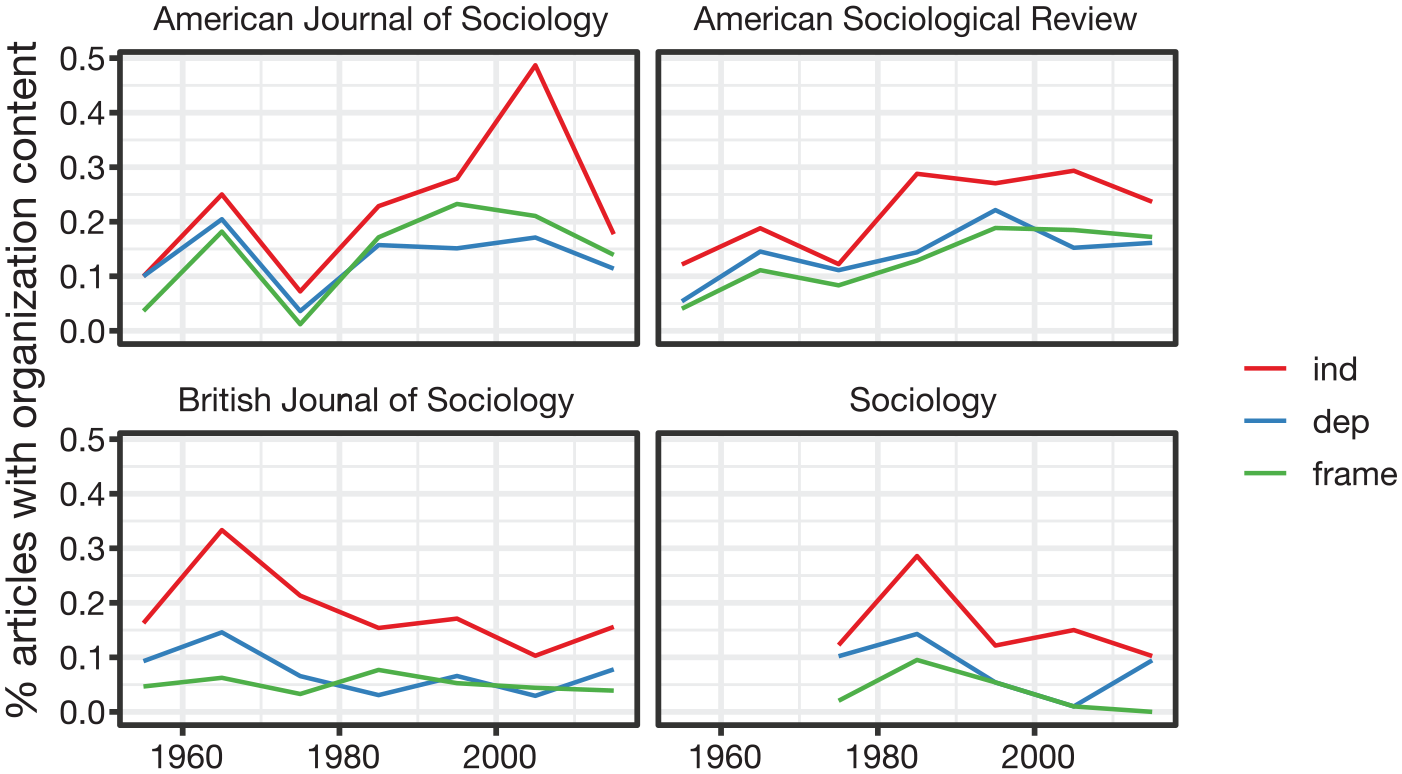
Development of organizational sociology over time, manual coding.
All three dependent variables develop similarly over time, albeit on different levels: using organizations as independent variables is most widespread, while using an organizational framework or dependent organizational variables is less frequent. The absolute levels of all variables are significantly lower in the UK journals SOC and BJS, whose levels moreover decline over time. The US journals ASR and AJS, by contrast, display a rising tendency, with a trough in the 1970s. By 2015/16 we found that 14 and 17% of all AJS and ASR articles, respectively, still used an organizational framework and could therefore be seen as organization-sociological in a narrow sense. While there has been a rise in organizational sociology since the 1950s, as we expected, there was a decline only in UK journals in the 1980s. Only the most recent period has seen small declines in almost all journals and variables, but – as logistic regressions show – levels are not significantly lower overall when compared to one or two decades ago.
The automated classification allowed us to extend these findings to the interstitial years and to other generalist and specialized journals. The prediction results of the SVM (Figure 2) reveal some interesting tendencies beyond our benchmark years: first, in generalist sociology journals there was high volatility, as expected, and in many years articles are likely to not employ any organization framework. Our sample accidentally selected years in most journals where values were non-zero. Second, organization frameworks are also used in other generalist journals at similarly volatile rates without a clear trend over time. Third, organization and management journals have had expectedly high values on organizational sociology, but with a declining tendency. This tendency also drives the global development.
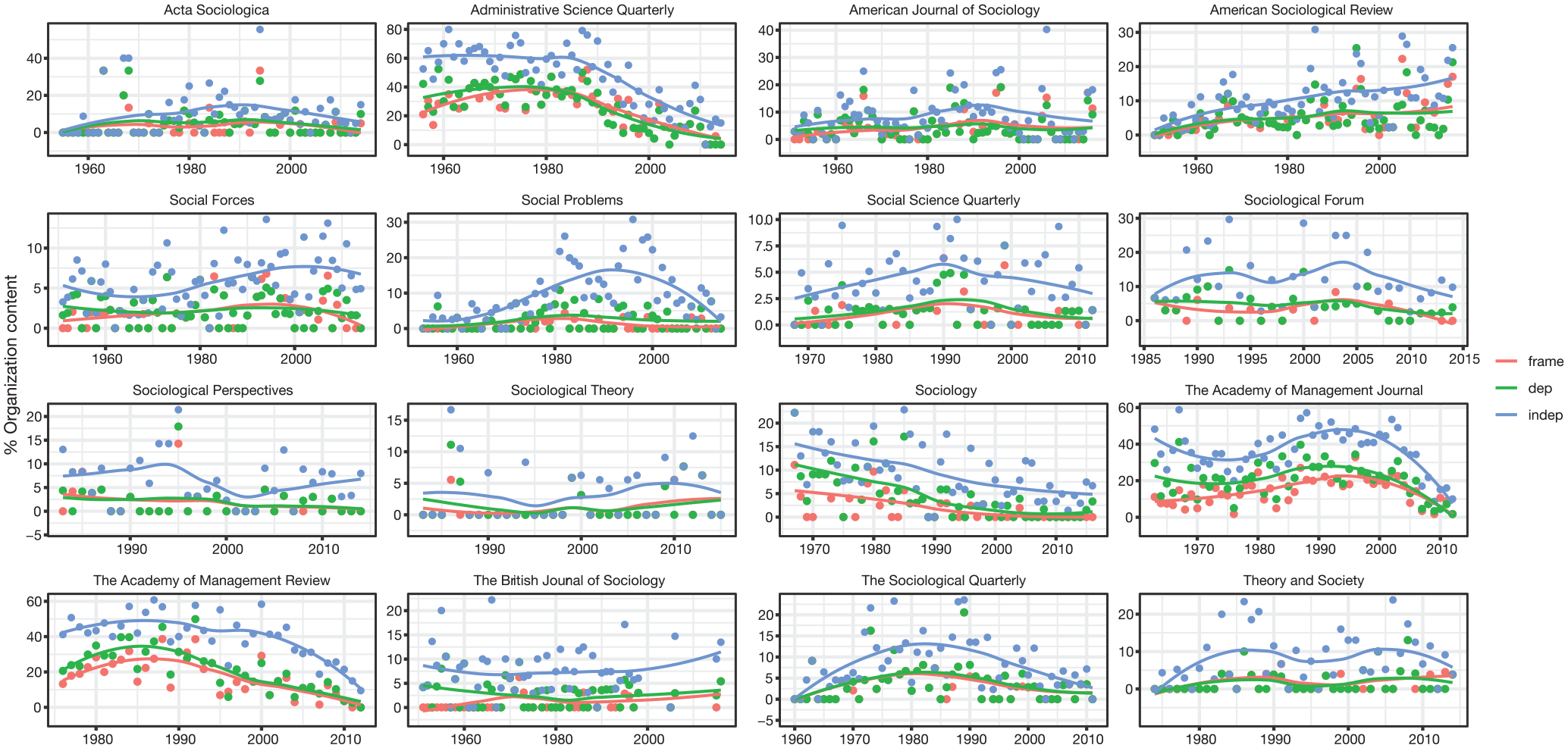
Development of organizational sociology over time, automated analysis.
One could argue that our finding of a relative persistence of organizational sociology in contrast to the narrative of decline is not reflected in declining publication numbers, but in declining citation references. To check this claim, we retrieved the Web of Science citation numbers – arguably not a complete overall citation count – for the articles in our manually coded sample (about 400 articles not found in Web of Science, retrieval July 2018) and calculated the average and median citations of articles using an organizational-theory framework in comparison with those without such a framework (Figure 3).
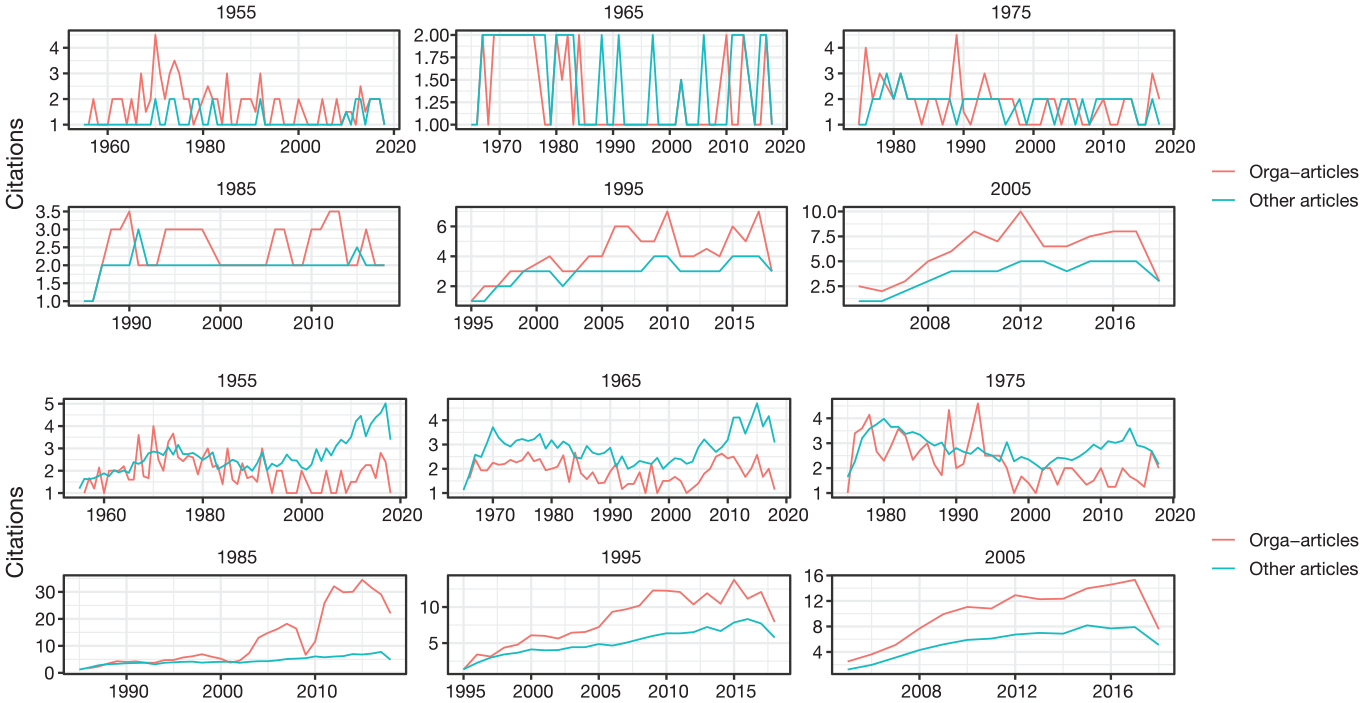
Development of median (above) and average (below) citations over time.
With regard to both accumulated citations by 2018 but also the median flow of citations each year, the organizational-framework articles are not cited less often than their counterparts. On the contrary, the median organization article from the recent three decades often received more citations than its non-organization counterparts. This development could reflect the close ties of organizational sociology with business journals and their exploding citations over the past two decades. 9 The phenomenon is also mainly driven by the two US journals. The averages reveal the importance of some citation stars among the organization articles.
Organization as reference object
Theory frameworks or dependent and independent variables in organizational sociology do not necessarily have to coincide with how much organizations are implicitly referred to in sociology. To operationalize this distinction, we added a dictionary-based search for organization words to our manual codings of organizational sociology. We measured a 0.11 correlation between the relative frequency of organization words and the use of an organizational framework. This result shows that one can speak of organizations without necessarily using an organizational framework (or an independent/dependent organizational variable). The reference to organizations thus appears more broadly across the discipline and can be found across articles.
The relative frequency of these dictionary terms makes up on average 0.34% of all words, but shows strong volatility over time. Over time, the trend is one of a slight decline, even though this again holds more for the UK than for the US journals. For the AJS, there is even an increase over time. This finding does not confirm our expectation that the importance of references to organizations would remain the same or increase over time, although there is only a slight decline.
Decline of theoretical diversity
To examine our expectations regarding the development of theoretical diversity in organizational sociology, we searched for the theoretical perspectives employed in articles that use or develop organization theory since 1975. The absolute frequencies are shown by decade in Figure 4.
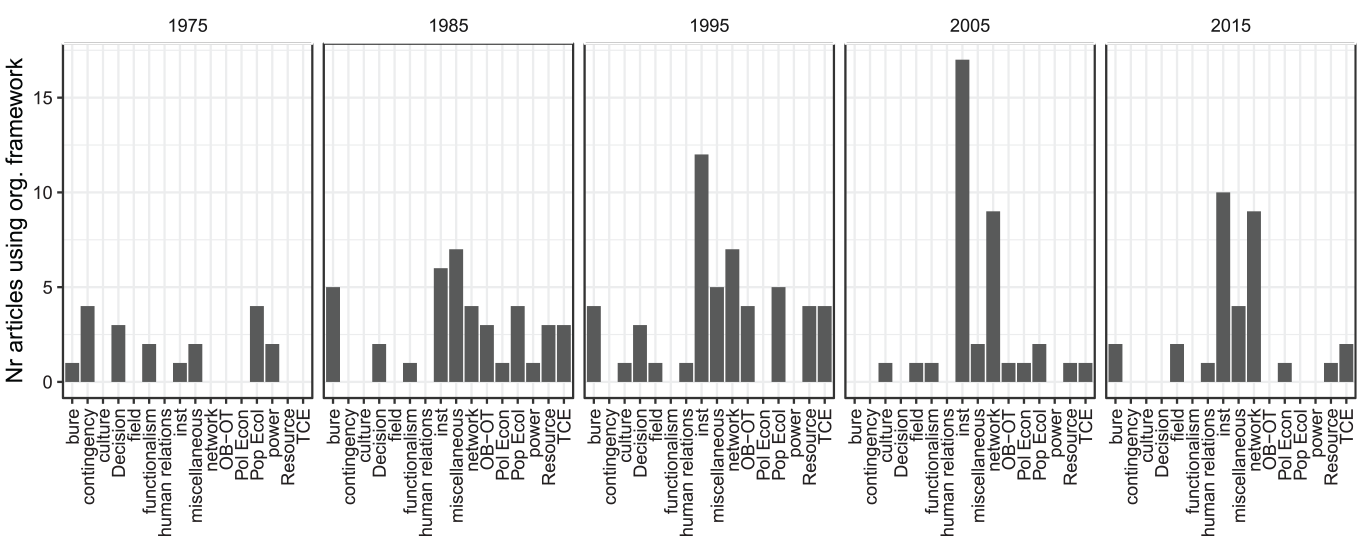
Articles by theories used over time.
Figure 4 shows that a variety of perspectives were used during the 1980s. In 1985/86, perspectives that had emerged in the 1970s – (neo-)institutionalism, population ecology, resource dependency, TCE – were used, while other work applied classical bureaucratic, decision-making and functional approaches, or other marginal frameworks. We can also observe work that began to apply network approaches. However, contingency theory disappeared entirely in this decade.
The plurality of theoretical perspectives was maintained during the 1990s, when the institutional approach became the dominant theoretical perspective. By the beginning of the twenty-first century, the diversity of frameworks had fallen substantially. Institutionalism and network approaches became by far the dominant theoretical perspectives.
These findings are surprising. While seminal review papers from the 2000s state that (at least) six major perspectives are prevalent in the twenty-first century (Colignon, 2007; Scott, 2004), in the four leading general-interest journals in sociology we found only two. Moreover, particularly work using contingency theory or population ecology has virtually disappeared. Other frameworks have been marginalized. Since the 1980s no new perspectives have emerged. Work that uses anything other than the theoretical perspectives identified (‘miscellaneous’) is nowadays rarer than in the 1980s and 1990s. Therefore, we can generally confirm that a few perspectives from the 1970s and 1980s currently dominate the field and that since the 1980s no new theoretical perspective has emerged. However, we find that in the twenty-first century instead of the presumed six major perspectives only two perspectives dominate the field, namely, institutionalism and network approaches.
Decline in methodological diversity
We examined the development of methodological diversity by exploring the methodological approaches used in the 223 articles with an organizational framework. We coded methodological approaches into quantitative, qualitative, mixed, experimental and conceptual approaches. Overall, there were 144 quantitative articles, followed by 42 conceptual and 23 qualitative ones. When we split the sample into the period before and the period after 2000, we find a strong increase in quantitative articles from 62 to 71% at the expense of the conceptual ones (from 23 to 9%). In 2016, 94% or virtually all articles had a quantitative methodological orientation.
Decline in variety of topics
To operationalize the topics referenced in the articles, we estimated a topical model. We were able to identify one business-related topic that correlated with articles using organizational frameworks (Figure 5). Both the main terms characterizing the topic (union, bank, interlock, mrger, sharehold, investor, etc.), as well as the articles realizing it most, reveal the business orientation. The articles with an organizational framework are significantly correlated with this topic (r = 0.42). Moreover, articles with an organizational framework tend to realize this topic increasingly over time. Organizational articles thus concentrate increasingly on a business-related topic. In 2015 and 2016, for instance, 12 organization articles were dominated by a business-related topic, whereas the remaining 18 articles were dispersed among nine different topics. The titles of the 12 business-related articles, for instance, mention banks, interlocking directorships, large corporations or corporate networks, while the organizational articles in the 1970s spoke of prisons, race, non-profits or unions.
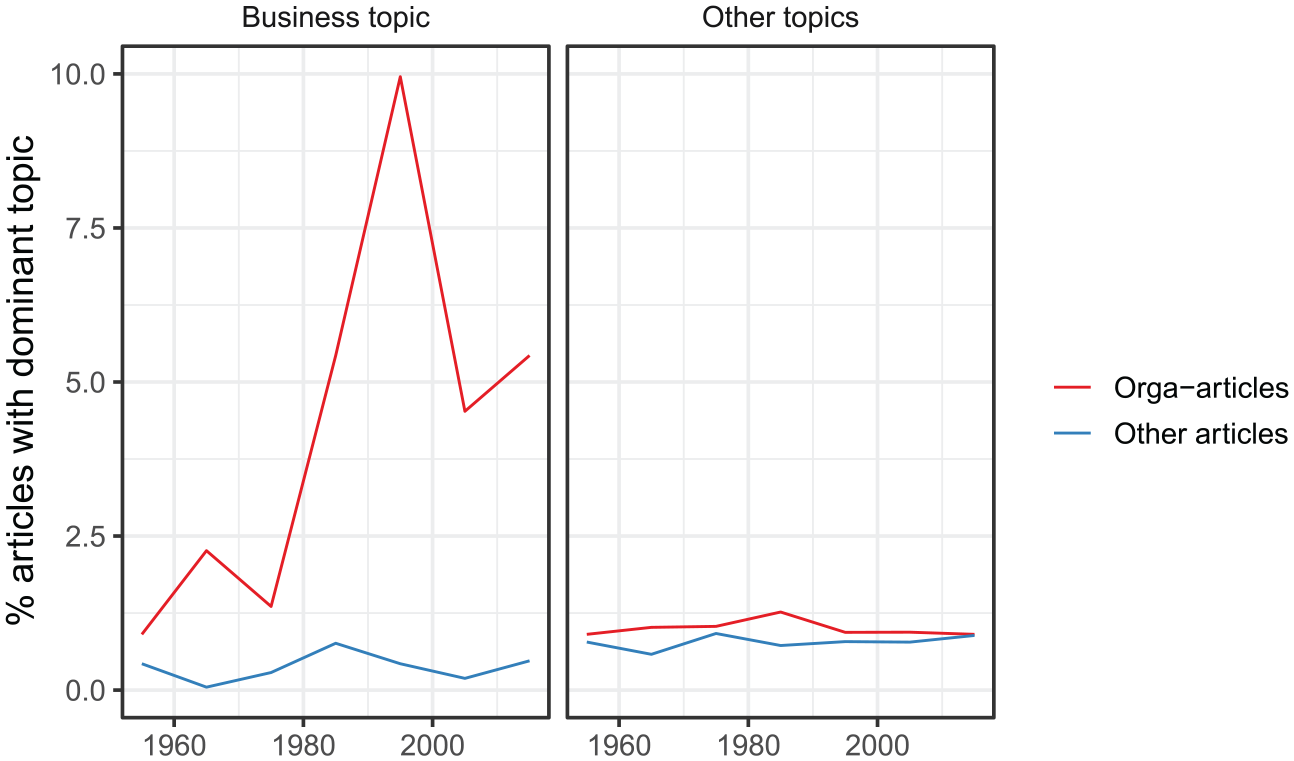
The business and other topics in organizational and general sociology.
The tendency towards more business-related topics in organizational sociology is also reflected in the departmental affiliation of first and second authors. To the extent that this can be known from the information provided in the journals, the first authors of organizational articles affiliated with business departments make up 27% of all authors after 1990 (only 20% beforehand), whereas 30% of second authors came from business departments. We take this as confirmatory evidence that organizational sociology tends to focus on business topics thematically and business school-affiliated authors predominate.
Discussion
Is organizational sociology ‘a subfield on the brink of irrelevance’ (King, 2017: 131)? In general, we did not find clear-cut evidence for this hypothesis: across time and the major generalist sociology journals, our manual classifications do not confirm a greater downward tendency in the number of studies using organizational frameworks, dependent or independent variables. Yet, our results revealed considerable differences between journals in this respect. In the UK journals BJS and SOC, the use or development of organization theory has almost petered out and citation references have become marginal. By contrast, in the US journals ASR and AJS, organizational sociology is found much more frequently. This trend is mirrored by our results from automated SVM classifications, which also reveal considerable differences between journals but do not show a downward trend for generalist sociology journals over time.
Despite alarming diagnoses in the literature on the current state of organizational sociology, the subdiscipline is far from being irrelevant within sociology. In 2015/16, 17 and 14% of articles in ASR and AJS still applied an organization-sociological framework. Their citation numbers, both the current total and the annual flow, also do not support the assumption of increasing irrelevance. Based on a dictionary approach, we also did not find a greater declining trend of concrete references to organizations.
But where does the perception of a decline of organizational sociology come from? We believe that one explanation for the impression of such a decline could be that the variety in theories, methods and topics has decreased. Therefore, it is not overall organizational sociology that decreases, but its diversity. Regarding theoretical diversity, the proportion of articles using neo-institutionalist or network frameworks has grown steadily since 1975, dominating the subfield since 2005 at the expense of the previous diversity. This finding is surprising considering that the general trend in sociology points in the opposite direction, showing an ever-growing diversity in recent decades (Turner, 2010). Instead, the decrease of theoretical diversity in organizational sociology seems to follow the general trend in the transdisciplinary field of organization studies. For this field, Bort and Schiller-Merkens (2011) have pointed out that since the 1980s scholars have increasingly tended to reuse a few dominant theoretical concepts instead of developing new ones in order to increase their chances of publishing in highly reputed business and organization journals.
Our findings also indicate that there has been a rise in the number of articles covering business-related topics in organizational sociology. This trend also mirrors the development in the field of organization studies towards the dominance of business-related interests (Hinings and Greenwood, 2002). These findings are reflected in the relatively high and growing share of business department-affiliated first and second authors of articles on organizational sociology, which presumably corresponds to the large-scale migration of organizational researchers from sociology departments to business schools in recent decades (Hinings and Greenwood, 2002). Their citation culture, which is illustrated by the considerably higher Journal Impact Factors of business and management journals, mentioned above, might also explain why we find a growing number of citations among American organizational-sociology articles since the 2000s.
The increasing share of business department-affiliated authors might also offer a possible explanation for the relatively high prevalence of organizational frameworks in ASR and AJS compared to other sociology journals. Business scholars are strongly influenced by business journal rankings when selecting potential outlets for their research because in business departments they are often evaluated, tenured and promoted based on these rankings (Barley, 2016; Hussain, 2015). While ASR and AJS are considered to be highly reputable outlets in most of these rankings, the other sociology journals on average score considerably lower or are not represented (see Harzing, 2020), and are therefore not so attractive to business department-affiliated scholars. The increasing absence of organizational sociology from the UK journals SOC and BJS could finally offer an explanation for the finding of a dominance of quantitative methodologies that came to prevail even more than before the 2000s. The four top-tier generalist journals in our sample – ASR, AJS, SOC, BJS – differ considerably in their methodological preferences. Existing studies have shown that SOC and BJS are the most qualitative among the generalist sociology journals while ASR and AJS can be considered as rather quantitative (Baer, 2005; Schwemmer and Wieczorek, 2020). However, since we only look at the four top-tier journals it is indeed possible that qualitative and conceptual works are still common in second ranked sociology journals. Nevertheless, this finding supports our expectation that the decline in theoretical diversity could be related to a growing dominance of quantitative papers in organizational sociology. Even if a significant number of qualitative and conceptual works exist in the second ranked journals, the chances of such a paper achieving a substantial impact – like coining a new theory perspective – will be lower, because the corresponding journals receive considerably less attention than the top-tier outlets.
A second possible explanation for the perceived decline of organizational sociology could be a substantial decrease of according works in outlets of organization and management studies. In this respect, the three organization and management journals in our automated classifications sample show a considerable decline in the use of organizational frameworks, dependent and independent variables. Although these results are fairly limited in terms of potential generalizations, they nevertheless confirm recent assessments of a (paradoxically) growing irrelevance of organization as a research object within organization studies (Ahrne et al., 2016; Apelt et al., 2017). Hence, these findings could suggest that organizational sociology has not substantially declined in sociology itself but perhaps in the interdisciplinary field of organization and management studies which are still most important in terms of the amount of organization articles. However, future studies are needed that take into account a broader range of organization and management journals to allow for more general conclusions.
Nevertheless, our results contradict the common assumption that the large-scale migration of organizational scholars has led to a collapse of research in organizational sociology within sociology (Adler et al., 2014; Hinings and Greenwood, 2002; Scott, 2004). Scholars still publish on organizational sociology within sociology, but increasingly on business-related topics, in line with publication practices and trends associated with business studies rather than with sociology.
Our conclusions are, of course, limited by our research-design choices. Our substantive manual codings only draw on major general-interest journals from sociology, in selective years from two Anglo-Saxon countries, and on research articles only. Regarding the observed decline of methodological diversity, our results allow no conclusion as to whether organizational sociology was published less often in SOC and BJS because corresponding work has become more quantitative, or if organization-sociological work has become more quantitative because these two journals accepted fewer organization-sociological articles. Our choice of explanatory variables is restricted to what is publicly reported in journals and disregards, for instance, such important factors like the demographics of generational change in the discipline. Future research would need to include much more sociological factors in the making of scientific articles.
It will be important for the future development of organizational sociology, we believe, for scholars to come up with new theories. Currently, organization theory in general is experiencing a kind of a phenomenon/theory mismatch (Adler et al., 2014; Davis, 2015a, 2015b). While the variety of organizational forms has increased significantly in recent decades (Barley, 2016; Davis, 2015a, 2015b), theoretical diversity in attempting to understand these forms has decreased dramatically, leaving only two theoretical perspectives from the 1970s and 1980s that dominate the field. Since then no new organization-theory perspectives have been developed or advanced, either in leading organization studies outlets (Bort and Schiller-Merkens, 2011; Davis, 2015a, 2015b) or in the four leading generalist sociology journals. The latter state of affairs seems to be especially problematic given that most of the newer organization theory perspectives emerged in top generalist sociology journals, not in organization studies outlets, during the 1970s and 1980s (for example, Hannan and Freeman, 1977; Meyer and Rowan, 1977; Williamson, 1981).
For us, the crucial question will be whether organizational sociology can rediscover ways of creatively researching and theorizing organizational phenomena. With regard to theory development, outside the dominant sociological debates, there are already promising new theoretical perspectives, such as meta- and partial organization theory (Ahrne et al., 2016), modern systems theory (Luhmann, 2018), the communication-constitutes-organization perspective (Schoeneborn et al., 2014) or process views of organization (Czarniawska, 2015; Hernes, 2014). These perspectives have already shown that they offer insights in a broad variety of new organizational phenomena (see, for example, Berkowitz, 2018; Dobusch and Schoeneborn, 2015; Grothe-Hammer, 2019a, 2019b). Nevertheless, the bulk of organizational sociology so far seems to have refrained from adopting such new theoretical views and instead remains engaging in criticism of the state of the subdiscipline and the new theoretical approaches (see, for example, Adler et al., 2014; Apelt et al., 2017; Aldrich, 2014; Barley, 2016; Davis, 2015a, 2015b). We believe that organizational sociology can have a prosperous future only if it proves able to leave the narrow paths it has followed in the past two decades.
Footnotes
Acknowledgements
Both authors contributed equally to this article. We wish to thank the guest editors of this monograph issue and the anonymous reviewers for their invaluable suggestions. We especially would like to thank Frank Meier for his time-consuming support in the coding of variables for this paper, as well as Bastien Dratwa, Sebastian Eickmann and Ilir Meni for their help in data management. This article also benefited from feedback of participants of the sessions on ‘Disappearing Organization?’ at the ISA World Congress of Sociology 2018 in Toronto, Canada. Last but not least we wish to thank Svenja Hammer, Daniel Meyer and Simone Schiller-Merkens for their feedback on prior versions of this article. This research was made possible thanks to a data agreement of Sebastian Kohl with JSTOR, dating from 10 October 2018.
Funding
The authors received no financial support for the research, authorship, and/or publication of this article.
