



Abstract
Societal and legal responses to adolescent sexual offending are often punitive rather than developmentally informed, assuming that adolescents who have sexually offended (AHSO) pose a high risk of sexual recidivism. This study examined long-term outcomes of 351 AHSO (aged 12–18 years) assessed in an outpatient forensic setting. Follow-up averaged 22 years, with participants reaching a mean age of 37. Overall, 62.4% reoffended, primarily for property (45.0%), justice administration (43.9%), or nonsexual violent offenses (40.7%). Sexual recidivism was far less frequent (13.4%), occurring mainly in the early years and stabilizing at low levels. Survival analyses indicated that while sexual recidivism plateaued, nonsexual reoffending showed more sustained patterns over time. These findings challenge assumptions about enduring sexual risk among AHSO and call into question the proportionality of lengthy, restrictive sanctions.
Introduction
A broad scientific and judicial consensus recognizes the distinct nature of adolescent delinquency compared to adult offending (Cavanagh, 2022; Fondacaro, 2015; Lussier & Blokland, 2014). Most industrialized countries have therefore established juvenile justice systems designed to account for adolescents’ developmental stage and potential for change (Cauffman & Steinberg, 2000; K. E. Heilbrun et al., 2016). Whereas adult systems tend to place greater weight on punishment, deterrence, and public protection through formal and severe sanctions, juvenile systems emphasize rehabilitation and social reintegration, with procedures and penalties that are more flexible and developmentally appropriate (K. Monahan et al., 2015; Robinson & Kurlychek, 2019).
Since the 1990s, however, this developmental orientation has been increasingly challenged in North America (see Chaffin, 2008). Over the subsequent decades, shifts in public discourse, policy priorities, and judicial responses to serious, violent, and sexual offending have contributed to a growing emphasis on managing potential risk and responding to public concern, often framed in terms of public safety, sometimes at the expense of developmental considerations (Bosetti and Fix, 2024; Corrado & Markwart, 1994; E. McCuish et al., 2021; Trépanier, 1999).
Against this backdrop, the distinction between adult and juvenile justice practices has become less evident in cases of serious crimes, particularly sexual offenses (Miller et al., 2024; Tolan et al., 2012). Juveniles have been increasingly exposed to adult-like criminal justice responses that are punitive and frequently involve restrictions on liberty. Beyond social and legal condemnation, the aim of such responses is to deter further sexual violence and protect potential victims (Najdowski et al., 2016; Sparks, 2021). Judges now have access to a range of adult-inspired measures, including custodial or community-based sentences lasting several years, mandatory registration on sex offender registries, DNA sampling, restrictions on access to certain people or places (e.g., children), Internet bans, and compliance with multiple conditions that, if violated, may result in new charges and sanctions (Cain & Sample, 2022; R. Fix et al., 2020; Letourneau et al., 2009; Przybylski & Lobanov-Rostovsky, 2017; Sparks, 2021).
Criminal justice responses to sexual offenses are often justified by the belief that adolescents who have sexually offended (AHSO) (a) differ from other justice-involved youth, (b) present a high risk of sexual reoffending, and (c) are likely to persist in sexual offending into adulthood (Cain & Sample, 2022; de Vel-Palumbo et al., 2019; Harper & Hicks, 2022; Lussier et al., 2016; Salerno et al., 2010; Sparks, 2021). Such views did not always dominate discourse (Doshay, 1943; Maclay, 1960) but gained traction by the 1980s from clinical observations of adults reporting problematic sexual behaviors that began in adolescence (e.g., Longo & Groth, 1983). Empirical research over the past three decades, however, shows the opposite: sexual recidivism rates among AHSO are low, and only a minority persist in sexual offending beyond adolescence, irrespective of imposed sanctions (Fanniff et al., 2017; Lussier & Blokland, 2014; Lussier et al., 2024). Much less is known about long-term sexual and nonsexual recidivism rates in this population, a gap the present study addresses. Most recidivism studies rely on samples from earlier eras and relatively short follow-up periods (5–7 years), limiting conclusions about longer-term trajectories (Lussier et al., 2025). By extending this horizon, the current study aims to inform policy and judicial practice with empirical evidence rather than unsubstantiated beliefs.
Adolescent Delinquency
Research in neuroscience and developmental psychology highlights features of adolescence that increase the propensity for antisocial behavior (e.g., Moffitt et al., 2002; Rutter & Sroufe, 2000). The prefrontal cortex, which governs impulse control, decision-making, and planning, continues to mature until roughly age 25 (Casey, 2015; Casey et al., 2020). Consequently, adolescents have greater difficulty than adults in anticipating consequences, envisioning the future, regulating emotions, and managing sexual or aggressive impulses (Casey et al., 2020). This immaturity, coupled with sensation-seeking, fosters impulsivity, risk-taking, and poor risk appraisal (Romer et al., 2017). Adolescents are also more influenced by peers, family, and broader contexts, being especially sensitive to social rewards and still developing their identity (Branje et al., 2021; Cavanagh, 2022; Defoe et al., 2015; Jones et al., 2014).
Adolescence is likewise a critical period for sexual development, including the emergence of sexual interests and early experiences (Fortenberry, 2013; van de Bongardt et al., 2015). As with identity, sexual interests are generally not yet consolidated (Ott et al., 2011; Stewart et al., 2019). For some, sexual conduct occurs within this exploratory context where boundaries are not yet well defined. For others, it represents an attempt to satisfy sexual urges in an impulsive, egosyntonic, and maladaptive manner. Still others may reproduce learned behaviors, particularly when sexualized behaviors have been observed, experienced, or normalized through prior interpersonal experiences, contributing to the enactment of inappropriate or coercive sexual behaviors during adolescence (e.g., see Burton et al., 2002; Laws & Marshall, 1990; Rich, 2011). Importantly, sexual offending during adolescence, like other delinquent behavior, tends to diminish with age and, for most, desist by early adulthood, through the combined influence of biological (e.g., brain maturation), psychological (e.g., identity development), and social (e.g., life events) mechanisms (Kazemian, 2016; Rocque, 2015; Weaver, 2019). Within this context of developmental plasticity, justice professionals are tasked with evaluating the mental health, criminal behavior, and reoffending risk of AHSO. Because adolescents’ behaviors and risk-related characteristics are still evolving and may change rapidly over time, accurately estimating future sexual recidivism remains particularly challenging during this developmental period (Spruit et al., 2017; Viljoen et al., 2008). Moreover, commonly used adolescent risk assessment tools are largely based on static or proximal indicators and are not designed to capture ongoing developmental changes in risk and protective factors, which further limits their ability to accurately estimate long-term sexual recidivism risk during adolescence.
Risk Assessment and Management
The label of “sex offender” can have profound consequences for adolescents, hindering development and obstructing the transition to adulthood (Bosetti and Fix, 2024; R. L. Fix et al., 2021; E. C. McCuish & Lussier, 2017). A persistent belief holds that AHSO differ from other delinquent adolescents in their trajectories and long-term risk of reoffending (Cain & Sample, 2022; Chouinard-Thivierge et al., 2023; Fanniff et al., 2017; Harris & Socia, 2016). This perception is echoed in public policy and judicial practice (Miller et al., 2024; Papp et al., 2020). Research shows, for example, that risk assessments are frequently overridden upward by professionals evaluating AHSO (Papp et al., 2020; Schmidt et al., 2016). Such discretionary overrides typically inflate the assessed level of risk, reclassifying youth initially rated as low or very low risk into moderate or high-risk categories (Guay & Parent, 2018). This trend reflects a broader shift toward prioritizing public safety over developmental needs, which can impact how criminal justice professionals approach their role and work with justice-involved adolescents.
When applied in presentence contexts, overestimation of risk can influence sentencing, leading to more restrictive and longer-term sanctions. Alongside detention or community supervision, AHSO are often subjected to numerous conditions modeled after those imposed on adults. Under community supervision, they are frequently treated as high-risk offenders by supervising professionals (Schmidt et al., 2016). Consequently, they face greater likelihood of reincarceration for minor violations or technical breaches, artificially inflating observed recidivism rates. While these practices are widely recognized by practitioners and researchers, they remain understudied in current empirical work on adolescent sexual recidivism. To address this gap, the present study distinguishes offenses against the administration of justice and drug-related offenses from other categories, offering a more nuanced picture of long-term recidivism among AHSO.
Recidivism Rates Among Adolescents Who Have Sexually Offended
Recidivism is typically defined as the commission of a new offense following an initial sexual offense officially recognized by authorities and is generally measured using official criminal justice records. Findings consistently show that AHSO are more likely to reoffend non-sexually than sexually, with sexual recidivism rates generally below 10% (Aebi et al., 2011; Caldwell, 2016; Fanniff et al., 2017; Lussier & Blokland, 2014; Lussier et al., 2024; McCann & Lussier, 2008; Waite et al., 2005). The most comprehensive and recent meta-analysis reports an average general recidivism rate of 43% and a sexual recidivism rate of 8% over an average five-year follow-up (Lussier et al., 2024). Caldwell (2016) also documented a sharp decline in sexual recidivism over the past four decades: from 10.3% in studies conducted between 1980 and 1995 to 2.75% between 2000 and 2015, a reduction exceeding 70%. Lussier et al. (2024) similarly noted a non-significant decline from 8% to 9% (sampling period <1980–1999) to 5% (2000–2009), likely reflecting methodological differences (e.g., definitions of recidivism, follow-up length, and sample composition) rather than an actual decrease. However, most estimates are based on relatively short to mid-term follow-up periods, leaving open the question of how sexual and nonsexual offending trajectories unfold over the longer term.
Longitudinal studies following AHSO into adulthood provide important insight into the temporal dynamics of recidivism. A Canadian study found that AHSO and adolescents adjudicated for nonsexual offenses exhibited comparable rates of sexual offending following the index offense (7.7% vs. 6.1%), measured up to age 23. Furthermore, both groups were distributed in similar proportions across four distinct general offending trajectories (E. McCuish et al., 2016). These results suggest that committing a sexual offense in adolescence is not, by itself, predictive of sexual or nonsexual long-term criminality. Other work shows that AHSO risk is dynamic, declining with time (Caldwell & Caldwell, 2022; Hanson et al., 2018; Hargreaves & Francis, 2014). In a U.S. cohort, Caldwell and Caldwell (2022) found that AHSO, compared to youth convicted of nonsexual crimes, initially presented higher risk of sexual recidivism. This risk declined more rapidly over time, such that by age 18 years the groups no longer differed, and by age 22 years AHSO had a lower risk. In the U.K., Hargreaves and Francis (2014) reported a 7% sexual recidivism rate after five years in a sample of 920 AHSO, rising to 13% after 35 years (see also Långström, 2002), suggesting stabilization much earlier than in adults (Lussier et al., 2025). Similarly, Worling et al. (2010) tracked 148 AHSO (mean age 15.5) over 16 years (mean age 32), reporting 16% overall sexual recidivism. Rates of both sexual and nonsexual recidivism appeared to stabilize around age 25, coinciding with brain maturation. These findings tend to support Lussier (2017) hypothesis that about 10% of adjudicated youth tend to persist in adulthood. Taken together, these findings are difficult to reconcile with legal measures specifically targeting AHSO as a high-risk group, which can sometimes extend over an entire lifetime (e.g., registration on sex offender registries) in the name of public safety.
Subtypes of AHSO and Recidivism
Beyond overall and long-term recidivism rates, prior research consistently indicates that AHSO constitute a heterogeneous population, with meaningful variability in offending patterns and recidivism trajectories (e.g., Hunter et al., 2003). To account for this heterogeneity, research has frequently relied on offense-related characteristics, most notably victim age and victim relationship, as a basis for distinguishing subgroups of AHSO, drawing in part on typologies developed in adult populations (Barra et al., 2021; Joyal et al., 2016; Martijn et al., 2020).
Victim age, in particular, has been widely examined in both clinical and research contexts (Brown, 2019; Joyal et al., 2016; Parks & Bard, 2006). Empirical findings suggest that AHSO against peers or adults are more likely to reoffend in general (Fanniff & Kolko, 2012; R. Prentky et al., 1997; Tidefors et al., 2019) and in nonsexual violent offenses (Krause et al., 2021) than those offending against children. In contrast, finding regarding sexual recidivism are mixed: while several studies report no differences by victim age (Fanniff & Letourneau, 2012; Keelan & Fremouw, 2013; Krause et al., 2021), others indicate higher risk among AHSO against children, particularly when the age gap with the victim is large (McCann & Lussier, 2008; R. Prentky et al., 1997). Victim age is also incorporated into major adolescent risk assessment tools (e.g., ERASOR and J-SOAP II), where it is often interpreted as an indicator of sexual deviance, a well-established predictor of adult sexual recidivism (Hanson & Morton-Bourgon, 2005; Mann et al., 2010).
Beyond recidivism outcomes, victim relationship has been shown to meaningfully distinguish developmental and clinical profiles among AHSO. A recent meta-analytic review suggests that intrafamilial sexual offending in adolescence is more strongly associated with indicators of developmental vulnerability, including family adversity, histories of maltreatment, sexual self-regulation difficulties, and internalizing psychopathology, whereas extrafamilial offending is more linked to broader antisocial features, consistent with a more generalist pattern of delinquency (Martijn et al., 2020). In line with these distinctions, intrafamilial AHSO tend to display lower overall recidivism than their extrafamilial counterparts (Aebi et al., 2011), although the role of victim relationship in shaping recidivism trajectories remains underexplored in adolescent samples despite its established relevance for adult populations (Brouillette-Alarie & Hanson, 2017; Hanson & Bussière, 1998).
Study Aims
The label of “sex offender” and its associated social stigma may contribute to adolescent being perceived as “high-risk”, potentially obscuring developmental factors and increasing vulnerability to marginalization (Harris & Socia, 2016). Social stigma and labeling can inadvertently increase the risk of reoffending by influencing a young person to develop and to internalize a self-image consistent with that of an outsider (e.g., a deviant person), a process called secondary deviance (Lemert, 1972), thereby creating a high-risk situation. Against this backdrop, existing evidence underscores the need to examine recidivism among adolescents who have sexually offended (AHSO) beyond sexual reoffending, by considering long-term patterns of other offense types. This is especially relevant given the rarity of studies with extended follow-up into adulthood (Lussier et al., 2016). While prior research has distinguished sexual from nonsexual recidivism, few studies have analyzed specific offense categories—such as justice administration or drug-related crimes—which may, at least in part, reflect the impact of judicial measures on youth marginalization over time. From this perspective, it is crucial to explore long-term recidivism among AHSO, particularly as professionals responsible for risk assessment or supervision rarely have knowledge of these individuals’ adult outcomes. This study therefore addresses two questions: To what extent do these youth desist from justice involvement and criminality in adulthood? And what patterns of continuity or discontinuity emerge from adolescence to adulthood? This study therefore documents recidivism among a cohort of AHSO from adolescence into adulthood, with an average follow-up of nearly 22 years. It also examines whether recidivism rates and the number of offenses differ across subtypes (child vs. peer/adult; intrafamilial vs. extrafamilial), given the widespread use of these offense characteristics to classify youth in judicial, clinical (e.g., risk assessment), and research contexts (Aebi et al., 2011; Brown, 2019; Joyal et al., 2016).
Methods
Participants
The sample included 351 male adolescents who had committed at least one contact sexual offense before age 18 years and were evaluated between 1992 and 2002 in an outpatient forensic psychiatry program specialized in sexual offending. Participants were aged 12 to 18 years at evaluation (M = 15.8, SD = 1.8). None met criteria for moderate or severe intellectual disability (exclusion criterion). Most (95.1%) were Canadian born; nine (2.7%) were from another country in the Americas, five (1.5%) from Africa, and origin was missing for three cases. At the time of initial assessment (T0), participants had an average of 2.25 documented sexual offense victims (SD = 1.9).
Data Collection
The study was approved by ethics committees at the [Université du Québec à Trois-Rivières] and [Philippe-Pinel Institute of Montreal]. It combined secondary data from Carpentier and Proulx (2011) with new records of adult official criminal recidivism. The original database included offense variables at T0 (initial evaluation conducted as part of official decision-making processes following the identification of the index sexual offense) and T1 (adolescent recidivism, i.e., a new criminal event occurring before age 18 years and recorded as criminal charges). Recidivism events were verified to have occurred after the T0 evaluation date.
In January 2019, additional data were collected at T2 to document adult recidivism using SOQUIJ electronic court records. All charges were coded into a dedicated grid capturing the number, type, and date of offenses. Independent random checks verified accuracy. Data were then exported into SPSS and merged with the T0 and T1 database. Analyses were conducted with SPSS v.29. Supplementary analyses comparing recidivism defined using charges versus convictions yielded similar results, indicating that findings were robust to the operational definition of recidivism.
Variables
Subtypes of AHSO
At T0, participants were classified into subtypes based on victim age and victim relationship, consistent with prior empirical research and clinical practice commonly used to capture heterogeneity in offending patterns and recidivism risk among adolescents who have sexually offended (Aebi et al., 2011; Brown, 2019; Joyal et al., 2016). For those with multiple victims, subtype classification was based on the three most recent victims identified at the time of the evaluation conducted for the index sexual offense. This decision was made to prioritize data completeness and reliability, as information on more distal victims was often less detailed or inconsistently documented in clinical files, thereby reducing the risk of misclassification. Given that the average number of documented victims at T0 was 2.25, this approach captured the full victim profile for the majority of participants.
Victim Age
Youth were classified as child-focused if offenses targeted only victims under 12 and at least three years younger than the adolescent perpetrator (n = 220). Those offending only against victims older than 12 or less than three years younger were classified as peer/adult-focused (n = 99). Participants offending against both child and peer/adult victims were categorized as mixed (n = 32). These age thresholds are widely used to distinguish child-directed sexual offending from sexual offending against peer or adults during adolescence and are consistent with conventions adopted in prior empirical studies and adolescent risk assessment frameworks (Aebi et al., 2012; Joyal et al., 2016; Krause et al., 2021).
Victim Relationship
Adolescents were classified as intrafamilial (intra) if all known victims at T0 were direct blood relatives (siblings or half-siblings; n = 102). Those whose victims had no direct biological ties (e.g., cousin, acquaintance, and babysitting context) were classified as extrafamilial (extra; n = 206). Participants with both intra- and extrafamilial victims were categorized as intra + extra (n = 41). This definition of intrafamilial offending focuses on direct biological relationships to reflect distinctions commonly made in the literature between biologically related and non-biologically related victims, which have been shown to be associated with different offending patterns (Martijn et al., 2020; Tidefors et al., 2010).
Recidivism
Recidivism was defined as any new criminal charge under the Criminal Code of Canada occurring after T0, excluding the index offense that prompted the evaluation. Consistent with prior research (e.g., Aebi et al., 2011; Caldwell, 2007; Carpentier & Proulx, 2011; Waite et al., 2005), charges rather than convictions were used, as the primary indicator of recidivism, given the prevalence of plea bargains in sexual cases (Letourneau et al., 2013). New offenses were grouped into five categories: sexual (e.g., sexual contact, sexual assault, possession or distribution of child sexual abuse material, and indecent exposure); nonsexual violent (e.g., assault, carrying a weapon, and criminal harassment); property (e.g., theft and burglary); drug-related (e.g., possession and production); justice administration (e.g., obstruction, breach of probation, and failure to appear). T1 captured adolescent recidivism, defined as new offenses committed before age 18 years. Charges documented in Youth Court files between the initial evaluation (T0) and the age of majority were recorded. Follow-up ranged from 1 to 72 months (M = 27.7, SD = 19.1). T2 represented adult recidivism, tracked through January 2019. Follow-up from the initial evaluation ranged from 184 to 325 months (M = 260 months, or 21.7 years; SD = 33). At T2, participants were aged 29 to 45 years (M = 37.6, SD = 3.45).
Analyses
Descriptive statistics (frequencies, percentages) were used to summarize recidivism categories at adolescence, adulthood, and cumulatively (adolescence + adulthood). Kaplan-Meier survival analyses estimated cumulative recidivism over time, accounting for censored cases (participants without reoffending during follow-up). Time at risk was defined as the number of months in the community until recidivism or, if none occurred, until the end of observation, excluding time spent in custody. Survival functions were compared across AHSO subtypes based on victim age (child, peer, and mixed) and victim relationship (intrafamilial, extrafamilial, and intra + extra), as recorded at T0. Results are reported as cumulative recidivism rates (1 − S(t), %) at 24, 36, 48, 60, 120, 180, and 240 months. Group differences were tested using the log-rank (Mantel-Cox) test with significance set at p < .05. Kruskal-Wallis tests examined differences in the total number of recidivism events (measured by number of charges) across subtypes. Non-parametric methods were used due to skewed data distribution. To ensure comparability of exposure, robust ANOVAs (Welch and Brown-Forsythe tests) were conducted on time at risk. These results are presented in the next section.
Results
Table 1 shows the frequency and percentage of recidivism across offense categories. The mean follow-up was 27.7 months in adolescence and 260 months (21.7 years) overall. During adolescence (T1), 14.8% of participants reoffended. Recidivism most frequently involved nonsexual violent offenses (6.3%), property crimes (6.0%), and offenses against the administration of justice (5.4%), whereas sexual (4.0%) and drug-related recidivism (0.9%) were less frequent. In adulthood, 58.7% of AHSO incurred new criminal charges. Property offenses (43.9%) were most common, followed by justice administration (41.9%), nonsexual violent offenses (39.0%), and drug-related offenses (26.5%). Sexual recidivism was the least frequent at 10.5%. When adolescent and adult recidivism were combined, 62.4% of participants reoffended. The most common categories were property (45.0%), justice administration (43.9%), and nonsexual violent offenses (40.7%), whereas sexual recidivism remained lowest at 13.4%. Because justice administration offenses may reflect supervision-related breaches rather than new criminal behavior per se and are not necessarily indicative of progression toward sexual reoffending, overall recidivism was also examined with these offenses excluded. Under this definition, overall recidivism decreased to 60.1% over the 22-year follow-up.
Number and Percentage of Recidivists by Offense Category.
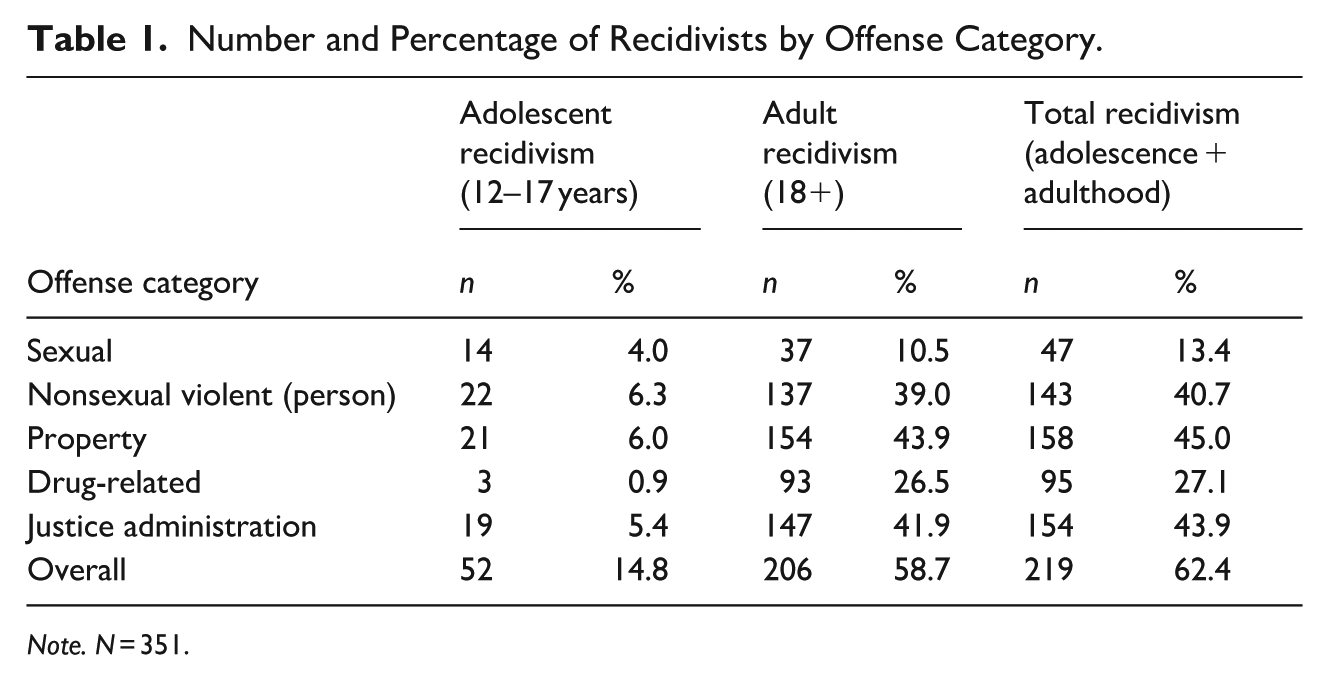
Note. N = 351.
Table 2 reports Kaplan-Meier survival analyses for AHSO subtypes at follow-ups ranging from 24 to 240 months. Patterns differed across offense categories. For sexual recidivism, most events occurred early, with cumulative rates remaining low and stable: 3.1% at 24 months, 8.0% at 60 months, and 10.3% at 120 months. Growth slowed after 96 months and plateaued by 120 months; over the next decade, rates rose only three points (≈0.3% per year). No significant differences appeared by victim age [χ²(2) = 1.103, p = .576] or relationship [χ²(2) = 0.831, p = .660]. Nonsexual violent recidivism rose continuously, slowing only after 10 years. Significant differences were found by victim age [χ²(2) = 12.234, p = .002], but not by relationship [χ²(2) = 1.785, p = .410]. Peer-focused AHSO exhibited significantly higher rates of nonsexual violent recidivism than the other subtypes.
Kaplan-Meier Cumulative Recidivism Rates by Subtype (24–240 months).
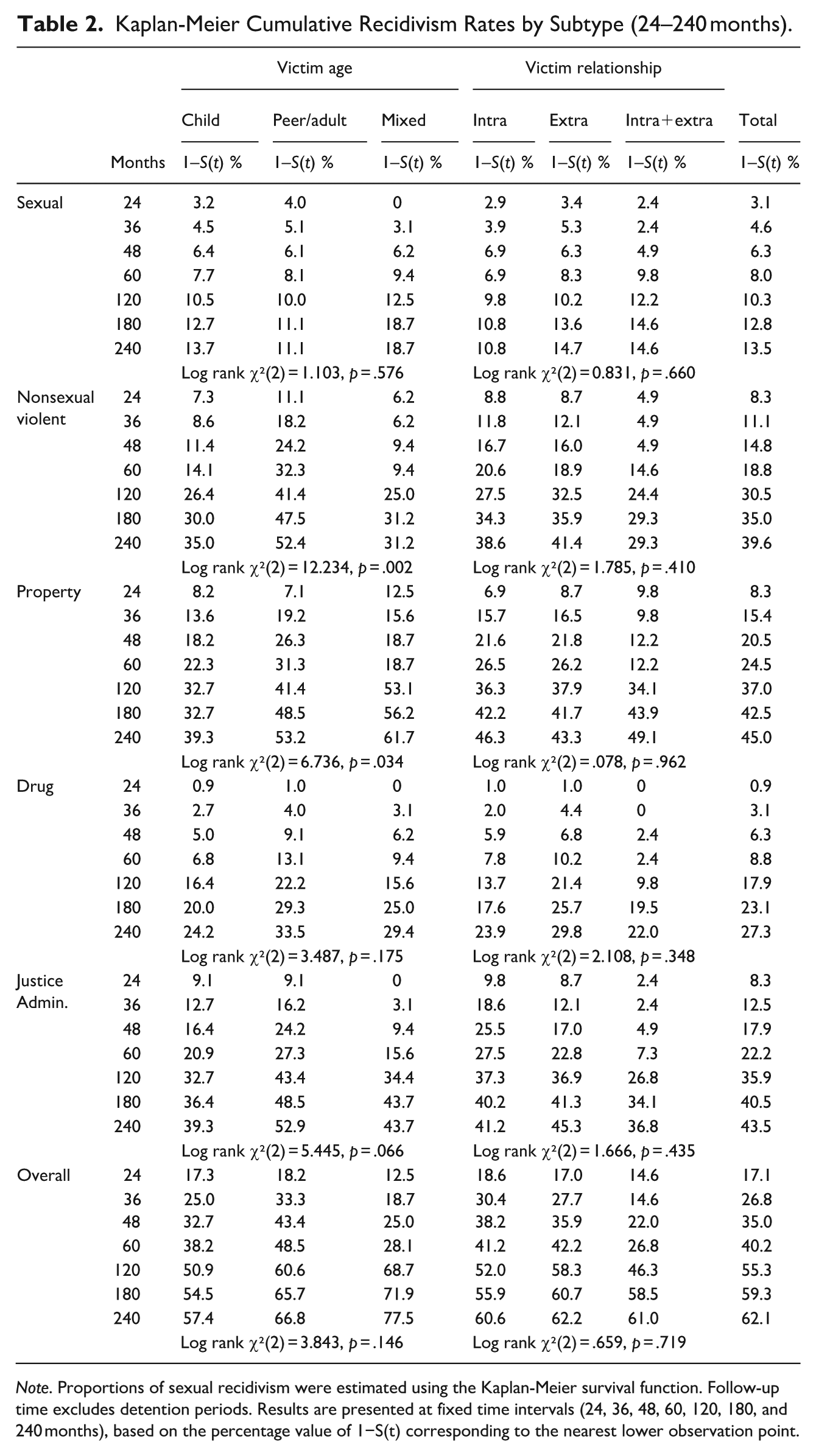
Note. Proportions of sexual recidivism were estimated using the Kaplan-Meier survival function. Follow-up time excludes detention periods. Results are presented at fixed time intervals (24, 36, 48, 60, 120, 180, and 240 months), based on the percentage value of 1−S(t) corresponding to the nearest lower observation point.
Property recidivism increased steadily until it stabilized at 245 months, with no further growth to 325 months. While no variation emerged by victim relationship (p = .962), peer-focused and mixed AHSO showed higher rates than child-focused youth [Log rank: χ²(2) = 6.736, p = .034].
Drug-related recidivism showed a delayed increase, reaching 27.1% by 240 months and stabilizing thereafter. No significant subgroup differences were found [victim age: χ²(2) = 3.487, p = .175; relationship: χ²(2) = 2.108, p = .348]. Justice administration recidivism rose more sharply, reaching 22.2% by 60 months and doubling to 44.5% by 325 months. No significant differences appeared by victim age [χ²(2) = 5.445, p = .066] or relationship [χ²(2) = 1.666, p = .435].
For the full sample, overall recidivism rose steeply during early follow-up, with cumulative rates of 17.1% at 24 months, 26.8% at 36 months, and 40.2% at 60 months (≈7% annual increase). Growth slowed thereafter, with rates reaching 55.3% at 120 months, 59.3% at 180 months, and 62.1% at 240 months. This indicates stabilization around 10 years post-evaluation, with modest increases beyond (≈0.6% annually between 120 and 240 months).
Table 3 reports the mean number of recidivism events (charges) for each AHSO subtype. Means were calculated across the full sample, including non-recidivists, producing high variability and skewed distributions. Accordingly, group differences were assessed with the Kruskal-Wallis test, which compared ranks rather than means. To control for differences in time at risk, ANOVAs (Welch and Brown-Forsythe) were conducted first. No significant effects were found by victim age [Welch: F(2, 79.19) = 2.064, p = .134; Brown-Forsythe: F(2, 133.886) = 2.209, p = .125] or victim relationship [Welch: F(2, 106.653) = 0.587, p = .558; Brown-Forsythe: F(2, 142.396) = 0.633, p = .533]. The only significant finding concerned nonsexual violent recidivism: adolescents who offended against peers at T0 had higher numbers of such recidivism than those who offended against children or both victim types [χ²(2, N = 351) = 9.440, p < .01]. No other comparisons reached significance.
Mean Number of New Criminal Charges by AHSO Subtype.
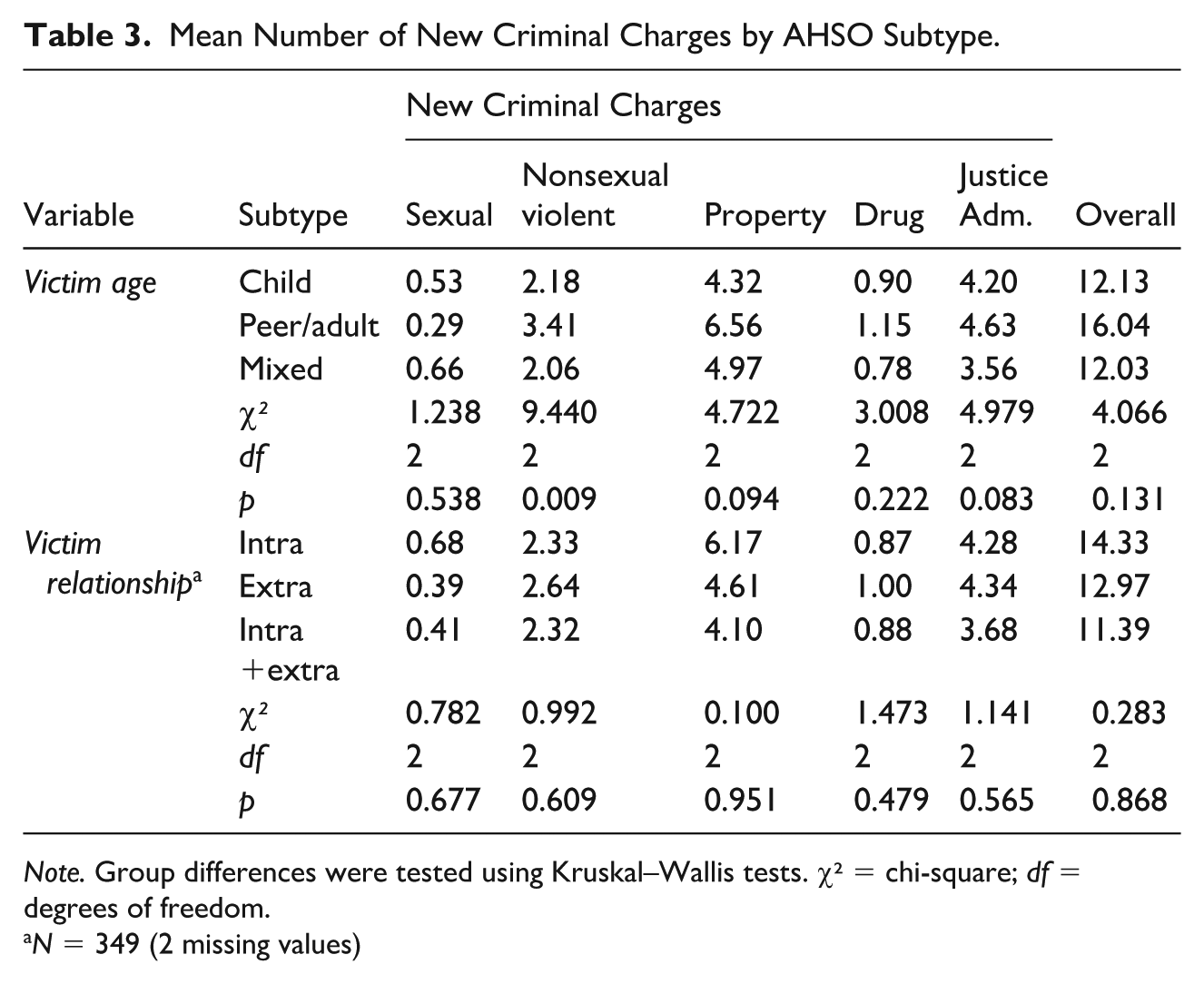
Note. Group differences were tested using Kruskal–Wallis tests. χ² = chi-square; df = degrees of freedom.
N = 349 (2 missing values)
Discussion
This study provides one of the longest follow-up examinations of AHSO to date, tracking outcomes from adolescence into full adulthood (ages 29–45 years at the end of follow-up). In doing so, it adds to a relatively small body of long-term research and extends prior work by distinguishing multiple categories of recidivism rather than focusing solely on sexual versus nonsexual outcomes.
The results reveal a consistent pattern: although more than half of participants reoffended criminally during the follow-up period, only 13.4% faced a new sexual charge, and most incidents occurred within the first few years after the index offense. This early concentration of risk indicates that sexual recidivism is not evenly distributed over time. Rather, the probability declines sharply as adolescents transition into adulthood. Beyond the mid-twenties, sexual recidivism stabilized at very low rates, reinforcing prior evidence that adolescent sexual offending is generally transient and rarely persists into adulthood (Fanniff et al., 2017; Lussier & Blokland, 2014; Waite et al., 2005). These findings add to the debate about whether adolescent sexual offending reflects a stable or transient pattern. Our results indicate that for the majority, such behavior is transient and does not persist into adulthood, though a minority of cases continue.
These conclusions are reinforced by the methodological scope of our study, which applied a broader definition of recidivism, counting charges rather than convictions, and extended the observation period well beyond most prior research. Even under these more sensitive criteria, sexual recidivism increased only marginally over an additional 14 years of follow-up, from 10.3% after 96.8 months as reported in a previous publication (Carpentier and Proulx, 2011) to 13.4% after 260 months in the present study. This stabilization aligns with prior findings showing that sexual recidivism risk declines sharply with age, suggesting that if AHSO have not reoffended by early adulthood, the probability of later sexual recidivism is very low (Caldwell & Caldwell, 2022; Hargreaves & Francis, 2014).
By contrast, nonsexual recidivism was both frequent and persistent. Over 40% of participants were charged with violent nonsexual offenses, nearly half with property crimes, and 43.9% with justice administration offenses such as breaches of conditions or failure to appear. This contrast highlights an important paradox: while public policies and practices often emphasize the sexual risk associated with this population, the greater long-term concern may lie in general and violent offending. Several, non-exclusive explanations may account for this pattern. One possibility is that some AHSO display broader propensities toward externalizing behaviors and general delinquency, which manifest in nonsexual reoffending. Another is that intensive supervision, restrictive conditions, and heightened stigma amplify justice system involvement by increasing detection and limiting reintegration opportunities. Prior research has shown that formal processing can heighten the likelihood of rearrest, incarceration, and delinquent peer affiliation compared to informal responses (Beardslee et al., 2019; Cauffman et al., 2021; Petitclerc et al., 2013). From this perspective, the “high-risk” label assigned to AHSO may not only overstate their sexual risk but also contribute indirectly to sustained criminal trajectories.
The Kaplan-Meier cumulative recidivism rates provide additional nuance by illustrating distinct temporal patterns across offense categories. Sexual recidivism was concentrated in the first years after the initial assessment, after which cumulative risk stabilized, a pattern consistent with the idea that sexual reoffending is primarily an early risk and seldom persists into adulthood. In contrast, property and justice administration offenses followed more prolonged patterns, with justice-related offenses in particular rising steeply throughout the entire follow-up. Nonsexual violent recidivism also grew steadily well into adulthood, while drug-related recidivism emerged more gradually but showed persistence once established. These divergent trends suggest that the greater long-term challenge for AHSO is not sexual persistence but broader and more heterogeneous forms of delinquency. They also call into question the proportionality of extended, sex-specific sanctions, given that sexual risk declines sharply with age whereas other forms of offending follow different, and in some cases more sustained, paths.
Our results also inform the long-standing debate on AHSO subtyping. While previous studies suggested that victim age is a meaningful distinction (Aebi et al., 2012; Brown, 2019), we found no significant differences in long-term overall or sexual recidivism between child- and peer-focused youth. This aligns with evidence showing that victim type is a poor predictor of sexual recidivism (K. Heilbrun et al., 2005; Keelan & Fremouw, 2013; Lussier et al., 2012) and supports the view that victim choice may reflect situational opportunity rather than enduring deviance (E. C. McCuish & Lussier, 2017). Still, peer-focused youth displayed significantly higher rates of nonsexual violent recidivism, consistent with prior findings linking this group to broader externalizing behaviors and conduct problems (Krause et al., 2021; Leroux et al., 2016). For these adolescents, sexual offending may represent one episode within a broader, persistent pathway of delinquency.
Similarly, no significant differences emerged among intrafamilial, extrafamilial, and mixed (intra + extra) subtypes, either overall or by offense category. These results diverge from earlier studies (Aebi et al., 2011; Martijn et al., 2020) suggesting that victim relationship has predictive value. Including a mixed group in our classification, youth with both intra- and extrafamilial victims, did not yield additional insights. Overall, these findings indicate that victim-based classifications, although still embedded in actuarial tools such as ERASOR and J-SOAP, may have limited utility for understanding long-term sexual criminal outcomes.
Implications for Public Policy and Practice
These findings carry several implications for how AHSO are managed within justice systems. First, they call into question the proportionality of long and restrictive sanctions, such as extended supervision, mandatory registration, or broad prohibitions on community activities. In our sample, survival analyses showed that sexual recidivism clustered in the early years and then stabilized at low levels, suggesting that risk declines as youth enter adulthood. While a minority do persist, many AHSO did not reoffend sexually at all. This raise concerns that prolonged sex-specific measures, such as extended supervision, registration requirements, or restrictive conditions limiting access to education, employment, or community activities, may exceed the level of risk observed. As suggested by prior research, such measures may also contribute indirectly to broader criminal involvement by increasing the likelihood of technical violations and by constraining opportunities for social and occupational reintegration (Bosetti and Fix, 2024). Nevertheless, the small subgroup who persist in sexual offending remains clinically and socially significant, given their potential to generate a disproportionate number of victims. Identifying these youth early, understanding the factors that differentiate them from desisting peers, and tailoring specialized interventions to their needs constitute key challenges for both research and practice.
Second, the high rates and persistence of nonsexual recidivism underscore the need for intervention models that extend beyond sexual-specific factors. Addressing criminogenic needs such as peer influences, relational difficulties, and self-control, alongside broader developmental challenges, may be more effective in supporting long-term desistance than intervention narrowly focused on sexual offending. Consistent with developmental research showing that psychosocial maturity extends into the twenties, interventions that foster mental health and self-regulation, strengthen pro-social relationships, and provide opportunities for social integration may help sustain developmental gains (Copp et al., 2020; K. C. Monahan et al., 2013; Ward et al., 2023). Importantly, such efforts can also counteract the stigma and marginalization that often surround AHSO, which themselves may hinder successful reintegration.
Finally, this study challenges the utility of victim-based classifications as primary indicators of long-term recidivism risk in both research and practice. Subdividing adolescents by victim age or relationship may disproportionately stigmatize those who offended against children, despite their similar risk of sexual recidivism. In contrast, peer-focused youth displayed higher rates of violent nonsexual recidivism, suggesting that interventions should also address broader patterns of aggression and conduct problems. Rather than relying heavily on victim characteristics, assessment and intervention should be guided by comprehensive evaluations of criminological, psychological, and developmental factors. The results indicate that risk assessment tools may need to place less emphasis on static offense characteristics from adolescence and instead give more weight to factors that better capture long-term trajectories, including developmental change, mental health, and environmental influences such as peer associations, family context, social support, and the impact of justice system involvement.
Limitations
This study has several limitations. First, recidivism estimates relied exclusively on official records. It is well established that this approach underestimates the true extent of reoffending, as not all offenses are detected or formally processed. Second, data collection was based solely on case files, which restricted the range of variables available for analysis. We lacked access to important psychosocial factors known to influence recidivism, such as quality of social support and occupational or community integration (Willis & Grace, 2009). Third, the sample consisted of youth evaluated in an outpatient forensic psychiatry program specializing in sexual offending, which likely means they had committed relatively serious offenses or presented psychiatric comorbidities. This selection bias may have inflated observed recidivism rates. Another limitation concerns the classification of adolescents into subtypes. Because only a very small minority of participants had more than three victims, we considered only the three most recent at the time of the initial evaluation. For those cases, taking all victims into account might have led to different classifications. Moreover, adult recidivism data were collected from Quebec court records (SOQUIJ), which only capture offenses processed within the province. Offenses committed elsewhere in Canada or abroad could not be included, leading to potential underestimation. This underestimation is unlikely to be important given that Quebec is the only French-speaking province in Canada (New-Brunswick is bilingual) with the lowest interprovincial migration rate in the country. Finally, given the long follow-up period, it is possible that some participants had died before data collection was completed. Because no centralized mortality registry is available in Quebec for research purposes, we were unable to account for this factor in our analyses.
Conclusion
The strength of this study lies in its exceptionally long follow-up, extending into participants’ late thirties and early forties, which offers a rare perspective on the adult outcomes of adolescent sexual offending in terms of their recidivism rates. By examining multiple categories of recidivism, the findings show that while many AHSO reoffended over time, sexual crime persistence into adulthood was uncommon. Most subsequent offenses occurred in nonsexual domains, indicating that sexual offending in adolescence is more often a temporary episode than a sustained pattern. The results also challenge the value of victim-based classifications. Although still used in research and practice, these distinctions showed little predictive utility for long-term sexual outcomes. For most AHSO, victim choice may be shaped more by circumstances and opportunity than by enduring deviance, underscoring the need for assessments that incorporate developmental change, environmental factors, and criminogenic needs.
Finally, consistent with person-first language principles (Lowe & Willis, 2020; Willis, 2018), this study highlights the importance of avoiding the label “sex offenders” when referring to adolescents. Such terminology is stigmatizing and misaligned with empirical findings, which show that sexual persistence into adulthood is the exception rather than the rule. While the current study focused on recidivism, other adult outcome indicators should be examined in future research (e.g., education, employment, health, social network, and quality of life). The adolescence-adulthood transition is a multifaceted phenomenon which starts with the period of emerging adulthood (e.g., 18–29 years old; Arnett et al., 2014). Emerging adulthood is known for being a critical period shaping the process of desistance from crime in youth previously involved in criminal activities (e.g., van den Berg et al., 2014). How the current laws impact adolescents’ experience of emerging adulthood (e.g., gaining autonomy, shaping an identity, and making career choices) remains relatively unclear and it should be considered in future research.
Footnotes
Author Note
Julie Carpentier, Patrick Lussier, and Jean Proulx are also affiliated with the International Center for Comparative Criminology (CICC) and of the Institut national de psychiatrie légale Philippe-Pinel Research Center.

Ethical Considerations
The study was approved by Ethics Committees at the Université du Québec à Trois-Rivières (CER-18-248-07.25) and Institut national de psychiatrie légale Philippe-Pinel (CER IPPM 18-19-06).
Consent to Participate
Not applicable: The study relied exclusively on retrospective file data, and the Research Ethics Boards did not require contacting participants for consent.
Funding
The authors disclosed receipt of the following financial support for the research, authorship, and/or publication of this article: This research project was supported by a Master’s scholarship from the Social Sciences and Humanities Research Council of Canada (SSHRC) awarded to the second author, and by financial support from the Groupe de recherche sur l’agression sexuelle (GRAS).
Declaration of Conflicting Interests
The authors declared no potential conflicts of interest with respect to the research, authorship, and/or publication of this article.