




Abstract
There is an ongoing debate about the risk of long-term sexual recidivism for justice-involved perpetrators of sexual offense. There is a long-held belief that lifetime sexual recidivism varies between 40% and 60% but other more recent estimations are in the 20% to 30% range. Higher rates appear to stem from older, higher-risk samples, which might not be generalizable nowadays. The current study presents findings from a 30-year prospective longitudinal study of adults incarcerated for a sexual offense and the long-term prediction of risk assessment. A sample of 553 consecutively admitted individuals in a Canadian penitentiary were followed for an average of 18 years following their prison release. The study provided information for the cumulative sexual recidivism rate for a 5-year (0.09; 95% CI [0.07, 0.12]), a 10-year (0.15; [0.13, 0.19]), a 20-year period (0.19; [0.16, 0.23]) and a 25-year period (0.20; [0.17, 0.24]). The Static-99R scores were informative about the risk of sexual recidivism (Total score area under the receiver operating characteristics curve [AUC] = 0.662; [0.619, 0.702]; Risk level AUC = 0.639; [0.596, 0.680]), but the instrument was outperformed by other information, including custody and community re-entry experiences. Very similar findings were observed for the Static-2002R. The findings stress the need to investigate risk and protective factors distinctively for short, moderate and long-term recidivism.
Keywords
Introduction
There are now well over 80 years of criminal justice policymaking decisions focused on justice-involved individuals and the risk of sexual recidivism (e.g., Lussier et al., 2023; Sanders, 2017; Wright, 2014). One of the key assumptions policymaking decisions is based on is the belief that these individuals remain at-risk of sexual recidivism over long periods (e.g., American Psychiatric Association, 1999), which has led to the enactment of policies with long-term implications (e.g., Lieb et al., 1998; McAlinden, 2012; Petrunik, 2002; K. Soothill, 2010). Such policies, however, are not clear about what constitutes long-term risk and how to identify individuals representing long-term risk. In fact, in several countries, it is now common practice to conduct risk assessment using actuarial tools to establish the risk probabilities of sexual recidivism. Such practices, which imply a static risk-based designation (e.g., low, moderate, high risk), do not carry a time component. This static approach to risk assessment has been challenged with the recognition that risk is dynamic (e.g., Lussier & Davies, 2011; Lussier & Healey, 2009) and that even high-risk offenders may not be at a high risk to sexually reoffend over their entire lifetime (Hanson, 2018). While research on risk, risk assessment and risk management has significantly evolved over the past 30 years, it remains unclear how research findings have impacted criminal justice practices in terms of the assessment of the long-term risk of recidivism (Lussier et al., 2024). Without clear guidelines, such policies have put pressure on professionals to determine whether individuals represent a long-term risk of sexually reoffending and such practices continue to raise clinical, practical and ethical issues (e.g., Doren, 1998; Frances, 2020; Janus, 2004; Wollert, 2001). These issues are important given that risk assessment impacts both front-door sentencing (e.g., custodial, community-based sentences) and back door sentencing (e.g., parole board decision, community supervision) decisions (e.g., Hood et al., 2002).
The stakes are high, yet making long-term prediction about human behavior is difficult and imperfect at best (e.g., Miller et al., 2005). As a result, the criminal justice system has growingly relied on actuarial risk assessment instruments to inform decision-making and to make a prediction about risk as evidence-based practices to determine risk of sexual recidivism. For risk assessment to be accurate, it requires precise, accurate, valid and reliable information about, first and foremost, the long-term risk of sexual recidivism (e.g., Hanson et al., 2024; Lussier et al., 2025). The reality, however, is that the bulk of research provides estimations of sexual recidivism over a relatively short-term follow-up period of about 5 years (Lussier et al., 2024), raising questions about the validity of risk projections made well beyond that period (e.g., Thornton et al., 2021; Wollert & Cramer, 2012). Given the long-term implications of criminal justice policies and sentencing decisions influenced by risk assessment, it is paramount to examine long-term risk of sexual recidivism and the ability of risk assessment instruments to discriminate between recidivists and non-recidivists. Based on a 30-year prospective longitudinal research project, the current study examines the long-term sexual recidivism rates for a cohort of justice-involved adult males with a history of sexual offending. The current study reports long-term sexual recidivism rates while examining covariate-adjusted predictive accuracy of actuarial risk assessment tools (i.e., Static-99R, Static-2002R) specifically developed for sexual recidivism.
Literature Review
There have been several narratives about the long-term risk of sexual recidivism. One influential narrative suggests that it is just a matter of time before all justice-involved perpetrators of sexual offenses become sexual recidivists (e.g., Abel et al., 1987; Langevin et al., 2004). Tenants of this narrative have argued that official data on offending vastly underestimate the true sexual recidivism rate due to the limitations of police data on crime. The underestimation of actual offending is not unique to sexual offending, and the issue remains to estimating the extent to which sexual recidivism is underestimated (e.g., Abbott, 2020; Lave et al., 2021; Scurich & John, 2019). That first narrative may reflect trends of another era and, in the absence of convincing evidence and questionable methodologies (e.g., Marshall et al., 1991; Webster et al., 2006), a second narrative has burgeoned. The second narrative suggests that, while the underestimation of sexual recidivism is inevitable, sexual recidivism should be approached from a probabilistic perspective. This has been emphasized by stressing that risk probabilities vary across individuals and should be based on empirically accurate, methodologically rigorous and falsifiable scientific evidence (e.g., Quinsey et al., 1995; Rice et al., 1990).
That second narrative, therefore, has been concerned about establishing a person’s risk probabilities of sexual recidivism using actuarial-based instruments more than determining the true base rate of sexual recidivism. A person’s risk of recidivism, however, is inherently tied to a group of reference and departure from that group in terms of risk probabilities allow categorizing that person’s level of risk (e.g., below average or low risk, above average or high risk). In other words, while the second narrative is less directly concerned with establishing the long-term sexual recidivism rates than establishing the risk probabilities, those probabilities are embedded in the development of actuarial risk assessment instruments. A third narrative proposes that desistance from sexual offending is the norm (e.g., Lussier & Healey, 2009), by stressing, among other things, the role of age and aging on offending, which had been neglected by the tenants of the previous two narratives. This third narrative is less concerned about establishing what the long-term sexual recidivism rate is or what the risk probabilities of a person are, but a reminder of the inherently dynamic nature of the risk of recidivism and the unpredictable nature of the life course. The study of desistance, however, has been focused on life events and life experiences from the point of view of justice-involved individuals over a relatively short post-release follow-up periods (e.g., Farmer et al., 2015; Harris, 2016; Lussier & McCuish, 2016) raising questions as to whether individuals considered desistors had in fact really desisted from crime (McCuish, 2020).
Estimations of sexual recidivism, risk probabilities and desistance from crime tend to be based on short-term follow-up periods. The typical follow-up, which consists of a period of about 5 years, is short when considering reports that some justice-involved individuals sexually reoffend a decade or more after their prison release (e.g., Prentky & Lee, 2007). More specifically, short-term estimations of recidivism are problematic in that they are vulnerable to issues of false desistance – that is, individuals considered as non-recidivists who become recidivists with a longer follow-up period (e.g., McCuish, 2020). In fact, it is well known that the percentage of a cohort of justice-involved individuals who sexually recidivate (also known as the base rate) will increase as the length of the follow-up period is extended (e.g., K. L. Soothill & Gibbens, 1978). Despite this critical issue, researchers have relied on short-term estimations of sexual recidivism mainly because long-term longitudinal studies are difficult to conduct, they require significant financial and professional resources and coordination, as well as repeated access to sensitive information over a long period of time.
In the absence of long-term sexual recidivism studies, some have argued that long-term estimations of risk are predictable from short-term risk of recidivism. Dubbed the constant multiplier effect (CME), it has been stated, without much empirical evidence, that 20-year risk of sexual recidivism in justice-involved individuals corresponds to the 5-year estimate multiplied by a factor of about 2 (see, Doren, 2010). The CME hypothesis suggests that extrapolation can be used to estimate long-term risk, but others have criticized this strategy for being too simplistic and for not considering the variability of risk across individuals and instruments (e.g., Wollert & Cramer, 2012). While the concerns are legitimate, research has since shown some empirical support for the CME suggesting the presence of some regularities as to the functional form 1 of sexual recidivism rates over time (e.g., S. C. Lee & Hanson, 2021; Thornton et al., 2021). The CME hypothesis suggests a universal functional form of sexual recidivism, but it remains unclear whether such form if indeed universal and whether it can be applied across context and risk levels.
The study of long-term risk of sexual recidivism is still scarce and this field of research has been characterized by contradictory findings over the years. Researchers tend to designate “long-term” recidivism rates when referring to studies with a mean follow-up period varying between 12 and 25 years (e.g., Nicholaichuk et al., 2014; Prentky & Lee, 2007). It has been shown that with such a follow-up period, the long-term risk of sexual recidivism can be in the 40% range, with some estimations being as high as 60% (e.g., Hanson et al., 1993; Kingston et al., 2015; Langevin et al., 2004; Prentky & Lee, 2007). Other studies produced more conservative estimations of long-term risk varying between the low 10%, up to about 30%. More conservative estimations can be partly explained by the inclusion adolescent samples (e.g., Rasmussen, 1999; Seabloom et al., 2003; Worling et al., 2012; Zimring et al., 2007). These studies show that the long-term risk of adolescents is lower than that of adults suggesting that the long-term of risk sexual recidivism risk could be age-related (e.g., Lussier & Blokland, 2014; Lussier et al., 2012). Excluding adolescent samples, more recent studies reported sexual recidivism rates within the 20% to 30% range (e.g., Ackerley et al., 1998; Bengtson & Langstrom, 2007; Blokland & van der Geest, 2015; Cann et al., 2004; de Vries Robbé et al., 2015; Nunes et al., 2013; Olver et al., 2018; Rice et al., 2008; K. Soothill et al., 2005; K. K. Soothill et al., 1976; Swinburne Romine et al., 2012; Tartar & Streveler, 2015; Thornton et al., 2003; Vess & Skelton, 2010), with some studies reporting estimations below the 20% mark (e.g., Baudin et al., 2020; Lussier et al., 2025). The discrepancies between reports of long-term sexual recidivism rates in the 40% to 60% range and those in the 20% to 30% range are quite significant and are unlikely to be explained by a single factor. A recent meta-analysis has shown that, since the 1970s, sexual recidivism rates have significantly dropped (Lussier et al., 2023) which could explain, at least in part, the discrepancies found between older and more recent studies. These findings raise questions about the accuracy of actuarial risk assessment tools given that different cohorts, across different periods, have produced significantly different estimations of long-term risk.
The difficulty in drawing firm conclusions about long-term sexual recidivism can be attributable to the number of issues and challenges conducting such research. Long-term studies are often based on a small sample of justice-involved individuals consisting of fewer than 200 cases (e.g., Baudin et al., 2020; Bengtson & Langstrom, 2007; D. T. Lee, 2003; K. K. Soothill et al., 1976). The small sample size of these studies in relation to the small proportion of these samples that were identified as sexual recidivists raised questions about generalizability. Furthermore, attrition and missing data are part of long-term longitudinal studies (e.g., de Vries Robbé et al., 2015) but the information is not constantly reported by researchers raising questions about the methodological rigor of these studies. It is unclear, for example, whether researchers considered mortality and whether risk estimates are adjusted by considering whether individuals’ date of their passing. In fact, the few studies that do report on mortality do not report any information as to how this information was considered.
Importantly, long-term studies tend to rely on administrative data that includes no information about their custodial and community reentry experiences which can impact recidivism (e.g., Blokland & van der Geest, 2015; Cann et al., 2004; Rydberg et al., 2025). Furthermore, the study of covariates of sexual recidivism is often tied to research decisions made several years if not decades prior to the data collection on sexual recidivism. To put into context, most long-term studies are based on a study sample of cases recruited prior to the 1990s, going back to the 1940s, suggesting that information from these cohorts might be less relevant nowadays (e.g., K. K. Soothill et al., 1976; Zimring et al., 2007). Also, and relatedly, because these studies were conducted in another era, measures and instruments used might be no longer relevant; some could be considered crude or not reflective of current knowledge, or some indicators that are now considered critical were simply unknown some 30 or 40 years ago. The 1990s is a critical period, because it marks the rise of empirical research on sexual recidivism, the rise of research on the associated risk factors, as well as the gradual emergence of actuarial risk assessment tools specifically designed for sexual recidivism (Lussier et al., 2024).
The Aim of Study
Long-term longitudinal study findings carry significant scientific, policy, clinical, legal and judicial implications, yet it remains a challenge to carry out such studies. Long-term longitudinal studies take time and require multifaceted coordinated resources and, as a result, government branches and funding agencies tend to favor studies with short-term findings and near-immediate policy implications (e.g., Cann et al., 2004; McCuish et al., 2021). Most long-term sexual recidivism studies were based on samples dating back to the 1980s and earlier periods. There have been significant changes since, not just in terms of policymaking, but also in terms of risk management strategies, which might impact sexual recidivism rates. In Canada, the 1990s saw the rapid rise of the risk-need-responsivity (RNR) principles in corrections (Andrews & Bonta, 2010; Andrews et al., 1990, 2006) whose relevance in the context of sexual offending has been demonstrated and principles integrated in correctional practices (e.g., Hanson et al., 2009; Olver et al., 2018).
The RNR principles significantly changed correctional practices, while highlighting the importance of actuarial risk assessment and risk-based treatment and interventions that are now well-accepted concepts in the field of sexual offending (e.g., Lussier & Frechette, 2022; Nunes et al., 2013; Olver & Sewall, 2018; Olver et al., 2014; Rice et al., 2008; K. Soothill et al., 2005; Swinburne Romine et al., 2012). As a result, to assist criminal justice decision-making, several risk assessment tools have been developed over the years specifically designed for justice-involved individuals with a sexual offending history, such as the Static-99R and the Static-2002R (Hanson & Thornton, 1999; Phenix et al., 2017). While the importance of prediction accuracy is undeniable, RNR principles are not just about risk assessment but also about individualized service delivery to prevent recidivism. While the goal of the current study is not to empirically test the RNR model, the current study recognizes that, since the implementation of RNR principles in corrections, sexual recidivism might have changed as a result (Lussier et al., 2023). To address this gap, the current study, based on a 30-year prospective longitudinal study design, aims to describe long-term sexual recidivism rates for a sample of adult justice-involved individuals.
The study is based on a cohort of 553 consecutive admissions to a Canadian federal penitentiary and represents a quasi-population of federally sentenced individuals convicted of a sex crime. The study, which started in 1994, now includes four waves of data collection, allowing to describe and contextualize justice-involved individuals’ background and profile, their experience in custody, but also their community reentry. First, the current study aims to determine the proportion of individuals who came back in the criminal justice system in relation to new charges for a sexual offense. In doing so, the study will allow revisiting the various narratives about the long-term while empirically examining the extent to which individuals return in the criminal justice for a sexual offense. Second, using survival analyses, the study seeks to explore the rate at which individuals came back in the criminal justice system for another sexual offense considering offenders’ risk level using well-known actuarial risk assessment instrument (Static-99R, Static-2002R). Examining the sexual recidivism rate will allow examining the functional form of the survival curve for justice-involved adults with a history of sexual offending. Third, using a series of Cox proportional hazard (PH) regression analyses, the ability to discriminate sexual recidivists and non-recidivists will be examined, holding constant a series of background characteristics (e.g., age at first conviction) as well as factors related to custodial (e.g., time spent incarcerated, having completed a therapy) and community reentry experiences (e.g., community supervision, the presence of a positive family member). With that said, the goal of the study is not to identify risk factors or to build a prediction model of long-term risk, but rather to explore the long-term risk of recidivism and to while taking into account offenders’ risk level.
Methodology
Sample
The sample consists of 553 individuals consecutively admitted to a federal penitentiary in the province of Quebec between 1994 and 2000. 2 All these individuals were adult males convicted for a sexual offense and were sentenced for a minimum of 2 years. These individuals were all admitted to the same federally run institution for their intake assessment before being transferred to another institution where they served their sentences. That assessment period usually lasted about 6 weeks, a period during which they were invited to take part in the study. At the time of their intake interview, this sample was, on average, 40.1 years old (SD = 12.0); the majority were white (84.6%), French-speaking (91.0%) and had no more than a high school diploma (63.7%). In total, 25.3% of the sample had a prior history of taking part in a sex offender treatment. In Canada, individuals convicted for serious criminal offenses and/or who have a lengthy criminal record, such as those included in this sample, tend to be imposed a federal sentence. Therefore, it is not surprising that 31.8% of the sample had a prior criminal record for a sexual offense and that, on average, this sample had 15.4 (SD = 18.2; median = 9) criminal charges.
Procedures
The current study is based on a prospective longitudinal study design implemented in 1994. The study was approved by Correctional Service of Canada and now includes four waves of data collection. Wave I consisted of in-person interviews conducted with each study participant (1994–2000). The participation rate was high (93%), and all individuals who agreed signed a consent form and were subsequently interviewed by a member of the research team (two licensed psychologists). It was made clear that their decision to participate in the study had no impact on their risk assessment (e.g., institutional violence, escape from detention, criminal recidivism) and their institutional risk classification and assignation. Individuals who agreed to participate in the study gave their consent allowing the research team to collect information from their correctional files, which included their criminal history, police reports related to the index crime, assessments of their institutional behavior, as well as their psychological and phallometric assessment. Recidivism data were first collected in 2004 at wave II by consulting correctional file data. Wave III was conducted in 2007, which consisted of updating recidivism data, while collecting data on treatment and intervention for each research participant as well as collecting information on participants’ community supervision experiences. Wave III data on intervention and community reentry experiences were collected from each person’s correctional file. Wave IV was conducted between 2023 and 2024 and involved collecting court-related information.
Attrition
Coding such a large sample over such a long follow-up period is not an easy and straightforward task. This requires matching individual’s name and date of birth with all court appearances after each of these individuals returned to the community. Of the 553 cases, 71 cases required further inspection, but most cases were easily resolved because their surname or given name was slightly misspelled or had very minor errors, because of an individual’s use of aliases or in fewer cases slight errors in birthdates. Issues were resolved, among other things, by matching other information of the files, such as previous convictions. For three cases, while data were available for waves I, II and III, their files could not be updated at wave IV due to missing information. As a result, their survival period was determined based on the information available at wave III. Of the 553 cases, however, 26 cases (4.7%) were not included in the follow-up study for the following reasons: 7 individuals passed away while in custody (i.e., illness, suicide, natural causes); 4 cases were believed to be incarcerated at the time the recidivism data were collected at wave III in relation to the index offense (2 were designated as a dangerous offender, which carries an indeterminate custodial sentence); 3 cases were believed to have been released out-of-province, elsewhere in Canada and recidivism data was not available; 5 individuals were deported to another country after completing their custodial sentence; 1 individual escaped from custody and is believed to have fled the country; 6 cases were lost due to what appears to be either file or coding errors and no recidivism data were ever collected as a result. In total, therefore, the final sample used to examine sexual recidivism consisted of 527 of the original 553 cases (95.3%).
Measures and Instruments
The study focuses on the ability of actuarial risk assessment instruments designed specifically to discriminate between sexual recidivists and non-recidivists. In that regard, the study includes two instruments designed specifically for that purpose: Static-99R and the Static-2002R. To complement these instruments, a series of covariates were included. Aside from sociodemographic indicators (e.g., civil status, years of education), the selection of covariates was guided by RNR principles (Andrews & Bonta, 2010; Andrews et al., 1990, 2006), which offer a template to examine recidivism. The RNR principles recognize the importance of risk and risk assessment to adjust the intensity of services and interventions (e.g., Nunes et al., 2013; Olver & Sewall, 2018; Olver et al., 2014; Rice et al., 2008; K. Soothill et al., 2005; Swinburne Romine et al., 2012). In total, three risk assessment instruments were included in the study,
Statistical Information on Recidivism
All study participants were assessed using the Statistical Information on Recidivism (SIR; Nuffield, 1982).The SIR is an actuarial-based risk assessment instrument developed to guide parole board decision-making for federally sentenced inmates (Bonta et al., 1996). 3 The instrument is based on 15 items informative about the risk of general recidivism, with lower scores (e.g., poor) being associated with higher risk of general recidivism. The SIR was completed by a correctional staff member at the time because it was standard practice to assess all individuals admitted to a penitentiary using that instrument. The purpose of including SIR scores in the study was not to validate the instrument, but rather to describe the sample while statistically controlling for an instrument that might have influenced criminal justice decision-making at the time research participants were serving their prison sentence. There were 19 cases for which the SIR scores were not available for this study, and, therefore, a missing data imputation technique was used (linear regression using case file information). The statistical association between the SIR total score and sexual recidivism before and after the imputation was near identical. The distribution of SIR scores was as follows: (a) very good (59.4%); (b) good (12.6%); (c) fair (12.4%); (d) fair to poor (8.8%); (e) poor (6.8%).
Static-99R and Static-2002R
It is noteworthy that when the initial study sampling started, most currently used actuarial-based risk assessment for sexual recidivism tools did not exist or were in the process of being developed. Because most individuals included in the sample had been released prior to 2007, it is unclear to what extent actuarial-based risk assessment for sexual recidivism played any part in the risk classification and parole-board decision-making for these individuals. For this study, the Static-99R (Phenix et al., 2017) was retrospectively coded using research file data collected at waves I, II and III. The Static-99R, which comprises 10 items, all static risk factors, is a more recent version of the Static-99 (Hanson & Thornton, 1999) in that it includes an updated weight for the age-at-release item (Hanson et al., 2016). The mean total score at the time of the prison release was 2.2 (SD = 2.4) with scores ranging from −3 to 9. The distribution of risk levels for this sample was as follows: (a) very low (4.8%); (b) below average (20.7%); (c) average (45.6%); (d) above average (21.3%); (e) well above average (7.6%). Similarly, the Static-2002R (Helmus et al., 2012; Phenix et al., 2008) was retrospectively coded. The mean score of the Static-2002R was 3.3 (SD = 2.4) with scores ranging from −2 to 10. The distribution of individuals across risk levels was as follows: (a) very low (4.0%); (b) below average (20.4%); (c) average (46.6%); (d) above average (18.6%); (e) well above average (10.5%).
Incarceration and Community Supervision Experiences
A series of covariates were included in the study, also anchored in RNR principles, to reflect incarceration and community supervision experiences. In the context of the RNR model, the need principle refers to intervention needs aiming to reduce the risk of recidivism while responsivity factors refer to factors that can affect or even impede a person’s response to such interventions (e.g., Ogloff & Davis, 2004). In the context of sexual offending, RNR principles recognize the importance of treatment programs targeting criminogenic risk factors (e.g., Lussier & Frechette, 2022) as well as the those targeting risk factors more specifically associated with sexual recidivism (e.g., Hanson et al., 1993; Sewall & Olver, 2019; Worling et al., 2012). Intervention needs refer to those focusing on criminogenic needs (those related to general recidivism) as well as those that are more specifically related to sexual recidivism (e.g., Lussier & Frechette, 2022). On average, justice-involved individuals were imposed a prison term of 4 years (SD = 2.58).
While incarcerated, all individuals were assessed for the purpose of producing a correctional intervention plan matching offenders’ treatment need; treatment participation being on a voluntary basis. In total, 391 individuals took part in some form of treatment program during their custody. Only 25% of these individuals took part in both a specialized sex offender treatment program (SOTP) and some form of criminogenic risk/need program (e.g., substance abuse, anger management, violence). In total, 38.8% of the sample took part in a SOTP and completed the program while 15.3% took part in such a program but did not complete (i.e., expelled, dropout). Also, 60.2% of the sample did not complete any form of criminogenic risk and need program while incarcerated. A total of 35.7% of the sample took part in a criminogenic needs treatment and completed it, while 4.2% took part in a program but did not complete that program. 4 In the context of custody, the ability to complete a treatment program was considered a measure of a person’s responsivity to intervention. On average, justice-involved individuals served 37.8 months (SD = 44.4) in custody prior to being released. Note that 83.2% of the sample has been under some form of community supervision prior to the warrant expiry date. This means that about 16.8% of the sample remained incarcerated for the whole duration of their custodial sentence. 5 While on community supervision, 23% of the sample breached the condition of their release. The presence of a supportive person in the community who had a positive influence on justice-involved individuals while they were under supervisory conditions was considered another measure of responsivity. In total, 36.4% of the sample was considered by criminal justice professionals (e.g., parole officers) to have at least one supportive family member while 21.5% had at least one supportive non-family member.
Mortality
Because this is a 30-year project, it was critical to determine whether each individual was still alive at the end of the follow-up period. If a person had passed away, steps were taken to determine the date the person passed. A number of steps were taken and different sources consulted to determine an individual’s status. Correctional files were consulted up to 2007 to determine individuals’ status. Obituaries were consulted using online sources up to 2024. A web scraper tool was used to search through these obituaries. The search was completed using a case-by-case research using various resources available online. Of the original 553 individuals, it was determined that 67 individuals (12.1%) had passed away before the end of the recidivism data collection date (this includes the seven cases that passed away while in custody; those seven cases were excluded from the follow-up study). For these cases where there was a confirmed death, the date of their passing marked the end of their follow-up period.
Follow-Up and Survival Period
The follow-up period refers to the time span starting when justice-involved individuals were released into the community, ending when the final data extraction of recidivism was completed. That follow-up period was used to determine the survival period, which marks the length of time that a justice-involved individual survived in the community without a new sexual recidivism event. In the current study, the released date marks the start of the survival period. The end of the survival period was determined by considering three distinct information: (a) whether the person has been charged for a new sexual offense prior to the end of the follow-up period; (b) whether the person has passed away prior to the end of the follow-up period; (c) the date court records were retrieved and collected to determine whether a sexual recidivism event had occurred. The end of the survival period was determined by the earliest occurrence of one of the three events (sexual recidivism, death, data collection). The length of the survival period, therefore, refers to the time elapsed (in months) between the start and the end of the survival period. The mean length of the survival period was 228 months (SD = 97.1; median = 268), or about 19 years. Overall, 75% of the sample had a survival period of at least 15 years without new sex crime-related charges. At the end of the survival period, individuals were, on average, 64.8 years old (SD = 11.9).
Sexual Recidivism
Data on recidivism were collected on three occasions when time, resources and funding were available. In 2004 (wave II) and 2007 (wave III), data on recidivism were retrieved by inspecting correctional files and police data (CPIC). Such sources covered all recidivism events having occurred anywhere in Canada. By 2008, more than 95% of this sample had been released from prison and were back into the community. The inspection of recidivism events was extended at wave IV, by consulting publicly available court records for everyone since their return into the community. The search was made possible by using participants’ name, date of birth and matching information (e.g., information about the index crime). Court data include all court appearances related to a criminal offense, including charges, date of the offense, nature of the charges against the individual, the individual’s plea, whether the person was found guilty and the sentences imposed by the judge. Court data consulted for this study are limited to the province of Quebec. Therefore, if an individual recidivated in another province and was charged in a province other than Quebec, this would not appear in the wave IV court data. This was not a significant concern because the interprovincial geographic mobility of Quebec residents is one of the lowest in Canada (e.g., Bernard et al., 2008). 6 Recidivism refers to a new charge for a sexual offense occurring during the follow-up period. Sexual offenses include a wide range of behaviors defined by the criminal code of Canada. In total, 101 individuals were charged again for a sexual offense. 7 Note that for this study, only the first sexual recidivism event was considered. Multiple sexual recidivism events were rare for this sample (4.4% of the 527 cases). The earliest recidivism event occurred 4 months after the prison release while the latest occurred 23 years later. In total, 68% of all sexual recidivism events occurred prior to 2008, which is not surprising given that previous studies have shown that the yearly recidivism rate peaks in the first few years following prison release (e.g., Lussier et al., 2025). 8
Analytical Strategy
Sexual recidivism and covariates were analyzed using a series of survival analyses. Survival analyses are superior to alternative methods such as logistic regression because they allow adjusting for censored cases (i.e., the possibility that non-recidivist would change status with a longer follow-up period; e.g., Allison, 2010). All survival analyses were conducted by statistically adjusting for the length of the survival period. Cox regression models (Cox, 1972) were used to simultaneously examine multiple statistical covariates of sexual recidivism. Cox regression is a PH model in that the hazard functions are proportional over time, irrespective of how much time has passed. The PH assumption was assessed for all covariates included in the study using the Schoenfeld residuals. It provides hazard estimates (Hazard ratio) and confidence intervals for each covariate in relation to the risk of sexual recidivism. Each study covariate and its statistical association to sexual recidivism were inspected separately using a series of Cox PHs regression analysis. While our goal was not to develop a prediction model but rather to explore the covariates of sexual recidivism, the ROC (i.e., receiver operating characteristic) analyses were performed to report the relative predictive accuracy of the regression models (Mossman, 1994; Swets et al., 2000). ROC curve analyses generate what is commonly referred to as the area under the ROC curve (AUC) values that vary between 0.50 (chance) and 1.00 (perfect discrimination between recidivists and non-recidivists; Rice & Harris, 1995). For Cox regression analyses, Harrell’s C-index (e.g., Harrell et al., 1982) and Gönen and Heller (2005) K coefficient were both used to assess the predictive accuracy of models. All analyses were performed using Stata (College Station, TX: StataCorp LLC), version 19.5.
Results
Sexual Recidivism: A Survival Analysis
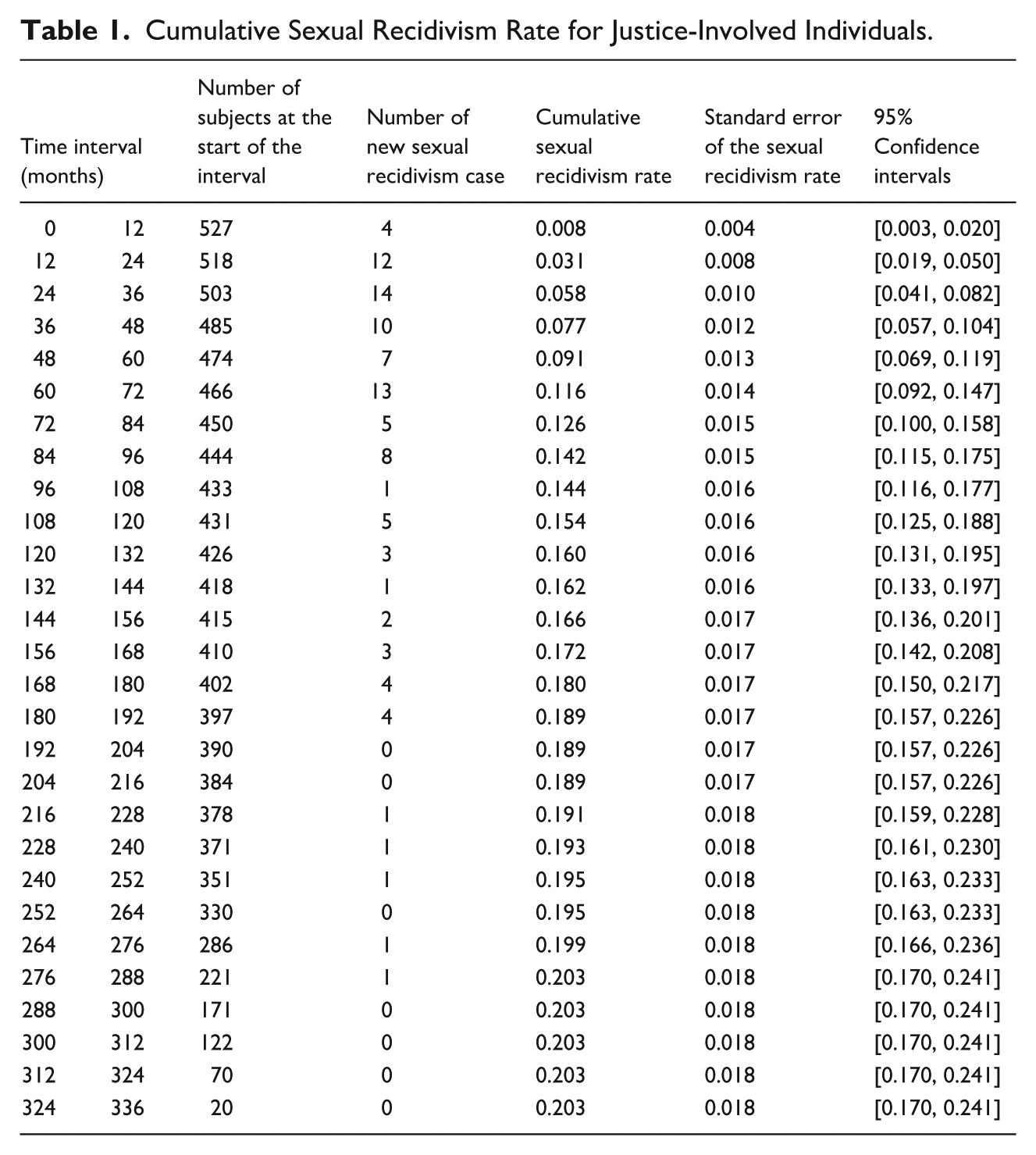
The life table presenting the cumulative sexual recidivism rate is presented in Table 1. This table is broken down into 12-month periods or time intervals showing the number of at-risk individuals from the start of the follow-up period up to 336 months (28 years). At the beginning of the follow-up period, there was 527 individuals; after 10 years, there was still 426 individuals at-risk of a sexual recidivism event. At the 20-year mark, the sample size was substantial with 351 cases remaining at-risk of recidivism. Table 1 also shows the number of recidivism events at each time interval. There are 101 recorded recidivism events for this sample. The first 5 years saw a total of 47 recidivism events or 46.5% of all sexual recidivism events for this sample. The latest recorded sexual recidivism event occurred after 276 months or after 23 years. The survival function of sexual recidivism is presented in Figure 1.
Cumulative Sexual Recidivism Rate for Justice-Involved Individuals.
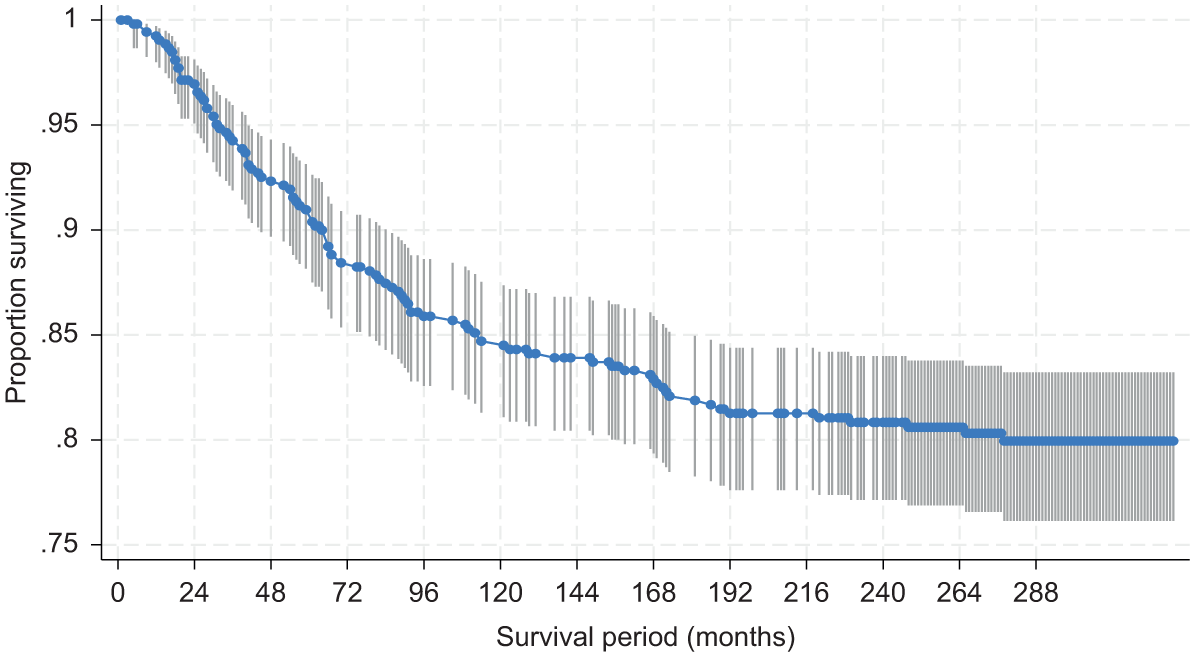
Survival function of sexual recidivism (95% confidence intervals).
Risk Assessment and Sexual Recidivism
In Table 2, sexual recidivism rates are presented according to Static-99R and Static-2002R risk scores. Overall, sexual recidivism rates increased as a function of (a) the person’s risk level based on the risk assessment scores; (b) the length of the follow-up period but the growth of that rate was not constant across risk level. For example, looking at the Static-99R, the sexual recidivism rates of the Below Average group varied between 0.039 (5-year) and 0.140 (25-year). In contrast, the Well Above Average group showed sexual recidivism rates varying between 0.256 (5-year) and 0.385 (25-year). Several findings should be highlighted here. First, the sexual recidivism rates continued to rise well past the 5-year mark and even the 10-year mark for all groups involved, with the exception of the Very Low group. None of the individuals classified as Very Low sexually recidivated during the follow-up. Second, the sexual recidivism rates appear to have stabilized at different time points across risk levels. For the Below Average and the Above Average groups, the rate stabilized around the 20-year mark while for the Well Above Average group, around the 15-year mark. Interestingly, the recidivism rate for the Average group continues to rise at the 25-year mark. Third, the sexual recidivism rate function appears to vary according to individuals’ risk level based on the Static-99R scores. For example, for the Average group, 10-year rate and the 20-year rate were, respectively, 1.78 and 2.21 times the 5-year rate. For the Well Above Average, the 10-rate and the 20-year rate was respectively 1.10 and 1.50 times the 5-year rate. Results were similar for the Static-2002R.
Cumulative Sexual Recidivism Rate (and Standard Errors) According to Static-99R and Static-2002R.
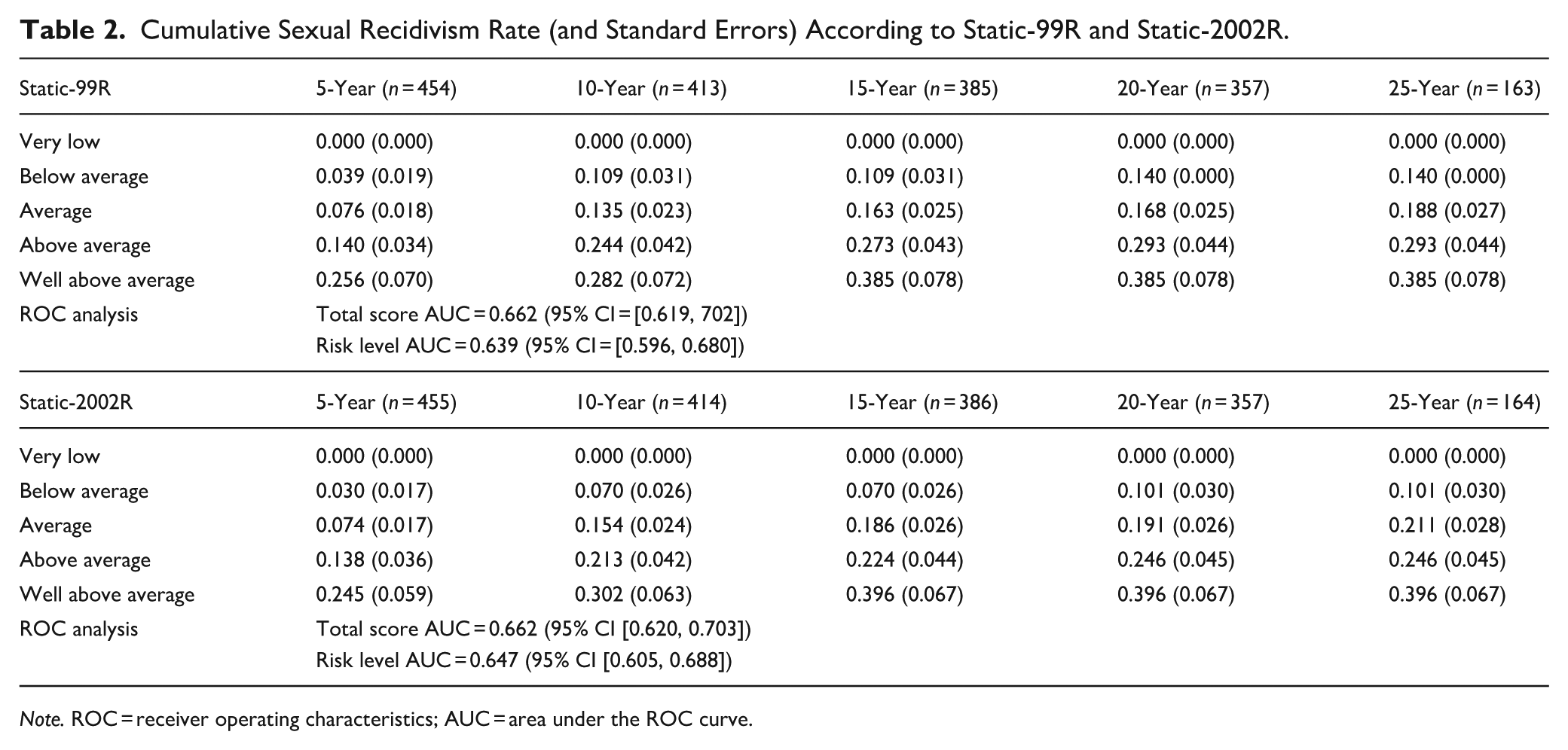
Note. ROC = receiver operating characteristics; AUC = area under the ROC curve.
ROC analyses were performed for both the Static-99R and the Static-2002R to examine their ability to discriminate between recidivists and non-recidivists. The ROC analyses were performed by considering (a) the instrument’s total (raw) score and (b) the instrument risk classification. Several observations stand out. Both the Static-99R and the Static-2002R showed similar AUC suggesting a modest or moderate ability to discriminate between recidivists and non-recidivists. To illustrate, the AUC for the Static-99R total score was 0.662 (95% CI [0.619, 702]), which corresponds to a Cohen’s d value of 0.591 and a Pearson’s r of .230 (see Salgado, 2018). Using risk categories, or risk bins, for both risk assessment tools is associated with lower AUC scores than those based on the total raw score, although the 95% CI overlap. To illustrate, the AUC for the risk categories of the Static-99R was 0.639 (95% CI [0.596, 0.680]), which corresponds to a Cohen’s d value of 0.503 and a Pearson’s r of .197. The survival curve for each of the Static-99R and Static-2002R categories are presented in Figure 2. The rate at which members of each group sexually recidivate evolves are consistent with the assigned labels based on either the Static-99R or the Static-2002R. For the Below Average risk group, 50% of recidivism events occurred just after 6 years while it took over 16 years for 90% of all recidivist events for that group to occur. For the Average risk group, it took 5 years for 50% of recidivism events to occur, but 15 years for 90% of those to occur. For the Above Average group, 50% of all recidivist events were reached after just over 5 years, while it took only 12 years for 90% of all events for that group to occur. Very similar findings were observed for the Static-2002R. In sum, for the Below Average and the Average groups, the sexual recidivism rates were lower, but recidivism events were more spread out over time compared to the higher-risk groups. It is notable that, for the Well Above Average group (n = 53), all sexual recidivist events occurred within the first 14 years, and none of the 24 remaining cases, from that point on, sexually recidivated.
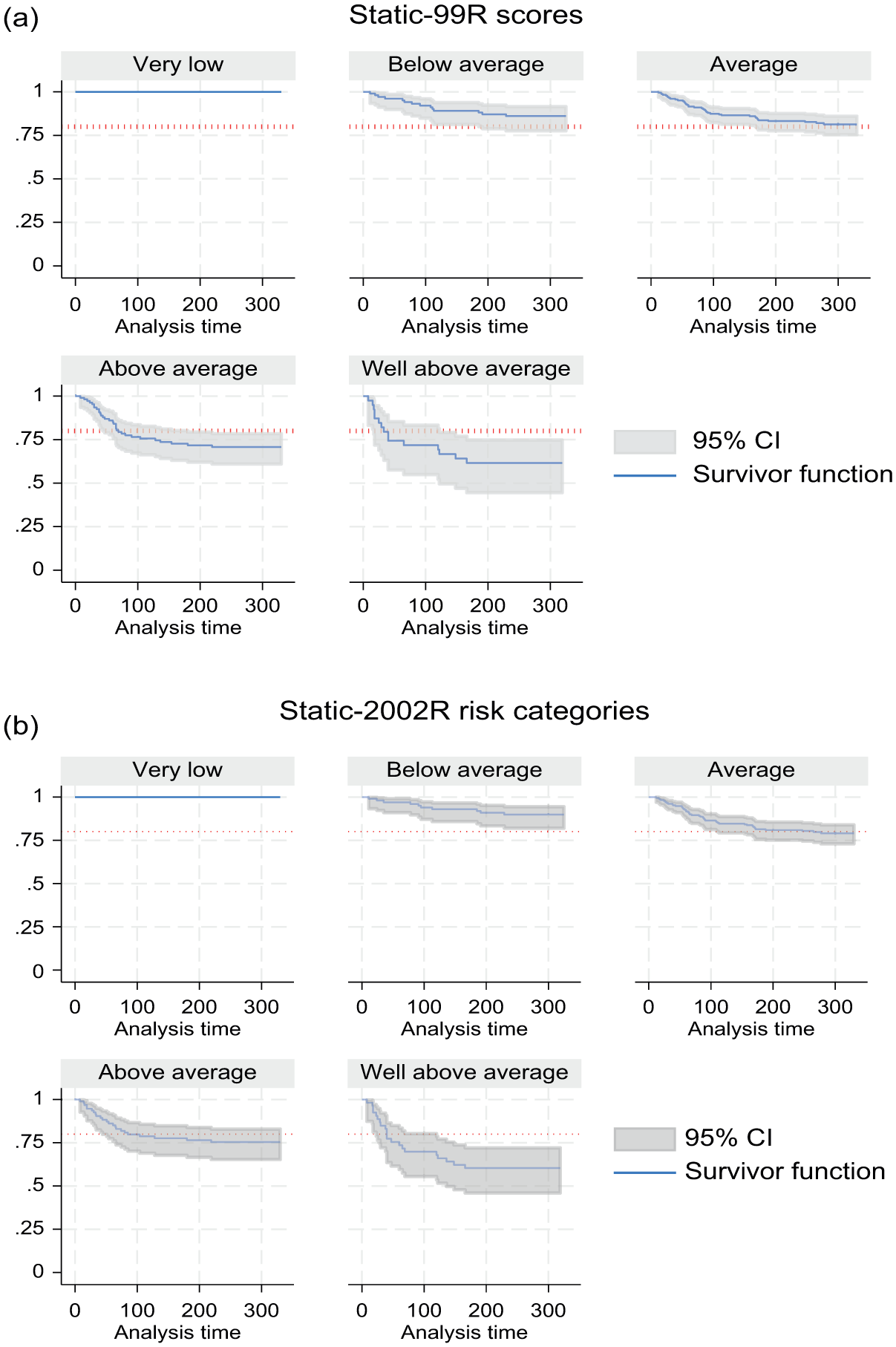
(a) Kaplan–Meier estimates of survival according to the Static-99R risk scores. (b) Kaplan–Meier estimates of survival according to the Static-2002R risk scores.
Covariates and the Proportionality of Hazards
Table 3 presents a list of all the covariates examined for the whole sample, which are grouped into two categories: (a) background information that was recorded at the individuals’ prison admission; (b) custodial and community reentry experiences. Looking at background information, a number of individual characteristics were statistically associated to sexual recidivism. 9 Sexual recidivists were significantly younger at their prison admission for their index offense; they were also younger adults at the time of their first criminal conviction. The risk of sexual recidivism increases with the number of prior criminal charges (for any crimes), with a high actuarial risk score on the SIR for general recidivism, and whether they had previously breached their community supervision conditions (parole/probation). Individuals who had a prior criminal record of sexual offending and a history of taking part in SOTP were more likely to sexually recidivate. Sexual recidivism risk probabilities increased with the number of victims but decreased as the log number of separate sexual offending events increased. In other words, sexual recidivists tend to have a greater number of prior victims against which they sexually offended on rare occasions. Non-recidivists sexually offended against a limited number of victims (1–2) but repeatedly on multiple occasions, a pattern consistent with incest and pseudo-incestuous offenses (Lussier et al., 2011).
Covariates of Sexual Recidivism Using Cox Proportional Hazards Regression.
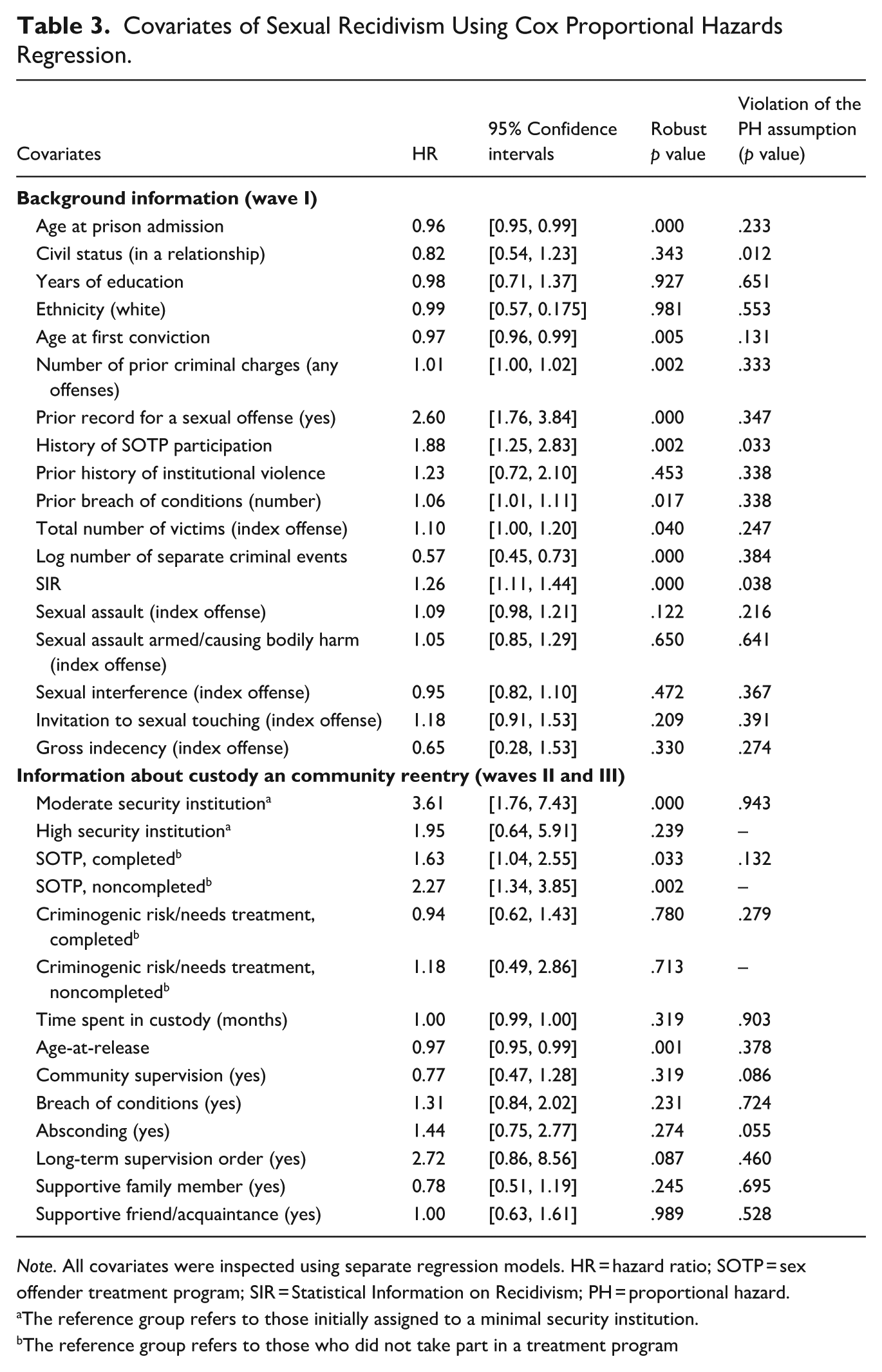
Note. All covariates were inspected using separate regression models. HR = hazard ratio; SOTP = sex offender treatment program; SIR = Statistical Information on Recidivism; PH = proportional hazard.
The reference group refers to those initially assigned to a minimal security institution.
The reference group refers to those who did not take part in a treatment program
When examining custodial and community reentry factors, several covariates were statistically associated with increased hazard of sexual recidivism. Individuals who were assigned to a medium-security penitentiary (as opposed to a minimum-security institution) were more likely to sexually recidivate. Note that the risk of sexual recidivism of individuals assigned to a maximum-security institution was not statistically different from those assigned to a minimal security institution, which is due to the small number of individuals assigned to a maximum-security institution. Individuals who took part in a SOTP while incarcerated were more likely to sexually recidivate than those who did not take part in such therapeutic programs. Those who completed it did not differ in terms of hazard rate from those who did not complete their specialized therapy. Of importance, the hazard rate of sexual recidivism decreased about 3% with every 1-year increase in age at the time of their prison release. Individuals designated for a long-term supervisory order following the end of their sentence were more likely to sexually recidivate, but that effect was only marginally significant. Three of the four significant covariates appear to reflect risk management decisions and the identification of individuals representing a higher risk (i.e., recommended for SOTP, moderate-security risk classification as opposed to a minimal-security risk classification; long-term supervisory order, which was imposed by a judge at sentencing but takes effect at the end of the sentence imposed).
Cox Regression Analyses of the Covariates of Sexual Recidivism
Table 4 presents a series of Cox regression analyses examining the statistical association between risk assessment scores before and after adjusting for the study covariates. The Static-99R and the Static-2002R were examined in separate models given their high correlation (Pearson’s r = .932). Inspection of the assumption of proportionality of hazards for both instruments was barely met (Static-99R: X2(1) = 2.86, p = .091; Static-2002R: X2(1) = 3.62, p = .057) suggesting that the hazards were time-dependent to a certain extent. 10 The first model tested included only the Static-99R total score, and it yielded a modest predictive accuracy based on Harrell’s C-index and Gönen & Heller’s K coefficient, both in the 0.60s range. After inclusion of the study covariates (See Model II), which includes two covariates tapping into two Static-99R items (age at release, prior history of sexual offending), Static-99R scores were no longer significantly associated with sexual recidivism. The inclusion of the study covariates significantly improved the predictive accuracy of the Cox regression models with Harrell’s C-index and Gönen & Heller’s K coefficient improving to the mid-0.70 range.
Cox Proportional Hazards Regression Models of Sexual Recidivism.
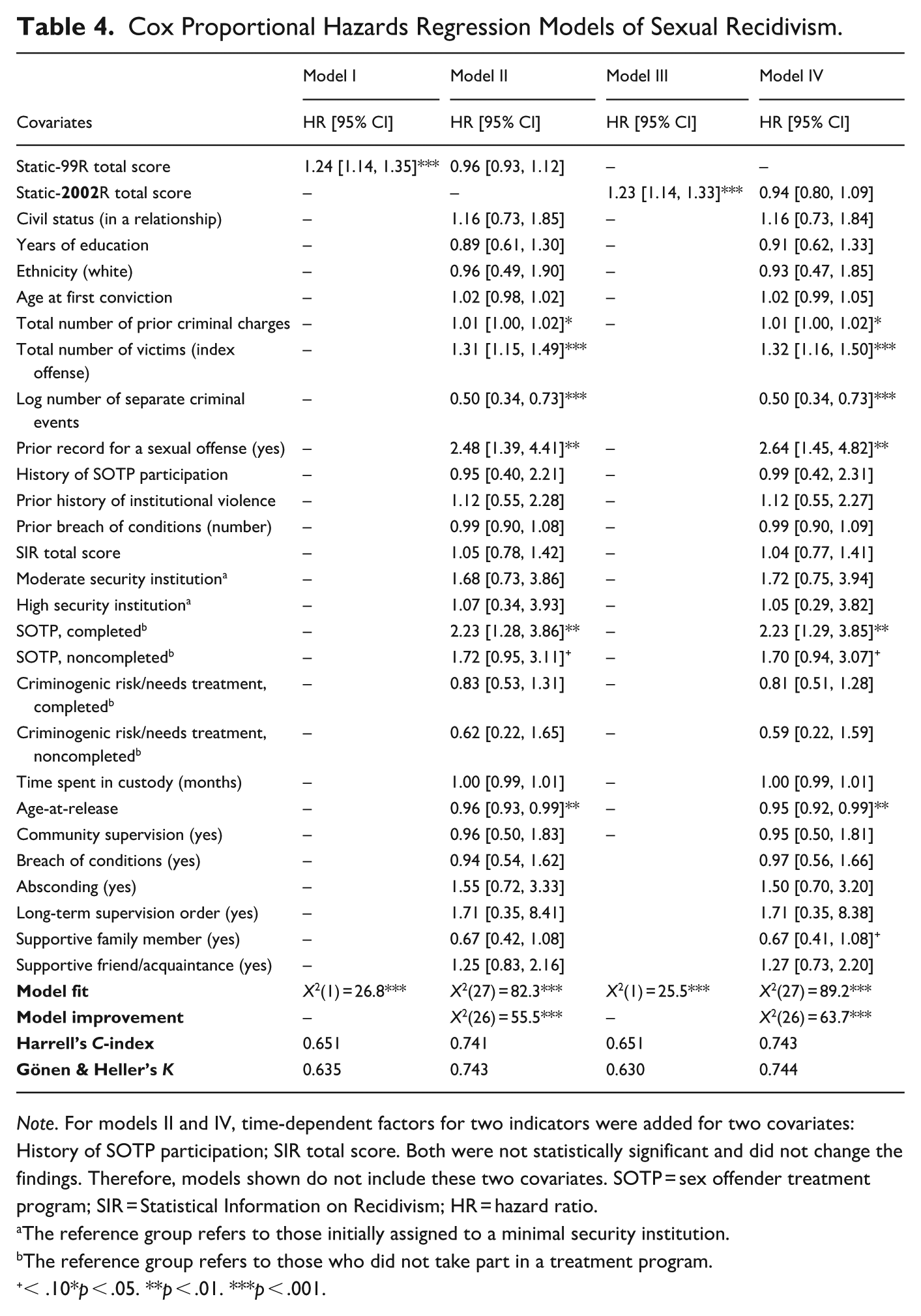
Note. For models II and IV, time-dependent factors for two indicators were added for two covariates: History of SOTP participation; SIR total score. Both were not statistically significant and did not change the findings. Therefore, models shown do not include these two covariates. SOTP = sex offender treatment program; SIR = Statistical Information on Recidivism; HR = hazard ratio.
The reference group refers to those initially assigned to a minimal security institution.
The reference group refers to those who did not take part in a treatment program.
< .10*p < .05. **p < .01. ***p < .001.
Several covariates allowed to discriminate between sexual recidivists and non-recidivists. The risk probabilities of sexual recidivism increased with every prior criminal charge for any offenses as well as the presence of at least one prior criminal record of a sexual offense. The risk probabilities of sexual recidivism also increased as a function of the number of victims and the number of separate criminal events. Each additional victim increased the hazard of sexual recidivism while each separate criminal events (log) were associated with lower hazards. Individuals who took part in a SOTP and completed it were more likely to sexually recidivate. Of importance, holding constant background, custodial and reentry information, age-at-release was one key covariate of sexual recidivism. The risk of sexual recidivism decreased by 4% per year older upon release. Replacing the Static-99R score with the Static-2002R scores led to very similar observations. When examined alone, the Static-2002R scores were significantly associated with sexual recidivism, although the predictive accuracy was modest (Model III). After inclusion of all covariates, the Static-2002R scores were no longer significantly associated with sexual recidivism (Model IV), but the predictive accuracy significantly improved by the inclusion of background information as well as custodial and community reentry indicators. The covariates that significantly contributed to the prediction of sexual recidivism were the same as those observed for Model II.
Discussion
There are only a handful of studies with a comparable follow-up period that can inform about long-term sexual recidivism rates. The limited number of studies can be divided into two groups: (a) earlier studies suggesting that between 40% and 60% of a cohort will sexually reoffend; (b) more recent studies suggesting that between 20% and 30% do so. Findings from the current study align best with the lower end of more conservative estimates as one out of five individuals was charged again with a sexual offense over a 25-year period. These results are valuable given that they are based on justice-involved individuals sampled in the late 1990s-early 2000s. Of importance, sexual recidivism events did not appear to be randomly distributed over the duration of the follow-up period. About half of the recidivism events tend to occur within the first 5 or 6 years while the other half of recidivism events are spread over the next 15 to 17 years. On the one hand, these findings highlight the importance of short-term studies to examine individuals who might be prone to sexually reoffend not too long after their prison sentence, even under some form of community surveillance. On the other hand, these observations demonstrate the extent to which short-term studies are plagued by cases of “false desistance” or individuals who might have looked like they desisted but sexually reoffend later (McCuish, 2020). As such, long-term follow-up studies as one avenue to tackle the issue of the dark figure of sexual recidivism (e.g., Abbott, 2020; Scurich & John, 2019).
The issue of short-term and long-term sexual recidivism can be examined through the lenses of the Static-99R. The Static-99R “Below average” group 5-year rate was 0.039 but grew to 0.109 over 10 years and to 0.140 over 20 years, an increase of 95% and 113% respectively. Similar findings were observed for the average group. In comparison, the “Well above average” group 5-year rate was high at 0.256 and slightly increased to 0.282 after 10 years (10% increase) and to 0.385 after 20 years (40%). This highlights that the Well Above Average risk group, as defined by the Static-99R, could be more of a higher-risk group in the short-term. For other lower-risk groups, the risk probabilities did not slow down at the same pace for reasons that could not be explained by the information available for this study. Such quantitative and qualitative differences suggest the need for a closer inspection of the timing of sexual recidivism across risk levels and how recidivism unfolds after community reentry and beyond. In fact, the evolution of sexual recidivism rates observed in the current study across risk levels compared to those extrapolated for the Static-99R (Thornton et al., 2021) highlights some differences. Based on S. C. Lee and Hanson (2021) observations, the projected 10-year sexual recidivism rate should be about 1.5 times the 5-year observed rate. Such a rule tends to underestimate the growth of sexual recidivism rate for the lower-risk groups while overestimating the risk of the higher-risk groups. 11 Departure between expected and observed rates can also be observed when extending the projection to 20 years post release, for routine samples such as the one included in the current study (see, Thornton et al., 2021). 12 Those differences are not trivial and should raise some concerns about long-term extrapolations of recidivism rates across context.
The inclusion of the study covariates took away the statistical association between the Static-99R, the Static-2002R and sexual recidivism. Two of those covariates tap into two items included in the two risk assessment tools which are consistent with the instrument and its content (i.e., prior sexual offenses, the person’s age-at-release). A closer look, however, raises important questions about risk and current risk assessment practices. The fact that these two covariates alone took away the statistical association between the Static-99R (and Static-2002R) scores and sexual recidivism means that the other items of the two instruments did not add statistically meaningful information to the prediction of sexual recidivism. In other words, all other items of the Static tools did not provide any incremental prediction value beyond a person history of sexual offending and the person’s age at prison release. To illustrate, the predictive accuracy of these two covariates alone in a regression model – that is, prior criminal record involving a sexual offense and the person’s age-at-release – was slightly better (Harrell’s C = 0.673; Heller’s K = 0.662) than the total score of the two actuarial instruments (see Table 4). The Cox regression models including background characteristics, information about custody and community supervision outperformed established measures of risk assessment of sexual recidivism (Buttars et al., 2015; Kroner et al., 2005). These findings are not trivial and raise concerns about these two widely used instruments and their influence on criminal justice decision-making, warranting additional research about their use for the prediction of long-term recidivism.
Overall, the study highlighted that, at a minimum, the covariates of sexual recidivism tend to reflect two underlying risk dimensions, antisociality and sexual deviance (e.g., Brouillette-Alarie et al., 2018; Hanson & Bussiere, 1998; Proulx et al., 1997; Quinsey et al., 1995). Sexual recidivists were more likely to present a more extensive criminal history (e.g., high SIR score, higher number of prior criminal charges, younger adult age at first criminal conviction), which is generally consistent with an antisocial propensity to break the law, disregard rules and others’ well-being, as well as the presence of criminogenic risk and needs. Sexual recidivists were also more likely to have more extensive sexual offending issues and problems (e.g., a prior record of sexual offending, a prior history of SOTP, a higher number of victims, being imposed a long-term community surveillance order), suggesting the underlying presence of a sexual deviance. Of importance, the current study highlights the long-term association between various covariates reflecting these two dimensions and recidivism, which speaks about the persistence of antisociality and sexual deviance over time but also the complementarity of these two dimensions in long-term patterns of sexual offending. A closer look at the case management of these individuals suggests, however, that criminal justice professionals utilized these two dimensions not as complementary, but rather in opposition for classification purposes. It appears that for case management purposes, a dual pathway approach was utilized by assigning individuals to either (a) a specialized SOTP or (b) some criminogenic risk/needs focused interventions, but rarely the two. Nowadays, it remains uncommon to address criminogenic risk and needs in SOTPs, possibly leaving important intervention needs unaddressed (e.g., Lussier & Frechette, 2022; Serin & Mailloux, 2003; Wormith et al., 2012).
During their custodial sentence, all individuals were offered, some form of treatment/intervention (e.g., SOTP, criminogenic needs). Not all individuals, however, volunteered for treatment/intervention, which implies that there was a self-selection bias (Jones et al., 2006). Our findings suggest that for SOTP, case management prioritized individuals with high risk and needs related to sexual offending, which explains that this group was more likely to sexually recidivate during the follow-up period. Despite completing their SOTP while in custody, they remained at-risk of sexually reoffending stressing the importance, upon their community reentry, of accessing mental health services and intensive community-based interventions (see Bradford et al., 2013). Such a high risk and needs group is most likely to benefit from intensive and prolonged SOTP following their prison release (see Olver & Wong, 2013). Another group that should be of concern is the lower-risk group who did not complete their SOTP. It could be that these individuals are not motivated to change and underestimate their risk of sexual recidivism and, as a result, they might be less receptive to correctional-based treatment and intervention. This is not surprising given that SOTP non-completion tend to be more strongly linked to antisociality and general criminality than sexual deviance (e.g., Nunes & Cortoni, 2008). In fact, research suggests that individuals considering themselves at no risk are more likely to sexually reoffend (Hanson & Harris, 2000). Note that the statistical association between SOTP outcome and sexual recidivism does not speak about the impact of such programs on sexual recidivism given that, among other things, the study did not control for the type of program offered and its approach used, the length of the program, whether there was a community-based follow-up component upon reentry, etc. Instead, our findings show the presence of an interaction effect between static risk of sexual recidivism (see Appendix A), SOTP outcomes (e.g., completion, non-completion) and sexual recidivism, which highlight the need to further explore case management procedures, treatment delivery and offenders’ responsivity to proposed intervention.
Limitations
It is important to reiterate that this sample is not representative of all justice-involved individuals convicted of a sexual offense, but rather representative of those federally sentenced adult males who perpetrated hands-on sexual offenses. In Canada, federally run sentences are handed to individuals convicted of more serious offenses and/or those with a more extensive criminal history. For example, about 30% of this cohort had a prior criminal record of a sexual offense prior their index crime. This was by no means a low-risk sample, an observation supported by the distribution of scores on the Static-99R and the Static-2002R, with about one third of the sample being above average in terms of their risk of sexual recidivism. The goal of this study was not to include and test all known risk factors of sexual recidivism and, therefore, important individual characteristics were not statistically controlled and accounted for (e.g., psychopathy, paraphilia). Individual risk factors will be examined in a series of follow-up studies to determine their association with long-term sexual recidivism. The current study focuses on new charges as a criterion to determine recidivism, which underestimate the true sexual recidivism rate for this cohort. That underestimation, however, is limited to some extent by the long follow-up period characterizing this study. Attrition or losing cases over time is part of all prospective longitudinal study but rarely documented in sexual recidivism research. The extent of attrition was reported and allowing highlighting issues and challenges conducting long-term longitudinal research.
While the current study does include information about community reentry, which is uncommon for this type of research, it did not include information about community reintegration beyond the period of community supervision. Not much is known about the life course of the individuals in terms of quality of life, intimate and familial relationships, work and employment, issues with alcohol and drugs and other post-incarceration relevant adaptions. Furthermore, the study did not include an examination of the covariates for different legal categories of sexual recidivism which might have masked some differences across sexual recidivism types. The current study did not include a measure to “time-at-risk” accounting for all period of incarceration allowing to make comparisons with prior studies (as most studies do not account for time-at-risk). While accounting for all period of incarceration is important, a meaningful adjustment would be that involving all periods of community supervision. Only a handful of studies explored the role and impact of community supervision on sexual recidivism which should be prioritized given several countries’ reliance on community corrections (e.g., probation, parole, halfway house).
Policy Implications and Conclusion
The current study findings stress the importance for risk assessors to be very cautious when making long-term predictions about the risk of sexual recidivism, even if their assessment is supported and guided by a recognized actuarial risk assessment tool. Most studies, de facto, have been focused on the examination of short-term risk factors given with the assumption that the same static factors apply over a person’s lifetime. In the process, the timing of sexual recidivism has been a neglected feature of sexual recidivism. The current study, based on a 30-year prospective longitudinal study design, shows that about one in five justice-involved adult males with a prior history of sexual offending are charged again for a sexual offense following their release. About half of sexual recidivism events tend to occur over the first 5 to 6 years, while the other half will do so over the next 15 to 17 years. Short-term studies, therefore, are prone to cases of false desistance and, as a result, tend to underestimate the risk of sexual recidivism. The study findings stress that one cannot only rely on a static actuarial risk assessment instrument to determine the long-term risk of sexual recidivism. The relatively modest predictive accuracy does not mean that sexual recidivism event is completely random, but rather that the dynamic nature of risk, sexual offending, and an individual’s life course are difficult to forecast using an actuarial instrument, given the presence of multiple life course and recidivism patterns (e.g., Francis et al., 2014; Lussier & Davies, 2011; Tewksbury et al., 2012).
The departure between expected and observed sexual recidivism rates demonstrates the challenges of making precise long-term prediction about sexual recidivism using well-known actuarial risk instruments. The Static-99R and the Static-2002R provide some information about the static probabilities of sexual recidivism but not about changes in the risk of sexual recidivism of over long periods. It cannot explain, for example, why the sexual recidivism rates of higher-risk individuals stabilize earlier than lower-risk individuals. In spite of changes made over the years to both actuarial risk assessment tools included in the study by including an age adjustment recognizing that risk probabilities drop as people age, additional modifications appear warranted. Such an age adjustment does not capture the dynamic aspects of human lives, how risk evolves across individuals and risk profiles but also the risk management strategies used and individuals’ responsivity to those. In fact, most of the items included in these tools might not be informative about the long-term risk of sexual recidivism.
Together, these findings highlight the importance of a person-oriented approach that also considers within-individual stability and changes over the life course. The dynamic nature of risk is minimally captured by justice individuals’ age-at-release, which cannot speak, however, about the presence of age-graded risk and protective of sexual recidivism, how familial, social and professional contexts evolve, how offending opportunities can change and how individual chose to shape their life course (e.g., see Lussier, 2016). The long-term longitudinal analysis of sexual recidivism stresses the importance of contextualizing within individual’s life course, to understand, among other things, why some individuals sexually reoffend a few months after their release, others a few years later, while for some individuals it can be a decade or more later. Contextualizing sexual recidivism means, among other things, exploring the presence of distinctive risk and protective factors for short, moderate and long-term sexual recidivism across age groups.
Footnotes
Appendix A
Cox regression analyses were performed by splitting the sample according to their risk level based on the Static-99R and the Static-2002 scores (Table A1). Regression models were conducted separately for those scoring, on the one hand, average or lower, and on the other hand, those scoring above average or higher. The purpose of these analyses was to determine whether the covariates of sexual recidivism changed according to the risk level. These analyses were conducted first using the Static-99R to classify individuals and next using the Static-2002R to classify them in one of the two groups. Overall, the results were consistent irrespective of whether the Static-99R or the Static-2002R was used. The analyses revealed that some covariates varied qualitatively (i.e., different statistically significant covariates of sexual recidivism) and quantitatively (i.e., different hazard ratios) across risk levels suggesting the presence of interaction effects between risk level and the study covariates.
When the risk classification was based on the Static-99R, the hazard ratio of offenders’ age-at-release was lower for the lower-risk group compared to the higher-risk group, suggesting a different age effect. This could mean that, with aging, higher-risk individuals’ risk of recidivism declines faster than the lower-risk individuals. This result is important given that age-at-release is already embedded in the actuarial risk assessment scores, but not the age-risk level interaction effect. Absconding was a risk factor of sexual recidivism for the higher-risk individuals but not for the lower-risk individuals highlighting that the same characteristic might carry a different meaning according to a person’s risk level. SOTP completion was associated with higher sexual recidivism rates for the higher-risk groups, but not for the lower-risk group, reflecting their higher needs for specialized intervention. Interestingly, SOTP non-completion was a risk factor of sexual recidivism for the lower-risk groups but not the higher-risk groups, suggesting that, differential efforts had been put to keep individuals in treatment depending on their perceived risk of sexual recidivism. Finally, the regression models were better at discriminating sexual recidivists and non-recidivists in the higher-risk groups compared to those in the lower-risk groups.
Acknowledgements
The authors would like to thank various research assistants who participated on this research project over the years. In particular, the authors would like to thank Julien Frechette, Xavier Leclerc, Sébastien Brouillette-Alarie and Pietro Violo for their help on this project. The authors would like to thank the editor and three anonymous reviewers for their helpful comments and suggestions.
Author’s Note
Patrick Lussier, Nadine Deslauriers-Varin and Jean Proulx are now affiliated with Centre International de Criminologie Comparée (CICC), Montreal, QC, Canada.
Patrick Lussier and Jean Proulx are now affiliated with Institut National de Psychiatrie Légale Philippe-Pinel (INPLPP), Montreal, QC, Canada.

Funding
The authors disclosed receipt of the following financial support for the research and/or authorship of this article: The study would not have been possible without the financial support from the Social Sciences and Humanities Research Council of Canada (CRSH; SSHRC), the Fonds de recherche du Québec – Société et culture (FRQSC), the Fonds pour la Formation de Chercheurs et l’Aide à la Recherche (FCAR) and the Centre International de Criminologie Comparée (CICC).
Declaration of Conflicting Interests
The authors declared no potential conflicts of interests with respect to the authorship and/or publication of this article.