



Abstract
This article examines how flagrante delicto and pretrial detention shape criminal case outcomes individually and cumulatively in Santiago, Chile. We find that flagrante delicto is associated with increases in the likelihood of pretrial detention and reductions in the likelihood of non-punitive outcomes, while both factors channel cases toward guilty pleas. Yet, flagrante delicto is also associated with increases in the likelihood of guilty pleas independent of pretrial detention, and both factors’ punitive effects are inconsistent at trial. We argue that flagrante delicto operates as a powerful tool in pretrial crime processing, reinforcing penal severity within the dynamics of a highly formalized criminal justice system. This partially challenges theoretical expectations about Latin American case processing and extends research on cumulative disadvantage beyond the United States. We also identify enhanced judicial review standards at pretrial stages and expanded public defender resources as policy interventions with potential to interrupt defendants’ disadvantageous trajectories.
Introduction
Over the last 30 years, virtually all Latin American countries experienced substantial growth in their prison populations (Sozzo, 2022). Between 1995 and 2016, incarceration rates in the region grew by an average of 107% (Bergman & Fondevila, 2021). Today, more than 2.5 million people are imprisoned across Latin America, including a high proportion of pretrial detainees (Institute for Crime and Justice Policy Research, 2024). Early explanations linked this prison boom to a neoliberal turn in penal policy. According to this view, top-down processes of punitive policy diffusion produced Latin America’s rising imprisonment, in which local adaptations of the war on drugs and new, rigid sentencing schemes were devised and deployed (Müller, 2012; Wacquant, 2003).
However, recent scholarship has reframed these arguments by noting the relevance of local politics, institutional capabilities, and criminal justice practices to explain the traits of the region’s penality (Iturralde, 2019; Sozzo, 2018). In this vein, Latin American scholars have begun investigating procedural dynamics that may be key to explain this incarceration growth (see Langer, 2021; Wilenmann, 2020). Specifically, detention in flagrancy or flagrante delicto (getting caught and arrested while committing a crime) and pretrial detention represent key mechanisms within criminal case processing across Latin American justice systems (Fondevila & Quintana-Navarrete, 2020; Goncalves et al., 2025). Nevertheless, little is known about their cumulative effects on defendants’ trajectories through legal proceedings.
In this paper, we leverage a novel dataset of over 1,000 criminal cases processed in Chilean courts between 2010 and 2017 to examine how initial decisions such as detention in flagrancy and its links with pretrial detention shape case outcomes, individually and cumulatively. To do so, we draw on cumulative disadvantage theory, a framework that focuses on sequential phases of decision-making rather than isolated stages, explaining how early decisions and practices—such as flagrante delicto and pretrial detention—can systematically shape and amplify inequalities in case processing (Guarnera et al., 2024; Kurlychek & Johnson, 2019). While developed in the US, this theoretical framework has recently demonstrated its applicability internationally, particularly in the Brazilian criminal justice system (Goncalves et al., 2025), making it valuable for examining procedural dynamics beyond its original context.
Chile presents an interesting case study to apply and extend cumulative disadvantage theory to a highly formalized Latin American penal system, which operates through rigorously defined procedural stages with mandatory hearings at each phase, and strictly codified legal requirements for key decisions like pretrial detention (Duce & Riego, 2016). Unlike the US system, which grants significant discretion to prosecutors in plea bargaining and case management, the Chilean model follows a more structured path with less flexibility, where legal rules trigger specific mandatory processes rather than opening discretionary pathways (Langer, 2021; Tiede, 2012). This formalization is a consequence of Chile’s comprehensive Criminal Procedure Reform (CPR).
Since the implementation of CPR in the early 2000s, Chile transitioned from an inquisitorial to an adversarial justice model, significantly restructuring criminal proceedings under managerial and decidedly legalistic logics (Arriagada et al., 2021; Sicardi & González, 2024). The CPR, celebrated for enhancing transparency and judicial accountability (Langer, 2007; Tiede, 2012), has also generated debates for its impacts on the prison system, as Chile’s incarcerated population considerably grew over the first decade of the 21st century. Some local scholars have contended that imprisonment’s rise was a direct consequence of the CPR (Wilenmann, 2020), while others have noted that prison growth began prior to the reform and that an expanded use of probation after 2012 actually tempered incarceration rates (Arriagada et al., 2021; Moraga et al., 2023; Wilenmann et al., 2025). What remains less understood is how the legal practices and mechanisms of Chile’s criminal procedures might produce cumulative disadvantages that funnel cases toward punitive outcomes. Our study provides empirical evidence on how legal decisions of Chilean criminal justice at pretrial stages, embedded in a structure with high levels of formalization, have operated in the streamlined way that some have theorized for Latin America (Bergman & Fondevila, 2021).
The Macro and the Micro in Studies of Penality
The analyses of Latin American penality address the region’s overall criminal justice landscape (see e.g., Hathazy & Müller, 2016; Iturralde, 2021). Yet, most studies privilege macro-level and theoretical perspectives, often overlooking the specific legal practices and institutional mechanisms that ultimately shape local conviction rates and sentencing outcomes. In contrast, criminological debates in the Global North, particularly in the US, have recognized that micro-level processes are crucial to understanding how larger policy shifts translate into grounded penal phenomena (Hannah-Moffat & Lynch, 2012).
The evolution of criminological literature in the US offers valuable insights for analyzing Latin American penal systems. Initially, US scholarship attributed incarceration growth to overarching neoliberal trends, the war on drugs, and the rise of a late-modern ‘culture of control’ (Garland, 2012; Sutton, 2004; Wacquant, 2009). However, later research revealed that shifts in sentencing regimes, prosecutorial discretion, and courtroom practices were central drivers of mass incarceration, highlighting how local actors and routines substantially influenced this penal development (Lynch, 2016; Pfaff, 2017; Schoenfeld, 2018). This line of inquiry underlines how policy transformations intermingle with concrete legal practices and mechanisms to fully understand penal expansion (Hannah-Moffat & Lynch, 2012; Lynch, 2011).
The shift toward micro-level analysis in US criminology has been particularly productive to develop cumulative disadvantage theory, which examines how early decisions in criminal processing create cascading effects that compound inequalities across subsequent stages (Kurlychek & Johnson, 2019; Kutateladze et al, 2014). Unlike traditional disparity research that examines isolated decision points, cumulative disadvantage theory emphasizes the sequential and interconnected nature of judicial decisions, where each stage constrains options and amplifies biases in later procedural phases (Sutton, 2013; Wooldredge et al., 2015). This theoretical perspective has proven especially valuable for understanding how seemingly neutral procedural mechanisms, like police arrests and pretrial detention, can systematically channel defendants toward punitive outcomes through routine organizational practices rather than explicit discrimination (see e.g., Stolzenberg et al., 2013; Zane et al., 2022). Besides, this framework allows for examining similar dynamics in underexplored legal contexts, like those where formalized procedures may create distinctive patterns of disadvantage.
Two additional frameworks developed in the US, focal concerns theory and the courtroom workgroup perspective, underscore the importance of examining judicial decision-making to scrutinize penality in specific contexts. Focal concerns theory posits that judges and court actors balance assessments of offender blameworthiness, community protection, and practical constraints often relying on heuristics to make decisions, in the process producing outcome disparities across race, gender, and socioeconomic lines (Hartley et al., 2007; Ulmer, 2012). Scholars have also noted that, independent of evidence quality, prosecutors usually focus on securing convictions through guilty pleas as a way of avoiding the uncertainty of trials (Ulmer et al., 2007). The courtroom workgroup perspective emphasizes how shared norms and routines within court communities contribute to bringing about detrimental penal outcomes for similar defendants (Dixon, 1995; Johnson et al., 2016). Through these frameworks, researchers have shown how war-on-drugs sentencing provisions, as well as bail and pretrial decisions disproportionately affect disadvantaged groups, compounding over multiple stages of criminal processing (Kurlychek & Johnson, 2019; Kutateladze et al., 2014; Lynch, 2018).
The focal concerns and courtroom workgroup perspectives provide crucial insights for understanding how cumulative disadvantage operates through judicial decision-making. Focal concerns theory suggests that case and defendant’s characteristics, like arrest circumstances as well as gender and race, may create lasting perceptions of blameworthiness among judicial actors influencing sequential decision-making across criminal procedures (Ulmer, 2012; Ulmer et al., 2023). Besides, recent research on focal concerns poses that in some jurisdictions legal factors are more significant than extralegal factors in determining sentencing outcomes (Sheeran, 2025). On the other hand, the courtroom workgroup perspective explains how familiarity between judicial actors, shared routines, and efficiency pressures can transform procedural mechanisms like pretrial detention and guilty pleas into systematic devices to channel criminal cases toward punitive ends (Johnson et al., 2016; Petersen, 2020). When combined with cumulative disadvantage theory, these perspectives suggest that legal procedural rules, rather than securing equalitarian penal treatment, may institutionalize biased practices by creating predictable punitive pathways that judicial actors predominantly follow based on initial case characteristics.
In Latin America, comparatively fewer studies have engaged with this type of micro-level inquiry, particularly through quantitative approaches (Galleguillos, 2024). While macro-level accounts of neoliberal policy diffusion remain pivotal for understanding the region’s prison boom (see e.g., Sozzo, 2022; Wilenmann, 2020), some scholars have started to trace how procedural practices drive penal outcomes. Bergman and Fondevila (2021), for instance, advanced a broad model arguing that Latin American criminal justice often relies on a common sequence of events in sentencing: a suspect is apprehended flagrante delicto, detained pretrial, and then pressured to accept a plea deal, thereby expediting convictions. Some studies in Brazil and Mexico partially corroborate this pattern (Fondevila & Quintana-Navarrete, 2020; Goncalves et al., 2025), while in Chile, scholars have noted that constructs like flagrante delicto are pivotal for the functioning of criminal justice (Araya-Moreno, 2022). However, many Latin American jurisdictions, including the Chilean case, lack robust empirical evidence on how specific legal mechanisms interact to shape adjudication processes.
Against this backdrop, the question of how disadvantage accumulates over successive procedural stages in Latin America remains underexplored. By focusing on how initial legal decisions can constrain disposition options and increase subsequent punitive outcomes, cumulative disadvantage theory helps elucidate the ways in which inequalities become embedded in procedural layers of judicial systems. In the next section we present a brief overview of cumulative disadvantage theory within criminal justice research to then introduce the structure of Chilean criminal procedures and our theoretical expectations on how flagrante delicto and pretrial detention, affect disposition outcomes in this jurisdiction.
Research on Criminal Case Processing and Cumulative Disadvantage
Empirical research in the US has supported the cumulative disadvantage perspective, especially regarding racial and ethnic disparities. Studies by Sutton (2013), Wooldredge et al. (2015), and Kutateladze et al. (2014) demonstrated how cumulative inequalities across stages like pretrial detention, plea bargaining, and sentencing systematically disadvantage Black and Latino defendants, ultimately increasing their likelihood of incarceration (see also Kutateladze, 2018). Juvenile justice research found that minority youth consistently faced cumulative disadvantages even in seemingly less punitive judicial trajectories, underscoring the nuanced, non-linear nature of cumulative disparities (Zane et al., 2022). In terms of gender, Goulette et al. (2015) found that, despite generally lenient treatment of women, some female subgroups faced compounded disadvantages depending on crime severity and prior records.
The mechanisms through which cumulative disadvantage operates vary across institutional contexts, but research consistently identifies pretrial detention as a critical amplifying factor of sentencing disparities (Johnson et al., 2016; Sutton, 2013). Pretrial detention not only signals individuals’ dangerousness to decision-makers but also creates practical pressures that make guilty pleas more attractive to defendants seeking to minimize time under custody (Louis, 2024; Petersen, 2020; Tartaro & Sedelmaier, 2009). Similarly, the circumstances of arrest—particularly whether defendants are caught “red-handed” or flagrante delicto—can create initial presumptions of guilt that persist throughout case processing, even when the law does not include specific provisions in this regard (Kutateladze, 2018; Kutateladze et al., 2014).
Thus, cumulative disadvantage theory underscores how seemingly neutral decision points and procedural mechanisms can progressively disadvantage certain defendants throughout case processing. In jurisdictions with higher levels of legal formalization than the US, such mechanisms may be especially important because they operate through strict procedural rules rather than discretionary decisions, potentially making cumulative disadvantages more systematic and less visible to judicial actors.
Despite these arguments and concerns, cumulative disadvantage research remains limited in global scope and scholars have scarcely operationalized it in criminal justice systems where rigid procedural structures and legal pathways define available possibilities for case processing (Kurlychek & Johnson, 2019). Yet, this perspective was recently used to analyze racial disparities in Brazil’s criminal justice system, showing how cumulative disadvantage theory can be extended to contexts with different legal traditions from the US, though generating similar results regarding race-based disadvantage. Indeed, similarly to the US, Black people in Brazil face higher odds of pretrial detention compared to their white counterparts, increasing their odds of conviction (Goncalves et al., 2025). However, even when this study demonstrates the applicability of the cumulative disadvantage framework to Latin American contexts, it does not focus on how strict procedural rules may disproportionately shape case trajectories. Given recent adversarial reforms across Latin America emphasizing procedural formality (Langer, 2007), exploring whether and how judicial practices systematically channel defendants into more punitive outcomes in this context can provide new insights for cumulative disadvantage research. By examining Chile’s criminal justice system, we can assess how cumulative disadvantage operates in arrangements where procedural rules, rather than individual discretion, dominate case processing. The highly structured nature of Chilean criminal procedures, combined with the prominence of legal tools like flagrante delicto and pretrial detention in case processing, provides an ideal setting for assessing how regulatory formalization in the penal realm may shape the accumulation of disadvantages in a non-US justice system. Thus, our study adds new nuances to the cumulative disadvantage framework.
The Structure of Chilean Criminal Procedures
Chile has been one of the most successful Latin American countries in transforming its criminal legal system from an inquisitorial to an adversarial model (Langer, 2021; Tiede, 2012). In the old inquisitorial system, a single judge both directed the investigation and decided cases, relying on secret dossiers (Duce & Riego, 2016). The Criminal Procedure Code of 2000 (CPC) changed this structure by introducing oral, open proceedings and clearly separated the roles of investigation, prosecution, and adjudication. The CPC also created modern criminal courts (Juzgados de Garantía and Tribunales de Juicio Oral en lo Penal, in Spanish), a national prosecution service (Ministerio Público), and a national public defense office (Defensoría Penal Pública).
Criminal cases follow sequential stages in the new system. Proceedings often begin either with a victim’s report to police or prosecutors or through police arrests. The latter frequently involve flagrante delicto, a form of detention in which the police catch someone in the act of committing an offense or in the immediate aftermath under circumstances defined by law as equivalent to flagrante delicto. If the prosecutor decides to press charges, the suspect is brought to the Audiencia de Control de Detención (ACD, the detention control hearing) in the Juzgado de Garantía (Guarantee Court) within 24 hr after the arrest. At the ACD, the judge reviews the circumstances of the arrest to ensure it complied with legal requirements (art. 132 CPC). If the Guarantee Court validates the detention, the process moves to formal charging in the Audiencia de formalización (arts. 131, 132, & 232 CPC). At this stage, prosecutors may dismiss the case if evidence is insufficient or if it is determined that the events do not constitute a crime (arts. 167, 169, & 170 CPC). Alternatively, cases involving minor offenses or first-time offenders may be resolved through diversionary mechanisms, such as deferred adjudication or reparative agreements, contingent on meeting certain conditions (arts. 237, 239, & 241 CPC). If diversion or dismissal does not occur, attention shifts to pretrial measures. Prosecutors can request pretrial detention, primarily based on flight risk, societal danger, and crime severity (art. 140 CPC). Chilean law provides no comprehensive bail system, so defendants are typically kept on remand or released under supervision measures of distinct intensity (art. 155 CPC).
After these initial stages, cases enter an investigation phase where prosecutors gather evidence, and both sides prepare for trial. During this phase, it is still possible to resolve the case without a full trial. Chilean criminal law provides for abbreviated procedures that are essentially plea bargaining mechanisms. One is called procedimiento abreviado (arts. 406 to 415 CPC) and the other juicio simplificado (arts. 388 to 399 CPC). Though these procedures require different conditions, in both cases the defendant can accept a negotiated plea. Depending on the deal and the defendant’s criminal history, the sentence could be probation or imprisonment (Riego, 2017). We provide more details on these procedures below. If no dismissal, diversion, or abbreviated procedure occurs, the case goes to the Tribunal de Juicio Oral en lo Penal, the trial court. Here, an independent panel of three judges considers the available evidence and determines guilt or innocence (arts. 325 to 338 CPC). Conviction at trial leads to a formal sentencing decision, whereas an acquittal releases the defendant (art. 343 CPC).
Theoretical Expectations
Building on the theoretical foundations and the structures outlined above, our analysis focuses on testing cumulative disadvantage theory in Chile’s criminal justice system, extending the framework’s deployment to a highly formalized legal context that differs from both the US and Brazilian systems. We examine two key mechanisms that embody the sequential decision-making process central to cumulative disadvantage theory. The first mechanism is represented by flagrante delicto, conceptualized as the initial trigger in our theoretical model. Based on cumulative disadvantage theory and focal concerns research, we expect flagrante delicto to initiate a disadvantageous trajectory by: (1) increasing the likelihood of pretrial detention through perceived evidence of guilt and dangerousness (Hartley et al., 2007; Ulmer, 2012); (2) reducing the incidence of non-punitive outcomes by activating prosecutorial assumptions about case strength and courtroom workgroup routines that favor quick processing (Johnson et al., 2016; Ulmer et al., 2007); and (3) increasing guilty plea rates by creating presumptions that persist throughout case processing (Kutateladze et al., 2014; Kurlychek & Johnson, 2019).
The second mechanism is pretrial detention, conceptualized as a decision that amplifies initial disadvantages. Consistent with prior cumulative disadvantage research, we expect pretrial detention to: (1) dramatically reduce the probability of non-punitive outcomes by signaling dangerousness and limiting defendants’ litigation options (Fondevila & Quintana-Navarrete, 2020; Goncalves et al., 2025); (2) increase pressure for guilty pleas as defendants seek to minimize time in custody while awaiting trial (Johnson et al., 2016); and (3) increase conviction rates at trial through the “detention penalty” documented across multiple jurisdictions (Louis, 2024).
Thus, we expect cumulative disadvantage to operate primarily through the sequence: flagrante delicto—pretrial detention—punitive outcome, a procedural pathway recently identified as prevalent in Latin America by criminal justice research (see Bergman & Fondevila, 2021). However, we also test for independent effects of flagrante delicto and pretrial detention and examine whether Chile’s legally formalized procedures may alter typical findings in cumulative disadvantage research.
Data and Methods
Data
This study uses a novel dataset of criminal cases from Santiago, Chile’s capital and the largest urban courts circuit. 1 The dataset comprises a sample of 1,090 cases resolved in Santiago’s criminal courts between 2010 and 2017 through the procedural paths we described in the prior section. This period was determined by data availability and access to judicial records of the original project. While the 2010 to 2017 timeframe reflects practical constraints of the data collection process, it provides a substantial 7-year window for examining judicial patterns of criminal case processing in the Chilean adversarial system. The study’s cases were drawn from all judicial districts of Santiago, representing a broad cross-sectional sample of criminal cases in the post-reform system, but only from those that effectively made their way to the courts. This excludes cases that prosecutors decided not to bring before the judiciary.
We obtained case data from court archives using a standardized instrument. Trained research assistants reviewed case files and recorded key variables, including defendant demographics, charges, procedural decisions, and the final case outcome. Cases that went to trial were oversampled due to their relative rarity. As our study relies on a sample rather than the universe of cases, we applied sampling weights in all analyses to ensure our findings are representative of the actual distribution of case outcomes in Santiago during the period 2010 to 2017. To our knowledge, this is one of the first datasets of its kind in Latin America, where obtaining systematic court data is notoriously difficult (Goncalves et al., 2025). Moreover, it is important to note that our study aims to provide a robust empirical snapshot of how legal mechanisms shape sentencing outcomes through a cumulative disadvantage lens, rather than a fully representative account of all disposition patterns in the Chilean criminal justice system.
Variables
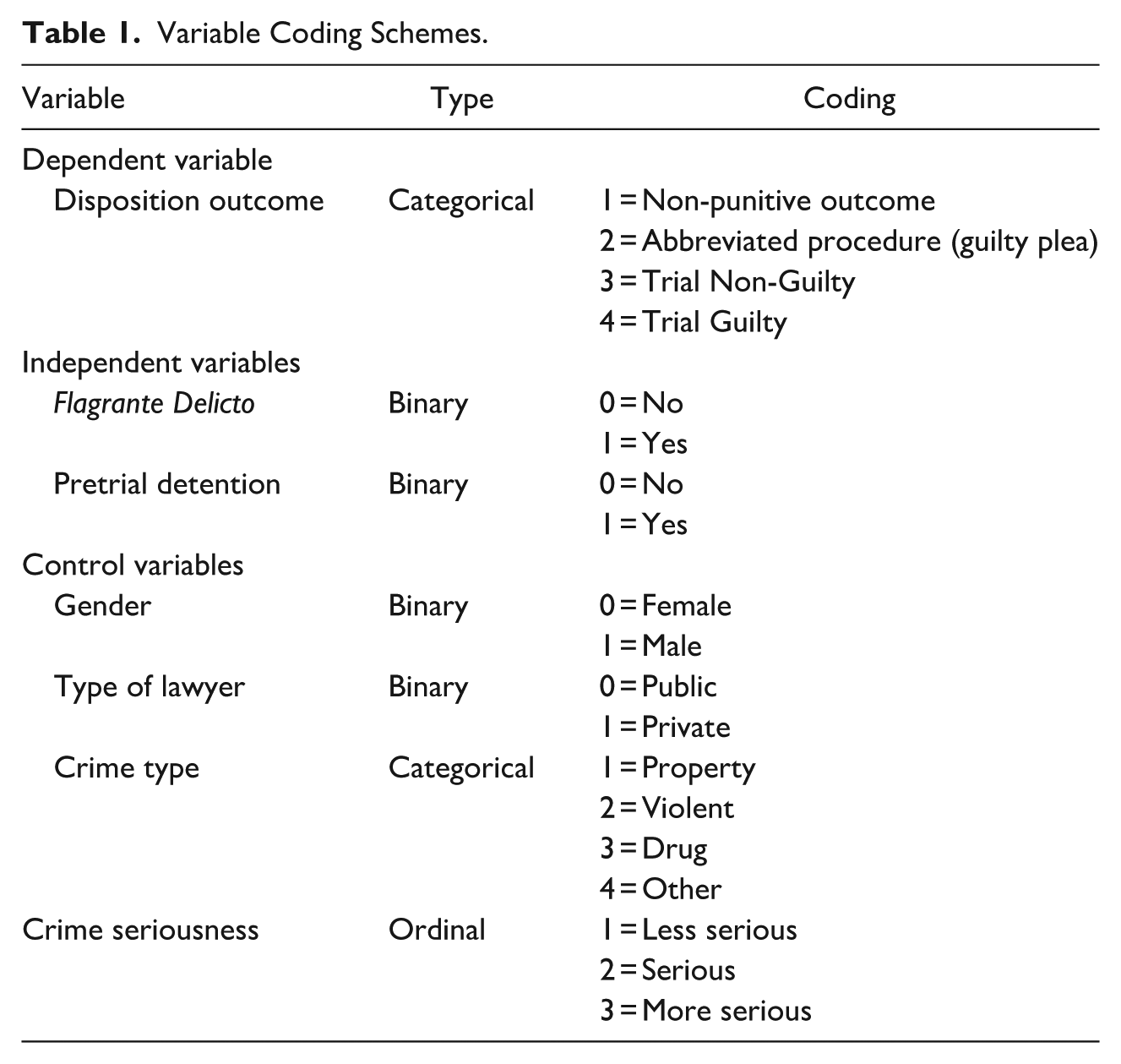
Our primary dependent variable is disposition outcome: (1) Non-punitive outcome; (2) Abbreviated procedure (guilty plea); (3) Trial Non-Guilty; and (4) Trial Guilty. These four mutually exclusive groups encompass virtually all forms of ending case processing in the Chilean criminal legal system. Non-punitive outcome includes (a) dismissals occurring due to judicial or prosecutorial decisions and (b) dismissals deriving from diversion mechanisms. There are multiple reasons to justify the first set of dismissals, like the lack of sufficient evidence to support indictments, lack of mens rea, or the expiration of the statute of limitations (arts. 167, 169, & 170 CPC). The second operates when penal actors agree to a diversion mechanism allowed by Chilean law (Galleguillos & Figueroa, 2023). Specifically, the CPC establishes that the prosecutor, with the defendant’s approval, can request the judge to apply a diversion mechanism when the likely sentence is no longer than 5 years of prison time and the defendant does not have a criminal record and is not subject to diversion in another criminal proceeding (art. 237 CPC). If the court approves diversion, the judge must decide the conditions to be fulfilled in a range of one to three years (art. 238 CPC). Once the defendant completes all requirements, the case is dismissed without further formal penal consequences (art. 240 CPC). Similarly, the defendant and the victim can agree to a monetary restitution plan to end the procedure without punitive consequences for the former in property crimes and other minor offenses (art. 241 CPC). If the judge validates the restitution plan and the defendant fulfils the obligations, the court dismisses the case (art. 242 CPC). The description of these diversion mechanisms as Non-punitive outcomes may be problematic, as they stem from the satisfaction of a series of conditions limiting defendants’ freedoms, such as the prohibition to contact the victim or the requirement to maintain a domicile for some period. However, just like the other type of dismissals, they do not generate a criminal record, which is why we grouped them together.
As to Abbreviated procedures, they occur when the prosecutor asks to end a case summarily through a guilty plea. The main requirement is the defendant’s acceptance of responsibility for the facts under investigation (arts. 395 & 406 CPC). In addition, these procedures may operate for crimes with maximum sentences of up to five years and in property crimes when the likely sentence does not exceed ten years (arts. 390 & 406 CPC). In terms of sentencing, upward or downward departures from prosecutors’ original request are limited for courts (Riego, 2017), though the parties can present special proposals to this effect in some instances (arts. 395, 412, & 413 CPC). Abbreviated procedures always end in a conviction. If none of these outcomes materialize, cases go to trial. We distinguish between acquittal (Trial Non-Guilty) and guilty (Trial Guilty) verdicts at trial.
The central independent variables in our analysis are (i) whether the case began with flagrante delicto and (ii) if the defendant was held in pretrial detention. Additionally, we used pretrial detention as a dependent variable to assess its relationship with flagrante delicto. Flagrante delicto is a binary indicator coded 1 if the defendant was arrested by police at the time of or shortly after the offense under the legal criteria of detention in flagrancy (art. 130 CPC), and 0 if the case started through other means without an immediate arrest. Pretrial detention is also operationalized as a binary indicator (0 = No; 1 = Yes). Pretrial detention must be requested by the prosecutor, and it has three main legal requirements: the existence of indicia about the perpetration of a crime; the existence of indicia about the defendant’s participation in the offense; and the existence of significant indicia suggesting (a) that pretrial detention is indispensable for a successful investigation, (b) that the defendant’s freedom is dangerous for society or the victim, or (c) that there is a flight risk (art. 140 CPC).
Our models also include control variables, selected based on established criminological theory and prior cumulative disadvantage research. Crime type (1 = property; 2 = violent; 3 = drug; 4 = other) and crime seriousness (1 = less serious; 2 = serious; 3 = more serious) capture case characteristics that focal concerns theory identifies as central to judicial decision-making, specifically assessments of blameworthiness and community protection needs (Ulmer, 2012, 2019). Our operationalization of crime seriousness is based on infractions’ levels of social harm. Less serious crimes encompass theft, counterfeiting, and drug possession. Serious crimes include robbery, arson, and other property crimes; crimes against personal freedom except for kidnapping; and crimes against public administration. More serious crimes comprise homicides, sex crimes, kidnapping, and drug-trafficking. Gender (0 = woman; 1 = man) addresses documented disparities in criminal justice outcomes between women and men that may distort our primary mechanisms (Goulette et al., 2015; Quintana-Navarrete et al., 2025; Steffensmeier et al., 2017). Type of lawyer (0 = public; 1 = private) encapsulates potential differences in defense quality and resources that may shape cumulative disadvantage effects, an important concern given research suggesting that defense advocacy in some jurisdictions can interrupt disadvantageous trajectories of defendants (Agan et al., 2021; Quintana-Navarrete & Fondevila, 2025).
Other variables commonly used in sentencing research are not available in our dataset due to limitations in the original data collection process. Most notably, our data lack information on defendants’ age and prior criminal records—important variables in cumulative disadvantage and focal concerns research (Kurlychek & Johnson, 2019; Kutateladze et al., 2014; Ulmer, 2012; Ulmer & Bowman, 2025). The absence of criminal records data is particularly significant given its established role in judicial decision-making and its potential relationship with flagrante delicto—repeat offenders may be more likely to be caught red-handed (Goulette et al., 2015). Additionally, we lack detailed socioeconomic information about defendants, which limits our ability to examine how cumulative disadvantage in Chilean criminal justice intersects with class-based inequalities (Steffensmeier et al., 2017). These data restrictions are common in Latin American criminal justice research (Goncalves et al., 2025; Quintana-Navarrete et al., 2025). Still, while data availability partially constrains our variable selection, the included controls represent the most theoretically relevant controls accessible in our dataset and align with established research on criminal case processing. We address how this limitation could potentially affect our findings in the Discussion section.
Lastly, all binary variables followed standard 0/1 coding as indicated in parentheses in prior paragraphs. Categorical variables were coded sequentially, with crime type coded 1 to 4 based on the primary charge category and crime seriousness coded 1 to 3 following an ordinal scale based on social harm criteria. These coding decisions adjust to common practices in criminal justice research and allow for straightforward interpretation of our regression coefficients. Table 1 provides a summary of our variable coding schemes.
Variable Coding Schemes.
Methods
Our analysis proceeds in two stages. First, we examine the disposition outcomes—including pretrial detention—as binary dependent variables with flagrante delicto as the main predictor. Pretrial detention is also included as a main predictor in the models where it is not an outcome. The goal of these models is to estimate the association of flagrante delicto and pretrial detention with each specific outcome, providing a benchmark for the cumulative disadvantage analyses (Zane et al., 2022). For estimation, we rely on Linear Probability Models (LPMs), an increasingly used approach in criminal justice research (Agan et al., 2021; Quintana-Navarrete & Fondevila, 2025). LPMs align with our aims as we seek to estimate the regression coefficients of the independent variables and not predicted values (Wooldridge, 2010). Second, we explore cumulative disadvantages associated with flagrante delicto and pretrial detention by estimating predicted probabilities and marginal effects from a multinomial logistic regression where these variables shape different pathways of case disposition. We use this approach since it is particularly suitable to study structural biases within the criminal legal system (see e.g., Goncalves et al., 2025; Zane, 2025; Zane et al., 2022). Given our sample design, all the models include judicial district and year fixed effects, although cases in the early years of the sample (2010–2015) are collapsed into a single category given the sparse data. These fixed effects capture stable district characteristics and period system-wide changes that could influence the practices and decisions of legal actors.
Results
Descriptive Patterns
Table 2 offers a descriptive overview of our sample. The right column (Original n) shows the sample’s original configuration, which overrepresented cases at the trial phase. For this reason, in the left column (Percentage with weights), we included adjusted data with weights to approximate the actual distribution of criminal cases processed by criminal courts in Santiago over the analyzed period (2010–2017). Our descriptions rely on this weighted information.
Descriptive Statistics.
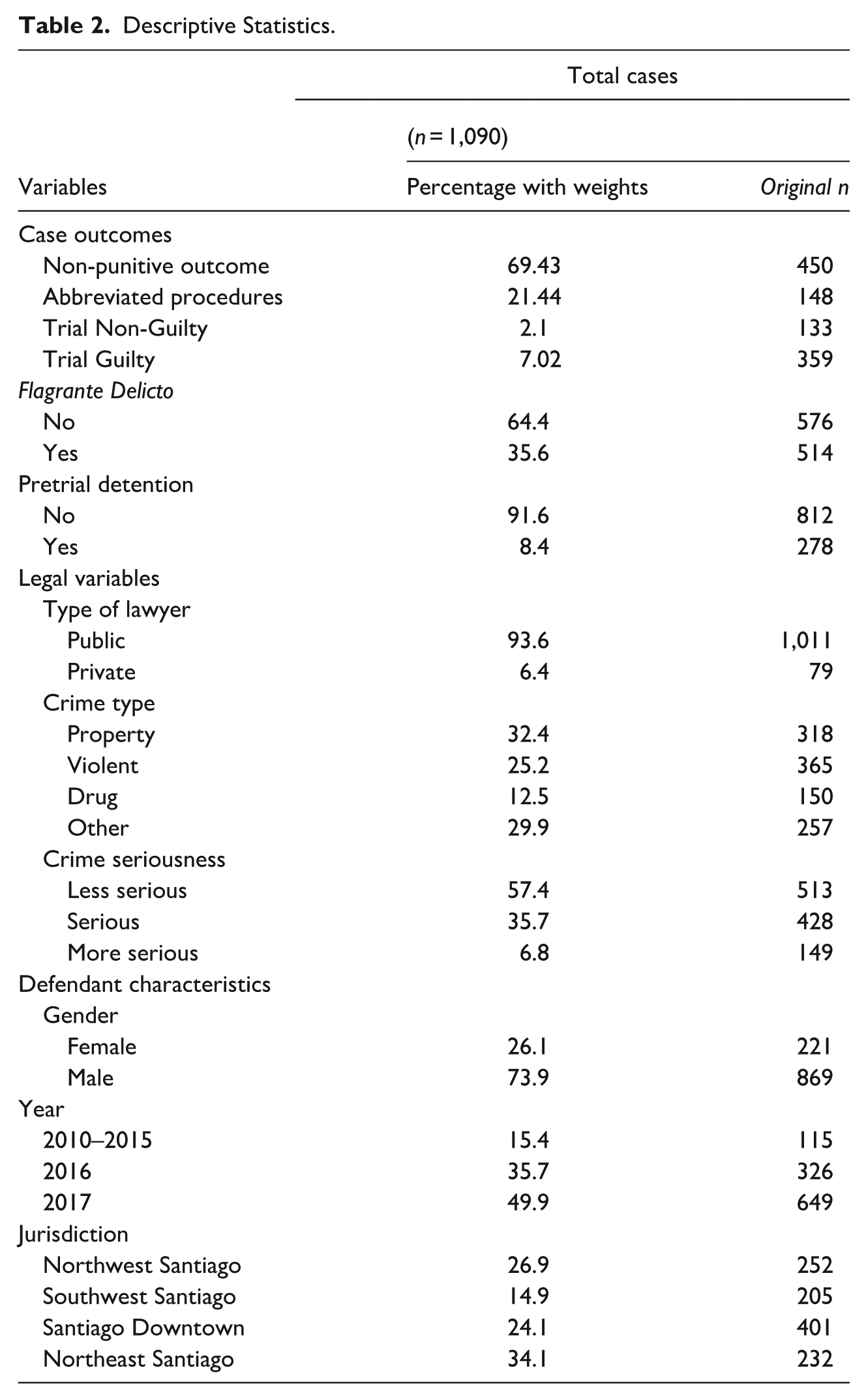
In terms of disposition outcomes, most cases ended through non-punitive measures (69.43%), followed by abbreviated procedures (21.44%). Only a minor portion of cases went to trial (9.12%) and among them, convictions were more prevalent than acquittals (7.02% vs. 2.1%). Regarding the remaining key variables, 35.6% of cases started with flagrante delicto, while only 8.4% of defendants were kept in pretrial custody. In terms of the controls, they are mostly aligned with depictions of the Chilean criminal justice system. Most defendants are men and public defenders represented more than 90% of people in our sample. There is a slight concentration of charges in property crimes (32.4%), while most cases fall in the less serious category (57.4%). Almost 50% of cases in our sample were solved in 2017, while a lower percentage (15.4%) finalized in the period 2010 to 2015. In geographical terms, the sample is balanced among Santiago’s four general jurisdictions.
Models
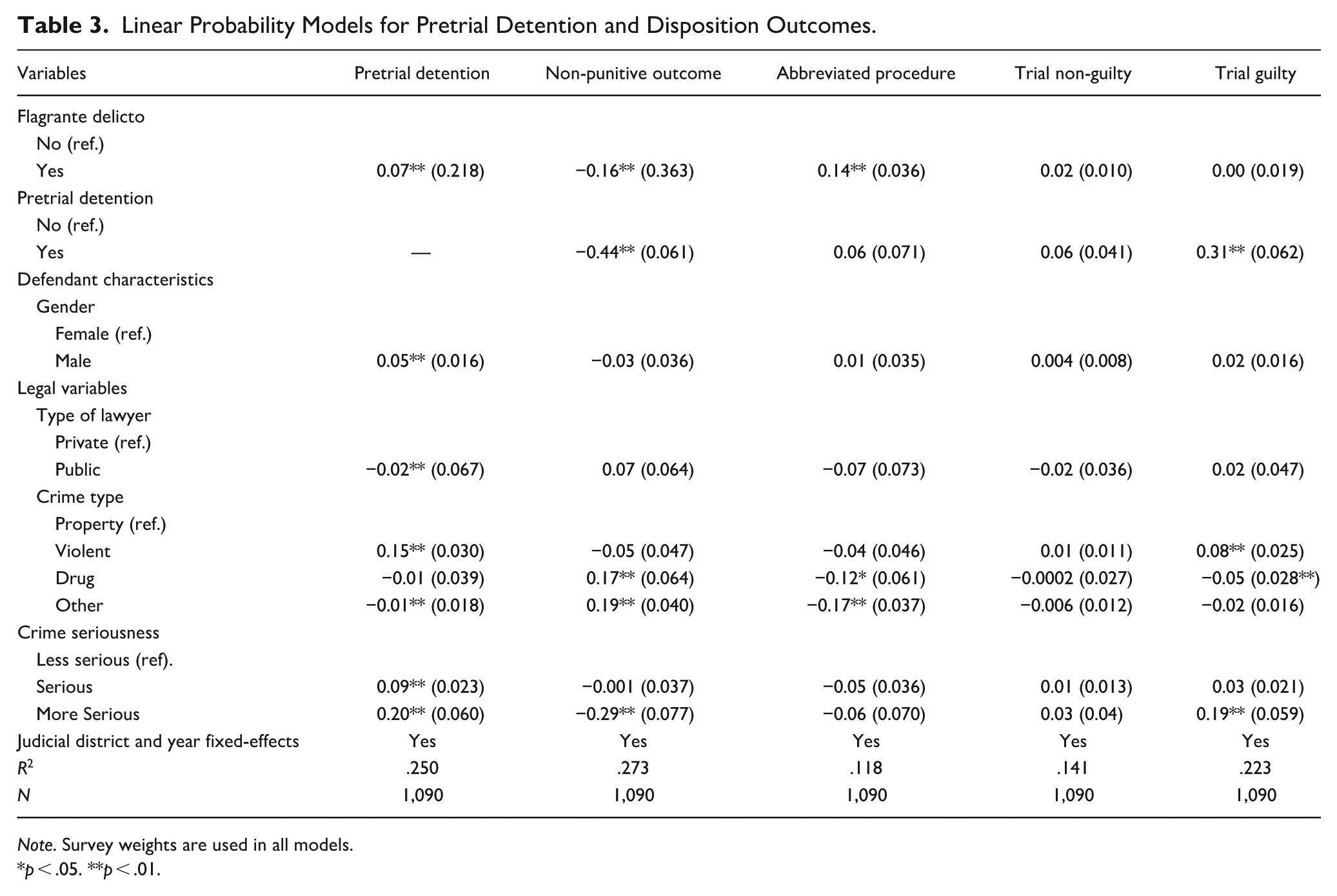
Table 3 presents the results from the Linear Probability Models (LPMs) estimating the relationship between case characteristics and outcomes (see also Table A2 in Appendix for further details). The LPMs indicate that flagrante delicto significantly decreases the probability of achieving a non-punitive outcome by 16 percentage points (p < .01) and increases the likelihood of an abbreviated procedure by 14 percentage points (p < .01), although in our regression models it is not significantly associated with either of the trial outcomes. Pretrial detention is strongly associated with a 44-percentage point reduction in the probability of a non-punitive outcome and a 31-percentage point increase in the probability of a guilty verdict at trial (p < .01). However, there is no evidence that it is associated with the likelihood of an abbreviated procedure or a non-guilty verdict.
Linear Probability Models for Pretrial Detention and Disposition Outcomes.
Note. Survey weights are used in all models.
p < .05. **p < .01.
Regarding the controls, the variables capturing crime categories and seriousness are associated with disposition outcomes: drug-related offenses increase the likelihood of a non-punitive outcome by 17 percentage points compared to property crimes (p < .01); most serious crimes significantly lower non-punitive outcomes by 29 percentage points, while raising trial guilty outcomes by 19 percentage points (p < .01). Public defenders showed no statistically significant association with judicial outcomes.
Given that we aimed to understand how flagrante delicto and pretrial detention may generate cumulative disadvantages in Chile, we also explored their potential connections. The first column of Table 3 shows the analyses of pretrial detention as a binary dependent variable of interest (0 = No; 1 = Yes). Results indicate that flagrante delicto, male gender, violent crimes, and higher crime seriousness significantly increase the likelihood of cases presenting pretrial detention in our sample (p < .01). Interestingly, too, public representation significantly decreases the likelihood of pretrial detention (p < .01), which could relate to the strong institutional capacities of the public defense office in Chile (Grau et al., 2023). Logistic regression models, used as robustness check, reaffirm the main findings from the LPM analyses (see Table A1 in Appendix). 2
We also ran a multinomial logistic regression model to test the consistency of our results. Figures 1 and 2 depict the marginal effects computed from the results of said model. Figure 1 highlights that detention in flagrancy significantly decreases the probability of non-punitive outcomes while increasing the likelihood of abbreviated procedures. Similarly, Figure 2 shows that pretrial detention significantly decreases the probability of non-punitive outcomes and increases the odds of abbreviated procedures and guilty verdicts at trial.
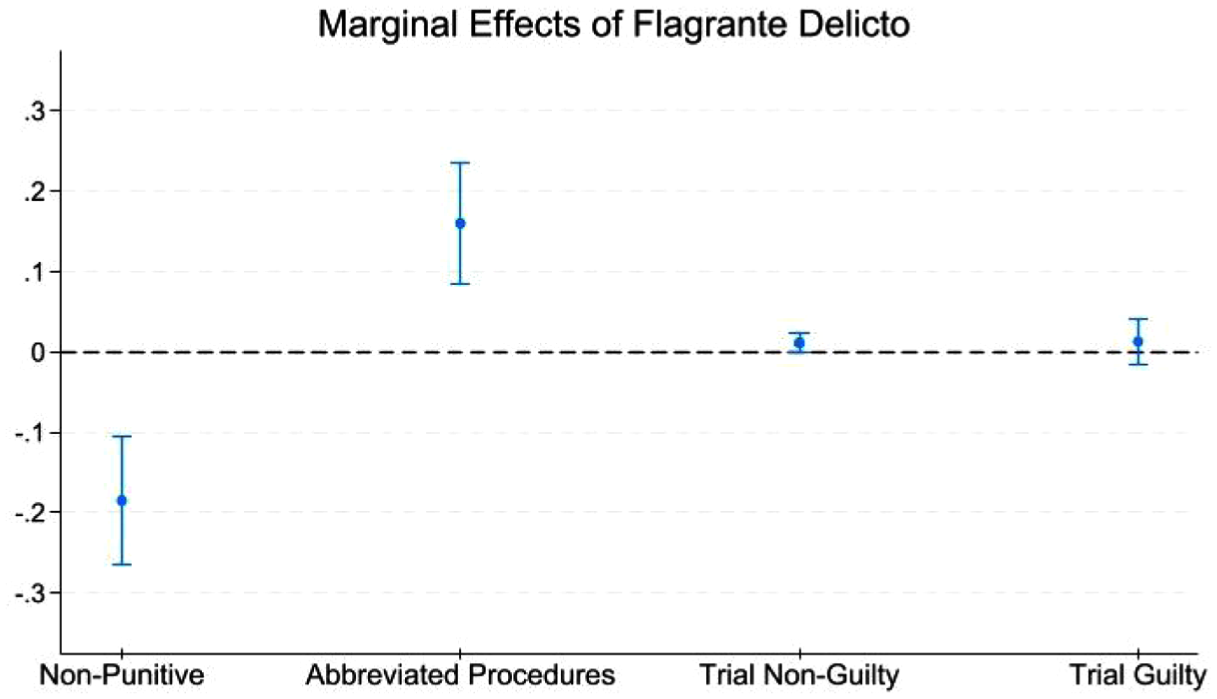
Marginal effects of flagrante delicto in multinomial model.
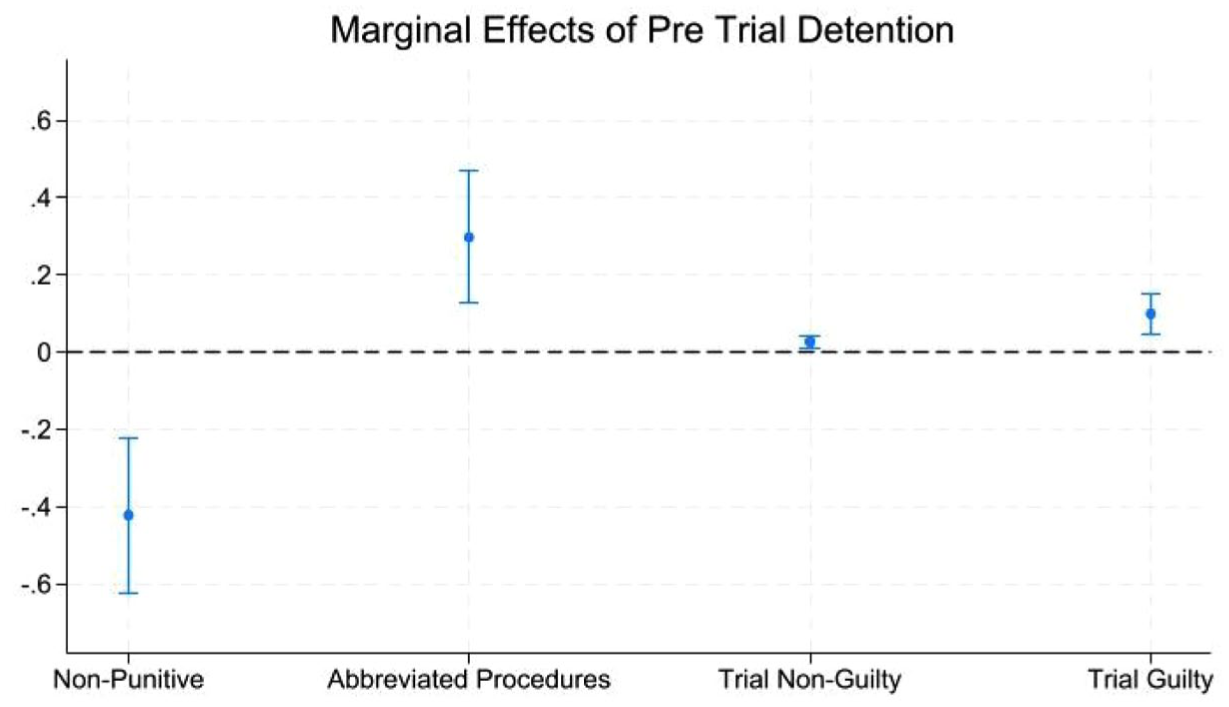
Marginal effects of pretrial detention in multinomial model.
Finally, we explored how distinct combinations of flagrante delicto and pretrial detention affect different judicial pathways (see Table 4). Our analysis reveals that flagrante delicto significantly decreases non-punitive outcomes by 18.62 percentage points while increases guilty pleas by 9.7 percentage points in cases without pretrial detention (Paths 1 & 2). Path 6 (pretrial detention followed by guilty plea) shows a significant increase from 1.56% for non-flagrante cases to 5.36% for flagrante delicto cases (p < .05), supporting cumulative disadvantage theory as detention in flagrancy and pretrial detention converge to increase guilty pleas.
Predicted Probabilities and Marginal Effects by Path.
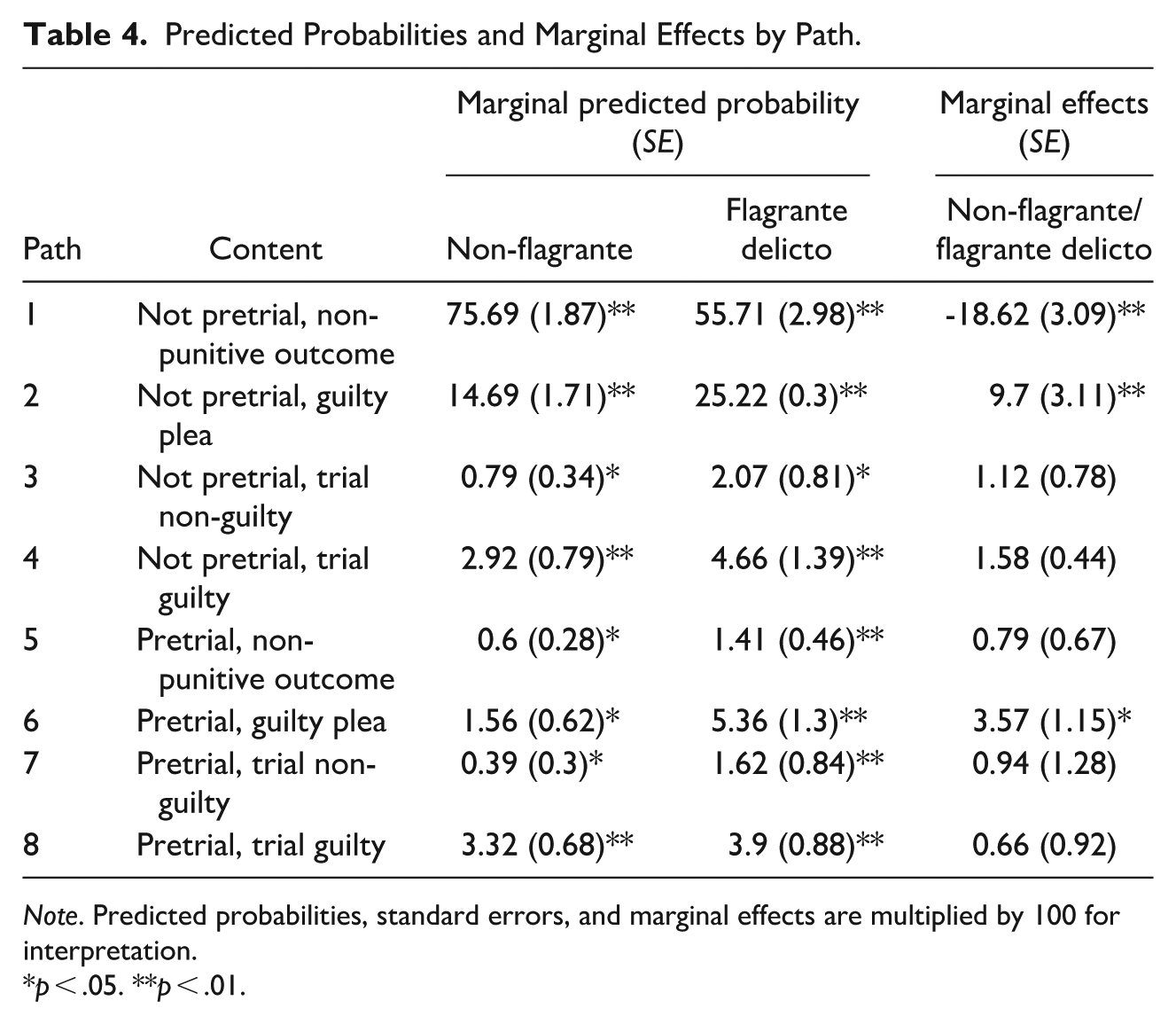
Note. Predicted probabilities, standard errors, and marginal effects are multiplied by 100 for interpretation.
p < .05. **p < .01.
Counterintuitively, Path 7 (pretrial detention followed by acquittal) shows flagrante delicto cases with a higher probability of acquittal (1.62%) compared to non-flagrante cases (0.39%), suggesting some cases receive heightened scrutiny at trial, which in turn could relate to legal and evidentiary weaknesses not apparent earlier. Path 8 (pretrial detention followed by conviction at trial) shows similar rates between non-flagrante (3.32%) and flagrante delicto cases (3.9%), indicating detention in flagrancy’s punitive impact diminishes at trial, possibly due to more thorough evidentiary examination or other type of judicial factor.
Overall, our predicted probabilities and marginal effects by path suggest that while flagrante delicto triggers cumulative disadvantage by reducing non-punitive outcomes and increasing guilty pleas, the typical Chilean case does not follow the full sequence proposed by Bergman and Fondevila (2021) of flagrante delicto—pretrial detention—guilty plea. Besides, the interaction between flagrante delicto and pretrial detention increases guilty plea probability, though detention in flagrancy’s punitive effects become inconsistent at trial. We further discuss these findings in the following section.
Discussion
Our findings suggest that the Chilean criminal justice system is characterized by a two-stage cumulative disadvantage process operating within the pretrial phase. First, flagrante delicto heightens the risk of pretrial detention and reduces early exits like non-punitive outcomes (dismissals and diversion mechanisms). Second, pretrial detention and flagrante delicto together exacerbate convictions through guilty pleas, accelerating the pace of procedures and compounding disadvantages into punitive outcomes. However, these variables’ effects at trial are less straightforward, as flagrante delicto increases the odds of acquittals and convictions at trial in cases with pretrial detention and raises the probability of guilty verdicts in scenarios without pretrial detention, though the marginal effects of these combinations are not significant. These outcomes could be the result of specific practices and rules at the trial phase.
In our research, flagrante delicto emerges as a powerful catalyst within criminal procedures (Araya-Moreno, 2022), associated with significant decreases in the probability of dismissals and diversion and increases in the odds of conviction through guilty pleas. From a focal concerns perspective, we argue that flagrante delicto satisfies judicial actors’ concerns regarding perceived culpability and community safety, resulting in simplified and expedited decision-making (Hartley et al., 2007; Lynch, 2019). Additionally, the focal concern related to fast convictions might push prosecutors to perceive these cases as ‘easy wins’ and promote guilty pleas to secure convictions without considerable litigation efforts (Ulmer et al., 2007).
The courtroom workgroup perspective provides a complementary explanation. In Chile’s lower criminal courts, prosecutors, defenders, and judges handle large caseloads and have developed routine ways to manage them at the pretrial phase (González, 2020; Velásquez & Riquelme, 2024; Wilenmann & Arístegui, 2022). In this case processing stage, flagrante delicto activates cooperation scripts among judicial actors to move swiftly to abbreviated procedures, rather than exploring alternatives like diversion or risking an acquittal at trial. Our results suggest that routinization around flagrante delicto leads to quick guilty pleas where the courtroom workgroup streamlines cases through the pipeline (see Johnson et al., 2016). This interpretation partially matches Bergman and Fondevila’s (2021) thesis on sentencing routines in Latin America. The higher plea rate and lower dismissal rate for cases with detention in flagrancy also underpin this argument.
Although our study shows that in Chile cumulative disadvantage often begins with flagrante delicto, our findings also reveal that the sequential process proposed by Bergman and Fondevila (2021) is not the most prevalent trajectory in Chile. Instead, flagrante delicto appears to operate as a powerful mechanism that pushes cases toward guilty pleas before full consideration at trial and relatively independent of defendants’ pretrial detention status. While detention in flagrancy does initiate a disadvantageous chain—resembling key elements of cumulative disadvantage theory by increasing the probability of subsequent adverse events—the course of cases does not necessarily include pretrial detention as a basis for generating guilty pleas. The insignificant difference between flagrancy and non-flagrancy cases at trial further complicates this picture, suggesting that flagrante delicto exerts its strongest influence earlier in case processing. On the other hand, pretrial detention is also strongly correlated with punitive sentencing outcomes in our analysis, which aligns with findings of previous studies in the US and Latin America (see Fondevila & Quintana-Navarrete, 2020; Freiburger & Hilinski, 2010; Goncalves et al., 2025; Kurlychek & Johnson, 2019). However, unlike the US, Chilean criminal justice does not have an extended bail system, so pretrial detention raises decisions’ punitive content in case processing as this form of custody entails lower chances of finalizing cases through non-punitive outcomes and higher probabilities of convictions through guilty pleas.
These findings suggest that features of the cumulative disadvantage framework and theoretical models around sentencing in Latin America can present important variations across local contexts, underscoring the value of comparative research for refining theoretical frameworks deployed to examine case processing and social disadvantages. Indeed, our study adds theoretical nuance by illustrating how legal formalization—rather than discretion—can be the primary driver of cumulative disadvantage. Our findings reveal a nuanced application of cumulative disadvantage in Chilean criminal justice. While flagrante delicto often triggers a disadvantageous chain by increasing the likelihood of pretrial detention and driving cases toward punitive outcomes, this pattern is not clearly identified at trial. Interestingly, cases with both flagrante delicto and pretrial detention show positive associations with non-guilty verdicts (See Table 4, Path 7), suggesting these mechanisms lose their punitive impact during trial phases. This contradicts basic cumulative disadvantage expectations and indicates that the framework primarily applies to early decision-making in Chilean criminal procedures, with its explanatory power diminishing at the trial stage.
Two interconnected factors likely explain this pattern. First, trials operate under stricter evidentiary rules requiring exhaustive assessment of evidence beyond reasonable doubt (Horvitz & López, 2002), transforming flagrante delicto and pretrial detention into secondary elements of judicial reasoning rather than determinative factors. Second, organizational differences at trial—including three-judge panels independent from earlier proceedings and a shift from collaborative to adversarial practices among legal actors—fundamentally alter case disposition routines. These considerations help explain why cumulative disadvantage manifests clearly in pretrial phases but weakens during trials. While our data cannot fully confirm these explanations, they suggest important avenues for future research on how disadvantage operates differently across diverse stages of criminal proceedings in highly formalized justice systems.
Our findings reinforce that cumulative disadvantage theory, while developed in the US context, can provide valuable insights for understanding criminal justice processes internationally. Consistent with recent applications in Brazil (Goncalves et al., 2025), we showed that the framework suitably captures how procedural decisions create cascading inequalities in Latin American justice systems. However, our study also reveals that the theory’s applicability varies across procedural stages, with cumulative disadvantage operating most powerfully during pretrial phases in Chile’s highly formalized system. This suggests that while the core mechanisms of cumulative disadvantage may travel across contexts, their specific manifestations depend heavily on local legal structures and institutional arrangements.
From a broader perspective, several dynamics are likely at work in Chilean case disposition practices. First, the leverage in plea negotiations shifts heavily when a defendant is detained in flagrancy. Such a defendant may agree to plead guilty just to avoid time in pretrial detention, which implies waiting many months in jail for a trial that could yield a longer sentence (Johnson et al., 2016; Louis, 2024; Tartaro & & Sedelmaier, 2009). Prosecutors are aware of this and may push quick pleas on individuals arrested flagrante delicto, knowing the threat of pretrial custody can induce compliance (Lynch, 2018, 2023). Second, defendants detained flagrante delicto might opt for expeditious guilty pleas as an avenue to prevent the uncertainty and extension of trials (Clair, 2020). Third, there may be a selection effect. Legal actors may interpret flagrante delicto as a strong sign of guilt and dangerousness, leading to higher rates of pretrial detention and guilty pleas in these cases (Kutateladze et al., 2014; Steffensmeier et al., 2017; Ulmer, 2012).
As Araya-Moreno (2022) poses, flagrante delicto is a legal technicality of the Chilean criminal justice system that allows judicial actors to process cases as if incidents brought to court occurred exactly how law enforcement agents report. Flagrante delicto is a communicative tool to understand that the crime effectively took place, even if there is no concrete evidence to corroborate it prior to trial. Symbolically, cases starting as flagrante delicto contain a strong presumption of guilt, which court workgroups operationalize and rely on in initial case processing to validate arrests as well as justify pretrial detention and convictions through guilty pleas.
For Chile and other Latin American countries, our findings underscore that flagrante delicto is not a neutral legal tool, but a practical decision that effectively “locks in” case trajectories towards administrative guilty verdicts before trial (Langer, 2021). Something similar, though less prominent, occurs with pretrial detention (Sozzo & Somaglia, 2017). Hence, our study reinforces the idea that to grasp Latin America’s penal trends, scholars should look at the micro-level legal processes that aggregate into macro-level outcomes (see Hannah-Moffat & Lynch, 2012; Lynch, 2011). While criminal justice reforms like those implemented in Chile promised more transparency and efficiency (Langer, 2007; Tiede, 2012), our findings suggest that they also institutionalized ‘fast tracks’ to conviction, particularly for those caught flagrante delicto. However, this pattern is not consistent across all phases of criminal procedures; it remains robust at pretrial stages but not at trial, primarily due to the distinct legal structure and organizational features of trial proceedings.
Comparatively, our findings resonate with Global North research that highlights how legal procedures can produce systemic biases. Our contribution on this point is to demonstrate a similar effect in a Latin American context, and within the interplay of a highly formalized legal framework. In the US, for example, the war on drugs and policies like stop-and-frisk created “flagrancy-like” situations disproportionately for minorities, leading to higher arrest and detention rates, which then accumulated in higher incarceration rates for those groups (Alexander, 2020; Lynch, 2016; Pfaff, 2017). In Chile, issues of race are less pronounced, but class and geography play a substantial role in criminalization practices—street crime in poor neighborhoods is more heavily surveilled, yielding more arrests (García-Campo Almendros, 2025). For this reason, cumulative disadvantage here likely correlates with poverty: the poor are more often caught in criminal acts and structural factors push them to plead guilty more frequently than other defendants (see e.g., Davis, 2022). Over time, this mechanism feeds the prison system with a stable stream of convicted individuals, maintaining the punitive approach to social control prevalent in Chile (Wilenmann, 2020).
Lastly, it is important to note some limitations of our study. First, our data come from a single metropolitan region (Santiago) and a specific timeframe (2010-2017), determined by the data collection process and availability of judicial records. While our dataset provides empirical foundations for examining cumulative disadvantage mechanisms, we do not claim full representativeness beyond Santiago or our analysis period. Rather, our research offers a focused examination of how legal tools like flagrante delicto and pretrial detention operated within this major jurisdiction during this period. Rural areas or other Chilean regions might operate differently. For instance, they might have distinct rates of flagrante delicto and pretrial detention due to variations in policing and local courtroom practices. Future research could compare multiple regions to see if the patterns of our findings hold. Second, as stated before, we lack information on key variables such as prior criminal records and socioeconomic status. This makes it possible that some of the associations we attribute to detention in flagrancy are partly due to repeat offenders or socioeconomically disadvantaged people being more likely to get caught in the act and more likely to be prosecuted harshly. Nonetheless, given that we control for offense type and severity, and Chilean judges do consider prior record connected to crime categories in sentencing (Wilenmann et al., 2019), we suspect the impact of flagrante delicto is not solely a proxy for prior record. Similarly, while we lack direct socioeconomic measures, the type of lawyer variable—public versus private—may partially capture economic disparities, as private representation typically requires financial resources unavailable to most defendants (Grau et al., 2023; Quintana-Navarrete & Fondevila, 2025). Moreover, as suggested before, flagrante delicto and pretrial detention might be the mechanisms through which prior criminal records and socioeconomic disadvantage are deployed in the system to achieve punitive outcomes. This remains an area for further investigation.
Third, our analyses are fully descriptive. We identified strong associations consistent with cumulative disadvantage but, in addition to prior criminal history and socioeconomic disadvantage, there could be unobserved factors influencing both the likelihood of flagrante delicto and its links with pretrial detention, as well as sentencing outcomes, like offenders’ prior behavior or strength of evidence. Future studies with more fine-grained data might use a design that approximates causality to see whether and how our results change. Regardless of these limitations, our work can open a path to develop such studies on Latin American criminal justice.
Policy Implications
Our findings reveal that Chile’s reformed criminal justice system, despite aims to enhance transparency and protect defendants’ rights, has created systematic pathways channeling cases toward punitive outcomes mostly through flagrante delicto, and to a lesser extent via pretrial detention. These mechanisms operate most powerfully during pretrial stages, suggesting that policy interventions should target early procedural phases. These insights entail important implications for criminal justice reform throughout Latin America.
Policy changes should implement stricter judicial review standards requiring evidence beyond arrest circumstances at multiple decision points. Judges should demand additional evidence before imposing pretrial detention or accepting guilty pleas in flagrante delicto cases. Additionally, mandatory “cooling-off periods” between arrest and plea negotiations in certain cases could reduce coercive pressures driving hasty guilty pleas. More broadly, policy interventions should develop standardized guidelines ensuring that procedural decisions balance state prosecution interests with defendants’ rights, regardless of arrest circumstances. This includes training police and judicial actors to recognize how social biases and legal mechanisms trigger cumulative disadvantages and to establish review systems guaranteeing that comparable cases receive similar treatment. Finally, our finding that public defenders are associated with a reduction in the likelihood of pretrial detention suggests that quality legal representation can interrupt disadvantageous trajectories, which also connects with the strong institutional capacities of the Chilean public defense office (Arriagada, 2023; Grau et al., 2023). Expanding public defender resources for initial hearings and mandating comprehensive defense consultation before plea negotiations in flagrante delicto cases could lower cumulative disadvantage risks throughout criminal procedures’ early stages.
In sum, recognizing how flagrante delicto and pretrial detention create cumulative disadvantages represents a crucial step toward more equitable criminal justice in Latin America, after a period of intense adversarial reforms. By carefully assessing cumulative disadvantages emergence at early procedural stages, Chile and other Latin American countries can better balance adversarial reforms’ efficiency gains with fundamental commitments to fairness and proportionality in criminal punishment.
Footnotes
Appendix
LPM Models for Type of Dismissal.
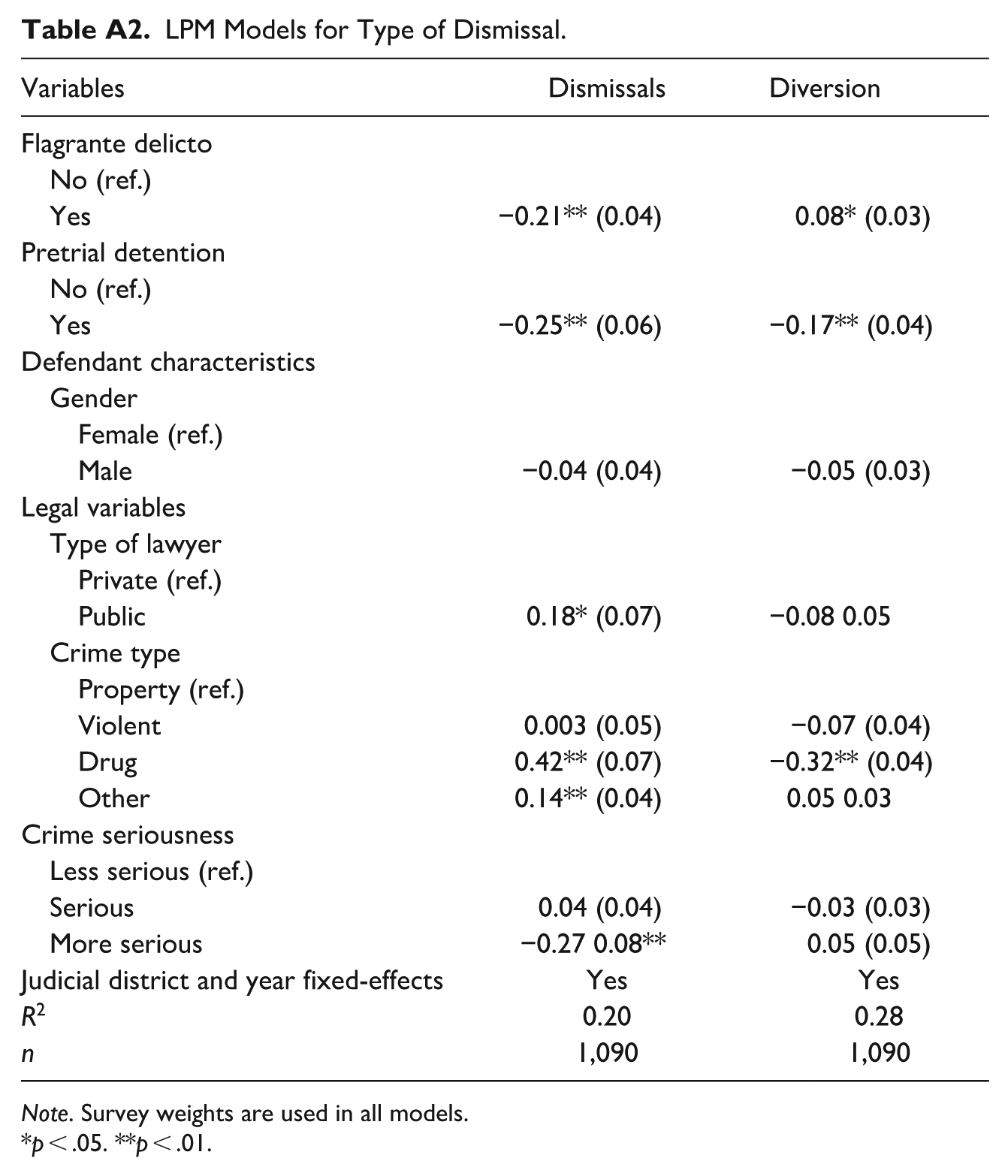
| Variables | Dismissals | Diversion | ||
|---|---|---|---|---|
| Flagrante delicto | ||||
| No (ref.) | ||||
| Yes | −0.21** (0.04) | 0.08* (0.03) | ||
| Pretrial detention | ||||
| No (ref.) | ||||
| Yes | −0.25** (0.06) | −0.17** (0.04) | ||
| Defendant characteristics | ||||
| Gender | ||||
| Female (ref.) | ||||
| Male | −0.04 (0.04) | −0.05 (0.03) | ||
| Legal variables | ||||
| Type of lawyer | ||||
| Private (ref.) | ||||
| Public | 0.18* (0.07) | −0.08 0.05 | ||
| Crime type | ||||
| Property (ref.) | ||||
| Violent | 0.003 (0.05) | −0.07 (0.04) | ||
| Drug | 0.42** (0.07) | −0.32** (0.04) | ||
| Other | 0.14** (0.04) | 0.05 0.03 | ||
| Crime seriousness | ||||
| Less serious (ref.) | ||||
| Serious | 0.04 (0.04) | −0.03 (0.03) | ||
| More serious | −0.27 0.08** | 0.05 (0.05) | ||
| Judicial district and year fixed-effects | Yes | Yes | ||
| R 2 | 0.20 | 0.28 | ||
| n | 1,090 | 1,090 | ||
Note. Survey weights are used in all models.
p < .05. **p < .01.
Declaration of Conflicting Interests
The authors declared no potential conflicts of interest with respect to the research, authorship, and/or publication of this article.
Funding
The authors received no financial support for the research, authorship, and/or publication of this article.
