




Abstract
Child-parent violence is an often-neglected form of domestic violence despite being subject to certain domestic violence policies such as mandatory arrests. To address gaps in this area, this study replicated the methods of Strom et al. using more recent NIBRS data. Contrasting previous findings, this study found that mandatory arrest policies were not statistically associated with odds of arrest compared to discretionary policies, whereas pro-arrest policies were linked to increased odds of arrest. These findings indicate differential policy impact, potentially in relation to the policy coverage and specificity. Observed incident characteristic consistencies and discrepancies between studies are discussed. Formal policy and practitioner response guidelines are needed in this area to address the particular circumstances and nuances of child-parent violence.
Introduction
Although family violence continues to gain attention in research and practice, research, policy, and practice addressing violence perpetrated by children against their parent or caregiver has seen more stilted growth, despite reports of increased cases in some Western nations (Fernández, 2017; Holt, 2013; Moulds et al., 2019). Challenges in defining and measuring child-parent violence have led to a fragmented understanding of its nature and prevalence, with studies using varying definitions to sample distinct populations in different locations operating under diverging laws and practices. While this diversity yields a broad scope of information, it impedes cross-study analysis and interpretations that are essential for investigating the mechanisms impacting child-parent violence incidents, reporting, and response.
One of the most significant gaps in previous literature is the lack of research attention to criminal justice policies and practices for responding to child-parent violence. While there are currently no child-parent violence-specific laws or official response policies in the United States, several state-level domestic violence arrest policies include child-parent violence in their definitions of domestic violence. These policies subject juvenile offenders to the same standards and consequences as adult offenders of domestic violence and raise questions on how this may impact the probability of arrest in child-parent violence cases.
In response, Strom et al. (2014) used the National Incident-Based Reporting System (NIBRS) to investigate child-parent violence and state-level domestic violence arrest policies and found that mandatory arrest and pro-arrest policies were associated with an increased odds of arrest of child-parent violence offenders compared to discretionary policies. However, this study used NIBRS data from 2000 to 2004, which covered only 20% of the U.S. population (Federal Bureau of Investigation, n.d.). Additionally, these data preceded Roper v. Simmons (2005), the U.S. Supreme Court case that determined that sentencing juveniles to the death penalty was unconstitutional, and was not long after the era of the “superpredator” moral panic of the 1990’s. As our social view of juveniles and their culpability have evolved, our system-related practices have potentially changed in tandem.
To address how potential cultural and system-related shifts may have impacted child-parent violence police reports, the current study replicated the methodology of Strom et al. (2014) using the most recent pre-COVID NIBRS data to explore stability and change in child-parent violence case characteristics in the U.S. By using the same methodology and data source, any identified changes can be more confidently attributed to actual changes in violence, reporting, or response, thus offering some insight into how child-parent violence, our justice system, and our data have evolved over recent years. In particular, I am interested in the relationship between state-level domestic violence policy and odds of arrest, and if this relationship retained the same significance and direction as the original study.
Conceptualizing Child-Parent Violence
Child-parent violence entails a unique dynamic in which the victim has social and legal authority over their offender. Moreover, the offender is typically a minor and the victim is an adult. This presents additional challenges for practitioners and the justice system in responding to incidents and determining responsibility. For instance, parents may face “double stigma” in which they feel or are viewed as responsible for both their child’s actions and their own victimization (Holt, 2011), which can further victimize them and exacerbates feelings of helplessness, guilt, and shame (Tew & Nixon, 2010). The lack of standardized protocols also leaves parents uninformed about the consequences of calling the police in child-parent violence incidents, and in certain jurisdictions with mandatory and pro-arrest policies, children may be arrested contrary to parents’ wishes. Collectively, this may dissuade parents from reaching out, particularly for future incidents, which could place victims at a greater risk of harm. The lack of formal policy or practice leaves practitioners to navigate these situations without support, which may lead to variation in response and outcomes that may not best serve the community.
Child-parent violence was first recognized in the literature by Harbin and Madden (1979), then termed “battered parent syndrome.” Though terminology has changed, and research in this area has substantially increased in the past decade, there is still no consensus on the definition of child-parent violence. The crux of the challenge is differentiating between developmentally appropriate behavior and violence that is considered deviant or criminal. Some level of child-parent discord is expected as children move through adolescence and establish their independence (see Coogan, 2018), such as a teenager slamming a door after an argument. Definitions must differentiate between aggressive behaviors by a child against their parent that can be attributed to normal development and those that are distinctly severe and must be addressed. Some scholars have suggested limiting child-parent violence to patterns of behaviors and excluding singular acts (e.g., Holt, 2016) and/or focusing on acts intended to control or coerce the parent (e.g., Holt, 2013). While this offers some protection against criminalizing youthful behaviors, it may not be practical for policy and practice. Information on previous incidents may not be available to responders or sufficient to apply such a policy, and it could present barriers to resources if parents must demonstrate a pattern of abuse to qualify for resources.
There is also significant variation in the offenders and victims included in child-parent violence definitions. While most definitions simply define child as an offender that is a legal minor per the jurisdiction of the incident, other scholars exclude younger children, such as those under 10 or 12 years old or the age of criminal responsibility in the jurisdiction, and some limit the age to adolescence and refer to it as adolescent to parent violence (APV; see Simmons et al., 2018). Some scholars also expand child to include young adults living with their parents (e.g., Walsh & Krienert, 2007). The concept of a parent receives far less attention, though studies typically rely on legal guardianship, including biological, step-, and adoptive parents, and some scholars have included foster parents (e.g., Schut et al., 2020). However, there has been little discussion on cohabitation, informal living arrangements, or how other caregivers such as daycare workers or group home employees may be similar or distinct from parents.
Prevalence and Key Characteristics
Ongoing challenges in defining child-parent violence have contributed to substantial variations in estimating its frequency and severity. Prior studies report between 5% and 21% of youth have physically aggressed against their parent in the past year (see Simmons et al., 2018), and 60% of youth verbally aggressed against their parent in the past 6 months (Calvete et al., 2013; L. S. Pagani et al., 2004; L. Pagani et al., 2009). Psychological aggression sees the greatest variation with estimates ranging from 33% to 93% of youth using psychological aggression against a parent (see Simmons et al., 2018), and much of this variation can be attributed to the definitions used and not the prevalence time frame. Notably, most of the above estimates were gathered in Spain and it is unclear how similar U.S.-based estimates may be.
Child-parent violence follows an adolescence-peaked age-crime curve, with onset typically occurring between ages 12 to 14 years (Cottrell, 2001; Snyder & McCurley, 2008) and the highest rates between ages of 15 to 17 years (Pérez & Pereira, 2006; Snyder & McCurley, 2008; Walsh & Krienert, 2007). There is a strong majority of female victims (mothers; Evans & Warren-Sohlberg, 1988; Routt & Anderson, 2011; Strom et al., 2014), and in system-involved samples, there is a higher proportion of male offenders (sons), leading some scholars to study child-parent violence as a gendered phenomenon. However, in self-report and community samples, there is an approximately equal gender distribution amongst offenders (Cottrell, 2001; L. S. Pagani et al., 2004; Simmons et al., 2018), indicating that there may be differential reporting. It could also reflect the fact that male offenders are more likely to use physical violence than female offenders (Del Hoyo-Bilbao et al., 2018; Ibabe, 2015; Ibabe & Jaureguizar, 2011; Jaureguizar et al., 2013; Nock & Kazdin, 2002), which may be more impactful, easily identifiable as inappropriate or criminal behavior, or more readily observable by others who may intervene.
One of the most consistently recognized predictors of child-parent violence is exposure to domestic violence. Children who were victimized by their parent were 71% more likely to perpetrate child-parent violence compared to children who were not, and the type of violence experienced by the child was positively correlated with the type of violence the child perpetrated (Gallego et al., 2019). Additionally, it was found that children perpetrate child-parent violence at a similar rate and severity level as they experienced or witnessed in intimate partner violence by their parent (Cornell & Gelles, 1982). This indicates that perpetrators of child-parent violence may be learning violent behaviors or responses within their home, potentially from their eventual victim, and interviews with parents, children, and practitioners who have been involved in child-parent violence cases support this potential (Holt & Lewis, 2021; Miles & Condry, 2015). This further complicates police response to child-parent violence in terms of responsibility and victim-blaming, particularly when officers or social workers are aware of, or may have even responded to, past violence in the household.
System and Community Response
As child-parent violence is characterized by the relationship between the victim and offender rather than the specific behaviors or offenses involved, there is no specific child-parent violence case label, and it can be difficult to locate justice-involved cases. Previous studies in the U.S. have primarily gathered data in jurisdictions where child-parent violence is included in domestic violence definitions (e.g., Schut et al., 2020), which may miss cases that are differentially labeled (e.g., “incorrigible child” and “destruction of property”). Additionally, this offers insight into incidents and response behaviors in only one jurisdiction, and the lack of formal policy and practice across the U.S. results in variation within and between departments. As such, it is difficult to infer what child-parent violence looks like within the justice system. However, one study in Philadelphia found that child-parent violence made up 20% of police cases of domestic violence (Schut et al., 2020).
While some states include child-parent violence in the state-level domestic violence statutes and policies, others only partially include it, and others exclude it completely. Both Mississippi’s and Kansas’ definition of domestic violence explicitly cover parents and children (Kansas Statutes, 2012; Mississippi Code, 2023), but Mississippi does not cover perpetrator/defendant age while Kansas explicitly states that the “family or household member” in domestic violence must be a person 18 years of age or older. Mississippi also defines parent as both blood and legal relations whereas Kansas does not define parent within the statute, which does not clarify the coverage of certain circumstances such as children residing with grandparents. Further, some states like South Carolina limit domestic violence exclusively to intimate partners (South Carolina Law, 2015), meaning child-parent violence is not included in these cases for any ages or circumstances. Statutes also vary in the defined behaviors covered, with some focused on physical violence while other broaden out to include additional abusive behaviors such as stalking.
Some states have adopted specific warrantless arrest policies for domestic violence that either require or encourage officers to make arrests when certain criteria are met, such as physical injury to the victim or use of a deadly weapon. As child-parent relationships are included in some domestic violence state statute definitions, this also means that some child-parent violence incidents are subject to mandatory arrest or pro-arrest policies. For example, in Arizona, children aged 15 to 17 years that complete an assault against a parent resulting in physical injury or which involved discharging or displaying a deadly weapon would be subject to mandatory arrest (Arizona Revised Statutes, 2022). However, mandatory and pro-arrest criteria differ between states, adding more variation to how officers respond to these incidents. There is some evidence that mandatory arrest policies may force officers to make an arrest in child-parent violence incidents when an arrest would otherwise not have been made (Strom et al., 2014), and the arrest of the juvenile may often be contrary to the parent victim’s wishes (Miles & Condry, 2016). Yet, with no other applicable policies, mandatory arrest and pro-arrest policies may be the only available guidance to inform officers on how they should respond to these incidents, at minimum conveying when an arrest is deemed necessary or appropriate.
There is relatively little information on what strategies officers use to respond to child-parent violence cases when left to their discretion. Across studies in the U.S., between 3% and 56% of child-parent violence cases ended in arrest (Armstrong et al., 2021; Erez & Tontodonato, 1989; Schut et al., 2020; Strom et al., 2014). Few studies examine officer response behaviors or case outcomes beyond arrest, though Armstrong et al. (2021) found that approximately 10% of police cases of child-parent violence ended in a referral to additional services. However, why officers may discretionally issue an arrest or a referral is largely unclear. Interviews in the U.K. with police officers and other relevant practitioners have revealed differing views on child-parent violence incidents, with some expressing child-parent violence to be the result of poor parenting and victimization or exposure to violence by the parents while others acknowledged the difficult positions of parents who are being victimized by their child and the anticipated or actual systemic repercussions to seeking help from the justice system (Holt & Lewis, 2021; Holt & Retford, 2013; Miles & Condry, 2016). To date, no study has directly examined officer decision-making in child-parent violence incidents, how varying officer perceptions of child-parent violence may impact case outcomes and arrest decisions, or how perceptions may interact with other incident circumstances such as the perpetrator’s age, gender, attitude, and criminal or case involvement history. The little information on officer decision-making and response, variation in state-level domestic violence policy, and void of child-parent violence-specific policies and practice make it difficult to infer how overall system response may be impacting child-parent violence incident outcomes and future child-parent violence perpetration.
The complexities of these incidents and limited justice and community resources have led to some concern in how these incidents are handled (see Holt, 2016; Miles & Condry, 2015; Wilcox, 2012). Using police and other officials to intervene can expose these youthful perpetrators, vulnerable victims, and other household members, to the justice system and its consequences and may not actually respond to the issue of ineffective communication and inappropriate behavior. Many domestic violence responses center around separating the perpetrator and victim, particularly in intimate partner violence and child abuse, but this tactic is largely not feasible in situations of child-parent violence. Unless the child is detained for a significant amount of time, arresting them will only offer a temporary separation and could even further breakdown the relationship between the child and parent.
Beyond police and social worker intervention, there are no broad or widespread alternative interventions in the U.S. However, some individual jurisdictions have adopted additional policies or programs. For example, the Step-Up program has been implemented in King County, Washington for over a decade as a treatment program for youthful perpetrators of family violence (see Routt & Anderson, 2011). This program works to help children identify abusive behaviors and how they could have responded respectfully instead and involves both the children and their parents. Other jurisdictions have been working on addressing community issues with non-justice responses, which may then offer additional response options to child-parent violence. Recently, Durham, North Carolina has implemented the Holistic Empathetic Assistance Response Team (HEART) program, an extension of 9-1-1. This program diverts mental and behavioral health calls for service to trained mental health clinicians, and response teams vary from strictly community partners to mental health clinicians and police officer dyads (see Community Safety, n.d.). This may divert some child-parent violence incidents, especially non-violent incidents, from justice system contact, and the response teams may be better able to offer support to the families involved and/or connect them to community resources.
Community-based interventions outside the U.S. have proven valuable in supporting families experiencing child-parent violence. Family Lives (formerly Parentline Plus), a non-profit organization in the United Kingdom., offers educational videos and other resources for parents on how to navigate parenting and respond to difficult situations, including how to respond to child-parent violence and aggression. They also have a hotline, live chat, and an email parents may use to receive direct advice and support. One study found that Family Lives received over 22,000 calls from parents regarding their child’s aggression in a 2-year period (Condry & Miles, 2014). This presents a non-justice avenue for support and may be better able to help parents curb aggressive behavior before it escalates or becomes a significant pattern. While the above programs, policies, and community supports are not widely implemented in the U.S., they represent additional response options that should be considered, and they offer comparisons to the current typical response of police involvement and potential arrest of the juvenile.
The Current Study
To overcome the challenge of cross-jurisdiction differences, this study used data from police departments across the U.S. and focused on broadly applied arrest policies to investigate police response to child-parent violence cases within the U.S. This study replicated the measures, methods, and full-sample logistic regression model of Strom et al. (2014) using more recent NIBRS data in order to explore any changes to case characteristics or odds of arrest over time and the relationship between domestic violence arrest policies and odds of arrest in these cases. Unless otherwise specified, all methods are in line with the original study. This study retained one research question from the original study and added a second:
RQ1: What is the impact of policy, incident, offender, and victim characteristics on odds of arrest in assault incidents involving juveniles and their parents?
RQ2: Have characteristics and odds of arrest in assault incidents involving juvenile and their parents changed since 2000 to 2004?
Methods
Data and Sample
This study merged data from NIBRS years 2017, 2018, and 2019, the most recent periods available before the COVID-19 pandemic, which may have impacted child-parent violence perpetration (see Cano-Lozano et al., 2021) and system response. In 2019, NIBRS covered around 45% of the U.S. population (Palais, 2021), just over double what was covered in the latest year of the original study. Additionally, this study contains incidents from 45 states compared to 27 states in the original. NIBRS data were obtained from the Inter-university Consortium for Social and Political Research (ICPSR) website. Three years of data were merged to obtain a similar sample size to the original study. Following Strom et al. (2014), cases were limited to those with offenders aged 12 to 17 years old, a victim-offender relationship of parent, stepparent, or grandparent, incidents with one victim and one offender, and cases with an offense type of intimidation, simple assault, or aggravated assault. Incidents were limited to those responded to by a city or county agency, excluding tribal, university, state, and federal responding agencies. The final data set included 57,276 incidents, with 55,254 incidents in the final analysis.
Measures
Dependent Variable
Arrest serves as the primary dependent variable, coded as 1 if an arrest was made, indicated by the presence of an arrest segment, and 0 if there was not.
Independent Variables
Arrest policies. State-level domestic violence arrest statutes were reviewed and coded as mandatory, pro-arrest, or discretionary. Mandatory arrest laws included verbiage indicating that an officer “shall” or “must” arrest. Pro-arrest statutes included language describing arrest as the “preferred response” but not mandating it. Finally, discretionary policies left the decision to arrest up to the responding officers. All statutes were analyzed for their application to child-parent violence incidents. Statutes that excluded juvenile offenders or child-parent relationships were coded as discretionary. Some statutes included specific context or circumstances in which arrest was mandatory, such as if the offender violated a protection order. If the information available in NIBRS was insufficient to address these circumstances, these statutes were coded as discretionary. If there was sufficient information, such as with the use of a deadly weapon, the policy was coded appropriately for the applicable incidents.
Care was taken to investigate each state’s statutes during each year of data. Only one change was discovered. In 2019, Idaho’s Supreme Court ruled that warrantless arrests for misdemeanor offenses were unconstitutional (Howell, 2019). For this reason, all cases in Idaho in 2019 were removed from the dataset, which totaled 266 cases. Cases in Idaho in 2017 and 2018 were retained. Dummy variables were autogenerated within the regression for arrest policies, with discretionary as the reference category. Year is a categorical variable coded 1 to 3 representing the years 2017 to 2019.
Population. Population is a continuous variable that refers to the average population served by the responding agency or the average population of the portion of the agency located within the county. This variable is positively skewed and was therefore logged. Region refers to the region of the country in which the case was located, coded as Northeast (1), Midwest/North Central (2), South (3), and West (4). Dummies were autogenerated within the regression with South as the reference category. Finally, City indicates whether the responding agency was located in a core city, meaning a central city of a Metropolitan Statistical Area, as a proxy for urbanicity, coded 1 if located in a core city and 0 if not.
Victim and offender characteristics. Both victim and offender gender were included, with female coded as 1 and male coded as 0. Victim race was transformed into a dummy, with white as 1 and non-white as 0, due to the low percentages of other races apart from white and black. Offender race is not included in regressions by Strom et al. (2014), potentially because of its high correlation to victim gender. However, offender race is included in the descriptive statistics in this study due to its relevance as a case characteristic and its presence in the larger literature on child-parent violence. Offender age, ranging from 12 to 17 years, is a count variable treated as a continuous variable within the model.
Incident characteristics. Location of the incident was transformed into a dummy variable with 0 coded as occurring in the residence and 1 coded as occurring outside of the residence. Weapon use categories were collapsed into no weapon use, personal weapon use (e.g., hands and feet) and nonpersonal weapons (e.g., handgun and blunt object). Dummy variables were autogenerated within the regression with no weapon serving as the reference group. Victim injury categories were collapsed into either no injury (0) or injury present (1).
There was a significant amount of missing data on weapon use (11.09%) and victim injury (9.60%). Strom et al. (2014) handled the missing data by recoding missing cases to a constant and including dummy variables with missing cases coded as 1, per Allison (2001). However, in attempting to replicate this method, Stata omitted those dummy variables from the logistic regression, possibly due to multicollinearity. Further investigation of the missing values revealed that every missing case for victim injury and 87% of cases missing on weapon use were intimidation cases. The definition of intimidation for NIBRS is “[t]o unlawfully place another person in reasonable fear of bodily harm through the use of threatening words and/or other conduct, but without displaying a weapon or subjecting the victim to actual physical attack” (Uniform Crime Reporting Program, 2000). Therefore, by definition, intimidation cases cannot contain weapon use or result in victim injury, which is likely why weapon use and victim injury are coded as missing for these cases. Given this definition, all intimidation cases were recoded to 0 (none) for both weapon use and victim injury, and a dummy variable Intimidation was generated with intimidation cases coded as 1 and simple assault and aggravated assault cases coded as 0. This allows intimidation cases to remain in the regression while still controlling for their distinction from other offense types on victim injury and weapon use.
Offender substance use was transformed into a dummy variable, coded 1 if police suspected the offender of using alcohol or other substances and 0 if not. Finally, additional offenses (termed ancillary offenses in the original study) is a dummy variable that captures additional offenses the offender committed during the incident, with 1 indicating additional arrest segments were present. For example, an offender may have committed both an assault and property damage during one incident. If the offender was arrested for property damage, that would result in a coding of 1 for additional offenses indicating that there was another offense present. These two variables act as rough proxies for offender behavior that may influence officer perceptions and their decision to arrest.
Analyses
Initial frequencies provide a preliminary look at the data on the above variables. Results from Strom et al. (2014) are listed within tables when relevant for ease of comparison. A logistic regression was run with the above variables, with arrest as the dependent variable, to analyze the odds of arrest in child-parent violence incidents by state-level domestic violence arrest policy. McFadden’s pseudo-R-squared is reported for this study, though the original study’s specific pseudo-R-squared was not available. Further bivariate analyses were run to investigate novel findings. All analyses were conducted using Stata 18 BE.
Results
As seen in the descriptive characteristics (Tables 1–3), the current study remains largely consistent with Strom et al.’s (2014) original analysis, with some notable differences. Across both studies, approximately 60% of offenders were male (sons) and 40% were female (daughters), and around three quarters of victim were female (mothers) and one quarter were males (fathers), highlighting the gender disparities reported in previous child-parent violence research. Offenders were, on average, approximately 15 years old, and about two-thirds were white while around three quarters of victims were white, a discrepancy that may warrant future attention. Most incidents were simple assault, occurred within the home, and involved the use of personal weapons. Relatively few incidents involved victim injuries, additional offenses, and offender substance use. Cases were most often located in Southern states and those with discretionary arrest policies, were handled by city agencies, and typically occurred outside of core urban areas.
Victim and Offender Characteristics of Child-Parent Violent Incidents.
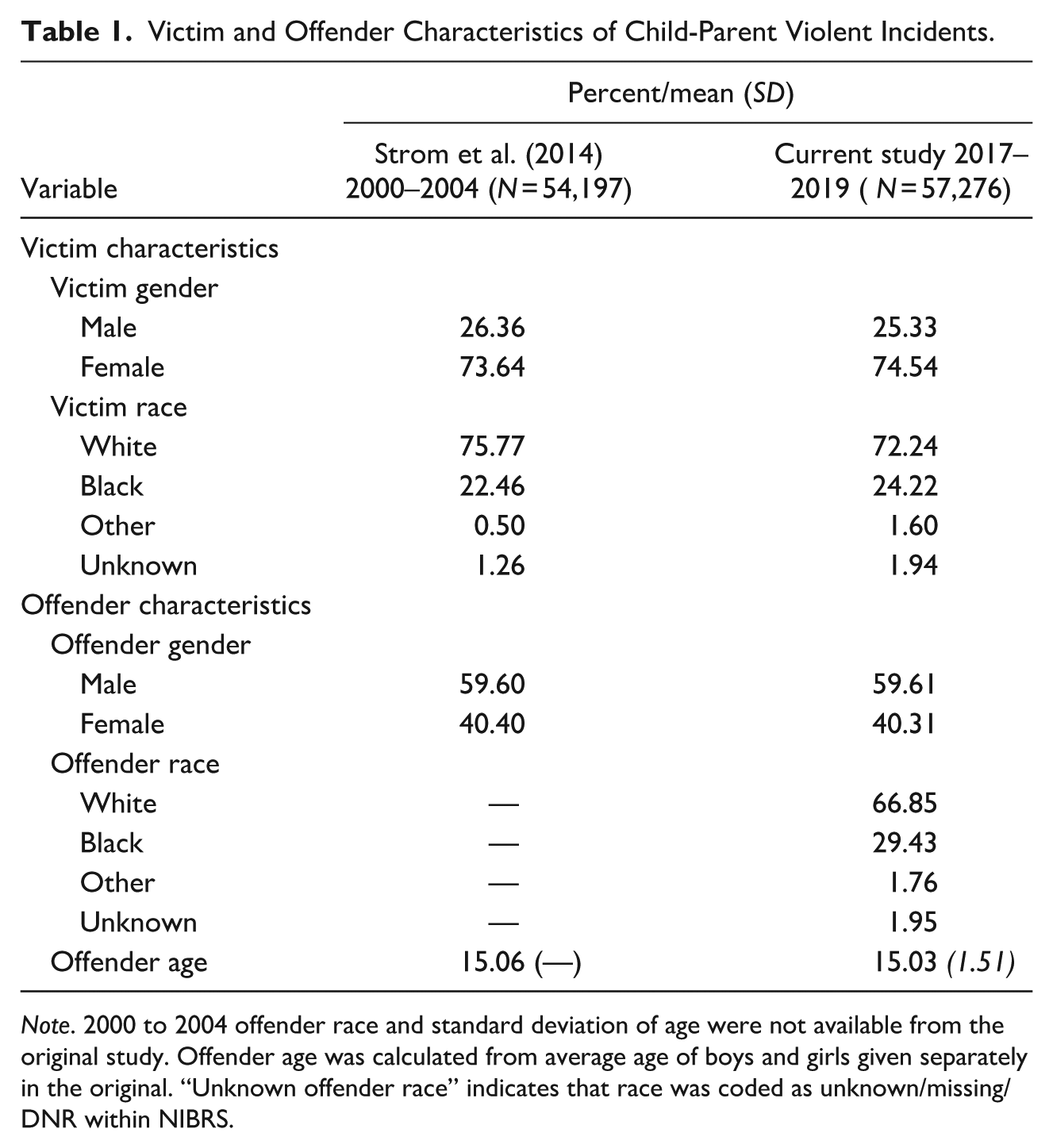
Note. 2000 to 2004 offender race and standard deviation of age were not available from the original study. Offender age was calculated from average age of boys and girls given separately in the original. “Unknown offender race” indicates that race was coded as unknown/missing/DNR within NIBRS.
Incident Characteristics of Child-Parent Violent Incidents.
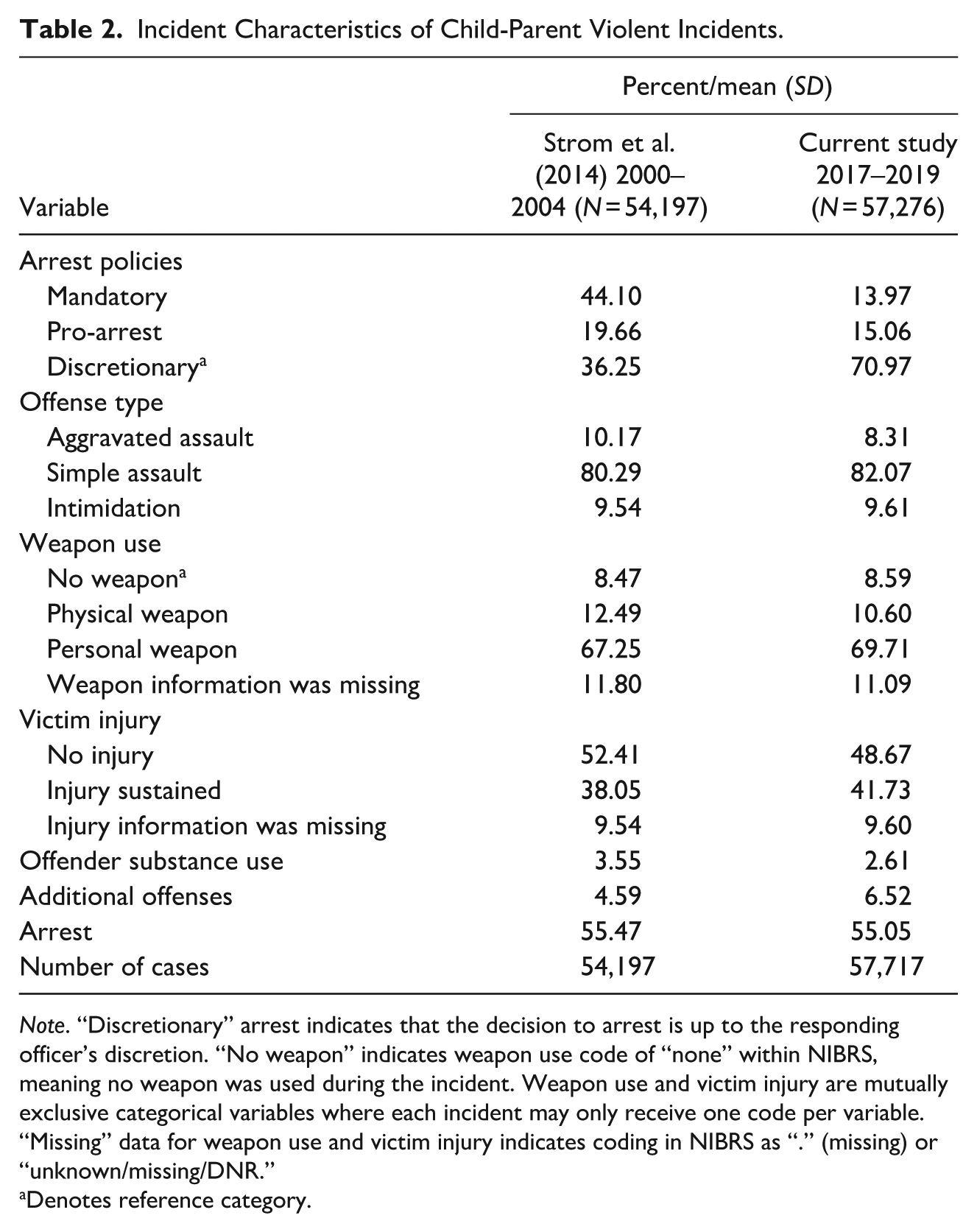
Note. “Discretionary” arrest indicates that the decision to arrest is up to the responding officer’s discretion. “No weapon” indicates weapon use code of “none” within NIBRS, meaning no weapon was used during the incident. Weapon use and victim injury are mutually exclusive categorical variables where each incident may only receive one code per variable. “Missing” data for weapon use and victim injury indicates coding in NIBRS as “.” (missing) or “unknown/missing/DNR.”
Denotes reference category.
Location Characteristics of Child-Parent Violent Incidents.
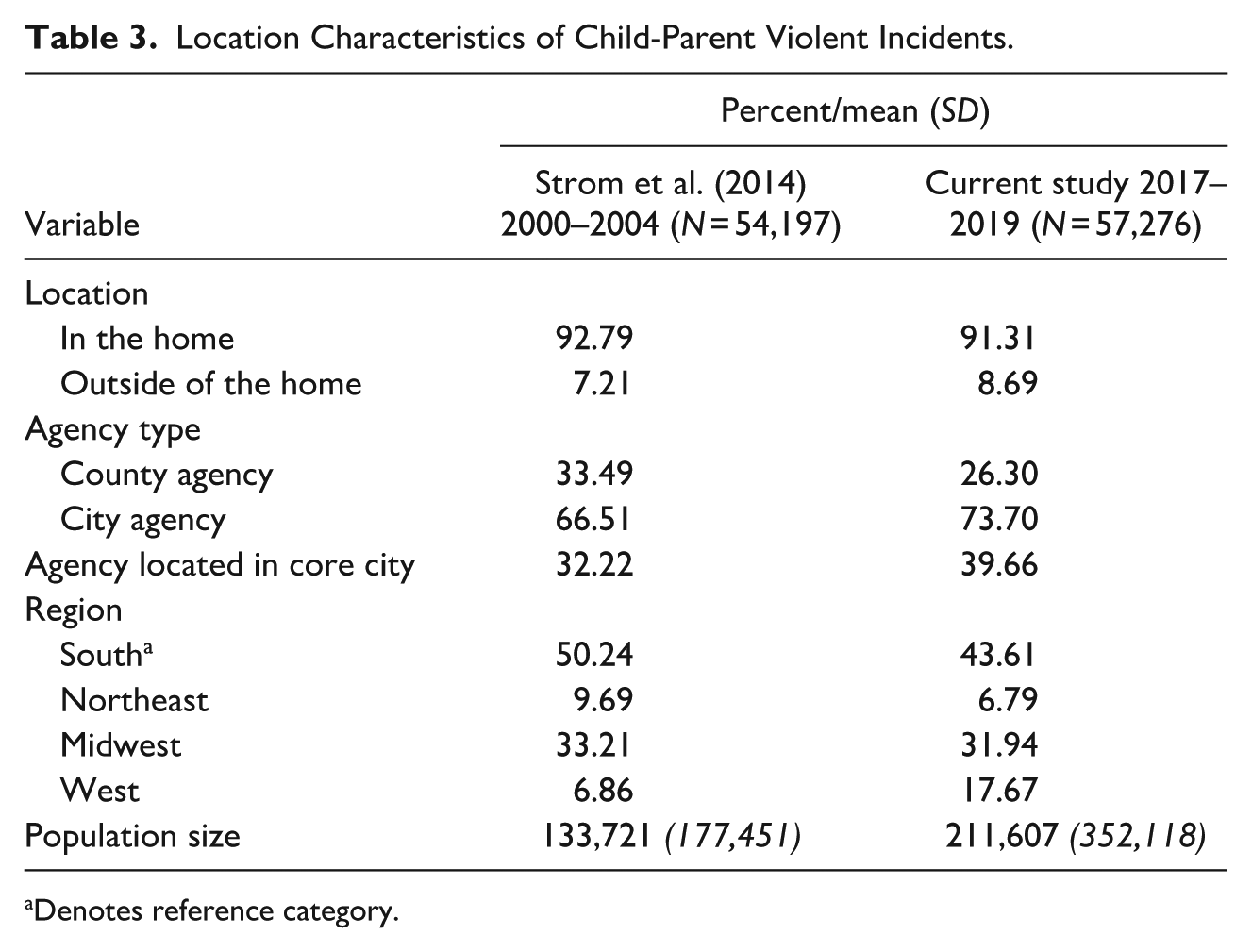
Denotes reference category.
The proportions of cases subject to each arrest policy changed dramatically between the original and this study. The proportion of cases in states with mandatory arrest decreased from 44.10% in the original study to just 13.97% in this study, pro-arrest decreased from 19.66% to 15.06%, and discretionary increased from 36.25% to 70.97%. Because there are only a few states with mandatory or pro-arrest policies, most of the states that have begun reporting since the original study have had discretionary policies, which is likely driving this shift. However, both state population size and reporting levels factor in as well. Surprisingly, the proportion of arrests did not change with 55% of cases in the original and this study ending in arrest.
Some of the most substantial changes were in the overall urbanicity and geolocation of cases. The average population size covered by the responding agency increased from 133,721 to 211,607. The proportion of cases responded to by a city agency increased from 66.51% to 73.70%, and the proportion of agencies located in a core city increased from 32.22% to 39.66%. The regional distribution also shifted, with cases in the West increasing from 6.86% to 17.67% and cases in the South decreasing from 50.24% to 43.61%. Changes in these variables are not unexpected as agencies shift their reporting from the UCR to NIBRS, and reporting to NIBRS continues to increase, particularly with larger agencies.
Multivariate Model
As seen in Table 4, there is relative consistency between the odds of arrest in the original and this study, with some key differences. The main finding from Strom et al. (2014) was that mandatory and pro-arrest policies were associated with increased odds of arrest compared to discretionary policies. However, this study found that mandatory arrest policies were not associated with increased or decreased odds of arrest, while pro-arrest policies were associated with a 127% increase in odds of arrest.
Odds of Arrest in Child-Parent Violence Incidents.
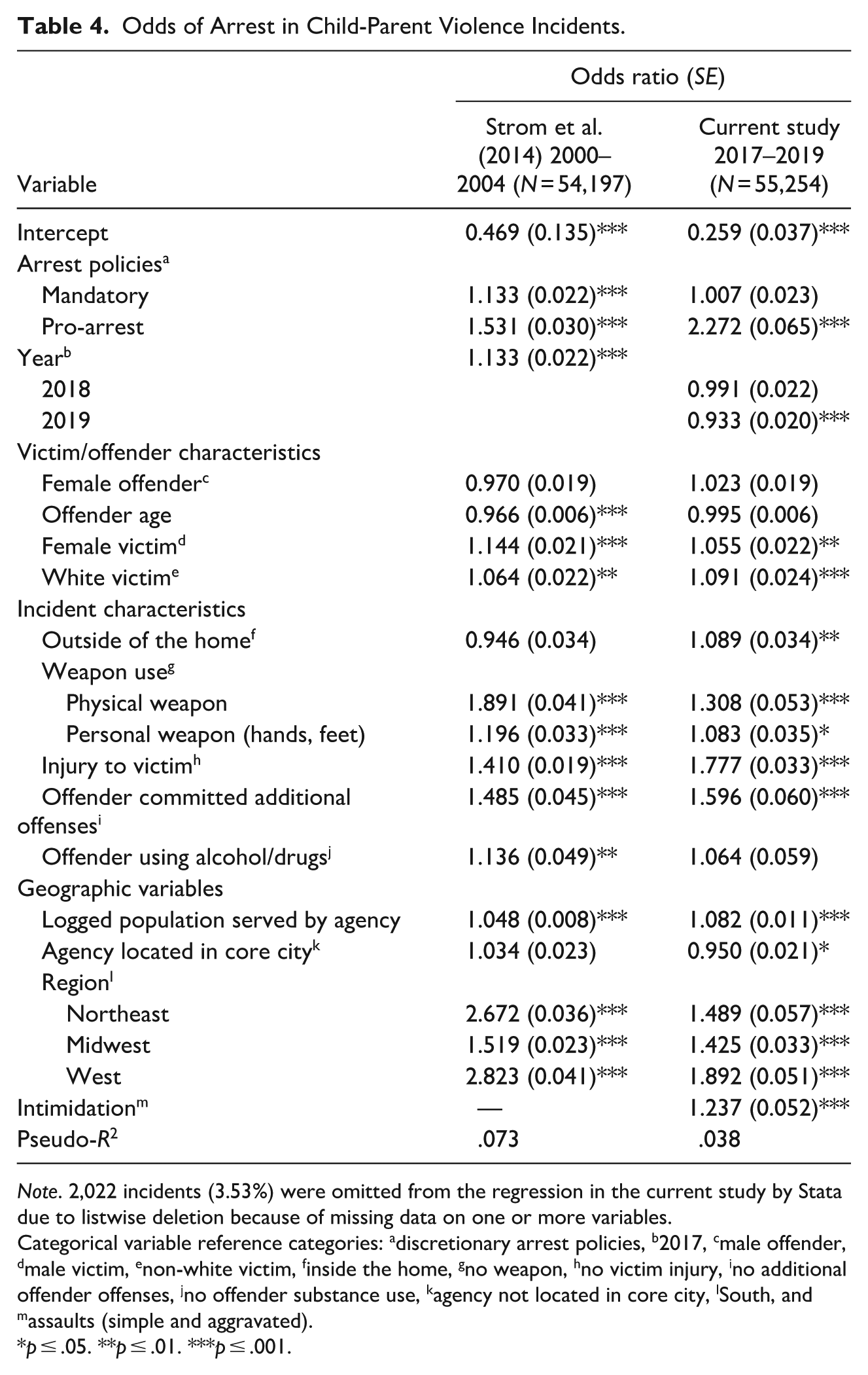
Note. 2,022 incidents (3.53%) were omitted from the regression in the current study by Stata due to listwise deletion because of missing data on one or more variables.
Categorical variable reference categories: adiscretionary arrest policies, b2017, cmale offender, dmale victim, enon-white victim, finside the home, gno weapon, hno victim injury, ino additional offender offenses, jno offender substance use, kagency not located in core city, lSouth, and massaults (simple and aggravated).
p ≤ .05. **p ≤ .01. ***p ≤ .001.
Most independent variables had similar findings between the original and this study. Female victims, white victims, physical and personal weapon use compared to no weapon use, victim injury, commitment of additional offenses, population size, and all regions compared to the South were associated with higher odds of arrest in both the original study and this study. Offender gender remained nonsignificant in both. Offender age was associated with slight decreased odds of arrest and substance use was associated with increased odds of arrest in the original study, but neither was significant in this study. However, the responding agency being located in a core city was not significant in the original but was associated with a small decreased odds of arrest in this study, and the incident occurring outside of the home was originally not significant but was associated with an increased odds of arrest in this study.
The intimidation dummy variable was not included in the original study, but in this study, intimidation cases were associated with a 24% increased odds of arrest compared to simple and aggravated assault cases. This finding was further investigated with bivariate analyses. A crosstabulation of arrest and offense type revealed that a smaller proportion of intimidation cases end in arrest (53%) compared to simple assault (55%) and aggravated assault (63%), showing that intimidation cases did not simply end in arrest more often than assault cases. Chi-square tests were run with offense type against both offender and victim gender to investigate possible differential offending or victimization by gender. Intimidation cases had the largest proportion of male offenders (68.30%) compared to simple assault (58.10%) and aggravated assaults (65.01%), and these differences were statistically significant (χ2 (2) = 274.53, p < .001). Intimidation cases also had the highest proportion of female victims (76.54%), closely followed by simple assault cases (75.31%) and then aggravated assaults (65.87%). These differences were also statistically significant (χ2 (2) = 219.22, p < .001). Lastly, an ANOVA was run with offender age and offense type. Intimidation cases had the oldest offenders, with a mean age of 15.16 years old, followed by simple assault and aggravated assault, 15.02 and 14.97 respectively. These differences were statistically significant (F (2) = 24.99, p < .001).
Discussion
This study offers insight into how child-parent violence perpetration, response, and reporting may have changed in the U.S. over a period of nearly two decades. The relative stability of certain variables, such as the offender and victim gender, offender age, and weapon use, gives greater confidence in the reliability of U.S. estimates and demonstrates that some aspects of child-parent violence perpetration may be less susceptible to external factors, especially those related to time, such as changing family dynamics. It also suggests that child-parent violence and its characteristics are relatively consistent across the U.S. While location variables, such as region and whether the responding agency was located in a core city, changed between the original and this study with a more representative sample of U.S. agencies, many child-parent violence incidents characteristics remained stable.
Importantly, Strom et al.’s (2014) initial analysis found that mandatory arrests were associated with increased odds of arrest and suggested that this may indicate that mandatory arrest policies are forcing officers to issue arrests when they otherwise would deem arrest inappropriate or unwarranted. However, those results did not replicate. In the current study, mandatory arrest policies were statistically unassociated with odds of arrest, suggesting that these policies may have little impact on actual arrest decisions. This may be partly due to the circumstantial requirements in some mandatory arrest policies. For example, in Arizona, officers are only required to make an arrest when the perpetrator is at least 15 years old and the victim was injured or when they used or displayed a dangerous weapon. In these cases, officers may be more likely to arrest the perpetrator even without a policy mandating it, with the policy currently acting as more of a formality and political stance than an active directive. This may also be evidence of changing views of domestic violence where currently officers consider it a serious offense and thus the policies are not as impactful on officer decision-making.
In contrast, both the original study and this study found that pro-arrest policies were associated with increased odds of arrest. This could be related to the broader scope of these policies. Pro-arrest policies tended to be more expansive and inclusive than mandatory arrest policies. For example, in Massachusetts, arrest is considered the preferred course of action for felonies and misdemeanors involving abuse, which includes various assault and battery offenses, kidnapping, stalking, and intimidating a witness (see Baker et al., 2017). Overall, there were fewer explicit circumstances, such as victim injury or weapon involvement, within the pro-arrest policies. In incidents subject to pro-arrest policies, there then may be more encouragement for officers to make an arrest compared to both mandatory and discretionary policies, which may in turn lead to higher odds of arrest. However, it is important to note that this is a cross-sectional study, and these findings could be attributed to a number of other explanations such as cultural differences in how child-parent violence, domestic violence, and juvenile justice are viewed. Additionally, the policies themselves may be more of a reflection of cultural views of domestic violence and juvenile justice rather than a driving force.
Unexpectedly, intimidation cases were associated with increased odds of arrest compared to simple and aggravated assaults, despite resulting in arrests less often. Further investigation did not provide much clarity. One potential is that these cases might involve clearer legality compared to physical assault. Whether or not a physical assault is considered illegal, particularly in a child-parent violence incident, may depend on a multitude of factors such as offender size and strength, victim fearfulness, community culture, and overall attitudes of the offenders, victims, witnesses, and responding officers. However, threats may more obviously illegal and require less discretion or circumstances to be considered a serious enough offense to warrant arrest. Initial case reporting should also be considered. Strictly verbal cases not involving threats may not result in an incident report whereas less serious physical assaults such as light shoving may still result in a report. The logistic regression model controlled for significant nuances in child-parent violence cases, which may explain why the isolated effect of an intimidation offense was significant. However, this finding remains largely unexplained and may be a fruitful avenue for future research.
In investigating intimidation cases, they had a higher proportion of male offenders compared to assault cases. This contrasts with previous findings that male offenders of child-parent violence are more likely to use physical violence whereas female offenders are more likely to use verbal violence. However, while intimidation does not include physical assaults, it is also not strictly verbal violence and can include bodily intimidating the victim and threats. This finding may underscore limitations of NIBRS due to the lack of context and details of incidents.
Limitations and Future Research
While this study provides some context to child-parent violence over time, it has several limitations. First, NIBRS incidents are coded for offense using standardized NIBRS offense definitions. When an offense within an agency does not exist in NIBRS, such as domestic violence, agencies must choose the most relevant NIBRS definition to label the incident offense. While both the offenses included in this study and the child-parent relationship were applicable to the domestic violence statutes and mandatory and pro-arrest policies in this study, without verification from the originating agency, it cannot be certain that every incident was interpreted or labeled as domestic violence and subject to arrest policy criteria by the responding officers. There may be incidents where officers did not recognize or consider the offense to be domestic violence and therefore the domestic violence arrest policy was not actually applied. However, it is unclear how often this may occur and what impact, if any, this may have had on the observed findings.
Despite great effort to replicate Strom et al. (2014) measures, this was not a perfect replication and thus, comparisons should be made with this in mind. Moreover, the changes in NIBRS data over time confounds historical context. It is impossible to assert whether observed differences between the original study and this study may be attributed to changes in child-parent violence perpetration, community reporting, police reporting, or the types of agencies submitting NIBRS data. NIBRS also lacks significant case detail and context, some of which was necessary to accurately and fully categorize which incidents were subject to which arrest policies. As such, some incidents that may have been subject to mandatory or pro-arrest policies were coded as discretionary due to insufficient information in NIBRS, and there is likely a proportional underreporting of incidents subject to mandatory or pro-arrest policies. Lastly, it should be noted that both the original study and this study had a large sample size and high statistical power, and based on the odds ratios, many of the observed relationships are quite small.
Though Strom et al. (2014) provided a fairly comprehensive model, there were some questions and suggestions identified throughout this process. A strong majority of incidents were subject to discretionary arrest policies, but there is little to lean on in investigating why officers may or may not issue a discretionary arrest in child-parent violence incidents. Officer decision-making in these incidents has been largely unexplored and would offer substantial insight into how these incidents are viewed and handled by officers, and if child-parent violence policies are adopted, what circumstances they may include to provide more guidance to officers. For example, it is largely unclear how circumstances such as perpetrator age, physical capacity for violence, criminal and victimization histories, and victim vulnerability factor into arrest decisions and other outcomes and how they may relate to the probability of future incidents. Certain statuses fulfilling the parental role may be viewed differently by police, potentially as more vulnerable and/or less “deserving” of victimization, such as grandparents or foster parents, and these victim perceptions could relate to an officer’s decision to arrest. Future studies may consider exploring victim relationship and victim-blaming specifically in relation to arrest decisions.
This area would also benefit from an expanded purview of system response beyond police contact. Armstrong et al. (2021) found that approximately 10% of child-parent violence cases ended in a referral to social services. However, it is unclear what services they were referred to, what prompted the referral, what services the offender and/or victims received, if any, and if the services impacted future child-parent violence perpetration. Additionally, it is unknown what proportion of child-parent violence arrests end in actual charges and are subsequently prosecuted and convicted. With concerns of the formalization of school sanctioning, such as the use of zero tolerance policies and school resources officers, there is reason to wonder if police and other services may also be replacing other methods of informal social control within the home in certain circumstances. Investigating which cases result in charges and convictions may offer some insight, and interviews with various justice system actors would give context and provide details on practitioner decision-making.
Conclusion
As child-parent violence continues to gain recognition in research, it’s important that policy follows suit. Broad policies may not provide adequate guidance for appropriate responses to these incidents, especially given the potential wide variation in incident circumstances and perpetrator and victim characteristics. Youth are particularly vulnerable to the consequences of the justice system and the families involved in these cases can be heavily impacted by the response and case outcome. Child-parent violence-specific policy and practice guidelines may not only offer support to responding practitioners but may help protect youth from adverse and possibly inappropriate or excessive responses to these incidents.
Footnotes
Acknowledgements
None.
Data Availability Statement
The data used in this work are publicly available and can be accessed through the Inter-university Consortium for Social and Political Research (ICPSR).
Declaration of Conflicting Interests
The author declared no potential conflicts of interest with respect to the research, authorship, and/or publication of this article.
Funding
The author received no financial support for the research, authorship, and/or publication of this article.
Ethical Approval and Informed Consent Statements
This study used publicly available secondary data with no personal identifiers.
