



Abstract
This study examines whether male subjects who agree with core beliefs of the extremist “incel” movement are more supportive of political violence, and why this may be the case. It employs an original public opinion survey using a representative sample of 900 American males and finds that subjects who hold incel beliefs are 124% more supportive of political violence as an abstract behavior and are 45% more supportive of political violence when it is put into a specific context. Furthermore, using serial mediation analysis, it determines that incel beliefs are linked to support for political violence through masculine gender role stress and aggression as well as though outgroup hate and illiberal attitudes.
The involuntary celibate or “incel” community is a misogynistic subculture, originating online in the 2000s, composed of straight men who struggle to form romantic and sexual relationships with women and who therefore harbor strong resentments towards women, feminism, and modern society. Discussion of political violence is ubiquitous on online incel message boards and experts note that violent ideation figures prominently in incel ideology and rhetoric (Baele et al., 2021; Jaki et al., 2019; O’Malley et al., 2022). Moreover, self-identified incels have engaged in acts of political violence, including infamous attacks in Toronto in 2018, Florida and Oregon in 2015, and California in 2014 (Zimmerman, 2024). 1 Consequently, experts have closely examined incels as potential sources of violent extremism in contemporary America (Baele et al., 2021; Kelly et al., 2022; Moskalenko, González, et al., 2022; O’Donnel & Shor, 2022).
In this study, I examine whether surveyed American males who subscribe to core incel beliefs are more supportive of the use of political violence and, if so, what might explain the connection between adherence to incel beliefs and endorsement of political violence. The study contributes to the existing literature in several ways. First, rather than focus on individuals who explicitly identify as incels or individuals who are active in incel communities online (see, for example, Daly & Reed, 2022; Moskalenko, González, et al., 2022; Moskalenko, Kates, et al., 2022; O’Donnell & Shor, 2020; O’Malley & Helm, 2023; Tranchese & Sugiura, 2021), I investigate the relationship between adherence to incel ideological tenets and support for political violence among American males using an original public opinion survey. 2 This is critical given that experts argue that mainstream societal tolerance for political violence produces an environment that is conducive to violent extremist actors and increases the probability that political violence will occur (see Crenshaw, 2000; Kruglanski & Fishman, 2006; Kushner, 1996; Ross, 1993; Weinstein, 2006). In other words, public opinion that is favorable to the incel ideology itself poses a threat to public safety.
Second, I construct a novel operationalization of core incel beliefs using a battery of original survey questions. This allows me to zero-in on the effect that mainstreaming of incel beliefs has on men’s attitudes about political violence and distinguishes incel beliefs from common misogyny, an attitudinal trait that scholars have found to be associated with individuals’ endorsement of political violence (see Bjarnegard et al., 2020; Kalmoe & Mason, 2022b; Piazza & O’Rourke, 2024).
Third, I not only examine whether men who hold incel beliefs are more likely to express support for political violence. I also empirically investigate personal and political attributes and attitudes that explain the connection between incel beliefs and support for political violence. For this part of the investigation, I employ serial mediation analyses to assess sequenced personal factors—masculine gender role stress, which reinforces aggression—and political factors—resentment toward outgroups, which reinforces preferences for illiberal governance—as part of the explanation for why men who hold incel beliefs are more likely to support political violence. This allows me to better explain why incel beliefs are linked to endorsement of political violence among American males.
Finally, I examine the impact of incel beliefs and the personal and political mediators on two different presentations of political violence: political violence in the abstract and political violence when placed in the context of a specific incident. This increases confidence that the findings of the study are not dependent on how subjects were surveyed about their attitudes toward political violence; a crucial element given debates on surveying American support for political violence (see Kalmoe & Mason, 2022a; Westwood et al., 2022) which I discuss in more detail in the research design section below.
Core Incel Beliefs
As previously stated, the incel subculture is a largely online community composed of heterosexual and mostly younger males who are hostile toward women, express strong misogynistic attitudes, and harbor resentments against contemporary society and the changes that feminism and the sexual revolution have produced (Baele et al., 2021; Hart & Huber, 2023; Helm, Holt, et al., 2024; Helm, Scrivens, et al., 2024; Kelly et al., 2022). Incels are a part of the larger so-called “Manosphere,” an interrelated coterie of online sites, blogs, and posting forums that are focused on promoting a toxic type of masculinity, men’s rights, and the idea that contemporary men are oppressed by a society that has gone too far in promoting women’s political, social, cultural, and personal independence (Zimmerman, 2022). Self-identified incels and men who are active within the incel community are an obscure, marginal group within the wider adult male population. That said, incel beliefs and ideological themes have permeated the mainstream. According to the public opinion data I collected for this study—described in more detail in the research design section below—around 77% of males either somewhat or strongly agreed with at least one of the nine incel tenets that I surveyed. 3 Around 15.6% of male subjects in my sample expressed somewhat or strong agreement with all nine incel beliefs that I surveyed.
What ideas constitute core incel beliefs? Sources that present and discuss the incel ideology identify several themes that define the incel ideology (Baele et al., 2021; Cottee, 2020; Hart & Huber, 2023; Helm, Holt, et al., 2024; Helm, Scrivens, et al., 2024; Hoffman, 2020; Jaki et al., 2019; Kelly et al., 2022; Woodward et al., 2022; Zimmerman, 2024). These include the following: First, that women in modern society are romantically and sexually fixated on a small minority of physically attractive (heterosexual cisgender) men, leaving unattractive men without female attention and therefore marginalized, excluded, and oppressed. Notably, incels subscribe to a view of society that is depicted as a deeply inegalitarian and hierarchical sexual marketplace in which attractive women are dominant and control everything, attractive men command the lion’s share of sexual attention from women but are still manipulated by women, average looking men face a scarcity of female attention and corresponding lack of power, and unattractive men (incels) are completely excluded and ignored and therefore constitute a sexual and sociopolitical underclass (Baele et al., 2021; Jaki et al., 2019).
Second, the incel ideology holds that this situation is due to the social changes wrought by feminism, the sexual revolution, and the rise of women’s rights, all of which have undermined traditional gender roles and have left unattractive men without any hope of finding mates or garnering sexual attention from women. More generally, incels assert that men are oppressed and victimized in modern society as a consequence of feminism (Cottee, 2020; Ging, 2019; Hart & Huber, 2023; O’Malley et al., 2022), and that unattractive men are particularly marginalized and excluded (Zimmerman, 2024). Zimmerman (2024) further explains that incels believe they currently live in a “gynarchy” in which they, as unattractive men, are unfairly excluded and oppressed.
Third, incels hold a regressive belief that all men are entitled to sex and romantic attention from women. According to incel ideology sex is a fundamental right for men, however women in modern society are denying it to all but an elite minority of attractive males (Baele et al., 2021; Tolentino, 2018). Janik (2018) further explains that some incels believe that women who deny men sex are committing a crime and deserve to be punished, including being subjected to violent retribution.
Fourth, incels present a distorted romanticization of a “just” historical past before feminism and the sexual revolution when, allegedly, all men including unattractive men could find loyal female romantic partners and mates because people married young, and adultery was condemned for women (Kelly et al., 2022). In this pre-feminist/sexual revolution golden era, unattractive men had a place in society and were not marginalized, according to incel beliefs.
Finally, the incel ideology depicts modern women as shallow, appearance-focused, manipulative and unfaithful toward most men—particularly men of average or “normal” attractiveness—and dismissive toward and therefore repressive of unattractive men (Baele et al., 2021; Helm, Scrivens, et al., 2024). In incel ideology, most women use average-looking men that they are in relationships with for security but will cheat on them with an attractive man if afforded the chance. This provokes strong resentments against modern women who exercise social, cultural, political, personal, and sexual choice. Moreover, incels often transfer these resentments beyond women to wider mainstream society, cultural and government institutions, and even to other men who accept the current status quo (Woodward et al., 2022).
How Might Incel Beliefs Reinforce Support for Political Violence?
The incel worldview is conductive to political violence, according to experts. 4 Zimmerman (2024) argues that according to adherents of incel ideology, the current social, political, cultural, and sexual status quo is both irreformable and completely intolerable for men and so therefore the use of violence is the only option. However she is careful to note that incel-fueled violence includes both outward-directed violence, such as political violence, as well as inward-directed violence, such as self-harm and suicide. The latter is a common manifestation of incel grievances (see also Hart & Huber, 2023; Moskalenko, González, et al., 2022). Other scholars studying the online and social media behavior of incels have found evidence reinforcing the link between incel beliefs and support for political violence by showing that pro-violence statements and attitudes are commonplace within incel rhetoric (Baele et al., 2021; Helm, Scrivens, et al., 2024; Jaki et al., 2019; O’Malley et al., 2022) while other experts have documented and discussed the political violence threats posed by adherents to the incel ideology (Kelly et al., 2022; Moskalenko, Kates, et al., 2022; Tomkinson et al., 2020). O’Donnel and Shor (2022) argue that active incels view mass political violence as a tool to draw attention to their beliefs and to foment an “incel revolution” that will address the wrongs of modern, feminist, post-sexual revolution society. For Baele et al. (2021) and Jaki et al. (2019), incels believe violence will achieve several socio-political objectives: to gain revenge against a society that has alienated and oppressed them; to draw attention to how feminism and the sexual revolution have contributed to their alienation and oppression; and to foster a revolution that will halt women’s social, political, and sexual empowerment and will restore a glorified traditional gendered order.
Because of this literature, I theorize that men who agree with the incel ideology are more likely to see political violence as an acceptable behavior. This leads to the first hypothesis of the study:
H1: Subjects who hold incel beliefs are more likely to express support for political violence.
How specifically might incel beliefs reinforce support for political violence, however? To answer this question, I investigate variables that provide a link between incel beliefs and permissive support for political violence, thereby providing more information about how the relationship works. I present these as two “routes” by which individuals who hold incel beliefs might be more likely to express support or tolerance for the use of political violence. One of these routs involves personal attitudes and attributes linking incel ideology to political violence. The other involves political beliefs and preferences. I discuss them in turn.
The Personal: Incel Beliefs, Masculine Gender Role Stress, Aggression, and Support for Political Violence
For the personal route, I theorize that men who hold incel beliefs are also more likely to exhibit masculine gender role stress and that men suffering from masculine gender role stress are more likely to display aggression, which is associated in the literature with greater support for political violence. Masculine gender role stress is a psychological condition predicated on the theory that men and women acquire different, gender-based normative behaviors and attitudes rooted in traditional social expectations. For men, traditional masculine, gender-normative attributes include dominance, decisiveness, stoicism, confidence, and heterosexual normativity. Moreover, according to this framework, some men feel compelled to continually assert and defend their masculinity. When these men feel that their masculinity is questioned or challenged, either by other individuals or in social situations, they experience masculine gender role stress: feelings of anxiety accompanied by a need to display beliefs and behaviors, often aggressive, to rescue and ameliorate their challenged masculinity (Cheryan et al., 2015; DiMuccio & Knowles, 2020; Vandello et al., 2008).
Incel beliefs work to reinforce masculine gender role stress. As previously noted, incels bemoan their inability to obtain romantic and sexual attention from women. Traditional patriarchal gender norms, according to incels, dictate that men are entitled to sex and romantic affection from women. Incels therefore charge that modern society, and modern feminism, prevent them from performing their ordained gender roles and receiving their traditional gender rights. This condition produces for individuals who hold incel views feelings that their masculinity has been violated. This violation, in turn, gives rise to feelings of resentment and aggression, toward women and toward a wider society, prompting them to become more tolerant of transgressive political behaviors, including political violence.
Several studies reinforce this theoretical expectation. Men who hold incel beliefs are also more likely to exhibit masculine gender role stress. A central tenet of the incel belief system is that traditional norms of masculinity are to be reified but that traditional masculinity is demonized and therefore repressed in modern society (Cottee, 2020; Ging, 2019; O’Malley et al., 2022). More on point, Scaptura and Boyle (2020) theorize that masculine gender role stress and “precarious masculinity”—insecurities about one’s masculinity—are associated with incel identification. Scaptura and Boyle (2020) further explain that a key theme within the incel community is what they term “acceptance threat,” or the fear that one, as a man, is not living up to the expectations of one’s gender ingroup. Acceptance threat permeates online incel discussions and serves to reinforce desire for ingroup identification. Fontanesi et al. (2024) and Vallerga and Zurbriggen (2022) also theorize that an important driving force for men who participate in online incel communities is fear that they cannot live up to traditional masculine gender roles. Because of this literature, I expect that male subjects in my study who agree with core incel beliefs are also more likely to exhibit masculine gender role stress symptoms.
I also expect subjects who exhibit masculine gender role stress to be more likely to demonstrate higher levels of aggression, including violent aggression. My expectation here is consistent with another body of literature showing a link between masculine gender role stress/insecure masculinity and aggression. Several studies find that males who fear they do not conform to traditional masculine gender roles and notions of masculinity are more likely to exhibit anger and aggression (see, e.g., Dahl et al., 2015; Eisler et al., 2000; Reidy et al., 2014). Other studies have specifically found that measures of heightened masculine gender role stress are associated with aggressive attitudes and behaviors (Bosson et al., 2009; Eisler & Blalock, 1991). 5
The relationship between masculine gender role stress and aggression has potential consequences for attitudes about political violence. Scholars have found that more aggressive individuals are generally more likely to express support for the use of political violence, or to find political violence to be a tolerable form of behavior (Kalmoe, 2014; Kalmoe & Mason, 2022b). Kalmoe (2014) explains that aggressive individuals express greater confidence that belligerent responses are effective solutions to their frustrations, are more likely to view other’s actions as threatening and hostile, view others as more likely to pose a threat, are more likely to be prepared to retaliate against perceived threats and slights from others, and are more desensitized to the dangers and costs of aggression.
Overall, the expectation that incel attitudes reinforce masculinity stress, aggression and tolerance of political violence are consistent with broader literatures on masculinity-based violence and violence against women. Seminal work by R. E. Dobash and Dobash (1979, 1984; R. P.Dobash & Dobash, 1992) determined that (mostly interpersonal) violence against women is a product of both misogyny and patriarchal norms about masculine and feminine gender roles and expectations. Specifically, they argue that violence against women is employed as a tool of control. This framework has also been employed in later work by Anderson (2008) and Kevan and Archer (2004). Other scholars have identified masculinity stress as an important driver of misogynistic political violence and terrorism, particularly against women in public office (see Krook, 2018; Sanín, 2023).
These literatures prompt me to theorize that the relationship between adherence to incel beliefs and support for political violence is mediated, serially, through masculine gender role stress and aggression. This leads to the second hypothesis of the study:
H2: The effect of incel beliefs on support for political violence is mediated through masculinity stress and its effects on aggression in subjects.
The Political: Incel Beliefs, Outgroup Hate, Illiberalism, and Support for Political Violence
The second “route” by which incel beliefs may lead to increased support for political violence is through aversion toward social outgroups and preference for political illiberalism. The incel ideology works to sharpen resentments against outgroups. As previously noted, men are drawn into the incel mindset out of feelings that they, as a social group, are manipulated, exploited, and abused by women, and by modern feminist society. According to incels, modern women have disrupted the traditional “just” social hierarchy in which men enjoy a privileged status. Usurpation of men’s social status produces strong feelings of aversion toward social outgroups challenging men’s positions: notably modern women but also other outgroups. The challenge to men’s dominant status produces a backlash against outgroups which erodes incels’ commitments to liberal, inclusive, pluralistic democratic society. Erosion of liberal democratic norms, in turn, remove inhibitions against the use of political violence.
Some literature provides support for this framework. The first step of the political route, aversion toward outgroups or “outgroup hate,” is a key component of intergroup conflict theory; a theory that explains violent conflict between groups in society (see, e.g., Brewer, 1999; Sniderman, 1975). According to intergroup conflict theory, individuals who experience stress or a perception of threat—frequently in response to political, economic, social, or cultural changes that affect perceived status—react by identifying more strongly with their social ingroup while becoming more adverse and hostile towards social outgroups. Brewer (1999) depicts this phenomenon as “ingroup love” and “outgroup hate.” An important facet of outgroup hate is the demonization and dehumanization of outgroup members, and it is a necessary step for normalizing political violence (Bandura, 1999; Ellemers et al., 2017). While much of intergroup theory focuses on conflict between racial or ethnic ingroups and outgroups, scholars have identified gender-based outgroup hate among individuals displaying hostile sexism (see Dunbar et al., 2007).
Incel ideology and rhetoric prominently feature discussions that conform to the intergroup conflict and outgroup hate framework (see Baele et al., 2021). Men, particularly average looking or unattractive men, are depicted within incel ideology as a suffering and persecuted social group, thereby strengthening ingroup love. Women, as well as men who conform to contemporary social norms about women’s rights and sexuality, are demonized as a social outgroup by incels (O’Malley & Helm, 2023). 6 Several scholars document the centrality of demonizing language against outgroups—women, men who conform to contemporary norms about gender relations—to incel rhetoric and ideology (see Baele et al., 2024; Chang, 2022; Ging, 2019). Though the outgroup for incels is most frequently a gendered outgroup, online incel forums also prominently feature racist tropes (Baele et al., 2021). This suggests that outgroup hatred is not strictly limited to women for many incels, and that discussion of race among incels has converged with what typifies other far-right subcultures and social movements (Hoffman et al., 2020). Scaptura and Boyle (2020) use the term “status threat” to explain this situation in the context of incel ideology: Men, particularly average and unattractive men, face serious challenges to their social status and sense of belonging in society by women and other outgroups. This produces outgroup hate, which manifests in strong resentments against women and other outgroups.
Outgroup hate is an important ingredient for the normalization of political violence in that it, among other things, contributes to the erosion of democratic norms for peaceful political participation. Tolerance of outgroups is a cornerstone of liberal, democratic governance. Democracy requires a high level of interpersonal trust among citizens, and that trust must cut across social groups in order to reinforce liberal rule (Sullivan & Transue, 1999). Tolerance of outgroups helps to reinforce interpersonal trust and shores up support for democratic norms, practices, and institutions (Diamond, 1994; Gibson, 1996; Linz & Stepan, 1996; Seligson, 2000). Scholars have found that resentments against outgroups strengthen illiberal and antidemocratic sentiments and fuel skepticism of democratic norms and institutions (Buyuker & Filindra, 2020; C. Miller, 2017). Public opinion studies by Miller and Davis (2021), Thompson (2021), and Drutman et al. (2018) demonstrate that U.S. subjects who express lower levels of tolerance toward outgroups are more likely to voice skepticism of liberal rule and to endorse antidemocratic forms of government. I expect individuals who express greater levels of outgroup hate, because of their embrace of incel beliefs, to also express support for illiberal and nondemocratic rule.
This, finally, has important consequences for attitudes toward political violence. Illiberal people are more likely to be more tolerant of the use of political violence. This is conceptually consistent with foundational research on the pacific effects of democracy. According to Przeworski (1991) and Riker (1983), democratic norms and institutions serve to reinforce non-violent modes of political participation. When people become skeptical of democratic norms, institutions, and practices, “violent mobilization” of political interests is more likely to occur (Albertson & Guiler, 2020; Berlinski et al., 2023). Empirical research documents this. Public opinion studies show that subjects who express skepticism of democracy and a preference for nondemocratic forms of government are more tolerant of the use of political violence. This is the case for illiberal American study subjects (Bartels, 2020; Bartusevicius et al., 2020; Piazza, 2024) and for subjects in other countries (Kaltenthaler et al., 2010; Zhirkov et al., 2014).
Given this, my third and final hypothesis is:
H3: The effect of incel beliefs on support for political violence is mediated through outgroup hate and its effects on illiberalism/preference for nondemocratic rule in subjects.
Research Design
To test the hypotheses of the study, I designed and fielded an original online survey of over 900 adult males living in the United States using the Lucid Theorem survey panel. 7 The Lucid panel employs a subject pool that is representative of the U.S. population (Coppock & McClellan, 2019). Moreover, other empirical studies of predictors of attitudes about political violence have also used the Lucid panel (see Armaly & Enders., 2024; Armaly et al., 2022). I fielded the survey from July 11 to July 13, 2024, in batches to include subjects’ responses across different days and from different time zones in the United States. 8 I limited the study to male-identifying subjects only, as males are more likely to be receptive to and influenced by incel beliefs (see Scaptura & Boyle, 2020). All subjects, prior to taking the survey, were presented with a consent agreement and all were debriefed upon completing the survey. I embedded a commitment check and multiple attention checks at various points within the survey. Subjects who either refused to commit or who failed attention checks were terminated from the survey and were not included in the study sample. 9 The median subject took 14.6 min to complete the survey, and the sample includes responses from subjects from all 50 U.S. states. I conduct two types of empirical tests in the analysis. To test hypothesis 1, the effect of incel attitudes on support for political violence, I use a standard ordinary-least squares regression estimation technique. To test hypotheses 2 and 3 I use a serial mediation technique involving structural equation modeling.
Dependent Variable
The outcome variable of the study is subject-expressed support for the use of political violence. Political violence, in the study, is defined as the use of violence to achieve a political goal or to communicate a political message. There is scholarly controversy on how to survey Americans about their support for political violence (see Kalmoe & Mason, 2022a, 2022b; Westwood et al., 2022). While this study cannot resolve that debate, it does adopt some best practices arising from the controversy when constructing the dependent variable. First, scholars argue that subjects’ support for political violence is affected by whether it is presented to them as an abstract political behavior without a specific context or mentions specific acts of political violence (Westwood et al., 2022). Second, scholars suggest that subjects be presented with a neutral response option, such as “neither agree nor disagree,” when surveyed about their attitudes toward political violence as this can affect the analysis (Westwood et al., 2022). Third, scholars argue that inattentive subjects may be more likely to express support for political violence and should therefore be accounted for (Kalmoe & Mason, 2022b; Westwood et al., 2022).
I accommodated these practices when constructing my dependent variable. I constructed two measures of subject support for political violence: support for political violence in the abstract, and support for political violence when it is put into a specific context. To build the support for political violence in the abstract measure, I presented subjects with eight statements depicting the use of political violence to express political attitudes and grievances, to pressure politicians, to counter government policies, or to retaliate against political opponents. 10 These statements are derived from those used in previous studies of public attitudes toward political violence (Kalmoe, 2014; Kalmoe & Mason, 2019; Uscinski & Parent, 2014). Furthermore, the statements did not mention a specific example or incident of political violence. Subjects were then asked whether they agreed or disagreed with the statements using a five-point Likert response scale that includes a neutral, median category of “neither agree nor disagree.” Subject responses were then combined into an additive index ranging from 8, indicating total repudiation of political violence, to 40, indicating strong support for political violence across the board. The frequency distribution of subject attitudes toward political violence in the abstract are graphically presented in the Supplemental Appendix and it reveals a leftward skew, indicating that support for abstract political violence is relatively low in the sample. Approximately 75% of subjects expressed moderate to low levels of support for abstract political violence, measured as a 23 or lower out of 40 on the abstract support for political violence scale.
To build the second measure of support for political violence, support for political violence when presented in a specific context, I presented subjects with two fictionalized vignettes depicting an individual engaging in political violence at a public event. These vignettes were modeled in part on similar instruments utilized by Westwood et al. (2022) and are presented in the Supplemental Appendix. I then asked subjects, using a 5-point Likert response scale with a neutral response option, whether they thought the offending individual in the vignette was justified in engaging in the political violence, and whether they were sympathetic towards the individual. I combined these subject responses into an additive scale ranging between 4 and 20, where 4 indicates complete rejection of specific political violence while 20 indicates strong endorsement. 11 Again, support for political violence when put into a specific, realistic context is low in the sample. A plurality (30.9%) of subjects felt that the offending individual in the vignette was not justified at all for engaging in political violence and expressed absolutely no sympathy for the violent actions. Around 67% of subjects expressed moderate to low support for specific political violence, measured as a score of 11 or lower on the 4 to 20 scale.
Independent Variable
The independent variable for the study is subject adherence to core incel beliefs and incel assessments of contemporary society. To construct this variable, I identified core themes present in sources that outline the incel ideology, and that I discuss in more detail above (Baele et al., 2021; Cottee, 2020; Kelly et al., 2022; Helm, Holt, et al., 2024; Helm, Scrivens, et al., 2024; Hoffman, 2020; Jaki et al., 2019; Woodward et al., 2022; Zimmerman, 2024). These themes include the following: That women in modern society focus their romantic and sexual attentions on a minority of physically attractive (heterosexual cisgender) men and ignore and therefore oppress average-looking or unattractive men. That this condition is the result feminism and the sexual revolution. That all men are by right entitled to sex and romantic affection, and that denying it to unattractive men renders those men a marginalized and oppressed class. That traditional society before the disruptions of feminism and the sexual revolution was “fairer” to all men because it allowed average and unattractive men a chance to find female partners for sex and marriage. Finally, that contemporary women are superficial, manipulative, and unfaithful toward men, and are prone to cheating if given the opportunity to be with an attractive man.
For the independent variable, I presented subjects with nine statements encapsulating these core incel beliefs and used a 5-point Likert response scale, with a neutral option, to determine whether they agreed or disagreed with them. I then constructed an additive index measure using their responses that ranges from 9, indicating complete rejection of incel beliefs, to 45, indicating strong endorsement across the board. 12 Frequency distributions of subject’s incel beliefs are presented in the Supplemental Appendix, and they conform to a somewhat normal distribution. Around 50% of the subjects express moderate to high levels of adherence to incel beliefs, measured as a score of 27 or higher on the 9-to-45 index. The modal response (10.4% of the sample), a score of 27 on the 9 to 45 index scale, likely indicates neutral responses of neither agree nor disagree to the various components of incel ideology.
Mediators
I employ several mediating indicators to test hypotheses 2 and 3 and determine how subjects’ personal attitudes and sociopolitical beliefs mediate the effects of incel beliefs on support for political violence. For the personal route, I employ two mediators that are serially correlated with one another: masculine gender stress and aggressive attitudes. To operationalize male gender stress, I utilize a validated, condensed version of the Masculine Gender Role Stress Scale (MGRS) developed by Swartout et al. (2015). I presented subjects with 15 statements depicting scenarios in which the subject—a male—might fail to meet traditional masculine standards of behavior such as being outperformed by women or others in work or financial life, appearing to be effeminate, emotional, or indecisive, or having their sexual orientation questioned. I then asked subjects whether the scenario would produce feelings of stress using a five-point Likert scale measure that included a neutral response category. The masculine gender stress index is measured as an additive scale ranging from 15 to 60, where 15 indicates an absence of stress experienced by subjects when presented with the gender role-challenging statements and 60 indicates high levels of stress across the board. Distribution of masculine gender stress in the sample is slightly skewed leftward. 13 Around 82% of subjects exhibited moderate to low levels of male gender role stress in response to the scenarios, measured as a score of 37 or lower on the 15 to 60 index.
The second personal mediator, which I theorize is predicted and reinforced by male gender stress, is aggression. The purpose of this mediator is to operationalize the link between masculine gender stress, and the anger and frustration that it engenders, and the propensity of a subject to endorse political violence. To measure aggression, I use four survey items from Kalmoe (2014) that present subjects with statements such as “If I’m pushed enough, I may hit another person” or “I have trouble controlling my temper.” 14 Kalmoe (2014) found that these survey items of subject aggressive tendencies were strong predictors of support for political violence. Subjects indicated whether they agreed that these statements applied to them using a five-point Likert scale that included a neutral category. These were combined into an additive scale ranging between 4, indicating a very low level of aggression, and 20, indicating a high level of aggression. Subjects’ aggression levels appear to be normally distributed across the sample. 15 Around 50% of subjects exhibited moderate to high levels of aggression, measured as an 11 or higher on the 4 to 20 index scale.
For the political route, I construct two mediators: outgroup hate and preference for illiberal, nondemocratic rule, which I argue is predicted by outgroup hate. I measure outgroup hate by presenting subjects with two statements about (undefined) minorities: “We are too concerned about protecting minority rights;” and “Members of other racial, religious, or minority groups are too demanding in their push for equal rights.” Subjects then responded by stating that they agreed or disagreed with the statements using a five-pint Likert scale with a neutral option. Subject responses were then combined into an additive scale ranging from 2, indicating very low outgroup hate attitudes, to 10, indicating very strong resentment towards outgroups. Approximately 50% of subjects exhibited moderate to strong hatred toward outgroups—measured as a score of 6 or higher on the 2-to-10-point index—and the distribution of outgroup hate attitudes across the sample is level across categories. 16
The second political mediator, which I theorize is reinforced by outgroup hate, is preference for illiberal, undemocratic rule in the United States. To capture illiberalism, I presented subjects with two questions asking them whether they thought that having a “strong leader who does not have to bother with Congress or elections” or military rule where military leaders have “suspended elections, closed down the legislature, and temporarily taken charge of the government in order to address extreme corruption” would be a good way to govern the United States. These survey questions were derived from Drutman et al. (2020). Subjects responded to these questions using a five-point Likert response scale with a neutral option. Support for undemocratic, illiberal rule is relatively rare in the sample. Only around 27.1% of subjects somewhat or strongly agreed that illiberal “strongman” rule or military rule would be a good way to govern the United States, measured as a score of 7 or higher on the 2 to 10 index scale for illiberalism. 17
Control Variables
I include a set of standard demographic and attitudinal controls in all estimations to mitigate spuriousness. These include subject age, income level, employment status, education level, marital status, race, whether they lived in a rural area, partisan identification, political engagement, political ideology, religious identification, news consumption and source for news, and where in the U.S. the subject resided. I also include in all estimations a base-10 log transformed measure of how long it took the subject to take the survey.
The median age for subjects in the study was 46. The median subject had a household income level of $40,000 to $44,999 per year, and around 12.6% of subjects reported being unemployed and looking for work. The median subject reported having completed some college education but did not receive a degree. Approximately 40.9% of subjects were married and around 10.7% reported being divorced and not currently married. Around 67.8% of subjects identified as white, non-Hispanic, while around 9.4% identified as black and around 16.0% identified as Latino or Hispanic. Around 6.6% identified as other races, or of mixed race. 18 Approximately 23.1% of subjects lived in rural areas. In terms of partisanship, around 29.3% of subjects identified as Democrats, around 36.2% identified as Republicans, and 26.6% identified as Independents. About 74.2% reported having voted in the 2020 election, and around 51.5% said that they had either contacted an elected official, urged another person to vote, or participated in a political protest. I also asked subjects about their political ideology. Around 28% identified their ideology as slightly or extremely liberal, around 36.1 identified as political moderates, and around 35.6% identified as slightly or extremely conservative. About 60.3% of subjects identified as Christians, and around 30.1% identified as “born-again.” The median subject stated that they followed the news “several times a week,” and around 20.03% stated that they relied mostly upon social media to obtain their news. Around 8.8% stated that they relied upon conservative media—cable television, news radio, websites, social media, or online or print newspapers and magazines—to obtain their news. Approximately 19.6% of subjects lived in the Northeast, around 18.9% lived in the Midwest, 37.6% in the South, and 23.8% in the West. 19
Results
The results of the analysis provide support for the hypotheses of the study. The first set of results demonstrates that subjects that hold incel beliefs are more supportive of political violence, both when it is presented as an abstract behavior and when it is depicted as a specific incident (hypothesis 1). This is demonstrated in Figure 1, in which the marginal effects of adherence to incel beliefs on support for political violence in the abstract are graphed.
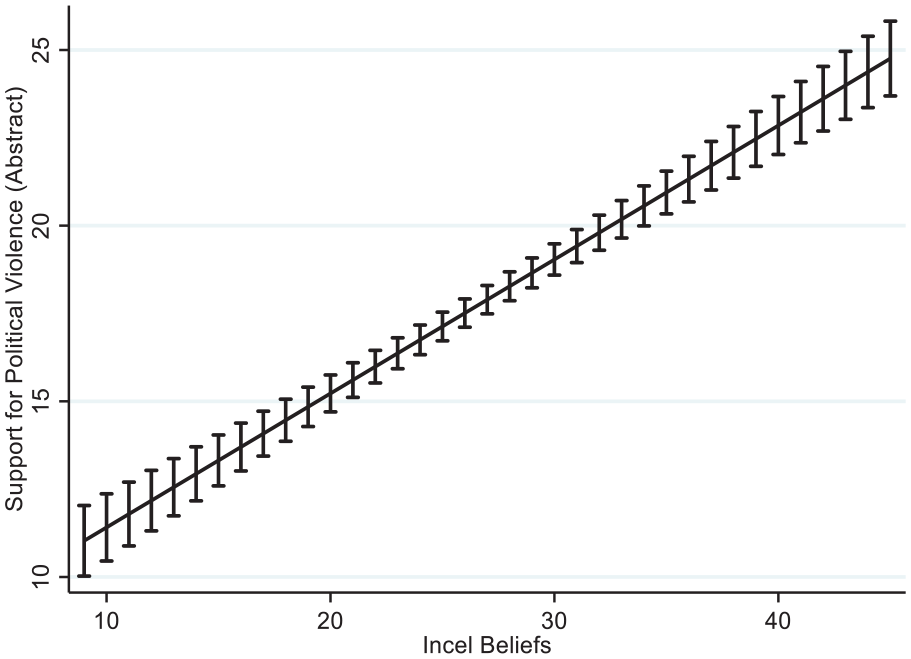
Incel beliefs and support for abstract political violence, marginal effects plot.
A one-unit increase in the incel belief index is associated with a β = .381 [95% confidence interval 0.328, 0.434] increase in support for political violence in the abstract. Increasing incel beliefs from the lowest level to the highest level corresponds with a 124.4% increase in support for political violence in the abstract. Moreover, adherence to incel beliefs is found to have a large positive effect on support for abstract political violence relative to other covariates. This can be seen in Figure 2 which plots the standardized 20 coefficients for all variables in the model.
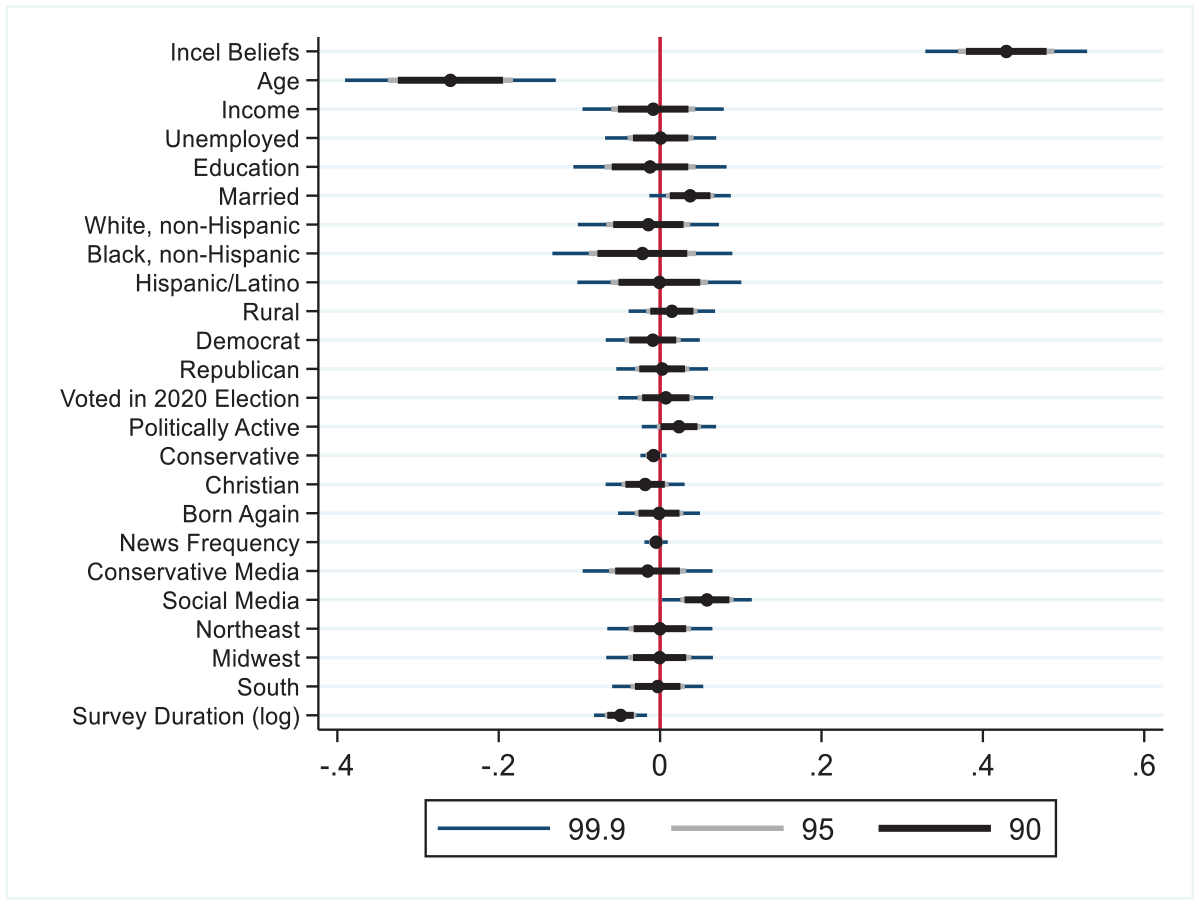
Incel beliefs and support for abstract political violence, standardized coefficient plots.
Agreement with incel beliefs is one of the few significant predictors of support for abstract political violence, and it also has the largest coefficient. A one standard deviation increase in the incel belief index corresponds with a β = .428 [95% CI 0.369, 0.488] standard deviation increase in support for abstract political violence. A handful of the controls are also significant at the 95% level but have smaller coefficients. Older subjects (β = −.259 [95% CI −0.337, −0.182]) and subjects who took longer to complete the survey (β = −.049 [95% CI −0.068, −0.029]) express lower levels of support for political violence when presented as an abstract behavior while married subjects (β = .037 [95% CI 0.007, 0.067]) and subjects who rely upon social media for news (β = .058 [95% CI 0.024, 0.091]) are more supportive of abstract political violence than subjects who are unmarried or divorced and subjects who use other forms of media.
Similarly, incel beliefs are associated with increased support for political violence when it is presented in the context of a specific incident. This is illustrated by Figure 3, which graphs the marginal effects of incel beliefs on support for specific political violence.
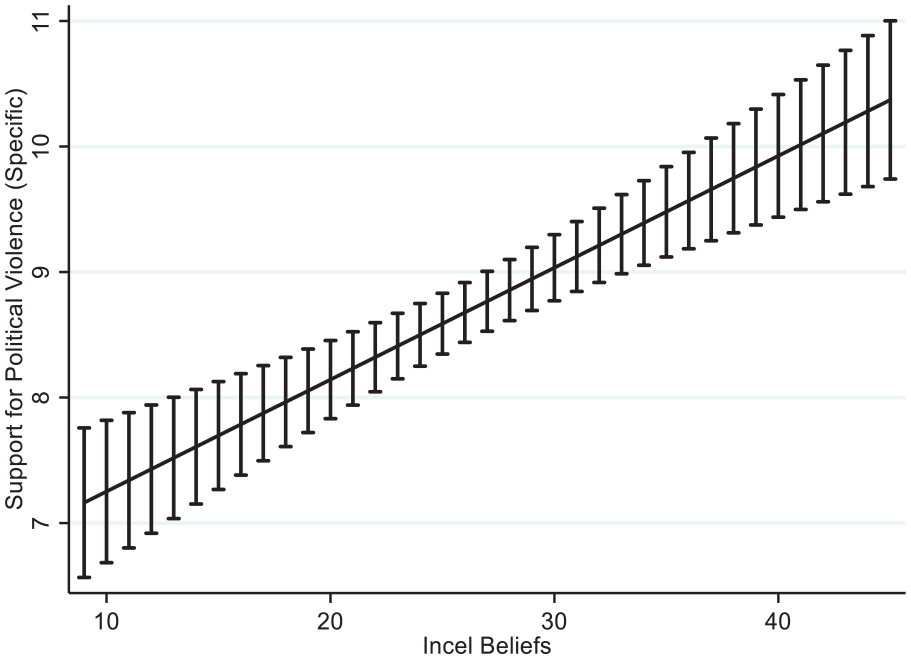
Incel beliefs and support for specific political violence, marginal effects plot.
Subjects holding incel beliefs are more supportive of political violence when it is presented as a specific incident. A one-unit increase in incel beliefs is associated with a β = .089 [95% CI 0.057, 0.120] increase in support for specific political violence. Increasing the incel belief index from is lowest to highest values corresponds with a 44.8% increase in support for specific political violence. And as was the case for the previous model, incel beliefs have a relatively high coefficient. This is shown in Figure 4, which presents standardized coefficient plots for the estimation.
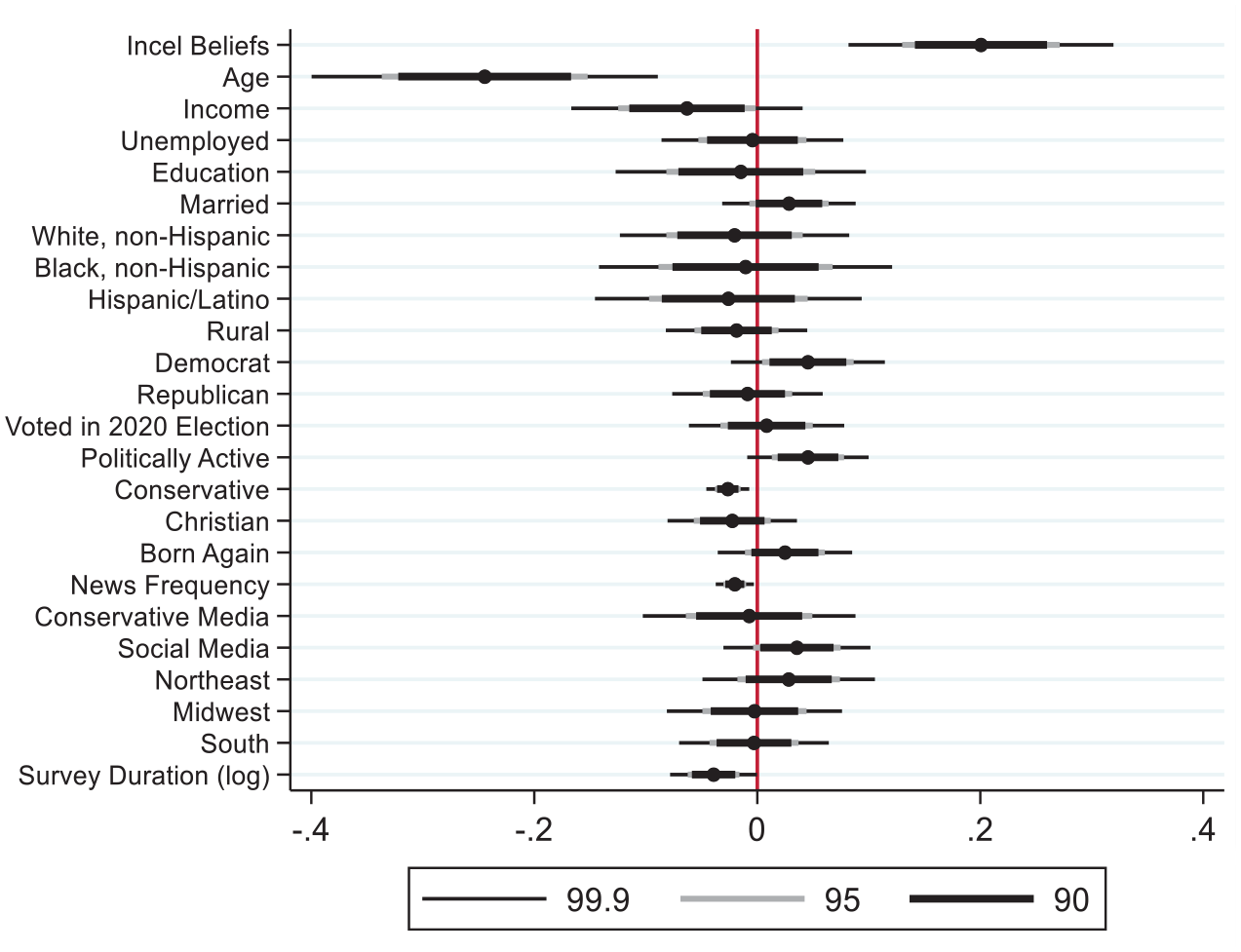
Incel beliefs and support for specific political violence, standardized coefficient plots.
Support for incel beliefs is a significant positive predictor of support for specific political violence (β = .201 [95% CI 0.129, 0.271]), in comparison with the other covariates. Age is a negative predictor of support for specific political violence that has a similarly sized coefficient (β = −.244 [95% CI −0.336, −0.152]). Income (β = −.063 [95% CI −0.124, −0.001]), conservative ideology (β = −.026 [95% CI −0.037, −0.015]), regular news consumption (β = −.020 [95% CI −0.030, −0.010]), and duration for the survey (β = −.039 [95% CI −0.062, −0.016]) are all also significant and negative but have smaller coefficients. Likewise, democratic partisan affiliation 21 (β = .045 [95% CI 0.004, 0.086])—suggesting that relative to independents, democrats are more supportive of political violence—and political engagement 22 (β = .045 [95% CI 0.013, 0.077]) are positive predictors, but also have smaller coefficients than incel ideology. 23
Serial Mediation Effects
The results of the serial mediation tests demonstrate that the relationship between incel beliefs and support for political violence is partially mediated both through subjects’ personal attributes—masculine gender role stress and aggression—and political biases and preferences—resentment toward outgroups and endorsement of illiberal, nondemocratic rule. This can be seen in Figure 5.
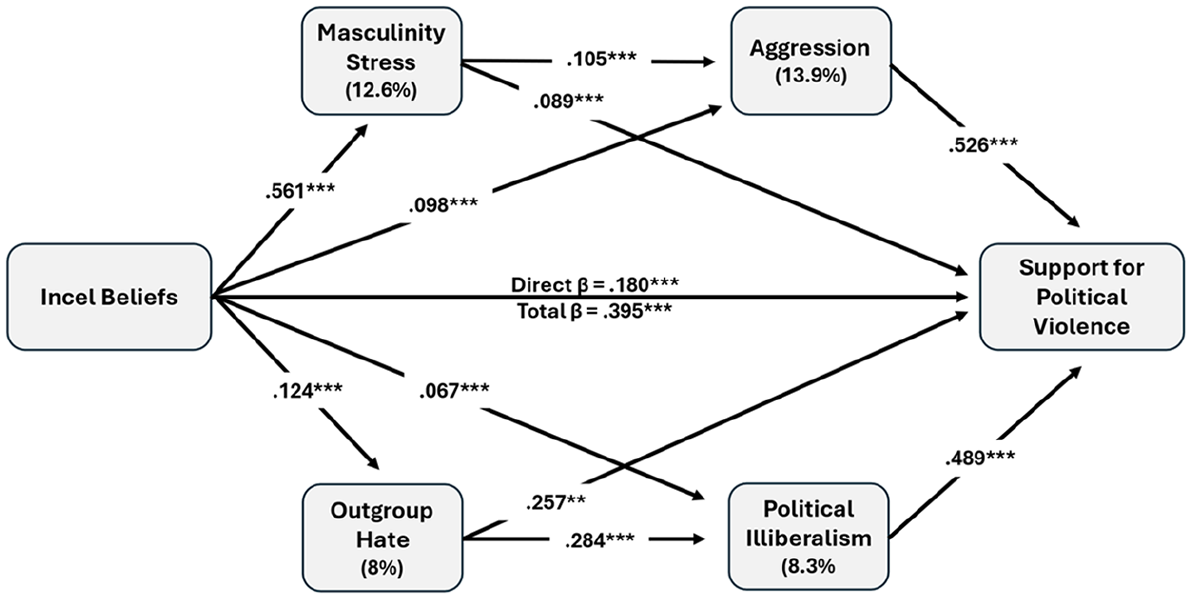
Mediation effects of masculine gender role stress, aggression, outgroup hate, and illiberalism on the relationship between incel beliefs and support for abstract political violence.
In Figure 5, the mediators associated with personal attributes and attitudes are presented at the top of the figure while mediators associated with political beliefs are presented at the bottom. Subjects who hold incel beliefs exhibit higher levels of masculine gender role stress (β = .561 [95% CI 0.494, 0.627]), as theorized, and subjects who exhibit masculine gender role stress display heighted aggression (β = .157 [95% CI 0.131, 0.182]). Aggressive subjects are, as theorized, express greater support for political violence in the abstract (β = .526 [95% CI 0.396, 0.655]). Approximately 12.6% of the effect of incel beliefs on support for abstract political violence is mediated through heightened masculine gender role stress while approximately 13.9% of the effect is mediated through aggression. Taken together, the personal route is estimated to account for around 26.5% of the relationship between incel beliefs and support for abstract political violence. Likewise, both political route mediators are significant. Subjects holding incel beliefs display greater aversion toward social outgroups (β = .124 [95% CI 0.104, 0.143]) and subjects who are averse toward outgroups prefer illiberal, antidemocratic modes of governance (β = .284 [95% CI 0.216, 0.352]). Subjects who prefer illiberal, antidemocratic rule voice greater support for political violence in the abstract (β = .489 [95% CI 0.322, 0.656]). Outgroup hate mediates approximately 8.0% of the relationship between incel beliefs and support for abstract political violence while illiberal attitudes mediate approximately 8.3% of the relationship. Taken together, the political mediators account for 16.3% of the mediation effect. This is smaller than the personal mediators, but still a significant part of the story.
A similar pattern is found for subject support for specific incidents of political violence. This can be seen in Figure 6.
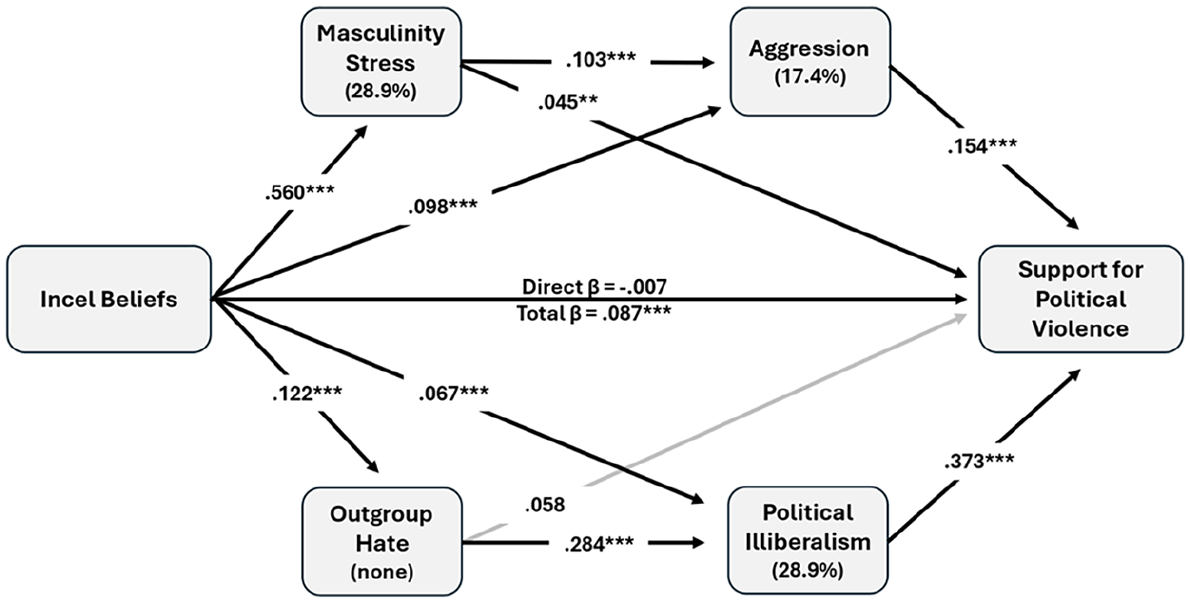
Mediation effects of masculine gender role stress, aggression, outgroup hate, and illiberalism on the relationship between incel beliefs and support for specific political violence.
As was the case in the previous mediation figure, the results for the personal route are presented at the top of the figure while results for the political route are presented at the bottom. Incel beliefs are positively correlated with increased masculine gender role stress (β = .560 [95% CI 0.493, 0.627]) and, in turn, masculine gender role stress is a positive predictor of aggression in subjects (β = .103 [95% CI 0.079, 0.127]). Aggression, as expected, is associated with higher levels of support for specific political violence (β = .154 [95% CI 0.075, 0.232]). Approximately 28.9% of the impact of incel beliefs on support for specific political violence is mediated through masculinity stress while around 17.4% is mediated through aggression, making the personal route account for around 46.3% of the effect. The political route, again, has a smaller effect but is still important. Incel beliefs predict outgroup hate (β = .122 [95% CI 0.103, 0.142]) and outgroup hate predicts endorsement of illiberal rule (β = .284 [95% CI 0.217, 0.352]). Illiberal subjects express greater support for specific acts of political violence (β = .373 [95% CI 0.272, 0.464]). However, outgroup hate is not a significant mediator—the link between outgroup hate and support for political violence is mediated through political illiberalism but it itself is not significant—while political illiberalism accounts for around 28.9% of the mediation effect between incel beliefs and support for political violence.
These findings provide support for hypotheses 2 and 3. Incel beliefs are associated with increased support for both abstract and specific political violence because they increase masculinity stress which manifests in heightened aggression and because they boost outgroup hate, which reinforces political illiberalism. All in all, the mediators have a larger effect when subjects are surveyed about their attitudes on the use of political violence in a specific context rather than in an abstract condition.
Conclusion
The results of this study demonstrate that the incel ideology poses a potential threat to public safety. Surveyed males who adhere to elements of the incel belief system are more likely to sanction the use of political violence, potentially creating a more permissive environment for violent extremist actors. This finding is consistent with previous research showing that incels and individuals who conform to incel ideas are more likely to make pro-violence statements online (Baele et al., 2021; Helm, Scrivens, et al., 2024; Jaki et al., 2019; O’Malley et al., 2022), are more likely to fantasize about violence (Scaptura & Boyle, 2020) or generally pose violent threats (Kelly et al., 2022; Moskalenko, Kates, et al., 2022; Tomkinson et al., 2020). Moreover, the study shows that the incel ideology reinforces support for political violence through two routes: the personal and the political. Males who hold incel beliefs are more likely to suffer from masculine gender role stress which contributes to heightened aggression that is associated with greater tolerance for political violence. At the same time, males who subscribe to incel tenets are more likely to exhibit resentments toward social outgroups and this contributes to illiberal political attitudes that facilitate greater toleration of political violence. This goes beyond existing research to show critical links between incel beliefs and support for political violence.
The study raises several points that may be of interest to policymakers and officials. It highlights the potential threat to public safety posed by the incel phenomenon beyond online communities and marginalized extremists. The study shows that incel ideas have permeated into the mainstream and provides evidence that they contribute to a wider normative permissiveness of political violence. By uncovering some of the links between incel beliefs and support for political violence, the study also provides some insight into ways that authorities might respond to this threat. Mainstream media and public figures should be more aware of the implications of tolerating or promoting incel themes in public discourse while law enforcement training could highlight the potential threat that incel beliefs pose to public safety. Social media platforms might revise and strengthen their community standards to reduce the proliferation of incel themes or cooperate with law enforcement in identifying incel threats online. The study also suggests that a wider discussion about how to address toxic masculinity is warranted. Additionally, efforts to foster greater tolerance for minorities and members of social outgroups through educational and other programming in addition to public policies that reinforce norms and institutions undergirding liberal, pluralist democracy are also likely to yield benefits
The study also identifies some future avenues of research. Taken together, the mediators in the study account for approximately 48% to 75% of the effect of incel beliefs on support for abstract and specific political violence. The study explains an important part of the story, but other mediators may be identified and tested to explain the complete impact of incel ideology on endorsement of political violence. Though the study produces a novel measure of adherence to incel beliefs that is based on different foundational aspects of the incel ideology, it aggregates them together into a singular index. Future research may delve deeper to see which specific categories of incel beliefs are most strongly associated with pro-political violence attitudes among men. The study does not identify what might prompt an incel belief adherent to move beyond mere endorsement of political violence towards actual engagement in violent extremism. Future research might return to the study of actual incel violent offenders and investigate the roles that masculine gender role stress, aggression, outgroup hate, and illiberalism play in prompting them to participate in political violence. The study theorizes a sequential relationship between incel beliefs, the mediators, and support for political violence. It finds evidence for serial mediation. However, it cannot empirically demonstrate a causal relationship. Future research may leverage experimental evidence to empirically show such causation.
Finally, the results of the study suggest that investigating whether incel attitudes and masculine gender role stress are also associated with acceptance of forms of violence beyond political violence or terrorism. It is likely that incel attitudes predict other forms of violence, given studies showing that masculine gender role stress is a predictor of a variety of other types of violence against women (see Baugher & Gazmararian, 2015; González & Rodríguez-Planas, 2020) and other feminist research on political violence demonstrating that adherence to traditional gender norms provokes wider acceptance of violence as a means to reinforce those norms (see overview of this literature by Gentry, 2022). Political violence motivated by incel ideas and masculinized norms surrounding the use of violence is simply one potential outcome.
Supplemental Material
sj-docx-1-cad-10.1177_00111287241310820 – Supplemental material for Incel Beliefs and Support for Political Violence Among U.S. Males: The Mediating Effects of Masculinity Stress, Aggression, Outgroup Hate, and Illiberalism
Supplemental material, sj-docx-1-cad-10.1177_00111287241310820 for Incel Beliefs and Support for Political Violence Among U.S. Males: The Mediating Effects of Masculinity Stress, Aggression, Outgroup Hate, and Illiberalism by James A. Piazza in Crime & Delinquency
Footnotes
Declaration of Conflicting Interests
The author declared no potential conflicts of interest with respect to the research, authorship, and/or publication of this article.
Funding
The author received no financial support for the research, authorship, and/or publication of this article.

Supplemental Material
Supplemental material for this article is available online.
Notes
Author Biography
References
Supplementary Material
Please find the following supplemental material available below.
For Open Access articles published under a Creative Commons License, all supplemental material carries the same license as the article it is associated with.
For non-Open Access articles published, all supplemental material carries a non-exclusive license, and permission requests for re-use of supplemental material or any part of supplemental material shall be sent directly to the copyright owner as specified in the copyright notice associated with the article.
