




Abstract
Guided by the General Aggression Model, the study investigated the moderating role of hegemonic masculinity in the relationship between empathy and verbal aggression among emerging adult men in Australia. A sample of 109 men aged 18 to 29 years (Mage = 24.3 years; SDage = 3.53) completed an online survey including the Interpersonal Reactivity Index, Conformity to Masculine Norms Inventory-29, and Anger Response Inventory. As predicted, empathy was negatively correlated with verbal aggression, whereas hegemonic masculinity was positively associated with verbal aggression. Moderated regression analysis, controlling for data collection year, revealed a significant moderating effect of hegemonic masculinity on the empathy–verbal aggression relationship. These findings suggest that traditional masculine norms may amplify verbal aggression risk, even among men with higher levels of empathy. Interventions should integrate empathy training with approaches promoting healthy masculinity to reduce aggression in this population.
Introduction
Verbal aggression (VA) is a common form of aggression in workplaces and interpersonal relationships, with serious psychological and organizational consequences (NSW Government, 2019; Victorian Public Sector Commission, 2024; Work Safe Australia, 2025). VA encompasses hostile verbal behaviors such as swearing, insults, threats, and belittling intended to inflict psychological harm (Work Safe Australia, 2025; Yavuzer et al., 2019). According to the 2023 People at Work Survey (Safe Work Australia, 2024), shouting, swearing, angry or hostile behavior, intimidation, and insults were among the most frequently experienced forms of workplace violence in Australia. Emerging evidence also indicates that VA has increased since the COVID-19 pandemic. For example, VA toward U.S. school personnel has returned to, or exceeded, pre-pandemic levels, with teachers experiencing the largest rise compared to other roles (McMahon et al., 2024).
Although VA does not inflict physical harm, it has serious psychological and organizational consequences for victims and witnesses. Research shows that customer-directed aggression is associated with emotional exhaustion, reduced job satisfaction, and greater turnover intentions among hotel employees (Karatepe et al., 2009). In the banking sector, victims report heightened anxiety and depression, alongside reduced productivity and safety perceptions (Acquadro Maran et al., 2022). In education, VA exposure contributes to stress, burnout, and intentions to leave the profession (McMahon et al., 2024). Harmful effects can also occur when aggressive language is nondirective. Sun et al. (2025) found that witnessing VA in multiplayer online games increased the likelihood of engaging in similar behavior, highlighting its social contagion effects. Understanding the psychological and social drivers of VA is therefore critical for effective prevention.
Two key predictors of VA are currently under investigation, namely empathy and hegemonic masculinity (HM). Empathy, the capacity to understand others’ emotions, is generally associated with lower aggression (Baskin-Sommers et al., 2014; Baumeister & Lobbestael, 2011), though evidence specific to VA is mixed (Sergeant et al., 2006). Conversely, HM, the endorsement of traditional masculine norms like male dominance and strength (Connell & Messerschmidt, 2005; Parrott, 2018), is consistently linked to higher aggression (Gallagher & Parrott, 2011; Van Doorn et al., 2021).
Despite substantial research on VA among adolescents (Smith & Moore, 2012) and family violence perpetrators (Clements et al., 2007), little is known about VA in emerging adult men (ages 18–29), a period marked by identity exploration, instability, and increased aggression risk (Arnett & Mitra, 2020; Lee, 2007). Moreover, the moderating role of HM in the empathy–VA relationship remains largely unexamined. This study addresses this gap by examining whether HM shapes the association between empathy and VA in emerging adult men.
Emerging Adulthood
While VA perpetration has been widely studied among adolescents (Smith & Moore, 2012) and perpetrators of family violence (Clements et al., 2007), limited research has examined the factors contributing to VA in emerging adult men. Emerging adulthood (ages 18–29) is a distinct developmental stage marked by identity exploration, social and occupational transitions, increased risk-taking behavior, and delayed entry into adult roles (Arnett & Mitra, 2020; Arnett et al., 2014; Lee, 2007; Roeser et al., 2019). It is also a period in which aggressive behaviors often emerge (Mata & van Dulmen, 2012), coinciding with ongoing cognitive and emotional development (Rudling et al., 2023). Evidence suggests that men in this age group are more likely to engage in aggression, including cyberbullying and relational aggression (Barlett & Coyne, 2014). Wright and Li (2013) found that more men than women aged 18 to 25 engaged in both cyber VA and face-to-face VA, and that stronger normative beliefs about cyber VA, that is, perceiving such behavior as acceptable, tolerable, and typical, predicted greater online VA perpetration and amplified the link between prior and subsequent cyber VA. Additionally, Internet gaming disorder, a condition highly prevalent among young adults (Gao et al., 2022), is positively associated with verbal aggressiveness in this demographic (Silva & Maia, 2024). Taken together, these findings underscore emerging adulthood as a critical period in which social and psychological factors shape aggressive behaviors.
Hegemonic Masculinity
Hegemonic masculinity (HM) refers to traditional masculine norms such as dominance, strength, and pride (Connell & Messerschmidt, 2005; Parrott, 2018). It is linked to behaviors that reinforce male dominance (Van Doorn et al., 2021), hostility toward women (Gallagher & Parrott, 2011), sexual aggression (Murnen et al., 2002), and overt aggression (Weisbuch et al., 1999). It functions by legitimizing socially sanctioned masculine behaviors and maintaining gendered hierarchy. Engaging in these behaviors can also serve as a compensatory response to broader social and structural conditions, such as economic disenfranchisement and racial inequality (Jeffrey et al., 2024). These processes are especially relevant during emerging adulthood, when masculine ideals are consolidated as young men negotiate socially acceptable behaviors and incorporate them into their identities (Arnett & Mitra, 2020; Lee, 2007).
The association between masculinity constructs and aggression is well established (Gallagher & Parrott, 2011; Lee et al., 2025). Preliminary U.S. survey data from 344 men show that conformity to traditional masculine norms predicts overall aggression more strongly than implicit aggressive cognition (Wieczorek, 2018). Recent work by Najström et al. (2026) similarly found that key dimensions of masculinity, that is, Dominance, Toughness, and Restrictive Emotionality, were strongly associated with aggression among men aged 18 to 40. Dominance and Toughness predicted higher physical aggression, while Restrictive Emotionality was linked to interpersonal mistrust, a precursor to hostile behavior. Although associations with VA were weaker, the findings indicate that hegemonic masculine ideals emphasizing control, emotional suppression, and physical strength contribute meaningfully to aggressive tendencies.
Although this study focuses on HM, the link between masculinity and aggression has long been recognized, including earlier work on hostile masculinity. Malamuth’s Confluence Model (Malamuth et al., 1991) conceptualized hostile masculinity, that is, negative masculinity traits, hostility toward women, and adversarial sexual beliefs, and demonstrated its strong association with both sexual and nonsexual aggression against women. Recent work by Sutton (2024) supports this pattern, showing that hostile masculinity, male peer support for violence, and problematic anger predicted intimate partner violence. Although hostile masculinity and HM are distinct, both emphasize dominance and power as central drivers of aggression. Jeffrey et al. (2024) further argue that many masculinity frameworks remain overly individualistic and culturalist, calling instead for approaches that situate masculinity within broader social structures, as HM theory does. This perspective supports examining how HM may intersect with psychological factors, such as empathy, in shaping aggressive behavior.
Verbal Aggression
VA is often examined within broader aggression research, which distinguishes forms of aggression such as physical aggression, emotional aggression, and property damage (Walker & Richardson, 1998). Although related, these forms are conceptually distinct, and examining their predictors separately refines our understanding of aggression as a construct (Kyranides et al., 2024). Existing work has largely focused on intimate partner relationships (e.g., Manning et al., 2018) and gender differences (e.g., Crick & Grotpeter, 1995), leaving gaps in knowledge about VA in non-intimate contexts. Moreover, triggers identified in couple relationships, such as empathy and HM, may not operate similarly in everyday interactions with non-intimate partners.
Research on empathy and VA has produced mixed findings. Some studies report a negative association. For example, Clements et al. (2007) found that lower empathy is associated with a more violent attitude toward intimate partners, and Stuewig et al. (2010) observed similar effects across three samples, with the strongest link among undergraduate students (M = 20 years). In contrast, the meta-analysis of Vachon et al. (2014) of 86 studies concluded that the relationship between empathy and aggression is generally weak and inconsistent. Other work likewise reported null findings; for instance, Yeo et al. (2011) found no association between empathy and VA in boys aged 9 to 14, and Jolliffe and Farrington (2006) found no significant association among adolescent men who experienced name-calling. More recent studies further complicate this picture. Lacko et al. (2024) reported that VA was positively correlated with affective empathy but not with cognitive empathy among Czech adolescents, whereas Atta et al. (2025) reported that VA positively predicted empathy scores among psychiatric nurses. Taken together, these inconsistencies suggest that additional variables, such as masculinity constructs, may influence the empathy–VA relationship.
Although HM is a strong predictor of general aggression (Connell & Messerschmidt, 2005), its role in VA is less clear. Harrington et al. (2021) found that men with low relationship power exhibited more physical aggression only when experiencing high masculine gender role stress (MGRS). Similarly, Cohn et al. (2009) reported that men who perceived masculinity threats were more likely to suppress emotions and behave aggressively. Consistent with HM theory, Franchina et al. (2001) found that men with higher MGRS were more verbally aggressive toward female partners when their masculinity was challenged. These findings underscore the need to examine HM’s impact on VA beyond intimate contexts. Indeed, preliminary U.S. survey data suggest that endorsement of HM norms, particularly toughness and restrictive emotionality, is associated with VA, albeit with modest effects (Wieczorek, 2018). Qualitative evidence from Indonesia likewise shows that toxic masculine norms drive verbal abuse and controlling behaviors in romantic relationships, reinforcing the link between rigid masculine ideals and aggression (Dewi & Umaroh, 2025).
Empathy, Hegemonic Masculinity, and Verbal Aggression
Although HM generally predicts greater aggression, empathy is typically viewed as protective (Björkqvistet al., 2000), but only when subsequent thoughts do not override empathic concern or promote unethical responses (Wang et al., 2017). HM may help explain inconsistent findings in the empathy–VA literature (Miller et al., 2012). For example, Gabbiadini et al. (2016) found that men who endorsed HM showed lower empathy toward female victims and more aggressive behavior, although their reliance on video game paradigms limits generalizability. Ferguson and Donnellan (2017) later critiqued these results, noting potential confounds such as game popularity and immersion. Aloia and Pederson (2021) likewise reported that individuals with a history of family VA exhibit higher trait anger but not necessarily lower empathy, suggesting that masculinity-related constructs shape these dynamics. Similarly, Lisak and Ivan (1995) found that sexually aggressive men demonstrated lower empathy and stronger endorsement of rigid gender norms, illustrating how hypermasculine socialization can erode empathy and increase aggression risk.
Despite evidence linking HM and empathy to aggression separately, to the authors’ knowledge, no research has examined whether HM moderates the empathy–VA relationship during emerging adulthood. Given HM’s established association with aggression (Connell & Messerschmidt, 2005), it may act as a contextual factor in shaping this relationship. Relatively recent Australian population data indicate that these traditional masculine norms remain widely endorsed and are perceived as constraining emotional expression and contributing to social harms (Flood, 2020). These cultural patterns underscore the ongoing relevance of HM in shaping men’s behavior and emotional regulation, reinforcing the need to explore how HM interacts with psychological factors such as empathy. Understanding this interaction may clarify the combined influence of empathy and HM on VA and inform more effective interventions for reducing aggression in this population.
Theoretical Framework
The General Aggression Model (GAM; Anderson & Bushman, 2002) offers a comprehensive framework for understanding the processes underlying aggressive behavior and has been applied to VA perpetration (e.g., Becher et al., 2025). GAM conceptualizes aggression as a dynamic sequence consisting of inputs, routes, and outcomes. Inputs include person factors such as personality traits, attitudes, and beliefs, and situational factors like provocation and anger-eliciting events. These inputs influence internal routes (cognition, affect, and arousal), which shape appraisal processes and ultimately guide behavioral outcomes.
In our hypothesized model, low empathy is treated as a person factor input because it represents a relatively stable trait that undermines perspective-taking and reduces inhibitory control, increasing vulnerability to aggression (Wang et al., 2017). HM, while also originating as a person factor, is conceptualized as an internal route that moderates this effect. Specifically, the association between low empathy and VA is expected to be stronger at higher levels of HM, as HM activates hostile cognitive schemas and affective routes tied to gendered dominance, thereby amplifying aggressive tendencies when cognitive resources for reappraisal are limited. This model aligns with evidence that person factors influence aggressive cognition and affect (Kersten & Greitemeyer, 2024) and that cognitive reappraisal can reduce aggression (Anderson & Bushman, 2002). Conversely, entrenched HM beliefs combined with low empathy heighten the likelihood of an aggressive outcome (Murnen et al., 2002).
Aims and Hypotheses
The present study aimed to examine the relationships between empathy, HM, and VA to extend current understanding and clarify misconceptions about factors that predict VA. Drawing on prior research (e.g., Richardson et al., 1998) and the GAM (Anderson & Bushman, 2002), it was hypothesized that higher empathy would be associated with lower VA, whereas stronger endorsement of HM would be associated with higher VA. It was further hypothesized that HM would moderate the relationship between empathy and VA such that men with low empathy would exhibit greater VA, particularly when they strongly endorse HM norms.
Method
Participants
Of the 237 initial responses, 106 were excluded for ineligibility, bot-like responses, or dropout, and 22 were removed due to substantial missing data. The final sample comprised 109 Australian men (M = 24.3; SD = 3.53; range 18–29 years). Eligibility required identifying as a man, being 18 to 29 years old, and residing in Australia.
Materials
The current study forms part of a larger project, and only the materials relevant to the present analyses are described below.
Masculinity
Hegemonic masculinity was measured using the Conformity to Masculine Norms Inventory-29 (CMNI-29; Hsu & Iwamoto, 2014), a 29-item measure organized into eight subscales, namely Playboy, Self-Reliance, Emotional Control, Winning, Violence, Heterosexual Self-Presentation, Risk-Taking, and Power Over Women. Items (e.g., Women should be subservient to men) were rated on a 4-point Likert scale (0 = Strongly Disagree, 3 = Strongly Agree). Higher scores reflect greater conformity to traditional masculine norms. Total scores were calculated by summing the scores across all scales and range from 0 to 87. Internal consistency in the present study was excellent (α = .943).
Verbal Aggression
The 8-item VA subscale of the Anger Response Inventory (ARI; Tangney et al., 1991, 1996) assessed participants’ likelihood of responding with VA to anger-eliciting scenarios. Items were rated on a 5-point Likert scale (1 = Not Likely to 5 = Very Likely), yielding scores from 8 to 40, with higher scores indicating more VA. Internal consistency was excellent (α = .923).
Empathy
Empathy was measured using the perspective-taking and empathetic concern subscales of the Interpersonal Reactivity Index (IRI; Davis, 1983), representing cognitive and affective components of empathy most consistently linked to aggression-related outcomes (Vachon et al., 2014). Each subscale includes seven items rated on a 5-point Likert scale (0 = Doesn’t describe me at all to 4 = Describes me very well). Total empathy scores were calculated by summing the items. Scores range from 0 to 56, with higher scores indicating greater empathy. Internal consistency was excellent (α = .929).
Procedure
Ethics approval was obtained from the relevant university’s Human Research Ethics Committee. Participants completed an online Qualtrics survey and were recruited through advertisements on social media (e.g., Facebook) and websites (e.g., Survey Circle) as well as through snowball and convenience sampling. The advertisement link directed interested individuals to the survey.
After accessing the survey, participants viewed an information statement, and informed consent was implied by choosing to continue. They provided demographic information (e.g., gender identity, age) followed by the ARI, IRI, and CMNI, presented in random order. A debriefing statement appeared at the end. The survey took approximately 20 min to complete.
Data were collected in two waves, in 2021 and again in 2025, to increase sample size. Core materials and recruitment methods were consistent, but the location item was revised, and the Auckland Individualism and Collectivism Scale (AICS; Shulruf et al., 2011) was included only in 2021 and omitted in 2025. AICS data were not used in the present analyses.
Data Analysis
Analyses were conducted using jamovi version 2.7.14.0. Independent t-tests and Two One-Sided Tests compared the 2021 and 2025 samples. All key variables differed significantly and failed equivalence tests. Therefore, the year of data collection was included as a control variable in all subsequent models. Descriptive statistics and correlations were computed, followed by a moderated regression analysis testing whether HM moderated empathy–VA relationship.
Results
Missing value analysis indicated that no variables were missing. The assumptions of normality, linearity, homoscedasticity, independence, and multicollinearity were examined and found to be satisfied. Descriptive statistics for each of the scales of interest are presented in Table 1.
Descriptive Statistics for the Scales of Interest.
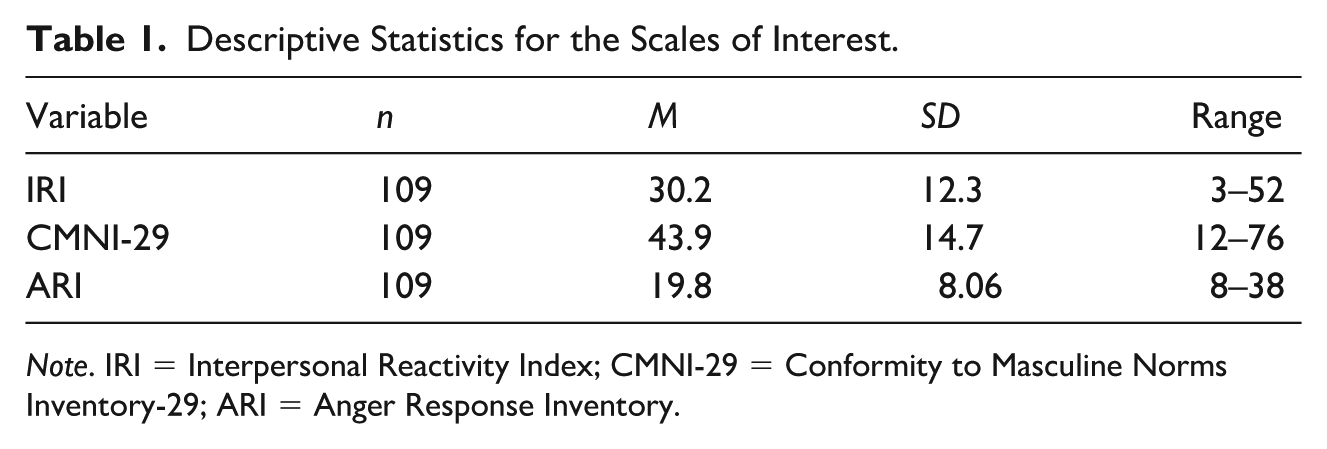
Note. IRI = Interpersonal Reactivity Index; CMNI-29 = Conformity to Masculine Norms Inventory-29; ARI = Anger Response Inventory.
Pearson’s product–moment correlations were conducted to test Hypothesis 1 (
Moderation Analysis
A moderation analysis was conducted using jamovi version 2.7.14.0 to examine whether HM moderated the relationship between empathy and VA. The overall model explained 71.0% of the variance in VA, F (4, 104) = 63.6, p < .001, R2 = .710. As shown in Table 2, empathy was significantly associated with VA (β = -0.491, p < .001), such that higher empathy was related to lower VA. Similarly, HM was also significantly associated with VA (β = 0.262, p = .002), indicating that greater conformity to masculine norms was associated with higher VA. Notably, the interaction between HM and empathy was significant (β = −.185, p = .004), indicating that HM moderated the relationship between empathy and VA. ANOVA results showed that the interaction explained a meaningful proportion of the variance, η²ₚ = .079.
Summary of Moderated Regression Analyses for Empathy and Hegemonic Masculinity Predicting Verbal Aggression.
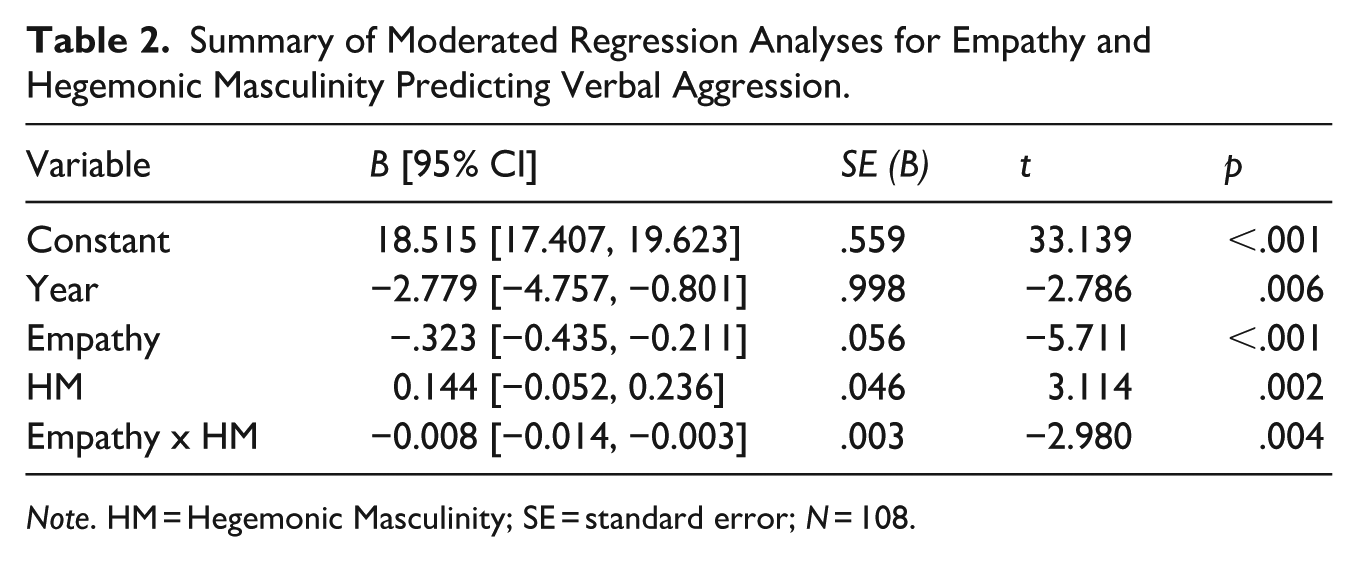
Note. HM = Hegemonic Masculinity; SE = standard error; N = 108.
Simple effects analysis (Figure 1) showed that the negative association between empathy and VA was significant at all levels of HM. At low HM levels, the negative association between empathy and VA was modest, F(1, 104) = 7.11, p = .009, η²ₚ = .064; β = −0.306. At average levels of HM, the association was stronger, F(1, 104) = 32.62, p < .001, η²ₚ = .39; β = −0.491. Finally, at high levels of HM, the association was strongest, F(1, 104) = 49.23, p < .001, η²ₚ = .321; β = −0.676.
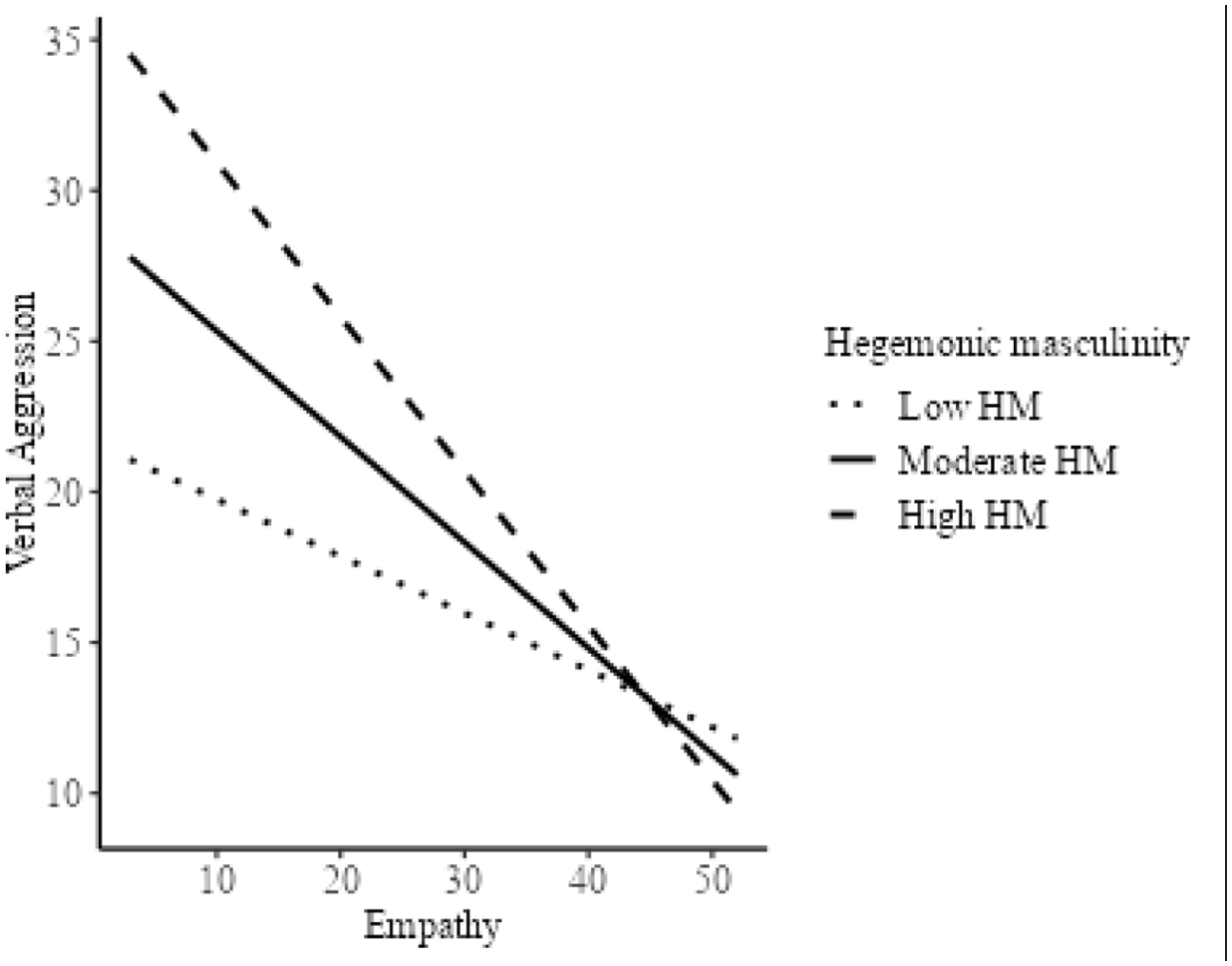
Changes in verbal aggression at different levels of hegemonic masculinity and empathy.
Taken together, these results highlight the influential role of HM. Men who strongly endorse HM tend to report higher levels of VA overall, and the inverse association between empathy and VA become increasingly pronounced as endorsement of HM increases.
Discussion
Drawing on the GAM (Anderson & Bushman, 2002), this study examined how empathy and HM relate to VA among emerging adult men, and whether HM moderates the empathy–VA association. As hypothesized, empathy was inversely associated with VA, HM was positively associated with VA, and HM moderated the relationship between empathy and VA, with empathy being less protective at higher levels of HM.
Empathy and Verbal Aggression
The inverse empathy–VA aligns with prior research showing that empathy reduces hostile interpretations and aggressive responding (e.g., Björkqvist et al., 2000; Richardson et al., 1994). This contrasts with studies reporting no association (Jolliffe & Farrington, 2006; Yeo et al., 2011), which may reflect developmental and methodological differences.
Emerging adulthood is marked by autonomy-seeking and identity exploration (Vleioras & Galanaki, 2024), and such self-focus may heighten sensitivity to perceived threats and potentially increase VA when independence is constrained, while also fostering empathy through frequent social negotiation. Neurodevelopmental evidence similarly suggests that during emerging adulthood, earlier maturation of limbic reward systems relative to prefrontal control regions responsible for judgment and impulse control increases risk-taking and aggression, whereas growing neural connectivity enhances social cognition (i.e., understanding how people interact) and sensitivity to others’ social signals and mental states (Rudling et al., 2023). These may explain how empathy helps buffer impulsive, hostility-prone responses by improving perspective-taking and reducing hostile attribution.
The stronger empathy–VA effect observed in the current study compared to Stuewig et al. (2010) may reflect the use of validated self-report measures (IRI, ARI), which assess typical responses rather than retrospective recall or hypothetical vignettes that can introduce memory biases or reduce ecological validity (e.g., Baez, 2017; Jolliffe & Farrington, 2006). Measurement choice likely influences effect sizes and should be considered in future research.
Hegemonic Masculinity and Verbal Aggression
The positive association between HM and VA supports prior research linking traditional masculine norms to hostility and status-driven behaviors (Connell & Messerschmidt, 2005; Gallagher & Parrott, 2011). Consistent with Najström et al. (2026), masculinity was associated with VA, although this relationship was weaker than that observed with physical aggression. Both the current study and Najström et al. (2026) underscore that hegemonic masculine norms emphasizing control and emotional suppression appear to increase aggression risk. These findings align with social dominance theory in which aggression can service to maintain hierarchical status (Jewkes et al., 2015).
These findings extend prior research on HM’s role in physical aggression (Peralta et al., 2010) and aggression in intimate partner contexts (Dewi & Umaroh, 2025; Gabbiadini et al., 2016) to general verbal hostility. This supports theoretical perspectives that situate masculinity within social hierarchies, where assertive or aggressive communication may function to claim or defend status (Bosson, 2025; Connell & Messerschmidt, 2005; Jewkes et al., 2015).
Moderating Role of Hegemonic Masculinity
A central contribution of this study is the finding that HM significantly moderated the relationship between empathy and VA, albeit the interaction accounted for only a modest proportion of variance in VA. Empathy was least protective for men who strongly endorse HM, consistent with evidence that hypermasculine beliefs suppress empathic responding and heighten aggression (Gabbiadini et al., 2016; Lisak & Ivan, 1995). Although contemporary masculinities are becoming more inclusive, HM remains influential, particularly in reinforcing emotional restraint and dominance (Connor et al., 2021). Thus, although the magnitude of the moderation effect is small, HM meaningfully shapes the interpersonal conditions under which empathy reduces verbal aggression.
Current findings align with the GAM, in which empathy operates as a person-level input promoting adaptive appraisal and emotion regulation, whereas HM activates dominance-oriented cognitive scripts and affect, constraining the inhibitory routes through which empathy typically operates. Consequently, although HM does not negate empathy’s protective benefits altogether, it reduces its effectiveness, increasing the likelihood of aggressive interpretations and verbalized anger under conditions of low or moderate empathy.
Significance and Implications
From a theoretical perspective, findings reinforce GAM-based models (Allen et al., 2018; Anderson & Bushman, 2002) by showing how cognitive–emotional dispositions and social norms jointly shape aggressive behavior. Empathy may reduce hostile attribution and support reappraisal, whereas HM may elevate dominance motives and moral disengagement, biasing appraisal toward confrontation, verbally aggressive responding (Miller et al., 2012). From a practical standpoint, interventions should move beyond single-focused approaches. Current efforts often emphasize empathy training (Beauchamp & Anderson, 2010) or challenging traditional masculinity norms separately (Jewkes et al., 2015). However, the moderating effect of HM suggests that these interventions may be insufficient if implemented separately. Initiatives integrating empathy-building with masculinity-focused approaches, such as The Man Cave (2021) and King County Government (2020), demonstrate the effectiveness of combining critical reflection on masculinity norms with cognitive–behavioral strategies that foster emotional regulation and empathy. Implementation should account for age-relevant contexts (e.g., emerging adulthood) and settings where verbal hostility is prevalent (e.g., education, customer-facing workplaces, online environments).
Limitations and Future Research
Several limitations should be considered. First, the current study’s cross-sectional design precludes causal inferences. Future research should employ longitudinal or experimental designs to establish causal inferences. It can also help clarify how HM and empathy jointly shape patterns of aggressive behavior across developmental and situational contexts. Second, the modest sample size drawn from men in Australia limits generalizability. Replication with larger, more diverse populations is warranted. Third, only basic demographic variables were collected, constraining analyses of intersectional influences, such as ethnicity, socioeconomic status, and religion.
A broader limitation of HM research is the lack of cross-cultural validation. Studies show notable differences in masculinity endorsement across countries (e.g., Lease et al., 2013). Cross-cultural research also demonstrates that societal norms shape aggression prevalence and perception, with higher power distance and collectivism associated with lower self-reported aggression (Rafferty, 2025). Anthropological work likewise highlights culturally specific expressions of masculinity and male violence (Martin, 2021), suggesting HM–aggression dynamics are not universal. Future research should therefore examine collectivistic and non-Western contexts to determine whether the HM–empathy–VA relationship is universal or culturally contingent.
Finally, although data were collected during two periods and the year of collection was controlled, caution is warranted when generalizing beyond this design.
Conclusion
HM significantly moderated the relationship between empathy and VA in emerging adult Australian men. While empathy generally reduces VA, its protective effect weakened among men who strongly endorse hegemonic masculine norms. Consistent with the GAM, these findings highlight the interplay between cognitive–emotional traits and socio-cultural norms in shaping aggression, demonstrating the need for integrated interventions that combine empathy-building strategies with positive masculinity approaches and cross-cultural research.
Footnotes

Ethical Considerations
Ethical approval for this study was received from the Human Resource Ethics Committee of Federation University Australia.
Consent to Participate
Informed consent was obtained from all participants in the study via an acknowledgment section in the online survey.
Funding
The authors received no financial support for the research and/or authorship of this article.
Declaration of Conflicting Interests
The authors declared no potential conflicts of interest with respect to the authorship and/or publication of this article.
Data Availability Statement
The data that support the findings of this study are available on request from the corresponding author.