




Abstract
Research increasingly aims to better understand criminal behavior in context. Invariably, this entails integrating sociological (and other) perspectives on structure and environment, with psychological and economic notions of individual decision processes. Unique among environmental influences on crime is the immediate context surrounding an offending opportunity. Here we focus on moral context. Perceived choice is often constrained by structural factors, such as concentrated disadvantage and social inequalities, which restrict prosocial opportunities and encourage offending. System 1 heuristic processes that involve moral salience can affect perceived choice sets as well. Such processes narrow choices by directing attention to one or a subset of behavioral options and away from others. They can also expand choices by counteracting the attention narrowing, criminogenic influences of competing heuristics such as temporally present orientation. Below we examine whether contextual circumstances can amplify the internal prominence of one’s moral self-conception, thus influencing moral judgements and related action. Using randomized experiments embedded in two online surveys, we assess the role of morally laden situational cues in choice processes.
Introduction
Criminological decision-making models have engendered criticism for overemphasizing the internal mindsets of would-be offenders. This neglects the structural and situational forces that interrelate with individual decision processes to produce crime outcomes (Coleman, 1986; Nagin & Sampson, 2019; Matsueda, 2013). Thomas et al. (2022) found that community structural characteristics affect crime rates, in part, by influencing judgments about the risks, costs, and rewards from offending. Context also shapes offender decision making by creating default circumstances that perpetuate structural disadvantages (Vaisey & Valentino, 2018), and as a setting for heuristics and biases (Bruch & Feinberg, 2017).
Recent advancements on judgment formation in context focus mostly on the perceived certainty of punishment. However, non-instrumental and normative considerations affect the perceived (dis)utility of crime as well. Few extralegal considerations figure more prominently in crime decisions than notions of morality (Aquino & Reed, 2002; Bachman et al., 1992; Brauer & Tittle, 2017; Haidt, 2012; Silver & Silver, 2021; Wikström, 2006). Yet in contrast to sanction certainty perceptions, little is known about the role of situational moral judgments in crime decisions.
To complicate matters, criminological research often treats morality as an enduring individual difference, thus obscuring situational moral dynamics. It is commonplace to operationalize “morality” with decontextualized moral evaluations of crime types, such as “how morally wrong is it to take something that doesn’t belong to you,” without reference to any situational circumstances (see Herman & Pogarsky, 2023). In Situational Action Theory, decision making processes only even occur when a sufficiently high level of preexisting “personal morality” does not foreclose crime as an action alternative (Wikström, 2006).
Herman and Pogarsky (2023) found that, as with perceptions of sanction certainty, moral judgments about crime also depend on immediate situational circumstances. These mechanisms follow the dual-process nature of Behavioral Economics: “System 2 typifies the kind of reasoning envisioned under models of rational choice and Bayesian updating and is conscious, deliberative, and slow. In contrast, System 1 is intuitive, automatic, and fast. It provides constant and near instantaneous answers to the questions in daily life” (Kahneman, 2011; see also Pogarsky & Herman, 2019; van Gelder, 2013; van Gelder & de Vries, 2012). On “System 2” moral decision making, Herman and Pogarsky (2023) found that circumstances conducive to rationalizing a criminal transgression, without unduly diminishing one’s positive self-concept, increase the moral acceptability of a crime opportunity and, hence, the likelihood of offending (see also Schweitzer & Gibson, 2008; Sykes and Matza, 1957; Thomas, 2019).
Here we investigate intuitive “system 1” influences on situational moral judgments. Research has shown that context can also shape decision making through mechanisms of salience or priming. Contextual circumstances affect the internal prominence of one’s moral self-conception, thus influencing decision-making processes (e.g., Ariely & Jones, 2012; Mazar et al., 2008). As well, strategic nudges or reminders in the immediate environment can increase moral salience, influence moral evaluations, and encourage prosocial decisions through intuitive processing (Haidt, 2001).
Most research on moral salience involves promoting prosociality. Outside of laboratory studies on cheating, little attention has been given to moral salience and decisions to transgress. Research suggests at least two distinct salience mechanisms. Incidental primes, such as recalling the Ten Commandments or moral word scrambles, are unrelated to the circumstances of a given offending situation. In contrast, in situ salience mechanisms involve features of the immediate physical or social environment that intuitively influence judgments.
Salience processes also relate to recent discourse on agency and choice sets in criminological research. Paternoster (2017) argued that criminology is best served by assuming people voluntarily form intentions and effectuate plans (see also Thomas et al., 2021a, 2021b, 2022), rather than being impelled toward crime by forces beyond their control (Cullen, 2017). But human agency is limited to available behavioral options or choice sets (e.g., Kijowski & Wilson, 2023). Structural disadvantages certainly constrain choice sets. For example, crime is often attributed to present-orientation, or the tendency to discount future adverse outcomes such as the possibility of getting arrested (Cherbonneau & Jacobs, 2019; Jacobs & Cherbonneau, 2021; Loughran et al., 2012; Nagin & Pogarsky, 2001). Yet, the raw desire to pursue future oriented prosocial investments, such as education and civic involvement, is readily thwarted by reduced opportunities in socioeconomically deprived areas.
Ordinary human decision tendencies also affect choice sets. Rather than deliberative discounting, present orientation also results from cognitive limitations that impede any consideration of the future at all (Burt, 2020; Nagin & Pogarsky, 2004). Indeed, the psychosocial immaturity of juveniles is a core rationale for a separate juvenile justice system (Steinberg & Cauffman, 1996). We propose that beyond structural circumstances, Type 1 intuitive mechanisms can also affect choice sets. A present oriented perspective, for example, limits forward thinking and prosocial behavioral possibilities. But heuristics such as moral salience are also leverageable to expand prosocial options by counteracting the “choice-narrowing” properties of competing heuristics such as present orientation (Barton & Grüne-Yanoff, 2015).
The current study investigates the role of morally laden situational cues in crime choice processes using randomized experiments embedded in two nationwide surveys. Moral cues include traditional reminders such as the Ten Commandments, moral story recall, and structurally embedded moral prompts. These forms of moral stimuli are more fully elaborated below. The article begins with the criminological treatment of morality as a “person-centric” attribute that largely downplays situational moral dynamics. Although various situational factors, such as circumstances conducive to rationalization, influence situational moral evaluations of offending opportunities, here we investigate moral salience. Results are presented from two studies that each investigate how morally salient cues influence moral evaluations in the context of crime decisions.
Morality and Crime
Broadly speaking, morality encompasses notions of right or wrong, good or bad, and what is deemed socially acceptable or unacceptable (Stets & Carter, 2012; Turner, 2010). Extensive research has demonstrated that moral considerations influence crime decisions, sometimes even more than consistent crime correlates such as instrumental factors or self-control do (Antonaccio & Tittle, 2008; Bachman et al., 1992; Burkett & Ward, 1993; Gallupe & Baron, 2014; Grasmick & Bursik, 1990; Haar & Wikström, 2010; Kroneberg et al., 2010). Yet although crime typically results from a confluence of situational factors and enduring individual differences (Nagin & Paternoster, 1993, 1994; Thomas, 2019), criminological research on morality is often “person-centric,” thus downplaying situational moral dynamics (Svensson, 2015; Wikström & Treiber, 2007).
This is evident both theoretically and empirically. In Moral Foundations Theory (MFT), individuals initially develop a “first draft of the moral mind,” incorporating evolutionarily advantageous problem-solving adaptations (Haidt, 2012; Silver & Silver, 2021). Subsequently, core moral intuitions arise, guiding behaviors through rapid and automatic processes (System 1) followed by interpretation to form moral judgments (System 2). Despite MFT’s emphasis on fixed moral foundations, the theory incorporates a dual-process lens, recognizing the interplay between intuitive and deliberative processes in shaping moral judgments. While MFT provides valuable insights, it may not comprehensively capture the dynamic nature of moral judgments. Empirical evidence suggests that humans demonstrate a certain degree of moral flexibility, adjusting cognitive moral evaluations based on immediate situational factors and contextual cues (Aquino et al., 2009; Herman & Pogarsky, 2023; Thomas, 2019).
Morality is comparably “extra-situational” in learning theories, which emphasizes “decontextualized” behavioral attitudes, such as “how wrong is stealing?”, that are independent from situational circumstances. This perspective on morality is rooted in abstract moral principles, irrespective of situational particulars. In a final example, according to Situational Action Theory (SAT), morality serves as an extra-situational threshold determining whether a crime even constitutes an “action alternative” subject to situational decision-making (Wikström, 2006). In the SAT framework, individuals evaluate the moral implications of an action at a higher, abstract level before engaging in situational considerations.
Empirical findings comparably emphasize “personal morality.” There are conflicting results on whether personal moral sensibilities moderate the role of situational incentives in crime decisions. Some studies find little interrelationship between the two (Cochran, 2016; Grasmick & Green, 1981; Jensen et al., 1978; Jordanoska, 2018). Others find evidence for deterrence-oriented decision making mainly among persons with low morality, and still some research reports the contrary conclusion of deterrence-oriented relationships mainly among persons with high morality (Gallupe & Baron, 2014; Pauwels et al., 2011; Piquero et al., 2016). A related moderating hypothesis considers morality a “threshold” or “filter” that determines whether an actor is “in the market” for offending to begin with (Andenaes, 1974; Nagin & Paternoster, 1993; Pogarsky, 2002; Toby, 1964; Wikström, 2006). There is little evidence, however, that a sufficiently high level of preexisting personal morality effectively “shuts down” crime decision making.
Throughout this literature, however, personal morality tends to be conceived as the aggregation of various decontextualized moral evaluations of specific crime types. These can range from general law breaking (e.g., “It’s okay to break the law if you can get away with it”), to minor deviance such as bicycling through a red light, to more serious crimes such as theft, drug use and violence (see Antonaccio & Tittle, 2008; Gallupe & Baron, 2014; Pauwels et al., 2011; Schoepfer & Piquero, 2006; Svensson et al., 2010). Yet this approach conflates judgments with more enduring personal attributes such as preferences and identities by operationalizing the latter with the former (Thomas & Vogel, 2019; see also Silver & Silver, 2021). Moreover, rather than being unitary, crime attitudes are multidimensional, in that they are offense and situation specific (Herman & Pogarsky, 2022, 2023; Sutherland, 1947; Thomas, 2018). Thus, the case has been advanced for moral identity or moral foundations to operationalize personal morality (Aquino & Reed, 2002; Herman & Pogarsky, 2022, 2023; Silver & Silver 2021; see also Brauer & Tittle, 2017).
Decontextualized judgments also obscure situational variation in moral evaluations of crime opportunities. Thus, Herman and Pogarsky (2023) distinguished decontextualized moral evaluations from situational moral evaluations, which correspond to a specific offending situation, defined as “the immediate setting in which behavior occurs” (Birkbeck & LaFree, 1993, p. 115; Thomas, 2019, p. 6). 1 Regarding decontextualized judgments, Barnum et al. (2021, p. 216) observed that “because risk perceptions are highly dependent on circumstances, questions about risk without details on context are ill posed.” Context seems comparably essential for moral evaluation. To complement and extend this line of inquiry, we address the possibility that System 1 heuristic processes such as priming and salience also affect situational moral evaluations of crime opportunities.
Moral Salience and Crime Decisions
Criminological research has increasingly investigated System 1 heuristic influences, such as anchoring, emotional arousal, and other heuristics, on perceived sanction certainty (Barnum & Solomon, 2019; Pickett, 2018; Pogarsky et al., 2017, 2018). For example, Pogarsky et al. (2017) found evidence for intensity matching in sanction certainty perception. The idea is that some judgments, such as “how tall is someone?”, are better suited for numeric expression than others. For complex probabilistic judgments such as perceptions about the likelihood of punishment were they to commit a crime, people can heuristically substitute a more tractable question such as “what is the intensity of my feelings toward this?” to guide them (Kahneman & Frederick, 2002, 2004). This phenomenon can produce illogical patterns of responses. Criminological research has also uncovered evidence for the availability heuristic, whereby the fluency of either recalling or imagining ideas impact their salience and related judgments (Tversky & Kahneman, 1973). Pickett (2018) found that seemingly irrelevant visible characteristics of a criminal target, such as the size of a purse, alter the perceived benefits and risks of crime, likely because such characteristics affect the fluency of picturing a high-value score and/or easily concealing the loot.
Kahneman (2011) explained that System 1 decision making involves the myriad cognitive associations amongst memories, ideas, emotions, and attitudes, that also influence behavior. Unlike System 2 reasoning, the associative network is neither chronological nor deliberate. Instead, salient associations often arise unpredictably, spontaneously, and not necessarily one at a time. Sometimes System 2 can intervene against complications from System 1 processing, but sometimes not (Kahneman, 2011; see Heller et al., 2017). Furthermore, the influence of specific cues can extend beyond System 1 to the distribution of cognitive resources in System 2 (Evans & Stanovich, 2013; Le Pelley et al., 2015). System 1, which is rapid and intuitive, filters attention by accentuating significant or familiar information. In so doing, System 1 guides the focus of System 2, steering cognitive resources toward particular aspects of a decision (Kahneman, 2011). In the current context, strategic nudges, cues, or reminders affect the salience of one’s moral self-conception. In turn, this affects situational moral evaluations, decisions, and behaviors (e.g., Ariely & Jones, 2012; Haidt, 2001; Mazar et al., 2008).
Moral Salience and Situational Moral Evaluations
Traditionally, moral “primes” include various external stimuli that affect moral self-awareness (e.g., Mazar et al., 2008). Examples include religious content (e.g., Rand et al., 2014; Shariff et al., 2016), phrases or topics with moral connotations (Aquino & Reed, 2002), and reflection on the good deeds of others (Haidt, 2003a, 2003b). Here we define a "moral cue" as a discrete stimulus or prompt with the capacity to elicit moral considerations, reactions, or behaviors within a specified context. Such cues include symbolic representations, environmental stimuli, or situational prompts with discernible normative relevance. The efficacy of a moral cue depends on its ability to influence an individual’s moral perception, decision-making processes, or subsequent behavioral responses, by activating moral cognitions and shaping ethical considerations in a given situation.
Research suggests that moral salience affects behavior by influencing judgements and relevant values (Bargh, 1994; Haidt, 2002; Weaver et al., 2013). Additionally, moral cues can restrict available rationalizations that promote criminal action (Herman & Pogarsky, 2023; Mazar et al., 2008; Shalvi et al., 2011; Sykes & Matza, 1957). According to Mazar et al. (2008), moral salience narrows available justifications to transgress (see also, Aquino et al., 2007; Welsh & Ordóñez, 2014). This makes dishonest behavior more likely when moral considerations are less salient and rationalizations are more accessible (Mazar et al., 2008).
Related to this are context-specific choice sets that reflect perceived behavioral options. Structural factors, such as concentrated disadvantage, neighborhood disorder, and social inequalities, restrict prosocial opportunities and encourage offending (Matsueda, 2013; Thomas et al., 2022). System 1 heuristic processes such as priming and salience can also affect perceived choice sets. They are “choice narrowing” in the sense that they direct attention to one or a subset of behavioral options and away from others. Often the implications from restricted choice are negative, as when present orientation leads to crime. However, intuitively restricted choice is also palliative if moral cues discourage transgression.
This implicates the ethical appropriateness of nudging (Thaler & Sunstein, 2003, 2009). Libertarian paternalists advocate for state intervention only when there are clear personal or societal benefits. However, some argue against the government determining what promotes individual well-being. Nudges entail subtle interventions to address human decision-making blind spots, such as inertia and present orientation. For instance, increasing default retirement contributions helps counteract people’s tendency to regret not saving more. In this case, the intuitive processes are “choice expansive,” thus mitigating concerns about government overreach. Moral priming can also broaden the choice set by introducing prosocial options for individuals focused on immediate potential antisociality.
These ideas gain further traction from social psychological research on how moral priming and moral elevation influence prosocial outcomes. Bargh et al. (1996, p. 230; emphasis added) defined priming as “the incidental activation of knowledge structures, such as trait concepts and stereotypes, by the current situational context.” Research has shown that attitudes and other affective reactions arise from the mere presence of relevant stimuli without conscious awareness. In turn this affects perceptions, judgments, and choice (Bargh, 1994; Bargh et al., 1992).
Similarly, Aquino and Reed (2002) argue that people differ in how morality contributes to their self identity, implying that moral considerations are more accessible for some persons than for others (see also Aquino et al., 2009; Bargh et al., 1996; Bartels, 2008; Cameron & Payne, 2011; Lapsley & Narvaez, 2004; Simpson & Willer, 2008; Zaki, 2014). In this view, people assume various identities in everyday life, each with corresponding norms and behavioral patterns (Minsky, 1988; Skitka, 2003). People routinely shift, for example, between scholar, friend, or parent. Each role and resultant identity shapes the salience of various ideas and norms (Aquino et al., 2009, p. 125). The behavioral influence of an identity depends on its accessibility in a given situation. As such, the salience of moral identity at a given time shapes its influence on cognitions, attitudes, and choice (Abrams, 1994; Aquino et al., 2009; Giles & Johnson, 1987; Hinkle & Brown, 1990; Skitka, 2003; Stets & Carter, 2012).
Types of Salience Processes
Research on moral priming typically investigates extra-situational or incidental primes. Examples include reciting the Ten Commandments (e.g., Mazar et al., 2008), unscrambling sentences containing moral words (e.g., Aquino et al., 2009), and recalling or witnessing a moral act (Haidt, 2003a, Silvers & Haidt, 2008). For example, Lai et al. (2014) induced moral elevation with morally laden videos. The authors found that, relative to affect-neutral videos, morally elevating videos reduced implicit and explicit sexual prejudice. Moral elevation can influence behaviors ranging from breastfeeding (Silvers & Haidt, 2008), volunteering (Schnall et al., 2010; Schnall & Roper, 2012), charitable donation (Aquino et al., 2011; Siegel et al., 2014; Thomson & Siegel, 2013), organ donation (Siegel et al., 2015), rejecting deontological violations in moral dilemmas (Strohminger et al., 2011), to increasing cooperation in economic games (Pohling et al., 2019; see also Pohling & Diessner, 2016 for review).
Though far less frequently, research has also investigated in situ or contextual moral priming mechanisms. These involve modification of the physical or social environment to influence intuitive thought processes. Examples include manipulating location (e.g., chapel vs. academic building), time or day (e.g., during prayer calls, Sunday), or other environmental cues (e.g., background music; overheard conversation) (Watanabe & Laurent, 2018). Research has found, for example, that students who are randomly assigned to complete an experimental task in a university chapel respond differently from those who perform the task in an academic building (e.g., Ahmed & Salas, 2013; Rutchick, 2010; Wu & Cutright, 2018). Similar work involves “watching eyes.” Nettle et al. (2012) publicly displayed watching eyes to increase the salience of social conformity (see also Bourrat et al., 2011; Burnham & Hare, 2007; Ekström, 2012; Haley & Fessler, 2005). These images appeared at three different locations with the goal of decreasing bike theft. Reported thefts were monitored for 12 months before and after the intervention. Bicycle thefts decreased by 62% at the experimental locations but increased by 65% in the control locations, which indicates that the signs were effective but displaced offending to sign-free locations. The picture of watching eyes continually reinforces the social norm against stealing, and thereby discourages offending. In situ primes are particularly relevant for real world policy implementation (Thaler & Sunstein, 2003, 2009).
Most research on moral salience involves promoting prosociality. Outside of laboratory studies on cheating and fraud, little attention has been given to the role of moral salience processes in decisions to transgress. Below we investigate both forms of moral salience in the realm of crime decision making. Specifically, we test whether incidental and in situ moral stimuli decrease the situational moral acceptability of offending opportunities and reduce the likelihood of crime.
Data
Data were utilized from two separate surveys administered in the Summer of 2022 and Winter of 2023 to samples of adult United States residents who were 18 years or older. The results from Study 1 informed a follow-up survey and data collection for Study 2, which refined and extended Study 1. All participants were recruited from Amazon’s Mechanical Turk (MTurk) through the CloudResearch platform. MTurk samples are widely used in academic research (e.g., Dowling & Wichowsky, 2015; Ratner et al., 2014), and increasingly prevalent in crime decision-making studies (e.g., Barnum et al., 2021; Pickett et al., 2018; Pogarsky et al., 2017). Snowberg and Yariv (2021) recently investigated the generalizability of findings from randomized experiments in MTurk. Although the authors found differences in behaviors across populations, these differences had limited impacts on most comparative statics and correlations between the behaviors.
MTurk “workers” register to participate in various human intelligence tasks (HITs) for money. Surveys are only one possible HIT. Others include video and audio transcription, tagging photos, translating text, and editing a book. There are hundreds of thousands of MTurk workers from over 40 countries. For data quality control, the sample was limited to workers with an approval rating of at least 95% on prior HITs and some prior experience with the Mturk platform (at least 100 HITs). According to Peer et al. (2014), this restriction substantially increases the quality of MTurk data. Eligible workers volunteer for the survey, which is posted as a link on the MTurk website. Workers were compensated $1.50 ($10/hour rate) for completing the survey. 2
As noted, we utilized the CloudResearch platform, which further vets MTurk participants to improve data quality. The platform includes a subset of the top performing MTurk workers on both attention checks and survey completion. The CloudResearch Toolkit draws only from approved participants, while blocking low-quality participants, duplicate IP addresses, and suspicious geolocations. Research has found that MTurk samples vetted with CloudResearch produce higher quality data than other crowdsourced platforms (Berry et al., 2022; Litman et al., 2017, 2021).
Study 1
Procedure
Study 1 tested whether incidental and in situ moral cues reduce the moral acceptability of two distinct offending opportunities, property damage and theft. In total, 2,300 workers began the survey. After listwise deleting cases with incomplete or missing information, we obtained a final analytic sample of 2,108 respondents (92%). 3 The sample is slightly younger, more educated, and has a higher proportion of whites than the general U.S population. Specifically, respondents are 49% male, 73% Non-Hispanic White, and range from 18 to 84 years around an average age of 41 years.
We investigated three forms of moral cues, with each respondent randomly receiving either a moral or neutral cue followed by a behavioral vignette. All vignette wordings appear in Supplemental Table A1 in the appendix, while Supplemental Table A2 provides details and wording for the three distinct priming manipulations, each with a neutral, control counterpart. At the outset, participants were randomly assigned to either receive one of the incidental cues or the in situ cue. The incidental cues involve extra-situational sources of moral awareness. Cue 1 entailed a “quiz” featuring morally laden verbiage (Aquino et al., 2009), and Cue 2 prompted respondents to recount an act of moral goodness they had witnessed previously (Haidt, 2012). After the incidental moral cue or neutral counterpart, respondents read two vignettes in randomized order describing opportunities for criminal behavior. Following each vignette, respondents provided a series of judgments, including the moral acceptability of the behavior under the circumstances, and the likelihood they would commit the act. Although the ordering of vignettes was randomized, the ensuing analyses pertain only to the vignette that immediately followed the cue to maximize any contrast between experimental and control measures. Thus, in the case of incidental cues, there are a total of 8 experimental conditions. For each vignette, respondents were randomly assigned to one of four experimental conditions, encompassing two moral cues and two neutral counterparts, each associated with two distinct behavioral outcomes (4 × 2 = 8).
Recall that at the beginning of the survey, half the sample was randomly assigned to the experimental condition that involved in situ sources of moral awareness. In this context, moral salience was manipulated through the actual setting for the crime. In situ manipulations involved the depiction of a church, witnessing a young person assisting an elderly woman, and overhearing a conversation about charitable efforts. Here, the moral cue is a circumstance within the offending vignette. As in the experiments above, following each vignette, respondents reported the moral acceptability of the behavior under the circumstances and their associated behavioral intentions. This yielded four additional experimental conditions: in situ moral cue for theft, in situ moral cue for property damage, in situ neutral condition for theft, and in situ neutral condition for property damage. Since the moral cue is embedded within the vignette, each respondent received only one of the four possible vignettes. Therefore, Study 1 included a total of 12 unique conditions. 4
Measurement
Situational Moral Acceptability
The primary experimental outcome was measured by asking participants how morally acceptable it is to engage in the behavior depicted in a hypothetical vignette. 5 Specifically, respondents were asked, “In the situation described above, how morally ACCEPTABLE or UNACCEPTABLE is it to. . . [drive off and ignore the damage you caused; take the sunglasses and leave]?” Responses ranged from 1 = very acceptable to 7 = very unacceptable. The measure was reverse coded so that larger values reflect greater acceptability.
Intention to Offend
Intention to offend was measured for each vignette. Specifically, respondents were asked, “If you were actually faced with the situation described above, how LIKELY or UNLIKELY is it that you would. . . [drive off and ignore the damage you caused; take the sunglasses and leave]?” Responses ranged from 1 = extremely likely to 7 = extremely unlikely. The measure was reverse coded so that larger values reflect greater likelihood of transgression.
Controls
Control variables are only included in the first model to help underscore the predictive capacity of situational moral evaluations for offending intentions. Controls include perceived arrest risk, self-control, prior offending behavior, prior arrest, prior vicarious arrest, gender, race, age, and education. Measurement descriptions and descriptive statistics appear in Supplemental Table A3.
Manipulation Check
The survey included two manipulation checks. The first, which was positioned immediately after the key outcomes, featured a paragraph ending with the instruction to select a specific color combination among those provided, to prove they read the content. Ninety-nine percent of the sample successfully did so. The second manipulation check was embedded in a 5-item measure of moral identity, directing participants to choose “Neither agree nor disagree.” Once again, 99% of the sample successfully passed this attention check. 6 Since the results remained consistent even after excluding the few participants who failed a manipulation check, these participants were included in the core analytical sample.
Results
First, to demonstrate the relevance of situational moral evaluations for crime decision-making, Table 1 displays Ordinary Least Squares (OLS) regression results predicting criminal intentions with situational moral acceptability and various controls, for each behavior. 7 For present purposes, the experimental conditions were aggregated together. Importantly, net of all controls, situational moral acceptability was strongly related to offending intentions at p < .001 for both theft and property damage and the effect sizes far exceeded those of other crime correlates in the model. 8 This relationship is consistent with prior work, see Herman and Pogarsky (2022, 2023).
OLS Regression of Intentions to Offend on Situational Moral Acceptability.
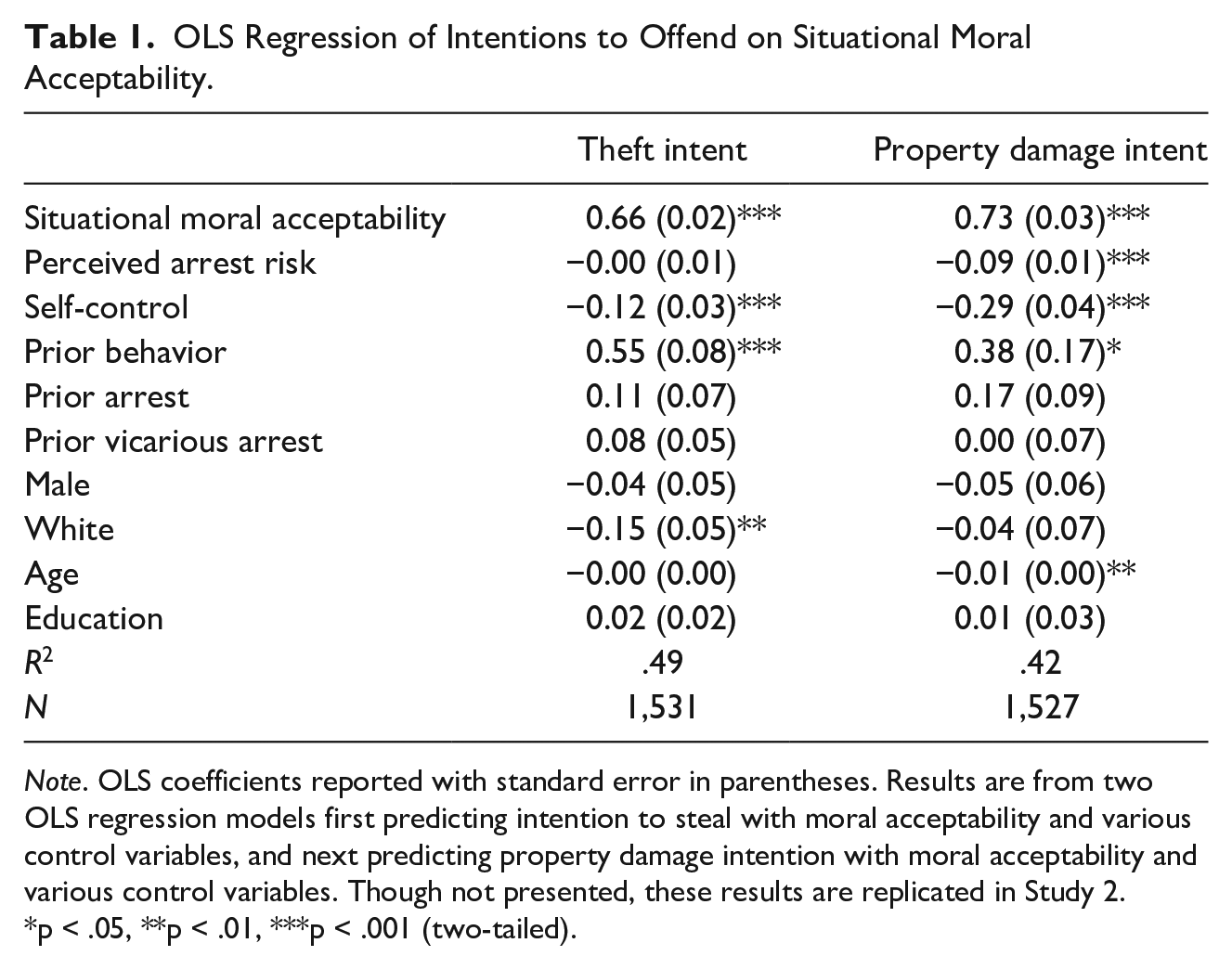
Note. OLS coefficients reported with standard error in parentheses. Results are from two OLS regression models first predicting intention to steal with moral acceptability and various control variables, and next predicting property damage intention with moral acceptability and various control variables. Though not presented, these results are replicated in Study 2.
*p < .05, **p < .01, ***p < .001 (two-tailed).
Moving to the experiments, recall that respondents viewed one of eight conditions comprised of three distinct moral cues: the quiz, moral storytelling, and in situ. Tables 2 and 3 report the mean situational moral acceptability for each experimental condition, and the corresponding neutral counterpart. For the theft outcomes in Table 2, mean situational moral acceptability for each moral salience condition is slightly lower than for each neutral counterpart. Specifically, the mean moral acceptability for the moral quiz cue is 1.85, 1.62 for the storytelling cue, and 1.68 for the in situ cue, whereas mean situational moral acceptability for each corresponding neutral counterpart is 1.90, 1.72, and 1.74, respectively. Table 3 shows similarly minor differences. Because these distributions are ordinal and skewed, two-tailed Wilcoxon signed-rank tests were conducted. No significant differences were detected in situational moral acceptability between any moral cue and its neutral counterpart.
Study 1: Situational Moral Acceptability for Theft, by Condition.
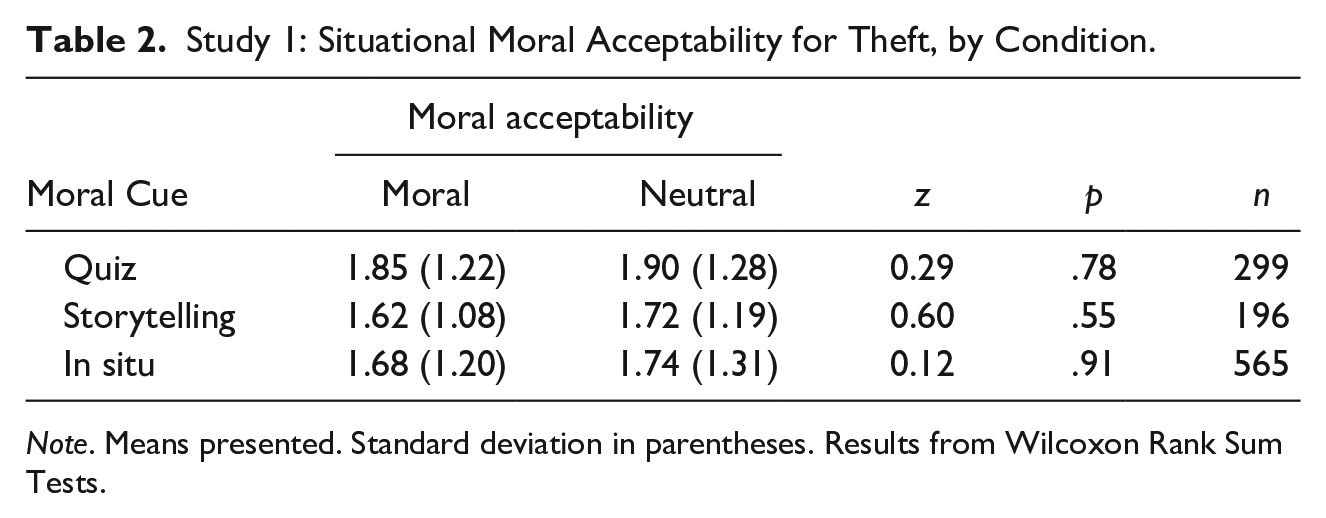
Note. Means presented. Standard deviation in parentheses. Results from Wilcoxon Rank Sum Tests.
Study 1: Situational Moral Acceptability for Property Damage, by Condition.
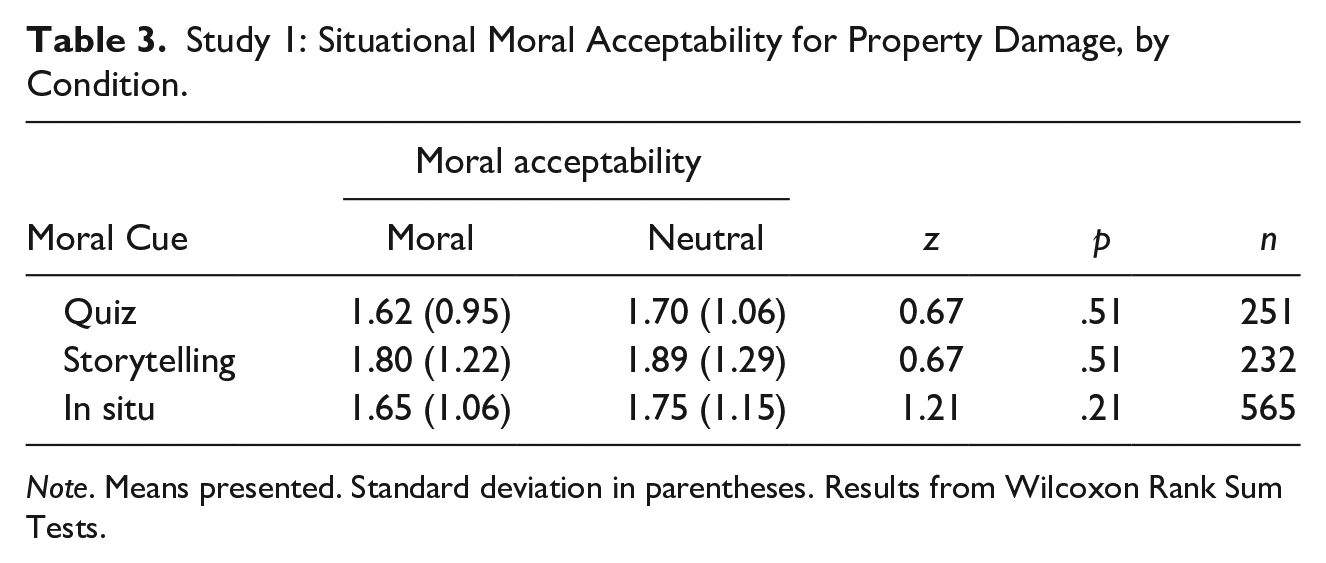
Note. Means presented. Standard deviation in parentheses. Results from Wilcoxon Rank Sum Tests.
This said, the aggregate pattern of findings across experiments is noteworthy. If situational moral acceptability is unrelated to moral cues, then the probability that situational moral acceptability is lower for any one moral cue than for its neutral counterpart is .5, akin to a coin flip. A Binomial Proportions test yielded p < .05 for the difference between the null hypothesized proportion of .5, and the observed proportion of 6/6 = 1.0. As well, p < .05 for a Wald chi-square test of 6 of 6 independent experiments yielding differences in the expected direction.
Figure 1 graphs the moral acceptability measures from Tables 2 and 3. It is immediately evident that no single experimental or control mean surpasses 2 on a 1 through 7 response scale, indicating that even absent moral content, respondents tended to consider the crimes in the vignettes as “very unacceptable.” We discuss the implications of this below.
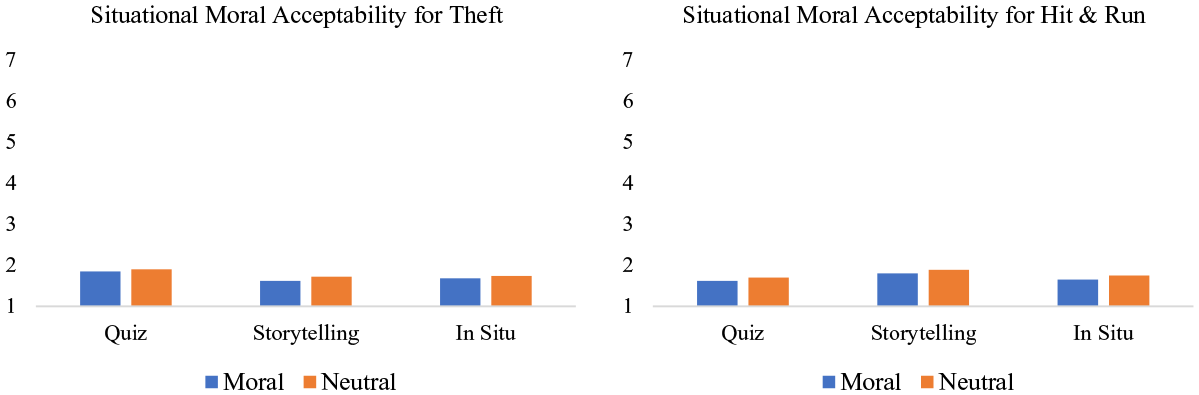
Study 1: mean situational moral acceptability, by experimental condition.
Discussion
It appears that the moral primes in Study 1 had little room to operate because baseline levels of moral acceptability were already low. To elaborate, the level of acceptability for the neutral conditions averages 1.78 on a 1 to 7 scale. Thus, the moral cues lack the actual opportunity to suppress moral acceptability of crime because even absent salient morality, respondents already considered the depicted offenses “very unacceptable.” Earlier we discussed how priming research typically either involves prosocial action, and outside of laboratory studies on cheating, little attention has been given to how moral salience affects decisions to criminally transgress. This could result from a preexisting general disapproval of criminal action which renders moral salience mechanisms superfluous.
There is evidence, however, that people tend to overgeneralize their disapproval of criminal behavior. For example, data from the National Youth Survey (NYS) indicate that, among U.S. adolescents, 93 percent report disapproval for hitting another person and 97 percent report disapproval for stealing, while the actual prevalence of such behaviors is substantially higher (Agnew, 1994; see also Sykes & Matza, 1957). This overgeneralization of disapproval results, among other things, from a lack of real-world contextual detail in survey research (Agnew, 1994; Herman & Pogarsky, 2023; Thomas, 2019). For example, the response to “how morally acceptable it is to hit a stranger” can differ, potentially substantially, from the response to “how morally acceptable it is to hit a stranger who taunted you, hurt you, or hurt a loved one.”
Mazar et al. (2008) indicated that moral salience narrows the acceptable justifications for transgression. Relatedly, Herman and Pogarsky (2023) found that situational moral evaluations of specific crime opportunities vary positively with the presence of circumstances conducive to rationalizing the misconduct (see Bandura, 1991; Sykes & Matza, 1957). Moreover, scenarios with rationalizing circumstances may better reflect real-world offending opportunities, which are not always so antiseptic or clear-cut. Thus, aiming to provide more room for moral cues to operate, Study 2 added rationalizing content to the vignettes to counteract generalized moral norms.
Study 2
Procedure
Like Study 1, Study 2 examines situational moral evaluations of unique offending opportunities using written experimental vignettes describing the same two criminal behaviors, property damage and theft. Extending Study 1, Study 2 integrates rationalizing content into each hypothetical scenario. The rationalizations align with techniques of neutralization (Sykes & Matza, 1957; see also Thomas, 2019), moral disengagement (Bandura, 1991), and comparable social psychological theories (e.g., Mazar et al., 2008). They involve the failure to acknowledge responsibility, an injury, or a victim. Specifically, the rationalizing content emphasized the victim’s wealth in the theft scenario, and the role of a misplaced shopping cart as a potential intervening cause in the vehicular hit and run condition. See Supplemental Appendix A4 for the precise wording of all vignettes. The revised scenarios aim to (a) better approximate real-world offending opportunities, and (b) counteract any baseline moral unacceptability linked to generalized norms, thus providing each moral cue more room to operate (see Herman & Pogarsky, 2023).
A total of 2,128 workers initiated the survey. Listwise deletion of cases with incomplete or missing information yielded a final analytical sample of 1,998 respondents. 9 The sample demographics align with those of Study 1, with 46 percent male, 73 percent Non-Hispanic White, and an age range spanning from 18 to 84 years, with an average age of 41 years. 10 The identical set of three moral cues (along with their neutral counterparts) used in Study 1 was implemented. The in situ cues vary slightly as they now include both moral (or neutral) cues and rationalizing content within the vignette. See Supplemental Appendix Table A6 for wording.
As in study 1, at the outset respondents were randomly assigned to either the incidental or in situ track. From there, each respondent was randomly assigned to receive either one moral cue or neutral counterpart, followed by a single behavioral vignette that included the additional rationalizing content. This design resulted in 12 experimental conditions. For analytical continuity, the focal measures were the same as in Study 1: situational moral acceptability and intention to offend. Study 2 also replicated the manipulation checks from Study 1. The color selection task had a success rate of 98%, and 99% of participants passed the “Please select ‘Neither agree nor disagree’" item on the moral identity measure. These cases were also retained because the findings were unchanged without them. 11
Results
Table 4 compares mean levels of situational moral acceptability across conditions for theft, whereas Table 5 corresponds to property damage. As in Study 1, for theft, moral acceptability for each moral salience condition is slightly lower than the corresponding neutral counterpart. Specifically, the mean moral acceptability for the moral quiz cue is 2.04, while the neutral counterpart is 2.11 (p = .26) Similarly, for moral storytelling, the mean moral acceptability is 2.02, whereas the neutral counterpart is 2.07 (p = .92) and last, for moral in situ mean situational moral acceptability was 1.97, compared to 2.08 for the neutral counterpart (p = 11). The same pattern is observed for property damage.
Study 2: Situational Moral Acceptability for Theft, by Condition.
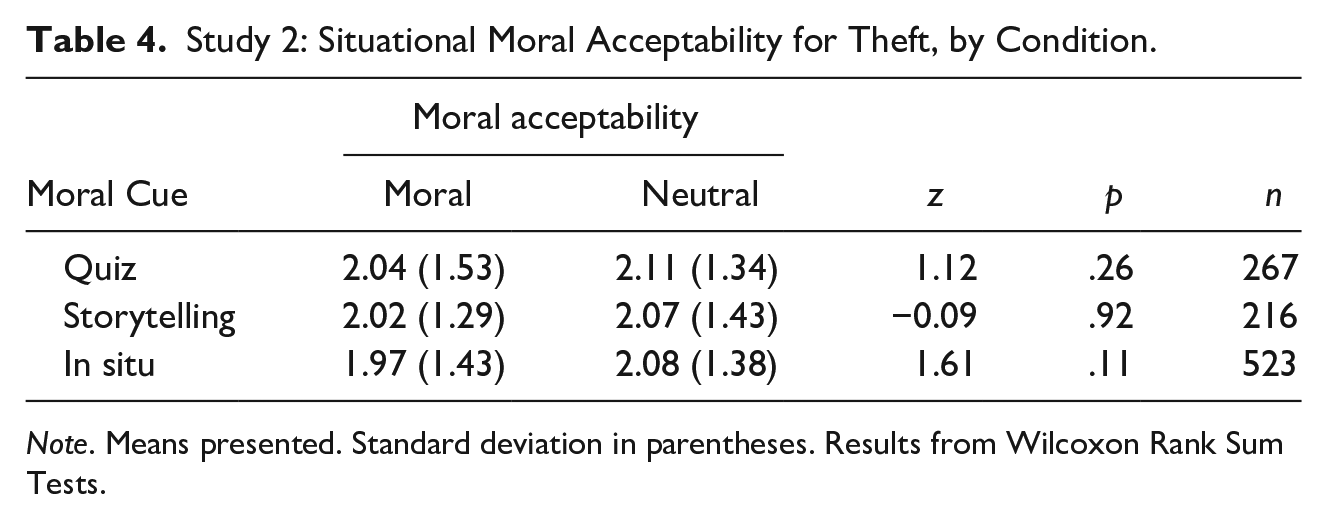
Note. Means presented. Standard deviation in parentheses. Results from Wilcoxon Rank Sum Tests.
Study 2: Situational Moral Acceptability for Property Damage, by Condition.
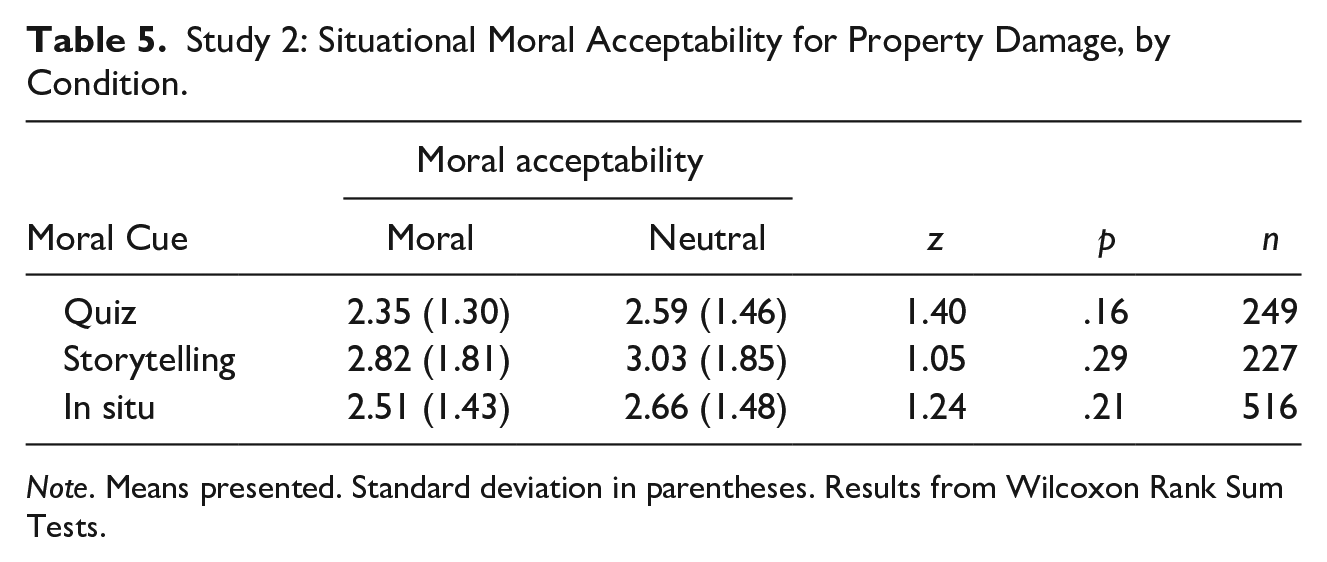
Note. Means presented. Standard deviation in parentheses. Results from Wilcoxon Rank Sum Tests.
Though the patterns were consistently in the hypothesized direction, independent t-tests again reveal no significant effects for any of the moral cues on average situational moral acceptability. To evaluate the significance of observing all six independent experiments in the expected direction, we conducted a Binomial Proportions test. The p-value for this test was .02, indicating a significant difference between the actual proportion of 1.0 and the expected proportion of .05, assuming no difference. 12
Additionally, the average moral acceptability of crime in Study 2 is considerably higher than in Study 1, thus suggesting the inclusion of rationalizing content indeed relaxed generalized moral restraint. This is evident in Figure 2 which displays the means from Tables 4 and 5. Despite the higher moral acceptability in Study 2, the average across control conditions in Study 2 remains only at 2.42 on a 1 to 7 scale. There is some indication however, that the moral cue was more effective in Study 2. The differences between moral and control conditions in Study 1 sum to .21 for theft and .27 for property damage, whereas the comparable differences in Study 2 sum to .24 for theft and .60 for property damage.
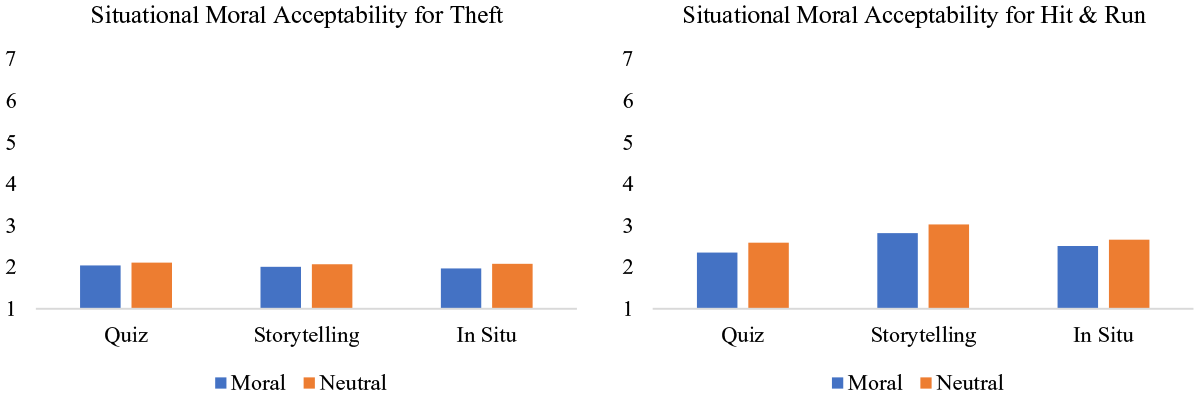
Study 2: mean situational moral acceptability, by experimental condition.
Supplemental Analyses
We also present analyses of distributional differences that are more comprehensive and potentially more interpretable than mean difference contrasts for ordinal variables. Specifically, we estimated a series of Ordered Logistic regressions in which situational moral acceptability was regressed on the experimental conditions (moral or neutral cue), for each experiment (quiz, storytelling, and in situ), and by behavior (theft and property damage). This yielded six total regression models. For ease of display, situational moral acceptability was recoded 1 = Unacceptable, 2 or 3 = Moderately unacceptable, and 4 through 7 = Acceptable. 13 Supplemental Figure S1 displays the predicted probabilities and 95 percent confidence intervals for each.
Recall that the situational moral acceptability of a behavior should relate negatively to moral stimuli. In the context of Supplemental Figure S1, this suggests moral cue recipients should be more likely to consider the behavior unacceptable than respondents with neutral content do. As well, moral cue recipients should be less likely to consider the behavior acceptable than respondents with neutral content do. Supplemental Figure S1 exhibits this pattern. Across five of the six distinct experiments, recipients of moral cues display a higher predicted likelihood of being categorized in the unacceptable group compared to counterparts who received corresponding neutral cues. Specifically, in the Quiz experiment with the theft outcome, the predicted probability for respondents in the moral cue condition to be classified in the unacceptable group is 49%, while in the neutral condition, it is 41%. Similarly, for property damage, the predicted probability of being classified in the unacceptable group is 25%, compared to 20% in the neutral condition. These differences, however, are not statistically significant. Nonetheless, comparable patterns emerge for the remaining two experiments for both behavioral outcomes.
Additionally, as expected, this pattern reverses for the upper portion of the distribution of situational moral acceptability. Again, across five of six separate experiments, respondents assigned to a neutral condition more often consider the behavior morally acceptable than respondents assigned to the moral condition do. Specifically, in the In Situ experiment featuring the theft outcome, the model predicts a 13% probability that a participant assigned to the neutral condition will consider the behavior morally acceptable, whereas the predicted probability decreases to 9% for the moral condition. Similarly, for property damage, the model predicts a 21% probability that a participant assigned to the neutral condition will deem the behavior morally acceptable, whereas the predicted probability decreases to 17% for the moral condition. Comparable patterns emerge for the Quiz and Storytelling experiments. Again, however, none of the observed differences are statistically distinguishable from zero despite these notable patterns in the data.
Discussion
Consistent with Study 1, individually the moral cues in study 2 do not statistically reduce the situational moral acceptability of crime. Nonetheless, in all six experiments the moral salience condition consistently yielded lower levels of situational moral acceptability of the crime scenarios compared to their corresponding neutral counterparts. As in study 1, this aggregate pattern is statistically significant. Additionally, consistent with existing work, incorporating rationalizing content increased moral acceptability for both behaviors (Herman & Pogarsky, 2023; Thomas, 2019). We find some evidence this allowed the moral cues more room to operate. 14 However, even absent moral cues, the acceptability of both behaviors remains low, thus impeding any moral salience processes.
Lastly, it is worth emphasizing that all 12 experiments across both studies yielded a difference in the expected direction. A Binomial Proportions test for 12 successes out of 12 trials, assuming a null hypothesis probability of .5, yielded p < .0002, implying some impact of moral salience in the experiments. 15
Conclusion
We have argued that criminological morality literature downplays the role of situational moral evaluations in crime decisions. To complement and extend existing findings on cognitive System 2 sources of situational moral evaluations, such as rationalizations, we investigated System 1 intuitive processes involving moral salience. Despite the null experimental results, several aspects of the findings are noteworthy. First, consistent with recent research, situational moral evaluations play an important role in crime decisions (e.g., Herman & Pogarsky, 2023). Second, situational moral acceptability of crime is slightly lower after receiving a moral cue in 12 of 12 separate experiments. While each individual difference is small and statistically indiscernible, the consistent direction of all differences supports the expectation that promoting moral salience may reduce crime acceptability. Last, consistent with Thomas (2019) and Herman and Pogarsky (2023), circumstances conducive to rationalization increased the situational moral acceptability of crime opportunities. In the current study, this amplified the opportunity for moral cues to operate.
The null findings from our salience experiments have various implications. The first involves the mechanisms by which intuitive and/or heuristic processes affect behavior. Recall the earlier discussion of how Kahneman’s (2011) two systems sometimes interact. System 2 deliberation can intervene when the requirements for a task exceed System 1’s intuitive capabilities, or to counteract a System 1 bias. However, though our central outcome was a System 2 oriented situational moral evaluation, while the primary predictor was System 1 oriented moral salience, we find no such interrelationship here. These findings comport with prior research on visceral activation and offender decision making. Loewenstein et al. (1997) tested the effect of sexual arousal on expectations of sexual forcefulness, whereas Exum (2002) tested the effects of anger and intoxication on violent intentions. Both studies found a direct relationship between System 1 visceral arousal and behavioral intentions. However, in neither case was this main effect mediated by altered perceptions about various costs and benefits from offending. 16 Future research should continue to investigate how the two systems interrelate.
Second, a continuous challenge was that, even with no moral cue, participants reported preexisting, general disapproval of both crimes. Although situational moral acceptability of the offense was slightly higher in study 2 because of the added rationalizing content, in neither study did moral acceptability exceed 2 on a 1 to 7 Likert scale. Our respondent population of adult United States residents who volunteer for online data collection may have contributed to this, as such persons likely possess stricter moral norms than younger or criminally involved people do. Beyond this, we used the CloudResearch platform which includes reliable and vetted survey takers to improve data quality. Both of our samples tended to show strong moral identity (x̄ = 4.4/5). Traditional MTurk and college student samples typically score lower on this validated construct (e.g., Aquino et al., 2009; Herman & Pogarsky, 2022). To mitigate this underlying moral unacceptability, future research should examine younger and more criminally predisposed respondent populations. Such research should also test the moderating potential of person-centric morality on the role of moral salience. On this score, Aquino et al. (2009) hypothesized that because morality is already salient for people with strong moral identity, moral primes should be most effectual for people with low person-centric morality. Using the Ten Commandment prime, the authors found support for this hypothesis.
Third, future research should consider alternative research paradigms for studying intuitive processes such as moral salience. The current study utilized an online survey platform to manipulate the salience of morality. Online surveys, however, are suboptimal for shifting moral awareness (see e.g., Howard et al., 2017). Existing research generally incorporates in-lab or in-person tasks, followed by actual opportunities to act. Here, the moral cue was entirely online, without researcher or any formal observation, with primary outcomes that were attitudinal and hypothetical. Recently, vignette methodology has been expanded to include photographs, videos, and virtual reality environments that provide more immersive and realistic crime opportunities than are possible with written scenarios (Barnum et al., 2021; Pickett, 2018; van Gelder & de Vries, 2019; van Gelder et al., 2022). This approach can manipulate the physical environment in a more all-encompassing manner and in real time.
Finally, the possibility also exists that moral salience plays little role in crime decisions. Research on moral cues and priming has become increasingly mixed. In social psychology, recent replication failures of traditional behavioral priming effects and extensive discussions concerning questionable research practices have prompted a reexamination of the priming literature (e.g., Chabris et al., 2019; Doyen et al., 2012; O’Donnell et al., 2018). Meta-analyses of moral based priming studies revealed small-to-moderate effects (Shariff et al., 2016), while other analyses using alternative methods for correcting publication bias failed to replicate prior work (e.g., Gomes & McCullough, 2015; van Elk et al., 2015; Verschuere et al., 2018). Priming scholars maintain, however, that null effects are open to interpretation, and that since priming is highly sensitive to variations in experimental features, participants, and cultural contexts (Cesario 2014), true effects can be challenging to discern (Watanabe & Laurent, 2018).
This suggests caution is warranted regarding priming and nudging based policy initiatives. On one hand, priming interventions are far less costly than directly manipulating the criminal justice system, for example, through policing or the operation of the courts. This is so long as inadvertent “wrong way nudges” are avoided (see Gibbons, 2015; Pogarsky & Herman, 2019). On the other hand, research on Behavioral Economics and crime control suggests that, rather than leverage intuitions and heuristics to curb antisociality, more enduring crime control impacts are achievable by molding youths to think more deliberatively and less heuristically to begin with. Heller et al. (2017) reported a successful example of this, the Becoming a Man program in Chicago. The intervention targeted “at risk” juvenile boys and consisted of 26 weekly group sessions emphasizing introspection, life skills, and reducing automatic thinking. Several Randomized Control Trials established that the program successfully reduced criminal involvement and improved school engagement.
The issues addressed in this article comport with the more refined conception of choice and crime in recent research (e.g., Barnum & Nagin, 2021; Loughran, 2016; Nagin & Sampson, 2019; Paternoster, 2017; Pickett, 2018; Pogarsky et al., 2017, 2018; Thomas et al., 2021a, 2021b, 2022). Such work revisits assumptions about the central actor in criminological models. Criminology can be unclear about whether it assumes human agency, wherein behavior is determined by people voluntarily pursuing intended goals, or whether it assumes that people behave largely according to forces outside their control. Choice based criminological theories have often embraced a more traditional rational choice perspective on the human responsiveness to incentives. But mounting disconfirmations of rational choice empirical predictions may raise skepticism in some about continuing to assume human agency.
Enter Behavioral Economics. Much like the Symbolic Interactionists who rejected sterile and unrealistic assumptions about human actors from Social Learning (Mead, 1934; Stryker, 2008), in behavioral economics human responsiveness to incentives is merely quasi-rational, and reflects predictable quirks and inconsistences not accounted for by traditional economic models (Kahneman, 2011; Kahneman & Tversky, 1979; Thaler, 2016). In turn, this more realistic conception of criminological actors makes the assumption of voluntary choice more intellectually palatable, thus expanding the consideration of choice sets.
Traditionally, choice sets have involved structural constraints. This rebuts the implicit assumption in economically oriented models of equal access and opportunity. Here we considered the possibility of “perceptually constrained” choice. Yet interventions such as that studied by Heller et al. (2017) above show promise for expanding choice sets, both by raising prosocial behavioral possibilities that might otherwise been obscured, and by counteracting criminogenic inclinations from heuristic choice processes.
Supplemental Material
sj-docx-1-cad-10.1177_00111287241259474 – Supplemental material for Moral Salience, Situational Moral Evaluations, and Criminal Choice
Supplemental material, sj-docx-1-cad-10.1177_00111287241259474 for Moral Salience, Situational Moral Evaluations, and Criminal Choice by Shaina Herman and Greg Pogarsky in Crime & Delinquency
Supplemental Material
sj-docx-2-cad-10.1177_00111287241259474 – Supplemental material for Moral Salience, Situational Moral Evaluations, and Criminal Choice
Supplemental material, sj-docx-2-cad-10.1177_00111287241259474 for Moral Salience, Situational Moral Evaluations, and Criminal Choice by Shaina Herman and Greg Pogarsky in Crime & Delinquency
Footnotes
Declaration of Conflicting Interests
The author(s) declared no potential conflicts of interest with respect to the research, authorship, and/or publication of this article.
Funding
The author(s) received no financial support for the research, authorship, and/or publication of this article.

Supplemental Material
Supplemental material for this article is available online.
Notes
Author Biographies
References
Supplementary Material
Please find the following supplemental material available below.
For Open Access articles published under a Creative Commons License, all supplemental material carries the same license as the article it is associated with.
For non-Open Access articles published, all supplemental material carries a non-exclusive license, and permission requests for re-use of supplemental material or any part of supplemental material shall be sent directly to the copyright owner as specified in the copyright notice associated with the article.
