




Abstract
This study focuses on sources of youth decision-making and examines paths through which these factors may affect delinquent behavior. Using longitudinal Add Health data, we explore the mediating mechanisms linking several antecedents of decision-making, thoughtfully reflective decision-making (TRDM), and crime. We find that various adverse factors (i.e., family and school stressful conditions, depression, sleep problems) reduce the ability of adolescents to be thoughtful and reflective, which leads to higher levels of criminal behavior. By contrast, involvement in conventional activities (i.e., hobbies, religious activities) is found to foster TRDM, which reduces delinquency. Our study calls for an integration of perspectives in criminology, cognitive psychology, and neuroscience to better explain the relationship between decision-making and crime. Policy implications are discussed.
Introduction
Adolescent crime including acts of violence, burglaries, and cybercrimes remains a major public health and societal concern (Federal Bureau of Investigation, 2019). To address this problem, research has focused on ways in which issues in various life domains (e.g., lack of family bonds, negative events, deviant peers) increase different types of delinquency (Teijón-Alcalá & Birkbeck, 2019; Wojciechowski, 2018; see also Kubrin et al., 2009 for review). Much less attention in criminology has been paid to the complex role of individual capacity to make decisions in crime. Recently, however, frameworks emphasizing decision-making have introduced novel approaches to understanding agency and crime (Pickett et al., 2018). Consistent with this trend, Paternoster and Pogarsky proposed an extension of rational choice theory arguing that individuals who are more thoughtful and reflective at all stages of decision-making are more likely to make favorable choices in life, which includes avoiding crime (Paternoster & Pogarsky, 2009).
Given individual cognitive abilities can be influenced by sensations, emotions, and other factors, it is important to identify and better understand sources of decision-making (Bishop & Gagne, 2018). Yet, criminologists have yet to conduct a comprehensive analysis of determinants of decision-making skills and the indirect links between these determinants and crime via the process thoughtfully reflective decision-making (TRDM). It is particularly important to understand the processes related to decision-making and crime among adolescents. During adolescence, individuals are prone to impulsive decision-making, which affects involvement in different risky behaviors including engagement in crime and delinquency (Adjorlolo et al., 2018; Pehlivanova et al., 2018). This impulsive decision-making is largely related to the diminished cortical thickness in specific structural networks of the brain in adolescence (Pehlivanova et al., 2018). Moreover, youth are highly sensitive to the influences of their environments, such as family and school, and their cognitive functioning is affected by two “competing” parts of the brain responsible for self-regulation and socioemotional aspects (Ernst, 2014).
In this study, drawing on the concept of thoughtfully reflective decision-making proposed by Paternoster and Pogarsky (2009), we investigate several potential sources of youth decision-making, their links to a multi-stage decision-making process, and youth involvement in crime as an outcome. Specifically, we use the first two waves of National Longitudinal Survey of Adolescent to Adult Health to evaluate how stressful conditions, aversive mental and physical states, and conventional activities influence adolescent ability to be thoughtful and reflective in decision-making. We further explore whether thoughtfully reflective decision-making serves as a connecting link between those sources of decision-making skills and adolescent criminal behavior.
Theoretical Framework: TRDM and Crime
In criminological literature, the interrelationships between different cognitive factors and crime have been addressed by rational choice models. According to these models, before engaging in crime, individuals are expected to engage in cognitive processing that involves, but is not limited to, collecting information about costs and benefits, assessing consequences of their actions, and carrying out analysis before making decisions (Cornish & Clarke, 1986; Loughran et al., 2016; Neissl et al., 2019). Notably, cognitive decision-making can be viewed as a process and, thus, it is important to account for individuals thinking systematically and reflectively at different stages. A recently introduced rational choice concept, thoughtfully reflective decision-making (TRDM), captures the idea of a multistage decision-making process and focuses on the ability to engage in logical analyses during each phase of making decisions (before, during, and after an act) (Paternoster & Pogarsky, 2009). TRDM involves intentionality, forethought, self-reactiveness, and self-reflectiveness. Individuals who engage in reflective decision-making collect information related to a particular problem; deliberate about probable solutions to the problem; examine alternative solutions and routes to achieving their aim; and reflect back on the process and the consequences of their choice to analyze what went right and what went wrong. Those who are more thoughtfully reflective in their decision-making are more likely to choose courses of action leading to favorable outcomes (e.g., educational attainment, better physical health, etc.) and to stay away from unfavorable choices such as crime.
Importantly, Paternoster and Pogarsky (2009) differentiate between the concepts of TRDM and self-control. While self-control is the trait that includes such components as a desire for immediate gratification, impulsivity, self-centered orientation, and volatile temper, TRDM represents a multi-stage process of making decisions. In addition, while self-control is theorized to be relatively fixed at a young age, TRDM is purported to be more dynamic, change over time, and vary based on different contexts or conditions. Finally, several studies have confirmed and supported the distinctions between TRDM and self-control concepts theoretically and empirically (e.g., Paternoster & Pogarsky, 2009; Timmer et al., 2021).
Sources of Decision-Making, TRDM, and Crime
Paternoster and Pogarsky recognize that decision-making is a cognitive skill that can be developed and, thus, the ability to reflect thoughtfully on decisions can be influenced by various factors. The authors specifically state that “an important line for subsequent work is in understanding the processes that produce TRDM” (Paternoster & Pogarsky 2009, p.122). Indeed, research in social and cognitive psychology and neuropsychiatry has suggested that various life experiences and conditions influence individual decision-making abilities (Blanco et al., 2013; Flin et al., 2017; Van Hoorn et al., 2016). However, this research area has been relatively underdeveloped in criminology, and studies have yet to investigate the relationships between sources of decision-making skills, TRDM, and crime. Not surprisingly, there have been recent calls to examine more thoroughly determinants of decision-making and their indirect effects on crime (Van Gelder et al., 2013). While the data and space limitations preclude us from focusing on all possible predictors of TRDM, in this initial investigation, we explore selected examples of life domains that were deemed important for youth outcomes by prior research, thereby assessing the mediating mechanism that links these factors, decision-making, and delinquency.
Adolescent Development and Decision-Making
During adolescence, human brain undergoes major structural changes including brain maturation and alterations in prefrontal areas (Andrews et al., 2021; Ferschmann et al., 2022; Foulkes & Blakemore, 2018; Steinberg, 2010; Stevens, 2009). Specifically, adolescents experience hormonal changes and imbalances in dopamine receptors in the striatum and prefrontal cortex affecting the reward circuitry of the brain (see Steinberg, 2008 for review). Evidence further suggests that adolescents experience changes in other parts of the brain such as cerebellum and parietal and temporal cortices (Steinberg, 2010). All those developmental changes in adolescence are also related to alterations in the socio-emotional system of the brain including increased reward sensitivity, which, as a result, leads to elevated sensation-seeking, impulsive choices, and risky behaviors (Steinberg, 2008).
Aside from biological changes, the development of individual brain structure appears to be closely linked to social surroundings (Andrews et al., 2021; Ferschmann et al., 2022), and multiple aspects of adolescent development are largely shaped by various environmental and individual-level social factors (Balogh et al., 2013; Foulkes & Blakemore, 2018; Muscatell et al., 2012). For instance, recent studies indicate that risk factors such as neighborhood disadvantage affect the neurocognitive performance and brain structure (Hackman et al., 2021), while family income influences decision-making by lowering the activity of the prefrontal cortex among adolescents (Palacios-Barrios et al., 2021). Additionally, adolescence is the time when peers play an increasingly important role and influence the cognitive development and decision-making (Albert et al., 2013; Chein et al., 2011; Foulkes & Blakemore, 2018; Gardner & Steinberg, 2005; Hoeben & Thomas, 2019; Segalowitz et al., 2012). Albert et al. (2013) suggest that peers are a unique stimuli of youth motivational state as they increase desire for short-term benefits, which heightens the propensities for risk-taking and impulsivity. Quality of friendship ties has also been found to influence the structural development of cortical regions of youth brain (Becht et al., 2021). Further, the history of substance use is another significant factor affecting decision-making in adolescence (see Chen et al., 2020; Dom et al., 2005 for review). Substance use among adolescents has been documented to be associated with the increased insula activation at the time of risk processing (Kim-Spoon et al., 20211), and it can lead to long-term changes in decision-making, especially through altering the evaluation of risk (Nasrallah et al., 2011). This may further promote maladaptive and risky decision-making (Chen et al., 2020; Kim-Spoon et al., 2021a; Zois et al., 2014).
Of particular importance are the detrimental effects of negative and stressful life events, such as maltreatment, neglect, and trauma, on adolescent cognitive development. Child maltreatment and abuse as well as other early life stressors have been found to negatively influence brain functioning and development because they modify neural processes and control system linked to decision-making (Bruce et al., 2013; Hanson et al., 2015; Lim et al., 2015; Mueller et al., 2010; Smith & Pollak, 2021). For example, youth who have experienced physical neglect and abuse exhibit higher activation in the anterior cingulate cortex compared to those who have not experienced those adverse events (Bruce et al., 2013). Further, drawing on the analyses of longitudinal data from adolescents, Kim-Spoon et al. (2021b) have revealed the association between neglect and the neurodevelopment of the brain’s valuation system, whereas abuse appears to affect the neurodevelopment of the control system. Additionally, adolescents who have experienced maltreatment, abuse, and other forms of trauma tend to suffer from blunted brain activity (Hanson et al., 2015) and impaired brain activation associated with regulation (Lim et al., 2015). A recent study by VanTieghem et al. (2021) has also found that adverse caregiving affects the developmental patterns of amygdala volume. Further. victimization has been found to negatively affect brain development and different cognitive processes (Quinlan et al., 2020; Telzer et al., 2018) and even contribute to the development of neurological atypicality (Quinlan et al., 2020). Additionally, different adverse experiences, including childhood stress and neglect affect the areas of the brain responsible for processing cues about potential rewards and risks, and disrupt physiological stress responses (Birn et al., 2017; Dillon et al., 2009; Hanson et al., 2015; Smith & Pollak, 2021). Cumulative stress exposure has been shown to be particularly detrimental and related to an increased connectivity between the ventral striatum and medial prefrontal cortex, which affects adverse outcomes such as elevated psychopathological states (Hanson et al., 2018).
Consistent with developmental literature, decision-making and risk-taking may be interrelated under different circumstances (Balogh et al., 2013; Reyna et al., 2011). Adverse life experiences and changes in risk and reward processing tend to shape risk-related decision-making (Kim-Spoon et al., 2021b; Mohr et al., 2010), with emotional decision-making increasing risk taking (Balogh et al., 2013; Cheung & Mikels, 2011). This is also likely to happen when individual behavioral control is immature, but the affective system has already reached maturity (Balogh et al., 2013; Rutherford et al., 2010). When contemplated activities are exciting to an individual, this discrepancy is further likely to promote risk-taking. Overall, in adolescence, sensitivity to adverse consequences is heightened, and various developmental changes in cognitive and emotional processing may promote risky decision-making and risk-taking behaviors (Balogh et al., 2013).
By contrast, a positive social environment, including prosocial families, communities, peers, and structured out-of-school activities, provides long-term benefits for adolescent development and prosocial behavior (Foulkes & Blakemore, 2018; Morrissey & Werner-Wilson, 2005; Silke et al., 2018; van Hoorn et al., 2016). The prosocial development and behavior of young people are shaped by the values and norms transmitted by parents, community programs, school-sponsored activities, youth-focused and volunteer organizations, and structured leisure activities (Linver et al., 2009; see Morrissey & Werner-Wilson, 2005 for review).
Notably, researchers have recognized that activities involving structure and skill building provide an important context for different aspects of youth development (Mahoney et al., 2005; Morrissey & Werner-Wilson, 2005; Silke et al., 2018). Activities that allow youth to express their identity and interests, generate structured performance, and help improve leadership skills are especially important for prosocial development (Morrissey & Werner-Wilson, 2005). These activities promote the development of critical thinking abilities, increase interpersonal competence and psychosocial adjustment, and foster the ability to perform developmental tasks (Mahoney et al., 2005; Randall & Bohnert, 2009). For example, according to the longitudinal study by Linver et al. (2009), involvement in various organized hobby-related activities has been consistently associated with more positive prosocial developmental outcomes. Further, studies point to another notable domain influencing prosocial development, religiosity. Focusing on various aspects of religiosity, research to date indicates that youth who possess higher levels of spiritual beliefs and religious practice exhibit higher prosocial development and more prosocial behaviors (Albanesi et al., 2007; Evans & Smokowski, 2015; Krauss et al., 2014).
Taken together, past research has emphasized the importance of various domains of the lives of young people, including biological, cultural, and social aspects, for their brain development, decision-making, and cognitive functioning (Dick et al., 2021; Foulkes & Blakemore, 2018; Quinlan et al., 2020; Telzer et al., 2010). However, more research is needed on specific mechanisms that explain the complex relationship between different aspects of adolescent lives, developmental processes, and criminal behavior (Birn et al., 2017; Timmer et al., 2021). Furthermore, the concept of cognitive decision-making has previously been understudied as an independent predictor of criminal behavior, and it has often been combined with risky behavior in a concept of “risky decision-making.” In this study, we aim to comprehensively examine various sources of decision-making, the ability of youth to make thoughtful and reflective decisions (TRDM), and delinquency.
Stressful Conditions, Decision-Making, and Crime
Stressful life experiences are one of the most common predictors of delinquency (Agnew, 2006). For example, various family issues such as family conflict, negative relationships with parents, and other parental problems are found to increase youth delinquency (Bao et al., 2014; Sigfusdottir et al., 2012). Additionally, researchers note the criminogenic effects of school-related problems including negative, prejudiced, and unfair treatment by teachers and students, and issues with academic performance (Bao et al., 2014; Kuptsevych-Timmer et al., 2018; Peck, 2013).
Besides increasing delinquency, stressful experiences could also be an important determinant of adolescent decision-making skillset. Adolescents are routinely exposed to the settings, such as family and school, where they may experience criminogenic chronic strains (Agnew, 2006). Chronic strains at home and school have been theorized to be enduring and common antecedents to stress (Pearlin, 1989). Stress, in turn, has been underscored by prior literature to be a unique state altering the ability to make decisions (Flin et al., 2017). Individuals under stress may experience changes in their decision-making abilities including alterations in sensitivity to different outcomes (e.g., rewards and punishments) and engage in more habitual responses as opposed to goal-oriented tasks (Porcelli & Delgado, 2017). Thus, the induced stress from adverse conditions at home and school may impair youth thoughtfully reflective decision-making, which can further heighten the likelihood of delinquency. In other words, stressful conditions can affect crime indirectly through their detrimental impact on TRDM.
Negative Mental States, Decision-Making, and Crime
Further, it is important to address how negative mental states such as depression can serve as a source of youth decision-making because depressive symptoms, including clinical depression, are highly prevalent among adolescents (Rice et al., 2017) and produce extremely negative effects on their cognition and behavior. Criminological literature has consistently linked negative emotionality including depression to deviant behavior (Ostrowsky & Messner, 2005; Peck, 2013). For example, using data from the National Youth Survey, Ostrowsky and Messner (2005) find that depression can increase both property and violent offending among youth.
In addition to influencing delinquency, depressive feelings may negatively affect decision-making abilities. Research is cognitive psychology and neuroscience has shown that depressive feelings tend to alter the depth and speed of information processing, influence the cost-benefit calculation as well as cause issues with cognitive processes related to task performance (Blanco et al., 2013; Lawlor et al., 2020; see also Bishop & Gagne, 2018 for review). For example, Blanco et al. (2013), focusing on the U.S. youth, find that it is more difficult for depressed individuals to utilize and maintain complex task structures related to decision-making. As such, it is reasonable to presume that youth depressive symptoms may affect their criminal behavior also indirectly by reducing their ability to reflect thoughtfully on decisions.
Adverse Physical Conditions, Decision-Making, and Crime
Besides negative mental states, it is also important to explore adverse physical conditions influencing youth life. One example of such conditions is sleep problems, which involve troubles with the sleep-wake rhythm affecting neurobehavioral functions and overall well-being, especially during the vulnerable period of adolescence (Clinkinbeard et al., 2011; Mears et al., 2020). Importantly, sleep problems have been linked to criminal behavior (Clinkinbeard et al., 2011; Timmer et al., 2021) with sleep-deprived adolescents engaging in more violence and property crime as compared to their counterparts with more normal sleep (Clinkinbeard et al., 2011).
While criminological literature has illustrated the importance of the effect of sleep problems on crime (Clinkinbeard et al., 2011; Mears et al., 2020), it has not yet comprehensively theorized about the complex intervening links in this relationship. We argue that, in addition to directly predicting criminality, sleep issues can also be an important determinant of decision-making skills influencing crime indirectly via decision-making abilities. Sleep problems may negatively affect decision-making skills because experiencing problems with sleep triggers issues with cognition, decreases performance on functional tasks and executive processes, and alters judgment and attention (Killgore, 2010; see Harrison & Horne, 2000 for review). Thus, based on prior literature in psychology and criminology, we propose that sleep problems may reduce the ability to be thoughtful and reflective in decision-making, which will further increase delinquency.
Conventional Activities, Decision-Making, and Crime
Finally, it is important to examine the conditions that can foster better decision-making skills and prevent criminal behavior. Accumulated research evidence suggests that engagement in various conventional activities plays a protective role against crime and delinquency (Baier & Wright, 2001; Paternoster et al., 2011). Specifically, studies have demonstrated that the attachment to conventional institutions and religious beliefs and behaviors prevents people from engaging in criminal and deviant behavior (Baier & Wright, 2001; Kubrin et al., 2009).
In addition to preventing crime, engagement in various pro-social activities can have other beneficial influences such as fostering better decision-making skills. Involvement in such conventional activities as hobbies and religious behaviors can improve various developmental outcomes among youth (Linver et al., 2009; McHale et al., 2001; Morrissey & Werner-Wilson, 2005). Importantly, engagement in these activities has been linked to the development of cognitive strategies and self-regulation, maintaining cognitive function, and many other positive developmental outcomes that foster reasoning and forethought (Donahue & Benson, 1995; Hargreaves et al., 2012; Linver et al., 2009). Therefore, we propose that involvement in hobbies and religious activities may increase engagement in thoughtfully reflective decision-making which, in turn, may decrease delinquency.
Empirical Evidence on TRDM and Crime
While the concept of thoughtfully reflective decision-making (TRDM) emerged relatively recently, existing research has already shown the crime-preventive effects of this factor. First, several studies, using the Add Health data, found that adolescents who engaged in more TRDM were less likely to be involved in delinquency (Paternoster & Pogarsky, 2009; Paternoster et al., 2011; Timmer et al., 2021). Using the same data set, Haynie et al. (2014), showed that the ability to thoughtfully reflect on decisions was marginally associated with adolescent violence. Louderback and Antonaccio (2017), focusing on another outcome, computer-focused cyber deviance, found that higher involvement in TRDM resulted in a lower likelihood of cybercrime among adults and students. Some studies, however, reported mixed evidence concerning the effect of TRDM on youth deviance, including drinking and driving, cheating in school, and other deviant acts (Kamerdze et al., 2014; Mamayek et al., 2015).
Prior studies have also demonstrated that TRDM may affect involvement in crime indirectly. For example, Paternoster et al. (2011) showed that TRDM influences engagement in criminal acts and other important outcomes relevant for youth through the accumulation of different types of capital. Additionally, several studies demonstrated that the relationship between TRDM and crime may vary across different age groups, levels of stressful, emotional, and physical conditions, and sanctioning regimens in schools (Louderback & Antonaccio, 2017; Maimon et al., 2012; Timmer et al., 2021). Yet, to date, no research has examined determinants of the ability to engage in thoughtfully reflective decision-making and the mediating mechanism involving TRDM as an intervening link between antecedents of decision-making and delinquency.
Present Study and Hypotheses
Using the first two waves of Add Health, we contribute to the literature by examining the previously unexplored determinants of TRDM and evaluating the links involving these important sources, decision-making, and delinquency. First, we assess the impact of stressful conditions at school and home on adolescent TRDM, which further links it to delinquency. Second, we examine the effect of depression, a negative mental state, on TRDM, which subsequently predicts adolescent criminal behavior. Third, we investigate the influence of sleep problems, an adverse physical condition, on TRDM, which thereby impacts youth involvement in crime. Finally, we explore the effects of conventional activities on TRDM, which further affects youth criminal and delinquent involvement. Collectively, the following hypotheses are tested in this research:
H1–H4. School- and family-related stressful conditions, sleep problems, and depression are negatively associated with engagement in TRDM among adolescents.
H5–H6. Involvement in hobbies and religious activities are positively associated with engagement in TRDM among adolescents.
H7–H8. TRDM mediates the relationship between school- and family-related stressful conditions and crime: higher levels of school and family stressful conditions result in less engagement in TRDM, which leads to higher levels of delinquency.
H9. TRDM mediates the relationship between sleep problems and crime: higher levels of sleep problems result in less engagement in TRDM, which leads to higher levels of delinquency.
H10. TRDM mediates the relationship between depression and crime: higher levels of depression result in less engagement in TRDM, which leads to higher levels of delinquency.
H11–H12. TRDM mediates the relationship between involvement in hobbies and religious activities and crime: higher levels of involvement in hobbies and religious activities result in more engagement in TRDM, which leads to lower levels of delinquency.
Methods
Data and Sample
This study uses the first two waves of the Add Health survey data to examine the relationship between adolescent decision-making and delinquency. During Wave I (1994–1995), a random sample of students in grades 7 to 12 was drawn from 132 middle and high schools in the U.S. Adolescents and their caregivers were interviewed about youth experiences, personality, behavior, and other aspects. To establish a correct causal order, we use responses from the Wave I survey to construct our independent, mediating, and control variables. Importantly, we use measures of independent variables referring to conditions/states that occurred in weeks/months prior to the interviews etc., while the mediating variable is measured in the present. The Wave II survey was conducted a year later, and we draw on the responses from students during the Wave II in-home interviews to construct our dependent variable.
The analytic sample includes respondents who have valid sample weights and no missing data on our dependent variable (delinquency at Wave II), which is consistent with the guidelines from the Add Health administrators and other studies using the same data (Chantala, 2006; Maimon et al., 2012). We further account for non-response and sample attrition between Wave I and II by using the appropriate sample-attrition weight (Wave II sample weight) provided with the data (Chantala, 2006; Laursen et al., 2011). Only a small percentage (about 8%) of observations had any missing data on any of our predictor variables, which allows us to use listwise deletion (Allison, 2001). Our final sample consists of 12,477 adolescents. A comparison of the full and final analytical samples reveals no significant mean differences in our primary independent and dependent variables. Finally, we account for clustering in the sample by schools and oversampling of certain groups in our models by using appropriate Add Health Wave II sample weights.
Measures
Dependent variable
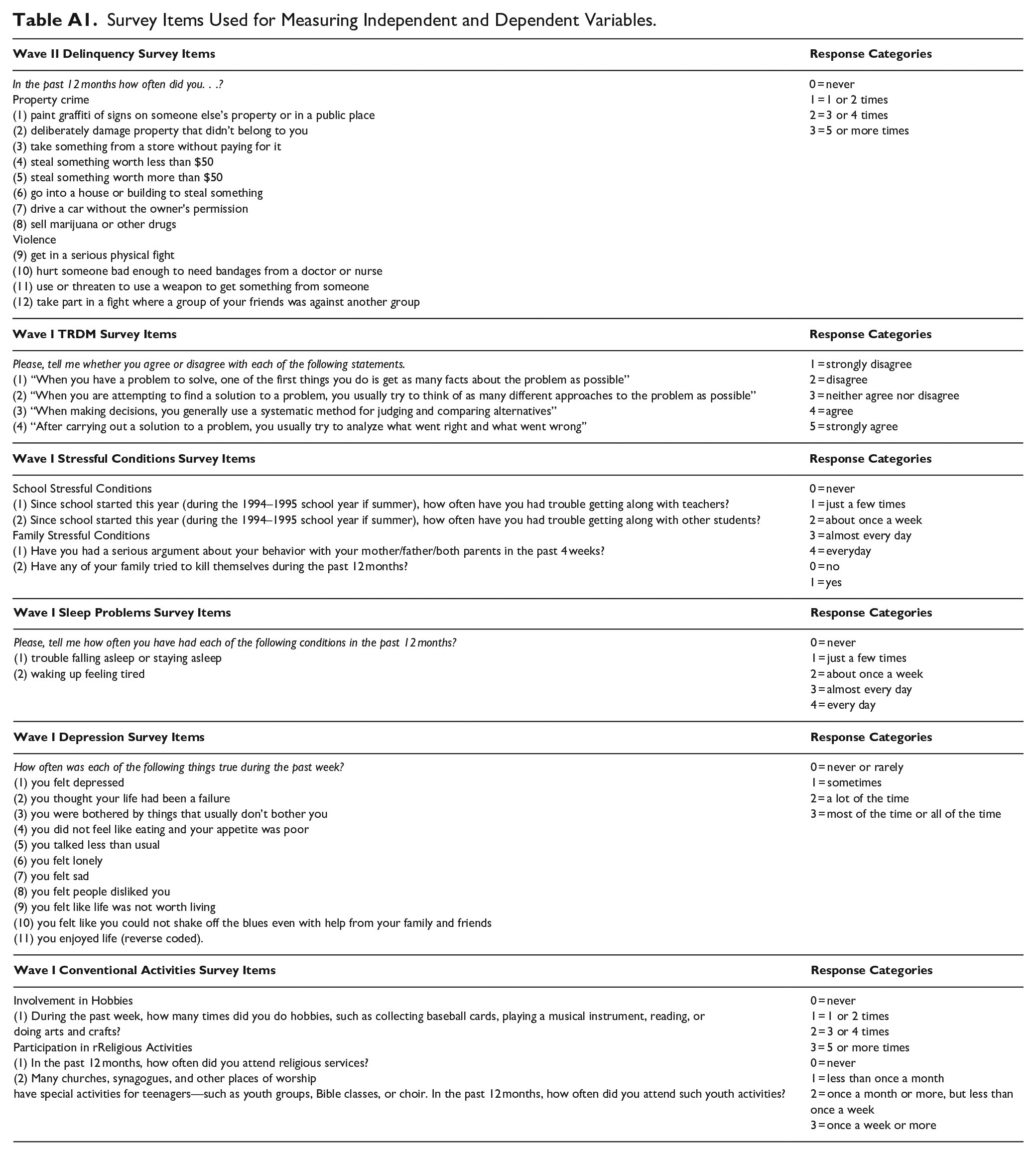
We employ delinquency index as our dependent variable. It is a summative index of 12 survey items (Wave II) that reflect the frequency of adolescent involvement in different violent and property crimes in the past year (e.g., getting into a physical fight, deliberately damaging property etc.) (see Appendix Table A1 for the list of survey items and response categories). Higher scores on this index reflect higher levels of delinquency (alpha = 0.82; range: 0–36). Similar indices have been used and validated by prior studies employing Add Health data and examining the TRDM-delinquency relationship (e.g., see Timmer et al., 2021). We chose to utilize the Wave II delinquency measure as an outcome because it allows to establish a more appropriate causal order and focus on delinquency during adolescent years. On the other hand, Wave III and subsequent waves provide information on adult crime. Descriptive statistics for the delinquency index and all other study variables are shown in Table 1.
Descriptive Statistics.
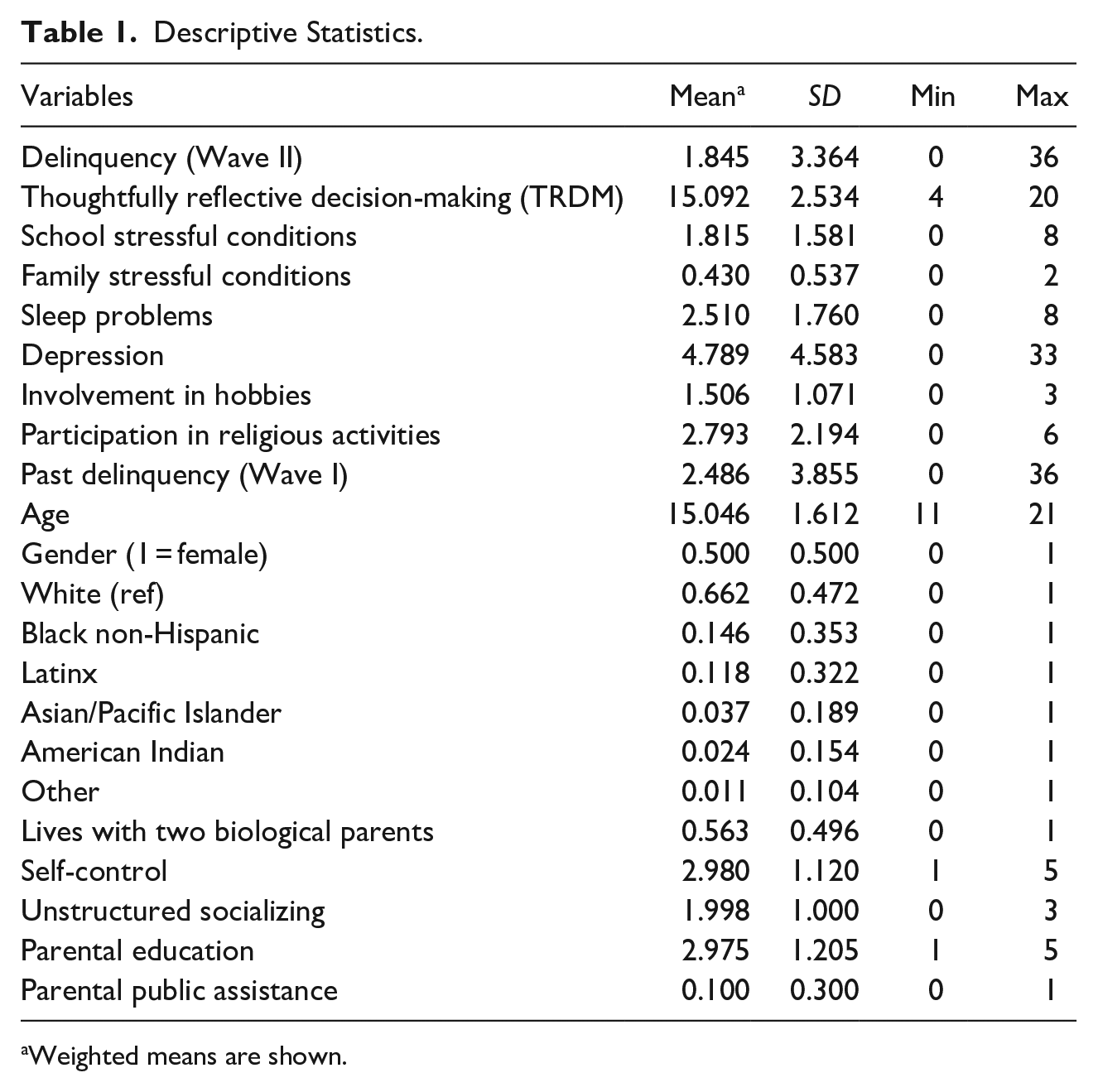
Weighted means are shown.
Independent variables
Thoughtfully reflective decision-making (TRDM
Sources of TRDM
While we recognize that youth may experience a variety of stressors, negative emotional and physical states and be involved in a range of conventional activities, in our study, we chose to include only “retrospective items” to construct the independent variables. Using those items allowed us to focus on several relevant aspects of youth life as well as establish a more correct causal order. In other words, we incorporate several examples of sources of TRDM tapping important domains of adolescent lives and measured using available survey items that refer to the past (i.e., before TRDM was measured in the present).
Stressful conditions
Drawing on prior literature (Bao et al., 2014; Sigfusdottir et al., 2012), we construct two summative measures of youth stressful conditions, representing two important domains of their lives—school and family. The school stressful conditions measure uses the two Wave I survey items asking about negative experiences with teachers and students whereas the family measure utilizes the two Wave I survey items asking about aversive experience with parents and other family members (see Appendix Table A1 for the list of items). To establish a more appropriate causal order between stressful conditions and TRDM, only the survey items asking about stress occurring in the past are utilized. The item responses are summed to create each measure, with higher scores representing higher levels of each type of stressful conditions.
Sleep problems
We create a summative measure of sleep problems, which consists of two survey items related to sleep-wake rhythm (see Appendix Table A1 for survey items). These items and similar measures have been used by prior studies focusing on sleep problems, insomnia, and other sleep-related issues (e.g., see Roane & Taylor, 2008). To establish an appropriate causal order between sleep problems and TRDM, we use survey items that ask about experiencing sleep-related issues during the past 12 months.
Depression
We construct a measure of depression, an example of negative mental health state, which includes items from the established CES-D scale (Radloff, 1977). We use a commonly employed 11-item scale (see Appendix Table A1 for the list of survey items), which was validated by prior studies focusing on the relationship between depression and delinquency (Peck, 2013; Timmer et al., 2021). The frequency of depressive symptomatology is measured during the past week, which allows for the establishment of a more appropriate causal order between depression and TRDM. Higher scores represent higher levels of depression (alpha = 0.84).
Conventional activities
We incorporate two generally common pro-social activities for adolescents, involvement in hobbies and religious activities. Involvement in hobbies is a one-item measure that pertains to frequency of adolescents engaging in various types of hobbies during the past week. Consistent with prior literature (see Rew & Wong, 2006), involvement in religious activities is a two-item variety measure representing the frequency of any participation in religious activities such as religious services or religious activities for teenagers during the past 12 months (see Appendix Table A1 for the list of items). 1 Because the engagement in pro-social activities is measured during the past week or past 12 months, it allows for the establishment of a more appropriate causal order with TRDM.
Control variables
We include several sociodemographic characteristics of adolescents and their families that are commonly included as control variables: age (measured in years), gender (male as a reference category), and race/ethnicity (White/non-Hispanic (reference group), Black/non-Hispanic, Latinx, Asian/Pacific Islander, American Indian and other race/ethnicity). Further, we incorporate family structure measured by whether respondent lives with two biological parents (1 = “lives with two biological parents”; 0 = “does not live with two biological parents”). Next, because over one-fifth of the ADD Health cases have missing data on household income, we use parents’ educational achievement as a proxy for the socioeconomic status of the respondent’s family (responses were recoded to range) from 1 (did not graduate high school or did not complete a GED) to 5 (got professional training beyond a 4-year college or university). Finally, we incorporate a variable reflecting whether respondents’ families have received any kind of public assistance in the past year (1 = “yes”; 0 = “no”). Further, consistent with prior research on TRDM, we control for important theoretical variables (self-control and delinquent opportunities) and for prior delinquent involvement (Maimon et al., 2012; Paternoster & Pogarsky, 2009). Following prior studies on TRDM (Paternoster et al., 2011; Timmer et al., 2021), we employ a measure of redefined self-control, which represents the tendency to consider the full range of consequences of one’s actions (Hirschi, 2004). It is measured by the degree to which adolescents agree with the following statement: “When making decisions, you usually go with your ‘gut feeling’ without thinking too much about the consequences of each alternative” (response categories range from 1 = “strongly agree” to 5 = “strongly disagree). 2 Higher scores reflect higher levels of self-control. Further, delinquent opportunities are represented by unstructured socializing with peers and measured by the degree to which youth “just hung out with friends” (response categories range from 0 = “not at all” to 3 = “five or more times”). Finally, we construct a measure of past crime using items from Wave I, which are the same violence and property crime items used to construct Wave II delinquency (alpha = 0.83). Importantly, as past crime is also affected by prior TRDM, our control for past crime also allows to account for past TRDM, thus providing an overall stringent control for prior cognitive decision-making abilities associated with criminal behavior.
Analytic Strategy
We conduct our analyses in several stages. First, we use OLS regression in models predicting TRDM as an outcome, which is approximately normally distributed. Second, we use non-linear negative binomial regression in models predicting delinquency. The use of negative binomial regression is appropriate in this context because the index resembles a count measure with significant over-dispersion (i.e., skewness) (Osgood, 2000). Further, we employ the KHB method of mediation/decomposition for non-linear models, which allows for the assessment of relative magnitudes and significance of direct and indirect effects (Karlson & Holm, 2011). This method has been used in prior research to assess mediating effects in negative binomial regression models (see Kuptsevych-Timmer et al., 2018). All analyses include Wave II sample weights with adjusted standard errors to account for data clustering by schools, oversampling, and sample attrition. The mediation tests also control for these factors. Variance inflation factors (VIFs) in all models are below 2.00, ruling out multicollinearity problems (Fisher & Mason, 1981).
Results
The results of bivariate analyses (available upon request) show that the correlation between TRDM and delinquency is negative and significant (r = −.104). Further, all the determinants of TRDM (school and family stressful conditions, depression, sleep problems, and involvement in hobbies and religious activities) are also significantly correlated with both thoughtfully reflective decision-making and delinquency in the expected directions.
The Influence of Sources of TRDM on Thoughtfully Reflective Decision-Making
To probe mediation effects articulated in our hypotheses, we, first, illustrate a significant link between our independent variables and the mediator (Baron & Kenny, 1986). The findings presented in Table 2 speak to associations between each of our independent variables and TRDM. 3 First, stressful conditions are negatively associated with TRDM. Drawing on Models 1 and 2, school and family stressful conditions significantly reduce the ability to make thoughtful and reflective decisions (b = −0.217 and b = −0.292, respectively). Next, the figures from Models 3 and 4 show that sleep problems (b = −0.154) and depression (b = −0.051) are also negatively associated with TRDM. These results provide support for Hypotheses 1–4. Finally, providing evidence in support of Hypotheses 5 and 6, the coefficient estimates from Models 5 and 6 show that involvement in hobbies and participation in religious events significantly increase TRDM (b = 0.217 and b = 0.068).
OLS Regression Coefficients Showing the Direct Effects of Sources of TRDM on Thoughtfully Reflective Decision-Making (b[SE]).
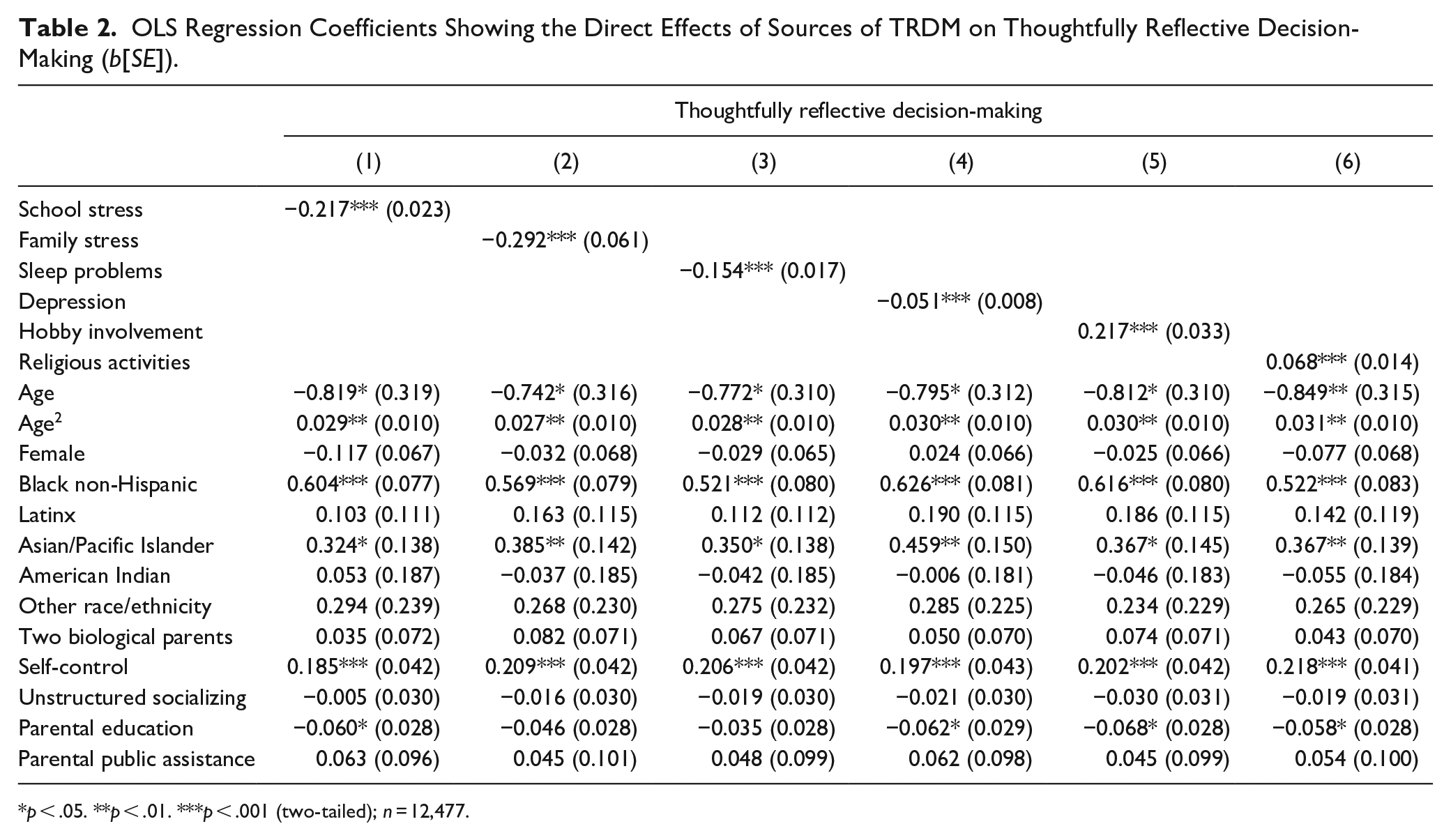
p < .05. **p < .01. ***p < .001 (two-tailed); n = 12,477.
Thoughtfully Reflective Decision-Making as the Link Between Sources of TRDM and Delinquency
Next, in a series of negative binomial regression models (Table 3), we assess whether TRDM mediates relationships between the determinants of thoughtfully reflective decision-making and youth involvement in delinquency. Notably, the expected negative relationship between TRDM and delinquency is supported by a significant regression coefficient for TRDM (IRR = 0.972) in the negative binomial regression model predicting delinquency and incorporating all control variables (results available upon request). The results presented in Table 3 demonstrate that the expected relationships between all independent variables and adolescent delinquent behavior are supported by significant regression coefficients for school stressful conditions in Model 1, family stressful conditions in Model 3, sleep problems in Model 5, depression in Model 7, involvement in hobbies in Model 9, and participation in religious activities in Model 11 (IRRs of 1.093, 1.185, 1.027, 1.011, 0.939, and 0.967 respectively). One unit increases in school stressful conditions, family stressful conditions, sleep problems, and depression are predicted to increase adolescent delinquency by 9.3%, 18.5%, 2.7%, and 1.1%, respectively. On the other hand, one unit increases in involvement in hobbies and participation in religious activities are predicted to decrease youth engagement in delinquent behavior by 6.1% and 3.3%, respectively.
Negative Binomial Regression Coefficients Showing the Direct Effects of Sources of TRDM and Thoughtfully Reflective Decision-Making on Delinquency (b[SE]IRR).
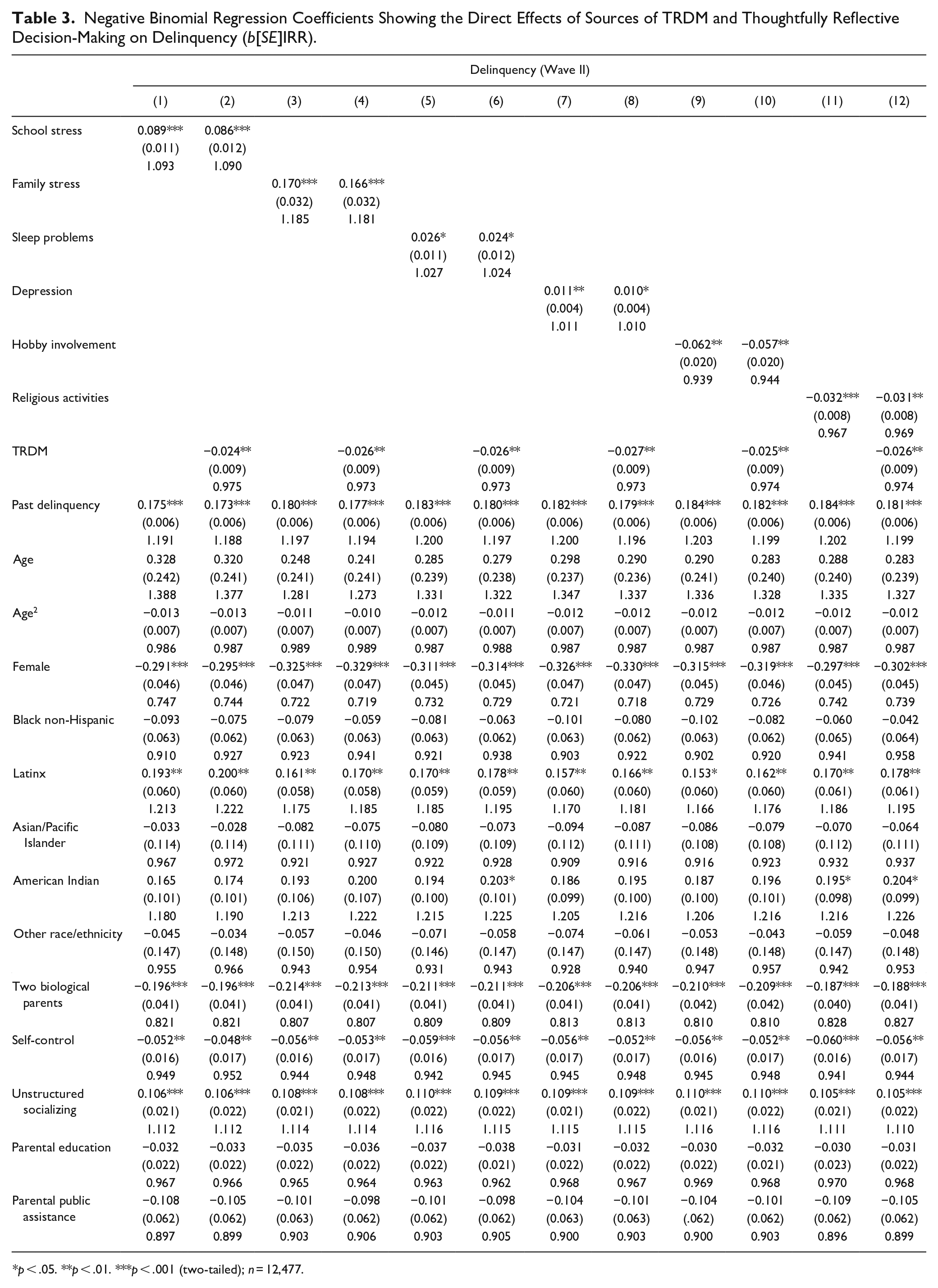
p < .05. **p < .01. ***p < .001 (two-tailed); n = 12,477.
To examine mediation, we determine whether the associations between the independent variables and outcome are significantly reduced when the mediator is included in the models (Baron & Kenny, 1986). As indicated in Table 3, when TRDM is included in the models predicting delinquency, the coefficient estimates for the other predictor variables decrease slightly in absolute value—from 0.089 to 0.086 for school stressful conditions (Models 1 and 2), from 0.170 to 0.166 for family stressful conditions (Models 3 and 4), from .026 to .024 for sleep problems (Models 5 and 6), from .011 to .010 for depression (Models 7 and 8), from −0.062 to −0.057 for involvement in hobbies (Models 9 and 10), and from −0.032 to −0.031 for religious activities (Models 11 and 12). Finally, although the differences in magnitudes are not large, results from the KHB decomposition procedure (Karlson & Holm, 2011) confirm that all those mediating effects are statistically significant. About 4% of the total effect of school stressful conditions on adolescent criminal involvement and about 3% of the total effect of family stressful conditions is due to a reduction in TRDM. Furthermore, results show that nearly 12% of the total effect of sleep problems on adolescent delinquency and about 8% of the total effect of depression are due to the reductions in thoughtfully reflective decision-making. Lastly, about 8% of the total crime-reducing effect of involvement in hobbies is due to the increase in TRDM, whereas about 5% of the preventative effect of participation in religious events can be traced to elevated levels of TRDM. Overall, these results provide evidence in support of Hypotheses 7–12.
Sensitivity Analyses
To evaluate robustness of our core analyses, we conducted several sensitivity analyses. First, we re-estimated all the models incorporating youth violence and property crime separately (tables available upon request). The results of the analyses using property crime, with one exception, reveal the general pattern consistent with the main findings when using overall delinquency. Youth who are engaged more in TRDM are less likely to be involved in property crime. Further, family and school stressful conditions and depression tend to increase adolescent involvement in property crime while engagement in hobbies and religious activities significantly reduce such criminal involvement. However, while sleep problems are associated with property crime in the expected direction, this variable fails to reach significance in models incorporating property crime. Next, the coefficients for the determinants of TRDM are reduced when TRDM is included in the models. Consistent with the core results, the KHB procedure findings confirm the significant mediating effect of TRDM on the relationships between all sources of TRDM and adolescent property crime.
Further, consistent with main results, all the sources of TRDM are significantly associated with violent behavior. These findings show that youth who experience higher levels of stressful conditions, depression, and sleep problems are more likely to engage in violence, while those involved in religious activities and hobbies are less likely to do so. Yet the effect of TRDM on violence is substantially weaker and non-significant as compared to the models using the overall measure of delinquency and property crime. The significant differences between the TRDM coefficients predicting violence and property crime are also confirmed by Paternoster et al.’s (1998) test for the equality of coefficients. The results of the KHB decomposition procedure further confirm that the effects of the antecedents on violence are direct rather than through TRDM as an intervening link as all mediation models are non-significant. Finally, since we were not able to use the measure of household income as a control variable in the core analyses because of a large amount of missing data, we reran the analyses with household income substituted for parental education in the reduced sample. These findings reveal very similar patterns of results with all mediation models significant except one (incorporating family stressful conditions).
Discussion
Using longitudinal data from the nationally representative Add Health survey, we investigated the relationships between thoughtfully reflective decision-making (TRDM), several of its antecedents, and adolescent involvement in delinquency. Adolescence is a critical period of individual development when the brain’s socio-emotional system is affected by transformations in dopaminergic pathways and, hence, impulsive decision-making and risk-taking are very common among youth (Steinberg, 2008). In order to better understand decision-making and behavior during this critical period, we examined a variety of sources of adolescent decision-making including stressful conditions, aversive mental and physical states, and involvement in conventional activities. In addition to exploring the direct influence of these sources on decision-making and delinquent behavior, we assessed their indirect effects on adolescent delinquent involvement via their influence on TRDM.
Several interesting findings emerge from our analyses. Consistent with prior research on TRDM (Paternoster & Pogarksy, 2009; Paternoster et al., 2011; Timmer et al., 2021), we find that TRDM has a preventive effect on adolescent delinquency. Moreover, our findings shed more light on possible sources of decision-making skills among youth and demonstrate that factors representing various life domains of adolescents may affect their TRDM. First, several factors can to some degree reduce adolescent ability to make thoughtful decisions. Cognitive decision-making skills of adolescents are found to be negatively affected by stressful conditions young people experience in their lives. Negative experiences with teachers and peers at school and family conflicts appear to decrease adolescent engagement in TRDM. Consistent with the extant research on adolescent development, adverse conditions may be precursors of stress that affect different aspects of decision-making including youth ability to put effort in making thorough judgments and careful considerations (Kim-Spoon et al., 2021b; Porcelli & Delgado, 2017; Smith & Pollak, 2021). Similarly, an aversive mental state, depression, is shown to be another factor reducing adolescent levels of thoughtfully reflective decision-making, likely because it alters information processing, the cost-benefit calculations, and other cognitive processes (Bishop & Gagne, 2018; Pogarsky et al., 2018). Finally, an aversive physical condition, sleep problems, is demonstrated to be one more factor reducing adolescent involvement in TRDM, which is consistent with past research showing that sleep problems may adversely influence individual cognitive skills, executive functioning, and judgment (Harrison & Horne, 2000; Killgore, 2010).
Our findings also reveal factors that may improve decision-making skills among adolescents. Specifically, they demonstrate that involvement in conventional activities increases engagement in TRDM. Young people who are involved in hobbies such as reading, playing a musical instrument, collecting baseball cards, doing crafts etc. or adolescents attending religious services and participating in religious activities designed for youth exhibit more involvement in TRDM. This suggests that pro-social activities provide the beneficial context for stimulating deliberative thinking, strategic reasoning, and thoughtful reflection, hence fostering adolescent cognitive skills (Hargreaves et al., 2012; Linver et al., 2009; Morrissey & Werner-Wilson, 2005). It is important to note that these effects may be observed because of complex pro-social influences of various social institutions and contexts on adolescents. Youth who actively participate in religious activities are also likely to have strong social bonds with their parents and, generally, live in social environments supportive of various structured activities. In support of this argument, prior research revealed the positive association between religiosity and social bonds as well as demonstrated that religiosity prevented crime via both increasing social bonds as well as cognitive factors such as self-control (Brauer et al., 2013). This suggests that it is important to further study comprehensively the relationship between religiosity, a variety of cognitive factors, social bonds, and adolescent crime.
Furthermore, our findings demonstrate that all the investigated determinants of decision-making skills are also significantly related to adolescent involvement in delinquency. Whereas stressful conditions, sleep problems, and depression are found to increase adolescent delinquency, involvement in conventional activities decreases adolescent engagement in such acts. Most importantly, our study also clearly distinguishes between these possible sources of adolescent decision-making, cognitive decision-making skills, and behavioral risk-taking in a form of criminal involvement. It further shows that some of the impact of these sources on juvenile misconduct may be indirect via adolescent involvement in TRDM.
Specifically, youth engagement in thoughtfully reflective decision-making is found to partially mediate crime-enhancing effects of stressful conditions, depression, and sleep problems and crime-reducing effects of involvement in hobbies and religious activities. Our results also demonstrate, that, whereas the magnitude of mediating effects varies and some of them are quite small, the largest mediating effect is found for the pathways involving sleep problems followed by those of depression and hobbies. About 12% and 8% of all total criminogenic effects of sleep problems and depression on adolescent delinquency appear to occur because of decreased involvement in TRDM, whereas about 8% of the total crime-preventive effect of involvement in hobbies is due to the increased adolescent engagement in TRDM. The direct and indirect consequences of sleep problems and depression and their influences on both cognitive skills and criminal involvement are especially important to document given that depressive symptoms and sleep issues can be highly detrimental in adolescence (Mears et al., 2020; Rice et al., 2017). Importantly, both favorable direct and indirect effects of involvement in hobbies on adolescent decision-making skills and crime should be considered when designing various initiatives to improve adolescent well-being. Finally, while the mediating effects of other TRDM sources such as family and school stressful conditions and religious activities are somewhat smaller in magnitude, they are nonetheless statistically significant suggesting that a multitude of factors may influence adolescent involvement in delinquency, not only directly but also through the avenue of thoughtfully reflective decision-making.
Notably, our results also show more pronounced direct and intervening effect of TRDM on property crime. This finding is consistent with a prior study by Timmer et al. (2021) showing more salient crime-reducing effects of TRDM on property crime. These differences can be explained by the fact that the engagement in property crimes such as burglary, car theft, fraud etc. is often complex and multi-faceted and involves more organization, forethought, deliberation, and planning (Burrell & Tonkin, 2020; Fox & Farrington, 2012). Thus, for such type of delinquency, the ability of youth to thoughtfully reflect on their decision-making may play a more important role as a predictor as well as a connecting link between different factors and criminal involvement. By contrast, youth who engage in violence are often influenced by strong emotions such as passion or rage, immediate stressors, and other factors that overwhelm cognition (Cartwright, 2002; Palermo & Kocsis, 2005), thus making thoughtful decision-making less dominant or important. In addition, our results suggest that some determinants of youth decision-making skills, such as sleep problems, may have a weaker direct connection to adolescent in involvement to property crime. Yet, consistent with the results from mediation models, issues with sleep still play a role in the pathway linking them to property crime via TRDM. Thus, their indirect link to this and other types of crime via the avenue of TRDM and other cognitive factors should be explored further. Finally, although our results do not show support for the indirect effects of the determinants of decision-making skills under consideration on adolescent violence via the pathway of TRDM, consistent with past research, they reiterate the importance of considering direct effects of school and family stressful conditions, depression, sleep problems, and involvement in conventional activities on youth violent behavior. Moreover, because our findings reveal that all those antecedents influence adolescent TRDM, it is important to investigate further their possible indirect effects on other types of criminal and deviant acts (e.g., alcohol and drug abuse, cybercrime etc.) through TRDM as an intervening link.
While this research provides important insights into the relationships between sources of TRDM, decision-making skills, and youth criminal behavior, it is not without limitations. First, this study uses self-report survey data, and thus, as with any data of this kind, there may be issues of telescoping, exaggeration, withdrawal of information, and other related problems. Notably, however, we are generally confident in the reliability of our findings because the patterns observed in our study are similar to the patterns in other research studies focused on adolescent delinquency.
In addition, our outcomes are not based on official crime statistics, and we did not examine whether youth have been involved with the juvenile justice system. Although this is a significant limitation, numerous studies have shown a substantial overlap between self-report data and arrest data (Babinski et al., 2001; Piquero et al., 2014). Moreover, due to differences in reporting and arrest rates across social groups, the potential police bias and the “dark figure of crime,” there are also benefits of using self-report data to comprehensively examine engagement in delinquency (Babinski et al., 2001; Maxfield et al., 2000; Pollock et al., 2016). Further, due to data limitations, we measure TRDM and its antecedents at Wave I. Therefore, we cannot make definitive claims about causality as sources of TRDM and TRDM were both measured at Wave I. However, we are generally confident about the temporal order of independent and mediating variables, because, while TRDM was measured at the present time, adolescents were asked about the sources of TRDM as events that occurred in the past (e.g., few weeks or months ago). In addition, our choice of the causal order was framed by a theoretical model. Nevertheless, future studies should focus on the more long-term effects of emotions, stressors, and other domains of life on TRDM, and explore how they further influence crime over the life-course. In addition, future research should address how TRDM can in turn affect stressors, emotions, and different activities and life conditions. We were also not able to include a more comprehensive measure of self-control as a control variable due to the limitations of Add Health data, and thus, future studies should incorporate a measure of self-control based on a more comprehensive scale. It should also be noted that our study focused on adolescents, which is an age group whose cognition is known to be vulnerable to external influences. More studies are needed to address the direct and indirect effects of thoughtfully reflective decision-making among adults and other social groups. Finally, we acknowledge that the first wave of Add Health data dates back to the 1990s. While the age of the dataset is a limitation of the study design, it is important to discuss multiple strengths of Add Health. First, the data collection is ongoing with the most recent (Wave V) data collection completed in 2016 to 2018. This means that our results focusing on adolescence may further serve as the foundation for studying decision-making and crime among Add Health participants into adulthood and assessing long term effects of causes of crime. Further, the sheer number of data collection waves over an extended period (more than 20 years) renders these data unprecedented in terms of research value, breadth, and diversity of measures. Over the years, Add Health has collected rich demographic, social, familial, socioeconomic, criminological, behavioral, psychological, cognitive, and health data from participants and their parents including unique measures of decision making. Given the exceptional quality of the data, the international reputation of the Add Health study, and the large number of ongoing analyses of these data, we firmly believe these data are the best available for our purposes. Finally, our study evaluates several theoretical arguments bearing on the links between antecedents of decision-making, decision-making skills, and criminal involvement, which are not “age restricted.” Thus, it is appropriate to evaluate the generality of those theoretical arguments with the data from different time periods and age groups.
Overall, despite the above limitations, our findings stress the specific aspects of adolescent lives that may impact involvement in delinquency by means of affecting youth decision-making. These results are promising, pointing to several factors that may improve adolescent decision-making and, consequently, reduce youth crime. Further, our results have important implications for further development of integrated criminological theories of decision-making suggesting complex influences on adolescent TRDM, which are ultimately consequential for involvement in delinquency. Therefore, such integrated theoretical frameworks should elaborate on the mechanisms linking decision-making and crime by extending mediation chains through inclusion of antecedents of decision-making abilities and incorporation of important factors shaping decision-making skills. For example, it is important to consider a wider range of emotions youth experience daily including thrill, love, empathy etc. as well as account for youth participation in a variety of activities (e.g., sports, gaming) to provide a more inclusive explanation of the connection between decision-making, its determinants, and adolescent misbehavior. Moreover, other factors that guide people’s behaviors, such as habits, can also play an important role in adolescent decision-making and crime, and thus, need to be examined. Overall, researchers should take into consideration that the pathway to crime is not always a uniform process, and, to better tackle the problem of delinquency, it is necessary to address the complex interrelationships between various dimensions of youth life, adolescent cognitive skills, and different types of crime. Moreover, there should be more consistent efforts involving a comprehensive integration of the frameworks from criminology, cognitive psychology, and neuroscience fields to develop improved explanations of crime.
Our results also have several policy implications. They confirm those from earlier research (Agnew, 2006; Baier & Wright, 2001; Clinkinbeard et al., 2011) suggesting that to prevent crime, necessary programs should be developed aimed at reducing stressful conditions and physical and mental health problems and encouraging pro-social activities among youth. Existing programs like the Forward Focused Model have also promoted the importance of evidence-based and trauma- focused approaches in addressing the issues of juvenile justice-involved youth through various pro-social activities (Calleja, 2022). These models are based on cognitive behavioral theory and account for various nuances of adolescent development (Calleja, 2013; Calleja, 2022). In addition to these efforts, we call for the need to comprehensively address such aspect as thoughtful and reflective decision-making among youth and develop novel ways in which TRDM could be fostered and detrimental adolescent experiences and behavioral outcomes—averted. For example, teachers, counselors, and other relevant stakeholders could work together to provide a safe environment where adolescents feel comfortable discussing different aspects of their life, how they make their choices, and behaviors they engage in. This, in turn, will allow to gain more insight into different aspects of adolescent decision-making processes in order to better understand and prevent youth involvement in delinquent behavior.
Footnotes
Appendix
Survey Items Used for Measuring Independent and Dependent Variables.
|
|
|
| In the past 12 months how often did you. . .?
Property crime (1) paint graffiti of signs on someone else’s property or in a public place (2) deliberately damage property that didn’t belong to you (3) take something from a store without paying for it (4) steal something worth less than $50 (5) steal something worth more than $50 (6) go into a house or building to steal something (7) drive a car without the owner's permission (8) sell marijuana or other drugs Violence (9) get in a serious physical fight (10) hurt someone bad enough to need bandages from a doctor or nurse (11) use or threaten to use a weapon to get something from someone (12) take part in a fight where a group of your friends was against another group |
0 = never 1 = 1 or 2 times 2 = 3 or 4 times 3 = 5 or more times |
|
|
|
|---|---|
| Please, tell me whether you agree or disagree with each of the following statements.
(1) “When you have a problem to solve, one of the first things you do is get as many facts about the problem as possible” (2) “When you are attempting to find a solution to a problem, you usually try to think of as many different approaches to the problem as possible” (3) “When making decisions, you generally use a systematic method for judging and comparing alternatives” (4) “After carrying out a solution to a problem, you usually try to analyze what went right and what went wrong” |
1 = strongly disagree 2 = disagree 3 = neither agree nor disagree 4 = agree 5 = strongly agree |
|
|
|
| School Stressful Conditions (1) Since school started this year (during the 1994–1995 school year if summer), how often have you had trouble getting along with teachers? (2) Since school started this year (during the 1994–1995 school year if summer), how often have you had trouble getting along with other students? Family Stressful Conditions (1) Have you had a serious argument about your behavior with your mother/father/both parents in the past 4 weeks? (2) Have any of your family tried to kill themselves during the past 12 months? |
0 = never 1 = just a few times 2 = about once a week 3 = almost every day 4 = everyday 0 = no 1 = yes |
|
|
|
| Please, tell me how often you have had each of the following conditions in the past 12 months?
(1) trouble falling asleep or staying asleep (2) waking up feeling tired |
0 = never 1 = just a few times 2 = about once a week 3 = almost every day 4 = every day |
|
|
|
| How often was each of the following things true during the past week?
(1) you felt depressed (2) you thought your life had been a failure (3) you were bothered by things that usually don’t bother you (4) you did not feel like eating and your appetite was poor (5) you talked less than usual (6) you felt lonely (7) you felt sad (8) you felt people disliked you (9) you felt like life was not worth living (10) you felt like you could not shake off the blues even with help from your family and friends (11) you enjoyed life (reverse coded). |
0 = never or rarely 1 = sometimes 2 = a lot of the time 3 = most of the time or all of the time |
|
|
|
| Involvement in Hobbies (1) During the past week, how many times did you do hobbies, such as collecting baseball cards, playing a musical instrument, reading, or doing arts and crafts? Participation in rReligious Activities (1) In the past 12 months, how often did you attend religious services? (2) Many churches, synagogues, and other places of worship have special activities for teenagers—such as youth groups, Bible classes, or choir. In the past 12 months, how often did you attend such youth activities? |
0 = never 1 = 1 or 2 times 2 = 3 or 4 times 3 = 5 or more times 0 = never 1 = less than once a month 2 = once a month or more, but less than once a week 3 = once a week or more |
Acknowledgements
This research uses data from Add Health, a program project directed by Kathleen Mullan Harris and designed by J. Richard Udry, Peter S. Bearman, and Kathleen Mullan Harris at the University of North Carolina at Chapel Hill, and funded by grant P01-HD31921 from the Eunice Kennedy Shriver National Institute of Child Health and Human Development, with cooperative funding from 23 other federal agencies and foundations. Information on how to obtain the Add Health data files is available on the Add Health website ( ). No direct support was received from grant P01-HD31921 for this analysis.
Declaration of Conflicting Interests
The author(s) declared no potential conflicts of interest with respect to the research, authorship, and/or publication of this article.