



Abstract
This experimental vignette study used nationally representative survey data (n = 841) to examine the effects of perpetrator sex and sexuality and victim sex on simulated juror punitivity and sentencing recommendations for individuals convicted of aggravated assault and domestic abuse. Results show participants recommended longer sentences and higher fines for male than for female offenders, and for those who victimized women than for those who victimized men, suggesting the effects of jurorbias on punitive attitudes are influenced by offender and victim sex. However, the effects of offender sexuality were insignificant in modeling. Path analysis showed that sex differences found in baseline models were partially explained by stigmatization (i.e., perceptions of dangerousness, fatalism blame, and social distance) hypothetical jurors attached to offenders.
Introduction
Researchers have consistently found that legally irrelevant characteristics including defendants’ and victims’ sex can negatively influence both punitive attitudes and sentencing decisions (Butcher et al., 2017; Cassidy & Rydberg, 2020; Steffensmeier & Demuth, 2006; Steffensmeier et al., 1998). For many crimes, men are more likely to be arrested, charged, convicted, sentenced to incarceration, and receive longer sentences than women (Baker & Hassan, 2021; Butcher et al., 2017; Cassidy & Rydberg, 2020; Prison Policy Initiative, 2019; Romain & Freiburger, 2016; Shaw et al., 2022; Starr, 2015) – although the effects of these sex-based differences seem to be most pronounced for “less” serious offenses (Liu et al., 2023) and have also been found to be racially dependent (Kramer & Wang, 2019). 1 Still, this pattern of sex-differences in processing and sanctioning holds when focusing exclusively on those who assault their intimate partners (Brown, 2004; Felson & Paré, 2005; Shernock & Russell, 2012; Russell, 2018). However, few studies have examined the influence of sexual orientation (i.e., heterosexual versus homosexual) on punitive attitudes or sentencing decisions (Mirabito & Lecci, 2021; Ringger, 2021). Research is needed in this area given many Americans (Adamczyk & Liao, 2019), and even some criminal justice professionals (i.e., law enforcement; Thompson & Nored, 2002), show bias toward sexual minorities (Noga-Styron et al., 2012), and research shows sexual minorities have higher rates of detention, incarceration (Meyer et al., 2017; Wilson et al., 2017), and victimization (Bender & Lauritsen, 2021) than their heterosexual counterparts.
Steffensmeier et al.’s (1998) argue that three focal concerns influence sentencing decisions: (1) perceptions of offender blameworthiness and level of harm caused, (2) the need for punishment and community protection, and (3) case-specific constraints and consequences. According to attributional theory (Hawkins, 1981; Shaver, 2016), sex differences in attitudes toward offenders and subsequently differences in sentencing may be explained by the fact that men are perceived as more dangerous and culpable than women (Felson & Feld, 2009; Leiber et al., 2018; Shields & Cochran, 2020). Similarly, from an attributional perspective, sexual minorities may be perceived as more blameworthy and culpable than their heterosexual counterparts because they are people that society marginalizes and stigmatizes (Goffman, 1963; Link & Phelan, 2001; Meyer, 2003; Pescosolido & Martin, 2015). The current study extends prior research by using an experimental vignette design to examine the effects of offender sex and sexual orientation and victim sex on simulated juror sentencing recommendations for intimate violent crimes (i.e., aggravated assault and domestic abuse). Further, we examine whether the effects of offender sex and sexual orientation on simulated juror punitivity is mediated by stigma placed onto offenders.
Literature Review
Attribution Theory
Attribution theory (Hawkins, 1981; Shaver, 2016) is one theory that has been used to explain sex disparities in criminal justice punitivity and sentencing decisions. 2 According to this framework, individuals socially construct an array of frameworks for people, events, and phenomena by assigning certain qualities or characteristics (i.e., attributes) as a mental shorthand to aid in making sense of themselves, others, and the world around them (Hawkins, 1981; Shaver, 2016). Attribution theory provides a cogent explanation for how individuals make sense of their own and others’ behavior and how they interpret the cause and consequences of behavior. From this perspective, individuals make socially constructed assessments of the appropriateness of an event, including whether it was justified or unjustified, legitimate, or illegitimate (Shaver, 2016). In general, these socially constructed typologies are completed unconsciously, thus, making sense of actions and intentions is primarily the product of environmental stimuli, circumstantial forces, or personal disposition (Hawkins, 1981).
Attribution theory has been used to explain perceptions of intimate crime and appropriate criminal justice sanctions (Kruis et al., 2023; Russell, 2018; Shields & Cochran, 2020). For example, Shields and Cochran (2020) used attribution theory to explain why women who committed sex offenses received more lenient sentences than men, even controlling for legally relevant factors (e.g., crime severity and prior record). Their results demonstrate that women who sexually offend are perceived as less culpable and threatening than men resulting in less severe punishments. At the societal level, these perceptions influence decision making by lay jurors, criminal justice professionals, and legislators alike, leading to implicit and explicit bias. Research on punishment finds male perpetrators of sexual and domestic violence are viewed as more dangerous than female perpetrators, and therefore more deserving of harsher sanctions (Russell et al., 2015; Shields & Cochran, 2020; Sorenson & Thomas, 2009; Stanziani et al., 2018). To date, however, few studies have examined the role of sexual orientation on punitivity or whether criminal stigma can explain any differences in these associations. The current study seeks to add to the growing literature in this area.
Intimate Partner Violence
Domestic or intimate partner violence (IPV) is a serious social problem with myriad negative consequences for victims and society (Black, 2011; Peterson et al., 2018). Historically, societal perception and criminal justice response to this crime has used a heteronormative lens. That is, men are often viewed as the perpetrators and women are viewed as the victims of this crime (Dutton & White, 2013; Hine et al., 2022a). Yet, the National Intimate Partner and Sexual Violence Survey (NIPSVS; Walters et al., 2013) finds that while 35% of heterosexual women report intimate partner violence at some point in their lifetime, 29% of heterosexual men, 43.8% of lesbians, and 26% of gay men do so as well, demonstrating that men and sexual minorities experience substantial rates of violence from their romantic partners too. Women also perpetrate violence (Hines & Douglas, 2009). Indeed, meta-analytical research found that women were slightly more likely to use violence, and used it more frequently against their partners, but commit different offenses (e.g., slap vs. punch) and are less injurious (Archer, 2000, 2002), which can help explain some of the differences in outcomes in the criminal justice system at the bivariate level. Findings like these cause some experts in the field to advocate for a less myopic approach to this crime, consistent with the data showing other factors (e.g., child abuse, trauma, and personality disorders) are more salient than sex (Dutton, 2012; Magdol et al., 1998). Relatedly, research reveals sexual minorities experience as high or higher rates of IPV than their heterosexual counterparts (Decker et al., 2018; Edwards et al., 2015; Semprevivo, 2021; Walters et al., 2013; West, 2012). However, despite high rates of relationship violence among sexual minorities, the public views these assaults as less serious (Russell et al., 2015; Stanziani et al., 2018), and police are less likely to intervene and are more likely to arrest both, or the wrong (i.e., victim) partner (Ciarlante & Fountain, 2010). Further, when the criminal justice system does respond, sexual minorities receive fewer available services than heterosexual people, including adequate shelters and affirmative legal protection (Ford et al., 2013; Samons, 2012).
Sex Bias in IPV
Research finds that female IPV offenders are generally treated more leniently than male offenders (Brown, 2004; Shernock & Russell, 2012). An early study by Brown (2004) found that male partners were about twice as likely to be charged as female partners when they caused minor injury to the other gendered partner in cases of intimate partner violence. Similarly, Hirschel and Buzawa (2009), using data from 213,589 cases, examined the likelihood of arrest controlling for jurisdiction, incident, and victim and offender characteristics, and found men were significantly more likely to be arrested than were women (74% vs. 67%). Research using arrest data from New Jersey also found that arrest was more likely when the perpetrator was a male and the victim was a female (Mele, 2018). Freiburger and Romain (2018) examined the effects of sex on the processing of family violence cases and found compared to women, men were less likely to be released on their own recognizance, received higher bail amounts, were more likely to receive a prison versus a jail sentence, and were incarcerated for longer periods of time. Cox et al. (2022) examining prosecutorial decision making found that prosecutors were more likely to seek the most serious criminal penalty when the victim was a female or comprised an opposite-sex couple. Combined, these findings suggest the criminal justice system over-responds to male offenders (comparatively) and under-responds to male victims of IPV.
Sexual Orientation Bias in IPV
While findings from research on sex-based disparity in intimate partner violence is consistent, studies that examine sexual orientation disparities in attitudes and sentencing decisions have produced mixed results. Some studies find heterosexual men are perceived as more violent than women and same-sex couples (Russell et al., 2015), while others find jurors perceive men to be more violent and that violence against women (victims), regardless of sexual orientation, is viewed more seriously (Sorenson & Thomas, 2009; Stanziani et al., 2018). For instance, Stanziani et al.’s (2018) vignette study manipulated both sex and sexual orientation producing four experimental conditions (heterosexual couple/female victim, heterosexual couple/male victim, gay couple/male victim, and lesbian couple/female victim) and found IPV committed by a male was perceived as more serious, with heterosexual men being viewed as more morally responsible than gay defendants, and IPV perpetrated against a female was perceived as more serious, with female victims viewed as less blameworthy than their male counterparts. However, one study on intimate partner homicide found respondents returned higher guilty ratings for gay men and lesbians than for their heterosexual counterparts (Coons & Espinoza, 2018). Further, one of the few studies to examine police officers’ attitudes found they rated heterosexual male IPV perpetrators as more threatening and dangerous, compared to gay men, lesbians, and straight women (Russell et al., 2015). The limited research including information on offender and victim sexual orientation combined with the lack of clear consensus in the findings demonstrates more research is warranted.
Current Study
The main objective of this study was to extend scholarly work in this area by examining whether, and if so, to what degree, simulated sentencing recommendations are influenced by certain legally irrelevant case characteristics of offenders and victims. We expand upon previous research by simultaneously examining the effects of perpetrator sex, perpetrator sexuality, and victim sex on simulated juror sentencing recommendations. Additionally, this research sought to determine if differences in perceptions of punitivity were influenced by differential rates of stigma attributed to offenders, consistent with attribution theory and our previous work (Kruis et al., 2023). Specifically, this study used data collected from a nation-wide sample of Americans to measure punitive attitudes toward sentencing hypothetical IPV offenders under different simulated conditions in two experimental vignettes. Extra-legal variables about the offender (i.e., sex and sexuality) and victim (i.e., sex) were experimentally manipulated to answer the following research questions:
RQ1: Do variations in perpetrator sex, perpetrator sexuality, or victim sex influence sentencing recommendations given to hypothetical IPV offenders?
RQ2: Does perceived criminal stigma mediate the relationship between experimentally manipulated variables and sentencing recommendations given to IPV offenders?
Given findings from prior research suggesting potential institutional misandry in the criminal justice system (Brown, 2004; Freiburger & Romain, 2018; Hirschel & Buzawa, 2009; Mele, 2018), we first hypothesized that male offenders would receive longer sentencing recommendations than female offenders, and that perpetrators who victimized men would receive shorter sentencing recommendations than perpetrators who victimized women. Further, given societal bias against sexual minorities (Adamczyk & Liao, 2019; Noga-Styron et al., 2012), we also hypothesized that homosexual offenders would receive longer sentencing recommendations than heterosexual offenders. Second, consistent with prior research, we hypothesized that differential sentencing recommendations would be explained by differential rates of criminal stigma participants attributed to offenders. That is, we speculated that criminal stigma would mediate the relationship between perpetrator sex, victim sex, and perpetrator sexuality on recommended sentence length. The following section describes the methodology used to test these hypotheses.
Methods
Research Design
This project was approved by the Pennsylvania State University Institutional Review Board (IRB). An original vignette survey experiment created and administered through Qualtrics was used as the instrument of data collection. The experiment was designed to assess how experimentally varied conditions of hypothetical criminal cases influenced simulated juror sentencing recommendations. The sample used in this study came from a Qualtrics research panel comprised of non-institutionalized, English-speaking adults (i.e., 18-years-old, or older) living in the United States. A reusable Qualtrics link sent via invitation was used by eligible panel participants to access the survey. The survey included a series of vignettes (see below) describing hypothetical criminal cases. Respondents were asked to assume the role of jury foreperson and provide appropriate sentencing recommendations for each vignette. Responses to the survey questions consisted of Likert-scale, text entry, and slider “scales” created to measure participants’ perceptions of appropriate sentencing for the hypothetical cases.
Quota based sampling was used by Qualtrics to help ensure general representativeness of the sample. While the sample demographic composition was slightly older than the national average at the time of data collection, the sample was similar to the demographic makeup of the US population in terms of sex and race at the time of data collection. Upon receiving the invitation link, interested panelists were first screened to ensure that they met eligibility criteria. If eligible, participants were then directed to the survey. A small point-based incentive was used for compensation (e.g., airline miles and gift card). Research has shown that Qualtrics panels are diverse, demographically representative, and tend to produce higher quality data than platforms that use crowdsourcing sampling procedures (Boas et al., 2020; Zack et al., 2019). All data were collected during the fall of 2021. Table 1 displays participant demographic information and descriptive statistics for variables used in the study (n = 841).
Participant Demographic Information and Descriptive Statistics (N = 841).
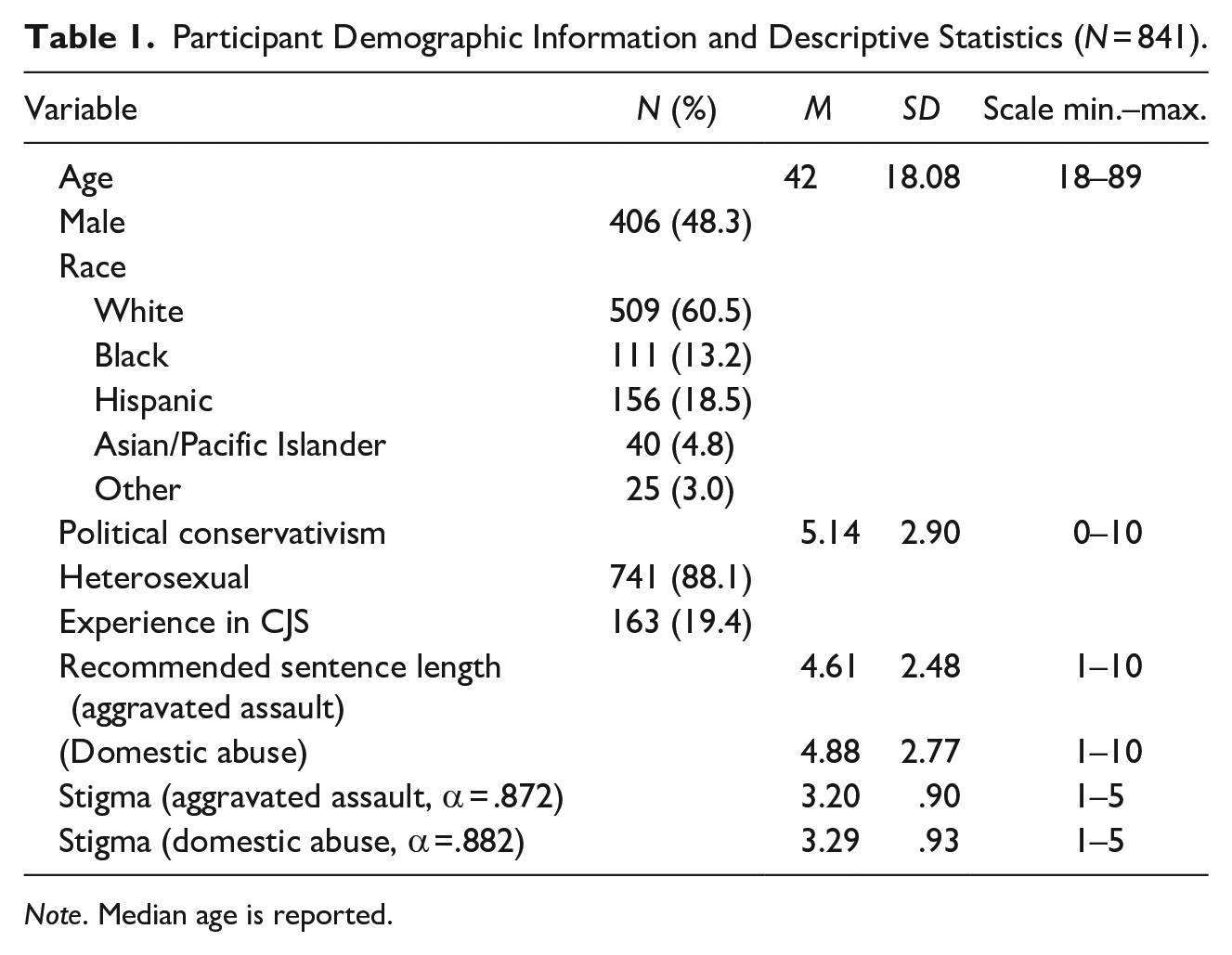
Note. Median age is reported.
Vignette Scenarios
Two experimental vignettes from the project were used for this study. Specifically, participants were presented with two vignettes portraying hypothetical cases of domestic violence. In both cases participants were asked to serve as a hypothetical jury foreperson and provide the presiding judge with sentencing recommendations. Participants were randomly assigned different treatment conditions in the vignettes for perpetrator sex (“male” vs. “female”), victim sex (“male” vs. “female”), and perpetrator sexuality (“heterosexual” vs. “homosexual”). The specific wording of the vignettes was as follows:
Vignette 1 (Aggravated Assault)
“Taylor Gray is a 28-year-old [man/woman] with no prior criminal record. [He/she] has been convicted of second-degree aggravated assault against [his/her] [ex-boyfriend/girlfriend]. Gray was arrested in [his/her] [ex-boyfriend’s/girlfriend’s] apartment complex shortly after the assault took place. The evidence against Gray, including security footage from the lobby and testimony from the [ex-boyfriend/girlfriend] leaves no doubt that [he/she] is guilty. The jury plans to convict [him/her] of assaulting [his/her] [ex-boyfriend/girlfriend], and, as jury foreman, the judge in the Gray case is now asking your opinion on the case itself and more specifically the sentencing.”
Vignette 2 (Domestic Abuse)
“Riley Brown has been arrested for domestic abuse after assaulting [his/her] [husband/wife]. [His/her] [husband/wife] had caught Brown cheating on [him/her]. After a short argument, Brown assaulted [his/her] [husband/wife], which attracted the attention of the pair’s neighbors. They called the police, who soon arrived and arrested Brown. After the conviction, as jury foreman, you were selected to assist the judge in deciding on Brown's sentence for assaulting [his/her] [husband/wife].”
Dependent Measure
Recommended Sentence Length
The outcome of interest for this study was recommended sentence length, a measure of punitivity. After reading each vignette, participants were asked to indicate the length of sentence, ranging from 1 to 10 years, that they believed was most appropriate for the hypothetical offender in the scenarios with which they were presented. Specifically, participants were asked: “Although the average sentence length for an individual with no prior record convicted of this type of crime is 5 years, [Gray/Brown] can be sentenced with between 1 and 10 years in prison. Please use the slider below to indicate the sentence that you believe is most appropriate for [Gray/Brown].”
Hypothesized Mediating Variable
Stigma
There have been four variants of stigma documented in the scholarly literature: (1) perceptions of dangerousness, (2) perceptions of blameworthiness, (3) perceptions of fatalism, and (4) desire for social distance (Kruis et al., 2021). Our measure of stigma captures all four dimensions. Specifically, participants were asked to report their level of agreement/disagreement with the following seven items: (1) “Someone like [Gray/Brown] is a threat to the safety of our community,” (2) “Although someone like [Gray/Brown] may seem all right, it is dangerous to forget that they are a criminal,” (3) “People like [Gray/Brown] are usually responsible for the criminal acts they commit,” (4) “If I knew someone like [Gray/Brown], I would try to avoid them,” (5) “It would bother me to live near someone like [Gray/Brown],”(6) “Even once someone like [Gray/Brown] serves their time, they will never fully reintegrate into society,” and (7) “Attempting to rehabilitate people like [Gray/Brown] with correctional social services seems futile (incapable of producing any useful result).” Responses were followed by a 5-point Likert scale ranging from “Strongly Disagree” (1) to “Strongly Agree” (5). Responses were summed and averaged to create a continuous measure with higher scores indicative of greater stigma placed onto perpetrators. Factor analysis indicated acceptable loadings for all items and reliability estimates suggested good internal consistency (α > .70).
Experimental Conditions
The independent variables in the vignettes included four dichotomous treatment conditions related to perpetrator sex (“male” vs. “female”), victim sex (“male” vs. “female”), and perpetrator sexuality (“heterosexual” vs. “homosexual”). These conditions were randomly varied between subjects. While prior research has examined the effects of perpetrator and victim sex on simulated juror decision making (c.f., Kruis et al., 2023), little work has explored the effects of perpetrator sexuality. Thus, we extend prior literature in this area.
Controls
A number of control variables were also included in analyses. Specifically, measures of age (18–89 years), sex (0 = “Female,” 1 = “Male”), race (0 = “White,” 1 = “Black,” 2 = “Hispanic,” 3 = “Asian or Pacific Islander,” and 4 = “Other”), political conservativism (0 = “left-leaning liberal” through 10 = “right-leaning conservative”), and sexual orientation (0 = “non heterosexual” and 1 = “heterosexual”) were included in analyses. We also included a measure capturing whether participants had ever been involved in a decision over another person suspected of a crime, such as serving on a jury, working for police, or assisting with prosecution. Participants were asked, “Have you had any experiences with the criminal justice system as a person responsible for an outcome of another individual suspected of crime, including investigating, arresting, prosecuting, convicting, or sentencing a person suspected of a crime (i.e., worked in the criminal justice system or served on a jury)?” Response options included 0 = “No” and 1 = “Yes.” Including such a variable enabled us to determine if perceptions of individuals who have actually made decisions over others in the system differed significantly from other simulated jurors in our sample, thus providing more robust findings that could be used to help generalize results to individuals who can, or who have, actually had the power to make decisions over others in the criminal justice system.
Analytic Approach
Data were analyzed using IBM SPSS and IBM SPSS AMOS versions 29. The analysis proceeded in five main steps. First, data were cleaned, and measures of central tendency and dispersion were analyzed. Second, factor analyses (i.e., Principal Axis Factor Analyses) and reliability estimations were used to help create our stigma measures. Third, t-tests were used to examine differences in mean scores in recommended sentence lengths between experimentally manipulated independent variables. Fourth, ordinary least squares (OLS) regression models were estimated to examine the direct effects of experimentally manipulated conditions on dependent measures at the multivariable level. A multi-step analysis was used to provide a preliminary examination of the mediating effects of stigma. 3 Fifth, path analyses completed in SPSS AMOS were used to assess the potential mediation effects stigma exhibited on the relationship between our independent and dependent measures. Missing data were controlled for using the regression imputation function in SPSS AMOS. 4
Results
Bivariate Findings
Table 2 displays findings from t-tests assessing statistical differences in mean scores for dependent measures by experimentally manipulated conditions. Statistically significant mean differences were found for perpetrator sex and victim sex in both vignettes (p ≤ .05), but not for perpetrator sexuality in either vignette (p > .05). Regarding recommended sentence length for the aggravated assault case, male perpetrators (M = 4.97, SD = 2.46) received longer recommended sentences than did female perpetrators (M = 4.25, SD = 2.46, p ≤ .001). Those who victimized men (M = 4.39, SD = 2.50) received shorter sentences than those who victimized women (M = 4.81, SD = 2.45, p ≤ .05). Similar findings were noted in the domestic abuse case, with male perpetrators (M = 5.11, SD = 2.76) given longer sentences than female perpetrators (M = 4.64, SD = 2.76, p ≤ .05), and perpetrators who victimized men (M = 4.40, SD = 2.62) given shorter sentences than perpetrators who victimized women (M = 5.37, SD = 2.83, p ≤ .001).
Descriptive Statistics and Results from t-tests Comparing Mean Scores for Recommended Sentence Length.
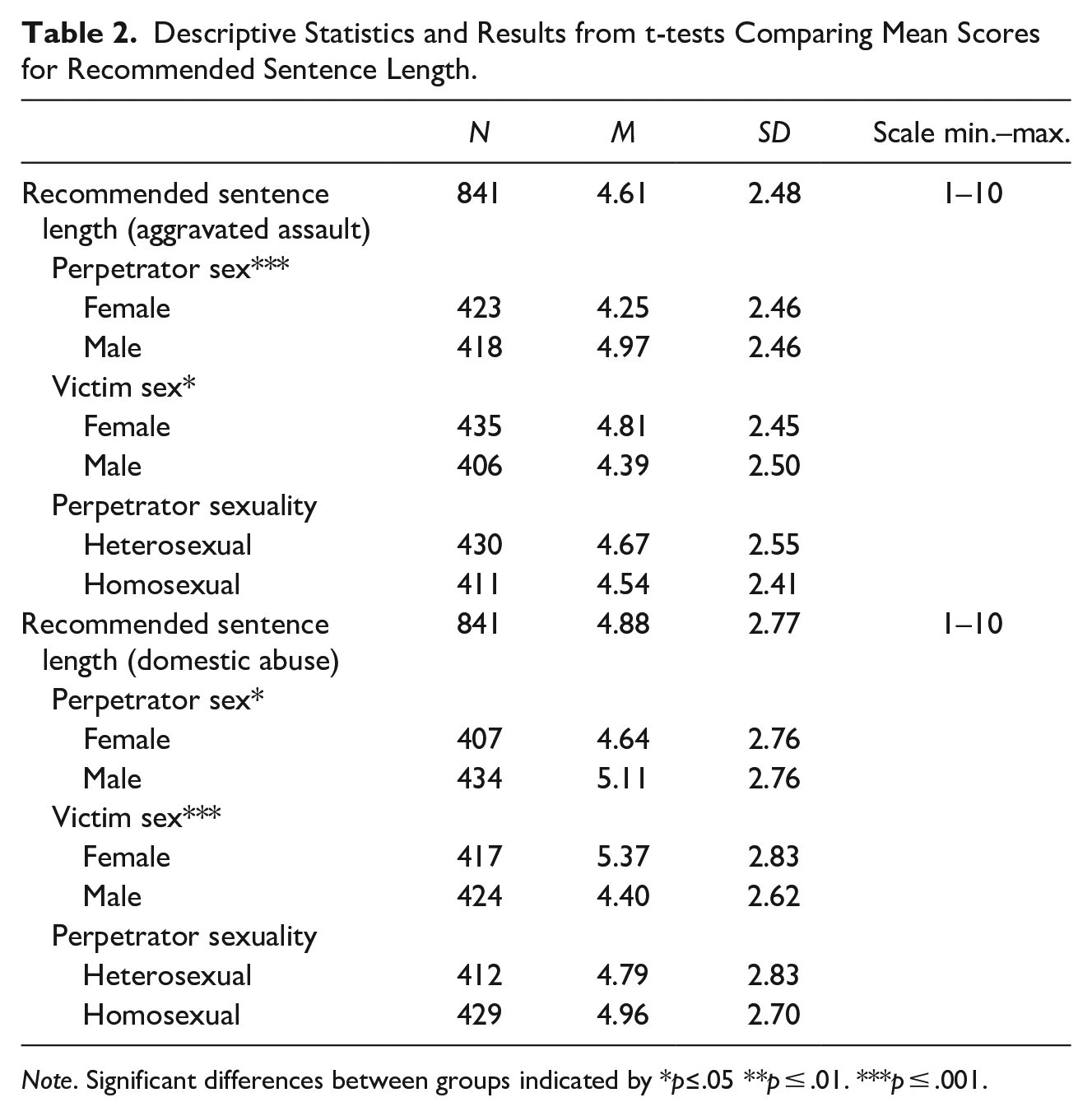
Note. Significant differences between groups indicated by *p≤.05 **p ≤ .01. ***p ≤ .001.
Multivariable Direct Effects
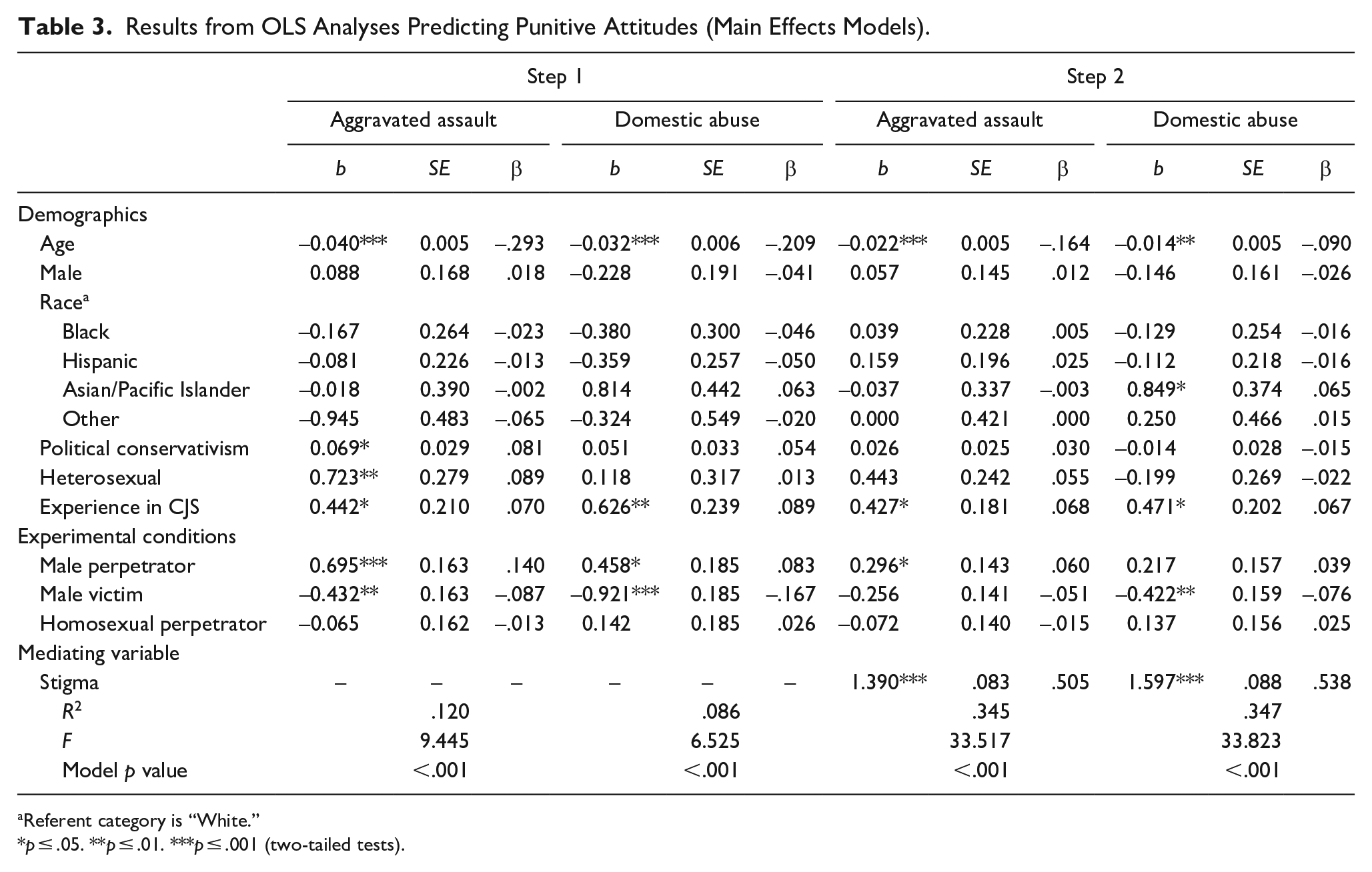
Table 3 displays results from OLS modeling regressing recommended sentence lengths onto predictor variables. Step 1 of the analysis examined the effects of variables on outcomes independent of stigma. Regarding aggravated assault, participants imposed longer sentencing recommendations onto male perpetrators (b = 0.695, p ≤ .001) and perpetrators who victimized women (b = −0.432, p ≤ .01). Findings also revealed that heterosexual (b = 0.723, p ≤ .01) and conservative participants (b = 0.069, p ≤ .05) imposed longer sentence recommendations, as did those who had experience as a decision-maker in the criminal justice system (b = 0.442, p ≤ .05). Older participants expressed a desire for shorter sentences compared to younger participants (b = −0.040, p ≤ .001). Similar findings were noted for domestic abuse, with male perpetrators (b = 0.458, p ≤ .05) and perpetrators who victimized women (b = −0.921, p ≤ .001) receiving longer sentencing recommendations than female perpetrators and those who victimized men. Participants who had experience as a decision-maker in the criminal justice system (b = 0.626, p ≤ .01) recommended longer sentences than those without experience, and older participants recommended shorter sentences (b = −0.032, p ≤ .001) than younger participants.
Results from OLS Analyses Predicting Punitive Attitudes (Main Effects Models).
Referent category is “White.”
p ≤ .05. **p ≤ .01. ***p ≤ .001 (two-tailed tests).
Mediation Effects
The final step in our analyses involved examining the mediation effects of stigma on recommended sentence lengths. Step 2 in Table 3 shows findings from the first part of this analysis. The inclusion of our stigma measure resulted in a significant increase in the R2 values in both models and diminished the effects of experimentally manipulated predictors on outcome measures. Regarding aggravated assault, victim sex (b = −0.256, p > .05) was no longer a significant predictor in the model with the inclusion of stigma, and the effects for perpetrator sex were lowered from the baseline model (b = 0.296 and β = .060, p ≤ .05). Regarding domestic abuse, perpetrator sex (b = 0.217, p > .05) was no longer significant and the effects for victim sex were lowered from the baseline model (b = −0.422 and β = −.076, p ≤ .01). Stigma was the strongest direct predictor in both models (b = 1.390, β = .505, p ≤ .001 and b = 1.597, β = .538, p ≤ .001, respectively).
Table 4 displays results from path analyses estimating the indirect effects of our experimentally manipulated variables, and the mediating effects of stigma, on recommended sentencing lengths. The first rows in the table display findings from analyses regressing our measures of stigma onto experimentally manipulated predictors. As anticipated, perpetrator sex and victim sex were statistically significant predictors of stigma in both models (p ≤ .05), however, perpetrator sexuality was not related to stigma (p > .05). Findings reveal that participants placed greater stigma onto male perpetrators and those who victimized women. The bottom rows in Table 4 show the indirect effects of experimentally manipulated predictors on outcome measures through stigma. As hypothesized, a significant indirect relationship was found for perpetrator sex and aggravated assault sentencing recommendation through stigma (b = 0.425, p ≤ .01), suggesting a partially mediating effect. Mediation effects were also found for the relationship between perpetrator sex and domestic abuse sentencing recommendation through stigma (b = 0.251, p ≤ .05), and between victim sex and domestic abuse sentencing recommendation through stigma (b = −0.540, p ≤ .01). These findings reveal that some, but not all, of the sentencing disparities observed in baseline modeling can be explained by disparate levels of stigma participants placed onto male perpetrators and perpetrators who victimized women. Figures 1 and 2 provide a visual display of these relationships.
Results From Path Analysis Assessing Mediation Effects.
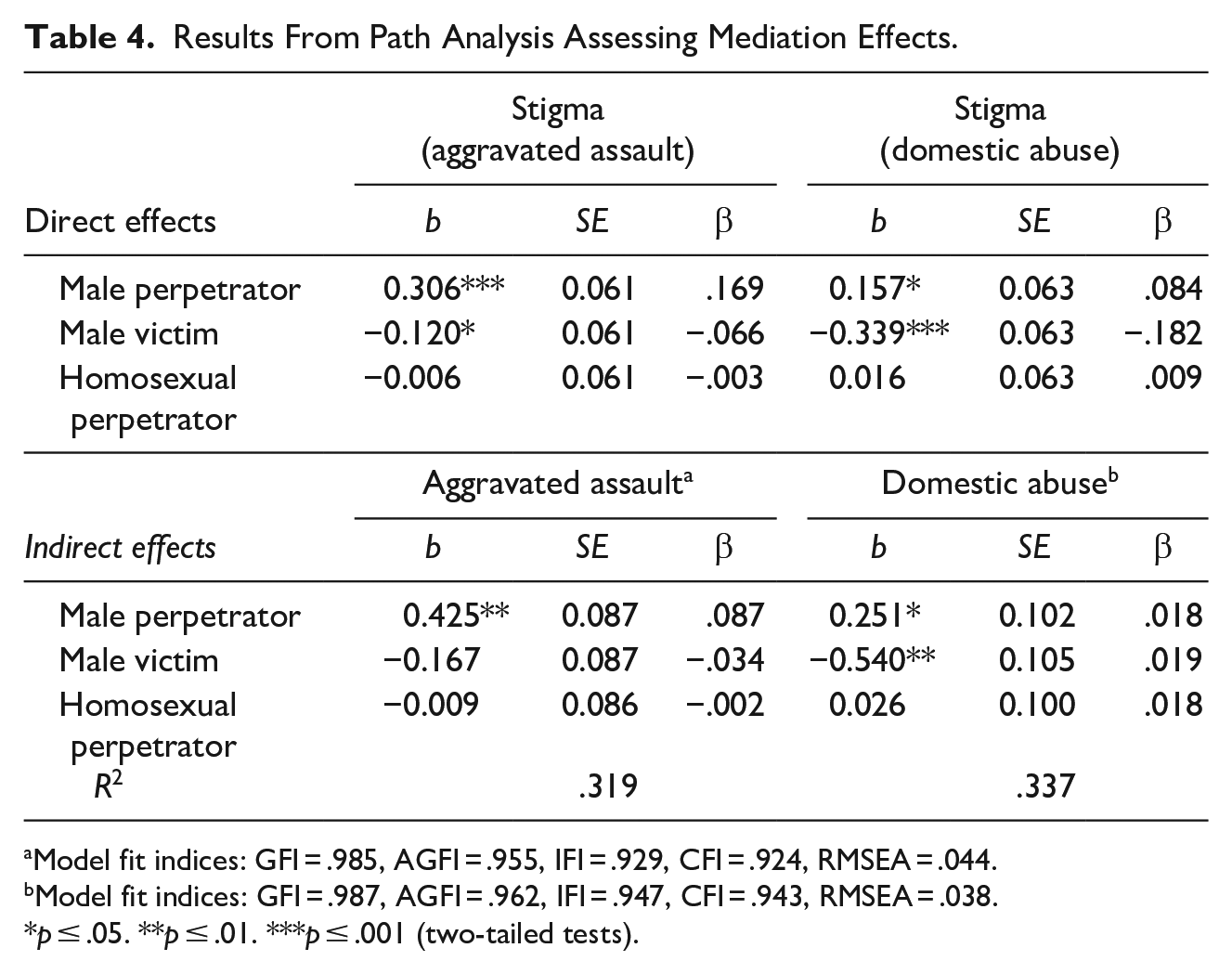
Model fit indices: GFI = .985, AGFI = .955, IFI = .929, CFI = .924, RMSEA = .044.
Model fit indices: GFI = .987, AGFI = .962, IFI = .947, CFI = .943, RMSEA = .038.
p ≤ .05. **p ≤ .01. ***p ≤ .001 (two-tailed tests).
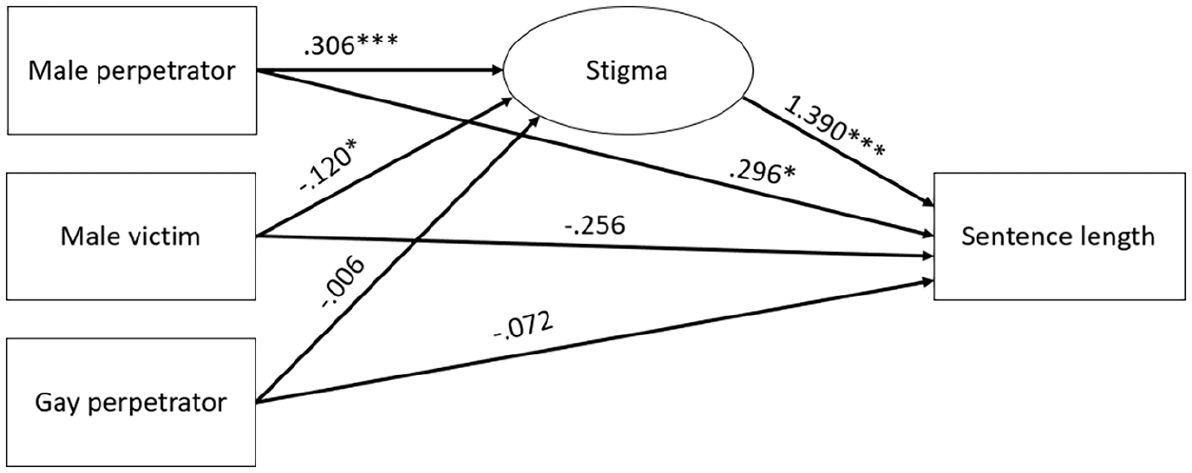
Visual display of path analysis examining mediation effects of stigma on recommended sentence length for aggravated assault.
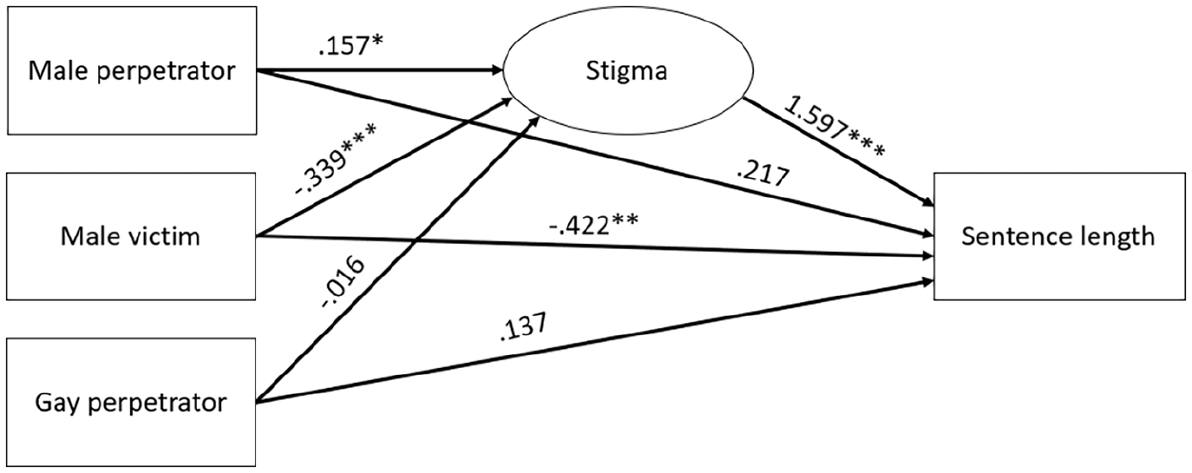
Visual display of path analysis examining mediation effects of stigma on recommended sentence length for domestic abuse.
Discussion
Guided by attribution theory (Hawkins, 1981; Shaver, 2016), focal concerns in sentencing (Steffensmeier et al., 1998), and prior research (Russell et al., 2015; Stanziani et al., 2018), this study had two main objectives: (1) to analyze the effects of perpetrator sex, perpetrator sexuality, and victim sex on simulated jurors sentencing recommendations, and (2) to determine if sentencing disparities documented in previous studies (Brown, 2004; Freiburger & Romain, 2018; Mele, 2018) could be explained by differential rates of criminal stigma participants attributed to IPV offenders. Mostly consistent with theory and our first hypothesis, perpetrator sex and victim sex were significantly related to sentencing recommendations. However, perpetrator sexuality was unrelated to participants’ judgments of punitivity. In support of our second hypothesis and the tenets of attribution theory and focal concerns perspective, criminal stigma was found to exhibit mediation effects – both fully and partially – on the relationship between perpetrator sex and recommended sentence length, and victim sex and recommended sentence length. These findings have several important research and policy implications meriting further discussion.
First, perpetrator sex and victim sex were significantly related to sentencing recommendations consistent with our hypothesis, attributional theory, and focal concerns. We found participants recommended longer sentences for male perpetrators and for perpetrators who victimized women. On average, male perpetrators received sentencing recommendations that were about 6 months longer than sentencing recommendations female perpetrators received. However, perpetrators who victimized men received sentencing recommendations that were more than 4 months shorter than perpetrators who victimized women. These findings are consistent with prior research demonstrating misandry in juror simulations (Mele, 2018; Stanziani et al., 2018) and the criminal justice system (Brown, 2004; Freiburger & Romain, 2018; Hirschel & Buzawa, 2009), and illustrating that legally irrelevant variables influence perceptions of punitivity.
Because prior research found society stigmatizes and discriminates against sexual minorities (Adamczyk & Liao, 2019; Meyer et al., 2017; Noga-Styron et al., 2012; Wilson et al., 2017), it was hypothesized that they would be perceived as more blameworthy, and thus receive longer sentencing recommendations, in line with attribution theory and the focal concerns model. However, contrary to expectations, perpetrator sexuality was unrelated to sentencing recommendations imposed by participants; heterosexual perpetrators received similar sentencing recommendations to homosexual perpetrators in both bivariate and multivariable models. Further, a series of interactive effects completed as auxiliary analyses (e.g., perpetrator sex × perpetrator sexuality; not shown) were not significant. These findings suggest that offender sexuality is unrelated to perceptions of punitivity. In the aggregate, participants’ sentencing decisions were not subconsciously, or consciously, influenced by perpetrator sexuality. Failure to find support may be due to the public (Russell et al., 2015; Stanziani et al., 2018) and criminal justice professionals’ perception that same-sex IPV is less serious (Ciarlante & Fountain, 2010; Russell, 2018). Alternatively, social desirability bias (Fisher & Katz, 2000) may have dissuaded participants from making more negative judgements or attributions concerning sexual minorities.
Second, consistent with attribution theory and focal concerns which suggest offenders who are viewed as more dangerous and blameworthy (i.e., criminally stigmatized) deserve greater sanctions (Steffensmeier et al., 1998), results showed that participants attributed greater stigma to male perpetrators and those who victimized women, and this stigma exhibited mediation effects on perpetrator sex and victim sex and our outcome measures. Further, the direct substantive effects of stigma trumped the effects of all other variables included in modeling. This finding is consistent with our earlier work and demonstrates how stigma experienced by certain types of offenders can be used as a salient attribute in criminal justice decision making resulting in discriminatory treatment (Kruis et al., 2023). That said, even controlling for stigma, male perpetrators still received statistically significantly longer sentences in the aggravated assault case, and perpetrators who victimized men still received statistically significantly shorter sentences in the domestic abuse case, suggesting criminal stigmatization does not fully explain disparities found in the modeling. Thus, future work should explore other factors that may be responsible for differences in levels of punitivity attributed to men, as current findings suggest criminal stigma (i.e., perceptions of dangerousness and blameworthiness) alone does not account for this difference.
The implications of these findings in line with prior research are important: Men experience bias in the criminal justice system as both offenders and victims of IPV. Consistent with prior research, male offenders, in particular, experience biased criminal justice responses merely because of who they are and not what they did (Brown, 2004; Cox et al., 2022; Kruis et al., 2023; Shernock & Russell, 2012; Russell, 2018). Implicit and explicit misandry present within decision-makers in the justice system contributes to the systemic discrimination of men involved with the justice system – a system that is supposed to be rooted in impartiality and fundamental fairness. No one should be punished more severely because of their demographic background. Only legally relevant case variables should influence decisions in the justice system. Perhaps the most concerning finding, which replicates prior work (Cox et al., 2022; Russell, 2018), is that these results included, and controlled for, a sub-sample of participants who have been decision-makers in the justice system, suggesting that these biases are present within actual, not hypothetical, decision-makers. We argue that a two-prong approach is needed to reduce stigma and sex bias in the public in general, as well as that found in and perpetuated by the criminal justice system itself.
Policy Implications
Given the role stigma plays in men receiving harsher sanctions as IPV offenders, and reduced support as IPV victims, practical and educational changes are needed. First, male IPV offenders are subject to bias in law enforcement and sentencing decision practices resulting in harsher sanctions (Brown, 2004; Hamilton & Worthen, 2011). Although women and sexual minorities are perceived as less “dangerous” (Felson & Feld, 2009; Leiber et al., 2018; Sorenson & Thomas, 2009) and in one study women had fewer risk factors associated with recidivism than did men (Henning & Feder, 2004), such differences do not justify the harsher view and treatment of male IPV offenders. Men should receive sentencing consistent with their actions, not their demographics. No offender should be subjected to greater or lesser stigma, and subsequently treatment, because of their demographic background. Allowing such treatment to exist in the criminal justice system is discriminatory, and arguably, a violation of the Fourteenth Amendment’s Equal Protection Clause. It is perhaps because of this bias that research on the effectiveness of intervention programs for IPV offenders finds results equivocal in their ability to reduce recidivism (Cannon et al., 2016; Dutton, 2012; Eckhardt et al., 2013). As such, we recommend more frequent statistical reviews of criminal processing to test for gender-based, and other forms, of bias in case processing and outcomes. We also support increased professional training and public awareness campaigns on bias, institutional sexism, and training for supporting male survivors. Regarding the latter, one promising training tool is the Serving Male Survivors workshop administered by the National Resource Center on Domestic Violence (n.d.).
Additionally, while women and sexual minorities may receive more lenient or equivocal treatment in some cases, the system is ill-equipped to deal with them as offenders (Cannon et al., 2016; Hines & Douglas, 2009). For instance, studies find domestic violence batterer intervention programs have insufficient services for women and LGBTQ perpetrators (Cannon, 2019; Cannon et al., 2016). Further, although some actuarial tools have been validated for use with women (e.g., the Ontario Domestic abuse Risk Assessment; Hilton et al., 2014), because most actuarial tools have been developed with samples of men who assault their female partners, some researchers question their validity with women and same-sex perpetrators (Edwards et al., 2015; Van Voorhis et al., 2010). Thus, continued evaluation of offender programs and use of best practices based on empirical research is recommended.
Second, but equally important, male and sexual minority IPV victims may not be perceived of as “legitimate” victims in need of intervention and services because they do not fit the heteronormative stereotype. Clearly, awareness and education campaigns are needed to inform the general public, from which jurors are drawn, as well as the actors in the criminal justice system about the realities of IPV. Notably, it is a serious and pervasive crime with devastating consequences to all victims, including men and sexual minorities (Black, 2011; Peterson et al., 2018; Walters et al., 2013). Yet, research finds the public perceives partner assaults as less serious than assaults by strangers (Horstman et al., 2021). Further, vignette studies find domestic abuses committed against men and sexual minorities are considered even less serious (Russell et al., 2015; Stanziani et al., 2018) and witnesses and third parties are less likely to call police (Felson & Paré, 2005; Stanziani et al., 2018). Police officers are also less likely to intervene when the victim is a male or a sexual minority (Brown, 2004; Ciarlante & Fountain, 2010; Hirschel & Buzawa, 2009) and when they do, fewer services are provided (Ford et al., 2013; Samons, 2012). Thus, the public and criminal justice professionals need to be informed about the extent of violence committed against heterosexual men and sexual minorities to ensure sufficient and appropriate responses. Research finds men and sexual minorities face many barriers in seeking help (Calton et al., 2016; Huntley et al., 2019; Tsui, 2014) and that victims services (Hine et al., 2022b; Wallace, 2014), supportive police response (Kuehnle & Sullivan, 2001), and affirmative legal services (Ford et al., 2013; Samons, 2012) are needed.
This study had many strengths including being theoretically driven, having a large national sample, and strong statistical analyses. Nonetheless, there are limitations that must be considered. Most notably, the data are cross-sectional, and as such, temporal ordering cannot be established between predictor, mediating, and outcome variables. Future work should attempt to replicate these findings using longitudinal data. Also, we only examined the effects of homosexual and heterosexual sexual identifications and did not explore the full spectrum of gender identifications. Given research finds transgender status affects mock jurors’ decision making (Ringger, 2021), we encourage other researchers to look into the effects of additional gender-and sexuality-based identifications, as well as the interactions between them, both within perpetrators and victims, on sentencing recommendations. Likewise, future work should also include other extralegal variables found to influence sentencing outcomes, such as perpetrator and victim race (Cassidy & Rydberg, 2020; Spohn, 2018; Steffensmeier & Demuth, 2006; Ulmer et al., 2020). It would be interesting to examine the additive and multiplicative effects of race/ethnicity on IPV cases, given results on sentencing outcomes more generally. It would also be useful to test other theories, such as the chivalry hypothesis, more directly in future studies.
In conclusion, our findings contribute to a growing literature demonstrating that male IPV offenders are viewed more negatively and treated more harshly than female offenders. Further, consistent with attributional theory and focal concerns perspective, results show that the differential treatment of male IPV offenders is partially explained by differential amounts of criminal stigma attributed to male offenders. Thus, this work highlights the need for policy change and awareness programs designed to provide more equitable sanctions to IPV offenders and improve treatment for male survivors, while also educating the public and members of the criminal justice system and correcting misperceptions of IPV. To reduce the disparity experienced by male offenders and victims of IPV, evidenced-based practices and programs within the community and the criminal justice system are needed.
Footnotes
Declaration of Conflicting Interests
The author(s) declared no potential conflicts of interest with respect to the research, authorship, and/or publication of this article.
Funding
The author(s) disclosed receipt of the following financial support for the research, authorship, and/or publication of this article: This work was supported by a Senior Research Grant from Penn State Altoona’s Office of Office of Research and Engagement.
