



Abstract
Sexual assault is a worldwide issue that impacts many individuals, often with serious and long-lasting effects. Police play an important role for victims seeking justice. However, police response has been highly criticized as less than optimal. One question that remains unclear is whether sexual assault training improves police response. This quantitative review examined the effect of police training on diverse police outcomes. Five databases were systematically searched, which resulted in 10 published papers reporting on 12 studies. Our review found consistent evidence that suggests that sexual assault police training can improve various police attitudes, knowledge, and behaviors. However, further research is needed before specific recommendations regarding training can be made.
Introduction
Sexual assault is a gendered crime affecting approximately one in three women (36.5%) globally, with varying prevalence estimates among countries (Borumandnia et al., 2020). The trauma and negative effects of sexual assault have been widely documented and can have lifelong deleterious effects on survivors (Haskell & Randall, 2019; McQueen et al., 2021). To attain criminal justice for sexual victimization, survivors must report the assault to the police to initiate an investigation, ensure immediate safety, and determine if there are reasonable grounds to render a charge (Spohn et al., 2014). However, police officers have received considerable scrutiny regarding their response to sexual assault (Doolittle et al., 2017). Officers have been described as heartless, blaming, and dismissive of survivors (Lorenz et al., 2019; Lorenz & Jacobsen, 2021), resulting in secondary victimization (Lorenz et al., 2019). To improve police repose and mitigate secondary victimization, the need for police training in responding to sexual assault has been frequently cited (Lapsey et al., 2022; Rich, 2019; Venema, 2019). Likewise, research from the police themselves has also indicated that police training is insufficient to prepare them for interviewing sexual assault survivors (Haskell & Randall, 2019; Murphy-Oikonen et al., 2022). Thus, the purpose of this systematic review was to synthesize and appraise the literature on the effect of sexual assault police training interventions.
Police officers have been deemed gatekeepers to justice in sexual assault cases (Spohn & Tellis, 2019). Concerns have been raised about the power that police officers have in the sexual assault investigation process (Doolittle et al., 2017), as guidelines for investigations are not universal (Branch, 2021). Related research on police practice in interviews found that some police officers did not follow existing guidelines, rarely established rapport, used primarily closed versus open-ended questions, did not elicit a free narrative, and had negative interview behaviors such as frequent interruptions (Schreiber Compo et al., 2012; Snook & Keating, 2011).
First-hand accounts from police officers concur that police practice in responding to sexual assault is variable (Murphy-Oikonen, Chambers, McQueen et al., 2022). While some police officers are diligent with a robust investigation (Murphy-Oikonen et al., 2022), others make premature assumptions about the veracity of victims’ claims and close cases prior to a thorough investigation (Maddox et al., 2012; Spohn et al., 2014). Similarly, not all police officers share the same views toward survivors of sexual assault as there is a wealth of literature exposing some officers for adhering to rape myths (Garza & Franklin, 2021; Lapsey et al., 2022) resulting in challenges to the investigative process. Rape myth acceptance among police officers creates skepticism in investigations (Garza & Franklin, 2021; Spohn et al., 2014), infiltrates the victim interview process (Garza & Franklin, 2021; Venema, 2018), and leads to secondary victimization among survivors (Lorenz et al., 2019).
Improving police response to sexual assault is of paramount importance for both survivors and the justice system. Evidence indicates that sexual assault is grossly underestimated, as only 13% of sexual assaults are reported to the police (Perreault, 2020). Victims have expressed numerous reasons for the lack of reporting, including shame, risk of retribution, and fear that the police will not believe their accounts (Department of Justice Canada, 2019; Rotenberg, 2017). Furthermore, few sexual assault cases result in conviction (Rotenberg, 2017), creating distrust among survivors of sexual assault that police officers will attain justice in their case (McQueen et al., 2021; Quinlan, 2016). Sexual assault survivors report negative experiences with reporting to the police (Doolittle et al., 2017; Lorenz & Jacobsen, 2021) as they often feel blamed for the assault (Department of Justice Canada, 2019), doubted due to their credibility (Morabito et al., 2019), and disbelieved (Spohn et al., 2014).
To address the challenges in police response to sexual assault, many have advocated for increased training for police officers (Lapsey et al., 2022; Rich, 2019; Venema, 2019). For example, the Department of Justice (Haskell & Randall, 2019) has highlighted that a trauma-informed response to sexual assault survivors is lacking among police officers, and further learning is required regarding compassionate approaches. Others have advocated for improved interviewing skills (Venema, 2016) and training to address police culture, including a focus on high rape myth acceptance (Hine & Murphy, 2019). Police officers have also indicated that more training is needed to better understand trauma (Venema, 2016) and the sexual assault investigative process (Kinney et al., 2007). Many police organizations have been making conscious attempts to improve the experience for survivors. However, prior research on police training suggests that the evidence concerning sexual assault training is mixed, specifically regarding attitudes (Sleath & Bull, 2017). In particular, the relationship between police training and police attitudes such as ascribing responsibility for the assault onto the victim (e.g., victim blaming) and rape myth acceptance have been studied with diverse findings (Darwinkel et al., 2013; Kinney et al., 2007; Sleath & Bull, 2017). This has led some researchers to question whether attitudes may be modified with training (Lonsway et al., 2001; Lorenz & Maskaly, 2018). Various factors may influence the mixed findings on sexual assault training including diverse methodologies (e.g., cross sectional versus experimental designs), types of training (e.g., content and duration), and outcome measures (e.g., reliability).
One question that currently remains equivocal is whether sexual assault investigation police training improves police outcomes. To date, no systematic review of this literature has been completed. As such, the purpose of this quantitative systematic review was to examine the effect of sexual assault training on diverse police outcomes. We used the broad term of “police outcomes” to capture the various police related outcomes measures that are evaluated in training studies, such as knowledge, rape myth acceptance, interviewing behaviors, etc. This review will benefit law enforcement agencies and other diverse groups by synthesizing the evidence from experimental studies on sexual assault training and police outcomes, to inform decision-making for training, curriculum development, policy, and future research.
Methods
Data Sources and Search Strategy
The search strategy aimed to find published studies that were peer-reviewed. A three-step search strategy was used with assistance from the university librarian. An initial limited search was conducted in google scholar for key articles, followed by an analysis of the keywords found in the title and abstract. A second search using keywords was undertaken across all included databases. The subject terms included, “Sexual assault” OR rape OR “sexual victimization” OR “sexual abuse” OR “sexual assault investigation*” OR “sexual assault interviewing,” combined with, training or train* OR learning or learn* OR education OR “professional development” OR “trauma-informed training” OR interviewing OR “investigative interviewing” OR “whole story training” OR “police education,” AND police OR “law enforcement” OR policing. Lastly, to ensure relevant articles had not been missed, the reference lists of included studies were reviewed and a cursory search of google scholar was conducted for additional articles relevant to the initial search.
The electronic databases Sociological Abstracts (abstracts), Web of Science, Social Service Abstracts (abstracts), Lexis Advanced Quick Law Plus (secondary materials), and Hein Online (Criminal Justice and Criminology Collection) were searched from 1997 to December 2022. Twenty-five years was selected as a sufficient time frame for a thorough review of the literature.
Eligibility Criteria
The review followed the Preferred Reporting Items for Systematic Reviews and Meta-analysis (PRISMA) statement (Moher, 2009). Studies were eligible for inclusion in the review if the: (1) study evaluated the effect of a sexual assault training intervention/program on police officer outcomes, (2) sample included police officers and/or recruits, (3) design was experimental including randomized controlled trials, quasi-experimental, cohort, and pre and post-test, and (4) articles were published in English in a peer reviewed journal within the last 25 years, from January 1, 1997 to December 31, 2022. Exclusion criteria included cross sectional and correlational studies evaluating the relationships between training and police outcomes. Studies that solely focus on police training for responding to child victims of sexual assault were excluded from this systematic review.
Data Management and Study Selection
The first author uploaded all studies from the search into Covidence software for systematic reviews and duplicates were removed. Two members of the research team independently screened the title, abstracts, and full-text articles for inclusion in the systematic review. Conflicts were resolved through discussion and re-review of the article to achieve consensus. All excluded studies were reviewed by a research assistant to confirm exclusion decisions. Upon further review, no studies from the excluded folder met the inclusion criteria.
Data Extraction
All quantitative data relevant to the research purpose was extracted from full-text studies independently by two authors using standardized templates for this review. The templates included a total of 18 items that provided information specific to the studies (e.g., author, country, year, purpose, design, and total sample size), specifics of police training (type of training, duration and frequency, mode of delivery, mandatory [yes/no], who delivered the training), training groups (number of participants for intervention and control group if applicable), outcome variables, measurement tools, psychometric properties, and findings. The extracted data were compared, and differences were discussed until a consensus was obtained. Given the diversity in training interventions, outcomes evaluated, and outcome measures, the data were synthesized narratively rather than using meta-analytic methods.
Results
The search yielded a total of 10 published articles reporting on 12 studies that evaluated the effect of police training on diverse police outcomes. Two of the published articles included two studies that were analyzed independently (Lonsway et al., 2001; Tidmarsh et al., 2021a). See Figure 1 for the PRISMA flow diagram outlining the screening, selection of studies for inclusion and reasons for exclusion.
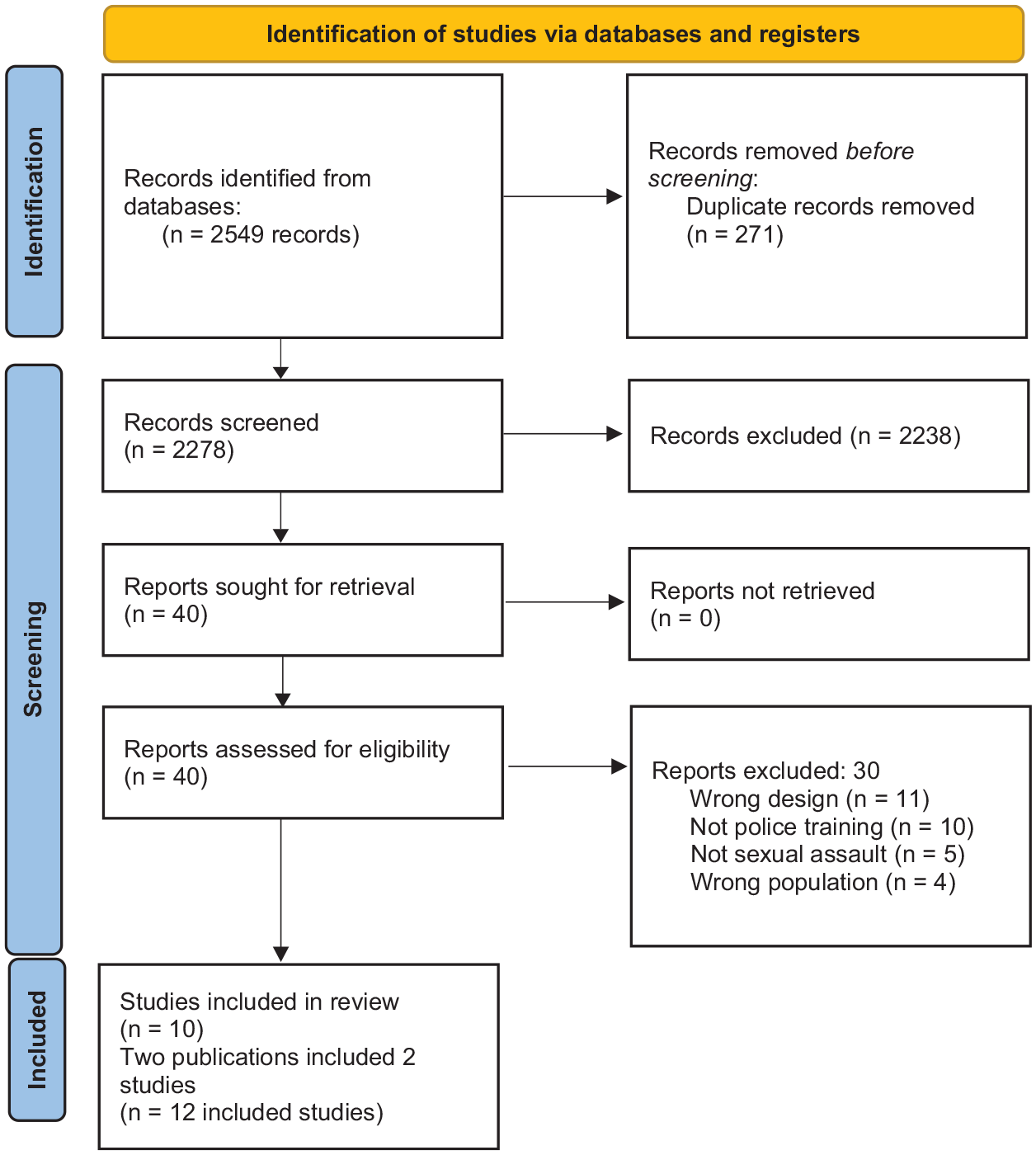
PRISMA flow diagram.
Characteristics of Included Studies
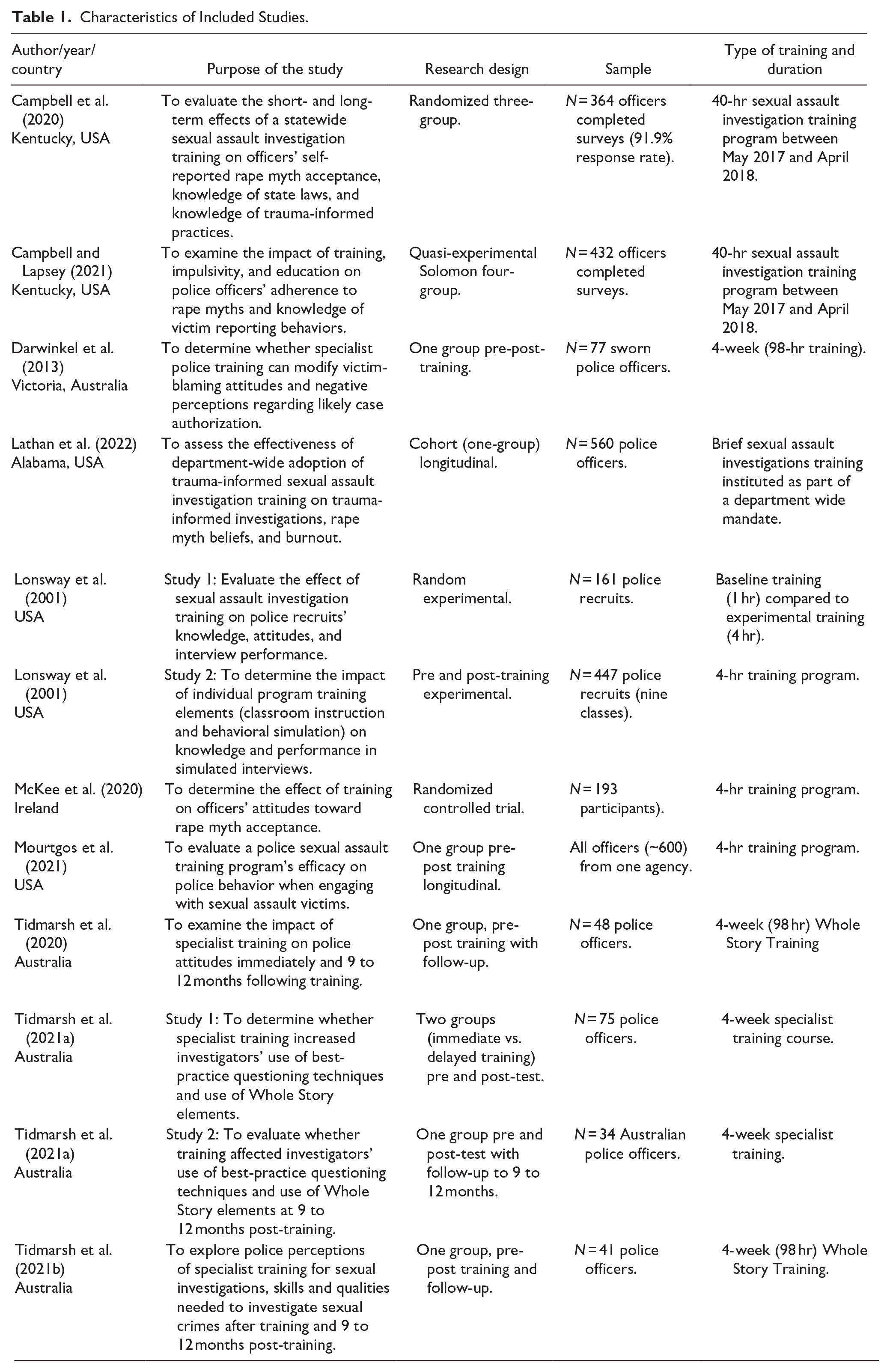
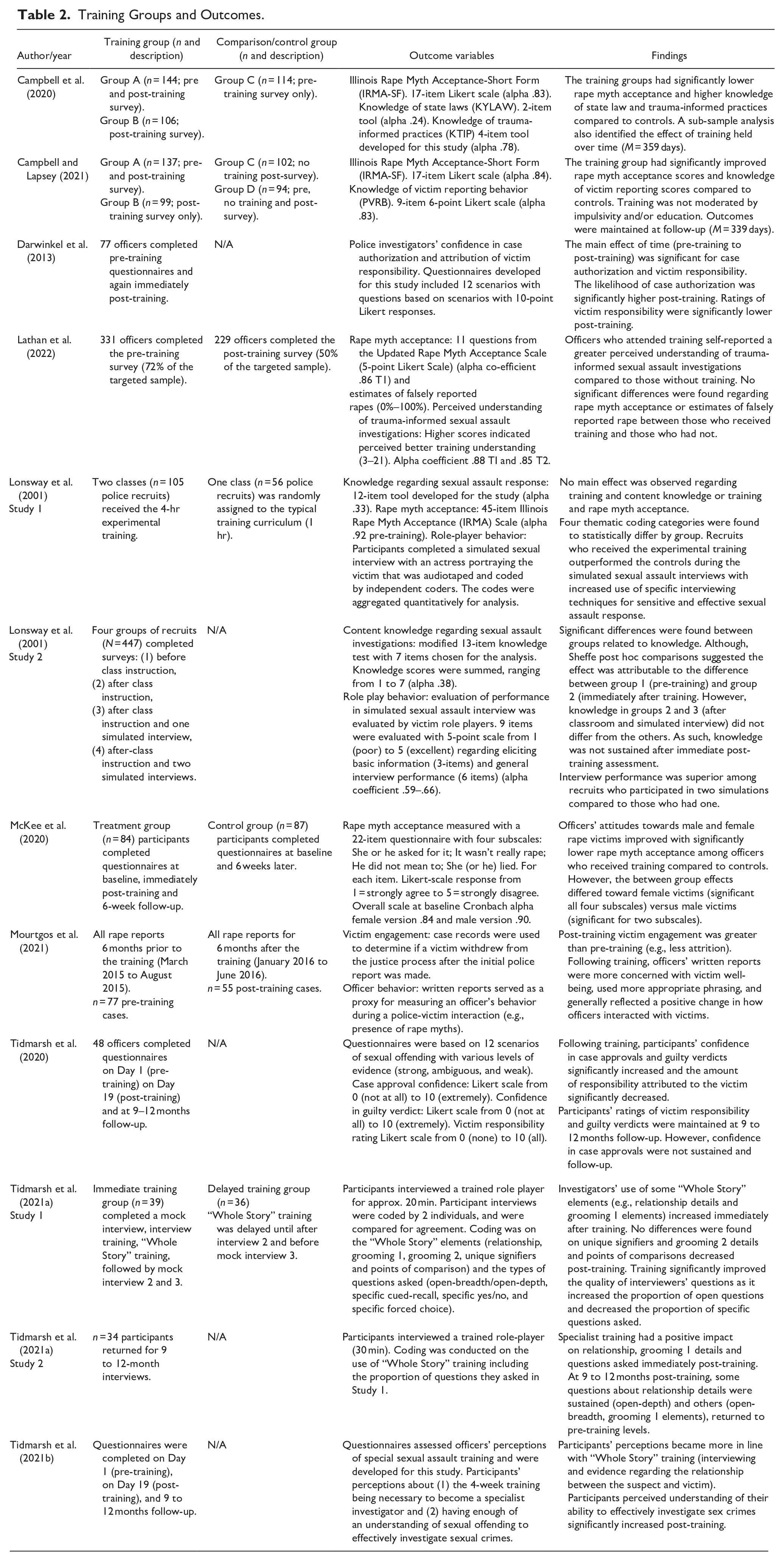
The characteristics of the 12 included studies are provided in Table 1. Studies were conducted in Australia (n = 5), the United States (n = 6), and Northern Ireland (n = 1). All studies were prospective and included a pre-test, post-test intervention design. Six of the studies had at least one treatment and control group, of which four used randomization for group allocation (Campbell et al., 2020; Campbell & Lapsey, 2021; Lonsway et al., 2001; McKee et al., 2020). The other six studies utilized a one-group pre-test and post-test training design. For these studies, the pre-training group/questionnaire served as the baseline/control. Sample sizes (N) ranged from 41 to ~600 police officers. The police outcomes were primarily evaluated with participant questionnaires or observation of interviews. One study extracted data from police records prior to and after training (Mourtgos et al., 2021). See Table 2 for a description of the study groups.
Characteristics of Included Studies.
Training Groups and Outcomes.
Characteristics of Participants
The characteristics of the participants in the included studies were diverse. Two studies evaluated police recruits (Lonsway et al., 2001) (study 1 and study 2), one study combined recruits with officers (McKee et al., 2020), and all other studies were sworn police officers. In all studies, there were substantially more male officers than female officers. For most studies, there was diversity in officer rank and experience; however, in two of the studies, the police officers (Tidmarsh et al., 2021a) and recruits (Lonsway et al., 2001) had little to no sexual assault investigation experience.
Police Training
All training was conducted face-to-face, with the exception of McKee et al. (2020), who used a combination of in-person and online training. In the majority of studies, training was conducted by a variety of individuals. All studies included experienced police officers (e.g., investigators, lieutenant) conducting some components of training; others included specialists with experience on the impact of sexual abuse on victims (Darwinkel et al., 2013); victim advocates (Lathan et al., 2022); faculty (Lonsway et al., 2001); and a psychologist, forensic medical examiner, and sexual assault counselor (Tidmarsh et al., 2020). The training methods were also diverse and included lectures, discussions, videos, role-playing, and interviewing. The content and duration of training varied between studies. The requirements regarding who received training also varied among studies, with some studies reporting mandatory training for all officers and recruits (Lathan et al., 2022; Lonsway et al., 2001; Mourtgos et al., 2021), others reported on training required for investigators (Darwinkel et al., 2013; Tidmarsh et al., 2020, 2021a, 2021b), and training required for a minimum number of designates based on department size (Campbell et al., 2020; Campbell & Lapsey, 2021).
Brief Training
In five of the studies, the training was brief (≤4 hr) (Lathan et al., 2022; Lonsway et al., 2001; McKee et al., 2020; Mourtgos et al., 2021). In most cases, the training was mandatory for all officers apart from McKee et al. (2020) which was voluntary. While the sexual assault training differed by study, there was a focus on similar topics such as sexual assault law, neurobiology of sexual assault, attitudes, investigation, and interviewing.
Forty-Hour Training
Two studies had 40 hours of sexual assault training (Campbell et al., 2020; Campbell & Lapsey, 2021). This specific training program was developed by the Kentucky Department of Criminal Justice Training (KYDICJT) as states such as Kentucky and Illinois adopted legislation mandating sexual assault training for law enforcement (Campbell et al., 2020). The 40-hr training included many of the same topics as the brief training, including laws, trauma-informed responses to victims, and investigative techniques, and also included content on rape myths.
Specialized Training with a Focus on “Whole Story.”
Five studies included a 4-week (98-hr) training program (Darwinkel et al., 2013; Tidmarsh et al., 2020, 2021a, 2021b). The training program focused on the dynamics of sexual offending and included the “Whole Story” framework. The “Whole Story” framework was developed by the Specialist Development Unit of the Sexual Offence and Child abuse Investigation Team (SOCIT) Project (Tidmarsh et al., 2012). “Whole Story” training emphasizes the importance of understanding the “relationship” which is driven and manipulated by perpetrators (Darwinkel et al., 2013) and obtaining relationship information as an important aspect of the victim interview. The 4-week training also included content relating to understanding victims and offenders, which utilizes case examples, court transcripts, and interviewing theory and practice.
Police Outcomes
As the focus of the studies were on diverse police outcomes, we synthesized the outcomes under the broader heading of attitudes, knowledge, behavior, and long-term outcomes (see Table 2 for study groups, measures, and outcomes).
Attitudes
Eight studies (reported below) evaluated training on diverse police attitudes, including rape myth acceptance, confidence in cases to proceed to prosecution/conviction, victim responsibility regarding the assault, false reporting, and perceptions of police training.
Rape Myth Acceptance
Of the five studies that evaluated police training on rape myth acceptance, three studies found a significant decrease in rape myth acceptance; two with 40-hr training (Campbell et al., 2020; Campbell & Lapsey, 2021) and one with 4-hr training (McKee et al., 2020). Alternatively, two studies found no differences with brief training (Lathan et al., 2022; Lonsway et al., 2001). In a randomized three-group study design with 364 officers, rape myth acceptance scores significantly decreased (e.g., lower rape myth acceptance) for Group A (treatment group) from pre-training (M = 1.51, SD = 0.47) to post-training (M = 1.35, SD = 0.37) t(143) = 5.053, p < .001) (Campbell et al., 2020). Between-group differences also significantly differed in rape myth acceptance scores between those in the control group (pre-test only) (M = 1.54, SD = 0.43) and those in the treatment group B (post-test only) (M = 1.35, SD = 0.39) (t(218) = 3.37, p < .001). Similarly, in a four-group quasi-experimental design, researchers found that the sexual assault training program significantly decreased rape myth acceptance scores (b = −23, p < .001, r = −25) (Campbell & Lapsey, 2021). In particular, approximately 80% of officers in the treatment group (n = 236) had rape myth acceptance scores below the mean of the control group. The randomized controlled trial by McKee et al. (2020), assessed police attitudes toward rape myth acceptance for both female and male victims. Rape myth acceptance significantly decreased (p < .05) among those who received training on all four subscales compared to controls for female victims of rape. For male victims of rape, significant decreases (p < .05) in rape myth acceptance were found among the training group for only two subscales (“he did not mean it” and “he lied”).
Two studies found no statistically significant difference in attitudes between groups who received training versus no training (Lathan et al., 2022) and those who received experimental (4 hr) versus typical (1 hr) training (Lonsway et al., 2001). In study 1 (Lonsway et al., 2001), 105 police recruits received 4-hr experimental training compared to 56 recruits who received typical curriculum training for 1 hr on issues related to criminal sexual assault. No main effect was found between training groups and rape myth acceptance F(1, 127) = .03, p < .86). Mean rape myth acceptance scores did not differ significantly from pre-training (M = 1.96, SD = 0.63) to post-training (M = 2.04, SD = 0.80). Similarly, no significant differences were found on rape myth acceptance scores in a brief training study that evaluated 331 officers pre-training (M = 26.59, SD = 9.75) compared to 229 officers post-training (M = 26.60, SD = 9.05) (p = .64) (Lathan et al., 2022). Estimates of falsely reported rapes also did not differ statistically from those in the pre-training (M = 29.29, SD = 21.08) group compared to those who received the brief trauma-informed training (M = 27.37, SD = 20.69) (p = .64). It is noteworthy that Lathan et al. (2022) did specify that rape myths were not part of the training, and it is unclear if Lonsway et al. (2001) included rape myths as part of the experimental training.
Confidence in Cases Proceeding to Prosecution
Two studies found a positive effect of police training and confidence in cases proceeding to prosecution (Darwinkel et al., 2013; Tidmarsh et al., 2020). Darwinkel et al. (2013) found a significant main effect of time (pre-training to post-training) on perception of case authorization findings and strength of evidence (strong, ambiguous, and weak) F(1, 76) = 12.22, p < .01). In particular, the likelihood of investigators’ case authorization of cases proceeding to prosecution increased from pre-training (M = 5.19, SD = 1.71) to post-training (M = 5.96, SD = 1.37). The study by Tidmarsh et al. (2020) supported the findings from Darwinkel at al. (2013) that training increased officers’ confidence in cases approved for prosecution (p = .001) and the likelihood of a guilty verdict (p < .001).
Victim Responsibility/Victim Blaming
Two studies evaluated police training and perceived victim responsibility related to the assault (e.g., victim blaming) with positive findings (Darwinkel et al., 2013; Tidmarsh et al., 2020). The study by Darwinkel et al. (2013) found that the amount of responsibility placed on victims decreased from pre-training (M = 2.48, SD = 1.88) to post-training (M = 1.67, SD = 1.98) F(1, 76) = 13.87, p < .01). These findings were consistent with Tidmarsh et al. (2020) who also found there was a significant effect for training, F(2, 84 = 17.13, p < .001) on victim responsibility ratings. Participants’ ratings of victim responsibility decreased from pre-training to post-training for all levels of evidence, including strong (p = .02), ambiguous (p < .001), and weak (p = .001).
Perceptions of Specialist Training
One study explored police officers’ perceptions of specialist training for sexual offense investigations (Tidmarsh et al., 2021b). A sample of 41 police officers completed anonymous questions before, immediately after, and 9 to 12 months after a 4-week intensive course that focused on the “Whole Story” framework for investigating sexual offenses. Prior to training, officers strongly agreed that specialist training was necessary (M = 8.34). However, these perceptions decreased after training (M = 4.59, SD = 4.29) before increasing again at the follow-up (M = 9.02, SD = 0.96). These findings suggest that officers felt strongly about the need for training prior to training and 9 to 12 months after training but not immediately post-training. Officer perceptions regarding whether they had sufficient knowledge to effectively investigate cases significantly increased after training (M = 7.30, SD = 4.10) and remained high at follow-up (M = 8.37, SD = 1.30) compared to before training (M = 4.65, SD = 2.39) F(1, 53) = 17.38, p < .001).
Knowledge
In six studies, researchers evaluated sexual assault training and officers’ knowledge on various topics including victim reporting behavior (Campbell & Lapsey, 2021), state laws (Campbell et al., 2020), trauma- informed practices (Campbell et al., 2020; Lathan et al., 2022) sexual assault response/investigation (Lonsway et al., 2001) (study 1 and 2), and knowledge to effectively investigate cases (Tidmarsh et al., 2021b). In most of the included studies (n = 4) (Campbell et al., 2020; Campbell & Lapsey, 2021; Lathan et al., 2022; Tidmarsh et al., 2021b), receiving sexual assault training improved officer knowledge. In the studies by Campbell and colleagues, officers who received training had significantly improved scores on knowledge of victim reporting (p = .01) (Campbell & Lapsey, 2021), knowledge of state laws (p < .001), and knowledge of trauma-informed practices (p < .001) (Campbell et al., 2020), compared to controls. Perceived understanding of trauma-informed sexual assault investigations was also significantly higher among officers who received training (M = 13.45, SD = 3.92), compared to the pre-training group (M = 11.07, SD = 4.10) scores F(1, 296) = 24.14, p < .001) (Lathan et al., 2022). Similarly, perceived understanding (e.g., knowledge) of sexual offending in order to effectively investigate sexual crimes significantly increased from pre-training (M = 7.30, SD = 2.39) to post-training (M = 7.31, SD = 4.10) and remained high at follow-up (M = 8.37, SD = 1.3) (p < .001) (Tidmarsh et al., 2021b). Conversely, two studies by Lonsway et al. (2001) found no between-group differences in recruits’ knowledge regarding sexual assault response. In Lonsway et al. (2001) study 1, no main effect was observed regarding training and content knowledge F(1, 121) = .48, p < .49). However, significant differences (p < .001) were found in mean knowledge scores pre-training (M = 8.55, SD = 1.82) and post-training (M = 9.51, SD = 1.82) of all participants (N = 161). This suggests an increase in knowledge occurred for both the experimental training group and typical training group participants. In study 2, one-way ANOVA analysis was conducted with knowledge scores between the four groups of participants and significant differences were found between groups F(3, 421) = 61.66, p < .001). However, the post hoc comparisons identified the differences were between groups 1 (pre-training) and 2 (immediately post- training) (d = 1.82). The knowledge scores for groups 3 and 4 (after classroom instruction and simulated interviews) did not statistically differ from group 1 or group 2 (p > .05). These findings suggest that the effects of training on knowledge were not sustained past the post-training questionnaire to the time when the simulated interviews were conducted.
Behaviors
Interviews
Four studies evaluated interview behaviors with positive findings (Lonsway et al., 2001; Tidmarsh et al., 2021a). In the two studies conducted by Lonsway et al. (2001), study 1 evaluated the impact of training on interview performance. Recruits conducted mock interviews with student actors toward the end of the experimental training. The interviews were audio-recorded and coded for analysis. Statistically significant differences were identified between training groups on four thematic codes. Recruits who received the experimental training were more likely to (1) allow the victim significant control over the pace and tone of the interview (p < .01), (2) address a range of needs and concerns of the victim (p < .01), and (3) provide empathy and reassurance to the victim compared to controls (p < .01). Lastly, recruits in the experimental training were less likely to ask about alcohol use of the victim and perpetrator compared to those in the control condition (p < .0).
In study 2 (Lonsway et al., 2001), the researchers sought to determine the impact of the training components (e.g., classroom instruction, behavioral simulation) on knowledge and interviewing behavior. Recruits participated in mock interviews after classroom instruction using professionals as victims (e.g., role play) who had more knowledge and experience in sexual assault investigations compared to the actors in Study 1. Results identified that the group who had two simulated interviews had significantly higher scores (p < .05) on recruits eliciting basic information from the victim (M = 4.12, SD = 0.85) compared to those who had one interview (M = 3.95, SD = 0.85). Similarly, the group that had one interview had significantly higher scores on general interview performance (M = 4.30, SD = 0.61) compared to those who had classroom instruction and no simulated interview (M = 4.0, SD = 0.68, p < .001).
The two studies by Tidmarsh et al. (2021a) also found that specialist training improved some, but not all, interview behaviors. In study 1, Tidmarsh et al. (2021a) compared immediate specialist training with a focus on “Whole Story” training versus delayed training on investigators’ use of best practice questions and relationship evidence. Participants completed mock interviews with a trained role-player after “Whole Story” training. The immediate training group demonstrated increased use of some “Whole Story” elements compared to the delayed training group. In particular, the proportion of questions about relationship details increased significantly among the immediate training group in interview two (M = 0.07, SD = 0.07) compared to the delayed training group (M = 0.03, SD = 0.02). Additionally, there was a significant increase in the use of grooming one details between interviews 2 to 3 (p < .005). Training also significantly increased the use of open-breadth (p < .001) and open-depth questions (p < .001) and significantly decreased the proportion of specific questions (p < .001). However, no difference or a decrease was found with questions concerning grooming two details and unique signifiers. For points of comparison, the delayed training group asked a higher proportion of questions compared to the immediate training group (p = .001).
In study 2 (Tidmarsh et al., 2021a), the researchers replicated the methods of study 1 and extended the follow-up to 9 to 12 months to determine both immediate effects and whether interview behaviors were sustained over time. Results confirmed many of the findings from study 1 that specialist training had a positive effect on investigators’ use of some “Whole Story” training components post-training, including increased questions on relationship details (p = .008) and grooming one details (p = .019). Training also had an impact on the types of questions asked, with more open questions breadth (p = .005), open depth (p < .001), and fewer specific questions (p = .005) post-training compared to pre-training.
Police Engagement with Victims
One study evaluated specialized sexual assault training on police behavior when engaging with victims (Mourtgos et al., 2021). Rape reports from one major metropolitan police agency were compared 6 months prior to training (n = 77) to rape reports 6 months after training (n = 55). Researchers found that victim engagement increased and police written reports were more victim-focused following training. Using Bayesian hypothesis testing, the researchers estimated that victim engagement (e.g., less attrition) improved by 32% in the post-training period. Likewise, machine-text analysis identified words like “bar” and “club”: were used more frequently in the pre-training period; whereas, words such as “advocate,” “charges,” and “arrests” were more frequently used post-training, suggesting that officers were more victim and suspect focused following training. Overall, the researchers found that the written reports reflected a positive improvement in how officers interact with victims.
Long-term Effects of Training
Five studies evaluated sexual assault training and its long-term effects (Campbell et al., 2020; Campbell & Lapsey, 2021; Tidmarsh et al., 2020, 2021a, 2021b). Three studies found that knowledge and attitudes were sustained at follow-up. Campbell and colleagues (2020; 2021) evaluated a sub-sample of participants at 9 to 12 months post-training. While the response rate was low (approximately 29%), they found that attitude and knowledge outcomes were sustained over time. Mean scores on rape myth acceptance and knowledge of trauma-informed practices did not differ significantly from the post-test to follow-up. Likewise, knowledge of state laws increased from post-training to follow-up (Campbell et al., 2020) as did knowledge of victim-reporting behaviors (Campbell & Lapsey, 2021). Similarly, Tidmarsh et al. (2021b) found that police perceptions regarding specialist police training being necessary (attitudes) and whether they had sufficient knowledge to investigate sexual assaults remained high at 9 to 12 months post-training.
The remaining studies found that some outcomes were sustained and others were not at the follow-up 9 to 12 months post-training. Confidence in guilty verdicts and victim responsibility ratings were maintained at 9 to 12 months; but, confidence in case approvals was not sustained as scores did not significantly differ from pre-training to follow-up (p = 1.56) (Tidmarsh et al., 2020). Similarly, Tidmarsh et al. (2021a) found in study two that participants asked significantly more relationship details questions during their follow-up interview than during their pre-training (p < .001). For question types, such as open-breadth, specific cued-recall, and grooming one details, the improvements were not sustained at the 9 to 12-month follow-up.
Discussion
The purpose of this quantitative systematic review was to examine the effect of sexual assault training on diverse police outcomes. Of the 12 included studies, various outcomes were evaluated, including attitudes, knowledge, and behaviors. While not all studies demonstrated an effect, we found a positive trend of improved outcomes after receiving sexual assault investigation training. All included studies demonstrated positive effects of training on police behaviors, including simulated police interviewing, victim engagement, and written reports. Most studies found beneficial effects on police knowledge of state law, trauma-informed practices, victim reporting behavior, and sexual assault investigation. Furthermore, improvement in police attitudes (e.g., rape myth acceptance, case authorization, and victim responsibility) was found to improve in most of the included studies. Many of the outcomes were also partially or fully sustained at follow-up periods between 9- and 12-months post-training although some reported a rebounding effect (Lonsway et al., 2001; Tidmarsh et al., 2020, 2021a). The results of this systematic review are important as previous findings from cross-sectional studies have been inconsistent regarding police training and diverse outcomes such as rape myth acceptance, police perceptions of victims, and attrition (Garza & Franklin, 2021; O’Neal, 2017; Rich & Seffrin, 2012; Sleath & Bull, 2017). Furthermore, the results support training as police officers have indicated feeling ill-prepared when responding to sexual violence (Murphy-Oikonen et al., 2022). By synthesizing the findings from experimental studies, our review shifts the evidence favorably toward the potential benefits of specialized sexual assault police training on diverse police outcomes.
The importance of improving police response to sexual assault cannot be understated as survivors report negative experiences when reporting sexual assault to the police (Doolittle et al., 2017; Maier, 2008). These negative attitudes toward survivors need to be addressed as many survivors experience secondary victimization following interaction with the police (Lorenz et al., 2019) and have cumulative adverse health outcomes due to their disclosure experience (McQueen et al., 2021). Furthermore, negative experiences with the police have also precipitated attrition among survivors who withdraw their reports following the initial disclosure (Morabito et al., 2019). Yet, survivors who feel that police officers are putting forth moderate to high amounts of investigative efforts are more likely to continue with the criminal justice process (Kelley & Campbell, 2013). In the absence of survivor involvement in the process, sexual assault cases do not proceed through the criminal justice system, contributing to low rates of conviction (Rotenberg, 2017). Given the theoretical evidence that attitudes may influence behaviors (Ajzen & Fishbein, 2005), the importance of addressing police attitudes (e.g., rape myths, credibility) through enhanced training, could assist in addressing the needs of survivors with a compassionate approach.
While our systematic review has identified that sexual assault investigation training can improve diverse police outcomes, this body of literature is underdeveloped. Only 12 studies met the criteria for inclusion in this review, despite having a broad time frame of 25 years. However, there appears to be recent interest in this line of inquiry, as nine of the twelve included studies have been published since 2020. The results from these recent studies have added to and strengthened the body of evidence regarding sexual assault training for police officers. However, there are some important considerations that remain. Police training is multi-faceted, and it is difficult to determine the effective component(s) to improve police outcomes. In addition, the included studies are primarily from the United States and Australia, where police practice is different. Thus, further research is required before specific recommendations for police training can be made. However, the lack of specific recommendations should not preclude police organizations from providing training within their organizations.
Overall, it appears that studies with the greatest number of hours devoted to training (40–96 hr) had improved outcomes. Within our review, there were two studies that found training had no effect on attitudes, including false reporting and rape myth acceptance (Lathan et al., 2022; Lonsway et al., 2001), and one study with null effects on knowledge of sexual assault response (Lonsway et al., 2001) (study 1). These studies evaluated brief training (2–4 hr) versus no training or limited training (1 hr). It is plausible that the dosage of training was too negligible to result in a change as rape myth acceptance was significantly decreased among officers who received 40-hr training (Campbell et al., 2020; Campbell & Lapsey, 2021). Training length has been identified as a factor potentially influencing police training outcomes (A. Murphy & Hine, 2019).
However, it is important to note that a few studies that offered brief training demonstrated some significant improvements in perceived understanding of trauma-informed practices (Lathan et al., 2022), rape myth acceptance (McKee et al., 2020), and police behaviors such as interviewing, documentation, and interacting with victims (e.g., less attrition) (Lonsway et al., 2001; Mourtgos et al., 2021) (Lonsway et al., 2001; Mourtgos et al., 2021). This suggests that brief training may be better than no training and that behaviors may be more amenable with brief training than attitudes.
In addition to the length of training, the modality of training may have had a positive effect on police outcomes. In particular, behavior change (e.g., simulated interview performance) was the salient outcome evaluated in four studies (Lonsway et al., 2001; Tidmarsh et al., 2021a). Each of the studies included an interactive learning model that utilized diverse teaching and learning strategies including lecture, discussion, and role-playing. Interview performance was found to be superior among participants who completed simulations compared to classroom-only delivery (Lonsway et al., 2001). Likewise, Tidmarsh et al. (2021a) found improvements in the quality of interviewers’ questions. This suggests that active participation and practice in training content may improve the integration of knowledge and implementation of behavioral aspects into a change in practice. This is consistent with the adult learning philosophy of andragogy, which promotes the active participation of learners. Experiential learning in simulation or scenario-based training has been effective in improving the problem-solving and critical-thinking skills of police recruits (Belur et al., 2019). Likewise, other modalities of training may be considered from the general police training literature such as virtual reality training (Martaindale et al., 2023) as some skills are transferable to police response to sexual assault investigations as officers must manage the complexity of cases, while simultaneously being sensitive to survivors’ needs (Haskell & Randall, 2019; Murphy-Oikonen, Chambers, McQueen, et al., 2022). Improvements in the interviewing behavior of police officers are of great importance since the victim interview is considered the most important and often the only source of evidence in a sexual assault investigation (Haskell & Randall, 2019). Furthermore, evidence in sexual assault cases is often correlated with the conviction of sexual offenders (Spohn et al., 2014; Venema, 2016), and police officers have a critical role in this process.
The type (e.g., content) of training that police officers received within the included studies was diverse. However, some commonalities were present, including content related to interview techniques, the law or dynamics of the crime, victim response and trauma-informed practices, and dispelling rape myths. Though similarities in content provide insight into important areas for learning, there continues to be a lack of consistency or standard in what police officers ought to know in order to perform an effective sexual assault investigation. In as early as 1976, The U.S. Department of Justice sponsored the development of a curriculum document for a 20-h training program for police officers who respond to sexual assault (Brown et al., 1976). Surprisingly, many of the recommendations are consistent with recommendations made over 4 decades later (Haskell & Randall, 2019) and include such areas as understanding the victim response, compassion towards victims, understanding the law, and interviewing techniques (Brown et al., 1976). Within the curriculum, 8 hr are devoted to role playing to practice the learned components of the program. Though police response to sexual assault has been consistently explored as an important area for learning, there continues to be a gap in standardized (Quinlan, 2016) or universal (Branch, 2021) curricula for police officers. As such, the effective content areas for police response to sexual assault require further exploration and standardization to improve police officers’ competency in investigations and survivors’ cooperation throughout the process.
Strengths and Limitations
Strengths of this systematic review include adherence to the PRISMA guidelines for systematic reviews and the comprehensive search strategy to identify relevant studies. However, various methodological limitations were also noted. While all included studies used a type of experimental design, only four of the twelve had a control group and randomization procedures (Campbell et al., 2020; Campbell & Lapsey, 2021; Lonsway et al., 2001; McKee et al., 2020), which were at less risk of bias compared to the pre-and post-test studies (Campbell et al., 2020; Campbell & Lapsey, 2021; Lonsway et al., 2001). No studies included a power analysis, and several did not disclose the randomization procedure or method of allocation sequence. While most studies used some validated measures to evaluate outcomes, some measures were either developed specifically for the study and lacked or had low-reliability assessments (Darwinkel et al., 2013; Lonsway et al., 2001; Mourtgos et al., 2021; Tidmarsh et al., 2020, 2021a). Another limitation regarding outcome measures was that attitudes and knowledge were primarily evaluated by self-report, which may lead to misclassification. Thus, there may be underreporting of some outcomes, such as rape myth acceptance due to social desirability bias. The included studies were predominately from the US and Australia, which may limit generalizability. The risk of bias and diversity of the training programs (e.g., duration, content, and modality), outcomes, and measurement tools, limited the applicability of conducting a meta-analysis.
Conclusion
The systematic review findings suggest that specialized sexual assault training can be effective in improving police attitudes, knowledge, and behaviors. These are important findings, given the inconsistent finding from cross-sectional studies and the negative discourse on police response to sexual assault. While it appears that police outcomes can be enhanced with training, we are unable to make any specific recommendations regarding training or what components of training are most effective. However, this should not preclude organizations from implementing training based on the needs of the organization. Rigorous research is needed in this area to further investigate sexual assault training programs and determine best practices for training including length, content, and modality.
Footnotes
Declaration of Conflicting Interests
The author(s) declared no potential conflicts of interest with respect to the research, authorship, and/or publication of this article.
Funding
The author(s) received no financial support for the research, authorship, and/or publication of this article.
