




Abstract
There is a link between antisocial behaviors and poly-victimization, showing that poly-victims have a high probability of engaging in delinquency. These victims show difficulties in self-regulation across multiple biopsychosocial domains. This review examined the impact of poly-victimization on delinquent behaviors in youth. B-on, Google Scholar, PubMed, and EBSCO databases were systematically searched to identify relevant studies published, resulting in 16 publications. Results identified the most common risk factors for poly-victimization and how these cumulative risk factors are more predictive of poly-victimization. Also, this phenomenon significantly increases the likelihood of adopting delinquent behavior and the predisposition to develop psychological problems. The results further highlight the psychological impact caused by poly-victimization, and how can influence the adoption of delinquent behaviors.
Introduction
Victimization is a significant stressor and a psychologically damaging factor for children and youth (Riley et al., 2020; Soler et al., 2012). Globally, over the past year, over 1 billion children aged from 2 to 17 years have experienced physical, sexual, or psychological violence or neglect (M’jid, 2020).
Children and youth can experience over one episode of violence throughout childhood (Källström et al., 2020). Poly-victimization is the experience of multiple types of victimization (e.g., Ford, 2017; Musicaro et al., 2019; Turner et al., 2012), including childhood neglect, psychological, physical, and sexual abuse, and witnessing violence (Finkelhor et al., 2011). According to research, poly-victims show more anxiety, depression (Ellonen & Salmi, 2011), less positive school engagement, use of drugs, and engagement in violent behavior than children with experience of a single type of victimization, making this phenomenon a great predictor of traumatic symptoms (Ford et al., 2010). Therefore, the cumulative effect of victimizations provokes a higher negative impact on mental health than single victimizations. For this reason, assessing the psychological impact must not focus only on one type of victimization (Méndez-López, 2021).
The psychological impact of victimization and traumatic experiences in childhood promote the adoption of delinquent behaviors (Ferreira, 2020; Johnson et al., 2002). Delinquent behavior is defined as the commitment of criminal acts and the adoption of socially deviant behaviors that go against established social norms and rules (i.e., conflicts with authority figures, opposition, and aggression) (Morgado, 2020). Delinquency in adolescence can be normative, depending on the different socio-cultural realities. Most children and adolescents show antisocial behaviors occasionally and are stimulated by the search for typical excitement in this age group. However, there is a group of youth who regularly adopt these behaviors throughout adolescence and adulthood (Sette Galinari & Rezende Bazon, 2020).
Poly-victimization has been found to be more highly predictive of delinquency and psychological problems in children and youths than single victimizations (Wemmers et al., 2018). Poly-victims are more likely to show difficulties in self-regulation across multiple biopsychosocial domains (i.e., physiology, emotion, cognition) (Ford et al., 2013), more likely to develop poor connections to pro-social adults and institutions, to become involved in problematic peer groups, and, subsequently, use aggressive and criminal behaviors (Voisin & Elsaesser, 2013). Because of the psychological impact, poly-victimization can facilitate unstructured socialization and associations with deviant peers. Children and youngsters repeatedly exposed to violence learn violence through observation or direct experience (Jonson-Reid, 1998) and may be consider a viable option for antisocial behaviors and substance use (Farrell & Zimmerman, 2017).
The lifestyles/routine activities theory explains the link between offending and victimization/poly-victimization (Azimi et al., 2021; Jennings et al., 2012). The routine activities theory highlights a set of situation characteristics (e.g., greater exposure to locations prone to crime) that can increase the likelihood of victimization or offense (Jennings et al., 2012). This theory shows the influence of risky lifestyles on committing an offense or experiencing victimization (e.g., neighborhoods with the absence of capable guardians, such as police) (Finkelhor & Asdigian, 1996). Schreck et al. (2004) showed that the time a youth spends with deviant peers without adult supervision is related to a greater likelihood of participating in violent offending and experiencing violent victimization.
According to PROSPERO (National Institute for Health Research, 2021), there are no current reviews on this specific topic, and given the increased research interest in this area, collating these findings would provide a clearer picture overall. Therefore, the main objective of the current study is to identify the risk factors of poly-victimization and the impact of poly-victimization on delinquent behaviors in youth. Completing this review also satisfies the growing demand for evidence-based practice, providing a systematic assessment of the findings. Searches of four databases were completed iteratively with identified studies collated and summarized pertaining to this aim.
Method
Protocol
The protocol of this systematic review was submitted to the PROSPERO register of systematic reviews (http://www.crd.york.ac.uk/prospero) and performed according to the PRISMA guidelines (Moher et al., 2009).
Eligibility Criteria
This systematic review includes studies based on samples of youth detained in juvenile facility centers. We included studies published between 2005—the year when the poly-victimization concept was first introduced in the literature—and January 2022. The current review applies the definition of poly-victimization presented by most of the research as experiencing multiple types of victimization, including childhood neglect, psychological, physical, and sexual abuse, and witnessing violence (Finkelhor et al., 2007, 2011). Were included studies: (1) published in English, Spanish or Portuguese; (2) with a sample between 10 and 20 years of age (the age of the sample was chosen based on the minimum ages of criminal responsibility in countries where there is a greater body of literature on this topic [USA, England, Australia]); (3) assessable at least four different types of interpersonal victimizations and; (4) that explored the link between poly-victimization and delinquency.
Information Sources and Search Strategy
Scientific articles were searched in B-on, Google Scholar, PubMed, and EBSCO with the following search terms: “polyvictimization” OR “poly-victimization” AND “youth offending” OR “youth crime” OR “juvenile delinquency” OR “delinquency” OR “youth offenders” OR “juvenile justice” OR “incarcerated youth.”
Data Management and Selection
Figure 1 shows the process of selecting the articles included in this study. The articles were reviewed first by title, then by abstract and finally by the full text. The database search identified 73 articles. Removing duplicates yielded 62 articles, and screening by titles and abstracts led to 20 articles to be fully assessed. To these articles, the inclusion criteria noted above were applied, obtaining 16 articles. Data extraction included: (1) characteristics of the sample; (2) measures of poly-victimization and delinquency; (3) risk factors of poly-victimization; (4) relation between poly-victimization and delinquency; and (5) gender differences.
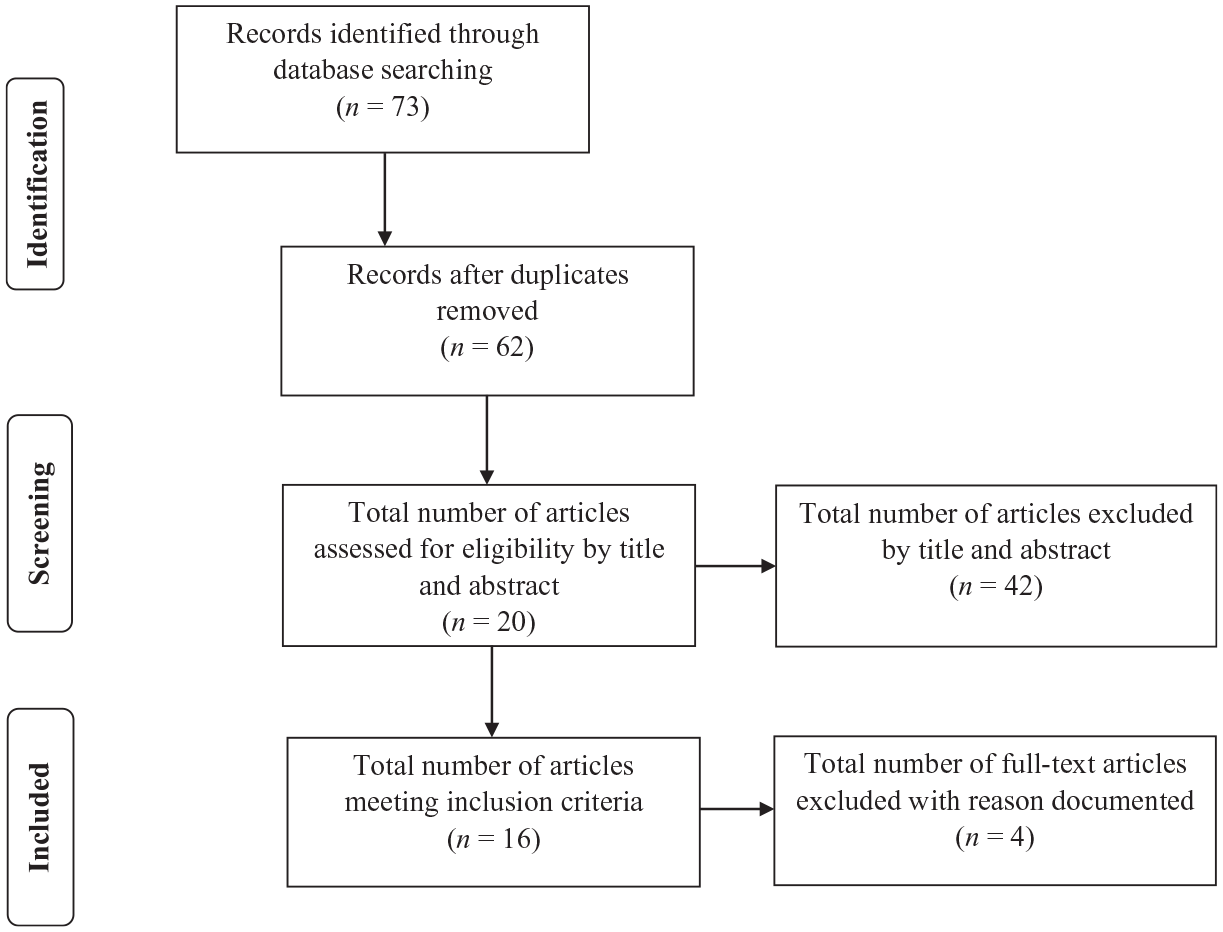
Flow diagram.
Data from articles that meet the inclusion criteria were extracted independently by both authors. Any discrepancies were discussed until reached a mutual agreement. The reliability of the agreement between the authors was assessed based on the standard criteria of Cohen’s Kappa statistic. Interpretation of the kappa statistic (κ) for inter-rater agreement was: <0.20 (slight), 0.21 to 0.40 (fair), 0.41 to 0.60 (moderate), 0.61 to 0.80 (good), and >0.81 (excellent) (McHugh, 2012). The reliability of the agreement between the authors is excellent (0.87).
Results
Study Sample
The studies comprised a total of 24,399 children and adolescents. Table 1 describes the characteristics of each sample, methodology, measures of poly-victimization and types of victimization. The study with a larger sample had 7,073 participants (Yoder et al., 2019), and the studies with the smaller sample had 100 participants (Alvarez-Lister et al., 2016; DeHart & Moran, 2015).
Characteristics of Reviewed Studies.
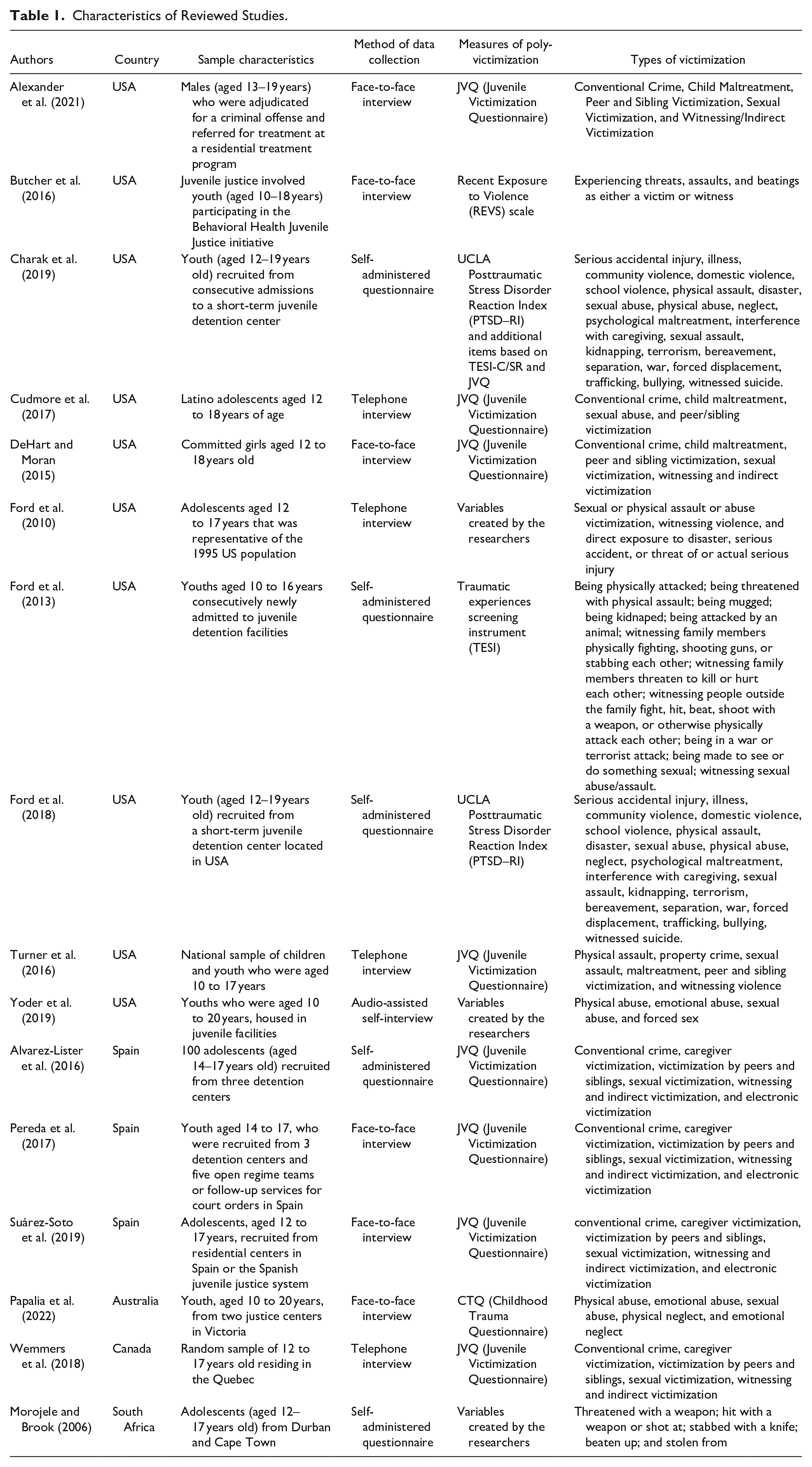
As shown in Table 1, the studies included children and youth between 12 and 20 years old. Regarding sample sex, one study only included delinquent girls in its sample (DeHart & Moran, 2015). Another study only included delinquent boys (Alexander et al., 2021). The remaining studies included both girls and boys in their sample.
Of the 16 studies, 10 were conducted in the United States of America (e.g., Alexander et al., 2021; DeHart & Moran, 2015; Yoder et al., 2019), three from Spain (Alvarez-Lister et al., 2016; Pereda et al., 2017; Suárez-Soto et al., 2019), one from Australia (Papalia et al., 2022), one from Canada (Wemmers et al., 2018), and one from South Africa (Morojele & Brook, 2006).
Study Design
Most of the studies were conducted quantitatively (n = 15), and one followed a mixed method approach (DeHart & Moran, 2015). The data were collected via individual interviews in juvenile justice residential facilities (n = 6), telephone interviews (n = 4), self-administered questionnaires (n = 5), and audio-assisted self-interview (n = 1). Of the 16 included studies, 11 examined the victimization among youth housed in juvenile facilities, two used data from the National Survey of Adolescents and the National Survey of Children Exposure to Violence II and, three assessed national samples of adolescents.
Measures of Poly-victimization
Several different measures were used to analyze poly-victimization and delinquency in the analyzed studies, including studies that created their own measure. The JVQ (Juvenile Victimization Questionnaire) was used by eight studies to assess poly-victimization (e.g., Cudmore et al., 2017; Pereda et al., 2017). The Traumatic Experiences Screening Instrument (TESI) was used by Ford et al. (2013). The Recent Exposure to Violence Scale (REVS) was used by Butcher et al. (2016), and the UCLA Posttraumatic Stress Disorder Reaction Index (PTSD–RI) was used by Ford et al. (2018) and Charak et al. (2019). However, Charak et al., added more items based on TESI-C/SR and JVQ. Ford et al. (2018) added to PTSD-RI the description of traumatic events possibly experienced by youth, such as prolonged separation from a caregiver or experiences of neglect. The Childhood Trauma Questionnaire (CTQ) was used by Papalia et al. (2022). Three studies created their owns measure to access poly-victimization (Ford et al., 2010; Morojele & Brook, 2006; Yoder et al., 2019).
Risk Factors for Poly-Victimization
The risk factors for poly-victimization were reported in two studies (Ford et al., 2013; Turner et al., 2016). Turner et al. (2016) concluded that the most common risk factors for poly-victimization are living in unsafe neighborhoods, living in places with rundown buildings, graffiti, public drinking, vandalism, and crime (Turner et al., 2016). According to Ford et al. (2013), girls, African American, and white youths are at particularly high risk of poly-victimization.
Relationship of Poly-victimization and Delinquency
Regarding the relationship between poly-victimization and delinquent behaviors, a study with a nationally representative sample shows that poly-victimized youths are more likely to report delinquent acts by themselves and associate with delinquent peers (Ford et al., 2010). Furthermore, as the number of different victimization experiences increases, the number of delinquent behaviors also increases (Ford et al., 2018). According to Cudmore et al. (2017), poly-victimization significantly increases the likelihood of engaging in delinquency by 53%. Poly-victimized youths usually experience several episodes of violence or abuse before committing any maladjusted behavior (Alvarez-Lister et al., 2016; Yoder et al., 2019).
Research indicated that engaging in delinquent behavior and being involved in the juvenile justice system are influenced by the high psychological impact caused by poly-victimization (Alexander et al., 2021; Yoder et al., 2019). This psychological impact on poly-victims is manifested by higher rates of depression (Ford et al., 2010; Papalia et al., 2022; Wemmers et al., 2018), anxiety (Alexander et al., 2021; Papalia et al., 2022), psychotic illness, rule-breaking, aggressive behavior, impulsivity, irritability, early-onset violence (Papalia et al., 2022), substance abuse (DeHart & Moran, 2015; Ford et al., 2010, 2013, 2018; Papalia et al., 2022), suicide risk (Ford et al., 2013; Papalia et al., 2022; Suárez-Soto et al., 2019) posttraumatic stress (Alexander et al., 2021; Charak et al., 2019; Ford et al., 2013; Wemmers et al., 2018) sexual concerns (Alexander et al., 2021), emotional and behavioral problems (Charak et al., 2019; Ford et al., 2013) and general impairment (Alvarez-Lister et al., 2016).
Nine studies found that externalization and internalization can be related with the delinquency of young poly-victims (e.g., Alvarez-Lister et al., 2016; Papalia et al., 2022). Poly-victims are more likely, than non-poly-victims, to show externalizing symptoms and general impairment and, had a three times higher-than-average risk of displaying these psychopathology symptoms (Alvarez-Lister et al., 2016). These symptoms occur because of the violence and neglect experienced in the multiple contexts of an adolescent’s life (e.g., family, community, school) and trigger lack of confidence in the world and the surrounding people, discouraging them from seeking the support they need. Similarly, the desire to retaliate against assisted violence, the attachment disruption, and lack of adequate, stable, and nurturing caregivers, are also factors that promote the development of symptoms of internalization and externalization and the consequent adoption of delinquent behaviors (DeHart & Moran, 2015; Ford et al., 2013; Papalia et al., 2022; Suárez-Soto et al., 2019). Reviewed studies also showed that poly-victimization increases delinquency based on the role of anger. That is, as anger increases, so do the probability of delinquency (Cudmore et al., 2017; Ford et al., 2018; Wemmers et al., 2018).
Seven studies highlighted the role of poly-victimization on substances use (e.g., Ford et al., 2010, 2013; Papalia et al., 2022). This research concluded that poly-victims were more likely to report alcohol and drug use problems compared to non-poly-victims. Being a poly-victim increases the scores on the delinquency scale and the frequent use of alcohol and marijuana (Morojele & Brook, 2006). DeHart and Moran (2015) evidenced that youth abuse substances as a form of self-medication to cope with past caregiver violence and witnessed violence.
Gender Differences in Poly-victimization and Delinquency
Some research concluded that boys are more likely to suffer from poly-victimization than girls, except for sexual assault (Butcher et al., 2016; Morojele & Brook, 2006; Wemmers et al., 2018). This result was explained from the exposure of boys to more potentially dangerous situations in general, and actual violence (Morojele & Brook, 2006). Also, boys exposed to multiple violence were more likely to exhibit externalizing behaviors compared to girls (Butcher et al., 2016; Wemmers et al., 2018).
However, four of the 16 studies analyzed concluded that young female offenders are more likely to have suffered from poly-victimization than boys (Alexander et al., 2021; Alvarez-Lister et al., 2016; Ford et al., 2013; Papalia et al., 2022). These studies show that girls generally have a higher risk of being exposed to sexual victimization and domestic violence. Thus, girls tend to become more vulnerable and more likely to suffer from violence.
Discussion
The detailed analysis of 16 scientific articles included in this study made it possible to examine the association between poly-victimization and youth delinquency. The balance of evidence from this review suggests that poly-victims are more likely than other victims to engage in delinquency and associate with delinquent peers (Ford et al., 2010). Poly-victimization is more strongly associated with offending risk than repeated exposure to violence or exposure to a single episode of violence (Farrell & Zimmerman, 2017). In addition, these findings point to a pattern of mental health problems among delinquent youth exposed to poly-victimization (DeHart & Moran, 2015; Ford et al., 2010, 2013, 2018; Papalia et al., 2022).
Findings identified as the most usual risk factors for poly-victimization living in unsafe neighborhoods, living in places with rundown buildings, graffiti, public drinking, vandalism, and crime (Turner et al., 2016), girls, African American, and white youths (Ford et al., 2013). This result provides support for the lifestyles/routine activities framework. A specific activity routine (e.g., activities in unsafe neighborhoods) can increase the risk and frequency of victimization, puts children and youth close to motivated offenders, and promotes the adoption of delinquent behaviors (Pereda et al., 2017). However, it should be noted that the research identifies other risk factors besides those found in this systematic review. For example, low household income and parental substance abuse are risk factors for poly-victimization in a Norwegian study (Mossige & Huang, 2017).
The associations between poly-victimization and adverse mental health were identified across distinct samples of this research, different measures, and different analytical techniques. That suggests that poly-victimization in childhood is an encompassing problem that affects children and youth negatively across their lives and is especially frequent in the lives of young delinquents. This systematic review showed that poly-victimization and delinquency frequently co-occur. Poly-victimized youths are more involved in delinquents acts and experience several episodes of violence (Alvarez-Lister et al., 2016; Yoder et al., 2019). Thus, as the number of different types of victimization experienced increases, the number of delinquent behaviors also increases, putting youth at risk for juvenile justice (Ford et al., 2018).
The results obtained in this systematic review show an association between childhood poly-victimization and internalized behaviors (e.g., anxiety and depression) (Alexander et al., 2021; Ford et al., 2010; Papalia et al., 2022; Wemmers et al., 2018) and externalized behaviors (e.g., rule-breaking, aggressive behavior, impulsivity, irritability, early-onset violence, and drug and alcohol abuse) (DeHart & Moran, 2015; Ford et al., 2010, 2013, 2018; Papalia et al., 2022). Poly-victimization is more strongly associated with internalizing and externalizing problems than single victimization (Méndez-López, 2021). Specifically, Musicaro et al. (2019) state that poly-victimization is associated with many behavior problems.
About the differences between gender, it is not possible to conclude which are more likely to suffer from poly-victimization, considering delinquent behaviors. Some authors mentioned that boys are more exposed to potentially dangerous situations and violence (Butcher et al., 2016; Morojele & Brook, 2006; Wemmers et al., 2018). However, it is also possible to verify that girls become more vulnerable and more likely to suffer from violence and have a higher risk of being exposed to sexual victimization and domestic violence (Alexander et al., 2021; Alvarez-Lister et al., 2016; Butcher et al., 2016; DeHart & Moran, 2015; Ford et al., 2013, 2018; Papalia et al., 2022). Since the results in this review were not consistent, they do not provide solid support for these differences, so we suggest that future research analyze gender differences.
This systematic review has some limitations which should be considered. First, only three studies portray European culture. It is not possible to estimate the impact of poly-victimization and its relationship with delinquency in European children and youth. Thus, the intervention suggestions mentioned above, must be adapted according to the culture. Future research should extend their sample to other cultures. Second, only articles in English, Spanish and Portuguese languages were included in the present review which may result in publication bias and exclusion of otherwise relevant sources of information. More research should include other languages which might provide different or additional results. Third, poly-victimization has been assessed using several approaches in addition to the “poly-victimization” concept and the JVQ instrument. It was possible to verify that other terms (i.e., multiple experiences of victimization, cumulative trauma, adverse childhood experiences) have been used in other studies to refer to poly-victimization. However, they were not considered in this review due to the inclusion criteria exclusively contemplated the poly-victimization term. Future research should clarify this concept.
Despite the limitations, this review has several strengths, namely, it was conducted following a protocol structured according to the PRISMA methodology (Moher et al., 2009), which allowed to carry out exhaustive, objective, and transparent analyzes of the articles relevant to this review. Additionally, from what we were able to assess, this is the first systematic review carried out on the impact of poly-victimization on delinquency in youth.
Conclusions
This review presents relevant information regarding poly-victimization among youth and delinquent behaviors. The knowledge of risk factors of poly-victimization provides greater awareness about the phenomenon so that it is possible to implement adequate prevention and intervention. Thus, the risk factors of poly-victimization should be analyzed among youth offenders to glean greater specificity in developmental pathways to youth victimization and violence. The promotion of mental health in children and youth poly-victims should be also one of the key points of prevention of delinquency. Programs to address multiple, co-occurring forms of violence exposure might be implemented throughout youth lives, and especially during childhood, as the likelihood of poly-victimization increases. Additionally, the relationship found between anger and delinquency (Cudmore et al., 2017; Ford et al., 2018; Wemmers et al., 2018) shows the need for interventions to regulate emotions and implementing adaptive coping strategies dealing with adversity.
Our findings show a fundamental understanding of poly-victimization research, highlighting the detrimental impact of experiencing violence in different areas of life. Further, the findings emphasize the importance of screening the exposure to poly-victimization and complex traumatic stress symptoms in children and youth to mitigate the negative consequences of poly-victimization and prevent delinquent behaviors. Considering the characteristics and the impact of poly-victimization, a joint effort between the government, social services, justice system, health professionals, and other professionals involved in the lives of these children is necessary to provide an adequate preventive response. Prevention and intervention should consider the mental and physical consequences of the phenomenon, should identify the risk factors (e.g., living in unsafe neighborhoods), prevent re-victimization, and promote the adoption of adequate coping strategies, to reduce the traumatic symptoms.
Footnotes
Declaration of Conflicting Interests
The author(s) declared no potential conflicts of interest with respect to the research, authorship, and/or publication of this article.
Funding
The author(s) disclosed receipt of the following financial support for the research, authorship, and/or publication of this article: This work was supported by the FCT—Foundation for Science and Technology, I.P., under the project UIDB/04585/2020.
