




Abstract
This study examines how strength of ideology, victim status, and other factors shape prosecutorial and sentencing decisions in cases of far-right extremist homicide. We draw from multiple conceptual frameworks to understand how assessments of defendants’ blameworthiness, crime seriousness, and other practical constraints influence the severity of legal outcomes. Our analysis of data from the United States Extremist Crime Database finds that while demographic attributes of homicide participants have little influence on legal outcomes, strong affiliations to domestic extremism and indicators of crime seriousness and risk significantly predict harsher treatment of defendants. We contextualize our findings within the broader criminological sentencing literature and discuss their implications for understanding how the American criminal justice system responds to domestic violent extremism.
Introduction
Domestic violent extremists commit a broad spectrum of violent and financial crimes (e.g., aggravated assault, bombings, arsons, tax evasion, and providing material support), with murder being one of the most serious. Ideologically motivated shootings, including mass shootings, have remained a consistent problem in the United States (Capellan et al., 2019), and domestic violent extremists have killed more people than any other terrorist movement in the last 20 years (National Consortium for the Study of Terrorism and Responses to Terrorism, 2017). As such, justice for victims and holding perpetrators accountable should be a top priority.
While state-level criminal courts are generally responsible for adjudicating cases of domestic violent extremism (Smith, 1994), we know little empirically about how defendants are charged and tried in America’s courts. A key question is how legal (e.g., crime severity) and extralegal (e.g., victim race) factors influence prosecutorial decision-making and sentencing outcomes within socio-legal contexts. Research has consistently found that racial and ethnic minority defendants tend to be treated more harshly by the courts, especially when they are young and male (Baumer, 2013; Franklin, 2018; Mitchell, 2005; Pratt, 1998; Spohn, 2015; Steffensmeier et al., 1998). However, less is known empirically about how such factors shape prosecutorial decision-making and sentences for defendants motivated by ideological grievances, such as White supremacy and anti-government sentiment (for exceptions see Smith & Damphousse, 1996, 1998). Even fewer studies have examined the judicial process for violent extremists adjudicated outside of the federal court system. This gap in criminal justice scholarship is concerning given the high-profile public discourse surrounding homegrown extremists who commit ideologically motivated violence, usually against members of social minority groups and government officials (Gruenewald & Pridemore, 2012). These debates often center around how an offender and offense should be officially labeled, prosecuted, and punished. Answers to these questions may have profound implications for society and governmental social control. Of interest here are political judgments about which behaviors to criminalize, how severe to punish domestic violent extremists, and whose moral values to preserve—the very essence of the justice system in the United States.
There also remains a lack of research on how victim attributes shape justice outcomes. This gap is likely due, in part, to the belief that victim attributes should not bias prosecutorial and judicial decision-making. However, limited studies have shown that offenders who victimize racial and ethnic minorities are often treated more leniently than those who commit crimes against White individuals (see Baumer et al., 2000), though these findings may depend on victim gender (Curry, 2010) and offender age (Steffensmeier et al., 1998). Scholars suggest that when faced with large caseloads, court actors may rely on racialized and gendered stereotypes, combined with defendants’ perceived levels of culpability and perceived risk of reoffending, in adjudicating criminal cases (Albonetti, 1991; Steffensmeier et al., 1998). Nonetheless, few have examined these dynamics for violent crimes, especially for far-right extremists who commit homicide.
We confront these gaps by focusing on two interrelated issues. We ask, do defendants’ (1) strength of affiliation to domestic violent extremism and (2) the symbolic status of victims they target shape official decision-making? The objective of our study is to examine how individual, incident, and other macro-level factors impact case dispositions and sentence severity for far-right extremist homicide defendants. We draw from several theoretical perspectives that explain disparities in justice outcomes and analyze data from the open-source United States Extremist Crime Database (ECDB; Freilich et al., 2014) to address our research aims. Our findings have important implications for ongoing debates about the adjudication of domestic violent extremists.
Theoretical Orientation and Prior Research
Extant scholarship has studied how both legal and extralegal factors shape the decision-making of criminal justice actors, including the police (Campbell & Fehler-Cabral, 2018; Higgins et al., 2012; Vito et al., 2019), prosecutors (Spohn et al., 2001), judges (Steffensmeier et al., 1998), and correctional officials (Cochran, et al., 2018; Huebner & Bynum, 2006; Logan et al., 2017). It is now well-established that legal factors like crime severity and prior arrest history influence how offenders are prosecuted and sentenced (for a review, see Steffensmeier & Demuth, 2000). Research has also consistently found that extralegal variables significantly impact the treatment of offenders in criminal courts. Within this vein, most studies show that defendant and victim characteristics, factors related to the court room working group, and socio-political context may uniquely shape case dispositions and sentence severity for violent crime perpetrators. We thus begin our investigation by briefly reviewing this work before turning to the current study’s contributions and hypotheses.
Defendant and Victim Characteristics
Research has shown that certain segments of the population do not receive equitable treatment by the courts based largely on their actual or perceived demographic characteristics (Bjerregaard et al., 2017; Gross & Mauro, 1989; Keil & Vito, 1989; Pierce & Radelet, 2002). Notably, defendants’ race or ethnicity matters in how they are treated by the U.S. legal system. Cars driven by Black Americans, for instance, are more likely to be searched by police (Higgins et al., 2012), and Black individuals are more likely to be stopped and frisked on the street by police (Gelman et al., 2007). Prosecutors are less likely to decline cases involving Black offenders (Colon et al., 2018), though this finding differs by crime type and the particular legal outcome of interest (Hartley & Tillyer, 2018; Kutateladze et al., 2014). A review of studies examining sentencing outcomes found at least a small to moderate race effect, indicating that some racial and ethnic minorities (i.e., Blacks, Hispanics, and Native Americans) are more likely to receive harsher sentences (Franklin, 2018). Studies have also shown that young Black males tend to receive the most punitive sentencing, possibly because they are viewed, in part, as less treatable or worthy of rehabilitative diversion programs (Cochran & Mears, 2015; Doerner & Demuth, 2010; Steffensmeier & Demuth, 2006).
There are also gender disparities in the sentencing of male and female defendants. Women are less likely to be incarcerated (Steffensmeier et al., 1993; Ulmer & Kramer, 1996) and are sentenced more leniently in comparison to men (Steffensmeier & Demuth, 2006), although the findings may be dependent on crime type and the type of legal outcome of interest (Rodriguez et al., 2006; Shermer & Johnson, 2010). One possible explanation for differential treatment is the chivalry hypothesis, which maintains that women are treated more leniently, particularly by male criminal justice actors who want to be seen as acting valiantly towards them (Steffensmeier et al., 1993). Female offenders may also receive leniency because they are viewed from a paternalistic perspective, suggesting that women are weak, vulnerable, and in need of protection (Baumer et al., 2000). It is also possible that women receive leniency by the courts because they are viewed as caretakers, and that incarcerating them for extended periods of time would cause additional harm to families (Daly, 1989). In this same vein, male offenders who target women may be viewed as especially blameworthy and punished more harshly (Belknap, 2001; Curry, et al., 2004; Daly & Tonry, 1997; Farrell & Swigert, 1978).
Like defendants, we also know that victim demographics can affect court case outcomes. For instance, racial and ethnic minorities, especially Black victims, are often devalued, as those who target them are treated more leniently than defendants accused of targeting White victims (Curry, 2010; Farrell & Swigert, 1978). The discounting of victimhood, especially when victims are stigmatized as disreputable, leads to more lenient treatment by the criminal justice system (Baumer et al., 2000). This is evidenced by studies finding more favorable outcomes in death penalty cases for offenders who kill racial and ethnic minorities (Hanke, 1995; Radelet, 1991; Unah & Boger, 2001).
The Courtroom Working Group
Aside from defendant and victim characteristics, studies indicate that the dynamics of American courtrooms can also influence how defendants are adjudicated. The court room working group encapsulates the unique environmental and contextual features in which prosecutors, defense attorneys, and judges operate daily. Court actors are embedded in economic, cultural, social, and political contexts that may shape court decision-making (Eisenstein & Jacob, 1977; Walker, 1989). Faced with a steady stream of cases, courtroom actors develop close working relationships and shared conceptions of cases that are deemed worthy of going to trial, as well as the “going rates” for those offenders convicted of committing some types of crimes (Eisenstein & Jacob, 1977; Nardulli et al., 1988). Typically, courtroom working groups are much less adversarial than portrayed in popular media depictions and share the goal of efficiently processing cases and filtering out less serious cases, or cases without strong evidence through plea bargaining and dismissals (Engen & Steen, 2000; Hagan, 1989; Ulmer & Johnson, 2004). Court workgroups use collective decision-making to maximize efficiency by standardizing the treatment of “normal crimes” (Sudnow, 1965), consisting of the most typical victims, offenders, and offenses (Johnson et al., 2010).
To minimize the uncertainty inherent in the processing of defendants under these precarious organizational conditions, court actors also make decisions based on cognitive heuristics, or perceptual shorthands (Skolnick, 1966; Steffensmeier et al., 1998), developed over time and rooted in group-based attributes ostensibly associated with future criminality. Studies have found that court actors’ rationality in sentencing and prosecutorial decisions is based partly on the assignment of attributions, or casual factors, to a criminal act (Cramer et al., 2010; Plumm et al., 2010). In Shaver’s (1985) blame attribution model, the cause of an event is evaluated, with blame assigned to whomever is deemed morally responsible for the unfavorable outcome. Court actors navigate criminal proceedings with limited information that is supplemented by biased assumptions relating to extra-legal factors. This oversimplified working knowledge, or “bounded rationality” (Albonetti, 1991; March & Simon, 1958), is based in part on racialized and gendered stereotypes of minority and male defendants.
Focal Concerns Theory and Severe Crimes
Focal concerns theory (FCT) offers an organizing framework for understanding how court actors confront uncertainty while making decisions (see Albonetti, 1991; Miller, 1958). Steffensmeier et al. (1998) applied FCT to investigate the key factors judges consider when sentencing persons convicted of crimes. First, the perceived blameworthiness of defendants may influence legal decision-making. Those who are viewed as fully and directly responsible for criminal activities and those who commit especially serious and sophisticated types of crime are considered the most dangerous and worthiest of blame and hypothesized to receive the harshest of sentences. The second consideration is the perceived level of risk offenders pose to communities. Judges use tough sentencing to deter and incapacitate would-be repeat offenders. Though predicting recidivism is more art than science, judges rely on information about a defendant’s prior criminal history, history of addiction, educational and employment status, and family history as indicators of future criminality and danger to the community. Third, Steffensmeier et al. (1998) noted that there are practical implications of judicial decision-making, such as costs to the courts and anticipated financial and social implications for defendants.
Importantly, the salience of factors shaping justice outcomes varies by crime type (Auerhahn et al., 2017; Cassidy & Rydberg, 2018; Steffensmeier & Demuth, 2006; Warren et al., 2012), including white collar and property offenses (Cassidy & Gibbs, 2019), felony drug offenses (Curry & Corral-Comacho, 2008), and federal immigration cases (Hartley & Tillyer, 2012). To date, however, there have been relatively few studies that focus on what predicts legal outcomes for serious crimes like homicide. One possible reason for this gap is that court actors are assumed to have less discretion for more serious crimes where there may be less ambiguity about appropriate dispositions (Black, 1976; Kalven & Zeisel, 1966; Spears & Spohn, 1997). Kalven and Zeisel’s (1966) liberation hypothesis postulates that extra-legal factors become less relevant to court actor decision-making as crime severity increases. Sentencing guidelines, especially for more severe criminal acts like homicide, are expected to mitigate variability in punitive responses. Thus, for more serious criminal acts, one might expect similarities across prosecutorial and sentencing outcomes regardless of victim and offender characteristics (Baldus et al., 1985; Barnett, 1985), as court actors may feel less liberated in deviating from legal precedent.
Countering this “liberation hypothesis,” Hauser and Peck (2017) found that racial and gender disparities in sentencing increased with crime seriousness. Black and Hispanic defendants of felony offenses were more likely to be imprisoned than White defendants and men were more likely to be imprisoned than women. Others similarly have examined how victim gender and race shapes legal decision-making in homicide cases (Baumer et al., 2000; Boris, 1979; Myers, 1979; Spohn, 1994). Defendants who kill women are less likely to receive charge reductions (Beaulieu & Messner, 1999), but are more likely to be convicted on their most serious charge (Baumer et al., 2000) and sentenced to death (Baldus et al.,1985; Baumer et al., 2000; Farrell & Swigert, 1978). Defendants who murder White victims compared to people of color are more likely to be prosecuted (Boris, 1979), convicted (Baumer, et al., 2000; Beaulieu & Messner, 1999), and to receive longer and harsher sentences, including the death penalty (Baldus et al., 1985; Hawkins, 1987; Holcomb et al., 2004; Kleck, 1981; Paternoster, 1984; Ulmer et al., 2020).
Prosecutorial decision-making and sentencing outcomes may also depend on where murder cases are adjudicated, especially for capital cases. Highlighting the relevance of socio-political context, research has found that Republican-appointed judges sentence people more harshly for the same crimes compared to Democratic-appointed judges (Schanzenback & Tiller, 2007, 2008), and Republican-appointed federal judges are more likely to sentence Black defendants more harshly than Democratic-appointed federal judges (Cohen & Yang, 2019). Ulmer et al. (2020) found significant variation in capital prosecutions across counties in a single state (Pennsylvania), reinforcing the importance of the broader context in which prosecutorial and sentencing decisions are made. Lynch (2019) argues that while the concept of focal concerns was originally a group-level explanation of decision-making, it has more recently morphed into an individual-level, psychological theory of judicial biases. Lynch (2019) also suggests that research on judicial disparities should consider the socio-legal contexts in which prosecutorial and sentencing decisions are made, including differences in laws across states and a community’s political environment.
Gaps in Knowledge and the Relevance of Far-Right Extremist Ideology
Relevant to the current study, there has been even less scholarly attention on legal outcomes for homicides committed by domestic violent extremists. Extremist murder is rare and there is a shortage of available data on this type of violent crime (Gruenewald & Klein, 2016). Until relatively recently, there were no databases or projects that systematically collected data on murders perpetrated by homegrown extremists in the United States (Freilich et al., 2014). In a search for the underlying causes and correlates of this type of crime, scholars have increasingly relied on open-source databases to learn more about how extremists plan, prepare, and execute their attacks (Freilich et al., 2014; LaFree & Dugan, 2007; Smith, 1994). While there has been substantial growth in criminological studies of domestic violent extremism (see LaFree & Freilich, 2016), little is currently known about the factors shaping the decisions of court actors responsible for adjudicating those individuals involved in these cases.
This is important because extreme right-wing lethal violence poses unique challenges for the American criminal justice system. Over the last two decades, the far-right extremist movement was responsible for nearly 75% of all ideologically motivated homicides in the U.S. (Freilich et al., 2014). Many of these attacks are committed by White males who target people of color and other underrepresented groups (e.g., LGBTQ+ and homeless individuals). Law enforcement also disproportionately fall victim to far-right extremist murders (Freilich et al., 2014; Gruenewald & Pridemore, 2012). Given the severity and nature far-right extremist violence, it is possible that ideology may play a role in shaping court case outcomes. There remains ideological diversity within the far-right extremist movement (Freilich et al., 2014), and the strength of perpetrators’ attachment to the movement varies considerably (Gruenewald et al., 2013). Some offenders may have loose connections with an extremist group, operating more on the fringes of the movement. By contrast, others may be more active and zealously committed to the movement’s political or social goals. Court actors like prosecutors and judges may view the latter as more culpable for their crimes and posing a greater risk to society. Thus, defendants with stronger affiliations to extremism may receive harsher treatment in court. To our knowledge, no study has attempted to disentangle ideology from other extra-legal factors in affecting case dispositions and sentence severity.
Another limitation of prior justice disparities research is the focus on either prosecutorial decision-making or sentencing outcomes, rather than conceptualizing legal decision-making as a multi-step process. Research has shown that prosecutorial decisions regarding if and how to charge offenders are shaped by expectations of the ultimate sentencing decisions by judges (Albonetti, 1986, 1987; Spohn et al., 2001). For instance, it is common for prosecutors to drop or lessen charges for defendants who they view as less culpable for crimes, or who may pose less risks to society, such that judges will not be mandated to sentence them more harshly based on legally binding sentencing guidelines. For this reason, we suggest that measuring the leniency or harshness of legal outcomes based on both the decisions made by both prosecutors and judges could prove a useful way to investigate the relative impact of legal and extralegal factors.
The Current Study
The current study extends prior research by examining how legal and extralegal factors shape prosecutorial decision-making and sentencing outcomes in the context of far-right extremist 1 homicide cases. Our overarching research question is: What factors influence how extreme far-right homicide defendants are treated during the prosecutorial and sentencing stages of the adjudicatory process? This includes how victim race and gender shape prosecutorial decision-making and sentencing but also considers how defendants’ ideological affiliations and the statuses of homicide victims influence justice outcomes. We hypothesize that homicide defendants who are more strongly affiliated with domestic violent extremism (H1) and who target victims based on their social status or identity (H2) will be treated more harshly by prosecutors and judges because they are viewed as more blameworthy and as serious threats to communities. In response to critiques by Lynch (2019) and the recommendation by Ulmer (2019) to consider the influence of contextual factors in which prosecutorial and sentencing decisions are being made, we account for socio-legal contexts. We expect that prosecutors and judges who operate in more socially progressive and politically liberal settings will treat defendants more harshly (H3).
Data and Methods
Data for this study originated from the U.S. Extremist Crime Database (ECDB; Freilich et al., 2014), an open-source database that has been established as a valid and comprehensive chronology of extremist murders in the United States (Chermak et al., 2012). The ECDB has been used in the past to examine criminal activities by the extreme far-right, radical Islamic terrorists, and eco-terrorists operating in the United States. The unit of analysis for this study is adherents of an extreme far-right ideology who committed a murder between 1990 and 2016. As there is a lag in how long it takes for cases to move through the judicial system, we opted to not use more recent data on extremist murders that were available at the time of the analysis.
The case identification and coding process for the ECDB begins with the review of multiple open-sources, including government records, watchdog groups, terrorism databases, and media accounts. The utilization of multiple types of sources increases the validity of the population of extreme far-right homicides (Chermak et al., 2012). Open-source data are then collected on each incident using keywords specific to the event, the defendant, and the victim. Over two-dozen search engines are used to identify information available on the Internet about the case. After the open-source data are collected, coders systematically apply the inclusion criteria, by first confirming that at least one of the defendants is a far-right extremist.
For the current study, we conducted additional targeted searches to verify and supplement existing ECDB data. Targeted searches included queries of county court records, state prison inmate records, general search engine inquiries, and searches for criminal records using a background check service. Although the background check service used, BeenVerified.com, is not as accurate or thorough as a law enforcement-initiated background investigation, it aggregates thousands of publicly available databases for defendants, including their address history, social media accounts, and criminal records. This additional layer of open-source searching was necessary for two reasons. First, open-source information may not have been available through search engines and background check services when data were initially collected by the ECDB. More recently, state and county governments have made police, court, and prison records available through online portals. Second, new information becomes available about homicide defendants as cases move through the criminal justice system. These follow-up searches may find additional data on more recent cases that were unavailable when first inputted into the ECDB, especially cases that have occurred within the last several years. Finally, we did not analyze the entire population of defendants found in the ECDB. Conducting targeted searches to fill in missing values and code new variables is time consuming and resource intensive. Thus our analysis includes a randomized sample of all defendants included in the ECDB who are connected to homicides alleged to be committed by one or more far-right extremist.
Dependent variables
Two dependent variables for our analysis measure legal outcomes for defendants in extreme far-right homicide cases. The first dependent variable is disposition type (1 = plea agreement and 0 = trial). Only those defendants who were ultimately convicted of homicide-related charges are included in analyses predicting disposition type. 2 Convictions based on guilty pleas generally result in less severe sentences for defendants in comparison to trial outcomes, which is one reason a defendant may choose to plead guilty rather than risk going to trial. Prosecutorial decisions to offer (and ultimately agree) to plea deals may be based on a number of factors, such as the status of evidence in the case and the constraints of their caseload size, as well as perceptions of defendant blameworthiness and risk to community. Pleaded guilty was also included as a control variable when examining factors potentially shaping sentence severity.
The second dependent variable is sentence severity (1 = more severe and 0 = less severe). The more severe sentences include life in prison without the possibility of parole, multiple life sentences served consecutively, or the death penalty. In other words, the more severe sentences are those in which defendants have little to no chance of ever being released from custody alive. Alternatively, the relatively less severe sentences encompassed all other judicial outcomes in which defendants were scheduled to be released from prison. Sentencing outcomes were captured in these categories for several reasons. First, as would be expected for a serious crime like homicide, very few defendants had charges dropped or were acquitted, so these judicial outcomes were combined into the less severe category. While there are reasons that charges might be dropped (e.g., becoming a cooperating witness or lack of evidence to obtain a conviction), information from open-sources indicated that all defendants played a key role in the perpetration of the homicide and therefore were included in the ECDB. Second, although the open-source data most always provided ranges for the years sentenced for the majority of cases, and whether defendants were parole eligible, this information was not universally provided and when it was, it was difficult to evaluate in a standardized way. Therefore, it made the most sense to collapse any conviction that was less than life in prison without the possibility of parole or death into a single category, allowing us to reduce missing values and maximize the sample size. Finally, collapsing life in prison without the possibility of parole and death sentences into a single category created a response that captured the most serious forms of punishment that our criminal justice system can apply to convicted criminals as not all states have the death penalty, but all can punish a defendant with life in prison without the possibility of parole.
Independent variables
Several variables are included in the model to explain legal outcomes for homicide defendants. The first independent variable measures the strength of the defendant’s affiliation to far-right extremism. The measure was originally coded in the ECDB on a scale from zero to four. Zero represents a defendant with no extreme far-right affiliation who is only in the database because they co-offended with an ideological extremist. These individuals make up only a small minority of defendants in the ECDB and are considered to have only indirect affiliations to the extreme far-right movement. We expect that homicide defendants with stronger ideological affiliations to the far-right extremist movement will be perceived as domestic violent extremists who are more blameworthy and who pose elevated risks to public safety, and thus will be treated more harshly by the criminal justice system.
A defendant coded as one has only one indicator supporting their connection to the extreme far-right movement and no evidence contradicting that affiliation. Indicators supporting a far-right extremist affiliation could include, but are not limited to, formal group membership (e.g., Ku Klux Klan and Aryan Nations), informal group membership (e.g., loose knit skinhead gang), White supremacist tattoos (e.g., swastikas and lighting bolts), or adherence to the specific tenets of far-right ideology outlined in the aforementioned definition. Defendants coded as a two have multiple indicators connecting them to the extreme far-right yet there is also evidence to the contrary, while defendants coded as a three have one indicator and no contradictory evidence. Information contradicting extreme far-right movement affiliation is typically represented by a statement attributed to the defendant, a family member, a friend, or their lawyer challenging the link of the defendant to the extreme far-right, either through a direct denial or an alternate explanation (e.g., the defendant was a skinhead not for the ideology, but for the comradery). The defendants with the strongest ideological affiliation are coded as four, consisting of those with multiple indicators supporting their ideological affiliation and no evidence to the contrary. For this study, defendant ideological affiliation is dichotomized with those coded as a four in the original data recoded to have strong ideological affiliation (1) and those coded as a one to three being recoded as having a moderate/weak affiliation (0). This separates defendants who were heavily involved in domestic violent extremism from those whose ideological affiliation, although still supported by evidence, is not as strong.
The second independent variable measures whether a symbolic victim is targeted. To be coded as 1, there must be at least one piece of evidence clearly indicative of the discriminatory selection of one or more victims prior to the perpetration of the homicide. Examples of such indicators include a statement or note made by the defendant, comments from others familiar with the defendant’s motive and beliefs, or information provided by actors within the criminal justice system. Homicides with clear symbolic victims include the victims of the bombing of the Alfred P. Murrah Federal Building in Oklahoma City or the mass shooting at the Emanuel African Methodist Episcopal Church in Charleston, South Carolina. Other examples of such cases would include White supremacists who target a gay couple because of their sexual orientation, skinheads beating a man to death because he is perceived to be Jewish, or Ku Klux Klan members murdering a Black man wholly, or in part, because of his race. Biased selection of victims adheres to expectations about hate or bias crimes that are typically viewed as resulting in more harm to society and specific social groups. Thus, we expect that defendants who target one or more protected or symbolic groups will be viewed as more blameworthy and threatening to public safety, and thus will receive harsher treatment by the courts than those who do not.
In addition to the two independent variables, a defendant-level measure of defendant age is included in the current study as a continuous variable. Defendant race and gender are controlled for during the defendant selection process, as all defendants included in the analysis were White non-Hispanic men. 3 Defendants’ prior arrest history is also included in the analysis, as we expect that those with prior arrests will be perceived as blameworthy and threatening to public safety. If evidence is found in the open-sources that identified a prior arrest or conviction for a violent crime or property crime, the defendant is coded as (1). If no evidence is found of a prior crime or only vague information is identified in the open-source that did not allow us to determine the seriousness of the prior crime, it is coded as (0). An example of this would be a criminal record that appeared in a targeted background search of a defendant that provided no evidence on the offense type, the court where the offense was adjudicated, or the seriousness of the offense (i.e., misdemeanor vs. felony). Although this most likely means that some defendants with serious violent or property priors are coded as (0), we believe this error is less problematic than including less serious citations or traffic offenses in the (1) category.
Victim race is also measured. For this variable, defendants who killed White (non-Hispanic) victims are coded as (1), while victims of all other races and ethnicities are coded as (0). If a defendant killed both White and racial/ethnic minority victims, the defendant record is coded as (1), indicating that at least one White victim was killed. 4 Drawing from prior research, we expect that defendants who target one or more White (non-Hispanic) victims will be perceived as posing a threat to dominant, racialized power structures, and thus will be perceived as more blameworthy than defendants who target racial and/or ethnic minority victims. Victim gender is coded as female victim (1) or male victim (0). If a defendant killed both male and female victims, the defendant record is coded as (1), indicating that at least one woman was killed. If there is information that one or more homicide defendants selected a victim for their symbolic value, then the defendant is coded as a 1. We expect, based on prior research, that defendants who target female victims, who are typically viewed as more vulnerable and innocent than male victims, will be viewed as violating social expectations of chivalrous responses to women, and thus more blameworthy than defendants who target male victims. Therefore, homicide defendants who target female victims are expected to receive harsher treatment by the courts than those who target male victims.
Incident-level variables include the number of victims killed during the homicides, or events, connected to the trial. This dichotomous variable captures whether there was one victim or multiple victims, coded as 1 and 0, respectively. The number of defendants is also measured (single defendant = 1 and multiple defendants = 0). Defendants did not have to be tried to be included in our study, but must have been arrested and accused of being involved in the homicide by law enforcement and prosecutors (though charges may have ultimately been dropped). This allowed for the inclusion of defendants in the sample who prosecutors may have viewed as less culpable for the homicide, and as such, they were willing to not file, drop, or reduce charges in exchange for their cooperation. Whether a firearm was used as one of the weapons during the incident is also included in this study (firearm = 1 and no firearm = 0).
Contextual variables include whether the defendant was adjudicated in a federal court or a state court (1 = federal and 0 = state), as differences in the types of crime and sentencing practices may vary across courts, thus potentially affecting prosecutorial and sentencing outcomes. The year that the homicide occurred is also included as a continuous item to control for the potential effect of significant socio-political events and policy changes on how domestic violent extremists are adjudicated. 5 On average, there were 11 far-right extremists prosecuted for homicide every year between 1990 and 2016, peaking in 2001 (n = 23). Another contextual variable captures whether the homicide occurred in a Democratic majority county. It is possible that liberal or more politically progressive populations are more likely than more socially conservative locales to consider extreme far-right violence a serious threat to their communities, potentially shaping the nature of court actor decision-making. The percentage of votes for the Democratic presidential candidates come from the CQ Voting and Election datasets and is a county-level measure. The date of each homicide was used to identify the presidential election date that was closest in temporal proximity to the homicides, and then the percent of voters who voted for the Democratic candidate were connected to the event. Additionally, a measure of state-level hate crime law is included that relies on the Anti-Defamation League’s (ADL) list of hate crime laws by state to determine whether at least one type of bias or hate crime law was active in the state where the homicide occurred based on the year that the homicide occurred. If the ADL’s data did not specify a year that a law was passed, additional information was collected through targeted open-source searches. The rationale for including this variable in the current study is that a state may have passed some form of hate crime law to demonstrate a collective proclivity against targeted violence against persons because of a group-based attribute, thus operating as a practical constraint that could influence the decisions of court actors in those states. Finally, because one of our dependent variables accounts for death penalty outcomes, we include a binary-coded measure state-level death penalty law (1 = the state had the death penalty at time of prosecution and 0 = state did not have the death penalty at time of prosecution) to control for the influence of state-specific laws on the harshness of sentences for far-right extremist homicide defendants.
Analytic Plan
The section that follows first presents bivariate statistics to provide initial explorations of the data. We secondly turn to multilevel multivariate methods, reflecting that far-right extremist defendants are nested within counties that are nested within states. The clustering of individuals within places violates the independence assumption and in turn can influence the estimation of parameters. For this reason, we rely on mixed effects logistic regression to estimate the effects of extra-legal and legal individual, incident, and macro-level (i.e., county and state) attributes of extreme far-right homicide on disposition type and sentencing severity. Given that our dependent variables are measured with two distinct categories, binary-logistic regression is the appropriate statistical approach (Long & Freese, 2014).
To begin, we estimate the intraclass correlation coefficient (i.e., ICC) for each outcome to determine the variation at each level of analysis. For disposition type, the ICC for the county is .272 and is less than .001 for the state level. ICC estimates are largely similar for sentence severity (County ICC = .266; State ICC < .001). Despite these very low estimates at the state-level, it is appropriate to include this level in analyses given the natural clustering of the data and therefore interdependence of observations. It is also possible to include relevant characteristics at this level as “variation” can be explained across multiple levels. In addition, the likelihood ratio tests for both outcomes comparing the multilevel model to a logistic model are significant. This further suggests that a hierarchical model is preferable. For these reasons, and because the observations are not independent, we elected to retain a three-level model (i.e., defendants nested in counties nested in states) for analyses.
Results
Our discussion of empirical results begins by reviewing the relationships between independent variables and our two outcomes of interest, case disposition (1 = plea agreement and 0 = trial) and sentencing severity (1 = more severe and 0 = less severe). For each dependent variable, we present the results of both bivariate and multivariate analyses.
Predicting Case Disposition Type
As shown in Table 1, bivariate findings suggest that strength of defendants’ affiliations with the far-right extremist movement systematically varies across disposition type. Providing some initial support for Hypothesis 1, approximately 36% of defendants deemed strongly affiliated with the extreme far-right movement pleaded guilty to charges, while significantly more (57%) went to trial.
Bivariate Findings by Court Disposition.
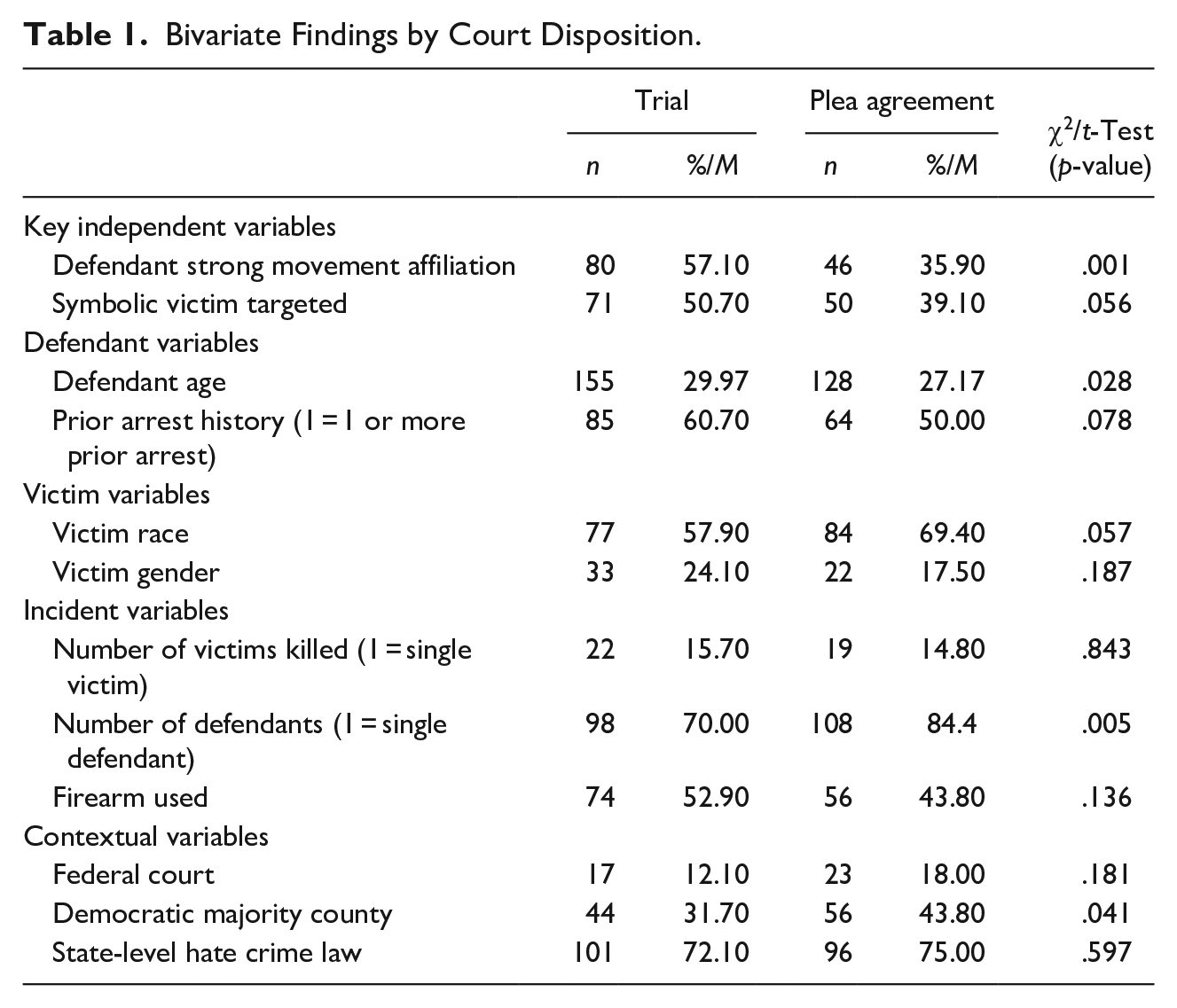
We also find that extreme far-right defendants who went to trial are more often older (30 years old) than those who entered into a plea agreement (approximately 27 years old), perhaps suggesting that older defendants may be viewed as relatively more blameworthy and as elevated risks to public safety. Defendants adjudicated in counties with greater percentages of Democratic presidential candidate voters are more likely to go to trial as opposed to enter plea agreements, compared to defendants who committed homicide in counties with fewer democratic voters. One interpretation is that prosecutors in more progressive counties are less likely to want to be perceived as offering leniency in the form of plea deals to violent domestic extremists. Bivariate findings (see Table 1) also indicate that far-right extremists who commit homicides as so-called lone actors are proportionately more likely to enter into a plea agreement than go to trial. None of the other variables included in Table 1 are shown to be significantly associated with the likelihood of plea agreement outcomes.
We also estimated multivariate analyses using mixed effects logistic regression. For parsimony, 6 we included independent variables found to be statistically related in the bivariate analysis to the dependent variable of interest, disposition type (see Table 2). 7 For these multivariate models, we included the year of the incident and whether the state had a death penalty law as control variables. Importantly, we find that extreme far-rightists who participated most in the far-right extremist movement are significantly more likely to take their case to trial than to plead guilty, net the effects of other potential factors. Drawing from FCT, one interpretation of this is that defendants who maintain strong affiliations with extremist movements are viewed by prosecutors as relatively more blameworthy and threatening to the community than those less strongly affiliated with the far-right extremist movement, and thus they are less likely to receive plea deals which could eventually lead to reduced sentences.
Predicting Likelihood of Plea Agreement Using Binary Logistic Regression.
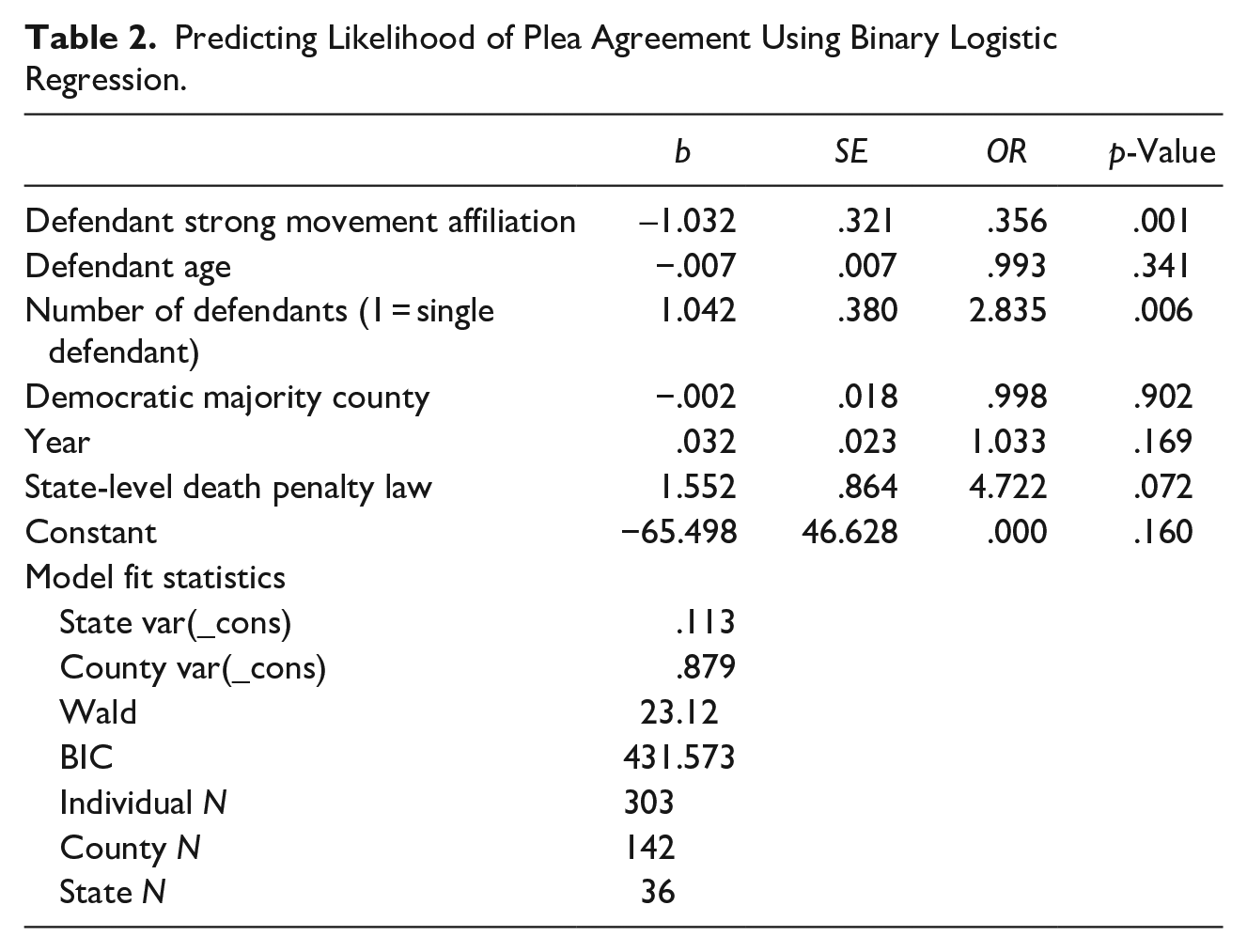
Alternatively, defendants with a strong involvement in the far-right extremist movement may be less inclined to accept a plea agreement so that they may have future opportunities to advance their social and political views during trial proceedings. Multivariate findings also support bivariate findings indicating that the number of defendants is significantly associated with disposition type. That is, extreme far-right homicides committed by a single defendant are significantly more likely to result in convictions based on plea agreements than trials.
Predicting Sentence Severity
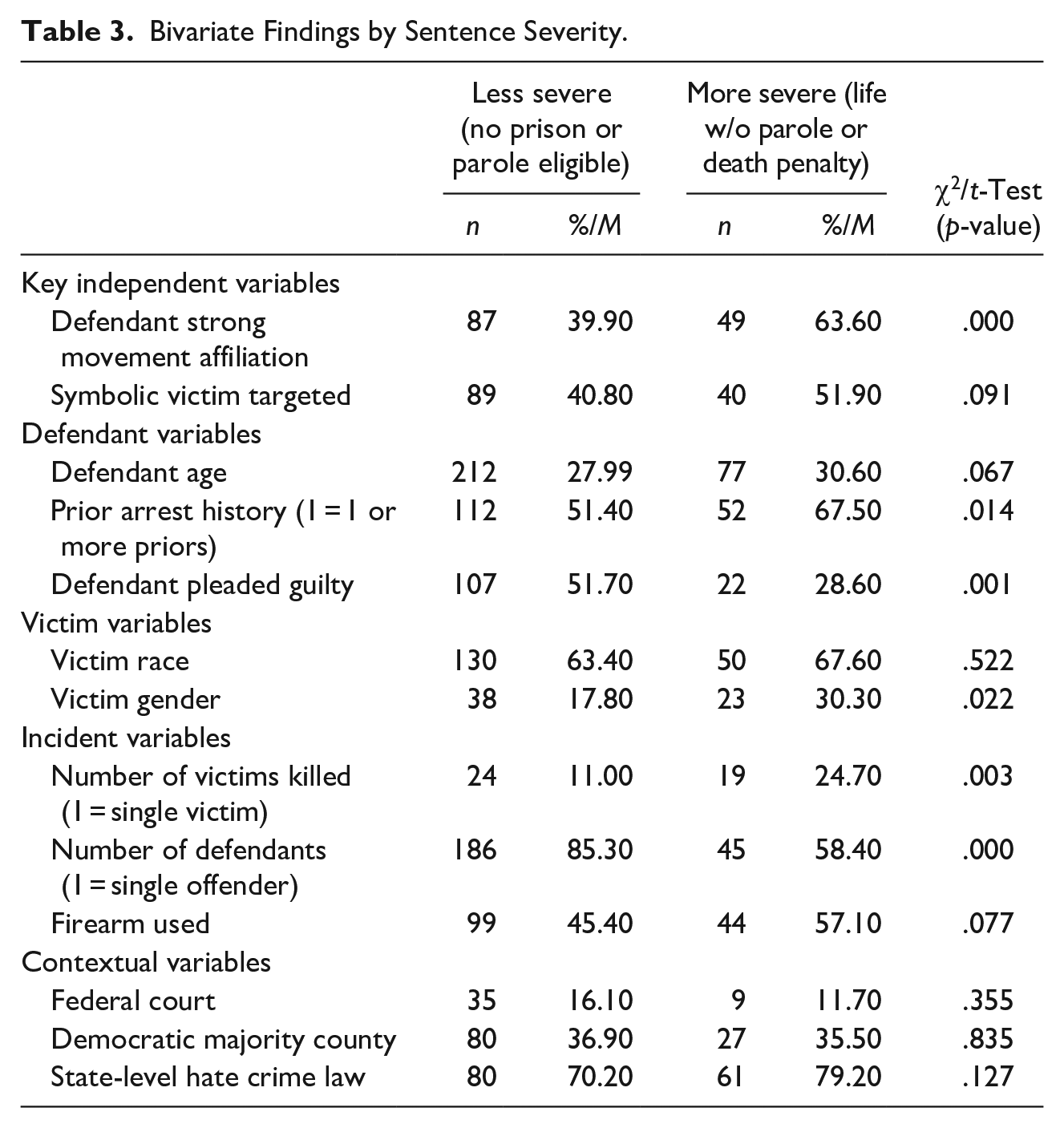
As shown in Table 3, for our second dependent variable, sentencing severity (1 = more severe and 0 = less severe), we find that defendants who are the more strongly affiliated with extreme far-right extremism are proportionately more likely to receive the most severe sentences (64% vs. 40%). Defendants who murdered female victims, while relatively rare overall (21%), are proportionately more likely to receive life in prison without parole or the death penalty (30%) compared to less severe sentences (18%), thus supporting prior research on other more common forms of crime. In addition, defendants with prior arrests and who kill multiple victims receive relatively harsher treatment by the courts than those without prior arrests and who kill a single victim, respectively. These defendants may be viewed as increased threats to future public safety and thus are more likely to be convicted and be incarcerated for life without parole or receive the death penalty than more lenient sentences. Also shown in Table 3, extreme far-right defendants who committed their crimes alone are proportionately more likely to receive less serious sentences (58%) in comparison to life in prison without parole or the death penalty (85%). Finally, we also find that extreme far-right defendants who pleaded guilty to charges related to homicides are proportionately more likely (52%) to receive less severe sentences than those who did not (29%). This is unsurprising as one of the key motivating factors in accepting a plea agreement is leniency in sentencing.
Bivariate Findings by Sentence Severity.
Multivariate Findings for Sentencing Severity
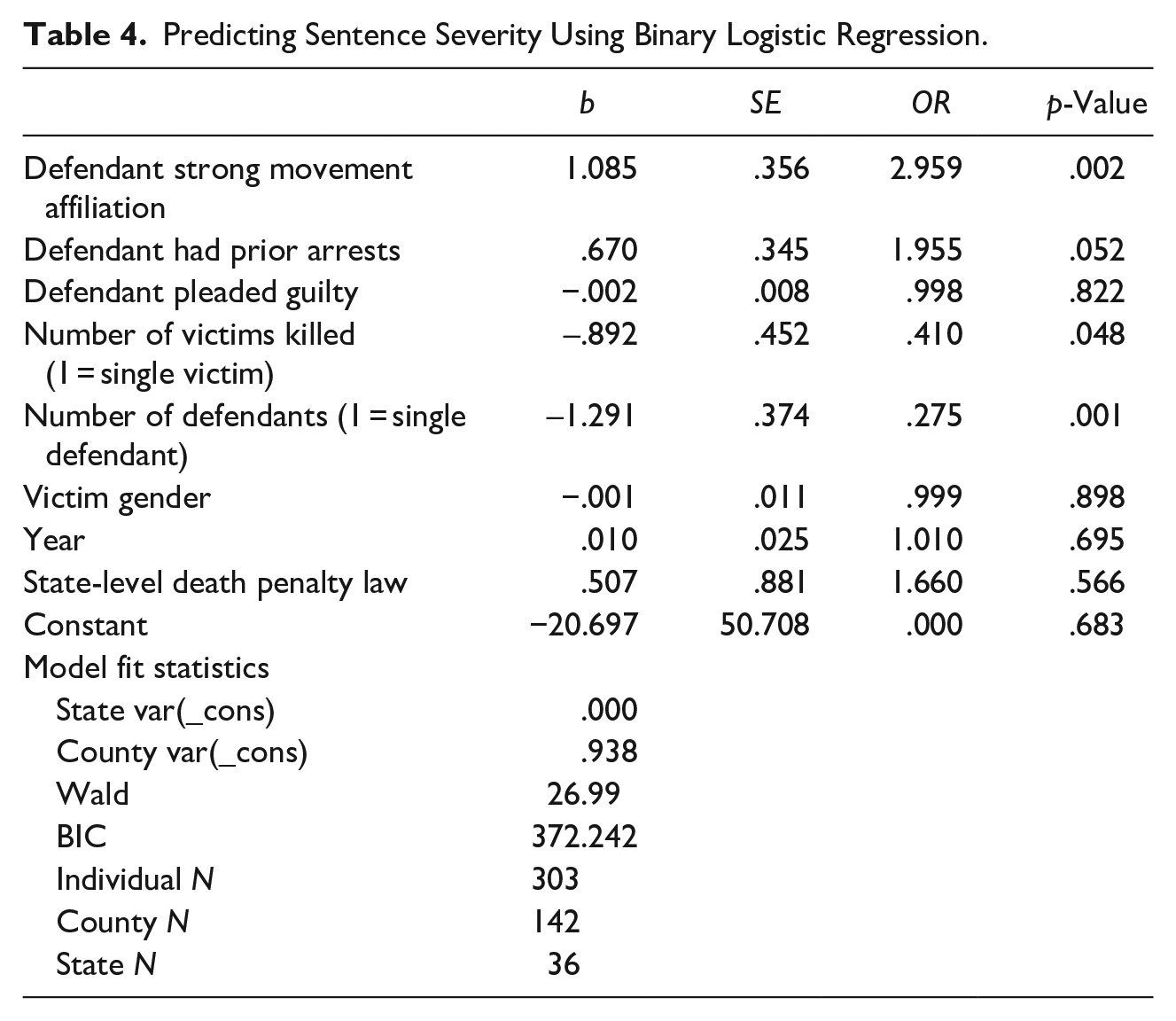
Multivariate mixed effects analyses shown in Table 4 that suggest defendants most affiliated with the far-right extremist movement are significantly more likely to be punished severely, receiving either a sentence of life without the possibility of parole or the death penalty, net the effects of other potential factors. Multivariate findings also indicate that lone actor extreme far-rightist defendants are punished less severely than defendants who commit their violent crimes with others. Moreover, extreme far-rightists whose crimes result in increased harm by killing more than one victim are sentenced more severely, while defendants involved in deadly attacks against only one victim receive less severe punishments. Third, and finally, we find that extreme far-right homicide defendants who had prior arrests are significantly more likely to receive relatively more severe sentences compared to those without prior arrests, again aligning with prior research on other more common forms of violence.
Predicting Sentence Severity Using Binary Logistic Regression.
Discussion
The current study examines the extent of court actor discretion on the legal outcomes for extreme far-right homicide defendants accused of committing these serious violent crimes in the United States over the last few decades. We realized at the outset of the study that it was possible there would be little variation in the legal outcomes of far-right extremist homicide defendants simply because homicide cases, and ultimately convictions of extreme far-right defendants, often exist under a spotlight, thereby mandating tough responses and adherence to existing operational guidelines. However, and despite that all homicides may rise to an elevated level of seriousness in the eyes of the criminal justice system, our analyses indicated justice disparities, suggesting that some defendants may be viewed as relatively more blameworthy and culpable for their crimes and posing elevated risks to public safety. In sum, our findings tentatively suggest that some extreme far-right homicide defendants may be viewed as being relatively more abhorrent than others.
One of the most notable findings from the current study is that strength of affiliation to the extreme far-right movement significantly influences how defendants are treated by the legal system. In fact, the strength of ideological affiliation is one of the strongest correlates in our analysis, controlling for other potentially relevant variables. Our results support the assertion that prosecutors, judges, and juries treat defendants more harshly, at least in part, because they are perceived as more blameworthy and as elevated risks to public safety when they are relatively more active and tightly aligned with extremist ideologies and extremist groups. Indeed, this was the case even when we account for contextual factors, such as laws and the political leanings of the locales where homicides occurred, and defendants were adjudicated. These findings have implications for defense attorneys who must navigate the adjudicatory process for cases involving group-based defendants.
Other factors may also be influencing this finding. In particular, far-right extremists are often suspicious of government and may be less willing to cooperate with court actors and accept plea bargains, ultimately causing them to receive harsher sentences at trial. In this case, the reason for the harsher treatment may lie more with defendants’ behavior in court rather than the court actors’ perceptions of blameworthiness and risk. While this still highlights the interactive dynamics of the courtroom working group, in the end, the defendant’s ideology may be a key driver of their punishment. Future work would do well to explore this hypothesis in finer detail.
Also notable, yet counter to our expectations, is that whether homicides targeted ideologically symbolic victims was not a statistically significant predictor of legal outcomes, net the effects of other variables included in our statistical models. At first glance, punishing someone more severely for their affiliations rather than their decisions to target someone because of the real or perceived social status seems counter to the American criminal justice system’s guiding principle of equal justice. Should someone be punished more harshly because they adhere to a hateful ideology? If criminal sentencing serves as one indicator of judicial values in the U.S., our findings seem to suggest that the politics of hate are widely viewed as especially detestable, and this may be the case regardless of the political leanings of the places these crimes occur. Our results support the few studies that have examined the prosecution and sentencing of ideologically motivated crimes in the United States, which have shown that defendants explicitly labeled as extremists by prosecutors are more likely to go to trial and be sentenced more harshly (Damphousse & Shields, 2007; Smith & Damphousse, 1998). Our findings also seem to suggest that the courts have a long history of sending a message to those closely associated with domestic violent extremism. Arguably, the theoretical implications of our findings may be that scholars should consider other elements of a defendant’s worldview and character, such as affiliation with domestic violent extremism, as potential factors impacting legal decision-making.
Somewhat surprisingly, victim race and gender were not significant factors in shaping legal outcomes for extreme far-right defendants. Why this is the case could be due to limits on discretion in homicide cases more generally, or perhaps because blameworthiness of defendants is assessed by court actors differently in cases involving extreme far-right homicide defendants from more common forms of crime. As noted, evaluations of blameworthiness and risk to the public may have more to do with defendants’ ideological affiliations. Understanding how blameworthiness is assessed, based on offender affiliations, as opposed to modes of victim selection, also has implications for prosecutors and defense attorneys.
Another important finding was that defendants who killed multiple victims were significantly more likely to receive life in prison without the possibility of parole or the death penalty. In other words, defendants involved in homicide cases where more than one victim is killed were viewed as committing more serious crimes, and as more blameworthy for the harm their crimes inflicted on victims and their communities. Our study supports criminological research more generally, as the defendants who had known prior arrests were significantly more likely to receive harsher sentences, including life in prison without the possibility of parole and the death penalty. We also found that far-right extremist defendants accused of committing homicides with co-defendants were significantly more likely to receive harsher treatment by the courts. One interpretation is that those extreme far-right defendants who committed homicides in groups would be viewed as more menacing, perhaps an indicator of a more troubling problem of extremist violence afflicting a community.
Limitations and Future Research
The current study is not without its limitations. While the ECDB is the most comprehensive database on extreme far-right violence, more information is available for some cases than others and missing values can be an issue for some types of variables when relying on open-source crime databases (Parkin & Gruenewald, 2017). Given homicides usually result in the most publicly available information and variables notoriously difficult to measure based on open-sources (e.g., relationship status and mental health) were not included in this study, we are not overly concerned with such limitations. In addition, the temporal scope of our analysis was limited to extreme far-right homicides occurring since 1990, primarily because collecting open-source materials on rare forms of crime before the time when large amounts of information became available on the Internet remains challenging. Future research should continue to explore, perhaps comparatively, the factors shaping legal outcomes for other types of domestic violent extremists, such as radical Islamic extremists and eco-terrorists in the United States, as their ideological affiliations and, possibly, how their threats to society may vary. Including both fatal and non-fatal forms of extremist violence in future studies would also advance our understanding of criminal justice responses to domestic violent extremism. While homicide may be the most serious manifestation of violent extremism, it is also the rarest. A more comprehensive analysis of less serious forms of violent extremism could shed more light on how prosecutorial and judicial discretion affect legal outcomes for those affiliated with violent extremist movements.
Conclusion
To the best of our knowledge, this is the first study to draw from prior judicial disparities research to empirically examine how legal and extralegal factors shape legal outcomes for domestic violent extremists who have continued to terrorize communities over the course of American history. Our investigation of determinants of legal outcomes for extreme far-right violent defendants was made possible by the increasing availability of data from the ECDB, which continues to provide a wealth of information on the nature of various forms of violent extremism and legal responses to these forms of serious crime. The results of this study extend the growing criminological literature on the ways that perceptual shorthands based on cultural stereotypes about criminal defendants, their victims, and the circumstances of their crimes in part shape the decision-making process for legal actors. Additionally, we accounted for how these decisions may have been shaped by varying county and state-level socio-legal contexts. We hope that the findings from this study help to inform important debates about the role defendants’ extremist ideologies should play on the legal outcomes for domestic violent extremists facing prosecution in the American court system.
Footnotes
Declaration of Conflicting Interests
The author(s) declared no potential conflicts of interest with respect to the research, authorship, and/or publication of this article.
Funding
The author(s) received no financial support for the research, authorship, and/or publication of this article.
