




Abstract
Given the victim-offender overlap, it has been suggested that every theory about offenders implies a corresponding theory of victimization. We assess the above assertion concerning Agnew’s general theory of crime and delinquency within the context of intimate partner violence (IPV). Drawing data from the International Dating Violence Study, we examine the direct and indirect effects of the self, family, school/work, and peer domains on IPV perpetration and victimization. We found the four life domains significantly predicted both IPV perpetration and victimization and their effects on both outcome variables were mediated by the constraint and motivation factors. Our results indicate that the mechanisms that account for offending posited in Agnew’s perspective appear to be equally relevant and applicable for understanding victimization.
Keywords
Introduction
The relationship between victimization and offending, also known as the victim-offender overlap, has been widely documented (Pratt & Turanovic, 2021). The discovery that offenders and victims are often the same individuals has been corroborated in studies involving the general population of adults and juveniles (Lauritsen et al., 1991; Sampson & Lauritsen, 1990) and specialized populations of adult offenders and deviant youth (Whitbeck et al., 2001). Scholars and researchers have applied theoretical concepts derived from criminological perspectives originally developed to account for crime and deviance, namely, self-control (Gottfredson & Hirschi, 1990), social learning (Akers, 1998), general strain (Agnew, 1992), and control balance (Tittle, 1995), to examine criminal victimization. Theoretical measures such as low self-control (Schreck, 1999), imitation, differential association, differential reinforcement (Cochran et al., 2011), anger (Hay & Evans, 2006), and control imbalances (Fox et al., 2016) have been linked to risks of victimization. Consequently, Berg and Schreck (2021) contend that every theory about offenders implies a corresponding theory of victimization.
In this paper, we assess Berg and Schreck’s (2021) assertion by exploring the victim-offender overlap using Agnew’s (2005) general theory of crime and delinquency. Like other mainstream perspectives, Agnew’s theory was developed to account for offending and has been employed to examine an array of criminal and deviant behaviors (Choi & Kruis, 2019; Cochran, 2017; Kabiri et al., 2020; Muftic et al., 2014; Ngo & Paternoster, 2014; Roh & Marshall, 2018; Zhang et al., 2012). However, to date, only one study has extended Agnew’s perspective to understand criminal victimization (Grubb & Posick, 2018). To address this gap, we explore whether the underlying processes concerning offending posited in Agnew’s perspective are equally useful for explaining the underlying causes of victimization within the context of intimate partner violence (IPV).
Our focus is on IPV because Agnew’s theory is well suited to examine this multifaceted phenomenon. Agnew’s perspective not only incorporates the key elements of crime and deviance derived from the dominant criminological theories—namely, biological, psychological, control, strain, and social learning—but also unifies risk factors and criminogenic characteristics known to directly influence criminal offending, including IPV, into a unified framework. Yet only one study has applied Agnew’s theory to examine IPV perpetration focusing on gender differences (Ngo et al., 2022) and no study has employed the perspective to understand IPV victimization. Hence, the present study extends the work of Ngo et al. 1 by investigating how IPV perpetration and victimization may be inextricably linked. Given that IPV is a crime of serious human and policy significance, findings generated from this study are intended for researchers and scholars to build upon, elaborate on, and extend in future inquiry to understand its root causes and advance applicable intervention and prevention strategies.
The remainder of our paper is organized as follows. First, we summarize Agnew’s general theory of crime and delinquency and provide a review of prior tests of the perspective. We also summarize prior findings on the correlates of IPV perpetration and victimization. Next, we describe our data and methods and report our results. Lastly, we discuss the policy implications of our findings and propose directions for future research.
Agnew’s Integrated Theory
At the heart of Agnew’s (2005) perspective is the proposition that crime is more likely to occur when constraints against such behaviors are low and motivations for them are high. Constraints are factors that deter or hinder a person from engaging in crime and motivations are forces that lure people to commit crime. The three main sources of constraint in Agnew’s perspective are external control (the likelihood that others will detect and sanction criminal behaviors), stake in conformity (the likelihood that individuals will be caught and punished by others if they deviate), and internal control (when individuals refrain from committing crime albeit the likelihood of their criminal behavior being detected and punished is low). The two primary motivational forces in Agnew’s perspective include factors that entice/pull an individual into crime (e.g., exposure to successful criminal models, being taught beliefs favorable to crime) and factors that pressure/push an individual toward crime (e.g., the need to alleviate negative emotions, the desire for revenge). Recognizing that certain factors can either act as a constraint against criminal behavior or motivation for it, Agnew (2005) groups these correlates into five life domains: self, family, school, work, and peer.
Life Domains
Within the self domain, Agnew (2005) posits that the super traits of low self-control and irritability are linked to criminal behavior. The super trait of low self-control characterizes individuals who are impulsive, risk-seeking, gravitate toward exciting and high-energy activities, lack ambition, motivation, or perseverance, are not bound by conventional rules and norms, and have little thought for the long-range consequences of their behavior. The super trait of irritability refers to individuals who tend to have an antagonistic or adversarial interactional style, respond to life events in an aggressive or antisocial manner, attribute adverse experiences to the malicious behavior of others, and show little concern for the feelings and rights of others.
Agnew (2005) also theorizes that the family plays a major role in either supporting or controlling criminal and deviant behavior and a youth’s experience at school can either increase or decrease crime and delinquency. Within the family domain, he maintains that poor family environments and behaviors such as child abuse, child neglect, family violence, and overall poor parenting practices, contribute to crime. Within the school domain, Agnew points to empirical evidence that students who are attached to their teachers and committed to achieving high grades are more likely to avoid crime while students who perform poorly, lack educational goals or aspirations, or are perceived as being mistreated by teachers are more likely to offend.
Within the peer domain, Agnew (2005) asserts that youth who associate with delinquent peers are more likely to report delinquent and deviant behavior. Specifically, associating with delinquent peers in unstructured and unsupervised activities increases the likelihood that a youth will learn criminal behavior through negative role models and having criminal behavior positively reinforced. Finally, within the work domain, Agnew (2005) postulates that those who experience poor working conditions, poor supervision, and those who are less attached and committed to their jobs are more likely to engage in crime.
Prior Tests of Agnew’s Integrated Theory
Agnew’s integrated theory has been applied to examine delinquency (Cho & Lacey, 2021; Muftić et al., 2014; Roh et al., 2022; Roh & Marshall, 2018; Zhang et al., 2012), recidivism (Ngo et al., 2011), substance use (Muftić et al., 2014; Ngo & Paternoster, 2014), academic dishonesty (Cochran, 2017), cyberbullying (Choi & Kruis, 2019; Kabiri et al., 2020), and IPV (Ngo et al., 2022) using samples of both adults and juveniles. The theory has also been tested in studies involving international samples (Cho & Lacey, 2021; Choi & Kruis, 2019; Kabiri et al., 2020; Muftić et al., 2014; Roh et al., 2022; Roh & Marshall, 2018), and with longitudinal data (Cho & Lacey, 2021; Choi & Kruis, 2019; Roh et al., 2022; Zhang et al., 2012). The lagged (Grubb & Posick, 2018; Ngo & Paternoster, 2014) and interaction effects of the life domains (Choi & Kruis, 2019; Kabiri et al., 2020; Muftić et al., 2014; Roh et al., 2022), and mediating effects of constraint and motivation factors (Cochran, 2017; Zhang et al., 2012) as theorized by Agnew have also been examined. A recent study explored whether the proposed mechanisms outlined in Agnew’s framework about gender differences in crime and deviance could account for sex differences in IPV (Ngo et al., 2022).
Overall, findings from prior research provide support for Agnew’s integrated perspective in that the measures representing self, family, school, and peer domains are associated with various delinquent and deviant behaviors, occurring both online and offline (Cochran, 2017; Kabiri et al., 2020; Muftić et al., 2014; Ngo & Paternoster, 2014; Roh et al., 2022). The hypothesized mediating effects of the constraint and motivation factors (Cochran, 2017; Zhang et al., 2012) and the efficacy of Agnew’s framework in accounting for sex differences in offending, albeit preliminary, have also received some support (Ngo et al., 2022). On the other hand, the hypothesized lagged effects of the life domains on crime and delinquency have shown less support in prior research (Grubb & Posick, 2018; Ngo & Paternoster, 2014).
Notably, to date, only one study has applied Agnew’s theory to understand criminal victimization. Employing three waves of data from the Project on Human Development in Chicago Neighborhoods Longitudinal Cohort Study (PHDCNLCS), Grubb and Posick (2018) examined the contemporary and lagged effects of the self, family, school, and peer domains on violent victimization. They found while the different life domains influenced risks of criminal victimization, only measures in the self and peer domains retained their significance once the offending measures were included. They also uncovered that when all other variables in their analysis were taken into consideration, prior victimization exhibited the greatest effect on current victimization. Given the accumulating research assessing the generality of Agnew’s integrated perspective, we seek to extend Grubb and Posick’s (2018) work by applying Agnew’s theory to examine an outcome that has not been examined in prior research: IPV victimization. Importantly, we also explore the mediating effects of constraint and motivation factors on the associations between the life domains and IPV victimization. Before we present our hypotheses, we provide a summary of the correlates of IPV perpetration and victimization.
Risk Factors of IPV Perpetration and Victimization
IPV encompasses physical, psychological, and sexual abuse by men and by women toward romantic partners of the same or opposite sex (Capaldi et al., 2012). Prevalence estimates for IPV perpetration in the general population are 5.7% (4.2% in men and 7.0% in women), and approximately one in six heterosexual cohabiting or married couples experience at least one act of IPV every year (Schafer et al., 1998). IPV perpetration and victimization rates are considerably higher in younger and dating samples, with reported rates of physical perpetration ranging from 26% to 46%, physical victimization ranging from 9% to 23%, sexual perpetration ranging from 3% to 12%, and sexual victimization ranging from 5% to 15% (Archer, 2000).
IPV perpetration is significantly and inversely related to age, income, formal education, heterosexual orientation, and White race/ethnicity. The odds of engaging in IPV are elevated by prior drug use, alcohol consumption, and among individuals with personality disorders, low self-control, greater levels of perceived stress, and a lower perception of availability of potential social resources (Okuda et al., 2015). It is noteworthy that in a study involving longitudinal data from a New Zealand birth cohort, the authors found the trait of negative emotionality (the enjoyment of frightening others and irrational suspiciousness) predicted both partner abuse (violence perpetrated against intimates) and general crime (violence perpetrated against non-intimates) among male and female respondents (Moffitt et al., 2000). Incidents of childhood maltreatment and neglect, childhood physical and sexual abuse, and exposure to parental and family conflicts have also been linked to IPV perpetration (Renner & Whitney, 2012).
IPV victimization is prevalent among perpetrators, thus, supporting the victim-offender overlap conjecture (Whitaker et al., 2007). Findings from prior studies suggest factors such as childhood maltreatment and neglect, childhood physical and sexual abuse, exposure to parental and family conflicts, depressive symptoms and suicidality, and low self-control are salient indicators in understanding the overlap between IPV perpetration and victimization (Barnes et al., 2009; Eaton et al., 2007; Foshee et al., 2004; Renner & Whitney, 2012).
Whereas the linkage between individual and familial characteristics and IPV perpetration and victimization has received a considerable amount of empirical attention, the number of research studies assessing the influence of school, work, and peer context on IPV is more limited. Nevertheless, factors such as school attachment/bonding and perceived school safety have emerged as risk factors for IPV perpetration (Foshee et al., 2011; Schnurr & Lohman, 2008). Similarly, association with delinquent peers and peer deviance have been found to increase the risk of dating violence (Foshee et al., 2004; Schnurr & Lohman, 2008) and IPV perpetration (Ngo et al., 2022). Concerning the impact of employment on IPV, to date, no study has explored the effects of unemployment, work attachment, and poor working conditions on IPV. 2 However, a handful of studies have reported a positive association between IPV and employment status (unemployed) and a negative association between IPV and work productivity (Alexander, 2011; Crowne et al., 2011).
Given the above evidence, Agnew’s theory appears both applicable and well suited to explore IPV perpetration and victimization because it incorporates many—if not all—of the risk factors known to link to both phenomena. As indicated previously, to date, only one study has applied Agnew’s perspective to examine IPV perpetration but focused primarily on gender differences (Ngo et al., 2022) and no study has employed the theoretical insights from Agnew’s theory to understand IPV victimization. This study attends to these issues and is an important extension of Grubb and Posick’s (2018) and Ngo et al.’s (2022) research.
Current Study
We are interested in determining whether the underlying processes concerning offending posited in Agnew’s perspective are equally useful for explaining the underlying correlates of victimization within the context of IPV. Agnew’s integrated theory encompasses seven key propositions specifying the direct, indirect, and reciprocal effects among the life domains on crime, and the nonlinear and/or contemporaneous effects of the risk factors on crime and one another. Given the complexity of the theory, Agnew (2005) suggests that it is best examined by assessing specific hypotheses. We follow Agnew’s recommendation and focus on two of the seven propositions. Premised on the first proposition that crime is caused by five clusters of variables organized into the life domains of self, family, school, peers, and work, we propose the following hypotheses:
Drawing from the second proposition that the variables in each domain increase crime by reducing the constraints against crime and increasing the motivations for crime, we propose the following hypotheses:
Methods
Data
Data for this research came from the International Dating Violence Study (IDVS), a project involving a team of researchers from 68 universities in 32 nations gathering data on the prevalence, correlates, and consequences of IPV among young adults worldwide (Graham et al., 2019; Sabina & Straus, 2008). After obtaining approval from each university’s internal review board (IRB), the researchers administered a pencil-and-paper survey to young adults enrolled in mostly criminal justice, sociology, and psychology courses between the years 2001 through 2006. Before starting the survey, study participants were given information about the nature and purpose of the study and were assured that no identifying information will be collected. Respondents were also instructed to think about their current partner, or, if they were single at the time of the survey, to think about their last relationship that lasted a month or more when answering items contained in the survey.
The response rates for the IDVS ranged from a low of 20% to as high as 100%, with 80% of researchers reporting a response rate of 65% or above. IDVS data are nicely situated for testing Agnew’s integrated theory given the data’s ability to measure key components of this theoretical framework. For the current study, only the sample from the United States is employed to focus on one single cultural context (n = 4,162). It is noteworthy that this is a common practice among scholars who have used IDVS data (Graham et al., 2019; Meade et al., 2017; Paat & Markham, 2016; Sabina et al., 2017; Sabina & Straus, 2008).
The demographic characteristics for the sample are presented in Table 1. As shown, the majority of the sample were females (68%) and the mean age of the sample was 22 years. Many of the respondents (91%) were not married (i.e., single, dating, engaged, or cohabitating), and an equal number of respondents were married (10%) or lived with a partner (11%). Slightly more than one-third (35%) of the sample indicated that they have engaged in IPV perpetration while one-third (33%) of the sample reported that they have experienced IPV victimization.
Descriptive Statistics for All Variables in the Study (N = 4,162).
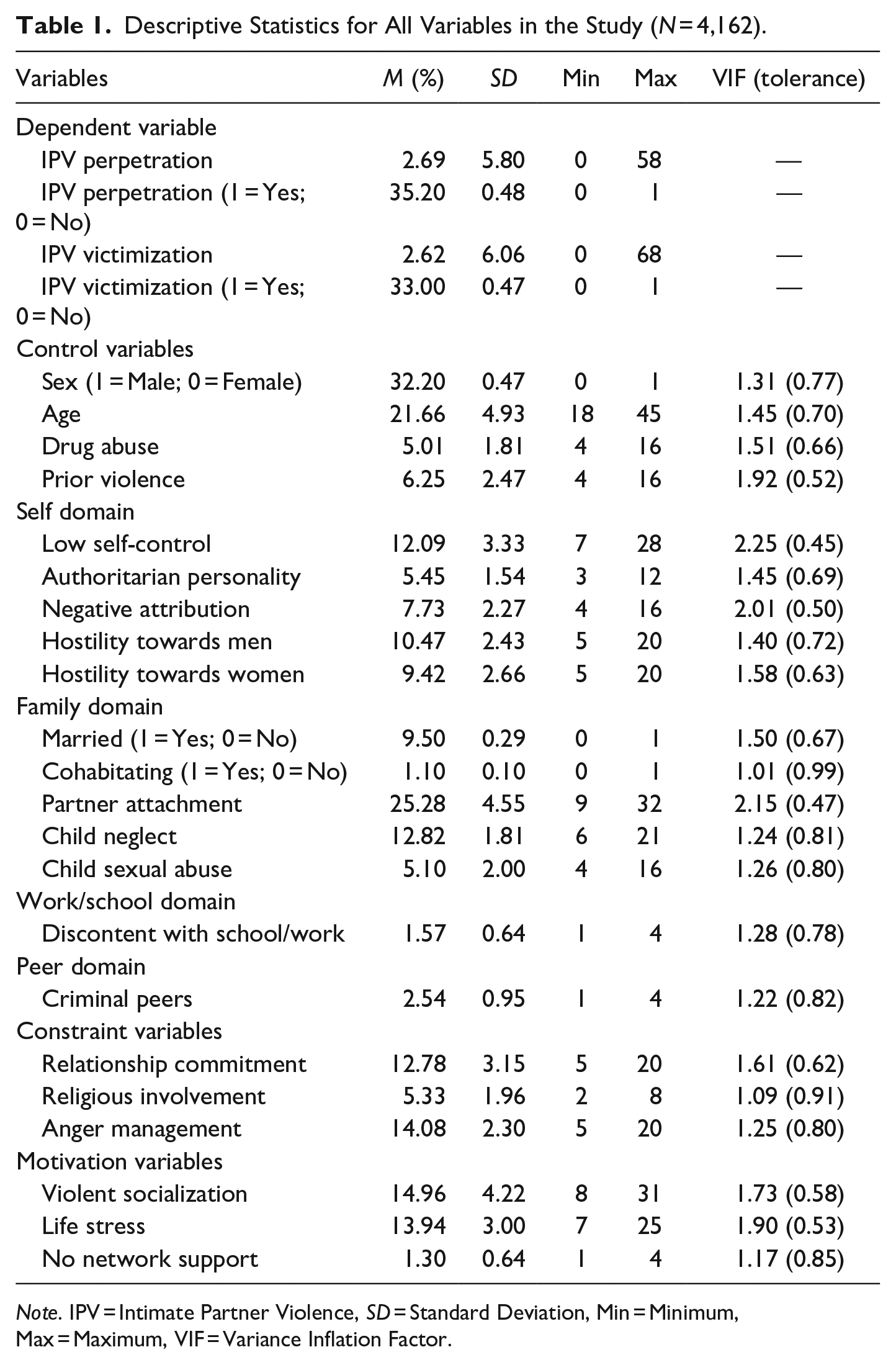
Note. IPV = Intimate Partner Violence, SD = Standard Deviation, Min = Minimum, Max = Maximum, VIF = Variance Inflation Factor.
Dependent Variables
There are two main outcomes in this study, IPV perpetration (α = .79) and IPV victimization (α = .82). IPV Perpetration was measured using 12 items asking respondents if they have committed violent and aggressive acts towards their intimate partners in the past 12 months. The same items were alternatively presented in the context of the respondent being victimized by these acts to measure the second variable, IPV Victimization. Two methods were used to construct the dependent variables. First, responses were collapsed into a dichotomous variable, where 1 represented the respondent perpetrated or experienced at least one form of violence and 0 indicated that the respondent did not commit or experience violence. Second, a simple summary score for each outcome was created. Both outcome measures are used in their continuous and dichotomous formats. The items and coding methods that were employed to construct the dependent variables are listed in Appendix.
Life Domain Variables
Our life domain measures include variables posited by Agnew to directly affect crime and deviance as well as represent risk factors of IPV as identified in prior research. The self domain contains five measures (Low Self-Control, Authoritarian Personality, Negative Attribution, Hostility toward Men, and Hostility toward Women) representing the super traits of low self-control and irritability. These variables have been linked to IPV in prior research (see, e.g., Baker et al., 2018; Gover et al., 2008; Jennings et al., 2011; Kim & Capaldi, 2004; Moffitt et al., 2000; Swinford et al., 2000; White & Widom, 2003). The family domain also contains five measures (Married, Cohabitating, Partner Attachment, Child Neglect, and Child Sexual Abuse) denoting respondents’ childhood experiences and adult relationship status. Similar to the self-domain variables, the above family domain measures have been linked to IPV in prior studies (Gelles & Straus, 1988; Swinford et al., 2000; White & Widom, 2003).
The measure Discontent with School/Work was created to represent the school and work domains. Although the IDVS does not include separate measures for the school and work domains—a limitation which we return to later—the sample in our study consists of college students and there is evidence that the majority of college students work. According to the U.S. Department of Education, from 2001 through 2005 (this is the period when IDVS data were being gathered), almost half (the percentages range from 47% to 49%) of all full-time undergraduate students and fourth-fifth (the percentages range from 79% to 85%) of part-time students were employed while enrolled in courses (National Center for Education Statistics, 2013). Finally, the peer domain was represented by the measure Criminal Peers. It is noteworthy that our school/work (Foshee et al., 2011; Schnurr & Lohman, 2008; Spriggs et al., 2009) and peer (Arriaga & Foshee, 2004; Miller et al., 2009; Schnurr & Lohman, 2008) domain variables are related to IPV in prior research. The items and coding methods to construct the life domain variables, along with their Cronbach’s alpha, are provided in Appendix.
Constraint and Motivation Variables
For the constraint variables, we employed three measures to represent a stake in conformity (Relationship Commitment), external constraint (Religious Involvement), and internal control (Anger Management). For the motivation variables, we also employed three measures to represent factors that entice (Violent Socialization) or pressure (Life Stress and No Network Support) individuals to engage in crime were created for the study. The items and coding methods employed to construct the constraint and motivation variables, along with their Cronbach’s alpha, are listed in Appendix.
Control Variables
Our control variables include four measures, Sex, Age, Drug Abuse, and Prior Violence. Sex was coded 1 for males and 0 for females and Age was measured in years. The items and coding methods employed to construct Drug Abuse and Prior Violence, along with their Cronbach’s alpha, are listed in Appendix. The descriptive statistics for the life domain, motivation, constraint, and control variables, as well as the VIFs and tolerances, are provided in Table 1. As shown, all VIFs are below 4 and all tolerances are above 0.25, indicating that multi-collinearity is not a problem.
Analytic Plan
To examine the effects of the life domain measures on IPV perpetration and victimization (Hypotheses 1A and 1B) and given that our dependent variables are count variables with a mean-variance inequality in favor of over-dispersion (M = 2.69 and SD = 5.80; M = 2.62 and SD = 6.06, respectively), we estimated two negative binomial regression models in which each of the outcome variables (IPV perpetration and IPV victimization) was regressed on the self (low self-control, authoritarian personality, negative attribution, hostility toward men, and hostility toward women), family (married, cohabitating, partner attachment, child neglect, and child sexual abuse), school/work (discontent with school/work), and peer (criminal peers) domain measures while controlling for sex, age, drug abuse, and prior violence. All negative binomial models were estimated using SPSS version 27.
To explore the mediating effects of the constraint and motivation variables on the relationships between the life domain measures and the outcome variables (Hypotheses 2A and 2B), we employed Preacher and Hayes’ (2008) bootstrapped test of mediation, PROCESS. PROCESS is a computational tool that integrates many of the existing statistical methods and techniques for mediation and moderation analysis (Hayes, 2018). PROCESS encompasses the bootstrapping method based on resampling with replacement (e.g., 5,000 times), and from each of these samples, the indirect effect is computed and a sampling distribution is empirically generated (Cheung & Lau, 2008). PROCESS uses ordinary least squares (OLS) regression when the outcome variable is continuous and logistic regression when the outcome variable is dichotomous. For the mediation analysis, we employed the dichotomous dependent variables (IPV perpetration and IPV victimization) and estimated two logistic regression models using Hayes’ PROCESS Version 3.5 for SPSS. 4
Results
Life Domains, IPV Perpetration, and IPV Victimization
The results of the direct effects of the life domains on IPV perpetration (Hypotheses 1A) and IPV victimization (Hypotheses 1B) are shown in Table 2. According to Model 1 of Table 2 (IPV perpetration), all five self domain measures (low self-control, authoritarian personality, negative attribution, hostility toward men, and hostility toward women) were significantly related to the outcome variable. For a one-unit increase in low self-control, the incident rate of IPV perpetration increased by 4%, for a one-unit increase in authoritarian personality the incident rate of IPV perpetration increased by 6%, for a one-unit increase in negative attribution the incident rate of IPV perpetration increased by 22%, and for a one-unit increase in hostility toward men the incident rate of IPV perpetration increased by 5%. Conversely, for a one-unit increase in hostility toward women the incident rate of IPV perpetration decreased by 2%.
Negative Binomial Regression of Life Domain, Constraint, and Motivation Variables on IPV Perpetration and Victimization (N = 4,162).
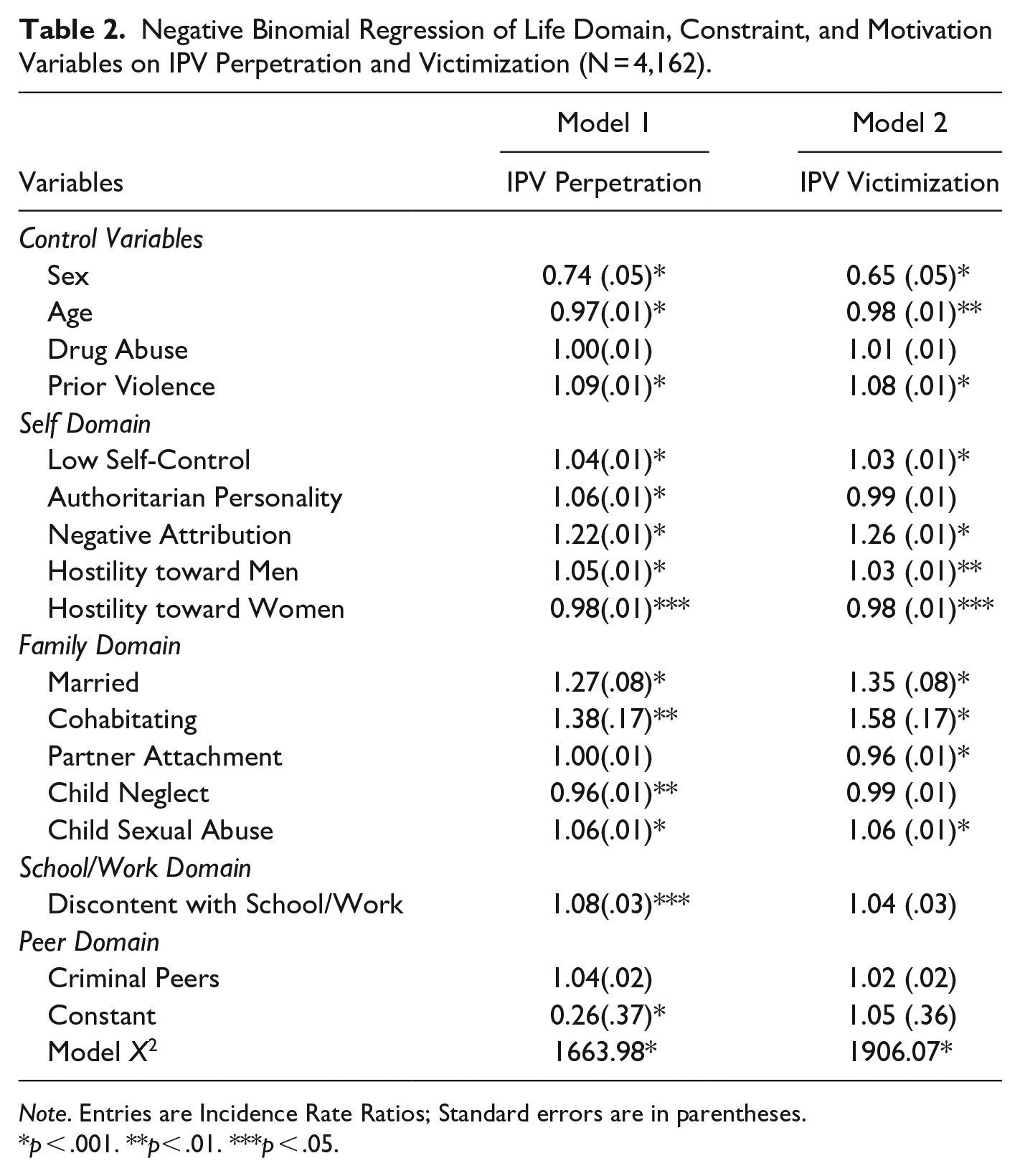
Note. Entries are Incidence Rate Ratios; Standard errors are in parentheses.
p < .001. **p< .01. ***p < .05.
The results also reveal four of the five family domain variables and the school/work domain measure were significant predictors of IPV perpetration. Specifically, the incident rate of IPV perpetration for married respondents was 27% greater than the rate for unmarried respondents, the rate for cohabitating respondents was 38% greater than the rate for un-cohabitating respondents, for a one-unit increase in child sexual abuse, the incident rate of IPV perpetration increased by 6%, and for a one-unit increase in discontent with school/work the incident rate of IPV perpetration increased by 8%. On the other hand, for a one-unit increase in child neglect the incident rate of IPV perpetration decreased by 4%. The peer (criminal peers) domain variable was not related to the outcome variable. Among the control variables, sex, age, and prior violence were significantly related to IPV perpetration. Respondents with high levels of prior violence had an elevated risk of engaging in IPV while male respondents and older respondents had a reduced risk of perpetrating IPV against their partner (Models 1 of Table 2).
Shifting our attention to Model 2 of Table 2 (IPV victimization), the results indicate that four of the five self domain variables (low self-control, negative attribution, hostility toward men, and hostility toward women) were significant predictors of IPV victimization. For a one-unit increase in low self-control the incident rate of IPV victimization increased by 3%, for a one-unit increase in negative attribution the incident rate of IPV victimization increased by 26%, and for a one-unit increase in hostility toward men the incident rate of IPV victimization increased by 3%. Conversely, for a one-unit increase in hostility toward women the incident rate of IPV victimization decreased by 2%.
Further, four of the five family domain variables (married, cohabitating, partner attachment, and child sexual abuse) were significantly related to IPV victimization. The incident rate of IPV victimization among married respondents was 35% greater than the rate for unmarried respondents, the rate for cohabitating respondents was 58% greater than the rate for un-cohabitating respondents, and for a one-unit increase in child sexual abuse, the incident rate of IPV victimization increased by 6%. On the other hand, for a one-unit increase in partner attachment the incident rate of IPV victimization decreased by 4%. The school/work (discontent with school/work) and peer (criminal peers) domain variables were not related to IPV victimization. Among the control variables, sex, age, and prior violence were significantly related to the outcome variable in that respondents with high levels of prior violence had an increased risk of falling victim to IPV while male respondents and older respondents had a decreased risk of experiencing this type of victimization (Model 2 of Table 2).
Mediating Effects of Constraints and Motivations
The results of the mediating effects of the constraint and motivation variables for IPV perpetration (Hypothesis 2A) are presented in Table 3 and the results for IPV victimization (Hypothesis 2B) are shown in Table 4. According to Table 3, four of the five self domain (low self-control, authoritarian personality, hostility toward men, and hostility toward women) and the work domain variables (discontent with school/work) that were significantly related to IPV perpetration in the previous IPV perpetration model became insignificant after the constraint and motivation variables were added to the model. On the other hand, the self domain measure of negative attribution and the four family domain variables (married, cohabitating, child neglect, and child sexual abuse) that predicted IPV perpetration in the previous model retained their significance in the current model. Also, while the peer domain variable (criminal peers) was not related to the outcome variable in the previous IPV perpetration model, it became a significant predictor of the outcome variable in this model (compare Model 1 of Table 2 with Table 3).
Mediating Effects of Constraints and Motivations on the Relationships between Life Domain Measures and IPV Perpetration (n = 4,162). a
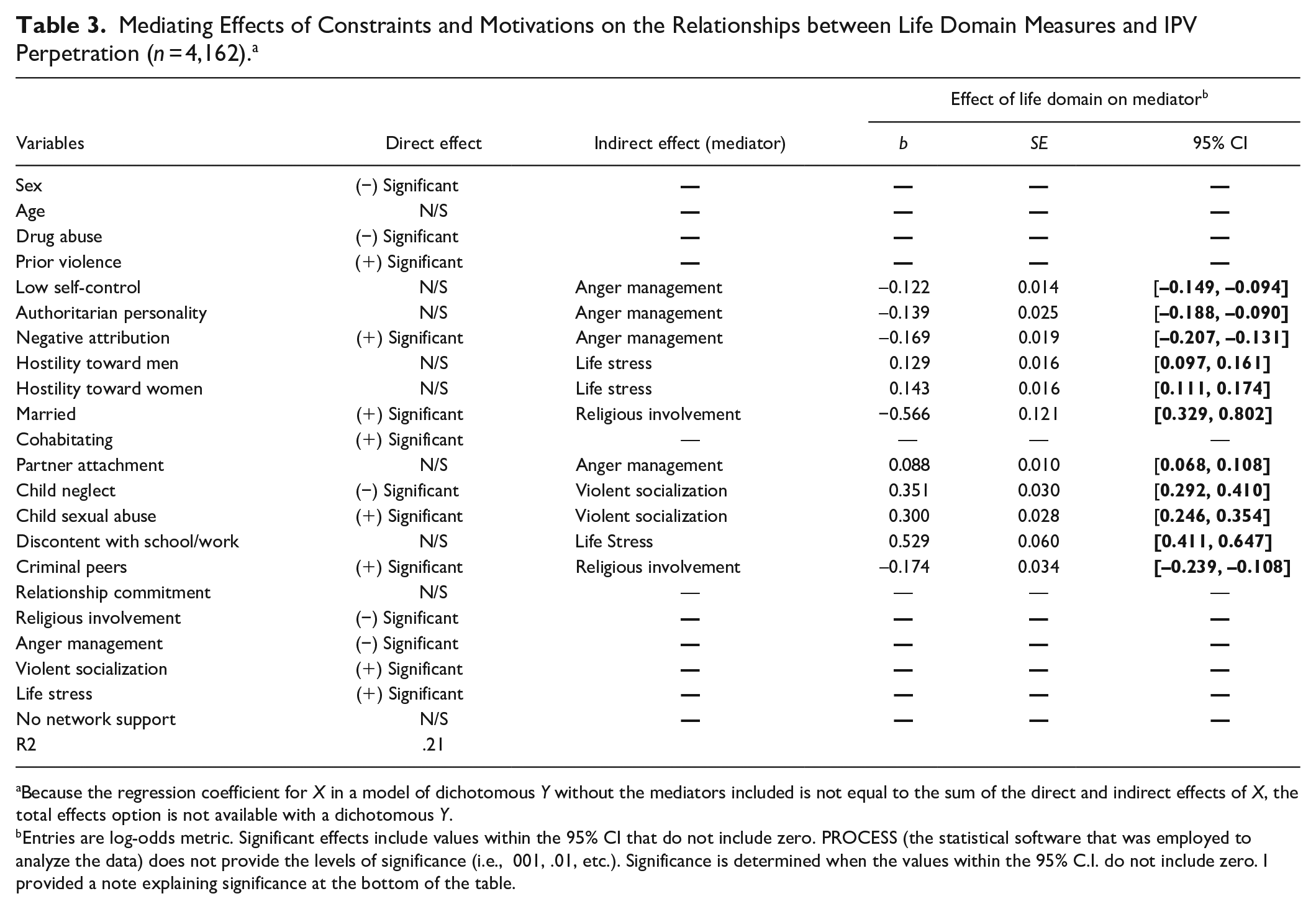
Because the regression coefficient for X in a model of dichotomous Y without the mediators included is not equal to the sum of the direct and indirect effects of X, the total effects option is not available with a dichotomous Y.
Entries are log-odds metric. Significant effects include values within the 95% CI that do not include zero. PROCESS (the statistical software that was employed to analyze the data) does not provide the levels of significance (i.e., 001, .01, etc.). Significance is determined when the values within the 95% C.I. do not include zero. I provided a note explaining significance at the bottom of the table.
Mediating Effects of Constraints and Motivations on the Relationships between Life Domain Measures and IPV Victimization (n = 4,162). a
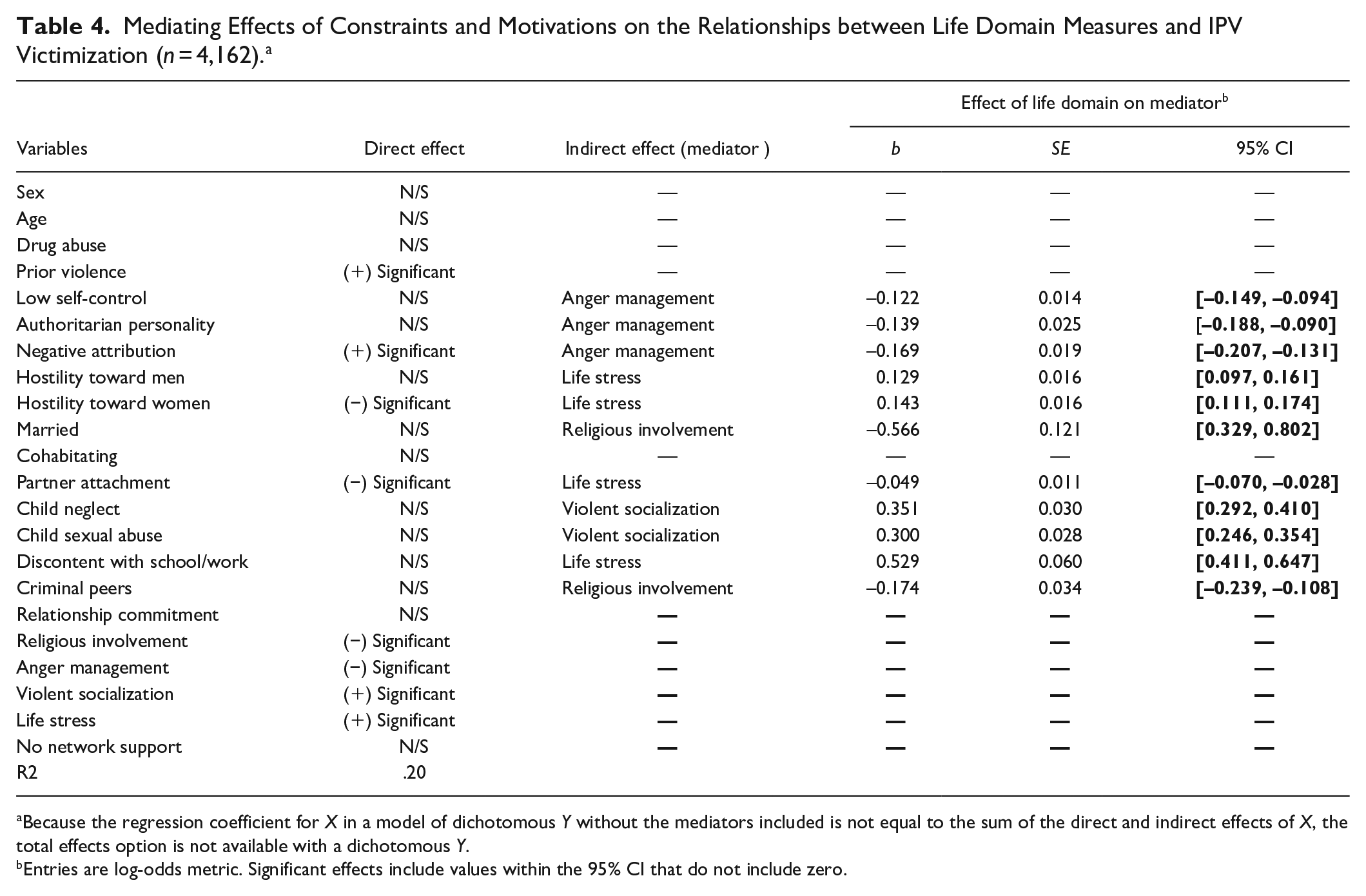
Because the regression coefficient for X in a model of dichotomous Y without the mediators included is not equal to the sum of the direct and indirect effects of X, the total effects option is not available with a dichotomous Y.
Entries are log-odds metric. Significant effects include values within the 95% CI that do not include zero.
The results from Table 3 also reveal evidence of mediating effects by the constraint and motivation measures. Specifically, except for the relationship between cohabitating and IPV perpetration, the relationships between all five self domain variables and IPV perpetration were mediated by anger management (low self-control, authoritarian personality, and negative attribution) and life stress (hostility toward men and hostility toward women), the relationships between four of the five family domain variables and IPV perpetration were mediated by religious involvement (married), anger management (partner attachment) and violent socialization (child neglect and child sexual abuse), the association between the school/work domain and IPV perpetration was mediated by life stress (discontent with school/work), and the association between the peer domain and the outcome variable was mediated by religious involvement (criminal peers).
Shifting our focus to the mediating effects of the constraints and motivations for IPV victimization (Table 4), the results reveal two of the four self domain (low self-control and hostility toward men) and three of the four family domain variables (married, cohabitating, and child sexual abuse) that were significantly related to the outcome variable in the previous IPV victimization model became insignificant after the constraint and motivation variables were added to the model. The school/work and peer domain measures continued to be unrelated to IPV victimization in this model as in the previous model (compare Model 2 of Table 2 with Table 4). Notably, similar to the mediation results for IPV perpetration, the results from Table 4 reveal evidence of mediating effects by constraint and motivation measures on the relationships between the life domains and IPV victimization. In particular, the relationships between the five self domain variables and IPV victimization were mediated by anger management (low self-control, authoritarian personality, and negative attribution) and life stress (hostility toward men and hostility toward women), the relationships between four of the five family domain measures and the outcome variable were mediated by religious involvement (married), life stress (partner attachment) and violent socialization (child neglect, and child sexual abuse), the association between the school/work domain (discontent with school/work) and IPV victimization was mediated by life stress, and the association between the peer domain (criminal peers) and the outcome variable was mediated by religious involvement. None of the constraint and motivation variables mediated the relationship between cohabitating and IPV victimization (Table 4).
Discussion and Conclusion
Following Schreck’s (1999) application of the main theoretical concept in Gottfredson and Hirschi’s (1990) self-control theory as a source of vulnerability for victimization, interests in the potential “generality” of other criminological theories in accounting for victimization ensue. However, to date, the bulk of the work in this area still involves examining the linkage between an individual’s level of self-control and his/her risk of becoming a crime victim (Pratt et al., 2014). In this study, we move beyond the self-control tradition and present the first empirical test that assesses the generality of Agnew’s general theory of crime and delinquency within the context of IPV—with a specific focus on his constraint/motivation mediation hypotheses. We are interested in examining whether the underlying processes for offending posited in Agnew’s framework are equally useful for understanding the underlying causes of victimization. Overall, our results provide strong support for the “generality” of Agnew’s integrated perspective in that the mechanisms that account for IPV perpetration appear to be equally relevant and applicable for understanding IPV victimization. Before we discuss the policy implications of our results and outline future research directions for Agnew’s theory, we present several key findings worth further discussion.
Life Domains, IPV Perpetration, and IPV Victimization
We found measures within the self, family, and school/work domains significantly predicted both IPV perpetration and victimization. On offending (Hypothesis 1A), as theorized by Agnew and consistent with prior research, we found that low self-control and irritability (authoritarian personality, negative attributions, and hostility toward men), being married or living with a partner (married and cohabitating), negative childhood experiences (child neglect and child sexual abuse), and negative attachment to school/work (discontent with school/work) was related to IPV perpetration (Model 1 of Table 2). Concerning IPV victimization (Hypothesis 1B), we found the same measures that were significantly associated to IPV perpetration (low self-control, negative attribution, hostility toward men, married, cohabitating, and child sexual abuse) predicted the outcome variable while having positive relationship experiences (partner attachment) decreased the risk of being victimized by IPV (Model 2 of Table 2).
We also uncovered several unexpected results. We found hostility toward women and child neglect decreased the risk of experiencing IPV perpetration and victimization (Models 1 and 2 of Tables 2). Given prior evidence that the relationship between childhood emotional abuse and IPV perpetration is mediated by hostility toward women (Vivolo-Kantor et al., 2013) and to explore this conjecture with our data, we estimated two negative binomial regression models in which IPV perpetration was regressed on child neglect and the control variables in the first model and on child neglect, hostility toward women, and the control variables in the second model (results not shown). We found evidence of a mediating effect of hostility toward women on the relationship between child neglect and IPV perpetration in that albeit child neglect was positive and significantly related to IPV perpetration in the first model, but after hostility toward women was added to the model child neglect did not predict IPV perpetration in the second model). 5 We replicated the analysis for IPV victimization and found that although child neglect retained its significance to the outcome variable in the second model, the magnitude of the effect decreased slightly (results not shown).
Mediating Effects of Constraints and Motivations
We also found some support for Agnew’s proposition that the variables in each domain increase crime by reducing the constraints against it and increasing the motivations for it. Except for the relationships among cohabitating, IPV perpetration, and IPV victimization, we found the effects of the self (low self-control, authoritarian personality, negative attribution, hostility toward men, and hostility toward women), family (married, partner attachment, child neglect, and child sexual abuse), school/work (discontent with school/work), and peer (criminal peers) domains on IPV perpetration and victimization were mediated by two constraint (anger management and religious involvement) and two motivation (violent socialization and life stress) variables. Respondents with the ability to control their anger had a decreased risk of perpetrating and falling victim to IPV, while respondents who were less involved in religious activities, socialized or exposed to violent behavior as a child, and reported high levels of life stress had an elevated risk of engaging in and being a victim of IPV (Tables 3 and 4).
We also uncovered the effects of two self domain (negative attribution and hostility toward women) and all five family domain (married, cohabitating, partner attachment, child neglect, and child sexual abuse) measures on the outcome variables (IPV Perpetration and IPV Victimization) were only partially mediated by the constraint and motivation factors (i.e., they retained their significance to the outcome variables in the full model; Tables 3 and 4). According to Agnew (2005), the effects of the constraint and motivation factors on crime and delinquency can be long-lasting (such as in the enduring constraints of believing that crime is wrong, or in having a strong emotional bond to one’s partner) or situational (as in motivation stemming from the presence of attractive targets for crime or in provocations by others). Unfortunately, the cross-sectional nature of our data precludes us from exploring the above supposition. Hence, we encourage future research to employ longitudinal data and examine the mediating effects of constraint and motivation factors on the relationships between the life domains and IPV perpetration and victimization. We also encourage future research to consider alternative intervening mechanisms not included in our study since Agnew (2005) maintains that his integrated perspective “. . . not only incorporates all of the variables commonly associated with the leading crime theories but also incorporates all of the intervening mechanisms associated with these theories” (p. 208).
Policy Implications
The findings generated from our study suggest that targeting anger and life stressors is crucial for treating and preventing IPV. Violent behavior is generally seen as a momentary outburst of anger and thus, the focus in treatment tends to be on managing emotions (Burton, 2018). In anger management workshops and education, the use of cognitive-behavioral therapy appears to be effective in helping participants feel more in control of their anger (Sax, 2012). Relatedly, problem-focused coping strategies aimed at reducing daily stress could be fruitful in combating IPV. Unlike emotion-focused coping which focuses on negative emotional responses associated with stress, problem-focused coping targets the causes of stress or a stressful situation that is causing stress, consequently directly reducing the stress (Lokhmatkina et al., 2015). Results from a meta-analysis revealed emotion-focused strategies are often less effective than using problem-focused methods concerning health outcomes (Penley et al., 2002). In addition to therapies such as relaxation techniques and problem-solving strategies, solution-focused therapy, a form of therapy that focuses on solutions to problems or issues and discovering the resources and strengths a person has rather than focusing solely on the problem as traditional talking therapies do, is a promising technique in treating relationship problems (Bond et al., 2013).
Even with the positive programmatic evidence noted above, we believe the best approach to combat and prevent IPV is by promoting healthy, respectful, nonviolent relationships. Prevention strategies such as Teach Safe and Healthy Relationship Skills that focus on promoting social and emotional competency among youth which in turn helps build healthy relationships among young couples are key strategies. Similarly, programs such as Disrupt the Developmental Pathways toward Partner Violence that emphasize parenting and interpersonal skills, preschool enrichment with family engagement, and home visitation are promising strategies for curbing IPV (Centers for Disease Control and Prevention, 2020; Piquero et al., 2009). Additionally, given that different types of violence are connected and often share the same root causes, addressing and preventing one form of violence such as IPV will have an impact on preventing other forms of violence.
Study Limitations
Our study is not without weaknesses. First, our study involved cross-sectional, quantitative, and self-reported data, and hence, definitive causal relationships cannot be established and no information on contextual factors was available to aid with the interpretation of the results. Second, our dependent variables only encompass physical aspects of IPV, so replication of our results with other forms of abuse is important, particularly psychological abuse like stalking. Similarly, other life domain variables, such as more detailed information about respondents’ employment and school experiences, were also not available in the IDVS. We encourage future research to incorporate measures capturing a variety of IPV victimization types as well as representing different aspects of the life domains in their study. Third, the influences of and manifestations regarding IPV perpetration and victimization may be age-graded and may involve a series of different types, such as physical and emotional violence, and also include relatively new spaces for it, primarily social media. Understanding how these fit within Agnew’s theory, and other criminological theories, for that matter, would be a relevant scope for future inquiry.
Future Research Directions
Finally, we offer three considerations to help expand the potential applicability of Agnew’s theory across crime types. First, it seems crucial that the conceptualization and operationalization of the life domain, constraint, and motivation measures align with findings generated from prior research. In the current study, we inferred from Agnew’s description of the irritability personality and conceptualized hostility toward women as an element of this individual characteristic. However, according to the extant evidence on IPV, hostility toward women is a mediator between childhood emotional abuse and violence perpetration (Vivolo-Kantor et al., 2013), a finding that we corroborated in our subsequent analysis (results not shown). Further, in our mediation analysis, while hostility toward women and child neglect were partially mediated by violent socialization and life stress, respectively, the direct effects of both measures on the outcome variables were not in the expected directions (Tables 3 and 4). According to Agnew (2005), “A theory of crime, however, does more than simply list the variables that cause crime and describe the reasons why they do so; it also describes the relationships between these variables” (p. 61). On this point, it behooves future research to not only draw from the theoretical insights of Agnew’s framework but also incorporate prior research findings when identifying and measuring key concepts to test the perspective and specify the relationships among the variables.
Second, in terms of prevention and treatment programs, Agnew (2005) maintains that “The best way to control crime is to address the direct causes of crime embodied in the five life domains” (p. 196). In the field of criminal justice, risk factors are routinely employed to assess risks of reoffending and develop intervention programs aimed at modifying the characteristics of individuals and their environments associated with crime (Andrews & Bonta, 2010). Further, it has been noted that the theoretical legitimacy of incorporating risk factors into the domain of treatment depends on their causal status. Hence, assessing whether the key theoretical variables outlined in Agnew’s perspective can serve explanatory functions in addition to their risk predictive roles is warranted. That is unless it can be demonstrated that a specific variable, individually or collectively, can serve an explanatory role as well as a predictive one, the variable should not be regarded as an intervention target or employed to monitor treatment changes (Ward & Fortune, 2016). As an example, given our finding that life stress (experiencing peer pressure, having financial difficulty) is a risk factor for both IPV perpetration and victimization, a useful undertaking for future research is to move beyond demonstrating this variable as a risk for crime and instead, establish it as a potential risk that if effectively targeted, will lead to a reduction in reoffending and victimization.
Third, the relevance and applicability of Agnew’s conceptual framework to crime and victimization occurring in cyberspace remain unexplored. The emergence of cybercrime (i.e., illegal activities committed using a computer, networked device, or a network) has occupied researchers and scholars in the past decade. To date, the application of mainstream criminological theories to understand cybercrime and cybercrime victimization has been characterized as superficial, occurring with little consideration for changes in criminal context and processes (Steinmetz & Nobles, 2017). Hence, an essential topic for future exploration is whether the causal processes theorized by Agnew to understand offending—and by extension victimization—in the physical world are applicable and useful for explicating crime and victimization occurring in the virtual environment. Future work in this area could help expand the scope of Agnew’s framework and determine its contemporary application.
Footnotes
Appendix
Acknowledgements
The authors would like to thank the anonymous reviewers and Alex Piquero for many helpful comments, which greatly improved the manuscript.
Declaration of Conflicting Interests
The author(s) declared no potential conflicts of interest with respect to the research, authorship, and/or publication of this article.
Funding
The author(s) received no financial support for the research, authorship, and/or publication of this article.
