




Abstract
Convenience exists in the financial motive, the organizational opportunity, and the personal willingness for deviant behavior. These three themes can result in 14 convenience propositions as presented in this article. In cases where an offender is detected, the offense can be examined by identifying relevant convenience issues in the structural model of crime convenience. Not all of the 14 issues will be relevant to create a narrative of one specific incident. In cases where prevention of offenses is the issue, then vulnerability review is appropriate for all 14 propositions. For example, domination of greed or extensive differential association can signal strong motivation or strong willingness for wrongdoing, while lack of oversight and guardianship can signal an invitation for wrongdoing.
Introduction
The criminologist Agnew (2014) suggested that “crime is often the most expedient way to get what you want,” and “fraud is often easier, simpler, faster, more exciting, and more certain than other means of securing one’s ends” (p. 2). Fast, easy, simple, and expedient are characteristics of convenience, where being convenient is not necessarily bad. On the contrary, the person can be seen as smart and rational (Sundström & Radon, 2015). Misconduct and crime can be hard to detect because signals of deviant behavior drown or disappear in noise (Gomulya & Mishina, 2017).
White-collar crime refers to offenses based on the social and occupational status of the offender as economic crime committed by a person of respectability and high social status in the course of the offender’s occupation (Sutherland, 1939, 1983). White-collar crime is illegal acts that violate responsibility or public trust for personal or organizational gain (Pinto et al., 2008). It is one or a series of acts committed by non-physical means and by concealment to obtain money or property, or to obtain business or personal advantage (Leasure & Zhang, 2018). The offender has legitimate access, where legitimacy is a generalized perception or assumption that the actions of an individual are desirable, proper, and appropriate within some socially constructed system of norms, roles, and values (Fitzgibbon & Lea, 2018). Legitimacy is an assessment of the appropriateness of an individual’s actions (Bundy & Pfarrer, 2015).
While financial motives and personal willingness of the offender for deviant behavior might be general for more trusted individuals than just CEOs, the unique convenience issues in the organizational opportunity category for this group of offenders make it worthwhile to address the group explicitly. Chief executive status and access to resources enable convenient ways to commit financial crime. Organizational decay, chaos, and collapse enable convenient ways to conceal financial crime.
This article maintains that the concept of convenience may help understand the wrongdoing at the top of organizations. The purpose of the article is to provide a theoretical foundation for future research based on a multi-dimensional explanation of white-collar offending. This perspective, which is composed of three interrelated themes of motivation, opportunity, and willingness, suggests that individuals more likely to commit white-collar crime are differently oriented to convenience as a factor in the choice to engage in illegal behavior. Individuals become more oriented toward convenience as the motive becomes stronger, as the opportunity improves, and as the willingness to engage in deviant behavior become more intense. Thus, perceptions of convenience should differ between those who view white-collar crime as more acceptable and those who view it as less acceptable.
To realize the purpose of this article, the method of a literature review is applied. Suggested convenience propositions are based on intensive review of business journals such as Journal of Business Ethics, Academy of Management Review, Academy of Management Journal, Organization Studies, Human Resource Management, and the Accounting Review, on top of several criminal justice journals. The article suggests 14 convenience propositions that cover the themes of motivation, opportunity, and willingness, starting with propositions for motive, followed by propositions for opportunity and willingness. The motive is dichotomous in possibilities and threats, the opportunity is dichotomous in committing crime and concealing crime, and the willingness is dichotomous in choice and innocence.
Finally in this article, the seriousness of white-collar crime is briefly discussed.
Convenience Propositions
Convenience theory is an emerging theoretical perspective to explain the phenomenon of white-collar crime where convenience was first introduced as a core concept by Gottschalk (2017). Recently, the theory has been evaluated (e.g., Chan & Gibbs, 2020; Hansen, 2020; Oka, 2021; Vasiu, 2021; Vasiu & Podgor, 2019) and applied by several scholars such as Braaten and Vaughn (2019), Dearden and Gottschalk (2020), Desmond et al. (2022), Stadler and Gottschalk (2021), and Qu (2021). While several case studies in recent years have applied the theory of convenience to the study of white-collar offenders, the theory with its structural model has been lacking explicit development and formulation of theoretical propositions. Therefore, this article represents an important contribution to the development of convenience theory.
Suggested categories of convenience propositions in the convenience triangle for trusted chief executives are illustrated in Figure 1. The three corners of the triangle are financial motive, organizational opportunity, and willingness for deviant behavior. The motive derives either from possibilities or threats for the individual or the organization. The opportunity derives mainly from committing or from concealing financial crime. To commit crime is convenience for high status individuals with legitimate access to resources. To conceal crime is convenient when there is institutional deterioration (decay), lack of oversight and guardianship (chaos), and criminal market forces (collapse). Crime as a choice can derive from offender identity, rationality, and learning. Crime based on perceived innocence can derive from justification and neutralization of guilt.
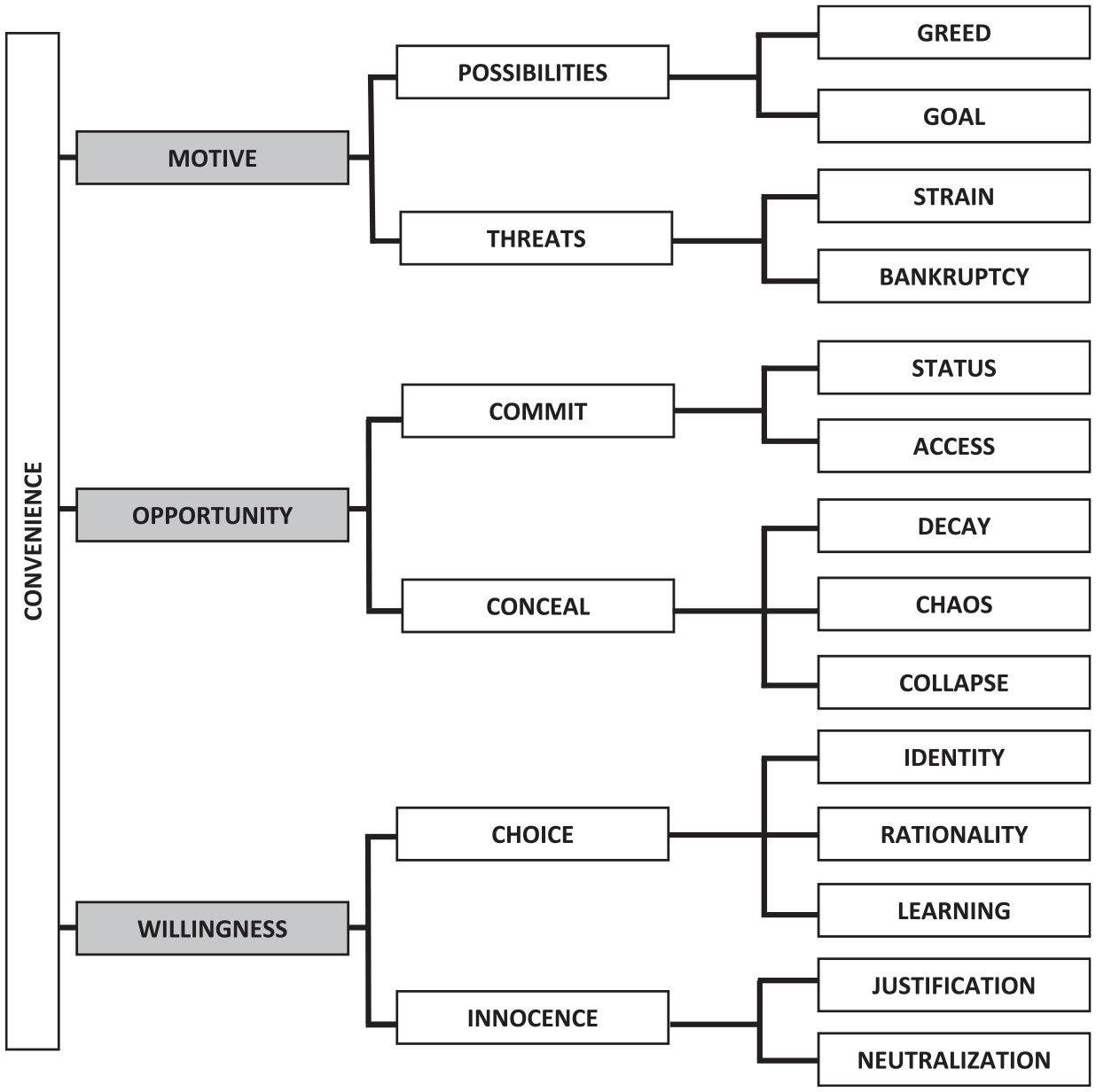
Structural model of white-collar crime convenience.
Motivational Propositions
The central column in Figure 1 illustrates possibilities and threats as the main motivational factors. Possibilities open up avenues for exploration and exploitation, while threats represent pain and obstacles that everyone would like to avoid.
At the individual level of possibilities, greed is the most acknowledged motive for financial crime by white-collar offenders (Bucy et al., 2008; Hamilton & Micklethwait, 2006). Goldstraw-White (2012) defined greed as socially constructed needs and desires that can never be completely covered or contended. Greed can be a very strong quest to get more and more of something, and there is a strong preference to maximize wealth. To outsiders it may seem strange that rich people have such a strong desire to become even richer that they are willing to break the law. However, as the definition indicates, greedy individuals are never happy with what they have, as they desperately want more all the time. Prosperity is not a means, but a goal for greedy individuals. Greed can grow when the organization does not have an adequate reaction (Haynes et al., 2015).
Sajko et al. (2021, p. 961) studied CEO greed where they defined greed as self-interest by excessive materialistic desire and lack of concern for the well-being of others: Greed, which is most commonly defined as an excessive materialistic desire to acquire personal wealth, can be seen as the “dark” end of the self-interest continuum – that is, hyper-self-interest (. . .) While self-interest is morally neutral, greed carries a moral charge (. . .) Greed by definition implies a lack of concern for the well-being of others.
The hierarchy of needs is another well-known motive for financial crime by white-collar offenders. Needs start at the bottom with physiological needs, needs for security, social needs, and needs for respect and self-realization. When basic needs such as food and shelter are satisfied, then the person moves up the pyramid to satisfy needs for safety and control over own life situation (Maslow, 1943). Higher up in the pyramid, the person strives for self-respect, status, recognition, and admiration (Cleff et al., 2013; Hausman, 2018). An important factor in many societies is the American dream of prosperity and success as the ultimate goal of life (Schoepfer & Piquero, 2006). It is an extreme one-sided emphasis on success in exposed assets (Trahan et al., 2005), and it is not matched by a concurrent emphasis on what means are legitimate for reaching desired goals. If illegal financial gain can help achieve desired acclaim, narcissists in particular might feel entitled to crime (Galvin et al., 2015). There might be confusion without moral guidance in terms of anomie that refers to lack of social and ethical norms (Merton, 1957).
Proposition 1a. As personal greed increases, financial crime will seem more convenient for a chief executive in a trusted position.
The strain perspective has become one of the leading theoretical explanations for crime (Langton & Piquero, 2007). The strain perspective argues that a range of factors influence whether individuals cope with strains through crime (Thaxton & Agnew, 2018, p. 888): Criminal coping is said to be most likely among those with poor coping skills and resources, little social support, low social control, beliefs favorable to crime, criminal associates, and opportunities for crime.
The strain perspective emphasizes strains and stressors that increase the likelihood of crime, the negative emotions (including anger) resulting from those strains that create pressure for corrective action, and the factors that influence or condition the likelihood of criminal coping (Thaxton & Agnew, 2018). Stress is a psychological state that arises from a mismatch between perceived demands and one’s ability to meet those demands given available resources (Linder et al., 2021).
Strains are events and conditions that individuals dislike. Strains lead to negative emotions and thereby create pressure for corrective action. Crime is one possible action, which seems attractive to some privileged members of the elite as a means to escape from or reduce strains (Froggio & Agnew, 2007; Ngo & Paternoster, 2016) such as the fear of falling from an elite position (Kouchaki & Desai, 2015; Piquero, 2012). The strain of pursuing goals within diverse possibility structures may lead to adaptations such as crime, delinquency, and other deviant behaviors. Delinquency results when individuals are unable to achieve their goals through legitimate channels (Vilalta et al., 2021).
Proposition 1b. As personal strain increases, financial crime will seem more convenient for a chief executive in a trusted position.
Escalation of commitment to ambitious business goals increases the likelihood of misconduct and crime (Sleesman et al., 2012, 2018). Escalation of commitment is defined as “decision-making in the face of negative feedback about prior resource allocations, uncertainty surrounding the likelihood of goal attainment, and choice about whether to continue” (Keil et al., 2000, p. 632). Welsh and Ordonez (2014) found that high performance goals cause unethical behavior. A strong emphasis on goal attainment might indeed lead organizational members to engage in illegal acts (Kang & Thosuwanchot, 2017). When executives perceive high performance goals as invariable, personal desperation for goal achievement can result (Kuvaas et al., 2016, p. 401): Perceiving goals as invariable refers to the extent to which employees believe that the goals in a performance management system represent absolute standards that they must meet without exception, even if they think other factors are more important.
In many organizations, ends justify means (Campbell & Göritz, 2014). If ends in terms of ambitions and goals are difficult to realize and achieve in legal ways, illegal means represent an alternative in many organizations (Jonnergård et al., 2010). Among most executives, it is an obvious necessity to achieve goals and objectives, while it is an obvious catastrophe failing to achieve goals and objectives, sometimes because of rivalry (Dodge, 2009). To make as much profit as possible might be the only goal (Naylor, 2003).
Goalsetting is often perceived in a positive light, meaning that ambitious goals increase performance (Locke & Latham, 2013). However, there is also evidence suggesting that high performance goals can lead to unethical behavior (Schweitzer et al., 2004; Simmons, 2018). Welsh et al. (2020) argued that this is not only because of rewards associated with goal attainment, but also because of changing morale reasoning processes related to the goal. As such, high goal commitment facilitates unethical behavior by increasing not only the motivation to achieve the goal but also the motivation to justify doing so by any means necessary (Locatelli et al., 2017). This is known as state morale disagreement, a process through which individuals justify unethical behavior (Moore, 2015) and disengage morally (Theoharakis et al., 2021). It is part of the dark side of ambitious goals.
Proposition 1c. As commitment to ambitious business goals increases, financial crime will seem more convenient for a chief executive in a trusted position.
The final convenience proposition within the motive theme is painful corporate economic threats. The threat of corporate collapse and bankruptcy might cause exploration and exploitation of illegal avenues to survive, where moral panic can occur (Chattopadhyay et al., 2001; Kang & Thosuwanchot, 2017). The survival of the corporation can become so important that no means come across as unacceptable in the current situation (Blickle et al., 2006). Sometimes, fraud and corruption are considered temporary measures to recover from a crisis (Geest et al., 2017), where the measures will be terminated when the crisis is over. A crisis is a fundamental threat to the organization, which is often characterized by ambiguity of cause, effect, and means of resolution.
Markets with crime forces can represent painful corporate economic threats. In many markets, there are cartels that regulate the supply side. A cartel is an implicit agreement between firms in the same industry to fix prices, to divide customers and markets among themselves, to fix industry outputs, to allocate territories, or to divide profits (Goncharov & Peter, 2019, p. 152): Cartel members seek to act collectively, as if they were a single monopolist, thereby maximizing the collective profit. By doing so, cartels violate competition policy and severely reduce consumer welfare through price-fixing activities that increase the price of goods far beyond the competitive level.
Chattopadhyay et al. (2001) studied organizational actions in response to threats. They found that threats are associated with urgency, difficulty, and high stakes. Threats involve a negative situation in which loss is likely and over which one has relatively little control. Threats against organizational survival can create a personal motive for executives to commit financial crime (Crosina & Pratt, 2019). Threats are often noticed very late, both by individuals and by organizations. Handling threats thus becomes a matter of urgency. Individuals and firms “fail to detect threats and prevent calamities not because of an absence of signals or insufficient knowledge (or faulty awareness), but because attention bandwidth and information-processing fidelity are inherently limited” (Downing et al., 2019, p. 1890).
Proposition 1d. As threats against the existence of the enterprise increase, financial crime will seem more convenient for a chief executive in a trusted position.
Opportunity Propositions
The central column in Figure 1 illustrates the opportunity to commit and conceal wrongdoing. Committing a crime is to carry out an offense, while concealment of crime is to hide traces of wrongdoing. Different from street crime where the offender goes hiding and the offense is visible, the white-collar offender remains visibly in the position while making efforts to hide the offense.
Trust is an important contribution to the convenience of white-collar crime. Trust is the acceptance of vulnerability to another’s actions. Kim et al. (2009) defined trust as “a psychological state comprising the intention to accept vulnerability based on positive expectations of the intentions or behavior of another” (p. 401). The Violation of trust is at the core of white-collar crime opportunity. Trust implies that vulnerability is accepted based upon positive expectations of the motives and actions of another. Berghoff and Spiekermann (2018, p. 291) found that all economic transactions depend on a certain degree of trust, without which transaction costs would simply be too high for economic activity: White-collar criminals abuse the good faith of various stakeholders, from customers to the general public, from shareholders to the authorities. Therefore, white-collar crime often coincides with the breach of trust.
Chief executives are trusted individuals who sometimes suffer from narcissistic tendencies as “masters of puppets” (Chatterjee & Pollock, 2017) who are able to attribute blame for their own wrongdoing somewhere else (Eberly et al., 2011). Some suffer from narcissistic identification with the corporation where they claim that “I am the company” (Galvin et al., 2015; Toubiana, 2020; Veltrop et al., 2021). As argued by Yip and Schweitzer (2015) as well as by Sutherland (1939, 1983) and Shapiro (1990), trust promotes unethical behavior. Trust is thus part of the opportunity structure that influences both status and access in Figure 1.
In the perspective of crime-as-a-choice, the status of the chief executive can make illegitimate actions relatively more convenient compared to legitimate actions. Status is an individual’s social rank within a formal or informal hierarchy, or a person’s relative standing along a valued social dimension (Kakkar et al., 2020). Status is the extent to which an individual is respected and admired by others, and status is the outcome of a subjective assessment process (McClean et al., 2018). Status differences lead to opportunity variations based on one actor’s acknowledgment that the other is entitled to certain privileges (Han et al., 2017). High-status individuals enjoy greater respect and deference from, as well as power and influence over, those who are positioned lower in the social hierarchy (Kakkar et al., 2020, p. 532): Status is a property that rests in the eyes of others and is conferred to individuals who are deemed to have a higher rank or social standing in a pecking order based on a mutually valued set of social attributes. Higher social status or rank grants its holder a host of tangible benefits in both professional and personal domains. For instance, high-status actors are sought by groups for advice, are paid higher, receive unsolicited help, and are credited disproportionately in joint tasks. In innumerable ways, our social ecosystem consistently rewards those with high status.
Especially individuals with high status based on prestige rather than dominance tend to be excused for whatever wrongdoing they commit. Individuals who attain and maintain high rank by behaving in ways that are assertive, controlling, and intimidating are characterized as dominant. Individuals who attain and maintain high rank by their set of skills, knowledge, expertise, and their willingness to share these with others are characterized as prestigious (Kakkar et al., 2020).
Proposition 2a. Higher social status for a chief executive in a trusted position is associated with greater convenience of committing financial crime.
A white-collar offender has typically legitimate access to resources to commit financial crime (Kempa, 2010; Huisman & Erp, 2013; Williams et al., 2019). A resource is an enabler applied and used to satisfy human and organizational needs. According to Petrocelli et al. (2003), access to resources equates access to power. Others are losers in the competition for resources (Wheelock et al., 2011). In the conflict perspective suggested by Petrocelli et al. (2003), the upper class in society exercises its power and controls the resources. White-collar offenders have legitimate access to premises (Benson & Simpson, 2018; Williams et al., 2019), and they have specialized access in routine activities (Cohen & Felson, 1979).
In the role of an entrepreneur (Huang & Knight, 2017), the trusted offender might have even easier access to crime resources for illegal entrepreneurship (McElwee & Smith, 2015; Peixoto et al., 2021). High social status in privileged positions is sometimes associated with entrepreneurship, where an entrepreneurial individual can create opportunities for deviant behavior (Ramoglou & Tsang, 2016). The entrepreneurship perspective emphasizes that entrepreneurs discover and create innovative and entrepreneurial opportunities (Tonoyan et al., 2010; Welter et al., 2017). Criminal entrepreneurs actualize illegal opportunities in the shadow economy (McElwee & Smith, 2015). Scheaf and Wood (2021, p. 2) found that entrepreneurial fraud has stimulated a wide array of research related to white-collar crime, where they provided the following definition of entrepreneurial fraud: Enterprising individuals (alone or in groups) deceiving stakeholders by sharing statements about their identity, individual capabilities, elements of new market offerings, and/or new venture activities that they know to be false in order to obtain something of value.
Opportunity is any “potential course of action, made possible by a particular set of social conditions, which has been symbolically incorporated into an actor’s repertoire of behavioral possibilities” (Coleman, 1987, p. 409). Aguilera and Vadera (2008) described a criminal opportunity as “the presence of a favorable combination of circumstances that renders a possible course of action relevant” (p. 434). An opportunity is attractive as a means of responding to desires, wishes, and ambitions. Committing financial crime might be convenient because of the offender’s status and legitimate access to resources.
Proposition 2b. Increased ease of access to crime resources for a chief executive in a trusted position is associated with greater convenience of committing financial crime.
As suggested by Berghoff and Spiekermann (2018, p. 290), sophisticated concealment is an important factor in white-collar crime: The privileged position of white-collar criminals is the result of several factors. Their offences are especially difficult to prosecute because the perpetrators use sophisticated means to conceal them. They can also often afford the best lawyers and have the political clout to influence the legislative process to their advantage and, if need be, to bribe prosecutors and judges. Additionally, the class bias of the courts works to their benefit. The law is often seen as not binding, at least not for and by economic elites.
Crime concealment becomes more convenient when there is organizational decay in the form of institutional deterioration (Barton, 2004; Donk & Molloy, 2008). An institution is a system of interrelated formal and informal elements—rules, guidelines, norms, traditions, and beliefs—governing relationships between institutional members within which members pursue their mutual interests (Gyõry, 2020). Institutional deterioration improves conditions of convenience for corruption and other forms of financial crime (Kostova et al., 2008; Pinto et al., 2008; Rodriguez et al., 2005). Institutional deterioration can occur conveniently, resulting from external legitimacy where deviance is the norm. An offender’s actions have a superficial appearance of legitimacy also internally, since both legal and illegal actions in the company occur in a manner characterized by disorganization (Benson & Simpson, 2018). Shadnam and Lawrence (2011, p. 379) applied the institutional perspective to explain moral decline and potential crime in organizations: Our theory of moral collapse has two main elements. First, we argue that morality in organizations is embedded in nested systems of individuals, organizations and moral communities in which ideology and regulation flow “down” from moral communities through organizations to individuals, and moral ideas and influence flow “upward” from individuals through organizations to moral communities. Second, we argue that moral collapse is associated with breakdowns in these flows and explore conditions under which such breakdowns are likely to occur.
Conventional mechanisms of social control are weak and unable to regulate the behavior within the organization. Concealment of crime occurs conveniently by simply disappearing among other seemingly legitimate transactions.
Proposition 2c. Organizational decay in the form of institutional deterioration is associated with greater convenience of concealing financial crime for a chief executive in a trusted position.
Lack of overview and guardianship can create a chaos that improves the convenient opportunity to conceal financial crime in the organizational setting for a white-collar offender. The agency perspective suggests that a principal is often unable to control an agent who does work for the principal. The agency perspective assumes narrow self-interest among both principals and agents. The interests of principal and agent tend to diverge, they may have different risk willingness or risk aversion, there is knowledge asymmetry between the two parties, and the principal has imperfect information about the agent’s contribution (Williams, 2008).
In a chaotic situation, misreporting in accounting is often a convenient way of concealing illegal transactions (Qiu & Slezak, 2019). Lack of transparency makes concealment in accounting convenient (Goncharov & Peter, 2019). Managers can withhold bad news by accounting misrepresentation (Bao et al., 2019), since financial statements are a substantive component of a firm’s communications with its stakeholders (Gupta et al., 2020).
Lack of oversight and guardianship becomes even worse when auditors slide over on the wrong side of the law. Mohliver (2019, p. 310) found that some auditors prioritize their clients’ interests over their legal obligation by recommending client malfeasance, for example in terms of illegal stock option backdating: The findings suggest that professional experts’ involvement in the diffusion of liminal practices is highly responsive to the institutional environment.
Auditors are supposed to serve as gatekeepers to protect shareholders and report directly to shareholder representatives on the board of directors, but auditors become surprisingly often hired by corporate management to whom they are loyal (Hurley et al., 2019). Reporting fraud to public authorities will also harm auditors (Mohliver, 2019, p. 316):
As organizations, audit firms are often severely penalized for client malfeasance. Yet the individual auditors working for these firms are susceptible to “motivated blindness” stemming from conflicts of interest that bias their moral judgment toward choices that help their clients.
Mohliver (2019) found that auditor bias toward accepting deviant financial reports increased when there is ambiguity about the appropriateness of a course of action. Financial misreporting that is viewed favorably by the client organization can be recommended by external auditors on the grounds that such reporting is already adopted among companies served by the same auditing firm.
Proposition 2d. Organizational chaos in the form of lacking overview and guardianship is associated with greater convenience of concealing financial crime for a chief executive in a trusted position.
While disorganized institutional deterioration causes decay, and lack of oversight and guardianship causes chaos, criminal market structures cause external collapse. Collapse of legitimacy is the final convenience proposition within the opportunity theme. Collapse might be caused by rule complexity preventing compliance (Lehman et al., 2020), participation in crime networks such as cartels (Nielsen, 2003), and financial crime as the usual way of doing business in markets with crime forces (Chang et al., 2005). Collapse represents a convenient situation for everybody ready to commit white-collar crime.
Rule complexity can create a situation where nobody is able to tell whether an action represents a criminal offense. It is impossible to understand what is right and what is wrong. Some laws, rules, and regulations are so complex that compliance becomes random, where compliance refers to acting in accordance with laws, rules, and regulations. The regulatory legal environment is supposed to define the boundaries of appropriate organizational conduct. However, legal complexity is often so extreme that even specialist compliance officers struggle to understand what to recommend to business executives in the organizations (Lehman et al., 2020). Then regulatory inspection does not work for compliance (Braithwaite, 2020), especially when operating internationally and globally where states do not agree on what should be legal and illegal activities (Boghossian & Marques, 2019; Pontell et al., 2020). Eberlein (2019) argued that globalization opens markets for corporations but outstrip the capacity of states to regulate and enforce laws on cross-border business conduct for the public good. Similarly, Schneider and Scherer (2019) argued that “the extent to which state authorities can regulate the externalities and the behavior of multinational corporations is limited,” and that “gaps in governance abound in today’s globalized world” (p. 1147). There is an erosion of state power and a shift toward private regulation. Maher et al. (2019) found that governments not just in global business, but also in local business are reluctant to intervene. They observed an ambiguity of the state to involve itself.
A cartel is a typical criminal network involving chief executives from competing firms who have chosen to have their businesses cooperate illegally on the market. A cartel is an association of independent firms in the same industry that strive to reduce competition by agreeing on areas such as market sharing, pricing levels, and production quotas. A cartel is collective misconduct of firms (Bertrand & Lumineau, 2016): “Instead of competing with one another, cartel members rely on each other’s agreed course of action” (p. 983).
Monopolies, cartels, and crime networks do not only represent threats in the motivational category of convenience (Chang et al., 2005; Geest et al., 2017). For deviant members of the elite, monopolies, cartels, and crime networks can represent attractive avenues for extra profits (Freiberg, 2020; Goncharov & Peter, 2019). Participation in criminal networks can be attractive (Nielsen, 2003), especially if criminogenic market symptoms cause markets with crime forces to be the usual way of doing business (Chang et al., 2005).
Proposition 2e. Market collapse caused by rule complexity, cartels, crime networks, state reluctance to intervene and other factors is associated with greater convenience of concealing financial crime for a chief executive in a trusted position.
Willingness Propositions
The central column in Figure 1 illustrates that willingness can be based on choice and innocence. Choice is a conscious decision to commit crime, while innocence is a perception of lacking a role in wrongdoing.
A corporation can initially be blamed for a scandal, yet corporate accounts and the secrecy of offenders can make corporate crime seem less serious (Dewan & Jensen, 2020; Schoultz & Flyghed, 2016, 2019, 2020a, 2020b, 2021a, 2021b). Dewan and Jensen (2020) studied high social status individuals in times of scandals that can change the role of status from being an asset to being a liability. They defined scandal as the disruptive publicity of misconduct, that is, a situation after detection and disclosure to the public. While the importance of status in convenience is related to prevention of blame before disclosure, Dewan and Jensen’s (2020, p. 1657) research was concerned with status after disclosure: Because scandal diminishes the effectiveness of factors that make status an asset, status offers less protection during a scandal. At the same time that scandal decreases the protective benefits of status, the factors that make status a liability remain or are augmented.
As illustrated in the figure, the willingness for deviant behavior derives from choice and innocence. White-collar crime can be the result of a choice based on identity, rationality, and learning, and white-collar crime can be the result of innocence based on justification and neutralization. Personal willingness for deviant behavior implies a positive attitude toward violating social norms, including formally enacted laws, rules, and regulations (Aguilera et al., 2018).
Personal willingness for deviant behavior increases as the gap between two antagonistic forces increases: the push of desires and the pull of self-regulation. Self-control failure arises because an executive experiences a potent and overwhelming desire that drives impulsive behaviors, while higher-level executive mental functioning is temporarily or permanently compromised and unable to override behaviors impelled by the desire. Self-control failure is a result of a desire that is too strong to stifle. Generally, self-control reflects an individual’s capacity and motivation to override desires and urges in order to act in accordance with one’s long-range goals (Liang et al., 2016): Effective human functioning requires the capacity to transcend primal desires and habitual behaviors in order to behave in a socially appropriate manner. When self-control fails, individuals disregard the long-term implications of their behaviors and succumb to their desires, such as eating fatty foods, cheating on a partner, or engaging in unethical behaviors. Ultimately, self-control failure contributes to poor physical and mental health, crime, and low-quality interpersonal relationships.
Identity is the first convenience proposition within the willingness theme. Crime as a choice can be based on an identity that makes it acceptable for elite members to break the law (Petrocelli et al., 2003), a professional deviant identity (Obodaru, 2017), an identity of a narcissist expecting preferential treatment (Zvi & Elad, 2018), deviant identity labeling (Mingus & Burchfield, 2012), reputation adaption to individual labels (Bernburg et al., 2006), and narcissistic identification with the organization (Galvin et al., 2015).
Narcissistic identification is a special type of narcissism, where the offender sees little or no difference between self and the corporation. The company money is personal money that can be spent whatever way the narcissist prefers (Galvin et al., 2015). Identification with the organization is the process through which an individual’s identity becomes entangled with, and imprinted by, the corporation. The person’s unique sense of self comes to be understood in reference to that organization, where the organization defines individual self (Toubiana, 2020).
Proposition 3a. A conveniently oriented chief executive in a trusted position with a stronger deviant identity has a higher level of willingness to get involved in financial crime.
The rational choice assumption about offending is based on a normative foundation where advantages and disadvantages are subjectively compared (Müller, 2018). When there is no perceived likelihood of detection, then there is no deterrence effect to prevent offences (Comey, 2009). If there is a certain perceived likelihood, then willingness might depend on the perceived consequences. For potential white-collar offenders it can be frightening to think of time in jail or prison. Research has shown that some white-collar offenders suffer from special sensitivity in prison, while others have special resilience ability in prison (Logan, 2015; Logan et al., 2019; Long et al., 2021), which means that they cope better with incarceration than other inmates. Deterrence comes from whether or not an offender has to go to prison, rather than the severity of sanction in terms of imprisonment length. Generally, the severity of punishment has shown to have no effect on recidivism (Mears & Cochran, 2018).
Rational choice is concerned with benefits of crime exceeding costs, where the perceived likelihood of incarceration is a cost element. Another cost element is media exposure, where investigative journalists often are the first to disclose suspected white-collar crime and the offender. Press reporters’ detection of misconduct and crime “represented an important ingredient of the nineteenth-century newspaper” (Taylor, 2018, p. 346), and this is certainly also the case so far in the 21st century media.
The economic model of rational self-interest is all about weighing up the pros and cons of alternative courses of action. When the desire increases, then the benefits in the rational benefit-cost comparison increase that in turn influences willingness. The rational choice perspective simply states that when benefits exceed costs, we would all do it. The perspective is explicitly a result of the self-regarding preference assumption, where rationality is restricted to self-interested materialism (Paternoster et al., 2018). Individuals and organizations are less likely to comply if they conclude that following laws, rules, and regulations is less profitable than violating those laws, rules, and regulations (Peeters et al., 2020).
Proposition 3b. A conveniently oriented chief executive in a trusted position with a stronger rational mind where perceived benefits of crime exceed perceived costs has a higher level of willingness to get involved in financial crime.
Learning from others by differential association was introduced by Sutherland (1983), who coined the term white-collar crime several decades earlier. The differential association perspective suggests that offenders associate with those who agree with them, and distance themselves from those who disagree. The choice of crime is thus caused by social learning from others with whom offenders associate.
In an elite setting, interactions with deviant others promote criminal activity. The essence of differential association is that criminal behavior is learned, and the main part of learning comes from within important personal groups. Exposure to the attitudes of members of the organization that either favor or reject legal codes influences the attitudes of the individual. The individual will go on to commit crime, if the person exposes himself or herself more to attitudes that favor law violation than to attitudes that favor abiding the law (Wood & Alleyne, 2010). Learning from others is an active process. Differential association can occur in the organizational setting, but does not as such increase the organizational opportunity to commit crime. Rather, differential association belongs to the behavioral willingness category of convenience, as crime learning makes it more convenient to favor law violation. Differential association by individuals can occur outside the organizational setting, such as exposure to law-violation attitudes early in life, exposure to law-violation attitudes over a prolonged period in different situations, and exposure to law-violation attitudes from people they like and respect. Once the appropriate attitudes have developed, young people learn the skills of criminality in much the same way as they would learn any other skill, which is by example and training (Wood & Alleyne, 2010). Individuals embedded within structural units by differential association become vulnerable to attitudes in favor of or opposed to delinquent and criminal behavior. Differential reinforcement of crime convenience develops over time as individuals become vulnerable to various associations and definitions conducive to delinquency.
Proposition 3c. A conveniently oriented chief executive in a trusted position with a stronger differential association to deviant individuals has a higher level of willingness to get involved in financial crime.
Justification of crime might refer to an offender claiming that the act of wrongdoing is morally justifiable or resulting from upper echelon biased information selection. Offenders may justify by negative life events that have occurred, by peer pressure (Gao & Zhang, 2019), or by disappointing work context that causes entitlement. In a justification, the actor admits responsibility for the act in question but denies its pejorative and negative content (Schoen et al., 2021, p. 730): People use justification mechanisms to protect their sense of self. People who sincerely believe that they are a specific kind of person but routinely demonstrate behaviors that indicate otherwise may avoid cognitive dissonance and maintain their sense of self by using justification mechanisms that allow them to “explain away” their behavior.
The offender might claim that the offense belongs into a larger picture in a comprehensive context, where the crime is an illegal element among many legal elements to ensure an important result. The offense was a required and necessary means to achieve an important goal. For example, a bribe represents nothing in dollar value compared to the potential income from a large contract abroad. Alternatively, a temporary misrepresentation of accounts could help save the company and thousands of jobs.
Proposition 3d. A conveniently oriented chief executive in a trusted position with a stronger ability to justify wrongdoing has a higher level of willingness to get involved in financial crime.
The personal willingness is concerned with the impression that surprisingly few white-collar criminals think they have done anything wrong. Most of them feel innocent and victims of injustice when indicted, prosecuted, convicted, and imprisoned. By application of neutralization techniques (Sykes & Matza, 1957), they deny responsibility, injury, and victim. They condemn the condemners. They claim appeal to higher loyalties and normality of action. They claim entitlement, and they argue the case of legal mistake. They find their own mistakes acceptable. They argue a dilemma arose, whereby they made a reasonable tradeoff before committing the act (Jordanoska, 2018; Kaptein & Helvoort, 2019). Such claims enable offenders to find crime convenient, since they do not consider it crime, and they do not feel guilty of wrongdoing (Cullen et al., 2021).
Proposition 3e. A conveniently oriented chief executive in a trusted position with a stronger ability to deny guilt has a higher level of willingness to get involved in financial crime.
Discussion
As criminology scholars have noticed from reading these propositions, convenience theory is based on a number of well-known theories. The first proposition is derived from general strain theory, the opportunity propositions relate to routine activities theory and opportunity theory, and later propositions are tied to rational choice theory and differential association theory. Convenience theory can simply be understood as an umbrella theory deriving perspectives from business management, organizational behavior, criminal justice, sociology, and psychology.
Trusted chief executives in convenient white-collar crime is an issue that has received increased attention in recent years, both in terms of occupational crime where the offender achieves personal financial gain and in terms of corporate crime where the offender’s institution achieves organizational financial gain. One of the topics discussed is the seriousness of wrongdoing by chief executives. At the lower end of seriousness, Alcadipani and Medieros (2020) found that white-collar crime tends to be perceived as and treated as corporate irresponsibility and not as misconduct, wrongdoing, offending, or law violation. People who do not profit from corporate activity and are victims of displacement, unemployment, and misery are the result of irresponsibility and not crime. Debates around companies’ social irresponsibility emerged from a dissatisfaction with corporate initiatives that claimed to be socially responsible. While the management literature had been dominated by CSR (corporate social responsibility), the management practice has been dominated by CSIR (corporate social irresponsibility), where corporate harmful actions are considered mere irresponsibility. Social irresponsibility is the choice of an action that is inferior to an alternative action when the effects upon all stakeholders are considered.
At the higher end of seriousness, some white-collar offenders are sentenced to prison at a length of incarceration that they impossibly can survive (Ragothaman, 2014). Generally, when detection of crime occurs, an issue of public opinion about seriousness emerges (Cullen et al., 2006, 2009; Rosenmerkel, 2001; Unnever et al., 2009). Cullen et al. (2020) studied public opinion about white-collar crime, and they found public willingness to punish white-collar offenders. However, they found that public opinion about inflicting punishment on white-collar criminals varies depending on clarity of culpability, typical harm, violation of trust, and need to show equity. If a detected offender is successful in disclaiming responsibility for crime by not being culpable, then the preference for punitive action declines. The offender can claim one or more of the conditions of responsible agency did not occur. Using this technique, the offender rationalizes that the action in question is beyond his or her control. The offender might present himself or herself as a billiard ball, helplessly propelled through different situations (Sutherland, 1983).
Conclusion
The term convenience can help address wrongdoing at the top of organizations as presented in this article. While financial motives and personal willingness of the offender for deviant behavior might be general for more trusted individuals than just CEOs, the unique convenience issues in the organizational opportunity category for this group of offenders make it worthwhile to address the group explicitly. Chief executive status and access to resources enable convenient ways to commit financial crime. Organizational decay, chaos, and collapse enable convenient ways to conceal financial crime.
This article has provided the foundation for future research based on a multi-dimensional explanation for white-collar offending. This perspective, which is composed of three interrelated concepts of motivation, opportunity, and willingness, suggests that individuals more likely to commit white-collar crime are differently oriented to convenience as a factor in the choice to engage in illegal behavior. Individuals become more oriented toward convenience as the motive becomes stronger, as the opportunity improves, and as the willingness to engage in deviant behavior become more intense.
Future empirical testing of the propositions does not necessarily have to focus exclusively on CEO offending. The theory as such does not do a better job for executives than other white-collar offenders.
Footnotes
Declaration of Conflicting Interests
The author declared no potential conflicts of interest with respect to the research, authorship, and/or publication of this article.
Funding
The author received no financial support for the research, authorship, and/or publication of this article.
