




Abstract
Using phenomenological methodology, the authors explore the core emotions involved in the transition from imprisonment to society for released juvenile lifers and how these emotions inform participants’ sense of self. Nine adult men, who had spent an average of 26 years imprisoned for homicide crimes committed as youth, participated in a series of in-depth interviews following their resentencing and release. Using interpretative phenomenological analysis, we found that reintegration following a life sentence involves powerful emotions of joy and shame, and that these emotions can be reconciled to achieve an integrated sense of self—one that embodies self-acceptance and positive self-regard. The findings add to prior theory and research and offer new understandings of the reintegration process for released juvenile lifers.
“There’s this duality or dichotomy of this very personal feeling of shame and pain. Then there’s the other side of it of feelin’ the happiness that goes with being able to appreciate these things like I didn’t appreciate them before.”- Allen
In 1996, at age 17, Allen was convicted of first-degree homicide and sentenced in criminal court to life imprisonment without the possibility of parole. Sixteen years into his sentence, a 2012 California law provided the possibility for sentencing review for those serving this most extreme sentence, and in 2019, Allen was released after a lengthy parole process. Now a 42-year-old free man, he is enrolled in college, living with his girlfriend, and thriving in the world outside of prison. The duality of his “personal feeling of shame” and “feeling of happiness” described above captures the essence of his experience of freedom. Like Allen, people sentenced to juvenile life without the possibility of parole (JLWOP) and, in some states, those sentenced to juvenile life with the possibility of parole (LWP) have the possibility of being resentenced and released due to changes in state laws following the U.S. Supreme Court decisions Miller v. Alabama (2012) and Montgomery v. Louisiana (2016). Resentencing and parole under these mechanisms are a relatively new phenomenon, and as such, there is limited research on how released “juvenile lifers” experience their transition to freedom after growing up behind bars.
Existing qualitative research on lifers who earn their release has largely centered on hardships and recidivism (e.g., Liem, 2016; Munn, 2009) and is not specific to people who were sentenced to life in prison as youth. This project centers on the narratives of nine adult men released from California state prisons after serving a life sentence for a homicide offense committed as a young person and released on account of state policies stemming from the Miller ruling. We pose two primary research questions: What are the core emotional experiences of reintegration following decades of confinement beginning in adolescence? How do these emotional experiences inform a sense of self?
Background
The United States has long been a global outlier in its harsh treatment of children in the juvenile and criminal legal systems. It was not until 2005 that the U.S. Supreme Court ruled the death penalty unconstitutional for minors in Roper v. Simmons (2005). Following Roper, Graham v. Florida (2010) held that JLWOP sentencing was unconstitutional for non-homicide offenses (560 U.S. 48, 81–82, 2010). Building upon these previous decisions, the Court ruled in Miller v. Alabama (2012) that a JLWOP sentence could not be applied under mandatory sentencing schemas and that the hallmark features of youth (e.g., brain development, reduced culpability, capacity to change) must be considered (567 U.S. 460, 479, 2012). Then in 2016, nearly 2,600 people serving a JLWOP sentence became entitled to case review when the Justices ruled in Montgomery v. Louisiana that the Miller decision should be applied retroactively (136 S. Ct. 718, 728, 736, 2016). Moreover, several states, including California, Illinois, Florida, and Massachusetts, had passed or considered policies pertaining to sentencing review for people serving LWP or “de-facto” life sentences (i.e., those exceed the natural life span) for crimes committed when they were under age 18 (Quinnipiac University School of Law, 2020). In a few states, including California, these “youth offender” parole policies extend to those convicted for crimes committed when they were under the age of 25 (Behr, 2020).
In 2020, there were still nearly 1,465 people still serving JLWOP sentences across the United States–including those who have not yet been resentenced or who have not yet been granted parole (Rovner, 2021). When considering the number of people also serving juvenile LWP or de-facto life sentences, this number totals nearly 11,000 and comprises 6% of all adult lifers in the United States (Nellis, 2017). The demographics of those serving juvenile life sentences evidences greater racial disparities than anywhere else in the criminal legal system (Nellis, 2017). In 2017, the Sentencing Project found that 76.8% of people sentenced to JLWOP were people of color, and 63.4% were Black. Of those sentenced to LWP as juveniles, 82.0% were people of color, 49.9% of whom were Black (Nellis, 2017). In light of these facts, these resentencing policies are important for racial equity (Mills et al., 2015).
A great deal of literature on JLWOP and the Miller ruling has focused on the rationale of the law itself (Caldwell, 2016; Gray-Stack, 2021), the varied and inconsistent implementation of the law (Caldwell, 2016; Klipsch, 2019; Kokkalera, 2019; Piel, 2020), and enhancing the possibilities of a meaningful chance for parole review (Kokkalera, 2021; Mills et al., 2015). However, few scholars have focused on the people most affected by these laws: those who are serving juvenile life sentences. One exception is Garbarino’s (2018) book Miller’s Children, which examines the cases of 40 young people with JLWOP sentences, delving into their life experiences, case histories, and hopes and dreams for freedom. These works inform the current study by highlighting the potential consequences of incarcerating youth for life sentences despite their capacity for maturation and change while also illustrating the ways resentencing laws can be applied in practice. Yet, given the recency of these policies, research has yet to fully examine the process of the transition to freedom following resentencing and parole.
Several scholars have qualitatively investigated the process of reentry among those paroled after serving life sentences. These studies do not focus on those convicted as minors per se, but they add to a body of knowledge relevant to the current inquiry. Scholarship on released lifers has noted the vast physical and mental health challenges associated with the transition to free society (Binswanger et al., 2011; Wallace et al., 2014), geospatial and parole-imposed barriers to successful reentry (Munn, 2009), and the role of social supports in easing reintegration challenges (Wallace et al., 2014). For example, Munn’s (2009) qualitative study illustrates the deep wounds of decades of imprisonment, likening the psychological torture of witnessing and experiencing violence in prison to a returning war veteran. The released lifers in this study struggled emotionally with the aftermath of long-term imprisonment and had trouble adjusting to a society that felt strange and unfamiliar. Liem’s (2016) work on released lifers identified similar feelings of displacement, isolation, and overwhelm associated with release after so many years of imprisonment.
One striking issue in this body of literature is a fairly consistent focus on the difficult aspects of this major transition, some of which can lead to recidivism (Liem & Richardson, 2014). Scholars characterize the experience of reentry following a life sentence as draining, shocking and laden with emotional and practical barriers to well-being. The literature aptly reflects the pains of imprisonment (Sykes, 1958) and how repeated, unaddressed trauma and violence can play out upon reentry, particularly for those who have spent the entirety of their adult lives imprisoned without the possibility or hope of release (Crewe, 2011). Yet, recidivism is a rather narrow focus of this larger story because lifers—and juvenile lifers in particular—have very low recidivism rates (Daftary-Kapur & Zottoli, 2020; Weisberg et al., 2011). We contend that there is a need for research that moves beyond recidivism and that provides space for released lifers to narrate multiple dimensions of this transition.
Theory: Shame, Emotion, and the Self
Narrative criminology provides a theoretical anchor for our current investigation of the emotional dimensions of freedom from imprisonment following decades of confinement. According to Sandberg and Ugelvik (2016), “Narrative criminology refers to the study of the role that telling and sharing of stories play in committing, upholding and effecting desistance from crime and other harmful acts” (p. 11). Maruna’s (2001) seminal work on desistance narratives provides a strong conceptual foundation to consider how personal “scripts” shape the life course following release from imprisonment. Central to these narratives is how formerly imprisoned people navigate their feelings of shame due to past criminal behaviors and the harm they have caused others (Maruna & Ramsden, 2004). Shame is a key concept in narrative criminology. The resolution of shame can lead those released from prison to either move toward a sense of belonging and citizenship or remain stigmatized (Braithwaite, 1989). Shame that is received from others’ views and judgements, including family members, authorities, or the larger society may lead a formerly incarcerated person to retreat to isolation or prior behaviors; not feeling part of, or embraced by a society that is ready to accept the rehabilitated or “redeemed” self (Maruna et al., 2004). While all formerly imprisoned people may face some aspects of shame in their social and personal relationships, Maruna (2001) contends that those who overcome shame embrace and project a “moral” and “good” sense of self, leaving the criminal version of the self in the past.
This literature raises an important question for those released in the wake of Miller and Montgomery; how to reckon with shame after spending the majority of one’s life condemned to die in prison based on the heinousness of the crime for which one was sentenced. Specific to research with released lifers, Liem and Richardson’s (2014) qualitative study found that participants narrated a core self—viewed as “normal”—in contrast to the past “criminal” self. Those who both desisted and did not desist from crime identified that their past, criminal behaviors did not reflect the core of who they really are. In the new versions of self, lifers moved closer to what they saw as their “good” and “moral” selves (Liem & Richardson, 2014). This process of growth is similarly reflected in Irwin’s (2009) ethnographic study of adult men serving life sentences in the violent and abusive conditions of California state prisons. Irwin (2009) finds that these men largely developed a positive sense of self by appreciating their evolution as good and moral people. As a whole, prior theory and research find that over a period of time, lifers tend to view their past criminal behavior as existing outside of their core selves, making way for their good and moral selves to take root.
Significance of the Current Study
To date, no qualitative studies have closely examined how people sentenced to life in prison as youth experience the transition to a free society. Juvenile lifers who have been resentenced and paroled due to Miller and Montgomery were all sentenced to die in prison due to homicide crimes, developed into adults while imprisoned, and have spent many more years in prison than they have in the free world. Given the recent nature of these mechanisms for release, this study seeks to understand how released juvenile lifers, who are now middle-aged men, forge and understand their sense of self while grappling with the emotions related to newfound freedom, including experiences of shame. This study is important in that it moves beyond recidivism to understand how released juvenile lifers come to understand and appreciate themselves despite the shame associated with a life sentence and the pains of long term imprisonment. In doing so, we aim to build theory around the emotional experience of transition from a “juvenile lifer” to an adult in the world outside the prison.
Method
In this study, we take a constructivist approach, one that seeks to understand the meanings and frames that individuals apply to their own experiences (Berger & Luckmann, 2011; Lock & Strong, 2010; Schutz & Luckmann, 1973). Within this epistemological frame, we used phenomenological methodology (Sokolowski, 2000), which attempts to uncover core processes involved in a shared experience, primarily through in-depth interviewing. This methodology is well suited to address our main research questions, as phenomenology is used to capture people’s judgments, experiences, and emotions (Sokolowski, 2000).
Recruitment and Sampling
From September to December 2018, we recruited participants purposively through referrals from legal defense/advocacy organizations and presentations at several halfway houses in the Southern California area that provide court-mandated transitional housing for people recently released from state prisons. We intentionally sought participants who met the following criteria: (a) convicted of a homicide offense as a young person (i.e., age 20 or under); (b) sentenced to life without the possibility of parole, de-facto life, or life with the possibility of parole and obtained release through one of several California youth offender re-sentencing polices; and (c) released from prison for a least 1 month (to avoid overwhelming people during early reintegration). From direct referrals and presentations, 22 men indicated an interest in the study. Of those, we prioritized recruitment for those released from JLWOP sentences. However, a limited number of people in this particular category led us to also consider those with an LWP sentence. Although we did not seek an all-male sample, these outreach strategies did not yield any female participants.
In total, 10 men participated in the study, including three from referrals and seven from the recruitment presentations at the halfway houses. In this paper, we focus on the narratives of nine men who completed at least two interviews. Once we reached the 10 participants and conducted the first interview, the team agreed that we had gathered a range of views and experiences but were arriving at a set of core experiences. At that juncture, we decided to focus on longitudinal interviewing rather than expanding the sample. Moreover, a small and homogenous sample fits with the phenomenological tradition and is not intended to be generalizable (Sokolowski, 2000).
Table 1 provides demographic information for each member of the study, using pseudonyms for confidentiality. The nine participants identified racially as Black (n = 3), Hispanic (n = 4), and White (n = 2). Participants’ ages at the time of first interview ranged from 39 to 50, with a mean of 44.9. The length of time since release from state prison ranged from 3 to 37 months with a mean of 9.6 (and a median of 3.4). The number of years that participants spent incarcerated ranged from 21 to 32 years, with a mean of 26.4. Three of the nine men had served JLWOP sentences, and the other six served LWP sentences. With the exception of one participant (Oscar), all of the sentencing crimes were committed as minors (under age 18).
Participant Characteristics.
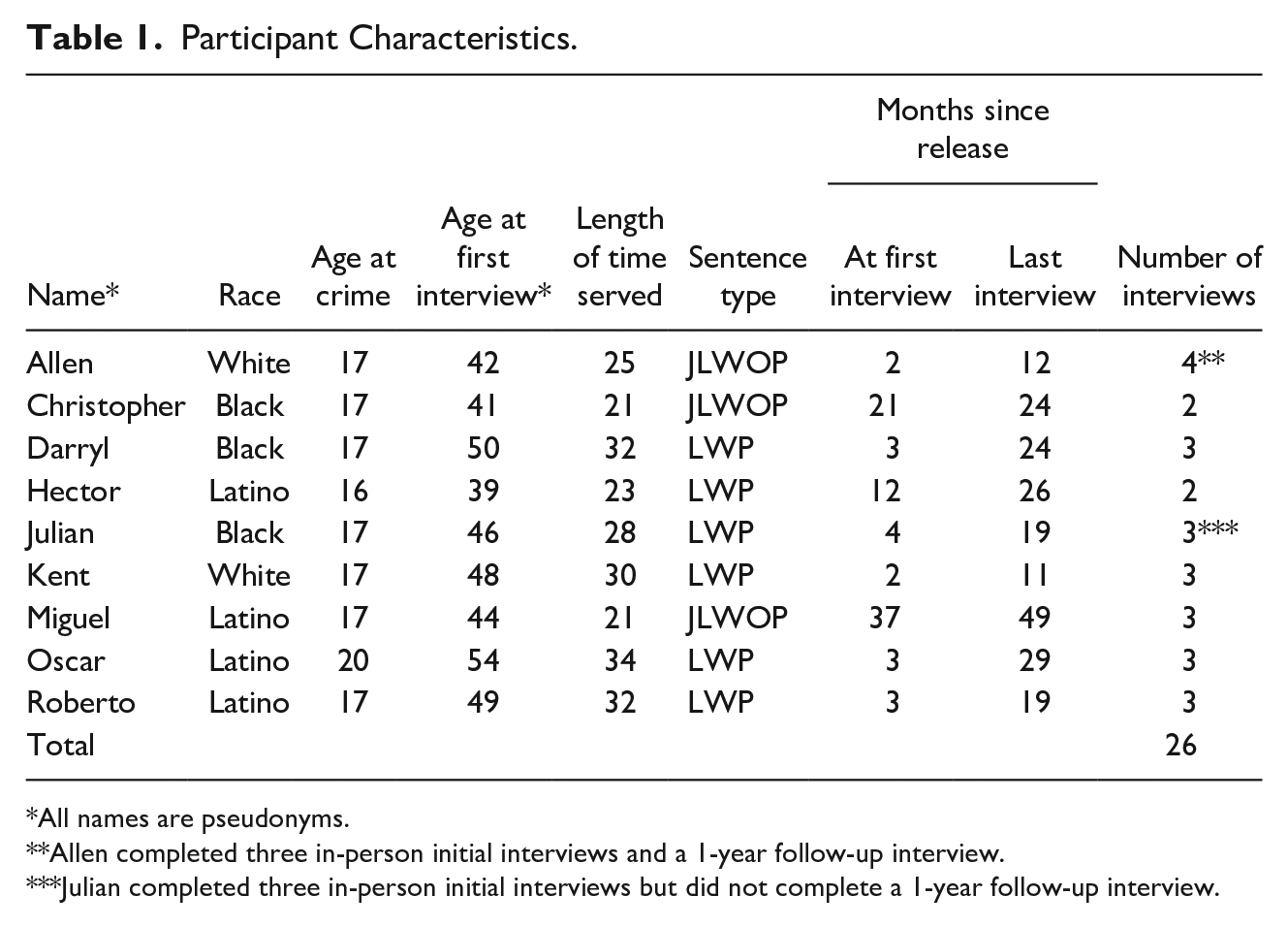
All names are pseudonyms.
Allen completed three in-person initial interviews and a 1-year follow-up interview.
Julian completed three in-person initial interviews but did not complete a 1-year follow-up interview.
Data Collection
The first and second authors of this paper, both White women, and one additional White male graduate student conducted at least two in-person interviews with all nine participants. Next, six of the nine participants completed a follow-up interview 9 to 16 months after the second interview over the phone or computer, as the COVID-19 pandemic restricted our ability to conduct in-person interviews. At the follow-up (third) interviews, no participants were still living in a halfway house. The 1-year follow-up typically served as the third interview, although a few participants requested additional interviews during the initial set or required four interviews to complete the interview guides. We were unable to locate three participants for a follow-up interview. The total number of interviews that comprised the focal dataset was 26 (see Table 1).
All interviews used an open-ended, flexible interview guide with conversational prompts to elicit the participants’ stories and reflections. The first interview covered childhood history, family, school, friendships, criminality, and the homicide charge that resulted in the life sentence. The second interview included questions about finding meaning in prison, resentencing, reflections on victim impact, release, and transition back to society. In the third interview we followed up on the transition to society in regard to work and family, along with discussing challenges, joys, and current events (e.g., COVID-19, the murder of George Floyd, the Presidential election of 2020).
All interviews lasted between 90 and 160 minutes and were digitally recorded. We also administered a brief demographic survey during the first interview. We offered a $35 gift card for the first interview and a $40 gift card for subsequent interviews. Several participants declined the incentives citing the study itself as important, rather than the individual gift. The Office Human of Research Protection at the sponsoring University approved all study procedures.
Analysis
Interviews were transcribed verbatim by a professional transcription service and uploaded to Dedoose software version 8.3.41 to assist with data management and coding. The analysis team included the two White female researchers and a Black male researcher. As a team, we brought different standpoints to the analysis. While the two White female researchers had designed the study and conducted the interviews, they did not have personal experience with family members sentenced to life or long-term incarceration. They entered the analysis having empathy for the participants and a deep appreciation for the participants in sharing their life stories. The third author brought personal knowledge of the impact that long-term incarceration has on individuals and the difficulty of rebuilding familial connections. He entered the analysis having a profound appreciation for the participants and found many similarities between their experiences and those of his own family.
Analysis followed the steps associated with interpretative phenomenological analysis (IPA), which aims to offer insight into how people make sense of key experiences, and involves a deep reading of text, coding, and a detailed look at each case prior to thematic abstraction (Smith & Shinebourne, 2012). First, we constructed life histories for each participant based on the first interview and then reviewed these histories with the participants at the second interview for accuracy and clarity. Next, we read each interview transcript closely and took notes on key ideas, paying close attention to words, phrases, and participants’ reflections on their life experiences. In the next phase, we conducted open coding (Saldaña, 2013), inductively applying codes to sentences, chunks of text, and phrases found in the interview transcripts.
After the initial coding was complete, we placed the codes into larger clusters of meaning, also known as patterns (Smith & Shinebourne, 2012). For this analysis, we specifically focused on a set of codes and patterns surrounding participants’ reentry experiences and, more specifically, the codes related to emotions, reflections on freedom, and thoughts about the self. Next, we exported the quotes associated with this set of codes into analytic matrices, which allowed us to identify the themes that conveyed the most meaning to participants (Smith & Shinebourne, 2012). From this deeper reading and team discussions, we located a set of core, superordinate themes; those that conveyed the larger meanings associated with the emotional experience of reintegration (Smith & Shinebourne, 2012). Once these superordinate themes were identified, we went back to the transcripts to test our working assumptions and to arrive at our final model.
Results
Figure 1 illustrates the major themes and the relationships between them and serves as the visual roadmap for reading the results. Joy was a core emotional experience as participants transitioned from imprisonment to freedom, and, on the opposite side of joy, participants also experienced various forms of shame. In the middle of the figure is the “integrated self,” which was related to how participants grappled with the dueling emotions of joy and shame. Moreover, as Figure 1 shows, an integrated sense of self was connected to a gradual process of self-acceptance, that included reckoning with the past and developing a sense of positive self-regard.
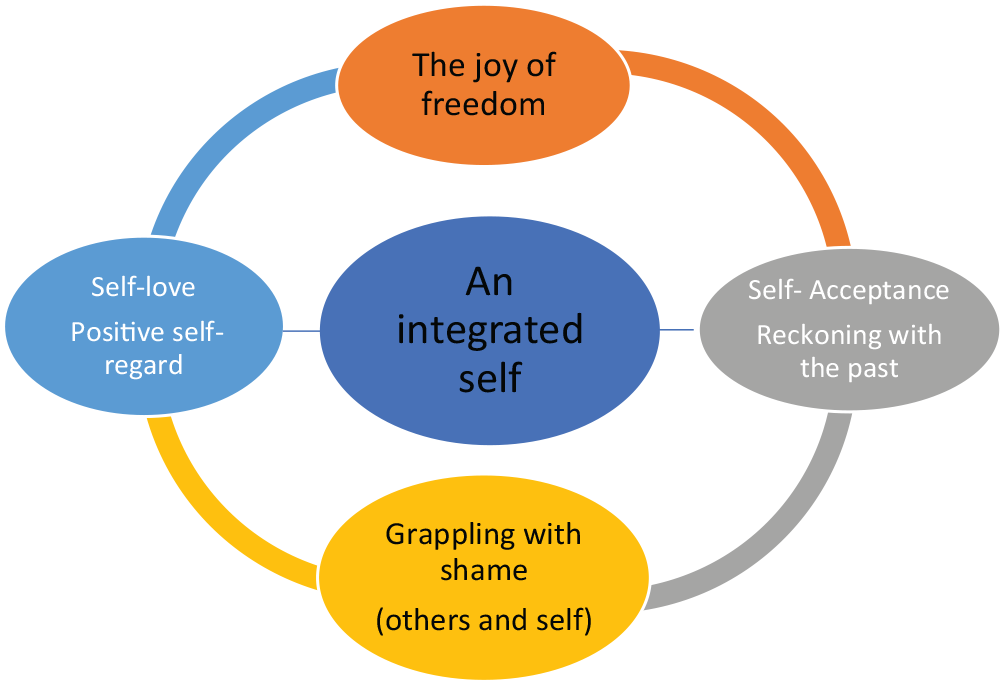
Core process and major themes.
The Joy of Freedom
“I was just like, ‘Man, this is a trip.’ I’m looking out the window, and I see the view. I mean it was like, ‘Man, this is life. This is it.’”–Oscar
The story of release from a life sentence entered into as a young person was characterized by a core emotional experience of joy. Despite experiencing several discomforts and anxieties associated with reentry, these men placed considerable value on the joyful aspects of their newfound freedom, finding pleasure in unexpected places and moments. This theme had two major properties: the initial joy and relief of freedom (i.e., immediately upon release), and everyday joys (i.e., finding pleasure in the ordinary and daily aspects of free life).
Allen, who received a JLWOP sentence at age 17 and served 25 years in prison, recalled the moment of his release with a visceral sense of liberation: Just touching my feet to the ground without cops on the other side of the fence and no handcuffs or shackles, it was very liberating. There’s nothing, I don’t think, that could ever prepare me for the sense of relief that I felt at that point in time. It was special. I don’t know if there’s anything in life that would ever be that relieving. Again, I don’t think I’ll ever experience it. I don’t wanna ever experience it in that way.
Allen understood his heightened experience of elation and relief in those first moments of freedom as an emotional phenomenon only akin to one of narrowly dodging death. He went on to say: “I think the only way that I could ever get close to that is surviving a near-death experience. I think that’s probably the closest that I could get is that sense of [exhales heavily].”
Miguel, another participant sentenced to JLWOP, served 21 years in prison before his release. He characterized his experience of release as one of “regaining his humanity.” Miguel described the moment in which he put on civilian clothing for the first time in 21 years: “It felt so weird. I felt like human. Now I’m human. I’m not wearing this costume that I wore for the last 21 years. I go on this bus and they escort me out of the prison and they just open the door on the road, and you can go now.” Present in Miguel’s recollection is affirmation of his core humanity as he was able to shed the “costume” of his prison identity. Many of the men described this experience of leaving prison in similar terms, evoking a sense of awe and pure bliss. Upon stepping off the bus or walking out the prison gates, participants described feeling overwhelmed by feelings of joy, excitement, relief, fear and anxiety all at once.
Hector and Oscar, sentenced to LWP at 16 and 20 and having served 23 and 34 years, respectively, described the joy of release in less sweeping terms, focusing on small moments of joy that felt meaningful to them. When Hector was asked about the moment of walking out of the prison doors, he recollected that moment as “Oh, exciting, happy. That same morning my smile didn’t go away all the way to the road when they were driving. It stayed with me all day.” Oscar also recalled his release as a happy, yet surreal experience. He said: “As soon as I stepped out of that gate, I looked back. I said, ‘Okay, now it’s real. [. . .] This is it. I’m gone.’” Oscar relayed his first moment of freedom: I went outside, and I just waited and waited [for the train]. I was just sitting there thinking, ‘Man, this is it. I’m going home. I’m no longer a prisoner.’ I’ve got nobody watching me, no cops. I’m free. This is it. . . I didn’t know what to do, so I went and bought me a candy bar. It was a Snickers. Oh, yeah. It was the best tasting candy I had in 35 years. So, I sat there. I was eating the candy bar, and I was just like, ‘Man, this is what freedom is like right now. Can’t wait to get home.’
Hector and Oscar highlight the small but meaningful moments, sensations, and joys of their newfound freedom, such as the detailed description of the Snickers bar. This cascade of impactful moments and recollections of joy are important to understanding what the emotional experience of freedom felt like to those who were imprisoned for the vast majority of their lives.
In addition to the initial experience of freedom, participants found substantial joy in the routine moments of their free lives. The enduring joys of daily life stood out as these men narrated their reentry experiences, holding more value in their reflections on freedom than the challenges they faced. Kent, who served 30 years of a juvenile LWP sentence received at age 17, described his everyday joy: “For me, I’m for real blessed. I love going to work. I love driving. I love everything. Hopefully, knock on wood, I never really get used to or get complacent in my celebration of my freedom because I’m blessed.” Kent’s description of experiencing joy in “everything,” recorded roughly 2 years after his release, captures the enduring nature of this emotion. Further, Kent’s desire to avoid complacency indicates that he understands this joy of freedom in contrast to his many years of confinement.
Oscar also describes the joy and excitement of freedom as he recalls sending photos of being at a major league baseball game to a friend he had met in prison. He said: I’m taking it all in, and I’m like, [sigh] life is big, and life is good. God is good. I’ve got a friend that’s over there in San Francisco, and we keep in touch. [. . .] Everything I’m doing, I’m sending him pictures, at the ballgames. . . . I said, ‘Hey, man, I sent you a little video. You’ve got a little surprise in there.’ He got it. He was like, ‘Ah, man, that’s crazy. Oh, my God.” It’s truly like a fantasy. Life has opened up. It just started rolling on me, just boom! Just like one of those party poppers, life exploded in my face, and I’m just rolling with it.
Oscar’s evoked image of the “party poppers” reflects a sense of awe at the boundless experiences and opportunities of the free world. Upon recognizing the expansiveness of the world outside of prison—one he was not sure he would ever see—he described gaining a sense of perspective, recognizing himself as small in the vastness of the free world when stating, “I’m in awe, so I see myself as this big [holds up fingers, demonstrating size] in the vast scheme of things. I’m not that King Kong no more. Now I’m that little flea that’s on King Kong’s back.” Oscar did not feel “small” in a negative light, but rather in relation to his experience of joy and awe at the expanse of opportunities in front of him, in stark contrast with the extremely limited world of the prison. Similar to Kent, Oscar understood his joy in relation to his previous deprivation of growing up imprisoned and everything he had missed in those years.
Julian, a 46-year-old man who spent 28 years imprisoned, appeared to struggle with navigating life as a free adult, including tasks such as opening a bank account to deposit his paychecks. Yet when he talked about his transition to free society, he placed great meaning on everyday pleasures. He described finding great joy in pancakes. This ordinary item brought Julian so much joy that it became a running joke within his family, and he even said that if his current career path does not pan out, he would apply for a job at the International House of Pancakes (IHOP). He stated: I love pancakes. They ended up taking me to the IHOP. IHOP is the best place on earth. I have been out six months and two days now. Yep, six months and two days. November 28th to May 28th is six months. It’s like six months and a couple of days. Within those six months, I’ve been to IHOP 11 times. I been to IHOP 11 times and each of my family when they come visit me, “Where you wanna go eat?” “IHOP.” I remember last time that my family came they’re like, “We ain’t goin’ to IHOP. We’re goin’ to Red Lobster.” We went to the beach, and by the time we got back from the beach, we were eatin’ at IHOP.
Despite experiencing both emotional and logistical struggles in navigating free society, Julian still described his reentry experience as positive. Summarizing his transition, he stated: “I’m blessed. What do I need? I don’t need anything.” Hence whether discussing the awe of walking out of the prison gates or the simple life pleasures, joy was a core emotional experience in these narratives of freedom.
Grappling with Shame
“Our footprints are still behind us regardless of whether we’re walking forward or not.”– Kent
While experiencing great moments of joy, the participants also found themselves in the position of navigating external and internal moments of shame. Shame was often expressed in relation to their joy and unique appreciation for life, which is why Figure 1 depicts shame on the opposite side of joy. As referenced in the epigraph, Allen described a duality of appreciating life and experiencing happiness, while also holding with him the knowledge that his heightened appreciation is a result of his time in prison and in relation to the harms he had caused others: It was liberating, and it was one of those things where—it’s really weird because there’s this thing of appreciation for life, and then there’s this other thing of the reason I have this appreciation for life is because somebody else lost their life by my hand. There’s this duality or dichotomy of this very personal feeling of shame and pain. Then there’s the other side of it of feelin’ the happiness that goes with being able to appreciate these things like I didn’t appreciate them before I don’t know life without [the duality] really. I don’t know if it was more so in there because I’m constantly surrounded by barbwire and electric fences type thing, but 100 percent, I’ve never had a day that I didn’t think about what I have done and the impact of those decisions that I made. I don’t know if it’s lessened in degree, but I can say that it is definitely apparent. There’s a lot more stimuli out here . . .—but there’s never a day that goes by that I don’t have these types of conversations with myself or these memories of it.
Participants understood the heightened nature of the joy that resulted from freedom in relation to the pains of imprisonment (i.e., the “barbwire and electric fences”), alongside the pain they had inflicted on others, including the victims and their family members. Hence as Allen narrates above, his appreciation for life- his joy-resulted from the impact of all of the “decisions I made.”
Shame was described in several ways. Several participants felt their shame when they were viewed by others on account of their past and their criminal histories. At times, they faced a social world that often did not acknowledge the men they have become. For example, in discussing his interactions with his family members, Kent recounted: My brother’s out here too, my little brother. He spoke at my wedding, which was kind of disheartening for me because whenever he was a kid, I was probably about 14 or 15, so I was really bad, caught up in everything, and all the drugs and all the—everything. And there was an incident where a kid, a bigger kid had hit him, and I told him, “Is he bigger than you?” He said, “Yeah.” I gave him a stick, and I told him, “Well, go hit him with this.” He remembers that so vividly that he mentioned it at my wedding during the speech, but he mentioned it in a way that it was like oh, “you know, that’s just the kind of guy he is.” It broke my heart a little bit. I’m really trying to make sure that he remembers me as someone different, that I build a better relationship with him.
For Kent, this moment brought the realization that his brother still saw his past reckless behavior as part of his character, even though he had spent many years on self-reflection and working to change. In this case, he was forced to reckon with the shame of the past through the eyes of his brother. It did not matter how comfortable Kent felt in his current self, because others did not see that person in that moment.
Miguel also experienced shame around others’ perceptions of his past and his desire to be seen as his present self. This came up when he described the experience of navigating disclosure of his past with his current college peers: “I don’t wanna be ‘the guy that was in prison.’ I want them to know me different and maybe later they’ll find out, of course. I think they already Googled me and they already know. Other questions are coming up.” For Miguel, the discomfort around disclosure was a fear of being reduced to “the guy that was in prison,” rather being seen for all of who he is. He did not necessarily feel shame about his own history, but rather worried that his history would come to define him in the eyes of his peers. Miguel reflected: “Honestly, I feel so grateful to be there. I still can’t get around to my peers, my fellow students how old I am, my history. [. . .] But I just can’t, it hurts me when they ask me.”
Several participants also described feelings of shame in relation to missed time and expectations of where they ought to be in life due to their chronological age. They reflect a desire for deeper relationships with family members, or for romantic relationships, comparing themselves to other men in their age bracket. For example, Julian, who disclosed that he had never had a relationship with a romantic partner, stated: “All the friends that I got—in prison all my friends they were all married, out here, the guys that I’m around are married. [. . .] My friends in there, they know about me. They know I’ve never been in love, kissed a woman and all these different things, but out here they don’t know.” These reflections indicated a feeling of shame around lacking the adult experiences that would be normative for his age.
In contrast to Julian, Christopher entered into family life fairly quickly, getting married within a year of his release to a woman who had young children. Christopher felt shame that he did not have the work experience or wages to keep up with his family responsibilities. In this quote, he reflected on his delayed “stage” compared others of a similar chronological age: People my age have been through that, lived that, and they’re coming in the place to where they should be relaxing. To where they’re breathing easily, and things are going well for them. You know what I mean. They’ve been through it. My stage is I’ve still gotta make something happen. I still gotta—that’s not the stage where I’m at. I still gotta be out here. I still gotta make it happen.
Although their relational lives were quite different, the core idea here the feeling of shame rooted in the missed years of imprisonment, and specifically the experiences and development that might have better prepared them for adulthood.
In sum, participants experienced shame in various ways. Shame was particularly acute when the past was given more weight than the many years they had spent maturing, or when they witnessed others enjoying key life milestones that they had missed. The next section explores how participants reconciled the emotions of joy and shame to forge an integrated sense of self.
Acceptance, Positive Self-Regard, and an Integrated Sense of Self
“I don’t regret spending time, ‘cause it shaped me.’”–Miguel
The journey to an integrated sense of self was intricately related to the duality of joy and shame. An integrated sense of self emerged from the understanding that the joy of freedom could only exist in this heightened capacity through acceptance of the past and how the past had shaped them. Moreover, participants moved through feelings and experiences of shame, including remorse, to forge a positive sense of self.
Acceptance. For these men, acceptance was often reflected in an understanding that they would not be the person who they are today without the past. As Figure 1 illustrates, self-acceptance was related to accepting the past; and this evolved over time. Oscar’s thoughts on freedom illustrate this idea: “I did 35 years. I got out, and I’m enjoying life. I’m not trying to make up for lost time. I’m just picking up in a different spot where I left off. I’m picking up with more knowledge, more maturity, more gratefulness, and enjoying life sober.”
In reflecting on the past, participants also discussed the harms they had caused others and they dealt with remorse and regret in various ways. Darryl was unique among the participants in stating that he lived his current life with no regrets. When asked about feelings of regret or missing out due to imprisonment, he responded: “I accept life. I accept every ache that I didn’t earn. I just woke up with. . . It is what it is. There’s no shame in it. It brought me to where I am today. I can take you where I was, and I can bring you to how I feel today. With no hang ups.”
Other participants aligned with this idea of accepting the past without dwelling on shame. However, some reflected a bit differently on the homicide crime itself, expressing great remorse for the victims and family survivors. For example, Allen stated: I wouldn’t change who I’ve become. Obviously, if there’s any moment in my life that I could change, it would be the night of [my crime]. Other than that, I wouldn’t change these things because I feel like they’ve molded me into who I am today. I really love myself.
Similarly, Hector states this part of his motivation to be a good person in the present is to honor the victim of his homicide crime. He said: I have to move forward. I have to, life keeps going. Not that I forget about him or the family, but if I really want to live through him and make sure that his life wasn’t in vain, . . . I cannot change the past, but what am I gonna do now because of what I went through, I’m this person now. I owe it to him. I owe it to myself, and I owe it to anyone that comes in contact with me to live and project good.
Like Hector and Allen, participants’ acceptance of their life path was expressed in relation to past harms they had perpetrated, remorse, and a desire to “project good.” Phrases such as “I’m this person now,” “I wouldn’t change these things,” and “I don’t regret spending time, ‘cause it shaped me” were part of the larger concept of reconciling the past toward self-acceptance.
Positive self-regard
Despite the shame associated with a homicide crime and spending so many years imprisoned, participants largely projected a positive sense of self. In response to a question about living in free society, Hector stated: “Things are better for me and things are better for everybody else. I’m not hurting nobody. I’m not taking from nobody. I’m respectful. I’m giving. I’m humble.” Like “humble and respectful,” participants used several positive terms to refer to themselves, including “empathetic,” “kind,” “loyal,” “giving,” and “loving.”
Participants expressed positive self-regard by emphasizing their capacity for empathy, connecting their empathetic responses toward others to their own difficult life experiences. As Miguel reflected, “I think I have a deep awareness of peoples’ possible plights or shoes they’ve walked in because of the shoes I’ve walked in.” They described themselves as intentionally good people and decided they wanted to do and be good because of, and not in spite of, their own histories. For example, despite having very limited financial means, Julian described always being kind to people experiencing homelessness, wanting to “jump out of the car and give them money.” They understood their capacity for empathy as stemming from their own experiences of trauma and many years of resignation that they would die in prison.
An integrated self
The themes of acceptance and positive self-regard were main components of an integrated self, one that appreciated both past and present. In the passages below, Allen describes how he integrates the younger person he was when he committed his crime with his current adult self. He identifies how his crime altered his life course, while also touching on how reconciling the past and present will carry him into his future.
Maybe it’s because of my past and the things that I’ve gone through and the things that I’ve done. Maybe it’s a sense of feelin’ like this is a part of my atonement to make sure that I’m conscious of being very respectful towards others. I dunno. I think it’s all interrelated. I’m a product of my experiences. It’s these experiences that I’ve had, not only through my life but what I’ve done in my life and the people that I’ve harmed, the harm that I’ve incurred. All of them have rounded me into the person that I am today. I wouldn’t change that. There’s definitely still weathering to be done and more experiences to have and more opportunities to explore possibilities. That’s really how I think that all of this has shaped me is it’s continuously preparing me for the next unseen road around the bend.
In this narrative, one can see a deep acceptance of the past, alongside a sense of remorse, or “atonement.” He uses the phrase “interrelated” which speaks to how the past and present fit together in forming a holistic sense of self. Allen also explains that he is a “product of his experiences,” meaning that all that he is gone through, and even the harm he has caused others, contributed to the good person who is today; one that he would not change.
Kent similarly describes how he reconciles his past and present into an integrated sense of self. He discusses the youthful naivete that contributed to his crimes, but then reflects an understanding that these experiences were essential in becoming a compassionate adult:
I was super naïve when I was a kid, and it made me do some stuff and think thoughts and be somebody I wasn’t when I first came to prison. That being said, the person I am today wouldn’t be the person that I am today without those experiences. They shaped me a lot. I told you I saw the guy get raped <in prison>. Would I still be hating if I didn’t see that? Would I still be just judging people for whatever values I had, sick and twisted, because of that, if it wasn’t for that? Every experience in our life builds us and makes us —into who we are basically. [. . .] Well, because look, if I wasn’t in prison as long as I was, like I said, I wouldn’t be the person I am.
Do you feel at peace with that?
Yeah. If they would have let me—there’s things, oh, I got regrets. Don’t get twisted. I got regrets, and I got things that I wish I was younger when I got out, but would I be the same person that I am today? Would I be compassionate? Would I be empathetic? Would I be the person I am today? Would I be able to look at a homeless person and give ‘em my food? Probably not. I probably wouldn’t.
Here Kent ends this conversation with a longing to be younger when he “got out,” but he reflects that wouldn’t be the person that he is now, one that he sees in a positive light, without his imprisonment. These narratives illustrate how participants cultivated their sense of self as free adults through accountability, an understanding of their past harms, and a recognition of the unique experiences that shaped them into adult men they are now. Through joy and shame, remorse and reflection, these men expressed great appreciation for their freedom and pride in who they have become.
Discussion
Existing scholarship on people who earn freedom from a life sentence emphasizes the challenges and hardships associated with reentry, often eclipsing other dimensions of this significant transition (Liem, 2016; Liem & Richardson, 2014; Munn, 2009). Based on prior literature, we did not anticipate such an emphasis on joy. Yet, following phenomenological methodology (Sokolowski, 2000), we adhered to participants’ narratives of their lived experiences, which identified both joy and shame as core emotional facets of their reintegration.
Participants experienced joy in numerous ways. Some found joy in daily elements such as food or making decisions about their next meal. They were often grateful for simple things, such as going to eat at a restaurant or attending a sporting event. Other participants experienced profound joy through the experience of freedom itself and reflected that this heightened feeling of joy was made possible by their extensive time in prison and the weight of the past. Capturing this feeling of sheer joy is an important antidote to the research on the pains of imprisonment itself (Crewe, 2011), in that prolonged pain and hopelessness paved the way for a sheer and raw appreciation of freedom itself.
On the other side of this unadulterated joy was shame. These men often felt pressure to prove that they were the compassionate adults of the present rather than the troubled child or adolescent who was sentenced to life in prison. At times, they felt that they were only remembered for who they were as youth. They also reflected on missed major life milestones that rendered them less prepared for their adulthood. These feelings of shame were related to self-acceptance because as the men accepted their life course and imprisonment in shaping them into someone they have grown to love, they desired external acceptance as well. This is similar to Maruna et al.’s (2004) concept of the “looking glass,” in that formerly imprisoned people want to affirm a new sense of self through other’s views and that shame and stigma can be barriers to self-acceptance and rehabilitation. In this study, we uniquely found that participants reconciled these feelings of joy and shame to forge a positive sense of self. They appreciated that the empathetic and kind persons they are today was made possible on account of, rather than in spite of, the past.
These findings offer a different perspective on release following life imprisonment. Extant research suggests that those released from life sentences often internally separate the current or reformed self from the past criminal self in order to overcome the shame of the past and to move forward in life (Liem & Richardson, 2014; Munn, 2009). In this study, the participants understood their current self as a culmination of their past experiences, including their experience of committing harm as a young person and serving their subsequent life sentence. In looking back on their past, they expressed remorse for the victims of their crimes while still seeing themselves as fundamentally good people.
To more robustly interpret these findings, we looked to studies of narrative identity in the field of psychology (McAdams & Mclean, 2013). This theory also understands that it is possible to tell a whole story of the self, one that doesn’t fragment the “bad parts.” Moreover, the theory suggests that those who integrate their adversity and faults into their current self-narrative tend to enjoy higher levels of well-being and mental health (McAdams & Mclean, 2013). Informing a positive narrative identity, people reflect on their lives and commitments, guiding who they become and what they do (Ward & Marshall, 2007). This theory seems to fit the narratives of the participants in our study, who, in the process of self-reflection, articulated that they would not go back and change their life path because without these experiences, they would not be the good people they are today. These men, imprisoned for an average of 26 years beginning at young ages, found a way to reflect and make meaning of their experience of life imprisonment without fragmentation, which has informed their sense of self and identity. Given the exploratory nature of this study, further research can build upon these findings by exploring factors that facilitate a positive and healthy sense of self and an ability to thrive despite spending most of one’s life imprisoned.
Implications
A recent Supreme Court ruling in Jones v. Mississippi (2021) established that courts do not need to make an implicit finding that rehabilitation is impossible in order to sentence a youth to JLWOP, only that the judge needs to consider their age as a mitigating factor at sentencing. While this does not significantly change the application of Miller, this ruling makes clear the importance of state policies in creating opportunities for release and barring the use of extreme sentences for youth moving forward. While the state of California has multiple mechanisms for parole review specific to those given life sentences as minors, in numerous other states, release and resentencing options are far more limited (Quinnipiac University School of Law, 2020). This study shows that not only can released lifers be safe to return to society, but they can also thrive emotionally even after decades of harsh conditions of confinement.
These narratives also challenge negative depictions of “child killers” (Garbarino, 2018) as these were the youth considered the “super-predators” of the 1990s and, as such, sentenced to die in prison (Mills et al., 2015). This study reveals that even those imprisoned since adolescence for violent crimes can find joy, meaning, and a sense of self-acceptance. As research has shown low recidivism rates for released juvenile lifers (Daftary-Kapur & Zottoli, 2020; Weisberg et al., 2011), this study complements these findings by identifying how people can forge a positive sense of self, which can lead to social integration, even under very difficult circumstances.
Limitations
This study is subject to several limitations. First, the sample consisted of volunteers from referrals and direct presentations—a group that may have fared better than others in similar circumstances in their willingness to share their experiences with the research team. Moreover, seven participants were still living in halfway houses upon their first interview, meaning that they may have been more connected to social supports at the time that they volunteered for the study. All of these circumstances around recruitment introduce some degree of bias. Nevertheless, the longitudinal nature of the study allowed us to follow the participants over time, such that we could also see how they fared once they had moved past their stay in a facility.
The sample also included people released under different youth parole mechanisms (see Table 1). In addition, one participant was older than age 17 at the time of their crime, but after careful review, we found that his story was not substantially different from the others. Hence, we intentionally included his interviews in the analysis. Additional research is needed to better understand how the experiences of those sentenced to imprisonment as minors may differ from those sentenced to life in prison in later years.
Last, our ability to keep in touch with participants was constrained by the COVID-19 pandemic and the subsequent restrictions on in-person research. It is possible that the remote interviewing limited our ability to capture more nuanced information in the follow-up interviews. The strength of this study is the depth and longitudinal interviews, allowing us to capture depth of thought and subjectivities as these participants moved through their lives post-incarceration. As the sample was small and self-selected, future studies can build on these findings and address these limitations to understand more about this growing population of released juvenile lifers.
Conclusion
This study sought to understand the emotional experiences of adults reentering society after serving a life sentence received in their youth. Despite growing up in prison and a lifetime of challenges, we found that this unique population was able to develop a positive sense of self, navigate external and internal sources of shame, and experience profound joy. Much of the existing literature on released lifers centers on recidivism and the hardships faced during reintegration (Liem, 2016; Munn, 2009). However, this is not the story that our participants told. While they surely noted emotional and logistical struggles, the joys of freedom outweighed other burdens of reentry, and it was this very appreciation for everyday joys that participants wanted to share. They spoke of positive self-regard, recognized their current selves and their histories as intrinsically linked, and narrated an integrated sense of self. Participants expressed the desire to be perceived by loved ones and society at large as their whole selves, including their past crimes. Their narratives fill an important gap in the literature on reentry for this unique group, telling a holistic story of their emotional path to freedom.
Footnotes
Declaration of Conflicting Interests
The author(s) declared no potential conflicts of interest with respect to the research, authorship, and/or publication of this article.
Funding
The author(s) disclosed receipt of the following financial support for the research, authorship, and/or publication of this article: This study was partially funded by a Faculty Senate research grant from the University of California, Los Angeles.
