



Abstract
This paper aims to advance theory and knowledge about prison visitation by organizing prior studies within a framework of visitation enablers and barriers and examining how practical, relational, and experiential factors explain variation in prison visiting among 773 adult males across eight Dutch prisons. Findings suggest that all three domains play out at once to influence visitation. Whether visitors come to visit seems to depend on their relationship with the incarcerated individual, whereas traveling distance is more predictive of how often they visit. Policies that introduce practical barriers can differentially affect visits from specific relationships. Finally, results indicate that incarcerated individuals make decisions about visits based on their in-prison experiences. Policy and research implications are discussed.
Introduction
Prison visitation has the potential to be a cost-effective practice for mitigating potential harmful effects of imprisonment and improving behavior, familial, and reentry outcomes. For this reason, visitation warrants special attention. Scholars have noted, however, that receiving visits is not self-evident (e.g., Cochran et al., 2017). Even when individuals in prison receive visits, visitation experiences are heterogeneous and not uniformly positive. Nonetheless studies typically suggest a range of benefits stemming from visits (e.g., Brunton-Smith & McCarthy, 2016; Mitchell et al., 2016). Given these potential benefits for people and prison systems, more systematic investigations of the factors that enable or hinder visits are needed to inform theory and policy centered on understanding who gets access to external social support during an incarceration term.
Recent work has begun to take important steps in this direction by assessing determinants of visits from a variety of angles. For example, this growing body of research has explored how visitation experiences (Turanovic & Tasca, 2019; Young et al., 2019), pre-incarceration relationships (Atkin-Plunk & Armstrong, 2018; Hickert et al., 2019), and diverse individual characteristics (Cochran et al., 2016, 2017) relate to receiving visits in prison. Beyond whether individuals are visited, recent scholarship has also examined predictors of visitation patterns (Hickert et al 2018; Young & Hay 2020) and who is visiting (Connor & Tewksbury, 2015). These papers identify that incarcerated individuals differ in their likelihood of receiving visits based on their demographic and criminal backgrounds (Cochran et al., 2016, 2017). Additionally, practical barriers, such as traveling distance, quality of the relationship pre-incarceration, and experiences during visits seem to be particularly influential in determining whether and how often an individual is visited (e.g. Hickert et al., 2018; Young et al., 2019). These key determinants appear to also be relevant for young people in prison (Mikytuck & Woolard, 2019; Young et al., 2019; Young & Hay, 2020).
The goal of this study is to build on these recent advancements by expanding our understanding of the determinants of prison visits in three ways. First, we add to the literature by applying a social ecological framework to visitation that is adapted from the broader social support literature (e.g., Vaux, 1988) and that, by extension, emphasizes the importance of considering the three interconnected domains of practical, relational, and experiential (that is, experiences with incarceration) factors simultaneously to better understand variation in visitation. Each of these factors appear across prior studies of visitation. This framework helps to integrate the mix of prior theory about visitation as it assumes that multiple actors are important for visitation, including the prison, the visitor(s), and the incarcerated individual. While many scholars recognize the role of prisons, most prior research is focused on determinants concerning either visitors (e.g., traveling distance) or incarcerated individuals (e.g., criminal background). We go beyond past studies by organizing prior research within the domains of practical, relational, and experiential characteristics and incorporating information from prisons, visitors, and incarcerated individuals to understand how the confluence of these domains impact visiting. Moreover, by using this framework we respond to calls from scholars to better articulate theoretical mechanisms behind visitation as “theoretical attention to explaining variation in receiving visits is lacking” (Young & Hay, 2020, p.71). Beyond its scientific value, using a holistic approach can also help practitioners and policy makers make more specific guidelines to stimulate and encourage visitation.
Second, beyond whether individuals are visited, we also examine how these factors relate to how often individuals receive visits and from whom they receive visits. This is important as it can be assumed that some factors, such as offense seriousness, may strongly impact the likelihood of the first visit, but exert limited effects on having many visits. Also, examining who is visiting is critical as visitors are a heterogenous group (with diverse reasons to (not) visit). Theoretically, considerations from social support literature propose differences between visitor types. For example, partners and parents are often highly invested in incarcerated individuals, thus they are less likely to break off a relationship in which they have already invested because otherwise, time and energy for the prior investment would be lost (Arriaga & Agnew, 2001). These ties may then visit despite barriers or administrative challenges. Contrastingly, friendships appear to be more difficult to maintain due to the stigma of imprisonment and associated challenges of visiting (Volker et al., 2016). Thus, any policies that seek to widen access to visitation or otherwise improve the effectiveness of it requires developing a better understanding of how practical, relational, and experimental factors impact the ties that are available to incarcerated individuals.
Third, we advance scholarship by examining visitation in an international context, namely the Netherlands. This is important as current knowledge about visitation stems almost entirely from the United States (U.S.). It is possible that our prevailing conclusions about who gets visited in prison are not broadly generalizable due to unique features of the U.S. penal system (such as its punitive character and excessive incarceration lengths). For example, individuals incarcerated in U.S. prisons have no federal right to visitation which means that prison officials can deny visits for various reasons, including misbehavior. If access to visits is based on behavior, then those who display good behavior have the best chance of being visited, which could confound results. 1 Research across contexts is critical, then, for advancing theory and policy conversations about visitation, its impacts, and its likelihood across people. Features of the Dutch prison context (described more in depth below), including its rehabilitative focus, the legal right to visits, and short lengths of stay, offer insight into which factors predict visitation in a setting more like other western European countries. More than that, a new context paired with the conceptual framework we introduce for anticipating enablers and barriers to visitation allows for testing of theories across contexts. For example, even if the nature of, say, practical barriers to visits varies across places, we can evaluate the relative impacts of practical barriers, broadly defined, across prisons and societies. We can do the same for relational and experiential factors. Over time, this would allow for a systematic body of evidence to emerge about the salience of these three domains in determining who gets visited during incarceration.
Against this backdrop, this study builds upon existing literature by addressing the following research question: to what extent are (a) practical factors, (b) relational factors, and (c) incarceration experiential factors related to receiving visits in prison? Through multilevel analyses we explore this question in terms of whether an individual is visited (i.e., the likelihood of receiving a visit) and in terms of how often an individual is visited (i.e., the frequency of visits). Additionally, we examine whether and how these factors differ depending on who is visiting. These considerations are explored as part of the Dutch Prison Visitation Study (DPVS), a unique study that aims to examine prison visitation from different perspectives and in all its variety. The rich data from this study contains a wide range of factors from multiple sources that can be used to predict whether, how often, and from whom incarcerated individuals receive visits.
Theoretical Framework and Prior research
Social support can be critical in times of stress and trauma. Vaux (1988) argued that in such times of stress, the process of maintaining social support is complex and transactional, occurring between the person and his/her changing social network. These transactions take place in a specific social context, which can shape the development of social support.
This social ecological framework is applicable to prison visitation. Imprisonment is a stressful event, physically disrupting the connection between an individual and the outside world. Visitation is a key form of social support, being that it is the only way individuals can maintain physical contact with loved ones beyond the prison wall. In order to maintain this form of contact, both incarcerated individuals and their visitor(s) weigh the costs and benefits of visiting. Individuals in prison can be assumed to make decisions on whether and how often they receive visits depending on their individual characteristics (e.g., their age and criminal history, whether they have a spouse or children) and their emotional situation (e.g., reactions to incarceration and visitation experiences). Visitors must also decide whether they take the effort to travel to prisons and spend time and money on these trips. These decisions concerning whether and how often to (receive) visit(s) are made within a specific ecological context, namely the prison. Since prison officials are granted substantial discretion to determine whether and when visits take place, it can also be assumed that visitation policies can impact the receipt of visits.
Prior research has identified a somewhat eclectic mix of enablers of and barriers to prison visitation. One way to organize these factors, and to facilitate more systematic empirical assessments of them, is within a framework informed by knowledge about the development of social support and that, by extension, considers the practical barriers to visitation, but also the social and incarceration contexts in which people reside. Specifically, prior theory and research on the predictors of visitation can be organized into these three domains: (1) practical factors, (2) relational factors, and (3) experiential factors. We elaborate on these three domains, the hypotheses that stem from them, and the prior literature that informs them, below 2 (see Table 1 for an overview of prior research on the determinants of visitation).
Prior Research on the Determinants of Prison Cisits.
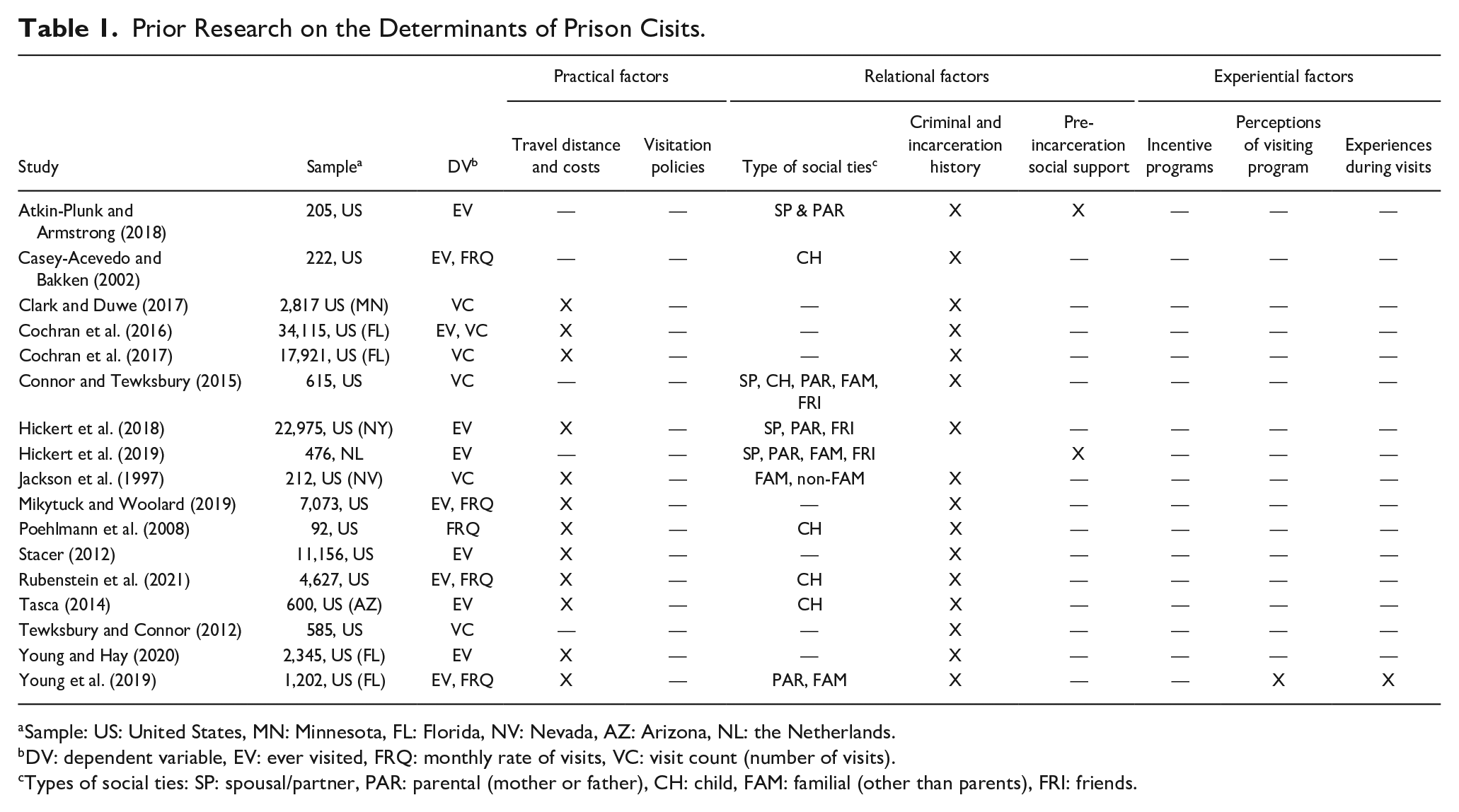
Sample: US: United States, MN: Minnesota, FL: Florida, NV: Nevada, AZ: Arizona, NL: the Netherlands.
DV: dependent variable, EV: ever visited, FRQ: monthly rate of visits, VC: visit count (number of visits).
Types of social ties: SP: spousal/partner, PAR: parental (mother or father), CH: child, FAM: familial (other than parents), FRI: friends.
Practical factors
Scholars have repeatedly noted the practical challenges to visiting an individual in prison: visitors often must travel far, which can be costly and time consuming (Christian et al., 2006). These barriers can be a hindrance to visit, especially for (potential) visitors with a low social-economic status (Cochran et al., 2016; Grinstead et al., 2001). Indeed multiple studies have found that when visitors lived further away from the prison and had a lack of economic or social resources, they were not only less likely to visit, but also visited less frequently (e.g., Clark & Duwe, 2017; Cochran et al., 2016; Mikytuck & Woolard, 2019; Poehlmann et al., 2008; Young & Hay, 2020).
Prison visitation policies can also create practical barriers to visiting. Policies concerning when and how often visits occur can differ across institutions both within and between countries. A review of visitation policies in all fifty U.S. states showed that while some prisons allowed up to 6 hours of visits per week, others allowed no more than one visit per week of up to 2 hours (Boudin et al., 2014). In the Netherlands, visitation policies also differ across prisons. For example, some prisons allow weekend visits, while others only allow visits during the week. While it may be understandable that differing policies exist due to diverse prison populations or managerial styles, these policies can have far reaching consequences, as noted by Hutton (2017) in her study on English prisons: “the volume of family contact permitted can come down as much to chance based on where you are located” (p. 211). Despite the great impact that visitation policies may have, we know surprisingly little about how these policies affect the receipt of visits in prison (although some studies have alluded to how visitation policies linked to security level may explain differing visitation rates, see Clark & Duwe, 2017; Hickert et al., 2018).
Relational factors
Even when faced with practical challenges, some family and friends do visit. It can be assumed that the nature, intimacy, and quality of the relationship ties between an incarcerated individual and their (potential) visitors could impact whether and how often family and friends visit. The nature of these relationships is important to consider as individuals have diverse social ties ranging from spousal, parental, familial, to friendship ties. Spousal and parental ties are mentioned repeatedly in the literature as important ties for incarcerated individuals, especially since many are parents (e.g., Arditti, 2003; Brunton-Smith & McCarthy, 2016). Spouses are particularly important for incarcerated males as they are reliant on them to maintain contact with their children during incarceration (Tasca, 2014). Moreover, scholars propose that incarcerated individuals with partners tend to have larger social networks, and thus, may have more access to social capital (Clark & Duwe, 2017).
Beyond the types of relationships available to individuals, the intimacy of these relationships can be complicated by the criminal involvement and incarceration history of a person. Social relationships may become strained as individuals engage in more offending and visitors who previously came to visit may grow weary after several incarcerations (Pleggenkuhle et al., 2018). Likewise, the seriousness of the offense can be consequential. Family or friends may be less forgiving and less willing to continue to invest time and resources on individuals who have committed serious crimes (Christian et al., 2006). Studies from diverse U.S. states indeed find that incarcerated individuals with less extensive criminal histories and who have committed less severe crimes are most likely to be visited (e.g., Clark & Duwe, 2017; Cochran et al., 2017; Jackson et al., 1997; Tewksbury & Connor, 2012).
Additionally, social support literature would suggest that the quality of the relationship between (potential) visitor and incarcerated individual is important: those close to the individual in prison are more likely to be responsive to their troubles and engage in supportive behavior even if it is costly or requires effort (Vaux, 1988). Recent research has highlighted that pre-incarceration social support (Atkin-Plunk & Armstrong, 2018; Hickert et al., 2019) is a key contributor to who is visited. However, since prior studies do not include measures of (perceived) barriers to visiting and relationships pre-incarceration, it is not yet clear how these factors simultaneously affect whether and how often loved ones visit.
Experiential factors
Not least, in-prison experiences might increase or reduce the willingness to receive (more) visits. Incentive programs can be found in prisons worldwide which use visits as a reward for good behavior (e.g., the Incentives and Earned Privileges scheme in England and Wales, see Hutton, 2017). While incarcerated individuals do not necessarily actively choose to participate in such programs, it is possible these programs could increase interest in receiving (more) visits as individuals are rewarded with extra and improved visits (for instance, special family day visits) (Hutton, 2017). In 2014, a system of promotion and relegation was introduced in Dutch prisons (Van Gent, 2013). Individuals who display good behavior and meet specific criteria can be promoted to the “plus program” where they can receive an extra hour of visits per week. Individuals in the plus program are also given preference for evening or weekend visiting hours over individuals in the basic program. Access to more visits at desirable times could increase the likelihood and frequency of visits, but to our knowledge, no prior studies have examined the impact of such programs on whether and how often individuals receive visits.
In addition, the perceptions of the visiting program could also impact whether individuals wish to continue to receive visits. Incarcerated individuals report frustrations due to the substantial restrictions on movement and physical contact (Dixey & Woodall, 2012; Hutton, 2016) and lack of privacy during visits, which makes it difficult to have meaningful conversations (Arditti, 2003). They may also be upset about the procedures family and friends must endure (e.g., being searched and subject to rules and strict security procedures) or about how their visitors are treated (Moran & Disney, 2019). These frustrations could result in individuals limiting, or even canceling, visits. While studies have described these frustrations, no prior studies have examined whether these perceptions impact visit frequency (see Table 1).
Finally, experiences during visits could impact visiting decisions. Visitation experiences are diverse: some individuals report positive experiences (e.g., feeling refreshed and having lifted spirits after visits), while others experience great feelings of loss and separation (Moran & Disney, 2019; Pleggenkuhle et al., 2018). Some individuals experience visits comprised of conflict, arguments, and confrontations, and thus may choose to limit contact (Meyers et al., 2017). Visitation experiences can also differ depending on who is visiting (Young et al., 2019). Yet it remains unclear whether these experiences impact how often individuals receive visits.
The Current Study
In sum, while the extant literature has provided important insights on the practical, relational, and experiential factors associated with prison visits, gaps in the literature are evident (see Table 1). We know surprisingly little about how these factors simultaneously relate to visitation and whether seemingly consequential factors, such as visitation policies, visiting programs or visitation experiences, actually impact access to external social ties, especially in contexts beyond the U.S. To advance our knowledge on prison visitation, our analysis will use a nationally representative sample of adult males incarcerated in the Netherlands to estimate the confluence of these domains, while controlling for socio-demographic and incarceration variables (e.g., age, ethnicity, and time served) known to be related to visitation (e.g., Cochran et al., 2017). Since we will be using data from the Netherlands, we provide a short description of the Dutch prison context below.
Imprisonment in the Netherlands
In 2017, approximately 31,000 individuals entered one of the 28 penitentiaries in the Netherlands (De Looff et al., 2018). Most adults serve less than a year in a penitentiary, including time in pretrial detention (Van Ginneken et al., 2018). Adults in pretrial detention, prison, extra care, and short-stay custody regimes 3 have the right to 1 hour of visits per week. Individuals in the prison regime can, however, earn an extra hour of visits per week if they are well-behaved (as part of the plus program). A maximum of three unique visitors is allowed per visit (with children under 16 often not counted toward this maximum). Most visits are contact visits, meaning individuals and their visitors can sit together with limited physical contact (i.e. brief kiss and/or hug at beginning and end of visit).
Prison governors are given discretion in the practical implementation of visitation; therefore, in some Dutch prisons visits can only take place during the week, while in others weekend visits are possible. In light of budget cuts, some prison governors have decided to make the most “efficient” use of staff and schedule visits on a limited number of days during the week. In other prisons, however, individuals can choose from different days or time slots to receive visits (still the maximum is 2 hours of visits per week, but visits can take place on different days each week). Visits are planned in blocks and organized per prison unit.
Method
Sample
The data for this study comes from the DPVS which is part of a nationwide survey study on prison climate in The Netherlands (the Life in Custody study; Van Ginneken et al., 2018). This paper specifically uses data from the 2017 data collection which uniquely combines survey data with administrative data on visitation. All individuals housed in eight prisons 4 in the Netherlands between January and April 2017 were approached to complete the survey (N = 2,095). Persons were individually approached at the door of their cell and both participants and non-participants were offered a small incentive (e.g., a snack or can of soda). Of those eligible, 1,397 agreed to participate and completed the Prison Climate Questionnaire (PCQ, Bosma et al., 2020). The most common reasons they gave for not wanting to participate was “lack of interest” (N = 228), “distrustful of research” (N = 35), and that they were “almost being released” (N = 10). Individuals were specifically asked to give permission to use administrative data, such as visitation records, for research purposes. For the purposes of this paper, we used administrative data and thus, the 49 individuals who did not give permissions are not included in this study. It is also important to ensure that visitation was possible. We therefore decided to only include individuals who were in prison for at least 1 month (N = 911). Since very few individuals (N = 25) were incarcerated for longer than 2 years and they have very different characteristics, they were excluded. Moreover, individuals in open regime (N = 32) and persistent offender regime (N = 81) were also excluded because they do not have visits in prison. 5 The final sample consisted of 773 participants housed in 53 prison units in eight prisons.
Compared to the total Dutch prison population, the subsample used in this paper is similar in terms of age and time served in prison. Individuals in the subsample were significantly more likely to be born in the Netherlands (OR = 1.58, 95% CI [1.35, 1.86]), serving pretrial detention (OR = 1.78, 95% CI [1.54, 2.07]), and be incarcerated for a violent offense (OR = 1.24, 95% CI [1.06, 1.45]). Overall, given that the sample represents different regimes and groups, the sample allows for generalization to the Dutch adult, male prison population that can receive visits in prison.
Measures
Dependent variables
Visitation, the key outcome variable of this study, was measured with administrative data. While administrative data can provide detailed information about visitors, the quality of the information recorded by prison staff pertaining to visits can vary. For example, individuals in prison are not required to be very specific about their relationships on visitation forms. Sometimes they wrote down a girlfriend, meaning a romantic relationship, and prison staff recorded this as a friend. We therefore decided to check information regarding visits recorded in the administrative data with the information provided in the PCQ. In the PCQ participants were asked how often they received visits from specific visitors in the 3 months prior to the data collection. We compared these answers in the PCQ with administrative data from the same time period. Generally, we found minimal differences in the amount of visitation. 6 In terms of specific visitors, self-reports of visits were somewhat higher, particularly for partners, than the administrative data. In cases when visiting information did not match, 7 we used available information in the PCQ to supplement the administrative data. 8 In this way we were able to get the most accurate and reliable picture of who was being visited by whom. 9
Using these data we constructed the outcome variables. For the likelihood of receiving a visit, we recorded whether an individual received a visit in the 3 months prior to the data collection (0 = no, 1 = yes). Separate dependent variables were created indicating whether an individual was visited by a specific type of visitor (partner, parents, family, and friends). For partner visits, we included only the subset of individuals who indicated that they had a partner (N = 415). We also calculated the frequency of visits for those individuals who received at least one visit (N = 572), defined as the average number of visits per month. The frequency was also calculated for each visitor type.
Independent variables
Practical factors
Visitation policies were coded at unit-level (level 2, n = 53). This was done because, although some policies are prison-wide, most policies are linked to the unit. 10 First, we recorded whether individuals in a prison unit could receive weekend visits (0 = no, 1 = yes). Second, we calculated how many days per week visits were available in each unit. Of the 53 units, 29 units had limited visiting options to 1 or 2 days a week. The maximum available of visits was 5 days a week, with very few units (n = 5) offering this. Due to this, we created a dichotomous variable for whether visits were available for 3 or more days a week (0 = no, 1 = yes). Both measures tap into how flexible policies are, for instance by providing the possibility to adapt to the visitors’ schedule (e.g., school, work).
For individuals who were visited (N = 572) we also had information concerning how far their visitors had to travel to the prison. In light of political and policy debates concerning the regionalization of prisons, we constructed a dichotomous indicator for each visitor type indicating whether the visitor type in question lived in the same province as the prison (1) or outside the province 11 (0). Since family and friends can consist of multiple visitors who may live in different provinces, this measure indicates where most family members and friends traveled from (e.g., if three family members visited and two lived in the same province and one outside the province, then it was recorded as 1).
Relational factors
Participants were asked whether they have a partner (defined as a relationship lasting for at least 3 months) and/or child(ren) (0 = no, 1 = yes). Since social ties could be impacted by criminal and incarceration history, administrative data was used to record whether an individual was incarcerated for a violent offense (0 = no, 1 = yes) and the number of prior imprisonments (in the past 5 years). In the PCQ participants were also asked how often they had contact with partner, parents, family, and friends 3 months prior to incarceration, ranging from never to daily. Since most individuals indicated having at least weekly contact prior to incarceration, we dichotomized answers (0 = never to monthly [“low contact”], 1 = weekly to daily [“high contact”]).
Experiential factors
First, we included whether an individual was in the plus program (0 = no, 1 = yes). Then to tap into visitation experiences, individuals who were visited were asked six questions in the PCQ about their perceptions of the visiting program (such as how satisfied they were with the visiting room, amount of physical contact, privacy during visit, and treatment of visitors by staff) using a 5-point Likert scale (ranging from strongly disagree to strongly agree). Individuals’ emotional experiences during visits was measured by two items (e.g., “After receiving a visit, I feel good”). Both scales had sufficient internal consistency (Cronbach’s alpha and split-half reliability scores were above .70). Results from an exploratory factor analysis of all eight items revealed that the two items concerning emotional experiences during visits distinctly leaned on different components, thus substantiating our use of these two scales as different constructs. Scores on these scales were highly skewed; most individuals scored low (M = 2.45, SD = 0.89) on the perceptions of visiting program scale, whereas most individuals scored high on the emotional experiences during visits scale (M = 4.22, SD = 0.89). We therefore dichotomized scores using the median split approach. For the perceptions of visiting program scale, scores were considered “positive” when above 2.5 and for emotional experiences during visits when above 4.5.
Control variables
We control for three variables known to be correlated with visitation and social capital: age (years), country of birth (0 = outside of the Netherlands, 1 = the Netherlands), and the amount of time served in this prison (months).
Analytic Strategy
We estimate two-level logistic and Poisson regressions models using MPlus (Muthén & Muthén, 2017). Logistic regression models were used to estimate the likelihood of receiving visits since the dependent variable is dichotomous. Poisson models were used for the frequency models since the dependent variable is a count measure, and thus, linear models are not appropriate. For both types of models multilevel modeling procedures were used to account for the nested nature of the data, with individuals (level 1, N = 773) being housed in prison units (level 2, n = 53). Practical, relational, and experiential factors were recorded at the individual level, except for measures of visitation policies (weekend visits and visit availability). These measures were recorded at the unit level since visitation polices are organized per prison unit. All independent continuous variables at the individual level were centered on their grand mean before they were included in the multilevel models to allow for easier interpretation of effects. Analyses were carried out using full information maximum likelihood with robust standard errors (MLR) estimation.
Our first model features visitation policies, all relational factors, participation in the “plus” program, and the likelihood of receiving any prison visit, as well as partner, parental, familial, and friend visits. Notably, the sample for “partner visit” includes only individuals who reported having a partner (N = 415). Our second model examined, in addition to the preceding predictors, how traveling distance, individuals’ perceptions of the visiting program, and emotional experiences with visits predict the frequency of visits for those individuals who received at least one visit (N = 572). Note, traveling distance is included in the frequency analyses since information about traveling distance was only available for those visitors who came to visit. Also, our two measures of visitation experiences are included in the frequency analyses since accurate perceptions of the visiting program can only be provided by individuals who have been visited. Frequency of visits from partner, parents, family, and friends were also examined; the samples in these models are limited to individuals who experienced at least one visit from the type of visitor in question.
Results
Descriptive Statistics
The descriptive statistics on each of the study variables are reported in Table 2. As shown, the likelihood of receiving a visit varied between 18% (parent visits) and 49% (partner visit). Seventy-four percent of our total research sample had received at least one visit in the past 3 months. For visitation frequency, individuals received on average 3.15 visits per month, which is slightly less than one visit per week. Family members visited most frequently.
Descriptive Statistics.
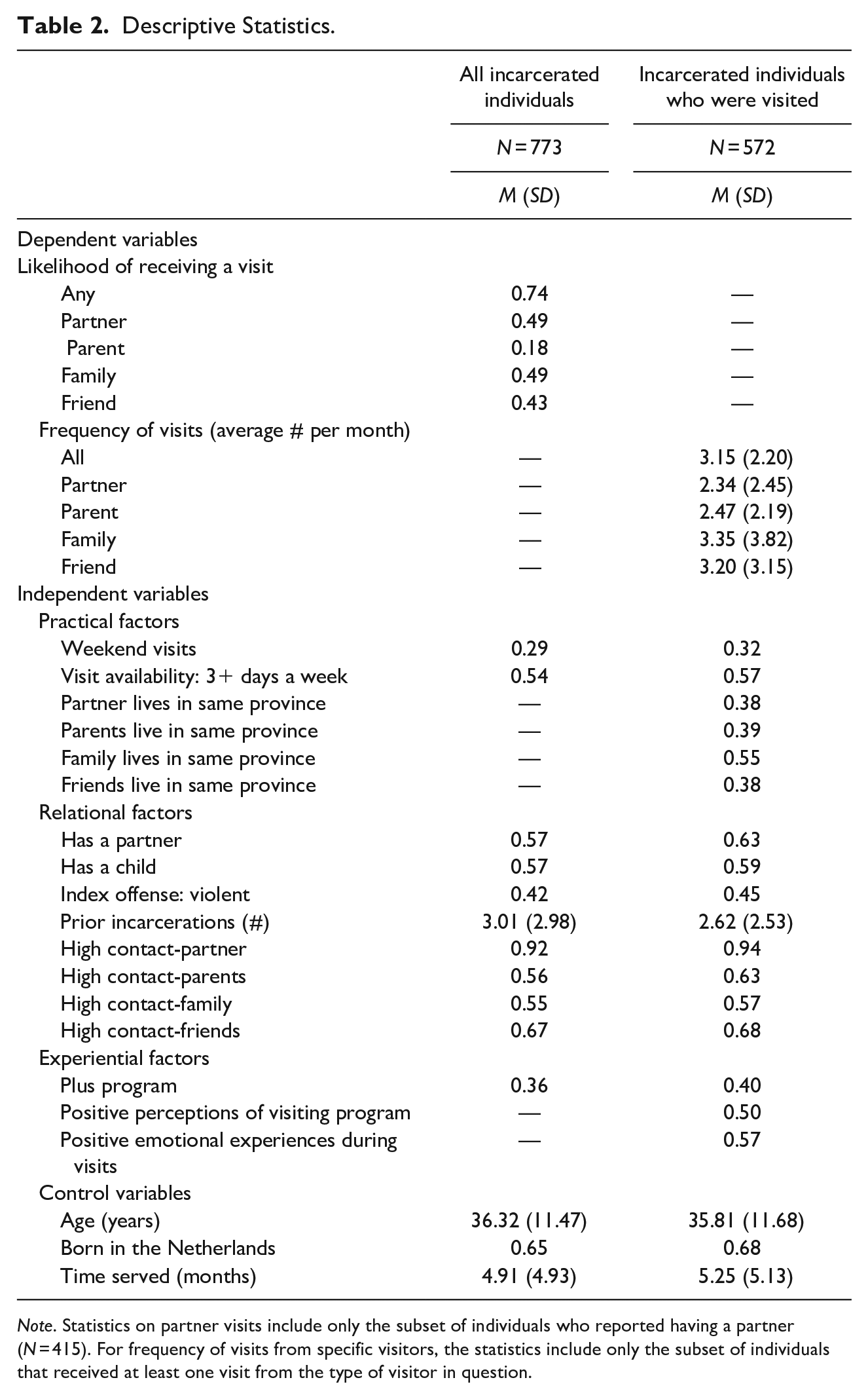
Note. Statistics on partner visits include only the subset of individuals who reported having a partner (N = 415). For frequency of visits from specific visitors, the statistics include only the subset of individuals that received at least one visit from the type of visitor in question.
Multilevel Analyses
Before proceeding with the hierarchical regression models, intercept-only models were estimated (not shown) to examine the amount of variation in the dependent variables across prison units. All interclass correlations were significant for the likelihood of receiving a visit, ranging from .09 (any visit) to .34 (family visits). For frequency of visits, the interclass correlations were much smaller and not significant (with exception of frequency of family visits where 15.2% of the variance pertained to unit level). Overall, this provides substantial evidence that the likelihood of receiving a visit varies across prison units.
Likelihood of Receiving a Visit
The multilevel model estimating the likelihood of receiving at least one visit (first column: “any visit,” Table 3) shows that neither practical nor experiential factors were predictive of receiving visits. The lack of significant associations within these domains is an important finding in and of itself. It suggests that having flexible policies and increased opportunities to receive visits (through the plus program) has little impact on whether individuals receive visits overall.
Multilevel Results: Likelihood of Receiving a Visit.
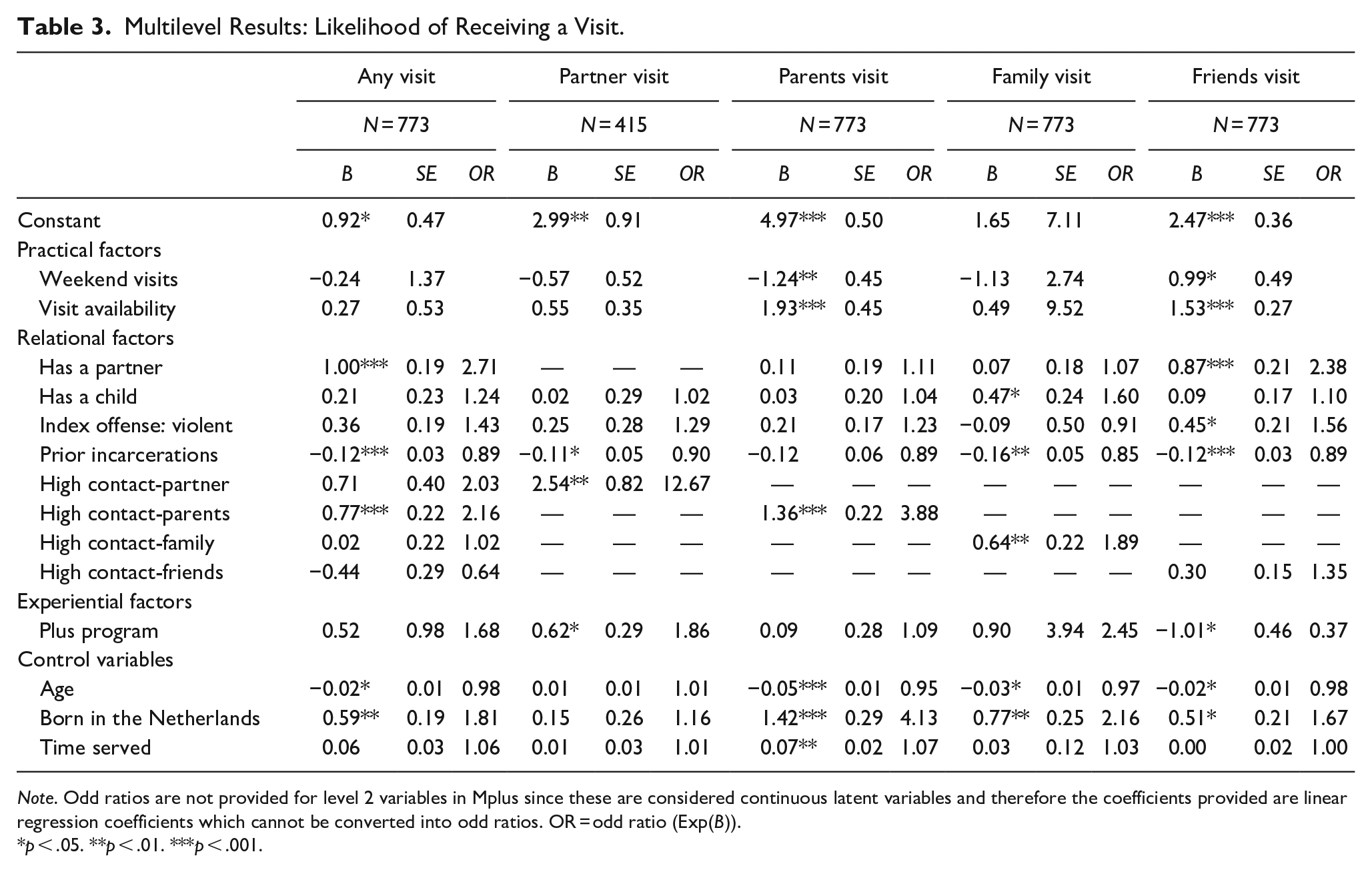
Note. Odd ratios are not provided for level 2 variables in Mplus since these are considered continuous latent variables and therefore the coefficients provided are linear regression coefficients which cannot be converted into odd ratios. OR = odd ratio (Exp(B)).
p < .05. **p < .01. ***p < .001.
Contrastingly, several relational factors were associated with being visited. Having a partner increased the odds of receiving a visit in prison. Also, individuals who had fewer prior incarcerations were more likely to be visited than individuals with multiple incarcerations. The odds of being visited were two times higher for individuals who had high contact with their parents prior to incarceration than individuals who had low contact. This is perhaps a reflection of the duration of the relationship with parents or that these individuals lived with their parents prior to incarceration. The other relationship types were not significant. Also, having a child or being incarcerated for a violent offense were not associated with receiving visits.
Next, we considered whether these factors related differently to specific types of visitors (partner, parents, family, and friends, also displayed in Table 3). Beginning first with the practical factors, we see that individuals on units with more visit availability (i.e., more than 3 days a week) were more likely to receive visits from parents and friends when compared to individuals on units where visits were only available on 1 or 2 days a week. The likelihood of visits from friends also increased when weekend visits were possible. Perhaps friends are less willing to take time off work during the week to visit and thus make more use of flexible visiting times. This may be less important for parents, since the results show that the likelihood of parent visits decreased when individuals were able to have weekend visits.
A consistent result across the models of specific visitor types is that pre-incarceration contact had relatively strong effects on the likelihood of receiving a visit. This result held in all models except for friends, suggesting that these bonds are weaker or that other factors, such as flexible visiting policies (as discussed above), are more important for predicting visits from friends. In terms of other relational factors, having a partner increased the odds of receiving visits from friends. Also, individuals who have children were 60% more likely to receive a visit from a family member than those who do not have children, which may be because family members accompany children to visits. Partner, family, and friend visits were more likely when individuals had fewer prior incarcerations. This was not true for parent visits; perhaps since these relationships may overlook, or be less influenced by, an individuals’ criminal background.
Experiential factors had few effects across the models on the likelihood of visits from partner, parents, family, and friends. Individuals in the plus program were 63% less likely to receive visits from friends than individuals in the basic program. It is possible that individuals in the plus program have closer family ties that visit them, as we see that they are more likely to receive partner visits. Finally, individuals who are young and were born in the Netherlands had higher odds of receiving parent, family, and friend visits. Spending more time in this prison increased the odds of parental visits but was not associated with the other visitor types.
Frequency of Visits
Results show that practical factors that tap into how flexible visitation policies are not associated with overall visit frequency. Traveling distance, however, was significantly related to how often individuals received visits (see first column: “all visits,” Table 4). The frequency of visits per month increases when the partner or parents live close to the prison. Traveling distance was not predictive for family and friend visits.
Multilevel Results: Frequency of Visits.
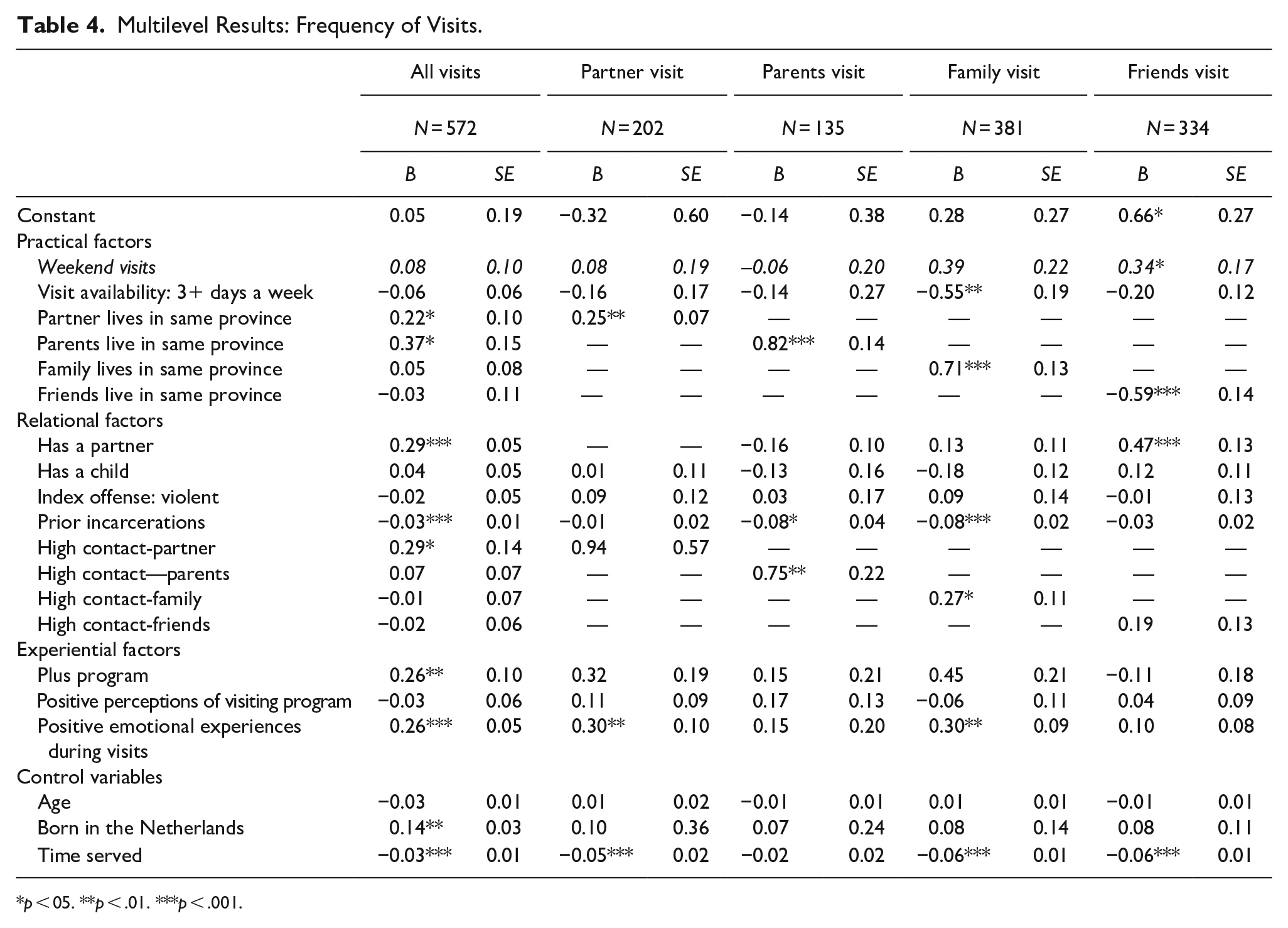
p < 05. **p < .01. ***p < .001.
Three relational factors were related to the frequency of visits. Two of these factors concern the partner: individuals who have a partner and who had high contact with their partner prior to incarceration received more visits on average per month. Perhaps persons with partners are more socially connected than single persons, which could result in more visits overall. Contrastingly, individuals with a more extensive incarceration history were visited less frequently per month.
Regarding experiential factors, we found that being in the plus program increased the number of visits received. Also, individuals who reported positive emotional experiences during visits received significantly more visits on average per month. This suggests that individuals who look forward to visits and have positive experiences during visits are visited more often. However, it is also possible, that those who have frequent visits attach more emotional value to their visits, and thus are more positive about them. No significant effects were found for the perception of the visiting program. Finally, we found that being born in the Netherlands increased the frequency of visits, whereas individuals who served longer periods of time in this prison received fewer visits on average per month; age was not associated with visit frequency.
A few key differences can be observed across the visitor types (see Table 4). Practical factors concerning visitation policies only affected family and friend visits. Family members visited more frequently when visits were available on 1 or 2 days a week. It is possible that incarcerated individuals prefer having family members visit, even when there are limited visiting options. Friends visited more frequently when weekend visits were possible. Also, friends who lived further away from the prison visited more frequently than those who lived in the same province as the prison. If friends that visit must travel far, this could explain why they make use of weekend visits. Contrastingly, partner, parents, and family who lived in the same province as the prison visited more often than those outside of the province.
Few associations were found between relational factors and the frequency of partner, parents, family, and friend visits. When individuals had high contact with parents and family members prior to incarceration then these visitors visited more often. Notably, the larger coefficients for traveling distance suggest that—at least for family members—that this has a stronger effect on visitation frequency than the amount of contact prior to incarceration. Individuals who had already been incarcerated several times received on average less visits per month from parents and family.
Finally, having positive emotional experiences during visits was associated with more frequent partner and family visits, but was not associated with parents and friend visits. The social support literature suggests that partner and family are important relationships for incarcerated individuals, thus if they also have positive experiences during visits then they may want to receive more visits from them. Perceptions of the visiting program and participation in the plus program were not associated with visitation frequency. In terms of control variables, age and being born in the Netherlands were not associated with visit frequency across all visitor types. For time served, the results indicate that the longer an individual served time in this prison, the fewer visits they received on average per month from partner, family, and friends.
Discussion
Prison visitation allows individuals to maintain social ties which may be of vital importance upon release. Nonetheless, a meaningful number of incarcerated individuals are never visited and, among those who are visited, substantial variation exists in the frequency of visits (e.g., Cochran et al., 2017). Recent scholarship on the determinants of visitation has shed some light on how various practical, relational, and experiential factors can contribute to the likelihood and frequency of visits. This study adds to this literature by using a social ecological framework which assumes that multiple actors are important for visitation and considers the practical barriers to visitation together with the social and incarceration context to better understand who gets visited in prison. Beyond whether an individual is visited, we also test how these factors relate to how often and from whom individuals receive visits. We use data from the DPVS, which expands our knowledge about the determinants of visitation to a western European context.
Four key findings emerged from our analysis. First, traveling distance seems to be the most prominent practical factor for overall visit frequency, as well as visits from specific relationships. We found that when visitors lived in the same province as the prison, they visited more often (except for friends). Although prior U.S. studies have consistently found that traveling distance matters for visitation (e.g., Clark & Duwe, 2017; Cochran et al., 2016), this result is striking since the Netherlands is geographically much smaller than most U.S. states. Even so, Dutch infrastructure is very dense and many individuals use public transport. The public transportation is quite expensive in the Netherlands, so even relatively short distances can be quite costly, which could also explain this result. Additionally, the effect of traveling distance on the average number of visits per month was stronger than the amount of pre-incarceration contact. This emphasizes that even when visitors may have a close relationship with the incarcerated individual (i.e., amount of contact), far traveling distances may still hinder them from visiting frequently. This result perhaps reflects the tradeoffs that visitors must make, as described in qualitative studies with visitors (e.g., Christian et al., 2006). Certain visitors may also be unable to visit due to these far distances, but we were unable to explore this in our data. Nevertheless, this result emphasizes the importance of placing offenders in prisons near their already existing social network.
Second, relational factors consistently emerged as predictors for both whether individuals received visits in prison and how often they received visits. Individuals who had more contact prior to incarceration were more likely to receive visits across several visitor types. This result aligns with theoretical notions that those close to you will provide support even when it is costly or takes effort (Vaux, 1988) and recent work on pre-incarceration social support (Atkin-Plunk & Armstrong, 2018; Hickert et al., 2019). Moreover, our other findings—such as having a partner increased the odds of receiving visits—point to this notion that having a strong network prior or during incarceration is important for visits. Multiple incarcerations may put strain on the social network as we found that having prior incarcerations decreased the odds of receiving visits (and these individuals received fewer visits too). This result could also reflect loss of social capital after enduring several prison spells. Collectively, these results suggest that individuals with few social contacts and who have extensive incarceration histories may benefit most from social network trainings or volunteer visits, and subsequently, increase visitation rates.
Third, we also found that several experiential factors were related to receiving more frequent visits. Individuals in the plus program were visited more often on average per month than individuals in the basic program. This suggests that programs providing more opportunities to receive visits, especially at desirable times, is related to more frequent visits (although we recognize that it is also possible that other characteristics of these individuals, for instance that they are motivated to work on reintegration, may also explain why they receive more visits). We additionally found that individuals who had positive emotional experiences during visits were visited more frequently, specifically by partner and family. It is possible that these experiences are reciprocal, if incarcerated individuals experienced their visits positively, then perhaps partner and family did too. We further found that individuals’ perceptions of the visiting program were not related to the frequency of visits. Nevertheless our findings seem in line with qualitative accounts showing that incarcerated individuals make willful and active decisions about visits based, in part, on their experiences (Pleggenkuhle et al., 2018; Turanovic & Tasca, 2019).
Fourth, the results of this study suggest that determinants can vary across visitor types. While relational factors were relatively consistent across the different visitors, practical and experiential factors did vary, especially for visitation policies. For example, we found that having visits available on more days during the week increased the odds of receiving visits from parents and friends. Such flexible policies seem especially important for friends, as having weekend visits also increased the likelihood of them visiting. Not only that, friends also visited more often when weekend visits were available. This suggests that flexible policies may be especially important for those relationships who are less willing, or able, to take time off work. By making visits more available, it may be possible for individuals to receive visits from a variety of visitors which can be beneficial for life after release (e.g., Brunton-Smith & McCarthy, 2016). Moreover, we recognize that flexible polices may be most important for children who are often in school during the weekday visiting hours. We were, however, unable to explore child visits due to poor registration of these visits in the data. 12 Ancillary analyses using self-report data on child visits from the PCQ did show that child visits were more likely when incarcerated parents had weekend visits. Future research should then examine how these policies impact child visits.
Taken together, these findings support the notion that practical, relational, and experiential factors play out at once to influence whether, how often, and from whom individuals receive visits in prison. A few limitations need to be acknowledged and considered when interpreting the findings. Since the study sample only included incarcerated males, the results may not be generalizable to incarcerated females. Prior empirical work suggests that incarcerated females are more inclined to reach out to family and be linked to the care and upbringing of children than their male counterparts (Jiang & Winfree, 2006; Mignon & Ransford, 2012). These qualitative differences may have implications for incarcerated females’ visitation experiences. Also, our sample consisted of individuals incarcerated for at least 1 month and up to 2 years. Due to this, our findings are most applicable to relatively shorter prison terms or jail incarceration in the U.S. Consequently, our study may even underestimate the effects of practical, relational, and experiential factors for individuals serving longer prison terms. It is possible that certain factors, such as traveling distance, have an even greater effect for these individuals as the costs of long traveling distances accumulate and become difficult to maintain over time. Thus, investigations among individuals serving different amounts of time in prison is warranted. Finally, the data used to tap into visitation experiences were reported about the same period in which individuals received visits. Due to the cross-sectional nature of this data, we cannot rule out the possibility that the frequency of visits could impact how individuals perceive the visiting program. It is possible that individuals who receive more visits recognize more problems with the visiting program. Moreover, individuals who receive many visits likely have more varied emotional experiences. Future work should examine this using longitudinal designs.
Limitations aside, the results of this study underscore the importance of using a social ecological framework in future research which recognizes that visits are the product of practical challenges, but also the social and incarceration contexts in which individuals reside. The latter is especially important as the role of prisons is often overlooked. Scholars should replicate and expand on our findings concerning visitation policies using different measures and populations across various visitor types. Moreover, scholars should examine different forms of contact (visit, phone calls, letters, video visits) as each form presents unique challenges and opportunities to stay connected to family and friends, which may influence visiting decisions (e.g., phone calls can often occur more frequently and can be less expensive, which may lead to less visits). Relatedly, future work should examine the financial costs of visiting since this may be consequential for (potential) visitors with a low social-economic status (Grinstead et al., 2001; Rubenstein et al., 2021). Also, visitors’ experiences or motivations to visit may be consequential for visitation. Even if an incarcerated individual wants to receive visits, if family or friends find visits to be too inconvenient or difficult then they may not visit (Comfort, 2003). More investigations of visitors’ perspectives is warranted.
Not least, the proposed social ecological framework offers a way of organizing and theorizing about visitation enablers and barriers across contexts. In this way we hope to facilitate more systematic empirical assessments of these factors. Future studies can identify whether their analyses were (more or less) influenced by practical, relational, or experimental factors. Over time this evidence could tell us whether and which factors are most impactful and help to identify primary predictors of visitation.
Footnotes
Declaration of Conflicting Interests
The author(s) declared no potential conflicts of interest with respect to the research, authorship, and/or publication of this article.
Funding
The author(s) received no financial support for the research, authorship, and/or publication of this article.
