



Abstract
Moffitt’s snares hypothesis posits that snares—such as addiction to drugs and alcohol, time spent incarcerated, unemployment, teenage parenthood, high school dropout, and disabling injuries—can trap individuals into persistent patterns of offending during periods in the lifecourse when desistance is normative. We test this hypothesis using data from the National Longitudinal Survey of Youth 1997 to examine the associations and mechanisms between snare exposure and criminal offending during young adulthood. Results indicate that snare exposure was associated with increased offending and that this was in part due to snare exposure undermining a successful transition to adulthood, harming health, and producing social disadvantage. Moreover, the association between snare exposure and offending varied for different life-course offending trajectories.
Moffitt’s (1993) developmental taxonomy has received widespread attention and moderate empirical support, with studies documenting the existence of different life-course offending trajectories (e.g., Piquero, 2008) and testing the etiology of different offending groups (e.g., Moffitt, 2006). However, less work has examined one of the theory’s central hypotheses concerning the continuity and change of offending during young adulthood: the snares hypothesis. According to Moffitt (1993), developmental snares—such as addiction to drugs and alcohol, time spent incarcerated, unemployment, teenage parenthood, high school dropout, and disabling injuries—may trap individuals into persistent patterns of offending during periods in the life-course when desistance is normative. These snares are thought to promote continued offending and delay desistance because they undermine a successful transition to adulthood, harm health, and produce social disadvantage (Moffitt, 1993; Moffitt & Caspi, 2005). Furthermore, Moffitt (1993) contends that although exposure to snares tends to promote offending for all life-course offending trajectories, individuals on the adolescent-limited (AL) pathway should be influenced more strongly by snares than those on the life-course persistent (LCP) pathway.
Despite calls for research to further investigate the snares hypothesis (Moffitt, 2006; Piquero et al., 2013), few studies have examined whether these ensnaring life events promote offending. Research thus far has mainly focused on how individual snares—such as alcohol or substance use—predict continued offending or otherwise delay desistance during young adulthood (Craig et al., 2015; Higgins et al., 2010; Hussong et al., 2004; Reyes et al., 2011). A single study examined multiple snares, but assessed them independently (McGee et al., 2015). To date, however, no study has examined the summative impact of the full range of snares proposed by Moffitt on offending, nor has any study examined the mechanisms underlying the snares-offending association. This absence is noteworthy given that Moffitt (1993, p. 691) posited “that variability in age at desistance from crime should be accounted for by the cumulative number and type of ensnaring life events that entangle persons in a deviant life-style.”
In response, we examined three research questions. First, does snare exposure (measured as the total number of snares encountered) predict continued offending during young adulthood? Second, if so, what mechanisms explain this association? Third, does the association between snare exposure and offending vary for individuals who belong to different offending trajectories?
Background
The Developmental Taxonomy
In her developmental taxonomy, Moffitt (1993) argued that the aggregate age-crime curve obscures two distinct offending groups—LCP offenders and AL delinquents. 1 According to Moffitt, these groups have different offending trajectories and distinct factors influence group membership. The LCP group is comprised of a relatively small group of offenders (5%–8% of the population) who commit over half of all criminal offenses. These offenses include both minor delinquency as well as violent crimes. LCP offenders begin offending at a young age, have a higher peak, and although their offending frequency declines over time, they continue offending over the course of their lives. According to Moffitt, LCP membership is largely due to neuropsychological deficits and exposure to adverse home environments early in life. In her theoretical formulation, Moffitt identifies both verbal (e.g., problem-solving) and executive cognitive (e.g., impulsivity and temperament) deficits. Meanwhile, Moffitt (1993) cites poor parenting practices and family disruption as examples of a disadvantaged rearing environment.
As noted elsewhere (Moffitt, 2006), the majority of research on the developmental taxonomy centers on LCP offending. This research is generally supportive of Moffitt’s (1993) arguments. For example, neuropsychological deficits predict LCP membership (Bellair et al., 2016; Moffitt et al., 1994) and when these deficits exist in the presence of an adverse childhood environment, an early onset of offending is more likely (Tibbetts & Piquero, 1999). Research also supports the notion that there are personality differences between the groups as LCP offenders are more callous, hostile, and impulsive than ALs, and the majority of LCPs continue offending beyond middle age. Further, LCPs are more likely to be convicted of violent and non-violent offenses as adults and experience incarceration (Moffitt, 2018).
ALs are the second group identified by Moffitt (1993). These individuals largely limit their offending to minor delinquency during the teenage years and are less likely to suffer from the neuropsychological conditions that LCPs experience. ALs begin to offend in adolescence as a result of a “maturity gap” (i.e., the gap between biological maturity and a lack of autonomy) and “social mimicry” (i.e., modeling the behavior of LCP peers in an attempt to appear more adult-like and independent). LCPs appear more adult-like due to their sexual experience, possession of financial resources obtained through criminal behavior, and their use of drugs and alcohol. Thus, LCPs do not experience a maturity gap and have the independence that ALs wish to acquire. In response, ALs mimic the behavior of LCPs. However, the maturity gap dissipates in late adolescence and early adulthood as ALs gain independence and transition into adult roles. Most ALs are argued to desist from offending in late adolescence and early adulthood because they lack the neuropsychological deficits possessed by LCPs and no longer experience a maturity gap.
The research on AL delinquency is generally supportive. Recent research on the social mimicry hypothesis reveals that associating with LCP peers is related to substance use initiation during adolescence (Widdowson et al., 2020). Additional research on the popularity of LCPs during adolescence is also largely consistent with Moffitt’s (1993) developmental taxonomy. Specifically, perceived popularity increases among those with an early onset of substance use and externalizing behavior (Franken et al., 2017) and chronic violent offenders saw increases in popularity as adolescents but declines in early adulthood (Young, 2014; albeit see Rulison et al., 2014). As a whole, these findings suggest that those on the AL pathway model the behavior of their LCP peers and that LCP popularity grows in response. Research on the other primary contributor to AL offending, the maturity gap, is also largely supported by research. Specifically, the gap between biological maturity and autonomy is positively related to delinquency (Barnes & Beaver, 2010; Piquero & Brezina, 2001). In sum, prior work studying both AL and LCP behavior is generally consistent with the arguments made by Moffitt (1993). However, not all individuals on a typical AL path desist in late adolescence or early adulthood as some are still involved in criminal behavior (Moffitt, 2018). While the majority of ALs desist in late adolescence and early adulthood, the offending groups are not deterministic and Moffitt (1993) recognizes there will be variation in the age of desistance on the right-side of age-crime curve (Moffitt, 2018). Members of the AL group who continue to offend in their adult years, will often do so at a lower volume and commit relatively minor offenses when compared to LCPs.
The Snares Hypothesis
In addition to offering an account of the etiology of LCP offenders and AL delinquents, Moffitt (1993) also identified mechanisms to explain why offending is sometimes sustained over the life-course. One mechanism, which is the focus of this study, is the concept of snares. 2 According to Moffitt (1993, p. 684), developmental snares such as “teenaged parenthood, addiction to drugs or alcohol, school dropout, disabling or disfiguring injuries, patchy work histories, and time spent incarcerated” have the potential to trap individuals into persistent patterns of offending during periods in the life-course when desistance is normative. Moreover, Moffitt (1993, p. 691) suggests that although the independent effect of one snare may increase the likelihood of offending, “that variability in age at desistance from crime should be accounted for by the cumulative number and type of ensnaring life events that entangle persons in a deviant life-style.”
Several potential mechanisms may explain why snare exposure would predict continued offending or otherwise delay desistance. Snares have the potential to undermine a successful transition to adulthood, harm health, and produce disadvantage, all of which narrow options for a conventional lifestyle and promote further offending (Moffitt, 1993, p. 684; Moffitt & Caspi, 2005, p.162). In terms of undermining a successful transition to adulthood, snares may decrease the likelihood that individuals transition into crime inhibiting turning points, such as marriage and military service. Marriage and military service are strongly associated with within-individual reductions in offending and desistance (Laub & Sampson, 2003; Warr, 1998). And prior research suggests that life events—such as drug and alcohol abuse, criminal justice contact, and lower educational and job attainment—reduce the likelihood that individuals enter into marriages or enlist in the military (Huebner, 2007; Sykes & Bailey, 2020). In terms of harming health, snare exposure may increase the likelihood that individuals suffer from disease and illness. Research suggests that many of the life events outlined as snares by Moffitt are associated with poor health outcomes (Aarons et al., 1999; Pampel et al., 2010; Turney & Wildeman, 2015). And not only is poor health associated with higher offending (Moffitt et al., 2002), but it also associated with a lower likelihood of marriage and military service (Fu & Goldman, 1996; National Research Council, 2006). In terms of producing social disadvantage, snare exposure may decrease the likelihood that individuals gain access to the types of high paying jobs that allow individuals to build wealth and discourages offending. Income and wealth are associated with lower offending (Haynie et al., 2008; Verbruggen et al., 2015). And prior research suggests that life events—such as drug and alcohol abuse, criminal justice contact, and lower educational and job attainment—reduce income and wealth (Arria et al., 2013; Siennick & Widdowson, 2020).
A final component of the snares hypothesis involves Moffitt’s prediction that AL offenders will be more strongly affected by snare exposure than their LCP counterparts. To Moffitt (1993), snares have a causal effect on subsequent behavior beyond any persistent individual differences in the propensity to offend. That is, snares represent a state dependence effect in her theory (Nagin & Paternoster, 1991; see also Laub & Sampson, 1993). Of the dual typology, ALs are said to be especially vulnerable to snares (Moffitt, 1993). This is because ALs are otherwise well socialized individuals, lacking a strong criminal propensity brought on by stable neuropsychological deficits. In the words of Moffitt (1993, p. 695), “[persistent] individual differences should play little or no role in the prediction of short-term adolescent offending careers.” The absence of persistent differences leaves only state dependence effects to explain continuity in AL delinquency. Although LCPs are susceptible to the same snares as their AL counterparts, the effect is believed to be weaker. This is because the same individual characteristics that got LCPs in trouble in childhood and adolescence (e.g., impulsivity and aggression) will continue to cause problems for LCPs in adulthood, above and beyond ensnaring life-events (Moffitt, 1993). Thus, the snares hypothesis predicts that the effect of snares will be conditional on trajectory group membership, with the effect being strongest for ALs or those with lower criminal propensity.
Prior Research Testing the Snares Hypothesis
Only a handful of studies have examined Moffitt’s (1993) snares hypothesis. The studies that have examined the hypothesis have mainly focused on how individual snares—such as substance use or alcohol abuse—predict continued offending or otherwise delay desistance in young adulthood. 3 For example, the first test of the snares hypothesis came from Hussong et al. (2004). Analyzing men from the Dunedin Multidisciplinary Health and Development Study at three time points (ages 18, 21, and 26), the authors used growth curves to examine whether alcohol and marijuana dependency were associated with antisocial behavior. Hussong et al.’s growth curve analyses tested two conceptions of the snares: whether alcohol and substance use at age 18 predicted subsequent offending, and whether alcohol and substance use at one time point corresponded with a contemporaneous elevation in offending at the same time point. Results suggested that drug and alcohol dependency were associated with increased levels of subsequent and contemporaneous antisocial behavior.
In another study, Higgins et al. (2010) examined dual trajectories of alcohol use and self-reported offending from ages 16 to 22 among a sample of 283 African Americans. In line with the snares hypothesis, the authors found that individuals who were on a slow desistance pathway tended to use alcohol more frequently. Reyes et al. (2011) examined the role of heavy alcohol use in desistance from dating aggression. Using a longitudinal sample of high school students followed from grades 8 to 12, the authors’ trajectory model suggested that alcohol use and dating aggression increased from eighth to ninth grade but declined after the sample reached 10th grade. Reyes et al. also found that for those who reported heavy alcohol use, dating aggression persisted in grades 10 and 11. Craig et al. (2015) used the Cambridge Study in Delinquent Development and Group Based Trajectory Modeling (GBTM) to identify three offending groups from ages 10 to 21; the authors then examined whether heavy drinking at age 18 was associated with subsequent convictions in young adulthood among those on an adolescent-onset pathway. Their results supported the snares hypothesis, showing that heavy alcohol use is associated with continued offending. Finally, in the only study to examine snares other than alcohol and substance use, McGee et al. (2015) used an Australian sample to examine whether snare exposure differentiated between adolescent-onset offenders who persisted or desisted from offending. In bivariate analyses, the authors found that adolescent-onset offenders who persisted were more likely to experience snares such as neighborhood disorder, early school leaving, unemployment, sexual assault, early parenthood, criminal justice involvement, and substance use disorders.
Although these studies suggested that snare exposure—especially alcohol and drug use—promotes continued offending, important questions remain unanswered. First, none of the studies have examined the summative impact of the full range of snares outlined by Moffitt on offending during young adulthood as Moffitt’s theory suggests. Second, none of the studies have examined the mechanisms that Moffitt suggested underly the snares-offending association. As noted, these are key parts of the snares hypothesis which this study was designed to address.
Current Study
The current study uses longitudinal data from the National Longitudinal Survey of Youth 1997 (NLSY97) to examine three research questions:
Method
Data and Sample
Data for this study came from waves 1 to 18 of the NLSY97. The NLSY97 is a nationally representative sample of 8,894 adolescents born during the years 1980 and 1984 in the U.S. and who were between 12 and 18 years-old in 1997. The NLSY97 contains two probability-based household samples: a nationally representative cross-sectional sample of 6,748 respondents and an additional over-sample of 2,236 Black and Hispanic youths. Data have been collected annually from 1997 to 2011 and biennially in 2013, 2015, and 2017 (for a total of 18 waves). The retention rate of the NLSY97 is high with about 83% of respondents being re-interviewed in the two most recent waves.
The following restrictions were made to the sample. First, we restricted the sample to the youngest two cohorts in the NLSY97–those born in 1983 and 1984 (n = 3,578). Focusing on the younger two cohorts allowed us to use GBTM to estimate SRO trajectories from ages 12 to 21. This age period allowed us to approximate respondents’ SRO trajectories during their prime offending years. Second, we restricted the sample to respondents who had complete data on SRO for at least three observations during waves 1 to 7 and complete data on the dependent variable for at least three waves during waves 8 to 18 (n = 3,140). We did this because we estimated trajectories of SRO using GBTM from waves 1 to 7 and arrest trajectories via mixed-effects models from waves 8 to 18; and having a minimum of 3 waves is recommend when estimating trajectories (Rabe-Hesketh & Skrondal, 2012). Third, we restricted the sample to respondents who participated at wave 7 (n = 3,088). We did this because most of our snare measures were taken at that wave. To address missing data on the study variables, we implemented multiple imputation using chained equations with the mim suite in Stata 16 (StataCorp, (2016), College Station, TX). In doing so, we created 20 imputed datasets. Standard errors were calculated using Rubin’s (1987) rules which accounts for the variance between and within the imputed datasets.
Measures
Self-reported offending
Measures of SRO were taken at waves 1 to 7. 4 SRO is the count of the number of types of offenses committed in the past 12 months (wave 1) or since the previous wave (waves 2 to 7). To create this measure, we summed respondents’ answers to six questions assessing whether they had purposely destroyed someone else’s property, stolen something worth more than $50, committed other property crimes, sold illegals drugs, intentionally attacked someone, and carried a handgun (α = .71). This measure is consistent with other criminological studies that have used the NLSY97 to assess criminal offending (e.g., Vogel & South, 2016). Higher scores indicate a greater variety of SRO.
Dependent variable
The dependent variable was a measure of arrest taken at waves 8 to 18. Consistent with other criminological studies that have analyzed annual arrest data with the NLSY97 (e.g., Bersani & DiPietro, 2016), arrest was a measure reflecting the number of arrests respondents reported at each wave. At each wave, respondents were asked whether they had been arrested for an illegal offense (excluding minor traffic violations) since the date of last interview; those who reported being arrested were then asked how many times they were arrested.
Focal independent variable
The focal independent variable was a measure of snare exposure, which was a summative index of the number of ensnaring life events that each respondent had encountered. Unless otherwise noted, these measures were from the wave 7 interview, when respondents were between 18 and 21 years old (mean age = 20.1). Binge drinking indicated whether respondents reported drinking five or more alcoholic drinks in one sitting in the past 30 days (0 = no, 1 = yes). Marijuana use indicated whether respondents reported using marijuana since the date of last interview (0 = no, 1 = yes). Hard drug use indicated whether respondents reported using hard drugs such as “cocaine” or “heroin” since the date of last interview (0 = no, 1 = yes). Incarceration history indicated whether respondents had been incarcerated by wave 7 (0 = no, 1 = yes). High school dropout indicated whether respondents reported having no high school degree (and were no longer enrolled in school) or had a GED (0 = no, 1 = yes). Unemployed indicated whether respondents reported being either unemployed or out of the labor force and not attending school at the time of their wave 7 interview (0 = no, 1 = yes). Teenage parenthood indicated whether respondents reported the birth of a biological child before turning 20 years-old (0 = no, 1 = yes). Injury/disfigurement indicated whether respondents reported having a health condition (which they were not born with) that currently limits their activities a little or a lot at wave 6 (0 = no, 1 = yes).
Mediating variables
We included three sets of mediating variables taken at waves 8 to 18. The first set of mediators were related to the transition to adulthood. Marriage indicated whether respondents were married at each wave (0 = no, 1 = yes). Military service indicated whether respondents were on active-duty military service at each wave (0 = no, 1 = yes). The second set of mediators measured health. General health was an ordinal measure of respondents’ self-reported health at each wave (1 = poor, 5 = excellent). Health coverage indicated whether respondents had access to health insurance at each wave (0 = no, 1 = yes). The third set of meditators captured social (dis)advantage. Income was a continuous variable reflecting the amount of income respondents made from wages in the year preceding each wave. Financial assets was a continuous variable indicating the total value respondents held across several categories of financial assets (i.e., retirement/pension accounts, bank or money market accounts, bonds or certificates of deposits, stocks held, and trusts or annuities). 5 Both income and financial assets were inflation-adjusted to 2017 dollars and log transformed to reduce skew.
Control variables
Several control variables were included in the analyses that may confound the association between snare exposure and offending. Male was a dichotomous variable for respondents’ gender (0 = female, 1 = male). Race/ethnicity were represented as a set of mutually exclusive dichotomous indicators for Black (0 = no, 1 = yes), Hispanic (0 = no, 1 = yes), and Other race (0 = no, 1 = yes); White was the reference category. Parental education was a continuous variable reflecting the highest grade of education completed by a parent. Two biological parents indicated whether respondents reported living with two biological parents versus some other household structure at wave 1 (0 = other family structure, 1 = two biological parents). Antisocial personality was based on 8 items assessed at wave 6 (Makarios et al., 2017). Specifically, personality was assessed with items that measure the following: lack of organization, unconscientious, undependable, careless, quarrelsome, difficult, stubborn, and distrustful. The response options consisted of a 5-point sliding scale, where higher scores equated to higher levels of the construct. Each item was standardized before averaging, resulting in a scale where higher scores equal higher antisocial personality (α = .65).
Analytical Strategy
The analytical strategy proceeded in two stages. First, we used measures of age and SRO taken at waves 1 to 7 to estimate GBTMs (Nagin, 2005; Nagin & Land, 1993). 6 Instead of identifying a single trajectory for the entire sample, GBTM detects sub-groups of respondents that follow similar trajectories of SRO over time. Specifically, GBTM uses mixture models to identify a finite number of trajectories in the sample. Once the number of groups is determined, the probability of belonging to each group is calculated for each respondent, and respondents are assigned to the group to which they have the highest probability belonging. GBTMs models were conducted using the traj macro (Jones & Nagin, 2013) available in Stata (StataCorp, (2016), College Station, TX). Zero-inflated Poisson model was used to model SRO given the count nature of the variety score (Jones et al., 2001). We estimated up to a seven-group solution to determine the best fitting model. Following the recommendations of Nagin (2005), we used several criteria for determining the best-fitting model, including the Bayesian Information Criterion (BIC), the average posterior probabilities (AvePP), and odds of correct classification (OCC).
Second, we estimated a series of mixed-effects negative binomial models predicting arrest from snare exposure, the SRO groups identified in the first stage, mediating variables, and the control variables. To illustrate, the base model we estimated was expressed below (where i indicates respondent and it indicates respondent-wave).

In equation 1, the dependent variable Yit was a count of the number of arrests by respondent i at wave t. β 0i was the individual-level intercept. Snare Exposurei was a time invariant measure of the number of ensnaring life-events respondent experienced at/by wave 7. 7 SRO Groupsi was a time-invariant set of dichotomous indicators for SRO group membership derived from the first stage; controlling for SRO group membership is a way that past research has accounted for persistent heterogeneity or criminal propensity (e.g., Apel et al., 2007; Laub et al., 1998; Piquero, 2008). Ageit and Age2it were time-varying polynomials for respondents age at waves 8 to 18. 8 Wi was a vector of time-invariant measures (e.g., male). In additional models, we added our time-varying mediating variables to the equation. If there is a mediating effect, the introduction of the mediators should attenuate the effect of snare exposure on arrest.
Results
GBTMs
Figure 1 reports the GBTM diagnostics used to select the number of SRO groups. As noted, we used the BIC, AvePP, and OCC to select the best fitting model. The BIC suggested that a 7-group model best fit the data because that model had the largest BIC. Yet, according to Nagin (2005), the AvePP for all groups should be at or above .70, and the OCC should be at or above 5. The 7-group did not meet these criteria. Thus, the next best fitting model is the 5-group model; it had the largest BIC while also having all groups AvePP above 0.70 and OCC above 5.
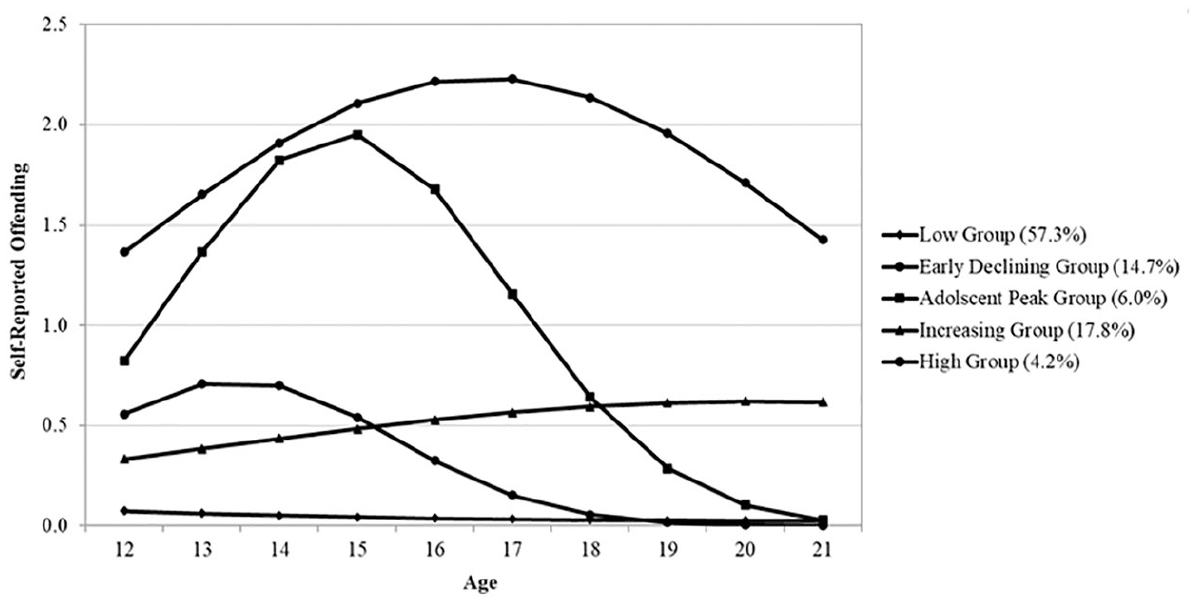
Group based trajectory model of self-reported offending by age.
Figure 1 also displays the results of the five-group trajectory model. The largest group (labeled low group) comprised about 57% of the sample and exhibited a very low rate of SRO across ages 12 to 21; this group most closely resembled the “abstainer group” from Moffitt’s taxonomy. The next three groups resembled the “adolescent-limited” pathway. The second group (labeled early declining group) comprised about 15% of the sample; this group’s SRO peaked at age 14 and declined thereafter, reaching very low SRO by age 18. The third group (labeled adolescent peak group) comprised 6% of the sample; this group’s SRO peaked at age 15 before declining thereafter. The fourth group (labeled increasing group) comprised about 18% of the sample; this group displayed a low but increasing rate in SRO across ages 12 to 21. Lastly, the fifth group (labeled high group) made up about 4% of the sample and displayed consistently high levels of SRO across ages 12 to 21; this group most closely resembled the “life-course persistent” pathway.
Descriptive Statistics
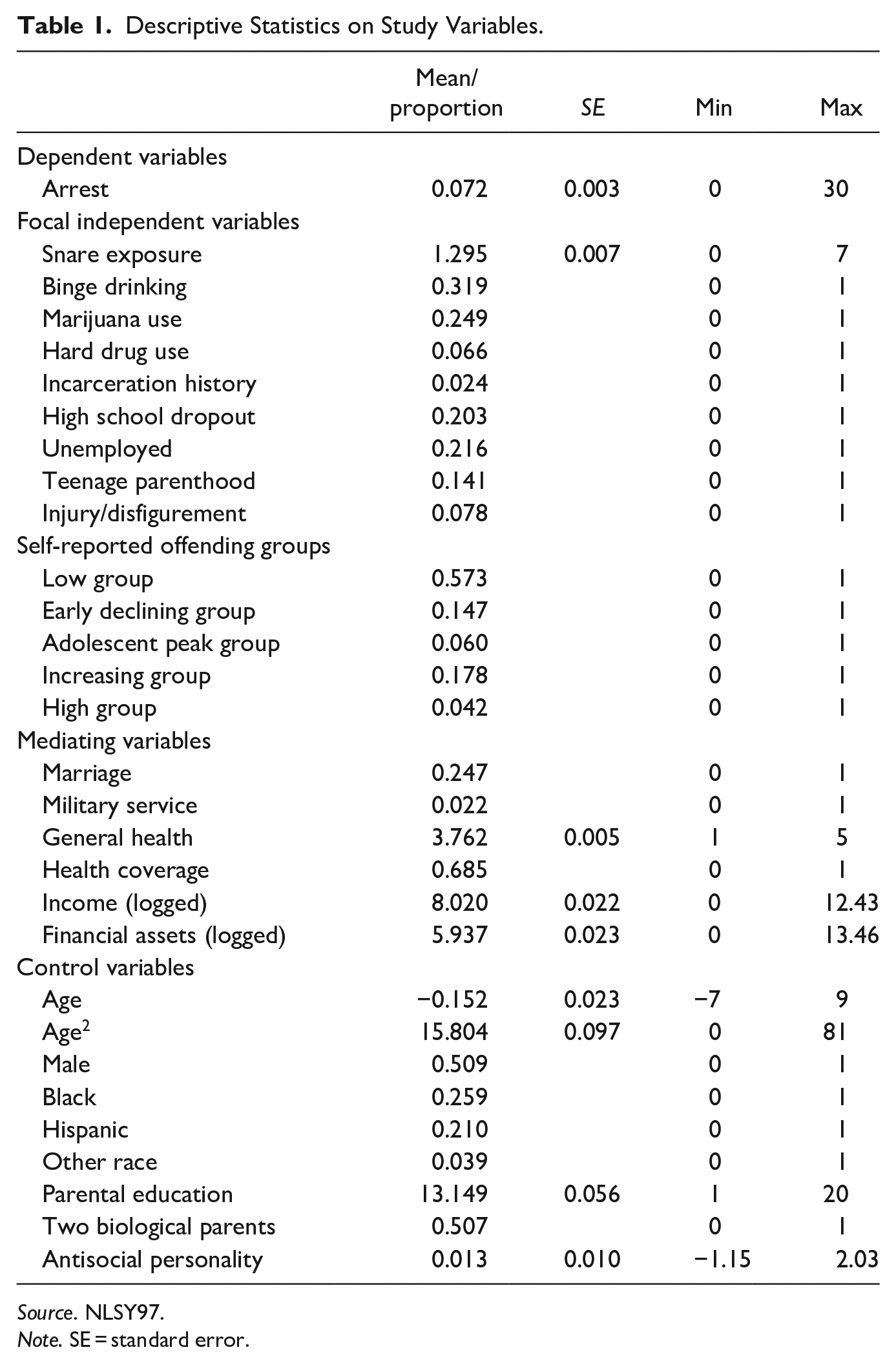
Table 1 shows descriptive statistics on the study variables. Most notably, among the full sample, the average respondent experienced 1.295 ensnaring life-events. It is important to note that although respondents could experience up to 8 snares, none did; rather, the maximum number of snares encountered was 7. Examining the snares individually, the results showed that about 31.9% of respondents binge drank, 24.9% used marijuana, 6.6% used hard drugs, 2.4% had been incarcerated, 20.3% were high school dropouts, 21.6% were unemployed, 14.1% were teenage parents, and 7.8% had an injury or disfigurement at/by ages 18 to 21.
Descriptive Statistics on Study Variables.
Source. NLSY97.
Note. SE = standard error.
Research Question #1
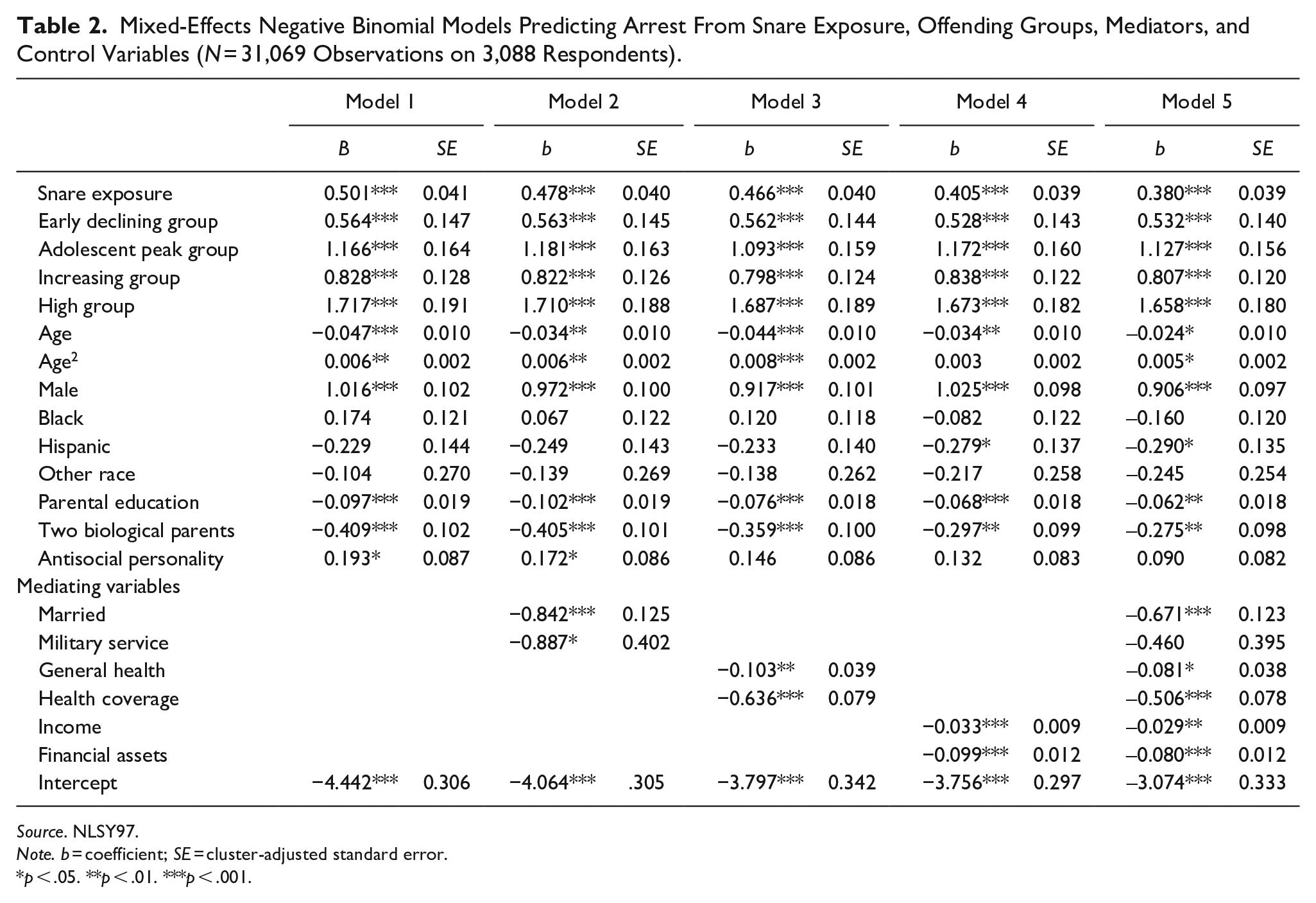
Our first research question asked whether snare exposure was associated with continued offending during young adulthood. Model 1 of Table 2 shows a mixed-effects model predicting arrest from snare exposure, SRO groups, and the control variables. This model indicated that snare exposure is positivity and significantly associated with arrest (b = 0.501, p < .001), net of controls. Specifically, for each one-unit increase in snare exposure, the expected count of arrest increased by 65% [(exp(.501)−1)*100 = 65.04%]. Thus, this finding indicates that snare exposure promotes continued offending during a period in the life-course when desistance is normative.
Mixed-Effects Negative Binomial Models Predicting Arrest From Snare Exposure, Offending Groups, Mediators, and Control Variables (N = 31,069 Observations on 3,088 Respondents).
Source. NLSY97.
Note. b = coefficient; SE = cluster-adjusted standard error.
p < .05. **p < .01. ***p < .001.
In terms of controls, model 1 of Table 2 also shows that SRO group membership, age, gender, parental education, two biological parents, and antisocial personality were significantly associated with arrest. Specifically, respondents in the early declining group, adolescent peak group, steady-increasing group, and high group had a significantly higher count of arrest than those in the low group (reference category). Moreover, males, those with low parental education, those who did not live with two biological parents, and those with high antisocial personality had a higher count of arrest.
Research Question #2
Our second research question asked whether snare exposure is associated with offending because it undermines a successful transition to adulthood, harms health, or produces social disadvantage. To assess this question, we added to model 1 our measures of marriage and military service (model 2), health and insurance coverage (model 3), income and financial assets (model 4), and all six together (model 5). In models 2 to 4, marriage (b = −0.842, p < .001), military service (b = −.887, p < .05), general health (b = −.103, p < .01), health coverage (b = −.636, p < .001), income (b = −.033, p < .001), and financial assets (b = −.099, p < .001) were significantly associated with the count of arrest and in the expected direction. 9 Moreover, models 2 to 4 show that the transition to adulthood variables, health variables, and social (dis)advantage variables, respectively, attenuated 5%, 7%, and 19% of the effect of snare exposure on arrest. Model 5 shows that when the six mediators are entered into the model, the snare exposure coefficient was attenuated by 24%, although the effect remained statistically significant (b = .380, p < .001). Together, the six mediators explain almost a quarter of the association between snare exposure and arrest.
Research Question #3
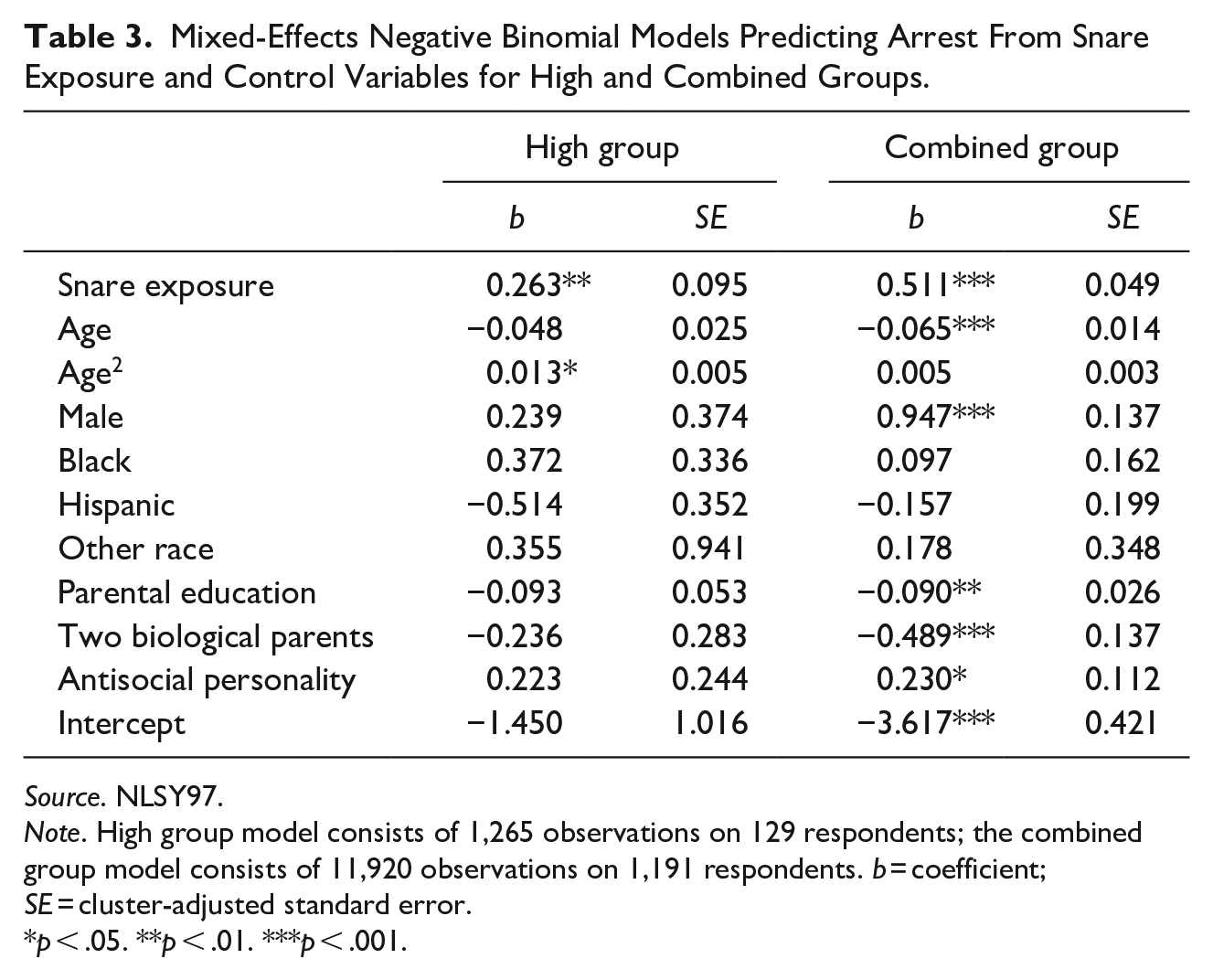
Our third research question asked whether the association between snare exposure and arrest is conditional on SRO trajectory group. Table 3 shows two mixed-effects models predicting arrest from snare exposure and the control variables. The first model consists of all respondents in the high group, which is the group that most resembles the LCP pathway. The second model consists of all individuals in the early declining, adolescent peak, increasing groups, which are the groups that most resemble the AL (or adolescent onset) pathway. To determine whether the association between snare exposure and offending is conditional on SRO offending group, we compared the equality of the snare exposure coefficients across models (Paternoster et al., 1998). A z-score greater than or equal to |1.96| was considered evidence that the coefficients differed significantly from one another.
Mixed-Effects Negative Binomial Models Predicting Arrest From Snare Exposure and Control Variables for High and Combined Groups.
Source. NLSY97.
Note. High group model consists of 1,265 observations on 129 respondents; the combined group model consists of 11,920 observations on 1,191 respondents. b = coefficient; SE = cluster-adjusted standard error.
p < .05. **p < .01. ***p < .001.
Table 3 indicates that snare exposure was positivity and significantly associated with arrest for both the high group (b = 0.263, p < .01) and the combined group (b = 0.511, p < .001), net of controls. Moreover, the z-score for the equality of coefficients was 2.33, suggesting that the coefficient for the combined group is significantly larger than the high group (p = .020). Thus, these findings indicate that although snare exposure was associated with continued offending for SRO groups that resemble both the LCP and AL pathways, individuals on the AL pathways are more strongly influenced by snare exposure.
Robustness Check
Our main analyses used GBTM to identify groups of respondents who followed similar SRO trajectories. However, a criticism of this approach is that GBTM is atheoretical (Piquero, 2008). Thus, it is important to assess whether our results were sensitive to the method used to identify SRO trajectories. To do this, we used a theoretical approach where we summed respondents’ SRO scores across waves 1 to 7 and divided the sample into: Abstainers (committed no SRO), LCP offenders (committed ≥ 10 SRO acts; the approximate top 5%), and AL delinquents (committed 1 to 9 SRO acts). We then re-estimated our models using this alternative scheme. In all cases, the results mirrored the main analyses: snare exposure was associated with arrest; the six mediators explained 21% of the snare-arrest association; and the association between snare exposure and arrest was significantly stronger for AL delinquents compared to LCP offenders. Due to space constraints, we did not include the results here, but they are available from the first author by request.
Discussion
Research evaluating Moffitt’s (1993) theory has focused largely on the identification of different life-course trajectories and the etiology of the different groups (see Moffitt, 2006; Piquero, 2008). Yet, one of the theory’s central hypotheses concerning continuity and change in offending—the snares hypothesis—is less clear. According to Moffitt (1993), snares—such as addiction to drugs and alcohol, time spent incarcerated, unemployment, teenage parenthood, high school dropout, and disabling injuries—may trap individuals into persistent patterns of offending during periods in the life course when desistance is normative. These snares are thought to promote offending and delay desistance because they undermine a successful transition to adulthood, harm health, and produce social disadvantage (Moffitt, 1993). Furthermore, Moffitt suggested that although exposure to developmental snares tend to promote continued offending for all life-course offending trajectories, individuals on the AL pathway should be influenced most by snares.
The purpose of this study was to test three research questions related to the snares hypothesis. The first research question addressed whether the number of snares individuals encountered was associated with continued offending during young adulthood. In line with Moffitt’s snares hypothesis, we found that each ensnaring life event that individuals experienced increased the count of arrest by 65%, net of controls. This finding is consistent with past studies documenting that snare exposure delays desistance by promoting persistent patterns of offending during young adulthood (e.g., Craig et al., 2015; Higgins et al., 2010; Hussong et al., 2004), but goes beyond prior research by being the first, to our knowledge, to show that the summative impact of the full range of snares outlined by Moffitt (1993) predicts offending during this period in the life-course.
The second research question addressed whether snare exposure was associated with offending because it undermined a successful transition to adulthood, harmed health, and produced social disadvantage. Our findings indicated that these factors explained a modest proportion (24%) of the association between snare exposure and offending; and they were unable to explain away the entire association. Moreover, of the mechanisms, social disadvantage accounted for the largest share of the association (19%), whereas the transition to adulthood (5%) and health (7%) explained a smaller share. Thus, we found only partial support for Moffitt’s (1993) claim for the mechanisms underlying the snare-offending association.
The fact that these mediating mechanisms did not explain away the entire association begs the question: What other factors underlie the snare-offending association? It could be that additional measures that capture a successful transition to adulthood (e.g., independent living), harmed health (e.g., sexually transmitted infections), and social disadvantage (e.g., neighborhood disadvantage) account for additional parts of the association. Alternatively, it could be that additional factors beyond these three sets of mechanisms underlie the snare-offending association. For example, psychosocial factors—such as the extent to which individuals view themselves as adults—are associated with reduced offending and desistance (Massoglia & Uggen, 2010). To the extent that snare exposure undermines subjective feelings of adulthood, it could be an additional mechanism linking snare exposure and offending. Future research should consider measuring and assessing additional mechanisms in the snare-offending association.
The third research question addressed whether the association between snare exposure and offending was conditional on SRO group membership. Our findings indicated that although snare exposure was associated with offending during young adulthood for both the high group (which resembled the LCP pathway) and combined group (which resembled AL pathway), the combined group was more strongly influenced by snare exposure than the high group. Such a finding supports Moffitt’s contention that AL delinquents are more suspectable to snares and provide an explanation for why individuals who begin their criminal careers in adolescence—and according to Moffitt (1993), lack the neuropsychological deficits associated with continuity in offending—sometimes persist into adulthood.
Our findings indicate that youth who encounter developmental snares may benefit from efforts aimed at breaking patterns of persistent offending and fostering desistance. Specific efforts could include existing services that target individual snares in isolation such as interventions for alcohol and substance abuse, programs for youth disconnected from the labor market, and reentry programs for justice involved youth. However, given our finding that each ensnaring life event that individuals encounter further increases offending, policy makers and practitioners may want to consider comprehensive services designed to address multiple, co-occurring risk factors. Examples of such services might include life skills courses and mentoring and education programs (e.g., Osgood et al., 2005).
Although these findings advance the current body of literature that has tested Moffitt’s (1993) theory, it is important to consider the limitations. First, we were unable to directly measure certain snares. Specifically, Moffitt (1993) considered drug and alcohol addiction to be snares, yet we were only able to operationalize these concepts with indicators for the presence or absence of binge drinking, marijuana use, and hard drug use. According to the Diagnostic Statistical Manual IV, addiction to drugs and alcohol is defined by two indicators: withdrawal symptoms and increased tolerance. Thus, our indicators likely measure drug and alcohol addiction imperfectly. Second, the identification of SRO groups was limited to a 7-year period covering ages 12 to 21. Although we conducted robustness checks, there is still some controversy on how to best identify longitudinal offending patterns like those of ALs and LCPs (Piquero, 2008). Thus, it is possible that our results could differ if individuals were observed for a longer period of time. We consider this an area for future research. Third, although our analyses controlled for sources of persistent heterogeneity (e.g., SRO group membership and antisocial personality), we were unable to control for all sources of heterogeneity. Given that prior work has shown that parts of Moffitt’s (1993) theory are heritable (Barnes et al., 2011), one omitted source may be genetic and/or biological factors. Future research should consider testing the snares hypothesis using a genetically informed research design.
In conclusion, our study advances research testing Moffitt’s (1993) theory by being the first, to our knowledge, to examine the association between snare exposure and continuity of offending, as well the mechanisms that underly this association. We interpreted our results from research questions #1 and #3 as providing support for Moffitt’s theory; whereas, our results from research question #2 only provide partial support. Whether our results would replicate with different measures, research designs, or data is a matter that future research should consider.
Footnotes
Acknowledgements
The authors would like to thank Carter Hay and Sonja Siennick for their helpful comments and suggestions on a previous version of this paper. However, any errors in this manuscript are solely those of the authors.
Declaration of Conflicting Interests
The author(s) declared no potential conflicts of interest with respect to the research, authorship, and/or publication of this article.
Funding
The author(s) received no financial support for the research, authorship, and/or publication of this article.
