



Abstract
Islamist terrorist attacks have become a salient threat to Western countries, and news coverage about such crimes is a key predictor of public emotional reactions and policy support. We examine the effects of two key characteristics of terrorism news coverage: (1) the victim’s religion and (2) first-person narratives that facilitate perspective taking. A quota-based experiment (N = 354) revealed that irrespective of the narrative type, news reports that mention the victims’ Muslim religion induce less anger and compassion, but more joy among non-Muslim news consumers. However, fear was equally induced by all news articles. As a consequence, fear, anger, and joy predicted support for more restrictive terrorism policies, while anger and compassion were related to more support for victim compensation.
During the past years, terrorist attacks committed by the so-called Islamic State (IS) have become a salient threat to Western countries. Recent attacks such as the 2019 Sri Lanka Easter bombings, the 2016 Christmas market attack in Berlin or the 2017 Manchester bombing have fueled public fears of terrorism and have made terrorism a prominent issue in international news coverage. However, the repeated association of negative attributes such as terrorism crimes and radicalism with Islam has also led to the perception of Muslims as threatening outgroup members (De Coninck, 2020; Velasco Gonzalez et al., 2008; Matthes et al., 2019; von Sikorski et al., 2021). In this context, terrorist crimes specifically targeting Muslims in Western societies have increased during the past years in Western countries (Kanji, 2018). The 2017 mosque shooting in Quebec City, the Finsbury Park attack in London—and most recently—the 2019 Christchurch mosque shooting leaving 50 people dead and many more injured are recent examples for such attacks. Findings from previous research suggest that major Islamist terrorist attacks are often followed by an increase in antiterrorist policies (e.g., Vasilopoulos et al., 2018). Yet, thus far, it remains unclear how terrorist attacks that target Muslim compared to non-Muslim victims influence emotional reactions and policy attitudes in non-Muslim majority societies.
News media coverage about terrorist crimes may crucially influence the public’s emotional and attitudinal reactions in response to a terrorist attack (Galantino, 2020; Näsi et al., 2020; Matthes et al., 2020; Saleem et al., 2016; von Sikorski et al., 2017). By stressing certain aspects of social identity and ignoring others, news coverage crucially influences identification processes with the victims (Major & O’Brien, 2005), which can determine the emotions emerging in the aftermath of terrorist attacks such as anger, fear, sadness, or compassion (Dumont et al., 2003). Investigating these emotional reactions is crucial, as they are key to understanding individuals’ support of policy preferences such as restrictive counterterrorism policies or support for financial assistance for victims (i.e., victim compensation). Yet, the extant work has mostly focused on the relation between emotions and policy support (Huddy & Feldman, 2011; Skitka et al., 2006; Vasilopoulos et al., 2018) without taking into account the crucial role of journalistic news coverage (but see Iyer et al., 2014).
Our research therefore adds to the existing knowledge by investigating how two key aspects of journalistic terrorism news coverage influence emotional reactions and subsequent support for restrictive counterterrorism and victim compensation policies: (1) enhancing the salience of the victims’ religion and (2) including victims’ first-person narratives which facilitate perspective taking among news consumers. We also investigate whether first-person narratives can mitigate potential differences in emotional and attitudinal reactions due to the victim’s religion. In doing so, we build upon previous work investigating the psychological responses to terrorist attacks (e.g., Iyer et al., 2014; Skitka et al., 2006) and draw on the theoretical approaches of social identity theory and media priming. To that aim, we employed a 2 × 2 factorial experimental design based on a Western, non-Muslim online quota sample (N = 354) that varies the absence and presence of the victims’ Muslim religion and the absence and presence of victims’ first-person narratives in news coverage.
Identification with the Victims in Terrorism News Coverage
Drawing on social identity theory (SIT, Tajfel & Turner, 1986), the degree to which terrorism news coverage influences individuals’ emotional and attitudinal reactions may crucially depend on whether they feel close or distant to the portrayed victims. According to SIT, individuals define their self-concept based on the characteristics of the groups to which they belong (Tajfel & Turner, 1986). Identification with one’s group motivates individuals to distinguish their group from others to preserve a positive self-concept or to attain self-enhancement (Abrams & Hogg, 1990). Indeed, a wealth of literature has built upon a social identity approach to explain intergroup relations in the context of race (e.g., Ramasubramanian, 2010) and religion (e.g., Fischer et al., 2007). Empirical studies in this field revealed that identification with a religious group can crucially influence individuals’ attitudes toward outgroup members (Ysseldyk et al., 2012) as well as evaluations of a terrorist attack (Fischer et al., 2007).
Yet, people are always part of multiple social groups and definitions of the self are changing (Turner et al., 1987), which is why the salience of group memberships plays an important role in ingroup–outgroup distinctions. According to SIT, the concept of self-categorization refers to a categorization of the self and others based on the salience of identity aspects (Oakes et al., 1994; Turner et al., 1987). Media portrayals serve as important situational cues that enhance the salience of certain identity aspects by highlighting some aspects and ignoring others (Major & O’Brien, 2005). Exposure to these portrayals makes certain identity categories accessible among receivers and may be used as cognitive shortcuts for individuals’ attitude formation (e.g., Mendelberg, 1997). This process is called priming—the psychological process by which a stimulus activates a particular knowledge structure, which in turn influences subsequent evaluation (Roskos-Ewoldsen et al., 2002). Extrapolated to the media, “priming refers to the effects of the content of the media on people’s later behavior or judgments related to the content” (Roskos-Ewoldsen et al., 2002, p. 97). Therefore, the media shape the considerations individuals take into account when making a judgment (see Johnson et al., 2009). As individuals usually have no first-hand experiences of terrorist attacks, the media are their main source of information about terrorist attacks, which makes terrorism news coverage a powerful tool for priming how individuals think and behave in response to a terror attack. Specifically, we argue that emotional and behavioral reactions crucially depend on whether or not journalistic news coverage (1) emphasizes the victim’s religion and (2) includes victims’ first-person narratives which facilitate perspective taking.
First, priming specific aspects of the victims in terrorism news coverage should enhance the salience of the victim’s belonging to one’s ingroup or an unrelated outgroup (Turner et al., 1987). Extrapolated to the context of terrorism news coverage, non-Muslim news consumers’ perceived identification should be lower when the victims are categorized as Muslims rather than non-Muslims (Dumont et al., 2003; Gordijn et al., 2001). Although non-Muslim news consumers do not represent a uniform group, their perceived identification with other non-Muslim ingroup members may increase under the perceptions of threat (Brewer, 1993; De Coninck, 2020; Rothgerber, 1997). Hence, based on the assumptions of SIT, we assume that emotional reactions may vary as a function of the perception of the victims as ingroup or outgroup members (Gordijn et al., 2001). Therefore, news reporting about Muslim rather than non-Muslim victims may evoke different emotions among non-Muslim news consumers.
Second, the news media may also alter emotional and behavioral reactions by facilitating perspective taking among readers (Aust & Zillmann, 1996; Bas & Grabe, 2015; Oliver et al., 2012). Perspective taking is a subdimension of empathy, which can be defined as “the tendency to spontaneously adopt the psychological point of view of others” Davis (1983, p. 113). Actively attempting to understand the perspective of others leads to a greater mental overlap of representations of the self and the other (Kaufman & Libby, 2012) and can reduce ingroup favoritism (Galinsky, & Moskowitz, 2000). The highest level of perspective-taking is reached by including personal testimonies that enable readers to imagine themselves in the negative circumstances of the victims, so-called first-person narratives (Aderman et al., 1974; Gordijn et al., 2001). When testimonies of personal experience are delivered with emotional poignancy, they have the potential to enhance identification in viewers (Bas & Grabe, 2015, p. 163; see also Aust & Zillmann, 1996). Existing research has demonstrated that first-person narratives result in greater identification with the characters and a greater ability to comprehend the thought processes of characters than third-person narratives (e.g., Pourgiv et al., 2003). The salience of the victim’s religion and the victim’s perspective may thus influence emotional responses and policy preferences.
Emotional Responses to Terrorism News Coverage
Researchers have observed the emergence of several discrete emotions in the context of terrorist attacks (Iyer et al., 2014, see also Dumont et al., 2003). The most common emotions studied in response to a terrorist attack are anger and fear (e.g., Das et al., 2009; Huddy & Feldman, 2011; Nellis & Savage, 2012; Skitka et al., 2006; Vasilopoulos et al., 2018). The experience of anger is highly likely in response to terrorism news coverage, since it arises when a situation seems unfair or illegitimate, and when an attack is perceived to be intentional. Furthermore, fear is a key emotional response to terrorism news coverage as it is inherent to the aftermath of many terrorist attacks (Dumont et al., 2003). Previous researchers have indicated that news coverage about terrorist attacks elicits death-related thoughts (Das et al., 2009) as well as fear of being hit by a terror attack (Nellis & Savage, 2012). Terrorism news coverage may also induce compassion with the victims as events that are beyond an individual’s control have been found to lead to feelings of compassion and a desire to help (Reyna & Weiner, 2001). Hence, terrorism news describing the victims’ suffering are highly likely to evoke compassion. Finally, as Muslims are often perceived as a threat among non-Muslims in Western societies (Velasco Gonzalez et al., 2008), it is important to take into account emotional reactions that tackle perceived joy in reaction to others’ suffering. So-called malicious joy describes the pleasure in response to threatening outgroup members’ suffering. Malicious joy generalizes to entire groups; individuals who have done nothing to provoke those feelings become targets only due to their affiliation with a threatening outgroup (Cikara, 2015).
Based on SIT, these emotional reactions may vary as a function of the perception of the victims as ingroup or outgroup members due to the resulting identification (Gordijn et al., 2001). Specifically, terror attacks should arouse lower anger, fear and compassion, but higher joy if victims are part of a threatening outgroup, because individuals feel less close to those victims (Dumont et al., 2003). Thus, we forward the following hypotheses:
H1: Non-Muslim news consumers perceive (a) less anger, (b) less fear, (c) less compassion, and (d) more joy when journalists emphasize the victims’ Muslim religion.
Furthermore, including first-person narratives in news coverage may alter emotional reactions by facilitating perspective taking. To the extent that people can relate to another person, the other’s well-being becomes more relevant, which in turn should intensify emotional reactions toward suffering others (Stürmer et al., 2006). Following from that reasoning, emotional reactions should differ in response to news coverage that includes first-person narratives and thus allow taking the victim’s perspective compared to news coverage which include third-person narratives. More specifically, we assumed:
H2: Non-Muslim news consumers perceive (a) more anger, (b) more fear, (c) more compassion, and (d) less joy when journalists include first-person narratives rather than third-person narratives.
We also investigate whether including first-person narratives moderates the relationships between the salience of the victim’s religion and news consumers’ emotional reactions. First-person narratives may reduce the perceived distance news consumers perceive to outgroup members (Pourgiv et al., 2003) and thus mitigate the differences in emotional reactions produced by group differences. If so, emphasizing the victim’s perspective could be an important means for journalists to mitigate negative effects among non-Muslim news consumers resulting from emphasizing the victims’ Muslim religion. To that aim, we hypothesized:
H3: Including first-person narratives rather than third-person narratives mitigates the differences in emotional reactions depending on victim religion hypothesized in H1a to H1d.
Policy Preferences in Response to Terrorism News Coverage
Appraisal-tendency theory (ATT) postulates that emotions are associated with specific motivational goals that give rise to distinct political attitudes and action intentions (Huddy & Feldman, 2011; Iyer et al., 2014). This assumption has received wide empirical support in the context of terrorist attacks and policy support (e.g., Huddy & Feldman, 2011; Iyer et al., 2014; Skitka et al., 2006). Based on the existing literature, two types of policy preferences can be distinguished: (1) restrictive policies against perpetrators such as monitoring and imprisoning offenders (e.g., Huddy & Feldman, 2011; Iyer et al., 2014; Lerner et al., 1998) and (2) policies that compensate victims (e.g., Cikara, 2015; Iyer et al., 2014; Oliver et al., 2012; Vitaglione & Barnett, 2003), which can be understood as financial compensation provided by governments as a means to promote a victim’s recovery and to provide access to justice (e.g., crime-related costs; see, e.g., Victim Support Europe, 2019).
Based on existing empirical evidence it can be theorized that these policy preferences may be fueled by emotional reactions elicited by terrorism news coverage. In that context, existing research suggests that anger and fear should predict policies that harm or punish the perpetrators who caused the suffering, while compassion and malicious joy should be related to policies focusing on the victim (Iyer et al., 2014). According to Moghaddam and Marsella’s (2004) definition of terrorism, terrorist perpetrators act intentional with the goal of changing political beliefs. This intentional motive is highly likely to induce anger, which arises when a situation seems unfair or illegitimate and when an act is perceived to be intentional. Additionally, the second key goal of terrorists is to generate fear (Moghaddam & Marsella, 2004). Fear induced by a terrorist attack is also directed at the perpetrator, as individuals fear that they or their close others will be hit by such an attack (Nellis & Savage, 2012). As fear and anger are emotions related to the perpetrator, they are also most likely to predict support for policies that harm or punish the perpetrators who caused the suffering (Iyer et al., 2014). These assumptions are in line with ATT and existing empirical studies, which suggest that anger increases the goal of taking action against those responsible for the harm (Huddy & Feldman, 2011, Iyer et al., 2014; Lerner et al., 1998; Vitaglione & Barnett, 2003), while fear leads to restrictive policies such as monitoring or imprisoning offenders in order to protect oneself (Skitka et al., 2006). Thus, we put forward the following hypothesis:
H4: (a) Anger and (b) fear predict higher support for restrictive perpetrator policies.
Existing research has not yet investigated how compassion and joy affect support for restrictive perpetrator policies. As compassion has been found to be linked to higher (Lazarus, 1991) and malicious joy to lower (Cikara, 2015) helpful behavior toward others, it could be assumed that compassion and joy also influence support for restrictive perpetrator policies. Yet, since no prior research has investigated these relationships, we formulate a research question:
RQ1: How are (a) compassion and (b) joy related to support for restrictive perpetrator policies?
Finally, it can be assumed that compassion and malicious joy are related to policies focusing on the victim. Compassion has been found to predict support for government policies which help those harmed by injustice (Stürmer et al., 2006; see also Iyer et al., 2014 for an overview). The feeling of malicious joy, in contrast, may reduce support for policies compensating the victims, as higher malicious joy has been linked to decreased help toward outgroup members (Cikara, 2015). Therefore, we proposed:
H5: (a) Compassion predicts higher and (b) joy predicts lower support for victim compensation policies.
The relationship of anger and fear with support for victim compensation policies are less clear. Previous research suggest that anger and fear are related to perpetrator-related policies rather than victim-related policies (e.g., Iyer et al., 2014). However, outside the context of terrorism news, anger (Vitaglione & Barnett, 2003) and fear (Marsh & Ambady, 2007) have been found to be related to prosocial behavior. Yet, since there is a lack of empirical evidence in the context of terrorism and policy support, we pose a second research question:
RQ2: How are (a) anger and (b) fear related to support for restrictive perpetrator policies?
Figure 1 displays the full theoretical model including all hypotheses and research questions.
Method
We employed quota sampling (N = 380) based on the demographic characteristics of the general population in Germany. The sample was recruited by a large private polling company. In total, we excluded 24 participants for very low (below 5 minutes) or very high (above 60 minutes) response times and 2 participants because they indicated Islam religious denomination, which yielded a final sample of 354 participants (53 % female; Mage = 48.20, SD = 15.42; ages 18 to 69 years; 2.9 % no school degree, 29.7 % compulsory school; 34.7 % vocational school, 18 % high school; 14.7 % academic degree).
Experimental Procedure
We employed a two (victim’s Muslim religion: Muslim vs. non-Muslim victims) × two (news coverage: first-person vs. third-person narrative) between-subjects design. We randomly assigned participants to four experimental groups: non-Muslim victims/first-person narrative (n = 84), non-Muslim victims/third-person narrative (n = 91), Muslim victims/first-person narrative (n = 85), and Muslim victims/third-person narrative (n = 94). After giving their informed consent, participants completed a pre-questionnaire including important covariates and read two different news articles about terrorism. Minimum exposure time was set to 20 seconds. After stimulus exposure, participants responded to a computer-administered survey, which included the assumed mediators and the dependent variables, and they received a thorough debriefing.
Randomization Check
A randomization check revealed no significant effects on gender, age, education, immigration background, political predisposition, religious denomination, religiosity, frequency of contact with Muslims, trait empathy, and trait anxiety (see Online Appendix A for measures; https://osf.io/pb875/?), thus, randomization was successful (all p > .10). Nevertheless, we also performed our analyses controlling for respondents’ religiosity, trait empathy, trait anxiety, as well as frequency of contact with Muslims as covariates, which did not change our findings.
Stimulus Material
We exposed all participants to two news articles about different terrorist events in Germany (see Online Appendix B). To account for the great variance in terrorism news and thus to increase the external validity of our study, we used multiple news articles in each condition as suggested by Reeves et al. (2016). However, in order not to overstrain our participants, we did not use more than two articles in each condition. We chose Germany as country of investigation as a major terrorist attack by the Islamic State (IS) occurred in Berlin 2016, which formed the basis for this study. The articles represented the original online layout of two mainstream German online news outlets: Focus.de and Welt.de. We chose Focus.de and Welt.de for two reasons. First, these news outlets provide short online articles which were suitable for our study. Second, these news outlets are mass market outlets known for a more emotional reporting style but are not as extreme as tabloid outlets. Therefore, including first-person narratives in news articles by these outlets ensured a high external validity.
The first article described a knife attack at a street festival in a small German town and the second article a shooting in Berlin. The articles either emphasized that all victims were part or not part of the Muslim religious community. To manipulate news coverage that facilitates perspective taking, we either used first-person narratives that described the event from a first-person account (i.e., the victim’s perspective) or third-person narratives describing the event from a third person-account (e.g., from a neighbor’s perspective; see also Kaufman & Libby, 2012). Both articles labelled the attacks as “terrorist attacks” and provided no details on the terrorists’ motives or identities. Hence, we only varied the victims’ religion, while holding the perpetrators’ identity constant across all conditions.
Pretest of Stimulus Material
We conducted a pretest among a student sample (N = 43, 70 % female, Mage = 26.28, SD = 9.03) employing the same 2 × 2 between-subjects design as in the main study (all items are included in Online Appendix A, https://osf.io/pb875/?). Results revealed that respondents indicated to a higher degree that the victim’s own perspective was portrayed in the first-person narrative condition than in the third-person narrative condition, F(3, 39) = 23.65, p < .001, η2 = .65. Similarly, respondents correctly indicated that the event was described from a third person’s perspective in the third-person narrative condition but not in the first-person narrative condition, F(3, 39) = 7.81, p < .001, η2 = .93. Additionally, participants reported that they could better put themselves in the victims’ position in response to the first-person narratives compared to the third-person narratives, F(3, 39) = 2.98, p = .043, η2 = .19. Participants could also correctly indicate whether the victims were Muslims, F(3, 39) = 75.29, p < .001, η2 = .85, or non-Muslims, F(3, 39) = 84.99, p < .001, η2 = .87. Finally, the news articles’ perceived credibility did not differ significantly across the experimental conditions, F(3, 39) = .29, p = .83, η2 = .02.
Measures
All items were measured on a 7-point Likert scale ranging from 1 “strongly disagree” to 7 “strongly agree”. First, based on Kim and Cameron (2011), we asked participants to indicate the extent of fear (M = 4.02, SD = 1.92) and anger (M = 5.17, SD = 1.85) they felt after reading the news articles. Furthermore, we assessed the degree of compassion they felt with three items (M = 5.50, SD = 1.40, Cronbach’s α = .91) as well as malicious joy with four items (M = 1.73, SD = 1.30, Cronbach’s α = .90). We measured restrictive policies with five items based on Saleem et al. (2016) (M = 5.63, SD = 1.33, Cronbach’s α = .91). We gauged support for victim compensation policies with two items (Johnson et al., 2009; M = 5.47, SD = 1.53; Spearman ρ = .89). Online Appendix C (https://osf.io/pb875/?) depicts the zero-order-correlations between the mediators and dependent variables.
Manipulation Check
To ensure that our manipulation of perspective taking worked as intended, we asked participants whether they could put themselves in the victims’ position while reading the news articles using the 7-point Likert-scale item: “While reading the news articles I could put myself in the victims’ position.” Participants in the first-narrative conditions indicated to be able to take the victims’ position to a significantly higher degree than those in the third-person narrative conditions, F(1,350) = 2.99, p = .031, η2 = .03. This result suggests that our manipulation of perspective taking was successful (please see Online Appendix A for means and standard deviations in the experimental groups, https://osf.io/pb875/?). Additionally, participants indicated to a higher degree that the terrorist act targeted Muslims in the Muslim victim conditions compared to the non-Muslim victim conditions, F(1,350) = 316.34, p < .001, η2 = .50, and vice versa, F(1,350) = 179.68, p < .001, η2 = .34 (please see Online Appendix A). Results also indicated that non-Muslim participants significantly perceived higher similarity with non-Muslim victims than with Muslim victims, F(1,350) = 14.95, p < .001, η2 = .04).
Finally, as we did not give any details on the terrorists’ motives and identity, we also asked participants who they thought was responsible for the terrorist attacks as an important covariate. The majority of participants in the non-Muslim victim groups (61.9 % in the first-person narrative condition; 53.8 % in the third-person narrative condition) assumed the terrorists were Islamists (e.g., members of the Islamic state), followed by lone operators and right-wing extremists. When the victims were Muslims, most participants assumed the perpetrators were lone operators, which do not belong to any extremist group (43.5 % in the first-person narrative, 42.6 % in the third-person narrative condition) followed by right-wing extremists, and Islamists.
Data Analysis
We conducted a structural equation model (SEM) in lavaan (R). We entered two manifest binary variables; one for each experimental factor, as well as the interaction term (i.e., the multiplicative product) of the two binary variables into the analysis. Compassion, joy, fear, and anger were modelled as mediators of the effects of terror news coverage exposure on the two dependent variables (support for restrictive policies, support for victim compensation policies). We used latent variables for all mediators and dependent variables except for anger and fear (i.e., single items). We used 95% bias-corrected confidence intervals based on 10,000 bootstrap samples for statistical inference of indirect effects. We included political orientation as well as participants’ perceptions of the perpetrator as covariates in all analyses, as some of the variance of emotional reactions may be driven by the assumed motive or identity of the attacker. Specifically, we included one binary variable for right-extreme fundamentalist and one for Islamist fundamentalist (with lone operator as reference category) into the analysis.
Results
Table 1 presents, and Figure 2 visualizes all of our results. In line with H1a, H1c, and H1d, we found that news consumers experienced less anger (b = −0.52, SE = 0.22, p = .018), less compassion (b = −0.35, SE = 0.16, p = .028), and more joy (b = 0.39, SE = 0.15, p = .009) when the victims were Muslims rather than non-Muslims. However, we found no significant effect of victims’ Muslim religion on fear (b = −0.29, SE = 0.23, p = .183), which does not support H1b.
Structural Equation Model, Unstandardized Coefficients, N = 354.
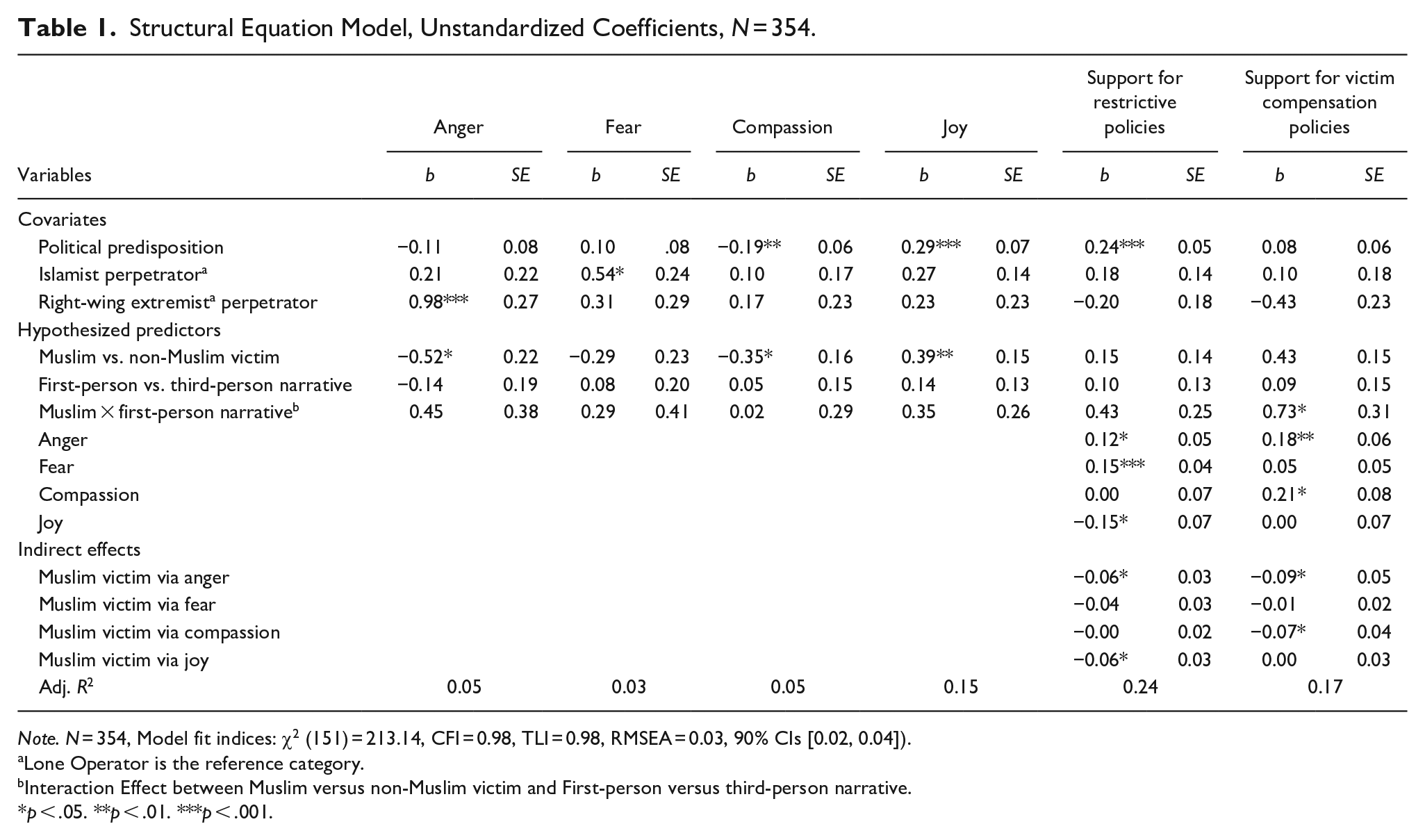
Note. N = 354, Model fit indices: χ2 (151) = 213.14, CFI = 0.98, TLI = 0.98, RMSEA = 0.03, 90% CIs [0.02, 0.04]).
Lone Operator is the reference category.
Interaction Effect between Muslim versus non-Muslim victim and First-person versus third-person narrative.
p < .05. **p < .01. ***p < .001.
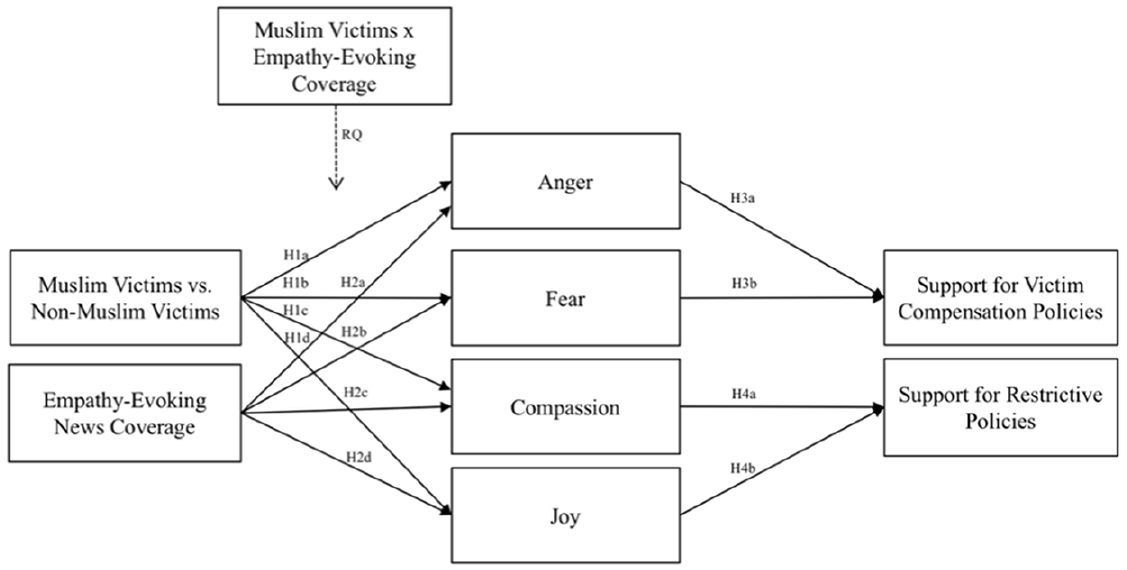
Hypothesized model.
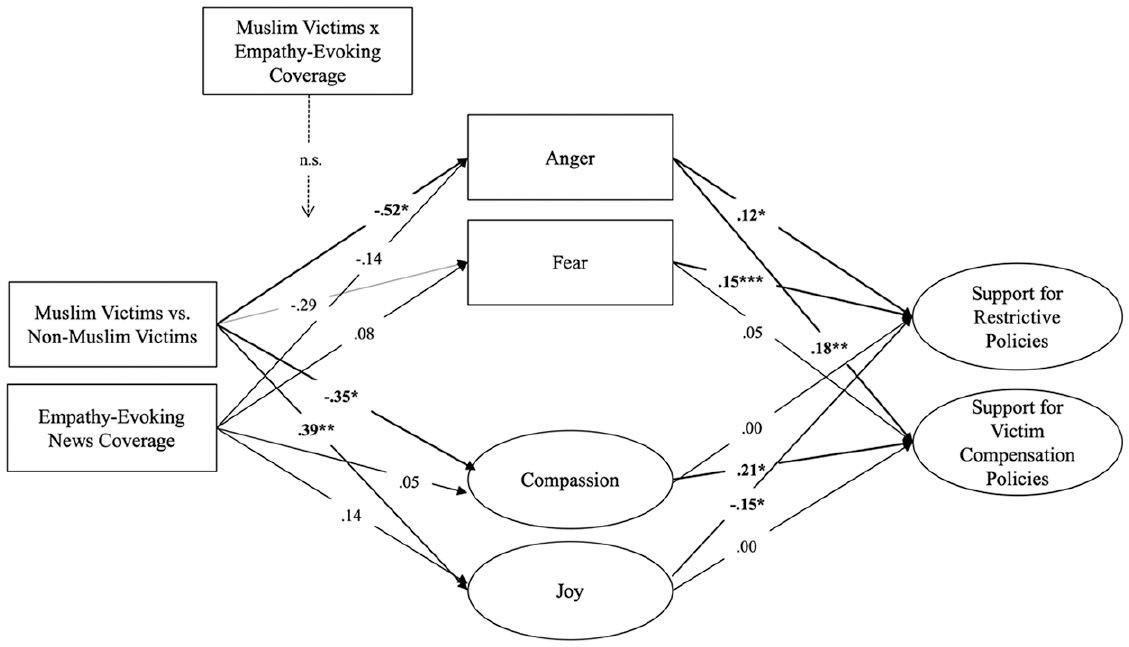
Structural equation model. Ovals represent latent variables and rectangles manifest variables. Unstandardized Coefficients. Model fit indices: χ2 (151) = 213.14, CFI = 0.98, TLI = 0.98, RMSEA = 0.03, 90% CIs [0.02, 0.04]).
Furthermore, we found no significant effects of first-person vs. third-person narratives on anger (b = −0.14, SE = 0.19, p = .433), fear (b = 0.08, SE = 0.20, p = .669), compassion (b = 0.05, SE = 0.15, p = .718), or joy (b = 0.14, SE = 0.13, p = .278). That is, news consumers’ emotional reactions did not differ depending on whether the event was described from the victim’s perspective (i.e., first-person narrative) or from another person’s perspective (i.e., third-person narrative). Thus, H2 had to be rejected.
We also found no interaction effects of victim religion and first-person narratives on emotional reactions (see Table 1). Thus, H3 was not supported. However, we did find a significant interaction effect of victim religion and first-person narratives on victim compensation policies, not mediated by emotional reactions (b = 0.73, SE = 0.31, p = .020) suggesting that individuals were more likely to support victim compensation policies in response to news coverage about a terrorist attack toward Muslim victims, when the victims’ perspective was emphasized. Supporting H4, we found that anger (b = 0.12, SE = 0.05, p = .013) and fear (b = 0.15, SE = 0.04, p < .001) predicted support for restrictive policies. Results also showed a significant indirect effect of victim religion on restrictive perpetrator policies via anger (b = −0.06; 95% CI [−0.13; −0.00]). We also found a positive significant effect of anger (b = 0.18, SE = 0.06, p = .001), but not fear (b = 0.05, SE = 0.05, p = .215) on support for victim compensation, which answers RQ1. The indirect effect of victims’ Muslim religion on support for restrictive policies via anger was also significant (b = −0.06; 95% CI [−0.17, −0.00]). In line with H5a, we furthermore found that compassion significantly increased support for victim compensation (b = 0.21, SE = 0.08, p = .011). There was also a significant indirect effect of victim religion on support for victim compensation via compassion (b = −0.07; 95% CI [−0.15, −0.00]). Yet, joy was not related to support for victim compensation (b = 0.00, SE = 0.07, p = .975). Thus, we found no support for H5b. Furthermore, we found a negative effect of joy (b = −0.15, SE = 0.07, p = .024), but not compassion (b = 0.00, SE = 0.07, p = .965) on support for restrictive policies, which answers our RQ2. We also found a significant indirect effect of victims’ Muslim religion on support for restrictive policies via joy (b = −0.06, 95% CI [−0.12, −0.00]).
Regarding the covariates, we found that right-wing political orientation predicted compassion, joy, and support for restrictive policies. Finally, participants’ perceptions of the perpetrator as right-wing extremist had a significant positive influence on anger, while perceptions of the perpetrator as Islamist extremist predicted more fear (see Table 1).2
Discussion
We investigated how two key characteristics of journalistic terrorism news coverage affect news consumers’ emotional reactions and support for policies targeted at perpetrators and victims: a) (1) enhancing the salience of the victims’ Muslim religion and b) including first-person narratives that facilitate perspective taking. We also investigated whether journalists can actively mitigate differences in emotions and attitudes due to the victim’s religion by including first-person narratives. With regard to the first determinant—the victim’s religion—we found that non-Muslim news consumers’ emotional reactions varied depending on the salience of the victims as minority members (i.e., Muslims) or non-Muslim majority members. Specifically, non-Muslim news consumers felt less compassionate, less angry, and more joyful when the victims’ Muslim religion was mentioned. Thus, in line with the concept of self-categorization, news exposure accentuated differences with Muslim minority members, therefore, portraying them as outgroup members, which resulted in ingroup favoritism and outgroup derogation (Turner et al., 1987). However, when the negative event of the terrorist attack was perceived as concerning oneself or one’s ingroup in the case of non-Muslim victims, anger and compassion were increased and joy decreased (see also Gordijn et al., 2001). Lower feelings of joy can be explained by the occurrence of a phenomenon called “intergroup schadenfreude” (Cikara, 2015, p. 12). Although the level of joy was low in all conditions, it was significantly higher when the victims were minority members (i.e., Muslims). This process can be explained by the association of Muslim victims with a threatening outgroup, which makes them targets of this kind of malicious joy (Cikara, 2015). This is a truly novel finding, which has not been demonstrated in research on the effects of terrorism before.
In particular, under the perception of outgroup threat, individuals tend to perceive more similarities among their ingroup members compared to outgroup members (Rothgerber, 1997). Irrespective of whether the threat actually exists or is only imagined, the perception that an outgroup constitutes a threat to ingroup interests or survival increases ingroup identification and intolerance against the threatening outgroup (Brewer, 1993). Thus, although the group of non-Muslims is rather diverse, outgroup threat may bring about perceived similarities with other ingroup members. The fact that non-Muslim news consumers clearly perceived more similarities with non-Muslim rather than with Muslim victims in this study was underscored by our manipulation check.
However, the victims’ Muslim religion did not affect non-Muslims’ fear, presumably because a terror attack always enhances fear of terror regardless of the victims’ characteristics. An alternative explanation would be that fear might be more strongly driven by perceptions of the perpetrator who caused the suffering rather than by the victims’ suffering itself (Iyer et al., 2014; Salovey & Rosenhan, 1989). Our finding that the covariate, news consumers’ perpetrator perceptions, significantly affected fear underpins this explanation. Specifically, we found that fear was highest when news consumers thought the perpetrator was an Islamist terrorist, which could be explained by the overall higher news attention for Islamist terrorist attacks (see Dixon & Williams, 2015).
Regarding the second investigated determinant of terrorism news coverage, we found that news coverage, which facilitated taking the victim’s perspective (i.e., first-person narratives), did neither intensify news consumers’ emotions, nor moderate the effects of victim religion on emotional reactions. Thus, our findings suggest that personalized first-person narratives could not reduce the differences in non-Muslim news consumers’ emotional reactions induced by the victims’ religion. A possible explanation is that even though news consumers could put themselves in the victim’s position when the news included first-person narratives, this perception did not change their consideration of the victims as ingroup or outgroup members. However, albeit not hypothesized, we found a significant interaction effect of first-person narratives and victims’ Muslim religion on support for victim compensation policies, which was not mediated by emotional reactions. In other words, when journalists emphasize the victim’s perspective, majority members are more supportive of policies providing financial support to minority victims. Yet, that effect cannot be explained by individuals’ emotions. Rather, a mediator not examined in our study seems to be at work here. As perspective taking may reduce perceived threats from an outgroup, cognitive interpretations such as individuals’ reduced outgroup threat in response to first-person narratives may explain that effect.
Furthermore, we investigated the political implications of individuals’ emotional reactions to news about terror crimes. We found that anger predicted support for restrictive counterterrorism policies, which can be explained by individuals’ preference for action (Iyer et al., 2014). Thus, these individuals are more inclined to endorse policies related to the restriction of civil liberties and punishment of perpetrators (see also Vasilopoulos et al., 2018). Furthermore, albeit not induced by the different versions of news coverage, fear was also positively related to support for restrictive counterterrorism policies. Although fear is typically associated with avoidance behavior, individuals might perceive policies restricting liberties of perpetrators as serving the purpose of preventing future attacks (Iyer et al., 2014).
With regard to victim compensation policies, we observed that anger was related to higher support for victim compensation. Thus, anger was the only emotion which increased support for both policies. In that sense, our findings corroborate a vast amount of studies (e.g., Huddy & Feldman, 2011) indicating that anger induces the desire for action. We also found that compassion increased support for victim compensation policies. Compassion is a prosocial emotion that is associated with a desire to help those who are suffering (Iyer et al., 2014; Oliver et al., 2012). However, against our expectation, malicious joy was not negatively related to support for victim compensation policies, but to support for restrictive counterterrorism policies. Thus, if victims are part of a threatening outgroup, individuals show less support for policies, which may prevent future harm to these victims (Cikara, 2015). As this study was the first to include joy as a relevant emotional reaction in the context of terrorism news coverage, more research is necessary to pin down the underlying mechanism of these effects.
Limitations and Future Research
Some limitations of this study need to be mentioned. First, in line with previous research (Vasilopoulos et al., 2018), we measured anger and fear with single items. However, findings from previous research reveal that single-item measures produce valid results, in particular, when measuring rather concrete concepts such as anger and fear (Bergkvist & Rossiter, 2007). For instance, Vasilopoulos et al. (2018) did not find different results when comparing single-item and multiple-item measures for anger. In fact, adding synonyms, for example, of an affective evaluation, may in some cases even reduce the validity of a measure (Rossiter, 2002). Moreover, we also assessed compassion and joy additionally with single items (see Online Appendix A; https://osf.io/pb875/?). All results remain constant when we substitute our latent measures with the single items, which suggests that our measures are valid despite the use of single items. Nevertheless, we encourage future research to replicate our findings with more differentiated measures. Furthermore, our design did not include Muslim respondents. Drawing from social categorization theory, it can be assumed that our findings generalize to Muslim news consumers presented with terror news about non-Muslim victims. However, these conclusions are merely speculative and deserve further research attention. Moreover, our study exclusively focused on short-term effects, and more research is necessary to allow reliable inferences about the duration of terrorism news effects. Furthermore, our findings should be replicated with more externally valid settings (see Stroud & Van Duyn, 2020).
Finally, it is important to note that all of our results were independent from the inclusion of perpetrator perceptions as covariate. Yet, future research should systematically investigate how both, characteristics of the perpetrator as well as the victims, affect individuals’ emotional reactions as well as their policy support. This can be done by manipulating the perpetrators’ identity such as religion in addition to the victims’ identity. As religion has played an important role in recent major terrorist attacks such as the Sri Lanka bombings or the Christchurch shootings, the distinct effects of terrorist attacks committed by a Christian versus a Muslim perpetrator with Christian versus Muslim victims should especially be in the focus of future research. Additionally, future research could tackle the question whether news consumers’ emotional responses and their resulting policy support differ depending on whether a perpetrator is a foreign or homegrown.
Implications and Conclusion
Our findings have important implications for research on terrorist crimes. First, they show that if journalists actively mention characteristics of minority groups such as the victim’s religion, they create mental outgroups in news consumers’ minds, which may crucially influence emotional reactions and political decisions. Our findings suggest that news reports which mention the victims’ minority status (i.e., Muslim religion) may foster the development of extreme “us” versus “them” camps in society. Hence, to avoid further contributing to polarized intergroup emotions and attitudes in societies, journalists should only mention victims’ religion or nationality in terrorism news coverage when it is absolutely necessary.
In cases where it is unavoidable to mention the victim’s religion, for instance, when a terrorist attack specifically targeted a mosque (e.g., in the Christchurch attack), journalists could employ other techniques to avoid polarized emotions and attitudes in response to news coverage. In this study, we tested whether the journalistic technique of including victim’s personal testimonials (i.e., first-person narratives) can mitigate the polarization of emotions and attitudes in response to terrorism news coverage. Future research should investigate additional techniques, which might reduce ingroup favoritism in response to news coverage. This could be achieved by portraying victims as individuals with personal characteristics beyond their minority status such as being a parent or being integrated in society—needless to say by guaranteeing their anonymity. Overall, an empathic, sensitive and reflective news coverage style might prevent different segments of society to further drift apart in the aftermath of terrorist crimes.
Footnotes
Declaration of Conflicting Interests
The author(s) declared no potential conflicts of interest with respect to the research, authorship, and/or publication of this article.
Funding
The author(s) received no financial support for the research, authorship, and/or publication of this article.
