




Abstract
Why do violent actors engage in strategic exhumations and relocate victims’ remains after a conflict, even when those remains no longer pose any security threat? We argue that analyzing the strategic management of victims’ remains by perpetrators can reveal a lot about the logic motivating actors to deploy clandestine repertoires of violence. We drew on a new global repository of countries with strategic exhumations supporting a comparative analysis of Cyprus and Chile. Despite differing conditions, both cases showed systematic disinterment processes. We argue international accountability coupled with organizational capacity drove these actions, with motives and capabilities varying between conflict and authoritarian settings.
Introduction
While much is known about the patterns of disappearances under Pinochet’s regime in Chile (Robben, 2005), the regime’s handling of victims’ remains is less understood. In 1978, the regime initiated Operación Retiro de Televisores, systematically disinterring victims buried across the country and relocating them to unmarked sites, often in the ocean (Leiva et al., 2020). This practice was not unique to Chile; Argentina, Brazil (Mazz, 2015), and Bosnia (Jugo and Wastell, 2015) engaged in similar perpetrator-led exhumations. Cyprus also experienced this after the Turkish invasion in 1974, but more systematically in the 1990s.
This article compares the tactical exhumations orchestrated by perpetrators in Chile and Cyprus. Despite differing contexts—time since violence, type of violence (state repression vs armed conflict), and international accountability—both countries moved bodies for strategic reasons. We argue perpetrators’ decisions to engage in strategic disinterment are influenced by both existential concerns over international accountability and the capacity to organize and carry out large-scale reburials. The influence of international accountability and the ability to rebury vary across contexts, however. In conflict situations, parties are mindful of legal obligations under international humanitarian law, motivating them to conceal criminal actions to avoid accountability. In authoritarian settings, actors are more concerned about international political scrutiny while maintaining a veneer of domestic legitimacy. In both cases, those wanting to move bodies need to control specific areas and must have access to the right equipment if they are to arrange sophisticated reburial operations.
In what follows, we first define our key concepts and phenomenon of interest and present our theoretical framework. We then explain how forensic evidence can reconstruct the logic of violence; we introduce a new global repository of countries practicing strategic disinterments, and select crucial cases for in-depth comparative analysis. Finally, we explain the value of forensic evidence in studying political violence. While our comparative approach offers important theoretical insights, the generalizability of our findings is inevitably limited by our focus on two cases, which we discuss further in the conclusion.
Perpetrator-led exhumations
Exhumations of human remains have gained global currency largely due to the international spread of transitional justice and other accountability norms in countries emerging from violence, state repression, and deep trauma (Kovras, 2017; Kovras, 2023). Humanitarian exhumations aim to identify the remains of victims of violence to satisfy the pressing humanitarian need of relatives to locate their missing loved ones (see Rosenblatt, 2015), often decades after the original crimes (see Aguilar and Payne, 2016; Ferrándiz, 2013). The scope of these exhumations is purely humanitarian, with no effort to attribute criminal responsibility. Exhumations are also a central tool for truth commissions mandated to document patterns of human rights violations; forensic evidence from graves has been critical in reconstructing past crimes. Finally, particularly since the 1990s, incriminatory evidence from graves has become instrumental in the prosecutorial efforts of domestic and international tribunals seeking to secure convictions in courts of law (see Wagner, 2008).
The majority of scholarly attention has focused on exhumations carried out by official organizations (e.g. international forensic groups) or non-governmental organizations (NGOs) to help societies come to terms with their violent past. Limited emphasis has been placed on exhumations carried out by perpetrators. In this article, we focus on this latter practice. By “perpetrator-led exhumations,” we are referring to the purposeful targeting of unmarked graves by the agents responsible for the original crimes and the burial of victims in these graves. We aim to explain why violent groups engage in this practice and selectively unearth specific unmarked and well-concealed graves, often years or decades later.
Our research is significant because it expands the understanding of violence by challenging the assumption that perpetrators exclusively target the living and examining how perpetrators manage human remains and clandestine graves long after the original crime. In addition, we provide new data on clandestine crimes. It is difficult to collect these data, as those responsible for such crimes are unlikely to openly discuss their past actions, particularly in cases of homicide. Moreover, ethical concerns, such as disclosure policies or unexpected findings, often deter scholars from interviewing perpetrators. As a result, research aimed at reconstructing the logic of clandestine crimes, such as enforced disappearances and the management of victims’ remains, has gained less ground than work on other forms of violence. Analyzing perpetrators’ behavior and their selective targeting of graves retrospectively can provide valuable insights into their broader repertoire of violence. Simply put, reconstructing the selective nature of grave targeting can reveal much about the logic of the original crimes (see Mikellide et al., 2024).
Some conceptual clarifications are necessary. In this article, perpetrator-led exhumations refers to processes of disinterment carried out by both violent state actors in repressive settings (e.g. military, police) and violent non-state actors, primarily in conflict or post-conflict settings (e.g. government-supported militias, paramilitary groups, armed guerrillas). Thus, we use the generic terms “violent actors” and “perpetrators” to refer to all the aforementioned groups. It is also worth noting that we explore only politically motivated crime, in that the political contestation is about state legitimacy (i.e. state repression and civil wars/conflicts). We exclude other contexts, for example, gang or drug cartel perpetrator-led exhumations, as different factors may shape the overarching logic. Temporally, we examine exhumations that occurred either during periods of repression and conflict or in their aftermath, such as during a political transition.
Accountability, capacity, and the logic of exhumations
We argue the decision of violent groups to engage in strategic disinterment is influenced by considerations of international accountability coupled with their capacity to organize large-scale reburial operations. Both of these factors vary across conflict and authoritarian settings.
We draw on literature suggesting international accountability drives perpetrators to adopt more clandestine forms of violence that fall outside the existing legal and normative frameworks (Fazal, 2018; Stanton, 2016). The fear of retributive justice is a clear motivation for perpetrators to engage in strategic disinterment. For instance, Serb-Bosnians systematically concealed the remains of victims to obstruct efforts to gather incriminatory evidence from graves and minimize the prospect of accountability (Jugo and Wastell, 2015). The international legal framework deters actors from engaging in repressive practices when these are explicitly prohibited by international law (Fazal, 2018). This may lead to a rational desire to conceal evidence, for example, by disappearing bodies. Faced with mounting external accountability pressures, state and non-state actors may try to take their crimes outside the realm of the law or conceal their tracks to make it difficult for external monitoring agencies to document unlawful behavior—in short, to achieve plausible deniability (Búzás, 2021).
Even when not directly tied to criminal proceedings, international accountability pressures and normative stigmas may push perpetrators to deploy clandestine forms of violence. Some scholars argue that focusing on specific repressive practices can lead to a reorganization of these tactics (DeMeritt, 2015; Fariss and Schnakenberg, 2014; Ron, 1997). States make “tactical adjustments” when they face “naming and shaming” denunciations from international actors (Hafner-Burton, 2008). This highlights one of the unintended consequences of increased international media and policy attention to human rights violations (DeMeritt, 2015): it could push dictators to deploy clandestine types of violence and revisit their crimes ex post facto. In a nutshell, breaching fundamental norms now carries increased political costs (Fazal, 2018).
In internal armed conflicts, parties are primarily concerned with legal obligations arising from international humanitarian law and international human rights law. They are thus motivated to conceal evidence to avoid international criminal accountability. In authoritarian settings, while violent actors are aware of potential criminal accountability, they are more concerned with international political scrutiny while seeking to preserve a sense of legitimacy domestically. Authoritarian regimes that rely on international recognition and economic support are motivated to conceal evidence of crimes to maintain plausible deniability and avoid accountability for human rights violations. Regimes not dependent on or seeking international legitimacy (e.g. North Korea, Iran) are less influenced by these factors.
It is important to conceptualize accountability not merely as criminal or retributive justice but as any process that compels groups to account for their crimes to the international community and/or to victim groups. Accountability is a dynamic variable that changes across time and space. Understanding when and how accountability motivates local groups is crucial. Internal factors could be variables as well; for example, in Chile, the disinterment began with the undeniable finding of victims, who were not supposed to exist, at a moment when the dictatorship had lost US support.
Accountability and loss of support alone cannot explain the selective nature of targeting of graves. We argue that the organizational capacity of violent groups is significant as well. While violent actors may be susceptible to external accountability influences, not all are equally capable of organizing large-scale operations like mass exhumations. Disinterment is a complex operation, including recruiting reliable individuals, securing specific territories, and often setting up roadblocks to prevent passersby from stumbling on the site. In addition, it involves procuring large machinery, such as backhoes and dump trucks, to assist in the process. Such an operation cannot be conducted without territorial control or access to state resources. For instance, areas under occupation are far more likely to experience these types of exhumations by occupying forces than regions not controlled by the army. Similarly, the military is much more likely to engage in perpetrator-led exhumations during a dictatorship, when they exercise sovereign control, rather than after democratization.
Another key aspect of organizational capacity is the perpetrators’ ability to keep track of the geographical locations of their past crimes. Military forces in authoritarian settings are more likely to engage in strategic disinterment due to their centralized and institutionalized memory of violence, enabling them to identify past violence cases, implement decisions across jurisdictions, and access necessary resources and manpower. In internal conflicts, the capacity for such operations varies depending on the relative power of armed groups in different regions.
While our argument points to international accountability pressures and organizational capacity as key drivers, we cannot directly observe perpetrators’ internal deliberations. Thus, we treat our interpretation of motives as plausible inferences rather than definitive causal explanations. This limitation is not a flaw of our analysis, but rather reflects the inherent boundaries of what can be known about clandestine practices designed to evade detection.
Research design, case selection, and forensic evidence
We reconstructed the sequence of events to explain why two different groups, the Chilean military in the 1970s and the Turkish army and local paramilitary groups in Cyprus, engaged in systematic disinterment. To that end, we took four steps. Figure 1 (in Appendix 1) provides a visual representation of these steps. First, since this phenomenon is relatively underexplored, we began by mapping the universe of cases, developing a novel global repository containing all recorded instances of perpetrator-led exhumations. Beyond the obvious advantage of illustrating the global spread of this phenomenon, establishing a comprehensive dataset enhances methodological rigor by increasing transparency and reducing bias in case selection for in-depth comparative analysis (Lieberman, 2005). As the literature suggests, this approach enabled us to identify crucial cases—those exhibiting representative patterns of the phenomenon—as well as outliers challenging theoretical expectations (Collier and Mahoney, 1996).
To develop this repository, we analyzed annual reports from major international forensic organizations that document human rights violations, including the Argentine Forensic Anthropology Group, the International Commission for Missing Persons, and Physicians for Human Rights. They all have extensive experience organizing exhumations across post-conflict and post-repressive states worldwide. Their reports provide a comprehensive record of exhumations, making them reliable sources for identifying perpetrator-led exhumations. 1
To increase our confidence that no recorded cases of perpetrator-led exhumations were overlooked, we conducted eight interviews with senior forensic experts. The interviewees confirmed the validity of claims in the annual reports and improved our understanding by providing further details about the specific circumstances of each country case. They described variations in operational tactics and the evolving context of forensic investigations not captured in the written reports. Importantly, their insights confirmed the accuracy of our repository. They explained how local practices, cultural factors, and even geopolitical pressures influenced the timing and method of perpetrator-led exhumations. The experts were deliberately selected based on their extensive field and regional expertise, with some specializing in Latin American cases, others in European and Asian contexts, and some possessing a global outlook. This team of experts ensured that our repository captures almost all countries where perpetrator-led exhumations have occurred, thus substantially improving the robustness of our analysis. 2
However, a caveat is necessary. We listed the recorded cases of perpetrator-led exhumations, not all instances that have occurred globally. It is simply impossible to determine whether other cases exist; in fact, this crime is designed to be concealed; the more effectively perpetrators carry it out, the less likely it is to be publicly documented. In effect, these cases fall into the category of “unknown unknowns,” instances that remain undiscovered. Therefore, we focused on the “known unknowns,” that is, officially recorded cases. Despite this limitation, we were able to draw meaningful inferences about the underlying logic of the crime.
Table 1 lists the countries with recorded cases of perpetrator-led exhumations, along with the type and period of violence.
List of countries with documented cases of perpetrator-led exhumations.
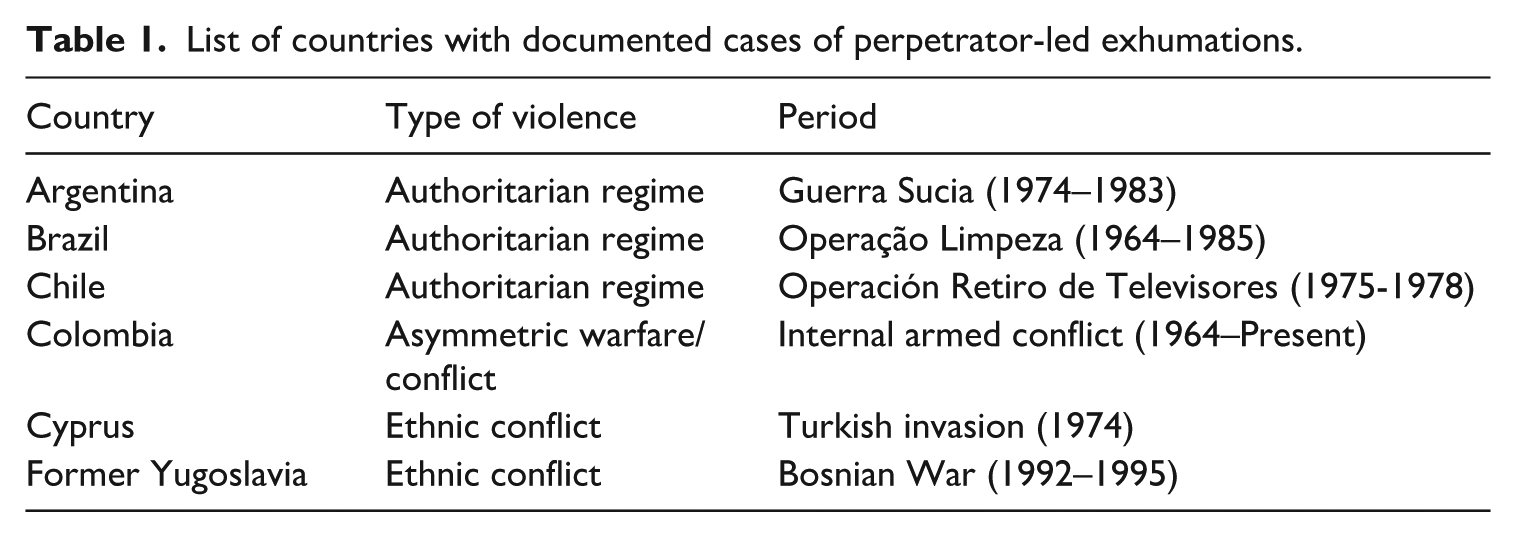
The repository guided our case selection for the second step: an in-depth comparative analysis. As several comparative political scientists have argued, the most-different systems design—selecting cases that are highly diverse in their background conditions but have the same outcome—is useful for developing novel theoretical hypotheses to study underexplored phenomena (Collier and Mahoney, 1996; Przeworski and Teune, 1970). We selected Cyprus and Chile as our two most different cases, characterized by distinct forms of violence (authoritarianism vs ethnic conflict), different regions, and varying geopolitical significance. Despite these differences, both experienced strategic disinterment processes (Collins, 2010; Robben, 2015). As with all small-n analyses, we aimed to explain the outcomes in these two cases. However, the “too few cases, too many variables” problem inevitably limits the generalizability of our findings. As we discuss in our conclusion, we are drawing preliminary conclusions from the two cases and invite further scholarship to test the generalizability of our findings in other contexts.
Our third step involved collecting and analyzing original data from forensic reports, interviewing relatives and other knowledgeable participants, and reading court transcripts to reconstruct the logic of perpetrator-led exhumations. Our investigation was hindered by the clandestine nature of the phenomenon. As noted above, there are both methodological and ethical challenges: perpetrators possess critical knowledge about these crimes, but consenting to an interview risks self-incrimination and has ethical and potential legal consequences for researchers (Shesterinina, 2019). Given that only a small number of individuals hold privileged knowledge about the motives for the original crimes—and the later exhumations—we used forensic data to reconstruct the logic behind perpetrator-led exhumations.
We focused on selective clandestine exhumations as a quasi-experiment to understand the motives of violent actors. We argued that examining when remains were removed from a particular grave and comparing this site to similar, untargeted graves in the vicinity would yield valuable insights into the afterlife of violence. Cross-referencing ante-mortem information with post-mortem data generated through forensic analysis enabled us to reconstruct events and test our hypotheses with greater precision. Previous studies have used forensic data to identify victims (Jugo and Wastell, 2015; Martin-Rodilla et al., 2019; Molina et al., 2022), discover new graves (Congram et al., 2017) and determine circumstances of death and patterns of trauma (Kimmerle and Baraybar, 2016; Komar and Lathrop, 2012), yet few have leveraged forensic evidence to draw inferences about the logic of repertoires of violence.
At the same time, it is essential to acknowledge that forensic science is an inexact one: it relies on forensic experts offering opinions, which inherently have different levels of uncertainty and error (Weizman, 2017; Williams and Maskell, 2021). Experts make estimates based on established methods, and they cross-reference lines of evidence, including background information and witness testimony, to support their interpretations (Congram et al., 2022; Salado Puerto et al., 2021). Meanwhile, the “CSI effect”—a term derived from the popularized portrayals of forensic science in media—can lead to unrealistic expectations about accuracy, causing overreliance on forensic evidence and distorting our understanding of political processes (Schweitzer and Saks, 2007). Being mindful of these limitations, we supplemented forensic evidence with additional sources of information, including interviews with relatives and court transcripts where available.
In Cyprus, interviews with journalists, lawyers, and former combatants, along with two decades of news reports, helped us identify potential strategic disinterment sites. Interviews with approximately 186 family members of the missing enabled us to confirm or challenge our hypotheses. 3 Ethical challenges in researching clandestine violence (Shesterinina, 2019) led us to secure consent from families to access forensic reports. Interviews with families served two overlapping purposes. First, they provided access to valuable forensic data contained in the reports, as the official body responsible for exhumations is bound by strict confidentiality and does not publicly disclose forensic information. Second, as many families of the missing in Cyprus have conducted their own investigations into the circumstances of disappearances and the looting of burial sites, we interviewed them to gain insight into the information they had gathered. Given the absence of formal transitional justice mechanisms in Cyprus, we had limited sources of information to rely on. Thus, families represented one of the most significant, albeit unofficial, sources of documentation.
In Chile, by contrast, the Servicio Médico Legal has managed dictatorship-era victim exhumations since 1994, with forensic information publicly accessible as part of judicial inquests. Since exhumations in Chile follow a more formal legal process, we relied on official documents, including court transcripts, judicial rulings, and inquest findings.
To understand the motives behind selective targeting, we took a fourth step, adopting a most-similar within-case comparative design. This involved comparing targeted and untargeted graves in close proximity. By examining mechanisms and strategic considerations behind re-exhumations, we aimed to uncover perpetrators’ decision-making processes. Cross-referencing family interviews, forensic reports, and historical records allowed us to identify patterns in victim and burial site selection. Finally, we created maps and visuals to help non-expert readers better understand our findings.
A crucial final caveat is in order. While this approach provides valuable insight into likely motivations, we acknowledge that such inferences remain necessarily speculative, as the covert nature of the crime precludes definitive access to the perpetrators’ thought processes. This limitation is not a flaw of our analysis, but rather reflects the inherent boundaries of what can be known—and the reality of unknown unknowns—when studying clandestine practices designed to evade detection.
Patterns of strategic disinterment in Cyprus and Chile
Cyprus
In Cyprus, the two communities were victimized in two waves of violence. In 1963–1964, in the context of low-intensity inter-communal fighting between Greek-Cypriot and Turkish-Cypriot militias, it was primarily—though not exclusively—Turkish Cypriots who were abducted, never to be seen again. In the summer of 1974, during the Turkish invasion and occupation of part of the island, it was the other way around: the invading Turkish Army and Turkish-Cypriot militias victimized Greek Cypriots (soldiers and retreating civilians). Hundreds of Greek Cypriots went missing in this period; however, Turkish Cypriots also went missing in the summer of 1974 (Kovras and Loizides, 2011).
Since 2006, the Committee on Missing Persons (CMP) in Cyprus has been engaged in a systematic campaign of search, recovery, and identification of the remains of approximately 2000 persons who went missing in the conflict periods of 1963–1964 and 1974 (Hadjigeorgiou, 2022; Kovras, 2014). At the time of writing, the CMP had exhumed 1203 individuals. Of those exhumed, 1047 had been identified, and at least 211 of these had been strategically exhumed from six graves at some point after the initial burial. According to forensic reports shared with the families, gravesites displayed evidence of disturbance by human activity, such as marks from heavy machinery on the original grave, while recovered remains were residual, fragmentary, and commingled. The overall skeletal assemblage for each grave that had seen strategic disinterment was represented primarily by smaller skeletal elements, such as hand bones, foot bones, and other miscellaneous and/or unidentifiable fragments, with the larger long bones, flat bones, and crania absent.
Our analysis revealed several patterns, some of which were counter-intuitive and unexpected. First, we observed strategic disinterment only in cases linked to the second wave of violence in 1974. Second, a combination of the following factors typically drove the decision of perpetrators to perform strategic disinterment: territorial control and unimpeded access to the territory of the primary grave location; availability of resources, especially with respect to logistics; victims last seen in the custody of the military or other officials.
While we expected cases of strategic disinterment would be more prevalent in the earlier period of inter-ethnic violence when civilians were disappeared by domestic militia groups, they were actually far more common during the armed conflict in 1974. Moreover, in the context of international accountability, it would seem far more likely for actors to try to conceal evidence of crimes against women, children, and other non-combatants, but the targeted graves contained the remains of men, either active military or reservists.
The targeted graves were outside residential areas and relatively well concealed. Three were in deep water wells of more than 9 m depth, one was in a limekiln at 3.5 m depth, one was in an open field at 3.5 m depth, and one was in a disused quarry. The six graves contained 37, 33, 17, 31, 9, and 83 individuals, respectively. While the number of individuals per grave was high for Cyprus, other graves containing equally large numbers of individuals were not targeted for strategic disinterment.
The timing of the strategic disinterments was interesting. While the exact timing of each could not be determined scientifically through forensic methods, combined witness information suggests only one of the graves was strategically exhumed shortly after the initial inhumation, and the other five were strategically exhumed decades later. The one that was exhumed shortly after the initial burial contained the remains of Turkish Cypriots and was located to the south of the UN-guarded line of contact, in an area under the control of the internationally recognized Republic of Cyprus. The remaining five—all containing the remains of Greek Cypriots—were located to the north of the line of contact in areas under the control of Turkey and the non-internationally recognized Turkish-Cypriot administration. Figure 2 (in Appendix 1) presents a map showing the locations of the strategic disinterments (in red) and the neighboring graves that were not disturbed (in blue).
The differences in the temporal window may be suggestive of concerns for international accountability and retribution. In the internationally recognized Republic of Cyprus, south of the divide, actors rushed to conceal evidence in the summer of 1974 shortly after one of the victims survived and sought refuge in the British Sovereign Bases, reporting the crime to representatives of the UN and the United Kingdom. In contrast, in the isolated and non-internationally recognized North, actors waited 20 years or more, engaging in strategic disinterment sometime in the mid-1990s.
On an international level, the reported timing of the strategic disinterments in the mid-1990s coincided with the use of aerial imagery by the US State Department for the localization of graves in Srebrenica, Bosnia, the establishment of the International Criminal Tribunal for Rwanda, the International Criminal Tribunal for the Former Yugoslavia, the application of the principle of Universal Jurisdiction for the arrest of Augusto Pinochet, and the advancement of forensic sciences more generally and their application in large-scale investigations of human rights violations. On a domestic level in Cyprus, the timing coincided with a successful campaign by the United States to recover and return two individuals with dual US and Cypriot citizenship. Similarly, in the mid-1990s, the leaders of the two communities were negotiating the terms for establishing a body to investigate the whereabouts of missing persons. As a result, the prospect of unearthing graves and exposing “inconvenient truths” about past crimes was a pressing concern. Likewise, during the 1990s, Turkey faced increasing international scrutiny, particularly regarding human rights violations, as negotiations for EU accession gained momentum.
By the early 1990s, legal cases against Turkey had been lodged at the European Court of Human Rights by both the families of the missing (Varnava and others vs Turkey, lodged in 1990) 4 and the state (Cyprus v. Turkey, lodged in 1995). Consequently, international accountability became a much more salient issue in Turkey’s foreign policy. Given this context, it is reasonable to expect that efforts to conceal evidence of some of the gravest human rights violations committed in 1974 were aimed at destroying evidence of the original crimes.
In short, the experience of Cyprus suggests the egregious crimes contravening the Geneva Conventions committed during the inter-state armed conflict of 1974 may have been costly for state actors. Notably, the most strategically significant disinterments involved prisoners of war and other detainees or individuals last seen in the custody of officials, such as army officers or uniformed police. The latter individuals’ legal statuses entail varying degrees of culpability, serving as a critical indicator of the power of international accountability. Simply put, not all graves bear the same “cost.” The exhumation of certain graves could expose more inconvenient truths than others.
The ability to orchestrate complex operations, such as large-scale removals of remains, is also pivotal in the decision to disinter. Actors with limited territorial control may be reluctant to allocate scarce resources to such risky endeavors. Conversely, those capable of conducting large-scale disinterments, who are cognizant of international accountability norms, are more likely to engage in such activities both during and after conflict.
The size of the grave, indicated by the number of buried victims, serves as a metric of perceived accountability. Mass graves inherently provoke questions about culpability and systematic human rights violations, thereby incentivizing actors to undertake strategic disinterment to obscure the crime. In addition, the transformative impact of new technologies on the international community’s approach to human rights violations may further compel armed groups to conceal evidence of their transgressions (Kovras, 2023).
To illustrate our argument, we present two pairs of selected gravesites.
Case 1: Afania
The most significant case of strategic disinterment involved 70 individuals recovered in Afaneia/Gazikoy, a Turkish-Cypriot village in northern Cyprus. The nearby village of Assia/Pasakoy, primarily Greek-Cypriot before 1974, had experienced inter-communal tensions and violence since the late 1950s (Kizilyurek, 2015; Patrick, 1976). Following the Turkish military takeover of Assia/Pasakoy, 107 men were detained, and 70 men over the age of 50 subsequently disappeared (Alasor, 2002; Andreou, 2016). The CMP’s forensic program later discovered their remains in two wells near Afaneia/Gazikoy. The recovered assemblage represented a minimum number of 68 individuals (following anthropological and genetic analyses) and consisted of only residual skeletal remains, suggestive of a prior non-expert excavation whereby the larger and easily identifiable skeletal elements (e.g. long bones, crania, pelvis bone) had been removed, and the smaller elements (e.g. patellae, hand bones, foot bones) and fragments were left behind (Interviews 9, 11, 2024).
As presented in Figure 3 (in Appendix 1), three nearby burial sites within 100, 170, and 610 m of the wells were untouched. These were much shallower and easier to reach, indicating location or visibility did not influence decision-making for removal (Interviews 9, 11, 2024). The three intact graves contained 14 individuals, all males, both civilians and reservists. The targeted wells differed from the non-targeted sites, not only with respect to size, but also with respect to the status of the individuals buried there. Specifically, the victims in the two wells were last seen in Turkish army custody, raising questions of accountability and compliance with the Geneva Conventions on the protection and treatment of PoWs (Interviews 17, 9, 10, 11, 2024). In an account shedding further light on the victimization process, an interviewee (Interview 11) explained, [The Turkish troops] separated the men who were eligible for military service from the women, children and the elderly. They loaded my father and other villagers into trucks and took them to Pavlidis’ garage . . . then they took them to a camp, left them for a night or two, but no one can tell us that for sure. And, after then it looks like they killed them.
Within this context, we suggest the primary motivation for strategic disinterment was to eliminate any evidence that could be traced to the perpetrators while also concealing a violation of international humanitarian law. By selectively targeting these two graves, the regime sought to mitigate the risk of exposing systematic violations, thereby avoiding international condemnation.
Case 2: Sinta
In the period preceding the Turkish invasion, Sinta/Inonu was a predominantly Turkish-Cypriot village surrounded by Greek-Cypriot villages, such as Strongylos, Lysi, Kontea, and Vatyli (Hadjigeorgiou-Ioannou, 2009a, 2009b). Relations between the communities were marked by animosity and violence, with three Turkish Cypriots going missing during the inter-communal violence of 1963–1967. During the second phase of the Turkish invasion in August 1974, many Greek Cypriots from Sinta sought refuge in the neighboring village of Strongylos. Upon the Turkish army’s takeover, men were separated from women and children. Women and children were released, but 17 Greek-Cypriot men, allegedly taken by a Turkish-Cypriot paramilitary group, went missing (Interviews 12, 13, 14, 15, 16, 2024).
Through the CMP program, the remains of these 17 men were located in a well in Sinta/Inonu, 3 km from Strongylos (see Figure 4 (in Appendix 1)). Archeological excavation of the site revealed a sophisticated removal operation involving features like an access ramp that led to the well shaft (Interviews 12, 13, 14, 15, 16, 2024). The original fill of the well shaft was identified at 10.8 m, suggesting a previous excavation to that depth (Interviews 12, 13, 14, 15, 16, 2024).
Remains recovered up to 10.8 m were fragmented and commingled, with larger skeletal elements (e.g. long bones, pelvic bones, and crania) absent. Remains recovered between 10.8 and 11.2 m displayed anatomical articulation, suggesting the previous operation had not reached that depth. This pattern revealed a sophisticated yet incomplete excavation by non-experts who left smaller elements behind (Interviews 12, 13, 14, 15, 16, 2024). According to the forensic reports, the site was disturbed after skeletonization had taken place, a process which takes between 3 and 12 years under favorable conditions (Fiedler and Graw, 2003) and much longer in wet conditions (Heaton et al., 2010).
The size of the grave and the status of the victims suggested targeted disinterment. A nearby grave, 2 km away, with similar conditions, was left intact. The well in Sinta, with 17 victims compared to six in the neighboring grave, was targeted because the victims were known to have been held captive by a paramilitary group. Thus, their discovery was likely to pose a higher risk to the perpetrators (Interviews 12, 13, 14, 15, 16, 2024). Moreover, one interviewee (Interview 12) who conducted his own investigation clarified the situation regarding prisoner status: “[My father] was under arrest. No, he wasn’t a soldier who was captured, but he was under arrest. And everyone who was killed [with him] was last seen under arrest.” Similar to the Afania example, the motivations for strategic disinterment included eliminating evidence that could expose violations of international law, managing political fallout, preventing the scrutiny of international bodies, and maintaining control of the historical narrative.
Pinochet’s exhumations in Chile
Systematic disappearances were a hallmark of early Pinochet-era repression in Chile (Collins, 2010; Robben, 2015), exemplified by the “Caravan of Death.” In 1973, General Arellano Stark, under Pinochet’s directive, oversaw summary executions of dissidents. Most disappearances occurred within the first 3 years post-coup (1973–1976) (Aguilar and Kovras, 2019). Graph 1 shows the temporal spread of disappearances, based on the Rettig Commission’s data, illustrating a broader violence pattern. The primary goal was to instill societal fear and demobilize resistance. Over time, as the regime solidified, physical repression decreased, but in 1978, the regime launched a systematic effort to strategically disinter victims.
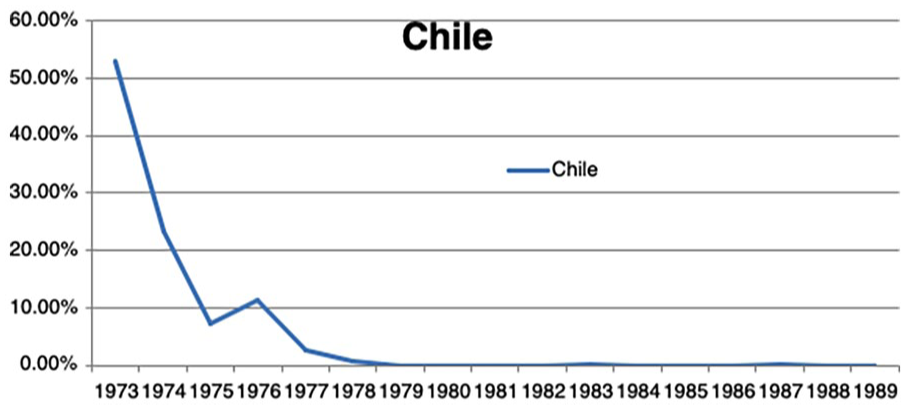
Data from the final report of the Chilean national commission on truth and reconciliation.
This decision is puzzling. Why did a regime that deployed a repertoire of clandestine violence and had a solid case of plausible deniability (victims were buried in common graves in unknown locations) decide to invest resources and manpower in strategic disinterment? And why after 1978 and not before? The question is even more intriguing when we consider that by 1978, the military regime had consolidated its power domestically, and regionally, and other military dictatorships in Latin America (e.g. Argentina) offered external assurances of stability.
In fact, timing matters. In 1978, the regime’s concealed crimes began to resurface. In Lonquén, near Santiago, 15 bodies were found in an abandoned lime kiln (Rettig Commission, 1990). Forensic evidence contradicted the official narrative that the victims were armed insurgents attacking local police. The remains were secretly reburied in Isla de Maipo Cemetery, and military courts absolved the police. The Lonquén discovery alarmed the regime, suggesting hidden skeletons could emerge nationwide and expose inconvenient truths about previous human rights violations. This realization heightened the regime’s concern about the potential for the discovery of its crimes. Moreover, by 1978, the regime had engaged in audacious attacks beyond its jurisdiction, attracting attention and risking the exposure of Pinochet’s human rights violations. For instance, in 1974, DINA (the Chilean secret police) assassinated General Prats and his wife in Argentina (Cabrera, 2011). In 1975, Christian Democrat leader Bernando Leighton and his wife were attacked in Italy. Most notably, in 1976, DINA killed a former Chilean ambassador and his US secretary in Washington DC. These attacks turned a spotlight on Pinochet’s repression. Although the Cold War narrative of fighting communism secured some Western tolerance, the United States had a dilemma supporting a regime violating human rights domestically and abroad. Meanwhile, families of the disappeared gained international support and mobilized human rights watchdogs, such as Amnesty International (Kovras, 2017). As a result, Pinochet’s repressive practices began attracting global attention (Rojas, 2022; Sikkink, 2011).
Timing also plays a crucial role in understanding the salience of international accountability, as it fluctuates over time. In particular, the election of President Jimmy Carter in 1976 marked a shift in US foreign policy, prioritizing human rights. Consequently, the previous belief that Chile was an undisputed strategic ally of the United States in the “crusade against communism” was no longer tenable. Even allied nations that blatantly violated human rights were now expected to be held accountable.
Amid this growing international scrutiny in 1978, Pinochet made several decisions to distance the regime from early dictatorship crimes. The regime launched Operación Retiro de Televisores, a centrally organized operation to relocate the remains of the disappeared to unknown sites, aiming to permanently erase incriminatory evidence (Lira and Rojas, 2022). A secret cryptogram A-1 from Pinochet instructed all military units to prevent third parties from finding burial sites (Escalante et al., 2013). The operation’s name underscored its goal to remove bodies from public view, executed under Pinochet’s direct command. In addition, DINA, responsible for many crimes, was dissolved and replaced by the Central Nacional de Informaciones (CNI) under new leadership (Salazar, 2011). An amnesty law, designed by Minister of Justice Mónica Madariaga, granted amnesty for crimes committed between 11 September 1973 and 10 March 1978, blurring distinctions between common and politically motivated crimes. These actions aimed to mitigate international pressure and enhance the regime’s legitimacy.
While Chile’s strategic disinterments were centrally organized, this alone fails to explain why some gravesites/victims were targeted while others were not. To account for this, we need to consider the violent actors involved in the commission of the original crimes and their status. The graves of victims executed directly by the military or DINA were targeted, and the remains were removed to secondary gravesites or were permanently disposed of. These official branches of the state (and regime) had the resources, manpower, training, and bureaucratic structure to carry out such a demanding operation. For example, we know that hundreds of the disappeared were killed and thrown into the ocean from military planes or helicopters. This can only be done by very well-resourced actors with access to privileged equipment. Moreover, both the military and the secret service kept systematic records of the locations where the bodies were buried—as well as the victims in each gravesite—so in the vast majority of cases, they could select more the important targets for strategic disinterment.
In 1975, a hybrid group named “Joint Command” (Comando Conjunto), which included members from different branches of the armed forces and local militias led by the Air Force (González and Contreras, 2023), began to operate locally along the same lines as DINA, but the group also had a personal agenda. Its loose, decentralized, and unofficial structure meant that even if its various members wanted to be involved in strategic disinterments, this would have been extremely difficult, as there was neither a clear chain of command nor an institutional memory. In fact, the activities of members varied significantly based on the availability of resources. Importantly, the goals of these local actors often differed from the official goals of the regime; some acts of violence were motivated by revenge or profiteering at the local level. Accordingly, not all incidents were reported. They were simply off the official radar. Hence, many of the victims found in common graves outside cemeteries have been attributed to the militias belonging to the Joint Command (e.g. Weibel, González Espinoza, Urrutia Galaz, Rivera Matus).
Ultimately, the personal agendas that dominated the Joint Command generated friction with DINA and led to its dissolution in 1977. This is crucial. When Operación Retiro de Televisores was launched (1978), the Joint Command’s members had either returned to their branches or reintegrated into civilian life. Arguably, because of its informality and the tension with DINA, it did not share information on its operations with the military.
Using data published by Servicio Médico Legal, we created Figure 5 (in Appendix 1) showing the burial sites of most of the identified missing persons in Chile. Out of 311 identified victims, nearly a quarter (82) were targeted for strategic disinterment, indicating official involvement. Perpetrators emptied graves to eliminate evidence but left small bone fragments, allowing forensic experts to identify victims through DNA matching. To understand the decision-making process behind strategic disinterment, we offer the comparative experience of two pairs of cases.
Case 1: Santiago Metropolitan area (Fuerte Arteaga vs Los Bronces)
In the Santiago Metropolitan region, two distinct findings reveal the differing methods employed by two organizations (see Figure 6 (in Appendix 1)). First, in 1995, skeletal remains were discovered in a shallow grave at the Fuerte Arteaga military compound by conscripts. The remains, later identified as Ricardo Weibel, Ignacio González, and David Urrutia—all communist militants detained by the Comando Conjunto between 1975 and 1976, were skeletonized but complete. 5 Second, as part of a broader official truth recovery initiative (Mesa de Diálogo) to find the whereabouts of the disappeared, one of the areas pointed out by anonymous sources from the military was the abandoned mineshaft, Los Bronces. 6
Even though both cases involved the same group of victims (communists), disappeared in the same region and at the same period, only the mineshaft was targeted for strategic disinterment, arguably because it was associated with the organization responsible for the disappearances (i.e. DINA). Approximately 280 small bone fragments were unearthed in the mineshaft, allowing forensic experts to identify 11 victims who were arrested by DINA between May 1976 and October 1977 in Chile and Argentina. The time range indicates it was a site used to bury victims—predominantly members of the Communist Party—detained at different times and in different places who were strategically disinterred as part of the official plan Retiro de Televisores.
It seems paradoxical that the remains of the three victims found in a military compound were left untouched, even though it would have been easy to carry out such an operation within military jurisdiction. This lends credence to the argument that the organization/group responsible for the disappearance determines the likelihood of strategic disinterment. In this case, the disappearance was carried out by the semi-official Comando Conjunto, which was no longer operational in 1978, and whose members were not necessarily part of the Armed Forces. Thus, when the centralized plan of strategic disinterment was launched, they would have had no way of complying, and these particular victims remained buried within a military compound until after the end of the dictatorship. Moreover, because it was unaware of their presence, the Armed Forces hierarchy was unable to prevent their discovery.
Case 2: Calama (Calama vs La Tetera Mine/Moctezuma Creek)
A pair of cases in the northern part of Chile points to the same pattern. The Calama case, often seen as the precursor to the Retiro de Televisores plan, occurred in October 1973. 7 Twenty-six prisoners taken from Calama prison by a military delegation were executed in the desert under the pretense that they attempted to escape. Their bodies were not taken to the local cemetery but were illegally buried in a shallow grave at El Buitre Creek.
In 1976, 8 when the bodies were exposed by environmental and animal activity, a military operation was ordered to exhume and relocate them. Simulating a military exercise, army personnel removed the bodies with the aid of a backhoe and transported them in military trucks. The remains were taken to El Loa Airport and supposedly thrown into the sea. In 1990, nearly 1500 bone and dental fragments were recovered in the original pit; genetic analysis identified 24 of the victims, 9 and another was identified through fingerprinting. As mentioned above, this operation is often considered the precursor to the centralized plan of strategic disinterments in 1978–1979.
The case of the victims Luis Contreras León 10 and René Linsambarth 11 was different. Both were arrested by Calama uniformed police (Carabineros) on 22 October 1973. They were taken to separate locations the next day under the guise of identifying explosives and weapons, and their families were told they had been released. In December 1990, Contreras’ body was found in a mineshaft (La Tetera), and his death was attributed to a fall. In December 1997, Linsambarth’s skeletal remains and clothing were found scattered in Moctezuma Creek; he had a bullet wound to the head. Despite clear evidence attributing their kidnapping and deaths to the Carabineros, they were not part of the operation Retiro de Televisores. The differences in methods, reasons, and objectives, along with a lack of higher directives, may explain the outcome. They were executed by an organization other than the army, and the Operacion Retiro de Televisores instructions were directed at military units. Moreover, the two actions appear to have been isolated and less organized, potentially driven by personal vendettas.
In sum, the strategic disinterment of bodies in Chile suggests the participation of the army and DINA, under the direct control of Pinochet. When perpetrators did not belong to the army, or the reason for deaths was revenge or the settling of scores, they seem to have escaped the notice of the dictatorship, and the bodies were not moved. In other words, the strategic disinterment of bodies followed the logic of blind obedience to the undisputed authority of Pinochet in a context of implacable authoritarianism.
While international factors were undoubtedly pivotal, domestic accountability pressures also loomed. It is plausible that domestic pressures—in tandem with external scrutiny – facilitated the decision to launch Operación Retiro de Televisores. By 1978, internal opposition groups and human rights organizations were growing more active, challenging the regime’s narrative and threatening its grip on domestic legitimacy. Recent domestic leaks and the rise of resistance movements may have further motivated the regime to obscure evidence of its past crimes. Besides, Chile’s Catholic Church’s outspoken stance against disappearances, and rising domestic criticism placed the regime under pressure to control damaging revelations that could fracture elite unity or weaken support among previously neutral sectors of Chilean society.
Conclusion and future research
Focusing on Cyprus and Chile, we have drawn on original forensic data from post-conflict exhumations and systematic interviews to reveal the rationale behind perpetrators’ selective targeting of graves for strategic disinterment. As our article shows, the study of the strategic management of victims’ remains can reveal the logic motivating actors to deploy repertoires of clandestine violence more generally. Despite the different background conditions, important parallels between Cyprus and Chile lead us to conclude perpetrators’ decisions to engage in strategic disinterment are influenced by considerations of international accountability, internal control of damage, and the capacity and authority to organize complex, large-scale operations. While all violent groups may wish to conceal incriminatory evidence of their crimes, however, the influence of international accountability varies, as does the ability to carry out reburials.
While this article provides a detailed analysis of strategic disinterment in Cyprus and Chile, we recognize that the findings emerge from the specific historical, political, and cultural contexts of these cases. Broader generalizations should be approached with caution and warrant further comparative research across different contexts. However, this limitation should not dissuade us; rather, it serves as a call for future research to test, refine, and expand upon these insights in other settings. Future research should explore other cases, including across a wider geographic scope and broader temporal window to allow statistical analysis of thousands of observations. Cases like Bosnia, where strategic disinterment was used extensively would be very helpful in drawing generalizable conclusions. In fact, findings from in-depth analysis of single instances of disturbed graves, such as Kozluk in Srebrenica seem to reaffirm the relevance of our framework (see Klinkner et al., 2025). Regional comparative analyses, for example, comparing Uruguay’s “operation carrot” to Chile’s Operation Retiro de Televisores, could further elucidate whether and how accountability drives repressive states to learn from each other.
Our work underscores the importance of forensic evidence in understanding the strategic management of victims’ remains and the related decision-making processes. It advances our knowledge in two important and complementary ways. First, on a theoretical level, it offers a more comprehensive understanding of clandestine violence and sheds light on the specific mechanisms through which accountability affects the selection of graves for disinterment. Second, on a policy level, our findings may help policymakers and negotiators manage the repercussions of shining an international spotlight on the phenomenon of strategic disinterment and protect the primary graves that are most at risk.
Supplemental Material
sj-docx-1-cac-10.1177_00108367251372866 – Supplemental material for Digging up crimes: Forensic perspectives on perpetrator-led exhumations
Supplemental material, sj-docx-1-cac-10.1177_00108367251372866 for Digging up crimes: Forensic perspectives on perpetrator-led exhumations by Nikandros Ioannidis, Iosif Kovras, Marisol Intriago-Leiva and Maria Mikellide in Cooperation and Conflict
Footnotes
Appendix 1
Funding
The authors disclosed receipt of the following financial support for the research, authorship, and/or publication of this article: Funded by the European Union (ERC – DISACT, 101086935). Views and opinions expressed are however those of the author(s) only and do not necessarily reflect those of the European Union or the European Research Council Executive Agency. Neither the European Union nor the granting authority can be held responsible for them.
Declaration of conflicting interests
The authors declared no potential conflicts of interest with respect to the research, authorship, and/or publication of this article.
Supplemental material
Supplemental material for this article is available online.
1
For example, we read the reports and followed up on references to ‘commingled’ remains in disturbed graves.
2
Table A1 in Supplemental Appendix A lists the forensic experts we interviewed.  presents the semi-structured interview protocol. The questions were designed to gather detailed information on the disturbance and relocation of burial sites, including the context, motivations, and agents involved.
3
Table A2 in Supplemental Appendix A provides details of nine interviews conducted with relatives of victims whose loved ones were found in graves. presents the semi-structured interview protocol designed to gather comprehensive information on relatives’ experiences and knowledge about the case.
4
Varnava and others v. Turkey (App. No. 16064/90, 16065/90, 16066/90, 16068/90, 16069/90, 16070/90, 16071/90, 16072/90 and 16073/90).
5
Judicial Rule, Case David Urrutia Galaz, Causa rol N° 120.133-B, 6 de octubre de 2006.
6
Judicial Rule, Causa rol N° 6-2002, 24 de abril de 2024.
7
As part of the Caravan of Death.
8
Police Statement of Manuel Segundo Aguirre Cortés, June 2, 2004. https://journaliststudio.google.com/pinpoint/document-view?collection=dde1fa4b375f1cdb&utm_source=collection_share_email&pli=1&docid=fe626d6251d8d938_dde1fa4b375f1cdb&page=1&p=1&labels=c70cddc20e2c1895
Author biographies
References
Supplementary Material
Please find the following supplemental material available below.
For Open Access articles published under a Creative Commons License, all supplemental material carries the same license as the article it is associated with.
For non-Open Access articles published, all supplemental material carries a non-exclusive license, and permission requests for re-use of supplemental material or any part of supplemental material shall be sent directly to the copyright owner as specified in the copyright notice associated with the article.
