




Abstract
This article identifies and unpacks the intrinsic potential for backlash in the pursuit of status symbols. While status loss has been associated with domestic pushback and reduced legitimacy for ruling governments, the literature on status is yet to examine how status-seeking can backfire even when a state can successfully claim to have acquired a status symbol. We contend that status backlashes are an inherent risk of status-seeking due to the multivocality of costly status symbols. Our heuristic framework for studying status backlashes proposes examining modes of critique that construe status symbols as irrational or unjustified costly endeavours, undermining their legitimating capacity and potentially even transforming them into a marker of stigma. Empirically, we identify three modes of critique present in reactions to Brazil’s hosting of the World Cup in 2014 and the Olympics in 2016. There, despite recognizing the symbolic value of hosting these mega-events, Brazilian audiences also criticized the government for the opportunity costs, vested interests and subservience that it entailed. Undertaking two shadow case studies – on the backlash against the United Kingdom’s renewal of its Trident nuclear weapons system and Norway’s engagement in military interventions between 1999 and 2012 – we document how these modes of critique associated with status symbols can travel across contexts.
Introduction
When one’s neighbour parks their new Porsche for the first time, it is likely to provoke gossip among other neighbours. This might have been the intent: few people buy Porsches for their functional utility; it is what the car is supposed to symbolize about the owner that they pay for. But the discourse generated by the neighbour’s Porsche is unlikely to prove singularly positive in either valence or substance. While some onlookers may well express envy and admiration and assume the neighbour must have money to burn to afford such a luxury, it is also likely to provoke eye-rolling, scorn and perhaps even pity. Snobbier neighbours may dismiss the Porsche as typical of the nouveau riches’ lack of class. Neighbours familiar with the domestic context may wonder out loud why the family puts up with the husbands’ vanity projects when their house is in such disrepair and whether he is having another midlife crisis.
Translating this metaphor into International Relations (IR), a large body of scholarship has well documented the propensity of states to buy Porsches (acquire status symbols, seek status), 1 systematically attempted to ascertain the positive feedback for the purchase (assess recognition for status-seeking), 2 but has insufficiently 3 examined its potential for backlash. Building upon the emerging strand of status research that explores the domestic politics of international status dynamics, this article identifies and unpacks the potential for status backlashes, which are likely to accompany any state’s status-seeking efforts. We hereby theorize a major consequence of the multivocality of status symbols, which is highlighted in the introduction to this special issue as a key feature of international status dynamics that has hitherto received too little attention by IR status researchers. In short, we contend that status backlashes are an inherent risk of status-seeking and that this stems from their ability to mean very different things to different audiences (multivocality). We develop a heuristic framework for studying status backlashes based on clashing narratives about the value of a given status symbol. In common, these modes of critique work by construing status symbols as irrational or unjustified costly endeavours, thus undermining the capacity of these symbols to legitimate the government and potentially even transforming them into stigmata. In so doing, we highlight how the analytical category of status can become a category of practice as domestic actors explicitly debate the merits and thus politics of status.
Shedding light on how and why states’ acquisition of status symbols backfires is important for both scholarly and policy purposes. First, while status researchers disagree about a great deal, a strong baseline of literature over the last two decades has shown that all kinds of states – great, small, rising and declining – ‘care sufficiently about status that they will exert considerable energy and even blood chasing it’ (Beaumont and Røren, 2024: 1). Hence, status has risen from an explanation of last resort to a phenomenon that is increasingly recognized as a central feature of international politics: from explaining peacekeeping to the waging of war, from mega-events to big science, status research has shown that a conventional rational explanation would remain incomplete without considering the drive for status (De Carvalho and Neumann, 2014; Gilady, 2018; Renshon, 2017). As the editors to this special issue argue, furthering our understanding of status symbols is thus ‘not an esoteric concern but crucial to shedding light upon how international order (dis)functions’ (Beaumont and Røren, 2024: 3). Starting from this assumption, we contend that shedding light on the domestic political costs of acquiring status symbols has a clear policy relevance: whether one considers status symbols to be manipulable for the public good or a pathology rational state should learn to avoid (Mercer, 2017).
Second, fleshing out the domestic political risks of acquiring status symbols also pushes the status research agenda forward theoretically. Scholarship has shown that states seek status symbols that are recognized by international audiences, often as a way of legitimizing the state and accruing political gains vis-a-vis domestic audiences (Beaumont, 2024; Pu and Schweller, 2014; Ward, 2017b). Hence, acquiring status symbols entails entering an often lengthy process involving not only the pursuit of external recognition but also the need to sell such symbolic value to multiple domestic audiences in order to legitimize the behaviour and accrue the expected political benefits. While status loss has been associated with domestic pushback and reduced legitimacy for ruling governments (Powers and Renshon, 2023; Ward, 2022), the literature is yet to examine how status-seeking can backfire even when a state can successfully claim to have acquired a status symbol. Here, we aim to address a theoretical puzzle: if leaders, governments and their citizens are as obsessed with status as much of the literature suggests, why is there not more status-seeking in international politics? 4 We argue that part of the answer to this question lies in the underappreciation of the domestic political risks and costs of even successful status-seeking.
This article examines the backfire of status symbols via a case study of Brazil’s hosting of the World Cup in 2014 and the Olympics in 2016. We selected this case because it provides an uncontroversial case of status-seeking followed by backlash (Van der Westhuizen, 2021) and thus offers a suitable case for theorizing backlashes. Despite being able to successfully host the events and generate international acclaim, the Brazilian government saw their endeavours feed growing political contestation that turned them from triumphs into liabilities. From this case, we identify three modes of critique through which audiences can contest a symbol and make it backfire: opportunity costs, vested interests and subservience. By putting these distinct modes of critique into dialogue with existing status theory, we contend that backlashes are likely to be found not only in developing or rising powers and regardless of whether the acquisition of a status symbol succeeds in generating international or domestic acclaim.
To explore whether and how these modes of critique travel across contexts, we explore two ancillary cases: the backlash against the United Kingdom’s renewal of its Trident nuclear weapons system and Norway’s contributions to NATO’s out-of-area operations. These cases can be understood as shadow cases (Soifer, 2020), which probe the relevance of the modes of critique beyond their original context of identification. Both cases share with Brazil the fact that they are instances of ostensibly successful international status symbol acquisition or performance, but also ones that led to significant backlashes. The cases are purposively selected to maximize variance in the type of state under study and cover the three types of state commonly found in the status literature: great, rising and small powers, thereby optimizing our research design to explore whether our modes of critique are intrinsic to the performance or acquisition of status symbols. Our comparison also adds variation in the issue areas where each state pursues their status symbols: mega-events, nuclear weapons and alliance contributions. Ultimately, our three cases reflect striking similarities in how the status symbols were critiqued in domestic politics, but also contextual variance: shifts in socioeconomic conditions and associated perception of public service seem to influence the prevalence and intensity of different modes of critique. We conclude by suggesting our analysis provides grounds for further research into what we call the politics of status.
International status-seeking, multivocality and domestic politics
Over the last two decades, a growing body of research has explored the prevalence and consequences of status-seeking in world politics. This scholarship has had considerable success in documenting how great (Wohlforth, 2009) and rising (Larson and Shevchenko, 2003, 2019) powers, as well as small states (De Carvalho and Neumann, 2014), often prioritize status over other more conventional interests (security and wealth). Notwithstanding a host of other differences, there is something approaching a consensus that status matters (Dafoe et al., 2014), and that a great deal of world politics is inexplicable without reference to the drive for status (Duque, in press; Renshon, 2017). While some have posited status to be an illusion that is pointless to chase, these same critics still recognize that states have nonetheless sought it frequently and ferociously (Mercer, 2017).
The success of this extant work – what Beaumont (2024: 9) calls the ‘first wave’ of status research (e.g. Deng, 2008; Larson and Shevchenko, 2003; Wohlforth, 2009) – has laid the ground for the second wave of status research that has begun to develop, nuance and often question the pioneering works. The defining feature of this second wave is that rather than using conventional rational theories as a foil, they take for granted that status matters, but challenge the conventional status theories theoretically and/or methodologically. While the debates have at times become heated (e.g. Ward, 2017a), this second wave has promoted an important intra-status debate that has already proven successful in refining and broadening the IR’s status agenda. Two strands of the second wave critique underpin this article’s concern with multivocality and domestic audiences.
First, the debate around how to measure, conceptualize and assess status recognition is a paradigmatic example of second wave status research (Duque, 2018; Mercer, 2017; Røren and Beaumont, 2019; Ward, 2022). The limitations of using embassies as a global proxy for status recognition have been rendered explicit and prompted more careful use of these data, while inspiring the development of new methods for ascertaining status (Buarque, 2023). Moreover, the difficulties in developing proxies for status that operate across time and space have prompted status scholarship to begin to pay heed to and theorize the multivocality of status symbols.
Most pertinent here is Pål Røren’s (2023) recent study of the diverging responses of different ‘status orders’ to Russia’s annexation of Crimea. Via a close discourse analysis, Røren shows how, despite widespread criticism, the United States began to recognize Russia as a ‘great power’ and a ‘rival’ following the annexation rather than merely a former superpower or declining power. Yet at the same time, Røren highlights how Russia’s status in the United Nations Security Council (UNSC) remained stable, while the annexation resulted in the country getting kicked out of the G8. Chastising status research for assuming univocality of status-seeking, Røren (2023: 48) argues that ‘any type of foreign policy action or behaviour . . . affects multiple audiences that are likely to respond to the act in different ways’. Røren’s work thus demonstrates how political workings of status symbols across different audiences are intrinsically intersubjective and discursively mediated. It is this multivocality that, we argue, opens the door for the backlash of acquiring status symbols.
Another strand of the second wave status research has stressed how domestic political processes affect international status dynamics. These works problematize the tendency of early scholarship to treat states as unitary actors (Pu, 2019; Pu and Schweller, 2014; Ward, 2017a, 2017b). A particularly fruitful line of research here explores how international status constitutes a source of domestic legitimacy (Lin and Katada, 2022; Pu, 2019; Pu and Schweller, 2014; Ward, 2017a, 2017b) and how status loss can be a source of delegitimation and domestic strife (Freedman, 2020; Ward, 2022). Theoretically, these works provide a much sturdier basis for understanding why governments would expend resources pursuing status, in comparison with previous works that tended to gloss over the mechanisms through which status motivations among individuals manifested in state behaviour (Ward, 2017a). In short, if domestic audiences place a value on their state’s international status and reward and punish their government according to their status performance, then a rational government and leader would have incentives to pay attention to the status implications of their policies (Beaumont, 2024; Powers and Renshon, 2023; Pu, 2019; Ward, 2017b, 2022).
More specifically, the domestic politics of status-seeking has been explored in several ways that allude to the value of theorizing disputes and backlashes. For instance, Clunan (2009) theorizes an active role for the domestic audiences, showing how Russia’s post-Soviet status-seeking was constrained by how well a status-seeking strategy ‘fit’ with prevalent historical narratives of the self among domestic elites. Works building on Putnam’s two-level game, meanwhile, use the domestic audience to make sense of seemingly contradictory status-seeking behaviour (Pu, 2019; Pu and Schweller, 2014). While exploring the idea that domestic audiences incentivize specific kinds of status-seeking behaviour, the emphasis of these works is on explaining the shape and form of status-seeking, rather than the sort of punishment it can provoke among domestic audiences. A second strand of scholarship has begun to explore the two-way relationship between international status and domestic politics. For instance, Ward (2017b) shows how persistent status denial can favour nationalist groups that support violent revisionist foreign policy, demonstrating how domestic politics not only shapes status ambitions but that the outcomes of status-seeking feedback into domestic politics. Similarly, Sambanis et al. (2015) demonstrate how military victories can enhance national identity cohesion and reduce domestic conflict. Exploring more directly the link between status loss and backlash, Ward (2022) analyses how the demise of the Spanish empire and its ensuing status loss heightened conflicts between central groups committed to restoring prestige and peripheral groups who instead rallied around their subnational identities, fuelling secessionism. Recent experimental evidence additionally suggests that domestic audiences do care about status and that they punish domestic leaders whom they associate with tarnishing the nation’s standing (Powers and Renshon, 2023).
Taken together, the second wave work emphasizing the multivocality of status symbols and on the role of domestic audiences offer some very relevant insights to make sense of what we argue to be the inherent danger of domestic backlashes against status-seeking behaviour. Works on the domestic politics of status show how status-seeking can be usefully conceived of as a process shaped by disputes among groups who influence which status symbols to pursue and punish those who they blame for status losses. Second, work highlighting the multivocality of status symbols opens the prospect of their value becoming politically contested, allowing for backlashes to emerge even when states can claim to have successfully acquired a status symbol. In the next section, we outline a heuristic framework for studying the domestic politics of status symbols, which we call modes of critique. We contend that this approach promises to broaden our understanding of the cost–benefit analyses facing status-seekers and thus identify an important factor influencing the general prevalence of status-seeking.
Status symbols and the danger of white elephants
There exists considerable debate among status scholars regarding why, how and when states seek status. Yet, there exists something of a consensus that status-seeking and status symbols can be identified by showing that alternative foreign and domestic policies would have better served traditional rational interests (see De Carvalho and Neumann, 2014; Larson and Shevchenko, 2003, 2019). Turning this methodological technique into a positive theory, Gilady (2018) theorizes that status symbols are constituted by their ostentatious wastefulness. The core of her theory relies upon Veblen’s (1989) notion of ‘conspicuous consumption’: that consumption is seldom only about satisfying one’s functional/material needs but also a signal to society about one’s social place. Those signals of social position vary wildly across contexts, but Gilady suggests that visibility, costliness and exclusivity are qualities associated with high symbolic utility and thus prone to constitute status symbols. Gilady links status symbols to the ‘handicap principle’ among animals: the ability to waste one’s time and money is a public means of displaying strength/wealth.
However, Gilady’s analysis leaves unanswered how states legitimate their conspicuous consumption. After all, status is not only an analytical category but one of practice – often with some pejorative meaning. Indeed, it is not only scholars that can spot ‘conspicuous consumption’ in world politics. As our cases illustrate, domestic groups and international audiences frequently call out their rivals for status-seeking, associating it with wastefulness and/or vanity. This risk is likely to increase when the state suffers from visible and widely recognized shortcomings in its public goods provision. Moreover, given that acquiring status symbols is often a lengthy process, states may also become a hostage to economic and political fortune: new costs may emerge through the process and/or macro-economic shifts may occur that prompt populations to revaluate the price of prestige. Hence, we argue that pursuing a status symbol entails convincing relevant audiences that the high price of status is worth it and side-lining narratives that portray it as a vain pursuit and a waste of resources.
Moreover, a government’s legitimation of its status-seeking will always need to cope with the multivocality of status symbols. Multivocality implies that different domestic audiences can react differently to a same status-seeking behaviour and the same status symbol (Adler-Nissen and Zarakol, 2021; Duque, 2024; Freedman, 2020; Røren, 2023; Van der Westhuizen, 2021, Ward, 2017b, 2022). As Freedman (2020) shows, in the case of Brexit, the same fact had opposite interpretations in terms of its status implications (a loss for ‘remainers’, a gain for ‘leavers’). Similarly, Van der Westhuizen (2021) explores how Brazil and South Africa differed in the extent to which they could cash out the symbolic value of hosting a FIFA World Cup. Ward (2022) theorizes that such variation may stem from pre-existing varying levels of attachment to national identity and their associated social cleavages. More importantly, multivocality may also stem from the variation in the values that different audiences associate with a given status symbol, which thus determines how and for whom the status symbol will work to impress. Consider do-goodery: its value stems not only from its signalling affluence, but from its common association with benevolence and altruism. In contrast, symbols associated with belligerence (such as winning wars or acquiring nuclear weapons) have their prestige tied to enduring positive associations that some audiences make between military might and authority, even while other groups will consider them stigmatizing (Røren, 2023).
We argue that the multivocality of status symbols produces an inherent risk of backlash as it enmeshes with domestic politics, hindering the ability of leaders to legitimize themselves vis-à-vis domestic audiences even when they garner international recognition. Crucially for our argument, the association of status symbols to socially valued attributes is not only contingent on existing normative structures and individual preferences, but it is also discursively mediated and thus open to political contestation. Political leaders who invest in status-seeking have incentives to strive to communicate positive status narratives across relevant audiences (see Beaumont, 2021, 2024). In contrast, backlashes would work by discursively decoupling status symbols from positive associations and recoupling them with negative ones. Partisan political incentives may encourage the opposition to take a critical attitude towards status-seeking behaviour of incumbents even if they may value the status symbol that is being chased. Ultimately, the multivocality of status symbols is likely to generate challenges for the legitimation process and thus likely at the root of the backlashes that may undermine them.
Perhaps the paradigmatic example how backlashes can discursively invert the value of a status symbol is the trope of the ‘white elephant’. This expression describes something recognized as a potential source of prestige and status, but lacking a legitimate purpose becomes emblematic of its owners’ profligacy and vanity. Although white elephants are one specific example of criticism, it seems plausible that other generic critiques exist, and status-seekers would wish to avoid. Building upon these theoretical grounds suggesting that status backlashes are likely to emerge, we move on in this article to examine inductively whether and how status backlashes share family resemblances in how they seek to undermine the policy of seeking a status symbol. Specifically, we will identify analytically distinct modes of critique that rewire the web of meanings associated with a given symbol in a given context. Hence, our heuristic for the study of backlash entails identifying how political actors dispute the meaning of symbols vis-à-vis relevant audiences by producing negative associations. Notably, we argue and show how these processes may impose significant costs on the status-seeking government even when the status symbols are successfully acquired.
Methodology and case selection
The empirical component of our article is comprised of two parts and three cases. We will first explore a clear and consequential case of status backlash to identify and theorize modes of critique. Then, we will assess the modularity of those modes of critique by investigating whether and to what extent they were manifested in two deliberately different ‘shadow cases’ of status-seeking (Soifer, 2020). While we selected deliberately different cases, our choices were designed to align with the three categories of status-based state identity (great, rising, and small powers). Given our focus on multivocality and the discursive mediation of status symbols, by selecting a fairly diverse set of cases, we can better understand the family resemblances while taking into account how varying contexts may also shape backlash dynamics. Cases were purposively selected to maximize scope, focusing on specific status-seeking policies that ostensibly appeared at least somewhat successful by conventional status accounts. Here, we reason that identifying status backlash in clearly failed policies would be both less interesting and lend less support to our claim that status backlashes are part and parcel of status-seeking.
To inductively identify modes of critique and address the looming question of whether these backlashes can be characterized as ‘status backlashes’, we take inspiration from discourse analytical approaches that use ‘participant-specified ontologies’, as opposed to scholarly specified ones (Bettiza, 2014). Rather than ‘imposing a coherent meaning upon their object of analysis (. . .), this approach explores how these concepts are wielded, contested, and adapted in practice, and with what consequence in specific political contexts’ (Kustermans et al., 2023: 9–11). What matters for our analysis is whether a policy was explicitly and publicly framed as a matter of status (or close synonyms) through its (de-)legitimation process and how status representations were linked to the backlash.
The case we focus on to identify modes of critique inductively is Brazil’s hosting of the World Cup in 2014 and Olympic Games in 2016. Van der Westhuizen (2021) has previously explored, in a comparison with South Africa, how Brazil was not able to exploit the symbolic value of hosting the World Cup domestically, opening space for greater contestation based on the events’ lack of instrumental value. His analysis puts Brazil squarely in the scope of our research as a case of successful acquisition of an internationally recognized status symbol which nonetheless suffered a major backlash domestically. However, whereas the author associates the backlash with a failure to have the expressive value of that status symbol recognized internally, as we demonstrate below, Brazilians retained support and expressed pride in the mega-events while also believing it would be detrimental to the country. By decoupling the analysis of backlash from failure, we can better isolate the politics of (de-)legitimating status symbols.
We additionally explore how status backlashes constitute a generic risk, not only associated with the Global South, but one obtaining among wealthier status-seekers too. Besides Brazil, we analyse two cases where states also successfully acquired internationally recognized status symbols but faced domestic backlash. The first one analyses a status backlash within a country striving to retain its great power identity: Britain’s acquisition of the Trident nuclear weapon system. The second one focuses on a small state, Norway, seeking status through ‘great power performances’ in military interventions of the post-9-11 period. Apart from their common outcome, their variation in type of status-based identity (great, rising and small powers) is paralleled varying cultural, social, political and economic conditions that can help understand factors shaping the prevalence and intensity of modes of critique across contexts.
While we dwell on the Brazilian case in order to theorize the modes of critique, each case follows a similar method, identifying and analysing the substance of the political contestation of the status-seeking. In each of the three countries, we conducted a close reading of the political debates in the media surrounding a policy that was described as or accused of being status-seeking. Given our expectation that backlashes may emerge, grow, and evolve, each case studies a temporal period beyond the initial decision with the goal of capturing the process of contestation. In order to generate a reliable window into the political debates, we triangulated analysis of public debates in major newspaper articles, secondary literature, and data from public opinion polls. For the Brazilian case, we focused on the two most-read newspapers in the country, Folha de São Paulo and Estadão (O Estado de São Paulo). Whereas the former is considered more liberal and pluralist, the latter has a clearly conservative editorial. In examining the UK and Norwegian shadow cases, we first utilized secondary literature and government reports and analysis (Mills, 2016; Norges offentlige utredninger [NOU], 2016), which helped us identify key periods of backlash, national polls on the issue, and enabled us to conduct Google searches to identify relevant op-eds and reporting in National newspapers. Here, we read until when we were confident that we had exhausted the substance of the debates. This evidence base was sufficient to document the existence of a status backlash, making it possible to analyse and compare the substance of the backlashes in terms of predominant modes of critique as well as infer at least some of the consequences of the backlash. However, although our comparisons enable us to develop some preliminary conjectures regarding when backlash intensity varies and when modes of critique vary, these questions are beyond our methodology and scope of the article.
Modes of critique in Brazil’s hosting of the FIFA World Cup and Olympic Games
In 2007, Brazil was selected as the host nation for the 2014 FIFA World Cup. Two years later, Rio de Janeiro was designated as the host city for the Olympic Games. At that point, Brazil was active in celebrating its emerging power narrative following several years of economic growth accompanied by increased diplomatic relevance in multilateral organizations (Abdenur, 2014; Burges, 2013; Dauvergne and Farias, 2012; Saraiva, 2016). Around this time, Goldman Sachs named Brazil the B of the BRICs, countries that would play an increasingly prominent role in the world economy (Paes et al., 2017). The international media also praised Brazil for its promise, as epitomized in the Economist ‘Brazil takes off’ cover in 2010. During this period, Brazil also saw a significant increase in the relative number of embassies, indicating its improving ‘status performance’ (Røren and Beaumont, 2019).
Regardless of the strength of the grounds for this ‘rising Brazil’ status narrative, this identity became an important component of the country’s foreign policy and a key component of the domestic legitimation strategy of the then-ruling coalition (Burges, 2013). Hosting the two most important sports events in the world was bound up with this symbolic narrative (Grix and Lee, 2013). These events conveyed Brazil’s growing affluence through its capacity to mobilize voluminous resources to organize them in the interval of two years (Folha, 2007b). This symbolism becomes clear in Lula’s own emotive, status framing, during the nomination of Rio to host the 2016 Olympic Games: ‘We are a country that was colonized, and thus we have the habit of feeling small, unimportant (. . .) Now, our time has come (. . .) Brazil gained international citizenship, we are no longer second-class citizens, we are first-class citizens’ (Dourado, 2009; Fonseca, 2009).
The first reaction to the announcement that Brazil would host the 2014 World Cup, in 2007, was one of shared euphoria between the government and the private sector (Ohata and Bastos, 2007). The domestic justification for hosting the event was a celebration of football as a ‘fundamental part of the country’s culture, an undeniable element of national identity and extremely symbolic’ (Sócrates and Oliveira, 2007). This sentiment of nationalism around the event even cut across the government and the opposition parties. In the announcement ceremony, the main leaders of the opposition parties were present (Folha, 2007c) – noteworthy, José Serra, then-governor of São Paulo and the adversary of Dilma Rousseff in the following election of 2010.
Despite this large support, criticism was not entirely absent and required the government to justify the large costs of hosting the event. Critics focused on the uncertain material payoffs of the events, often explicitly pointing to the many ‘white elephants’ it would generate. As a response, the government emphasized the alleged material benefits in terms of legacies, with the World Cup being presented as an ‘opportunity window’ to ‘promote 50 years of development in the country’ (Suplicy, 2007). The Brazilian Football Confederation (CBF) also cited the creation of 40,000 jobs in Germany during the 2006 World Cup as an example of the expected gains (Folha, 2007a). Meanwhile, the private sector claimed that the World Cup would stimulate public and external investment in areas such as infrastructure and transportation (Estadão, 2010). Regardless of whether Brazilians considered status and/or the purported material benefits of hosting to be a compelling rationale, there was then strong support for hosting the mega-event and only 10% of Brazilians opposed it (Folha, 2008).
In the years following Brazil’s selection as host nation, concerns were raised about the country’s readiness to be able to host a World Cup. These concerns were related to uncertainties about public safety as well as that the influx of tourists could ‘collapse’ the hotel and air sectors, and that the infrastructure projects and stadiums would not be delivered on time (Camacho, 2008; Estadão, 2011; Ohata and Bastos, 2010; Torres, 2008). This scepticism was shared by the Brazilian public: in 2012, two years before the event, more than 50% believed Brazil was unprepared to host the Cup (Datafolha, 2012). Nevertheless, support for the mega-events remained high. According to the same survey, 69.6% of the population believed that the World Cup was very important to the country, while only 10.7% stated that it was not important at all (Datafolha, 2012).
The tension between these widespread concerns regarding preparedness and the expressive support for the events highlights the conflicting sentiments of Brazilians. In other words, contra Van der Westhuizen (2021), the symbolic value of the World Cup and the Olympics seemed to be salient for Brazilians at the same time as concerns about its viability were gaining traction. These contradictory sentiments would only become more salient as the critiques towards the World Cup grew. In June 2013, a year before the World Cup, multiple protests started to pop-up all over Brazil. The demonstrations were initially sparked by an increase in public transportation fares in state capitals (Singer, 2013) and grew to encompass a wide range of grievances, including corruption and poor public services. President Dilma Rousseff popularity plummeted from 65% approval in March to 30% in June 2013 (Falcao, 2013). This explosion of public discontent against the government, politicians and political parties also tarnished the World Cup and the Olympics.
Yet at the same time, polls conducted amid of the protest showed that over 70% of Brazilians still supported hosting the events (Ibope, 2013). In 2014, in the months leading to the World Cup, support held firm among the majority, according to public opinion surveys (Datafolha, 2014a, 2014b, 2014c, 2014d, 2014e). Moreover, during and after the World Cup, polls showed that most Brazilians ‘felt proud’ of the country for the organization of the event (Datafolha, 2014e, 2014c). Counter-intuitively but not inexplicably, those same polls also show that most respondents believed the event would bring more harm than benefits to the country (Datafolha, 2014a, 2014b, 2014c, 2014d, 2014e).
We contend that this dissonance can be unravelled by examining how the costly process of acquiring or performing a status symbol can become vulnerable to critiques that undermine the government’s legitimacy, even if the symbol produces pride in the population. While the majority of Brazilians recognized the symbolic value of hosting these events, they increasingly weighed them against the mounting costs and problems it entailed. Massive public investments in infrastructure and stadiums prompted various groups to criticize the government for wasting public resources that could be better invested elsewhere (Estadão, 2017). Meanwhile, the motto ‘public services with FIFA standards’ was used to criticize the government, and growing dissatisfaction was fuelled by major corruption scandals involving big construction contracts. By 2013, at the height of the protests during the FIFA Confederations Cup, Brazil’s government feared losing its host status, and needed to make additional concessions to appease FIFA’s concerns (Rizzo et al., 2013). These problems opened the discursive space for a backlash constituted by at least three modes of critique. We detail them in the next subsections to illustrate how the mega-events, in the span of a few years, could have their acknowledged symbolic value outweighed by a chorus of critiques within domestic politics.
‘The World Cup I can give up; I want money for health and education’: opportunity costs
The World Cup in particular opened space for criticism about the trade-off and conflicting priorities in the allocation of public resources. Officials justified the large sums of investment by citing job creation and the expectation that the events ‘would pay for themselves’ on tourism revenues (Soares, 2014). The official narrative about the World Cup and Olympics was that its material legacy would expand the reach and quality of public services. Nevertheless, at the root of the 2013 protests was the widespread perception that essential public services, such as public transportation, remained poor (Pinheiro-Machado, 2019), and were not receiving sufficient funds from the same state that was spending millions of dollars on stadiums.
The World Cup and the Olympics became key within a narrative of discontent, as an icon of the state’s unjustified and vain spending decisions. As one journalist put it, in reaction to Lula’s claims regarding the boost to Brazilian prestige stemming from the Olympics: There is still a long way to go for Brazil to be first class, as Lula decrees. There are many people living in much worse classes. How will the poor in the favelas of Rio de Janeiro be when the Olympic torch lights them up in 2016? We already have a deadline. (Malbergier, 2009)
Indeed, the combination of the government’s lofty status-infused rhetoric and its spending on grandiose stadiums, amid a highly unequal society with major social challenges, rendered the events all too easily cast as white elephants. As a prominent former football player and critic, Tostão, commented, I have no doubt that the stadiums will be ready and beautiful, that we are in a position to hold a World Cup as or more organized than that of South Africa, that the fans will enjoy a great party, even more so if Brazil advances in the competition and is the champion, but we cannot turn a blind eye to so many absurdities, to so much unnecessary and excessive spending and to two big lies: that there would be no public money and that the World Cup will leave a great social and urban legacy to the population. (Tostão, 2013)
While this narrative had a broad appeal within the middle class, the opportunity costs of the World Cup and the Olympics were directly experienced by the more vulnerable domestic audiences. Multiple cases of people being evicted from their homes because of the infrastructure projects provided empirical support for the perception that the opportunity costs of the mega-events were too high. Social movements would call the Olympic Games as the ‘Exclusion Games’, accusing the organization of violating human rights since more than 4120 families lost their houses because of public works connected to the mega-events (Estadão, 2016; Folha, 2013, 2015).
‘As they rob you, you shout “goal!”’: vested interests
Mega projects are usual suspects for corruption. Lack of transparency on public investment became a concern soon after Brazil was named host country (Angélico, 2008). In 2012, public opinion surveys showed that while 70% of the population were in favour of the event, 76.5% of Brazilians believed there was corruption in the World Cup infrastructure projects, with only 9% stating otherwise. This perception preceded the emergence of any scandals associated with these events. Former player and then congressmen, Romario, asserted that the World Cup and Olympic Games would be ‘the biggest theft of our history!’ (Folha, 2012b). However, these suspicions did not initially affect the support for the event or even for the government which then had high levels of approval. They were by then mostly reflective of Brazilians’ historically low level of trust in public institutions (Power and Jamison, 2005).
This would change from March 2014, when Operation Car Wash started unveiling a corruption scandal involving multiple political parties, the government and Brazil’s major construction companies. The scheme linked campaign donations and kickbacks to fraudulent procurement contracts. At the centre of the scandal were the companies that were building stadiums and the related infrastructure for the World Cup and the Olympic Games (Rocha and Mattoso, 2016). While the stadium loans or the infrastructure construction was not then directly found to be implicated in fraudulent contracts, the high visibility of such costly investment turned them into symbols of this broader corruption. ‘As they rob you, you shout “Goal!”’ (Figure 1), as one of the protest’s catchphrases put it. Hence, the intention of using the mega-events to generate attention to a rising Brazil backfired and would instead be used to highlight accusations that politicians and construction oligarchs were using the events to enrich themselves (Leite, 2017).

Poster held during street demonstrations in 2013.
‘There will be no World Cup’: subservience
Some of the earliest criticisms towards the World Cup came from left-wing parties and social movements due to the high price of the tickets, which made it impossible for most of the population to attend a match. These protests highlighted how the event would cost ‘billions [in public] spending, while FIFA will profit more than US$ 4,5 billion’ (Folha, 2014). In addition, the population expressed their disapproval of the ‘authoritarian and imperial’ way in which FIFA directed preparations for the event (Pinto, 2017). In order to host the World Cup, the Brazilian government agreed to change laws to meet FIFA’s demands, such as allowing the consumption of alcohol during matches and removing discounts for students and the elderly (Estadão, 2013; Folha, 2012a). By the Agreement for the Right to Host the 2014 World Cup, Brazil was bound by contract to meet and guarantee these demands. All these were combined in the 2012 ‘General Law of the World Cup’, changing temporarily many of its own laws to meet FIFA’s demands. This prompted criticism of subservience particularly from left-wing critics of the government, concerned with the democratic deficits associated with the process.
Following the 2013 protests and the risk of losing its hosting status, Brazil made an additional legal modification to address security concerns around the Olympic Games, approving an Anti-Terrorism Bill (no. 13.260/2016). This approval happened in a context of growing repression associated with the events, with greater impacts on vulnerable populations (Coutinho and Amora, 2014). The new law was thus seen by many, particularly on the left, as enabling the government to curb citizen’s rights to appease an external actor.
Altogether, concessions to FIFA and new security laws to appease the Olympic Committee fed into a narrative that portrayed the events as symbols of subservience to external actors to the detriment of Brazilian citizens’ rights. Concessions to FIFA were criticized as subordinating national laws and domestic consumer rights to foreign economic interests. The hardening of security for the events alongside the Anti-Terrorism Bill was conveyed as signalling that the perception of security of foreigners was more important than the lives and rights of domestic citizens.
Transposing modes of critique across contexts
Taking stock of the Brazilian case, in the context of our provisional theorization of status backlashes, this section identifies and abstracts three modes of critiques that can be used to study other cases of status backlash. First, not only the mega-events but also status symbols in general are necessarily difficult and costly to acquire. Hence, as displays of ‘conspicuous consumption’, status symbols always have unusually high opportunity costs, such as those faced by Brazil, in terms of the range of alternative ways resources could have been spent. Opportunity costs trigger backlash through narratives that make salient these alternative uses for resources invested in status symbols, thus turning them into markers of state inefficiency. Here, the terms ‘status-seeking’ and ‘status symbols’ may become a label wielded in practice as insults intended to stigmatize the very goal of status-seeking. Second, by demanding voluminous (and often public) resources, the process of achieving status symbols attracts multiple vested interests. These interests, when disclosed, maculate the value of the status symbol, allowing for their portrayal as primarily serving the economic interests of narrow groups. Finally, as multiple status symbols demand international validation, their pursuit may entail forgoing democratic and sovereign oversight over policy. Domestic narratives can then construe the status symbol as a signal of subservience to external actors, portraying states as low-standing weak actors.
These three modes are by no means exhaustive, but they are also not overfitted to the Brazilian case. Indeed, we illustrate below how these modes of critique can travel to illuminate the ways in which different actors strive to (de-)legitimize status symbols in very different contexts, but also how they can help illuminate how different contexts shape different politics of status backlash.
Britain, the bomb and the politics of nuclear status
The United Kingdom exploded its first nuclear bomb in 1947. This initiated a long-running and periodically intense domestic debate around the wisdom and morality of its nuclear weapons programme (Croft and Williams, 1991). This debate was from the very beginning understood by the actors involved as not only a question of security but Britain’s status in the world (Croft and Williams, 1991). By the time the United Kingdom debated the renewal of its Trident nuclear weapon system (2005–2016), the demise of the Soviet Union, and the acknowledged absence of state-threats to deter, would only increase the salience of status in the debate (Beaumont, 2021). Indeed, the mooted renewal of Trident prompted numerous op-eds debating its status value; reflected by headlines such as ‘High Price of Nuclear Prestige’ (Financial Times, 2006) and ‘Without Trident the second division awaits’ (Times, 2009). Indeed, it speaks to the salience of the status in the public debate that in the White Paper setting out the rationale for renewing Trident it specifically rebutted the idea that status provided good grounds for its renewal (Ministry of Defence, 2006). While Tony Blair’s memoirs suggest the White Paper protested a little too much, 5 what matters for our purposes here is that the debate surrounding Trident was constituted in the public sphere, often quite explicitly, as a matter of status.
As in the Brazilian case, the British case highlights how treating the acquisition of the symbol as a multivocal and discursive process, rather than a singular event, can illuminate the contestation around legitimation. Indeed, although the initial decision to renew Trident was taken by parliament in 2006, the final decision to confirm it would become increasingly contentious and risked dividing the Liberal-Conservative coalition government (2010–2015). Indeed, as the global economic crisis bit and the United Kingdom introduced extensive austerity measures, the value of Trident would be put under increasing scrutiny and face significant opposition.
Notably, all three modes of critiques could be found amid the opposition to Trident and were frequently wrapped up within a discourse that sought to question and often ridicule what was presented as futile or vain quest for status. Perhaps the most succinct illustration of how these critiques co-constituted the backlash came from Guardian columnist Simon Jenkins, who, in criticizing the United Kingdom’s purported quest for status, highlights vested interests and opportunity costs: Reading the Chatham House study today is to realise how deaf politics can be to reason. Gordon Brown justified Trident as merely supplying ‘Scottish jobs’. Blair wanted to be ‘at the top table’, as does Cameron . . . If Britons wanted to police the world, they should sustain a well-equipped army, not posture as a nuclear power . . . The cry of the defence lobby, that ‘you can’t put a price on security’ is rubbish. There is a price on every sort of security. (Jenkins, 2013)
Indeed, besides op-eds, the Guardian published a host of cartoons (e.g. Figure 2) (Riddell, 2009) that lampooned Trident, with status profligacy and opportunity costs as central themes.
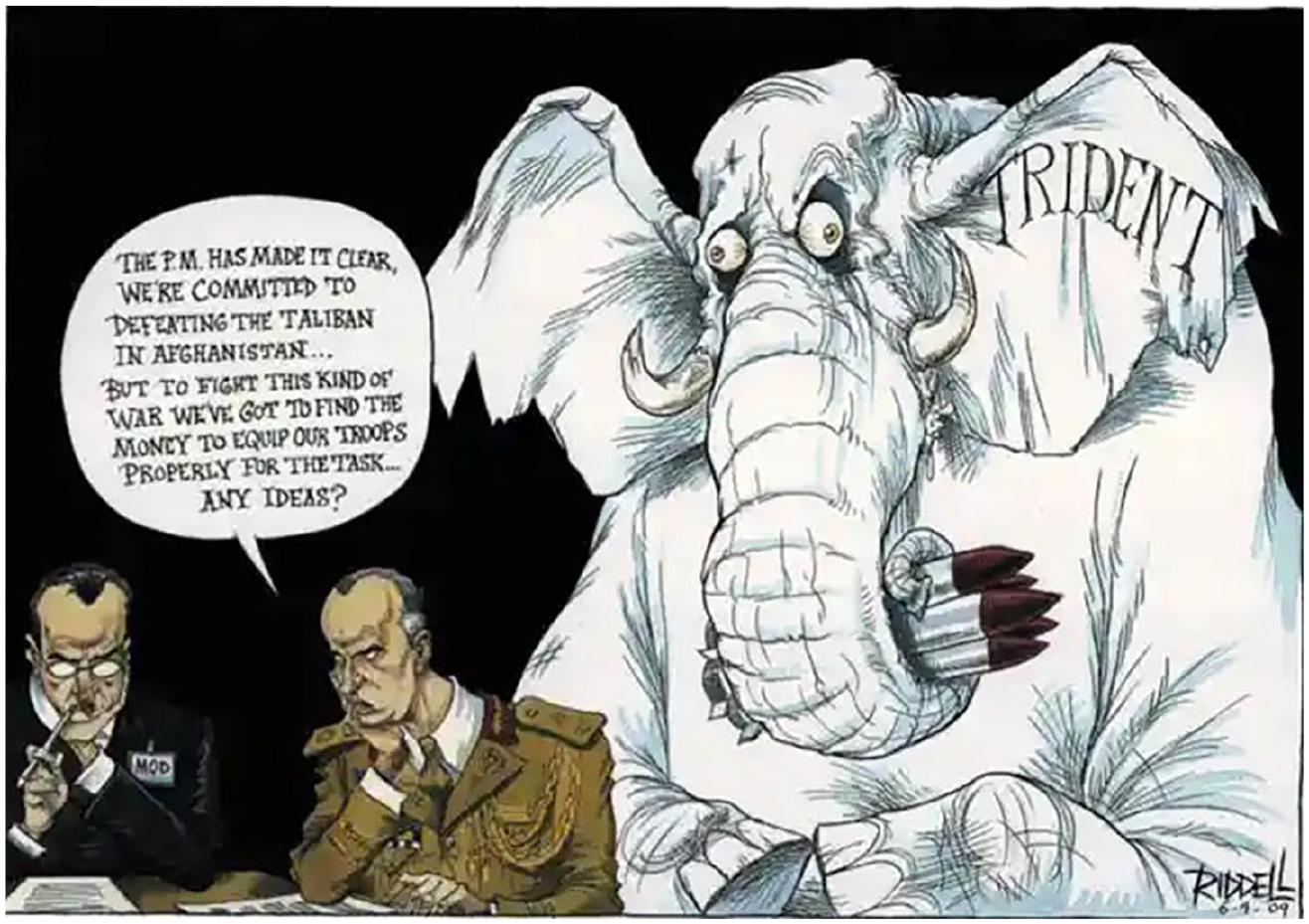
”The White Elephant in the Room” observer comment cartoon (Riddel, 2009).
The backlash in England could be found among backbench MPs, the left-leaning press, anti-nuclear movements, backbenchers and retired generals. The strong version of this movement called for the United Kingdom to abandon nuclear weapons altogether while weaker variants wished to consider cheaper alternatives to Trident (see Norton-Taylor, 2013). Polling on the Trident suggests that as the coalition governments’ austerity began to bite, the opportunity costs became more salient. While polling was highly sensitive to phrasing of the question, 6 when put into the context of the economic costs, opposition to renewing Trident enjoyed as much as 55% (see Mills, 2016: 94–100). Notably, the Liberal Democrats – the junior partner in the coalition – favoured a cheaper alternative. Regardless of the validity of the polling, the government was sufficiently concerned about the prospect of renewing Trident while cutting other public services that it initiated a ‘value for money’ review and ultimately delayed making the final decision until the next parliament (Lindborg Pena, 2010).
Within Scotland, the dragging out of the final decision likely contributed to keeping nuclear weapons in the public eye and salient in the run-up to the Scottish independence referendum in 2016. Certainly, the status-related critiques around Trident would be instrumentalized by the Scottish Nationalist Party (SNP). For instance, the SNP Member of Parliament for the district where the Trident was based asked rhetorically, ‘Does anyone really think that nuclear weapons make the UK a safer place? For the establishment down here [London], Trident is a political weapon – it’s about preserving your status as a nation’. But the SNP’s critique also tied Trident question to Scottish identity: constructing the Trident as not only a waste of money, but stigmata – that only Scottish independence could remove. For instance, in its plans, the SNP asserted that ‘[a]n independent Scotland would be a nuclear-free Scotland. The UK’s nuclear submarines would have to be removed from Scottish waters, encouraging the UK, we hope, to end its dangerous reliance on an outdated nuclear deterrent’. Illustrating the multivocality of status symbols, the SNP presented opposing nuclear weapons as a status-enhancing move. Rather than throw away money-chasing seats at top tables, a denuclearizing Scotland would enable it to establish a post-UK identity as ‘progressive peace-making state’ and establish itself as a single state nuclear weapons free zone (Ritchie 2016). Co-constituting this narrative of a potentially progressive future was the notion that by imposing upon Scotland ‘weapons of mass destruction’, the union denied the democratic will of Scots.
Indeed, in line with our expectations of how status symbols can become vulnerable to symbolizing subservience to other’s misguided preferences, Trident’s renewal became a focal point to highlight what they systematically argued was an intolerable democratic deficit, as the foreign spokesperson for the SNP, Angus Robertson, laid out in 2012, The majority of MPs from Scotland and the majority of Members of the Scottish Parliament have voted against Trident renewal. The Scottish Government are opposed to Trident, the Scottish Trades Union Congress is opposed to Trident, the Church of Scotland is opposed, the Roman Catholic Church in Scotland is opposed, the Episcopal Church of Scotland is opposed, the Muslim Council of Scotland is opposed, and, most important, the public of Scotland are overwhelmingly opposed to the renewal of Trident. A YouGov poll in 2010 showed 67% opposed, as against only 13%. There was majority opposition among the voters of all four mainstream parties in Scotland, including Conservative voters and Liberal Democrat voters. The Westminster Government are aware of the objections but are ploughing on regardless. (House of Commons, 2012, col. 611)
As Ritchie (2016) summarizes, in his in depth analysis of Scotland’s identity and its connection to the SNP’s opposition to nuclear weapons, the ‘determination to realize a sovereign right to decide the constitution of armed forces, including nuclear weapons and how to use them or not, became symbolic of the SNP’s case for independence’ (our emphasis).
Ultimately, the United Kingdom’s renewal of Trident illustrates how the very qualities that generate the symbolic power of international status symbols – their very public cost – combined with the multivocality of their symbolic value, renders them vulnerable to backlash, which may emerge over time. Notably, the backlash against Trident embodied the modes of critiques inducted and theorized in the Brazilian case. The global financial crises and austerity policies rendered Trident increasingly vulnerable to opportunity cost critiques and thus prompted a lengthy cost–benefit analysis of the decision. Meanwhile, the SNP’s critique underlined the multivocality of nuclear weapons as status symbols, transforming Trident from a symbol of great powerdom to a totem of subservience to the English other. While it is beyond the scope of this vignette to assess the relative strength of these status backlashes, it is worth stressing that they were not trivial, since almost certainly contributed to public opinion polls that maintained a significant opposition to renewal. This helps explain why the initial decision to renew prompted the second largest rebellion of Labour MPs during its 12 years in office, led the Conservative-Liberal coalition government (2010–2015) to delay the final decision and would become a key pillar of the SNP’s narrowly unsuccessful campaign to leave the union.
Norway’s status-seeking and its discontents
When De Carvalho and Neumann (2014) published their seminal edited volume on Norwegian status-seeking, its argument made a splash in the small state’s literature for its intuitive yet novel argument that seeking status was not merely the preserve of great powers politics. What is less well known is that in theorizing Norway’s ‘quest for status’, they were theorizing what had become a contested political issue within Norwegian domestic politics.
A sure-fire sign that the status is salient is when the government denies its relevance. Hence, it is telling that Norway’s foreign minister in 2008 felt the need to assert that the 800 million Norway spent on peacebuilding ‘must never be seen as important in promoting our reputation and winning international prestige’ (Støre, 2008). Although not strictly a denial, Støre was attempting to limit what had become an unedifying debate around the value – for Norway and Norwegians – of its foreign policy agenda. Although Støre himself had participated in the debate just 2 years earlier – arguing that proposed budget cuts for peace promotion would undermine Norway’s ‘reputation’ (Støre, 2006, cited in Skånland, 2010) – he and the government belatedly recognized that conducting a public cost–benefit analysis of the government’s virtue-signalling risked undermining any pretensions that remained of its virtue. Perhaps unsurprisingly, Støre had little success in quelling the sceptical analyses of Norway’s status-seeking. As a leading public intellectual put it, ‘prestige had replaced security’ (Toje, 2021) as the priority for Norway’s global engagement strategy.
The aspiration to quell status-talk was not helped by the tendency of Norway’s own ministers, who evaluated their performance by embodying the ‘grammar of status competition’ (Beaumont, 2024). As the Committee on Foreign Relations and Defence boasted in parliament, the United States had judged Norwegian contributions to NATO’s military intervention in Libya (2011) as ‘best in class’ (quoted in Græger, 2014: 99). 7 Despite their success in apparently receiving a (we must assume, metaphorical) ‘gold star’ from their leading ally (Græger, 2014), some on both the mainstream left and the right questioned the value of the status gained.
Indeed, Norway’s role in the NATO-led International Security Assistance Force (ISAF) offers an illuminating example of how its successful status-seeking prompted a backlash. First, the government’s very own evaluation of its efforts noted that Norway’s ‘bidragskrigsføring’ (contribution-warfare strategy) had concluded that the primary objective was to be seen as a ‘good ally’ to the United States and other NATO countries (NOU, 2016: 10; see also Jakobsen et al., 2018). On this front at least, they deemed Norway’s contribution to ISAF a clear success (NOU, 2016: 193). Yet, the process of seeking ‘good ally’ status generated considerable domestic opposition along the way, including from within one of the ruling coalition parties, the Socialist Left Party (SV). Since entering government in 2005, SV had dialled back its traditional NATO-scepticism and anti-war rhetoric (NOU, 2016: 193). Yet, as the occupation wore on and requests for additional Norwegian support came forth from NATO allies, it reignited SV members’ anti-war spirit.
As the United States became bogged down in an increasingly intense counter-insurgency, NATO’s ISAF mandate was steadily expanded (2003, 2006) to the whole of Afghanistan. Yet due to the uneven distribution of the insurgency, this left some NATO members with more challenging missions than others. Hence, pressure began to grow for NATO members located in the north to contribute to operations in the increasingly besieged southern parts of Afghanistan where heavy fighting with the Taliban had become common by 2006 (Trønnes, 2012: 79–80). Given that status symbols generally need to be perceived as difficult and costly to be valuable (Gilady, 2018), NATO’s request in September 2006 to add to the Southern ISAF mission should have offered the opportunity for Norway to shine and cement its status within the alliance. Certainly, the pro-NATO majority within parliament spoke out strongly in favour of sending troops south to show solidarity but also to ensure their standing and thus influence within the coalition. Yet, after an allegedly heated debate among the governing parties, Norway would decline to send the troops (Trønnes, 2012: 74–75).
In line with the multivocality of status symbols, Norway’s praised ‘good ally’ status within NATO had little resonance among significant numbers of the population and for one of the parties in the ruling coalition, quite the opposite. Indeed, SV opposed sending Norwegian forces to southern Afghanistan and successfully vetoed the plan against the wishes of other ruling parties as well as the opposition. Notably, Kristin Halvorsen, then SV leader and Minister for Finance (2005–2009), explained her reasoning in terms of questioning the opportunity costs of the status quest and the subservience it entailed: ‘[I] understood that it was important for the prime minister, foreign minister and minister of defence how Norway’s contribution’s to missions abroad were perceived in NATO’ (cited in Jakobsen et al., 2018, our emphasis). However, Halvorsen said she ‘just could not understand why Norway should be there for NATO and the United States no matter what they asked of us’. Halvorsen’s concerns were expressed more starkly among many in her own party and the left more generally (e.g. Vinding, 2006; see Hatling, 2010: 75–77), for whom such ‘solidarity’ with allies has been routinely presented as a subservience (Græger, 2019: 86). The initial ‘win’ for SV would at least temporarily undermine Norway’s reputation within NATO (NOU, 2016: 33–34). Indeed, the willingness and capacity to send troops to the South had become seen as a litmus test for member-states’ standing within the alliance. As the US defence secretary reflected in the aftermath, NATO risked turning into a ‘two-tier alliance’ with ‘in which you have some allies willing to fight and die to protect people’s security and others who are not’ (Gates quotes in Wintour, 2008, see Noetzel and Schreer, 2009; Trønnes, 2012). The matter also caused short-term bilateral friction with the United States and somewhat long-term irritation among the British (NOU, 2016: 34).
However, the backlash would soon cause a major political headache for SV. The deteriorating security situation and SV’s opposition to sending Norwegian troops south sparked a broader debate about the wisdom of Norway’s entire military participation in Afghanistan. SV was left stuck between supporting the coalition government and listening to its members. 8 Indeed, rather than dampening its members’ criticism of the war, the success in vetoing sending troops south seemed to inspire the radical wing of SV to call for an end to Norway’s military participation. While the polling on the war presented a mixed picture depending on how the question was phrased, a majority of SV’s supporters consistently opposed Norwegian military participation (NOU, 2016: 193). 9 This would become publicly manifested in the ‘bring the soldiers home’ movement, which was initiated and gathered momentum from 2007, and climaxed with a protest outside parliament in November that year. Notably, the protest counted not only SV members, parliamentarians, but also some of its leadership (Roux, 2007). While the protest reflected SV’s long-term opposition to what they called US and NATO warmongering, it is notable that a key argument emphasized the opportunity costs of the war in terms of the potential for contributing to Afghanistan development and state-building (e.g. see Taksdahl and Storvik, 2007).
Like the other cases, a politically significant backlash emerged during the process of an ostensibly successful quest for status. While clearly not reaching the scale of the Brazilian backlash, it influenced the shape and trajectory of Norway’s military efforts, leading it to eschew the symbolic utility of sending its troops to support counter-insurgency efforts in South Afghanistan. We suggest that this decision is usefully illuminated by considering the multivocality of status symbols and by paying heed to the process by which they are acquired and performed: while the rest of the government placed a high value upon Norway’s status in NATO, SV considered Norway’s membership a stigma it sought to disassociate from and thus vetoed the plan. Yet, the backlash that was channelled through SV would ultimately end up undermining the party: after successfully resisting Norway’s mission creep, the backlash among their supporters grew, prompting considerable disillusionment when SV leadership continued to support Norway’s military presence in Afghanistan. The Norwegian and British converge as both illustrate how opportunity costs and accusations of subservience are modes of critique that lend themselves easily to critics of status-seeking.
Conclusion: foregrounding the ‘politics of status’
The thesis this article has sought to substantiate is a simple one: that acquiring or performing status symbols embodies inherent risks for governments. We argued that even when a status symbol ostensibly succeeds in generating acclaim or pride, the nature of status symbols – their multivocality and intrinsic costliness – is liable to engender backlashes. To flesh out what status backlashes entail, we then inductively theorized three modes of critiques that international status symbols are prone to generate. First, opportunity cost critiques will almost automatically resonate among those that do not value the form of status pursued in the first place (e.g. the opposition in Brazil, the left side in Norway, and the United Kingdom with regard to military interventions and acquisitions). As our Brazil case illustrates, opportunity cost critiques may also convince otherwise supportive citizens that the pride gained from a status symbol was not value for money. Moreover, treating the acquisition of status symbols as a process rather than an event highlights how these costs may only become apparent with time and thus shift public assessments of their value for money. Second, the inherent costliness of status symbols draws attention to those who do profit from the venture, rendering the government vulnerable to accusations of vested interests. Third, status symbols are vulnerable to accusations that the government prioritize international audiences over the citizenries’ interests, engendering a sense of democratic deficit or perhaps even subservience. While these risks accompany any foreign policy, we suggest the three cases provide evidence that these critiques are likely to be amplified when a policy is either legitimated to its population and/or critiqued as a status symbol.
The article aims to contribute to understanding the general prevalence of status-seeking in world politics by illuminating the intrinsic potential for domestic backlashes to emerge out of even successful acquisition or performance of status symbols. Among the major overarching questions animating status research is when states will seek status symbols. To date, the dominant theories have focused on various exogeneous triggers. This article’s argument does not question these factors’ salience but suggests that insofar as status-seeking is a rational endeavour (e.g. Beaumont, 2024; Renshon, 2017), these analyses are incomplete as they overlook a source of costs and risks that states should consider: domestic backlash. Models that overlook these uncertainties will struggle to account for dogs that do not bark: states that would appear structurally primed to embark on costly status quests but refrain from doing so.
Analysing modes of critique and dynamics of status backlash across contexts also allows for alternative sources of variance in the domestic politics of status. While all our cases embodied backlashes, it is likely not a coincidence that Brazil suffered the most severe backlash and that the vested interest mode of critique was most pronounced in this case. This is not unexpected, given the then widespread perception of corruption in the country and the significant financial stakes associated with mega-events. One conjecture then could be that levels of trust in public institutions and previous public recognition of corruption make costly status-seeking riskier. Second, in both the Brazil and the United Kingdom, status backlash gained strength as the countries socioeconomic conditions deteriorated plummeting perceptions of public service quality. Despite the countries very different preceding socioeconomic conditions, this context appears to have exacerbated the perception of the high opportunity costs entailed by status symbols in contrast to the provision of more basic public services.
Third, a common trait of our cases is the existence of a pluralistic public sphere and a functioning democracy, which may be a condition for status backlashes in the first place. While we did not include a wider variation in regimes, this factor may help explain why authoritarian governments (e.g. Qatar, Azerbaijan and China) are among the most ostentatious status-seekers. In other words, the lack of a pluralistic politics and public sphere dampens the risk of backlashes and thus frees up the government to pursue status-seeking. While our analysis was limited to showing how status symbols generate similar kinds of backlash across different contexts, the logical next step for this line of argument would be to explore more systematically the conditions that affect the intensity and scale of the backlash.
Finally, zooming out, we believe that our article provides a warrant for foregrounding what we would call ‘politics of status’, inspired by Bettiza’s (2014) notion of ‘politics of civilization’. Its starting point is the observation that domestic actors readily identify state actions as status-motivated and debate them in the public sphere on those premises. In our view, status researchers have been too prone to treat statements about status-seeking as strictly epistemologically useful for researchers striving to infer motivations rather than ontologically significant in process of (de)legitimation of that same status-seeking. Put differently, if the press routinely refers to a government’s mega-project as a white elephant, it is not only evidence that the project might be motivated by status but constitutes a political dispute about the legitimacy of perceived status-seeking behaviour, which can be a significant liability for a government. Hence, a politics of status approach would explore how public proclamations and accusations regarding a state’s quest for status play out in domestic politics: generating gains and imposing costs for governments. Deepening our understanding of these political costs of acquiring or performing status symbols – or being accused of doing so – would not only provide a fuller understanding of the cost–benefits of international status-seeking but would also provide policy salient knowledge that could temper would-be status-seekers.
