




Abstract
This article examines the gendered appearance management ambassadors do to properly represent states. Drawing on feminist sociologist theorizations of labor, and attentive to intersections with sexuality, class, and Western standards, the study shows the unequal extraction of time and effort from men and women as they manage their appearance in diplomacy. Theoretically, I argue that the gendered management of dress, hair, and adornments are better conceived of as labor than as habitus or capital. Empirically, the study focuses on appearance management among ambassadors posted to Washington D.C. 2018–2020. Relying on a wealth of data—an original time survey, ambassador interviews, and observations—the study makes three empirical claims about the diplomatic embodiment of states: (a) diplomatic appearance standards are largely gender binary, with male uniformity and female variation; (b) more time and effort is demanded from female than male ambassadors; and (c) diplomatic appearance standards demand gender labor that is inextricably linked with the management of sexuality, upper class conventions, and Western physical appearance norms for representing states. In short, individuals presenting as men or women (although apparently not nonbinary) may now represent states as ambassadors, but more labor is extracted from women in doing so.
Introduction: the gendered and time-consuming work of representing a state
“I don’t have the time—it takes a lot of energy for me. I can’t focus, when I eat breakfast, I have to think about what I wear. . . It’s very stressful.” These are the words of a female ambassador posted to Washington D.C., describing how she experiences the dress codes and appearance standards of bilateral diplomacy. Like other ambassadors, she depicts very busy workdays with many different kinds of engagements—meetings on Capitol Hill or in the Department of State, hosting a luncheon at the embassy, media events, speaking to members of the national diaspora, a cocktail party at another embassy, a dinner event or evening gala, and more. For ambassadors presenting as women,
1
each engagement may come with a distinctive dress code that requires a change of clothes, makeup, and hairdo. Requirements for male ambassadors, in contrast, are less taxing. In the words of the same ambassador: For a man, it’s a suit and a shirt. For us, it’s not the same. I get comments, like, why am I wearing the same clothes all the time. Those who make those comments don’t think about the fact that in a day, I do six different events. I can’t change six different times! I am extremely harshly judged, no matter what. (Female Ambassador 8)
While some diplomats may enjoy spending time on their appearance, this ambassador described appearance management as “the worst part of my job.”
This article centers gender to examine diplomatic appearance management, defined as what diplomats do to manage their physical appearance when representing states. I argue that a feminist conceptualization of labor effectively captures the gender-unequal extraction of time and effort from diplomats. To make this argument, the article brings practice-oriented diplomacy scholarship into conversation with feminist sociology of gender and sexuality at work. As many diplomacy scholars have pointed out, diplomats represent and thus embody states (e.g. Cornut, 2015: 389; Nair, 2019; Neumann, 2008, 2012; Oglesby, 2016: 247; Pouliot, 2010a: 87; see also Steller, 2008). What is rarely noted is that diplomats represent states as gendered beings, enacting diplomatic gender norms that provide rules and guidelines for appropriate dress and appearance. Furthermore, scholarship pointing to the importance of dress in diplomacy has done so in passing, without addressing what diplomats actually do during the day, in gender terms, when they dress and appear as a state. The empirical aim of this article is thus to provide a fuller examination of diplomatic dress and appearance norms and of the appearance management diplomats are required to do. The study also examines whether diplomatic gender norms are such that the time and effort devoted to dress and appearance differs between male and female diplomats.
The theoretical aim of the article is to bring the concept of labor to the fore of diplomatic studies. Existing scholarship on diplomatic dress—like much diplomacy scholarship more generally—has relied primarily on Pierre Bourdieu’s theoretical framework to show that dress functions as a status marker productive of social distinctions of class, gender, and geographical identity among diplomats. Via Bourdieu, gender is furthermore theorized as long-lasting dispositions of the mind and body (i.e. as “habitus”) and as a resource used in field-specific status struggles (i.e. as “capital”). To my knowledge, no diplomacy scholars who rely on Erving Goffman have addressed gender. His dramaturgical model of social interactions would offer a view of gender as more intentional and even playful citations of gender norms, as diplomats use “impression management” to enact and navigate diplomatic norms (Goffman, 1959, 1976).
Practice-oriented approaches have been key to opening up performative accounts of diplomacy, highlighting gender as performance, the production of status distinctions among men and women, and more. However, these approaches obscure the daily extraction of time and effort—and the inherently distributive nature of time and effort—involved in doing gender. I argue that the concept of labor, as used in feminist sociology of work, draws attention precisely to the ongoing gender-unequal extraction and distribution of time and effort in daily diplomatic life. Diplomatic dress and appearance are rightfully understood as gender performances, but such performances should not only be conceived of in terms of symbolic status markers, identity, or cultural capital, I contend. Diplomatic dress and appearance management should also be conceived of in terms of gendered labor: the unequal extraction of time and effort from men and women required to meet expectations. A focus on labor thus provides a crucial corrective that complements existing practice approaches to diplomacy.
The labor diplomats do to meet gender expectations is built into bilateral diplomacy, I also contend. Indeed, the unequal amount of labor required from male and female diplomats is connected to how states are gendered in and through diplomatic representation. While states may no longer be represented through exclusively masculine dress and appearance, standards of diplomatic embodiment remain androcentric in that they provide more uniform, simpler, and thus less time-consuming appearance standards for men than for women. What is more, as prior scholarship has noted, diplomacy is infused with upper class and often Western norms with important and unequal implications for what ambassadors are required to do. An analysis of diplomatic labor thus needs to be intersectional, which in the present study entails being attentive to the intersection of gender, sexuality, class, and Western/non-Western standards in diplomacy.
The main empirical focus of this study is the ambassador corps of Washington D.C. 2018–2020. Ambassadors, diplomats of the highest diplomatic rank, are particularly central and visible figures in the representation, promotion, and embodiment of their state abroad. Washington D.C. is a capital where male ambassadors are in large majority—in 2018, of 175 ambassadors posted in D.C., only 21 (12%) presented as women. Like their male colleagues, these women represented states from around the globe, ranging from the Caribbean to the Middle East, Africa, and Europe. D.C. is thus a global diplomatic site in the sense that diplomats with potentially different appearance standards from all parts of the world interact. As a diplomatic site, D.C. is furthermore at the center of global politics, an exceptionally complex and busy meeting place where the stakes are high and where diplomats need to exert extra effort to be seen and heard.
The analysis is divided into three main sections. The first concerns ambassador appearance standards in D.C. The article shows that despite the enormous variation in dress, hair, and how gender is performed around the world, gender is visually expressed in largely binary terms in diplomacy—ambassadors present as either men or women, indexing narrow bands of acceptable appearance standards of upper class and largely Western heterosexuality. This results in gendered representations of the state that entail male simple uniformity and female ornate variations and complimentary alternatives. There is regulated and intermittent use of “national attire,” which is primarily used by non-Western diplomats, but this does not disrupt the general binary gender pattern. In sum, the study shows that ambassador work—whether at international meetings, banquets, receptions, press conferences, or making other public appearances—demands familiarity with an inventory of gendered expressions appropriate for representing states, expressions which constitute devices to practice diplomacy effectively.
The second section turns to what demands these standards place on diplomats’ time. Relying on a unique time survey sent to all bilateral ambassadors posted to D.C. and Stockholm and on interviews with 19 ambassadors in D.C., I show that male and female ambassadors all spend significant time and effort on dress and appearance. However, women spend considerably more time than do men—roughly twice as much—particularly on planning and changing outfits, applying makeup, and with manicures and hairdos. In contrast with the male ambassadors, they also identify dress and appearance as a time-consuming and often stressful component of their work. In treating labor time as a distributable resource, the article returns to questions that used to animate more feminist scholarship, namely, distributive questions of who gets what and how.
The third section centers on how ambassadors describe the efforts entailed in diplomatic appearance management, for depth and texture. Relying on the interviews with ambassadors in D.C., I identify three central and related tasks in representing states—the management of appropriate sexuality, upper class conventions, and of Western gender standards—and how ambassadors describe their experiences. The interviews show how gender works intersectionally, across and through sexuality, class, and West/non-West distinctions, producing a more stressful and demanding experience for some ambassadors than others. The interviews also point to what it might mean to dress and appear inappropriately in diplomacy: to be sexually suggestive, not to appear “classy,” and more. While it is beyond the scope of this article to unpack the question of what is at stake when (mis)representing states through inappropriate appearance and what the consequences may be, the analysis lays the groundwork for such a study.
The analysis is preceded by a discussion of existing studies on dress and appearance in diplomacy, using this as a springboard to bring practice-oriented diplomacy scholarship into conversation with the sociology of gender and sexuality at work, to set out my feminist labor approach to appearance management. The section immediately preceding the analysis then addresses the data and methods of the study. The final and concluding section discusses the implications of the analysis for the gendered representation of states in international relations.
Appearance management as gendered labor: diplomatic studies meet the sociology of gender and sexuality at work
Dress, distinctions, and capital in diplomatic studies
Existing scholarship on contemporary diplomacy has pointed in passing to the importance of professional dress and appearance in diplomacy for some time (Essex and Bowman, 2020; Kuus, 2015; Lewicki, 2016; Neumann, 2008, 2012, 2019, 2020). This scholarship is part of the turn toward practices and the mundane things that diplomats do as foundational to international politics (e.g. Adler-Nissen, 2014; Neumann, 2002; Pouliot, 2010a, 2010b, 2016; Pouliot and Cornut, 2015; Wiseman, 2015). There is wide agreement in this work that practices are embodied and that the “skilled body” is basic to diplomacy (e.g. Neumann, 2008). There is furthermore wide agreement that these shared practical understandings are classed, and that “diplomatic culture”—the common stock of rhetoric and manners among diplomats (Dittmer and McConnell, 2016: 3)—is infused with upper class scripts of behavior (e.g. Kuus, 2015; Nair, 2020; Neumann, 2008, 2012).
Dress and appearance have been theorized as performances that are productive of status, part of the many practices that (re)produce social distinctions among diplomats in particular sites around the world. Neumann’s (2008, 2012) groundbreaking work on the intersection of classed social status and gender in the Norwegian Ministry of Foreign Affairs (MFA) briefly discusses dress, arguing that clothes are one important status marker among Norwegian diplomats (e.g. Neumann, 2008: 682–683 and 686). Essex and Bowman (2020), in turn, contend that gendered work attire helps produce distinctive institutional affiliations among employees of Global Affairs Canada (GAC). While the casual clothes within development is accommodating to male and female employees alike, they contend, non-male dress is indirectly construed as lacking in professionalism and status in GAC (Essex and Bowman, 2020: 12).
Other studies have moved beyond national institutional sites to examine how clothes—among other symbolic resources—express and produce national and geographical distinctions in multinational diplomatic contexts (Enloe, 2014; Kuus, 2015; Lewicki, 2016; Neumann, 2019, 2020; Zabursky, 2000). In a study of distinctions of social class and nationality among diplomats, Kuus (2015) looks at symbolic power in European Union (EU) diplomacy in Brussels. She expands the understanding of “diplomat” to civil servants and other professionals in the EU external relations machinery (Kuus, 2015: 369). Kuus emphasizes that there is “no unified dress code” (p. 375) but—without discussing gender—she quotes an informant noting that the “upper echelons” wear suits. Whereas there is an “absence of clear visible markers” between diplomats of the former East and West Europe, many of her interviewees locate dress as a North/South matter, with Southern Europeans allegedly more elegant and confident dressers than Northern Europeans (p. 376).
Adding gender to an analysis of the European Commission, Lewicki (2016) makes a different claim: dress and appearance are indeed implicated in hierarchies between East/West. A masculinized and West European hegemonic “Euroclass” is established in part through disparaging the dress and appearance of younger female representatives of new member states, he argues. These women are represented as “overdressed,” “trashy,” and “flashy,” wearing clothes that allegedly are too sexually revealing, in the “wrong” colors, and with “cheap” accessories (European Commission, Lewicki, 2016: 126–128). Their incongruence with expectations for a “proper” European diplomat reveal the masculinized, upper class, and old member state character of European diplomacy, he concludes.
In sum, then, prior scholarship has pointed to the importance of dress in diplomacy. Dress has been theorized exclusively as a status marker productive of social distinctions of class, gender, and geographical identity among diplomats. Theoretically, this scholarship often relies on Bourdieu’s conceptual cluster of “fields,” “habitus,” and “capital.” As a sphere of activity, the diplomatic field consists of norms and rules of the game, including for clothes and appearance. Diplomatic agents are socialized into the field, but how—and how well—they learn the rules of the game depends in part on their hitherto learned bodily and mental skills, tastes, styles, and habits. Bourdieu refers to the totality of such mental and bodily habits and dispositions as habitus, arguing that habitus is generally shared by people with similar backgrounds (e.g. Bourdieu, 1990: 66–67).
A field is furthermore always a process of stratification, based on struggles over distributions among agents of a mix of various forms of “capital” (economic, cultural, and social) and how these are deployed in practice (e.g. Pouliot, 2016). In Bourdieu’s rendering, capital is understood as resources that function as currencies in the field, currencies that may yield a high social standing, influence, and other “profits” (e.g. Abrahamsen and Williams, 2011: 313; Bourdieu, 1986). An agent’s ability to move in a field depends on that agent’s possession of the field-specific capital and skill in putting it to work. Crucially, no field is static, as agents such as diplomats struggle to change both the distribution of capital and to change what resources are validated as capital in the field (e.g. Abrahamsen and Williams, 2011: 313).
While heavy emphasis is placed on field, habitus, and capital in Bourdieu-inspired diplomatic studies, the place of labor in the diplomatic field is generally overlooked. One exception is Deepak Nair’s wonderful study of “servant” performances by international bureaucrats, which utilizes Arlie Hochschild’s (1983) concept of emotional labor to analyze what these bureaucrats do (Nair, 2020). However, Hochschild’s Marxian understanding of labor drops out from the study, and emotional labor thus appears no different from Bourdieu’s notions of habitus and skillful deployments of capital. Bourdieu himself did not center the concept of labor, as his quest was to complicate and move past conventional Marxist theorizations. To Bourdieu, “capital is accumulated labor” (Bourdieu, 1986: 241). When and how capital accumulates and from what kind of labor varies historically and by form of capital, but much of Bourdieu’s opus focuses on social conditioning that takes place during many years of socialization, particularly in childhood (e.g. Bourdieu, 2001: 49). When understood thusly, gender is theorized in terms very close to Bourdieu’s conception of habitus, as long-lasting dispositions of the mind and body (see e.g. Bourdieu, 1986: 244).
As dispositions and background knowledge that manifest in the body as “a social product” (Bourdieu, 2010: 191), gender can thus be approached as something individuals such as diplomats carry with them over time, as dispositions but also as resources they can draw on when called for. This indeed seems to be how diplomacy scholarship on dress theorizes gender. To be sure, the labor invested in inculcating such dispositions can of course be considerable, consisting of “an investment, above all of time,” by the socialized individual, as well as by parents, educators, and so on (Bourdieu, 1986: 244). But it is an investment of time and effort made primarily before adulthood and before entering diplomacy.
So conceived, the ongoing labor—the daily use of time and energy—that produces gender expressions easily disappears from view. After all, by the time individuals enter diplomacy, gender labor has already turned into habitus and capital, ready to be put to use. It is perhaps not surprising, then, that the small body of work on dress in diplomacy has not focused on the ongoing extraction of time and effort—nor its distributive nature—involved in performing gender in diplomacy, opting instead to focus on the symbolic meaning of clothes.
This article builds on the important work of practice-oriented scholars. However, in a more systematic and in-depth empirical analysis, I also want to draw attention to (a) the gendered labor that is extracted in an ongoing, day-to-day manner in the diplomatic field, by focusing on the efforts entailed in what diplomats actually do when managing appearances; (b) the distribution of time and effort between diplomats presenting as women and as men (as there appear to be only two sex categories in diplomacy); and (c) the ways in which this labor is in the service of gendered states. To center labor and the unequal demands on diplomats’ time and effort in my gender analysis, I put diplomacy scholarship in conversation with the sociology of gender at work in the following section.
Appearance management as labor: sociology of gender and sexuality at work
Feminist scholarship has been attentive to the management of physical appearances for decades (e.g. Dellinger, 2002; Hollander, 1995; Kaiser, 1997). However, rather than as enduring dispositions, many sociologists of work have approached gender as ongoing accomplishments that are generally routine and mundane, a view that really took off with the 1987 publication of West and Zimmerman’s groundbreaking article “Doing Gender.” They argued that: Doing gender involves a complex of socially guided perceptual, interactional, and micropolitical activities that cast particular pursuits as expressions of masculine and feminine “natures.” . . . [They shift our attention] from matters internal to the individual and focuses on interactional and, ultimately, institutional arenas. In one sense, of course, it is individuals who “do” gender. But it is a situated doing, carried out in the virtual or real presence of others who are presumed to be oriented to its production. Rather than as a property of individuals, we conceive of gender as an emergent feature of social situations: both as an outcome of and a rationale for various social arrangements and as a means of legitimating one of the most fundamental divisions of society. (West and Zimmerman, 1987: 126)
West and Zimmerman—like Judith Butler’s subsequent account of gender as performative (e.g. Butler, 1990, 1993)—were inspired by but developed Goffman’s work, particularly as expressed in The Presentation of Self in Everyday Life (1959) and in “Gender Display” (1976). These accounts of gender as performative emphasize the repetitive normative enactments that keep gender in motion and changing through practice. Importantly, for these scholars, gender performances draw primarily on contextual norms rather than on enduring dispositions of individuals.
In this article, I also rely on a performative view of gender. I furthermore borrow the Goffman-inspired notion of “appearance management” from Kaiser (1997) as paying attention to, planning, creating, and managing one’s appearance. 2 However, overlooked in these practice-oriented accounts are theorizations of gender practices as labor, that is, as the use of time and effort to produce something of economic, social, and/or symbolic value (e.g. Acker, 2006: 31–32). Extraction is central to the labor concept, as performances demand not just skill but also an often unequal amount of time and effort from practitioners. Feminist scholarship has a long history of grappling with the concept of labor, which used to largely center on androcentric and Western conceptions of work as paid labor in a market economy. In feminist accounts, the labor concept refers not only to activities directly and expressly involved in the production of market value but to social and symbolic value more broadly (Weeks, 2004: 185), including, for example, “care labor,” “emotional labor,” and “reproductive labor” (e.g. Hochschild, 1983). Whether waged or not, this kind of labor is often naturalized—in many cases as something that is made to appear as coming naturally to women or particular groups of women—thus making the ongoing time, effort, skill, and exploitation required on a daily basis invisible and taken for granted.
Drawing on this scholarship, I argue that in producing social and symbolic value for states, diplomatic dress and appearance should also be understood as labor. It takes time and effort for diplomats to plan, pay attention to, and manage their appearance in ways that conform with prevalent expectations for appearing like a state. Clothes must be purchased, appropriate outfits need to be planned and put on, hair needs to be trimmed and done, makeup applied, nails trimmed appropriately, jewelry selected as the situation calls for, and so on. During a workday, clothes and appearance need to be adjusted and perhaps changed, lipstick reapplied, and more.
To complicate matters, gender is always implicated in a range of intersecting axes of differentiation, including class, race, nationality, religion, body weight, age, ability, and more. An intersectional sensibility is thus both fruitful and necessary when studying diplomatic labor (on intersectionality, see, for example, Choo and Ferree, 2010; Crenshaw, 1991). No one study can reflect all relevant axes of differentiation, however. This study will address how gendered appearance labor also entails managing sexuality, class expressions, and international hierarchies between the West and non-West. It thus leaves examinations of race, body weight, and other relevant dimensions in diplomatic appearance management to future studies.
Mixed methods and a wealth of data
The study rests on a wealth of data, combining primary and secondary source materials and interviews with a simple quantitative time survey. These data are used both as complements and as a form of triangulation in which each source is used in comparison with and as a check on the others.
To understand diplomatic appearance norms, the study relies both on primary and secondary sources (such as diplomatic manuals and professional journal articles) and on interviews with ambassadors (described below). I have also attended a large number of embassy receptions and events, which—along with observations during the interviews—provide an additional if more partial source of information about diplomatic appearance standards.
To compare the time male and female ambassadors spend on appearance management, the article also relies on a time use survey conducted among ambassadors in D.C. in Nov–Dec 2019. The survey asked around 20 brief questions about how much time the ambassadors spent on various tasks preparing their appearances for the workday and in preparation for work-related evening events. Although the estimated time to complete the survey was only 5 min, I anticipated that the response rate would be low, as elite response rates on web surveys are generally low, ambassadors are particularly pressed for time, and many MFAs do not allow diplomats to follow external links in emails. I thus opted to include ambassadors posted to Stockholm, Sweden in the survey, under the assumption that Stockholm diplomatic appearance standards are roughly similar to those in D.C. The survey was sent to 316 ambassadors in D.C. and Stockholm, and 33 (10.4%) responded, a response rate that is typical for elite surveys. Although a higher response rate would have allowed for more fine-tuned answers and an intersectional analysis, the responses provide statistically significant answers about whether women ambassadors do in fact spend more time on their appearance than their male colleagues, and we get some indication of roughly how much time. I commissioned LORE, a research institute specialized in web surveys at the University of Gothenburg, to carry out the survey as the Ambassador Panel (Andreasson and Andersson, 2019). More specific information about the survey can be found in Supplemental Appendix 1.
To learn about what ambassadors do when they manage their appearance, I conducted 16 interviews with ambassadors currently or very recently posted in Washington D.C. I also rely on interviews with three U.S. female ambassadors who were in D.C. (see Supplemental Appendix 3). The interviewees represent states from many parts of the world—Africa, Asia, Europe, Latin America, and the Middle East—which suggests a potentially broad range of voices and perspectives on appearances (see Supplemental Appendix 2). The interviews were carried out between late 2017 and 2020. These interviews were extraordinarily difficult to arrange, often requiring many many emails, letters, and phone calls. Even when interviews had been arranged, they were frequently canceled by the ambassador (sometimes never to be rescheduled). I nonetheless managed to interview 11 female ambassadors, roughly 65% of the women posted to D.C. during this period, and 5 male ambassadors. While five might seem a small number, it is theoretically motivated: beyond the first interview, I received no new information about how male ambassadors manage their appearance. As I will show below, given the appearance standards, it is not surprising that male ambassadors do not have all that much to say about them.
Of the 19 interviews, 12 were conducted in person—generally at the respective embassies—and 7 were carried out via video call due to COVID-19 restrictions. All the interviews with men were online, whereas most of the interviews with women were in person. As Kuus (2021: 10) has pointed out, expert interviews with diplomats are formal and time-constrained affairs squeezed into busy schedules. In that sense, the difference between an interview online or in person is not that notable—they were all semi-structured, discussing the same set of questions, and lasting between 1 and 2 h. That said, as Kuus also points out, it is sometimes “during the sociable minutes after the formal interview when the richest insights are revealed” (Kuus, 2021: 10). My assessment is that the consequences are marginal for the overall claims of this study, however. All the evidence—the interviews, the time survey, the primary and secondary sources, my observations—point in the same direction of women needing to spend more time and effort than male ambassadors on appearances. It is also notable that male and female interviewees agreed in their assessment of the unequal burden placed on men and women in this regard.
Gendered appearance labor among ambassadors in D.C
When ambassadors manage their appearance in Washington D.C., they do so in a capital that is enormously busy and complex. With 181 embassies in 2018, the city hosts the largest bilateral diplomatic community in the world. As a diplomatic work site, D.C. is characterized by incredible complexity: governmental power is divided between the executive, legislature, and judiciary, each with a large number of staffers; there are the federal agencies, among which the Department of State is of course central for diplomats; there is a division of power between the federal, state, and local levels; and there is a large media and a large business sector. There are furthermore hundreds of large nongovernmental organizations (NGOs), charitable groups, and other civil society organizations based in D.C. Virtually every state has a diaspora community in the United States. Ambassadors are tasked with navigating this complex environment, seeking ways to best represent and promote their state.
Gendered, classed, and Western diplomatic appearance norms
The appearance of diplomats in general and ambassadors in particular are subject to much attention, regulated both by formal protocol rules and by more informal yet explicit norms. These are, in the words of one ambassador, “relatively straightforward” (Female Ambassador 7). Indeed, ambassadors are made well aware of how they are to appear. As another ambassador remarked: I think there are very clear dress codes, normally, in how you are to carry yourself in the diplomatic world. And I expect that among diplomats, because I am always aware that I am not representing myself. I am representing my country. So in everything, you put your best foot forward, so to speak. And whatever the circumstance, you dress according to dress code. (Female Ambassador 6)
Representing your country in D.C. may be particularly demanding. As another ambassador explained, in D.C.: you can’t afford to sleep when it comes to dress and comportment. If you’re known as the drunk-driving ambassador, it kills your credibility. Here in D.C., it’s also personal appearance. This is where everyone tries to look perfect, with all the help surgery can afford. (Male Ambassador 1)
He continues: D.C. is very formal, more formal than other places I have been to. I wouldn’t dream of showing up at a dinner without a tie, usually with a dark suit. You can’t come in scruffy. This is a much more stratified society than it appears at first sight and you are judged by sight. You have to be groomed properly. During brunch in the weekend, you can go in khakis, but you can’t go too far even then. (Male Ambassador 1)
So what does looking “perfect” entail for ambassadors in D.C.? Some ambassador work requires a “business casual” look (dress shirt, slacks, sport coat, tie optional), but the business suit is more standard. The U.S. contexts they move in—the State Department, Capitol Hill, the business community—are all contexts where Western professional business attire is expected (e.g. U.S. Department of State, 2011: 7; U.S. House of Representatives, 1979). These expectations expressly differentiate between appropriate male and female attire. For instance, to enter the floor of Congress, men have to wear a suit and tie. Women may choose between slacks, a skirt, or a dress, but they must cover their shoulders when wearing a dress or a sleeveless shirt, and they must wear a jacket if in slacks. Neither men nor women may wear open-toed or athletic shoes (e.g. Shabad, 2017; Zengerle, 2017).
Although the class background of ambassadors is now more varied than historically and although there is now diplomatic representation from across the globe, the visual culture of diplomacy in D.C. continues to be elite and mostly Western. Today, this coincides with some of the visual expressions of Western financial and business sectors, interspersed with some remnants from the European aristocracy (e.g. Neumann, 2012). The uniformity in dress and hair among male ambassadors is particularly stunning. Although they arrive to D.C. from the entire world, representing states whose populations dress in a myriad ways, the dress and hair of male ambassadors is in most professional instances almost identical. As one male ambassador stated, this uniformity means that the rare deviation becomes very noticeable: It becomes very strange, in front of other people, if you don’t follow the dress code. Then you are the only person wearing something different than the others. (Male Ambassador 2)
It is no exaggeration to claim that the uniform use of the Western business suit has taken the place of the formal diplomatic uniform that used to be standard wear. Around 1800, such uniforms were widely adopted by European states as part of the wave of administrative reforms that helped professionalize the foreign service (Hackspiel-Mikosch, 2005: 362–364). The Ottoman court, Japan, Latin American states, and a few other polities also adopted these uniforms during the 19th century. By the 1870s, when the sending and receiving of male ambassadors had become a universal practice among European states, diplomatic protocol thus regulated their dress so as to set ambassadors apart from the military, unofficial personages and women while at foreign courts (Nickles, 2008: 298).
Diplomatic uniforms reflected 19th century European court fashion. Diplomats generally wore a uniform consisting of white silk stockings, a heavy and richly gold-embroidered coat, a cocked hat, and a sword, with the sword considered the mark of a gentleman (Hackspiel-Mikosch, 2005; Nickles, 2008: 298–303). When diplomats from the young U.S. republic refused such aristocratic European apparel, insisting instead on appearing in the formal attire of ordinary U.S. male citizens, they were alternately refused access (the king of Sweden remarked in 1853 that “on occasions of court, no one can be received but in court dress” Nickles, 2008: 300), mistaken for court servants or ridiculed as undertakers or waiters (Nickles, 2008). Today, though the uniform has changed, appearing in high status apparel still indicates the high status of diplomacy. It also ensures the ambassador is presentable and shows respect to the hosting state.
The diplomatic uniform was widely abandoned after WWI, except for very special occasions. During the 20th century, as the Western business suit took the place of the diplomatic uniform, women began being appointed as ambassadors in small numbers. Today, the standard outfit of female ambassadors in D.C. is female variations on the male business suit: a pantsuit or skirt and suit jacket, which deviate in certain details from the uniformity of male diplomatic wear. Indeed, when asked what they mostly wear to work, my interviewees generally responded “suits. I wear suits” (Female Ambassador 12). Female ambassadors appear in suits that accentuate waists, hips, and legs, even if at times ever so slightly. The sturdier material of the suit is generally combined with silky blouses and accessories such as lace detail or scarves. The color range is wider and not limited to the gray, dark blue, and black of male diplomats, and there is variation on this basic theme in terms of the specific cut, color, and texture of the clothes. This variation on a basic theme holds true of the hair, makeup, and jewelry worn by female ambassadors as well, in contrast with the uniform sporting of short haircuts and mostly clean-shaven faces by male ambassadors. While female ambassadors appear in a range of haircuts and hairdos, the basic theme seems to be conservative elegance and careful management.
In any given week, most ambassadors also attend a number of evening events, with their own gender-specific dress requirements. Invitations typically specify dress code by gender: invitations to formal dinners and many evening functions come with gender-specific “black tie” or “white tie” instructions, indicating that business attire is not appropriate and that participants are expected to wear even more formal and elegant clothes. 3 Whereas “black tie” and “white tie” instructions for men involve dressier variations on the suit, women are instructed to wear a knee-length cocktail dress, floor-length ball gown, or long skirt with an elegant top, depending on the occasion. These outfits are to be coupled with high heels or dressy flats (eDiplomat, 2019). In contrast with the men’s wear, there is lots of variation on these basic themes, with lots of colors, textures, and details available for female ambassadors to display. Evening events typically also allow for “traditional” formal attire, not least for women, as will be developed below.
Diplomatic dress codes in D.C. tilt heavily toward elite Western clothing conventions, as emphasized above. That said, diplomacy is also a multicultural institution that recognizes certain forms of diversity. In certain situations and contexts, ambassadors thus draw on the aesthetics of the political aristocracy of non-Western states. For instance, at highly ceremonial state functions and during embassy celebrations of “national day,” ambassadors may wear apparel expressive of national identity. These are carefully orchestrated expressions, signaling particular versions of national distinction (as such, they warrant a study of their own). Formal evening events also allow for “traditional” or “national” attire, such as the thawb and ghutra sometimes worn by male Saudi ambassadors. With very few exceptions, it is non-Western ambassadors that use “national” or “traditional” attire during such events. This includes hairdos and headwear during formal events.
The largely West-centric uniformity of diplomatic attire furthermore makes it possible to adapt diplomatic attire to signal national distinction and independence from the West. For instance, the so-called “Nehru Jacket” 4 has been used in diplomacy to signal independence from colonial powers (e.g. Vestal, 2008). India’s current Prime Minister Narendra Modi had “desi waistcoats” (a sleeveless adaptation of the Nehru Jacket) tailor-made for the 42 African heads of state to wear during the 2015 India–Africa Summit in New Delhi, to signal continued unity of Afro-Asia (Tshabalala, 2015). Diplomats representing revolutionary states have likewise often challenged diplomatic clothing standards as a part of their revolutionary agenda (Armstrong, 1999). Indeed, non-Western adaptations and variations such as the “Nehru Jacket,” “Gandhi cap,” “Mao suit” and more have become part of the diplomatic repertoire (Shimazu, 2016: 71). Again, this is premised on the domination in diplomacy of the Western business suit, not least in D.C.
Spending time on diplomatic appearance
There are clear standards—and clearly gendered standards—in D.C. for how diplomats in general and ambassadors in particular are to appear in order to competently represent a state. And this takes time, on a daily basis. Clothes need to be purchased, planned, put on, and changed, hair needs to be trimmed and prepared, makeup needs to be applied and removed, and nails might need to be trimmed and painted. Ambassadors furthermore often have to change outfits, refix their hair, and alter makeup during a workday, as they move between contexts with different kinds of demands.
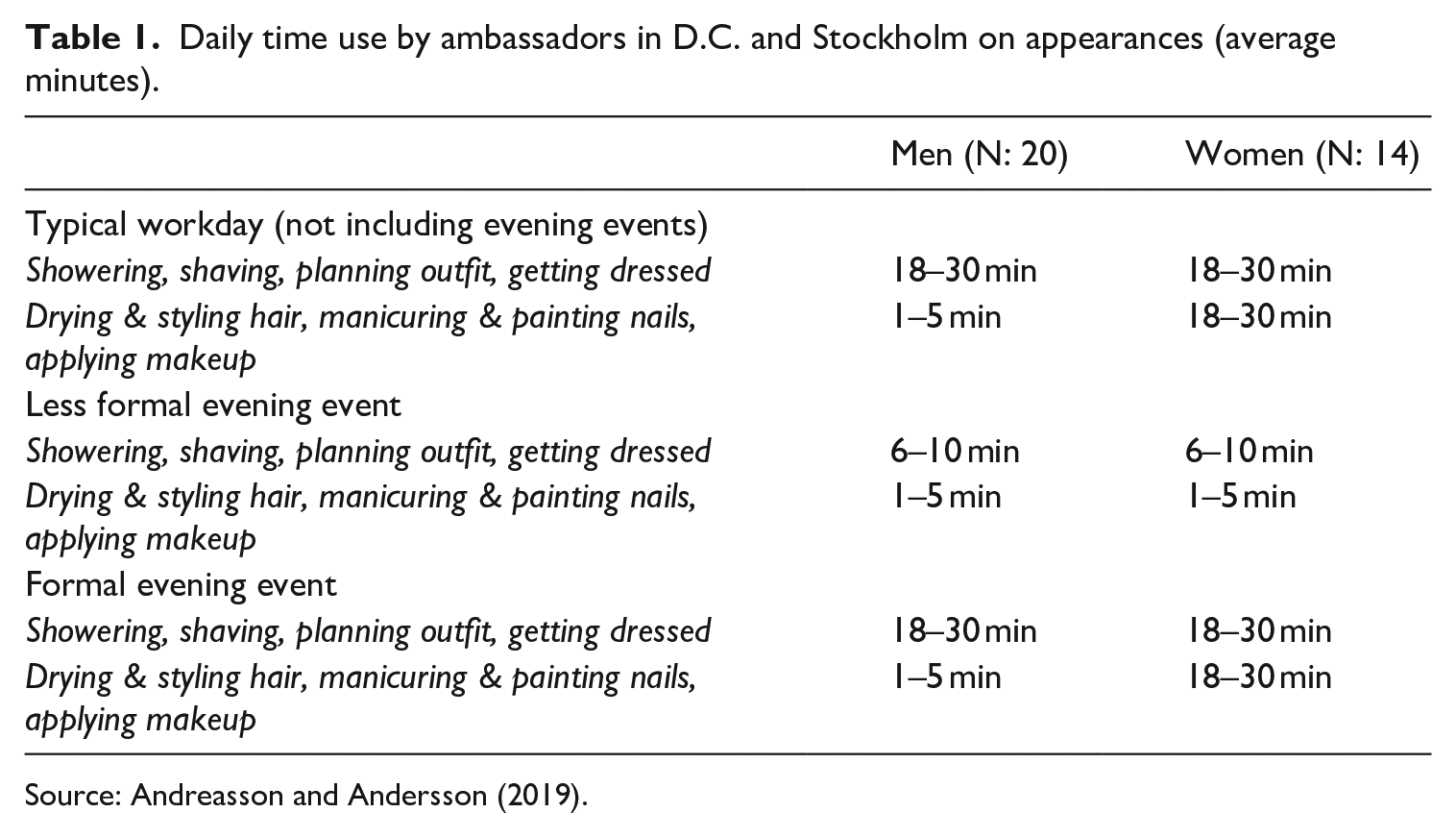
Importantly, on average, female ambassadors spend considerably more time and effort on professional appearance than do men. To dispel any doubts on this point, the time survey carried out among ambassadors posted to D.C. and Stockholm shows that although all ambassadors devote a fair amount of time to appearances, women spend more time than do men (Table 1).
Daily time use by ambassadors in D.C. and Stockholm on appearances (average minutes).
Source: Andreasson and Andersson (2019).
The survey shows that women and men spend roughly the same time showering, shaving, and getting dressed for the typical daytime workday. However, not surprisingly, women ambassadors spend 18–30 min more a day than do men fixing their hair, applying makeup, and doing their nails (in fact, virtually no men spent any time at all on makeup and painting nails, whereas all the female ambassadors did).
The ambassadors furthermore responded that they attend 1–2 formal evening events and 2–4 less formal evening events in a typical week (Andreasson and Andersson, 2019). Getting ready for the formal evening events is especially time-consuming, and particularly for female ambassadors (Table 1). Thus, although all ambassadors spend a fair amount of time preparing their appearance for work, women on average spend 4–7 h in a 5-day work week, roughly twice as much time as men do.
The interviews confirm the time survey—virtually all the ambassadors interviewed stated that appearance demands are tougher for women than for men. As one male ambassador put it: “Frankly, it’s easier for men. There are a few rules you have to stick to. Not complicated” (Male Ambassador 1). Or, in the words of a female ambassador: “it’s so easy for the men. They just grab a shirt and a tie and jump into their suit” (Female Ambassador 13). The ambassadors raised multiple aspects that make appearances more labor-intensive for women than for men, beyond gender norms on makeup and nail polish. For one, since appearance standards are less uniform—with more colors and cuts allowed—it is more noticeable when a woman wears the same outfit twice. “For women, because of the colors that we wear, people can tell if it’s the same outfit. For men, it’s straight forward” (Female Ambassador 4). Visibility on social media compounds this issue. As one ambassador stated: Yeah, you think about what to wear every day [laughter]. It is important and it is one of the things which is not easy, especially now with social media. Because you come out publicly so often and you don’t like to look the same. (Female Ambassador 7)
The long workdays, with multiple meetings and events during the day followed by semi-formal or formal events during the evening, also place unequal demands on men and women. Expectations for women’s wear change more between the daytime and evening contexts; women need considerably more time to prepare for formal events, and there is pressure not to wear the same dress to several formal events (at least not within a certain time period). In the words of one ambassador: events are a hard thing—you have to go home, change, go to the new function. Sometimes they forget to send you an invite and then want you to come anyways, so there is no time to plan. (Female Ambassador 4)
Another female ambassador explained her experience similarly, stating that as an ambassador, you try to change your clothes and reapply makeup as needed: especially when you have very high-level delegations. But you can’t change your clothes so many times in a day. You just can’t. It’s too much. Sometimes, there is no time even to go shopping for a new outfit. So you try to look refreshed even though the outfit might be the same. But that’s an issue. (Female Ambassador 7)
Managing appearances—representing states
Clearly, female ambassadors generally spend more time than men managing their appearance. What is more, they seem to think more about their appearance as diplomats than their male colleagues. None of the men interviewed had much to say about dress and appearances beyond noting their importance and the different standards for men and women. “It’s not much work for people to dress up in suits,” as one male ambassador stated (Male Ambassador 3). The female ambassadors, on the contrary, had all the more to say. One ambassador explained that looking professional is particularly important for women, in order to show that they successfully manage all the demands that an ambassador faces: Women ambassadors in particular have to pay attention to their appearance. I mean, I think that we have to for the sake of the post we are in. You have to. Nothing is worse than looking neglected. What sign are you giving others? (Female Ambassador 10)
But what is it that ambassadors do when working on gender appearances? Doing gender as ambassadors entails doing gender in a binary manner, as discussed above—one can embody and represent a sending state either as a man or as a woman, but it would be difficult to present as nonbinary. In the analysis of interviews with ambassadors in D.C. below, I show that when embodying states, ambassadors do at least three interrelated things: they try to display appropriate (a) sexuality and (b) upper class expressions while simultaneously trying to manage (c) Western/non-Western gender standards. Crucially, each of these intersecting dimensions demand more effort from women than from men.
Managing (hetero)sexuality
None of the interviewees had much to say about dress and sexuality with respect to male ambassadors. This silence can itself be read as indicative of a masculinized ideal of “asexual professionalism” (Collier, 1998) among ambassadors, an ideal expressed in the business suit. As Longhurst (2001: 99) has argued, the business suit helps create the idea of a contained and controlled male body: The suit helps to create an illusion of a hard, or at least a firm and proper, body that is autonomous, in control, rational and masculine. It gives the impression that bodily boundaries continually remain intact and reduce potential embarrassment caused by any kind of leakage.
Since the male business suit simultaneously functions as a diplomat’s uniform, it also allows ambassadors who present as men the advantages of uniformity and of more easily conforming to visual expectation.
In contrast, female ambassadors have to manage the paradox of needing to present some “femininity” while simultaneously being in greater need to seal their bodies with the business suit. In addition to wearing heels, ambassadors generally express femininity through more body-fitted cuts and the incorporation of lighter fabrics. As Longhurst (2001: 99) has contended: “when bodies are draped in soft, light fabric it is often possible to see the boundaries of the body—the rise and fall of the chest, mound of the breast, contour of the muscle.” This, she continues, expresses a body that is not so easily contained and controlled, a body where flesh and body fluids may spill over, “a body that is both desirable and disgusting” (Longhurst, 2001: 99).
Tensions between presenting femininity and asexual professionalism emerged in virtually all of the interviews with ambassadors who present as women. Indeed, they all pointed to the need for women to contain and manage their bodies in order to appear “professional.” As one ambassador explained: during the day, you do not have to be provocative where you are because you don’t want to . . . it’s just not right. And that has nothing to do with being a female or not. For me, it’s about being professional. And a dress code during the day—you can be very elegant and enjoy the way you are and the way you look without having to be provocative. (Female Ambassador 10)
Another ambassador went to great lengths to explain how a suit jacket helps contain the sexuality attributed to women’s bodies. She argued that as an ambassador: your appearance, you never want it to look sexy because that would mean you weren’t serious. But you have to be very well groomed. Me: Yeah. Then what do you do? You wear suits. Me: Yeah? Which is what men wear. . . . But here’s the thing that I and others try to do, I never want my gender or my sexuality to be an issue. I never wear low-cut blouses. I never wear short . . . and in fact, skirts in general, because they expose your legs, because when you sit you have to tuck your legs in, since the skirt comes up. And we kind of neuter ourselves, we wear pantsuits, buttoned-down shirts. And the pearls. But I just want to remove it as an issue, and I got formal training. We are like, “Your appearance should never be an issue.” So in a way, we make ourselves non-descript. (Female Ambassador 2)
The tension between expressing femininity while avoiding displays that would be interpreted as inappropriately sexual—never wanting “sexuality to be an issue”—was a recurring theme in the interviews. As expressed by another ambassador: Ok, so, like, I don’t want anyone to sit there and look at me and think that . . . “wow, that shows a lot of cleavage” or this or that, because then nobody will hear what I have to say. I mean, that is how most people think. But I do want to be feminine, like I want to be dressed in a feminine way and I like to wear lipstick and all that, but at the same time I don’t want . . . it’s the message that is the important thing, and the gravity of the ambassador position. Because of that, even if I had wanted to, I wouldn’t put on a skirt where half my butt is sticking out or wear something really low cut. (Female Ambassador 13)
Several female ambassadors also discussed having to pay attention to how they present their bodies during the workday in order to avoid sexualizing gazes. Female Ambassador 2 mentioned above that “when you sit you have to tuck your legs in,” so she avoids wearing skirts altogether. Another ambassador described how she has learned how to sit when on a stage so that the audience or photographers cannot see up her skirt. Paying attention to this is necessary: because you’re all the time under scrutiny. The photographers can sit in different—on the floor and [pointing to her crotch] so you have to be very, very aware, very cautious all the time. That’s something you learn also. And this is a burden men don’t have. It’s very easy, they have a pair of—a suit, a shirt and a tie. (Female Ambassador 5)
It is clear from the interviews that female ambassadors deem it necessary to pay careful attention to sexuality norms, so as to not transgress the fine line between presenting “femininity” and making sexuality “an issue.”
Managing class and economic costs
As discussed earlier, diplomacy remains an elite institution infused with upper class conventions. For diplomats thoroughly socialized in these conventions, the class dimension seems to be barely noticeable. However, two of the female ambassadors—both of whom self-identified as of a working class or economically poor background—described their discomfort with the gendered upper class elegance expected of ambassadors. One of them, representing a European state, explained that she grew up under humble economic circumstances in a smaller town and thus struggled to display the gendered “elegance” that seemed to come so easily for the others: The other ambassadors are so tasteful. They must feel that I [gesturing that she is not tasteful] . . . you know, they have such refined hairdos . . . like, they’re more elegant. And do you know what I think it is? The others, they come from the upper classes. They come from an educated background. They have “family silver” and, no, I don’t have that. And they’re used to this elegance. They come from a different background. Just look at their jewels! [laughter] (Female Ambassador 13)
The ambassador does not stop at describing her (self)-consciousness of class displays in diplomacy, however. She also expresses wanting to appear more elegant, like the other women, and some of the effort involved in doing so: And I feel that, when I see the other women ambassadors, that they are so elegant. And I feel that I am not at all that elegant. And that I would like to be a little more elegant. They all look so exclusive. Like . . . well, my nails are freshly painted now, but they always have manicured nails. And there I am, with my chipped nail polish . . . Well, I would never come to a function with chipped nail polish, because it looks so . . . it just wouldn’t be possible. So, there is really a difference. An enormous difference. (Female Ambassador 13)
The “enormous difference” the ambassador describes among diplomats of different class backgrounds is echoed by the second ambassador. In her case, as a representative of a non-European state and of African descent, she expresses even more discomfort with the upper class and largely European diplomatic appearance conventions, what she refers to as “bling and gowns”: I’m uncomfortable. I grew up very poor. And maybe . . . I don’t know if it’s good or bad, but it makes me a little uncomfortable . . . I just like being more true to me, and being ambassador is probably not the environment where you’re just really true—you’re always representing. I’m not a person who likes to dress up in bling and gowns. So those things– invitations, you’ll find I stay away mostly from those unless I have to go. I’m not good at that. If I have to wear something long, I will wear African gowns, because I know those you can wear. Because I am concerned I might go and I might not be dressed appropriately. So yeah, you do feel that which a man would not feel. He just puts his suit on all the time and goes. So the female ambassador has that added pressure. You want to be correct because people are looking at your appearance. (Female Ambassador 12)
In other words, this ambassador would rather avoid more formal events than risk appearing inappropriate.
We will return to the question of African gowns below. For now, it is important to note that the ambassador connects her discomfort in diplomacy not simply with being of a humble background but with being a woman of a humble background. Men can put on a suit and be done, she claims, whereas women—and particularly women not of the upper classes—have “added pressure” to meet diplomatic class standards. That said, even if none of the interviewees raised questions about the classed character of male appearance in diplomacy, it is likely that diplomats do make fine-tuned class assessments of men’s appearances and that male ambassadors of more modest backgrounds also struggle to feel comfortable in their business suits and tuxedos. But the efforts entailed in meeting those standards do not seem to match those demanded from poor or working class women in diplomacy.
In sum, so far, two broad conclusions can be made about class: in managing their appearance to embody states, ambassadors not only do gender and manage sexuality—they simultaneously do class. And in doing class, women of humble backgrounds have to do more work, as it takes them more effort to display the proper elegance in nails, hairdos, gowns, and jewelry
Managing Western and non-Western gender standards
Gendered appearance labor also entails managing the fact that D.C. diplomacy rests largely—though not entirely—on Western conventions. Since most ambassadors are either career diplomats or appointed from elite sectors where the Western business suit is also standard, many male ambassadors seem to have no difficulties managing these dress norms—they are generally already familiar with the Western business suit, having made it their own. As one male ambassador representing a non-Western state explained, figuring out what to wear upon being posted: was not difficult for me, but I assume that for some ambassadors it might be, but that would not be an issue for me . . . I’m not saying it’s trivial. I’m just saying, in my case it wasn’t much of an issue. (Male Ambassador 4)
Another male ambassador, also representing a non-Western state, has a professional background that did not involve wearing Western business suits. He did not find adjusting to Western diplomatic conventions particularly difficult, however, in large part due to formal protocol training and the simplicity of the male dress code (Male Ambassador 2).
As noted above, diplomatic protocol allows for “national” dress options during formal events. Again, this is an option selected primarily by ambassadors representing non-Western states, and generally only for the most formal occasions (such as meeting the president or hosting high-level dinners and receptions) or during diaspora events. The formal inclusion of “national” dress is expressive of the partially multinational character of diplomacy and allows ambassadors to display national distinctiveness in the midst of Western conventions. As one ambassador stated, wearing “national” attire is: basically identity. If I wear my national dress, this is the only dress in the world, it’s very specific. People look at you, they make note of you, you are visible. (Male Ambassador 2)
Notably, a number of ambassadors underscored that the diplomatic environment of D.C. is more multicultural than many European capitals, with more plural appearance standards allowing ambassador to comfortably display national distinctiveness. As one ambassador elaborated: One thing that I appreciate in the United States, even in a formal context, there is a multicultural acceptance. Compare that to Germany, where most of the time you wear formal Western clothes. In the US, they appreciate multicultural attire. I never feel out of place because I wear my country’s attire. I get so many appreciative comments; sincere comments. Sometimes I come in European attire, however. One time, I wore a European suit, and a US State Department person said “I was looking for you, my sister, and I didn’t see you. Where are the African clothes?” She was laughing, and I said I just got tired. (Female Ambassador 4)
However, not everyone agrees with this assessment. Several female ambassadors expressed feeling constrained by Western appearance standards. One of them was discussed in the “class” section above. In her view, Western attire is expected even if non-Western clothes are acceptable. And her feelings of discomfort in (Western) “bling and gowns” lead her to avoid as many formal events as possible, even if she opts for “African gowns” when she does have to attend an event (Female Ambassador 12).
Another female ambassador contended that not meeting Western appearance standards poses barriers in diplomacy. Representing a conservative Islamic state, she often covers her hair with a scarf and dresses in looser clothes that cover more of the body than many other female ambassadors. In her experience: the clothes will spark a conversation, but not necessarily more than that. There is a downside, because for a lot of people in the US, it’s actually . . . well . . . people who do not know me, my apparel distances them from me. The perception people have just by looking at me—it’s distancing. They think I am somebody they cannot connect with. Of course, they don’t know why I’m dressing the way I do. With people who already know me, it’s easy. The difficulty is with the baggage that others have when they see a woman in my clothes; they cannot break free from my outfit. For them, it’s not just an outfit—they think I’m oppressed, conservative, that I have certain beliefs they don’t understand, a whole set. I cannot get a break from being a woman, a Muslim. [Addressing an imaginary US audience:] Can you not see beyond any of this and focus on what I have to say?” (Female Ambassador 8)
Whereas some ambassadors think nothing of the Western appearance standards and others are quite comfortable displaying “national” distinction, these women clearly labor to negotiate Western and non-Western appearance norms in diplomacy. Thus, although all ambassadors express Western/non-Western appearance standards when representing their state, these norms demand more labor for some ambassadors—notably certain female ambassadors—than for others.
Conclusion: gendered labor, the representation of states, and women’s time poverty
Ambassadors represent states as gendered beings. Indeed, in managing their appearance to properly represent and embody their state, ambassadors must cite gender norms to remain what Butler (1993: 232) calls “viable subjects.” As the analysis above has shown, contemporary appearance standards in diplomacy are gender binary, with “male” and “female” versions both of dress codes and the more informal norms on hair, nails, and makeup. States can now be diplomatically represented by both women and men, in contrast with the 19th century (whereas doing so as nonbinary seems still to be unimaginable). That said, when ambassadors do gender through their appearance, they simultaneously manage diplomatic standards of (hetero)sexuality, the upper classes, Western/non-Western expressions, and more. Gendered representations of states are thus inextricably linked with sexuality, class, and Western norms in diplomacy, as feminist scholarship has long argued with respect to other arenas. Ambassadors therefore never present simply as “women” and “men”—they always also display class appropriate, sexually appropriate, and culturally appropriate appearances.
What ambassadors actually do to manage their appearance has largely been overlooked in diplomacy scholarship, particularly with respect to gender. And although the immensely popular practice approach to diplomacy provides fruitful theoretical tools to analyze appearance management, its focus on habitus, field-specific capital, and competent practices obscures the extractive and distributive character of doing gender. Incorporating a conception of labor from feminist sociology that centers the daily extraction of time and effort from practitioners allows one also to capture these dimensions of diplomatic representations. Buying clothes and accessories; planning, putting on, and changing outfits; trimming and fixing hair and hairdos; manicures; applying makeup; and the ongoing attention to one’s appearance through the workday should all be conceived of not simply as engaging competently in diplomatic practice but also as labor that extracts effort and time to produce value for the state.
Conceived of as labor, the unequal distribution of demands on diplomats’ time and effort can also be addressed. Although only certain aspects of the use of time was quantified in this study, the time survey showed that female ambassadors spend roughly twice the amount of time on clothes and appearances as their male colleagues. The interviews indicated that they also spend more time thinking about and adjusting their appearance throughout the workday. Many of the women expressed feeling stressed, insecure, and uncomfortable about meeting diplomatic appearance standards. This stress seems to be compounded for ambassadors not from an elite or Western background.
This should also be understood in light of what feminist scholars call women’s “time poverty” (e.g. Bryson, 2007: 35). Indeed, the unequal amount of time devoted to embodying states needs to be placed in the context of ambassadors generally being extremely pressed for time, with female ambassadors seemingly even more pressed for time than their male colleagues. This is in large part a function of diplomacy remaining modeled on a heterosexual couple, consisting of a male official diplomat and a diplomatic wife who shoulders a range of informal and supportive duties that are crucial but unpaid (e.g. Enloe, 2014). Ambassadors without a diplomatic wife end up doing some of the work that the wives of male ambassadors typically perform (on the importance of a diplomatic wife, see, for example, Stephenson, 2020). As one female ambassador stated: We [women ambassadors] all have experience of juggling between our children, between . . . women have to do the work at the residence, and make sure things are fine, regardless of how much help you have. You have to follow up on that. And then you have to do your work in the office. And you have to look relatively okay. That all takes time, you know? (Female Ambassador 10)
Male and female ambassadors alike describe appearance work as a “burden men don’t have” and as “added pressure” for women, due to “higher standards,” factors that may be compounded by class and culture. While now possible, embodying the state as a female ambassador entails added work and additional pressures on time.
Supplemental Material
sj-docx-3-cac-10.1177_00108367241251628 – Supplemental material for Gendered labor: Appearance management and the unequal extraction of effort and time among ambassadors
Supplemental material, sj-docx-3-cac-10.1177_00108367241251628 for Gendered labor: Appearance management and the unequal extraction of effort and time among ambassadors by Ann E. Towns in Cooperation and Conflict
Supplemental Material
sj-pdf-1-cac-10.1177_00108367241251628 – Supplemental material for Gendered labor: Appearance management and the unequal extraction of effort and time among ambassadors
Supplemental material, sj-pdf-1-cac-10.1177_00108367241251628 for Gendered labor: Appearance management and the unequal extraction of effort and time among ambassadors by Ann E. Towns in Cooperation and Conflict
Supplemental Material
sj-pdf-2-cac-10.1177_00108367241251628 – Supplemental material for Gendered labor: Appearance management and the unequal extraction of effort and time among ambassadors
Supplemental material, sj-pdf-2-cac-10.1177_00108367241251628 for Gendered labor: Appearance management and the unequal extraction of effort and time among ambassadors by Ann E. Towns in Cooperation and Conflict
Footnotes
Acknowledgements
This article owes much to a lot of people. For a close reading and careful comments, I am particularly grateful to Rebecca Adler-Nissen, Kristin Anabel Eggeling, Katarzyna Jezierska, and Birgitta Niklasson. For thoughtful feedback, I would also like to thank the participants in the research colloquia and conferences where the paper has been presented: GenDip-DiploFace Workshop (2020); School of Global Studies, University of Gothenburg (2019); Department of International Relations, Koc University (2019); and European International Studies Association (2019).
Funding
The author(s) disclosed receipt of the following financial support for the research, authorship, and/or publication of this article: The research has been generously funded through two Wallenberg Academy Fellowships from the Knut and Alice Wallenberg Foundation (KAW 2013:0178 and KAW 2020:0186).

Supplemental material
Supplemental material for this article is available online.
Notes
References
Supplementary Material
Please find the following supplemental material available below.
For Open Access articles published under a Creative Commons License, all supplemental material carries the same license as the article it is associated with.
For non-Open Access articles published, all supplemental material carries a non-exclusive license, and permission requests for re-use of supplemental material or any part of supplemental material shall be sent directly to the copyright owner as specified in the copyright notice associated with the article.
