



Abstract
In 2014, Sweden’s Feminist Foreign Policy (FFP) was announced with a fanfare. This article critically interrogates how Sweden implements the FFP through digital diplomacy by investigating the extent of Sweden’s gender equality activities on Twitter since the introduction of the FFP and by tracing gendered online abuse in digital diplomacy. I focus on Swedish embassy tweets towards two countries where feminism is highly contested – Poland and Hungary. The theoretical inspiration comes from discursive approaches to the spoken and unspoken, enriched by feminist observations about the non-binary character of voice/silence. The method applied is gender-driven quantitative and qualitative content analysis. The findings demonstrate that the FFP has not set any significant mark on digital diplomacy in the analyzed cases. The launching of the FFP went completely unnoticed and posts related to gender equality have actually decreased since 2014. There are no traces of ambassadors being subjected to gendered online abuse, but heavily xenophobic and paternalistic language is directed at Sweden as a representative of liberal policies. The article contributes to the literature on digital diplomacy by highlighting the (lack of) links between foreign policy and digital diplomacy and it addresses a gap by focusing on gender in digital diplomacy.
Introduction
In 2014, the first country in the world to do so, Sweden launched its Feminist Foreign Policy (FFP). The FFP is officially summarized by three Rs – rights, representation and resources – indicating the areas on which the foreign office should focus in its work toward gender equality in international relations. The three Rs practically encompass all spheres of foreign policy, such as aid, trade and diplomacy and, as the foreign ministry claims, the FFP is implemented ‘throughout’ and ‘at all levels’ (Government Offices of Sweden, 2019a). Even though the FFP was promoted as a new quality, it can also be seen as yet another move in the direction already practised by the Swedish state (Egnell, 2016; Towns, 2002), an externalization of Sweden’s state feminism (Bergman Rosamond, 2020). Nonetheless, the FFP clearly raised the ambition of Sweden’s leadership in gender equality around the world. So far, three more countries have followed suit, declaring their foreign policies feminist: Canada in 2017, France in 2019 and Mexico in 2020. As the then Minister for Foreign Affairs Margot Wallström proudly announced in 2019, ‘Today all colleagues relate to this policy. Civil servants in Stockholm, diplomats, local staff, administrators. We don’t have one ambassador for our feminist foreign policy – we have hundreds. . . our four years of a feminist foreign policy tell us that it is possible to do a lot if we aim high and integrate a gender perspective into everything we do’ (Government Offices of Sweden, 2019b). Sweden indeed aimed high and thus entered the spotlight as an international norm entrepreneur in gender issues, attracting a lot of attention and scrutiny, from the academic community too (Aggestam and Bergman Rosamond, 2016; Aggestam et al., 2019; Aggestam and True, 2020; Bergman Rosamond, 2020; Egnell, 2016; Robinson, 2019; Rosén Sundström and Elgström, 2020; Thomson, 2020).
The introduction of the FFP coincided with the emergence of a new arena for diplomacy, digital diplomacy. Digital diplomacy refers to the use of digital technology and social media platforms by states communicating with foreign and domestic publics (Cull, 2013). It is most often presented as a special form of public diplomacy and, as such, neatly intertwined with the construction and communication of national identity (Duncombe, 2017). Through social media and digital technology, states gain yet another forum to signal their image and identity (Jönsson, 2019), making their values and priorities known to a broader audience. In contrast to classic tools of diplomacy, digital diplomacy deliberately reaches out to wider publics, not only highly selected elite circles. It facilitates bypassing the host country’s government in establishing direct contact with the host society (Pouliot and Cornut, 2018), thus communicating without intermediaries and gaining increased possibility of ‘owning’ the message. If a country’s foreign policy is a declaration of its values and priorities (see Carlsnaes, 2002), and digital diplomacy is one of the venues where foreign policy is signalled, we should see an increased activity related to gender equality and changed (feminist) content of the Swedish digital diplomacy since the launching of the FFP.
The aim of this article is to critically interrogate how Sweden implements the FFP through digital diplomacy. More specifically, I ask: (a) What is the extent of Sweden’s gender equality activities on Twitter and how has it changed after the introduction of the FFP – has the content of Sweden’s digital diplomacy become more feminist? (b) Given the proliferation of gendered online abuse (Ging and Siapera, 2018; Levey, 2018), does it also appear there and if so, what forms does it take in digital diplomacy? The article thus makes two distinct contributions to the rapidly growing literature on digital diplomacy. First, instead of treating digital diplomacy as an isolated field of study, the article explicitly investigates the link between foreign policy and digital diplomacy. Second, it addresses a gap in the extant digital diplomacy literature, which is surprisingly silent on the issue of gender.
To answer these questions, the article focuses on the Swedish FFP on Twitter towards two countries where feminism and even the concept of gender are highly contested – Poland and Hungary. In these two countries the need for an FFP is obvious from a Swedish perspective, with a lot of room for promotion of gender equality. Recognizing that the overall direction of a foreign policy is designed in the capital, it is always concretized and practically elaborated at the embassies abroad; hence, the focus is on Swedish embassies’ Twitter accounts. The data consists of tweets posted by @AmbSzweWarszawa and @SwedeninHU between 2013 and 2019, totalling 1855 original messages, as well as replies to these tweets. To better understand the local formulation of the FFP and Twitter strategies, this data is complemented by interviews with all five former and current Swedish ambassadors to Poland and Hungary since the launching of the FFP. The content analysis of the tweets relies on discursive and feminist theories of silence. The discursive theoretical approach helps bring attention to the content of digital diplomacy and the fact that both voicing and silencing are important elements of international signalling. Feminist theorizing of the voice/silence dichotomy further questions the assumption about silence as void of agency. Moreover, feminist analyses of the digital sphere highlight that shaming and silencing of women and those conveying the gender equality message is an important mechanism of gendered online abuse.
The rest of the article is organized into six main sections. The first reviews the literature on digital diplomacy, identifying that it insufficiently investigates the link between digital diplomacy and foreign policy and that despite the growing literature on gendered online abuse, little is known about this mechanism in digital diplomacy. Next follows a short discussion of existing literature on the FFP, identifying its scarce focus on implementation and a lacuna of studies of the FFP in digital diplomacy. The third section turns to the article’s theoretical foundations, a combination of a feminist perspective on silence and voice as two equally complicated expressions of meaning, with silence as a diplomatic signalling tool. Next, the article’s data and methods are discussed. The subsequent analysis demonstrates that the FFP has not set any significant mark on digital diplomacy in the analyzed cases. The launching of the FFP went completely unnoticed on @AmbSzweWarszawa and @SwedeninHU and posts related to gender equality have actually decreased since 2014. Digital diplomacy and one of its handles, Twitter, obviously do not saturate the whole range of activities of Sweden’s FFP in Poland and Hungary. Nevertheless, the relative silence on issues related to gender equality and the FFP in digital diplomacy is in stark contrast to the loud and proud announcement of the FFP as a new quality influencing the entirety of Sweden’s foreign policy. Moreover, as the analysis shows, this silence on the issues of gender cannot be interpreted as a pragmatic avoidance of controversial topics on Twitter since both embassies post about their support for other highly contentious issues. When it comes to gendered online abuse, there are no traces of ambassadors being subjected to such treatment. However, heavily xenophobic and anti-feminist language is directed at Sweden as the representative of a feminist policy, confirming the expectation from the literature that shaming and silencing online also targets those who challenge male dominance by expressing a feminist standpoint. These findings force us to rethink the optimistic assumptions about the democratizing potential of digital diplomacy.
What we know about digital diplomacy and what we don’t
Compared to other political and social actors such as the military, business or civil society, diplomacy has been rather slow on the technological uptake (Copeland, 2013). Following the lead of the foreign office in the United States, which was first to establish a Taskforce on eDiplomacy in 2002 (later, the Office of eDiplomacy; Spry, 2018), many foreign offices now orchestrate the use of digital tools in diplomatic practice. Even though the literature notes differences in terms of the extent of adoption of digital diplomacy in different contexts, new social media are increasingly engaged in the diplomatic practice. Capturing this trend, diplomacy studies have paid more and more attention to digital diplomacy, under such inventive labels as public diplomacy 2.0, eDiplomacy, cyber diplomacy or Twiplomacy (e.g., Bjola, 2016; Cull, 2013; Manor and Segev, 2015; Potter, 2002). These studies have investigated various aspects of the utilization of digital technology for diplomatic purposes. In most cases, these are quantitative studies of the use of social media by diplomats and world leaders. The focus tends to be on how (often) digital tools are employed, how broad a reach they have and who is connected (e.g., Newsom and Lengel, 2012; Strau et al., 2015). A common entry point is an interest in how and to what extent digital tools are changing the practice of diplomacy (e.g., Heine and Turcotte, 2012), starting from the assumption that many qualities of the new media may be at odds with traditional diplomacy. The particular features of immediacy and interactivity, as well as the fact that most traffic on social media is unmediated (i.e., the input from the public is unpredictable), risk clashes with the management mores and conventions of traditional diplomacy (Cornut and Dale, 2019; Seib, 2016).
A striking feature in the literature is the normative embrace of digital diplomacy (e.g., Dodd and Collins, 2017; Kampf et al., 2015; Manor, 2016). The normative premise is that digital diplomacy will bring diplomacy closer to the people, making diplomats more responsive and accessible. This expectation of social media democratizing diplomacy has mostly been proven wrong. Apparently, despite technical possibility, social media is not utilized in a dialogical manner, but rather as an informative, one-way signalling tool (e.g., Dodd and Collins, 2017; Kampf et al., 2015). Thus, it follows the patterns observed in social media use by other public institutions (Small, 2011; Strau et al., 2015; Waters and Jamal, 2011).
The rapidly growing scholarship on digital diplomacy offers increasing insights into the who, with whom, when and how of digital diplomacy, but there is a shortage of studies of what diplomats communicate about digitally and how that communication is received. Through a focus on the content of embassy tweets, this article contributes to the existing literature in two ways. It explores the connections of digital diplomacy to foreign policy and it applies a gender lens to digital diplomacy. First, the scholarship on digital diplomacy rarely focuses on the links to foreign policy. The few existing studies argue that these should be connected and that this is seldom the case. For instance, Sobel et al. (2016) investigate the case of the US and its digital diplomacy, concluding that there is no apparent link between digital diplomacy and foreign policy orientation. A few more scholars state generally that ‘[p]ublic diplomacy is pointless if it is free-standing, separated from defined foreign policy objectives’ (Seib, 2016: 68). Digital diplomacy can be used merely to mark the embassy’s presence in the digital world, but then, as Riordan (2016) concurs, it is a waste of time and resources. In such a case, it simply becomes yet another promotion mechanism, a display window for nation branding or a nation’s selfie (Manor and Segev, 2015). Following that lead, Constance Duncombe argues that the way state representatives communicate on digital platforms ‘reflect[s] and frame[s] state identity and how a state wishes to be recognized by others’ (Duncombe, 2017: 562). She further contends that this identity limits the range of actions available for a given state internationally. The intersubjective policy-identity process (see Hansen, 2006) legitimizes (or forecloses) political possibilities for change in international relations. Thus, the fragmented observations from previous literature stress that while the link between digital diplomacy and foreign policy is often missing, digital diplomacy and the way it represents a state is important for international relations.
While feminist contributions to the broader literature on social media are quite significant, these insights have yet to find their way to the field of digital diplomacy. The growing scholarship on gender and politics online has shown that people perceived as women, and especially those not conforming to gender stereotypes, more often encounter violence online (Ging and Siapera, 2018; Yelin and Clancy, 2020). In her analysis of Twitter, Facebook and Instagram, Tania Levey (2018: 2) observes that ‘[p]osting online about feminism, rape, sexual harassment, and political representation attracts the worst online abuse.’ There is some indication that those who convey a gender equality message or challenge gender norms on behalf of others are targeted by such violence as well. The techniques used to intimidate those individuals and groups are silencing and shaming online (Levey, 2018). It remains to be seen whether digital diplomacy is spared such dynamics. Hence, part of the ambition with this article is to cast light on how gender-related issues are communicated and received through digital diplomacy.
The current article focuses on the content of digital diplomacy, analyzing its connections to foreign policy and, more specifically, the FFP. Thus, its contribution to the digital diplomacy literature is threefold. First, it is fairly uncommon to study the what of digital diplomacy, the content of digital communication by diplomats. Second, the focus on how digital diplomacy is linked to foreign policy is rather unique. Third, by including a discussion of gender dynamics in digital diplomacy I hope to start a conversation about a topic overlooked by this scholarship.
Feminist foreign policy analysis
The article also contributes to and builds on the emergent field of feminist foreign policy analysis. By two decades ago, Lisa Ann Richey (2001) was already analyzing the intersection between the Danish state identity as progressive and feminist and its development policy. Designing a feminist foreign policy, she argued, a critical interrogation of ‘development’ is needed. Other important voices in this body of work were those of Valerie Hudson et al. (2009), who argued for an intrinsic link between the security of states and security of women. Feminist foreign policy analysis witnessed a new impetus after the launching of the Swedish FFP (see e.g., the special issue in Foreign Policy Analysis 2020, no. 16). Since 2014, more and more scholars have become interested in the theoretical underpinnings, ethical potential as well as implementation dilemmas of the FFP. Existing contributions suggest that the FFP should be seen as an example of an ethical orientation in foreign policy and various analytical frameworks are suggested as useful for future studies of the Swedish FFP as well as other gender-sensitive and ethically driven foreign policies (e.g., Aggestam and True, 2020; Aggestam et al., 2019; Robinson, 2019). An interesting debate has arisen about the theoretical underpinnings of the FFP, situating it either within ‘gender cosmopolitanism’ (Aggestam and Bergman Rosamond, 2016; Bergman Rosamond, 2020) or feminist ethics of care (Aggestam et al., 2019; Robinson, 2019). While these are valuable contributions driving the study of the FFP forward, to date there have been fewer attempts at analyzing the implementation of the FFP.
In a recent article, Annika Bergman Rosamond (2020) analyzes the discursive constructions of the contents, normative ambitions and pitfalls of the FFP by a closer look at the central documents. A similar focus on policy documents, comparing the Swedish and Canadian FFP, is found in Jennifer Thomson’s (2020) article, which asks what kind of feminism characterizes the two foreign policies. One study (Egnell, 2016) traces how the FFP has been accommodated in the Swedish Ministry for Foreign Affairs (MFA), revealing that the policy was launched before the necessary training and reorganization took place at the ministry. Yet another article (Rosén Sundström and Elgström, 2020) focuses on other European Union (EU) state actors’ perceptions of the legitimacy, coherence and effectiveness of the FFP, concluding that while the FFP has some recognizability, it is not always positively viewed.
A recurrent theme in these studies is the observation of the pragmatism versus idealism dilemma that the FFP actualizes. While foreign policy is driven by national interest, the adoption of the f-word (feminist) actualizes inscription in an ethical discourse of struggle for gender equality which might collide with other rationales. Both analyses of policy documents (Bergman Rosamond, 2020; Thomson, 2020) and the institutional adaptation of the Swedish MFA (Egnell, 2016) highlight that pragmatic arguments, such as economic benefits or effectivity raising, are mixed with principled ones, where gender equality is presented as a human right. This article speaks to the growing literature on feminist foreign policy, complementing its findings with an empirically engaged analysis of how the FFP is implemented in digital diplomacy.
Voice and silence (about gender issues, in foreign policy)
Studies qualitatively analyzing content of communication often rely on discourse theory. This article is no exception. In short, discourse theory focuses on the power dynamics through an investigation of what and how things are communicated. A widely shared understanding is that to understand power we need to analyze both what is articulated and what is not; that is, silence and silencing are important objects of study (Huckin, 2002). Silence is here seen as a discursive act, not mere absence of expression. It is constructed through the practice of silencing, also self-silencing, which is ‘arising from and producing acts that make it easier for certain entities (individuals or groups) to speak and be heard in their preferred forms while at the same time making it more difficult for others’ (Thiesmeyer, 2003: 3). Usually disadvantaged actors, such as minorities or women, are subject to silencing.
One example of silencing is provided by the scholarship on gendered violence, the type of violence that has the effect of telling women to ‘shut up’ which, as Mary Beard (2017) argues, can be traced three thousand years back in time. Mona Lena Krook (2017) has shown that increased presence of women in politics as leading figures, activists and voters is accompanied by a surge of physical attacks, intimidation and harassment directed at these women. While Krook’s focus is on female leaders and voters, her observation that ‘female politicians who speak and act from a feminist perspective appear more likely to be attacked. . . given that they challenge male dominance in multiple ways’ (Krook, 2017: 82) shows the cumulative effect of gendered violence. These dynamics seem to be amplified in the digital sphere, where gendered online abuse takes the form of shaming and silencing (Levey, 2018). While women are the primary focus in studies on various forms of online misogyny (Ging and Siapera, 2018; Yelin and Clancy, 2020), it is not at all unlikely that others, such as male and non-binary persons as well as institutions promoting feminism, gender equality and LGBT rights could be subjected to similar treatment, with the same goal of disciplining and silencing these types of claims.
Importantly, drawing on discourse theory, feminist scholarship has expanded the perspective on silence, arguing that ‘we have to get beyond thinking about “silence” as equivalent to “silenced”, and recognise that silence may be active and empowering’ (Hutchings, 2019: xii). The unpacking of the simple binary of voice as an expression of agency and silence as lack thereof leads to a much more nuanced analysis (Parpart and Parashar, 2019). Such a deconstructive move ‘enables asking the question whether silence might be agentic, and if so, when and how’ (Hansen, 2019: 32). While attentive to silence as a potentially meaningful expression, we should not lose sight of power/gender dynamics involved in silencing. Cynthia Enloe (2004: 70) summarizes it well: ‘Not all silences come from a sense of being silenced, but many do.’ Following this clue, these studies focus predominantly on the silences of disadvantaged groups and individuals.
Silence, however, is not exclusively the weapon of the weak. In the case of diplomats, they are by no means underprivileged in the wider societal context. Nevertheless, the observations from the literature on discourse and silence, as well as from feminist deconstructions of the silence/voice dichotomy about silences as ambiguous, meaningful and immersed in social structures, help us understand not only how certain actors are not heard but also how certain issues might not be voiced. Indeed, among diplomacy scholars we find those focusing on both voicing and silencing as part of diplomatic signalling (Jönsson, 2016). Signalling is portrayed as a fundamental practice in international relations (e.g., Kinne, 2014; Trager, 2015) and a key way in which foreign policy is played out. Diplomats are depicted as ‘“intuitive semioticians,” conscious producers and interpreters of signs’ (Jönsson, 2016: 79) and silence is included as one instrument of signalling, on a par with expressed words. As Christer Jönsson (2016: 82) observes, ‘Silence may send messages as well.’ He describes further how the advent of new media changed the communication practices of diplomats, arguing that ‘the basic premises of diplomatic communication – searching for the optimal combination of verbal and nonverbal instruments, of noise and silence, and of clarity and ambiguity – remain’ (Jönsson, 2016: 89).
In this article, a particular site of diplomatic signalling is analyzed: embassies on Twitter. The investigation focuses on what is voiced and what is silenced when Sweden carries out its FFP through digital diplomacy in the adverse context of Central Europe and what, if any, forms of gendered online abuse can be traced.
Case selection, data, and methods: studying the content of digital diplomacy
Even though the overall direction of a foreign policy is designed in the capital, it is always concretized and practically elaborated in a given context of its implementation (Cooper and Cornut, 2019). This means that embassies abroad are crucial actors to study if we want to understand how a foreign policy works in practice. This is why this article focuses on Swedish embassies rather than on the MFA.
A common understanding in digital diplomacy studies seems to be that Twitter is the most appropriate medium to analyze. To substantiate this claim, most scholars refer to the Twiplomacy report, which states that Twitter is the most popular new communication technology tool among world government leaders (Lüfkens, 2018). Interviews conducted for this article reveal that Twitter is not always the go-to medium, at least not for embassies in Central Europe. Facebook is identified by the interviewed ambassadors as the most prevalent social medium among regular Polish and Hungarian citizens. Twitter accounts are nevertheless maintained by the embassies with the motivation that it is the space where elites such as politicians, journalists, businesspeople, NGOs and influencers can be reached. We know from previous research that Twitter is the most accessible digital diplomacy tool for research purposes. Facebook has stricter regulations about data mining, requiring permissions. For these reasons, and to enable comparisons with previous research, Twitter messages and interactions were selected as objects of study.
Twitter accounts of Swedish embassies in Budapest and Warsaw were chosen for two reasons. First, both Poland and Hungary are members of the EU and the EU has been identified as a ‘laboratory for public diplomacy experimentation’ (Melissen, 2013: 439). Since EU cooperation provides more direct and denser contacts between its member states, there is less space for traditional diplomacy. The increased ‘outreach activity, especially in the form of public diplomacy through various communication platforms’ (Archetti, 2012: 198) amongst the EU countries is explained as an attempt by European embassies to compensate for their loss of representative functions. Second, the radical right-wing governments in Poland and Hungary have systematically diverted from pro-gender equality policies, making these countries interesting for Sweden’s FFP by offering multiple possibilities to engage in promotion of gender equality. With the coming to power of Fidesz in Hungary in 2010 and Law and Justice in Poland in 2015, a series of reforms were introduced, and the official rhetoric significantly shifted to a radical conservative position. An important aspect of that shift was a turn away from liberal values, including support for gender equality, toward an active promotion of familialism as opposed to feminism (Grzebalska and Pető, 2018; Krizsan and Roggeband, 2018). The governments launched an ‘anti-gender crusade’ of a sort. 1 ‘Gender ideology’ and ‘sexualization of children in schools’ (aka sexual education) are widely debated in the government-loyal media. LGBT, an acronym hard to decipher for most Poles and Hungarians, is used as a scarecrow, a stand-in for Western colonization of traditional and ‘natural’ Polish and Hungarian values. LGBT and women’s organizations experience legal harassment in the form of cuts in funding, excessive auditing and public smearing (Human Rights Watch, 2019). Moreover, as traditional media outlets in Poland and Hungary are more and more controlled by the governing parties (Sata and Karolewski, 2019), social media has become an even more important arena for diplomatic signalling.
The analysis is based on two different sources of data. First, qualitative semi-structured interviews with current and former Swedish ambassadors to Hungary and Poland were conducted, with questions about their experience of implementation of the FFP as well as the embassy’s use of social media. Five ambassadors were interviewed in total, two Swedish ambassadors to Budapest and three to Warsaw, all of them posted in the respective capital between the years 2014 and 2020 (see Appendix 1). The interview data was analyzed qualitatively, with manual coding. According to the informed consent agreements, no direct quotes will be used in this article, only narratives derived from the interviews. Second, data from official Twitter accounts of the Swedish embassies in Budapest and Warsaw was collected. The main focus was on the original tweets posted by the embassies, but comments to these tweets were also collected. Tweets were studied to find out how and to what extent the embassies post about such issues as feminism, gender equality and LGBT rights, thus implementing the FFP in the local context.
The official embassy accounts in both countries (@AmbSzweWarszawa and @SwedeninHU) were launched in February 2013 and data was extracted until May 2019. The embassy in Warsaw has been more active on Twitter, even though the activity has faded somewhat over time, while @SwedeninHU ceased to post any tweets in October 2018, which shortens the time span for the Hungarian case. This asymmetry makes comparisons slightly tricky. Nevertheless, some comparisons of the two accounts will be presented, while the main focus of the analysis will be on @AmbSzweWarszawa, where fuller data is available. At the end of the studied period, the embassy in Budapest had in total 1269 followers and 1272 tweets (of which 299 were original embassy tweets and the rest retweets posted on their feed), whereas the embassy in Warsaw had in total 2342 followers and 3322 tweets (of which 1556 were original embassy tweets). 2 The analysis only focuses on the tweets issued by the embassies because, as the accounts make clear, retweets do not mean endorsement. 3 The method applied is gender-driven content analysis with a focus on what is voiced and what is not.
The total number of the two embassies’ tweets were manually coded based on the content, divided into seven categories: Gender equality (tweets related to gender equality, feminism, LGBT rights); 4 Foreign aid & immigration policy (also including references to events linked to ethnic minority rights, e.g. commemoration of Raul Wallenberg, and charity fairs for these ends); Business & economy (references to Swedish brands; also other themes if Swedish companies are mentioned by name, e.g., cultural events sponsored by IKEA); Other policy solutions (references to other Swedish policies such as ecology, welfare state, etc.); International collaboration (references to visits of the ambassador and Swedish politicians, participation in summits and various cooperation meetings); Culture, sport & tourism (this category also includes references to Swedish politics in general, such as appointments of new governments, elections being held, etc.); Self-promotion (promotional material for the embassy and consulates in the country, such as references to hiring of local staff, references to ambassador’s or embassy’s other social media, references to ambassador’s letters to Swedes in Poland/Hungary as well as occasional holiday wishes). 5
Twitter reactions to the embassy posts were also collected. These are crucial for understanding gender dynamics in digital diplomacy. It is noteworthy that the Swedish embassy Twitter account in Warsaw is overwhelmingly run in Polish, with only a few messages translated to English. In Hungary the opposite is true – during the studied period, the embassy only posted three tweets in Hungarian, all the rest in English. It seems reasonable to assume that posting in local languages increases the chance of interactions with the local population. Apart from a simple mapping of number of likes, retweets and comments on @AmbSzweWarszawa and @SwedeninHU, the content of all comments was analyzed to capture potential presence and type of gendered online abuse. Rather than a quantitative estimate of the proportion of negative/positive comments, I analyzed the language of comments.
Hence, the theoretical perspective this article applies is a discursive approach with its attention to the spoken and unspoken word enriched by feminist observations about the non-binary character of voice/silence. The article, however, does not resort to discourse analysis as a method. Instead, the method applied is gender-driven quantitative and qualitative content analysis. Departing from the three-level distinction set out by Norman Fairclough (1995), I opted for an analysis of the text (tweets and interview transcripts), but do not systematically trace their production and consumption, for instance through an analysis of intertextuality, or the wider sociocultural practice in which they are situated and which they produce. A gender-driven content analysis ‘bring[s] a feminist lens and feminist concerns such as women’s status, equality, and social justice to the study of [. . .] culture’ (Leavy, 2007: 224). In this way, I follow what Patricia Lina Leavy sees as a growing practice, whereby ‘many feminist researchers perform textual analysis from a deconstruction perspective [here discourse theory] in which a text is analyzed to see not only what is there but also what is missing, silenced, or absent’ (Leavy, 2007: 228). A common conclusion in ‘feminist content analysis’ is that ‘cultural artifacts’, that is, the various forms of texts analyzed, are often a ‘conservative force’ (Reinharz and Davidman, 1992: 147), preserving or even reinforcing existing gender hierarchies. It remains to be seen to what extent and how (embassy) Twitter is being used in a progressive way, as a means to spread the feminist (foreign policy) message.
Analysis of the feminist foreign policy on Twitter
The Swedish MFA’s focus on social media presence can be traced back to early 2013, when foreign minister Carl Bildt in his Statement of Government Policy declared that ‘Before the end of the month, all of our embassies will be on Twitter and Facebook. We must be at the absolute cutting edge in digital diplomacy efforts’ (Bildt, 2013: 12). As of 2019, the Swedish MFA boasts a public Twitter list of its digital network 6 with 104 missions on Twitter (including two accounts for the MFA, one in Swedish, one in English and a few doubles in local languages). The oldest of these Twitter accounts were launched in 2010, the newest in 2016. The activity on these accounts varies with respect to both frequency of updates and number of followers. As of the end of May 2019, 75% of these missions had posted more than 1000 tweets each, and 27% of missions exceeded 3000 tweets. When it comes to followers, 82% of missions had gathered more than 1000 followers each, and 38% had more than 3000 followers. This places @AmbSzweWarszawa among the more active embassies and @SwedeninHU in the lower tier. The Twiplomacy report (Lüfkens, 2018) highlights that around the world, more than 4600 embassies and 1400 ambassadors are active on Twitter. According to that report, the median average for each ambassador and mission is 1501 followers.
The interviewed ambassadors are in agreement that the use of Twitter and other social media is encouraged from Stockholm, but there is a lot of leeway in how to handle digital diplomacy. The ambassadors get some training at home and the MFA produces plenty of content that can be used on the local Twitter accounts. However, according to the interviews, what actually is posted is mostly of local origin, created by the embassy staff. This is confirmed by the fact that the two studied accounts differ significantly in terms of frequency of tweets and content of the messages.
How often?
The content analysis of tweets posted at @AmbSzweWarszawa and @SwedeninHU demonstrates that the Swedish embassies post about a variety of topics. Figures 1 and 2 below indicate the share of each theme in the total number of tweets for the respective embassy. It is clear that these themes are not distributed evenly between the two accounts.
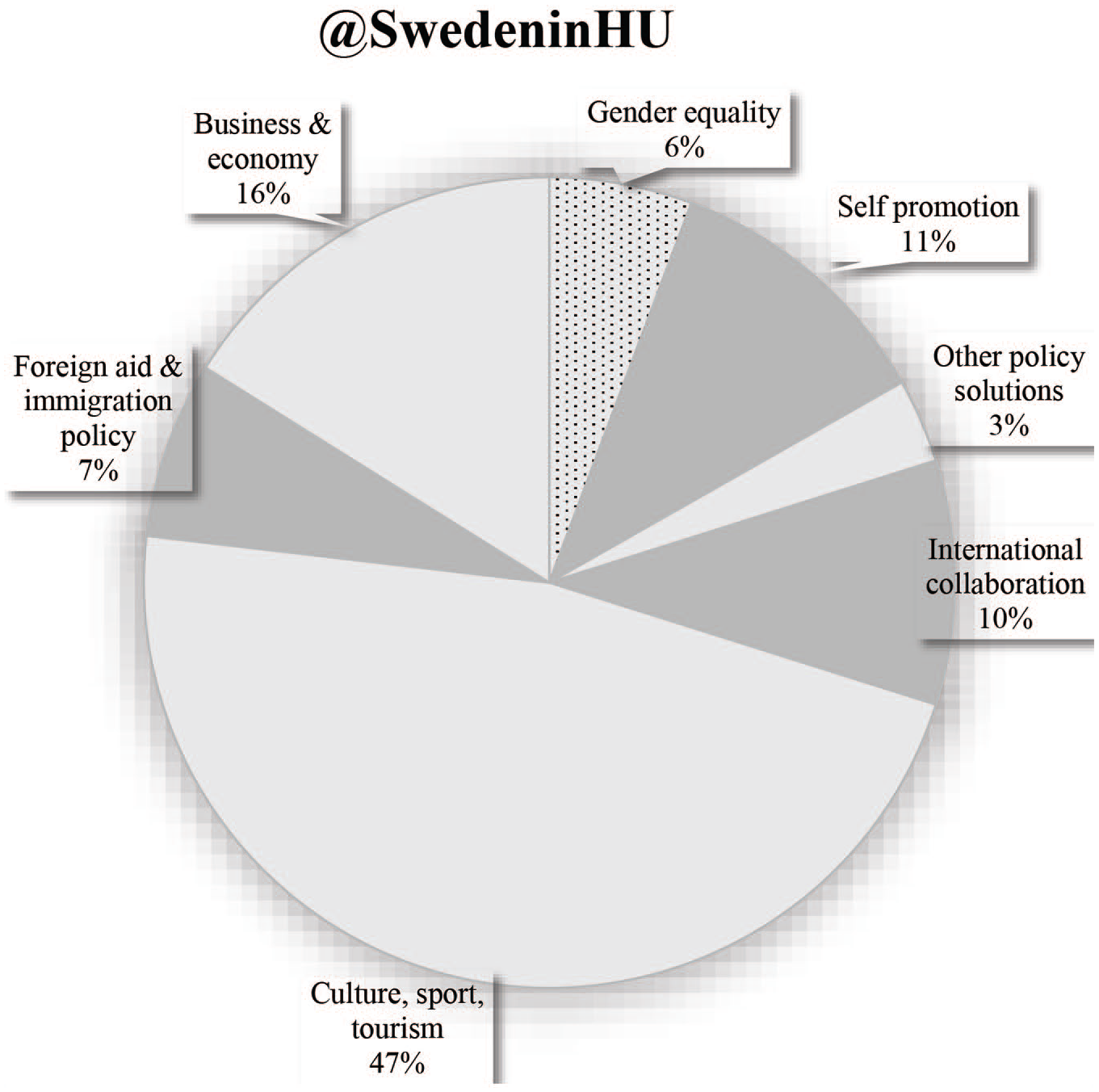
Thematic share (%) of tweets posted by @SwedeninHU.
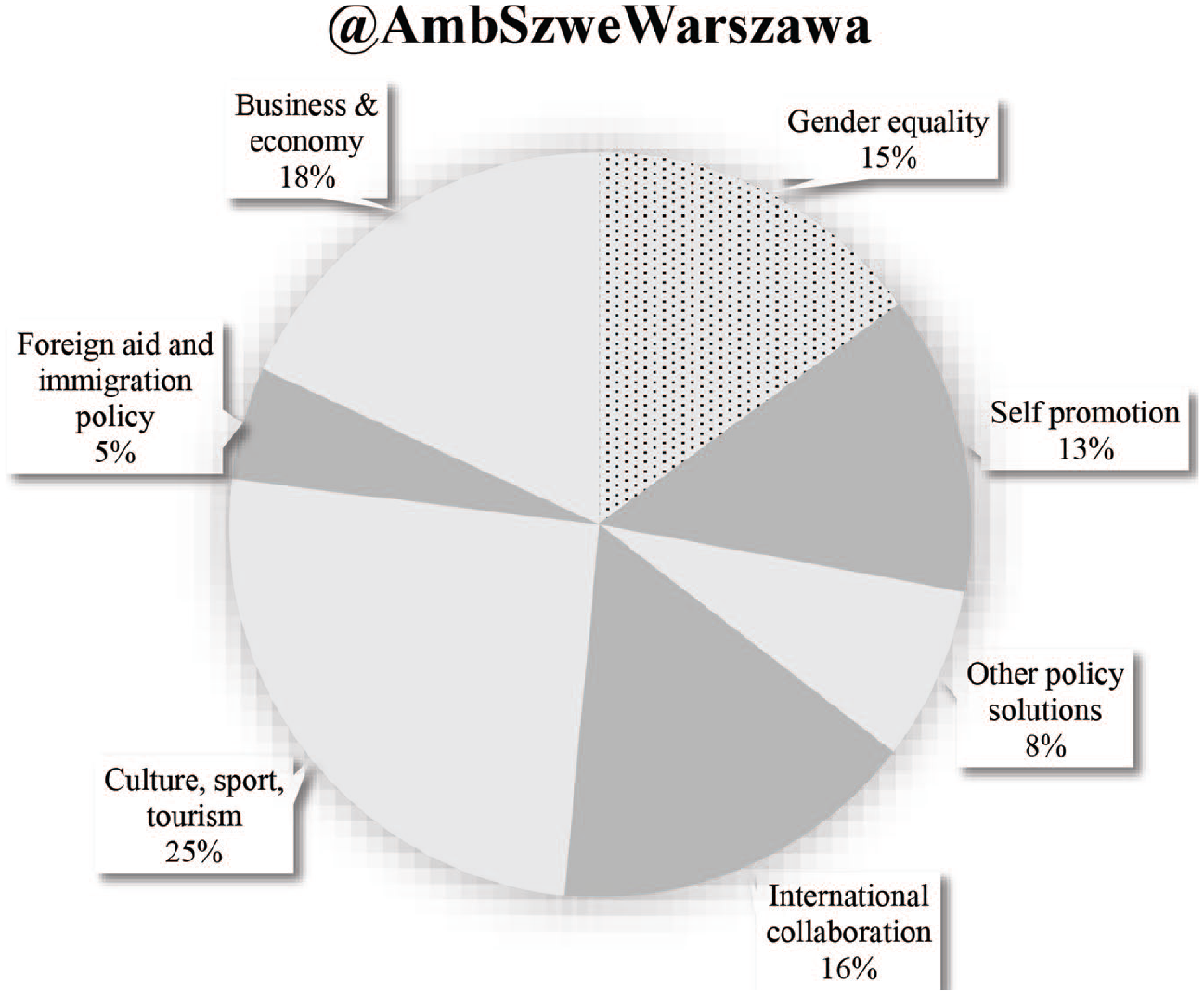
Thematic share (%) of tweets posted by @AmbSzweWarszawa.
As is evident, tweets related to the Gender equality category are scarce in both cases, especially on @SwedeninHU, which only dedicated 6% of its tweets to this topic. On @AmbSzweWarszawa, Gender equality tweets featured more than twice as often (15%), which is still not impressive given that, according to the declarations, the FFP is supposed to permeate all aspects of foreign policy and all actions. The share of three thematic categories – Foreign aid & immigration policy, Business & economy, as well as Self-promotion – is similar on both accounts (maximum variation of two percentage points), but there are bigger differences in the share of the four remaining categories. Most striking is the variation in the dominant category for both embassies – Culture, sport & tourism – which amounts to one-quarter of all tweets in Poland and almost half (!) of all tweets in Hungary. The categories of Gender equality, Other policy solutions and International collaboration were posted about twice as often by the embassy in Warsaw.
When it comes to the more fine-grained reading of the content of Gender equality tweets, it is noteworthy that neither of the embassies explicitly publicized the introduction of the FFP on their Twitter feeds. Nor can we observe an upswing of tweets related to gender equality after 2014 when the FFP was launched. Instead, the opposite is true for both embassies. The more ample Polish data allows for more detailed analysis over time. 7 If there is a pattern visible in that data, it seems related to the preference of individual ambassadors, with regard to both frequency and more specific framing of the gender equality issue. It is pretty clear that during the posting of Ambassador Staffan Herrström (2011–2015), @AmbSzweWarszawa posted tweets related to gender equality much more often than during the postings of the following two ambassadors. As evidenced in Figure 3, tweets related to that issue appeared 2.5 times more often during Herrström’s posting and they did so even before the FFP was launched. We can also see a clear declining trend over time in the use of Twitter in general by the embassy. During Ambassador Herrström’s time in Warsaw an average of 29.7 tweets per month were posted, which have gradually decreased to less than half of that under the current Swedish ambassador to Poland. Inga Eriksson Fogh and Stefan Gullgren were equally (in)active on the issue of gender equality, feminism and LGBT rights on Twitter (an average of 1.4 tweets in this category per month), but considering the lower general activity on @AmbSzweWarszawa during Ambassador Gullgren’s tenure, the relative share of tweets related to gender equality increased slightly during his time in office.
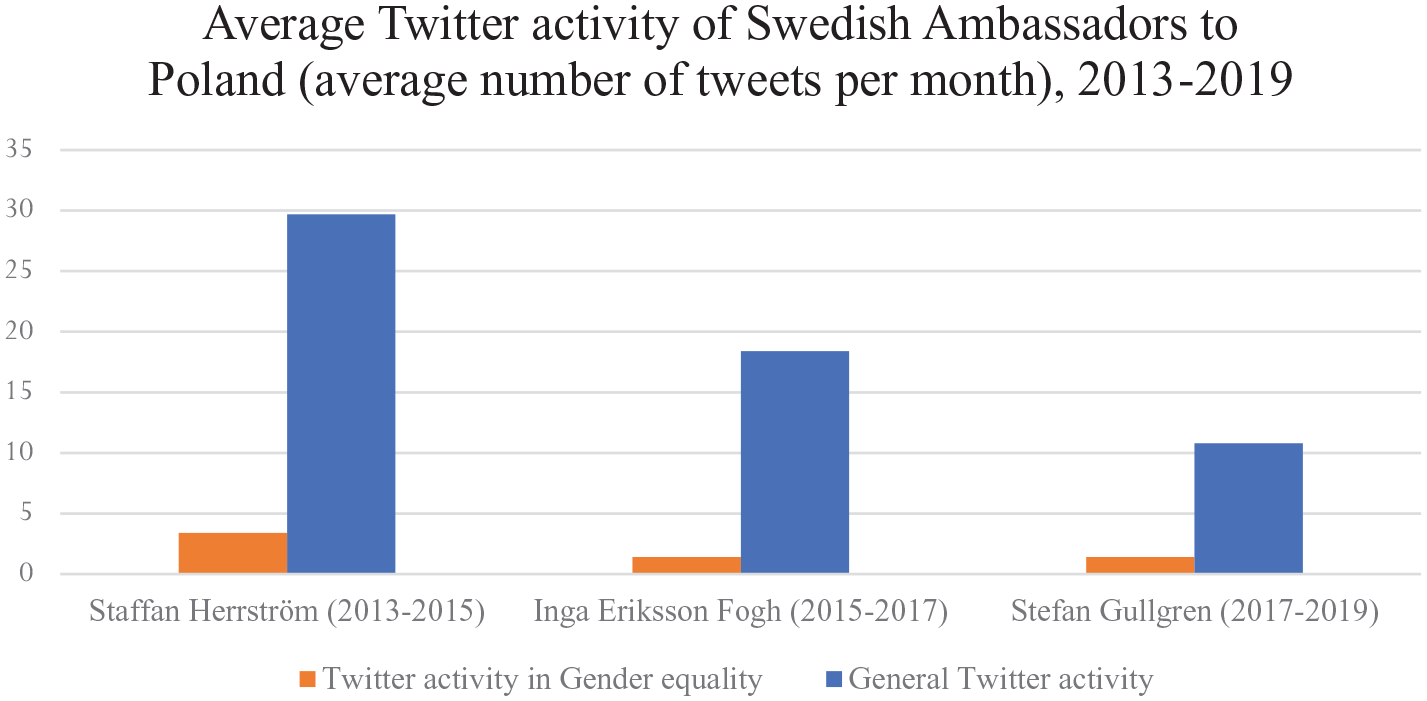
Twitter activity on @AmbSzweWarszawa split by Swedish ambassadors to Poland.
Silence is the message?
One note of caution is relevant here. The posting of Inga Eriksson Fogh, and the observed drop in mentions about gender equality, feminism and LGBT rights on Twitter, coincided with the coming to power of the populist right-wing Law and Justice party in Poland in October 2015, and their introduction of harsh measures against gender equality and feminism. In such a context, the less prominent reporting on these issues on @AmbSzweWarszawa might be a sign of self-silencing, an attempt to avoid explicit confrontation. For instance, it is remarkable that the biggest street protests in Poland around gender issues (reproductive rights), the so-called black protests, which took place in October 2016 sparked by a law proposal on a total ban on abortion (Król and Pustułka, 2018), are not at all visible on the embassy’s Twitter feed. As the ambassadors assured us in the interviews, Twitter is used for quick messaging about current issues, but there is always a concern about being accused of taking sides in political debates in the host country. With gender equality and feminism being so politicized, silence about these issues might be read as a pragmatic move. Remarkably, however, on several occasions, the importance of freedom of the press and rule of law are mentioned, also highly contentious issues after Law and Justice came to power.
Likewise, the relative silence on @SwedeninHU on issues related to gender equality can hardly be interpreted as avoidance of confrontation on a controversial issue, because the embassy does not shun other locally highly contentious topics such as migrants’ rights and freedom of the press. There are tweets about the embassy supporting and its personnel participating in marches against the government closing media outlets and expelling the Central European University from Budapest. One high-profile gender equality issue that the embassies explicitly mention on Twitter, breaking the silence, is the support for local Pride Parades, as, for example, in ‘Today it’s #PrideParade2016. We are present. We support!’ (2016-06-11 @AmbSzweWarszawa). Together with a significant number of other embassies, support letters are signed every year, and this fact is announced on Twitter. Should we, then, see silence on the issues of feminism and gender equality as deliberate and selective self-silencing?
Instead of assuming intentionality behind the silence, one might follow observations from previous literature (Egnell, 2016), and see this silence as an implementation glitch, resulting from lack of training on issues related to gender equality and feminism among Swedish diplomats. However, according to both Robert Egnell (2016) and the interviewed ambassadors, this initial insecurity about what the FFP meant and how it was supposed to be put in practice was amended quickly, and thus has to be refuted as a viable explanation for the lack of more prominent promotion of gender equality on the analyzed embassy Twitter feeds.
The pragmatism of the FFP
Among the scant messages about Gender equality, a coupling of this theme with Business & economy is prominent during the whole studied period, markedly increasing over time. Tweets like ‘Ongoing conference about Gender (in)equality-how much it costs? Searching for life work balance’ (2013-05-22 @AmbSzweWarszawa) or ‘Gender equality important for economic growth in Europe - PM Stefan Löfven at press conf in Warsaw’ (2015-03-16 @AmbSzweWarszawa) abound. In Warsaw, during the last two years, over one-third of all tweets in the Gender equality category were closely linked to Business & economy. These were references to interviews with successful Swedish business leaders in Poland, women and men, talking about the direct value of gender equality and how it ‘pays’. Linking economic arguments to promotion of gender equality abroad is not a framing invented by the embassy. It follows the recommendations from the Swedish public diplomacy agency, the Swedish Institute. In a report about the perception of gender equality and feminism in selected countries abroad, the Swedish Institute concludes that to be successful in promoting gender equality, ‘economic, pragmatic arguments instead of ideology’ (Svenska Institutet, 2016: 9) should be used. The pragmatic stance is obvious here. The line of thought is as follows: an effective promotion of the FFP requires various arguments and tools, a mix of idealism and pragmatism (see also Aggestam and Bergman Rosamond, 2016; Bergman Rosamond, 2020).
Such a framing is not unusual in public discourse around feminism in Sweden or elsewhere. For instance, when launching the HeForShe campaign in Sweden in June 2015, the Swedish Prime Minister stressed that ‘Gender equality is as ethically right as it is economically smart. For this reason, it is the way forward for Sweden’ (Government Offices of Sweden, 2015). Such a pragmatic argument, akin to neoliberal feminism, emphases empowerment through economic liberalism as a route to gender equality and women’s emancipation (Bergman Rosamond, 2020; Rottenberg, 2018; Yelin and Clancy, 2020) and is an effect of the neoliberal logic being incorporated by state feminism (Kantola and Squires, 2012). The FFP clearly showcases this mix (see Egnell, 2016). Gender equality is presented as a means of achieving economic growth at the country level and a smart investment for individual companies. Such a representation could be read as contrasting the alternative frame of gender equality as a universal human rights issue, an intrinsic value worth pursuing on its own. Asked about the clash between these framings of gender equality, all the interviewed ambassadors underlined that strategic-economic and rights arguments are not in opposition but rather reinforce each other, an argument debunked by feminist scholars, who rather claim that this is a sign of feminism being co-opted by economic ends, ‘leav[ing] structural gender inequality unrecognized’ (Thomson, 2020: 427). The ambassadors also put forth the view that the utility argument is simply more effective, especially in countries where the intrinsic value of gender equality is not widely recognized, as is the case in Central Europe after the illiberal turn.
Even though digital diplomacy does not reflect the totality of the embassies’ undertakings, the analysis so far has evidenced that Swedish digital diplomacy in Poland and Hungary, assessed by the embassies’ use of Twitter, shows only meagre or no apparent links to the FFP. There is very little content that can be associated with gender equality, feminism or LGBT rights promotion, and the launching of the FFP went totally unnoticed. Nor has the content of digital diplomacy become more feminist since 2014. It appears that this relative silence is part of diplomatic signalling, a pragmatic move. This reading is reinforced by the framing of the few gender equality messages present on Twitter. Efficiency arguments close to neoliberal feminism stand out, which seems to be in line with how the FFP is framed in the capital. The next section looks into Twitter interactions to provide an answer to the last research question – whether and how gendered online abuse is present in digital diplomacy.
The dark side of digital diplomacy
In general, the two Swedish embassies’ Twitter accounts get meagre attention from the public, measured by retweets, likes and replies. One-way communication dominates (i.e., the embassy sending out a message that remains without any reaction at all), which corroborates previous scholarship on social media use by public institutions (e.g., Bloodgood and Masson, 2018).
Only seven tweets on @SwedeninHU received 10 or more reactions (retweets, likes and/or replies), and none of them exceeded 50 reactions. This is why the following analysis focuses on @AmbSzweWarszawa. In the Twitter account of the Swedish embassy in Warsaw, 89 (6%) of all tweets posted in the studied period got moderate attention, that is, received over 10 likes, replies and/or retweets. Only nine tweets got 50 or more reactions, and just four got more than 100 such reactions. Looking at the thematic distribution of those tweets, the three biggest scores among the tweets that received moderate attention (minimum of 10 reactions) were found in the Culture, sports & tourism category (27 embassy tweets), Gender equality (21), and Self-promotion of the embassy (20). Top attention scores were found in the category of Immigration policy and Self-promotion.
The one single topic dominating the comments on @AmbSzweWarszawa during the analyzed years, irrespective of the topic of the original embassy tweet, is the issue of the so-called no-go zones in Sweden, and the alleged threat that Swedish immigration policy poses to Swedes, especially Swedish women, and tourists in Sweden. This online activity was sparked in September 2015, when Jarosław Kaczyński, the leader of the ruling Law and Justice party, gave a speech to the Polish parliament in which he mentioned Sweden’s ‘54 sharia zones’ where the police do not dare enter and Swedish girls are not allowed to wear short dresses (tvn24, 2015). The embassy was quick to remark that this was not an accurate depiction of Sweden: ‘There are many misunderstandings about immigration to Sweden, e.g., the question about law. We explain: in Sweden the Swedish law is followed’ (2015-09-16 @AmbSzweWarszawa). This statement caused many harsh reactions on Twitter, most immediately in the hours and days following the embassy tweet, but even three years later, in 2018, there were comments referring to this event. The discussion ridiculed the embassy’s denial as an act of political correctness, with new ‘facts’ proving Kaczyński was right. Among the many strongly xenophobic and anti-Muslim comments, a few also mention issues of gender, bringing up the image of Sweden as the international rape capital, and linking rape statistics to number of immigrants in Sweden: ‘In Sweden there is sharia rule and you are the rape capital of Europe’ (2015-09-17 @Peter Pan); or ‘YourCountryHasMostRapesOnWomenIn Europe!2placeInTheWorld!MuslimsRapeYourWivesMothersSistersDaughtersChildren’ (2015-09-17 @###siwy). Such tweets depict women as void of subjectivity – women become rape statistics useful to further the xenophobic argument. They are portrayed as actual or potential victims in need of protection. Hence, the language is paternalistic rather than misogynistic.
The embassy kept silent, not responding to those hostile comments. The interviewed ambassadors confirm that not engaging with critical or aggressive comments on social media is a deliberate strategy of ‘not getting into a spiral’. This tactic resulted in open irony about the ‘embassy SWE being childish. “Head in the sand, we’re not here”’ (2015-09-24 @OstrAdam). The comment clearly alluded to the understanding of silence as lack of agency and thus responsibility. Repeatedly, suggestions to pose questions in Arabic appear to prompt the embassy into action. Some ridiculed the silence from the embassy as caused by them being busy ‘counting the zones where the Swedish law is not followed’ (2015-09-25 @garibaldi1965). The commentators eagerly engaged with each other, deriding the few who tried to object to the tone or content of the xenophobic comments. The embassy Twitter account became a forum living its own life, on the side of the official messaging. As one comment has it, ‘Trolling the embassy has never been easier. It would have been funny were it not for the topic which the @AmbSzweWarszawa is failing to address’ (2017-01-24 @pp_olszewski). Again, silence is interpreted as a failure to act.
There are plenty of angry references to how the embassy handled the issue in the first place, by openly speaking up against Kaczyński, thus daring to interfere in Polish internal affairs, and the subsequent silence and non-responsiveness to the questions from the commentators. The messages sent on embassy Twitter, about Sweden as a model country, clearly vexed the audience. Even apparently neutral and harmless tweets from the embassy provoked stark reactions and discriminatory comments. For instance, under the embassy tweet about Swedish companies as innovation leaders (2017-03-23 @AmbSzweWarszawa), we can find a response: ‘you are also European leaders in rapes and murders’ (2017-03-23 @Morowa_Panna). A few minutes after the embassy posted a tweet about ‘Sweden as a family friendly country. #family #profamilypolicy #paternityleave #fathers #mothers #children #gender equality’ (2017-07-18 @AmbSweWarszawa), @KrisTheSavage (2017-07-18) responded: ‘They forgot to mention the sharia zones, girls’ genital mutilation and the wave of rapes.’ The nationalistic, xenophobic, paternalistic, homophobic and anti-left comments are woven together, forming an indistinguishable cluster. ‘Pedophilia, zoophilia, abortionism, gender, euthanasia and deviant Islam. . . Sweden is a beautiful country. Is it?’ (2017-02-18 @prof. Wiktor Kuppelweiser). Such mixes are by no means unique for this site. The juxtaposition of various examples of discriminatory language, often a blend of xenophobia and misogyny, is observed by scholars of populism and social media alike (e.g., Alston, 2017; Plaza-Del-Arco et al., 2020). However, so far, these dynamics have not been highlighted by scholars of digital diplomacy.
It is widely recognized that ‘platforms like Twitter encourage extreme content, and algorithms reward polarisation’ (Lanier, 2019). Nevertheless, the contrast between the way the embassy uses Twitter to signal about Sweden’s leading position in the world in various fields and some public responses to this signalling is striking. Importantly, because of the chosen strategy of non-engagement by the embassy, there is hardly any communication between these two flows, both taking place in the same Twitter space of the Swedish embassy in Warsaw. While understandable, given the harsh tone of the comments, it might be argued that refraining from dialogical engagement goes against the ‘key norms in the implementation of gender-just external relations’ (Aggestam et al., 2019: 33).
Concluding reflections
The aim of this article was to critically interrogate how Sweden implements its FFP through digital diplomacy. Digital diplomacy was treated as one medium among others in the diplomatic signalling toolbox available in international relations. The article contributes to the rapidly expanding digital diplomacy literature in several ways. First, it is fairly uncommon in that scholarship to focus on the content of digital diplomacy. Second, this study investigates the links between digital diplomacy and foreign policy, which is rather novel, linking two literatures that are often separated. Third, by focusing on the FFP on Twitter and tracing gendered online abuse, the article introduces a gender perspective to the field of digital diplomacy. Another contribution is to the literature on feminist foreign policy analysis, which up to now has not focused sufficiently on the implementation of the FFP. Moving beyond studies of policy formulation, this article is the first to provide a systematic account of how the FFP is implemented in digital diplomacy. The research questions targeted the extent of gender equality tweeting since the launching of the FFP, the feminist content of embassy tweets as well as prevalence of gendered online abuse in responses to the embassy tweets.
The results highlight that there is very little messaging about feminism, gender equality and LGBT rights on the analyzed Twitter accounts. There is no visible trace of the FFP being launched as a new foreign policy direction and tweets related to gender equality actually decrease over time. The pattern discernible in the embassies’ Twitter use is related to the posting by individual ambassadors and the issues they (and their staff) seem to have prioritized to highlight on social media. This suggests that digital diplomacy, as represented by @AmbSzweWarszawa and @SwedeninHU, is detached from the direction set out by foreign policy, thus confirming findings from previous research (Sobel et al., 2016). Both foreign policy and digital diplomacy can be seen as discourses about national identity (cf. Hansen, 2006), but it would be naïve to expect full overlap between these discourses. Digital diplomacy, also because of the nature of this medium, will never fully mirror a country’s foreign policy. However, foreign policy and digital diplomacy can signal a more or less coherent picture of a national identity. Findings from this study indicate that despite loud campaigning about the FFP as a new quality in Swedish foreign policy since 2014, Sweden’s digital diplomacy is rather silent in this respect. In light of feminist work on voice and silence, this silence is interpreted as a choice not to fully engage with the FFP in digital diplomacy (by more openly and more frequently discussing issues of feminism, gender equality and LGBT rights). It seems clear that the silence on gender issues analyzed in this article runs the risk of limiting the impact and credibility of the FFP. When the embassies use Twitter to boast about Sweden’s various achievements in sports, in business, in international rankings of all sorts, digital diplomacy appears to align more with the promotional logic of nation branding (Jezierska and Towns, 2018) than with being another tool of communicating interests and identity, i.e., of realizing foreign policy. I contend that, in order to account for more than mere digital presence of the embassies (Riordan, 2016), there needs to be a distinguishable link between the sending country’s foreign policy and its digital diplomacy. A detachment of (the study of) digital diplomacy from foreign policy (analysis) risks obscuring how digital diplomacy, here understood as what and how state representatives post on social media and how they choose to interact in the digital sphere, co-creates these states’ international identity. Through digital diplomacy the states express a certain image and gain a certain reputation. It is highly problematic if these are at odds with the orientation declared in their foreign policy.
Apart from exploring the links between digital diplomacy and foreign policy, this article also sought to expand the digital diplomacy literature by incorporating a gender lens. By focusing on how a gender equality message is received, I investigated traces of gendered online abuse in digital diplomacy. The limited data in this article make generalizations difficult, but it is noteworthy that gendered abuse was not discovered in the analyzed material. However, evidence of an unholy mixture of xenophobic and paternalistic comments was found. The embassies refrained from engagement with these reactions, which apparently provoked new discriminatory comments.
While silence is always ‘fraught with ambiguity’ (Hansen, 2019; Hutchings, 2019), it is nevertheless meaningful. There are also limits to the assumption of intentionality – not every silence is a deliberate act of diplomatic signalling. Two types of silence were identified in the analyzed material – the relative silence on @AmbSzweWarszawa and @SwedeninHU on issues related to gender equality and silence as response to comments on these accounts. With respect to the former, it might leave the impression of Swedish digital diplomacy conforming to locally hegemonic norms of illiberal anti-genderism instead of promoting gender equality. It appears as a pragmatic move, i.e., concerns about smooth relations between nations gaining preference before promoting feminism in an adverse context. This tactic is especially striking if we realize that the embassies did not avoid conflict with local authorities about other highly politicized issues such as freedom of expression and rule of law. Hence, scarce tweeting about gender equality is interpreted as selective self-silencing, in effect depreciating the feminist profile of Swedish foreign policy. The second silence, namely, ignoring discriminatory comments, is also a deliberate strategy clearly signalling distance and non-acceptance of such language by the diplomats. Here, deliberate silence can be read as resistance to injustice and harmful behaviour (Parpart and Parashar, 2019: 6). It casts a shadow on the possibility of dialogic communication heralded both by digital diplomacy and feminist foreign policy scholars. If and how digital diplomacy should engage in such encounters is a question future studies might want to engage with.
Footnotes
Appendix 1
Acknowledgements
Earlier drafts of this article were presented at the GenDip workshop in 2019 and at the ECPG conference in 2019. The insightful comments received during these occasions were invaluable. I would also like to thank the anonymous reviewers for their helpful and constructive reading. Finally, I am grateful to Jędrzej Świeżewski, my talented brother, for assistance in data compilation.
Funding
Research for this article was funded by The Swedish Research Council (2017-01426).
