




Abstract
Contributing to the ‘narrative turn’ in International Relations and offering an answer to the question ‘What makes a strategic narrative efficient?’, this article adds to the methodological theorization of the formation and projection phases of the narrative’s lifecycle. We suggest that the impact of the constructed image in the narrative can be reinforced by the interplay of at least three projection properties: (1) content accentuation and priming, through iterations; (2) content contextualization, through historical and cultural resonance with the consumers’ memories; and (3) content verbalization, through narrative tactics that evoke a range of the consumers’ involved attitudes to the framed image. These properties, being intrinsic ingredients of the projected content, tend to enhance emotions. In our work, they get traction in the antagonistic narrative tailored by the Russian propaganda to depict Ukraine orientated towards the European Union (EU). The empirical case study analyses articles published on the Russian e-news platforms portraying the EU granting Ukrainians visa-free travel to the Schengen area in 2017, a milestone in Ukraine–EU relations. We define Russia’s narrative, created in reaction to this event, as antagonistic and consider it to be a precursor of the aggressive narrative crafted/employed by Russia to justify its 2022 military assault on Ukraine’s sovereignty.
Keywords
Introduction
24 February 2022 – the day of the Russian Federation’s military full-scale assault on Ukraine – marks a watershed in the geopolitical history of the 21st century. While this act of aggression took many commentators by surprise, an attentive look into the Russian strategic narrative – the story furthering an official political strategy via the construction of ‘a shared meaning of the past, present and future of international politics to shape the behaviour of domestic and international actors’ (Miskimmon et al., 2013: 2) – sheds light on the historically complex contexts behind the roots of this aggression. Several key inputs shape these long-term contexts, influenced in a major way by the 2012 elections in the Russian Federation (hereafter Russia), which secured Putin an unprecedented third term in the Kremlin. Following a series of ‘colour’ revolutions in the post-Soviet space in the early 2000s, culminating in Ukraine’s Maidan in 2013–2014 and the annexation of Crimea in 2014, the 2016 Foreign Policy Concept of Russia formulated a particular message about the country’s role in the modern world. In it, ‘Russia seeks to achieve its strategic goal of establishing a sphere of influence in its neighborhood and projecting its status as a “global player”’ (Herd and Marshall, 2016: 10). In compliance with this ‘storyline’, Russia was narrated as prioritizing the value of sovereignty and non-interference by others in its domestic and foreign affairs while openly stressing its regional supremacy in the post-Soviet space, vis-à-vis the Euro-Atlantic expansion into this region. The post-Soviet independent states, opposing the post-USSR reintegration and aspiring to escape the traditional geopolitical sphere of Russian influence in favour of the West/the European Union (EU), were perceived by Russia as a threat (Headley, 2018). Accordingly, the later strategic formulations – and specifically the essay ‘On the Historical Unity of Russians and Ukrainians’ by Putin (2021) – framed sovereign Ukraine in strongly antagonistic terms.
We assert that the study of strategic narratives is not merely an exercise in heuristics, but a powerful tool with which to understand broader geopolitical phenomena in a world in flux – where the multilateral International Relations (IR) are at risk of failing vis-à-vis the ‘great power’ politics. Critical voices in the scholarship of political narratives ask how exactly they can mobilize groups (Dixon and Gellman, 2020) or, in other terms, ‘What makes a strategic narrative efficient?’ Answering this question requires new research methodologies to which this article aims to contribute. Here, the proposed methodological framework is further applied to the analysis of the successive versions of Russia’s strategic narrative on Ukraine. We argue that since the disintegration of the USSR, this narrative has developed within the oppositional scale ‘SELF/GOOD versus OTHER/BAD’. Here, Ukraine, initially identified as SELF/GOOD (a part of the USSR headed by Russia) came to be recognized first as NOT-OTHER/NOT-BAD, then NOT-SELF/NOT-GOOD and, finally, OTHER/BAD (a ‘traitor’ to the USSR ‘family’ with Russia as the ‘senior brother’). Our study considers the NOT-SELF/NOT-GOOD and OTHER/BAD versions, where the portrayals of Ukraine are defined as the antagonistic (pre-escalation of the war in 2022) and the aggressive (following the 2022 full-scale invasion) narratives respectfully. In this article, we intend to reveal the properties of Russia’s antagonistic media narrative on Ukraine, with the study of its further aggressive version to follow. Thereby, we clarify some important dimensions in the relationship between Russia and Ukraine relevant for the understanding of the retrospective setting of Russia’s surge of aggression.
The research methodology we employ contributes to the scholarship on the strategic narrative of its formation and projection life phases. The analysis of the formation phase employs a novel algorithm, which constructs the narrative-based political concept (NBPC), or mental image. This integrates information about particular emotively connoted facts portrayed in multiple thematically homogeneous texts (Zhabotynska and Velivchenko, 2019). The analysis of the narrative’s projection phase shows how these texts transmit and reinforce the constructed image via the interplay of at least three projection properties: (1) accentuation of the factual and emotive content, through its iterations, (2) amplification of emotions, through historical and cultural contextualisation of the content and (3) diversification of emotions in their verbalization, through narrative tactics that evoke consumer’s involved attitudes to the constructed image. Ultimately, the proposed framework helps to understand the tools and instruments for projecting antagonistic strategic narratives and to suggest the ‘propaganda effects of such a strategy on the domestic Russian population’ (Herd and Marchall, 2016: 10). Empirically, informed by an interdisciplinary approach, combining the insights from IR, media and discourse enquiries, psychology and cognitive linguistics, our study showcases antagonistic media narratives of suppression, destruction and direction (Wagnsson and Barzanje, 2019) published on Russian e-news platforms, which depict Ukraine as being orientated towards the EU. Our enquiry focuses on the EU’s granting of visa-free travel to the Schengen area for Ukrainians in 2017, which has become one of the milestones in EU–Ukraine relations.
We start by outlining the contribution to the strategic narrative theorization within IR and introduce our new theoretical framework. The next section details the data, methods, findings and discussion of the empirical study that supports the theory. Conclusions summarize the results of this study, pointing to their theoretical and practical implications, and sketch perspectives for future research.
Theoretical framework: strategic narrative and its efficiency
Strategic narratives in the IR theoretical debate
Scholarship on narratives in contemporary IR has become established in the last decade, heralding the so-called ‘narrative turn’ (Oliveira, 2020; Wibben, 2010: 23). Researchers in this field share the view that narratives are complex, sense-making constructs used to gain legitimacy and trigger action and participation in IR (Bruner, 1991). Comprehensive reviews of the research on narratives in IR (see Crilley et al., 2020; Hagström and Gustafsson, 2019) argue that narratives are ‘integral to important contemporary issues such as security, war, justice, migration, inequality, race and gender, to name a few’ (Crilley et al., 2020: 631). Theoretical debates on narratives in IR – and in political science in general – are multiple and diverse. An exhaustive account of the vibrant literature engaging with the concept of narrative is beyond the scope of this study. Here we consider three theoretical paradigms, which form an interdisciplinary notion of the narrative in IR from somewhat differing perspectives: the narrative’s ‘strategicality’ (Miskimmon et al., 2013, 2017); the narrative’s ‘power’ (Hagström and Gustafsson, 2019) and the narrative’s ‘ontological security’ (Steele and Homolar, 2019). The key ideas of these theoretical conceptions are compatible: strategic narratives that further a political strategy should exercise power so as to be accepted and appropriated by the audience whose memory and own security (security of Self) resonate in consonance with such narratives.
The narrative’s ‘strategicality’, which primarily informs our study, highlights several key notions relevant for this research. Namely, the strategic narrative theory maintains that the strategic narrative constructs a ‘shared meaning of the past, present, and future of international politics’ while pursuing a clear goal to ‘shape the behavior of domestic and international actors’ (Miskimmon et al., 2017: 6). Strategic narratives are maintained to have three stages of existence: formation, projection and reception (Miskimmon et al., 2013, 2017). Our research concerns the formation and projection phases, with the emphasis on the latter. We provide an insight into the mechanisms that ensure an efficient ‘communication flow’ (Miskimmon et al., 2017) framing relations between Russia, Ukraine and the EU/West by Russia’s official narrators.
We also engage with the narrative’s ‘power’ approach which treats a narrative as ‘dominant, or powerful, if a critical mass of social actors accepts it as “common sense”’ (Epstein, 2008; Krebs, 2015, cited by Hagström and Gustafsson, 2019: 391). The narrative’s ‘power’ is its capacity ‘to produce effects by ascribing meaning and mobilizing collective action’ (Hagström and Gustafsson, 2019: 391). From this perspective, Russia’s antagonistic narrative on Ukraine may be considered ‘powerful’, since it has obtained a significant response among the Russian audience who ‘approved of’ Russia’s 2022 war against Ukraine. We maintain that the ‘power’ of this narrative is provided by integrating its cognitive aspect (alleged ‘common sense’) and emotive potential.
Literature dealing with the narratives in the context of ‘ontological security’ in IR discusses ‘how narratives shape not only the Self and who gets to belong, but also the Other and who gets excluded’ (Steele and Homolar, 2019: 216). The narrative’s ontological security means that it serves as a ‘sense-making device that allows conceptions of stable selfhood to be projected, even protected, across time and space’ (Kinnvall, 2004, 2007; Mälksoo, 2015, cited by Steele and Homolar, 2019: 216) so linking individual and collective memory, as well as past, present and future. The ‘complex interplay between narrative and memory’ argued by this approach has relevance for our study, as does the claim that ‘agents recall a comforting narrative regarding the “past” not only to make the present reassuring, but also as a basis or script for what should be done by the agent or group in the near future’ (Steele and Homolar, 2019: 216). Political actors may exploit this ‘psychological need for continuity’ and use it as a gateway to ‘regenerating and reinforcing past notions of belonging and inclusion, in particular when agents experience trauma and anxiety’ (Steele and Homolar, 2019: 216). This approach confirms the importance of factoring the psychological into the understanding of strategic narratives. It invites a systematic insight into narratives on the Self and Others (and their intersections) given Russia’s historical trauma of the collapse of the USSR and present-day anxieties linked to the perceived loss of geopolitical and regional influence.
The above ideas, however, are but a sketch that calls for more precision in identifying how strategic narratives become ‘powerful’ or efficient when transitioning from their formation through projection to reception. Our methodological presumption is that, having been particularly constructed (framed) factually and emotionally at the stage of its formation, the image is further projected and modified in the narrative via involvement of its three major properties that make the embodied narrative content potentially efficient for reception. These are (1) accentuation of the emotionally connoted facts, which entrenches them in the recipient’s mind, (2) amplification of the emotions via their contextualization within a historical and cultural continuum and (3) diversification of the emotions via their verbalization through particular narrative tactics targeted at the consumers’ intended attitudes. Viewing emotions as a curtailment of the ‘power’ of a strategic narrative, we theorize their role as a pivot of the three projection properties. In this theorization, we follow relevant literature arguing that narratives are a powerful tool for mobilizing the community, since they ‘facilitate emotional buy-in from participants and can be wielded instrumentally to motivate people to engage in collective action’ (Gellman, 2016: 25). Moreover, emotions are one of the key scope conditions behind the change of images in IR (Chaban et al., 2017). The comprehensive framework and step-by-step process we propose here help to understand the narrative’s projection in the ‘unsettled narrative situation’ (Krebs, 2015) of the post-Soviet transformation, where Russia is trying to restore its sphere of influence in the region and aspiring to maintain its place as a global power similar to the United States or China.
Formation properties of antagonistic strategic narratives
Structure of the narrative content: NBPC
A political narrative is understood both as a text whose structure represents the teller’s image of the world and as a textually arranged image of the world imposed upon the audience (Zhabotynska and Velivchenko, 2019: 365). This image, defined as a ‘narrative-based political concept – NBPC’ (Zhabotynska and Velivchenko, 2019: 366), is a construal or ‘framed’ content. As Goffman (1986: 24) puts it, ‘we tend to perceive events in terms of primary frameworks, and the type of framework we employ provides a way of describing the event to which it is applied’. An NBPC includes information represented in multiple data – textual messages concerned with a particular politically relevant topic, the name of which becomes the name of this concept. The latter emerges from the meaning of a so-called ‘meta-text’ with its referential and relational coherence: it has a limited set of iterated textual referents that exhibit different kinds of relations within a particular event (Zhabotynska and Velivchenko, 2019: 366). An NBPC is structured by a hierarchy of thematic chunks. These are: thematic domains as the major foci of an NBPC, thematic parcels as the foci of the domains and thematic quanta as the foci of the parcels. Thematic quanta, as ‘macropropositions’ (Van Dijk and Kintsch, 1983: 190), schematize the meanings of empirical textual descriptions and build a ‘meta-narrative’ – an umbrella story inferred from other stories (Zhabotynska and Velivchenko, 2019: 366). The NBPC is a construct that exhibits divergences in the narrators’ worldviews or ideologies. It demonstrates particulars in (1) the choice and arrangement of the hierarchical thematic chunks and (2) their factual and emotive salience (Zhabotynska and Velivchenko, 2019). As such, the structure of the NBPC arranges the information which is to be projected in the narrative and which can be analysed in terms of the narrative’s projection properties targeted at the audience’s attitudes and affections.
Emotions in the antagonistic narrative content
Emotions that capture the attention of social and IR scholars (see Clement and Sangar, 2017) are credited a special role in how people contemplate complex and disputed social and political realities. Not only do people respond to emotions more than to facts, but ‘emotional response alters our perception of reality’ (Duffy, 2018: 4). Emotions make ideas last – they are one of the success factors that tell the story and make ideas ‘sticky’ (Heath and Heath, 2007). Although human resistance to changing opinions is a well-known phenomenon in cognitive psychology, strong emotions are credited with the ability to change even deeply pre-set images (Brader and Marcus, 2013). These characteristics explain why emotions have come into the focus of studies on political discourse: ‘Politicians can and do appeal to our emotions, with little reference to realities, and significant misdirection’ (Duffy, 2018: 157). Emotions, especially negative ones, play a crucial role in the formation and projection of strategic narratives.
Harmful divisive narratives tend to rely on consistent negativity. In his review of social neuroscience research, Duffy (2018) mentions that the brain reacts more strongly to negative images when already storing negative information readily and accessibly. Negativity has a greater emotional impact than positivity, which ‘stems from the very basics of our brain function’ (Duffy, 2018: 115). The innate bias of a human being, to focus on negative information for self-preservation, is used by opinion-making discourses aiming to misdirect for certain political gains. Evoking emotions, especially negative ones, remains a popular strategy in flows of misdirection and disinformation. This is also due to another feature of negative images – their mental ‘stickiness’ (Duffy, 2018: 62). Negative emotions are featured in antagonistic strategic narratives. We address these emotions via the study of language ‘as a key through which we gain access to emotions and their constitutive social function’ (Heller, 2017: 75).
According to Wagnsson and Barzanje (2019), antagonistic narratives adopted in IR and endowed with a harmful discursive capacity demonstrate three major communicative strategies – those of suppression, destruction and direction. Suppression intends to accomplish a status shift of a country in the international arena. It involves featuring a once-decent country turning into an outlandish, even repulsive territory. Status loss for the narrated means status gain for the narrator. Whereas suppression is about altering the status of a country, destruction is about rendering it weak via damaging, denigrating or undermining its capabilities. Destruction maximizes the power of the narrator by diminishing the power of the narrated (Wagnsson and Barzanje, 2019: 11–13). Direction intends ‘to steer the narrative towards a preferred behavior by way of implicit inducement’ (Wagnsson and Barzanje, 2019: 3). It is about ‘leading the other away from “bad” towards “good” behavior’ and guiding the other away from an undesired posture, policy or behaviour, towards a preferred one’ (Wagnsson and Barzanje, 2019: 13).
Projection properties of antagonistic strategic narratives
Property 1. Accentuation: factual and emotive salience of the content
The first property, for the projection of a strategic narrative to be efficient, is the volume and intensity of iterations exhibited by textual descriptions portraying factual and emotive facets of events. Such iterations create media ‘consonance’: ‘if we are frequently exposed to the same, or a very similar story through the media, we are more likely to notice the information in the world around us that confirms the stories we’ve heard and seen’ (Duffy, 2018: 61). Media scholars also propose a related concept of priming – ‘activation of concepts in the human memory due to the media exposure resulting in the heightened accessibility to the concept’ (Brewer et al., 2003: 494). Accessibility is provided by reiterating the same image in multiple media narratives that prime both cognitive and emotive aspects of the narrative’s content.
Property 2. Contextualization via historical and cultural resonance: amplification of emotions
Unpacking the second property behind an impactful projection of a strategic narrative – contextualization of the narrative through historical and cultural resonance – we distinguish between (1) Self-images, (2) Other(s)-images and (3) historical and cultural memory of Self–Other interactions. In our research, the Self (Russia) is the narrator, while the Other (Ukraine) is the narrated.
Historical contextualization means that a narrative describes events immersed in social contexts that serve as a background to the story and the images it evokes. We argue that in the news media narratives such historical backgrounds may be single- and multiple-scoped. A single-scope background concerns only a present-day context of the story. A multiple-scope background, alongside the present-day context, includes the past (retrospective) or/and the future (prospective) contexts. Our study of the Russian media’s antagonistic narratives on Ukraine emphasizes the retrospective context. It positions the narrative on the historical continuum once shared by the narrator and the narrated, and represented by various historical distances.
According to Braudel (1980), short-, medium- and long-term historical distances in our mental maps help to explain how we understand the world around us and the actors within it. Historical distances of various terms interact with one another in a complex way with all aspects of individuals and groups influencing memories, identities and political decisions. For Braudel (1980), it is the longer spans of time that are of greater importance and impact. Viewing emotions as an intrinsic part of the long-term memory, scholars (Duffy, 2018) accentuate that views of the past tend to be ‘rosy’. Humans tend to think that things were better in the past and are overly critical of the present. Thinking ‘things were better in the past’ has roots in the strong sense of self-preservation.
‘Historical voices and collective memory’ (Matoesian and Gilbert, 2020) of historical events border on the memory of culture. Therefore, our second pivot is the notion of cultural resonance, a key concept in media and political communication research. In his work on media framing of foreign policy issues, Entman (2003) suggests that those ‘frames that employ more culturally resonant terms have the greatest potential for influence’. Culturally resonant frames ‘use words and images highly salient in the culture, which is to say noticeable, understandable, memorable, and emotionally charged’ (Entman, 2003: 417). While arguing a central position for cultural resonance in his framing theory, Entman (2003: 429) admits a deficit of operations and methods to measure it. We tackle this deficit and, as a start, propose the conception of historical and cultural resonance.
On one hand, historical and cultural resonance serves as an ‘attention getter’: people are prone to exhibit more interest in that which concerns them immediately. On the other hand, historical and cultural resonance dovetails with emotions. As Heller (2017: 76) notes, ‘Emotions precede, form and sustain identity’. Images of the Self, associated with identity, tend to be more positive and often acquire meaning only when juxtaposed against images of the Other that tend to come with simplification and innate negativity. Moreover, images of the Other often come through a stereotype – a concept ‘held by one social group about another which is used frequently to justify certain discriminatory behaviors’ (Leersen, 2007).
Referring to Braudel’s (1980) argument of the strong impact of ‘longer history’, we argue that the emotive impact of negative images is further reinforced and magnified when these images are historically and culturally sensitive. For the Russian audience, the historical and cultural memory of interactions with Ukraine is informed by the longer-term mental mappings: it chooses the attitude of the shared past (and the USSR in particular) as being its corner stone. Voluminous research evidences that Russian officialdom (fed by national psyche and identity) has demonstrated a positive attitude towards the times when it was the USSR’s leader, while Ukrainian officialdom (possessing a different set of identity narratives) has had a mixed-to-negative attitude to the Soviet period (and strongly negative following the escalation of Russia’s aggression and invasion of Ukraine in 2022).
Property 3. Verbalization through the narrative tactics: diversification of emotions
In our case of antagonistic narratives, we focus on the narrative tactics that aim to evoke diverse negative responses and implement the communicative strategies of suppression, destruction and direction inherent in the antagonistic discourse. Pertaining to the ways in which the fact is ‘moulded’, or construed, the narrative tactics are grouped into the following:
Existential, with textual descriptions focused on the fact’s existence – negation of the fact, recognizing the fact as erroneous and doubting the fact;
Referential, with textual descriptions substituting the actors initially mentioned in the fact by other actors – readdressing the fact to another referent and cross-reference of the fact (its mapping on the fact deemed similar);
Intra-factual, with textual descriptions modifying the fact proper – pejoration (worsening) of the fact, re-focusing the fact (putting emphasis on a particular detail), reinterpretation of the fact, transformation of the fact and the change of roles in the fact;
Inferential, with textual descriptions featuring the narrator’s considerations as to the fact – drawing inference from the fact and the disapproval of the fact;
Affective, with textual descriptions representing the narrator’s overt attitude to the fact – disdain of the fact, an ironic view of it, mocking it and aggressing towards the fact.
The above narrative tactics are employed to ensure that objective facts become ‘less influential in shaping public opinion that appeals to emotion and personal belief’ (Duffy, 2018: 8).
To summarize, the content of an antagonistic narrative, having been structurally arranged and emotionalized, is projected with involvement of its accentuation, contextualization and verbalization through various narrative tactics. These projection properties may occur in different configurations (not all of them may be involved). However, the narrative’s projection may be deemed to be most powerful when all these properties interact.
Data and method
The EU and Ukraine negotiated visa-free travel for Ukrainian citizens to enter the Schengen area between 2008 and 2017. The agreement came into effect on 11 June 2017. It is of major significance, not only for the two parties, but also for the problematic triangle of Ukraine, Russia and the EU. The visa-free travel, which allows Ukrainians to visit EU countries in the Schengen area for up to 90 days, was yet another affront to Russia’s foreign policy within the Russian-Ukraine conflict since the Euro-Maidan movement in 2013. For years, Russian leaders have aspired to a visaless entry to the Schengen area for Russian citizens. The negotiations stalled after Russia’s annexation of Crimea in 2014, and there is no indication they could be revived in the short term following Russia’s invasion of Ukraine in 2022. Meanwhile, the close connections between Ukraine and the EU meant a further move by Ukraine towards Europe, and away from Russia. This state of affairs resonated in Russia’s narratives on Ukraine.
A vital actor in projecting strategic narratives is the state-owned mainstream media that have now acquired a digital format. The analysed media (published on e-news platforms) that provided information on Ukraine’s visa-free travel to Europe are intended for readers inside Russia, as well as Russian-speaking audiences outside Russia. The periods of observation are 11–18 June and 12–16 July 2017 (1 week and 1 month after the visa-free travel came into effect). The data were collected in real time, as the reportages were appearing. The key search terms (their full names, abbreviations and derivatives) included: Ukraine, the EU, Europe and case-specific visa-free travel. We observed six e-news platforms, with the final sample of 52 articles: Ria.ru (23 articles), Life.ru (14), Aif.ru (8), Mk.ru (5), Novayagazeta.ru (1) and Republica.ru (1). The analysed e-news platforms are popular and influential media sources, with a wide reach both inside Russia and outside its borders (All you can read, 2001–2021). The articles contained 555 descriptions immediately related to the topic VISA-FREE TRAVEL FOR UKRAINE. The content of a single description associates with a proposition including the logical subject (the target concept) and its homogeneous predicate (the property of the subject). The data were collected and processed by linguistically trained native speakers of Russian.
To detail the protocol of the data analysis, we first employ the proposed methodology for structuring an NBPC to expose the factual and emotive foci of the narrative topic VISA-FREE TRAVEL FOR UKRAINE. Then, we proceed to project these foci in the media texts and see how the negatively connoted ideas are accentuated, amplified through historical and cultural contextualization relevant for the Russian audience and modified through the verbal narrative tactics (existential, referential, intra-factual, inferential and affective) that implement the antagonistic communicative strategies of destruction, suppression and direction.
Analysis
Arrangement of the narrative content
All information featured in the dataset constitutes the NBPC ‘VISA-FREE TRAVEL FOR UKRAINE’ that has several invariable referents: VISA-FREE TRAVEL AGREEMENT BETWEEN THE EU AND UKRAINE; UKRAINE (Other): Ukraine, Ukrainians, Ukrainian authorities, President Poroshenko; THE EU (Other): all actors; RUSSIA (Self): Russia, President Putin. The NBPC is structured by four thematic domains (Figure 1): (1) THE EU – UKRAINE VISA-FREE TRAVEL AGREEMENT (focus): information about the agreement proper; (2) UKRAINE (focus) – VISA-FREE TRAVEL: information about Ukraine in its relation to the agreement; (3) THE EU (focus) – VISA-FREE TRAVEL: information about the EU in its relation to the agreement and (4) RUSSIA (focus) – VISA-FREE TRAVEL: information about Russia in its relation to the agreement.
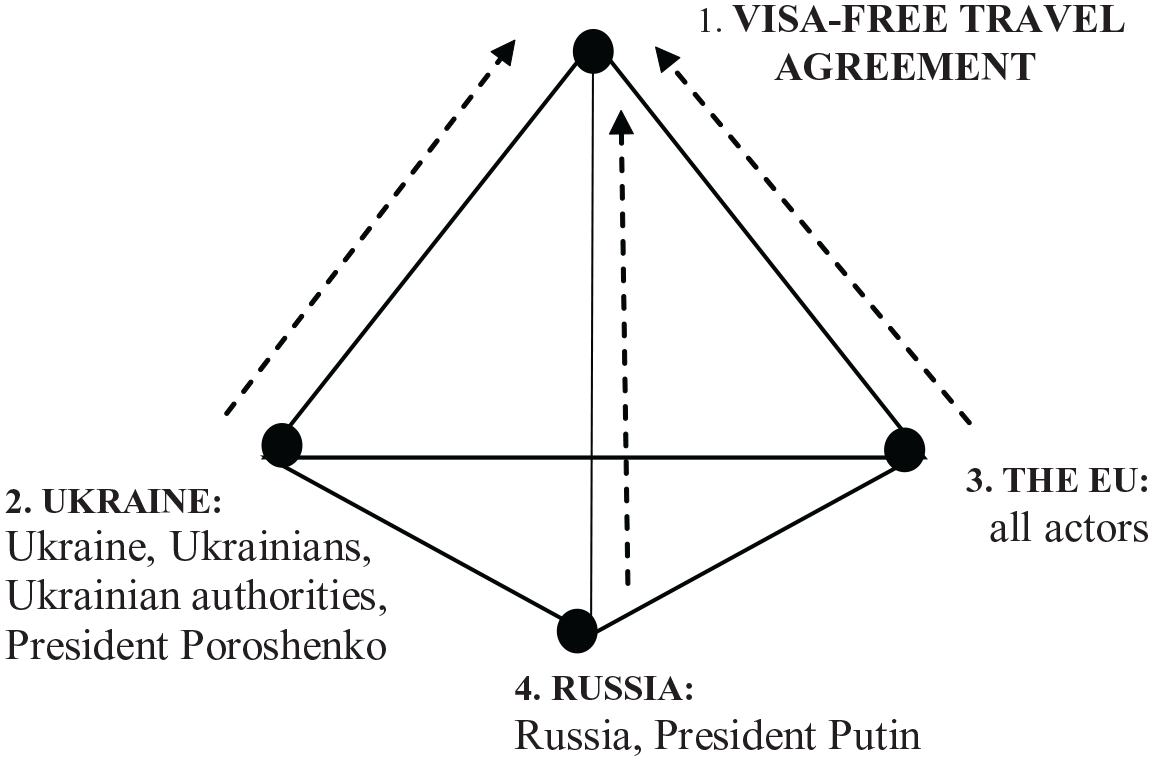
VISA-FREE TRAVEL FOR UKRAINE narrative-based political concept: thematic domains.
Each thematic domain has its own parcels with thematic quanta that generalize the content of particular textual descriptions (see Tables 1 and 4 in Appendix 1). Specification of the parcels and their quanta results from the bottom-up analysis: they are inferred from the meanings of 555 textual descriptions obtained from the media articles.
Among textual descriptions, 287 or 51.7% are neutral (/0/), 241 or 43.4% are negative (/−/) and 27 or 4.9% are positive (/+/). Therefore, the overall emotive plane of the NBPC is roughly half-neutral and half-negative, with minimal positivity. Negativity is overwhelmingly attached to Ukraine (Other) and moderately to the EU (Other). Neither receives a positive assessment. The media reserve positivity only for Russia (Self) which is never depicted negatively.
Accentuation: factual and emotive salience of the content
The results of the content analysis, given in Tables 1 to 4 (see Appendix 1), show that the NBPC’s thematic domains, parcels and quanta have different degrees of factual salience, which demonstrate the importance of the respective topic to the narrator. Among the four thematic domains, the most salient are ‘1. EU–UKRAINE VISA-FREE TRAVEL AGREEMENT (focus)’ and ‘2. UKRAINE (focus) – VISA-FREE TRAVEL’. Somewhat less salient is the domain ‘4. RUSSIA (focus) – VISA-FREE TRAVEL’. The domain ‘3. THE EU (focus) – VISA-FREE TRAVEL’ has the least salience. The most prominent topics represented by parcels within the domains are ‘4.2. Ukrainian President says “farewell” to Russia quoting the great Russian poets Lermontov and Pushkin’ and ‘2.1. Implementation of the agreement’.
The emotive salience is exhibited by the most negative domains ‘2. UKRAINE (focus) – VISA-FREE TRAVEL’ (43.6% of all negative descriptions) and ‘4. RUSSIA (focus) – VISA-FREE TRAVEL’ (28.6% of all negative descriptions). The parcels with prevailing factual salience are also the most negative emotively (see Tables 1 to 4 in Appendix 1).
Contextualization: amplification of negative emotions via historical and cultural resonance
The NBPC has an obvious ‘locally hooked’ domain ‘4. RUSSIA (focus) – VISA-FREE TRAVEL’ relevant for the Self (Russia) and the shared historical and cultural background of the Self and the Other (Ukraine). A high level of negativity (observed in half of the descriptions in this domain) appears in response to the speech of the Ukrainian president Poroshenko who hailed the start of visa-free travel for Ukraine with the quotes from Russia’s revered poets of the 19th century – Mikhail Lermontov (1814–1841) and Alexander Pushkin (1799–1837). Lermontov’s quote was most discussed. It said: ‘Farewell – unwashed, indigent Russia, / The land of slaves, the state of lords, / And you, its navy-coated marshals, / And you, their dedicated herds’ (translation by A. Givental). Russian media came with a great diversity of the ways of how to misdirect away from the fact and elicit negativity (see the analysis below). Russian president Putin commented on Poroshenko’s reference to Lermontov’s verse by responding with the lines of Ukrainian poet Taras Shevchenko (1814–1861): ‘Ukraine has reached a limit in its fight. / Its own children crucify it worse than Poles’ (translated by S. Zhabotynska).
The data demonstrate the influence of the historical element in terms of long- and mid-term history. In the former case, it is the historical view of the Russian Empire, retendered by its progressive cultural icons of the 19th century. In the latter case, quoting the two poems was also a reference to the literary texts taught at Soviet schools following the mandatory national curriculum. Specifically, Pushkin and Lermontov were well-known cultural figures from Russian classical literature, promoted across the former USSR. These exact two poems quoted were obligatory for generations of Soviet citizens to memorize and recite. In contrast, Putin’s quotation of Taras Shevchenko, the revered poet in Ukraine, did not strike a similar cord. In the former USSR, national poets of republics other than Russia were studied in a marginal manner. Arguably, historical and cultural references that are a part of the shared cultural presuppositions widen the facts’ interpretation and amplify the reader’s emotions.
Verbalization through the narrative tactics: diversification of negative emotions
A set of narrative tactics is used to implement the communicative strategies of destruction (damaging Ukraine’ image), suppression (demonstrating the loss of Ukraine’s international status) and direction (guiding Ukraine to a preferred behaviour). These tactics ‘mould’ information by addressing its existential, referential, intra-factual and affective traits constitutive of the domains and their parcels in the NBPC ‘VISA-FREE TRAVEL FOR UKRAINE’ (in brackets below is the number of negative textual descriptions).
Existential tactics
Referential tactics
Intra-factual tactics
Inferential tactics
Affective tactics
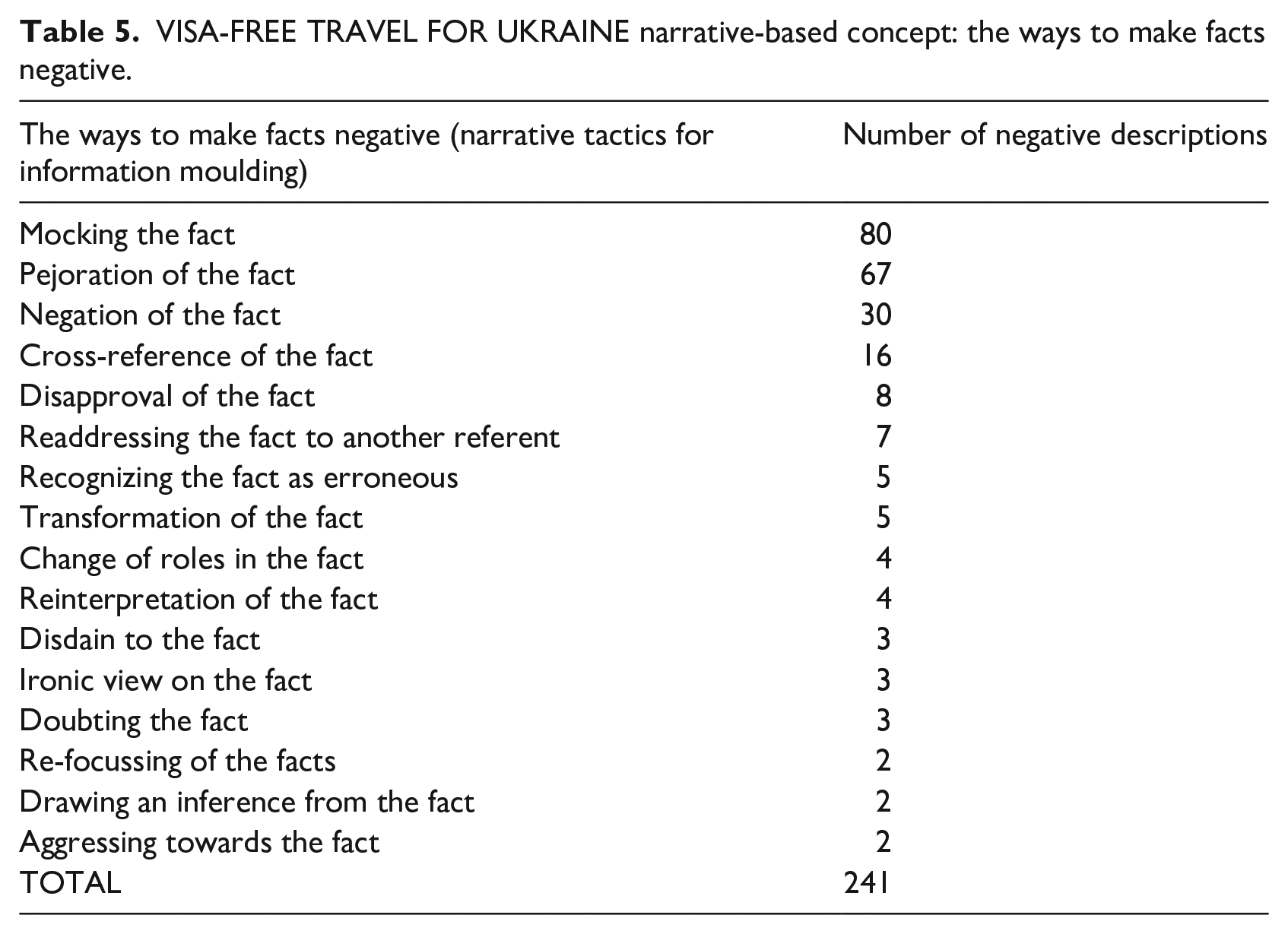
Among the narrative tactics that create negativity, several are used the most (Table 5 in Appendix 1). Mocking the fact and pejoration of the fact lead, with negation of the fact and cross-references being third and fourth, respectively. Importantly, the four most used narrative tactics reflect the four different aspects in information moulding: affective (in the lead), intra-factual, existential and referential. This pool suggests that narrators do not rely exclusively on one type of information handling for the purpose of the destruction, suppression or re-direction of the opponent’s image, but engage with different verbal techniques, keeping in mind the diverse cognitive profiles of their audiences. Yet, that affective tactics are the leading strategy is telling, as it suggests an appeal to processing information and invites an intensive response.
Discussion
The analysis shows that in Domain 1: THE EU–UKRAINE VISA-FREE TRAVEL AGREEMENT (focus), Rusian media narrators apply the tactics of pejoration, mockery, disdain and irony to induce the images of Ukrainian leadership as being weak, selfish, striving for PR and having low credibility. The narrators point to the legal conditions of the agreement as being unjustifiably strict for Ukrainians who are poor and constantly cheated by their authorities. As such, the narrators’ attitudes reveal a strong preference for the antagonistic strategy of destruction. Destruction heavily engages the mockery tactic that delivers a range of messages denigrating the international image of Ukraine by portraying Ukrainians as a deliriously happy crowd celebrating some outlandish event.
In Domain 2: UKRAINE (focus) – VISA-FREE TRAVEL, among the ways to convey negativity, pejoration is used the most, followed by mockery. News texts describe Ukrainians as eager to flee from their poor, dysfunctional country, congregating in crowds at the borders, cheating the officers at the check-points, smuggling goods and striving to become illegal labour migrants. The value of visa-free travel is also distorted: it is featured as useless and even harmful for Ukraine. The narrators’ attitudes in this domain explicate primarily the destruction communicative strategy, while direction becomes a second marginal input: people from the east of Ukraine are closer to Russia, thus Russia is a better direction for them than the EU.
In Domain 3: THE EU (focus) – VISA-FREE TRAVEL, the leading tactic is negation of the fact that Ukrainians pose no risk to the migration situation in the EU. The Russian media depict Ukraine’s aspirations for membership in the EU as empty and groundless, since the country is not reformed. They portray the EU as being tired of Ukraine, while offering it an undeserved favour which may aggravate the existing migration crisis in the EU. The attitudes employed by the narrators evidence the communicative strategy of destruction.
In Domain 4: RUSSIA (focus) – VISA-FREE TRAVEL, Ukraine is portrayed as an unsophisticated state, a country with a deeply corrupt leadership, or even as being a slave to the EU. Ukraine, once a part of the USSR, is shown as having become ‘worse’ as an independent state with European outlooks. The media also report that Ukraine and Russia have a shared history and culture, and that they still could move closer to each other. As such, we observe antagonistic strategies in action – destruction (leading), suppression and direction. Here, the negativity of Ukraine’s image is amplified by its contextualization within the history and culture cherished by the Russian audience.
The analysis of invariable referents demonstrates high factual and emotive salience of the actors Ukraine and the Ukrainian people (Table 6 in Appendix 1). In the portrayal of Ukraine and Ukrainians, the dominant use of the destruction strategy gives ground to suggest that Russian media narrators chose to frame Ukraine as a ‘lost case’ for Russia. The shared past, allegedly neglected by Ukraine, is becoming increasingly distant. The shared future is ephemeral as Ukraine looks the other way. The negativity of Ukraine’s image, amplified by historical and cultural resonance and magnified by iterations of the respective textual descriptions, shapes the narrative on Ukraine as moving away from Russia and morphing into an ultimate Other. Ukraine emerges as a wretched international player and a worthless partner. The narrative warns Russia’s multi-national domestic audience, and other post-Soviet states, against following Ukraine’s path or dealing with Ukraine as a ‘normal’ international subject. Such a narrative is resilient and long-lasting, feeding into the latest strategic narrative projections (see the framing of the sovereign Ukraine in the essay ‘On the Historical Unity of Russians and Ukrainians’ by Putin (2021)) and the war-time rhetoric of Russia’s government since 24 February 2022.
Conclusion
Scholars of various fields view narratives as indispensable tools with which to study different spheres of life. One of them is IR, where ‘international relations evolve around the interplay of images’ (Fisher, 1997: 4), with images framed through narratives. In political discourse, narratives employed by political actors to extend their influence, manage expectations and change the discursive environment in which they operate, are defined as strategic (Miskimmon et al., 2013). Intensive interdisciplinary discussion has not yet provided a comprehensive account of the exact properties that make strategic narratives potentially efficient in their impact upon the public. Such properties tend to be associated with the narrative’s content that contributes to shaping the Self-image of a nation, or its identity image, and the images of the Others who may be perceived either as friends (the nations to cooperative with) or as enemies (the nations to confront).
Addressing a need to add precision to the strategic narrative theory, we offer important methodological insights into the formation and projection of strategic narrative in general, and antagonistic strategic narratives in particular. The latter are characterized by the narrator’s communicative strategies of suppression, destruction and direction of the depicted protagonist (Wagnsson and Barzanje, 2019). We suggest that formation of the narrative content exhibits its construal via the selection of particular emotively connoted information arranged in the ‘narrative-based political concept’ (Zhabotynska and Velivchenko, 2019) as a coherent structured image projected in the narrative. An efficient projection, or embodiment of this image, should profile a distinct emotive charge, theorized as being the most impactful if employed along the three distinctive categories of the content’s accentuation, contextualization and verbalization through diverse narrative tactics. The proposed research methodology develops a universal algorithm, providing a significant advantage over ad hoc, case-based solutions employed in the analysis of strategic narratives.
Our study particularized the theorization by addressing the antagonistic narrative, exemplified by Russian e-news platforms reporting on the granting of visa-free travel to Ukrainians, one of the major developments in Ukraine–EU relations. The resulting narrative presented Ukraine as a contemporary antagonist of Russia. The application of a novel research algorithm yields results demonstrating the ‘backstage mechanics’ used by the Russian mainstream media, aiming to trigger a particular emotively-laden perception of Ukraine within Russia and among Russian speakers, especially in Russia’s ‘near abroad’. The understanding of such ‘mechanics’ is necessary to resist the discursive aggression that escorts aggression in IR. The resulting framed image has the potential to influence the diagnosis of the situation and lead the audience to favour certain types of actions. As such, our study contributes to the studies of propaganda in general and that of the Russian media in particular, adding a novel insight to the concept of the narrative.
This overwhelmingly intentional negative framing of Ukraine in its no-visa arrangement with the EU – evidencing Ukraine’s ‘European choice’ as its complex foreign policy direction – risks an uncontested consumption among Russian audiences, especially due to the lack of in-depth nuanced political knowledge among the general public. Our initial insights into the reactions and opinions of the news readers – a subject of our follow-up investigation – reveal the news recipients’ strong emotive reactions to the narrative, ranging from envy, anger, fury, dislike and hatred towards Ukraine (the Other) to love and admiration of the Self. Featured in the antagonistic narratives, the readers’ aggressive perception of Ukraine may have well thrown a ‘bridge’ to the present war-time aggressive narrative, crafted by the Russian mainstream media striving to meet the audience’s expectations. Propaganda intensifies propaganda.
Footnotes
Appendix 1
VISA-FREE TRAVEL FOR UKRAINE narrative-based concept: the ways to make facts negative.
| The ways to make facts negative (narrative tactics for information moulding) | Number of negative descriptions |
|---|---|
| Mocking the fact | 80 |
| Pejoration of the fact | 67 |
| Negation of the fact | 30 |
| Cross-reference of the fact | 16 |
| Disapproval of the fact | 8 |
| Readdressing the fact to another referent | 7 |
| Recognizing the fact as erroneous | 5 |
| Transformation of the fact | 5 |
| Change of roles in the fact | 4 |
| Reinterpretation of the fact | 4 |
| Disdain to the fact | 3 |
| Ironic view on the fact | 3 |
| Doubting the fact | 3 |
| Re-focussing of the facts | 2 |
| Drawing an inference from the fact | 2 |
| Aggressing towards the fact | 2 |
| TOTAL | 241 |
Funding
The authors disclosed receipt of the following financial support for the research, authorship, and/or publication of this article: This publication is based upon work from COST Action ENTER, CA17119, supported by COST (European Cooperation in Science and Technology).

Author biographies
Professor