




Abstract
Much social theory takes for granted that transnational people-to-people dialogue is inherently liberal in process and content – a haven of everyday authenticity that shelters ideas of human rights and democratic reform. In contrast, this contribution shows how communist regimes built and institutionalised an encompassing administrative state capacity to control and shape micro-level professional contacts with the West. This extensive but secret system of coercion, which was brought to light only with the opening of former communist regime archives, set a markedly illiberal framework for everyday East–West deliberations during the Cold War. Effectively, the travel cadre system may not only have delayed the demise of Soviet bloc communism, by isolating the population from Western influences. It was also intended to serve as a vehicle for the discursive influence of Soviet type regimes on the West. The article provides one of the first and most detailed English language maps of the administrative routines of a communist regime travel cadre system, based on the East German example. Furthermore, drawing on social mechanisms methodology, the article sets up a micro-level ‘how it could work’ scheme over how travel cadre systems can be understood as a state capacity, unique to totalitarian regimes, to help sway political discourse in open societies.
Introduction
According to Charles Tilly, states respond to the international system by developing their capacity for competition, conflict and war (Tilly, 1992). State capacity is the administrative framework and ability of the state to force individual citizens into compliant behaviour, to serve the state’s efforts at international rivalry (Lindvall and Teorell, 2016; Mann, 1984). Examples of state capacities are coercive forces, such as the police and military, and bureaucratic infrastructure, geared to tasks such as taxation and information and statistics collection (Skocpol, 1985).
This contribution documents how, during the Cold War, communist regimes built and institutionalised encompassing bureaucratic procedures to control, shape and instrumentalise all individual professional contacts with the West, and argues that these travel controls were an important state capacity for waging the global war over hearts and minds, discourses and state self-identities, narratives and ontologies of the international system, by shaping micro-level interactions – the ‘microfields’ or the ‘quotidian’ – in everyday transnational deliberation (cf. Barnett and Duvall, 2005: 55). Crucially, due to their illiberal coercion of the individual – and due to the travel cadre system’s reliance on the communist regime’s unique degree of control over domestic society, state, public sphere and economy – travel cadre systems were, and are, unavailable as a policy option for lesser authoritarian regimes, as well as for liberal democracies.
In the domestic terminology of communist regimes, the travel controls over professionals was termed a travel cadre system (Macrakis and Hoffmann, 1999: 264–265; Niederhut, 2005; Wolle, 1999). The article is based on archival materials from the East German state administration, a university, and the regional secret police, including the classified rules and regulations, and routines for screening, instruction and reporting requirements.
As is well known, the East German political system was built on the Soviet template, and it is likely that other communist regimes – past and present – had and have similar systems of travel control. Hence, the East German case prompts questions concerning how travel cadre systems affected all East–West dialogue during the Cold War – but also how the foreign policy efforts of contemporary communist regimes are organised today (cf. Edney, 2012; Nathan, 2015; Varrall, 2017).
The historical East German travel cadre system served several types of purposes, including industrial and technological espionage (Macrakis, 2018), the prevention of defections to the West (Stirn, 2011), and the defence of the communist political system against foreign influence. Importantly however, East German bureaucratic planning shows that the travel cadre system was conceived primarily as a foreign policy institution, aiming to spread and stabilise a regime-friendly world-view among Western publics. In effect, the travel cadre system may not only have delayed the demise of Soviet sphere communism by blocking everyday democratic dialogue and influence from the West (cf. Risse, 2000; Risse et al., 2013). The travel cadre system was also intended as a vehicle for the reverse direction of discursive influence of Soviet type regimes on the West. For the sake of illustration, the article exemplifies these ambitions in the context of East German contacts with Sweden – which was a GDR priority and a pivotal polity in the context of the Cold War.
The elaborate procedures of the travel cadre system show that communist regimes attached great importance to everyday transnational conversations between communist regime subjects and their Western colleagues, and institutionalised the efforts to win hearts and minds in the West, and shape Western discourse. Notably, this state behaviour is largely incongruent with realist assumptions concerning the means and goals of competition and war in the international system. Indeed, through the lens of a narrowly realist view of power – which dominated Western international relations (IR) during the Cold War itself – efforts on behalf of communist regimes to influence public opinion in Western polities were simply invisible, or at least inconsequential.
In contrast, contemporary IR is increasingly preoccupied with the social constructivist facet of the multi-dimensional chess board of international competition. The broad research agenda on the ideational-social face of international competition includes the early writings on the soft power of the USA (Nye, 1990), followed by contributions on the normative power of the European Union (Manners, 2002), everyday socialisation within EU institutions (Checkel, 2007), the socialisation of China within international institutions (Johnston, 2008), and the spiral model for the transnational promotion of human rights norms (Risse et al., 2013). More recently, prompted by contemporary developments, the constructivist agenda has expanded to include the efforts of communist and post-communist regimes to challenge the West. Relevant research includes studies of the discursive struggles over normality and stigma, rightful roles and legitimate authority in East-West relations (Zarakol, 2010; cf. Elias, 1994; Mattern and Zarakol, 2016), the rise and fall of dominant narratives underpinning Cold War national security policy (Krebs, 2015), states’ use of strategic narratives to gain international influence by shaping foreign norms, identities and cause-effect stories (Miskimmon et al., 2013, 2017; Szostek, 2017a; Hedin, 2016), and the role of micro-level transnational linkage and interpersonal communication for public reception of strategic narratives (Szostek, 2017b).
Joining this broad field of inquiry, the article studies travel cadre systems as a communist regime foreign-policy tool in the Cold War struggle over Western political discourse, narrative and state identity. It suggests conceptualising the travel cadre system as a state capacity to harness and direct individuals to promote strategic state narratives, with the goal to influence Western perceptions concerning which states counted as friends or foes, role models or villains, forerunners or reactionaries, and the appropriate role of one’s own state in this drama (Somers, 1994; Szostek, 2017a; cf. Wendt, 1994).
Drawing on social mechanism methodology (Checkel, 2017; Hedström, 2008; Hedström and Ylikoski, 2010), the article sets up a heuristic ‘how it could work’ scheme, detailing the micro-level mechanisms by means of which travel cadre controls could be employed by communist regimes to sway macro-level political discourse in open societies (cf. Krebs, 2015; Schmidt, 2017: 250–255).
The article begins by framing the travel cadre system theoretically; as foreign policy tool, as totalitarian state capacity, and as micro-level driver of discursive change. The article then maps the design of the East German travel cadre system, and analyses the potential macro-level effects of its iterated micro-level impact. The article’s concluding section argues that travel cadre systems constitute a unique totalitarian state capacity to influence open societies with state-sponsored strategic narratives, and emphasizes everyday micro-level deliberation as an important aspect of international competition.
The travel cadre system as foreign policy tool
In internal East German administrative regulations, the travel cadre system was consistently referred to as an aspect of foreign policy – ostensibly for gaining discursive influence, legitimacy and soft power in the West. For example, in the case of Sweden and East Germany (or the German Democratic Republic, GDR) we now know from archival materials that an early goal with transnational relations with Sweden was to build support in Swedish politics and society for the international recognition of the Soviet zone of occupation as a country in its own right (Linderoth, 2002; cf. Teorell, 2017 on the role of perceptions of ideological affinity for state recognition).
According to archival research, during the 1970s and 1980s, Sweden remained a crucial focus for GDR foreign communication efforts, due to ‘its position in the international system’ and its vocal international stances on issues of East-West détente and disarmament (Abraham, 2007: 22). In other words, communist regimes wanted to influence how Sweden wielded its power as international critic and internationalist norm entrepreneur (cf. Björkdahl, 2007, 2008; Makko, 2010; Stenelo, 1984). Secondly, among IR scholars, a common assumption is that the Soviet Union and its allies wanted to keep Sweden out of the North Atlantic Treaty Organisation (NATO), by trying to foment Swedish public opinion in a direction conducive to this realist goal. However, there of course exists no exhaustive list of the various objectives for the travel cadre efforts at persuasive communication in relation to Sweden or any other country, its various sectors of society, or across the decades of the Cold War. Rather, this article focusses on the travel cadre system as foreign policy tool and state capacity.
The so-called travel cadre, in German Reisekader, were those communist regime citizens who were registered as approved to travel to non-socialist states in the line of their profession or service. Notably, the system did not apply only to a certain segment, such as party members or members of the security services, but to all who travelled in the line of their professions. The system comprised all occupations and organisations, from archaeologists (Gringmuth-Dallmer, 2017), to ophthalmologists (Jähne, 2017), mathematicians (Scharlau, 2016: 143–152), sailors (Stirn, 2011: 189–224), historians (Van der Heyden, 2015), medical doctors (Erices, 2014), theatre directors (Kelly, 2014), employees in industry (Rafalzik, 2009) – and university students and professors.
In a rough estimate, there were 25,000 travel cadre registered in East Germany in 1970, 30,000 in 1980, and over 90,000 in 1988 (Niederhut, 2005: 40; cf. Wolle, 1999: 1626). Within the sector of higher education alone, in the one year of 1988, 18,509 trips were made to the West by 7623 individuals registered as travel cadre (Jordan, 2001: 214; cf. Hedin, 2005: 287). These numbers show, on the one hand, that exceedingly few of the roughly 16 million inhabitants of the GDR held the privilege of foreign travel; and on the other hand, over time, during the two decades of the 1970s and 1980s, the resulting cumulative number of transnational micro-level dialogues conducted was considerable.
In contrast to the ordinary cadre system – which trained socialist party members to fill the key positions in state administration, the economy and the organisations (Chan, 2016; Manion, 1985; Wagner, 1999) – all travel cadre were not party members. Within the university sector, roughly 40 percent belonged to no political party at all (Hedin, 2005: 280; Niederhut, 2005: 43). Likewise, although the Ministry for State Security – the Staatssicherheitsdienst, Stasi – recruited many collaborators among the travel cadre, especially within the natural sciences (Macrakis and Hoffmann, 1999; Rafalzik, 2009), it is estimated that direct collaborators remained a minority among the travel cadre, especially among the already more loyal social scientists and humanities (Labrenz-Weiß, 1994; Niederhut, 2005).
Just as with the ordinary cadre system, there was no umbrella provision for the travel cadre system in the official legislation of the GDR, other than the general constitutional provision for the leading role of the state-carrying Socialist Unity Party (SED). Instead, the travel cadre system was codified in a series of formal regulations, which were secret and classified. Older rules and regulations found in the archives are stamped ‘for official use only’ and later rules ‘confidential and classified’. Some updated regulations end with an order to destroy old ones, in accordance with laws on how to secure classified documents. Importantly, travellers were not to be informed of the design of administrative routines for screening, decision criteria or grounds for individual decisions – or whether they themselves were being screened. Furthermore, travellers were under strict prohibition to admit the existence of the travel cadre system, which counted as an official secret – in German: Dienstgeheimnis.
The travel regulations consisted of guidelines for the administrative procedures by which so-called travel cadre were to be nominated, screened, trained and obliged to write reports. The administrative system took shape in the mid-1960s, fermented in the early 1970s and remained largely unchanged during the remaining two decades of the existence of the GDR. In 1963, two years after the final closing of East German borders and the construction of the Berlin wall, existing travel regulations for the sector of higher education were collected in a single document, issued by the state secretary of higher education. 1 The 1963 ordinance was replaced in 1970, and again in 1978, with travel regulations with similar content. And the 1978 university travel regulation remained in place up until the democratisation of the GDR in 1989/90. 2 These sector-specific guidelines for institutions of higher learning were congruent with, and a specification of, general umbrella guidelines, such as the 1974 and 1982 instructions issued by the GDR Council of Ministers, which applied to professional travel from all sectors of society, including industry and commerce, public administration, and societal organisations. 3 Notably, some of these travel cadre guidelines provide also for how foreign guests to the GDR should be hosted, namely by travel cadre.
An early state regulation for East German universities expressed explicitly the totalitarian ambition that not just some, but all, foreign contacts were to directly serve the government’s foreign policy: All relations of the universities and their agencies to other states, or to agencies of other states, are part of the foreign policy and the science policy of the German Democratic Republic. They serve the entire construction of socialism in the GDR and the implementation of the foreign policy goals of the government of the GDR. The relations can be initiated and maintained only in concert with the state relations to the respective countries. (East German regulation for universities, 1963
4
)
This basic view, that all forms of foreign contact should be subservient to government goals, is also mirrored in the consistent referral to the travel cadre as the ‘foreign deployed’ of the state – in German: im Einsatz. With slight variations in the wording, from the early 1960s to the end of the GDR, the travel cadre system regulated ‘the selection, preparation, testing, deployment and supervision of GDR citizens deployed abroad’.
Travel cadre systems as totalitarian state capacity
Researchers have put forward numerous and overlapping typologies of state capacity: coercive versus civil state capacities (Bull, 1982); despotic versus infrastructural capacities (Mann, 1984); extractive, coercive, and administrative state capacity (Hansen and Sigman, 2013); and cognitive and informational state capacity (Brambor et al., 2016; Lindvall and Teorell, 2016).
The concept of totalitarian state capacity underscores the communist regimes’ extraordinary claim to power over society and the everyday (Enquete-Kommission of the German Federal Parliament, 1998; Siegel, 1998). Effectively, travel cadre systems denied basic civil rights such as freedom of conscience and speech, information, opinion and expression, freedom to leave the country, rule of law, and protection from arbitrary denial of rights on the basis of political opinion. Furthermore, the coercion of the travel cadre would not have been possible without the unique organisational features of communist regimes, with party control over the state, society, economy, organisations, media and the public sphere (Friedrich and Brzezinski, 1965: Chapter 2).
Notably however, in congruence with recent interpretations of the concept of totalitarianism, communist regime travel cadre systems were not simply coercive, but organised to foment and harness willing discursive participation, active initiative and sincere belief (cf. Hedin, 2004). In this sense, the system was not only despotic, but enabling; an infrastructural capacity to seed out, educate, mobilise and direct loyal regime sympathisers in the everyday participatory service of the state (cf. Mann, 1984: Figure 1 and 207).
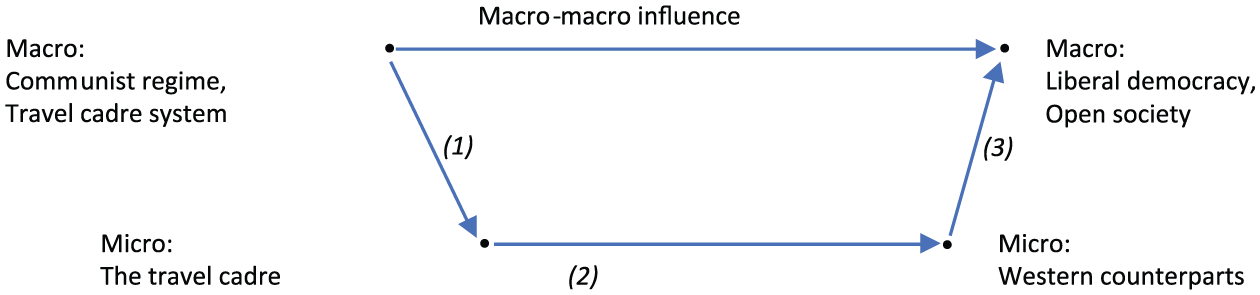
Visualising the micro-foundations (1–3) of macro-level influence.
Still, post-rationalist theories of public administration posit several caveats to modelling the travel cadre system – or any government policy or administrative capacity – as a simple government ‘tool’ (Williamson, 1995). Furthermore, as with all forms of communication, the effects of travel cadre deliberation depended on the recipient (cf. Szostek, 2017b). And, given that Swedish counterparts were indeed swayed, as research on social movements has noted, similar movements can produce different outcomes under different circumstances (Hedström and Ylikoski, 2010: 56, quoting Tilly). This enumeration of caveats suggests that a government policy instrument, such as the travel cadre system, can achieve less or more of any intended outcome, but also have interesting other effects that are reverse, auxiliary, or simply irrelevant to state goals.
Still, states do at times rack it up. Indeed, the absence of reform of the basic structure and routines of the GDR travel cadre system, over its almost three decades of existence, can arguably be read as an indicator that the communist regime perceived that it worked. Accordingly, this article explores the potential effectiveness of the travel cadre system as government policy to influence political discourse in open societies. Specifically, the analysis spotlights aspects of the system’s design, which likely enhanced its capacity – and in the absence of which it would plausibly have been less effective.
The micro level as driver of discursive change
How could the travel cadre system, by controlling the citizens travelling from communist regimes, influence political discourse in open societies (cf. Schmidt, 2017)? The recent IR interest in micro-politics point up micro-level mechanisms and processes as drivers of political change (Kertzer, 2017; Solomon and Steele, 2016). The new agenda draws on older discussions of the level-of-analysis problem in IR that probe the transnational and domestic institutional, ideational and cognitive sources of foreign and security policy (Kaarbo, 2015; Moravscik, 1997; Singer, 1961; Wendt, 1992). Political science studies of micro-politics look at how informal behaviours at the level of the individual can have political consequences at the macro level (Chakravarty, 2013). Micro approaches call attention to how macro-level phenomena can be the sum of large numbers of local or individual ‘microscopic’ events – which each on its own may be largely inconsequential for society. Particularly, micro-political approaches take an interest in individual political affect, subjectivity and identity, and how these can change in interaction with others (Solomon, 2013) and how such processes of identity-formation are shaped by reiterated interactions with others, over time (Solomon, 2014).
Recently, IR research has turned to social mechanisms as a promising approach to model the role of micro processes for macro-level social, discursive and political change (Chakravarty, 2013; Checkel, 2017; Kertzer, 2017; Solomon and Steele, 2016). Helpfully, a mechanisms approach can integrate the analysis of cognitions, affects, relations and incentives with structural factors (Tilly, 2001: 37–38).
Mechanisms modelling disaggregates general social processes into chains of micro-level events, that – if repeated by numerous individuals – result in an aggregate outcome at the collective, macro level (Hedström, 2008). As a metaphor, consider the continuous drops of water that, with time, may hollow out a stone. The mechanisms approach is similar to process analysis, with the crucial difference that process analysis aims to explain a singular event, whereas a mechanisms approach looks for micro-level patterns that – if they are common and repeated – can produce cumulative large-scale outcomes at the macro level (Ylikoski, 2017).
The goal of mechanisms modelling is to explain how, in principle, the specified micro events can produce a macro-level effect (Ylikoski, 2017). The aim is to further overall understanding and open up new research agendas, by explaining the moving parts of a plausible and empirically supported cause (Ylikoski and Aydinonat, 2014). This type of heuristic how it could work causal scenario is neither a generalising reduction, nor a covering-law theory, nor a summary. As a rule, social events – such as change or stability in political discourse – have multiple and complex causes (cf. Jepperson and Meyer, 2011). In contrast, the goal of mechanisms modelling is to describe only one among many contradictory or reinforcing processes, shaping society.
The relation between micro- and macro-level is commonly visualised with a diagram launched by the sociologist J.S. Coleman, the so-called ‘Coleman’s boat’. The diagram breaks down macro-to-macro influence into a chain of situational, action-forming, and transformational micro-level mechanisms (Coleman, 1986: 1320–1327; Hedström and Ylikoski, 2010; Kertzer, 2017; Ylikoski, 2017). In a version of Coleman’s boat, Figure 1 models the macro-to-macro effect of a communist regime travel cadre system on political discourse in an open society as a result of micro-level mechanisms (arrows 1–3).
The design of the travel cadre system
The following section describes the East German travel cadre system, for the sector of higher education, based on multiple documents that confirm and add on to earlier research, in German language (cf. Gries, 1995; Niederhut, 2005; Hedin, 2005; Wolle, 1999). For clarity, the process has been graphed in Figure 2. The text describes each step in the administrative routine: Nomination, political screening, security screening, confirmation, training, travel directives and travel report.
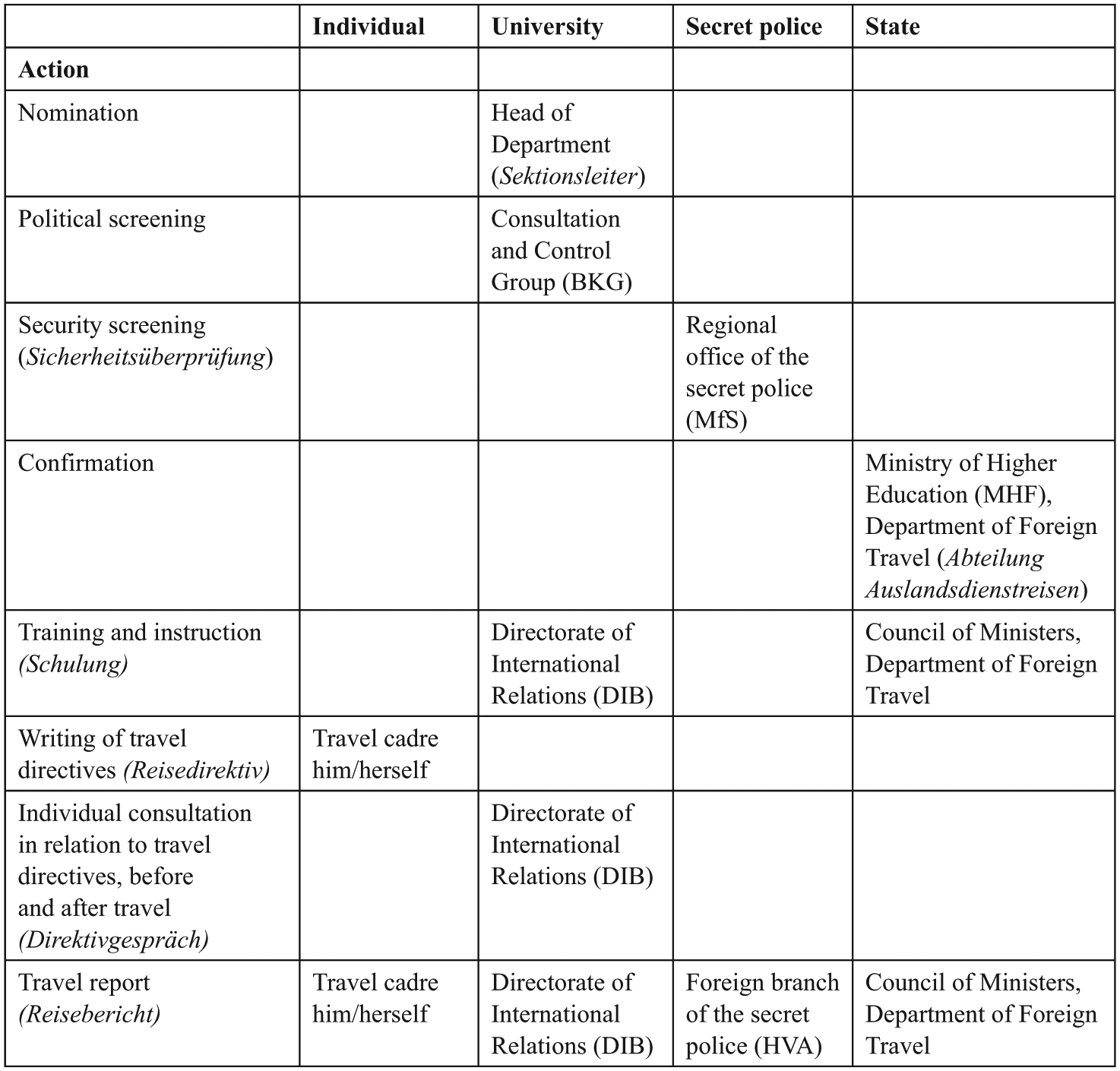
The administrative procedure of the travel cadre system for institutions of higher education in East Germany.
Nomination
University travel cadre were to be nominated by the chief of their academic section. With the nomination, the director or section chief was to include an assessment of the political-ideological stance and loyalty of the nominee. 5 If such an assessment proved faulty, this could have dire consequences for the director and the ‘collective’ research team – which could be dissolved, robbed of their research resources and barred from receiving Western visitors (Reich, 1992: 97–117).
Political screening
The next instance of screening was the specially designated Consultation and Control Group (BKG), which included heads of departments, and staff responsible for the ‘quality of the cadre’. The first secretary of the local SED party organisation usually sat in on meetings – although the BKG in itself was not a party organ. The BKG’s task was to control that the criteria for travel cadre selection were upheld (i.e. that political reliability trumped other considerations, such as professional qualifications). For example, the BKG could write that the travel cadre nominee ‘has a positive influence on the students and stands for the politics of our party and government’. 6 A further breach of the professional integrity of the nominee was the political assessment of his or her social circles, i.e. his or her friends and acquaintances.
Security screening
The ensuing Stasi screening was based in the documents collected by the BKG, but also made use of Stasi informers, in three areas: the residential area where the nominee lived; the workplace of the nominee; and the leisure time activities that the nominee undertook. For the regional office of the Stasi, such standard three-month security screenings for ‘important positions in state and society’ (Sicherheitsüberprüfungen) were – along with the observation of the institutions of higher learning – two of their main tasks (Ammer and Memmler, 1991: 117–127; Engelmann et al., 2016: 400–401; Gieseke, 2011: Chapter 5). The regulation for basic security screening specified that for travel cadre, the screening should put specific emphasis on the ‘bond to the societal circumstances in the GDR [–] in word and deed’, and require a ‘high level of political reliability’, to ensure that ‘a dignified representation of the GDR can be expected abroad’ (Richtlinie 1/82 reprinted in Engelmann and Joestel, 2004: 397–416, 402–403).
These assessments of political loyalty could reach far back in time. For example, a 1985 detailed instruction for the screening of travel cadre asked for the behaviour of the nominee during politically trying situations such as the events of 13 August 1961 (when the Berlin wall was constructed), the August 1968 events in Prague, as well as the then ongoing developments in Poland. 7 Also, any critical or negative statements concerning, for example, the accuracy of the politics of the party, or regarding the GDR policy on information or possibility for travel, were to be recorded in the screening. 8
The security screening by the Stasi was to result in a clear answer – yes or no – which was to be conveyed to the BKG verbally, and without disclosing the specific grounds for the decision. In turn, the nominee was not to know of the security screening at all.
Confirmation
University-level decisions of travel cadre status were sent to the relevant ministry, which in turn sent them for confirmation by the Department of Foreign Travel at the Council of Ministers of the GDR. Notably, at the ministerial level, the travel cadre administration was organised after Western destination, rather than sending institution, which meant that the GDR Ministry for Higher Education would confirm travel cadre also from other sectors of society – such as for example hospitals – if the travel destination in the West was a university. This confirmation procedure enabled the ministries to keep records, collect statistics and make central plans over foreign contacts.
Training and instruction
Travel cadre were required to participate regularly in special training sessions. Instructions addressed practical issues such as the language and customs of foreign countries, but a central task was to prepare the travel cadre to defend the politics and world view of the GDR when deliberating with Western counterparts. Training materials stated explicitly that no contact in the West was to be regarded as a private matter. 9
A 1988 training material topped the list of topics with ‘the development of relations between socialist and non-socialist states’, ‘the current problems of class clashes in the designated countries’, ‘the appropriate behaviour in the case of confrontations with organs, institutions and individual persons of the host country’, and ‘organisational and content issues of the reporting obligation’ (quoted in Niederhut, 2005: 64).
Training sessions were often based on so-called Guides for argumentation (Argumentationshinweise) on specific current issues. With practical examples and exercises, the travel cadre were trained how to reply to Westerners who, for example, questioned the Berlin wall, the militarisation of East German society, or the lack of democracy in the GDR (Niederhut, 2005: 65). Archives contain Argumentation guides on manifold issues, such as how to defend the GDR against critique from Amnesty International, and how to argue in relation to the Conference on Security and Cooperation in Europe. Guidance was provided that would be relevant to the specific context that the travel cadre would visit in the West.
The German historian Jens Niederhut concludes that the central task of the training sessions was to instil in the travel cadre an adequate enemy image of the West, and of the enemy challenges that he or she was about to face (Niederhut, 2005: 64–66).
The exact organisation and responsibility for the training sessions, and the origins of their contents, has not been fully mapped, but it seems that the sessions were coordinated by the respective university’s Directorate of International Relations (DIB) and involved, among others, the Stasi (Niederhut, 2005: 64–66). Training materials were issued by the Council of Ministers, marked as strictly confidential; not to be duplicated; and to be conveyed to the travel cadre in verbal form only. 10
Travel directives
In consultation with the university DIB, the travel cadre were to write and receive verbal approval and instruction in relation to their individual travel directives, including both the professional task at hand, and political duties; a so-called Direktivgespräch. Generally, the travel cadre was explicitly obliged to represent the GDR and the SED in every conversation, and spread a positive image of the GDR; this especially in informal interactions with Western counterparts. 11
Travel reports
The guidelines for the travel cadre system included a requirement for compulsory written and verbal travel reports. Within the university sector, short reports were due in three days, and a longer report within the month. 12 Already the initial, short report was to contain characterisations of the contact persons at the institutions or organisations that the travel cadre had visited abroad. 13 The longer travel report should then include an account and assessments of all the relations, connections and contacts with individuals, institutions and organisations of the host country – centred on the question of political-ideological views; i.e. who was a friend or enemy of the GDR.
At East German universities, the travel reports collected from the travel cadre by the university DIB were as a matter of routine sent on to the foreign branch of the Stasi, the Hauptverwaltung A, which in turn forwarded the reports to its opposite number in the Soviet Union, the First Main Directorate of the Soviet Union’s Committee for State Security, the KGB (see for example Eckert, 1995; Gries, 1995; Macrakis and Hoffmann, 1999: 86–87, 120; Niederhut, 2005: 128–129; cf. Schmeidel, 2008: 115–119, 141). During the 1989/90 interim government of the GDR, the Hauptverwaltung A destroyed most of its archival records (Schmeidel, 2008: 110–111), but travel reports can still be found in local and ministry archives.
The micro-level mechanisms
We now proceed to analyse the travel cadre system, as mapped in Figure 2, with the help of the three micro-level mechanisms, drawn up in Figure 1. How did the design and routines of the system affect its capacity to shape political discourse in open societies?
The situation (1) – theories of resistance versus loyalty
Given the situation they were in, were travel cadre loyal to the state or did they resist? Importantly, the overview in Figure 2 shows the multiple instances involved in travel cadre screening. The nominating head of department, the BKG group, the Stasi, and the Ministry of Higher Education – all four could veto a travel cadre decision. This article argues that the institutional structure, with multiple institutionally separate veto points, makes it unlikely that niches could evolve, where social networks of individuals could help each other resist or evade regime control (cf. Lindenberger, 1999). Furthermore, the Stasi screening went well beyond the professional arena to include the nominee’s whole private social sphere. This systematic invasion of the prepolitical lifeworld must have sown distrust in its web of human relations and served to quench the generation of communicative power (cf. Habermas, 1977, 1996; Havel, 2018 [1978]).
Another indicator of the potential effectiveness of the system is how it remained largely constant over the decades, from its formalisation in the early 1960s to the fall of the Berlin wall. Within the university sector, internal statistics reveal that rates of defection were below a quarter of a percent (Hedin, 2005: 282). 14 Indeed, when reform was discussed in 1988, one argument was that the system was so reliable that it could now be decentralised to the regional level. 15
A third, crucial indicator, is that the travel cadre system was not geared primarily towards disciplining the unruly, but towards selecting and rewarding the earnest and trustworthy, the steadfast and ardent regime supporters. To be allowed to travel to the West was a highly coveted prerogative, bestowed on regime loyalists. In a sense, the travel cadre system was a mechanism to nominate and confirm membership in the new, ruling class; the elite of communist society (cf. Djilas, 1957). Just like cars, apartments, telephones, and the right to read foreign books or journals, or publish scientific writings, travel cadre status was a privilege doled out by communist regimes to its advocates (cf. Maier, 1999: Chapter 1).
This last observation goes against the grain of one of the key references for the micro-politics research agenda: James C. Scott’s work on micro-level resistance. In Scott’s work, the hubris of Soviet-type high-modernist state planning was met by ubiquitous aversion and stealthy disobedience at the micro level (Scott, 1985, 1989: 50, 1998). Scott’s assumption of pervasive resistance is akin to 1980s revisionist research on communist regimes, which depicted citizens as persevering, tenacious liberal subjects, with the minds of a Westerner, unencumbered by their historical context, who made rational, selfish business deals with the communist regimes for their own individual advantage (Krylova, 2003). In contrast, post-1991 research has shown how many citizens took communist ideology seriously and held a genuine belief in the hostile and dangerous nature of the capitalist West – as propagated by the communist regimes (Kotkin, 1995; Hedin, 2004). Many ordinary people – not to speak of the elite at the universities – experienced a sense of positive self-integration under communist regimes, and were faithful and loyal participants in the state-led internationalist project to build a socialist world (Hellbeck, 2003; Sabrow, 2001). Furthermore – echoing the early insights of Polish historian Jan T. Gross, who showed how Soviet communism ‘privatised’ the state by organising citizens to police each other (Gross, 1982, 2002: 117ff) – post-1991 historical research has focussed attention on how social control under communist regimes was highly dispersed and rested on broad popular participation.
In sum, from James C. Scott’s theorisation of the micro level under communist regimes, we should expect travel cadre systems to be run from a single centre; focus on controlling deviant subpopulations; and face ubiquitous resistance (Scott, 1998: 87–102). In contrast, the travel cadre system was in fact implemented by several collaborating institutions: the state bureaucracy, the ruling state socialist party, and the secret police, Stasi. It was aimed at selecting and rewarding regime loyalists. And it relied on the broad active participation of street-level bureaucrats and local party functionaries, as well as ordinary citizens who reported on colleagues, friends and neighbours to provide information for travel cadre screenings.
Interaction (2) – the psychology of persuasion
Which traits of the travel cadre system would enable it to influence Western counterparts? Here, psychological research on bias and misinformation suggests some clues.
First, for persuasion to be successful, an iterated, congruent message and perceived social consensus are key (Lewandowsky et al., 2012). By selecting and training the regime’s most dependable advocates, the travel cadre system contributed to such congruence of message in micro-level deliberations with Westerners, and an image of unanimous loyalty to the larger political project of the GDR regime. For example, the East German representatives at a 1978 conference for German language lecturers from Sweden acted under both collective and individual directives – which were even more detailed – on what to say and to which named Swedish individuals. 16 Some general talking points were how the socialist publishing policy of the GDR gave East German students access to the German classics, as well as to contemporary ‘progressive’ Swedish literature; how the Soviet Union had contributed to the 1975 Helsinki Final Act, and the Warsaw countries were implementing it diligently; and how human rights were under threat in capitalist countries due to unemployment, the 1972 Anti-Radical Decree in West Germany, and substance abuse in Sweden.
Second, since the travel cadre hindered less loyal citizens from foreign travel as well as contact with visiting Western colleagues, it blocked negative information on the domestic conditions within the GDR from reaching foreign audiences – an effect that was compounded by the communist regime control over domestic media and publishing. This is important, since government propaganda may be weakened to the degree that foreign audiences realise that it is inconsistent with domestic realities (Curnalia, 2005; Nye, 2013).
Third, decisions to accept or reject new information is often based on perceived ideological affinity, world-view, or ‘directionally motivated reasoning’ (Flynn et al., 2017; Lewandowsky et al., 2012; Nyhan and Reifler, 2010). Hence, to be successful, rhetoric should affirm rather than contest the worldview and identity of the counterpart (Lewandowsky et al., 2012: 121ff) and appeal to pre-existing values, interests, prejudices and myths (Schmitt, 2018). This matches common travel directives, which advised the travel cadre to be ‘principled but prudent’, illicit sympathy and find friendly informal contacts – and avoid conflict. For example, archival research shows how travel cadre found and sought mutual ground with Swedish social democrats by invoking the myth of the peaceable GDR and the revanchist West Germany, and by appealing to a common Swedish-GDR identity as small states in opposition to the global forces behind the US wars in Indochina and the coup in Chile (Halbrock, 2006). Notably, these types of discourses related to the self-identity of the Swedish state, and perceptions and norms surrounding Sweden’s and other countries’ positions and roles in the world polity. Effectively, the travel cadre appealed to – and tried to shape – Swedish state identity, biographical narrative, and ontologies of the international system; variables in focus for a wide array of IR scholarship on discursive-ideational factors, including role theory in foreign policy (Hyde-Price, 2018) and the social construction of rank in international hierarchy (Mattern and Zarakol, 2016).
Fourth, the effect of propaganda is weakened when recipients have been alerted to doubt the source. Psychological studies show how critical reception is greater when people have been given a pre-exposure warning (i.e. a hint that the information they are about to receive may be misleading; Lewandowsky et al., 2012: 116). Here, it is of course crucial that the existence of the travel cadre system was unknown in the West – or at least that there was a lack of systematic proof of its existence, which allowed for the benefit of the doubt.
In sum, the travel cadre system enabled communist regimes to iterate a congruent message to foreign audiences; and to target for further influence those individuals and institutions in the West where the message seemed to be gaining traction. Furthermore, an advantage over traditional propaganda was the system’s ability to avoid pre-exposure warnings, and quench counter-messages.
Transformation (3) – the planning capacity of communist regimes
Finally, how could the travel cadre system be used as a tool of influence beyond the individual, on larger discourses in open societies?
As noted earlier in the text, the travel cadre were commissioned to collect information on which individual Westerners and institutions were ‘friends’ or ‘enemies’ of the GDR. Since travel reports were collected and processed by both the Stasi and by state agencies – and, in the case of the GDR: handed on to the KGB – the travel cadre system arguably gave the communist regimes a formidable information-gathering capacity (cf. Brambor et al., 2016). For example, one 1977 travel report categorised the academic staff of the Stockholm University Department of Political Science into three groupings, listing for each the names of the leading scholars, their research interests, and academic followers; a majority group that sympathised with the Swedish Social Democrat Party; a smaller grouping with non-socialist and anti-communist sympathies; and a small group endorsing Marxist-Leninist views. 17
Furthermore, internal documents from the GDR travel cadre system refer recurrently to the term ‘multipliers’ – Multiplikatoren – i.e. Western citizens who were considered capable of influencing public and political opinion in their home country, ‘multiplying’ the influence that the travel cadre had achieved on the individual. In the case of Sweden – that we take as our example here – archival case studies show that targeted categories of ‘multipliers’ included, for example, the teachers and lecturers of German as a foreign language; journalists, especially Swedish public service broadcasters; members of the cultural sphere, including film makers; and officials in public administration and at the universities, especially within the fields of education policy and the schools of education (Abraham, 2007; Herrmann, 2006; Meune, 2010; cf. Hedin, 2015: 71–72).
In sum, the travel cadre system gave communist regimes a formidable tool to collect information, and to plan and direct micro-level foreign contacts strategically, on the basis of that information. However, as already argued, the response of the recipient polity – its individuals and institutions – is the ultimate arbiter of whether efforts at persuasion will take effect. Here, the micro-level ‘how it could work’ scheme might have a feed-back loop, where early success or failure at gaining legitimacy as contact partners for a specific Western individual or institution could ostensibly open or close the door for more contact and influence (cf. Szostek, 2017b: 387–389; Ylikoski, 2016: 21–22).
Conclusions
The archival evidence on travel cadre regulations and routines show that during the Cold War, communist regimes built up an encompassing administrative state capacity to harness and direct micro-level transnational deliberation for the purpose of influencing professionals and institutions in the West. In turn, this suggests that communist regimes saw the struggle over Western micro-level perceptions and discourses as an important, or even decisive, dimension of international competition.
In the case of GDR and Sweden, efforts to influence Swedish counterparts were particularly strong within the fields of education and culture – sectors of society where a state continuously recreates its self-narrative and ontologies of the global political system: which countries count as friends or foes, peaceful or belligerent, progressive or retrograde, paragons or deterrents, related or foreign. The relevance to international relations of such nation-state discourses have been explored by studies of the narrative underpinnings of government security policy (Krebs, 2015), and the contribution of collective national identities – and the transnational communicative processes that shape them – to enabling and anchoring multilateral groupings and alliances, such as the Non-Aligned Movement (Vieira, 2016), NATO (Greve, 2017), and the EU (Johansson-Nogués, 2018; Mitzen, 2006). In a similar vein, current analyses of Sweden’s hesitation to join NATO argue that a long-standing discursive-ideational heritage concerning Sweden’s role in the international system is at odds with evolving geostrategic imperatives, and that the former explains the hesitation (Hyde-Price, 2018).
The analysis of the travel cadre system offered here makes a novel contribution to micro-level studies, by documenting the unique capacity of communist regimes to harness and direct the everyday professional and social-collegial life of its university professors and other professionals for foreign policy purposes. In effect, the communist state capacity to persuade foreigners with state-sponsored strategic narratives depended on the everyday active and willing participation of the travel cadre, as its privileged and willing executives.
In contrast, the evolving micro move in IR has tended to focus on examples of pro-democratic and spontaneous mobilisation, implicitly conceptualising the everyday as a site of heroic resistance and suffering at the hands of macro-level forces (cf. Scott, 1985; Solomon and Steele, 2016). In a related vein, during the early naughts, IR research focussed on person-to-person transnational dialogue as inherently pro-democratic (Risse, 2000). This paradigm was based on the interpretation of Gorbachev’s Perestroika politics, and the ensuing demise of Soviet communism, as the result of democratic persuasion by the West, which confirmed transnational deliberation as the ‘Achilles heel’ of despotism, and the success of détente policies of ‘change through contact’ (Albert et al., 2008; Brandt, 1962, 1963; Risse, 1994).
Actually however, the travel cadre system created a lop-sided competition, where communist regimes could target the publics of open societies in the West, while communist societies remained closed for foreign contact. In response, the Reagan administration – which believed in the importance of ideas for ‘winning’ the Cold War – invested heavily in Western radio news broadcasts to Central and Eastern Europe, which in effect could reach less loyal citizens than the select travel cadre sent on détente era exchanges (Lenczowski, 2016).
In sum, as demonstrated in this study, the travel cadre system was designed as an offensive state capacity to influence foreign counterparts – which prompts questions concerning how Western discourses were shaped by these contacts during the long process of the Cold War. By bringing to light the travel cadre system as strategic tradition and unique type of administrative state capacity, this study contributes to an emerging research agenda on the efforts of non-democratic regimes at micro-level influence on open societies.
Footnotes
Acknowledgements
For comments on the text, thanks go to the editors and the reviewers, the workshop on Everyday IR at the 2018 ISA conference in San Francisco, as well as the workshops of the STANCE research program and the Swedish Network for Foreign Policy Analysis, and the Power & Morality workshop at the Power & Governance conference at the University of Tampere, Finland.
Funding
For financial support, the author wishes to thank the Axel and Margaret Ax:son Johnson Foundation and the Swedish Research Council.
