




Abstract
Security partnerships between unequal partners walk a fine line between mutually beneficial cooperation and coercion. This article theorizes resource provision in security partnerships in which a funder substantively supports a recipient organization. Specifically, I develop an argument concerning the effect of principal–agent interactions in security partnerships on the recipient’s agency through mechanisms of agenda-setting and capacity-building. The European Union’s (EU) peace and security partnership with the African Union (AU) illustrates the contentious politics of resource mobilization in security partnerships, and how these politics affect the secretariat of the recipient organization. The article arrives at the rather optimistic conclusion that the EU is a generous partner with an explicit goal of cooperative engagement. Furthermore, opportunities for coercion are minimized by the EU’s internal bureaucratic obstacles, the AU’s strategic sequencing of the resource mobilization process, and the overarching post-coloniality of the partnership. However, occasional episodes of coercive EU behaviour have led to considerable tensions in the partnership. These findings add important contrast to postcolonial critiques of AU funding: the AU Commission exercises considerable organizational agency, which relegates the EU – despite being a large payer – to the role of a small player, particularly when it comes to directly influencing the AU.
Keywords
The European Union (EU) plays a paradoxical role in African security. It has provided considerable support for African security initiatives since 2004, with over €2.7 billion spent between 2004 and 2017 through the African Peace Facility (European Commission, 2019: 10) and over 60% of the EU’s current military and civilian missions are taking place on the African continent. Yet African media and citizens regularly accuse Europe of neo-colonial influence in the continent’s regional institutions. At the African Union (AU), although the EU is by far the biggest funder of peace and security initiatives, its importance is concealed by showcasing less resource-rich partnerships with other actors. In short, there is a contradiction of expectations in the EU–AU partnership: large contributions suggest considerable EU influence, yet there is a perception of little influence in EU circles, to the extent that the EU argues that it must ‘stop being a payer and start being a player’ (Interview EU 6).
To address this puzzle, I ask: what explains variation in how the EU shapes the agency of the AU Commission (AUC) in peace and security? Drawing from the literature on security partnerships, funding of international organizations (IOs) and post-coloniality, I argue that the design and management of resource mobilization contracts affect the agency of the recipient. My argument focuses on the organizational outcomes of security partnerships and the inter-organizational dynamics that cause them.
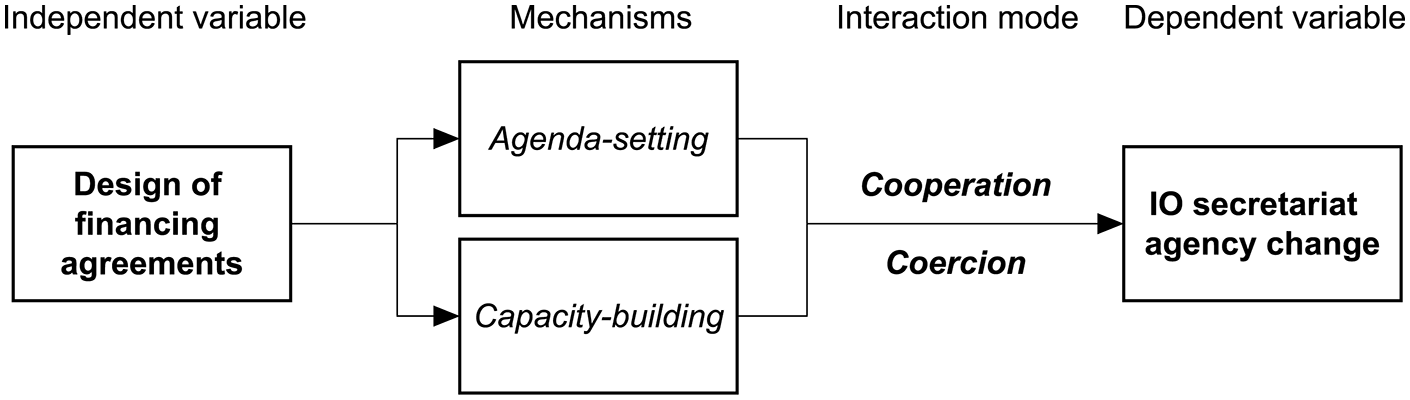
My theoretical argument (Figure 1) builds on the definition of recipient agency as ‘the capacity to act intentionally’, which orients two main causal mechanisms through which external partners (such as the EU) can shape the agency of an IO secretariat (such as the AUC): first, agenda-setting captures how the purpose of a financing agreement shapes the secretariat agenda; and second, and potentially in parallel, capacity-building describes how financial management provisions in a financing agreement shape secretariat capacity.
Theoretical argument.
Partnerships that provide external funding can either diminish or increase recipient agency. To capture this variation in agency outcomes, I theorize two ideal-typical interaction modes that capture the dyadic relationships between external partners and IO secretariats: cooperative, whereby the partnership enhances the recipient’s agency; and coercive, whereby a partner imposes a change against the recipient’s will, thereby lowering the recipient’s agency.
The empirical section operationalizes this theory using the case of the EU’s peace and security partnership with the AU by systematically applying the two mechanisms and two interaction modes. This results in a highly nuanced assessment of how the EU influences the AUC’s agency. The analysis reveals that the EU’s security partnership with the AU is dominated by cooperative agenda-setting and capacity-building, which enhances the overall agency of the AUC. Nonetheless, there are rare but important instances of EU coercion in both agenda-setting and capacity-building. Furthermore, the AU succeeds more easily at politicizing and criticizing coercion in agenda-setting than in capacity-building, where the politics of financial management are buried in bureaucracy.
This article contributes to the literature on security partnerships by offering a novel perspective on organizational sources of agency in security partnerships. Pushing the conceptual categories of extant scholarship on security partnerships, my argument incorporates not only benevolent cooperation and cooperation challenges, but also intentional coercion in security partnerships (cf. Williams and Boutellis, 2014; and Andonova, 2017). I also incorporate the insight from organizational theory that resource dependence does not automatically spell external control (Pfeffer and Salancik, 2003).
The article draws from postcolonial critiques of AU funding to make an important and specific contribution on the nature of EU–AU interactions. While the EU’s size as a contributor is remarkable, the AUC exercises considerable agency that prevents direct coercive influence on its goals and programmes. Critiques of AU financing gain depth when underscoring how the pursuit of African agency hinders neo-colonial influence. One should carefully balance the problems caused by EU funding with the AUC’s successes in channelling resources towards agency enhancement and resistance against coercion. Although I empirically demonstrate some instances of coercion, I re-balance this narrative with overwhelming evidence of cooperative inter-organizational relations, wherein the AUC ensures cooperation thanks to bureaucratic sources of agency. This also speaks to the ongoing debate on ‘African agency’ in international affairs (Bah, 2017; Beswick and Hammerstad, 2013; Brown and Harman, 2013; Soulé, 2020).
A theory of agency outcomes in security partnerships
External security partnerships can help IOs meet their resource needs, particularly when the resource base among member states is limited (Gwatiwa, 2022; Haastrup, 2013). Resource mobilization partnerships have complex effects on the agency of IO secretariats; therefore, a comprehensive principal–agent model is beneficial to explain such effects. Several scholars have used principal–agent analysis to unpack IO funding and partnerships (Barnett and Finnemore, 1999; Graham, 2014; Hawkins, 2006; Patz and Goetz, 2019; Vaubel, 2006). The basic tenet of principal–agent analysis is that states and secretariats enter a relationship in which the IO (as the agent) delivers a specified output as delegated by the states (the principals). Principals hold a key position; by mandating the IO to fulfil certain tasks, they ‘create IOs to serve certain purposes [. . .] and delegate to them certain powers necessary for them to perform their function effectively’ (Oestreich, 2012: 6). The principal delegates a certain mandate to the agent, an administration, based on the premise that certain goals can be realized more efficiently or effectively (Hooghe and Marks, 2015; Millner, 2006).
The independent variable of my theory of agency outcomes for security partnerships is the design of financing agreements. These agreements or contracts, which are often concluded either as binding agreements or Memoranda of Understanding, stipulate the type of resource to be provided, financial management provisions, and the purposes of the contract. The degree of fine-tuning in financing agreements varies; however, Global North partners in African security tend to include more fine-grained mandating provisions in their financing agreements. Contracts often cover both the financing modality and its management structure in terms of mandating.
The dependent variable of this theory is the IO secretariat’s agency. Agency, defined here as ‘the capacity to act intentionally’, 1 is found virtually everywhere actors seek freedom under constraints. With regard to IO secretariat agency, ‘intention’ is the secretariat’s agenda and ‘capacity’ is the administrative capacity. Thus, I define IO secretariat agency as the administrative capacity to use resources meaningfully and efficiently to control and act on a policy agenda that guides resource mobilization and institutional operation. The first element of IO secretariat agency, capacity, is the ability of the secretariat to use administrative and political expertise to mobilize and transform resources for IO operation. Capacity is required for financial management, project management, project design, and implementation. The second element of IO secretariat agency, policy agenda, describes the presence of policy goals. This agenda may be the result of delegation from the IO’s principals, such as its member states, but it can also occur by deviating from or adding to the principals’ policy agendas (Hardt, 2016: 168; Lyne et al., 2006: 6).
The postcolonial paradox shaping power in the EU–AU security partnership
The postcolonial context of EU–AU relations provides the setting for this article’s inter-organizational focus. While the proposed theory is generalizable beyond the EU–AU relationship, EU–AU interactions occur within a context of complex and persisting coloniality. This context means that any EU coercion has high costs in terms of how the relationship is perceived. Building on Barnett and Duvall’s (2005) typology of power, I argue that post-coloniality tends to force direct inter-organizational interactions into an attempted post-postcolonial cooperative interaction mode, whereas postcolonial attributes of coercion are likely to persist in the realm of indirect power.
EU–AU relations are inherently structured by this postcolonial paradox (Kotsopoulos and Mattheis, 2018; Orbie, 2021; Staeger, 2016). The EU is widely accepted to feign a ‘virgin birth’; however, the origins and practices of the EU–AU relationship are still deeply embedded in the colonial past and postcolonial interests of EU member states (Fisher Onar and Nicolaïdis, 2013; Hansen and Jonsson, 2014). The paradox can be stylized as follows. On the one hand, the EU operates on the (disproven) assumption that it is a post-postcolonial entity whose normative power entitles it to assume a leadership role in Africa’s pan-African integration process. On the other, any EU involvement in African integration can be framed as a continuity of practices from colonial times. This paradox creates an imperative for both the EU and AU to avoid forms of interaction that appear neo-colonial, and for the EU to potentially shift direct forms of power outside the inter-organizational relationship and into the broader space of Africa-EU interactions.
Concretely, this paradox incentivizes the avoidance of internal and public perceptions of coloniality in the EU–AUC resource mobilization partnership. The EU addresses this by eschewing most direct uses of coercive power. Building on Barnett and Duvall’s (2005) seminal typology, such ‘direct’ power is likely to be criticized for being neo-colonial. However, in the broader ideational and normative space of Africa-EU relations, the EU still imparts strong indirect influence, such as through standard-setting, ideational leadership and by virtue of blueprints for regional integration from which Africa might selectively draw. The diffuse nature of these ‘indirect’ forms of power means they are harder to pinpoint and criticize (Barnett and Duvall, 2005).
‘African agency’ is an important concept in assessing the EU’s effect on Africa’s place in international politics. The AUC’s agency is a central dimension of African agency, as are the AU’s influence in international politics (e.g. through its annually rotating Chairperson) and the group of African states at the United Nations (UN) General Assembly. The AUC’s ability to shape African and global politics enables it to exercise agency beyond theoretical expectations based on ‘templates from elsewhere in the world’ (Tieku, 2021: 267). While fully concurring with Tieku’s analysis, my argument emphasizes the AUC’s agency not in global politics, but in its core business of shaping the programme delivery of the AU. The impetus of African agency is not only for Africa to make a substantive impact in certain policy areas, but, as argued by Bah (2017: 149), ‘the strategic desire’ to ‘thwart the application of Western global liberal governance in Africa’. African agency, in other words, is also about carving out space for African-led governance, even if policy goals align with those of external actors. Furthermore, Bah (2017: 158) argues that contemporary African agency at the AU is an ‘effort to reproduce and transform structures of domination’, and needs to cater to existing power structures while seeking to establish space for African-led action. Thus, decision-making on AU programmes is a core question for African agency.
As the general capacity to act intentionally, African agency does not necessarily prevent the pursual of policies resembling (post)colonial arrangements. The essence of decolonial African agency is, after all, Africans shaping their future ‘under their own steam’, which does not preclude selective or proactive continuity with ‘artefacts inspired by colonialism’, as long as there are ‘good reasons for embracing them’ (Taiwo, 2022: 58 and 27). In security partnerships, such ‘good reasons’ may include well-designed funding arrangements that grant access to external resources without introducing unacceptable influence. This line of reasoning aligns well with my claim that coloniality in resource mobilization results in the EU avoiding direct imposition and instead favouring inter-organizational cooperation. Indirectly, of course, the coloniality of ideas continues to pervade the EU–AU partnership, and indeed Africa’s governance (Ndlovu-Gatsheni, 2013). The following sections unpack inter-organizational power relations more ‘directly’, without negating the broader context of coloniality described above.
Inter-organizational interaction modes: cooperation and coercion
In inter-organizational relations, cooperative and coercive interaction modes in delegation relationships can lead to relative changes in IO secretariat agency. Here, these interaction modes are used to build a causal argument about why particular financing agreements lead to a relative change.
In a cooperative mode, the attributes of the delegation relationship enhance the agency of the IO secretariat. For example, the principal may support the agent’s intentions or simply allow the agent to act intentionally by not imposing conditionality. In this mode, principals and secretariats may be driven by the joint attainment of a goal, or they may agree on the necessity of the intent driving the relationship (McNamara, 2012: 391). In terms of IO financing, resources may be provided with fewer strings attached. When the funder aligns with the preferences of the IO secretariat, resources are more likely to be provided without conditionality.
In contrast, coercive relationships lower agency by restricting the secretariat’s capacity to act intentionally. This outcome is engrained in relationships that require the principal’s purpose to be implemented against the intentions of the secretariat. Funders may apply sanctions or conditionality to achieve particular policy agendas or secretariat capacity changes. Even if the agent initially invited the relationship, they must accept the decrease in agency to continue it. This type of funder–secretariat relationship has been described extensively in the Europeanization and conditionality literature with regard to how the EU offers cash payments or promises of progress in EU accession for policy reforms (Schimmelfennig and Sedelmeier, 2005: 10–12). It is also prevalent in rational design institutionalism and realist power-based explanations of IOs, where exogenous institutions exercise objective power over others (Waltz, 1979).
Mechanisms of agency change: agenda-setting and capacity-building
The causal mechanisms of agency change in security partnerships, namely, agenda-setting and capacity-building, relate to the content and design of specific financing agreements. In both IO funding and development cooperation, principals stipulate a contract stating the resources that will be provided along with precise terms for their transfer (Patz and Goetz, 2019; Spencer, 2015). Uncertainty surrounding international commitments leads to funders preferring temporally finite contracts to safeguard against future changes (Koremenos, 2005).
The agenda-setting mechanism captures how principal–agent interaction shapes the agent’s policy agenda through the resource mobilization relationship. Cooperative agenda-setting can have an agency-increasing effect, such as when the financing agreement docks onto the secretariat’s existing policy agenda, or when the purposes stipulated in the financing agreement align with or complement the IO’s existing policy plans, thereby enhancing those goals by funding their implementation. Cooperative agenda-setting also occurs when the funding agreement stipulates purposes that the IO has not previously worked on, or has no extant policy on, but actively requests during negotiations with the funder. Beyond specific purposes foreseen in the financing agreements, funders may also seek to gain a ‘seat at the table’ when the broad lines of the IO’s agenda are being defined (Swedlund, 2013: 365). In contrast, coercive agenda-setting is a form of agency-decreasing mandating. This occurs when the financing agreement decreases the secretariat’s capacity to act intentionally, such as through conditionality or the stipulation of policy goals that the secretariat has not previously espoused. The secretariat may find itself bound by contractual clauses regarding the purposes and ways in which the policy goal must be achieved. Coercion arises from the need to undertake specific actions without leeway in how to do so, which constrains agency. Earmarking funds is a particularly common form of coercive mandating (Graham, 2017).
The capacity-building mechanism describes how a funding relationship can shape the capacity of an IO secretariat for resource mobilization. Capacity-building affects the agency of the secretariat by changing its ability to mobilize administrative and political expertise. This mechanism is triggered by the specification of capacity-related purposes in the financing agreement. Cooperative capacity-building positively impacts the secretariat’s agency, such as when financing agreements specify financial management purposes that align with the IO secretariat’s requests, or when a funder supplies resources for the specific purpose of enhancing the secretariat’s capacity. In contrast, coercive capacity-building occurs when financing agreements impose capacity-related purposes on the secretariat in return for continued or future resource provisions. By imposing such conditionality, the funder reduces the ability of the secretariat to operate its bureaucracy as it intended.
Data and methods
Data on AU resource mobilization were collected from 2015 to 2021 using a qualitative multi-methods design consisting of semi-structured elite interviews (N = 131; see Appendix 1), participant observation of budget consultation meetings, anthropological ‘hanging out’ (Nair, 2021), and document analysis. This multi-methods design allowed for triangulation and compensated for the challenges faced when accessing the AU, thereby increasing the quality and quantity of data. In addition, the validity of the key empirical findings was improved by compiling information from multiple sources. These methods were used in parallel and allowed for positive cross-fertilization.
A multi-source content analysis was conducted to establish the interaction modes between the two mechanisms of agency change, with a focus on cooperation and coercion in the inter-organizational realm of direct power. The first and main analysis method was to explore discursive evidence relating to the presence or lack of cooperative and coercive effects, such as through the language in the collected EU and AU documents and interview transcripts. Second, a desk assessment was conducted to analyse EU–AU funding agreements and partnership architecture, particularly policy dialogues, reporting mechanisms, regularity of meetings and policy goal setting. Owing to the limited availability of information about the more contentious details of these agreements, information from multiple data types, particularly interviews and document analysis, was connected and complemented. Finally, to discuss the postcolonial paradox of EU–AU relations, I analysed the indirect, diffuse, and discursive ways in which EU funding of the AUC shapes perceptions and interests. The case selection for the empirical illustration of the mechanisms is chiefly inductive; for example, the AU Mission in Somalia (AMISOM) is in the focus because close to all interviewees brought it up as a leading example of EU coercion.
Coloniality, cooperation and coercion in the EU–AU security partnership
The AUC’s dependence on external financing is undisputed; however, the consequences of this dependence are highly contested. While AU member states consider peace and security to be a highly sensitive and political policy area, it is uniquely expensive and highly dependent on partner resources. The AUC’s Peace and Security Department (PSD), 2 which assumes the role of secretariat for the AU’s peace and security operations, is the largest department in the AUC, both in terms of staff (170 staff members) and share of the AU’s total budget (47% or US$273.1 million in 2020) (African Union, 2019a, 2019b). Resource mobilization is a particular point of contention for the PSD. Given the high politicization and extensive role of partners, member states have carefully delegated powers on peace and security operations to the PSD. However, both member states and external funders strive for privileged access to the PSD. Thus, the politics of resource mobilization are a cornerstone of the PSD’s activities.
The AU peacekeeping budget covers all activities related to peace operations in the field. Member states have a policy of avoiding external funding for strategic security issues, such as small and light arms, anti-terrorist policy and intelligence (Interview AU 5). However, the PSD’s programme budget (US$37.7 million in 2020) was only 48% member state-funded in 2020 (African Union, 2019a). The EU accounts for up to 80% of external contributions to the AU’s peace and security budget (Interview EU 2, EU 8, EU 9). The EU and other partners fill the gaps left by the arrears and financial inability of member states to shoulder the high costs of this policy area.
The AU’s relationship with the EU has had an ambivalent effect on its agency in terms of agenda-setting. The EU has shaped PSD’s agenda by funding its ambitions. Many of the PSD’s policies would not have been developed without cooperative support from the EU. However, despite these instances of cooperation, there are important instances of coercion. In terms of capacity-building, EU contributions have had a clear agency-increasing effect, such as by boosting human resource capacity at the PSD. Although the EU stipulates financial management conditionality through the Pillar Assessment, this effect is ‘cushioned’ by the ancillary resources provided by the EU to the PSD for complying with its conditionalities.
Post-coloniality and alignment of EU–AU interests
The postcolonial nature of EU–AU relations significantly shapes dynamics of cooperation and coercion. The postcolonial imperative to avoid coercion means that the EU tends to shift its focus away from more direct forms of influence (coercion) over the AUC’s agenda and capacity, and instead towards cooperative engagement in areas where interests coincide. Thus, overlapping interests are an important prerequisite for EU–AUC engagement. There is a remarkable degree of overlap between the overarching policy goals of the EU and AUC. For example, the EU is a strong proponent of the UN’s Sustainable Development Goals (SDGs), which strongly overlap with the AU’s Agenda 2063. A 2016 mapping exercise commissioned by the AUC revealed 93% correspondence between the indicators and targets of Agenda 2063 and the SDGs (African Union, 2016e). The SDGs are, as the AUC argues, ‘heavily influenced’ by an African Common Position and Africa ‘being the only region to submit a well-articulated position in writing’ (African Union, 2016e).
Given the postcolonial paradox, the AUC’s pursuit of African agency results in an overarching interest to work closely with the EU, while locking it out of actual decision-making processes. This overarching institutional interest, which is explored in the sections below through different aspects of the EU–AUC relationship, tends to override substantive considerations; the AUC only allows the EU to contribute when their cooperative engagement can be credibly assured. Thus, I argue that the AUC’s continued pursuit of extensive EU funding is aptly captured by the observation of Taiwo (2022: 34) that, ‘while there may be post-independence phenomena that mimic similar ones in the colonial period’, African policy-makers have concluded that one ‘cannot automatically assume that they have the same pedigree’.
Agenda-setting: the EU as a ‘big payer’ but ‘small player’
The EU generally seeks to dock onto the AU’s peace and security agenda by implementing funding agreements that align with the PSD’s agenda and requests. An important EU representative (Interview EU 8) argued that ‘relationships of trust are needed’ to establish a successful working relationship. A senior diplomat in Addis Ababa (Interview Partner 2) argued that relationships with PSD officials should be ‘open and frank without a fear of being taken the wrong way’. These statements reflect the need for cooperative relationships driven by the attainment of a common goal. In light of the EU’s large contributions, some accuse the EU of coercive interference in the PSD’s policy agenda. However, owing to the postcolonial paradox, there is little demonstrable evidence for coercion, as illustrated by the analysis of the EU’s African Peace Facility below. Nevertheless, the EU shifts potential coercion onto other actors in the African Peace and Security Architecture (APSA).
The African Peace Facility, a purse without power
Despite the EU’s leading role as a funder, the AUC does not allow the EU many opportunities to impose policy purposes on its agenda. The AUC achieves this by front-loading political decisions and separating agenda-setting from resource mobilization. The EU’s cooperative role is also grounded in its alignment with the PSD’s agenda whenever possible. Furthermore, even if the EU wanted to impose conditionality, its own complex bureaucratic processes hinder such political interference. Although the EU struggles to link into the PSD’s planning processes, it tends to respond positively to all requests for support from the PSD – there are no known instances of the EU refusing an African Peace Facility request altogether (Interview EU 3, EU 5, EU 7, Expert 2, Partner 5).
The African Peace Facility is the main vehicle through which the EU provides resources to the AU for peace and security, particularly for non-lethal military materials and services. The African Peace Facility operates outside the EU budget and provides considerable financial support to the AU and APSA, with a substantial €2.7 billion allocated between 2004 and 2017 (European Commission, 2019: 10). As a result, the AU’s peace and security operations were funded almost exclusively by the African Peace Facility.
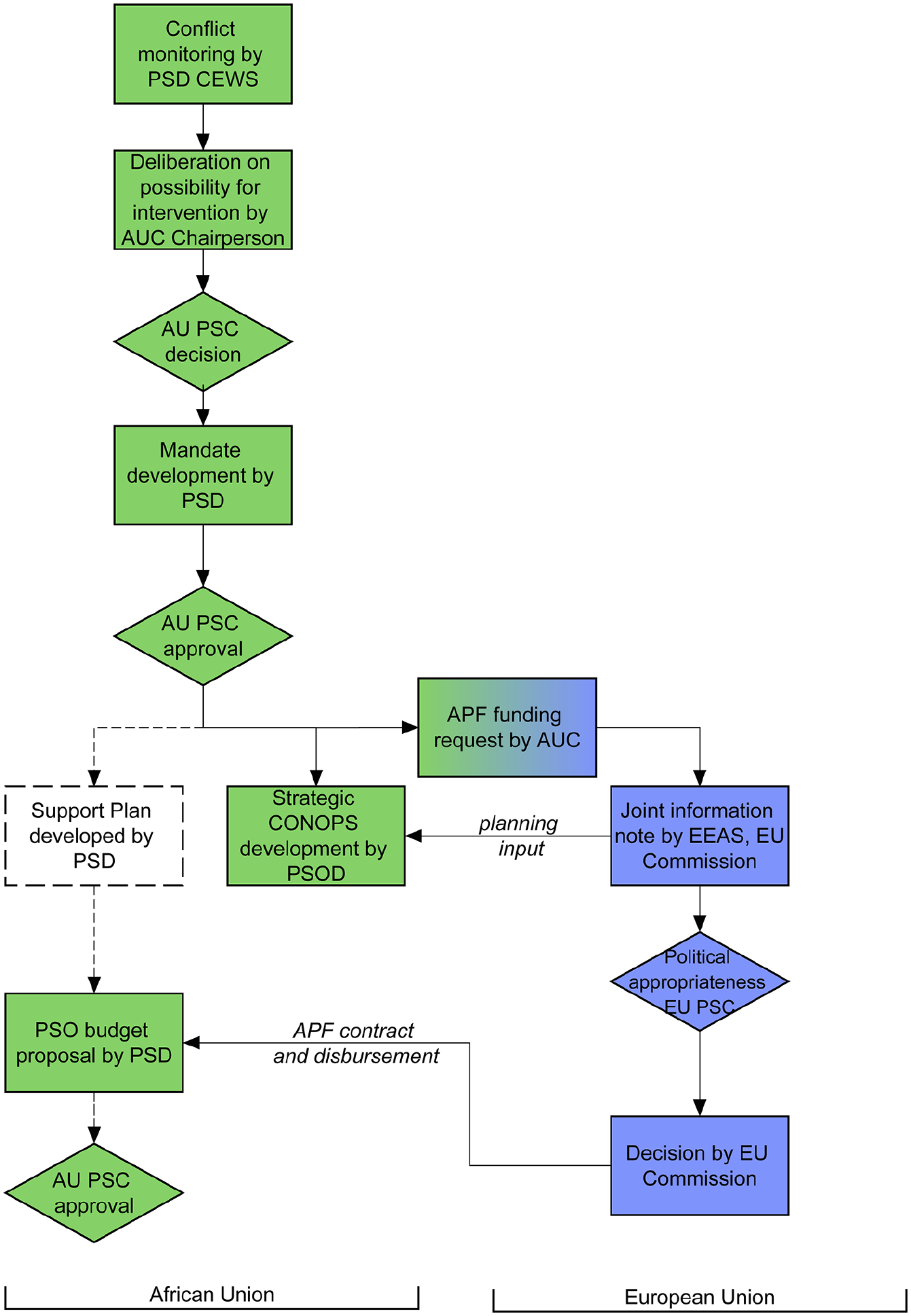
The PSD’s approach to mission planning deliberately shifts the EU’s support towards cooperative agenda-setting. When planning a peace and security operation, finding political agreement among AU member states and resource mobilization are ‘two different vectors’ of decision-making (Interview EU 5). Resource mobilization is usually an informal process that follows the agreement of the mandate by the AU’s Peace and Security Council (Interview AU 2, EU 5). The PSD also organizes resource mobilization conferences in which pre-approved mission budgets are presented to partners (Interview AU 2). In either situation, support from the EU’s African Peace Facility comes in after the PSD has made critical decisions independently of the EU, as demonstrated in Figure 2. The EU has a latent possibility for agenda-setting at the level of mission planning, but due to the lack of institutionalization in the PSD’s planning processes, the EU’s agenda-setting capacity remains marginal.
Agenda-setting between the AU and EU through African Peace Facility funding requests for peace and security operations.
The PSD produces several draft documents on mission planning. However, few of these are officially endorsed and follow-up documents for resource mobilization and mandating are not always produced, such as the strategic concept of operations (African Union, 2010, 2016b; Interview AU 1, EU 7). This leads to considerable informality and leaves EU counterparts ‘a bit lost’ in the process (EU 7). Thus, the EU conducts resource mobilization based on its experience and strengths and ends up ‘supporting missions with what [it] know[s] how to do best’ (EU 7). In many cases, the EU is interested in providing services, materials, logistical support and healthcare services, as well as systems for command control, coordination and information (C3IS) and intelligence, surveillance and reconnaissance (Interview EU 7, EU 11).
The EU’s steadfast contributions to the African Peace Facility and the PSD’s non-routinized mission planning mean that EU support tends to be cooperative. The AUC’s agency is successfully enhanced through this cooperative agenda-setting. The AUC mobilizes the resources required to fund its activities without inviting direct external influence on the more politicized aspects of its peace and security operations. Although the non-routinized nature of the AUC’s planning processes might not be entirely intentional, this bureaucratic dysfunctionality acts as an effective barrier to conditionality-based EU agenda-setting.
EU coercion in the AMISOM troop reimbursement incident
The EU has exerted rare but highly politicized instances of coercive agenda-setting. Perhaps the most notable example is the change in the allocation of EU funding for the AMISOM. This issue was cited by almost all interviewees in Addis Ababa as the most prominent case of partner coercion in the AUC’s agenda-setting. AMISOM was the AU’s largest peace and security operation with more than 20,000 soldiers on the ground at times. It was heavily dependent on external partners to finance its daily operations, mission planning, and logistics; in fact, only about 4% of the total cost of AMISOM was financed by AU member states (Vorrath, 2012: 1; Interview AU 6). The contributions of the UN, United States and EU were far larger and roughly equal in size.
Troop reimbursements are the largest expense in the AU’s peace and security operation budget. They cover the costs of deploying military personnel abroad, including personal equipment, direct deployment allowances and the (often small) troop salaries (United Nations, 2017, sec. 28). The AU’s arrangement with the EU for troop reimbursements stems from 2009, when the EU agreed to match UN troop reimbursement rates for AMISOM troops. The EU first agreed to pay troop reimbursements in 2007 at US$500 per soldier per month, which increased to $750 in 2009 (Williams, 2018: 322). However, by 2016, AMISOM’s troop size had increased almost 15-fold to 22,000 (United Nations, 2016). Meanwhile, the UN aimed to increase its troop reimbursements from US$1028 in 2014 to US$1410 per soldier per month by 2017 (United Nations, 2014), which the AU expected the EU to follow. However, reflecting the inflated troop size, the EU opposed this increase and capped troop reimbursements at €738 in 2016. According to an EU representative involved in the decision, this was done to avoid inflating AMISOM’s budget from US$20 million to US$33 million (EU 7). The EU then announced that it could not cover foreseen troop reimbursements, given AMISOM’s increasing troop size. Instead, the EU asked the AU to choose other budget lines of AMISOM on which to spend EU funds (of an overall unchanged total). The EU implemented this change without consultation and presented it to the AU as a ‘fait accompli’ (Mahmood and Ani, 2017: 10). Despite significant resistance, the AU had little choice but to accept this conditionality.
This imposition of conditionality by the EU curtailed the AUC’s agency. In a rare public criticism, the AU Military Operations Coordination Committee stated that it ‘regret[ted] the decision by the EU to reduce the payment of AMISOM troop allowance by 20%’ (African Union, 2016f). The EU’s decision also lowered the AUC’s agency because the EU abused the AU’s intention to continue to align its troop reimbursements to the newly increased UN rates; in fact, it forced the AU to do the exact opposite. By lowering its contributions, the EU coerced the AU to reallocate funding.
This instance of coercive agenda-setting had a clear impact on the course of AMISOM and its eventual drawdown (European Union, 2019: 19; Interview African 1, AU 1, AU 3, EU 8). Six months after the EU’s troop reimbursement ceiling took effect, the AU’s Peace and Security Council endorsed a new concept of operations that referenced AMISOM’s exit strategy in Somalia and an eventual troop drawdown (African Union, 2016d). Notably, the directive nature of this imposition cost the EU dearly in terms of perceptions, as it had acted against the postcolonial paradox’s push for cooperation.
Capacity-building: capacity substitution and cushioned conditionality
As the secretariat of the AU’s peace and security operations, the PSD faces considerable capacity challenges. Funders can increase a secretariat’s capacity through the provision of financial management and resources. Such capacity-building increases agency if the provision is devoid of conditionality and aligns with the funding requests of the secretariat.
At the PSD, external partners have laudable intentions to fix the PSD’s capacity problems, and the PSD continuously requests capacity-building measures from partners. The agency outcomes of capacity-building are mitigated. On one hand, EU-led capacity-building solves some short-term problems, such as salary payments and the lack of technical expertise. On the other, it often amounts to capacity substitution. Partners’ capacity-building efforts take too much space for the PSD to develop its own capacity. This ultimately creates the structural conditions for continued dependence on partners. Crucially, the EU also imposes conditionality regarding financial management through the Pillar Assessment. While this assessment is based on positive incentives and is cushioned with additional support, it remains coercive. These issues are explored below.
Salary payments without a say
The EU directly supports PSD salaries but has no say in hiring and firing at the AUC. The PSD has approximately 40 regular and 130 short-term staff (European Court of Auditors, 2018: 24; Interview AU 6, AU 5, Partner 7). Their salaries – of which partners contribute 40%–50% (African Union, 2016c, 2017, 2018, 2019a) – constituted approximately 33% of the PSD’s overall programme budget for 2020, or US$11.8 million annually (Author’s calculations based on African Union, 2019a). Notably, the PSD receives a dedicated salaries fund, demonstrating the salience of security at the AU.
The PSD invites salary support through a Joint Financing Agreement (JFA) that is devoid of conditionality, which enhances the PSD’s agency while strengthening its capacity. The PSD receives financial contributions from funders without allowing them any influence over hiring decisions or direct and individual access to funded staff members (Interview EU 1, EU 8, Expert 4). JFA partners such as the EU have voiced concerns that their contributions are not reflected sufficiently in functional policy dialogue at the PSD (Interview Partner 1, Partner 4, Partner 6), and lament not having ‘enough of a say’ in return for their contributions (Interview Partner 1). This dissatisfaction is evidence of cooperative capacity-building, in which the PSD sets the boundaries for partners’ influence over how it operates. In these cooperative relationships, the EU cannot use its capacity-building for agenda-setting: the AUC has designed external funder interventions to ensure external partners cannot shape human resources and policy decisions directly. The funding modality is proofed by design against direct coercion.
EU coercion through capacity-building: the Pillar Assessment
The Pillar Assessment is an ex-ante assessment of the financial management systems of the EU’s funding recipients. The EU establishes whether a recipient precisely matches the ‘principles, standards, and methods’ of EU financial management (Interview Partner 3). If they do, the EU can use the recipient’s financial management systems through ‘indirect management’, which promises considerable efficiency gains in administering EU funds and effectively makes the funding recipient an agent implementing EU external action programmes. The Pillar Assessment pertains to the ‘internal control’, ‘accounting’ and ‘independent external audit’ systems of the funding recipient, and stipulates rules and procedures for ‘providing financing from EU funds through grants’, ‘procurement and financial instruments’ and ‘sub-delegation’ (European Commission, 2014).
The Pillar Assessment effectively imposes a wealth of financial management conditionalities on the AUC by linking them to the promise of future disbursements that are easier to handle. The AUC was first ‘pillar assessed’ by the international consultancy firm EY in 2014, but failed in the accounting, procurement and sub-delegation areas (Interview EU 1, EU2; EU 4; European Union, 2019). After the failed Pillar Assessment, the EU interrupted disbursements for several months, leading to a cash flow crisis (Interview Expert 1, EU 9). In line with the postcolonial paradox of the EU–AU partnership, the AUC does not communicate publicly about the Pillar Assessment.
Compared with other AUC departments, the PSD has been much more successful in setting up dedicated bureaucratic arrangements to streamline its resource mobilization from the EU and even in requesting EU funding. The PSD’s Project Management Team, an entity of approximately twelve staff who report directly to the director of the PSD, was put in place chiefly to deal with EU funding (Interview AU 5). For larger contributions, such as the JFA for Salaries, staff members have been hired to focus exclusively on these contracts (Interview Partner 4). The PSD conducts audits on their contracts and is generally kept occupied based on the way the EU disburses its funding (EU 5). While helpful for eventual Pillar Assessment compliance, this form of capacity-building arguably substitutes secretariat capacity rather than building it up sustainably.
In the short-term, the Pillar Assessment decreased the PSD’s agency, as its financial management conditionality demanded significant bureaucratic resources. Nevertheless, the EU offered several short-term fixes that ‘cushioned’ its conditionality, including paying for consultants to help the PSD meet its conditions, funding activities towards a successful second attempt at the Pillar Assessment, contracting EY to accompany the follow-up process (Interview EU 2), and financing the valuation of all AUC assets for audit purposes (Interview Expert 3, AU 7, EU 9). These measures supported the AU in eventually passing the Pillar Assessment in December 2019 (Interview EU 10, EU 12), since when the PSD has been able to access EU resources more easily. This raises the question of whether short-term coercion with potential long-term positive effects on secretariat agency is more palatable than other forms of coercion.
African security beyond the AUC: forum-shopping through bilateral, sub-regional and ad hoc funding modalities
The discussion above demonstrates that the EU’s engagement with the AUC is predominantly cooperative. While the EU generally appreciates the secretariat-to-secretariat logic of EU–AU cooperation, the postcolonial paradox limits how the EU can shape policy processes at the AUC coercively, and makes alternative organizational fora in the broader space around APSA an attractive option. Recently introduced funding instruments give the EU the ability to circumvent the AU in future contributions to other African security actors. While past contributions through the African Peace Facility required a formal AUC role, the new European Peace Facility enables EU forum-shopping in African security (Busch, 2007; Hofmann, 2019).
While the impact of the European Peace Facility on EU-Africa security partnerships remains to be seen, there is ample institutional design evidence of EU forum-shopping. The EU has entered into a ‘General Programme’ with the AU, which excludes the provision of lethal military assets that is otherwise possible through the European Peace Facility (European Union, 2021). This General Programme is arguably a commitment to a normative, cooperative EU. The AU will likely be the only EU partner to receive a General Programme, which allows the AUC to request EU funds through a simplified procedure with fewer veto points for EU member states (Interview EU 12). The General Programme also carries over many activities previously funded under the African Peace Facility (European Union, 2021). At the same time, new European Peace Facility assistance measures with other African security actors demonstrate that the EU is ready to balance the AU’s primary role in African security with an ability to negotiate funding with less subsidiary actors such as sub-regional organizations, member states and ad hoc coalitions (Karlsrud and Reykers, 2020). Time will tell what impact the interaction mode and volume of non-AU support will have on the agency of the AUC.
Conclusion
What explains the variation in how the EU shapes the AUC’s agency in peace and security? This article demonstrates that the adage ‘he who pays the piper calls the tune’ fails to capture the dynamics between money and power in the EU–AU partnership in peace and security. Rather, I hope to leave readers with a nuanced assessment of EU funding in the AU’s security activities, and posit that direct, inter-organizational relations are far more cooperative than much literature and popular critique would suggest. At the same time, such cooperative relations do not preclude continued coercive patterns of interaction in the indirect realm of coloniality. The postcolonial paradox of EU–AU relations underscores the contradictory nature of the EU’s role as a leading partner of Pan-African organizations such as the AU. Against this backdrop, the EU and AU have invested considerable resources to establish a highly capitalized partnership that accommodates the contradictory imperatives of the postcolonial paradox of EU–AU relations: embracing the need for African-led governance of security, as well as the appetite for readily available European funds.
This article provides further evidence to the claim that the AUC exercises considerable African agency. The AUC holds a surprising amount of power over its funders. Moreover, resource mobilization should be understood through separate mechanisms of agency change that pertain to the recipient’s agenda and capacity. This nuanced and disaggregated understanding of IO partnerships helps us to assess the complex and seldom unidirectional effects of diversified funding in security partnerships and other areas of IO resource mobilization.
The empirical analysis presented a broadly benevolent EU that genuinely seeks cooperative engagement with the AU. Good intentions are not enough, however. The AUC has established its resource mobilization in a way that institutionalizes the EU as a marginal player in its decision-making processes. In agenda-setting, the AU succeeds considerably better at such marginalization, and has even capitalized considerably on the highly publicized incident involving AMISOM troop reimbursements. In capacity-building, however, the AU prefers to keep its acquiescence to EU coercion below the radar of public scrutiny. In both mechanisms of agency change, the AU appears to excel at playing the temporal dimension by accepting short-term coercion to enable long-term cooperation. Both with AMISOM and the Pillar Assessment, the AU has engaged in the EU’s coercive relations with a view to future benefits of a cooperative nature.
Finally, the EU–AU partnership should be observed in the context of other, less resourceful AU security partnerships. Overall, the AU has relied heavily on the EU to mobilize financial resources for almost two decades, which has had ambivalent effects. The EU’s support has generally helped the AUC to implement large-scale peace and security operations and other significant parts of its ambitious agenda. However, the AUC’s over-reliance on the EU hinders its agency, despite its diversified partner base. Future research should explore PSD’s relationships with more than 60 partners, most of which only make small contributions to peace and security initiatives. PSD’s attempts at creating a large group of funders to develop discretion from the EU mean that PSD must handle numerous contracts with largely insignificant contributions, which comes at considerable administrative cost. Attempts to compensate for the EU’s predominant role in funding this budget category have had the undesirable effect of adding more administrative strain without mobilizing significant additional resources.
As the AU enhances its African agency, the EU aspires to a foreign policy with a more geopolitical pedigree (Tocci, 2016). This article’s discussion of the postcolonial paradox illustrates the considerable struggle of both the EU and AU to untangle money and power in their partnership. Yet a ‘more geopolitical EU’ can embark on two paths: more coercive impositions on Africa, or a more explicit spelling out of EU interests and, ultimately, more selective but cooperative embracing of the AUC’s preferences.
Footnotes
Appendix 1
Acknowledgements
The author would like to warmly thank Stephanie Hofmann, Paul D. Williams, Liliana Andonova and Jean-François Bayart for their comments on different versions of this article. Two anonymous reviewers and the editors of Cooperation and Conflict provided very useful comments and feedback.
Funding
The author(s) disclosed receipt of the following financial support for the research, authorship and/or publication of this article: Research for this article was made possible in part by a research grant from the Swiss National Science Foundation, grant P0GEP1_172079.
