




Abstract
Although coercion literature has traditionally focused on two-actor dyads, coercion in three-actor settings is a prevalent yet understudied strategy in International Relations. Such cases of “triangular coercion” represent a phenomenon whereby a coercer who lacks direct leverage over a resilient target coerces a third party who does possess leverage over the target, and to whom the target is vulnerable, and manipulates it into a clash of interests with the target. By forcing an otherwise uninvolved intermediary to align with the coercer, a coercer can alter the balance of vulnerability vis-à-vis its otherwise resilient target and enhance its susceptibility to coercion, albeit by extension. Existing scholarship tackles triangular coercion from different angles and mostly focuses on actor typology. This article seeks to promote our understanding of this strategy by proposing a conceptual model that distills its logic into the abstract components of vulnerability, resilience, and leverage. To demonstrate the dynamics of triangular coercion, the article draws on three empirical cases: Israel’s failed attempts to force Lebanon to rein in Hezbollah in the 1990s, Nazi Germany’s successful manipulation of Britain and France into coercing Czechoslovakia in 1938, and the Soviet Union’s success at forcing the United States to coerce Israel in 1973.
Barely had a week passed since President Donald Trump had threatened North Korea, in early August 2017, with “fire and fury like the world has never seen,” when White House Chief Strategist Steve Bannon publicly debunked the president’s implied nuclear threat. “There’s no military solution here,” he confessed, “they got us” (Kuttner, 2017). Faced with a resilient target over whom it wielded little if any direct leverage, the United States changed course. Rather than threatening North Korea directly, senior US officials stepped up their pressure on China, which, as noted by National-Security Adviser H.R. McMaster, possessed, “tremendous coercive economic influence” (MSNBC, 2017) over Pyongyang. In this context, US Senator Lindsey Graham stated Trump had confided him that “if there’s going to be a war” to stop North Korea, “it will be over there. If thousands die, they’re going to die over there. They’re not going to die here.” Claiming that he believed the president, Graham added that “if I were China, I would believe him, too, and do something about it” (Ortiz and Yamamoto, 2017). Indeed, to make China lean on North Korea, the White House accentuated the costs China itself would incur if it failed to unleash its coercive leverage against Pyongyang (Mattis and Tillerson, 2017).
These purposeful US efforts to produce indirect leverage over North Korea reflected a prevalent but understudied phenomenon in international politics: coercion in three-actor settings, or “triangular coercion.”
A central theory of International Relations (IR), coercion pertains to the way in which states employ threats and promises to make other actors do something they otherwise would not do, largely by exploiting their vulnerabilities (Art and Greenhill, 2018). A primary requisite of coercion is the communication of a credible threat of punishment. To be credible, threats and promises must be accompanied with explicit commitments from which backing down would seem too costly (Schelling, 1960). However, the very pursuit of coercion, a strategy designed to achieve a desired objective without having to pay the cost of military victory, almost inherently calls into question the coercer’s credibility and resolve (Pape, 1996: 13).
Coercion literature has traditionally focused on inter-state deterrence standoffs and on bilateral models featuring a coercer and a target. Yet, coercion often involves more than two actors and rarely unfolds in a linear sequence (Byman and Waxman, 2002: 37–38). Coercers often circumvent the linear logic, meaning that rather than taking on their adversaries directly, they enlist outside support or manipulate third parties to do their bidding. That this mechanism occasionally succeeds merits further empirical and conceptual scrutiny, as the field of IR largely revolves around the ability to influence behaviors and shape outcomes. This article proceeds as follows. The following section presents the extant literature on coercion in three-actor setting. Next, the article proposes a conceptual model that distills the logic of triangular coercion and explains it through the interplay between vulnerability and leverage. The article proceeds to illustrate the model using one historical case of triangular coercion failure and two cases of triangular coercion success. The conclusion offers avenues for further research.
Different strands of triangular coercion literature
Existing scholarship on triangular coercion is relatively scant, but also fragmented and narrow. Some scholars addressed the phenomenon in a nuclear context, namely in situations involving the United States. In 1998, Robert Harkavy noted the potential emergence of the “wholly new strategic concept” of “triangular deterrence,” whereby “a weaker power lacking the capability to deter a stronger” and “distant power,” threatens a riposte against a “smaller, closer or contiguous state.” While Harkavy noted that his analysis may be applicable to non-nuclear settings, the main thrust of his article was confined to nuclear settings, specifically examining how rogue states could coerce the United States by threatening to inflict pain on a US ally. A related variation of coercion in three-actor settings involving the United States pertained to cases where nuclear states adopted what Vipin Narang called a “catalytic posture” in the hope of “catalyzing third-party military or diplomatic assistance” from the United States when their vital interests were threatened. To blackmail US support, countries signaled that they might be forced to use nuclear weapons (Narang, 2015: 75–77).
Another strand of triangular coercion scholarship followed the 11 September 2001, terrorist attacks. Terrorist groups constituted an unidentifiable and therefore undeterrable target. Scholars thus explored ways to render them coercible, focusing attention on concepts like “indirect deterrence,” a strategy whereby the coercer pursued not its elusive terrorist target but its enablers (Knopf, 2010: 10–12). Keren Fraiman examined cases whereby states sought to force other states to restrain terrorist groups operating from within their borders. Focusing on the relationship between the coercer and the host state, Fraiman (2018) argued that “if a coercer can credibly threaten or use limited action to increase the pain of a base state, such actions should cause the base state to at least evaluate the costs of compliance before rejecting the demands of the coercer” (pp. 120–121). Boaz Atzili and Wendy Perlman similarly tackled the difficulty of deterring terrorists operating from host states, but concentrated on the relationship between the third party and the target. They found that because terrorists enjoyed popular support within their host state, triangular coercion success depended on the latter’s “institutional capacity” to acquiesce to the coercer’s demands and implement steps opposed by the host state’s public. Thus, whereas Fraiman argued that triangular coercion simply depended upon the coercer’s ability to credibly threaten the third party if the latter refused to act against the target, Atzili and Perlman (2012, 2018) cautioned against the notion that success merely depended on the coercer’s ability to threaten to punish a third party who lacked the actual capacity to rein in the ultimate target.
Other scholarship on triangular strategies suggests that focusing strictly on the third party’s institutional capacity holds little value beyond the specific issue of terrorism. Mancur Olson’s scholarship showed that large groups of people could be coerced into collective action (Olson, 1965). Taking this a step forward, Thomas Schelling asserted that even a large group of helpless people can be manipulated and harnessed in the service of bringing collective coercive pressure on powerful targets. Thus, “pain and damage,” Schelling (1966) noted, “could also be aimed at intimidating populations, affecting governments only indirectly. Populations may be frightened into bringing pressure on their governments to yield or desist” (p. 180). Nowhere is this more evident than in Kelly Greenhill’s conceptualization of “coercive engineered migration,” whereby states strategically manipulate targets’ preferences by threatening to generate, or indeed generating, mass migration crises. States were thus able to harness the humanitarian crises they had purposefully caused as a coercive instrument against superior adversaries (Greenhill, 2010: 1–11). In such cases, not only did the third-party lack institutional power, as required by Atzili’s and Perlman’s theory, but it was not even a standalone actor in the traditional sense. That populations could be manipulated into playing such a role suggests that third-party weakness neither implies insufficient leverage nor precludes the possibility that it could be utilized to increase the coercer’s leverage over the target. For instance, a coercer could hold at stake a third party who is not strong, but to whom the target is formally committed (Smith, 2006). Thus, that populations are not an independent, unitary, standalone actor in the traditional sense hardly precludes the fact that a coercer could turn them into a strategic factor that an otherwise resilient target would be forced to factor into its own strategic considerations.
Another variation of triangular coercion is Timothy Crawford’s model of “coercive isolation,” which builds on his research on “wedge strategies,” whereby a coercer increases its target’s perceived vulnerability by offering inducements to the target’s ally and by paying it off in order to reduce the target’s expectation of allied support. Thus, by detaching a patron from its target one can “impose on the target an immediate loss of power to resist” (Crawford, 2008, 2018).
The most comprehensive attempt to overcome the fragmentation in the literature was made by Michal Smetana and Jan Ludvik, who explain that unlike classic two-actor coercive dyads, in “indirect coercion” the coercer seeks “to alter the strategic choices of the target by drawing an intermediary into the conflict,” thus producing a triangular interaction (Smetana and Ludvik, 2019). Drawing on three successful cases of indirect coercion, they propose three paths by which a coercer can manipulate an intermediary against an elusive target. The first path involves a relatively weak actor who “takes hostage” of, and threatens to inflict pain on, an intermediary to whom the target is committed. In the second path, the coercer forces the intermediary to lean on the target by threatening to attack the target, to whom the third party has an alliance commitment, and thus to drag the third party into an undesirable clash. In the third path, the coercer threatens to punish the intermediary unless it pressures the target. The article concludes by identifying “several intriguing observations that deserve further attention.” These include studying “the coercer’s rationale for choosing indirect coercion over the direct variant” and “the extremely intriguing . . . motivations of actors to alter their policies even when the threatened punitive action is not directed towards themselves” (Smetana and Ludvik, 2019).
While the studies cited do not state so explicitly, what they ultimately have in common is that they pertain to would-be coercers who lack direct leverage over a target and thus attempt to exploit the vulnerability of a third party in a bid to affect the calculations and behavior of the target. By distilling the dynamics of triangular coercion down to the elements of resilience, vulnerability, and leverage, a general model can be constructed, one that offers a tighter and more comprehensive conceptualization of the strategy of triangular coercion. Such a model encompasses the broad variety of settings and actor types featured in the literature and helps to bring previous findings into clearer focus. As noted, existing literature emphasizes actor typology, focusing on questions such as whether or not actors possess nuclear weapons, on whether they are a “smaller power,” a state without “institutional capacity” or “lacking options to reach the target’s territory,” on whether they are not even a state but rather a popular terrorist group residing in a “host state.” This variation of attributes ultimately boils down to leverage, vulnerability, and resilience. This article proposes that these abstract attributes make for a conceptual framework that is generally applicable to coercion in three-actor settings and which help to focus the limelight on the actor that matters most in triangular coercion—the third party.
The vulnerability-credibility interplay
Triangular settings, at least in the current context, are more complex than bilateral interactions because they involve the considerations and capabilities of a third party that, whether powerful or weak, would have otherwise preferred to remain uninvolved. Its role boils down to its ability to shift the balance of vulnerability between the coercer and the target and to the way in which the coercer may leverage the third party to gain credibility and leverage over the target. This section briefly explains the relationship between vulnerability and credibility.
Far from constituting an absolute condition, vulnerability refers to actors’ susceptibility to long-term detrimental impact and to their ability to adapt to exogenous developments. Keohane and Nye characterized vulnerability as “an actor’s liability to suffer costs imposed by external events” even after altering its policies in a bid to escape their negative impact (Keohane and Nye, 2012). In other words, vulnerability is about one’s actual or perceived exposure to inescapable costs. These could stem, among other things, from military inferiority, economic or military dependence on the coercer, or from existing political or normative obligations that commit an actor to a particular course of action. In the context of strategic interaction, vulnerability is about the extent to which an actor is able to guarantee its security, retain a contested asset, or maintain policy alternatives in the face of others’ efforts to make it adjust to their strategic preferences and drag it into an undesirable strategic interaction. Thus, an actor seeking to deter an opponent by means of a credible threat, or to reassure an ally with a credible commitment, must constrain itself and commit to a certain course of action. It does so by reducing its latitude and available options, thereby exposing itself to a potentially inescapable costly scenario. While eliminating one’s own options generates credibility, it exposes the actor to strategic manipulation. This dilemma looms large in alliance politics, where allies must carefully navigate between the requisite of commitment and the risk of entrapment (Snyder, 1984).
If vulnerability connotes exposure to inescapable costs, leverage means a capacity to threaten to impose concrete material or political costs on another actor (Busby and Greenhill, 2015). It thus depends on one’s ability to exploit another actor’s constraints in order to reshape its behavior and advance one’s strategic objectives. The way this works in two-actor settings is that the coercer reduces its target’s options and threatens it with inevitable costs, thereby making it realign with the coercer’s preferences. When the target is resilient to the coercer, the latter may attempt to exploit the vulnerability of a third party to whom the target is vulnerable. Flowing from this, resilience, like security, depends on the interaction between threats and vulnerabilities (Buzan, 1991). Thus, it refers to the degree to which actors can shield themselves from strategic manipulation and keep their options open. In alliances, for instance, this is achieved through the introduction of escape clauses. It is for this reason that actors tend to use equivocal language in their threats and commitments.
Importantly, military superiority does not automatically produce leverage or resilience. While this means that superior actors might not be able to coerce weaker states (Miller, 2014), it also means that an abundance of power does not necessarily protect against strategic manipulation and coercion. 1 Moreover, powerful actors, too, seek to avoid being dragged into conflicts. Conversely, material weakness does not necessarily imply absence of leverage, nor inability to manipulate other actors into undesirable situations. Indeed, relational power approaches maintain that “capabilities even when held in relative abundance do not automatically or necessarily influence the behavior of others” (Friman, 2015).
Building on this discussion, the following model distills the structure and logic of triangular settings to the elements of resilience, vulnerability, and leverage. As illustrated, the crux of the situation is that the target is resilient to the coercer. It is, however, vulnerable to a third party that is vulnerable to the coercer. Thus, while the coercer lacks direct leverage over the target, it nonetheless wields leverage over a third party that wields leverage over the target or that can be left with no choice but to become part of a situation in a way that is detrimental to the target. Because capabilities do not guarantee leverage, and because weakness does not preclude leverage, any actor type—whether strong or weak, state or non-state—can potentially fit into each of the three rubrics. While unintuitive, this means, for instance, that a coercer could be a junior ally who manipulates a superpower to lean on a powerful target, or, alternatively, a superpower who coerces another superpower to lean on a militarily inferior target. Also, the coercer could be manipulating the third party in a bid to deter a target or, conversely, to compel it into action. In compellence, the coercer manipulates the third party into actively leaning on the target. In deterrence, the coercer threatens to take unilateral action against the third party (Figure 1).
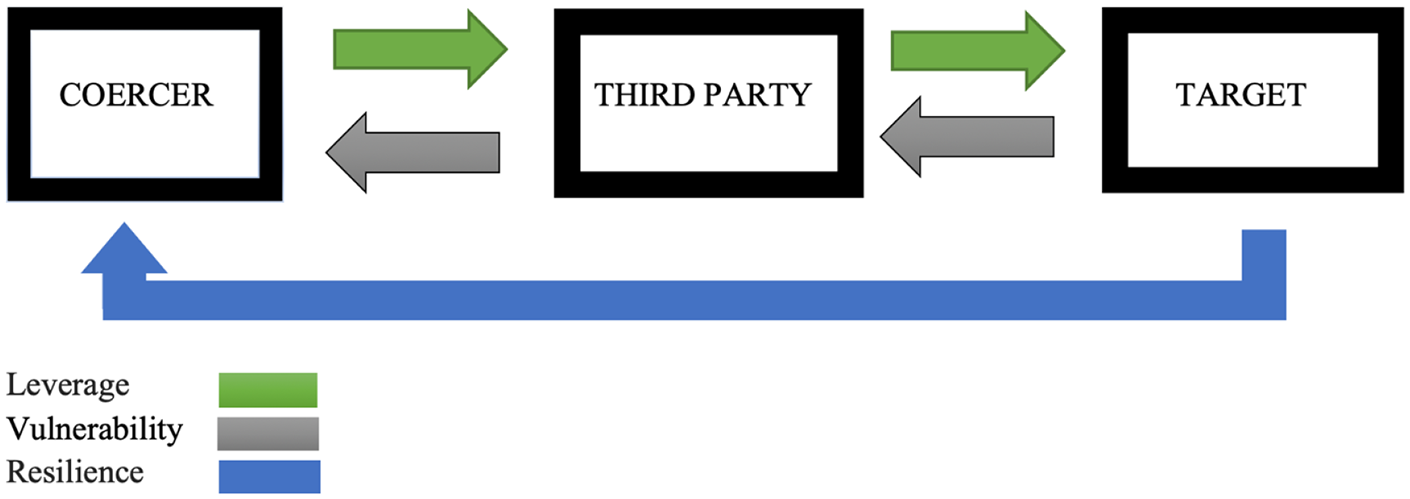
The Dynamics of Triangular Coercion.
As explained, credibility requires that actors make self-enforcing commitments that reduce or eliminate their latitude. Whereas in traditional coercion the coercer gains credibility and leverage by tying its own hands, in both the compellent and deterrent applications of triangular coercion the coercer gains credibility and leverage by tying someone else’s hands. Such measures would be perceived as leaving the coercer with little or no option but to implement its threats and are thus likelier to be believed.
Importantly, a third party that is vulnerable to the coercer, and whom the latter decides to “take hostage,” effectively loses its ability to make strategic choices anyway, as the situation is simply imposed on it. This applies not only to state actors but also, according to Schelling, to populations. Even without agency, and without being an independent, standalone actor in the traditional sense, the third party is nonetheless a strategic factor in the target’s calculations and a source of leverage in the coercer’s hands. What ultimately matters in triangular coercion is therefore whether the third party can be coerced, utilized, or otherwise left with little or no option but to help impact a target’s strategic considerations. What also matters is that the ultimate target must bring into consideration that a third party could be forced into a clash with it.
By invoking the calculations, capabilities, concerns, and constraints of a third party, and by forcibly committing it to a certain course of action, triangular coercion introduces a credible dimension into an otherwise less credible interaction. This dimension of credibility is less accentuated by “coercive isolation,” where the target’s ally is paid off to abandon the target. What the existing literature on triangular coercion does not sufficiently capture is that in triangular coercion, the third party is either forced to align with the coercer or is manipulated in a way that enhances the likelihood that it would indeed promote the coercer’s interests at the expense of those of the target. This enhances the credibility of the threat and accentuates the severity of the crisis. The clearest manifestation of triangular coercion would be the sequential transition of coercive pressure, most notably a demand, a threat, or an ultimatum, from the coercer to the third party, and from the latter on to the target. We may also observe a genuine sense of urgency in a third-party fearing the prospect of being chain-ganged.
Since the coercer’s objective would be to force a third party to align with its preferences or otherwise serve its interests at the expense of the target’s interests, triangular coercion will generate increased friction between the third party and the target. For triangular coercion to succeed, and for a target to alter its policies even when, as Smetana and Ludvik point out, the threatened punitive action is not even directed at itself, the ultimate target would need to be vulnerable to the third party. Conversely, if the target is resilient to the third party, triangular coercion is likely to fail.
The logic of this model is illustrated through three historical case studies: one failed case and two successful ones. The first features Israel’s failed attempted coercion of Lebanon in the 1990s. The second case study features what is not only a classic case of triangular coercion but arguably the most consequential manifestation of this strategy in modern history: Nazi Germany’s indirect coercion of Czechoslovakia in 1938. Hitler’s dismemberment of Czechoslovakia is among the cases analyzed by Smetana and Ludvik, albeit not according to the specific model presented in this article, which revolves around the attributes of resilience, vulnerability, and leverage. The third case features the Soviet Union’s successful coercion of Israel in the 1973 Arab–Israeli War, in which it harnessed the United States in the service of applying immense pressure on Israel, forcing it to end its siege of the Egyptian Third Army.
Triangular coercion failure: Israel, Lebanon, and Hezbollah
During the 1990s, the Israel Defense Forces (IDF) found itself in a worsening military conflict with the Lebanese Hezbollah, then a small non-state actor of several hundred fighters. In 1992, Hezbollah introduced a new military strategy whereby it fired rockets into Israel whenever IDF activity exceeded certain parameters. Determined to force the group to abandon this method, Israel launched two military offensives against Hezbollah: Operation Accountability, in 1993, and Operation Grapes of Wrath, in 1996. Yet, both offensives failed to achieve Israel’s stated goal of excluding Hezbollah’s rocket attacks from the acceptable “rules of the game.” In both cases, Israel, having failed to deter the highly resilient Hezbollah and clearly unwilling to unleash a major invasion, pursued triangular coercion. Because Hezbollah could not be coerced directly, Israel sought to coerce the Lebanese government into exerting pressure on Hezbollah on its behalf. Whereas Hezbollah’s guerrilla tactics proved resilient to Israel, Lebanon itself presented a highly vulnerable third party. To make it act against Hezbollah, Israel deliberately forced thousands of residents, from dozens of Lebanese towns and villages, to flee northward to Beirut. Thus, on the second day of Operation Accountability, on 26 July 1993, Israeli Prime Minister Yitzhak Rabin ordered the IDF to start bombing Lebanese villages with smoke- and phosphorus bombs “to generate a mass flee of villagers to the suburbs of Beirut” and to “bring pressure on the Lebanese government.” It was believed that this would force Hezbollah “to return to previous rules of the game in its fighting against Israel” (Barnea, 1993). Explaining the strategic logic behind the expulsion of tens of thousands of villagers, an Israeli military affairs reporter noted that by creating a migration crisis, Israel sought to “bring pressure on the authorities in Beirut to rein in Hezbollah” (Sadde, 1993a; Schiff, 1993). Days later, a senior IDF officer threatened to fire “thousands” of artillery shells on Lebanese villages “until there is nothing left of them, or until the villagers exert heavy pressure on the Lebanese government to end Hezbollah’s activity in southern Lebanon” (Sadde, 1993b). While Israel succeeded at causing a major migration crisis in Lebanon, it failed to spur Lebanon into action against Hezbollah, as the latter enjoyed the backing of the de facto ruler in the country, Syria. Hezbollah was thus resilient not only to Israel but also to the Lebanese government. Syria, however, was impervious to ramifications humanitarian crisis in Lebanon. Hezbollah’s rocket fire only increased in the following years. Despite its failure, Israel pursued an identical strategy in its next offensive against Hezbollah, Operation Grapes of Wrath. Shortly after ordering the operation, on 11 April 1996, Israeli Prime Minister Shimon Peres summed up his objective as “making clear” to Hezbollah that under no circumstances would Israel tolerate rocket attacks (Haaretz, 1996). Faced with the same resilient target, Israel once again resorted to triangular coercion, this time generating a migration crisis on a much larger scale than in1993. Four days into the operation, a senior IDF officer warned that unless Lebanon curbed Hezbollah, Israel would intensify the expulsion of villagers and force the evacuation of the Lebanese port city of Sidon. “Apparently, until thousands of refugees do not move from Sidon to Beirut, the leaders of Lebanon will not budge” (Glickman and Eshel, 1996). Explaining the logic behind its strategy, Peres noted that “because the villagers have left their homes and fled, we have successfully made it the interest of the Lebanese government to act in order to stop the fire” (Azoulay Katz, 1996). Once again, Israel correctly identified the Lebanese government as vulnerable to mass migration, but just like in 1993, it markedly overestimated Lebanon’s leverage over Hezbollah. While the evacuation of masses generated pressure on the government, it once again fell short of influencing Syria, then the predominant power in Lebanon. As a senior Lebanese official explained, “Lebanon is unable to demand the resistance end.” Even Lebanese Prime Minister Rafik Al-Hariri, whose agenda was at odds with Hezbollah’s, stated that his government would not clash with Hezbollah (Al-Nahhar, 1996). Israel’s pursuit of triangular coercion once again failed because Syria, the only actor with real leverage over Hezbollah, was resilient to the migration crisis.
Hitler coerces Britain, France to compel Czechoslovakia to relinquish the Sudetenland
Nazi Germany’s ability to wrest the Sudetenland from Czechoslovakia in October of 1938 was a textbook case of coercive success. By sheer threat, Hitler brought about the dismemberment of a powerful adversary and reshaped the European balance of power. This he achieved by making Britain and France bring coercive pressure on Czechoslovakia, which resulted in the unraveling of its territorial integrity (Armstrong, 1939). That Germany pursued its goal by means of coercion was captured in the words A.J.P. Taylor (1961), who stressed that Hitler succeeded by “the threat of violence, not by violence itself” (p. 192). Hitler emerged victorious in a war “fought only in the minds of the Czech leaders, where they were defeated” (Vital, 1971: 16). This section explains how Hitler achieved his objective not through directly coercing Czechoslovakia but through triangular coercion.
Following Germany’s annexation of Austria in March 1938, Hitler sought to advance eastward and “liberate” three million ethnic Germans from Czechoslovakia. His main challenge was the latter’s resilience. The Sudetenland was the German name of a hundreds-miles-long area stretching along the border between Czechoslovakia and Germany. Hilly and heavily fortified, the area constituted a formidable barrier for any invading German army (Shirer, 1960: 322). A strategic asset, the Sudetenland was the bedrock of Czechoslovakia’s resilience and a powerful deterrent. Any attempt to conquer the area meant risking a protracted war with Czechoslovakia’s well-equipped 34 army divisions, which in 1938 were “probably a match in themselves to the half-trained German army” (Taylor, 1961: 194). It also risked activating Czechoslovakia’s alliance system with France and the Soviet Union, and drawing Britain into the war (Shirer, 1960: 238). Importantly, this was also the perception among the German command, which explains why a direct confrontation with Czechoslovakia was vehemently opposed by Germany’s military leadership and Foreign Office, who feared that Hitler’s approach risked defeat (Kershaw, 2000: 89–90; Shirer, 1960: 327–330). So daunting was the prospect of war with Czechoslovakia that senior Nazi officers, including General Franz Halder, the Chief of Staff, were involved in plans for a military coup in the event that Hitler decided to act (Kershaw, 2000: 123).
But whereas Czechoslovakia was a resilient target to Germany, it was vulnerable to its own allies, France and Britain, who feared war with Germany. It was Prague’s own strong sense of dependence on Europe’s democratic powers and “exaggerated reliance” on treaties and collective security which rendered it vulnerable to British and French pressure (Taylor, 1961: 193).
The third party in this historical episode were Britain and France. Far from sharing identical interests, the two countries were war-weary and openly risk-averse. Both feared that war could be inevitable if German grievances were left unaddressed. Given France’s alliance commitment to Czechoslovakia and Britain’s commitment to France, the two powers were concerned that Hitler could readily drag them into a war at his own choosing by attacking Czechoslovakia. This made them especially susceptible to German coercion. France’s vulnerability to Germany: if Germany attacked Czechoslovakia, France would be forced to choose between the undesirable options or war with Germany or the abandonment of an ally. Like France, Britain was vulnerable to German manipulation and coercion primarily because it was extremely war-averse and openly opposed to becoming the enforcer of collective security in Europe—an openly available fact clearly known to Hitler. Already upon taking office in 1937, Chamberlain convened a discussion about France’s alliance obligations toward Czechoslovakia, an act later described by Henry Kissinger (1994) as “the sort of query diplomats initiate when they are looking for loopholes in order to escape honoring their commitments” (p. 308). Britain’s ties with France only exacerbated its vulnerability, as London feared that if Hitler attacked Czechoslovakia and forced France to back its Czech ally, Britain would have little option but to come to France’s assistance. To reduce their vulnerability, France and Britain made efforts to wrestle themselves out of any commitment to Czechoslovakia. Meanwhile, an ever-assertive Hitler signaled that Czechoslovakia would become his next target. Amid an increasing sense of urgency, Britain and France concluded that the Sudetenland issue required a solution that would satisfy Hitler. As tensions increased, they grew ever more worried that Hitler could simply attack. Hitler thus exploited their vulnerability and manipulated them into bringing their full pressure to bear on his otherwise resilient target, Czechoslovakia.
Triangular coercion unfolded in stages. In the Spring of 1938, Hitler encouraged the Sudeten German Party to stoke tension among local ethnic Germans and make demands “unacceptable to the Czech Government” (Bruegel, 1961: 331). As the impasse continued between the Czech government and the Sudeten movement, tensions escalated, intensifying British and French fear of war. As tensions heightened in late April 1938, French President Edouard Daladier and Foreign Minister George Bonnet traveled to London. While France hoped for a more solid British commitment that would deter Germany, Britain exerted visible efforts to escape any obligation to France and Czechoslovakia. During their talks, Chamberlain stressed to his French interlocutors that Britain would not risk war for Czechoslovakia—a message designed to discourage France from guaranteeing its alliance commitment to Czechoslovakia. Fearing that a German attack on Czechoslovakia would thrust them into war, Britain and France subsequently “came forward as principals; and their object, however disguised, was to exact concessions from the Czechs, not to restrain Germany” (Taylor, 1961: 201–202). The Sudeten issue thus turned into a dispute in which Germany was influencing Britain and France to pressure Czechoslovakia; the two democracies gradually became a third party in the hands of a coercer. Following the London summit, the New York Herald Tribune shed “what can truly be called official light on the real British attitude” toward Czechoslovakia. Drawing on a briefing with an unidentified British leader, the newspaper’s London correspondent stressed that “nothing seems clearer than that the British do not expect to fight for Czechoslovakia and do not anticipate that Russia or France will either. That being so, the Czechs must accede to the German demands if reasonable” (Armstrong, 1939: 210). At that stage, “reasonable” demands, from a British perspective, did not include Czechoslovakia’s dismemberment, as would later be the case, but, rather, increased rights to its German minority. Describing Hitler’s approach, and capturing the dynamics of triangular coercion, Taylor noted that the more Hitler’s pressure continued, “the more the Western Powers would do his work for him. Czechoslovakia might even be broken without effort from the German side.” London and Paris were asking Czechoslovakia to “commit suicide in order to secure their own peace of mind” (Taylor, 1961: 201–202).
Tensions peaked in May after Czechoslovakia, acting on intelligence reports that the German army was deploying on its border, mobilized its military. While its intelligence information turned out to be fed by a sophisticated deception campaign, by mobilizing its army Prague had sent a clear signal of resolve (Lukes, 1996: 157). In the following weeks, Germany refocused its efforts on Britain and France, signaling that “If London and Paris desired a peaceful solution, they had to compel Prague to make all the necessary concessions” (Lukes, 1996: 174).
In August, Britain dispatched a mediator to Prague to mediate between the government and the Sudeten party. By the end of the month, Britain learned from German opposition sources that Hitler planned to wage war on Czechoslovakia within weeks (Kershaw, 2000: 108). These reports, coupled with the fact that Hitler was scheduled to address the closing session of the Nazi Party Congress in September, engendered an acute sense of urgency in London and Paris, who feared a potential imminent German attack on Czechoslovakia. Against this backdrop, the Czech leadership was “subjected to pressure without many precedents in modern diplomacy,” pressure which turned out to be effective “because it came from Czechoslovakia’s quasi ally” (Lukes, 1996: 185). On 30 August, the British cabinet declined to issue a warning to Hitler. Instead, it decided to issue an ultimatum to Prague to accept Hitler’s demand for autonomy to the Sudeten Germans. That Prague soon accepted the ultimatum, on 5 September, only motivated Hitler to raise his demands (Kershaw, 2000: 108).
The crisis entered a new stage on 12 September, when Hitler addressed the annual Nazi Party congress in Nuremberg, demanding “self-determination” to the Sudetenland and hinting that Germany might use force to achieve this goal. If the “tortured” Sudeten Germans “do not obtain rights and assistance by themselves,” he declared, “they can obtain both from us.” To reinforce his implied threat, Hitler issued a deterrent threat to France, announcing that half a million Germans were busy erecting “the most gigantic fortifications that ever existed” along the German–French border (Bulletin of International News, 1938). In London, an alarmed Chamberlain noted that “for the first time, this speech promised the support of the Reich to the Sudeten Germans,” and that “for the first time” Hitler had “publicly raised the issue of self-determination” (Armstrong, 1939: 222). The parties appeared to be fast approaching the ultimate moment of truth. The day after Hitler’s speech, French Prime Minister Daladier, fearing that things “risk getting quite out of control all at once,” informed Chamberlain that a German invasion of Czechoslovakia “must at all costs be prevented” (Taylor, 1961: 216). Bonnet said that France would support “any proposal” Chamberlain might make, “whether it were accepted by the Czechs or not” (Lukes, 1996: 220). Desperate to escape what appeared to be an imminent war, Paris finally decided that the abandonment of Czechoslovakia was preferable to war. Czechoslovakia was “being asked to surrender territory so that France would escape war” (Taylor, 1961: 218).
This brought the crisis to its final stage. On 15 September, Chamberlain flew to Munich to meet with Hitler, whose primary concern was “to keep the crisis going until Czechoslovakia disintegrated” (Taylor, 1961: 217). Realizing that Britain was bent on reaching a peaceful solution, Hitler raised the stakes. He now informed Chamberlain that the Sudeten Germans were to “return” to the Reich under the principle of self-determination or “he would be prepared to risk a world war” (Armstrong, 1939: 225). Once again, Hitler’s threats translated into yet harsher British demands on Czechoslovakia. It was only in late August that Britain demanded the Czech government grant autonomy to the Sudeten Germans in the framework of the state. But in light of Hitler’s latest demand, Britain and France informed Czechoslovakia on 20 September that to prevent war and serve its own vital interests, “the districts mainly inhabited by Sudeten Deutsch” (Armstrong, 1939: 228) must be transferred to Germany. They further threatened Czech President Edvard Beneš that Prague must “realize that if it does not unconditionally accept the Anglo-French plan it will stand before the world as solely responsible for the war which will ensue.” Beneš was further informed that “under no condition is Great Britain going to march, even if France were to go to Czechoslovakia’s help.” Finally, the two countries warned Czechoslovakia that if its refusal provoked war, “France wishes to notify the Czechoslovak Government officially that she is not going to fulfil her treaty obligations” (Armstrong, 1939: 225). Capturing the core dynamic of triangular coercion, Foreign Affairs editor Armstrong (1939) noted shortly thereafter, “Chamberlain and Daladier were dictating to Beneš what Hitler had dictated to Chamberlain” (p. 228).
Six days later, on 26 September, Hitler once again increased his demands, now insisting that German troops be allowed to immediately enter the Sudetenland rather than in an orderly transition. For the first time, Hitler also warned that unless his demands were met, he would occupy the Sudetenland by 1 October. The following day, Chamberlain, in a broadcast to the nation, famously bemoaned the idea that Britain should risk war “because of a quarrel in a faraway country between people of whom we know nothing!” (Shirer, 1960: 403). It was three days later, on 29 September, that the Munich conference was held, bringing together the leaders of Germany, Britain, France, and Italy. The summit produced the Munich Agreement, which stipulated that the Sudetenland would be handed to Germany in phases by 10 October, and “without destruction of any of the existing installations” (World Affairs, 1938). In conveying the agreement to Prague, Chamberlain asserted, “There is no time . . . it must be plain acceptance” (Vital, 1971: 42).
Shortly thereafter, Czech Prime Minister Jan Syrový publicly announced, “superior force has compelled us to accept” (Armstrong, 1939: 270). While the Czechs “had shown courage in the face of enemy threats” they were, in Shirer’s (1960) words, “to crumble at the desertion of their friends and allies” (p. 348). As shown, the referenced “superior force” was indeed the combined coercive power of Germany, which, unable to directly coerce Czechoslovakia, manipulated Britain and France into coercing their ally, on Hitler’s behalf, into accepting far-reaching German demands. Capturing the dynamics of triangular coercion throughout the crisis, Armstrong wrote in the January 1939 issue of Foreign Affairs that “what started as a two-sided negotiation” between the Sudeten Germans and the Czech government “ended in a series of international ultimate,” from Hitler to Chamberlain, then from Chamberlain and Daladier to Beneš, and finally from Chamberlain, Daladier, Hitler, and Mussolini to Beneš (Armstrong, 1939: 198). That same month, Hitler informed the Czech foreign minister that Czechoslovakia was now “completely at the mercy of the German Reich” (Faber, 2008: 435).
1973 Arab–Israeli War: USSR uses the United States to force Israel to release Egypt’s Third Army
Perhaps, the most important guiding principle for both the United States and Soviet Union throughout the Cold War, especially after the Cuban Missile Crisis of 1962, pertained to their determination to steer clear of situations that risked direct confrontation (Johnson, 1971: 288). This concern was on full display in the last days of the 1973 Arab–Israeli War, initiated simultaneously by Egypt and Syria on 6 October. These events, known in Israel as the Yom Kippur War and in the Arab world as the October War, ended three weeks later with the IDF having managed to encircle the entire Egyptian Third Army in the Sinai desert. With thousands of Egyptian troops cut off from their supply lines, Israel was in a position—and indeed had every intention—to achieve a decisive victory.
On 22 October 1973, following intensive diplomatic activity by the United States and the Soviet Union, the Security Council passed Resolution 338, which urged the warring sides to adhere to a cease-fire, starting 6:52 p.m. local time. The fighting, however, resumed on the Egyptian front shortly thereafter, possibly as a result of the Egyptian troops’ efforts to escape Israel’s stranglehold. Cairo then urgently turned to Moscow for help, accusing Israel of deliberately violating the cease-fire and tightening its grip on its beleaguered troops. Israel, however, was a U.S. client and thus a resilient target to the Soviet Union, which sought to avoid direct military involvement. The following day, the Soviets employed triangular coercion in an effort to compel Israel to let go of the Egyptian forces and spare their own client, Egypt, the humiliating defeat Israel was planning to inflict upon it (Gompert et al., 2014: 112; Kissinger, 1982). As then-Soviet Ambassador to the United States, Anatoly Dobrynin, observed, “the Kremlin strongly believed that Israel could not act without at least tacit knowledge of the White House” (Dobrynin, 1995: 300). Describing this episode, another longtime Soviet diplomat wrote, “not wanting to become a party in the war, the Kremlin leaders concluded that the only way out of the deadlock was to exert effective pressure on Washington and force the Americans to pressure Israel” (Israelyan, 1995: 168). In a message to US President Richard Nixon, Soviet leader Leonid Brezhnev stressed that Moscow was “shocked that the understanding which was reached only two days ago has in fact been ruptured by this action by the Israeli leaders” (Foreign Relations of the United States (FRUS), 1973a). Although vastly superior to Israel, Moscow was constrained in its ability to exert direct pressure on a client of the United States. To save his own client, Brezhnev pressed Nixon to employ his “possibilities to influence Israel with the aim of putting an end to such a provocative behavior.” To instill a sense of urgency in the United States, Brezhnev stressed in his message—tellingly communicated to Washington over the Hot Line at 4:35 a.m. Moscow time—that it was “necessary to adhere without delay,” and threatened to take “appropriate steps unilaterally” (Israelyan, 1995).
To this latter threat of unilateral Soviet military intervention, the United States was particularly vulnerable, for had Moscow entered the fray, Washington, given its commitment to Israel, and in order to prevent a blow to its own prestige, would have had little option but to intervene as well. Put differently, the United States would have had to throw its military weight behind its own client and risk the dangerous prospect of a direct clash with the Soviet Union. The Soviet Union was using the US commitment to Israel to signal the United States that it could drag it into an undesirable situation and potentially to a military confrontation. Describing Brezhnev’s message, then-National-Security Adviser and Secretary of State Kissinger noted, “It was in effect an ultimatum.” Moreover, the Kremlin backed up its demands with palpable military measures, which prompted the United States to alert its own strategic forces. In his memoirs, Kissinger explained that “we had tangible reasons to take the threat seriously” (Kissinger, 1982: 583–585). Kissinger himself would later note that not only was the Soviet leader’s cable “reinforced by the fact that ten of the 12 airborne divisions of the Soviet Union had stood down, which was a signal of preparation,” but that “some things happened in the nuclear field that made us concerned” (Burr, 1998: 156).
Despite these alarming developments, persuading Israel “to volunteer some type of relief for the Third Army” was “not an easy assignment,” Kissinger (1982: 603) recalled. Israel “was in no hurry to expedite any kind of supplies; it was still hoping for the surrender of the Third Army . . . Israel’s leaders wanted to end the war with its destruction. . . . I had to impress on Israel the gravity of the crisis” (Kissinger, 1982: 598). Amid rising tensions, Kissinger (1982) called Israel’s Ambassador to the United States Simcha Dinitz, telling him that he had the impression that “Israel preferred to be raped rather than to make a decision of its own accord . . . You will be forced if it reaches that point.” Then, reacting to yet another Soviet ultimatum to Nixon, in which Brezhnev demanded “necessary measures” to resolve the crisis within “the next few hours,” Kissinger stepped up the pressure on Israel, at which point the Soviet ultimatum to the United States became a US ultimatum to Israel—precisely as intended by Moscow (Primakov, 2009: 158). 2 Nowhere was the friction between the third party, the United States and the target, Israel, more evident than in Kissinger’s decision to present an ultimatum to Israel. The U.S. ultimatum stipulated that if Israel failed to agree by “no later than 8:00 a.m. tomorrow” to provide supplies to the Egyptian troops, the United States would “join the other members of the Security Council in making it an international matter.” In a message he conveyed to Israel from President Nixon, Kissinger warned the Israeli ambassador that “your course is suicidal. You will not be permitted to destroy this army” (FRUS, 1973b). It was as a result of this diplomatic pressure that the following day, 27 October 1973, Israel allowed supplies to reach the Egyptian troops (Barnea, 1973; Kharif, 1973). To be sure, the United States was not being forced to prevent an outcome it supported. As Kissinger told Ambassador Dobrynin in the last days of the war, “My nightmare is a victory for either side” (National Security Archive, 1973). Nonetheless, Kissinger took the Soviet threat seriously and acted upon it resolutely.
Shedding light on this tense episode in US-Israel relations, Israeli Defense Minister Moshe Dayan—representing the target of coercion in this case—said in a closed meeting on 28 October that Israel was forced to allow supplies to the encircled Egyptian troops due to “American pressure.” The United States, Dayan said, warned Israel that if it continued to insist on besieging the Egyptian army, the Soviet Union would enter the war, and threatened Israel: “We will dissociate ourselves from you, and you will be forced to fight by yourselves, alone . . . if you want to fight without us, without our political and practical assistance—go for it. You will receive no supplies from us ….” Dayan noted that “all of this was conveyed in hysterical tones, lest we put them at war with the Soviet Union.” Dayan further cited the US messages as stressing that “it is inconceivable that a country of three million people will cause a nuclear world war.” Revealingly, Dayan described Israel’s decision to allow relief to the Egyptian troops as “the hardest thing we have had to face under the current circumstances” (Foreign Affairs and Defense Committee, 1973).
Conclusion
The historical case studies analyzed in this article reflect the dynamics of triangular coercion in international interactions. In each case, a state lacking the willingness to use force or the capacity to directly coerce a resilient target pursued triangular coercion. In all cases, a third party was effectively manipulated into an otherwise bilateral dyad, resulting in third-party pressure on the designated target. Coercers succeeded when the ultimate target of coercion was vulnerable to a third party that was itself vulnerable to the coercer, as illustrated in the conceptual model. Coercion success was exemplified in the Soviet Union’s ability to bring U.S. pressure to bear on Israel at the end of the 1973 War, and in Germany’s coercion of Czechoslovakia in 1938. Triangular coercion failed when the ultimate target of coercion was resilient to the third party, as shown in Israel’s failure to coerce the Lebanese Hezbollah.
Despite recent advances in the field, triangular coercion remains an under-researched topic that merits further attention from scholars and policymakers. This is perhaps especially so in today’s ever-interconnected and -dependent global landscape, which exhibits new forms of both vulnerability and potential leverage, which necessitates new and innovative ways of thinking about coercion. Recent examples can be seen in the manner in which the Belgium-based company SWIFT, which conducts the bulk of global cross-border payments, was forced to comply with US and EU sanctions of Iran and Russia in 2012 and 2022, respectively, and to ban the two countries from its services (Reuters, 2012). Another understudied manifestation of triangular coercion involves the threat of intelligence publicization, whereby states disclose or threaten to publicize evidence of another actor’s wrongdoing in a manner that could force third-party intervention (Nutt and Pauly, 2021; Riemer, 2021). Further insights on the workings of triangular coercion could potentially be gleaned from non-IR literature. Criminology may be a case in point: the practice by which legal authorities manipulate a third-person into becoming a state witness against a “resilient” suspect is prevalent and widely familiar, and could potentially be drawn upon for IR-relevant insights.
Given the importance of actors’ perceptions in shaping strategic preferences and behavior, and in determining coercion outcomes, future research should also examine case studies and investigate the manner in which targets’ perceptions of their own vulnerability to third actors affected their decisions. A recent high-profile case of triangular coercion that merits analytical scrutiny is the one mentioned in the outset, meaning the United States’ attempt to coerce China into applying its coercive leverage against North Korea, in 2017, a tense episode that likely impacted developments in US-North Korea relations.
For helpful insights, the author wishes to thank Oren Barak, Yoni Brander, Kelly Greenhill, Robert Jervis, Morgan Kaplan, Guy Laron, Galia Press-Barnathan, Jonah Schulhofer-Wohl, two anonymous reviewers, and participants at the International Studies Association 60th annual convention in Toronto, 2019. The author gratefully acknowledges support from the Israel Institute during his appointment as a postdoctoral research fellow at the Harvard Kennedy School’s Belfer Center for Science and International Affairs, during which research for this article began.
Footnotes
Funding
The author(s) received no financial support for the research, authorship, and/or publication of this article.
