




Abstract
How does the presence of female rebel combatants during conflict influence the likelihood of United Nations post-conflict peacekeeping deployment? While past literature on peacekeeping emphasizes the role of conflict attributes and security council interests, only few studies investigate the importance of belligerent characteristics. We argue that, because dominant gender stereotypes paint women as peaceful, female rebel combatants lead domestic and international audiences to perceive conflicts in which they fight as more severe. Given that recent UN resolutions and mission mandates align with these stereotypes, this in turn, causes the UN to intervene and deploy peacekeepers. Multivariate regression models drawing on a global sample of UN post-conflict missions provide empirical support for our hypothesis. Our findings add to the growing body of literature emphasizing the role of women in combat roles, and contribute to the discussion on the UN’s Women, Peace, and Security agenda.
Introduction
In October 2000, the United Nations (UN) adopted the landmark United Nations Security Council Resolution 1325 on Women, Peace, and Security. This placed gender mainstreaming, women’s participation in conflict resolution, and a focus on gender-based violence at the core of their peace building agenda (Olsson and Gizelis, 2013). Subsequent resolutions reiterated these goals while especially condemning gender-based violence and emphasizing the necessity to protect women and girls (Kreft, 2017: 135). Accordingly, sexual violence and the specific protection of women and children regularly features in UN resolutions mandating peacekeeping missions and has received substantial scholarly attention. For instance, recent studies consider how conflict-related sexual violence affects mandate language (Kreft, 2017), to what extent peacekeeping forces can decrease combatants’ use of such violence (Johansson and Hultman, 2019), and under what circumstances peacekeepers themselves are prone to engage in sexual misconduct (Beber et al., 2017; Horne et al., 2020; Karim and Beardsley, 2016). In addition, existing scholarship argues that the occurrence of gender-based violence raises the probability of the UN deploying a peacekeeping mission to the conflict, as well as increasing individual member countries’ troop contributions (Benson and Gizelis, 2020; Hultman and Johansson, 2017; Sarwari, 2020).
We move beyond the focus on gender-based victimization of women as a determinant of conflicts receiving attention from the UN. Instead, we ask how women’s participation in a conflict affects the chances of peacekeepers being deployed. That is, previous studies indicate that women being victims of violence triggers UN activity and leads to the deployment of peacekeeping missions (Benson and Gizelis, 2020; Hultman and Johansson, 2017), but what if they are instead perpetrators of violence? Given that Resolution 1325 emphasizes women’s role in conflict resolution, how does their activity as rebel combatants influence the United Nations in their decision on whether to deploy peacekeepers?
Due to dominant gender stereotypes perceiving women as inherently peaceful and passive, women who engage in political violence are regularly portrayed as “mothers,” “monsters,” or “whores” and “both their actions and their existence [as] singular mistakes and freak accidents” (Gentry and Sjoberg, 2015: 12). These stereotypes persist despite female rebels perpetrating equally brutal acts of violence as male soldiers (Cohen, 2013). Building particularly on Gentry and Sjoberg’s (2015) work on politically violent women as “mothers,” recent scholarship studies how domestic and international audiences view women’s participation in rebel groups (Loken, 2021; Manekin and Wood, 2020). We build on this work and argue that female rebels draw international attention to conflicts. Precisely because women’s participation in political violence is seen as extraordinary, it leads international observers to view a conflict as more severe; so severe as to force society’s “most peaceful members,” women, to take up arms and fight (Loken, 2021; Toivanen and Baser, 2016). This perception, in turn, leads the international community to consider an intervention as being necessary, and may result in the UN authorizing peacekeeping forces. We thus expect that UN peacekeepers are more likely to be deployed to preserve the peace after armed conflicts fought by rebel groups that included female combatants.
We use a global dataset of post-conflict countries in the period after the Cold War to test the empirical implication of our theoretical argument. In line with our expectations, we find robust evidence that the UN are more likely to deploy peacekeeping missions to post-conflict countries in which women fought as rebels. Our results suggest that conflicts involving female rebel combatants have a 30 percentage points higher probability, on average, of receiving a UN peacekeeping mission in the post-conflict phase than conflicts fought by all-male rebel groups.
We also assess an alternative mechanism linking female rebel combatants to an increased probability of peacekeeping deployment. Existing studies argue that rebel groups with women among their ranks exhibit higher military capabilities and are less likely to be defeated in combat (Braithwaite and Ruiz, 2018; Wood, 2019), suggesting that they fight in more deadly and protracted conflicts than all-male groups. In addition, the protracted nature of these conflicts indicates that they are less likely to see decisive victories and more likely to experience stalemates (Braithwaite and Ruiz, 2018). Both conflict protraction and the absence of victory should attract UN peacekeeping (e.g. Fortna, 2004; Gilligan and Stedman, 2003), making them additional theoretical pathways linking female combatants to the deployment of peacekeepers. In other words, we assess whether our finding of female rebel combatants increasing the likelihood of UN deployments is a by-product of the well-established role of actual conflict severity, and not due to audiences’ perceived severity due to dominant gender stereotypes. This is an important distinction, because if our macro result was solely attributable to actual severity, the role of women as combatants would be negligible in the face of other predictors like conflict duration and stalemates. Causal Mediation Analyses (Imai and Yamamoto, 2013) suggest that the observed relationship between women combatants and UN peacekeeping deployments is not driven by the conflicts’ protracted nature or frequent stalemates. This highlights the importance of considering female combatants as a relevant belligerent characteristic.
In the following section, we discuss the existing literature examining where peacekeepers go, demonstrating that rebel groups and their attributes have received scant attention. Thereafter, we develop the argument that conflicts in which rebel groups include female fighters are more likely to experience UN peacekeeping. Subsequently, we detail our research design and present our empirical results. We conclude by discussing potential implications of our argument.
Where do peacekeepers go?
While peacekeeping operations are a prominent instrument the United Nations has at its disposal to intervene in conflicts and facilitate peace, the UN charter is rather silent on them. The relevant chapters 6 and 7 state that the Security Council can authorize military action “to maintain or restore international peace and security” if the conflict in question presents a “threat to the peace, breach of the peace, or act of aggression” or is “likely to endanger the maintenance of international peace and security.” However, the charter provides no precise indication of when a conflict qualifies as a threat to peace or challenges international security. This begs the question which conflicts receive peacekeepers and which ones do not. There is a large body of literature on this question, most of which can be subsumed in two strands.
The first group of studies argues that an armed conflict is more likely to receive attention in the Security Council and a UN mission if it was active for a long time, saw extreme violence, or resulted in substantial loss of life among combatants and civilians (Beardsley and Schmidt, 2012; Benson and Gizelis, 2020; Binder and Golub, 2020; Braithwaite and Ruiz, 2018; Frederking and Patane, 2017; Gilligan and Stedman, 2003; Hultman, 2013; Hultman and Johansson, 2017; Melander, 2009). At the same time, a UN intervention is found to be more likely in cases which did not end in a clear victory (Fortna, 2004), involve many different factions (Beardsley and Schmidt, 2012), or have a history of previous violent conflict (White et al., 2018). In summary, these studies argue that UN missions get deployed to conflicts that are violent, enduring, and hard to solve; that is, the “difficult cases.”
The second approach puts more emphasis on the interests of the permanent five members of the security council (P5), and on other UN member countries to lobby for an intervention. For instance, there is evidence for geographical biases, as conflicts in more remote locations and in the immediate vicinity of the P5 are less likely to see mission deployment (Beardsley and Schmidt, 2012; Duque et al., 2015; Gilligan and Stedman, 2003). Contributing countries similarly become less likely to send troops to a mission the farther away that mission takes place (Perkins and Neumayer, 2008). In a similar vein, Uzonyi (2015) argues that countries base their deployment decision on whether they experience negative externalities from an ongoing conflict, showing that higher refugee inflows increase the probability and level of troop contributions. Finally, some studies highlight the positive effects of existing or potential trade ties on peacekeeping deployment (Binder and Golub, 2020; Stojek and Tir, 2015; Zhang, 2021).
In addition to these two strands, a limited number of studies considers how the characteristics of the belligerents render an intervention more or less likely. On one hand, conflicts are less likely to receive an intervention the larger the government army is, suggesting that a UN mission is not desirable if the governmental forces can win a conflict through military force (Fortna, 2004; Gilligan and Stedman, 2003). On the other hand, Bakaki and Hinkkainen (2016) argue that rebels’ use of child soldiers attracts post-conflict peacekeeping deployments since the presence of child soldiers increase the risk of conflict recurrence, thereby making peacekeeping more desirable.
In summary, existing literature shows that UN peacekeeping missions are deployed to conflicts which are intense, difficult to solve, likely to recur, and when they touch upon the interests of influential states. In contrast, researchers have given scant attention to the belligerents of these conflicts. Even when doing so, the role of belligerents is reduced to whether their attributes make a conflict a “difficult” case. The following section discusses how one particular belligerent attribute, namely whether rebels have female fighters among their ranks, affect UN peacekeeping deployment decisions. To explain this relationship, we develop a theoretical framework that goes beyond the focus on difficult cases.
Female combatants and peacekeeping
With its adoption of Resolution 1325 in October 2000, the United Nations Security Council recognized that “women and children [. . .] account for the vast majority of those adversely affected by armed conflict” and affirmed “the important role of women in the prevention and resolution of conflicts and in peace-building.” By doing so, it placed a focus on women’s participation in conflict resolution as well as their protection from the consequences of armed conflict at the front and center of the United Nations’s (UN) agenda to protect civilians (Olsson and Gizelis, 2013). While the implementation of Resolution 1325 has been a slow and arduous process, many mandates for subsequent peacekeeping missions explicitly express concerns about sexual and gender-based violence 1 and often emphasize the “specific protection of women and children” 2 among the more general call to protect civilians (see Kreft, 2017). In line with this emphasis to stop gender-based violence and protect women, existing studies find that sexual violence increases the probability of a conflict receiving attention from the United Nations Security Council (UNSC), as well as the probability of mission deployment (Benson and Gizelis, 2020; Hultman and Johansson, 2017). In what follows, we propose that conflicts are not only more likely to receive UN peacekeeping when women are the victims of targeted violence, but also when they participate in the perpetration of violence as rebel fighters.
As recent studies show, this participation is not rare, with women participating in 40%–60% of intrastate conflicts in the past 40 years (Henshaw, 2017; Wood and Thomas, 2017). In particular, women are more likely to join armed rebellion in societies that are more gender-equal (Thomas and Wood, 2018) and to fight for groups with redistributive and generally leftist goals (Henshaw, 2016; Thomas and Bond, 2015; Wood and Thomas, 2017), whereas their mobilization into Islamist groups is very unlikely (Wood and Thomas, 2017). Interestingly, there is only mixed evidence on whether female participation is more likely in groups which explicitly advocate for women’s rights, as Thomas and Bond (2015) find support for this proposition but Henshaw (2016, 2017) does not. Case studies also do not suggest that women achieve emancipation from gendered oppression when they join rebel groups (Shekhawat, 2015).
However, rebel groups often emphasize their female membership when communicating to domestic and international audiences, even when in reality women only make up a small minority of their fighting forces (Loken, 2021). For instance, rebel groups such as the Colombian FARC, the El Salvadorian FMLN, the Sri Lankan LTTE, and the Nepalese CPN-M all employed women to engage with and increase support among civilians (Alison, 2003; Herrera and Porch, 2008; Sharma and Prasain, 2004; Viterna, 2013). And even the Islamist, deeply conservative Hamas featured a female suicide bomber, Reem al-Riyashi, holding an assault rifle in one hand and her son in the other hand in a propaganda poster and in propaganda videos (Loken, 2021: 36–37). Existing studies argue that this emphasis on female combatants serves to humanize the group and legitimize its struggle (Manekin and Wood, 2020; Sjoberg, 2010). With common gender stereotypes depicting women as passive and peaceful, them taking up arms to rebel against a government indicates to observers that they are enduring great hardships and violence under the current regime (Viterna, 2014). In other words, their visible participation juxtaposes the rebels with an oppressive government while “suggesting that conditions are so severe that even the most vulnerable [i.e. women] are taking up arms” (Loken, 2021: 23). Importantly, international audiences also come into contact with this characterization due to the international news media paying strong attention to female combatants (see Loken, 2021; Trisko Darden et al., 2019). This “construct[s] a heroic image of women in war who step outside their traditional roles when extreme circumstances require it” (Toivanen and Baser, 2016: 305) and hence, emphasizes the severity of these women’s circumstances. To both domestic and international observers, the presence of women among rebels’ fighting forces thus signals that the rebels are fighting in an intense war against a violent government.
Accordingly, Manekin and Wood (2020) provide evidence that the presence of women in rebel groups makes the groups’ goals and their use of violence appear as more legitimate to international audiences who “perceive female fighters as comparatively less motivated by self-interest than their male counterparts” (p. 2). Because women are regarded as being more peaceful, their presence thus changes how international audiences perceive the conflict they fight in; it increases the legitimacy of the rebels and, in turn, decreases that of the opposing government. Like limiting violence against civilians, the provision of social services, and exhibiting democratic norms (Arves et al., 2019; Flynn and Stewart, 2018), the presence of female fighters improves rebels’ public image among international audiences as they are perceived as peaceful and aligned with “western-liberal” norms such as gender equality. As a result, groups that include female fighters are also more likely to receive support by diasporas, transnational non-governmental organizations (NGOs), and advocacy groups (Manekin and Wood 2020: 18). To international audiences, female combatants thus suggest a rebel group’s use of violence to be extraordinary and in response to violent state repression, prompting them to respond and intervene.
We argue that this response can include the decision to send peacekeepers. Numerous studies show that the United Nations and its Security Council deploy peacekeeping missions in order to promote peace and protect civilians. Conflicts are thus more likely to receive attention in the Security Council, and to see a UN mission deployed, when they had a disproportionate impact on civilians (Beardsley and Schmidt, 2012; Binder and Golub, 2020; Frederking and Patane, 2017; Gilligan and Stedman, 2003; Hultman, 2013; Melander, 2009). As described earlier, there is substantial evidence that the UN emphasizes gender-based violence and the protection of women in their resolutions, peacekeeping mandates, and mission deployments (Benson and Gizelis, 2020; Hultman and Johansson, 2017). Importantly, this focus on sexual violence and the “specific protection of women and children” (Resolution 2499 (2019), 32.(a)(iii)) has been criticized as it “risks reinforcing traditional gender stereotypes” (Kreft, 2017: 140) and “fail[s] to move away from the ‘woman as victims’ paradigm” (Barrow, 2010: 234). In other words, while UNSCR 1325 has placed women’s experiences of armed conflict at the core of the UN’s peacekeeping agenda, its implementation and subsequent resolutions exhibit what has been termed “benevolent sexism,” as women are still mainly viewed as peaceful victims which require protection (Carpenter, 2005; Glick and Fiske, 1996, 1997). Consequently, we expect the presence of female rebel combatants to signal that a conflict is so severe that it even forces society’s most pacific members to take up arms—and hence, requires intervention. Therefore, we argue that female rebel combatants increase the probability of a UN peacekeeping mission being deployed as their presence increases a conflict’s perceived severity.
In addition, female combatants may cause NGOs to pressure the UN for intervention. Military interventions are frequently driven by domestic and transnational audience interests (e.g. Bueno de Mesquita et al. 1999; Murdie and Peksen, 2013) with peacekeeping missions being no exception. For instance, UN deployments are more likely when the economy of a permanent member of the security council is bound to profit from them, while the experience of past fatalities and the prospect of upcoming elections decrease governments’ willingness to deploy troops in UN missions (Duursma and Gledhill, 2019; Levin, 2021; Stojek and Tir, 2015). At the same time, there is clear evidence that lobbying by transnational NGOs and advocacy groups can lead governments to intervene in ongoing conflicts and sanction offending states (Murdie and Peksen, 2013, 2014). In their efforts to sway the UN, these organizations also tend to cast women as requiring particular protection during armed conflict (Carpenter, 2005). Along these lines, both Amnesty International and Human Rights Watch played a role in the formulation and authorization of the African Union-United Nations Hybrid Operation in Darfur (UNAMID) mandate by “condemning the sexual violence in the Darfur conflict and calling the [UN] bodies to action” (Kreft, 2017: 140) while an alliance of NGOs, the NGO Working Group on Women and International Peace and Security, played a similarly influential role in the creation of UNSCR 1325 (Hill et al., 2003). These are examples of the UN Security Council being swayed by domestic and transnational interest groups publicizing the suffering of women and lobbying the UN for an intervention. Given that female combatants increase the probability that exactly such NGOs pay attention to a conflict and advocate for third-party intervention to it (Manekin and Wood, 2020), this further increases the probability of seeing a UN peacekeeping mission deployed.
In summary, we argue that due to dominant gender stereotypes, female rebel combatants signal a conflict’s severity. Women, seen as society’s most pacific members, taking up arms thus raises international audiences’ attention and leads them to perceive a conflict as extraordinarily violent. As both the UN and transnational advocacy groups are responsive to such “woman as victim” frames, we propose that the international community is more likely to send peacekeepers to conflicts where women fight.
This argument is illustrated by the United Nations Mission in Liberia (UNMIL), the United Nations peacekeeping mission monitoring the peace agreement of the civil war in Liberia. The war raged in 1989–1997 and then again in 1999–2003. Women participated prominently in all rebel groups, for instance making up approximately 40% of the membership of the Movement for Democracy in Liberia (MODEL; Pugel, 2007). The peace agreement ending the war, signed in August 2003, was followed shortly after by UNSCR 1509 which instituted the creation of UNMIL. In their calls for a peacekeeping mission to be established, human rights NGOs had emphasized the existence of female combatants (Amnesty, 2003; Human Rights Watch, 2002) and UNSCR 1509 accordingly mentions them explicitly. Both influential NGOs’ attention to the issue as well as its inclusion in the mission mandate suggest that women’s participation in the Liberian civil war played a significant role in the decision to create UNMIL. Further indicating such a focus on the topic of Women, Peace, and Security, UNMIL was also the first UN peacekeeping operation to explicitly mandate the implementation of UNSCR 1325 and to pay particular attention to gender mainstreaming questions (Basini, 2013).
While NGO reports and the resolution establishing the mission in Liberia reflect women’s active participation in rebel groups, these documents also indicate an interpretation of this participation that views female combatants as vulnerable and requiring saving. For example, women are marked as vulnerable by being mentioned together with children (see Carpenter, 2005) and while Amnesty (2003) first states their “massive mobilization,” they then discuss the “lack of protection for women and children” in the next sentence. UNSCR 1509 mandates the Disarmament, Demobilization, and Reintegration (DDR) process to pay “particular attention to the special needs of child combatants and women” (Resolution 1509 (2003), 3.(f)). However, the DDR process was found to successfully disarm and demobilize women from the armed groups they fought for, for example, by providing separate cantonment sites, whereas its reintegration component was almost exclusively designed for male fighters (Basini, 2013; Jennings, 2009). As Jennings (2009) argues, this was the case because male former fighters without an occupation were seen as much more dangerous to the post-conflict peace than female ex-combatants who, once disarmed and demobilized, were thought to simply return to their traditional, pre-war roles. The case of UNMIL thus illustrates not only how the participation of women during the Liberian civil war captured the United Nation’s attention, but also shows how this attention went hand in hand with a stereotypical perception of women as passive victims of violence. Even when actively participating as rebel fighters, women were still framed as more peaceful and that they engaged in violence only due to the extreme circumstances of the war, returning to their pre-war roles once normality was restored.
At the same time, female rebel combatants may increase the probability of UN peacekeeping mission deployment through an alternative, indirect channel which pertains to how they affect the actual severity of the conflict they fight in. Existing research suggests that rebel groups including female combatants are able to mobilize larger fighting forces and are less likely to be defeated by the opposing government (Braithwaite and Ruiz, 2018; Giri and Haer, 2021; Wood, 2019; Wood and Allemang, 2021). At the same time, it points to a positive relationship between the use of terrorism and the recruitment of women (Thomas and Bond, 2015). As a result, the conflicts they fight in may feature more combatants, last longer, and be more likely to involve rebel violence against non-combatants. In other words, conflicts where women fight on the rebel side may be more deadly and protracted than conflicts where they do not. Given that such difficult cases are more likely to experience a UN peacekeeping deployment, female combatants may also increase the probability of peacekeepers being deployed in this way. In addition, existing research has shown that peacekeepers tend not to be deployed to conflicts where one side has achieved a decisive victory or where the government seems at least capable of doing so (Braithwaite and Ruiz, 2018; Gilligan and Stedman, 2003). As the participation of women among the rebels is associated with a stark decrease in the probability of government victory, while not increasing rebels’ chances at victory (Braithwaite and Ruiz, 2018), female rebel combatants may also increase the probability of peacekeepers being deployed because they make decisive victories less and stalemates more likely. Taken together, female rebel combatants may thus not, as we argue earlier, increase the probability of UN peacekeeping deployment by altering how observers view a conflict, but instead by changing observable levels of physical violence. Such actual conflict severity, instead or in addition to the theorized perceived conflict severity, may thus be a competing mediating factor linking female rebel combatants to the likelihood of UN peacekeeping deployments.
In summary, we argue that female rebel combatants increase the probability of UN peacekeepers being deployed. When women take up arms to fight a government, this changes how international observes perceive a conflict’s severity, the transgressions of the government, and the necessity to intervene. Thus, the international community is more likely to send peacekeepers to conflicts in which women fight. In addition, we suggest the influence of women on conflict characteristics, resulting in actually more protracted and indecisive conflicts, as an alternative theoretical mechanism leading to a higher likelihood of UN peacekeeping. We thus derive the following macro hypothesis:
H1. Conflicts featuring rebel groups that include female combatants are more likely to experience UN peacekeeping.
In the following section, we discuss how we test this hypothesis as well as how we distinguish between the alternative theoretical channels discussed earlier.
Research design
To test our hypothesis, we use the UCDP Conflict Termination Dataset (Kreutz, 2010, version 2.0) to identify post-conflict periods after civil wars that resulted in over 25 battle-related deaths. Our unit of analysis is the first year of these post-conflict periods.
Our dependent variable captures the presence of UN peacekeeping operations after conflicts. We draw on replication data by Bakaki and Hinkkainen (2016) who coded a binary variable that takes the value of 1 for UN peacekeeping presence in post-conflict periods and 0 otherwise. Capturing peacekeeping presence in the first year after a conflict has ended helps to mitigate concerns over reversed causality (c.f. Bakaki and Hinkkainen, 2016).
The explanatory variable of interest, presence of female combatants in rebel groups, is based on the Women in Armed Rebellion Dataset (WARD) by Wood and Thomas (2017), version 1.3. A rebel group is defined to have female combatants if female members of the group received “military training, [. . .] combat arms, and directly participated in organized violence on behalf of the organization in any capacity during the conflict,” which is judged based on human coding of news reports (Wood and Thomas 2017). We code a binary variable that takes the value of 1 for conflicts that featured at least one rebel group with female combatants, and 0 otherwise. 3
To account for covariates that may be systematically related to both the presence of female rebel combatants and the occurrence of peacekeeping operations, we consider several control variables. All of the following are retrieved from the replication data of Bakaki and Hinkkainen (2016). First, we include political, economic, and demographic features of the countries in which the conflicts took place. Limited development economically, measured through gross domestic product (GDP) per capita (logged), and socio-demographically, measured through infant mortality, in the year before the conflict ended increases female mobilization (Asal and Jadoon, 2020). However, it may also be associated with weaker existing or potential trade ties, thereby decreasing the propensity of UN intervention. A more democratic regime type, also measured in the year before the conflict ended, is associated with increased gender equality and female mobilization (Thomas and Wood, 2018), and may render UN interventions more likely. Population’s size (logged), ethnic fractionalization, and the Composite Index of National Capability (CINC) score proxy various dynamics related to the conflict environment and international audience attention, which may influence both female mobilization and UN involvement. Specifically, conflicts involving a materially more capable government may be less likely to receive peacekeeping (Gilligan and Stedman, 2003) but, as rebels require larger fighting forces, more likely to involve female combatants (Thomas and Bond, 2015). Along the same lines, greater ethnic fractionalization and population levels may attract peacekeeping but may have a more ambiguous effect on women’s mobilization into rebel forces, perhaps even reducing it (Wood and Thomas, 2017). 4
Second, we condition on features of the previous conflict, as these features conceivably influence both the recruitment of women into combat roles as well as peacekeeping deployment. Whether or not the conflict was fought over natural resources, which is associated with recruits’ incentives to join (“greed versus grievance”) as well as other countries’ interest in the conflict, is one of such features. Other relevant features that proxy many core conflict characteristics are whether the conflict ended with a peace agreement between the warring factions, and the conflict duration. 5 However, these also induce post-treatment bias, as they themselves may be a result of the presence of women rebel combatants. We explicitly model this mediating effect using causal mediation analysis below, and offer supplementary results from a sensitivity analysis in the Online Appendix (Rosenbaum, 1984).
As with many observational studies, it is difficult to derive unambiguous deductive expectations of the influence of our covariates on the relationship of interest. For some features, for example, the existence of natural resources, it is unclear whether their effect on rebel recruitment is also stratified by gender. Therefore, and to avoid ending up with an obscure garbage-can model (Achen, 2005), we exercise transparency over the degree of model dependence our findings exhibit. We compute several separate models, starting with a naive bivariate specification and sequentially increasing the number of control variables. This enables the reader to examine our estimate of interest under varying model specifications. Visual inspection suggests that the common support assumption holds for all covariates. Our final data include 75 post-conflict periods between 1992 and 2006, spanning 37 different countries.
In addition to this test of the hypothesized macro relationship, we use mediation analysis to distinguish between alternative theoretical mechanisms. As discussed earlier, the effect of women combatants on the likelihood of UN operations may also be an indirect one through female rebels’ influence on conflicts’ protraction and outcomes. We thus specifically model the mediating effect of the two post-treatment variables peace agreements and conflict duration. 6 This additional analysis allows us to not only present evidence on whether female combatants have the expected positive effect on UN peacekeeping deployments, but also to which mechanism this may be attributed.
The dichotomous nature of our explanatory variable of interest reduces the model to a simple comparison of means test. This renders functional form concerns when modeling the relationship superfluous, leading us to choose a simple linear regression. In the Online Appendix, we offer the same analyses employing logistic regressions, the results of which yield similar conclusions to the results of the linear regressions. With a final dataset of just 75 observations, all information substantially contribute to the analysis. In our sample, list-wise deletion leads to the removal of seven observations due to unobserved values in the variables infant mortality, population size, GDP/c, and regime type. The data generating process leading to this missingsness is not known. To understand possible bounds of the potential bias induced by list-wise deletion, we also use multiple imputation of the missing values as a robustness check. Generating five separate datasets and combining the analyses’ results, which are included in the replication material, we arrive at similar findings as to those shown below.
Approximating causal inference with observational data is difficult. Therefore, as a last step, we additionally conduct an out-of-sample prediction exercise. The results of this predictive model shows whether having knowledge of the presence of female rebel combatants in a conflict facilitates forecasting of UN deployment after the conflict.
Results
Table 1 shows the results of linear regression models. Model 1 is a simple bivariate analysis that yields a positive relationship between female rebel combatants and UN peacekeeping presence; a conflict involving female rebel combatants increases the predicted percentage share of peacekeeping operations in the post-conflict period by 19.6%. This result is statistically significant at the 0.05 confidence level. Models 2–4 display the same relationship while conditioning on different covariate combinations. Under all restriction specifications, the relationship of female rebel combatants on UN peacekeeping remains substantially strong, positive, and statistically significant (see Figure 1 for the predicted probabilities based on model 3). We do not use model 4 for this prediction due to the influence of post-treatment variables.
Linear regression models.
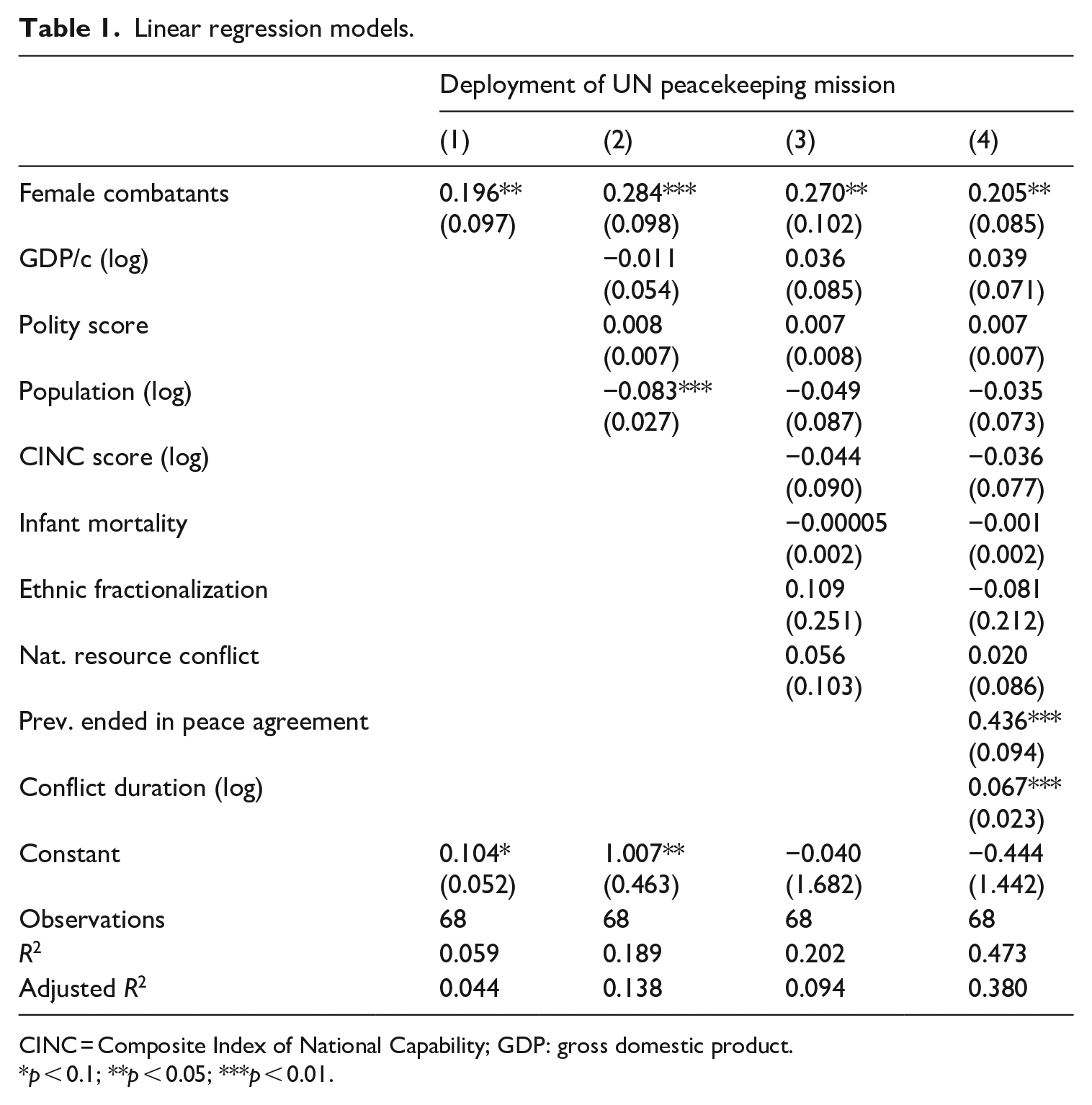
CINC = Composite Index of National Capability; GDP: gross domestic product.
p < 0.1; **p < 0.05; ***p < 0.01.
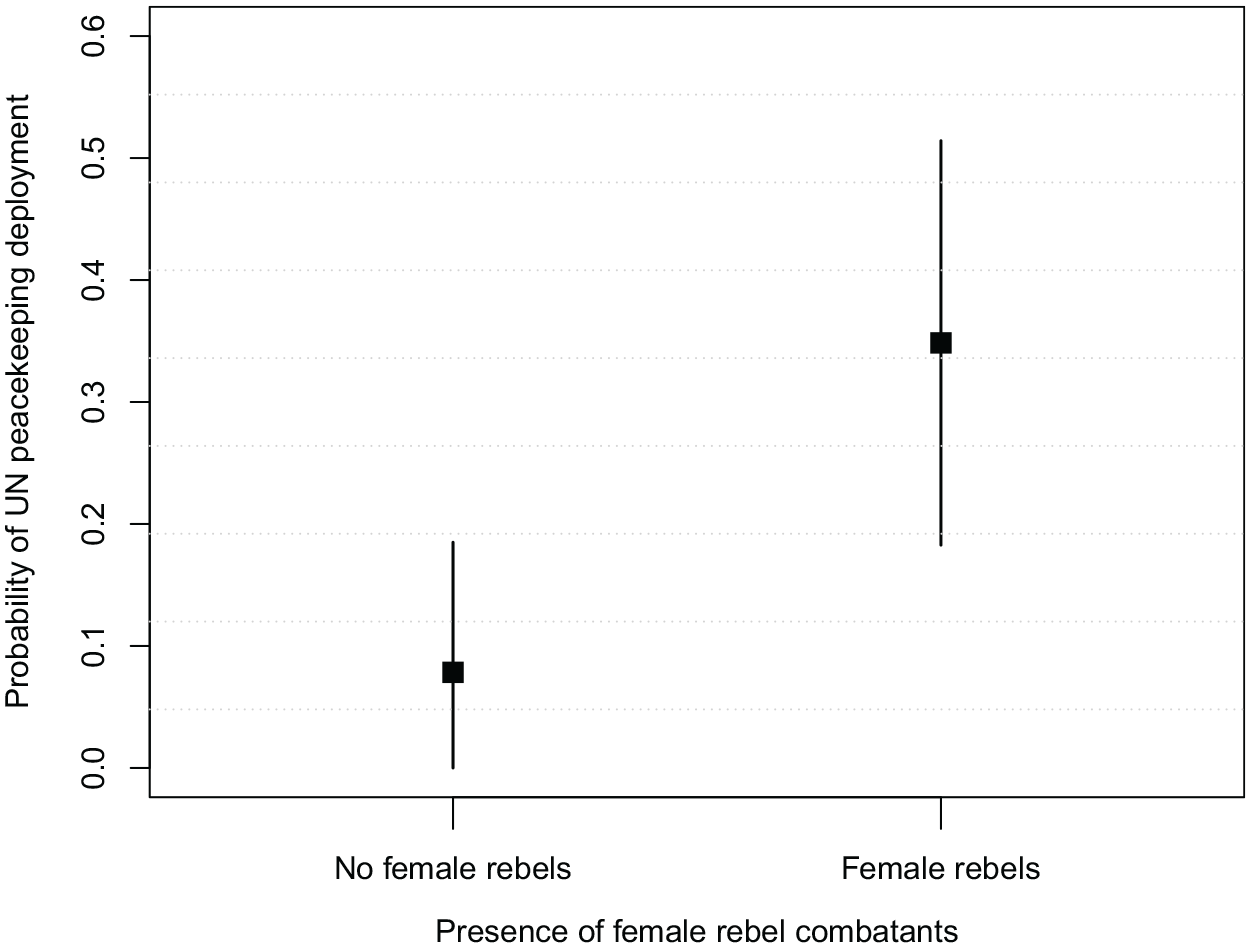
Predicted probability of UN peacekeeping deployment.
Figure 1 indicates that conflicts involving no female rebel combatants have an 8% probability of seeing a post-conflict peacekeeping mission, whereas this probability increases to 35% for conflicts involving female rebel combatants. This 27 percentage point increase suggests a substantively and statistically meaningful increase in the likelihood of UN peacekeeping deployment when female rebels are present.
Mediation analyses
Mediation analysis helps to determine the degree to which a treatment variable exerts a direct effect on the outcome variable, and how much of it is relayed through another variable “in-between” the explanatory and outcome variable. Following the discussion on alternative theoretical mechanisms earlier, we identify two potential mediating variables; whether a conflict ended in a peace agreement and the duration of the conflict may both be influenced by the presence of female rebel combatants, thereby mediating its influence on the deployment of UN operations.
We conduct two separate mediation analyses, one for each mediator. One caveat of this setup is that multiple mediators may result in biased estimates due to a violation of the sequential ignorability assumption (Imai and Yamamoto, 2013). 7 Therefore, just like the findings in model 4, the results of these mediation analyses may be suggestive but need to be treated with caution. See Figure 2 for a visualization of the findings. The results suggest that the effect of female rebel combatants on UN peacekeeping operations is mostly driven by the Average Direct Effect (ADE), and not by the Average Causal Mediation Effect (ACME). 8 In other words, these results suggest that the presence of female rebel combatants directly influences the deployment of UN peacekeeping, and does not work through conflicts’ termination type or duration.
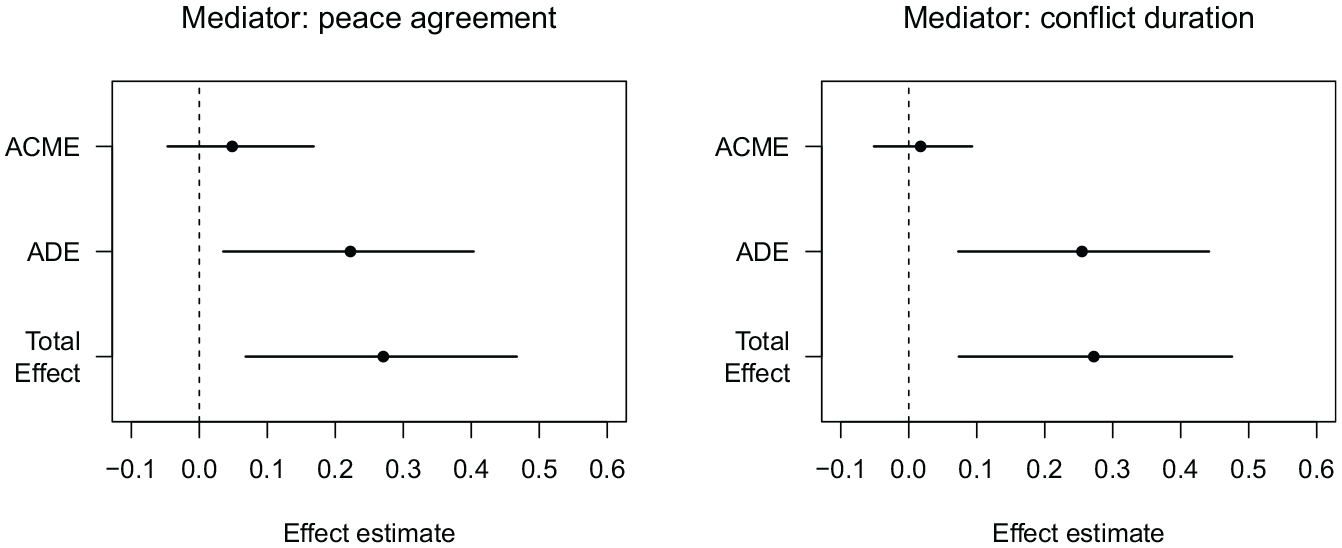
Mediation analyses.
While we are unable to unambiguously isolate a causal effect due to the directional ambiguity and violation of the sequential ignorability assumption, the mediation analyses reveal a strong divergence between the ADE and the ACME. This suggests that the effect of female rebel combatants on UN peacekeeping deployment is not due to an associated change in conflict characteristics, but a result of the direct influence of the presence of female rebels. These findings tentatively support our notion that the presence of female rebels increases the likelihood of UN involvement due to a shift in the international audience’s perception of the conflict, rather than due to the conflict’s actual protraction or the absence of decisive victories.
Out-of-sample prediction
With these observational data, the estimated effect size of the female combatants treatment is a combination of direct, indirect, and endogeneous dynamics. While we isolate the direct effect as best we can and find promising results, it is difficult to establish causality in the absence of an experimental setting. Therefore, and to not fall prey to false pride (Schrodt, 2013), we also aim to understand how well the presence of female combatants predicts the occurrence of UN peacekeeping.
An R2 of 0.059 in model 1 in Table 1 suggests that, within the sample we use for the analysis, the unconditional variation in the presence of female combatants predicts roughly 6% of the variation in UN peacekeeping deployment. However, predicting variation in data with a strictly parametric model which is designed to minimize the (sum of squared) residuals of just the very same data may not be the best benchmark for a variable’s actual predictive power. Therefore, we conduct an exercise designed to predict UN peacekeeping deployment based on the variables in our main model, but outside of the model’s sample and irrespective of functional form assumptions. Below, we rank the variables according to their comparative predictive power.
Figure 3 visualizes the variables’ ranking based on a random forest model. The plot shows the mean decrease in accuracy (MDA), referring to the decrease in out-of-sample predictive accuracy if a variable was omitted. 9 This means that variables ranking high in this metric contribute more to the model’s predictive accuracy than variables ranking low. Female rebel combatants is ranked second after the CINC score, meaning that these two variables contribute the most to out-of-sample predictive performance. Consequently, considering whether female combatants mobilize in a rebel group helps predicting a UN peacekeeping deployment more than factors such as GDP, population size, or regime type.
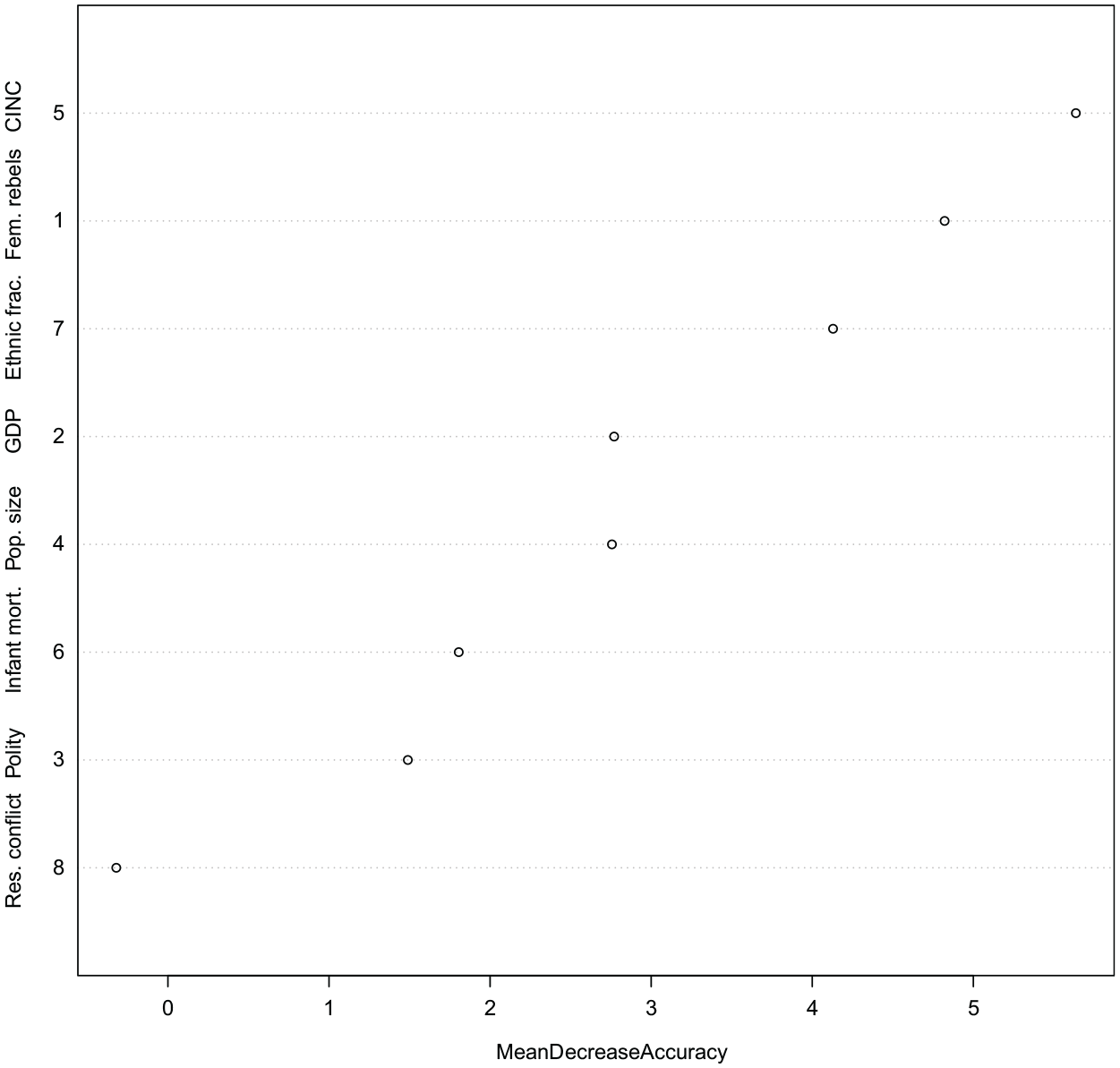
Out-of-bag feature importance.
Conclusion
We argue that female rebel combatants increase the probability of UN peacekeepers being deployed to a conflict country. Based on the idea that widely held gender stereotypes depict women as peaceful and passive, we theorize that their participation in rebel groups draws international observers’ attention to a conflict and leads them to perceive it as more severe. With the UN deploying peacekeepers to conflicts in which the lives of civilians are at stake, particularly emphasizing the protection of women and children, this perception of increased severity results in peacekeepers being sent to conflicts in which women fight among the rebel ranks. Results from statistical analyses using global data on female combatants and peacekeeping deployments in the post-cold war period support this expectation. Conflicts where rebels have women among their ranks exhibit an estimated 39.9% probability of seeing a UN peacekeeping mission in the post-conflict phase, while this probability is only 9.4% for conflicts involving all-male rebels. Subsequent mediation analyses suggest that this increase is rather driven by the audiences’ perceptions and gender frames than actual observable severity. At the same time, it should be reiterated that while our results indicate a robust relationship between women’s participation in rebel groups and the deployment of peacekeepers, our research design allows only very limited causal identification. Similarly, while our results are in line with the perceived severity mechanism and offer evidence against alternative explanations based on actual severity, this does not offer proof that the proposed mechanism drives our results. Providing better causal evidence to further corroborate this relationship thus falls to future research.
By exploring the association between female combatants’ presence in rebel groups, the gender frames this activates, and peacekeeping deployment decisions, this research contributes to the emerging literature on women in combat roles. It presents further evidence that female combatants change how outside observers view a conflict and that this can have real consequences for how they respond to it. These findings emphasize the crucial, strategic role women play in rebel groups’ communication with domestic and international audiences. More generally, our results suggest that female combatants allow non-state actors to benefit from audiences’ benevolent sexism and masculinist protection reflexes (Carpenter, 2005; Glick and Fiske, 1996, 1997; Young, 2003). In this vein, future studies may consider how female combatants strategically affect important outcomes such as nonviolent anti-government protests, biased interventions, or third-party mediation (especially considering that closely related research on the effects of sexual violence already exists; c.f. Johansson and Hultman, 2019, and Nagel, 2019). In addition, further research is clearly warranted on whether audiences differ in how their perceptions of a conflict and their according responses are affected by the presence of female combatants. For instance, observers may be particularly likely to respond to the presence of female combatants in a conflict if it takes place in a country that is geographically or culturally close to them. At the same time, responses may also differ based on observer countries’ regime types, gender equality, or wider political views. For example, Sarwari (2020) suggests that leftist governments respond more strongly to conflict-related sexual violence. Relatedly, the degree of response may also vary as a function of the interaction between female combatants and conflict characteristics, which provides a rich field to explore.
Furthermore, this study advances our understanding of UN peacekeeping missions and the Women, Peace, and Security agenda. We present evidence that peacekeeping missions are not only deployed to conflicts which are particularly violent, the “hard cases,” or which are closely related to the interests of a security council member state. In arguing that female combatants attract the deployment of peacekeepers, we add to a host of studies critically analyzing the implementation of UNSCR 1325, suggesting that peacekeeping deployments follow gender frames depicting women as victims which are to be protected. Our theoretical argument particularly complements existing research showing that gender-based violence increases the probability of the UN becoming active (Benson and Gizelis, 2020; Hultman and Johansson, 2017). This is especially the case given that female combatants and sexual violence may not be present in the same conflicts (Mehrl, 2020). However, our results also raise questions about the extent to which the resolution’s point on women having an active, “important role [. . .] in the prevention and resolution of conflicts and in peace-building” is taken seriously by relevant actors.
Finally, future research may also consider to what extent women’s participation in armed conflict on the side of the state security forces affects outside intervention. On one hand, women’s presence among these forces may similarly result in them being perceived as more peaceful and their use of violence as more legitimate. This may then make outside interventions less likely as the state would be seen as more compromising (see, for example, Greig, 2005) and its oppression of rebels as more legitimate. On the other hand, it is less clear whether female combatants similarly alter the perception of state security forces. For instance, Young (2003) suggests that states cast themselves as masculinist protectors, regardless of their agents’ gender, indicating that it should matter little whether government forces include women among their soldiers.
Supplemental Material
sj-pdf-1-cac-10.1177_00108367211047133 – Supplemental material for Female rebels and United Nations peacekeeping deployments
Supplemental material, sj-pdf-1-cac-10.1177_00108367211047133 for Female rebels and United Nations peacekeeping deployments by Marius Mehrl and Christoph Dworschak in Cooperation and Conflict
Footnotes
Acknowledgements
The authors are grateful to the editor, Annika Björkdahl, and three anonymous reviewers for excellent suggestions. For their feedback on earlier versions of this paper, we thank Han Dorussen, Kristian Skrede Gleditsch, Evgenija Kroeker, Alex McAuliff, Sara Polo, and audiences at the University of Essex, the ISA 2021 Annual Convention, as well as the Workshop on Conflict Dynamics at the University of Oxford. All mistakes are their own. The authors contributed equally to this work, and authorship is in reverse alphabetical order.
Funding
The author(s) received no financial support for the research, authorship, and/or publication of this article.

Supplemental material
Supplemental material for this article is available online.
Notes
Author biographies
References
Supplementary Material
Please find the following supplemental material available below.
For Open Access articles published under a Creative Commons License, all supplemental material carries the same license as the article it is associated with.
For non-Open Access articles published, all supplemental material carries a non-exclusive license, and permission requests for re-use of supplemental material or any part of supplemental material shall be sent directly to the copyright owner as specified in the copyright notice associated with the article.
