



Abstract
This article showcases how a feminist perspective provides novel insights into the relations between military heritage/history and national security politics. We argue that analysing how gender and sexualities operate at military heritage sites reveals how these operations dis/encourage particular understandings of security and limit the range of acceptable national protection policies. Two recent initiatives to preserve the military heritage of the Cold War period in Sweden are examined: the Cold War exhibits at Air Force Museum in Linköping and the redevelopment of a formerly sealed off military compound at Bungenäs, where bunkers have been remade into exclusive summer homes. By combining feminist international relations and critical heritage studies, we unpack the material, affective and embodied underpinnings of security produced at military heritage sites. A key conclusion is that the way heritagization incorporates the ‘naturalness’ of the gender binary and heterosexuality makes conceptualizing security without territory, or territory without military protection, inaccessible. The gendering of emotions and architectural and spatial arrangements supports historical narratives that privilege masculine protection and reinforce a taken-for-granted nativist community. A feminist analysis of military heritage highlights how gender and sexualities restrict security imaginaries; that is, understandings of what is conceivable as security.
In what ways are national security politics reliant on the preservation of memories of geopolitical threats, conflicts and military violence? Following the claim that national security strategies align with narratives of who ‘we’ are (Hansen, 2006), critical scholars show how collective memories and the production of heritage tend to affect contemporary understandings of security and national protection (Basham, 2016; Danilova, 2015; Gustafsson, 2014; Heath-Kelly, 2020; Reeves, 2018a, 2018b). International relations (IR) research on the nexus of memory-making and national security points to how the privileged versions of historical pasts make certain security choices justifiable or even self-explanatory (Åse and Wendt, 2019b; Bell, 2006; Zehfuss, 2006).
The present article develops this literature by demonstrating the merit of a feminist analysis in elucidating the relations between the making of military history/heritage and national security politics. The purpose is to gain new insight into these relations by examining the ways sexed and gendered bodies, emotions and materialities are constitutive of military heritage. In addition, this analysis reveals how gender and sexuality are key dimensions supporting common sense notions and national security assumptions. The ‘naturalness’ of the gender binary and heterosexuality defines what can be understood as security and restricts the range of acceptable national protection policies. Hence, we claim that a feminist perspective provides increased scope for critiquing and contesting privileged national security narratives.
Feminist IR research has shown how ideas and conceptualizations of national security and territorial protection are both shaped by and (re)shape gender norms and relations. Military institutions perform gendered practices, and presumptions about masculinity and femininity justify military activities (Cohn, 1987; Hearn, 2012; Tickner, 2001; Wibben, 2018). This research field has also highlighted the contextual and variable incorporation of intersectional hierarchies and (hetero)sexualities into understandings of security and protection (Ackerly et al., 2006; Khalid, 2015; Tickner and Sjoberg, 2011). Although feminist research that deals explicitly with the nexus of memory-making and security is rare (Altinay and Pető, 2016: 7), a new and burgeoning body of IR literature relates military heritage and remembrance initiatives to the gender norms, racial tropes and colonialism inherent in security politics (Åse, 2020; Basham, 2016; Heath-Kelly, 2020; Tidy and Turner, 2020; Ware, 2019; Welland, 2017). The memorialization of military activities and topics privileges the masculine military protagonist, while disregarding women’s agency and war memories (Danilova and Purnell, 2020; Mannergren Selimovic, 2017; Repo, 2008; Szitanyi, 2015; Taber, 2020). Remembrance of military conflict tends to represent women allegorically and to convey established gender tropes, the most prominent being those of tragic motherhood and of women as innocent and ‘pure’ (Graff-McRae, 2017; Reeves, 2020).
Inspired by this feminist literature, we combine a gender analysis with a critical heritage studies (CHS) approach to heritage as objects and ideas constructed in and constituting a resource for the present (Graham and Howard, 2008; Harrison, 2013; Smith, 2006). The key concept, heritagization, captures the power-laden process of turning competing pasts into ‘the Past’ (Macdonald, 2013: 18) and unsettles the idea of any self-evident preservation of historical realities. A uniting idea in this research field is that contemporary social and political conditions impact which and whose memories are saved, represented and made tangible (Gentry and Smith, 2019). In relation to the contingency characterizing the heritage of war, Gegner and Ziino (2012) underline how the making of heritage involves different actors actively producing identities. Accordingly, heritagization is considered a construction with material consequences and a process that often reinforces identities and hierarchical relations connected to, for example, gender, ethnicity and class (Smith, 2008). While discursive perspectives have been important in CHS research, recently scholars have argued for the importance of material aspects and affective qualities of heritagization (Harrison, 2013; Waterton, 2014). From a CHS perspective, war and military heritagization has often been seen as reinforcing nationalist, colonialist and soldier identities (Dittmer and Waterton, 2017; Pauls and Walby, 2020).
A feminist approach to heritagization draws attention to how heritage is gendered, in the sense that gender norms and sexualities underpin the (un)privileging of particular identities, memories and experiences. In line with the foundational thinking within feminist IR, CHS scholarship accentuates embodied experiences. Laurajane Smith (2008: 159) understands heritage as ‘corporeal reinforcements of a sense of belonging and sense of place’ (cf. Dittmer and Waterton, 2017). Relating to historic eras involves more than thinking and talking – the past is also felt. This means that scholars need to address ‘the embodied (including affective and sensory) emplaced and material dimensions of the past’ (Madonald, 2013: 80). The embodied and affective dimensions of heritage contribute to affirming the national subject (who ‘we’ are) and making it appear self-evident. Combining CHS perspectives with feminist IR allows for the emergence of new knowledge of how the processes that make the military past physically and emotionally available incorporate gender and sexualities. Our approach makes possible an analysis of military heritagization that unpacks the material, affective and embodied underpinnings of security understandings. We draw attention to how gender and sexualities operate at military heritage sites and highlight how these operations dis/encourage particular understandings of national protection and security.
This article showcases the merits of such a feminist analysis by examining two recent initiatives to preserve the military heritage of the Cold War period in Sweden. The sites represent state-sponsored and commercial engagements with the military past, and both have attracted significant public interest and admiration. The first site consists of the two official and permanent exhibitions, ‘If War Comes – Sweden during the Cold War’ and ‘Secret Acts – The DC-3 that disappeared’, at the Air Force Museum in Linköping. The museum has drawn large crowds of visitors and was named Museum of the Year in 2010. The second site is Bungenäs in northern Gotland. Here, commercial actors are turning a formerly sealed off Cold War military compound into an area for outdoor recreation and trendy summer accommodation, with bunkers remade as exclusive homes. Bungenäs’s re-development has received national and international media attention and acclaim in design and architecture communities, as illustrated by the coffee-table book Bunker One Zero Four (Ehrs, 2017) and an accompanying photo exhibition at the Gotland Art Museum in 2017.
Methodological reflections: denaturalizing heritage
Feminist scholarship characteristically engages in the deconstruction and politicization of seemingly natural concepts and hierarchies. The method of denaturalization is an important strategy for laying bare how established understandings and acknowledged ‘facts’ depend on gendered binaries and thereby appear beyond problematization and political contestation (Aradau and Huysmans, 2014; Åse and Wendt, 2019a; Weeks, 2011). Because masculinities/femininities and (hetero)sexuality are constitutive of conceptualizations of state sovereignty and ingrained in ideas of violence and national protection (Hutchings, 2008; Yuval-Davis, 1997; Zalewski and Parpart, 2008), it is challenging for IR scholars to expose and question these naturalized understandings. V Spike Peterson (2010: 20) discusses how the ‘naturalness’ of sex difference is translated into a ‘natural’ male-protector privilege – in which the presumed weakness and irrationality of the feminine seemingly requires protectionist behaviours grounded in masculine strength and rationality. In line with these understandings, we conceptualize gender as ingrained in the ideas and conceptions (re)produced in the heritagization of military pasts. This thinking recognizes gendered aspects of activities and artefacts that may appear to have little to do with gender or sexuality – for example, the construction of territories and borders or displays of military technology and bunker architecture.
In line with the CHS perspective, we emphasize the methodological merits of addressing the material structures and spatiality, aesthetics and bodily features of heritage-making. As Macdonald (2013: 94) phrases it, it is ‘through specific physical elements such as buildings or natural features – that the past is made present’. We draw inspiration from CHS and feminist IR-scholars, both of whom highlight the affective dimensions of military heritagization. This entails addressing the central role of the affective in museums’ geopolitical narratives (Dittmer and Waterton, 2017) and how specific architectural designs ‘move us physically and emotionally and, in this process, construct meaning about warfare and security’ (Reeves, 2018a: 109; cf. Lisle, 2016; Tidy and Turner, 2020). In this research, emotions are seen as performing ‘political work’ and as being socially shared rather than exclusively residing in the individual (Åhäll, 2018). Emotions contribute to the positioning of the individual body in relation to the (gendered and racialized) community (Ahmed, 2004; Parashar, 2018) and to producing gendered and hierarchical perceptions of who constitutes the good citizen (Johnson, 2010). Moreover, emotions are linked to embodiment and somatic dimensions (Dittmer and Waterton, 2017; Reeves, 2018a). Laughing, crying or getting goose bumps are corporeal experiences and involve bodily reactions. The expression of emotion through physical responses draws attention to how gendered meaning-making does not consist of words and discourse alone (Åhäll, 2018).
Because intuitive bodily sensations and emotions are easily assumed to express an authentic truth or reflect a common-sense reaction, they are particularly important to problematize. Foregrounding how the physical materiality of military heritage supports specific emotions, experiences and narratives, our analysis pays attention to the ways in which visitors are invited to understand and feel threat, security or affinity to a (national) community. In this regard, we take inspiration from Janet Jacobs’ (2010) careful analysis of how, in the specific architecture and visual layout of museum exhibitions of the Holocaust, connections to the past are ‘filtered’ through gender and how particular gender norms (a strong protector masculinity, united heterosexual families) can thus come across as prerequisite for avoiding genocide. Similarly, we focus on the ways gender and sexualities define displays of military history and heritage narratives and thereby (dis)inspire forms of security politics.
In more specific methodological terms, our examination rests on extended field visits made in 2019 and 2020 to heritage sites. These visits were performed in line with a CHS-inspired methodology. That is, we consistently noted the architectural and spatial arrangements of the sites and documented our bodily movements, visual impressions and sensory and somatic reactions (Dittmer and Waterton, 2017). We compiled extensive field notes and photographic documentation. The field visits were conducted within a research group consisting of us two political scientists and two CHS-scholars, an ethnologist and an architecture historian. The trans-disciplinary set-up facilitated a conscious attempt to ‘see’ collectively with each other by continuously sharing our immediate streams of thought and reflections vis-à-vis the milieu we encountered and documenting these reflections. Our conversations, our differing perspectives and our analytical focus helped us to unpack and denaturalize the sites and to make visible the discursive, material and somatic dimensions involved in heritagization. For example, the group’s attention was directed to how aesthetic features can help tell as well as silence certain stories. As political scientists, we noticed how our immediate professional searchlight directed us towards text and narratives, and we learned to observe the details of the three-dimensional surroundings, including colours and acoustics, and to notice how different settings orchestrate visitors’ movements to make them inhabit certain subject positions (cf. Reeves, 2018b). Our ambition to combine a CHS-perspective with feminist IR is reflected in the reading of materialities, emotions and embodiments/subject positions as manifestations and negotiations of security problematics. The process of knowledge production progressed, for example, by consistent attention to how the heritagization invoked different bodies as protectors/protected and to the uses of spatiality and materialities in producing a geopolitical ontology. To broaden our understanding of the heritagization taking place, we read up on Sweden’s military Cold War history and gathered media materials and secondary literature pertaining to the sites. We also obtained the planning and production documents for Bungenäs.
Following an overview of the national context and the two sites, our analysis proceeds through three thematic sections that examine the construction of territory, national community and the body in the making of Cold War heritage. Taken together, these themes reflect important conceptual discussions in both feminist IR (the geopolitical, national inclusion/exclusion and security/conflict embodiments) and in CHS (space/materiality, group identities/belongings and the body/the somatic). While all the sections examine how sexed and gendered bodies, materialities and emotions become constitutive in the construction of heritage, the section on the body emphasizes the experiencing body and highlights the sensory and somatic dimensions. The concluding discussion spells out the political consequences in terms of the privileged security understandings and actions that follow from the incorporation of gender and sexualities into military heritagization. We reflect upon how alternative ways to understand threats and territoriality, or what safety, community and sovereignty can mean, become intangible and unthinkable.
The Cold War military heritage: context and empirics
Gender scholars highlight the pivotal role accorded to the body and sexuality in bipolarity and Cold War security discourses. A foundational political belief was that protection of national borders hinged upon a potent, hypermasculine and integral male body capable of resisting foreign penetration (Costigliola, 1997; Higgins, 2018). ‘Normal’ heterosexuality and nuclear family life were perceived as stabilizing and as providing protection against communist subversions and ‘abnormalities’, such as homosexuality and a soft, deviant masculinity (Dumančić, 2017; Laville, 2013). The close connection between Cold War notions of national security, ‘the home’ and procreative heterosexuality reveals sexuality as securitized.
While Sweden was not exempt from this gendered Cold War context, the country’s specific geographic and ideological position ‘between’ the superpowers led to particular conceptions of security and identity. Neutrality was an important feature of national self-understanding (Agius, 2006; Stråth, 2000), expressing both a national peacefulness and vulnerability due to the heavy arms race taking place on both sides of the iron curtain. The idea of Sweden as intrinsically non-belligerent and invested in international disarmament (Jonter and Rosengren, 2014; Sandman, 2019) coexisted with ‘deep militarization’ (Kronsell, 2012). State institutions, companies and most citizens were deeply involved in the Cold War strategy of ‘Total Defence’ (Cronqvist, 2012). The doctrine of armed neutrality required a military defence with a strong capacity for defensive violence, a large domestic weapons industry and military fortifications across the country (Agius, 2006; Åselius, 2005). An important feature of this doctrine was mandatory male conscription. Almost every adult male received military training and acquired competence in martial violence in the Cold War period (Malm, 2019). The draft promoted a gendered citizenship, the idea being that boys became citizens when they fulfilled their duty as military protectors of Swedish democracy and the welfare state (Sturfelt, 2014: 33). The conscription-based ‘People’s Defence’ was consequently positioned as a guarantor of the ‘People’s Home’ (folkhemmet). Even though the formal and doctrinal neutrality has since been abandoned, the country remains non-aligned, and Swedish contemporary national self-understanding incorporates ideas of peacefulness, neutrality and international solidarity (Åse and Wendt, 2019a). Moreover, gender equality and social progressiveness have emerged as distinguishing national traits, as evidenced by the country’s renowned feminist foreign policy (Bergman Rosamond and Kronsell, 2020).
When the Cold War ended, the Swedish Armed Forces began a radical downsizing involving the abandonment of military bases and fortifications that rendered numerous military vehicles and installations useless. Over the last 15 years, however, both Swedish authorities and commercial actors have taken an interest in preserving the military remnants from this time. In 2008, a state-sponsored network of select military sites representative of the Cold War era was formed (the Swedish Military Heritage Hands-on History Museums). Furthermore, private investors and military enthusiasts are engaged in turning a wide range of military artefacts from the period into museums, experience centres, private housing or recreational areas.
The two military sites that we use to present this article’s argument – the Cold War exhibitions at Linköping Air Force Museum and the redeveloped Bungenäs – are part of this recent heritagization of Sweden’s military past. Both sites reside at militarily charged locations. Linköping hosted the headquarters of SAAB, the Swedish producer of military airplanes, and the museum sits in a former military area. The Air Force Museum receives public funds and is professionally curated. The general outline of its permanent exhibition, ‘If war comes: Sweden during the Cold War’, relates the development of Swedish air force technology to the global threats and international arms race of the period as well as to the domestic sphere. The main attractions, aside from the nationally produced military aircraft, are five realistically constructed private homes – each representing a typical family home from each decade from the 1950s to the 1990s – with carefully recreated kitchen arrangements and living rooms. In the basement, below the family homes, is the exhibit ‘Secret Acts’. The centrepiece is the salvaged wreck of a Swedish DC-3 aircraft that was shot down by the Soviets over the Baltic Sea in 1952, killing all eight crew members. The museum narrative describes the downing, the diplomatic repercussions and the years of searching that led to the plane being recovered and put on display in the museum. The grieving and grievances of the widows of the deceased men have a prominent role in the exhibition.
Bungenäs is located at the northern tip of Gotland, an island that was strategically important throughout the Cold War. This was where strategists believed Warsaw Pact troops would land in the event of a hostile invasion. In 1963, the Swedish Crown acquired this 165-hectare scenic peninsula for military purposes. For almost 40 years, the area was sealed off from the public and heavily militarized. The coastlines of Bungenäs were sprinkled with bunkers, trenches, manned Bofors cannons and radar surveillance equipment. With an open horizon to the east, the beaches were used for heavy artillery training. In 2000, Bungenäs was de-militarized and opened to the public, and in 2007, it was bought by real estate developer and entrepreneur Joachim Kuylenstierna. Together with Skälsö Architects, he orchestrated the area’s conversion into a site for outdoor recreation and fashionable summer house accommodation where the military legacy has a central experiential and aesthetic role. Although initiated by commercial interests, the area’s re-development adheres to official building regulations. The area guidelines adopted by the municipality of Gotland assert that no fortifications shall be removed or concealed, and newly built houses must blend in with the military and modernist architecture (Region Gotland, 2011). Future development is also spelled out and includes community services and a spa. As of 2020, several bunkers have been refurbished and now serve as luxurious homes, and the more than 30 newly built houses harmonize architecturally with the military atmosphere.
Gendered territory
The following section analyses how the heritagization of the military past at Bungenäs and the Air Force Museum incorporate gender and sexuality, thereby promoting understandings of national territory as needing protection and naturalizing the inseparability of security politics from the territory/homeland.
As one walks into Bungenäs, the place’s Cold War military legacy is impossible to disregard. A timeworn metal fence crowned with barbed wire borders the area, and the entrance is an opening beside an iron gate where out-of-date military signs announce risk of life and that this is a military practice area (‘övningsområde’). Access is possible on foot or by bike only. Developer Kuylenstierna remarked, ‘I had to put up quite a fight to keep the fence’ (Forsberg 2015) and reflected on the distinctive atmosphere connected to a place that for years has been sealed off. These spatial entrance arrangements make present the history of danger and military violence. An imagined historical masculine military community is carefully manufactured at Bungenäs. The roads have military names, and newly made but industrially distressed road signs create a distinctly military-type setting. Bunkers, trenches, a military training course and traces from military vehicles and grenades are valued and protected, while guidelines ban objects associated with the civilian sphere and family life, such as outdoor plastic furniture, brightly coloured parasols and holiday decorations (Sundström et al., 2015).
It is a past of exclusively men’s experiences and histories that is signalled and made available to visitors and residents at Bungenäs. The site reflects the history of masculine protection, armed neutrality and Sweden’s Cold War strategic situation. The defence doctrine of the time downplayed aggressive and offensive military capacities and emphasized the ideal of the ‘neutral warrior’ that combined military strength with being explicitly defensive (Kronsell, 2012). Strategic thinking relied on the idea that, even in a crisis, there must be time to mobilize the ‘people’s defence’. This rationale led to an ‘anticipatory logic’ (Denman, 2020: 243), the premise of which was to use early warnings from intelligence information and to rely on robust physical defences designed to slow the aggressor. Bungenäs fortifications faced the Soviet bloc, and radar and surveillance installations monitored the Baltic Sea, making the east/southeast the exclusive geographic reference point for approaching threats. Thus, the preservation of the more than 100 deserted military structures above and below ground, an objective stated in the area guidelines, brings back Cold War notions of military threats.
The Cold War geospatial imaginary, together with the period’s preoccupation with containment, are echoed in the architectural style and the shapes and colouring of the new buildings at Bungenäs (see Figure 1). The favoured building materials are concrete, steel and untreated wood. The shapes and spatial arrangements allude to fortification: enclosed structures and rectangular forms dominate. Several of the new summer homes are also placed in or immediately adjacent to military bunkers and fortifications. Because it creates possibilities for ‘unique accommodation’, such placement is highly encouraged (Region Gotland, 2011). The bunker homes are concealed in the landscape but nonetheless have impressive fields of vision. These exclusive homes incorporate the military threats and strategic situation of the time and transform the Cold War line of fire into a spectacular view of the Baltic Sea.
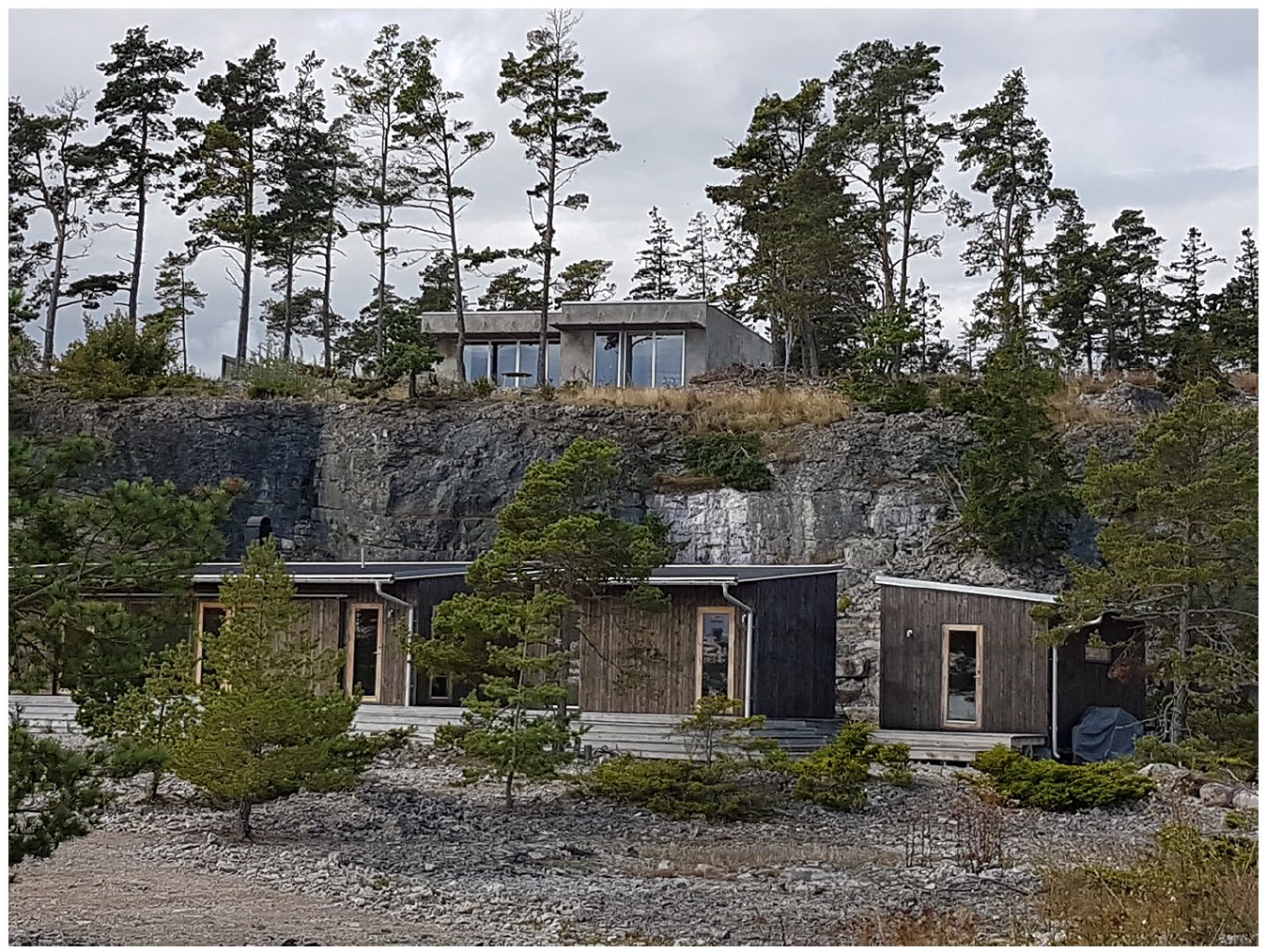
Fortification-inspired summer house architecture at Bungenäs, Gotland.
In contrast with that at Bungenäs, the military heritagization at the Linköping Air Force Museum does not exclusively prioritize masculine historical experiences. Rather, the ‘If war comes’ exhibit highlights the civilian ‘home front’. The ‘family home’ installations are sheltered by military airplanes, many of which hang from the ceiling, like vigilant air-borne protectors. The exhibition layout invokes a gendered protector-protected dynamic, reflected in the spatial separation of the masculinized war front and the feminized home front. The domestic/the homes are a proxy for the national soil, making physically tangible the necessity of military protection, signalled by the aircraft suspended above. This spatial arrangement reinforces gendered notions of security and of men’s and women’s historically different obligations to the nation-state: men’s responsibility to use violence to protect the nation and its citizens and women’s home-front duty to produce and care for the nation’s future citizens (Young, 2003).
As argued by feminist theory, conceptions of national security depend on the idea that ‘honourable’ men/citizens should sacrifice themselves to protect their country’s territory – and its women and children – from the enemy (Åse, 2018; Åse and Wendt, 2019b; Tickner, 2001). The idea of the ultimate sacrifice is a central element in the spatial ordering of the Air Force museum. The downstairs exhibit displays the DC-3 aircraft found on the seafloor. The atmosphere is solemn and dark, and the plane is lit with blueish colours that strengthen the feeling of being underwater. The wreck is displayed in a specially built sarcophagus-like case with associations to a grave; it is now finally ‘resting’ (per the wording on the museum homepage) in the museum (see Figure 2). The suggestive surroundings, together with a line of portraits of the men who died and exhibits of their personal items, help to establish this space as a national (war) memorial. The gripping display invites grief, contemplation and respect; the men died ‘for us’.
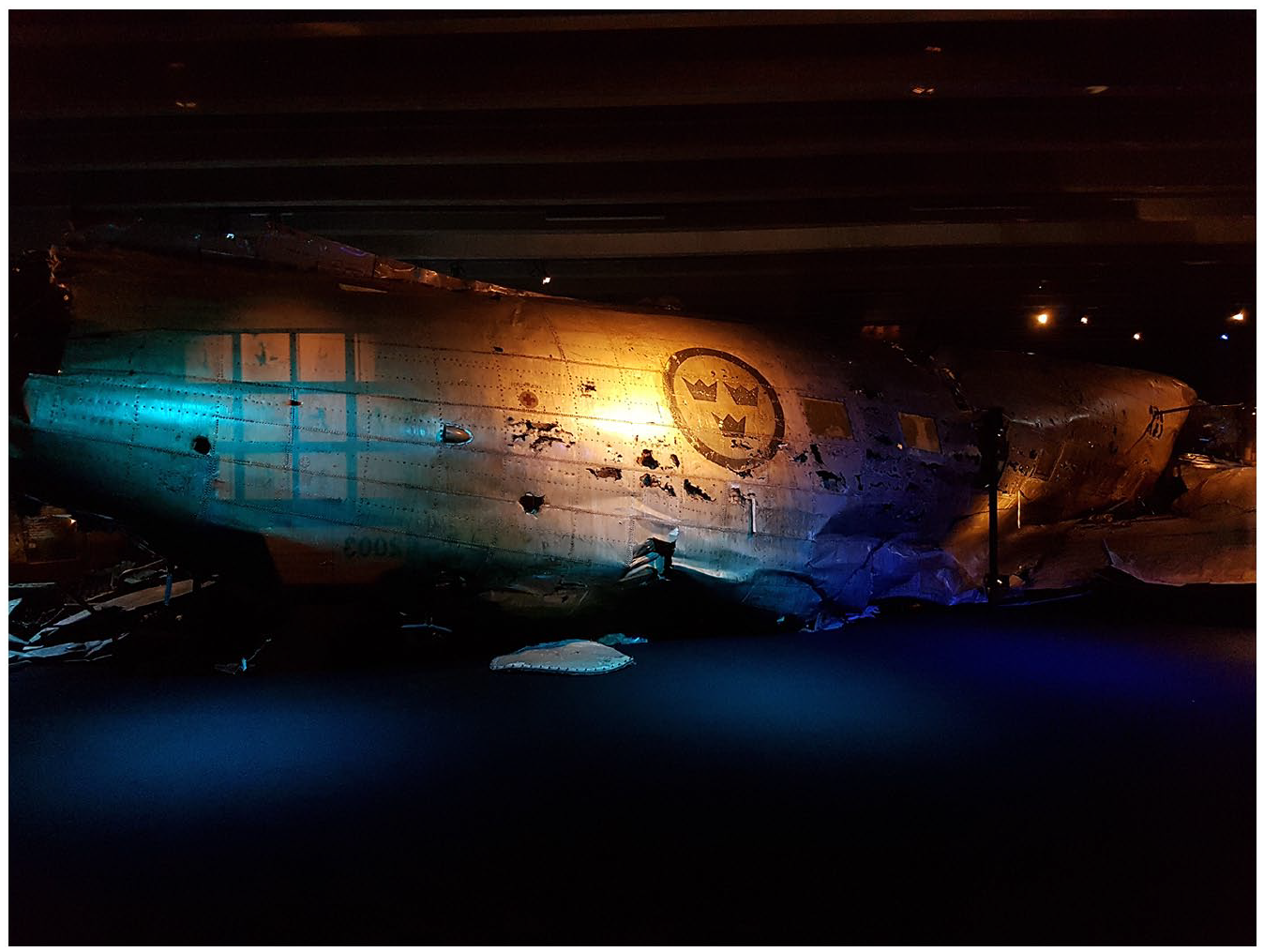
The salvaged DC-3 wreck displayed at Air Force Museum, Linköping.
The museum’s architecture connects the protected territory with the fallen protector-heroes, an impression underlined by the built-in communication between the floor levels. Glass openings in the floor of the ‘If war comes’ exhibition reveal views of the DC-3 wreck underneath, while from below, these openings become skylights through which the visitor can spot the national Swedish emblem of the three crowns decorating one of the airplanes above. Linking the shot-down aircraft to the still-potent protector planes above suggests that the survival of the national home relies not only on our technical and industrial competence but also – as evidenced by the historic sacrifice of the DC-3 airmen – on a preparedness to die for the nation. In this instance, heritagization idealizes masculine death for the nation, presenting it as a heroic act.
The choreographing of the Air Force Museum’s floor levels to evoke the underwater realm/the sea, the soil/land and the sky projects the idea of a Swedish territory that needs protection to survive. Common-sense geopolitics require that the state ‘has’ a territory/a national home that other states ‘want’. The same analysis can be made regarding Bungenäs. Here, the architectural and aesthetic cultivation of the military past – containment aesthetics, bunker architecture, seeing without being seen – reactivates Cold War geopolitical imaginaries, reinforcing the idea that physical space/territory constitutes the ‘reason’ for protection. Criticizing as essentialist the idea of territory as a straightforward ‘cause’ of war and armed conflicts, constructivist scholars argue that military conflicts and space are in fact mutually constitutive, meaning that armed conflicts both produce and are produced by space/territory (Björkdahl and Buckley-Zistel, 2016). Territory is not pre-existing; rather, it is a process, something that comes into being (Doevenspeck, 2016). With this perspective, the heritagization at both the Air Force Museum and Bungenäs produces space as national land/territory.
The uses in heritage of the ‘natural’ difference between women and men and the associated separation of domestic femininity and protective masculinity also preserve the idea that territory requires military protection as something that just is – a ‘natural’ fact or circumstance. As Laura Sjoberg (2016) demonstrates, national security seems imaginable only in relation to the idea of two biologically distinct and gendered bodies (where the female body is associated with vulnerability and the male body with violence/danger). The Linköping exhibit illustrates security’s intimate connection with gender binaries. The museum displays introduce a gender-spatial separation ultimately resting upon a male, heroic sacrifice. Stable and conventional gender categories mark the secured Swedish territory. The heritagization at Bungenäs comes across as exclusively masculine, not least because of the suppression of material traces and signs of femininity and the domestic and their connotation of vulnerability. The military remnants incorporate the history of male conscription and the ‘neutral warrior’ protecting the Swedish nation. When this massive masculine imprint on the military past is unproblematically reiterated and idealized, it naturalizes the idea that land/territory requires masculine military protection in the form of violence. These analyses demonstrate that the gender binary, conventional gender norms and a masculinized (capacity for) violence are crucial components of what produces the nation as territory.
Gendered community
In this section, the feminist analysis draws attention to the use of gender at the two heritage sites to confirm nativist and nationalist conceptualizations of community. Ideals of domestic femininity and masculinity, the latter coupled with technical knowhow, tie together who ‘we’ are, both as protectors and protected.
At the Air Force Museum, the temporal narratives connect the physically separated domestic and military spheres and produce the impression of a national community characterized by continuous progression. The decade-by-decade timeline associates changes within the household to Swedish military progress, manifested in the selection of 15 national aircraft models described in detail. By linking modernized kitchens, television sets and increasingly sophisticated telephones to the development of new, advanced military technology, these progressions come across as two sides of the same coin, the one not possible without the other. When read in this way, the narratives promote established Swedish Cold War welfare/warfare logics – the figure of thought presents militarization as necessary to develop and protect ‘the People’s Home’. The exhibition thus reiterates western Cold War security thinking that linked military preparedness to the intimate sphere of homemaking (Cronqvist, 2012; Laville, 2013). The housewife’s duty was to create a well-prepared household, and the idea of the nuclear family was essential to guaranteeing national stability and superiority. As demonstrated in the famous kitchen debate between Richard Nixon and Nikita Khrushchev in 1959, domestic femininity was an object of superpower competition in the Cold War era (May, 1988). The central role that the exhibit gives the model homes reproduces international politics’ saturation of the private/domestic.
The way the exhibit makes the intertwining of the intimate/domestic with the nation’s security real and tangible simultaneously contributes to making military armament appear necessary and unquestionable, just as natural as our need for a home. The constructed home environments invite the visitor to relate to Cold War heritage through the – presumably shared – familiarity of the domestic and pleasurable recognition of a range of everyday objects and experiences. The visitors can take a seat in what for many native Swedes is immediately familiar furniture; admire or be horrified by the taste in wallpaper; and open kitchen cabinets to investigate the era-appropriate utensils. Catchy Swedish hit music from the decade in question plays in the background, and the TV screens show some of the most popular shows of the period. Notably, the entry to the exhibit leads the visitor through a perforated plastic curtain printed with an intersection image of a 1950s family home. Making visitors enter through the domestic exemplifies how the exhibit persuasively merges familial history/genealogy with national history/genealogy. To have actual homes stand in for the homeland displays the national community as the reproductive family. The use of the family form to evoke the nation can, following Berlant and Warner (2008: 549), be conceptualized in terms of a national heterosexuality signifying order and normality, ‘a space of pure citizenship’. This trope resonates in the museum’s invitation to meet ‘Familjen Folkesson’ (the Peoplesons) and to ‘step right into the living room of the Swedish People’s Home (‘Folkhemmet’) during the Cold War’ (Air Force Museum homepage).
The choice to present Cold War history through the domestic is in part a consequence of the museum administration’s conscious effort to include civil/societal aspects of military history and specifically to attract a female audience to the site (interview, manager, 2019). While such strategies include feminine-coded experiences as part of the collective memory, making visitors ‘relate intimately (‘non-politically/privately’) to the museum and the military institution undertakes particular types of political work’ (Tidy and Turner, 2020: 137). One consequence is the perpetuation of the taken-for-granted national and homogenizing ‘we’ perspective, illustrated, for example, in the lack of narratives describing the immigrant population that made up a considerable part of the labour force in SAAB’s airplane factories in Linköping (Danielsson, 2017). The visitor who is presumably recognizing and enjoying the domestic settings is a distinctly Swedish visitor, addressed in the role of a family member. The invitation to visitors to engage intimately (as ‘naturally’ gendered family members/subjects) with the exhibition naturalizes gendered protection. Consequently, masculine and military/violent protection of ‘our’ private homes/our nation can appear incontestably benign and caring. In sum, the interlinking of the feminized domestic and the masculinized military confirms the national community as essentially nativist (because it parallels ‘natural’ heterosexual procreation) and supports the idea that a (masculine) capability for military violence is fundamental to the wellbeing and security of the (feminine) national home. This argument clarifies how the gender binary and heterosexuality help to define perceptions of ‘good’ and rational/sensible security politics.
Interestingly, and in obvious contrast to the exhibits and narratives at the Air Force Museum, Bungenäs constructs a basically homosocial community. Obligatory heterosexuality and the emphasis on orderly domestic family life associated with the ‘folkhem’ period are absent. As a materialization of the border post – directly facing the enemy – the ‘home front’/the protected is just an understood premise. The entrepreneur’s claim that having to leave one’s car at the entrance creates a special atmosphere where ‘we truly meet, as equals, and communicate with each other’ (Meadows, 2014) produces a vision of masculine social equality projected onto Sweden’s Cold War heritage. By not allowing any external signs of home ownership or domesticity, the area guidelines produce an aesthetic uniformity that implies (male) equality. No fences or other visible indications of the borders between properties are permitted, and there is a ban on gardens and flowerbeds (Region Gotland, 2011). The control of aesthetic detail – codified, as discussed earlier, in the design manual – creates a distinctly un-idyllic scene that lacks visual cues indicative of domestic or family life (see Figure 3). As noted by Elaine Tyler May (1988: 163), the Cold War ideology of domesticity meant that reduced class and social inequalities were attached to an emphasis on gender difference. In view of this analysis, the heritagization at Bungenäs relies both on the banishing of traditionally feminine and homely aesthetic expression and on the invocation of an idealized history of conscription in which men became each other’s equals by sharing the military experiences associated with their citizenship duty. The Bungenäs redevelopment scheme thus uses the trope of social equality – exemplified by every Swedish man’s Cold War obligation to do military service – to generate a financially profitable air of social exclusivity and aesthetic uniqueness.
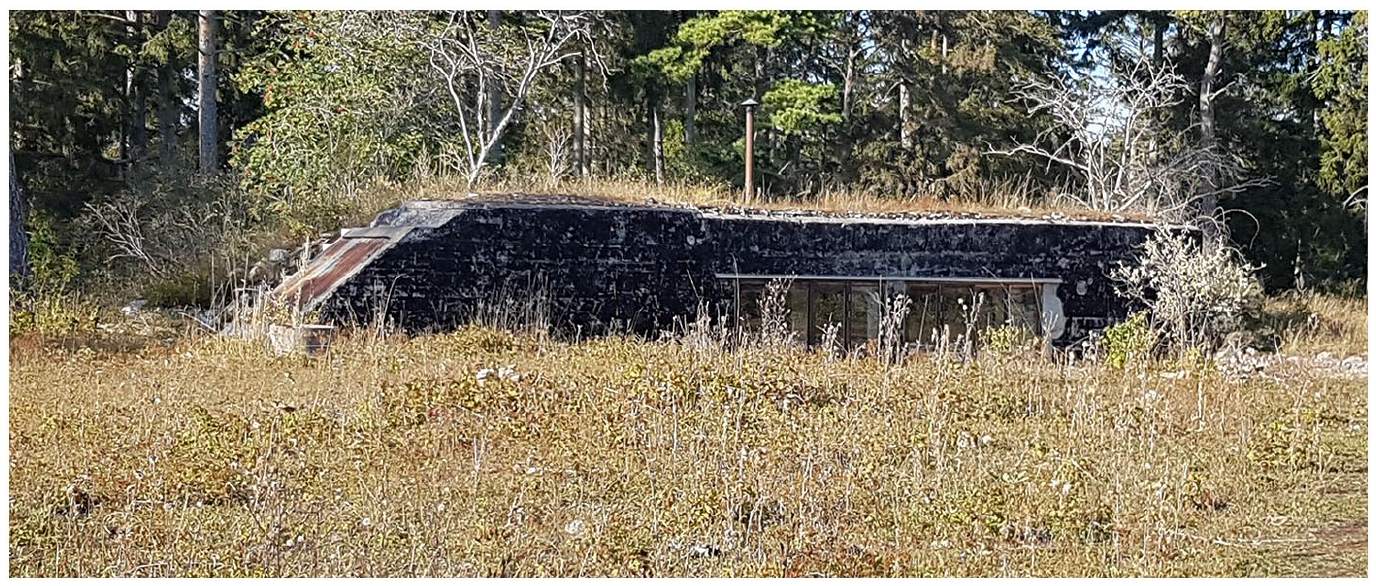
Cold War bunker refurbished as a summer house at Bungenäs, Gotland.
For this phantasy of male equality to be persuasive, women and femininities need to be suppressed. As demonstrated by feminist scholars, men’s role as protectors and citizen-soldiers in Western societies historically supported their political equality, while women/femininities were simultaneously confirmed to be politically subordinate and associated with the private and domestic (Landes, 2001). Carole Pateman (1988) suggests that women’s relegation to the private ‘home front’ served to confirm men’s political equality. When the military heritage becomes linked to exclusively masculine experiences and when military comradeship becomes the basis for social and political equality, it follows that women/femininities/the domestic dis-align with protecting the nation and its values.
The various uses of the military past at Bungenäs also appeal to nationalist tropes and established Swedish self-understandings. Sweden’s ‘peace identity’ encompasses the idea that ‘our’ defensive violence is distinct from aggressive military violence, which causes wars and extensive physical harm and suffering (Sandman, 2019). The heritagization ‘un-sees’ soldiers’ actual uses of and exposure to violence and idealizes the troubling historical realities of Cold War violence and threats of atomic annihilation. In the case of Sweden, the ideal of the neutral warrior is coupled with an emphasis on positive national protection. Moreover, the logic of deterrence supported Swedish strategic thinking that a large capacity for military violence actually guaranteed that violence would not have to be used. In addition to the ‘people’s army’, fortification systems, technical competences and large-scale safe rooms and provision stores were understood as crucial to assure national protection. In line with this legacy, the military heritagization at Bungenäs does not idealize violent acts or martial capabilities. Rather, it suggests a national protector who refrains from using its competences in military violence and the technical resources available to it (unless threatened by a foreign belligerent). Such characteristics of Sweden’s Cold War history enable the recycling and aestheticizing of the masculine-protector violence associated with Sweden’s neutral warrior ideal. This dominant trope clearly blocks out the national subject as feminist and a gender-equality pioneer (cf. Jezierska and Towns, 2018). However, it also supports the established representation of an innocent Swedish military masculinity. In this way, the making of military violence aesthetically enjoyable confirms established historical narratives regarding who ‘we’ are. Nationally specific ways of engaging with military violence confirm both national identity and the version of masculinity associated with ‘our’ soldiers. In a similar way, specific security politics are framed as logical and appropriate – because such politics fit with ‘our’ men’s masculinity (Hutchings, 2008).
At the Air Force Museum, the sense of national community and feelings of belonging are evoked not by identification with a military subjectivity, but primarily through recognition of familiar items in the national homes – designs, magazines, toys and TV shows. Rediscovering these innocent objects – surrounded by potent military technologies – invites nostalgia for the domestic past. Following Carol Cohn (1987), this is a form of domestication of war violence that risks ‘taming’ and making militarization and violence appear harmless. Entering the homes in the Linköping exhibit puts visitors in a position that is pleasurable and emotionally reassuring. The invitation to physically experience, recognize and confirm the past (this is exactly what it looked like!), deflects critical reflection. The sentimental yearning for an idealized past, Berlant and Warner write (1998), builds upon an emotional longing for a common past that decontextualizes history and conceals societal conflicts and differences. In relation to war and conflict, such a nostalgic ‘feel of the past’ (Macdonald, 2013: 87) includes the longing for an idealized, secure and highly gendered past associated with stable gender roles and ‘a return to an idealized patriarchal order’ (MacKenzie and Foster, 2017: 208). Our analysis of this military heritagization reveals how the gendering of the civilian/military divide supports decontextualization and idealizes the national and nativist community and its history.
Gendered bodies
In this section, we demonstrate how a feminist analysis makes visible the gendered bodily positioning choreographed by the sites and the corporeal experiences and pleasures offered at the sites. We discuss how these sensory connections to the Cold War past support certain understandings of security and protection.
Entering Bungenäs entails a bodily experience of crossing a civilian/military line. To physically approach the location where the nation’s border was exposed but also successfully militarily protected initiates a corporeal connection to masculine historical experiences. Because women/femininities are ‘naturally’ associated with the civilian sphere and men/masculinities with the military, the gender dualism reinforces this soldierly ambiance. It is from the vantage point of an embodied soldier subjectivity that the military atmosphere at Bungenäs, carefully orchestrated as authentic, is absorbed. The fortification-inspired architecture discussed earlier – enclosed and austere structures placed at ‘secure’ locations – aligns visitors with the Cold War strategic narrative. The spatial arrangement of new constructions in accordance with the earlier lines of fire compels the visitor/resident to bodily inhabit a soldier’s experience of protecting the border. In this way, the visual pleasure of an unbroken sea view incorporates Cold War soldiers’ violence capabilities.
An exclusive ‘designer heritagization’ also uses military violence as a resource enabling pleasurable embodied experiences. A case in point is the refurbishment and publicizing of ‘Building 104’, a subterranean bunker turned into an exclusive summer house. Originally housing a Bofors cannon, the bunker’s transformation into living quarters involved excavating three underground levels and adding a few new over-ground buildings to create a ‘trench inspired courtyard’ (van Dinther, 2016), whose design directly references the remaining trenches located at the military practice area some hundred metres away. The architect placed a Jacuzzi in the cannon pit and used the cannon’s loading hatch to create ‘a visual connection between the shower and the Jacuzzi’ (van Dinther, 2016). The interior consistently uses Cold War aesthetics, featuring concrete walls and an all-pervasive grey colouring. This heritagization of protector violence enables aesthetic pleasure and wellbeing and physically recreates – when the inhabitants walk across the courtyard – soldiers’ movements through the trenches.
The aestheticized heritagization at Bungenäs fuses violence and nature. Leaving the traces of soldiers’ engagement with military violence, such as hollows from grenades and mines, intact inserts human violence into the area’s natural beauty. Enjoying the location’s breath-taking views, wildlife and vegetation is made inseparable from appreciating (the history of) military violence. The abandoned military fortifications and new buildings also blend particularly well with this rough and wild coastal landscape. Violence appears to belong within nature’s scenery. This is convincingly manifest in the as-yet unrealized plan to remodel several bunkers and trenches at Bungenäs into a spa. The chosen location is the vast stone beach on the east coastline, where the land is heavily perforated with evidence of military activities. Describing the location as ‘mangled’, the planning document states that the military remnants are still thrilling. Integrated into the existing structures and largely concealed, the spa will consist of several sections that, through their focus on the openness of the landscape and the horizon, will enable a powerful experience of nature: stillness, contemplation and silence. The spa amounts to a ‘refinement of the principles of the bath’, offering future visitors the choice to ‘bathe and cleanse’ in several saunas and indoor and outdoor pools. Stark contrasts define the spa as ‘cold and warm, darkness and light, closed and open’ (Region Gotland, 2011). The idea of a Cold War spa transforms the strategic situation of the time – opposing forces, containment and borders – into a sensation on the skin. Through the bathing body, the trajectory of Cold War bipolarity is turned into physical delight. Here, the heritagization merges political and military history with the experiencing body, which, in turn, establishes as a powerful truth that enjoying nature’s scenery and the pleasures of the body is in unison with – rather than disassociated from – military violence and threatening geopolitics.
In the Linköping ‘home front’ exhibitions, the visitor is positioned as an embodied member of a distinctly Swedish nuclear family invited to touch, feel and listen to era-typical artefacts from domestic ‘folkhem’ settings. The tactile and acoustic experiences invite recognition and reassurance (reinforced by the possible connections to an individual’s family genealogy: My grandmother had one of these!). However, the exhibition also destabilizes the feeling of being in a protected home by allowing marks of the enemy, not immediately visible, to show up inside the homes. Several unexpected and even bizarre signs of the communist threat are subtly inserted into the pleasant family settings. These installations spur the visitor to move vigilantly through the exhibits to detect signs of danger: a few dots of blood suddenly appear on the walls, and, looking through the book shelves, one finds oneself face to face with a brightly coloured red figurine of Joseph Stalin lurking among the volumes. The encouragement of visitors to playfully engage in exposing the enemy spying on us (‘Swedes’) in our own homes constitutes an entertaining counter-espionage activity that simultaneously instils doubt regarding just how safe the home front was.
In the 1960s home, two sets of five plastic, phallic missiles – in the colours of the Soviet and American flags – penetrate the living room parquet (see Figure 4). The contrast between the home idyll and the exaggerated, even grotesque, phalluses tearing up the very foundation of the safe home/territory is both arresting and comic. This display startles the visitor, and in our research group, we laughed in astonishment. While these installations build upon sexualized understandings of masculine invasion/rape of a feminized body/homeland, they also make strange and mildly mock the gender tropes and taken-for-granted linkages between the intimate home, sexuality and national security. Symptomatically, the curatorial choice to position centrally the national homes (associated with women/femininity) seems to facilitate such destabilization. There is no equivalent flippant subject position available in the weapons/military technology sections or in the DC-3 exhibit. This circumstance marks the necessity of the visitor relating emotionally and bodily to the military masculine protector as not a laughing matter but a serious entity to be respected and revered.
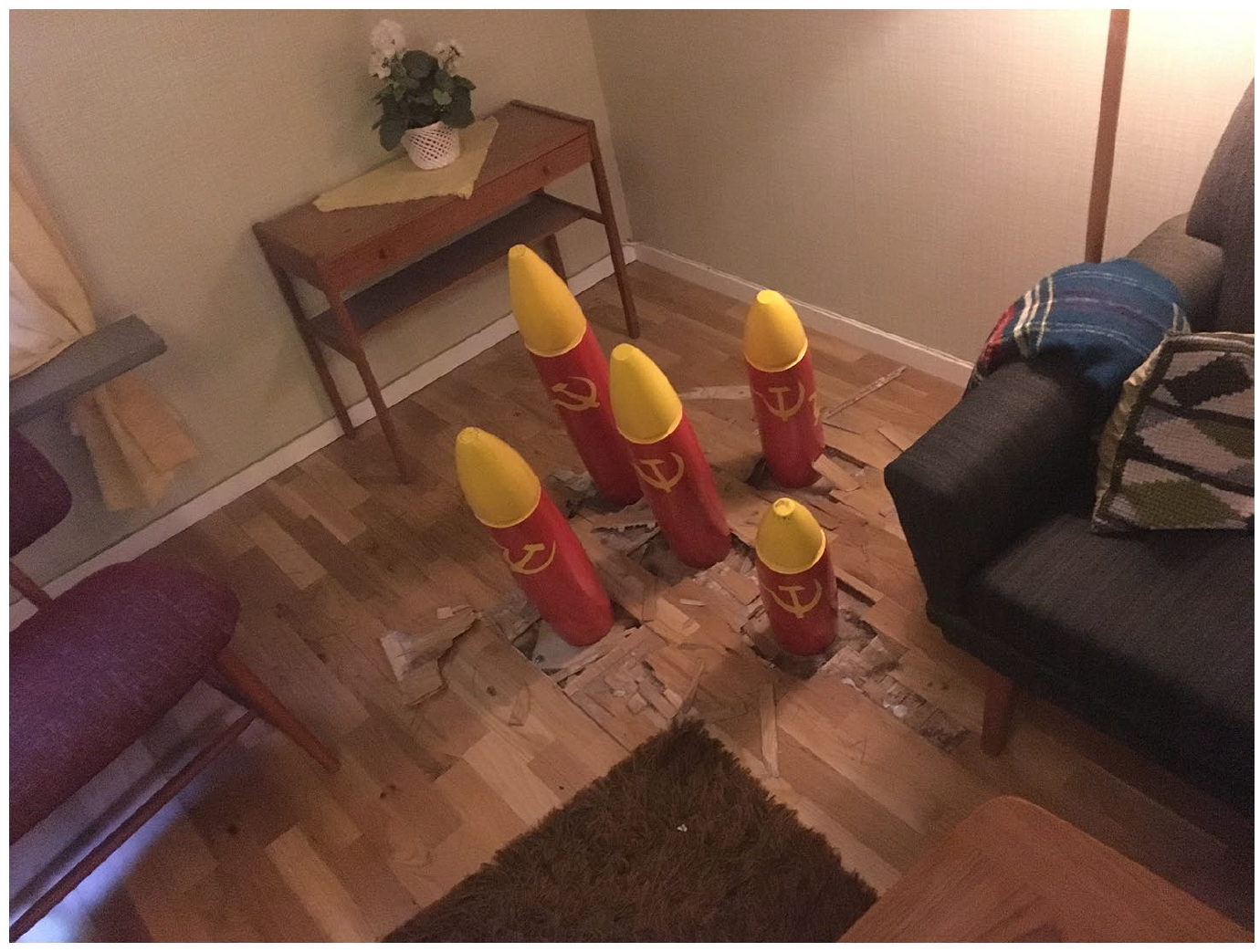
USSR missiles breaching the floor of the displayed 1960s national home, Air Force Museum, Linköping.
Humorous interventions can problematize certain logics and discourses and constitute an example of what Lisle (2016: 25) describes as ‘unruly moments that question and disrupt dominant geopolitical imaginaries’. However, such responses also require shared understandings and common frames of reference. Jokes about ‘our’ historical experiences thereby strengthen feelings of community. To laugh about the constant fear of the ‘Russian scare’ or the superpower phalluses protruding from opposite sides of the neutral Swedish floor is also a way to feel Swedish, to confirm this national identity. When visitors react to and laugh about gendered and sexualized security politics, they express physically the national memories of in/security. On such occasions, the individual body merges with the national body (cf. Dittmer and Waterton, 2017), a moment that both is experienced through the body and is about the body.
Concluding discussion
This article has aimed to gain new insights into the relation between memory-making and national security by conducting a feminist analysis of gendered bodies, emotions and materialities in military heritagization. The bringing together of CHS literature and feminist IR enabled an analysis of how the gendering of emotions and spatial and architectural arrangements supports historical narratives that privilege geopoliticized ways of understanding security and protection and a taken-for-granted nativist community. A key argument, developed below, is that denaturalization of the military heritage reveals the ways in which gender and sexuality restrict security imaginaries; that is, understandings of what is conceivable as security.
In the heritagization we have analysed, the gender binary and heterosexuality, as biological ‘truths’, reinforce common sense notions of the territory/homeland as that object which should be, and essentially needs to be, protected. The idea that (national) territory is a prerequisite for a sovereign state to exist and that the protector of that territory and sovereignty necessarily is a masculine military institution characterizes the military heritage. The ‘naturalness’ of the gender binarity and heterosexuality inherent in the protection logic and the associated gendered civilian/military divide makes thinking about protection without territory or territory without military protection inaccessible. Our feminist analysis elucidates how military heritagization renders other values and identities unthinkable as ‘deserving’ protection or legitimizing military violence. This point echoes feminist concerns that the conceptualization of security politics fundamentally concerns states’ security and not humans’ safety or wellbeing. Further, as visitors are invited to corporeally experience – to feel and inhabit – gendered identities as soldiers and family members, a distinctly nativist national community is reproduced. The privileging of these identities affirms the nativist community as exclusive and a self-evident motivation for protection. Our point is that the invocation of ‘natural’ gender and heterosexuality in narratives of the military past reinforces the valuing of geopolitical and state security over that of humankind.
The examined military heritage sites discourage conceptions of protection associated with features other than military and masculine subjectivities and aesthetics. The heritagization at Bungenäs and Linköping performs the taken-for-granted-ness of the idea that national security is about masculinity and reinforces the belief that security providers are men. The feelings of pleasure associated with gender-conservative and nostalgic yearnings and the physical enjoyment of aestheticized military violence make military protection seem self-evident and irrefutably good. This analysis illustrates our overall argument regarding the constitutive function of foundational gender and sexuality norms in limiting conceptualizations of security.
In Cold War memory-making, women are not only disconnected from violence but dis-aligned with any form of protector agency and security-establishing activities. Women/femininities are either entirely repressed – as in Bungenäs, where the feminized ‘reason’ for protection is absent both materially and experientially – or present as the ‘private’ and sexualized protected: home-makers and military wives, as in the Air Force Museum. At both sites, security is fundamentally conditioned on men/masculinity. The gendered separation of the military and civilian spheres as well as their interlinking influence understandings of security. When mundane and innocent features of the Swedish welfare state and everyday life are made to resonate with security politics and the military, any effort to problematize security policy choices and militarization can come across as a peculiar and unreasonable questioning of banal phenomena such as modern refrigerators, ABBA or the ‘normal’ life of heterosexual families.
In sum, the feminist analysis illuminates how ‘natural’ heterosexuality and gender underpin narratives dealing with the Cold War military past. This heritagization makes it difficult to think about security without gender dualism, without nativism and without protection as associated with the nation-state and military masculinity. A feminist analysis of military heritage can therefore contribute substantially to the scholarly understanding of the relations between memory-making and security. It sheds light on the perpetuation of aggressive militarism and the appeal of the idea that conventional warfare and military violence capabilities will keep us humans safe, despite the fact that societies are utterly vulnerable to the numerous non-military threats of contemporary times: climate change, pandemics and global inequalities. As calls for re-armament and militarist ‘New Cold War’ discourses reverberate increasingly loudly in today’s global security context, the opening up for critique and contestation of common-sense security understandings is all the more urgent.
Footnotes
Funding
This work was supported by Riksbankens Jubileumsfond [grant number P18- 0210:1].
