




Abstract
How successful have emerging powers been at increasing their representation within the secretariats of international organizations (IOs)? We examine the representation of the BRIC countries (Brazil, Russia, India, and China) in the International Monetary Fund (IMF), the World Trade Organization (WTO) and the United Nations (UN) System, including the UN Secretariat, over the last two decades. The analysis reveals four major findings. First, some redistribution of staff positions from established to emerging powers has taken place, but it has been relatively minor. Second, nationals from emerging powers are still strongly under-represented in international secretariats in comparison with those from established powers. Third, emerging powers’ representation at the IMF and WTO increased more than in the UN, where it actually declined. Fourth, there is strong variation between emerging powers: India appears to be the most successful emerging power in sending its nationals to the secretariats of IOs, Brazil’s and China’s records are mixed, and Russia has fared poorly. We interpret our findings in light of international relations theories and theories of institutional path dependence. The results suggest that staffing patterns are only loosely related to shifts in economic size and are subject to strong independent institutional dynamics.
Introduction
A key challenge facing international organizations (IOs) today is to adapt to rapid changes in the distribution of power amongst states. The dimension of this challenge that has attracted the most attention—both from scholars and others—is the redistribution of formal institutional privileges, such as voting shares at the International Monetary Fund (IMF) and World Bank or permanent seats on the UN Security Council (Ikenberry and Wright, 2008; Lipscy, 2016; Stephen, 2012; Vestergaard and Wade, 2015; Zangl et al., 2016). Countries such as Brazil, Russia, India and China (BRIC) have made it a foreign policy priority to secure greater control over key international institutions, and this can only come at the expense of established powers such as the United States (US) and countries of the European Union.
Yet states exercise control, gain prestige and secure resources not only through formal institutional privileges but also informally via the placement of their own nationals on IOs’ professional staffs. 1 In light of the traditional predominance of the nationals of developed countries within international secretariats (Novosad and Werker, 2019; Parizek, 2017), it is not surprising that emerging powers such as China have sought to increase their representation in the staffs of various international institutions (Liu, 2018). The BRICS countries (including South Africa) annually repeat their calls to make IOs such as the UN, the World Trade Organization (WTO) and the IMF ‘more inclusive, democratic and representative, including through greater participation of emerging markets and developing countries in international decision-making’ (BRICS, 2019: 2). They have also called for a break from the Euro-American duopoly over the heads of the IMF and World Bank (BRICS, 2012), and at the WTO, a group of countries including Brazil, China and India have made improved representation of developing countries a major staffing policy agenda. 2
In light of the importance that emerging power governments have attached to personnel changes in IOs, it is surprising that we know so little about the degree of success (or failure) of emerging powers in improving their positions in the secretariats of IOs. This is doubly regrettable because secretariats can have important roles in shaping institutions’ output and functioning (Eckhard, 2019; Eckhard and Ege, 2016; Hawkins et al., 2006) and because, while not all international institutions contain formal institutional hierarchies such as a limited number of permanent seats or weighted voting shares, all have only a limited number of staff positions to distribute amongst their members.
In this article we examine to what extent emerging powers have increased their representation on the staffs of the IMF, WTO and the UN over the last two decades. We rely on quantitative data garnered from the IOs’ annual staffing reports, but also draw on qualitative insights from 25 interviews with permanent representatives, their deputies and other senior diplomats of the members’ permanent missions to the UN and the WTO in Geneva in 2017 and 2018. Due to our interest in the position of emerging powers relative to established powers, we focus on the BRIC and G7 countries. 3 The data reveals a persistent chasm between the representation of emerging and established powers in international secretariats, although the chasm has narrowed somewhat over time.
The article proceeds as follows. First, we theorize emerging power representation in IO secretariats from two international relations perspectives, a realist-inspired power-oriented institutionalism, and a Gramsci-inspired perspective on co-optation. Although differing in their explanatory logics, both perspectives would expect the staffs of IOs to closely reflect changes in the global economy. We contrast this expectation with an institutional path dependency perspective, which emphasizes the roles of high barriers to entry and network effects in shaping IO staffing. Second, we present our empirical findings on the changing national composition of the secretariats of the IMF, the WTO and more than 30 bodies of the UN System. 4 Third, we interpret our results in light of our theoretical expectations, identifying evidence consistent with strong independent institutional dynamics and path dependency. Our findings emphasize that both realist-inspired and neo-Gramscian accounts need to take the relative autonomy of international institutions’ staffing seriously. The staffing of IOs appears to be driven considerably by endogenous institutional dynamics and cannot be reduced either to the dominance of powerful states or to the dictates of world hegemony.
Theory: power shifts and international organizations’ secretariats
How do international power shifts impact the staffing of international organizations? The intuition that, as states gain material resources, they will also gain representation in the staffing of IOs is consistent with two distinct theoretical traditions in international relations. The first sees IOs as reflecting the international distribution of power, while the latter sees them as mechanisms for the co-optation of emerging powers into the existing hegemonic order.
Realist authors see a close association between international institutions and the international distribution of power. For John Mearsheimer, international institutions are epiphenomena that ‘are basically a reflection of the distribution of power in the world’ (1994: 7). Likewise, for Kenneth Waltz, international institutions are closely bound to ‘the capabilities and intentions of the major state or states that gave them birth and sustain them’ (2000: 26). In the same vein, Randall Schweller and David Priess understand international institutions essentially as a form of collusion among the great powers (1997: 8). This realist-inspired story is consistent with a power-oriented institutionalist perspective which understands states as competing for influence over IOs via informal mechanisms such as bureaucratic politics, lobbying and agenda setting (Stone, 2013). One important mechanism of informal influence is the placement of fellow nationals in the professional staffs of IOs (Dijkstra, 2017: 610; Kleine, 2013; Novosad and Werker, 2019). 5 Because institutions are understood as expressions of power politics, they are likely to reflect closely the distribution of power amongst states. States with rapidly expanding material capabilities—such as Brazil, China and India in recent years—should be able to use their newfound capabilities, and especially their increased funding contributions, to attain greater representation in IO secretariats.
The increasing role of nationals from emerging powers in international secretariats would also be consistent with perspectives that emphasize the co-optation of potential challengers to the global hegemonic order. According to the co-optation perspective, as new powers gain in global influence, ‘the institutional structure of the current world order will integrate and co-opt them into existing international institutions’ (Stephen, 2012: 296; see also Kruck and Zangl, 2019). From a neo-Gramscian perspective, it is in fact one of the central purposes of IOs to co-opt elites from ‘peripheral’ countries in order to sustain global hegemony (Cox, 1983: 173). Pursuing this line of reasoning, William Robinson sees the BRIC countries as being increasingly integrated into global capitalism and into an ostensible ‘transnational state’ which includes IOs such as the IMF and WTO (Robinson, 2001: 166–167, 2015). From such a perspective, we would expect elites from the BRIC countries to be increasingly integrated into the ‘transnational state cadre’ (Robinson, 2001: 167). This would also fit with arguments emphasizing the durability of the existing international order, which is supposed to provide ‘a wide array of channels and mechanisms that allow the new rising states to join and to be integrated into the governance arrangements of the old order’ (Ikenberry and Wright, 2008: 5).
Both the realist-inspired ‘balance-of-power’ perspective and the Gramsci-inspired ‘co-optation’ perspective provide reasons to expect nationals from rising powers to be increasingly present in international secretariats. But, as a burgeoning historical institutionalist literature has demonstrated, international institutions often display a remarkable resistance to change (Fioretos, 2011; Hanrieder, 2015; Rixen et al., 2016). Drawing on concepts from historical institutionalism and the economic analysis of hysteresis—the dependence of systems on their past states (Göcke, 2002)—we advance two key reasons that the staffing of IOs may be more path dependent and insulated from global power shifts than we would otherwise expect.
First, attaining staff on IOs may be subject to start-up costs that function as barriers to entry to newcomers (Demsetz, 1982). Acquiring the educational and institutional mechanisms for training and supplying qualified candidates for positions in IOs is costly (Eckhard and Steinebach, 2018). Successful entry presupposes the access of a relatively large part of the population to advanced university education and professional training and support. The absence of such structures hampers the chances that applicants succeed in the context of strong international competition for professional secretariat positions. Another barrier to entry affecting the staffing of IOs could be the role of English as the default medium of communication. Reflective of the historical first-mover advantage of the US and Britain, acquiring the English competencies at a level required for integration into IO secretariats may constitute a significant barrier for non-native speakers. 6
Second, staffing patterns in IOs may be subject to social network effects. The concept of network effects in economics describes when the marginal returns from an activity or institution increase with the number of participants, or network size (Katz and Shapiro, 1985). Social network effects thus imply that the value (cost) of participating in networks increases (decreases) along with the number of participants (see e.g. Lipscy, 2016: 28). One aspect of social networks emphasized in political science research is the distributive effects that can emerge from differential access to, and centrality in, social networks, which are often characterized by a core-periphery structure (Hafner-Burton et al., 2009: 567–570). These distributive effects will be particularly acute when existing social networks are characterized by homophily—the tendency for social ties to flow from the similarity of persons (McPherson et al., 2001). In the context of international secretariats, this suggests that countries which already enjoy robust presence on existing social networks are likely to find it easier to place staff in professional positions than countries who are not already integrated into such social networks. Strong social network effects would generate a self-reinforcing dynamic, as citizens from countries already well-represented in international secretariats would enjoy superior access to them. Put together, we propose that barriers to entry and social network effects may act as significant mediators between changes in the global economy and changes in international secretariats, rendering the national composition of IO staffs strongly path dependent. 7
Empirical analysis: the BRIC countries in international organizations’ secretariats
To assess these expectations, we examine trends in the national composition of the professional staffs of the IMF, WTO and the UN System broadly defined. 8 Technically, the IMF is a UN specialized agency, and the WTO is a ‘related organization’ of the UN System, but, due to their organizational autonomy, we will discuss them separately. 9 The IMF and the WTO are two of the most significant organizations in the governance of the world economy, while the bodies of the UN in many ways make up the institutional core of the international political system. 10 This case selection is driven by three considerations: substantive political importance, global membership, and data availability. 11
Our data cover the period from 1997 until 2015 for the UN, from 2004 until 2015 for the IMF, and from 2000 until 2015 for the WTO. For each organization, we go back in time as far as the existing data sources allow. 12 All the bodies have near universal membership today, but in the case of the WTO, data availability for China and Russia reflect their accessions in 2001 and 2012, respectively. In Figure A1 (Appendix 1), we present charts of staff representation in the IMF, WTO and UN System for each BRIC and G7 country over the relevant time periods.
The IMF
The IMF exercises a critical role in the governance of the international economy by monitoring countries’ economic policies and exchange rates, surveying the global financial system, and acting as lender of last resort in the event of international payment crises. Its programmes come with conditions that can severely restrict the policy autonomy of debtor countries—making it into one of the most politicized institutions of global governance (Tokhi, 2019). The IMF is sometimes described as a ‘staff-driven’ organization because the Secretariat plays a central role in the Fund’s technical work and in drawing up the conditions for its loan programmes (Barnett and Finnemore, 2004: 45–72). Out of the Secretariat’s staff of approximately 3,300, around 2,150 qualify as professional staff as opposed to support staff. 13
With its weighted voting structure, the IMF accords formal decision-making influence based on the share of subscriptions held by its member states. The result has been that, traditionally, the Fund is dominated by highly developed countries from North America, Europe and Japan (Stone, 2011; Wade, 2003). Moreover, many of its professional and technical staff hail from the same countries, are trained at elite English-speaking universities (mostly in economics), and are closely connected to European and US-American career paths (Momani, 2005, 2007). The Articles of Agreement commit the IMF Managing Director to recruit staff ‘subject to the paramount importance of securing the highest standards of efficiency and of technical competence’ while still paying ‘due regard to the importance of recruiting personnel on as wide a geographical basis as possible’ (IMF Articles of Agreement, Article XII, Section 4). In recent years, the IMF also increasingly emphasizes the diversity of its staff in its public communications. 14
Drawing on data in the statistical appendices of IMF diversity reports, Table 1 shows the BRIC and G7 countries’ representation on IMF staff in the years 2004 and 2015. While the eleven-year time span for which data is available is shorter than those of the WTO and the UN presented below, significant changes can be observed. First, the relative share of BRIC countries’ nationals on IMF staff has increased by one third, from 10.2% to 13.9% of professional positions. Second, by far the most sizable expansion in professional staff has been experienced by China, whose share of 2.2% (43 individuals) in 2004 grew to 4.6% (99 individuals) by 2015. By contrast, Brazil and Russia both increased their representation only marginally, while India maintained its already relatively strong position of almost 5% of professional staff. The share of G7 countries declined by more than 4 percentage points, from 47% to around 43%. The biggest relative decline has been experienced by the US, losing almost 7 percentage points from its initial position of nearly one quarter of all professional staff. 15 All of the G7 countries have lost staff shares in the IMF with the exceptions of Italy and Japan, who made gains.
Country representation in professional staff of the International Monetary Fund, 2004 and 2015.
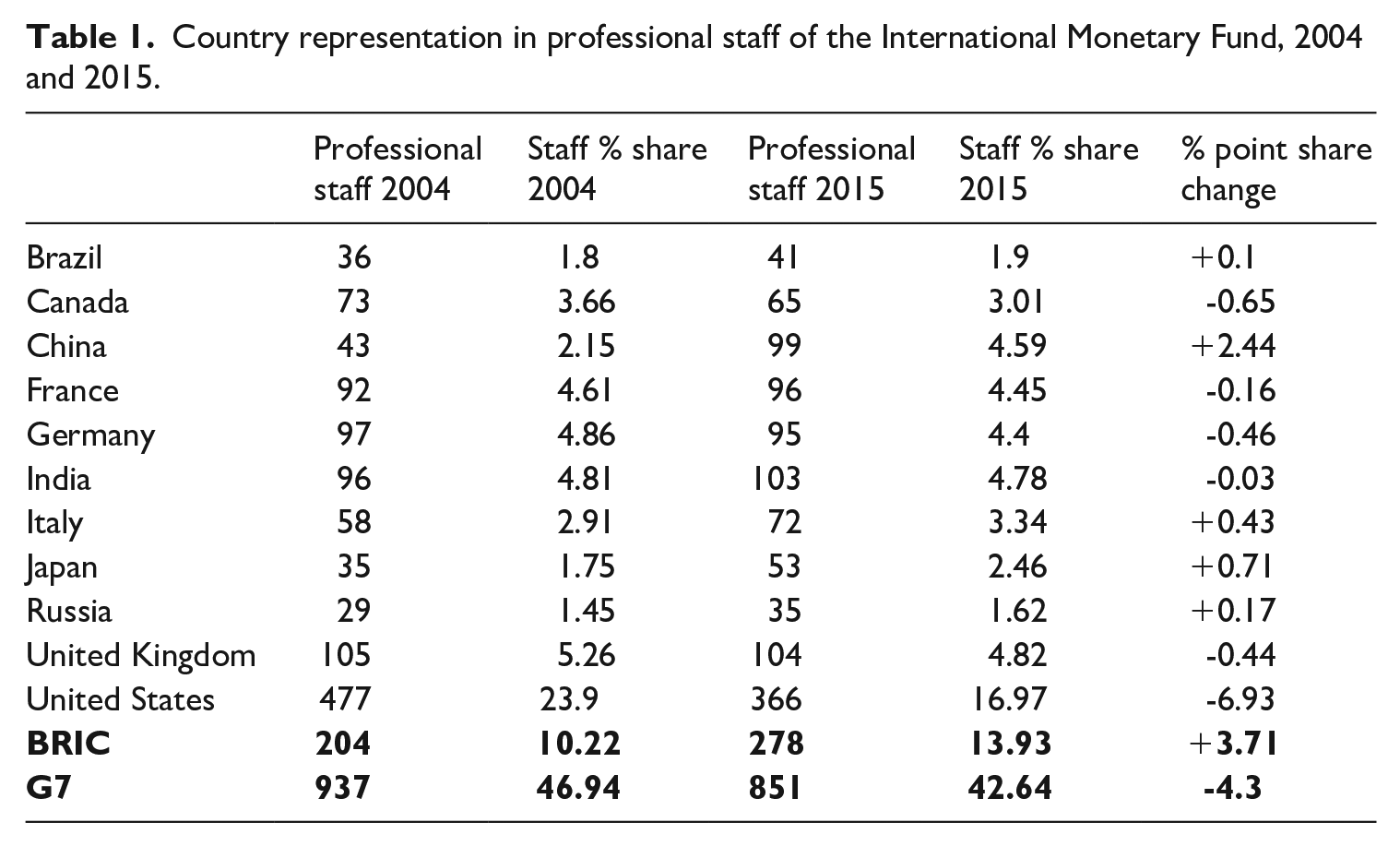
The numbers in Table 1 point to two findings. First, arguably the most striking fact is the extent to which the IMF staff is still dominated by G7 countries, which in 2015 accounted for nearly 43% of staff. Second, however, a fairly sizable redistribution of professional positions has taken place between emerging and established powers. As we will highlight later, the 14% share of staff for the BRIC countries is quite high in comparison with the UN. Moreover, the gains by emerging powers (primarily China) roughly correspond to the losses experienced by established powers. Emerging powers have also made personnel gains in positions of senior management at the IMF: between 2017 and 2020, the Brazilian, Carla Grasso, was a Deputy Managing Director and Chief Administrative Officer; 16 since 2016, Tao Zhang of China has been a Deputy Managing Director; and Kalpana Kochhar of India has served since 2016 as the Director of Human Resources (International Monetary Fund, 2020). So while the IMF staff is still dominated by nationals from G7 countries, emerging powers have made modest but significant gains since 2004.
The WTO
Like the IMF, the WTO plays a central role in global economic governance, with the trade agreements it administers in many ways serving as the foundation of international commerce. In contrast to the IMF, however, the WTO does not formally institutionalize a decision-making hierarchy amongst its members, relying instead on consensus and the one-country-one-vote principle. Partly due to its formal reverence for the principle of sovereign equality, the WTO is often characterized as a ‘member-driven’ organization, leaving most of its day-to-day affairs in the hands of state representatives (Elsig, 2010). The WTO Secretariat is based in Geneva and consists of approximately 630 regular staff, of which around 360 are professional staff, the others consisting of support and linguistic staff. 17 The Secretariat is headed by the Director-General. While the Secretariat has no decision-making powers, it does supply crucial information to members and provides technical and administrative support to the WTO’s various councils and committees. Unlike many IOs, the agreement establishing the WTO does not include any clause on geographic or regional diversity of staff. Only the Staff Regulations adopted in 1998 state that its recruitment policy ‘shall be based on the principle of equal opportunity for all, regardless of gender, nationality, race or religion with the objective of ensuring the broadest possible diversification of the Secretariat’ (WTO Staff Regulations, Recruitment Policy, WT/L/282, p.7).
While it is well known that Brazil, China and India have emerged as central players within the WTO system (e.g. Hopewell, 2015), little is known about their representation in the WTO Secretariat. 18 Table 2 compares their representation in the WTO staff in the years 2000 (the earliest data available) and 2015. (The first figure available for China is from 2005, and due to Russia’s later accession we only include the observation from 2015).
Country representation in professional staff of the World Trade Organization, 2000 and 2015.
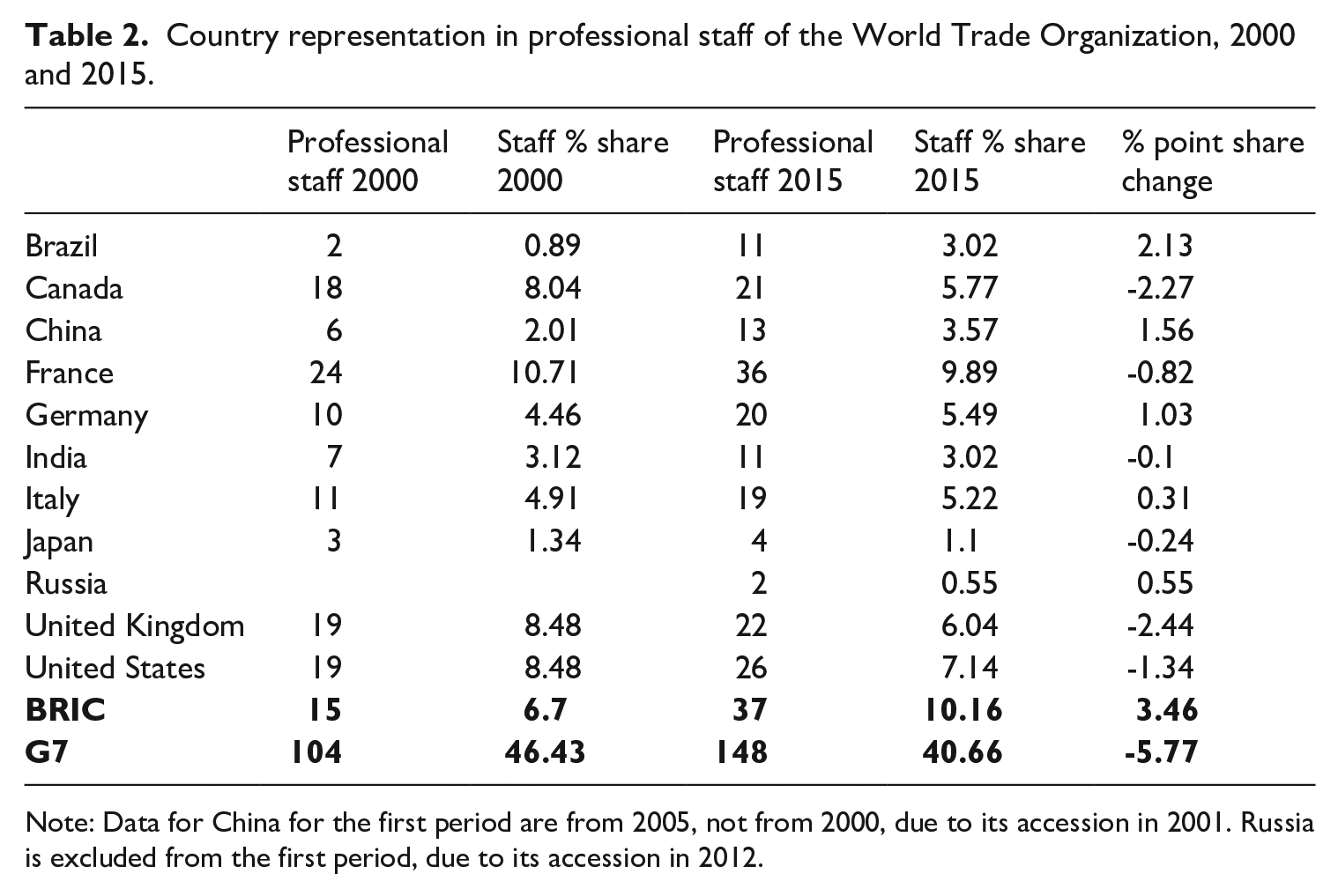
Note: Data for China for the first period are from 2005, not from 2000, due to its accession in 2001. Russia is excluded from the first period, due to its accession in 2012.
The overall picture at the WTO is similar to that of the IMF. We observe a rise in the representation of the emerging powers, but from very low initial values: from 6.7% (without Russia) to 10.2% (including Russia which, however, only accounts for 0.6%). The G7 countries’ position has declined relatively, but from a high level, decreasing from 46.4% of all staff in 2000 to around 41% in 2015.
By far the biggest gainer of staff at the WTO has been Brazil, followed by China. There were 11 Brazilians working at the Secretariat in 2015 (3%), compared with only two in 2000 (0.9%). Brazil was also successful in its nomination for the position of the WTO Director-General, held by Roberto Azevêdo between 2013 and 2020. China is also represented, through Xiaozhun Yi, among the four Deputy Director-Generals (World Trade Organization, 2020). The biggest decline has been experienced by the United Kingdom and Canada. Probably due to geographical proximity to Geneva, France has always had the highest share of staff (10% in 2015), with the US coming second with 7%. Overall, as in the IMF, countries such as Brazil, China and India have slowly improved their representation in WTO staff despite their position within the Secretariat remaining limited compared with nationals from G7 countries.
The United Nations
The UN has been central to the international system since 1945 and is supposed to embody the idea, originating in the League of Nations, of an impartial international civil service drawn from different backgrounds but committed to the internationalist cause (Ziring et al., 2005: 136). As one of the core organs, the UN Secretariat plays a critical role in administering the UN’s work (see Novosad and Werker, 2019: 55–56 for an overview).
To manage the tensions between states regarding their representation in staff, the General Assembly has implemented ‘desirable ranges’ for some of the professional regular budget posts for different member states in the UN Secretariat. Until 1962, the desirable ranges were calculated on the basis of members’ financial contributions alone; today, this factor retains more than 50% of the weight in the calculations. Most of the UN specialized agencies apply similar rules (United Nations Joint Inspection Unit, 2012a). In light of the rapid rise of China, and the ambitions of India and Brazil in attaining permanent representation in the Security Council, it is especially pertinent to examine whether emerging powers have improved their representation in the UN bureaucracy. Our data is drawn from the UN Chief Executives Board for Coordination Personnel Statistics reports, published annually from 1997 onwards, covering virtually the entire UN System (United Nations System, 2020). 19
The data in Table 3 shows that the UN—the UN Secretariat and around 30 programmes and agencies of the UN System—reflects very different staffing patterns compared with the IMF and WTO. There are some surprising findings. First, not only have emerging powers not seen an increase in their share of professional staff over the last 20 years, they have in fact lost representation, along with the established powers of the G7. In 1997, BRIC countries held around 8.5% of all professional positions; by 2015 this share had fallen to 7.1%. The decline is particularly notable in the UN Secretariat, by far the largest single body of the UN System. There, BRIC countries have also lost shares, from around 13% in 1997 to just above 8% in 2015. However, most (but not all) of this decline is attributable to the massive decline in the position of the Russian Federation as successor state to the Soviet Union. Russia has lost 2.1 percentage points across the UN System generally, and it has declined from 6.3% to 2.7% in the Secretariat. At the same time, Brazil has also experienced a decline of its share of professional staff positions, while the portion of Chinese nationals has not increased at all. Although China today accounts for 18% of the global population and contributes 12% of the UN regular budget (second only to the US), it still accounts for less than 2% of all professional UN staff. Of the BRIC countries, only India has experienced gains in staffing representation, rising from 2.1% to 2.7%. This may, in fact, be seen as quite a success for a country that still only pays around 0.8% of the UN’s assessed budgetary contributions.
Country representation in professional staff of the United Nations System, 1997 and 2015.
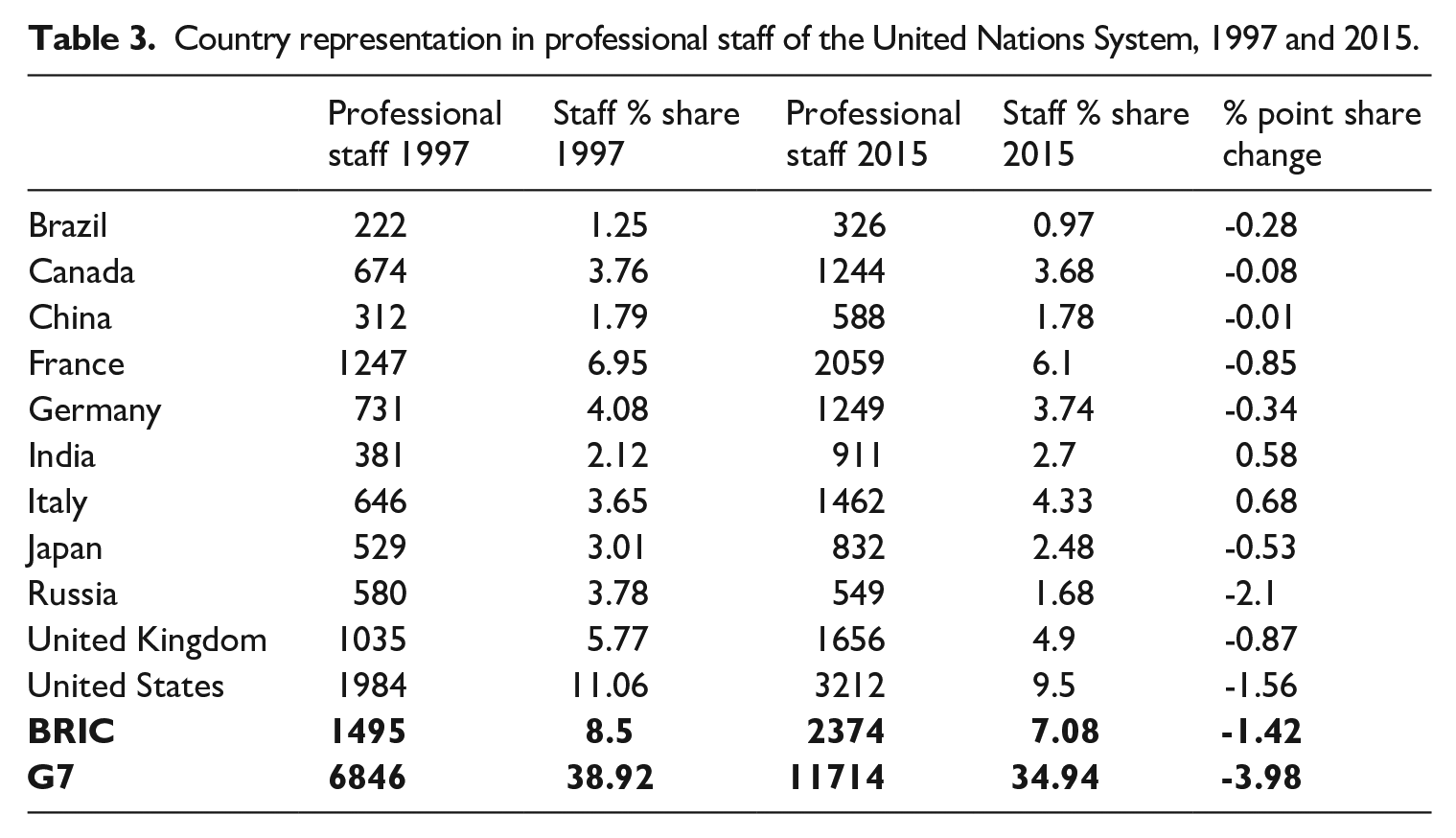
It is notable that the emerging powers, which have almost tripled their combined share of world GDP over the twenty years, have seen no overall increase in their share of UN staff. At the same time, as in the cases of the IMF and WTO, the share of staff from G7 countries has declined somewhat, from 39% to 35%. 20 As we document elsewhere, the major gainers of representation in staff in the UN have in fact been particularly low-income countries, many of them in Sub-Saharan Africa (Parizek and Stephen, forthcoming). In the aggregate across the UN System and all staff levels, the combined share of BRIC nationals in the professional UN staff is half of that in the IMF and around two thirds of that in the WTO.
Nationals from emerging powers have been more successful in occupying senior positions in the UN System, however. In the UN Secretariat, Maria Luiza Viotti of Brazil is the Chef de Cabinet to the UN Secretary-General; Tatiana Valovaya of Russia is the Director-General of the UN at Geneva; the Chinese national, Liu Zhenmin, is the Under-Secretary-General for Economic and Social Affairs; and Atul Khare of India is the Under-Secretary-General for Operational Support (United Nations Protocol and Liaison Service, 2020). Nonetheless, the lack of gains for emerging powers in the UN staff does chime with Novosad and Werker’s claim regarding senior positions in the UN Secretariat that people from Western Europe and its offshoots still dominate the UN Secretariat (2019: 13).
Interpretation
Four central findings arise from our data. First, some redistribution of staff positions from established to emerging powers has indeed taken place, but it has been relatively minor. In a pattern consistent with the balance-of-power and hegemonic co-optation perspectives, at the IMF, China has been the major winner and the US the major loser of shares on the professional staff. Likewise, at the WTO, the share of nationals from BRIC countries has increased, while that of G7 has decreased. This pattern is, however, confounded in the case of the UN, where both emerging and established powers have lost staffing shares. Moreover, contrary to the expectations of the balance-of-power and co-optation perspectives, it is apparent from the results in Tables 1–3 that there is no direct translation of growing material power (or a growing role in global capitalism) to representation in international secretariats (or the transnational state cadre). This is most visible when we examine staff representation per unit of economic activity. Figures 1(a) to (c) show the total numbers of professional staff from the G7 and BRIC groups per one billion US dollars (USD) of gross national income (GNI), for the IMF, the WTO and the UN System, respectively. In all three cases, emerging powers (marked with the dashed line) started in the 1990s at a much more favourable conversion rate than established powers. Over time, however, the situation has reversed. By 2015, the figure for BRIC countries in the UN declines from 0.6 to 0.1 professional staff members per one billion USD of GNI, and similar trends are evident at the IMF and WTO. As it turns out, emerging powers have even been surpassed by the established powers in their ability to convert economic power to staff representation. Established powers’ ratio of staff to economic size only declined marginally (depicted by the full line in Figures 1(a) to (c)). Established powers now enjoy more international secretariat staff per unit of economic activity than the emerging powers, in all three institutions under examination. If representation in international secretariats followed closely the shifts in the global economy, we would expect these lines to remain stable over time. This is far from the case.
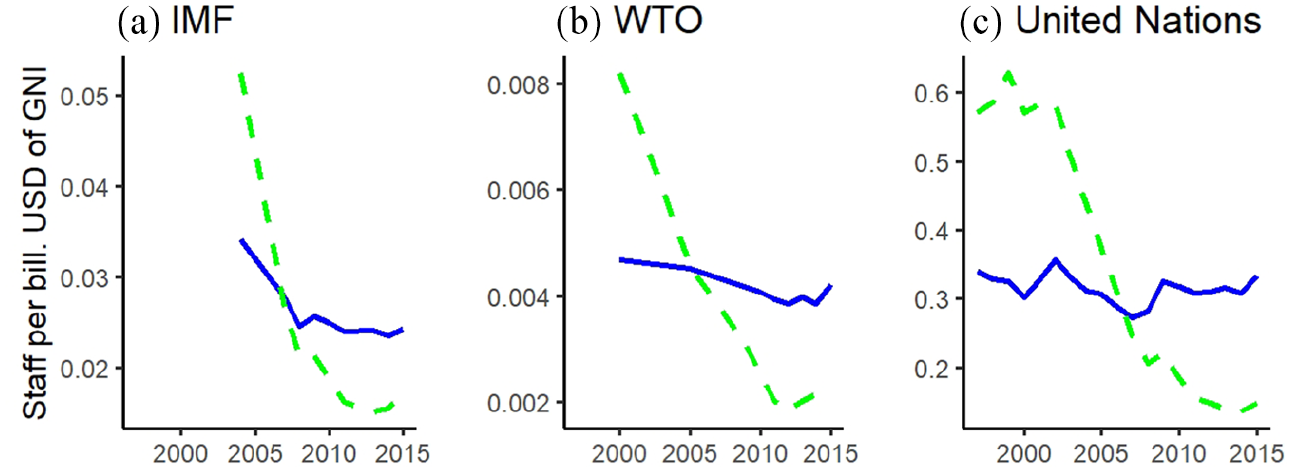
Conversion of economic power into staff representation.
This leads to our second core finding: nationals from emerging powers are still strongly under-represented in international secretariats in comparison with those from established powers. Rather than readily reflecting exogenous power shifts, the staffing of IOs appears to be quite stable over time, to the advantage of established powers. One reason for the slow pace of change in staff composition will be that many professional staff are employed on permanent contracts, which will necessarily produce a lag between changes in hiring patterns and staff composition. However, this will be mitigated by the overall growth in staff numbers in all of the institutions in our data. Over the periods we examine, the number of positions in the secretariat of the IMF increased by 8%, in the WTO by 63%, and across the UN System by almost 90%. The overall growth in international secretariats combined with routine staff turnover should mitigate the role of permanent contracts in explaining the slow pace of change that we observe.
In line with a focus on linguistic barriers to entry, in our interviews with country representatives to the UN and the WTO, the lack of proficiency in English was frequently identified as a major impediment for better representation of the BRIC countries. 21 This may also help to account for the higher share of Indian nationals in international secretariats relative to other BRIC countries. However, one international comparison suggests that English proficiency levels in China are beginning to approximate those of India, while English proficiency levels in Russia and Brazil appear only marginally lower (EF Education First, 2019: 6–7). So the other BRIC countries may be close to overcoming this barrier to entry. More generally, there appears to be a lag between economic growth and its conversion into stocks of human capital necessary for competing with candidates from developed countries. 22 Acquisition of the skills and knowledge necessary for generating international civil servants is a relatively specialized form of power that is still highly unequally distributed. The production of candidates for membership in international secretariats may also require high initial investments which act as a barrier to entry for newcomers.
Social network effects may also play a role. In an interview, one permanent country representative to the UN Office at Geneva, a former senior UN staff member, observed that when a country already has many staff members in a particular institution, another applicant from that country will very likely know someone in the division. That person will be asked: What do you think are some of the questions that may be asked [during the interview]? Because you know someone to call [. . .] Nationalities get reinforced. You find British candidates bubbling to the top or French candidates bubbling to the top, in a particular institution.
23
In line with social network effects, this suggests that having an already relatively high number of individuals of a certain nationality within an international bureaucracy will contribute to that country’s network centrality, increasing its control over and access to information, and boosting their social capital (Hafner-Burton et al., 2009: 568–571). The formation of a cohesive sub-group with a central position in the social network may generate an ‘in-group’ dynamic which disfavours outsiders (Hafner-Burton et al., 2009: 569; see also Kleine, 2013). The IMF, for example, has for a long time been criticized for recruiting its staff from a narrow set of US-based universities and very similar study programmes, creating a highly homogeneous and interconnected group (Momani, 2005, 2007: 46–47, 52; Stiglitz, 2002: 35). Eckhard and Steinebach (2018) also find that experience from participation in UN programmes, including in peacekeeping operations, may increase the success of candidates in hiring procedures. In sum, membership in the international public service may be subject to self-reinforcing dynamics that are difficult to penetrate from a position of network peripherality.
Our third core finding is strong variation between countries. Of the emerging powers, India stands out as the country that is most successful in sending its nationals to the secretariats of IOs. Of the BRIC countries, India has the highest number of nationals at the IMF, the second highest at the WTO (equal with Brazil in 2015), and by far the largest number in the UN System. Most likely, English language skills and a highly regarded elite education system contribute to India’s status as the emerging power with the greatest representation in IO secretariats. China has gained by far the most staff at the IMF, and, while it has also gained at the WTO, China’s representation in the UN remains surprisingly low. One reason that China’s representation lags behind its sensational economic growth may be related to the complicated and opaque process by which China’s Ministry of Human Resources and Social Security selects candidates for positions in IOs (Liu, 2018). Yet, the Chinese government is reportedly introducing new measures to ameliorate its under-representation in IO secretariats, which may raise its staff share over time (Liu, 2018). Russia stands out as the BRIC country with the least staff representation at both the IMF and WTO, despite modest growth in both, and the second-lowest number of staff in the UN System. Russia’s share of staff at the UN has more than halved in the last 2 decades (see also Parizek and Ananyeva, 2019).
Our fourth major finding relates to inter-institutional variation: while emerging powers’ representation in the secretariats of the IMF and the WTO has increased modestly in recent years, there is no comparable trend in the UN System. We propose three reasons for this. First, this may reflect different levels of salience that the emerging powers attach to different institutions. Emerging power governments may prioritize staff representation in ‘staff-driven’ IOs with authoritative bureaucracies, such as the IMF and World Bank. 24 The BRIC countries have often targeted these shareholding institutions as particularly in need of reform. They may also consider key international economic institutions such as the IMF and WTO to be more important for their policy priorities and for legitimizing their domestic development models (Nölke et al., 2015; Stephen, 2014). 25 Second, the proportion of highly trained technical staff at the IMF and WTO may be higher, on average, than in the UN System. These positions may be more insulated from overt political considerations in staff appointments compared with other professional positions (Momani, 2005: 179). Third, an alternative explanation for the exceptional situation in the UN System would be that it reflects differences in the organizations’ formal decision-making procedures. Most decision-making in the UN is based on the one-country-one-vote principle, which leads to a relatively high level of influence by large groups of economically smaller states. 26 In fact, least developed countries are relatively well represented amongst UN staff, when judged against their population and economic resources (Parizek, 2017). By contrast, the weighted voting procedure of the IMF allows emerging powers orders of magnitude more decision-making power compared with smaller developing countries. The Chinese share of 4.4% of staff is relatively close to its 6% share of the voting quota; the same goes for Russia’s share of 1.6% of staff. India’s 4.3% of staff surpasses its 2.6% voting quota, while Brazil’s formal voting power and share of staff are roughly equal (at around 2.2%). In the WTO, too, economic and trade-related power lends large countries particular influence, despite its consensus principle (Steinberg, 2002; Wilkinson, 2014). Paradoxically, then, the weighted voting structures that disadvantage emerging powers in relation to established powers may nonetheless provide them with far greater relative influence than in institutions run according to the one-country-one-vote principle.
Conclusion
Our findings indicate that there is no direct connection between the economic growth of emerging powers and increased representation in the staff of IOs. From a power-oriented institutionalist perspective, this suggests that emerging power governments are still strongly disadvantaged when it comes to a key mechanism of informal influence over IOs. From a neo-Gramscian focus on the co-optation of developing country elites, this suggests that the co-optation of emerging powers into the transnational state cadre is only limited. The professional personnel of the international civil service are still heavily rooted in the North Atlantic.
These results point to several issues of broader concern in relation to international power shifts and international institutions. First, they highlight how different forms of power shift at very different paces. While major changes have been manifestly taking place in the global distribution of economic power, this has only limited implications for shifts in relation to more specialized forms of power (Baldwin, 1979). In our case, we have emphasized the role that barriers to entry and social network effects may play in rendering the staffing of IOs path dependent and ‘locking in’ the advantages of established powers. This issue of imperfect fungibility of economic power has, of course, major importance for the discussion of global power shifts, most visibly with regard to China (Ross, 2019).
Second, our results highlight that, even when formal provisions for institutional adaptation are in place, implementation may not follow. To be sure, there are prominent cases of reform substantially delayed due to protracted domestic ratification, as in the case of IMF Voice reform (Vestergaard and Wade, 2015: 2). Our findings highlight that, even when no formal obstacles are in place, implementation of substantial institutional goals may not follow. All of the bodies we have examined contain provisions for equitable or diverse geographical representation of staff. The UN and IMF include such provisions in their constitutive documents. Yet, the observed long-term staffing representation patterns simply fail to reflect these provisions. For example, it is suggestive that an evaluation of UN staff recruitment carried out by the UN Joint Inspection Unit in 2012 uncovered a widespread view among staff at large that ‘the rules, policies and procedures governing recruitment are neither consistently applied nor effectively implemented’ (United Nations Joint Inspection Unit, 2012b: 5). Our findings are consistent with approaches that emphasize the relevance of decoupling to the work of international organizations (Kentikelenis et al., 2016; Stephen, 2018).
Third, the ability to set not only the formal rules but also the terms of staff recruitment may also help to account for emerging powers’ interests in creating new multilateral institutions (Stuenkel, 2016). Highly persistent uneven patterns of staffing in the existing institutions may add to emerging powers’ sense of a lack of the institutions’ ownership and representation in them, further fuelling their readiness to engage in the creation of new institutions.
This article represents a first cut at revealing the position of emerging powers within the secretariats of IOs. On the one hand, the tendency toward lock-in in the staffing of international secretariats should not be exaggerated; clearly, there is change over time. On the other hand, the mechanisms of path dependence may help to account for the still striking under-representation of emerging powers and the sluggishness by which material changes in the world have affected IO bureaucracies. It will be important to follow the developments in staffing in the coming years, also in global and regional organizations other than those we study here, and observe if more dynamic changes to the staffing patterns occur. While the conditions for rising powers to achieve formal international institutional change has attracted much scholarly attention, informal institutional change is important too.
Supplemental Material
BRICS_G7_secretariats_data – Supplemental material for The long march through the institutions: Emerging powers and the staffing of international organizations
Supplemental material, BRICS_G7_secretariats_data for The long march through the institutions: Emerging powers and the staffing of international organizations by Michal Parizek and Matthew D Stephen in Cooperation and Conflict
Footnotes
Appendix 1
Acknowledgements
We thank Paul Collins for research assistance and the reviewers at Cooperation and Conflict for input which greatly improved the article.
Funding
We gratefully acknowledge funding by the Czech Science Foundation, project ‘Global bureaucracy: The politics of international organizations’ staffing’ (Grant no. 17-10543S).
