



Abstract
Sects and strict denominations are growing more rapidly and retaining members better than mainstream religions. To what extent do they influence vote choice? I investigate whether the Iglesia ni Cristo (INC), a religious sect in the Philippines, can compel all members to “vote as one” and support a full ticket of endorsed candidates. Using a triple difference identification strategy, I show that the municipal-level vote-shares of INC-endorsed national candidates are unit elastic with respect to the share of INC voters across municipalities. Conventional low-information rationality models of voting cannot fully explain this. But augmented with social voting in which actions of other group members inform the objective function of voters, a voting model with religious sect endorsements can produce extremely large behavioral responses. These findings have implications on policy as well as on our understanding of strict religions’ influence on politics.
“People cannot but notice the unity of the Church of Christ. This fact is most visible during election times because the Church of Christ members (Exec. Minister Eraño G. Manalo, Fundamental Beliefs of the Iglesia ni Cristo, p. 105, 1989.)
The past few decades have seen a renewed interest among comparativists in the role that religion plays in politics (Djupe & Calfano, 2013a; Grzymala-Busse, 2012b). The resurgence of religious fundamentalism, in particular, has led more scholars to consider religious sects as important political actors (Gill, 2001). 1 Many have observed that, around the world, fundamentalist churches and other sects seem to have a strong ability to turn out voters and get them to back endorsed parties and candidates (Freedman, 2020; Haynes, 2009; Layman, 1997; Patterson, 2005; Regnerus et al., 1999; Wald & Shye, 1995). To scholars of political behavior, however, this purported power of religious sects to influence the vote presents a puzzle: beyond serving as information shortcuts endorsements should not necessarily compel members to strictly abide by them given that the ballot is secret and that church members can have competing partisan identities (Margolis, 2018). At the same time, although there is a growing body of literature in religion and politics exploring the various ways that congregations can influence the political behavior and beliefs of their members, 2 little progress has been made in rigorously assessing the extent to which religious endorsements affect vote choice, beyond case studies and ecological analyses that often face significant inferential challenges. Can leaders of small religious sects use endorsements to powerfully sway the vote in their favor, and if so, how?
This article establishes evidence on how religious movements characterized by strong belief systems are able to mobilize members not only to turn out but also to fully support a slate of church-endorsed candidates. I study the reputed power of endorsements by a religious sect in the Philippines—the Iglesia ni Cristo (INC). INC is an independent and indigenous religious sect with some 1.37 million voting-age faithfuls spread out across the archipelago. 3 Every election, INC endorses a list of candidates for office, from the president down to municipal councilors. Leaders of INC claim that members subscribe to the sect’s “vote as one” teaching, which stipulates that all voting-age members turn out and vote only for the candidates endorsed by the group (see epigraph above).
Can a small religious sect compel all members to “vote as one” and support a full ticket of endorsed candidates? At first blush, the claim seems untenable. For the sect to sustain compliance with the teaching, members must, in the first place, be obliged to turn out to vote, and in the second place, vote for all and only for endorsed candidates. But voting in the Philippines is not compulsory and the ballot is secret. Moreover, almost all endorsed candidates are non-INC members, come from different political backgrounds and affiliations, and have opposing policy preferences. At the same time, INC members look no different than members of the dominant Roman Catholic church, at least in terms of observable characteristic that typically predict voting behavior. 4 The claim that INC can enforce the “vote as one” teaching amongst its members with near-perfect compliance, on the surface, seems difficult to sustain.
To provide a theoretical explanation for the efficacy of INC’s endorsements, I examine the anecdotal and ethnographic accounts on how INC is able to enforce the “vote-as-one” teaching, and extract from these some key characteristics that I then incorporate in a formal model of vote choice. I use as a starting point the standard low-information rationality models of voting. If we keep all the standard assumptions of these models, then they cannot fully rationalize the prediction implied by INC’s “vote as one” teaching—that all members will support all and only the endorsed candidates. I then draw on insights from theories on religious social interactions (Berman, 2000; Berman & Laitin, 2008), and extend the standard low-information model of voting to explain the efficacy of INC’s “vote as one” teaching. Specifically, I include the actions of other sect members directly in the objective function of voting members, which create a multiplier effect that amplifies the potency of endorsements on sect members’ individual voting calculus. The result is somewhat counter-intuitive: the fact that the “vote as one” teaching is very demanding is precisely the reason why it works. In the absence of religious social interactions, only a small fraction of the church members will likely comply, but with strong religious social interactions, even the marginally compliant members incorporate in their own voting calculus the value to other members of compliance.
The model makes stringent empirical predictions of INC’s “vote as one” teaching. If highly effective, then the vote-shares of INC-endorsed candidates and the share of voting-age INC members across subnational units should approach a one-to-one relationship—a prediction of near-unit elastic relationship. Further, all else held constant, the vote-shares of non-INC-endorsed candidates should be invariant to the share of voting-age INC members across geopolitical units—a prediction of near-perfectly inelastic relationship.
I test these predictions using data on the municipal-level vote-shares of nationally-elected endorsed senatorial candidates in the Philippines during the 2007 and 2010 elections, matched with INC’s share of municipal-level voting population based on the national census. Using a triple difference identification strategy that differences out heterogeneity across subnational units, across candidates, and across years, I show evidence in support of this article’s theoretical predictions. In particular, I find that a 1% change in the municipality-level INC share of the voting population is associated with an increased average vote-shares for endorsed candidates of approximately 0.97%—a magnitude that is statistically indistinguishable from a unit elastic relationship. In contrast, the municipality-level INC share of the voting population is completely invariant (i.e., inelastic) to the average vote-shares of non-endorsed candidates.
This article contributes to the study of religion and politics in three ways. First, “research on religious fundamentalism tends to produce studies emphasizing “big” processes with very little microlevel foundational basis (Gill, 2001, p. 119).” This article builds on a growing body of work on the political economy of religion that has roots in rational choice theory to understand how strict religions can wield remarkable political power (Berman, 2000; Grzymala-Busse, 2012a; Iannaccone, 1992, 1998; Iannaccone & Berman, 2006).
Second, this study adds to the growing body of evidence on the impact of political endorsements. Scholars have shown that industry endorsements help voters overcome their ignorance of industry-specific issues (Kuklinski et al., 1982; Lupia, 1994). Interest group endorsements affect who voters support at the polls (Arceneaux & Kolodny, 2009; Rapoport et al., 1991). Newspaper endorsements shape voter attitudes (Chiang & Knight, 2011), and celebrity endorsements increase voter turnout and can affect election outcomes (Garthwaite & Moore, 2012). This article complements these studies by providing evidence on the effect of religious sect endorsements on vote choice.
Finally, establishing whether religious endorsements have a causal impact on voter behavior has implications for the study of democratic accountability. Religious sects and similar strict denominations around the world continue to grow more rapidly and with higher rates of membership retention than their mainstream counterparts even as they show no signs of weakening in their strict doctrinal requirements (Iannaccone, 1998; Grzymala-Busse, 2012a). Evidence shows that these groups can hold veto power over policy (e.g., Ultra-Orthodox Jews in Israel (Berman, 2000)). Left unchecked, these groups can be potent forces influencing electoral outcomes.
This article proceeds as follows. In the next section, I discuss the standard explanations for how endorsements work and why the efficacy of the “vote as one” teaching is an anomaly in light of these explanations. Next, I provide background on Iglesia ni Cristo and the sect’s “vote as one” teaching and incorporate existing theories on religious social interactions to rationalize INC members’ compliance with the teaching. I then formalize this in a model of vote choice with religious sect endorsements and social interactions to generate testable predictions. The penultimate section presents the empirical results with a discussion on competing explanations due to selection, reverse-causation, simultaneity, and other forms of omitted-variable bias. The final section concludes with broad implications for policy and our understanding of strict religions’ influence on voter behavior.
How Endorsements (Typically) Affect Vote Choice
Scholarship on endorsements and voting behavior suggests that voters are generally uninformed about politics (Boudreau, 2020). Few hold stable attitudes on political issues and fewer still are able to organize their beliefs into one coherent, overarching ideological system (Converse, 1964; Simon, 1957). However, because voters want to make correct decisions, they circumvent the task of collecting and considering all relevant information by taking advantage of information shortcuts or heuristics (Chaiken et al., 1989; Petty & Cacioppo, 1986). Endorsements are a prime example of political heuristics. As such, they allow voters to decide as if they were fully informed (Lupia & McCubbins, 1998; McKelvey & Ordeshook, 1985).
Lupia (1994) argues that individuals need only know whether they like or dislike the group endorsing a candidate to transform the endorsement into an information shortcut. As long as people choose to like groups that align with their values and dislike those that do not, endorsements become credible source cues that citizens can use as an efficient information shortcut (Druckman, 2001; Lupia, 1994). Endorsements are most useful among the least politically informed (Lupia, 1994; Popkin, 1991), although other scholars argue that endorsements can only be efficient if they are both accessible and activated in the individual’s mind (Chaiken et al., 1989). If the individual lacks the contextual information necessary to realize the political implications of the endorsement, then knowing this piece of information is no better than not knowing it (Kuklinski & Quirk, 2000; Zaller, 1992).
These theories of voting behavior, based on low-information rationality, may explain full compliance if a number of strong assumptions are made. In particular, all members would need to be sufficiently close to an ideal policy point (e.g., that of the INC leader), and endorsed political candidates would also need to be strategically located around the same ideal point, so that the vast majority of members would have supported these candidates without the endorsements. The endorsements would then work to persuade the outliers to vote as well, causing all members to support the “vote as one” teaching.
List of Top 24 Vote-Getting Senatorial Candidates in 2007.*
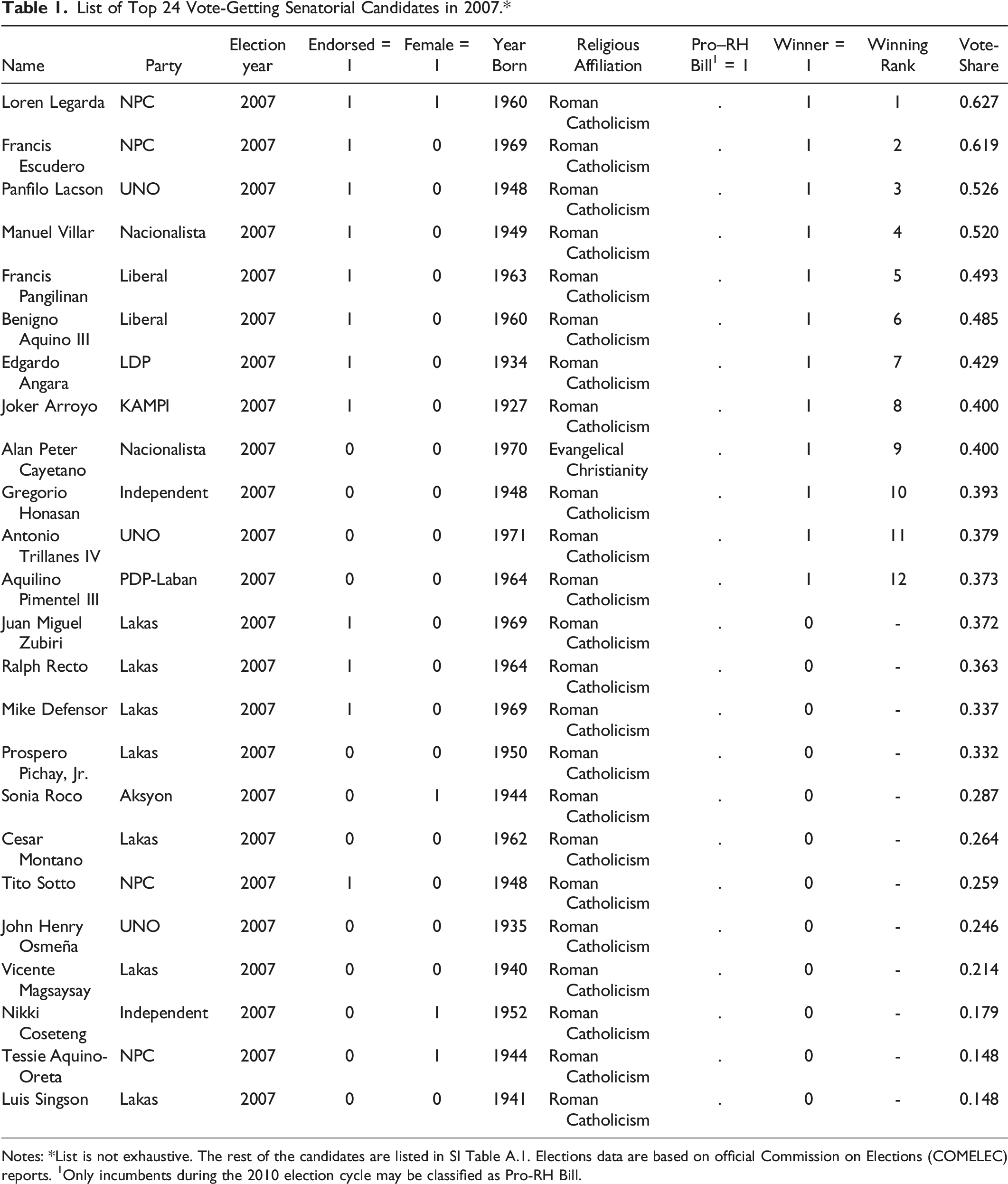
Notes: *List is not exhaustive. The rest of the candidates are listed in SI Table A.1. Elections data are based on official Commission on Elections (COMELEC) reports. 1Only incumbents during the 2010 election cycle may be classified as Pro-RH Bill.
List of Top 24 Vote-Getting Senatorial Candidates in 2010.*
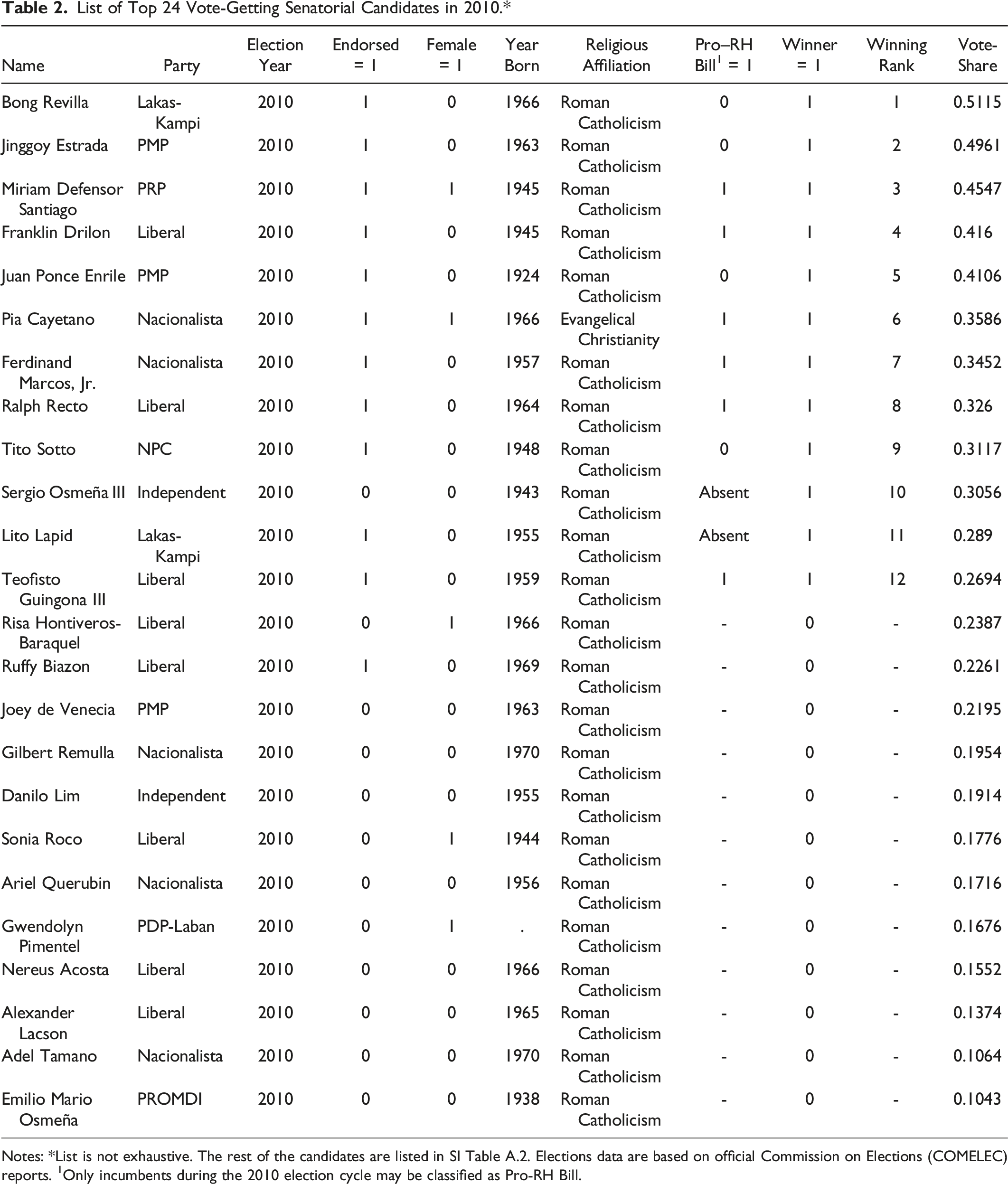
Notes: *List is not exhaustive. The rest of the candidates are listed in SI Table A.2. Elections data are based on official Commission on Elections (COMELEC) reports. 1Only incumbents during the 2010 election cycle may be classified as Pro-RH Bill.
What is it about religious sect endorsements that makes them especially effective? I look to the literature on religious social interactions to explain the efficacy of INC’s endorsements. However, before doing so, I provide a brief historical overview of Iglesia ni Cristo and its ‘vote as one’ teaching. This background is essential for understanding the roots of INC’s organizational influence and the unique social dynamics that enable its endorsements to compel such cohesive voting behavior. By grounding the discussion in the context of INC’s history and teachings, I aim to clarify the mechanisms that drive its members’ electoral choices and provide a foundation for the subsequent theory-building exercise.
Iglesia ni Cristo and the “Vote as One” Teaching
The Iglesia ni Cristo (INC) (trans. “Church of Christ”) was founded in Manila in November 1913 by its first Executive Minister, Felix Y. Manalo, and was officially registered as a religious corporation in 1914. According to its articles of incorporation, the goal of the organization is to “propagate the doctrine and wise teachings of the Gospel of Christ in the whole Philippine Archipelago.” INC holds that the Church of Christ was founded by Jesus Christ himself, but Felix Manalo was God’s last messenger, whom he sent to re-establish the Christian Church to its true, pristine form (Reed, 2001).
Manalo initially recruited 12 converts, and within a year of founding INC, he and his first followers converted more than 1000 Catholic Filipinos to his sect (Reyes Sta Romana, 1955). By 1936, INC had 85,000 members. This figure grew to 200,000 by 1954. By the time of Manalo’s death in 1963, the Iglesia ni Cristo had become a nation-wide church with 1250 local chapels, and 35 large concrete cathedrals. His son Eraño Manalo became the next church leader and led a campaign to grow and internationalize the church until his death on August 31, 2009, whereupon his grandson, Eduardo V. Manalo, succeeded as executive minister to-date.
In 2010, the Philippine census by the National Statistics Office found that 2.45% of the population (about 2.45 million) in the Philippines are affiliated with the Iglesia ni Cristo, making it the third largest religion/religious denomination in the Philippines after the Roman Catholic Church (80.6%) and Islam (5.6%), respectively. Today, INC has more than 400 established locales and committee prayer groups scattered in more than 65 countries and territories around the world. 5
Theology, Doctrinal Teachings and Admonitions
According to INC theology, the sect is “the only continuation of the Church of Christ in Jerusalem.” 6 INC denies the authority and authenticity of any other Christian denomination, especially of the Roman Catholic church. INC also claims to be the “fulfillment of a prophesy mentioned in the Book of Isaiah and the Book of Revelation (Reyes Sta Romana, 1955).” The prophet Isaiah wrote that God called a “ravenous bird from the East, the Man that executeth my counsel from a far country.” The INC believes “the East” is the Philippines by a further interpretation of a verse from Isaiah: “Wherefore glorify ye the Lord in the East, even the name of the Lord God of Israel, in the isles of the sea.” The INC believes that the isles of the sea are the Philippine islands. Revelation 7:1–3 provides the other theological basis of the INC belief: the INC faithful believe that the phrase in Revelation, “another angel rising out of the east,” refers to Felix Manalo, and that “the four corners of the earth” are the Philippines.
For the past 100 years, INC disputed many cardinal tenets of Catholicism, including the ex cathedra authority of the Pope, validity of infant baptism, creed of Trinitarianism and the pivotal role of the Church of Rome as the exclusive vehicle of human salvation.
INC members are expected to lead a clean ethical life. They are prohibited from gambling, excessive drinking, and other forms of vice. Interfaith marriage is banned. Members are also prohibited from joining labor unions as it is against the notion of unity and brotherhood. Noncompliance are grounds for excommunication. INC members are required to attend services twice a week (Thursdays and Sundays). Attendance is carefully recorded by the church overseers.
Structure of Authority
The INC has a highly centralized authority structure. The executive minister has the monopoly of power and is solely responsible for the affairs of the sect (c.f. Article III of the amended Articles of Incorporation of INC). In his time as the founding Executive Minister, Felix Manalo’s word became the law of the INC whenever there was no written laws or by-laws (Reyes Sta Romana, 1955).
The executive minister, along with other members of the hierarchy, exercise control over the members of the lower INC hierarchy by standardizing the religious service throughout the country. The central office (previously in San Juan, Rizal but now in Quezon City), prepares the weekly sermons and selects the hymns for local churches everywhere.
INC has a highly centralized bureaucracy and hierarchical pastoral organization. The church is divided into ecclesiastical districts, which are subdivided into ‘locales.’ Locales are neighborhood clusters of believers or self-sustaining parish organizations. Within locales are units called purok (roughly a neighborhood cluster), that are comprised of ‘committee prayers’ (or informal devotional groups). Committee prayers are informal assemblages of Church members under lay leadership and often comprised of households. These grassroots pastoral groups regularly meet in private homes of members or public halls while mobilizing sufficient resources to build or purchase a house of worship with a nearby parsonage for an ordained minister.
Media
The Church operates a broadcasting system which features radio and television programming (Bible readings, religious discussions, concerts, cultural presentations, dramas, variety shows, public service offerings and newscasts) that cater to the faithfuls but are also designed for outsiders who might be attracted to INC.
INC has the monthly magazine Pasugo (trans. God’s Messenger), which remains a basic source of information concerning church history, doctrines, educational programs and missionary achievements. It is a medium for attracting potential converts as well as a device for periodic rebuttal of criticism by Catholic and Protestant detractors. It also provides continuing chronicle of the growing membership, worldwide diffusion, social services and institutional elaboration of the church (Fuentes, 1999; Kavanagh, 1961).
Provision of Secular Goods and Services
The INC offers the congregation a very informal but effective mutual aid system whereby poor members are assisted in emergencies (such as a funeral or sickness) by other members’ contribution in cash or in kind at the regular service. Another important socio-economic function of the INC is the securing of jobs for its members (Ando, 1969).
INC sponsors various social and economic programs to assist the poor and promote the welfare of all Filipinos such as the Kabayan Ko Kapatid Ko (trans. My Countrymen My Brethren) program. It manages a system of parochial education designed to provide spiritual and secular instruction for adults and children, and it finances communal organizations that serve to inspire and integrate local, regional and national congregations through religious meetings, musical competitions, health seminars, sports activities, and self-improvement projects.
In recent decades, INC has established several schools and universities and hospitals across the country. In its centennial celebration, INC inaugurated a world-class arena that can house 50,000 faithfuls.
The “Vote as One” Teaching
The members of INC are expected to be politically loyal to the directions of the hierarchy, especially in voting. The INC hierarchy selects the presidential, senatorial, and congressional and local candidates for whom the followers are expected to vote. The final selection is usually announced at the regular services a few weeks before the elections.
There is no formal coercive system for ensuring that voters accept the instructions of the hierarchy, but the INC does apply normative means of persuasion by appealing to appropriate passages from the Bible which support the hierarchy’s political decision. For example, John 17:11, 21, and 23 in the Bible serve as basis for why INC members should be united in voting; 1 Corinthians 1:10 is another basis for the voting unity of the INC (Ando, 1969).
The INC has been active in the Philippine electoral process ever since the prewar period. Pre-EDSA revolution, it has endorsed presidential candidates Manuel L. Quezon, Sergio Osmena, Sr., Manuel Roxas, Jose Avelino, Ramon Magsaysay, Carlos P. Garcia, and Ferdinand E. Marcos, only one of whom did not become president of the country. Since the first presidential election post-EDSA Revolution, the INC endorsements have received national media attention, and are highly regarded by politicians and pundits as crucial for winning seats both at the national and local elections. 7
How Religious Social Interactions Amplify Political Endorsements
Building on scholarship on social interactions within religious sects (Berman, 2000; Berman & Laitin, 2008; Iannaccone, 1992; Iannaccone & Berman, 2006), I rationalize the efficacy of INC’s endorsements by applying a particular form of social interaction models to the puzzle of INC members’ compliance with the “vote as one” teaching—the club good approach. In clubs, the actions of other members appear in each others’ objective functions, but externalities flowing from those actions are excludable, applying only to club members (Berman, 2000). I argue that this is essentially what happens in INC members’ voting behavior—their decision to turnout and to vote for the endorsed candidates are influenced by the behavior of the other members. Note that this approach to voting behavior among religious sect members as a social activity does not deny the importance of endorsements as heuristics in the face of low-information, rather, it attempts to provide a positive theory emphasizing the mutual insurance aspect of life in religious communities that manifests in the voting calculus of INC members.
Compelling members to comply with the “vote as one” teaching is not simply a matter of resolving the limited information problem. The task is much bigger and may be thought of as a two-stage problem. First, members must find it worthwhile to turn out to vote, that is, the benefit to them of going to the polls must be greater than the cost. Second, once at the polls, they must find it more beneficial to support INC’s endorsed candidates than supporting non-endorsed candidates or abstaining.
In terms of the first-stage problem of obliging members to turn out, most members likely find spiritual benefit from following the church’s teaching 8 such as participating in civic activities that showcase the unity of INC. After all, the relatively high cost of becoming a member in terms of strict doctrinal requirements guarantees that most members are highly committed and would take the spiritual benefits and costs of turning out to vote seriously. Social interactions serve to amplify the benefits (or at least reduce the cost) of turning out to vote. Locales and ‘committee prayers’ can engage in group mobilization efforts (e.g., carpooling to the polling station and holding potlucks in someone’s house afterwards), which reduce the physical cost or increase the social benefits of voting among INC members. The same pastoral groups can also engage in monitoring turn out of members during elections. The least pious or the least politically engaged members are deterred from not turning out since other members from the same committee prayer or locale can verify turn out and admonish recalcitrant members.
The second-stage problem is much trickier to solve. Even if turn out can be monitored, the secrecy of the ballot precludes monitoring of individual vote choice. But then again, most members are likely to comply to the teaching out of religiosity and commitment to the church, as some scholars might argue (c.f. Finke & Stark, 1998; Kelley, 1978). However, given the size of the congregation and its heterogeneity in characteristics that scholars believe matter for the vote (e.g., INC members are no different than Catholics in terms of age, gender, educational attainment, and average household size distributions), it is difficult to sustain the argument (unless assumed altogether) that all members would comply with the “vote as one” teaching by dint of religiosity and commitment. Without making the assumption that all members are highly acquiescent, the challenge for the INC leadership is in compelling members who might have strong incentives to not comply. After all, a member may have strong policy preferences that align with the preferences of a non-endorsed candidate. Alternatively, a member may have a strong personal affinity with a non-endorsed candidate. At the local level, a member may also benefit from engaging in clientelistic exchanges with non-endorsed candidates (e.g., receiving vote-buying money for his/her vote). These and similar reasons generate incentives for a member to not comply with the “vote as one” teaching. Why would they comply if they can free-ride and support whom they want at the polls?
While the church cannot perfectly monitor and enforce compliance, they provide substitute secular goods (clientelistic goods—e.g., the proverbial political contributions for kasal, binyag, libing (trans. baptism, wedding, and funeral) and public goods such as education and hospitalization), reducing the opportunity cost among members of complying with the teaching (Ando, 1969). 9 At the same time, INC can increase the psychic cost of noncompliance through doctrinal admonitions and mobilizing grassroots pastoral groups to employ normative forms of persuasion.
As a result, members have little or no reason not to vote for the endorsed candidates. The combined power of political benefits - both clientelistic and programmatic - that are sure to be provided by INC, and the imposition of high psychic costs associated with voting for non-endorsed candidates serve to lower the group cost of subscribing to the vote as one teaching, which each member takes into account in his voting calculus but which non-members cannot incorporate in their voting calculus.
In this sense, to “vote as one” may impose a heavy demand on the faithful but religious social interactions increase the benefits of compliance and minimizes its cost. Members willingly subscribe to the “vote as one” teaching based on the spiritual and emotional benefits of participating in such an activity that unites the group, and also because of the reduction in the opportunity costs of voting only for the endorsed candidates due to the benefits of being part of the group.
This, I argue, is why INC’s endorsements are extraordinarily effective: Where the group offers both incentives and norms (in the form of a doctrine that views “voting as one” as a church doctrine) and lowers the costs of voting for these candidates (by providing political benefits in place of the outside benefits from accepting money or goods), INC can sustain the teaching despite high monitoring costs and the heavy demand it imposes on voting members. This concept aligns with the literature on social voting, which emphasizes how social incentives can rationalize voter turnout and explain vote choice. For example, Abrams et al. (2011), and Sokhey and McClurg (2012) explore how social utility models can be applied to voting behavior. In clientelistic contexts like the Philippines, group and social network-based monitoring, are particularly relevant (Cruz, 2019; Ravanilla et al., 2022; Rueda, 2017). The social voting models encapsulate economic and social dimensions of voting: information through endorsements as signals of candidate quality, economic incentives from clientelistic club goods, and social incentives where voter utility is influenced by the behavior of others within the same group.
In summary, this article posits that the conventional low-information rationality model of voting, augmented with religious social interactions, can produce extremely large voting behavioral responses, sustaining full compliance with the “vote as one” teaching. The next section formalizes this argument in a simple voting model.
A Voting Model with Religious Sect Endorsements and Social Interactions
Motivated by the preceding narrative account of INC’s organizational features, I propose a voting model with candidate endorsements by a religious sect building on the endorsement model developed in Garthwaite and Moore (2012). Following (Lupia, 1994; Lupia & McCubbins, 1998), the leader of the sect acts as the “speaker” or “source” who endorses several political candidates to communicate information about the sect’s (or the leader’s) interests to its members. Members—some of whom are less informed about the candidates than others—then use the leader’s endorsements to update their beliefs about what election outcomes might be good for them and then vote accordingly.
Sect Leader’s Decision Problem
The sect leader L endorses candidate j if:
Voter Preferences
There are two types of voters in the electorate: sect members (M) and outsiders (O). Members do not know the ideal policy of the sect leader but knows that it has some distribution, hence, M–type voters face a signal extraction problem as in Grossman and Helpman (1999).
Voters value candidates’ policy preferences and personal characteristics. For now, I assume only one policy dimension (or one heuristic attribute) on which candidates might differ, and about which voters are uncertain.
Following Knight and Schiff (2010), the preference of voter i for candidate j is:
Voters are uncertain about candidate quality and are Bayesian. Voting-age members of INC (M-voters) regard the sect leader as a credible source of information on candidate quality. After the endorsement of candidate j, voting-age members receive a common noisy signal (θ
j
) of the quality of candidate j:


Hence, voters place more weight on the sect leader’s signal when the noise in the signal is relatively smaller than the variance of their prior information. M-voters’ post-endorsement preferences for candidate j can thus be written as:
O-voters (outsiders) share the same prior beliefs as sect members, and as their perceptions of quality are unaffected by the endorsement their preferences about candidate j remain:
Voter Behavior
Voting is assumed to be costly, allowing for the possibility of abstention. Specifically, a voter selects the candidate they most prefer, candidate j*, and votes only if:
Religious Social Interactions in the Voting Model
As I argued in the previous section, compliance to the “vote as one” teaching is not just driven by supply-side mechanism (e.g., high entry costs, group monitoring, etc.) but also because members willingly subscribe to the teaching based on the spiritual and emotional benefits of participating in an activity that unites the group as well as on the very real material and opportunity costs of voting only for the endorsed candidates. While some members may believe that the ballot is secret to humans but not to God, and others may use endorsements as informative signals, these factors alone do not fully explain the observed behavior. The INC has community-level monitoring mechanisms to ensure turnout, indicating that the church does not rely solely on the belief that “(Big) God is watching (c.f. Norenzayan, 2013).” Furthermore, the INC offers secular goods and services, such as employment assistance and mutual aid, which reduce the opportunity costs of complying with the “vote as one” directive. By providing both spiritual and material incentives, the sect can sustain the “vote as one” teaching in spite of its heavy demand on the members. This comprehensive approach provides a less heroic and more empirically grounded explanation that accounts for both the religious social interactions and the additional behaviors observed within the INC community.
I model the lower cost of voting for endorsed candidates through the inclusion of group-related costs (i.e., a benefit/negative cost due to religious social interactions). Consider the simplest case in which the sect is simply a two-person group (other than the sect leader). Suppose further that costs is a linear function of a common cost (c) and a group-related component (c
g
), which enters the cost function negatively as it lowers the relative cost of voting. For simplicity, group-related costs are assumed proportional to the net utility of the other group member, where the net utility from voting received by person i voting for their most preferred candidate j* is:
The net utility from voting for person 1 in a group is therefore based on person 2 in the following way:
This proportionality factor (γ) is between zero and one and everyone knows the net utility of the other group member. I assume individuals’ preferences about a candidate are independent within a group. Where there are no sect members in a pair, person 1’s net utility is:

And they vote if
Suppose now that there are two members in a pair (our interest here). In this case, the utility of both individuals is:
This is strictly greater than the utility of the member in the preceding case, because it incorporates the multiplier effect of religious social interactions.
To see the aggregate implications of the endorsement, suppose that the proportion of voting-age population who are members is equal to β (where 0 < β < 1/2). Each member is paired with a member, and the remaining outsiders are paired together. With the preferences over candidates independently distributed across voters and locations and distributed type–1 extreme value, the stochastic elements in the participation and candidate selection equations depend on the differences in perceptions of candidate quality and are logistically distributed.
Conditional on voting, equation (14) governs the vote-share of the endorsed candidate. Recall the weight placed on the sect leader’s endorsement is α. The vote-share τ of the endorsed candidate j* is equal to:
The net utility from voting is the latent variable in the voter participation equation: voting is observed when net utility is positive. If the voters’ priors about candidates’ quality possess the same mean 
In equations (14) and (15), the second term represents the effect of the sect leader’s endorsement, as the log-odds ratio can be expressed as a linear combination of the increase in quality in the signal received by members
Multiple Endorsements and Heterogeneous Types of Sect Members
So far, the model has only considered one endorsed candidate j* and two members of the group. However, INC’s “vote as one” teaching is much more demanding: it requires numerous members to vote for multiple endorsed candidates. Without incorporating religious social interactions and given the heterogeneous types of endorsed candidates, M-voters would participate and fully comply to the teaching if:
For some M-voters, κ ij E[μ ij + η ij |θ j ] < 0 for some j’s. As the teaching demands compliance with more and more heterogeneous types of endorsed candidates, and as M-voters have increasingly varied individual preferences (η ij ) for candidates, some M-voters are bound to have a negative net utility from compliance, even if endorsements are useful source of information about candidates.
Incorporating religious social interactions resolves the puzzle of full compliance. With n number of M-voters, each voter i would participate and fully comply to the “vote as one” teaching if:
For as long as there are sufficiently high number of M-voters with positive net utility from complying to the teaching,
Theoretical Predictions
Given the power of religious social interactions to rationalize compliance among M-voters (and no compliance among O-voters), the voting model not only predicts that some M-voters would support some endorsed candidates but that nearly every voting member of Iglesia ni Cristo shall subscribe to the “vote as one” teaching and vote for all and only for endorsed candidates. These exacting theoretical predictions imply the following testable hypotheses:
All else held constant, an increase in the vote-shares of INC-endorsed candidates should result in a nearly equal and proportional increase in the share of voting-age INC members across geopolitical units—a prediction of near-unit elastic relationship.
All else held constant, the vote-shares of non-INC-endorsed candidates should be invariant to the share of voting-age INC members across geopolitical units—a prediction of near-perfectly inelastic relationship.
All else held constant, the vote-shares of INC-endorsed candidates should be invariant to the share of voting-age members of other religions and denominations across geopolitical units—a prediction of near-perfectly inelastic relationship.
Empirical Application
Data
The data that I use for the empirical exercise come from two sources. The data on electoral returns for election years 2007 and 2010 are from the Commission on Elections (COMELEC) and the data on municipality-level population share of INC voting-age members are from the Census of the Philippines in 2000 and 2010.
Dependent Variable
To test the efficacy of INC’s endorsements, I focus on the electoral outcomes for the senatorial candidates in the 2007 and 2010 elections. Unlike in the U.S. and in most democracies where senators have subnational (e.g., statewide) constituencies, senators in the Philippines are elected by plurality-at-large voting by the entire national electorate. The Philippine Senate consists of 24 seats. Senators sit for six-year terms with half of the seats up for reelection every three years. Every election, voters can vote for up to twelve senatorial candidates and the top twelve vote-getters are awarded seats.
Every election year, INC endorses 12 senatorial candidates. In 2007, there were 37 senatorial candidates and INC endorsed 4 candidates from Liberal, 2 from Lakas-Kampi, 2 from PMP, 2 from Nacionalista, 1 from PRP, and 1 from NPC (see Table 1). In 2010, there were 61 senatorial candidates and INC endorsed 4 candidates from the Liberal Party, 2 candidates from the LAKAS/CMD Party, 2 from the Nacionalista Party, 1 from People’s Reform Party, 2 from PMP, and 1 from NPC (See Table 2).
As shown in Tables 1 and 2, endorsed candidates tend to do well at the polls and are more likely to win office relative to their non-endorsed counterparts. This difference is likely systematic so that comparing the election outcomes for endorsed versus non-endorsed candidates is likely to yield biased estimates of the effect of endorsements. This article takes a different approach to test the efficacy of INC’s endorsements (more on this below). In this article, the dependent variable of interest is the vote-share of senatorial candidate j in municipality/city k in election year t.
Independent Variable
The main independent variable of interest is the INC-share of voting population in municipality/city k in election year t. For election year 2007, I use the census 2000 data on the number of voting age members of INC (which includes individuals who are 11 years and older in 2000 and would be 18 years old or older and of voting-age in 2007). This might be underestimating the number of voting-age members since it fails to account for voting-age converts between 2000 and 2007. For election year 2010, I use the census 2010 data. 11
Controls
Summary Statistics.
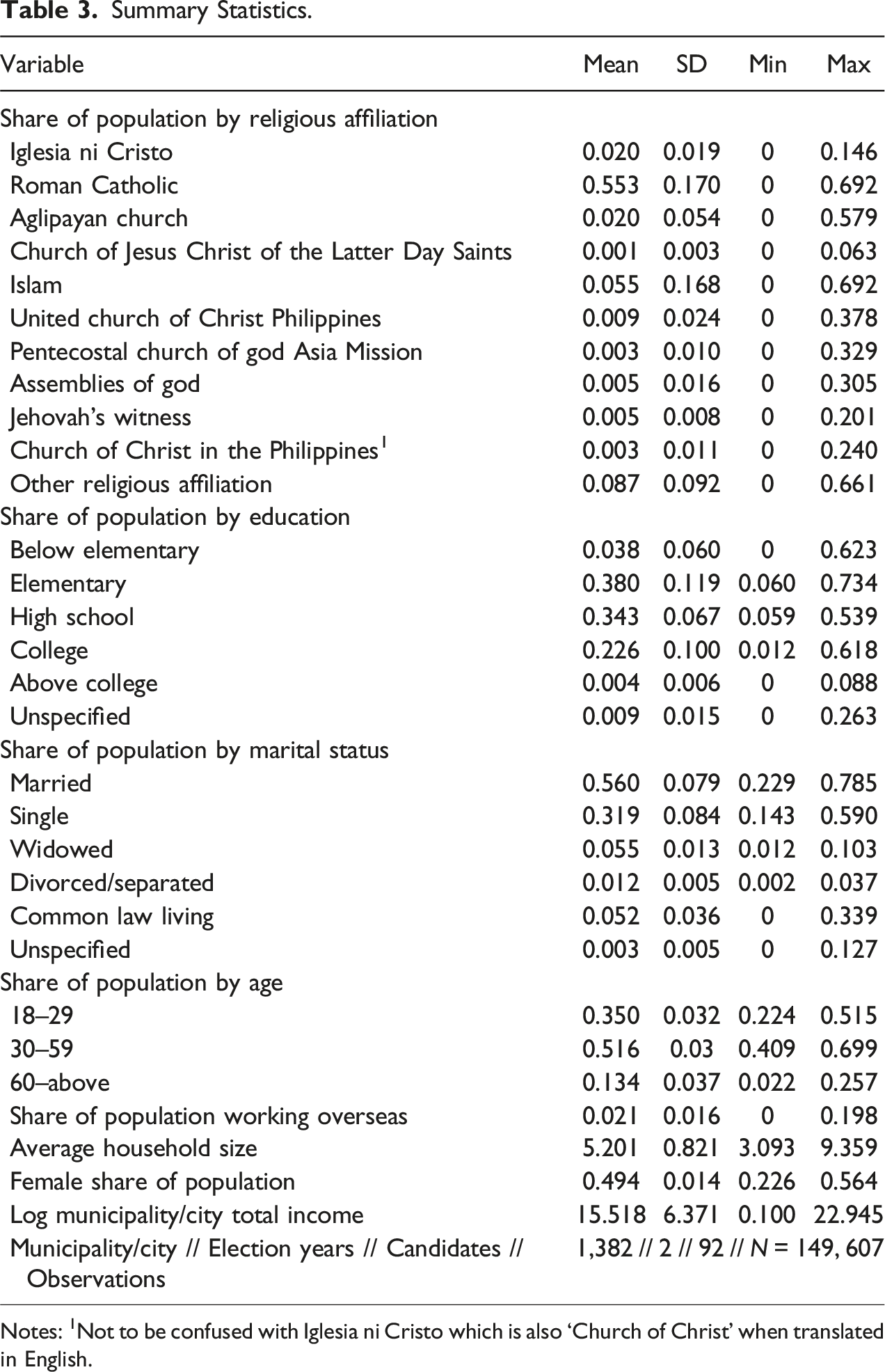
Notes: 1Not to be confused with Iglesia ni Cristo which is also ‘Church of Christ’ when translated in English.
Econometric Strategy
To formally test this article’s hypotheses, I stack the candidate-level data to form a panel dataset with candidate–year–municipality observations. With this dataset, I can then employ triple difference estimation as follows:
In this specification, the effect of INC’s “vote as one teaching” is identified by the change in the municipal-level share of INC voting-age members from one election year to the next, differencing out time-invariant heterogeneity across municipalities as well as across candidates (hence the “triple difference” (Berck & Villas-Boas, 2016)). While this approach helps isolate the effect, it is important to consider potential concerns of selection bias as well as ecological fallacy, which arises from inferring individual behavior from aggregate data. In the subsequent section, I discuss various methods to mitigate these concerns and provide robustness checks to support the validity of the results.
Because the main independent variables of interest are expressed in log terms, the coefficient estimate of β can be interpreted as the elasticity of candidates vote-shares with respect to the share of INC voting-age members. Therefore, limiting the dataset to the sub-sample of endorsed candidates allows me to test the null hypothesis that β = 1 – a test of unit elastic relationship. Likewise, limiting the dataset to the sub-sample of non-endorsed candidates allows me to test the null hypothesis that β = 0 – a test of perfectly inelastic relationship.
Results
The Efficacy of INC’s “Vote as One” Teaching
The findings of this article in support of the core theoretical predictions are summarized in Figure 1 and reported in Tables 4 and 5. Figure 1 shows that the relationship between the predicted vote-shares of endorsed candidates (solid line) and INC share of voting population closely follows the 45-degree (dashed) line, indicating a unit elastic relationship (predicted values based on the regression results reported in Column 5 of Table 4. On the other hand, the relationship between the predicted vote-shares of non-endorsed candidates (dotted line) and INC share of voting population is essentially zero, indicating a perfectly inelastic relationship (predicted values based on the regression results reported in Column 5 of Table 5. Vote-shares of endorsed and non-endorsed candidates and Iglesia ni Cristo’s share of municipality-level voting population. Elasticity of INC–Endorsed Candidates’ Vote-Share to INC Members’ Share of Total Voting Population. Notes. ***p < .01, **p < .05, *p < .1. Huber-White robust standard errors clustered at the municipality/city level in parentheses. Estimates in bold represent the coefficient of interest: the elasticity of INC-endorsed candidates’ vote-share with respect to INC members’ share of the total voting population, across different model specifications. Full set of covariates are listed in Table 3. Elasticity of Non–endorsed Candidates’ Vote-Share to INC Members’ Share of Total Voting Population. Notes. ***p < .01, **p < .05, *p < .1. Huber-White robust standard errors clustered at the municipality/city level in parentheses. Estimates in bold represent the coefficient of interest: the elasticity of Non-endorsed candidates’ vote-share with respect to INC members’ share of the total voting population, across different model specifications. Full set of covariates are listed in Table 3.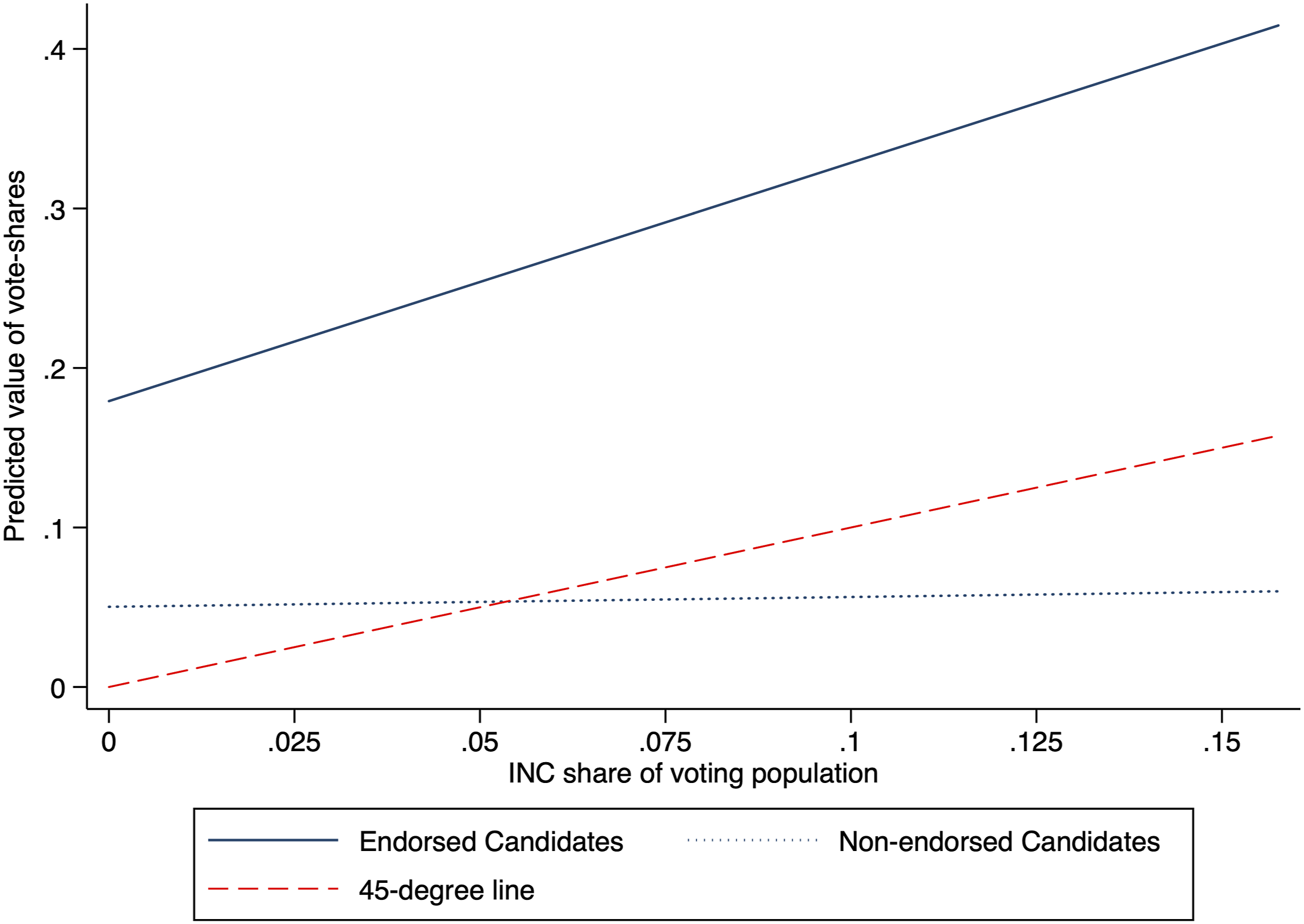
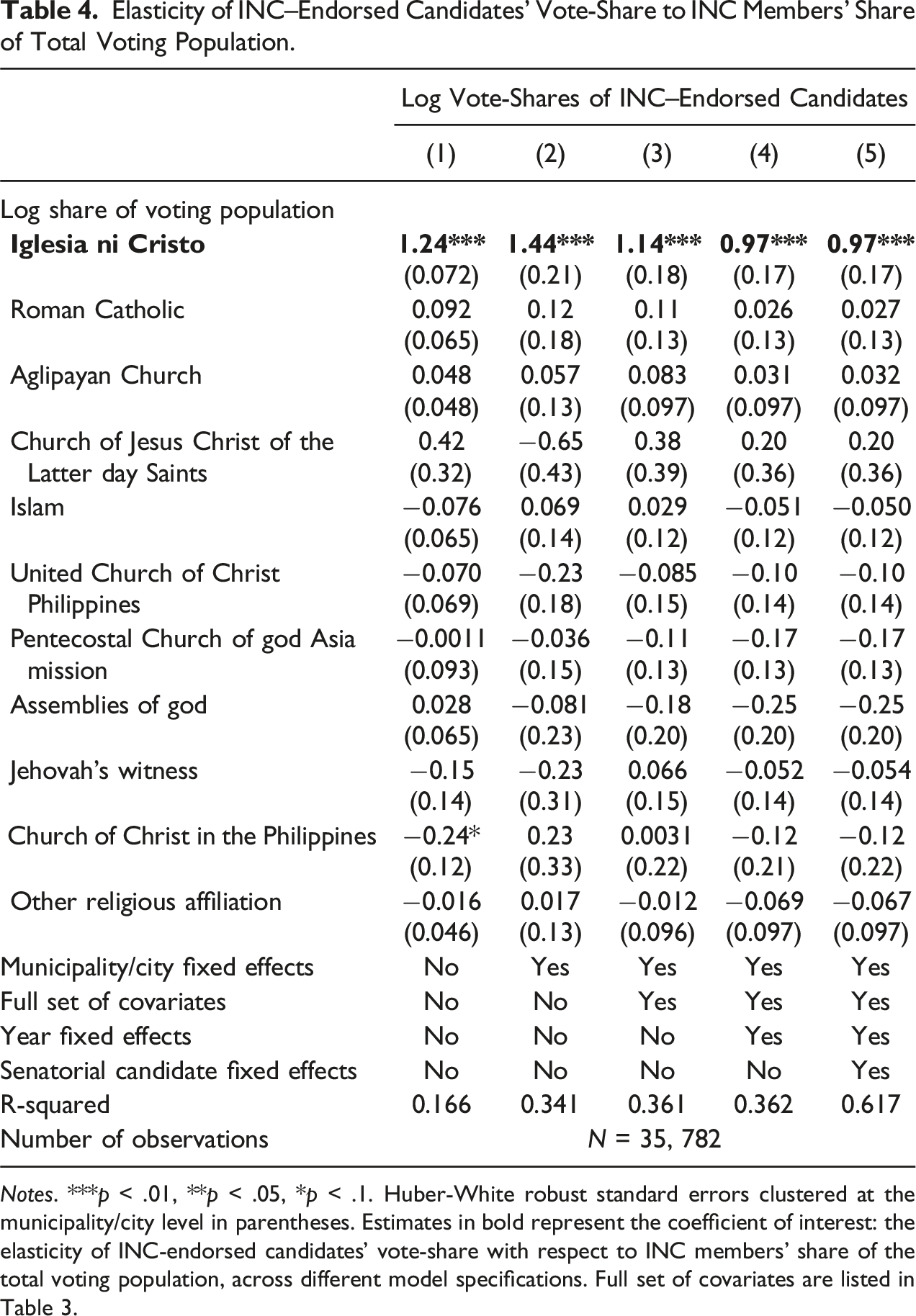
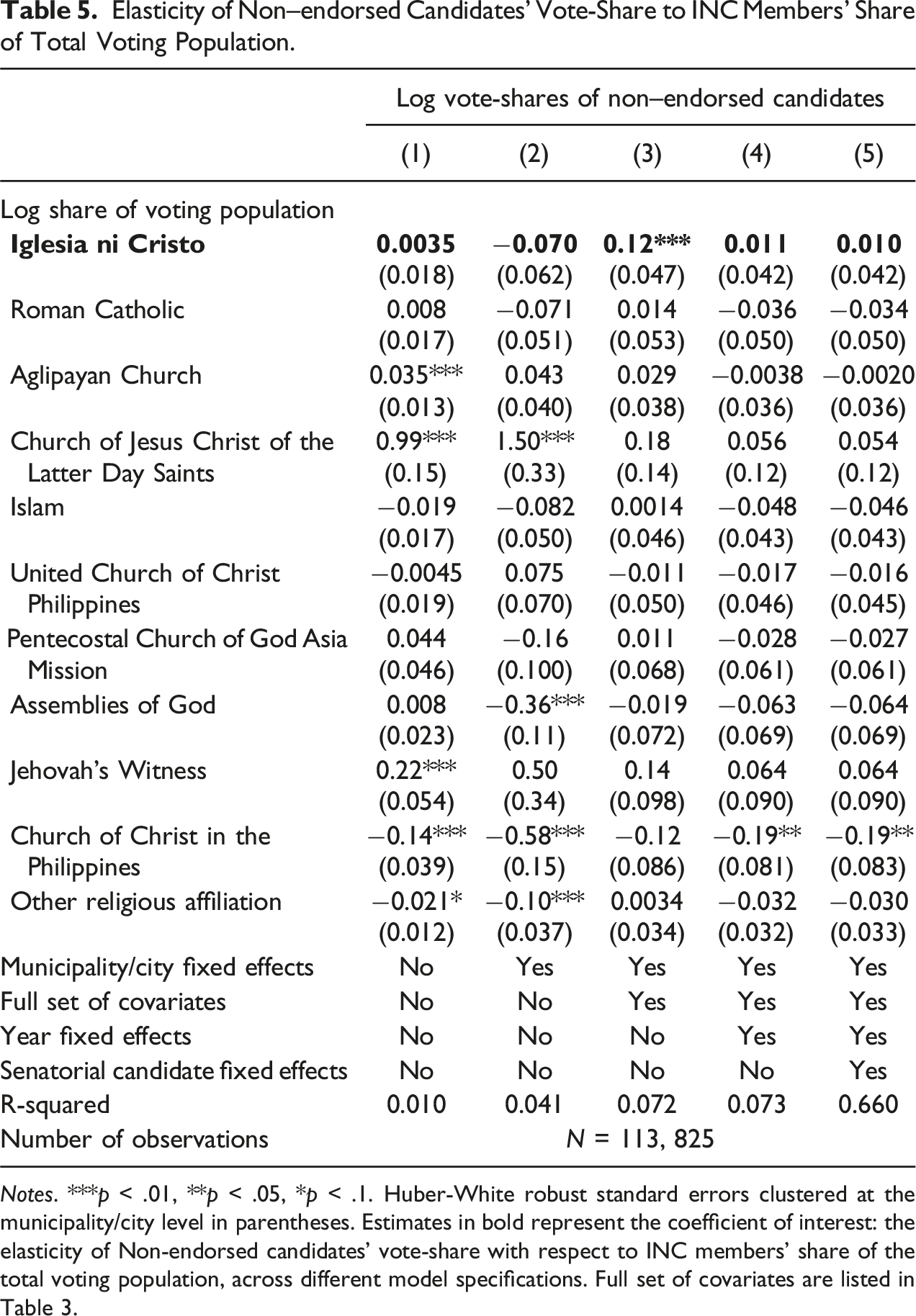
Table 4 formalizes the evidence for the prediction that the vote-shares of INC-endorsed candidates are unit elastic with respect to the municipality-level INC share of the voting population (Hypothesis 1). Once controlling for the full set of covariates, municipality/city fixed effects, year fixed effects and candidate fixed effects, the coefficient estimate of β in column 5 is 0.97 which is statistically indistinguishable from, 1.00.
One way to put this finding in perspective is to compare it with the impact of celebrity endorsements on vote choice. Before the 2008 Democratic presidential primary in the United States, Barack Obama was endorsed by talk show host Oprah Winfrey. Garthwaite and Moore (2012) assessed the impact of this endorsement using, as measures of Winfrey’s influence, subscriptions to her magazine and sales of books she recommends. They find that “a 10% change in the county-level circulation of Oprah Magazine is associated with an increased vote share for Obama of approximately 0.34 percentage points in states with primary elections (p. 358).” In contrast, the findings of this paper implies that a 10% change in the municipality-level INC share of the voting population, all else held constant, is associated with an increased vote-share for an endorsed senatorial candidate of approximately 9.7 percentage points because of INC’s “vote as one” teaching.
Falsification Test: Impact on Non-Endorsed Candidates
Table 5 formalizes the evidence for the prediction that among non-INC-endorsed candidates, vote-shares should not be responsive to increases in the municipality-level INC share of the voting population (Hypothesis 2). Once controlling for the full set of covariates, municipality/city fixed effects, year fixed effects, and candidate fixed effects, the coefficient estimate of β in column 5 is 0.01, which is statistically indistinguishable from zero. This table serves as a key falsification test of the theory, demonstrating that INC vote share does not affect outcomes it shouldn’t.
Placebo Test: Impact of Other Religious Groups
It is worth noting that none of the other religious groups explain vote-shares of either the endorsed candidates or non-endorsed candidates. 12 This result provides a nice parallel placebo test that reinforces the validity of the theory (Hypothesis 3). The informational value to outsiders of the endorsements is fully eroded by the stringent requirements of the “vote as one” teaching, so that none of the other religious organizations subscribe to it.
Attenuation Effect in Areas with Cross-Cutting Social Norms
An additional robustness test involves examining whether the theory predicts an attenuation effect in areas where the INC’s ability to implement bloc voting might be weaker due to strong cross-cutting social norms and pressures. For instance, in regions such as the Autonomous Region in Muslim Mindanao (ARMM), where there are competing social and religious influences, the impact of INC endorsements might be less pronounced.
Table A.3 in the appendix indeed shows an attenuation effect in such regions, as the results are no longer significant when looking only at municipalities and cities in ARMM. This suggests that while INC’s bloc voting strategy is effective in many areas, its influence can be diluted where there are strong alternative social norms. This finding provides further support for the robustness of the social voting model, demonstrating that its applicability varies depending on the social context.
Ruling-Out Alternative Explanations
The results above provide strong evidence for the efficacy of INC’s endorsements. How robust are these results? In this section, I attempt to address and allay issues that may undermine the findings.
Is the Result an Artifact of Selection?
The identification strategy used in this study relies on changes at the municipal level, specifically, the share of INC voting-age members from one election year to another. This approach controls for time-invariant heterogeneity across municipalities and candidates. It is important to note that senators are either endorsed or not by the INC leadership at the national level, meaning that municipality characteristics should be unrelated to national endorsement.
Reverse-Causation
Could electoral outcomes of endorsed candidates (i.e., candidate vote-shares) affect variation in INC membership across municipalities? This cannot be the case given that the use of the Senate race precludes churches from moving strategically to different municipalities, as the Senate has a national constituency.
Simultaneity
Other (unobservable) characteristics might be explaining both vote-shares of endorsed candidates and the share of INC voting-age members. For instance, municipalities that are economically rich might also be places in which endorsed candidates tend to have higher vote-shares and where a greater fraction of the voting population are INC voting-age members. But this alone cannot explain the exacting predictions of the unit-elasticity relationship between the two variables. Moreover, the difference-in-differences specification controls for time-invariant unobservable and observable characteristics across municipalities and senatorial candidates. Given the number of endorsed candidates, it is very hard to sustain the argument that the observed result is an artifact of simultaneity.
Strategic Response of Candidates to Endorsements Combined with Strategic Endorsements Made by the Sect Leader
The argument that the sect leader simply endorsed candidates who they think are going to garner the support of INC members, even in the absence of endorsements, is the greatest threat to the causal interpretation of the observed result. Moreover, candidates might be aligning themselves along the policy preferences of the INC members, which makes them more likely to be endorsed, and therefore generates the observed result. In other words, we do not observe the counterfactual world in which the endorsed candidates would not have been supported by INC members in the absence of endorsements.
To address this threat, I take advantage of the issue on the Reproductive Health (RH) Bill, which caused a clear divide among senatorial incumbents as well as among citizens. The RH Bill was highly debated and controversial, aiming to provide universal access to methods on contraception, fertility control, sexual education, and maternal care. The Roman Catholic Church officially opposed the bill, arguing that it promoted immoral behavior and contraceptive use against their teachings. In contrast, the INC officially expressed their support for the bill, advocating for reproductive health rights and access to family planning services. However, some senatorial incumbents voted against the bill in a highly publicized senate hearing, and some of these anti-RH bill incumbents were nonetheless endorsed by the INC sect leader. This scenario provides a valuable test to assess whether endorsements still have an impact, even if INC members should not, a priori, be supporting these candidates.
Elasticity of Vote-Shares of INC-Endorsed, anti-RH-Bill Incumbents to INC Members’ Share of Total Voting Population.
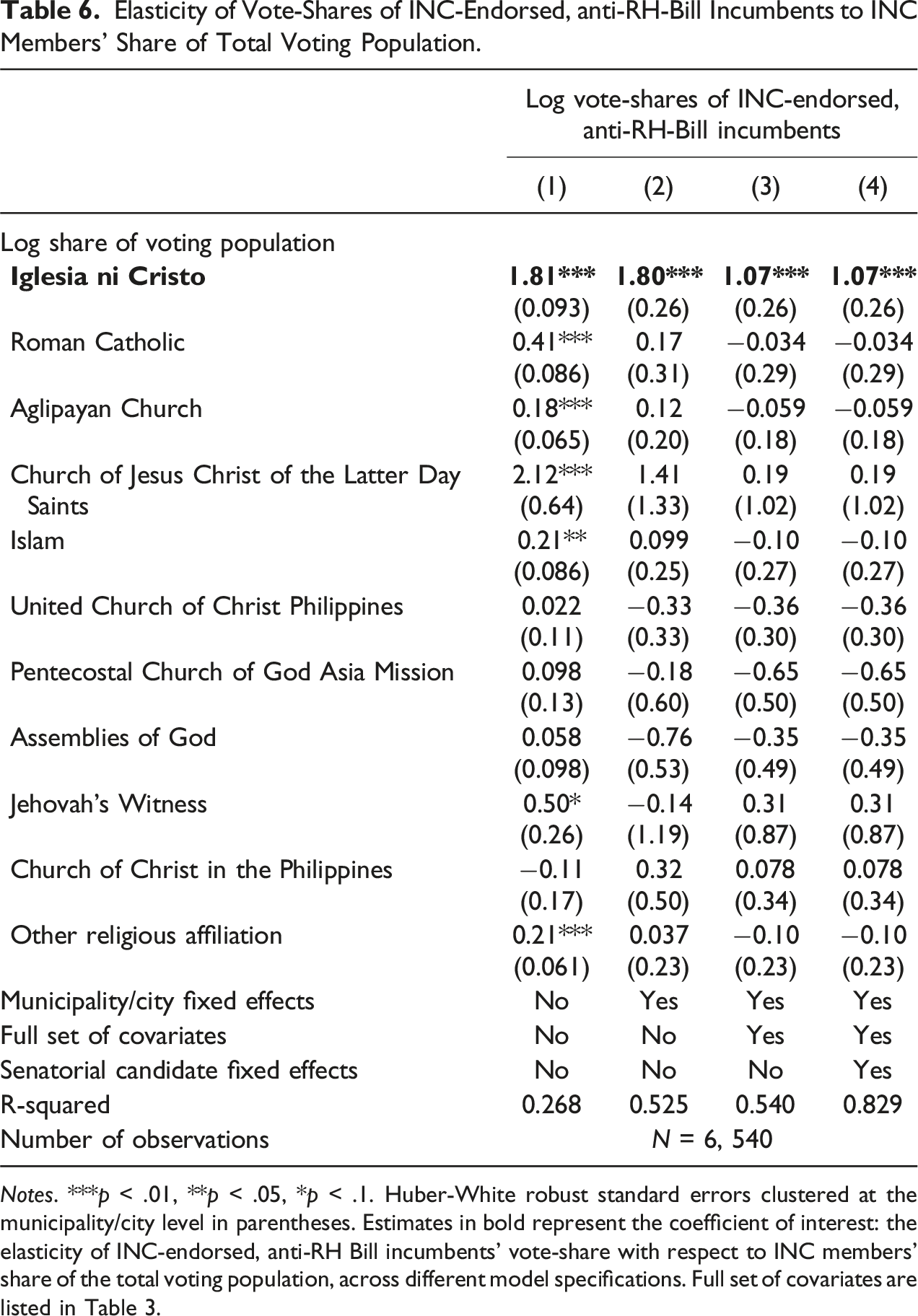
Notes. ***p < .01, **p < .05, *p < .1. Huber-White robust standard errors clustered at the municipality/city level in parentheses. Estimates in bold represent the coefficient of interest: the elasticity of INC-endorsed, anti-RH Bill incumbents’ vote-share with respect to INC members’ share of the total voting population, across different model specifications. Full set of covariates are listed in Table 3.
Conclusion
This paper provides a political economy explanation and empirical evidence for the power of religious sect endorsements in politics. I argue that religious social interactions among the members of the sect are what produce large behavioral responses to the endorsements. The sect faces a two-stage problem of compelling its members to turn out in the first place, and in the second place, to vote for all and only for the endorsed candidates. To solve this problem, the sect mobilizes pastoral groups at the community-level to reduce the cost of turning out and to monitor compliance. This resolves potential free-riding among members. The sect then provides substitutes for the clientelistic and public goods that members might otherwise enjoy from engaging in political exchanges with, and supporting, non-endorsed candidates, which reduces the opportunity cost of compliance with the “vote as one” teaching. This strategy, coupled with the doctrinal persuasions and admonitions that increase the psychic costs of noncompliance, changes the voting calculus of members (but not those of outsiders) so that even if the ballot is secret, members nonetheless support all and only the endorsed candidates. Once the first-stage problem of free-riding in turning out is resolved, and once the incentive compatibility and participation constraints are satisfied, the only thing left for the sect member to do is rely on endorsements as heuristics for identifying which candidates to support at the polls.
The empirical results of this study suggest that INC’s endorsement is powerful enough to change election outcomes both at the national and local levels. INC’s 1.37 million voting-age members is larger than the difference in the popular vote totals between the 12th-ranked senatorial candidate who won a seat in the Senate and the 16th-ranked candidate who lost in 2007. This means any of the four candidates ranked 13th to 16th would have displaced the 12th-ranked candidate and won a seat if they were endorsed by the INC. The INC’s average share of municipality-level voting-age population is 2%. In 2007, 8.5% of mayoral elections were decided with a margin of less than 2%. This suggests that INC’s “vote as one” teaching could have made a difference in the outcomes of 139 of the 1634 mayoral races across the country.
These findings have implications for policy. First, efforts of political mobilization (e.g., Get Out the Vote) may have stronger effects if made through small groups with strong social interactions like small religious sects and other strict denominations, because such groups have the ability to reward (or reduce the cost of) and monitor turn out. While the notion that churches can conduct GOTV efforts is not new, this study provides rigorous empirical evidence of the extent to which religious endorsements can influence vote choice, addressing empirical limitations in previous studies. For as long as religious sects and other similar organizations can potently influence the voting behavior of their members, they will continue to serve the purpose of mass mobilization for individual candidates or coalitions of candidates. This, in turn, may continue to undermine party formation and democratic consolidation in developing democracies such as the Philippines. Policies that explicitly preclude religious organizations from endorsing candidates for political office (e.g., the U.S. Internal Revenue Code section 501(c)(3)) can limit the ability of such groups to influence electoral outcomes.
Religious endorsements and religious influence in politics can be very potent and have both positive and negative implications. In contexts with weak parties and high levels of clientelism, like the Philippines, clergy endorsements can help citizens make more informed and ideological choices by providing a trusted source of information and reducing the costs associated with political decision-making. This view aligns with research suggesting that religious organizations can play a crucial role in mobilizing voters and enhancing democratic participation (Djupe and Gilbert, 2008; Smith, 2019). Specifically, in the case of the Philippines, Brooke et al. (2023) demonstrate how the Catholic Church has systematically reduced victimization during the drug war by raising attention and building local solidarity, highlighting a positive implication of clergy influence on political behavior and societal concerns such as human rights. However, it is also important to recognize the potential risks, such as reinforcing existing power structures and marginalizing dissenting voices within religious communities. These dual aspects underscore the complexity of clergy endorsements in democratic societies and the need for nuanced analysis, which this study aims to provide by balancing these considerations.
Supplemental Material
Supplemental Material - The Extraordinary Effect of Religious Sect Endorsements on Vote Choice: Evidence From Iglesia ni Cristo’s “Vote as One” Teaching
Supplemental Material for The Extraordinary Effect of Religious Sect Endorsements on Vote Choice: Evidence From Iglesia ni Cristo’s “Vote as One” Teaching by Nico Ravanilla in Comparative Political Studies
Footnotes
Acknowledgments
I thank Anna Grzymala-Busse, Allen Hicken, and Dean Yang for feedback on the early versions of this article. I am grateful for the helpful comments from Stephan Haggard, Kikue Hamayotsu, and all the seminar participants at the University of Michigan CP workshop, UCSD GPS, and the Midwest Political Science Association Annual Meeting. I also extend my sincere gratitude to the editors and three anonymous reviewers for their insightful suggestions and constructive feedback, which greatly strengthened this article.
Declaration of Conflicting Interests
The author(s) declared no potential conflicts of interest with respect to the research, authorship, and/or publication of this article.
Funding
The author(s) received no financial support for the research, authorship, and/or publication of this article.

Data Availability Statement
The data, code, and any additional materials required to replicate all analyses in this article are available on the Comparative Political Studies Dataverse within the Harvard Dataverse Network (see Ravanilla, 2024).
Supplemental Material
Supplemental material for this article is available online.
Notes
Author Biography
References
Supplementary Material
Please find the following supplemental material available below.
For Open Access articles published under a Creative Commons License, all supplemental material carries the same license as the article it is associated with.
For non-Open Access articles published, all supplemental material carries a non-exclusive license, and permission requests for re-use of supplemental material or any part of supplemental material shall be sent directly to the copyright owner as specified in the copyright notice associated with the article.
