



Abstract
Given the worldwide pattern that women leaders are often constrained by expectations to demonstrate proof of masculinity to be considered effective, this study explores whether it is possible for these expectations—and the leadership styles they promote—to change over time. I develop a new methodological tool to measure stereotypically masculine leadership style called the Ferrous Scale and apply the Scale to the three female prime ministers of New Zealand, where I find that Ferrous scores decline with each female prime minister. I conduct interviews with the three women leaders and examine a set of hypotheses on the causal mechanisms behind the apparent erosion of the association between executive office and masculinity in New Zealand, building a theory called the Succession Effect: that a succession of female prime ministers—rather than societal gender progressiveness or partisan affiliation—was the prerequisite in New Zealand to loosen the association between executive office and masculinity.
Keywords
Introduction
“...don’t underestimate the power of the crowd. The power of the crowd still very much normally begins from their previous experience. They are shifting along an axis of well, ‘notwithstanding that’s what I thought, I’m now seeing examples.’ Are we there yet? It’s certainly easier. And it will be easier for the next woman prime minister.”
– Prime Minister Jenny Shipley (1997–1999); original interview
“I think that Jenny becoming prime minister at the end of 1997 was tremendously helpful to me. Because, suddenly, people couldn’t say that a woman couldn’t be prime minister; there was one…Before that, there was always that lingering question of could a woman do the job? Clearly a woman was doing the job.”
– Prime Minister Helen Clark (1999–2008); original interview
“…I also thought, internally, that it wasn’t my gender that was the issue, it was the character traits that I had that might be my barrier to leadership—that I wasn’t the traditional mold of leader. But I didn’t equate that to gender, because I had these women who had gone before me.”
– Prime Minister Jacinda Ardern (2017–2023); original interview
The phrase “Iron Lady” has become synonymous with former United Kingdom Prime Minister Margaret Thatcher, yet the label extends far beyond her. There has been a trend within the last 60 years in which women holding executive office have been individually characterized as the Iron Lady of their country or region; these leaders have included Indira Gandhi in India (Steinberg, 2008), Golda Meir in Israel (McGee, 2023), Gro Harlem Brundtland in Norway (Henderson, 2013), Angela Merkel in Germany (Sykes, 2013), Ellen Johnson Sirleaf in Liberia (Jalalzai, 2013a), Dalia Grybauskaité in Lithuania (Martyn-Hemphill, 2015), and Dilma Rousseff in Brazil (NBC News, 2011), among others. The “Iron Lady” label in politics is often assigned to female leaders who display stereotypically masculine traits in their leadership styles. This pattern is reflective of findings that female leaders have had to demonstrate proof of masculinity in order to be considered effective (Ahrens, 2009; Duerst-Lahti, 2006; Jalalzai, 2008, 2013b; Jamieson, 1995; Murray, 2010; Sjoberg, 2009).
However, each aforementioned female leader was the first woman to govern her country, which raises the question: do women always need to portray stereotypically masculine traits to succeed in executive politics, or is there a greater degree of flexibility in political leadership style for subsequent female executives in a given country compared to the first? Further, if women’s leadership styles (and the expectations for how women ought to lead) do change over time, how and why does this evolution occur? These are the questions at the heart of this study.
In the field of comparative politics, women leaders have not yet received the degree of systematic, change-over-time analysis that male leaders have received (Neustadt, 1990; Skowronek, 2008). This is in large part due to women’s underrepresentation in executive office around the world. As a snapshot, in March 2024, women held the current executive political position in approximately 13% of UN member states (Robinson & James, 2024). However, women have served as heads of government around the world since 1960, and the total number of women who have successfully shattered their nation’s highest political glass ceiling to date has nearly tripled in the past two decades (Clancy & Austin, 2023). Women are diversifying executive office at a remarkable pace (at least along the lines of gender), and it is imperative that political science scholarship reflect that empirical shift.
This study has multiple parts. First, I set out to develop a methodological tool to empirically measure stereotypically masculine leadership style as a foundation to analyze the well-evidenced association between executive office and masculinity and how this has applied to women leaders. Traditionally, leadership style in the field of political science is analyzed through binary categories of leadership, for example, transactional versus transformational leadership (Burns, 1978), president as persuader (Neustadt, 1990), and gender-based metaphors (Anderson & Sheeler, 2005). While category- and label-based analytical frameworks have yielded significant insights and have advanced our understanding of political leadership, they often do not identify systematic replicability criteria that would easily allow future scholars to apply the categories to a wider scope of world leaders. To address this gap, in this study I develop a methodological device called the Ferrous Scale. 1 The Ferrous Scale measures leadership style along the axis of stereotypically masculine traits through a content analysis coding scheme (Hardy et al., 2004) based on leaders’ primary source speeches. The unique value of a score-based scale is that it serves as one metric that any leader—regardless of contextual factors like gender, country, year, or position—can be mapped onto, allowing for more rigorous and replicable analyses in comparative political science (Adcock & Collier, 2001). Thus, the Ferrous Scale lends itself to the study of change over time, which is a central part of this study and many other studies in political science. By developing and deploying the Ferrous Scale, I also open the aperture for the creation of future scales measuring different dimensions of leadership, advancing the methodological tools at our disposal.
The second task of this study is to apply the Ferrous Scale to a sample of female leaders to investigate the well-evidenced association between executive office and masculinity and whether it may change over time. Because the focus of this study is on theory-development (Mearsheimer & Walt, 2013) concerning the nature of women’s executive political leadership, the gendered expectations—from both the party elites and the public—that shape their political behavior, and how and why these variables may change over time, I utilize thick analysis in my approach in an effort to better understand the causal mechanisms at play in these complex topics (Collier et al., 2010). For reasons detailed below, I selected the three female prime ministers of New Zealand as the case studies for analysis. I employed a team of research assistants blind to the study’s main questions and hypotheses to conduct in-depth content analysis coding of nearly 200 speeches over the course of the prime ministerial terms of Jenny Shipley (1997–1999), Helen Clark (1999–2008), and Jacinda Ardern (2017–2023), as well as three male prime ministers in New Zealand for comparison. The results show that each successive female prime minister has a lower Ferrous score (i.e., led in a less stereotypically masculine way) than the woman who came before her. To be clear, these results on their own do not tell us anything about the change over time in levels of sexism towards women in politics in New Zealand; they only tell us that the rhetorical leadership style of the female prime ministers has become less stereotypically masculine over time, which is notable given the repeated findings in the field of gender and politics that female leaders often need to demonstrate proof of masculinity to be taken seriously.
The third task of this study is to address why the association between executive office and masculinity appears to have eroded over time in New Zealand and why this matters. To do so, I develop three potential explanatory hypotheses: the Gender Progressiveness Effect, the Partisan Effect, and the Succession Effect. I then examine these hypotheses and their causal mechanisms by conducting original interviews with prime ministers Shipley, Clark, and Ardern to understand how they interpreted the environments they operated within and their own behavioral approaches to leadership (Martin, 2013; Mosley, 2013). Through analysis of the interviews, I argue that while all three hypotheses likely carry causal weight, the Succession Effect seems to be the most significant; namely, that the change over time in leadership style in New Zealand arguably occured because the succession of female prime ministers established the presence of role models, facilitating greater room for maneuver within the mindsets of future female prime ministers, and potentially her political party and the public at large, regarding the definition of “good leadership.” In other words, I hypothesize that the gendered constraints that govern executive leadership style loosen as a result of a succession of women shattering the highest glass ceiling in a given political system. In framing this hypothesis around constraints, I do not intend to imply that female leaders inherently prefer to lead in a non-masculine manner. Rather, the crucial point is whether women have the opportunity to lead in a non-masculine manner should they choose.
This is not a comprehensive study on women’s leadership styles, and women are not a monolithic analytical category (Norris, 1997). This is a specific investigation into the gendered constraints placed on leadership, and whether the need to demonstrate masculinity remains constant over a succession of female prime ministers, using New Zealand as a case study. Though it is impossible to generalize findings from the New Zealand sample to the entire universe of female leaders, the central questions in this study present a puzzle for the fields of leadership studies and gender and politics and can shed light on similar patterns in other regions of the world, ultimately enhancing our understanding of leadership in the 21st century.
Theoretical Foundations: Executive Office and Masculinity
Political leadership style is a strategic choice (Ahrens, 2009; Neustadt, 1990; Skowronek, 2008; Uhr, 2014). Leaders employ rhetorical devices and present certain behavioral queues to mobilize political support for their policies and platforms, both among the public and the political elite (Helms, 2005). Political executives will also often seek to craft an image of themselves according to the public’s expectations and preferences (Atkinson, 1984; Campbell & Jamieson, 1990; Edelman, 1988; Gaffney, 1991). One dimension of the expectations that have governed executive political leadership style for women around the world is the well-documented association between masculinity and executive office (Davidson-Schmich, 2011; Jalalzai, 2008; Trimble & Treiberg, 2010). The perceived “maleness of high office” (Watson, 2005, p. 56) is perhaps unsurprising as men have held executive political office for most of human history and still today constitute the majority of those in power. As Norris (2010) writes, “executive office is most commonly regarded as focused upon perceived masculine traits and issues, where women are thereby disadvantaged by stereotypes” (p. xvi). Eagly and Karau (2002) describe this as a perceived incongruity between leadership roles and the female gender role.
To overcome this bias, scholars have observed that women political leaders, particularly at the national executive level, have often had to over-emphasize their masculine traits and behaviors (Ahrens, 2009; Schramm & Stark, 2020). Returning to the concept of leadership style as a strategic choice, in addition to the typical set of variables that factor into a leader’s calculus as they define their rhetorical and behavioral style, women leaders (unlike men) are also confronted with the immediate bias that they are not masculine enough to do the job (Steinberg, 2008). Sjoberg (2009) explains this phenomenon as follows: the definition of what it means to be a good leader is couched in masculine terms….Therefore, men are assumed to have leadership capacity, while women’s masculinity is doubted until proven. As such, the burden of proof to demonstrate masculine capacity is higher on a woman….D’Amico and Beckman make the argument that women who succeed in politics do so by emphasizing masculine values even more strongly than their male counterparts do, in order to prove their capacity to govern (1995). p. 157.
Yet, at the same time, women leaders often face criticism for being too masculine, or not behaving ‘as a woman should' – a gendered tightrope known as the double-bind (Jamieson, 1995). These contradicting expectations and biases are in part why we see such a dearth of women leaders even still today.
The use of the phrase “masculine leadership style” in this study is based on stereotypical societal understandings of masculinity and relies on the definition of gender as a social construct (Beckwith, 2005; Sjoberg, 2013). I do not claim that men and women inherently lead differently, nor that certain traits are tied to female or male leaders in practice. Rather, this study aligns with the school of thought that gendered constructs are implicit in definitions of leadership (Duerst-Lahti & Kelly, 1996), where traits seen as “stereotypically masculine” such as assertiveness, aggression, and toughness are generally favored when evaluating political leadership capability, particularly at the national executive level (Huddy & Terkildsen, 1993; Murray, 2010).
There are several factors which might mediate the expectation for a woman leader to display stereotypically masculine traits. To identify these, it is useful to draw from the extensive literature on variables affecting women’s paths to political power, as it is possible that similar factors affect the behavioral expectations for women in office. The first among these is the level of gender progressiveness in the leader’s country. Studies have shown that societies with higher levels of gender equality often have higher percentages of women represented in politics, both within the legislative and executive branches (Norris & Inglehart, 2005; Paxton & Hughes, 2007). Still, other cross-national studies like the one done by Jalalzai (2013a) show that “neither positive nor negative attitudes towards women’s [political engagement],” nor the prevalence of gender stereotypes, adequately explain women’s path to political power (p. 17). Further, even once women do shatter the glass ceiling, they are still confronted with gender stereotypes in how the public, the media, and their colleagues treat them (Murray, 2010; Van der Pas & Aaldering, 2020). However, it is possible that as structural gender equality grows within a country, the expectations surrounding women’s political leadership may become less rigidly gendered.
Party affiliation could also serve as a mediating variable. Scholars have found that conservative voters tend to prefer candidates that exhibit stereotypically masculine traits whereas liberal voters often prefer stereotypically feminine traits (Eriksson & Funcke, 2015; Laustsen, 2016; Winter, 2010); however, the majority of existing studies are based on environments with only male leaders. Are preferences and expectations different for female leaders of varying parties? As an observational point, the seven “Iron Women” identified at the start of this paper come from center-right and center-left parties. What these women do all share in common, however, is their status as the pioneer: the first to shatter the glass ceiling in their country. What if a woman leader faces a landscape where her predecessors are not all men? Would the association between executive office and masculinity still hold, or would the gendered constraints placed around executive leadership style become less relevant?
There is extensive literature on the positive impact of women’s increased descriptive representation (Pitkin, 1967) on women’s paths to political power (Alexander, 2012; Alexander & Jalalzai, 2018; Anderson & Sheeler, 2005; Jalalzai, 2016; Mansbridge, 1999), women’s substantive representation (Childs & Krook, 2009; Swers, 2002), voters’ confidence in the legislature (Schwindt-Bayer and Mishler, 2006), and women’s political activity writ large (Wolbrecht & Campbell, 2007). The main causal mechanism facilitating many of these relationships is symbolic representation, also commonly known as the role model effect: the behavioral responses elicited among the public when members of excluded groups hold power (Mansbridge, 1999). I contribute to this body of literature by exploring how increased descriptive representation of women in the executive branch may impact political leadership styles for future women leaders.
My three hypotheses on the association between executive office and masculinity and why it may change over time, stemming from the existing literature on gender and politics, are as follows:
The overarching dependent variable in this study is leadership style as measured on the Ferrous Scale, and the independent variables under examination through these three hypotheses are societal gender progressiveness/equality, the leader’s political party affiliation, and descriptive representation in the executive branch (whether or not a succession of women leaders has already been established). These three hypotheses are not mutually exclusive in the case of New Zealand and may feed into each other. However, if through examination one hypothesis holds more explanatory power than the others, this has implications for the trends we might expect in women’s political leadership. Note that the following analytical implications may be confined to prime ministerial systems (given the case study country), as the path to executive power differs significantly in presidential systems.
The main difference between Hypotheses A and C is which variable holds the first degree of explanatory power: the succession of female prime ministers or the increasing structural gender progressiveness. In other words, do gendered expectations and norms for women’s political leadership change before or after the women leaders come to office? In Hypothesis A (similar to Hypothesis B), critical junctures such as decisions made by leaders during particular moments are not nearly as important as long-term structural trends in determining the extent to which discursive leadership style meets or defies the expected correlation between masculinity and executive office. On the other hand, the explanatory variable in Hypothesis C is that women break through the glass ceiling, and then expectations and norms for political leadership styles change. For Hypothesis C, the role of the leaders is critical in determining whether society’s expectations for “good leadership” change over time. Importantly, in Hypothesis C (similar to Hypothesis B), societal gender progressiveness is not a necessary condition for a woman to reach executive office; she became prime minister because she climbed the internal ranks of her party and may have encountered countless gendered obstacles to do so, regardless of whether her party is center-left or center-right. Once she reaches executive office, those obstacles and expectations are still present, and the onus falls on her to initiate the change to this landscape. Even if she does not advocate for women-friendly policies (also known as women’s substantive representation), as is the case with many “n-of-1” female leaders (Wiliarty, 2011), her presence in office sparks the beginning of the Succession Effect as those around her—from the voters to the party elites who promoted her—learn that the role of prime minister is not solely for men.
It is not guaranteed that the well-evidenced global association between executive office and masculinity will change over time. At the same time it is also not a universal truth that all women, even those who are first in the job, will display stereotypically masculine leadership style traits. Thus, the first question in this study is: how can we empirically measure the extent to which a leader displays a stereotypically masculine leadership style? To address this question, I develop a new methodological device called the Ferrous Scale and apply it to New Zealand as a case study.
Case Selection: New Zealand
This study follows the general principles for case study criteria as outlined by Geddes (2003), namely that cases should be “representative of the domains of the theories they are intended to test” and “different from the cases from which the arguments were induced” (p. 132). Although this study is a theory-building, not theory-testing, exercise, these criteria still apply well. To Geddes’ first point, in selecting the female leaders for this study I decided to narrow the sample size from all female world leaders to only female heads of government—the dominant position of political power in dual systems—to minimize institutional variance and focus on the leaders with the most day-to-day impact on their countries (Jalalzai, 2013b). 2 I also decided to focus the analysis within one country to minimize confounding contextual variables inherent in cross-national studies, although future studies should expand the scope. Lastly, and most importantly, I needed to select a country that has experienced at least three female heads of government in order to analyze change over time, the most central piece of this study’s theory building. To Geddes’ second point, another important criterion was to avoid selecting cases on the dependent variable, in other words, leaders who are (or are not) commonly known to be “Iron” or portray stereotypically masculine traits, to ensure rigorous examining of the hypotheses (King et al., 1994).
As of March 2024, only seven countries in the world had experienced three or more female heads of government: Finland, Moldova, Norway, New Zealand, Poland, Switzerland, and the United Kingdom. To ensure robust content analysis of primary source speeches, the case study country must have the female heads of government each in position for at least one year, which eliminated Finland, Moldova, Norway, and the United Kingdom. Switzerland was also removed from consideration given the unique institutional power distribution in their executive branch; while Switzerland would be an interesting future case study, I prioritized selecting a country whose executive institutional features are often found in other countries for the sake of research design replicability. This left New Zealand and Poland as the possible case studies. While Poland would fit the decision criteria for selection, neither I nor the research assistants I had access to had proficiency in Polish and many of the intricacies and nuances involved in primary source content analysis are lost in translation for foreign languages. Based on these criteria, the case study country in this study is New Zealand.
New Zealand was the first country in the world to grant women the right to vote (1893) and was one of the first countries in the world to have experienced three female heads of government with Jacinda Ardern’s ascension in 2017. New Zealand is a unicameral parliamentary democracy, under a constitutional monarchy, with the prime minister as head of government. The country underwent a significant change in the electoral system in 1993 when it switched from first past the post (FPP) to mixed member proportional representation (MMP), with the first government elected by MMP taking office in 1996. This electoral change helped precipitate an increase in women’s legislative representation (Curtin & Sawer, 2011), consistent with the findings of studies such as Rule (1994) and Norris (2004). Important for the comparative analysis in this study, all three female prime ministers in New Zealand held office after MMP was introduced, eliminating the salience of electoral system type in explaining any variance in political leadership style between the three female leaders. The first female prime minister, Jenny Shipley, has been described as “New Zealand’s ‘Thatcher,’” evoking the Iron Lady moniker (Barber, 1997), while the third female prime minister, Jacinda Ardern, has become associated with the “politics of kindness” (Elliott, 2020). Observationally, it seems that women’s prime ministerial leadership styles in New Zealand have become less stereotypically masculine over time, despite the repeated finding in the field of gender and politics that women leaders often need to over-emphasize their masculine traits to succeed (Sjoberg, 2009).
It is important to keep in mind that this study’s “N of 3” sample cannot be representative of the experience of all women leaders around the world and throughout history. However, the small sample size lends itself to theory building (Lieberman, 2005) and understanding contextualized causal mechanisms, which is the purpose of this study.
Examining the Dependent Variable: “Ferrous” Leadership Styles
The Ferrous Scale: Method and Data
The first task of this study is to empirically analyze the association between executive political office and masculinity by measuring stereotypically masculine leadership style. To do so, I developed a methodological device called the Ferrous Scale. The term “ferrous” plays off the “Iron Lady” moniker, but the Ferrous Scale measures stereotypically masculine leadership styles, not whether a leader is an “Iron Lady.” The difference is key, as the phrase “Iron Lady” itself is not an official category of political leadership to be measured but rather a label based in biases, and the gender neutrality in the title “Ferrous Scale” allows for male leaders to be mapped onto the scale as well.
The Ferrous Scale is comprised of seven traits that the existing literature views as stereotypically masculine (Huddy & Terkildsen, 1993; Murray, 2010; Norris, 1997). These traits are specific on their own and distinct enough from each other in definition such that a human coder could read a speech and determine whether or not a leader is portraying each of the seven traits. The seven traits that make up the Scale are: Resolute, Certain, Uncompromising, Decisive, Action-Oriented, Ruthless, and Ability to Handle a Crisis. Each trait is scored 0 or 1 for a given speech and holds equal weight on the Ferrous Scale, and the Scale is based on a cardinal—rather than ordinal—categorization of traits. In other words, if a leader portrays three of the Ferrous traits in a speech, she or he will earn a three on the Scale for that speech, regardless of which traits are portrayed; the increments of the Scale do not correlate with a particular trait. Averaging each leader’s scores across her or his speeches, which are equally weighted, yields a final Ferrous Score for that leader.
I developed a codebook detailing the definitions and key signifiers of each trait for content analysis coding (i.e., how do we know if a leader is portraying that she is resolute?) that was then applied to this study’s dataset of speeches and can be applied to future studies as well. 3 I hired a team of five research assistants for this study, provided them with the codebook, and did not share any information with them regarding my research questions, hypotheses, or even the term Ferrous Scale, to make the data collection process as objective as possible. I also first pilot-tested the coding scheme by instructing the research assistants to code a small random sample of speeches using the codebook to confirm that the Ferrous traits were in fact distinguishable before proceeding with coding this study’s dataset of speeches.
The New Zealand prime ministerial speech types selected for inclusion in this study’s dataset were: Prime Minister’s Statement, Prime Minister’s Speech to (their) Party Conference, Prime Minister’s Waitangi Day Speech, and Questions for Oral Answer within parliament. I selected these speech types because they offer variance in purpose and audience without being too context-specific, allowing for comparison across many leaders and decades. Given that Questions for Oral Answer take place frequently in sitting sessions of parliament, I included one day of Questions for Oral Answer each quarter for every year the prime minister was in office (one day from March, June, September, and December). While the focus of this study is on women prime ministers, three male prime ministers who held office between 1990-present were also coded and placed on the Scale for comparison: Jim Bolger (1990–1997), John Key (2008–2016), and Chris Hipkins (2023). 4
Dataset of Speeches Analyzed. a
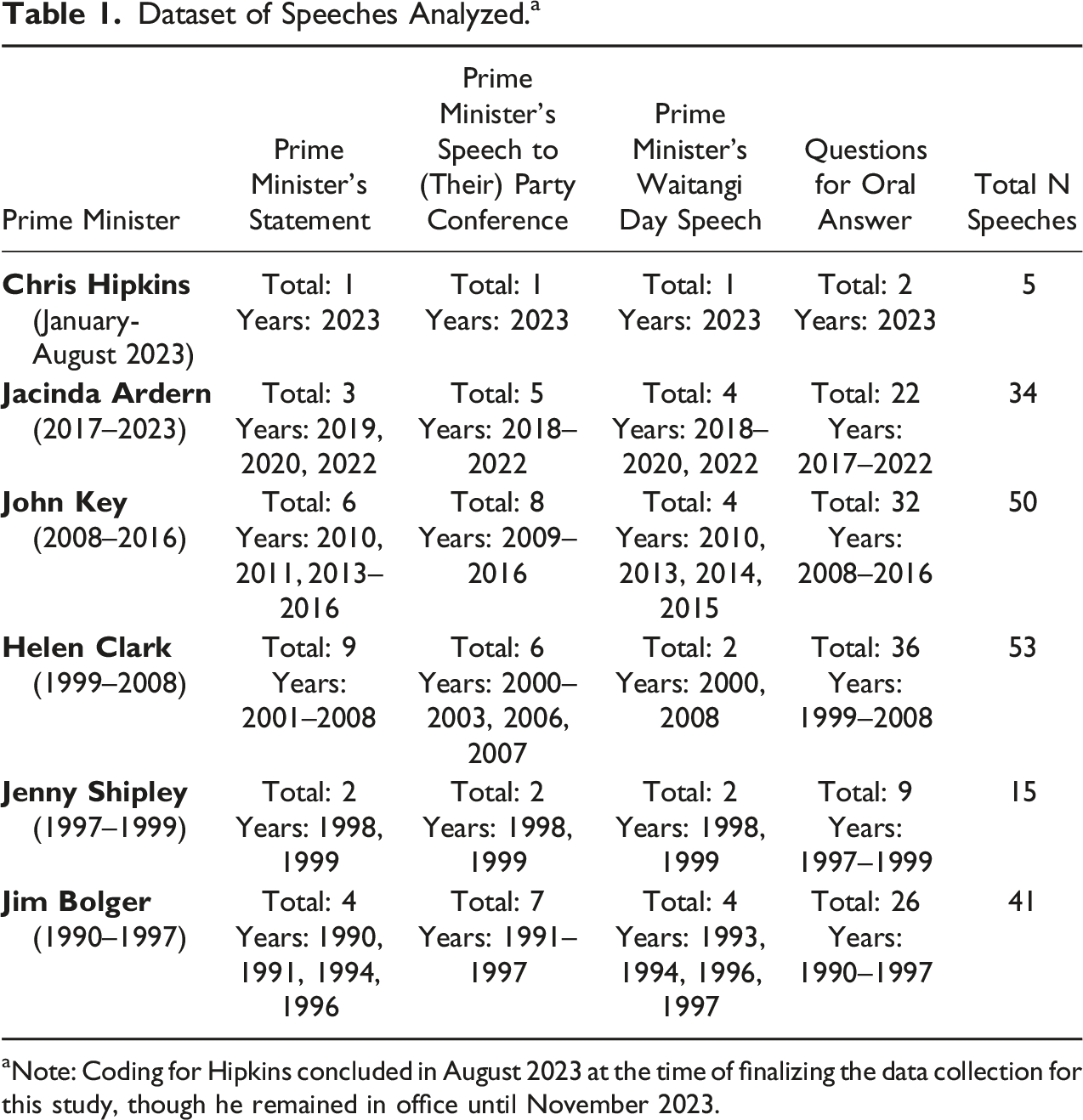
Note: Coding for Hipkins concluded in August 2023 at the time of finalizing the data collection for this study, though he remained in office until November 2023.
Every speech was coded by two coders in isolation to ensure validity of the Ferrous Score. 7 If a coder determined that a trait was present in a speech at least once during the speech, they marked that trait “yes” for that speech. If a coder determined that five traits were present, for example, that speech received a Ferrous Score of five. Each leader’s overall Ferrous Score was calculated by adding the scores of their individual speeches and dividing by the total number of speeches analyzed. If one of the two coders determined a trait was present, the trait was marked “yes” for that speech even if the other coder determined it was not present. Given this, the Ferrous scores are slightly weighted towards the higher end of the scale, but that bias is the same for all leaders coded. Intercoder reliability was moderate to high, with a percent agreement score of 74% overall.
The aim of placing leaders onto the Ferrous Scale using content analysis is to determine which traits they portray through their use of language, rather than which traits they may actually possess. This is a study in leadership styles and the expectations that govern them, not personality styles. Further, my approach to studying leadership style and mapping leaders onto the scale is through analysis of the leader’s self-portrayal (her rhetoric and performative discourse), rather than content analysis of media coverage or other secondary sources. While a leader’s self-presentation is certainly impacted by how the media portrays her, I am interested in uncovering how the leader (and her staff) interprets those outside expectations, internalizes them, and then shapes her leadership style. In this sense, this study departs from traditional models of feminist leadership which do not see self-portrayal as a primary form of leadership expression (Sjoberg, 2013). The goal in this study is to get a better understanding for how women leaders think they ought to behave based on surrounding gendered constraints, and whether and why this mindset changes at all with each successive female prime minister. Further research should approach this same topic from the outside observer’s perspective (e.g., media groups, political party elites, and average citizens).
Ferrous Scale Findings
The Ferrous Scale results are below in Figure 1 for the six New Zealand prime ministers analyzed in this study. I find through content analysis of speeches that each successive female prime minister in New Zealand portrayed an average of fewer Ferrous (i.e., stereotypically masculine) traits than her female predecessor. The Ferrous Scale: Sample of New Zealand prime ministers, 1990-present. Note. Each prime minister’s dates of service are listed below their name. Each prime minister’s Ferrous Score is stated either below their dates of service (for the women prime ministers) or above their name (for the men prime ministers).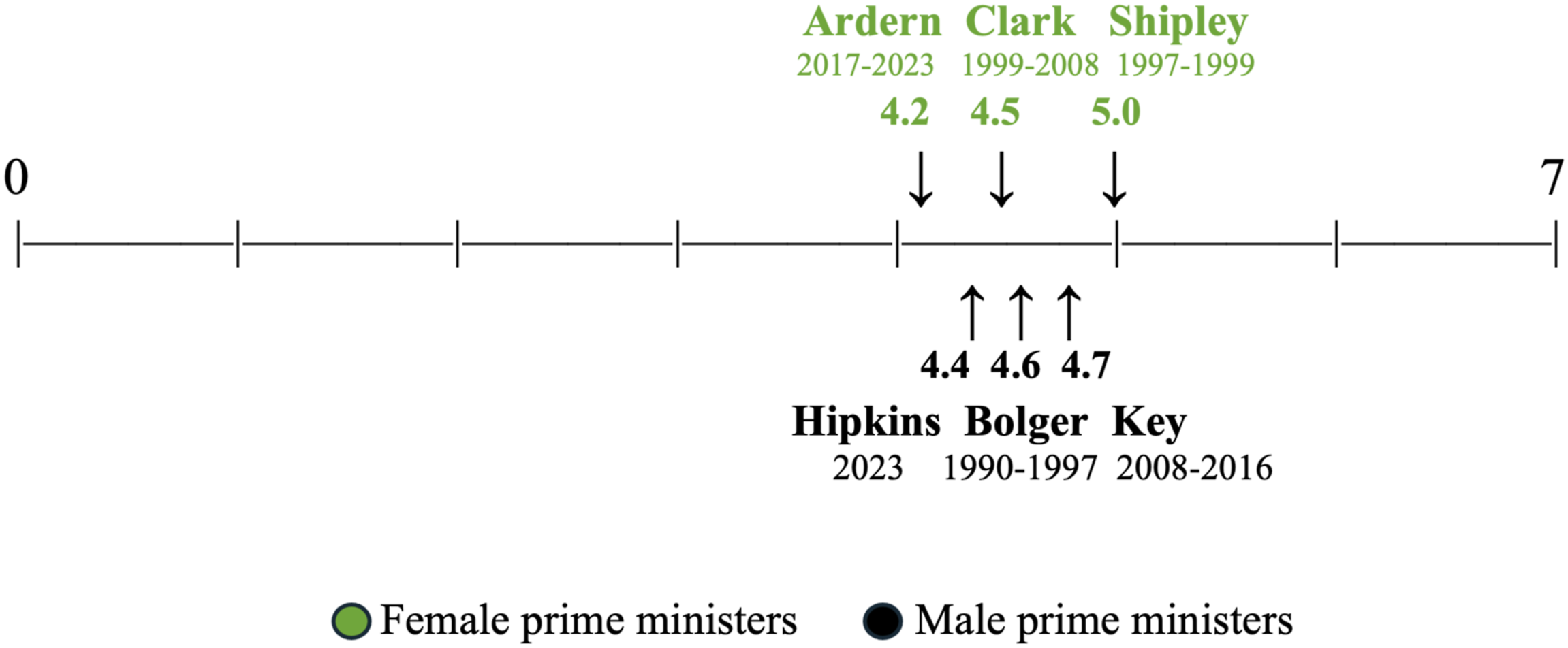
The analytical value of the Ferrous Scale is in the comparative location of the prime ministers to one another, not in the numerical distance between them or the exact number they earn. The clustering of the prime ministers towards the center of the Scale makes sense conceptually, as it would be unexpected to find a leader who portrays none of the seven traits or a leader who portrays all of them, all the time. While not all of the Ferrous Traits are inherently positive (e.g., Uncompromising and Ruthless), scholars have found that many of these traits have been synonymous with strong leadership (Sjoberg, 2009). This could suggest that even small differences in the Ferrous Scores of leaders are significant. The variance in the Ferrous Scores across the speeches analyzed was 1.24.
In the case of New Zealand, the sequence of the prime ministers on the Scale is validated by qualitative findings from other scholars on the leadership styles of these six leaders, particularly the women leaders. 8 For example, while Jenny Shipley has been described as “New Zealand’s ‘Thatcher’” (Barber, 1997, p. 1), Jacinda Ardern has come to be known around the world for her characteristic blend of kindness and strength (Tyner & Jalalzai, 2022; Vani & Harte, 2021), and for being, in her words, “a crier [and] a hugger,” as she concluded her valedictory speech to Parliament in April 2023 (Ardern, 2023, p. 11). I predict that if dozens more leaders were added to the Ferrous Scale, most of the variance would take place between levels three to five on the Scale, and that within-level comparisons (e.g., 4.2 vs. 4.5) would reflect obvious observational differences in leadership style in practice (e.g., between Jacinda Ardern and Helen Clark).
In the investigation regarding the association between executive office and masculinity, it is revealing that Shipley—the first female prime minister—has a higher Ferrous Score than the three male prime ministers. This reflects findings that women leaders have had to emphasize stereotypically masculine traits even more than their male counterparts to prove they can do the job (Sjoberg, 2009). On the other hand, Ardern—the third female prime minister—has the lowest Ferrous Score of the group, which calls that trend into question. The following discussion focuses on the possible explanatory factors behind these findings and works towards building a theory on the change over time in association between executive office and masculinity.
Examining Explanatory Power and the Hypotheses: Prime Ministerial Interviews
Method and Data
In order to examine the causal mechanisms at play in the three explanatory hypotheses proposed earlier, I conducted interviews with prime ministers Jenny Shipley, Helen Clark, and Jacinda Ardern. I contacted each prime minister (or her aide) and then scheduled and conducted each interview separately. Interviews were conducted over Zoom for ease of scheduling and logistic feasibility. Although the interview questions for each prime minister were tailored, I focused on the same core themes and probes to ensure comparability. My goals were to: analyze the decision-making processes that informed their leadership styles; gain insight into how they perceived and navigated the gendered expectations and obstacles of higher office; and get a sense of their understandings of the landscape for women in politics in New Zealand and how that has changed over time.
Of course, the Ferrous traits only capture a small fraction of traits that a leader might portray as part of her or his discursive leadership style. The important piece for this study is not simply whether the leader possessed stereotypically masculine traits, but whether she felt it would be advantageous (or even necessary) to emphasize these traits to be taken seriously as a leader, given the existing findings in the field of gender and politics. The Ferrous Scale findings in this study demonstrate that it may have become less necessary over time in New Zealand for female prime ministers to emphasize masculinity to prove their effectiveness as leaders. The following analyses seek to explore this further.
The Role of Gender Progressiveness: Analyzing Hypothesis A
Global Gender Gap Report, World Economic Forum: New Zealand.
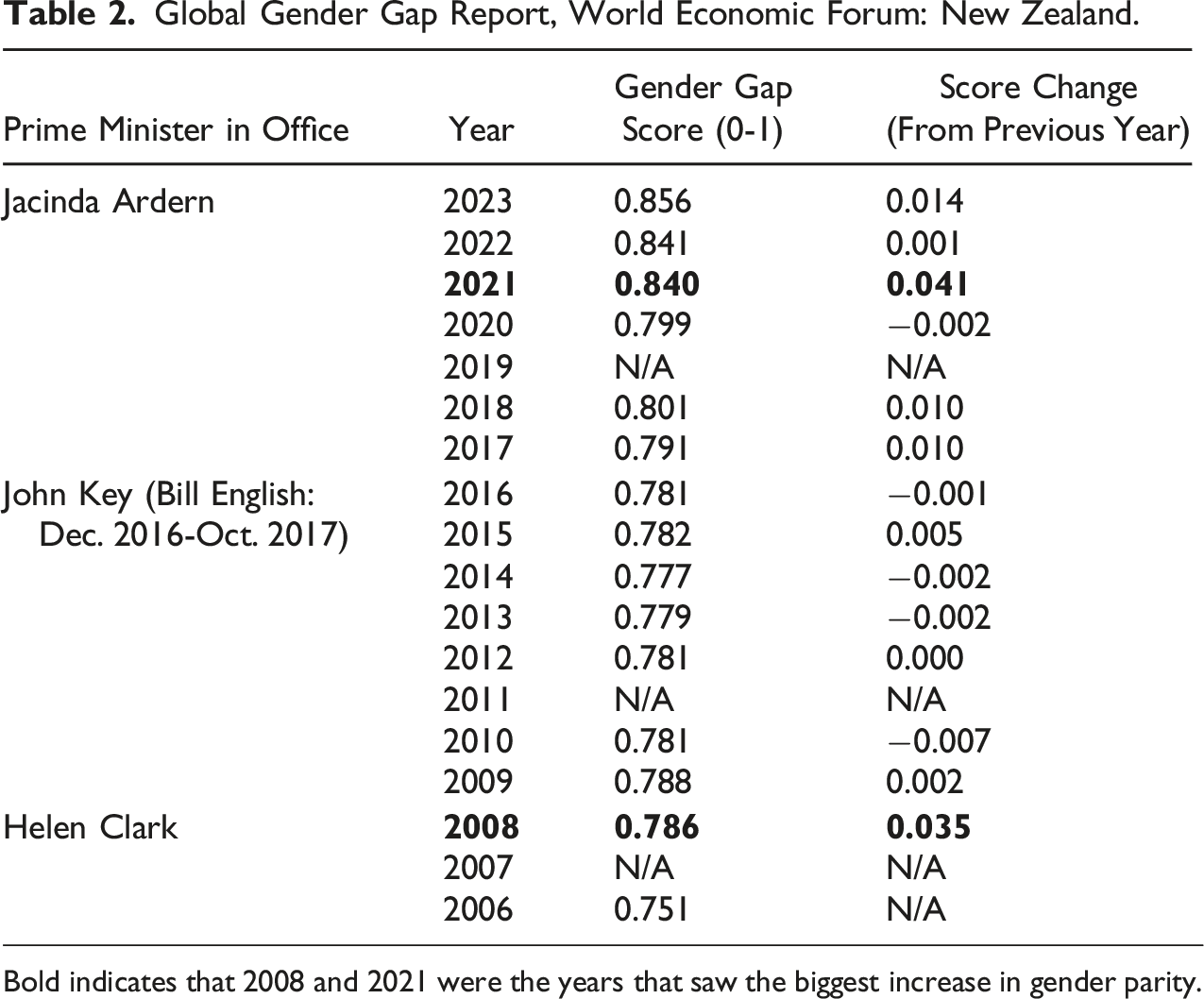
Bold indicates that 2008 and 2021 were the years that saw the biggest increase in gender parity.
Based on this data, the most significant increases in gender parity in New Zealand between 2006-present took place between 2006–2008 and 2020–2021, as highlighted above. 2008 and 2020 also saw among the largest increases of female MPs since Shipley’s time in office. Notably, both of these timeframes are near the end (or second half) of female prime ministers’ tenures: Helen Clark departed office in November 2008 after a nine-year tenure and Jacinda Ardern departed office in January 2023 after a nearly six-year tenure. Given that data collection for the Global Gender Gap Report began in 2006, this dataset cannot reveal whether there might have been larger jumps in gender progressiveness earlier in Clark’s tenure or in Shipley’s tenure. However, the patterns above cast doubt on the explanatory power of Hypothesis A. Notice too that the Gender Gap Score worsened most frequently during the tenures of John Key and Bill English, when society lacked a female role model at the head of government.
Following the causal logic of Hypothesis A, if New Zealand became more gender progressive over the course of Clark’s long tenure as prime minister, then I would expect for her to feel less gender scrutiny (and potentially less of an expectation to demonstrate masculinity) as her time in office continued. However, based on our interview, Clark seemed to face even more gender-based biases towards the end of her time in office: When I became Prime Minister, I’d been able to shrug off most of the negative stereotyping that had been attached to me earlier on as Leader of the Opposition. But what I found in my last term in government…was that a degree of gender stereotyping came back. Particularly there was an angle which I hadn’t heard for a long time, which took the form of ‘she doesn’t have children but she wants to tell you how to bring up your family.'
9
These attacks evoked the spectre of ‘a bossy woman.’ Quite unpleasant really.
In Clark’s experience, length of time in office and higher levels of gender parity in society did not lead to a more forgiving environment to be a female prime minister. Relatedly, in 2018, Kantar launched an annual study called the Reykjavík Index for Leadership which evaluates social perceptions of women in leadership across the G7 and other countries. While New Zealand was not included, a notable finding in the 2020-2021 study was that only 41% of Germans said they felt very comfortable having a woman as head of government (Kantar, 2020); this was after having Angela Merkel as chancellor for 16 years!
Another underlying assumption in Hypothesis A is that the same causal force that facilitates women’s entry into executive office (gender progressiveness) is what changes leadership expectations and styles. However, there have been instances in which women have shattered their nation’s glass ceiling in countries that have lacked societal gender progressiveness (Jalalzai, 2013a), and conversely, even relatively gender-progressive societies that elect women will often maintain masculine-based expectations for political leadership. For example, in New Zealand there was a “rapid increase in egalitarianism that occurred from the 1970s to the 1990s” (Huang et al., 2019). There was even an influx of female list MPs in 1996 with the electoral shift to MMP. However, Shipley still faced scrutiny from her peers simply because she was a woman. She shared in our interview: There are existing biases amongst your male colleagues and institutions in government, full stop. That’s still true. So women are coming into those and having to convince people to put [the biases] aside and get on with the business. Women do that, by the way, very successfully. But it’s a barrier you have to get through that in my opinion our male colleagues are not confronted with when they become ministers, for example, and expect to be taken seriously immediately.
Even though New Zealand is comparatively one of the most gender progressive countries in the world today (World Economic Forum, 2023), Jacinda Ardern (as prime minister) and the female MPs in office still receive gender-based scrutiny and misogynistic hate speech, especially through online platforms (Corlett, 2022). Helen Clark shared the following remarks on this topic in our interview: I am concerned about the current mood in New Zealand. I'm concerned about the way in which Jacinda was treated. And I’m concerned that this may send signals to younger women that politics is not a place for them to be.
Women’s ability to hold executive political office and their forms of leadership style may have less to do with the country’s existing level of gender parity than might be assumed. In fact, through my interviews with the three female prime ministers, it seems that Jenny Shipley, Helen Clark, and Jacinda Ardern often led as they did despite the societal gender norms and expectations, not because of them.
Political Parties Change, Gender-Based Expectations Remain: Analyzing Hypothesis B
Hypothesis B suggests that the variable with the most causal weight in explaining variance in women’s leadership styles along the Ferrous Scale is her political party, with center-right parties expecting and promoting more Ferrous leaders. The Ferrous Scale findings in this study point to the potential of this hypothesis holding explanatory power, as the six prime ministers (both women and men) are ordered on the Scale by party with the center-right National Party leaders (Bolger, Shipley, and Key) having higher Ferrous Scores than the center-left Labour Party leaders (Clark, Ardern, and Hipkins). For this hypothesis to earn further explanatory power through the interviews conducted in this study, I expected to see a difference in the way Clark and Ardern spoke about their experiences compared to Shipley. I was particularly interested in the comparison between Shipley and Clark given that they ran against each other in the 1999 general election. Scholars have commented that gendered considerations in that election were rather “neutralized” given that both candidates were women (Curtin & Sawer, 2011, p. 57), but Shipley and Clark’s strikingly similar personal accounts of the gender biases they faced tell a different story.
In our interview, Shipley identified the expectations of her National Party peers as the “most overwhelming” set of expectations when she first came to office. She stated more than once that those around her, including the media, the public, and her peers, viewed her as exceptional because of her gender, and that she attempted to dilute aspects of her feminine appearance, tone, and overall portrayal that she felt distracted from who she was as a leader. Shipley shared: We were—whatever we did, both myself and Helen Clark, [who] was leader of the opposition at the time—scrutinized to a very high degree…. And frustratingly, it was more about what we did and how we did it and how we looked and how we dressed before they came to the what we were saying. So a lot of my actions focused on how could I try and get that clutter out of it—so I didn’t seem to be flamboyant or exceptional.
Clark also reflected on the environment of expectations she faced as leader of the opposition and as prime minister: If you’re a pioneer for women in that role, you are faced with other challenges like the excessive interest that’s shown in what you wear, how you look, and how you sound. So, yes, there were quite a few battles to fight in order to be able to win. Definitely you need strength. You couldn’t survive the experience without that.
Clark continued: “I think I would see myself as a strong leader and I think that would be the public perception; strong leader, got things done. Didn’t always agree with her, but she got things done.” As noted previously, Clark endured countless gendered stereotypes and was often painted as a tough leader (see: the coining of the phrase “Helengrad” (Trimble, 2018)). In our interview, Clark hinted that there may have been some distance between her leadership style and her personality style, which could suggest that she shaped her leadership style to emphasize strength—again, despite being a member of the center-left party: People often, when they’ve met you in person, would say oh, you’re very different from the way you are on the TV. But when you’re on the TV, you’re answering questions, they’re often tough questions. And you know, it’s not going to be all smiles and fluffy ducks.
It is still possible that center-right and center-left parties encourage different leadership style types, but it appears in the case of New Zealand that women prime ministers of both parties felt the need to signal stereotypically masculine leadership traits in some fashion. And, of note, both Shipley and Clark have higher Ferrous Scores than the male prime ministers in their parties.
While outside the scope of this study to analyze further (e.g., through a cross-national study), I predict that the first woman to serve as president or prime minister of her country (or perhaps even leader of the opposition), regardless of the country’s level of gender progressiveness or her party affiliation, will have a comparatively high Ferrous Score compared to the women after her and even the men before her as she seeks to demonstrate proof of masculinity. If a country has not experienced any women heads of government (or perhaps only one), I suspect that women candidates of any ideological leaning who demonstrate stereotypically masculine traits would seem the most familiar to their party peers and the public. Studies have found that left-leaning parties are more likely to recruit and encourage women leaders (Crowder-Meyer, 2013; Fox & Lawless, 2010; Pearson & McGhee, 2013), and yet many of the women who have been first to hold their nation’s executive post have been from conservative parties (Jalalzai, 2013a). It is possible that this is due to a compound effect between Hypotheses B and C, where conservative women may display a higher Ferrous score more often and that style of leadership is more acceptable to the general public if a succession of women leaders has not yet been established. This compound effect coupled with the lower likelihood of right-leaning parties to encourage women leaders could also help explain why we continue to see such a dearth of women leaders on the world stage. This is a trend worthy of future cross-national analysis.
The Succession Effect – Role Models Matter: Analyzing Hypothesis C
The main causal mechanism in Hypothesis C is symbolic representation, as stated before. As women leaders operate in a sphere historically reserved for men, their behaviors and actions alter the meanings and definitions attached to “leadership.” Shipley, Clark, and Ardern all commented on the theme of symbolic representation in our interviews without stating that phenomenon by name. All three women demonstrated that the presence or absence of women predecessors in their political careers impacted their leadership experiences, and that they were aware of the agency they themselves held (and continue to hold) as role models for other women.
Shipley remarked on her experience as the first female prime minister and the surrounding gendered expectations: I’ve always had a deep resonating voice, it’s a family trait. And I think that was important as a first woman prime minister, because there were multiple forces looking for reasons why this was different, or things to criticize. And so I was very conscious to use the qualities and tone of my voice, simply to be a calm conversational type-tool in my both style and delivery.
10
What is noteworthy about Shipley’s high Ferrous Score and her leadership style is not that she portrayed stereotypically masculine traits or a deep voice, but that she had to be hyper aware of her identity as a woman prime minister because “prime minister” in New Zealand—until Shipley—was socially analogous to “man.” Brooks (2013) argues that women being “held to the standards of good leadership rather than to the standards of good femininity” is a positive sign for women’s equality in politics, building a “leaders-not-ladies theory” around this concept (29). However, what Brooks fails to acknowledge is that this very dichotomy between “ladies” and “leadership” inherently dubs leadership a masculine realm, wherein the standard for “good leadership” against which women are measured is defined by stereotypically masculine traits.
Gender equality in politics is not suddenly achieved when the first woman breaks through the highest glass ceiling. The pioneer woman is met with certain biases and expectations because her gender makes her novel. Shipley shared that: There’s no question that the critical mass [of women in leadership] has normalized women leading in New Zealand to a much greater extent. It certainly was a pain in the neck [for me] in so far as it was exceptional, and it took the media a long time to get past ‘this is exceptional.'
Shipley added that New Zealand society has learned and caught up after witnessing women leaders change the landscape for gendered political expectations. Future studies should investigate this same topic from the perspective of public opinion data. Shipley commented: Social evolutions are occurring, and they are extremely important. But they’ve been led as much by us in our decisions to become leader, because you step into it willingly, and sl-[laughs] slowly the socialization of ‘is this exceptional or not' is rambling along.
Both Clark and Ardern pointed to the female prime ministers before them as a key reason why they were able to lead in the manner they did. Clark commented: I think that Jenny becoming Prime Minister at the end of 1997 was tremendously helpful to me. Because, suddenly, people couldn’t say that a woman couldn’t be prime minister; there was one…Before that, there was always that lingering question of could a woman do the job? Clearly a woman was doing the job.
Similarly, Ardern shared the following: I credit them [Shipley and Clark] with the fact that as a young person, I did not—and I’ve said this many times—I did not believe that my gender was a barrier to being a leader. I didn’t. It didn’t even occur to me that it was an issue. And that is phenomenal. And I don’t take that for granted. Helen Clark was the first person I ever voted for. So that gives you a bit of a sense of how meaningful the presence of her and Jenny in political life was for me and for many, many other women.
The change over time in New Zealand from the way Jenny Shipley led and was perceived to the way Jacinda Ardern led and was perceived is not simply due to generational change or increasing societal gender progressiveness: the shift required change-makers, and it required multiple women to break through the glass ceiling. It doesn’t matter how gender progressive a society is—if that society has not experienced a female head of government, the role is going to be associated with men and stereotypically masculine traits. As Shipley shared: …don’t underestimate the power of the crowd. The power of the crowd still very much normally begins from their previous experience. They are shifting along an axis of well, ‘notwithstanding that’s what I thought, I’m now seeing examples.' Are we there yet? It’s certainly easier. And it will be easier for the next woman prime minister.
Having two female predecessors allowed the role of gender to (mostly) fade into the background in Ardern’s mind. To her, being a female prime minister was not exceptional. This is certainly not to say that the concept of gender was neutralized in the environment around her (the mindset of her peers and the public); the difference is in what Ardern believed she could be, and how she believed she could behave.
An unexpected theme in all three of the interviews was that the leaders did not feel the need to adopt or dispose of certain leadership traits—rather, they might have slightly emphasized or de-emphasized certain characteristics based on how they thought they would be perceived. Shipley said she did not feel she “had to bring another persona in” upon becoming prime minister. Clark noted “by the time I became prime minister, I was comfortable in myself. I’d established a way of working which was very direct: say what you mean, mean what you say, don’t over promise, be direct, be straightforward.” Ardern shared that because she became prime minister “so rapidly and so unexpectedly,” this meant “no one tried to go through a rebranding exercise” for her – she commented there “just simply wasn’t the time to even go through a process of analysis of that nature.” Ardern did acknowledge “I certainly was aware of perhaps not displaying all of my emotions all of the time…I don’t mind crying in public, but you can’t do it all the time.” Leaders do not show up to executive office on day one as a blank slate: they have careers before them and personality styles. A fundamental piece of who they are as people, too, has to do with whether they have role models to point to. Ardern and Clark touched on these themes in their first filmed bilateral conversation, held by the UN Women National Committee Aotearoa in 2018 in celebration of the 125th anniversary of the granting of women’s suffrage (Stuff, 2018): Ardern: Did you feel that you were in a position where people were encouraging you to try and change things about yourself to fit the stereotype of what a politician was meant to be? Because, the stereotype, when you were in politics, was very male-based because [the leaders] were predominantly male. Did you feel that pressure? Clark: …You did have to stamp your foot as a woman. Because you can’t just be a carpet that people are going to walk over. You’ve got to step your authority on the place. Ardern: Do you think you end up having to do that more? Clark: Probably.
This exchange reveals that Clark felt a need to establish her authority and assertiveness (recognized as stereotypically masculine (Murray, 2010)) because the existing understanding and expectation of leadership when she held office was “male-based,” as Ardern said. Though she was the second female prime minister, Helen Clark was a pioneer in many ways, as the first female leader of the opposition in New Zealand (1993–1999) and the first female prime minister to assume office as a result of an election. Clark commented on this in our interview: Because New Zealand hadn’t had a woman leader of the opposition before, a woman being in the top job and being strong was perceived, I believe, somewhat differently from a man at the top job being strong.
Here Clark hints at the double bind phenomenon (Jamieson, 1995) wherein women are both expected to, and penalized for, portraying masculine traits. Clark’s experience demonstrates that, in the case of New Zealand, a woman leader’s room for maneuver to break from the association between executive office and masculinity may have more to do with whether or not she is a pioneer than her political party.
For Hypothesis C to hold explanatory power, I expected Ardern to discuss the connection between her unique leadership style and the presence of women leaders before her. Over the course of our conversation, it became clear that having female predecessors reduced the salience in her mind of gender as a barrier to success. Other factors, such as age, played a bigger role from Ardern's perspective. When Ardern came to office in 2017, she became the youngest female leader in the world and the youngest leader in New Zealand since the 1850s. She shared: I did wonder whether or not people would find my age a barrier. I was young when I was elected, relatively speaking in politics at that time. And I also thought, internally, that it wasn’t my gender that was the issue, it was the character traits that I had that might be my barrier to leadership—that I wasn’t the traditional mold of leader. But I didn’t equate that to gender, because I had these women who had gone before me.
Political leadership is a series of frontiers. The sample size of those that wield power is so small compared to the population of citizens that there is nearly always possibility for new frontiers to be crossed and pioneers to be named. Historically, this has meant variation between straight white men: leaders in this category are analyzed and compared based on their policies, ideas, leadership styles, family structures, upbringings, affiliations and alliances, and more. However, most democracies have expansive political leadership frontiers that remain unexplored, including that of gender, race, ethnicity, sexuality, religion, and age. The burden on the pioneer leader, in any of these frontiers, is high. Regarding gender, the first female prime minister or president typically faces the pressure to prove that a woman can hold the position, irrespective of her political party or whether the country possesses a high level of gender parity. As can be seen from Ardern’s account, the third female leader, by nature of being third, is going to face less of the burden to prove a woman can do the job and can instead break down new frontiers, like variance in leadership style. Ardern shared: Whilst I wasn’t the first woman, I often felt like the first testing different ways of doing things. I felt in some ways that I was seen as experimental. Because it [the leadership style] was remarked upon. And I didn’t think it was particularly noteworthy, some of the time. Why would it be remarked upon if you show basic humanity during a tragedy? Why is that worthy of note? It must mean it’s a first, I don’t know…I think, perhaps now we move past the idea of just first based on ideas of gender and age, and instead just look for firsts that might be around leadership styles, character traits that you bring, whether that’s male or female. There are more firsts to be carved, but perhaps it’s in a way that we haven’t thought about before.
I do not claim that every third female leader in a country will lead like Ardern or face a landscape free of sexism – in fact, they very likely will still face gendered biases while in office (and afterwards) as Ardern did. There is a risk in overstating that gender has become normalized in politics by the time the third woman becomes prime minister; even Ardern felt the need to constantly prove her competence: …I did feel the need to constantly prove my competency. And that wasn’t a masculine trait but it was probably a response to perception that as a young politician, and a female politician, I often found it hard to separate out what judgment I be might be getting from both those traits. That I needed to constantly demonstrate my competency—that I was capable. And that was something that I was constantly mindful of.
Ardern’s reflection relates to a substantial body of scholarship on the topic of female political ambition and confidence which reveals that women impose a self-selection process in politics, filtering themselves out of consideration due to concerns of under-qualification (despite findings that women who run for office are generally more qualified than their male counterparts) (Fox & Lawless, 2010; Fulton et al., 2006). Although it seems that Ardern still felt the need to prove her capability to lead, I predict that the presence of women role models facilitates a mental shift in which future women, with perhaps different leadership styles, see themselves as being able to take office. I suspect that this change can take place irrespective of, and independent from, the change over time in societal gender parity in the country, including the prevalence of gender stereotypes in politics.
Conclusion
The original question posed at the beginning of this study was: given the worldwide documented pattern that women leaders are often constrained by expectations to demonstrate proof of masculinity, is it possible for these expectations—and the leadership styles they promote—to change over time? I addressed this question in three parts, developing a new methodological tool to measure stereotypically masculine leadership style called the Ferrous Scale, applying the Ferrous Scale to the three New Zealand female prime ministers through content analysis coding, and examining a set of hypotheses to explore the causal mechanisms behind the apparent erosion of the association between executive office and masculinity in New Zealand. All three hypotheses hold plausible theoretical weight, though I find in the case of New Zealand that Hypothesis C (The Succession Effect), potentially compounded by Hypothesis B (The Partisan Effect), seems to provide the most explanatory power. I theorize that establishing a succession of women heads of government in one country may be a prerequisite to break down the expected association between executive office and masculinity and to alter the definition of “good leadership” as held by the public, party elites, and future female leaders themselves. Within this theory is also the hypothesis that the first female leader to shatter her country’s executive political glass ceiling, regardless of her party affiliation or the country’s level of gender progressiveness, will need to portray Ferrous (stereotypically masculine) leadership style traits, and that the women who come after her may have the opportunity to lead differently.
This theory can be tested in a wide range of other cases and settings around the world. Although the other “succession” countries (Finland, Moldova, Norway, Poland, Switzerland, and the United Kingdom) were removed from case study consideration in this primary investigation, it would be valuable to apply the Ferrous Scale and examine the Succession Effect theory (and its alternate hypotheses) in these cases in future research. Other future case studies could even include countries that have only experienced one female head of government to test the theory that the pioneer woman will rank comparatively high on the Ferrous Scale; in these cases, rather than mapping successive female leaders in comparison, the preceding male leader(s) can serve as the points of comparison. Here I would expect the first female leader to score higher on the Ferrous Scale than her male counterparts.
The Ferrous Scale and Succession Effect theory can also be examined in cases unrelated to heads of government but still in the realm of executive political power. For example, an analysis of the leadership styles of female governors in the United States would be insightful, particularly considering variance in gender progressiveness levels by state. That type of study, or a cross-national study of women mayors, would both lend themselves well to nested analysis (Lieberman, 2005) given the larger N available. Future research should also consider applying the Ferrous Scale to female candidates for executive office in countries that have yet to elect a woman leader as this would reveal how potential pioneer leaders are positioning themselves to the public. There are even analogies that can be drawn to the business world considering the growing number of women in C-Suite positions. Lastly, future research should also explore creating additional replicable leadership style scales to measure other axes of political leadership through content analysis coding. By studying the leadership styles and decision-making processes of female political executives around the world and over time, we are able to significantly improve our understanding of leadership in the 21st century.
Footnotes
Acknowledgments
I would like to thank my team of research assistants who performed the content analysis coding for this paper, Ethan Addis, Miles Asher Cohen, Casimir Fulleylove-Golob, Tara Nair, and Dalia Rubinstein. I would like to thank J. Donald Moon, Sarah Wiliarty, Farida Jalalzai, P. Michael McKinley, Jim Bodner, Ezequiel González Ocantos, and David Rueda for their thoughtful insights on this study over many years. An earlier version of this paper was presented at the 50th Annual Northeastern Political Science Association (NPSA) Conference where I was fortunate to receive additional feedback from Jennifer M. Piscopo, Christina Xydias, Malliga Och, and Amy Atchison. All errors and omission are my own. Finally, I would like to give my significant thanks to Prime Ministers Jenny Shipley, Helen Clark, and Jacinda Ardern for their willingness to participate in this study and for carving new frontiers for women in politics.
Declaration of Conflicting Interests
The author(s) declared no potential conflicts of interest with respect to the research, authorship, and/or publication of this article.
Funding
The author(s) received no financial support for the research, authorship, and/or publication of this article.

Data Availability Statement
The dataset I built for this manuscript can be accessed in the Harvard Dataverse here: https://doi.org/10.7910/DVN/DMRFWI (Tyner, 2024).