



Abstract
Across Europe, contention has emerged over the Istanbul Convention, a treaty combatting violence against women. The Convention has become a main arena for contention over gender and sexual equality. Right-wing forces mobilize nationally—and transnationally—to advocate for traditional values and oppose so-called ‘gender ideology’, while progressive actors resist efforts to curtail women’s rights. Consequently, while many have ratified the Convention, several countries have not. This article asks which causes motive ratification; which causes underlie non-ratification? We present a qualitative comparative analysis (QCA) on 40 European states to disentangle the causal complexity of ratification decisions. We identify four pathways for ratification, driven by feminist egalitarian norms, international conditionality, pro-European governments at odds with social opposition, and societies unwilling to mobilize for conservative religious institutions. We unpack these causal patterns in four minimalist case studies. The article reveals causation underlying contention between pro-gender, anti-gender, and state actors, and resultant policy outcomes.
Keywords
Introduction
Global levels of democracy have decreased during the last decade. In this context women’s rights are increasingly under attack: broad and assertive pushback against gender equality has led in both young and more established democracies to a dismantling of gender equality rights and institutions gained in the previous decades. Opposition to gender equality also undermines the adoption of new norms (Krizsán & Roggeband, 2021). Loose networks of conservative actors including churches, think tanks, civil society organizations, political parties, and sometimes governments mobilize in national and international arenas to attack reproductive rights, sexual freedom and diversity (Bob, 2012; Chappell, 2006; Graff et al., 2019a; Graff & Korolczuk, 2022; Krizsán & Roggeband, 2021; Kuhar & Paternotte, 2017). Across Europe over the past decade, these actors have focused considerable campaigning energies on opposing the Council of Europe Convention on preventing and combating violence against women and domestic violence, better known as the Istanbul Convention (IC). Attacks delegitimize the central goal of the Convention, combating violence against women, and undermine gender equality as a norm.
Adopted in 2011, the IC is today the most comprehensive international treaty addressing gender-based violence. It defines gender-based violence in relation to gender equality and proposes coordinated intervention from a large number of actors, state and non-state, to acknowledge, combat, and prevent violence at individual and structural levels. The Convention deals with a long discussed and regulated issue, building on and systematizing extant policy solutions. Gender-based violence is considered to be one of the most widely and successfully regulated gender policy fields, marked by the adoption of (inter)national legislation (Htun & Weldon, 2010). The Inter-American Convention on the Prevention, Punishment and Eradication of Violence against Women, for example, was adopted in 1994 without any contention (Roggeband, 2016). All European states have to some degree recognized forms of violence addressed by the IC and have already adopted policies to deal with the problem before the IC was issued.
The IC initially appeared to be a success with 34 ratifications by 2019. Yet, amid ratification processes, opposition to the Istanbul Convention emerged at national and EU levels (Berthet, 2022). Opponents criticize the Convention’s explicit linkage between gender-based violence and structural gendered inequalities between women and men, the definition of gender in Article 3(c) as “the socially constructed roles, behavior, activities, and attributes that a given society considers appropriate for women and men,” and Arts. 12–16 that require states to “promote changes in the social and cultural patterns of behavior of women and men” by means of education and other methods. The Convention, depicted as spreading “gender-ideology” and a threat to traditional values and gender roles (Korolczuk & Graff, 2018; Krizsán & Roggeband, 2021), became a target of anti-gender campaigns in Europe (Kuhar & Paternotte, 2017). Resulting from this contestation, many governments, in particular in Central and Eastern Europe, have refused to ratify (i.e., Bulgaria, Czech Republic, Hungary, Slovakia, Latvia, Lithuania). Moreover, some countries that previously ratified the Convention have withdrawn (Turkey) or announced plans to withdraw (Poland). Refusal to ratify the IC is a core component of democratic erosion in these countries (Krizsán & Roggeband, 2021); and resistance demanding IC ratification is a manifestation of democratic resilience in the face of attacks on gender equality.
Opposition to the Convention did not emerge everywhere, nor was it uniformly successful where it did. While arguments opposing the Convention are relatively similar across countries, only in some countries did strong oppositional campaigns emerge; in some instances, this emergence resulted in a refusal to ratify or withdrawal. In this paper we investigate under what conditions the Convention is successfully adopted—and under what conditions it was rejected. We interpret non-ratification of the IC as an indicator of opposition to gender equality. 1 A recent comparative work found that complex combinations of factors lead to the failure of ratification in some countries and its success in others (Krizsán & Roggeband, 2021). Typical of gender equality, progressive policy results from diverse factors in numerous combinations (Krook, 2020; Muriaas et al., 2022). As such, IC ratification processes provide a useful lens for better understanding and theorizing gender equality progress and its bottlenecks in a context of opposition to gender equality. 2
To investigate the causal processes underlying IC ratification and rejection, we use a mixed-methods design of qualitative comparative analysis (QCA) and minimalist causal mechanism case studies. 3 QCA is a fitting tool to study causally complex phenomena, particularly in the area of gender and politics (Ciccia, 2017). Building on prior qualitative case-study research, we apply QCA to 40 Council of Europe (CoE) states to which the Convention is open for ratification. Our QCA and complementary process-tracing case studies identify four pathways leading to IC ratification: the first group, which we call ‘role models,’ evinces the importance of broad egalitarianism for gender equality progress. The second group, ‘EU dependents,’ underscores the continued significance of international conditionality in parts of Europe. The third and fourth pathways are more fragile: ‘pro-EU governments,’ represents several countries with strong opposition to gender equality, homogenous religious majorities, undergoing democratic backsliding, but not supported by solid right-wing governments; instead, these countries have pro-EU or pro-gender equality governments that manage to ratify the Convention, despite opposition. The fourth group, that we label ‘tame Catholicism,’ describes countries with strong organized religion, but no strong popular opposition to gender equality.
In addition to offering an (equifinal) causal explanation for ratification, our analysis of non-ratifying countries shows that all had solid right-wing governments throughout the period of debates about the Convention. Yet we find that this condition is not sufficient for blocking ratification, but instead must be combined with other conditions. We identify three patterns of blocked ratification. The first pattern covers countries with right-wing government and democratic backsliding, as well as strong religious sentiments and mobilised opposition to gender policy. In our analysis only one state belongs here: Turkey, the only country that has so far withdrawn from the Convention. The second group of countries, which we label unbridled resisters, have (in addition to right-wing government) strong social opposition to gender, no strong support for women’s equality, and no conditionality of EU candidacy; in short, countries displaying this pattern have powerful socio-political forces opposing the IC—and no countervailing forces. The third pattern refers to countries that are not marked by strong religious forces, but do have stridently illiberal political and governmental forces. At the same time, they lack the strong social forces and international conditionality that might push them to ratify.
Our mixed-methods analyses explain the multiple divergent causal pathways taken towards, on the one hand, IC ratification, addressing gender-based violence and thus promoting gender equality, or on the other hand IC rejection and entrenched resistance to greater gender equality. Countries’ paths have further important ramifications, especially for the link between participatory governance and popular support for gender equality and democracy.
Below, we discuss conditions affecting IC ratification. Then, we describe the mixed-methods research design and data. Next, we present QCA findings on ratification and non-ratification. We complement this cross-case analysis with four minimalist causal mechanism case studies that identify the ways in which conditions combined to cause ratification. We then discuss findings and implications.
Ratification or Rejection: Contributory Conditions
Under what conditions do CoE states ratify the IC? Under what conditions do they reject it or at least not ratify? Recent research found that in Central and Eastern Europe failure and success of ratification can be explained by complex combinations of factors (Krizsán & Roggeband, 2021). Building on this and other research on gender policy progress, we suggest four sets of key conditions: (1) the strength of opposition to gender equality, (2) the strength of gender equality support, (3) state factors, including government orientation and democratic backsliding, and (4) international leverage. In this section, we discuss these sets and the conditions subsumed under them.
Opposition to Gender Equality
Opposition to gender equality is not new, but it has gained strength since the 2010s (Graff et al., 2019a; Kuhar & Paternotte, 2017) and has effectively blocked or reversed gender equality and women’s rights policies in some contexts (Krizsán & Roggeband, 2018b). Reversal is most visible in sexual and reproductive rights, family and education policies, and LGBTQ rights, issues that have long been contentious (Graff et al., 2019b; Piscopo & Walsh, 2020). Yet in the last decade opposition has also targeted policy domains where policy intervention was less controversial and important progress had been made, such as policies combating violence against women (Mazur, 2002).
Since the 2000s opposition to gender equality has mounted, propelled by a loose network of actors who, under an ‘anti-gender ideology’ umbrella, mobilize against gender equality and sexual rights in national and international forums (e.g., Bob, 2012; Chappell, 2006; Graff & Korolczuk, 2022; Kuhar & Paternotte, 2017). A report by the European Parliamentary Forum for Sexual and Reproductive rights identifies a transnational network of like-minded religious conservatives and far-right actors, whose funding comes from within Europe, but also Russia and the United States (Datta, 2021). Whereas opposition was initially geared towards blocking the advancement of gender equality and LGBT rights, contemporary transnational anti-gender campaigns deploy strategies for advancing their own agendas, promoting traditional family models and gender roles (Chappell, 2006; Goetz, 2020; Zeller, 2021). Appropriating human rights language, they have become successful international lobbyists promoting ‘alternative’ or counter norms (Vinjamuri, 2017) and active litigators at international courts (Yamin et al., 2017). At national levels, conservative and populist right-wing groups that oppose gender equality have captured state power and gained influence in institutional politics through electoral alliances, ministerial and judicial appointments, or basic service delivery.
While anti-gender actors are not all religious actors, conservative organized religion does play a central role in many contexts. The Holy See is a key actor, orchestrating (transnational) opposition since the mid-1990s (Buss & Herman, 2003; Chappell, 2006; Goetz, 2020). Consequently, much attention has focused on the role, motives, and frames of the Catholic Church in mobilization against gender equality and sexual rights, and less on other religious actors. However, by the late 2010s the Catholic Church’s central role was shared with other churches and political actors (Paternotte, 2023). Evangelical and Pentecostal churches are increasingly active in opposing women’s rights advancement and abortion rights in the U.S. and Latin America (e.g., Semán & García Bossio, 2021). In Eastern Europe and Russia, Orthodox churches play an important role (Krizsán & Roggeband, 2021). At the international level, Catholic, Evangelical, Orthodox, and also Muslim actors form coalitions opposing progress on gender and sexual rights (Chappell, 2006). While elite actors typically drive anti-gender campaigns, protests, petitioning, or referendums, often building on religious infrastructures, can lend popular support to campaigns (Krizsán & Roggeband, 2021; Kuhar & Paternotte, 2017).
The capacity, popularity, and institutional embeddedness of campaigns against gender equality is critical to understand the success or failure of IC ratification. A strong position of (conservative) organized religion and strong anti-gender sentiments (and associated mobilization) might form a sufficient combination to prevent ratification.
Support for Gender Equality
Strong public support and forces mobilizing for gender and sexual equality can counter opposition. The advancement of gender equality rights critically depends on the mobilization of gender equality advocates, both within and outside of the state (Htun & Weldon, 2018). Women’s parliamentary representation is a central factor for advancing gender equality claims (Dahlerup, 2006; Htun & Weldon, 2018; Paxton et al., 2006). Some studies suggest more women’s representation correlates with the passage of more women-friendly policies (Fallon et al., 2012). 4 Other studies point to women’s rights organizations’ role in shaping political agendas and pushing for institutional reform (Htun & Weldon, 2018; Krizsán & Roggeband, 2018b). Women’s organizations are particularly prominent in pursuing policies on combating gender-based violence (Htun & Weldon, 2010, 2018). While some research argues that the autonomy of women’s organizations is fundamental to achieving policy progress, others argue that women’s organizations capable of combining or alternating between institutionalized and grassroots strategies drive progress and protection of women’s rights (Andrews, 2001; Krizsán & Roggeband, 2018a). The capacity of women’s rights advocates to organize and to engage with institutional politics is critical for achieving policy outcomes like IC ratification.
Relatedly, responses to anti-gender forces often hinge on popular support for gender equality. Women’s movements and gender equality advocates both contribute to and build on popular support. On the one hand, where women’s political empowerment and support for gender equality are strong, opponents have slim chances of blocking the IC. On the other hand, the absence of these conditions makes countries less resilient against gender equality opponents and more susceptible to non-ratification.
State Factors
States mediate the contention of anti-gender and pro-equality forces. Feminist scholarship explores how gender equality is achieved through the state, finding that regime and government types are variously supportive or hostile to gender equality objectives (Tripp, 2013).
Research on anti-gender actors suggests they find the most support from (populist) right-wing parties and governments (Graff & Korolczuk, 2022; Kuhar & Paternotte, 2017). Although violence against women is one of the few gender issues where right-wing governments have been supportive of progress (Krizsán & Roggeband, 2018a; Mazur, 2002), it is currently mostly right-wing governments that mobilize conservative gender discourses and discredit gender equality norms. Regarding the IC, Krizsán and Roggeband (2021) find that right-wing governments successfully contest ratification when they have strong and undivided majorities, and govern over longer periods of time. Figure 1, depicting the presence of solidly right-wing governments and IC signature and ratification in the 40 countries we analyse, shows that IC ratification typically occurs under non-right-wing governments (cf. Dahlerup, 2006; Mazur, 2002). Istanbul Convention adoption and solidly right-wing governments in 40 countries. Periods covered by a grey bar represent times when a solidly right-wing government was in power. ◦ marks the date of signing the Convention. ⋄ marks the date of ratification. × marks the date of Turkey’s withdrawal.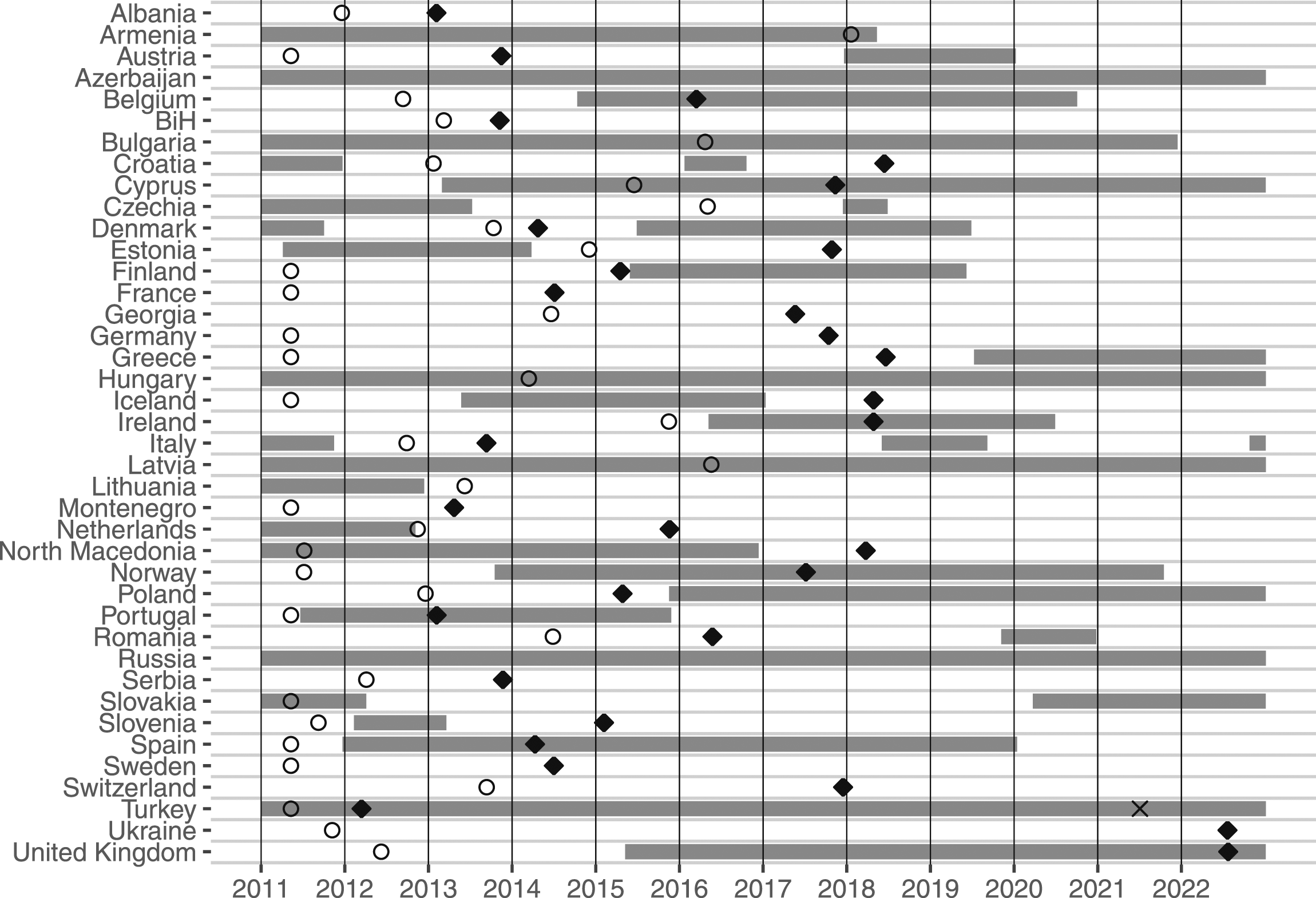
Equally, regime type is a pivotal element. Krizsán and Roggeband (2018b) assert that in Central and Eastern Europe democratic erosion coincides with backsliding of gender equality rights. This may not always be overt policy change; it often involves hollowing out policies by dismantling implementation or accountability mechanisms. Although democratization does not always bring more gender equality (Tripp & Hughes, 2018; Waylen, 2008), and autocrats may also adopt women-friendly measures to maintain their regimes (Bjarnegård & Zetterberg, 2022; Donno & Kreft, 2019), overall de-democratization brings an erosion of gender equality as well. Systematic measurements indicate a strong correlation between democracy and gender equality (Beer, 2009; Welzel et al., 2002). Accordingly, we expect ratification can be more readily obstructed in countries with backsliding democratic conditions and solid right-wing governments.
International Conditionality
Finally, international context also impacts gender equality policy. Following the disintegration of the Soviet Union a large-scale process of norm alignment started in which Western states, through international organizations like the EU, CoE, and UN, transmitted liberal values and international norms to post-socialist countries. This process happened both through softer, socialization reinforcement mechanisms and through accession conditionality, linking adherence to material and political resources (Krizsán & Popa, 2010; Schimmelfennig & Sedelmeier, 2005). In particular, the EU has wielded great influence in gender equality policy development in Central and Eastern Europe through its accession processes (Bego, 2015; Liebert, 2003). Strong conditionality ceased after new members’ accession, leading to a softening of requirements and more space for contesting EU rules (Sedelmeier, 2008). EU membership also resulted in a reconfiguration and decrease of the civil society funding as development organizations withdrew, citing the EU’s own funding serving the same purposes (Roth, 2008).
International alignment with the EU and other organizations nevertheless continues to shape gender equality policies in candidate countries (Spehar, 2021). Beyond the direct influence and conditionality of EU accession negotiations, being outside the EU also permits considerable involvement for other international organizations and funding agencies. Candidate states rely on international organizations to develop, implement, and fund their gender equality policies and institutions. Influence comes through more coercive measures such as the threat of withdrawing funding, but also through social learning and norm diffusion (Schimmelfennig & Sedelmeier, 2005).
These candidate states may consequently change their political rhetoric, but also their policies, governance, or consultation practices with longer-term foreign policy goals in mind (Bego, 2015). Opportunities to join the EU or other international organizations contribute to norm compliance (Avdeyeva, 2007; Falkner et al., 2008).
Thus, international context and particularly EU candidacy status may encourage international norm compliance and constrain anti-gender actors.
Data & Methods
We ask why some states have ratified the Istanbul Convention and others have not. Our analyses take a causes-of-effects perspective on causality (Mahoney & Goertz, 2006). That is, we have cases with known outcomes, the causation for which we seek to identify and explain. We employ a mixed-methods design to identify and verify different causal pathways to IC ratification and to rejection. A mixture of survey data and extant political indicators enable us to perform fuzzy-set qualitative comparative analysis (QCA) based on factors described in the preceding section. We complement this cross-case analysis with a series of minimalist causal mechanism case studies, which investigate the causal veracity of the QCA patterns revealed.
QCA refers to a group of methodological techniques designed to disentangle complex causality marked by conjunctural causation, equifinality, and asymmetry (cf. Schneider & Wagemann, 2012, pp. 5–6, 78–83). It allows us to avoid the particularism of small-N case studies while retaining detailed case-based insights. QCA calibrates cases’ set membership scores in the outcome (i.e., IC ratification) and relevant conditions. Our analysis uses fuzzy-set membership scores, wherein cases may be full set members (1) or full non-members (0), as well as partial set members (>0.5) and partial non-members (<0.5). Fuzzy-set QCA is particularly useful because it captures qualitative differences (i.e., differences in kind) and quantitative differences (i.e., differences in degree). Calibrated cases are represented in a truth table, which can be logically minimized to identify sufficient conditions or combinations of conditions for the outcome. Thus, we evaluate existing hypotheses about the reasons for IC ratification and non-ratification.
However, with QCA we do not simply confirm or refute these hypotheses; instead, “the evaluation of theory-guided hunches sheds light on which parts of existing theories are supported by empirical findings; in which direction they should be expanded; and which parts need to be dropped” (cf. Schneider & Wagemann, 2012, p. 296). This is fundamental to QCA as a research approach: findings are not produced by the creation of a model and performance of an analysis but rather through an iterative process essential to qualitative research, the ‘back and forth between ideas and evidence’ (Ragin, 2008). Accordingly, we inspect our QCA results by examining how conditions manifest in country ratification processes. Specifically, follow-on case studies aim to identify causal mechanisms underlying the patterns identified by the QCA (cf. Schneider, 2023). We thereby contribute to theory-building concerning conditions for gender equality policy success. QCA/configurational analysis combined with case studies are particularly well suited to gender and politics comparative theory-building endeavors (Ciccia, 2016; Krook, 2020; Muriaas et al., 2022).
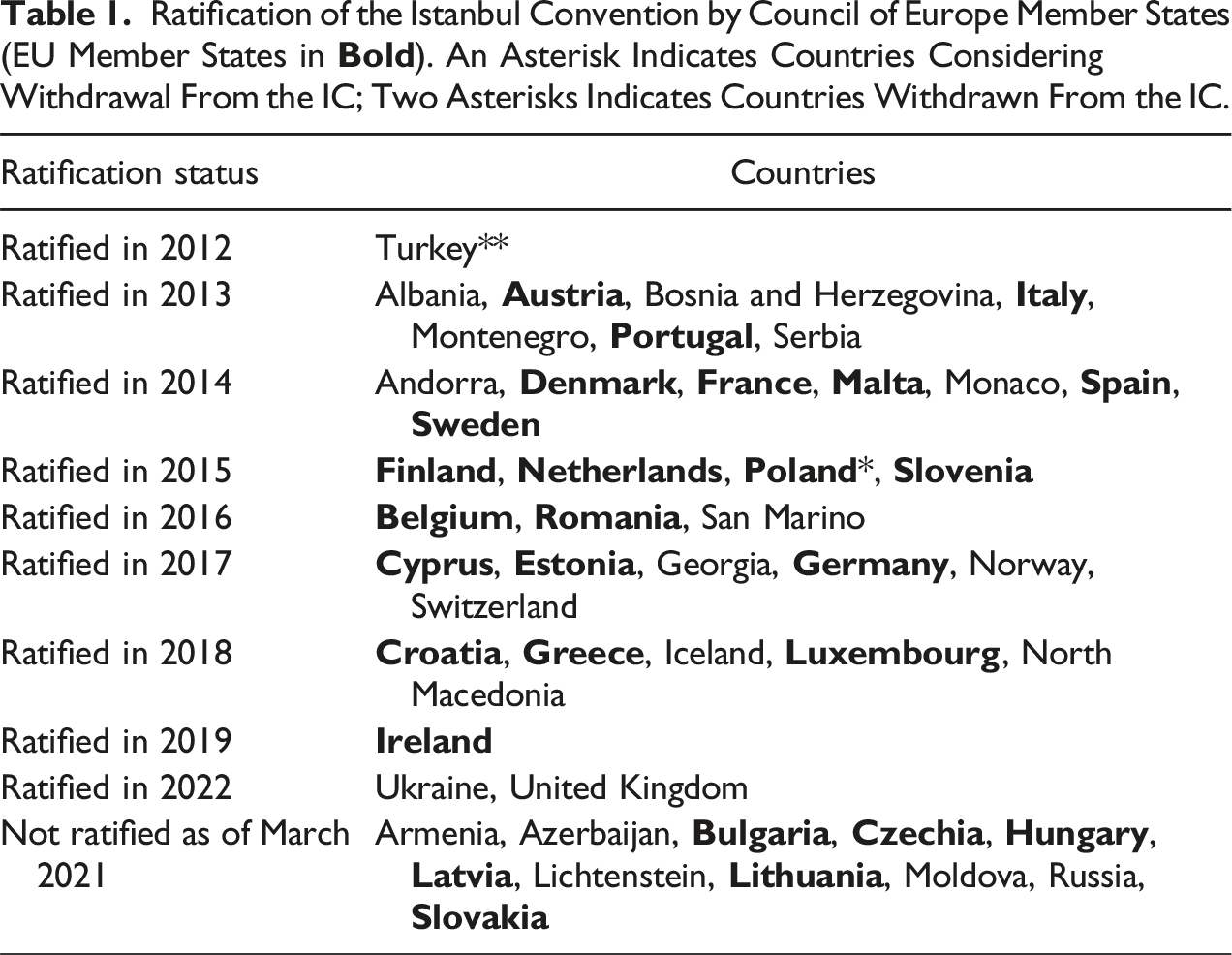
Ratification of the Istanbul Convention by Council of Europe Member States (EU Member States in
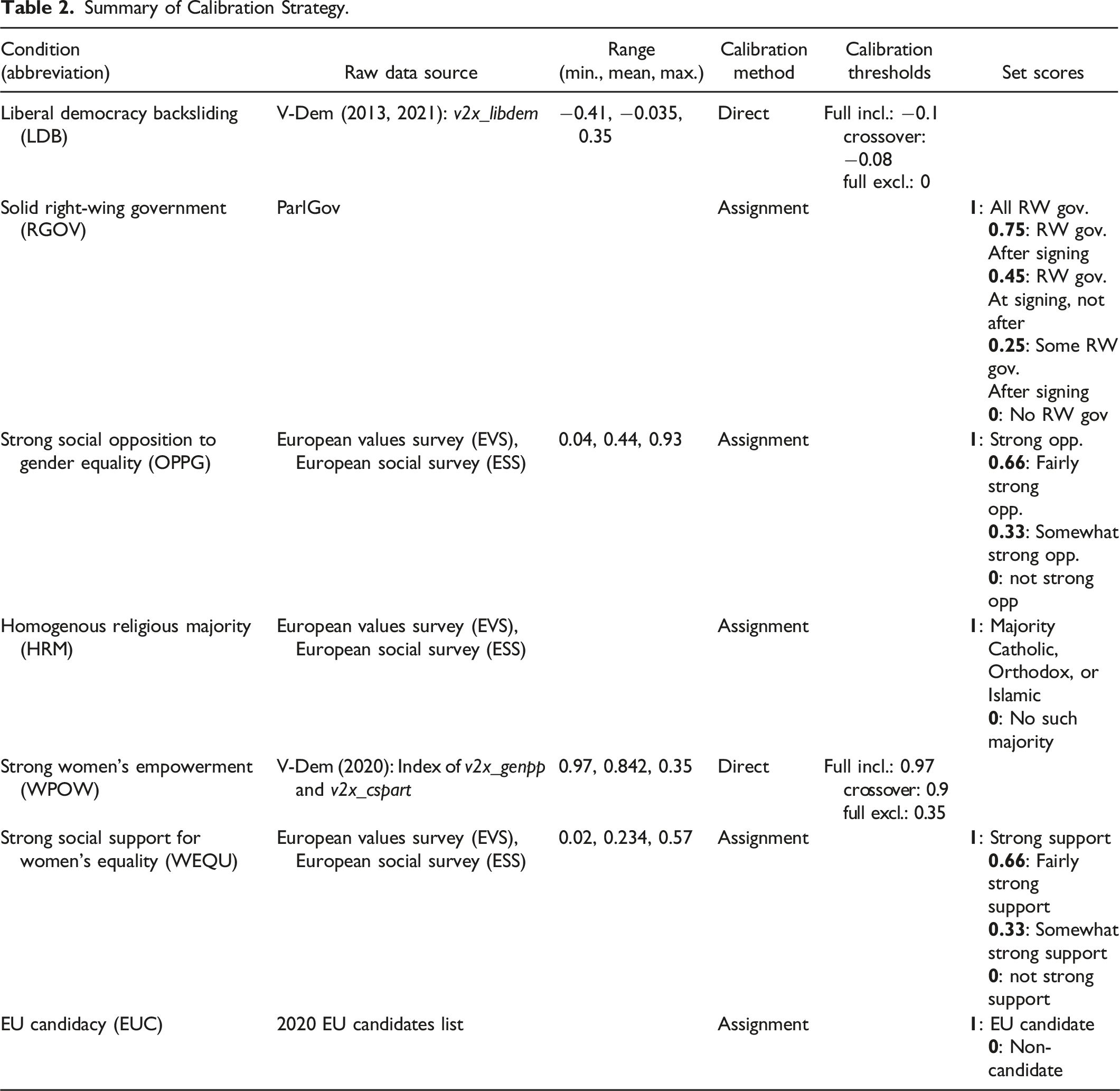
Summary of Calibration Strategy.
Operationalizing Outcome: Istanbul Convention Ratification
In our analysis, the outcome, IC ratification, is a fuzzy set. We assign the set membership scores based on whether a country has ratified. Full inclusion (1) is when states have signed and ratified the Convention. Among countries that have ratified, several issued accompanying declarations or reservations. 8 However, only two of these deviate significantly from the IC’s terms. Both Croatia and Poland’s ratification included obstructive reservations. When Poland ratified in 2015, the legislature included clarification that it would apply the Convention only insofar as it is ‘in accordance with the principles and the provisions of the Constitution of the Republic of Poland which has clauses that may be seen to contravene with the Convention.’ 9 Similarly, with its ratification in 2018, Croatia stipulated application only to the extent the Convention accords with the constitution and pointedly added, ‘the provisions of the Convention do not include an obligation to introduce gender ideology into the Croatian legal and educational system, nor the obligation to modify the constitutional definition of marriage.’ 10 Therefore, though they have ratified, there is a degree of difference between these two cases and other outcome members, so we score Croatia and Poland as only partial members (0.66) of the outcome set.
Seven countries in our analysis have signed the Convention but not ratified: Armenia, Bulgaria, Czechia, Hungary, Latvia, Lithuania, and Slovakia. We score these as partial non-members (0.33) of the outcome. Signing is not ratifying, it merely signals an intention. Without ratification, the prerogative of legislatures, there is no binding commitment. Nevertheless, we assert that these cases are different from those that never signed and, concomitantly, never showed any intention to adopt the Convention.
Three countries do not represent IC ratification at all. Two of these, Azerbaijan and Russia, never signed, rejecting from the outset the Convention’s specific terms and broader aims of building a more gender equal democracy. That both countries are characterized by hard authoritarianism is not coincidental. The regimes of Ilham Aliyev and Vladimir Putin have rarely shown any interest in democracy, never mind a gender equal one. The third country, Turkey, withdrew from the Convention in 2021. 11 The country, where the Convention was drafted and opened for signature and which was among the first signatories in 2011, denounced the treaty less than seven years after it entered into force. This dramatic step is one piece of Turkey’s hardening rejection of gender and sexual equality under Recep Tayyip Erdogan, who became president in August 2014, less than a month after the Convention entered into force in Turkey. We score these three countries as full non-members (0) of the outcome.
Operationalizing Conditions
Strong Social Opposition to Gender (OPPG)
Anti-gender mobilization is configured differently across contexts and target several issues. Among these issues, opposition to LGBTQ + rights is arguably the most common point of resistance for anti-gender movements. Accordingly, we use data from the fifth wave (2017) of European Values Survey (EVS) and the eighth round (2016) of European Social Survey (ESS) to measure the extent of anti-LGBT attitudes in national populations. While not directly representing the mobilization for protest activities and other advocacy, we take this as a proxy for the mobilizing potential of anti-gender movements.
We draw from both EVS and ESS in order to overcome the omission of certain countries in each. From the index of these variables we use our case familiarity to draw the cut-off line between those cases that should be full members, meaning strong anti-LGBT attitudes (1), partial members (0.66), partial non-members (0.33), and full non-members, meaning very low anti-gender attitudes (0) (see calibrated cases in Appendix 1).
Homogenous Religious Majority (HRM)
The vanguard of anti-gender mobilization often appears in the guise of powerful religious institutions and their acolytes. In particular, the mobilization of Catholic, Orthodox, and Islamic adherents has effected a great influence on political institutions and policy-making processes. These religious forces are especially potent when they represent majorities of a country’s citizenry. In the absence of reliable data on the strength of institutionalized religions (Htun & Weldon, 2018), we proxy the power of religious actors that have mobilized against the IC. We calibrate a crisp set, HRM, which draws upon European Values Survey answers about respondents’ religious affiliation. Countries where a majority identify as Catholic, Orthodox, or Islamic 12 —the religions conspicuously influential in opposing the IC—are members of the set (1); other countries are non-members (0) (See further in Appendix 1).
Strong Social Support for Women’s Equality (WEQU)
Whereas the mobilizing potential of anti-gender movements is measured well by opposition to LGBTQ + rights, we argue that support for women’s rights is the best indicator of mobilizing potential for pro-gender equality movements. We again use EVS and ESS survey data to measure the extent of support for women’s equality in national populations taking questions on the equal right to employment as a proxy (Appendix 1). Once again, matching similar questions from the two surveys allows us to overcome gaps in coverage. We use these variables to guide our calibration of cases as full members (1), partial members (0.66), partial non-members (0.33), and full non-members of the set (0) (see the table of calibrated cases in Appendix 1) where strong supportive attitudes for gender equality qualify a country to be a full member of the set, while weak support means that they are not a member of the set.
Strong Women’s Political Empowerment (WPOW)
Women’s civil society organizations and women’s representation in political institutions provide the organizational infrastructure for supporting gender equality. The extent to which (a) women are able to and do in fact participate in civil society and political institutions and (b) civil society organizations—where women’s rights advocacy is typically rooted—can access policy-making processes are crucial for measuring women’s empowerment and advocacy capacity. Accordingly, we create a measure using two sub-indices from the Varieties of Democracy (V-Dem) 2020 Women’s political empowerment index: the women’s political empowerment index and the civil society participation index (Appendix 1). We take the 2020 scores from these indices to form an unweighted composite index. We then calibrate the cases following the ‘direct method.’ 13 In WPOW we have a condition that indicates the capacity of women to affect societal debates and decisions, especially, though not solely through civil society advocacy.
Solid Right-Wing Government (RGOV)
Anti-gender social mobilization is at its most potent when it has reliable allies in government. Typically, these are solid right-wing governments, solely composed of right-wing parties. Opposition can be more effective when right-wing government has been continuously in power and there is no intra-governmental division about supporting anti-gender ideas. To calibrate the RGOV condition we relied on the ParlGov dataset about governing parties and cabinets, which both catalogues the composition of government parties and categorizes parties on a left-right ideology spectrum. 14 As summarized in Table 2, we coded countries as full set members (1) if they had solidly right-wing governments throughout signature and ratification (or not) of the Convention. Partial members (0.75) were not solidly right-wing governed at time of signature but have been since. Near members (0.45) were solidly right-wing governed at signature but not afterwards. Partial non-members (0.25) were not solidly right-wing governed at signature and subsequently witnessed changes between right-wing and non-right-wing governments. Full non-members (0) had no solidly right-wing governments in the 2010s. Figure 1 depicts the periods of solidly right-wing government and dates of IC signature and ratification (where applicable).
Liberal Democratic Backsliding (LDB)
The responses of countries and governments to the IC has been linked to democratic conditions. Previous studies maintain that it is not merely poor democratic conditions—that is, an absolute measure of democracy—but democratic backsliding—that is, a relative measure, capturing the change from one period to another—that is most relevant for explaining resistance to gender-equal initiatives like those enumerated in the Convention (Krizsán & Roggeband, 2021). 15 We draw once again on V-Dem data. The liberal democracy index corresponds to the most widespread conception of democracy. We calibrate our LDB condition by first creating a measure of the change in each country’s liberal democracy score from 2013, the year before the Convention entered into force, to 2021; then, we again apply the direct method of calibration to fit the data between qualitative anchors with a logistic function.
EU Candidacy (EUC)
International influence and particularly conditioning financial and political support on adoption and respect for international norms is a powerful driver for gender equality policy change, especially in un-consolidated democracies. Prospect of EU accession is a strong conditionality relation. Accession to the EU and other international and regional platforms spurs norm adoption in several Eastern and South-Eastern European countries. To capture such strong international influence we look at which countries are EU candidates. We calibrate the condition as a crisp set: countries that are EU candidates are members of the set (1); other countries are non-members (0).
The preceding descriptions imply directional expectations, theoretical hunches about the direction of causal influence on the outcome: women’s political empowerment (WPOW), strong social support for women’s equality (WEQU), and EU candidacy (EUC) are expected to bolster IC ratification, while strong social opposition to gender (OPPG), homogenous religious majority (HRM), liberal democratic backsliding (LDB), and solid right-wing government (RGOV) are expected to undermine it. Although directional expectations lend themselves in QCA to the intermediate solution type, in our main analysis we evaluate the parsimonious solution because the majority of simplifying assumptions made for it are easy counterfactuals and the results involve fewer multiply covered cases than the intermediate solution. 16
We hasten to add that no QCA solution is solely sufficient to infer causation. Researchers must go back to cases to dissect the results (cf. Schneider, 2018, p. 253). Therefore, after presenting our QCA we proceed to a series of minimalist causal mechanism country case studies. It is our combination of methods that enables us to infer causation: QCA suggests (seemingly) decisive conditions and avoids the particularism of single-case studies; process tracing assesses the validity of QCA results and aims to reveal causal mechanisms.
Patterns of Istanbul Convention Ratification
Here, we lay out our QCA results. 17 Following the standard procedure, we begin with the analysis of necessity, followed by the analysis of sufficiency for the outcome. Then, we perform the same analytical one-two punch for the non-outcome, looking at patterns of conditions in cases that did not ratify the IC.
Necessity
We tested whether any conditions or disjunctions 18 were consistently present in cases that ratified the Convention, that is prima facie evidence of necessity. No single condition emerged as necessary. Three disjunctions, reported in Appendix 2, surpass standard thresholds for necessity. However, for each there are cases that violate the potential necessity relationship. Therefore, as we detail in Appendix 2, we assert that there is no necessity relationship and proceed to the sufficiency analysis.
Sufficiency
Truth Table. The Outcome Column for Row 25 is Marked With a Dash, Denoting the Contradictory Cases (i.e., Some With the Outcome and Some Without) Represented by This Row. 108 Further Truth Table Rows (i.e., Logically Possible Combinations of Conditions) for Which There Are No Empirical Manifestations in the Data Are Omitted From the Table. Key: OPPG = Strong Social Opposition to Gender Equality, HRM = Homogenous Religious Majority, WEQU = Strong Social Support for Women’s Equality, WPOW = Strong Women’s Empowerment, RGOV = Solid Right-Wing Government, LDB = Liberal Democratic Backsliding, EUC = EU Candidacy.
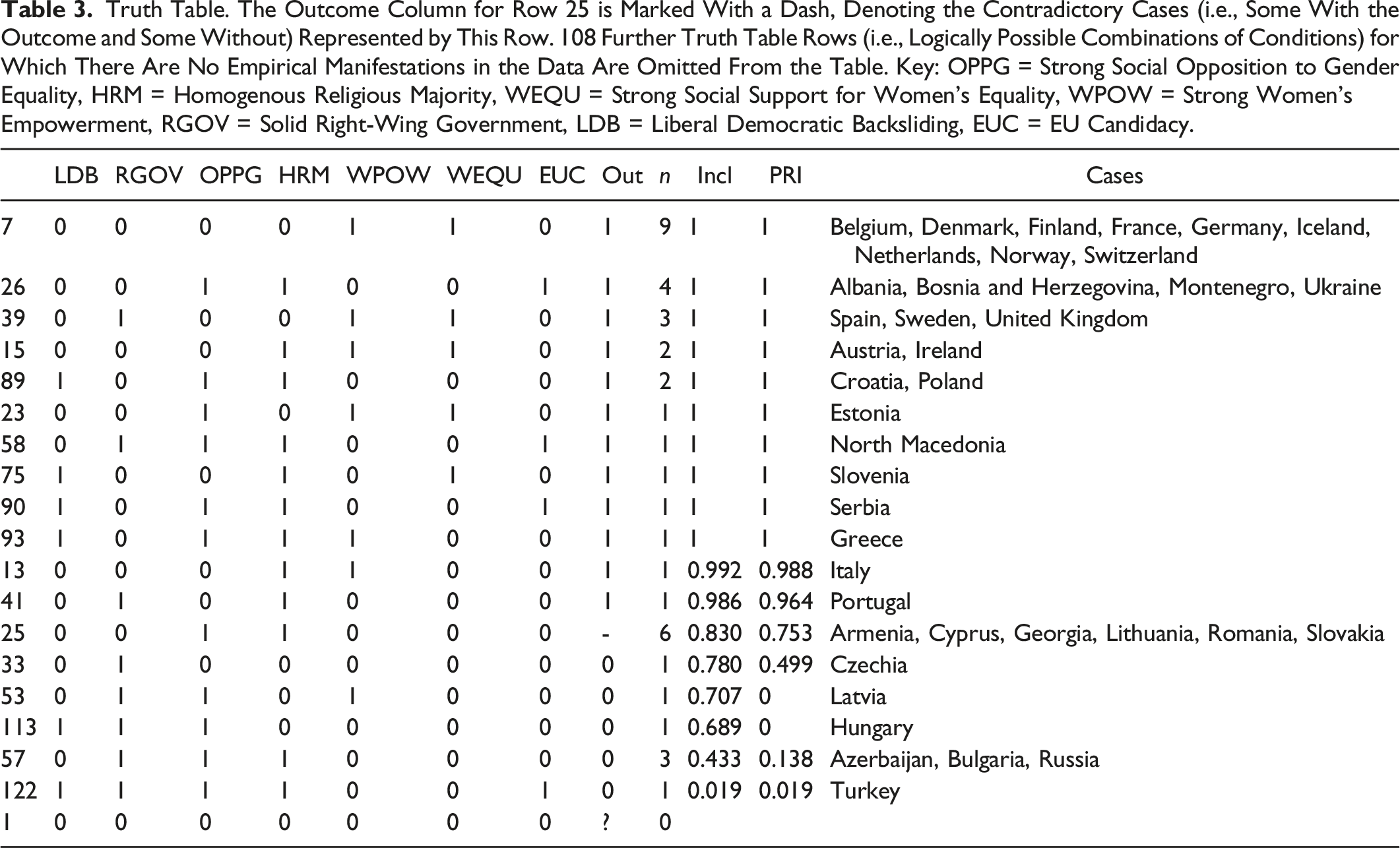
The truth table is sorted by outcome (OUT) and consistency or inclusion. 20 PRI refers to “proportional reduction in inconsistency” and indicates relevance, “how much it [analytically] helps to know that a given X is specifically a subset of Y and not a subset of ∼Y” (Schneider & Wagemann, 2012, p. 242). Inclusion indicates how some rows—in Table 3, row 25—represent cases that have and do not have the outcome. Row 25 describes Cyprus, Georgia, and Romania (ratified), and Armenia, Lithuania, and Slovakia (not ratified). They all share strong opposition to gender equality (OPPG) and homogenous religious majority (HRM). This combination of conditions bolsters non-ratification yet some have ratified. The likely explanation for the three instances of ratification lies in Cyprus’s, Georgia’s, and Romania’s relatively strong political motivation to align with European norms (even if Romania and Cyprus are EU members already, and Georgia only applied for membership in March 2022). Schneider and Wagemann (2012) stipulate that one should address how these inconsistent rows will be handled in the analysis. In this paper we exclude row 25 from minimization, though we discuss these cases further below.
Figure 2 visualizes the truth table. Here, the light grey bars represent truth table rows with the outcome (IC ratification); dark grey are the rows without the outcome (no ratification); and the black bar represents the contradictory truth table row (row 25). We see, for example, row seven, which represents the largest number of countries (nine), in the first light grey bar. The figure shows how these countries are characterized by a coincidence of strong women’s empowerment (WPOW) and strong support for women’s equality (WEQU) co-occurring with the successful Convention ratification. Set intersections of QCA model. The light grey bars represent truth table rows with the outcome; dark grey without; the black bar represents the one contradictory truth table row (i.e., row 25).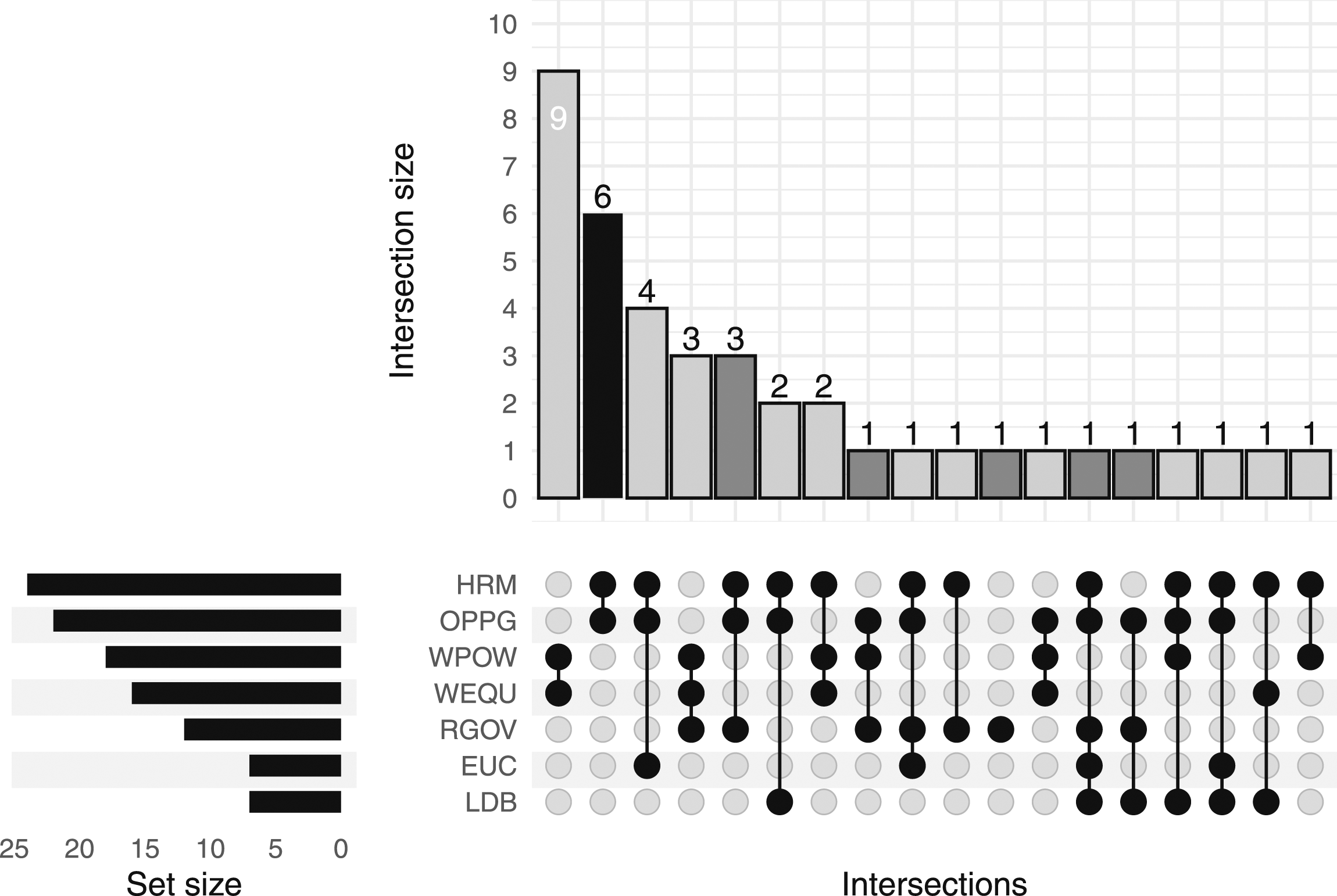
To produce the most parsimonious solution
21
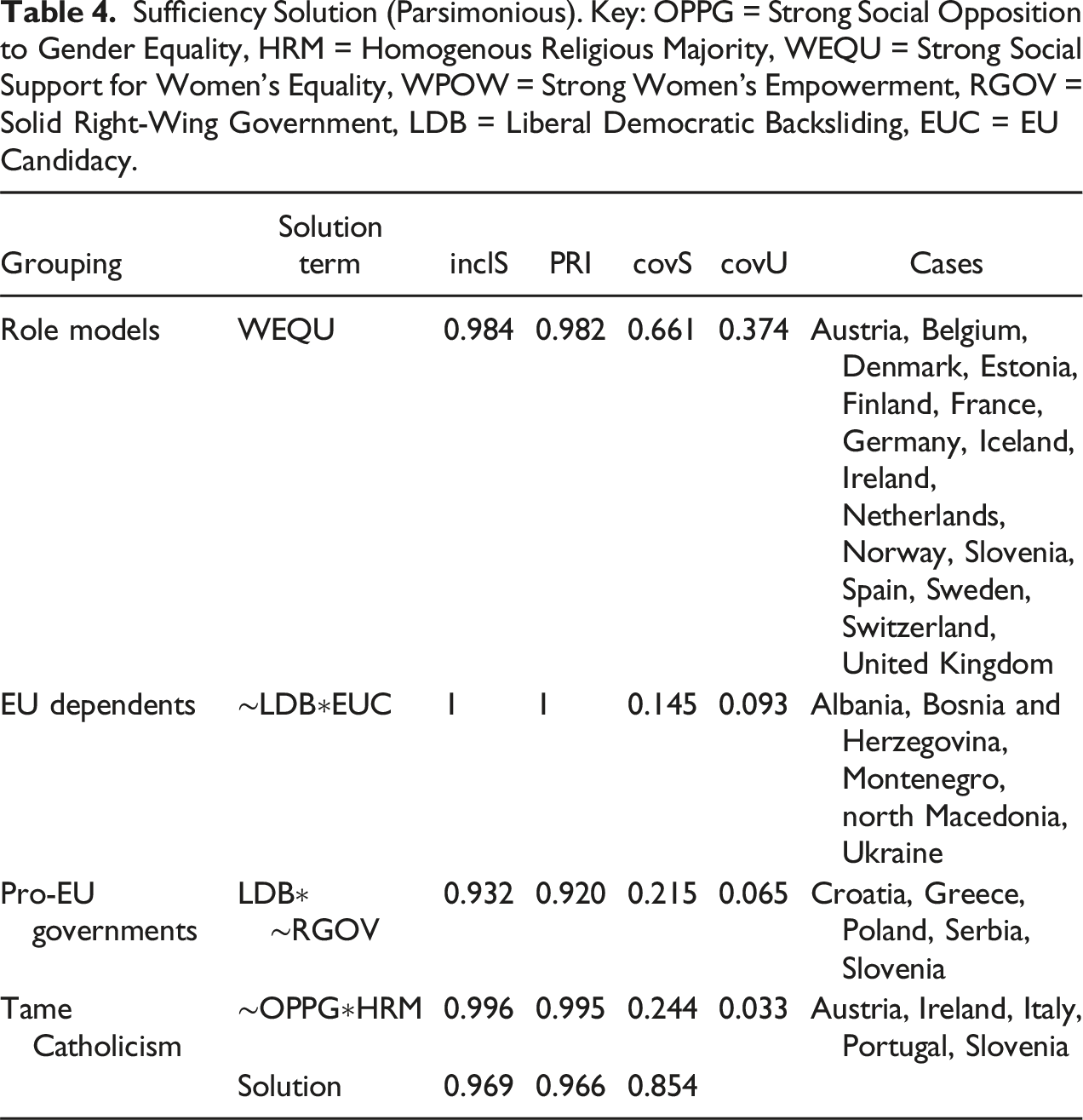
we reduce the complexity of the truth table. Minimization of our truth table produces four configurations of conditions that seemingly motivate ratification of the Istanbul Convention:
This expression reads as follows: • Strong social support for women’s equality (WEQU) or • Not liberal democratic backsliding (∼LDB) and EU candidacy (EUC) or • Liberal democratic backsliding (LDB) and not solid right-wing government (∼RGOV) or • Not strong social opposition to gender (∼OPPG) and a homogenous religious majority
are sufficient for Istanbul Convention ratification (IC).
Sufficiency Solution (Parsimonious). Key: OPPG = Strong Social Opposition to Gender Equality, HRM = Homogenous Religious Majority, WEQU = Strong Social Support for Women’s Equality, WPOW = Strong Women’s Empowerment, RGOV = Solid Right-Wing Government, LDB = Liberal Democratic Backsliding, EUC = EU Candidacy.
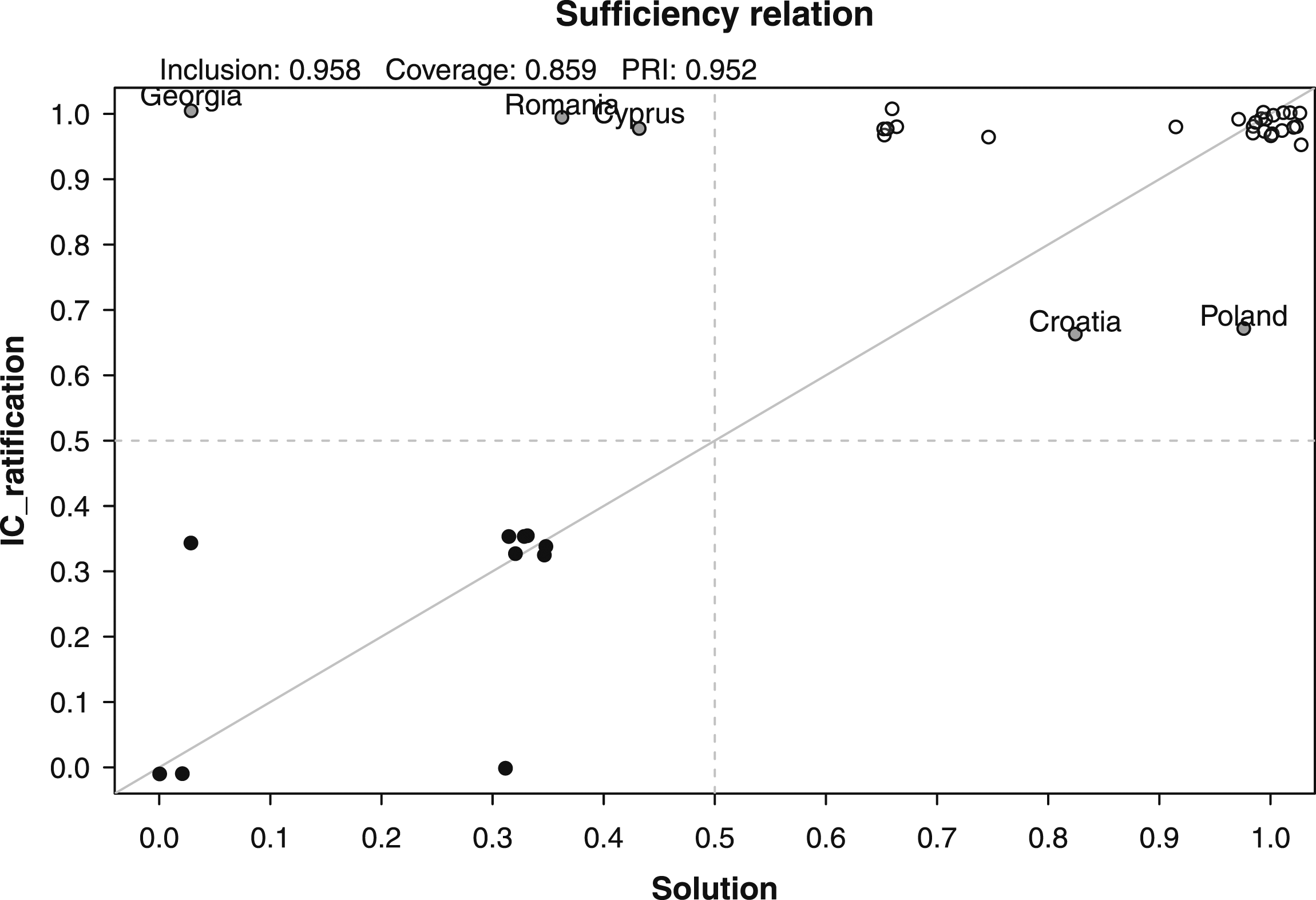
Sufficiency solution.
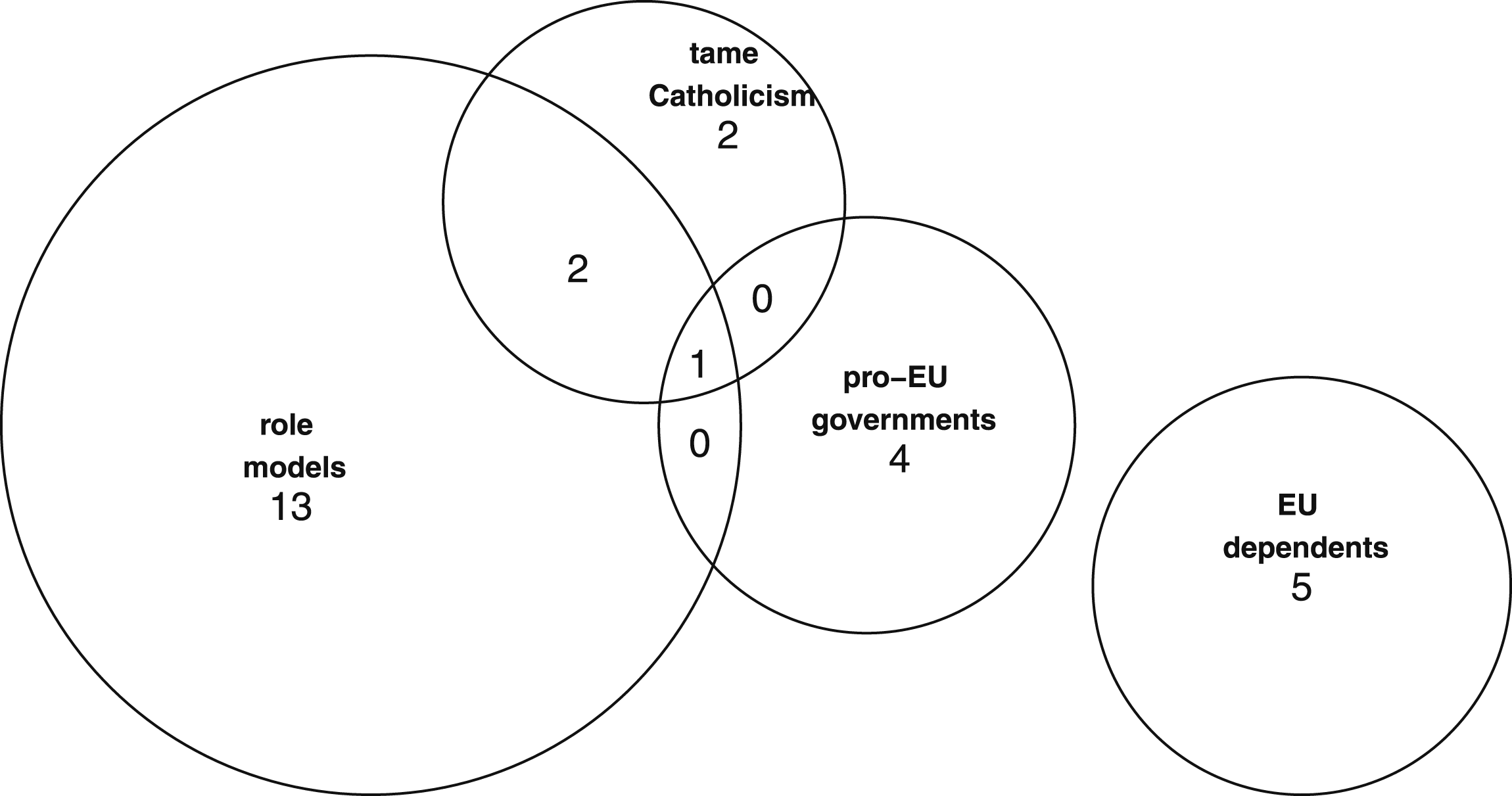
Solution (parsimonious) terms and overlaps.
The first configuration consists of the condition WEQU, strong social support for women’s equality, which is solely sufficient. All role models, with the exception of Slovenia also have strong women’s empowerment (WPOW). This pattern, simplified to one essential condition, represents the role models of gender equal democracies. The countries covered, mostly clustered in North-Western Europe, have high standards of development and living, are democratically stable (not backsliding), and have populations with some of the highest levels of women’s political participation and social support for women’s equality. These characteristics motivate IC ratification and the further development of gender equality public policy.
The second configuration, EU dependents, represented by the conjunction of ∼LDB (not liberal democratic backsliding) and EUC (EU candidacy), is conspicuous for its group of EU candidate countries. Among several countries in the European neighborhood there is persistent political will to join the EU—or at least to ensure that aid and investment from the EU and other Western sources continues to flow into the country. Actions taken to appease those interests, such as treaty ratification, seem to explain IC ratification in Albania, Bosnia and Herzegovina, Montenegro, North Macedonia, and Ukraine. Moreover, a similar mechanism is likely at work in the three cases not covered by our solution: Georgia (not an EU candidate) and Cyprus and Romania (EU member states) all rely on capital inflows, prominently from the EU and United States. The EU candidacy condition thus likely only proxies an underlying relationship, essentially a complex system of quid pro quo in which receiver states follow the development and policy steps prescribed by donor states.
The third configuration is marked by the conjunction of LDB and ∼RGOV, liberal democratic backsliding and the absence of a solid right-wing government. Here we find pro-EU governments, a group of countries that have powerful religious institutions and have witnessed deteriorating democratic standards (both in terms of equality and institutional integrity, see Table 11): Croatia, Greece, Poland, Serbia, and Slovenia. But none of these five countries had a solid right-wing government throughout the signature and ratification period. We see this factor’s importance also through the contrast with countries that rejected the Convention (see below), all of which had solid right-wing governments, and countries where solidly right-wing governments subsequently came to power. Poland ratified shortly before the right-wing Law and Justice party came to power in late 2015 (see Figure 1); subsequently, the government, evidently to mollify the country’s Catholic episcopacy, powerful conservative civil society, and voters, has declared its intention to withdraw from the Convention.
The fourth configuration, ∼OPPG and HRM, denotes the presence of a homogenous religious majority along with the absence of strong social opposition to gender and sexual equality. We call this pattern tame Catholicism because the five countries represented by it—Austria, Ireland, Italy, Portugal, and Slovenia—have large Catholic majorities but this has not resulted in the same degree of Catholic-inspired anti-gender mobilization seen in Poland and Croatia. A common pathway to resisting the Convention is where religious institutions help mobilize social opposition into anti-gender movements and together support the election of right-wing governments. Without the strong social opposition to gender, though, that pathway is short-circuited.
Rejection of the Istanbul Convention
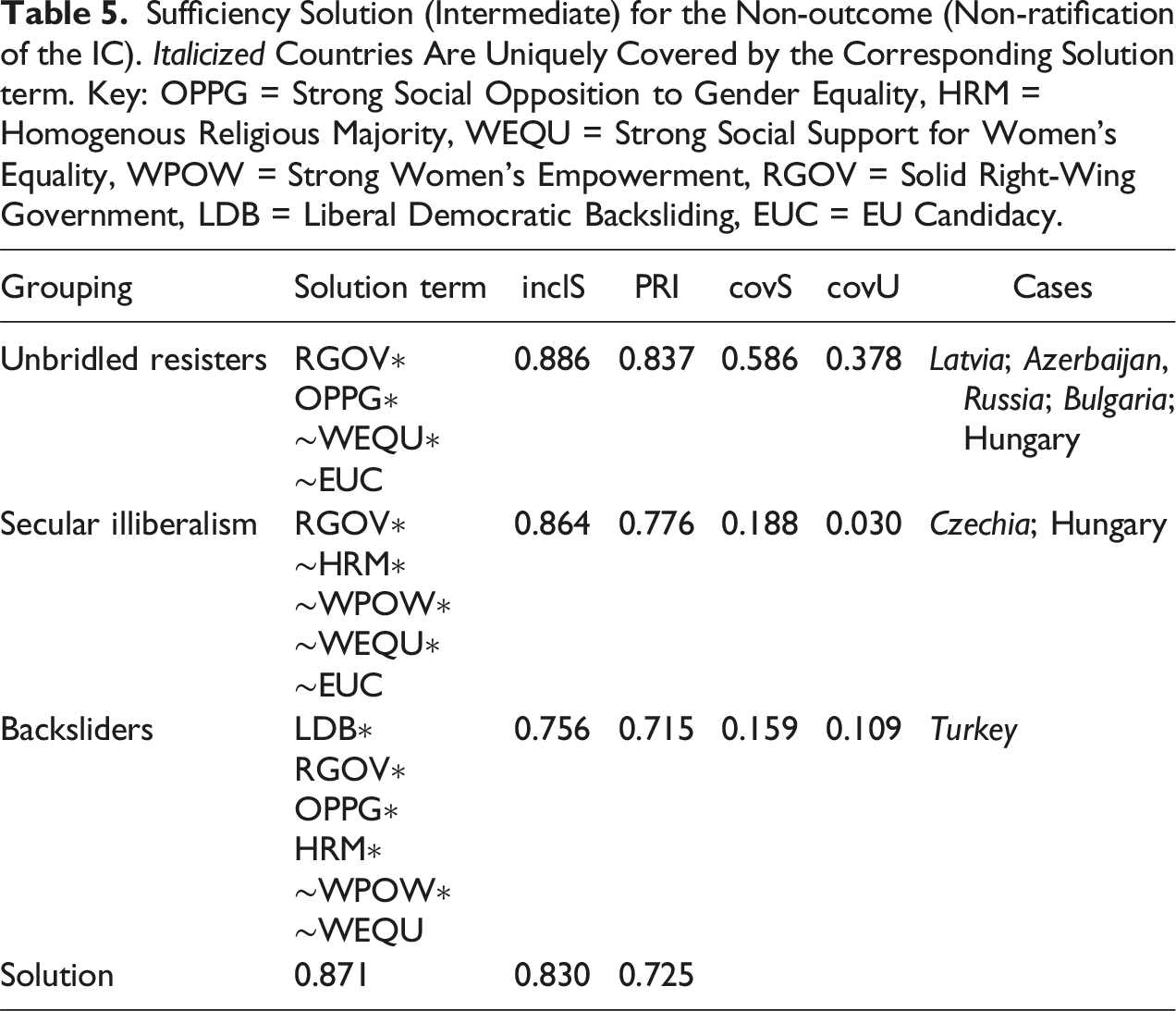
Sufficiency Solution (Intermediate) for the Non-outcome (Non-ratification of the IC). Italicized Countries Are Uniquely Covered by the Corresponding Solution term. Key: OPPG = Strong Social Opposition to Gender Equality, HRM = Homogenous Religious Majority, WEQU = Strong Social Support for Women’s Equality, WPOW = Strong Women’s Empowerment, RGOV = Solid Right-Wing Government, LDB = Liberal Democratic Backsliding, EUC = EU Candidacy.
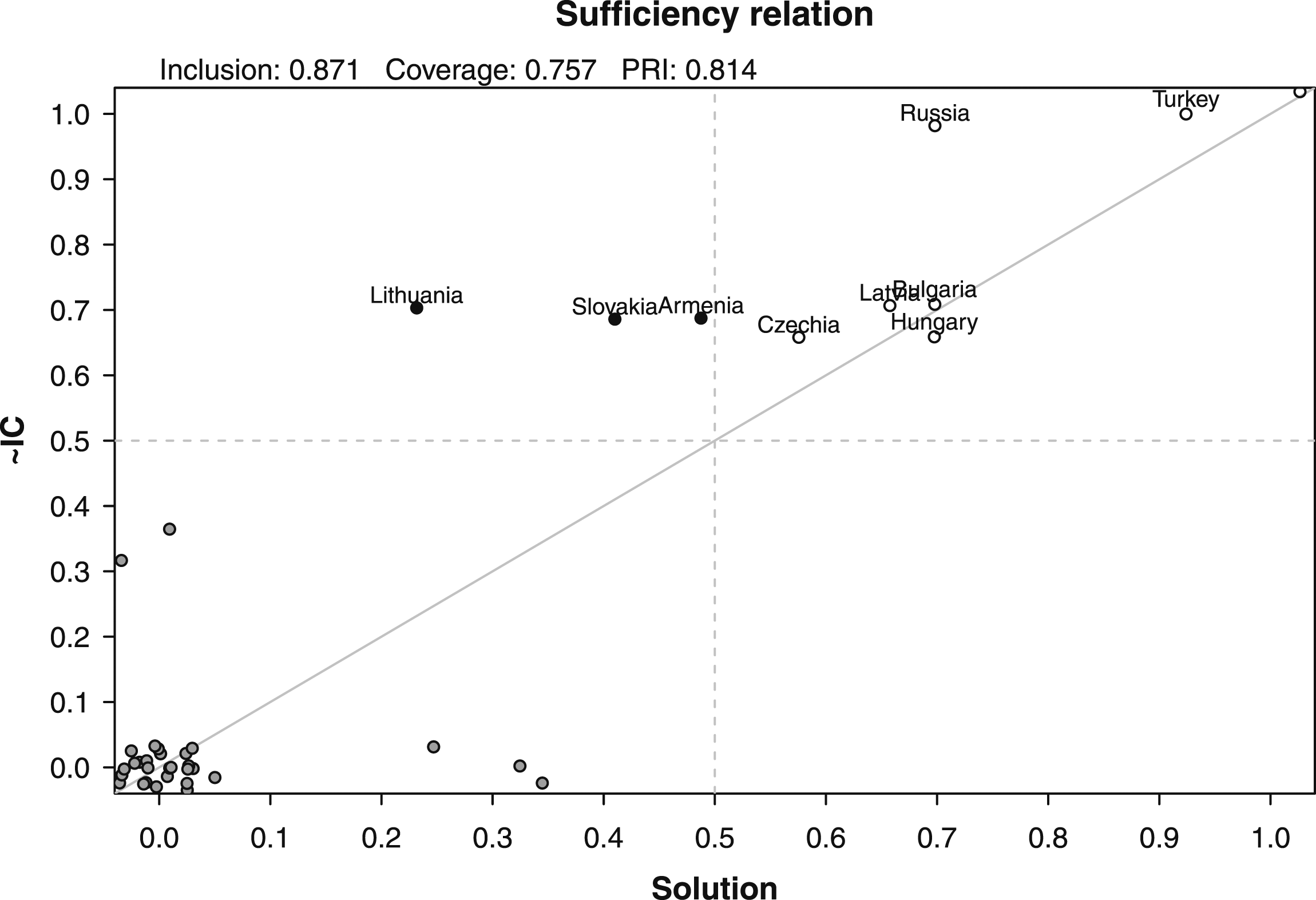
Non-outcome sufficiency solution (intermediate).
Even though there is no single condition that explains non-ratification, there is one conspicuous common element present among all three patterns of rejecting the Convention: solid right-wing governments (RGOV). It is not surprising that this is a key causal ingredient; resistance to the IC needs a strong governing authority opposed to it. Yet the presence of a solid right-wing government is not solely sufficient. As shown in Table 3, several countries that had RGOV ratified the Convention. This underscores the conjunctural causation underlying rejection of the Convention: the co-occurrence of multiple conditions is needed.
The first paradigmatic rejection path, backsliders, is characterized by combination of all conditions that we hypothesized to explain non-ratification: liberal democratic backsliding, a strong majority religion, solid right-wing government, and strong opposition to gender equality. Popular support for gender equality or political empowerment for women are absent here, so there is nothing to hinder opposition to the Convention. Only Turkey represents all these characteristics. This path shares many attributes with other countries rejecting the Convention, but the institutionalized majoritarian religion separates it from Hungary, a secular backsliding country, and visible democratic backsliding differentiates it from religious and authoritarian countries like Azerbaijan and Russia where there was no democracy in the first place.
The second rejection pattern we call unbridled resistance to the IC. This group of countries is characterized by solid right-wing government (RGOV) in combination with strong social opposition to gender equality (OPPG). What could curb such strong forces of opposition would be strong support for women’s equality (WEQU) or EU conditionality (EUC). However, neither of these conditions are present among the unbridled resisters in Table 5. Unchecked, oppositional forces are sufficient to reject the Convention. Azerbaijan, Bulgaria, Hungary, Latvia, and Russia are covered by this grouping, though the subset of authoritarian regimes, Azerbaijan and Russia, is conspicuous.
The third pattern, secular illiberalism, makes clear that non-ratification is not necessarily related to religious opposition. It includes countries with solid right-wing government (RGOV), but without several other conditions, most noticeably a homogenous religious majority (HRM), demonstrating the potential potency of secular conservatism in gender issues. Czechia and Hungary are highly secular societies, without powerful institutionalized religions; but they have been consistently led by right-wing governments that pursue conservative agendas. Those agendas have no place for the gender-sensitive obligations enshrined in the IC.
Taken together, our analysis allows us to extend the findings of other studies of anti-gender mobilization and contention around the Istanbul Convention (e.g., Krizsán & Roggeband, 2021) and suggests causal processes across 40 country cases. With good measures of fit, the conditions in our QCA model help explain ratification and non-ratification in nearly all of the countries. 25 In order to disentangle patterns of causation we now turn to minimalist causal mechanism case studies of the four patterns of successful ratification.
Causal Mechanism Case Studies
To assess what mechanisms underlie the suggestive causation of our QCA—or indeed to determine if this suggestive causation is mistaken—we inspect the four patterns of ratification with a series of minimalist case studies. In this, we are guided by the literature on nested analysis (Lieberman, 2005), on combining QCA and case study research (Schneider, 2023; Schneider & Rohlfing, 2013), and on mixed methods in gender and policy research (McBride & Mazur, 2010). Figure 4 shows that a few cases are covered by multiple configurations. These cases are seemingly causally overdetermined; they would be unhelpful for determining the causal impact of a single configuration. Instead, below we select uniquely covered cases that we have more in-depth knowledge of, and where we can isolate the suggestive causation. Spain, Montenegro, Croatia, and Italy are each uniquely covered by different configurations. And though Croatia is slightly deviant case 26 (see Figure 3 where Croatia is below the diagonal in the upper-right quadrant) (Schneider & Rohlfing, 2013), we select it precisely because it is worth considering one of the cases in which the Convention was ratified with obstructive reservations.
Role Models and the Case of Spain
In the ‘role models’ group are countries that have large and consolidated support for women’s equality (WEQU). It consists mostly of North-Western European countries as well as a few from other parts: Belgium, Denmark, Finland, France, Germany, Iceland, Netherlands, Norway, Switzerland, Estonia, Spain, Sweden, Austria, Ireland, and Slovenia. The implication underlying this pattern is that in these countries support for gender equality is so high that there is little opportunity for actors to mobilise opposition. Spain is a typical case here, despite being the only Southern European country in the group. Along with twelve other countries, Spain was the first signatory to the IC (11 May 2011). Signature took place under a center-left government, but ratification happened under Mariano Rajoy’s center-right government on 10 April 2014. Neither signature nor ratification caused major public debate; the Convention was adopted unanimously by the Congress and Senate.
Early and speedy adoption encapsulates the broad consensus in support of women’s rights (again, as suggested by the WEQU condition). Spain developed solid public support for gender equality issues over the past decades, following its transition to democracy in 1976—coinciding with waning political influence of the Catholic Church and a strong secularization of society. 27 The Women’s Institute, created in 1983, became a strong state-level institution providing women’s rights organizations with important access to policy-making processes (Valiente, 2015). Feminists active in the Socialist Party (PSOE) have been appointed to high-level political positions. This political empowerment of women also contributed to the country’s adoption of progressive gender equality measures at the central state level. This included an ambitious legal framework in relation to intimate partner violence: the Organic Law 1/2004 on Integral Protection Measures against Gender Violence, which turned Spain into one of the first European countries to have specific gender-based violence legislation. The law set a benchmark for dealing with intimate partner violence by envisioning wide-ranging protective and supportive measures for dealing with violence against women from a gender perspective.
In 2016, the two main competing political parties, the Socialist Party and the conservative PP party both presented different non-legislative motions to improve and update Law 1/2004 and promote a State Pact on Gender Violence, which the Congress adopted unanimously on 23 November 2016 (Villacampa, 2021). Spain’s strong support for women’s equality along with strong empowerment of women in the party political arena, was indeed sufficient for ratification, engendering an overwhelming consensus mechanism.
Yet, as a coda to this story, we observe that in the past few years new right-wing and conservative religious actors, not least the VOX political party, have voiced opposition to the distinctly gendered approach to intimate partner violence in Spain. 28 These actors are mobilizing to abolish the Organic Law and the State Pact (Cabezas, 2022). Though unsuccessful at the national level, where the left-wing government has reiterated its goal to keep gender-based violence at the center of its political agenda and expressed its firm commitment to the Istanbul Convention, 29 VOX has entered regional and local governments. Yet, as a counterbalance, Spain has a vibrant feminist movement with a high mobilization capacity. Gender-based violence is one of the core issues of their campaigns (Alonso et al., 2023). Despite the rise of new right-wing and conservative actors, social support for gender equality (WEQU) in Spain remains high, a bulwark against efforts to oppose policies like those in the Convention.
EU Dependents and the Case of Montenegro
Our analysis shows that uncontroversial ratifications did not just happen in gender progressive role model countries but also in countries without strong support for gender equality. International incentives emerge as equally powerful motors of ratification. The second pattern of the solution covers five EU candidates (EUC) that are dependent on foreign aid and development support. Each of the countries, Albania, Bosnia and Herzegovina, Montenegro, North Macedonia, and Ukraine, have potent anti-gender forces: strong social opposition to gender (OPPG) and homogenous religious majorities (HRM)—but each also rely on international sources of support, financial and technical. The impetus to align policies with international norms and adopt gender equality standards of the EU (and by extension the CoE) is strong, conditioned by substantial development aid inflows and by the prospect of full Euro-Atlantic integration. This conditionality mechanism overrides the strong opposition to gender equality and the influence of religious institutions that might have otherwise led to blocking the IC.
These countries were mostly quick to sign the Convention: Montenegro signed on 11 May 2011 along with the other twelve first signatories; North Macedonia, Albania, and Ukraine followed later that year; and Bosnia and Herzegovina signed in early 2013. Moreover, three of the five were also quick to ratify, doing so prior to the Convention’s entry into force in 2014. Albania on 4 February 2013 became the second country, after Turkey, to ratify; Montenegro (22 April 2013), the fourth; and Bosnia and Herzegovina (7 November 2013), the sixth. (North Macedonia ratified on 23 March 2018; Ukraine on 18 July 2022.) Speedy ratification is one means for these countries to signal intent to remain good partners for the EU and other Euro-Atlantic structures.
Consider Montenegro, an EU membership candidate since 2012. After gaining independence in 2006 Montenegro maintained relative political stability under the moderate left-wing leader Milo Djukanovic, who served as prime minister six times, and as president since 2018. The democratic record of the country is relatively poor: V-Dem categorizes Montenegro as an electoral autocracy. Women’s political empowerment is weak compared to some neighboring countries. And there is little popular support for gender equality. The Orthodox church claims an overwhelming majority among the population, but Montenegro has no state religion and is relatively supportive of religious freedom. The country’s request for EU accession was evaluated favorably in 2013, but came with strings attached for improving gender equality.
Beyond quick IC ratification, Montenegro’s representative in the Parliamentary Assembly of the Council of Europe (PACE), Snezana Jonica, sat on the CoE Committee on Equality and Non-Discrimination. When it entered into force in 2014, Jonica relayed her country’s message to PACE: “The delegation of the Parliament of Montenegro in the [PACE] is pleased to state that Montenegro belongs to the group of the first 11 countries in which the Convention enters into force, which is another proof of our commitment to achieving its goal” (Vijesti, 2014). The conditionality mechanism indeed brought about the Convention’s ratification. 30
While EU candidacy is a serviceable and illuminating proxy for responsiveness to foreign influence and consequent policy alignment, we expect that it does not completely capture the underlying causal factor. The three countries not covered by our solution, in the upper left quadrant of Figure 3, may also have acted under international incentives, though Cyprus and Romania are EU members and Georgia is an Eastern Partnership state. 31 A more fine-grained measure of responsiveness to international conditionality might help to explain these deviant cases.
Pro-EU Governments and the Case of Croatia
While the first two identified paths resonate with literature on gender and policy by tying progress either to widespread social and political endorsement of gender equality or to international incentives, the last two paths are more remarkable. The pro-EU governments ratification pattern includes Croatia, Poland, Serbia, Greece, and Slovenia, all characterized by democratic backsliding during the period of signature and ratification (LDB), homogenous religious majorities (either Catholic or Orthodox) (HRM), significant popular anti-gender attitudes (OPPG), and no consistent pattern of gender equality or women’s empowerment conditions, nor of strong international incentives at the time of ratification (perhaps excepting Serbia). Despite this ill-starred constellation of conditions these countries ratified the Convention, in some cases amidst high levels of contention (Poland and Croatia). An important common trait is the absence of solid right-wing governments throughout the period of signature and ratification (∼RGOV). During ratification some had center-right governments, which were largely moderate and pro-EU.
Croatia exemplifies this pattern. Representatives of the country played an active part in the IC’s development. Its state representative, Dubravka Šimonović, co-chaired the CoE Ad Hoc Committee for preventing and combating VAW and domestic violence (CAHVIO). Consequently, the country signed the Convention relatively early on, in January 2013, under the Social Democratic Milanović government. This was the start of a five-year process towards ratification. In the first three years, the Milanović government dithered, citing the necessity to change existing legislation. At the end of 2016, the center-right Plenković government (chiefly composed of the Croatian Democratic Union, HDZ) took up the issue as it came to power. On the International Day for the Elimination of Violence Against Women, 25 November, Prime Minister Plenković announced the government would begin ratification. Despite the ensuing anti-gender campaign, Plenković made several public statements demonstrating government support for the Convention. 32 On 13 April 2018, amidst significant street protests, the Croatian parliament ratified. A limiting declaration was added to the text, saying: “The Republic of Croatia considers that the provisions of the Convention do not include an obligation to introduce gender ideology into the Croatian legal and educational system, nor the obligation to modify the constitutional definition of marriage.” The declaration was meant to placate the outraged opponents of the Convention.
Anti-gender opposition was extremely strong during the ratification process. This mobilization predated the campaign against the Convention (Kuhar & Paternotte, 2017). Together with several prominent civil society organizations, the Catholic Church played a key mobilizing role as part of its resistance against “gender ideology” (Hodžić & Bijelić, 2014, p. 23). A new civil society initiative, Istina o istanbulskoj (‘the Truth About the IC’) was also launched in 2017. Organizations opposing the Convention mobilized large-scale protests during the parliamentary debates. The inclusion of IC opponents in the ratification working group and the limiting declaration accompanying ratification demonstrate the strength of the opposition.
However, Croatia also has a strong legacy of successful feminist mobilization for combating violence, including a history of fruitful cooperation with state actors (Krizsán & Roggeband, 2018a; Spehar, 2007). Yet in the late 2000s this densely networked movement fractured and started to lose critical allies inside state structures. The movement increasingly had to share its position in negotiations with conservative organizations. In response, the movement adopted more disruptive tactics. Feminists used several strategies to advocate for the Convention: cooperative tactics, such as channeling requirements set by the Convention into ongoing policy projects, engaging state partners such as the Gender Equality Committee of the Parliament, the Gender Equality Ombudsman, various ministries and President Ivo Josipovic, but also street protests (Sutlović, 2019).
Overall, the case demonstrates the importance of the government’s pro-Convention position in alliance with gender equality actors to resist the powerful network of opponents to the Convention. This government gender alliance mechanism sufficed for ratification even in a context of strong social opposition to gender equality and a powerful religious institution supporting that opposition campaign (Krizsán & Roggeband, 2021). However, countries following this path are also quite vulnerable to shifting direction. As the case of Poland, another country in this grouping, shows, replacement of pro-EU governments with de-democratizing forces can easily turn the countries towards undermining the Convention and even considering withdrawal from it.
Tame Catholicism and the Case of Italy
We refer to the fourth pattern of IC ratification as tame Catholicism. represented by Catholic-majority countries (i.e., HRM): Italy, Portugal, Austria, Ireland, and Slovenia. While in other Catholic majority countries in our study (Croatia, Lithuania, Poland, Slovakia) powerful religious actors mobilized social opposition to gender to fuel contention against the IC, that base of mobilizing potential was not as broad in the tame Catholic countries (i.e., OPPG). Within this group, Austria, Ireland, and Slovenia are all also covered by the ‘role models’ pattern, meaning that they are causally overdetermined. We therefore look more closely at one of the two cases represented only by this pattern: Italy.
Italy signed the IC on 27 September 2012 under the technocratic government of Mario Monti, and ratified on 10 September 2013 under the centrist government of Enrico Letta (himself a member of the centre-left Partito Democratico). There were some signals that the government might hesitate to sign the Convention. During the drafting process, Amnesty International reported 33 on a set of proposed amendments tabled separately by the United Kingdom, Russia, the Holy See, and Italy that circumscribed the Convention’s scope. Italy’s proposals related to Chapter VII of the Convention, giving migration and asylum rights related to gender-based violence rationales, and specifically focused on Article 59’s reference to residence status. The proposal to add the qualifying phrase ‘as recognized by internal law’ to 59(3) was accepted; the proposal to stipulate in 59(4), regarding forced marriage and residence status, that persons would regain residency ‘in the event of the dissolution or annulment of the marriage’ was rejected. Concerns over duties towards victims’ residency status might have deterred the right-wing government of Silvio Berlusconi, who was Prime Minister during the drafting process and when the Convention opened for signature in May 2011, but not Monti’s nor Letta’s government.
More importantly, concerns over violence against women became a prominent topic in Italy by the time the IC opened for signature. First, in the 2000s the Italian National Institute of Statistics (ISTAT) incorporated data collection on gender discrimination and violence against women. More than recognizing the 667 femicides (homicides against women) between 2010 and 2013, 34 the driving force behind adopting and implementing the Convention was the Letta government’s response to several high-profile incidents. The brutal murder in May 2013 of Fabiana Luzzi, by her boyfriend made national headlines. Josefa Idem, the Minister for Equal Opportunities, Sport and Youth Policies, referred to Luzzi’s murder as spurring the government to ratify the Convention. Greater awareness of the problems addressed by the IC, moral outrage at some particularly egregious cases, and, under Letta’s government, the advocacy of several female ministers and officials, including Laura Boldrini (President of the Chamber of Deputies), Emma Bonino (Minister of Foreign Affairs), and Josefa Idem, all combined to propel Italy’s ratification. These drivers, a social pressure mechanism, unimpeded by strong social opposition to gender and hostile mobilization from the Catholic Church seen in other countries, were successful in securing ratification.
However, Italy demonstrates how IC ratification is punctuated not with a full stop but with an ellipsis. In 2022, the far-right government of Giorgia Meloni’s Fratelli d’Italia party, in coalition with Lega and Forza Italia, was inaugurated. Opposition to gender policies and promotion of traditional gender roles were prominent planks of the coalition’s election campaign (cf. Giorgi & Loner, 2022). It remains to be seen whether Meloni would go so far as the Law and Justice-led government in Poland to raise the idea of withdrawing from the Convention.
Conclusions
Over the past decade there has been an increase in attacks on gender equality: anti-gender equality movements and rhetoric have invaded political debates and policy processes. The contention around the Istanbul Convention exemplifies how opposition to gender and sexual equality policies have gained traction in several countries. Our mixed-methods study of 40 Council of Europe states lends credence to previous research on IC ratification in Central and Eastern Europe (Krizsán & Roggeband, 2021) and identifies causal processes at work elsewhere. We identified patterns explaining IC ratification and the underlying causal mechanisms, depicted in Figure 6, as well as patterns of rejection of the Convention. Beyond understanding the politics of ratifying the IC our analysis also contributes to explaining policy successes and failures of anti-gender campigns more generally. Paths of Istanbul Convention ratification. The rounded rectangles name the four groupings found in our sufficiency analysis for IC ratification. The conditions, in rectangles, that comprise those groupings, are sufficient causes for IC ratification through the mechanisms, in trapezoids, that we described in our discussion of typical cases.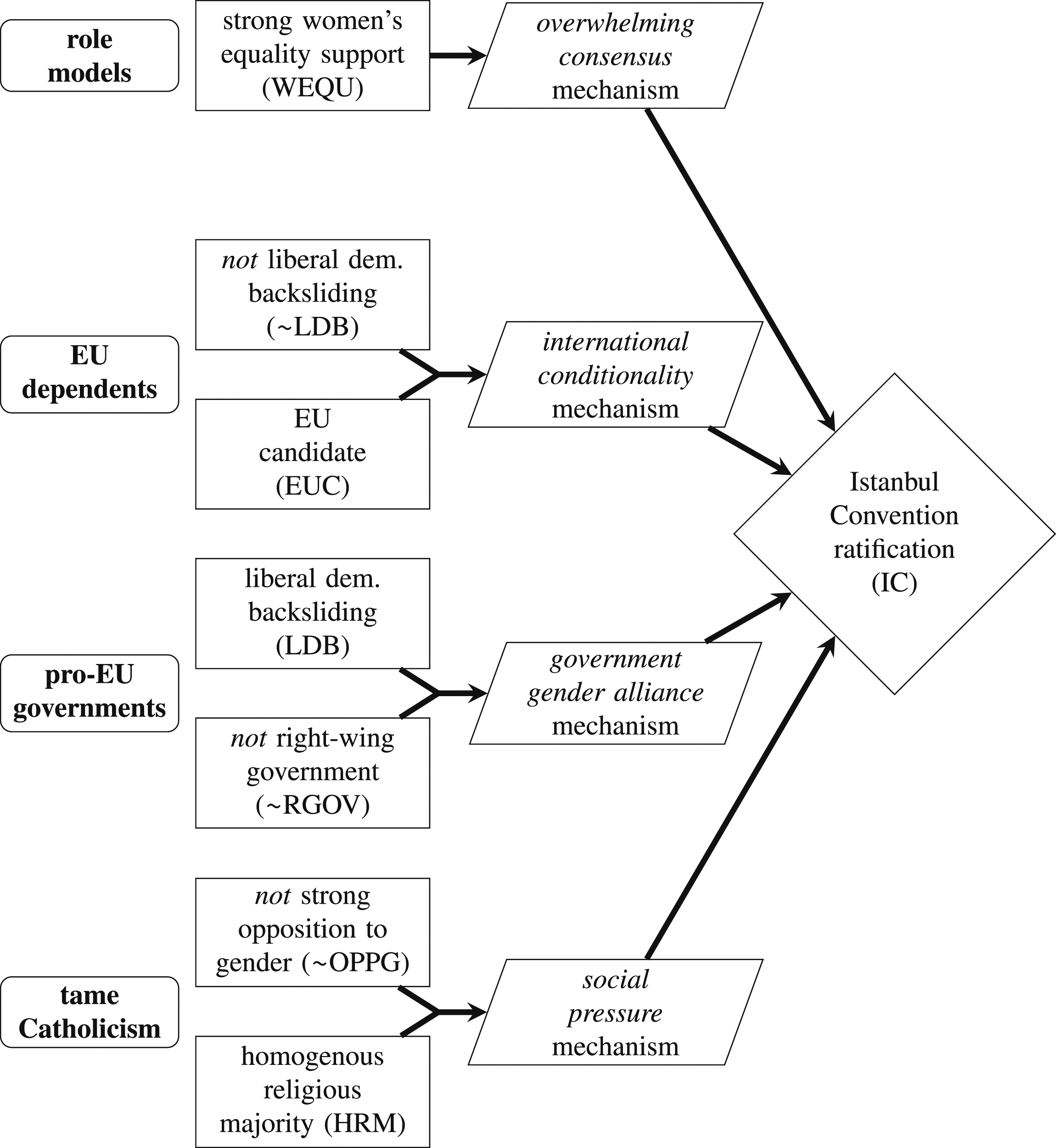
Our analysis refutes simplistic monocausal explanations, such as the assertion that contention over gender and sexual equality is an East versus West phenomenon. Though non-ratification cases are concentrated in Eastern Europe, not all post-socialist countries failed to ratify. Some of these, as argued above, may be motivated by their desire to become EU members, which does not necessarily mean they are strong promoters of gender and sexual equality. Others, such as Estonia and Slovenia, are conspicuous members of the ‘role model’ grouping of ratifiers. The ‘Eastern problem’ offers little explanatory power here.
Figure 6 depicts the complex causal processes behind IC ratification uncovered by our analyses. Some identified causal processes resonate with previous research on adoption of gender equality norms, others are new patterns that need to be further unpacked to grasp their theoretical implications. This may open opportunities for further theorization about the adoption of gender equality norms and the policy consequences of anti-gender campaigns.
Four patterns explain Istanbul Convention ratification. The ‘role models’ pattern confirms that social support for gender equality and political empowerment of women is fundamental to meaningful and sustainable progress on gender equality norms. This confirms previous findings about the importance of women’s political empowerment, including representation, civil society participation in policy-making, and the role of gender equality agencies in achieving policy progress (Dahlerup, 2006; Fallon et al., 2012; Htun & Weldon, 2018; Krizsán & Roggeband, 2018a; Mazur, 2002). The ‘EU dependents’ pattern supports assertions about the importance of international influence for gender policy progress (Bego, 2015; Schimmelfennig & Sedelmeier, 2005; Spehar, 2021). Countries in this pattern, acting under a conditionality mechanism, ratified but do not necessarily embrace gender equality ideals. Rather, their IC ratification seems an opportunistic demonstration of compliance with EU norms, making them acceptable candidates to various Euro-Atlantic structures. The ‘pro-EU governments’ pattern groups countries with homogenous religious majorities and liberal democratic backsliding that nonetheless ratified the Convention. What enabled these unlikely cases of ratification was the alliance between pro-ratification actors (mostly feminists) and pro-EU governments. In highly polarized contexts, these alliances tilted the balance towards ratification. But in these contexts decisions are susceptible to reversal (Engeli et al., 2012). The ‘tame Catholicism’ pattern is marked by the absence of strong social mobilization and polarization over gender and sexuality issues. Yet the political mobilization of anti-gender sentiments under the recently elected Meloni government indicates the vulnerability among this group to backsliding.
Our study also identified patterns underlying rejection (non-ratification) of the IC. The presence of right-wing governments is the one condition present among all non-ratification cases. Although in earlier years both right-wing and left-wing governments supported policies combating violence against women (Mazur, 2002), in the current climate of polarization over gender and sexual equality, combating violence against women has become politicized and increasingly falls under what Htun and Weldon (2018) call doctrinal gender issues.
We expected a large overlap between liberal democratic backsliding and non-ratification, indicating convergence between democratic backsliding and the erosion of gender equality rights. However, our findings show that democratic backsliding is neither necessary nor solely sufficient to explain why countries rejected the Convention. Among the CoE member states we see countries where liberal democracy is eroding but that nevertheless ratified: Croatia, Poland, Greece, and Serbia. The point here is that these countries did not have a solid right-wing government throughout the period of study, which helps explain why they ratified. We also see some countries that did not show signs of liberal democratic backsliding but did not ratify the IC: Bulgaria, Czech Republic, Latvia, Lithuania, and Slovakia. What all of these countries share is low popular support for gender equality and low levels of women’s political empowerment. Exploring IC (non)ratification patterns provides a critical lens to assess current challenges to gender equality in Europe and indicates that the electoral successes of populist right-wing parties, in coalition with anti-gender actors promote majoritarian, non-pluralist, and illiberal democracy projects that will undermine gender equal democracy. Our research also indicates the fundamental importance of popular support for gender equality and the empowerment of women’s rights advocates for preventing negative policy consequences of anti-gender campaigns. Further research should examine these patterns in other fields of anti-gender mobilization.
Supplemental Material
Supplemental Material - Who is Afraid of the Istanbul Convention? Explaining Opposition to and Support for Gender Equality
Supplemental Material for Who is Afraid of the Istanbul Convention? Explaining Opposition to and Support for Gender Equality by Andrea Krizsán, Conny Roggeband, and Michael C. Zeller in Comparative Political Studies.
Supplemental Material
Supplemental Material - Who is Afraid of the Istanbul Convention? Explaining Opposition to and Support for Gender Equality
Supplemental Material for Who is Afraid of the Istanbul Convention? Explaining Opposition to and Support for Gender Equality by Andrea Krizsán, Conny Roggeband, and Michael C. Zeller in Comparative Political Studies.
Supplemental Material
Supplemental Material - Who is Afraid of the Istanbul Convention? Explaining Opposition to and Support for Gender Equality
Supplemental Material for Who is Afraid of the Istanbul Convention? Explaining Opposition to and Support for Gender Equality by Andrea Krizsán, Conny Roggeband, and Michael C. Zeller in Comparative Political Studies.
Supplemental Material
Supplemental Material - Who is Afraid of the Istanbul Convention? Explaining Opposition to and Support for Gender Equality
Supplemental Material for Who is Afraid of the Istanbul Convention? Explaining Opposition to and Support for Gender Equality by Andrea Krizsán, Conny Roggeband, and Michael C. Zeller in Comparative Political Studies.
Footnotes
Declaration of Conflicting Interests
The author(s) declared no potential conflicts of interest with respect to the research, authorship, and/or publication of this article.
Funding
The author(s) received no financial support for the research, authorship, and/or publication of this article.

Data Availability Statement
Supplemental Material
Supplemental material for this article is available online.
Notes
Author Biographies
References
Supplementary Material
Please find the following supplemental material available below.
For Open Access articles published under a Creative Commons License, all supplemental material carries the same license as the article it is associated with.
For non-Open Access articles published, all supplemental material carries a non-exclusive license, and permission requests for re-use of supplemental material or any part of supplemental material shall be sent directly to the copyright owner as specified in the copyright notice associated with the article.
