



Abstract
Under what conditions do rebels succeed in establishing functional institutions in state-dominated areas? Canonical theories of rebel governance and state formation insist that territorial control is a necessary precondition for the development of governing institutions. Yet despite growing recognition that this claim is empirically incorrect and theoretically limiting, we lack knowledge about the conditions under which rebels succeed in governing civilians in areas where the state dominates. We argue that low state governance responsiveness towards rebel constituencies enables insurgents to overcome the challenges associated with establishing institutions in state-dominated areas. Low state responsiveness increases popular demand for insurgent institutions, decreases the costs associated with governing, and enables insurgents to collude with civilians to hide their institutions. Case studies from Ireland, South Africa, and Algeria illustrate our propositions. Our findings deepen knowledge on how rebels govern and expand their territorial reach, and shed light on alternative trajectories of state formation.
Introduction
The Revolutionary Front for an Independent East Timor (FRETILIN) lost most of its territorial control to Indonesian occupation in 1977–1979. Nevertheless, FRETILIN went clandestine and continued to act like a parallel government that organized the masses and resolved local disputes (Hoho, 2002, p. 578). Likewise, the United Liberation Front of Assam (ULFA) in northeastern India “called the shots” across large swathes of Assam and built schools and flood defenses without any claim to territorial control (Waterman, 2023, p. 280). The Kurdistan Workers Party (PKK) in Turkey also established governance without territorial control, and administered justice, security, and education in cities under Ankara’s control (O’Connor & Jongerden, 2023, p. 6). And across zones dominated by the Afghan government, the Taliban installed sophisticated governance systems, including courts (Jackson, 2018, pp. 18–19). These examples raise the question: Under what conditions do rebels succeed in establishing functional governance institutions in state-dominated areas?
This study builds new theory about the establishment of insurgent institutions in state-dominated areas: those in which state security forces exercise predominant territorial control and insurgents lack a regular and overt military presence. Insurgent institutions are “structures and practices, both formal and informal, that rebels develop as part of a broader governance arrangement to interact with the civilian population” (Mampilly & Stewart, 2021, p. 17). A rich literature shows that insurgent institutions are common, often established to help rebels win popular support, garner international legitimacy, signal ideological commitment, and raise funds (Florea & Malejacq, 2024). However, existing research provides limited guidance for explaining rebel governance in state-dominated areas. Instead, canonical studies insist that a high degree of territorial control is a necessary precondition for rebel governance without which rebel institutions are too vulnerable to counterinsurgent attacks, too expensive, and too unattractive to function (Kalyvas, 2006; Kasfir, 2015; Mampilly, 2011; Weinstein, 2007).
In contrast, more recent research suggests that rebel governance sometimes arises in areas where the state is dominant and the insurgents are unable to operate out in the open (Albert, 2022; Huang, 2016; O’Connor & Jongerden, 2023; Wagstaff & Jung, 2020; Waterman, 2023), such as in urban areas (O’Connor, 2023). Moreover, evidence shows that criminal organizations—which rarely control territory and usually operate in epicenters of state strength—frequently regulate social order, provide public goods, and resolve disputes (Barnes, 2017; Magaloni et al., 2020; Uribe et al., 2022). Nevertheless, with few exceptions (O’Connor, 2023; O’Connor & Jongerden, 2023; Waterman, 2023), existing research on rebel governance absent full territorial control is scarce, and there is a lack of comparative research on the conditions that facilitate insurgent institutions in state-dominated areas.
Rebel governance in state-dominated areas is also puzzling in light of canonical theories of state formation. Rebel governance scholarship draws heavily on the analogy of insurgent bureaucracies as “embryonic states” (Loyle et al., 2023, p. 269; Mampilly, 2011, p. 34). A common claim in the state formation literature is that aspiring political authorities first establish territorial control and then build institutions for interacting with their subjects. Tilly (1992, p. 20) asserts that the state formation process starts when rulers subdue their internal rivals and realize that maintaining control over territory demands a public administration. Likewise, Olson (1993, p. 568) posits that the state stems from metaphorical “roving bandits” that conquer territory and then “replace anarchy with government.” For Herbst (2014, p. 12), precolonial African states’ limited military control over peripheral regions with low population density disincentivized the creation of expansive states. Thus, if rebel governance indeed mirrors historical state formation processes, we may be overlooking an alternative pathway towards statehood.
Starting from the observation that a lack of territorial control need not preclude rebel governance (Jentzsch & Steele, 2023; Loyle et al., 2022, 2023; Pfeifer & Schwab, 2023; Rubin & Stewart, 2022), we develop a novel argument about the conditions that facilitate rebel governance in state-dominated areas. A lack of territorial control makes establishing, involving civilians in, and protecting insurgent institutions more difficult (Kasfir, 2015). We propose that overcoming such challenges is easier when state governance responsiveness toward rebel constituencies is low and the state makes political decisions that do not correspond to the desires of the citizens that the insurgents claim to fight for (Grossman & Slough, 2022). Low state responsiveness facilitates insurgent institution-building because it increases popular demand for alternative institutions. This demand makes civilians more likely to accept the risks of participating in rebel institutions, decreases the insurgents’ costs of maintaining institutions, and facilitates civilian-insurgent collusion to hide institutions.
To submit our theory to an initial test, we combine between- and within-case qualitative analysis of three insurgent groups that lacked full territorial control. Our cases include insurgent groups that varied in the number of institutions they established in state-dominated areas, despite their initial intent and attempts to govern civilians: the Irish Republican Army (IRA) in pre-independence Ireland, the African National Congress (ANC) in South Africa, and the Groupe Islamique Armée (GIA) in Algeria. We find that the degree of state responsiveness helps account for why the IRA and ANC established functional rebel institutions in state-dominated areas while the GIA did not. Although further testing is warranted, this finding identifies state responsiveness as an explanatory factor for future studies of rebel governance absent full territorial control. We also uncover an endogenous relationship between state responsiveness and insurgent institutions whereby rebel governance efforts affected popular perceptions of state responsiveness relative to insurgent responsiveness: the IRA and ANC used institution-building to undermine state institutional responsiveness, while the GIA established institutions of such poor quality that it reduced popular appetite for Islamist rule.
The study makes three principal contributions. First, it contributes new knowledge on rebel governance. We present a novel argument about the conditions that facilitate rebel institutions in state-dominated areas. We also shed new light on the overlooked establishment phase of rebel governance and show that institution-building can constitute a way to capture territory, thereby deepening knowledge on how insurgents win civilian support and expand their territorial reach. While canonical models of civil war argue that military control, above all else, induces civilian compliance (Kalyvas, 2006, p. 111), we add to recent research showing that good governance can be equally effective—even absent military control (Jackson, 2018; Jentzsch & Steele, 2023; Loyle et al., 2023; Rubin & Stewart, 2022). Second, we shed light on what governance by armed actors looks like in urban areas. Existing rebel governance research primarily focuses on the rural hinterland (Staniland, 2010, p. 1624). Our focus on state-dominated areas, many of which are in cities (Kalyvas, 2006, p. 133), adds to recent research on the urban dynamics of rebel rule (Deglow, 2023; O’Connor, 2023) and urban governance by criminal groups (e.g., Lessing, 2021). Third, we contribute new insights on state formation trajectories. Loyle et al. (2022) propose that better understanding rebel rule also deepens knowledge on state governance. Studying how aspiring sovereigns sequence military control and institution-building can hence help elucidate both historical state formation processes and contemporary pathways to de facto statehood.
An estimated 111 million people worldwide live in areas contested by armed groups (Bamber-Zryd, 2023). Knowledge on rebel governance in state-dominated areas can help policymakers better gauge how civil war affects these people’s security and welfare, and aid humanitarians in refining their engagement strategies. Moreover, insurgent institutions provide crucial clues for estimating rebel strength. Fixating on military control over territory can lead observers to underestimate how much influence insurgents exercise in a given area (Jackson, 2018; Jentzsch & Steele, 2023). Insufficient appreciation of the Taliban’s significant institutional presence in state-dominated areas, for example, contributed to the international community’s failure to anticipate the Taliban’s August 2021 offensive (Jackson, 2022; Terpstra, 2022). A lack of knowledge on insurgent institutions in state-dominated areas can thus be extremely costly.
Previous Research
A large research agenda examines the determinants of rebel governance (Florea & Malejacq, 2024). Rebel governance encompasses insurgents’ efforts to regulate violence, extract resources, provide services, and develop political organizations amidst civil war, including functions like taxation, policing, education, and service provision (Huang, 2016; Mampilly, 2011; Stewart, 2018; Weinstein, 2007). Existing research has identified several key determinants of rebel governance, including a dependence on civilian support (Huang, 2016; Weinstein, 2007; Wickham-Crowley, 1987), secessionist or legitimacy-seeking political goals (Mampilly, 2011; Stewart, 2018), a need for continued economic production (Lidow, 2016), and Marxist or Islamist ideologies (Huang, 2016). Moreover, several studies show that civilian demands can prompt and shape rebel governance (Arjona, 2016; Jackson, 2018; Rubin, 2020; van Baalen, 2021). However, much of the focus in this scholarship is on rebel incentives to govern, rather than the conditions under which insurgents hold the capacity to govern.
Canonical studies posit that full territorial control is a prerequisite for rebel governance. Wickham-Crowley (1987, p. 482) maintains that controlling the means of violence in a locale is “a fundamental prerequisite of government” without which rebel governors “would be just nosy social workers.” Weinstein (2007, pp. 163–164) argues that rebel institution-building is only feasible in areas where the insurgents are the strongest military force. Likewise, Kasfir (2015, pp. 27–29) claims that “the capacity to govern” can only exist when rebels “acquire the military capability to defend the area.” Kalyvas (2006, pp. 114–117) concurs, contending that insurgents are incentivized to deploy coercion rather than provide positive inducements like governance in contested zones. Mampilly (2011, p. 17) echoes this consensus, stating that effective governance requires that rebels have the capacity to “provide a degree of stability that makes the production of other government functions possible.” Arjona (2014, p. 1375) goes further still, positing that maintaining a monopoly over the use of violence constitutes the minimal level of governance possible.
We argue that the claim that rebel governance demands a high degree of territorial control is empirically unsubstantiated and theoretically limiting. First, cross-national evidence shows that territorial control is a determinant of rebel governance rather than a prerequisite (Albert, 2022; Huang, 2016; Wagstaff & Jung, 2020). In fact, a considerable number of insurgent groups that lacked territorial control developed sophisticated wartime bureaucracies (Huang, 2016, p. 52). Such high-institutionalist rebels without consolidated territorial control operated in countries as diverse as Palestine, Vietnam, Peru, Timor-Leste, Thailand, and Egypt. Several case studies of rebel institution-building in state-dominated areas confirm this finding (Hoho, 2002; Jackson, 2018; O’Connor, 2023; O’Connor & Jongerden, 2023; Waterman, 2023), an observation further supported by research on criminal governance (Barnes, 2017; Magaloni et al., 2020; Uribe et al., 2022).
Second, the claim that rebel governance demands territorial control is at odds with key insights on insurgency. Rebels gain important strategic and military benefits from governing civilians, including popular support, resources, intelligence, and legitimacy (Arjona et al., 2015). Service provision, for instance, helps insurgents win hearts and minds (Carnegie et al., 2022), while institutions like police forces and resistance councils enable the monitoring of civilians and identification of enemy collaborators. Nowhere do these functions matter more than in state-dominated zones, where civilians can easily be coerced or persuaded to support proximate counterinsurgents, and defection has immediate military consequences (Kalyvas, 2006). In fact, both Mao Zedong (1937/2007, p. 43) and Che Guevara (1961/2003, p. 87) consider organizing civilians key to capturing territory.
We are not alone in suggesting that a lack of territorial control need not inhibit rebel governance (see e.g. Jentzsch & Steele, 2023; Loyle et al., 2023, pp. 269–270; Loyle et al., 2022; Pfeifer & Schwab, 2023, p. 8; Rubin & Stewart, 2022). Nevertheless, there are almost no studies that systematically examine why some insurgent groups successfully establish institutions in state-dominated areas while others do not (Loyle et al., 2023, pp. 269–270). One important exception is Waterman (2023), who investigates why the ULFA in northeastern India was able to govern civilians without controlling territory. He finds that the ULFA’s social embeddedness and pre-existing social ties to civil society organizations, penetration of state institutions, and a favorable media environment allowed the insurgents to govern state-dominated areas. While his study provides detailed insights into an emblematic case of non-territorial rebel governance, the single case design means that it cannot ascertain the counterfactual that the ULFA would have been unable to govern absent those conditions. Thus, there is a need for more comparative research on the conditions under which rebels establish insurgent institutions in state-dominated areas.
A Theory of Rebel Governance in State-Dominated Areas
Rebel governance in state-dominated areas refers to the establishment and maintenance of functional insurgent institutions—such as police forces, taxation regimes, political committees, dispute resolution forums, schools, and hospitals—in areas where the state exercises dominant territorial control. We view such insurgent institutions as functional when at least a segment of the civilian population makes use of them (Kasfir, 2015, p. 32), thus excluding “paper tiger institutions” that should be easy to establish even without territorial control (Mampilly & Stewart, 2021, p. 38). To fit our definition, insurgent institutions need not be solely staffed and operated by members of the rebel organization. But insurgent leaders must set the goals and basic operating procedures of these institutions, and must provide oversight of their performance.
Territorial control is the degree to which an armed actor can operate freely and prevent hostile armed actors from operating freely in a delimited geographical space (Jentzsch & Steele, 2023, p. 454; Kalyvas, 2006, p. 132; Rubin, 2020, p. 463). Such territorial control is a matter of degree. We focus on state-dominated areas, where the state’s military forces exercise “secure but incomplete control” (Kalyvas, 2006, p. 211). 1 Areas under dominant state control are characterized by the permanent or regular presence of state military personnel that prevent insurgents from establishing a military foothold or operating with military effectiveness. However, such areas still host clandestine insurgent cells or experience sporadic insurgent incursions, thus enabling rebel access to the civilian population. This insurgent access implies that state-dominated areas come in multiple shades, where the state is sometimes able to impede rebel governance, and sometimes fails in preventing the insurgents from establishing clandestine institutions (Jentzsch & Steele, 2023, pp. 455–456). In contrast, our argument does not apply to areas under full state control, which by definition implies that the state has destroyed all clandestine insurgent cells and is able to prevent the insurgents from entering, operating in, and accessing civilians (Kalyvas, 2006, p. 211).
We argue that the conditions for establishing functional insurgent institutions in state-dominated areas are most favorable when state governance responsiveness toward rebel constituencies is low. State governance responsiveness refers to the degree to which a government makes political decisions that correspond to the desires of its citizens, in our case those citizens claimed as the insurgents’ constituency (Grossman & Slough, 2022, p. 132). Rebel constituencies are “those parts of a country’s civilian population from which the group originally emerged and for which they claim to fight in their struggle against the government” (Ottmann, 2017, p. 30). These constituencies need not support the insurgents, but are claimed as the target of insurgent governance and often share certain identity attributes, such as ethnicity or socioeconomic class, with the rebels.
Responsive states both listen to their citizens’ concerns through mechanisms like elections, opinion polls, collective action, and frontline bureaucrats, and make policies that align with the preferences of some qualified majority. Since responsiveness is affected by factors such as regime type and the actions of state bureaucrats, it is not a static national-level characteristic but can vary over time and space (Grossman & Slough, 2022, p. 132). Unresponsive states, in contrast, ignore the preferences of rebel constituencies and fail to adopt the policies they want (Hobolt & Klemmemsen, 2005, p. 380). This failure to respond to citizen desires may entail a blanket refusal to provide public goods or an unwillingness to provide them to certain societal groups, such as insurgent-associated minorities. Sometimes, rebel constituencies may consider state governance illegitimate due to a lack of deliberation or descriptive representation (Arnesen & Peters, 2018). When citizens see the state as fundamentally unrepresentative of their ethnic or social identity—as may be the case under colonialism and minority rule—no amount of effective service provision can render governance responsive in their eyes.
State governance responsiveness differs from state capacity, which refers to the state’s ability to penetrate society, regulate social relations, and control resources effectively (Migdal, 1988, p. 4). Capacity thus measures the state’s ability to enforce its policies and repel challenges to its authority (Hendrix, 2010, p. 274). While state responsiveness and capacity often correlate, they diverge in key ways. Responsiveness entails consulting and addressing citizen preferences but does not necessarily require the capacity to translate those preferences into policy; in responsive but low-capacity states, representation can offset inadequate services (Arnesen & Peters, 2018, p. 889). Moreover, state capacity markers like repression, control, and extraction are often unpopular and unresponsive to citizen preferences (Hendrix, 2010, p. 274), and high repressive capacity can insulate political authorities from demands for responsive governance. We argue that high state capacity may not prevent rebel governance if the state is seen as unresponsive to rebel constituencies.
How Low State Governance Responsiveness Enables Insurgent Institutions
We argue that low state responsiveness towards rebel constituencies facilitates the establishment of functional insurgent institutions through three inter-linked causal mechanisms (Figure 1). First, low state responsiveness increases popular demand for rebel institutions, that is, a widespread belief among potential insurgent supporters that rebel institutions constitute a more responsive alternative to existing governance arrangements. Insurgents operating in state-dominated areas have a harder time monitoring and enforcing civilian compliance, which makes it difficult for insurgents to coerce civilians into participating in their institutions (Kasfir, 2015, p. 34; Stewart & Liou, 2017, p. 285). Additionally, the state is often able to continue its administrative activities in these zones, meaning that civilians have a clear “outside option” and can turn to the state to procure governance goods (Rubin, 2020, p. 466). Hence, what determines civilian access to basic goods such as security, education, and dispute resolution in state-dominated areas is not the state’s presence but its responsiveness. Civilians that perceive state governance as unresponsive are therefore more likely to seek out alternative institutions that can provide security, educate their children, and adjudicate disputes (Menkhaus, 2006, p. 75)—thus making space for rebel governance. Civilians that perceive state governance as responsive to their needs, in contrast, should be less likely to take the risk of turning to insurgent institutions (Wickham-Crowley, 1987, p. 481). Linking state governance responsiveness and insurgent institutions.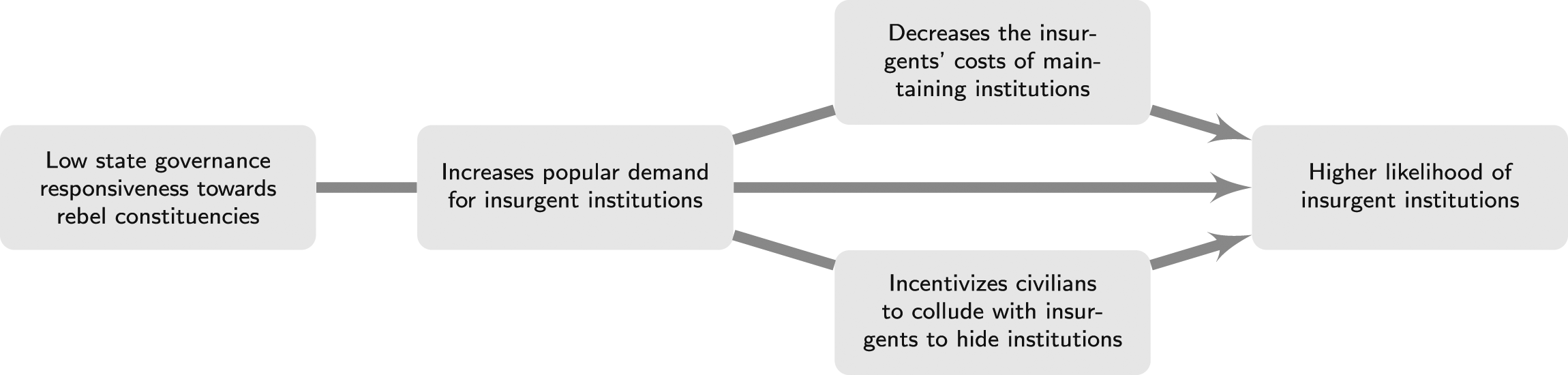
Second, popular demand decreases insurgents’ costs of establishing and maintaining governance institutions. Dominant state control means that citizens retain the possibility to turn to state institutions for public goods, or to forum-shop for the highest bidder. This “competitive governance” drives up the cost of establishing and maintaining insurgent institutions and deters rebels from extending their rule to areas outside their control (Revkin, 2021, p. 50). Convincing civilians to participate in insurgent institutions in state-dominated areas is thus more expensive for rebels than in areas where rebel rule is the only game in town (Wagstaff & Jung, 2020, p. 297). This dynamic is accentuated when rebel constituencies perceive whatever remains of the state bureaucracy as responsive to their needs, as trying to out-compete the state’s provision of public goods drives up the costs. Popular demand also helps make institutions more effective, as civilian compliance is often necessary for rebel governance to function (Florea & Malejacq, 2024, pp. 5–6). In contrast, when rebel constituencies view existing governance arrangements as unresponsive, even underdeveloped rebel institutions offer a significant improvement over the status quo, which lowers the bar for establishing insurgent governance (Rubin, 2020, p. 466).
Third, popular demand incentivizes rebel supporters to collude with insurgents to hide or conceal their institutions. Dominant state control makes it difficult for insurgents to shield their institutions and those who participate in them from counterinsurgent attacks, thereby decreasing the chance that civilians will risk involvement in insurgent institutions (Kasfir, 2015, pp. 27–29). But civilian agency can lessen this risk. Civilians who perceive state responsiveness as low and value rebel institutions as an alternative will be loath to reveal their presence to security forces. Without civilian cooperation, finding and shuttering rebel institutions is difficult. Rebel administrators can dispense public goods and services and regulate aspects of civilian life through informal networks and word of mouth. Many insurgent institutions have light physical footprints—at their simplest, courts for dispute resolution require nothing more than a judge and a makeshift courtroom, while political meetings can be held in basements and taxes paid under the guise of legitimate business. Without local information from cooperative civilians, identifying such light-footprint institutions and the rebel bureaucrats that covertly staff them is a tall task (Kalyvas, 2006). Conversely, when civilians perceive state responsiveness as high, they are more likely to conspire with state agents to stamp out insurgent institutions.
Scope Conditions and Nuances
Three main scope conditions apply. First, we seek to explain the conditions under which insurgents succeed in building and maintaining functional institutions in state-dominated areas, rather than why insurgents attempt to govern in the first place. A rich literature documents the factors that incentivize rebel groups to build institutions, including a reliance on civilian support (Huang, 2016; Weinstein, 2007; Wickham-Crowley, 1987) and secessionist ambitions (Mampilly, 2011; Stewart, 2018). Our argument is thus restricted to insurgent groups that intend to govern civilians, and seeks to explain when these groups succeed in establishing governance institutions in state-dominated areas and when they do not.
Second, civil wars are not always characterized by “a straightforward competition over the loyalty and compliance of civilians” (Staniland, 2012, p. 254), but can also feature bargains and state-insurgent cooperation (van Baalen & Terpstra, 2023). Since we assume that establishing insurgent institutions in state-dominated areas is difficult due to counterinsurgent military and governance operations, our argument only applies to cases in which there is competition between states and insurgents. Importantly, this scope condition implies a substantial degree of state capacity in the cases we theorize—a state sufficiently powerful and motivated to stymie the consolidation of insurgent territorial control.
Finally, our argument does not fully explain why rebel constituencies turn to insurgents for governance rather than towards other alternatives, such as religious groups, social movements, or organized criminal networks. The absence of (responsive) state governance need not imply rebel governance, even in areas under full rebel control (Glawion & Le Noan, 2023). On one hand, we agree that state-dominated areas haunted by an unresponsive state are likely to see a multitude of governors. Civilian self-governance, or “civilocracy” (Hyyppä, 2023, p. 53), should be particularly likely when civilians have high collective action capacity but view the insurgents as a threat to their values, ideology, identity, and social organization (Florea & Malejacq, 2024, p. 11; see also Arjona, 2016; Hyyppä, 2023; Rubin, 2020). Indeed, civilocracy holds a key advantage over rebel governance: security forces are less likely to punish participants in civilian institutions than those involved in illegal insurgent organizations.
On the other hand, while the insurgents are by definition out-gunned by the counterinsurgent in state-dominated areas, they still hold greater coercive capacity than their non-armed competitors. This coercive advantage offers important benefits. Clandestine insurgent cells can intimidate, threaten, or even kill rival governors, making civilian association with non-armed governors risky. Insurgents operating in state-dominated areas can also co-opt or collaborate with alternate governors, a behavior made easier by their common interest in supplanting an unresponsive state.
Perhaps most crucially, coercive capacity makes governance more effective, fostering popular demand for such governance among civilians. Insurgent governors can draw on their coercive endowments to punish crimes, enforce decisions, and forcibly redistribute wealth. Indeed, Arjona (2016, pp. 175–176) shows that in Colombia, social cleansing campaigns constituted the most common insurgent entry strategy into a new community. Courts and dispute resolution forums—both of which rely on coercion to enforce judgments—are among the most common insurgent institutions (Loyle, 2021). Thus, while insurgent institutions in state-dominated areas may not be the only game in town, civilians should be particularly likely to turn to them given their greater effectiveness. 2
Research Design and Analytical Approach
We combine between- and within-case qualitative analysis to assess our theoretical argument. This approach is suitable because our main ambition is to build theory and because most of our key variables are multidimensional and require in-depth contextual analysis. Additionally, a process-tracing approach allows us to disentangle the temporal sequence of state responsiveness and rebel governance in state-dominated areas, which is key for addressing endogeneity and examining causal mechanisms (Bennet & Checkel, 2015, pp. 7–8).
Main Features of the Cases.
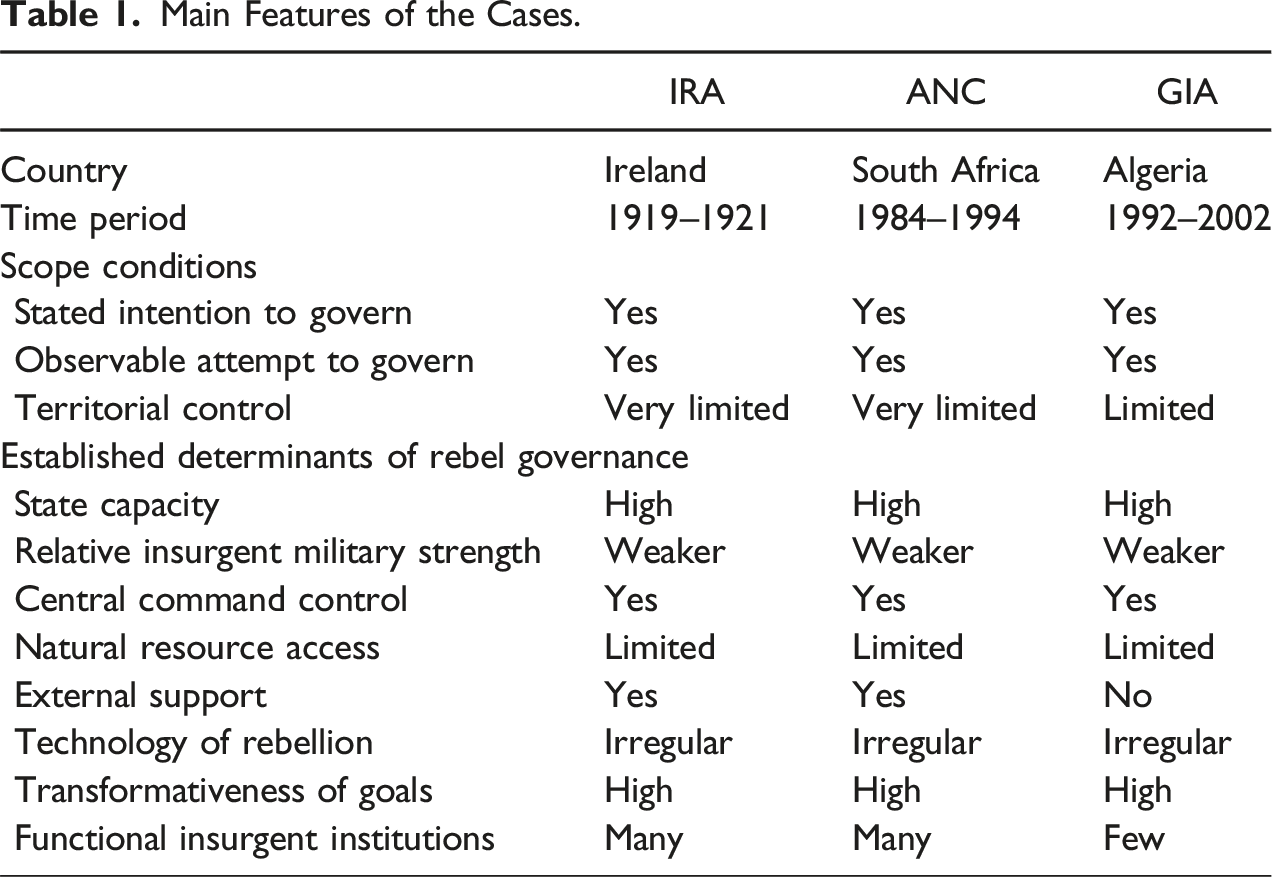
Insurgents can establish a plethora of different institutions that vary in sophistication, capital intensiveness, and need for territorial control (Albert, 2022). We focus on five cost-intensive and common insurgent institutions to measure our dependent variable: civilian councils, education provision, health care provision, courts, and police forces. Our interest lies with functional institutions, meaning that there must be evidence that civilians made use of these institutions. Measuring the degree of state governance responsiveness—our independent variable—demands attention to both citizen preferences and state responses (Grossman & Slough, 2022, p. 132). We thus interrogate citizen preferences as signaled by elections, polls, collective action, or expert accounts, and compare those preferences to the state’s reaction to such preferences.
Our argument expects that the establishment of functional insurgent institutions in state-dominated areas should be more common when state governance responsiveness towards rebel constituencies is low. Additionally, our argument yields several within-case observable implications that we use to structure the empirical analyses (Bennet & Checkel, 2015, p. 30). First, since a scope condition is that the insurgents are motivated to govern, we document that the insurgent group both intended to and took concrete steps towards governing civilians. Given our second scope condition, we investigate state-insurgent interactions in state-dominated areas to ensure that there was armed competition that obstructed insurgent institution-building. Third, we pay close attention to temporal sequence to ensure that low state responsiveness preceded and co-varied with the establishment of insurgent institutions over time. Fourth, regarding the popular demand mechanism, we expect to find evidence that citizens demanded alternative governance institutions (e.g., through protests, petitions, or attempts at self-governance), viewed insurgent institutions as a viable alternative, and participated in insurgent institutions despite serious risks. Fifth, concerning the governance costs mechanism, we anticipate seeing evidence that insurgent leaders considered the costs of establishing insurgent institutions and decided to challenge state institutions they perceived as less responsive. Finally, regarding the concealing institutions mechanism, we expect to find evidence that civilians worked with the insurgents to hide institutions. Given that all three cases are well-documented, we base our analysis on pre-existing sources such as scholarly studies, statistics, reports, and newspaper articles.
The Irish Republican Army (1919–1921)
The IRA was born in the context of increasing nationalist upheaval in Ireland in the early 20th century. Harsh British repression of the Easter Rising revolt in 1916 galvanized Irish nationalism. In the 1918 elections, the nationalist party Sinn Féin won a large majority, declared independence, and formed a new parliament, the Dáil Éireann. The IRA became the Dáil’s armed wing and began to wage war against British forces on the island. The war continued until 1921, when the parties signed a truce that paved the way for Irish independence in 1922 (Mulholland, 2013).
Badly outgunned by British forces, the IRA never attempted to hold territory. The IRA instead pursued a methodical guerrilla campaign, using “flying columns” to conduct hit-and-run strikes on Royal Irish Constabulary (RIC) forces and barracks. Its combatants relied almost exclusively on ambushes, assassinations, and acts of sabotage rather than frontal attacks (Mulholland, 2013). Thus, the IRA was “a movement that functioned on the run,” a decentralized, covert organization composed of autonomous and often disconnected brigades conducting independent guerrilla operations (Costello, 2003, p. 88).
The IRA and the Dáil Éireann made governing civilians a core priority. The Dáil viewed itself as the legitimate elected government of the Irish people, and the IRA as the military guarantor of that government. Performing the functions of modern statehood was essential to proving that legitimacy to both domestic and international audiences (Mitchell, 1995). As the head of the Dáil’s new civil service put it in 1919: Actual constructive work will leave a bigger mark on people than political work […] it invests the Government with tangibility as such. It means that the Dáil […] is functioning as any progressive Government should be expected to function (Mitchell, 2002, 74, emphasis in original).
The establishment of parallel government quickly followed these ambitious proclamations (Mulholland, 2013). Hence, the IRA showed a clear intention to govern civilians.
The strategic emphasis on governance had immediate and lasting effects. In spite of its limited territorial control, the IRA forged a sophisticated network of institutions for service provision, dispute resolution, and political organization. The Dáil Éireann itself represented a democratically-elected civil administration body that operated entirely from territories beyond the IRA’s military control. The IRA’s parliament-in-waiting accomplished several substantial governance tasks. Between January 1919 and May 1921, the Dáil Éireann met 21 times and passed 36 decrees. Additionally, the insurgents established a system of county councils loyal to the Dáil rather than the British Local Control Board. The Dáil instituted an effective system of local oversight, which required county councils to submit minutes of meetings, and appointed undercover inspectors to audit the councils’ performance and support their tax collection efforts (Daly, 1994). Furthermore, the IRA and Dáil created a system of national arbitration courts to resolve disputes, and enlisted IRA volunteers to enforce court decisions (Kotsonouris, 1994). What accounts for the IRA’s success in establishing institutions in state-dominated areas?
The British state’s governance responsiveness was overall low in Ireland, especially among the Irish nationalists whom the IRA considered its core constituency. Many Irish citizens, particularly the Catholic majority in central and southern Ireland, felt the British government represented neither their interests nor their identity. Nationalist sentiment intensified with rising international calls for self-determination and decolonization after World War I (Mitchell, 2002, pp. 70–73). This sentiment was further inflamed by the brutal British crackdown on the Easter Rising revolt (Mitchell, 2002, p. 72). Nationalists thus saw British institutions as unresponsive due to the simple fact of not being Irish.
Additionally, Irish citizens had functional complaints about British rule, especially about rural land rights (Laird, 2005, p. 63). Despite British land reform efforts, land inequality remained a central theme among Irish nationalists, and Britain’s policy of granting land to soldiers was highly unpopular. A Wexford farmer remarked that the British “take over the land, British Army officers […] they had big mansions, the local people had mud cabins” (Augusteijn, 2002, p. 114). Likewise, an IRA leader in Cork banned property sales by Protestant landowners because “we were not going to have them leave Ireland with money in their pockets from land they had stolen from the people” (Augusteijn, 2002, p. 114). This widespread anger at British land policy highlighted the unresponsiveness of British governance to local demands.
Evidence suggests that low state governance responsiveness enabled the IRA’s establishment of insurgent institutions in state-dominated areas. As our theoretical framework suggests, it seems to have generated widespread popular demand for insurgent rule (Hughes, 2014, p. 30). This dynamic was especially evident around insurgent courts. One Irish unionist diagnosed the success of the Dáil’s courts as being due to popular dissatisfaction with the British justice system: [The Dáil] has become the de facto Government. Its jurisdiction is recognized. It administers justice promptly and equably […] The logical deduction is that profound dissatisfaction with the origin of the law, not with law and order, is the cause of the trouble (Kotsonouris, 1994, p. 22).
The importance of low state responsiveness was visible in the IRA’s efforts to encourage demand for rebel governance by undermining the effectiveness of state institutions. Pro-Dáil local authorities locked British courthouses and the IRA attacked RIC barracks, further diminishing the effectiveness of British courts and police in rural areas. The IRA and Dáil leadership pressured civilians to bring complaints to Republican courts only, declaring recourse to the British courts “a betrayal” (Kotsonouris, 1994, p. 49) and threatening violence against people who used the incumbent system (Ferriter, 2015, p. 226). Dáil courts quickly came to be seen as the only functional judicial system in these areas.
Second, the IRA focused their governance efforts on those aspects of British rule where state governance responsiveness was particularly low. Popular dissatisfaction with British rule ensured that IRA-sponsored alternatives were often preferable to the status quo. The Dáil itself represented a response to popular complaints about descriptive representation: a relatable, identifiable symbol of Irish self-rule responsive to Irish citizens. According to the Dáil president, it was a body that stood for “the right of the people of this nation to determine freely for themselves how they shall be governed” (McCracken, 1958, p. 28). The Dáil also recognized that land tenure was an area ripe for revolutionary governance. Sinn Féin’s founder Arthur Griffith argued that “the Land question is the biggest question we have” (Mitchell, 1995, p. 87). In response, the Dáil established a bank dedicated to financing land purchases by smallholders and tenants and launched a new—albeit largely ineffective—land reform program (Ferriter, 2015, pp. 229–235). This focus extended to the court system, where the insurgents prioritized adjudicating land tenure cases that British courts had failed to address (Ferriter, 2015, p. 129; Mitchell, 1995, p. 136).
Finally, the IRA exploited the popular demand for insurgent institutions and the RIC’s lack of reliable human intelligence to hide its institutions from repression. The Dáil held covert meetings and operated its ministries through a dozen unmarked offices scattered around Dublin (Mitchell, 1995, p. 54). IRA-sponsored courts were also forced to operate covertly, working out of “farmhouses, barns and schools” (Ferriter, 2015, p. 227). One court in Dublin was held in the main British-controlled courts complex “under the cover of a mundane legal consultation” (Kotsonouris, 1994, p. 48). The popularity of Republican governance ensured that many civilians helped protect institutions. Citizens hosted covert Dáil courts in their “creameries, farmhouses, outhouses, barns” (Costello, 2003, p. 203). Petitioners to a West Limerick court hid their cars to avoid scrutiny (Kotsonouris, 1994). Sympathetic postal workers disrupted British attempts to repress Republican operations by seizing their correspondence and redirecting it to the IRA, to the extent that the British army had to transmit mail by airplane (Mitchell, 1995, p. 205).
In sum, the British state’s low governance responsiveness enabled the IRA to establish institutions despite lacking territorial control. Widespread dissatisfaction with British rule among the IRA’s core constituency allowed the insurgents to establish institutions for dispute resolution, wealth redistribution, and political organization. By focusing insurgent governance on issues where British rule was especially unresponsive, the IRA tapped into a deep reservoir of popular demand, thereby reducing governance costs and concealing institutions from counterinsurgent repression.
The African National Congress (1984–1994)
The ANC emerged in 1912 to promote racial equality and democracy in apartheid South Africa. The movement initially relied on nonviolent tactics, but launched an underground armed wing, Umkhonto we Sizwe (MK), and a guerrilla campaign in 1960 (Darracq, 2008, p. 591). MK established bases in frontline states like Mozambique and Zambia, recruited and trained thousands of fighters, and received significant military support from the Soviet Union, Angola, and Cuba (Jeffery, 2009, pp. 4–6). Although the government arrested the MK leadership in 1963, the ANC continued to fight until the civil war’s end in 1994. Our analysis focuses on the post-1984 period, when the ANC launched a people’s war and actively attempted to establish insurgent institutions (Jeffery, 2009, p. 67).
Due to the apartheid government’s military superiority and the lack of suitable guerrilla warfare terrain, the ANC never established consolidated territorial control. Instead, the ANC operated through underground cells in South Africa and from secret bases in neighboring countries, and waged an armed struggle characterized by acts of sabotage, sporadic clashes with government forces, and covert operations to stir up popular resistance (Herbst, 1988, pp. 667–669; Jeffery, 2009, pp. 85–121). To the extent that the ANC operated on South African soil, their military presence was limited to temporary control over certain black townships (Herbst, 1988, pp. 667–668). Nevertheless, the state’s security forces maintained the capability to enter, raid, and repress political dissent in the townships, turning South Africa’s peri-urban areas into a battle zone (TRC, 1998).
The ANC’s impetus for establishing insurgent institutions emerged with the 1979 strategy describing a protracted people’s war (Jeffery, 2009, p. 41). This strategy, operationalized in a document entitled Planning for a People’s War, put great emphasis on the need to develop underground structures (Rueedi, 2020, p. 619). A key lesson was the imperative “to create the social organisations which will motivate, mobilise, and ultimately control the people” (Jeffery, 2009, p. 28), which the ANC leadership viewed to be “of great significance for the further advancement of our struggle” (Seekings, 2000, p. 170). The ANC therefore moved to create organizations for interacting with civilians and to co-opt or collaborate with existing civilian institutions (Jeffery, 2009, p. 46). At the same time, the ANC-affiliated United Democratic Front (UDF) adopted a similar strategy of “people’s power” that focused heavily on creating alternative governing structures (Seekings, 2000, p. 169). Thus, the ANC’s intention to govern civilians is well-documented and included concrete steps towards building insurgent institutions.
Despite the ANC’s weak military standing, it succeeded in developing a sophisticated parallel governance system in state-dominated areas. The ANC established elected area, block, and street committees that helped organize stayaways, rent boycotts, and strikes (Jeffery, 2009, p. 86), and facilitated the provision of both education and health care (Price, 1991, pp. 214–215). Moreover, ANC militants formed “people’s courts” for policing and resolving local disputes in the townships (Jeffery, 2009, p. 86), as well as punishing defectors (Price, 1991, p. 210). Black South Africans often participated en masse in the ANC’s government-in-waiting, “effectively creating a situation of dual power” (Zunes, 1999, p. 156). What explains the ANC’s success in establishing institutions in state-dominated areas?
State governance responsiveness was overall low in South Africa. Although the regime managed a capable state administration, apartheid’s racial segregation meant that state governance was highly unresponsive to the black majority’s needs and seen as a source of oppression rather than services. The black local councils, designed to improve the state’s standing among the ANC’s prime constituents (Jeffery, 2009, p. 69), were widely perceived as corrupt, ineffective, and illegitimate. The village and town councils established in 1982 were equally unpopular, inspiring a turnout under 20% in the 1983 local elections (Jeffery, 2009, p. 69). State governance responsiveness declined further in the 1980s, when it responded with heavy repression to the ANC’s mission to make the country ungovernable (Jeffery, 2009, p. 69) by destroying the black local administration and replacing it with its own civic associations (Herbst, 1988, p. 668). According to the ANC’s official strategic plan adopted in 1979, “reducing the capacity of the enemy to govern” constituted a central tactic (The Green Book, 1979). One strategy was to attack and kill non-white security officers and councillors, making state administrative positions “very dangerous to hold” (Stemmet & Barnard, 2003, p. 102). Another strategy leveraged the power of nonviolent mass action such as rent boycotts to economically and morally bankrupt the apartheid state (Zunes, 1999).
The apartheid regime’s low willingness to respond to the black majority’s needs made space for insurgent institutions. When the state’s willingness to provide governance declined, it “became an opportunity [for the ANC] to make some inroads in the communities on the ground” (Darracq, 2008, p. 592). As Zunes (1999, p. 157) asserts, “alternative institutions prospered because official institutions were no longer recognised as legitimate.” Moreover, consistent with our argument, the creation of ANC-sponsored committees and courts often followed “the collapse of government-created structures such as Community Councils” (Vol 2. TRC, 1998, p. 383), suggesting that low state responsiveness was important for the viability of insurgent institutions (Jeffery, 2009, pp. 85–86). The establishment of an ANC “de facto government” in Alexandria township in Johannesburg, for example, followed large protests and riots that undercut the state’s legitimacy and made the township ungovernable (Herbst, 1988, p. 668), while the Residents’ Civic Association, a UDF affiliate, in the Inkwenkwezi township in Port Alfred came about when state rule broke down (Jeffery, 2009, p. 87).
Several additional pieces of evidence concerning the causal mechanisms are consistent with our thesis. First, there was broad popular demand for alternative governance institutions. The most telling indicator of this demand is that civilians started to establish their own grassroots institutions for managing township affairs and “bread and butter” issues (Darracq, 2008, p. 592). Township residents created these institutions in “response to the resignation of township councillors and the collapse of municipal services and other aspects of local state administration” (Seekings, 2000, p. 169). These grassroots initiatives signaled to the ANC that there was growing demand for alternative institutions and that the time was ripe for insurgent institution-building in the townships (Darracq, 2008, p. 592; Seekings, 2000, p. 170). Moreover, as the initial establishment of parallel institutions was born out of necessity rather than ideological fervor, township residents were willing to take great personal risks to participate in insurgent institutions (TRC, 1998, pp. 614–615).
Second, ANC leaders seemed aware that establishing insurgent institutions in the shadow of a dominant state was a costly endeavor that could only succeed if the state was perceived as unresponsive to local citizens. In fact, Oliver Tambo announced that the establishment of alternative institutions should focus precisely on hitting the enemy administration “where it is the weakest” (Jeffery, 2009, p. 67). Additionally, it is telling that the ANC invested in alternative institutions only in the 1980s—when there was a massive decline in state service provision—and not in the 1960s and 1970s, when the state still maintained some services for black residents (Zunes, 1999, p. 157). Hence, while it is difficult to establish to what extent low state responsiveness made the ANC less concerned about the costs of competitive governance, it seems unlikely that the ANC would have adopted this strategy had state governance responsiveness been higher.
Third, civilians helped conceal insurgent institutions from counterinsurgency operations. The apartheid state maintained the capacity to deploy soldiers and police in the townships, yet the ANC’s popular support made it “extremely difficult” for the state to penetrate the townships’ social landscapes (Rueedi, 2020, p. 618). For example, in Alexandria township, the entire township organization went underground to hide from state security forces empowered by a state of emergency in 1986 (TRC, 1998, p. 614). Social networks based in kinship, schools, churches, and community organizations played a key role in protecting clandestine institutions, while other insurgent institutions charaded as apolitical civic associations (Rueedi, 2020, p. 618). In contrast, whenever the state was able to ensure civilian collaboration, as in the Khayelitsha township in Cape Town, it “vigorously crushed” prospective insurgent institutions (Vol 3. TRC, 1998, p. 472).
Finally, subnational variation in state responsiveness correlated with insurgent institutions. In 1970, the apartheid government established the homeland system, which aimed to improve the state’s responsiveness by delegating power to black rural elites, while simultaneously stripping black South Africans of their citizenship (van Kessel & Oomen, 1997, pp. 564–565). Most of the homeland rulers held little popular legitimacy and were both unwilling and unable to respond to their residents’ needs (van Kessel & Oomen, 1997, pp. 566–567), enabling ANC institutional infiltration (Vol 2. TRC, 1998, p. 419). One exception was KwaZulu, which incorporated the popular Inkatha movement and empowered traditional Zulu institutions. Inkatha believed that Zulu liberation was best achieved by resisting the apartheid system from within rather than alongside the ANC, a movement perceived as openly hostile towards the Zulu (Jeffery, 2009, pp. 148–149). With Inkatha’s tacit support, the state could lessen the ANC’s appeal among Zulu people that may otherwise have flocked to the ANC (van Kessel & Oomen, 1997, p. 570). This mediated state responsiveness made it more difficult for the ANC to establish institutions in KwaZulu, as Inkatha supporters helped the state identify and violently evict insurgent institutions (Schuld, 2013, pp. 64–65). For example, in Mpumalanga township, Inkatha used resident support to establish a “no go” area that forced the ANC to withdraw “from the organisational terrain” (Bonnin, 2006, p. 68). Similar violent efforts to uproot ANC institutions unfolded across the rest of KwaZulu in the 1980s and 1990s (Vol 3. TRC, 1998, pp. 77–122).
In sum, we find that the apartheid state’s low governance responsiveness created favorable opportunities for the ANC to establish insurgent institutions in state-dominated areas. While the regime partially created these conditions, the ANC’s ability to exploit this weakness was crucial in enabling the insurgents to govern the shadows.
The Groupe Islamique Armée (1992–2002)
The Algerian civil war started in 1992, when the military prevented the Front Islamique du Salut (FIS) from translating their electoral success into political power. In response, several Islamist armed groups launched an armed struggle against the state (Hafez, 2020, p. 614). Among them was the GIA, a coalition of localized militias with ties to the Algerian mujaheddin that fought in Afghanistan or older homegrown Islamist militants (Thurston, 2020, pp. 33–34). The GIA took a more radical stance towards the government than other insurgent groups, rejecting all forms of concessions and negotiations (Hafez, 2000, p. 581). The GIA ceased to exist as a unified and coherent movement in 1997, although its remnants remained active until 2002 (Kepel, 2002, pp. 273–274).
The GIA never exercised consolidated territorial control over large swaths of Algeria for a sustained period of time (Martinez, 2000, p. 197). Nevertheless, the GIA established something akin to contested control over several remote mountain bases, Algiers suburbs, and larger cities in the Mitidja plain (Lia, 2015, p. 33). Recurrent military incursions by both government forces and the GIA, as well as highly fragmented patterns of local control, characterized these contested zones (Kalyvas, 1999, p. 264). The guerrillas first infiltrated these areas in 1992–1993, when they attacked police outposts and forced the Algerian army and police to evacuate (Kalyvas, 1999, p. 262; Lia, 2015, p. 33), and exercised higher degrees of territorial control for one to three years (Kalyvas, 1999, p. 262). The state put the GIA on the defensive in 1994, and soon the insurgents lost control of most areas, including the Algiers suburbs in 1993–1994, smaller towns around Algiers in 1994, and most parts of the Mitidja plain in 1996 (Kalyvas, 1999, p. 263). The rebels retained their bases in the hills surrounding the Mitidja plain, leaving Mitidja an area dominated by the government for the remainder of the war (Kalyvas, 1999, pp. 263–264).
The GIA’s intention to govern stemmed from its overall political objective to transform Algeria into an Islamic state through violent jihad (Hafez, 2020, p. 615). There is evidence that local GIA commanders initiated some governance activities as early as 1992–1994 (Martinez, 2000, pp. 100–106), mainly by imposing sharia law on residents in contested areas and engaging in vigilante justice (Watts, 2015, p. 158). The intention to govern civilians became explicit on 26 August 1994, when GIA leader Cherif Gousmi announced the creation of a Caliphate in liberated areas that would “manage the affairs of the umma in the framework of a state governed by the law of the Almighty” (Willis, 1996, p. 329). Gousmi declared himself Caliph of Algeria, and outlined an Islamic government-in-waiting that consisted of eleven ministries, including an interior and foreign affairs ministry (Stone, 1997, p. 188; Willis, 1996, p. 329). Hence, there is evidence that the GIA intended to govern and took concrete steps towards establishing insurgent institutions.
Despite the GIA’s state-building ambitions, there is little evidence that the group established and sustained functional institutions in state-dominated or even contested areas. Most institutions were provisional and short-lived. Although several accounts indicate that the GIA established some governance in areas under their influence (Kalyvas, 1999, pp. 262–264; Lia, 2015, p. 33), these accounts do not specify what types of institutions the guerrillas maintained. There is no evidence that the group provided education or health care, or that it created local councils or police forces. Instead, most examples of GIA governance are efforts to regulate local economies (Martinez, 2000, pp. 108–109; Willis, 1996, p. 375). One exception was the imposition of sharia law, yet even this form of rebel governance mainly took the form of violence rather than careful regulation of religious affairs (Watts, 2015, p. 158; Willis, 1996, p. 375). What explains the GIA’s failure to maintain insurgent institutions in state-dominated areas?
Algeria in 1992 was far from a model democracy in which the state made political decisions that corresponded to citizen preferences. Nevertheless, Algerians experienced an unprecedented improvement in state responsiveness in the immediate prewar period. Set against a deep economic crisis that hamstrung the Algerian state (Willis, 1996, p. 109), the one-party state embarked on “ground-breaking” political reforms in the late 1980s (Aghrout, 2004, p. 200). In 1988, massive demonstrations and public unrest pushed the government to liberalize the political system and legalize organized civil society and opposition organizations (Thurston, 2020, p. 31; Willis, 1996, p. 107). These reforms paved the way for a dormant Islamist movement to organize a political party, the FIS, which grew quickly and won 54% of the votes in the 1990 commune election (Willis, 1996, p. 133) and 188 out of 430 seats in the 1991 parliamentary election (Thurston, 2020, p. 31). Thus, for the first time in decades, both the national and local government increasingly reflected the electorate’s pro-Islamist preferences (Le Sueur, 2010, p. 44). While the 1992 military coup put democratization and further islamization on hold, these political reforms established a more pluralist political opposition that the military elite had to relate to during the civil war (Aghrout, 2004, p. 201).
The increase and sudden relapse of the Algerian state’s responsiveness appears to have provided favorable conditions for jihadist governance at the beginning of the war. The GIA’s initial military success and embryonic governance was most pronounced in communes that voted for the FIS (Martinez, 2000, p. 95), where many people supported and collaborated with the insurgents (Kalyvas, 1999, pp. 260–261). Nevertheless, as the state’s responsiveness towards FIS voters started to improve again in 1994, the space for insurgent institutions closed and GIA governance failed to take root. In 1994, the Algerian state initiated several reforms that boosted its perceived responsiveness, including efforts to make the state administration more responsive to local needs (Martinez, 2000, p. 173). These reforms, augmented by international aid and the oil industry, helped the government with nothing less than a “social reconquest of the nation” (Martinez, 2000, pp. 178–179) and “represented a step in the direction of re-establishment of trust between the population and the government” (Le Sueur, 2010, p. 69).
The state’s growing responsiveness spearheaded several developments that speak to our hypothesized causal mechanisms. First, the Algerian state’s rising responsiveness and the GIA’s increasing brutality undermined popular demand for insurgent institutions. Both the 1995 presidential and 1997 parliamentary election testified to this political shift away from Islamist governance (Le Sueur, 2010, p. 69), as voters abandoned Islamist parties for a nationalist center-left coalition (Stone, 1997, p. 257). In parallel, popular demand for insurgent institutions eroded because the GIA’s incipient institutions were of such poor quality. GIA governors struggled to sustain local economies and provide services to the population (Watts, 2015, p. 158), and many GIA leaders became heavily involved in corruption and violence (Kepel, 2002, p. 271). The GIA’s terror campaign against civilians further eroded popular demand for insurgent rule (Kepel, 2002, p. 273). Case experts note that this brutality played a major role in extinguishing the remaining popular demand for jihadist institutions (Martinez, 2000, p. 109). Likewise, the FIS recognized that the GIA’s terror campaign undermined popular demand for Islamist rule and “drained the reservoir of sympathy among the population formerly supporting the FIS” (Martinez, 2000, p. 204). As Watts (2015, p. 158) notes, local citizens that once supported the GIA “saw them instead as the new oppressors” and became “more receptive to the Algerian government as the promises of Sharia governance fell short of reality.”
Second, the state’s rising responsiveness made maintaining germinal insurgent institutions more costly. There are no internal documents available that allow us to examine the GIA’s strategic decisions concerning governing state-dominated areas after 1995. However, given the state’s improved prowess at providing services, there is evidence that out-governing the state was no longer a realistic prospect. In fact, undermining insurgent governance was precisely what the Algerian state aimed at by trying to get ahead of the GIA in terms of public goods provision (Martinez, 2000, p. 173). The state’s deepened involvement in ensuring dispute resolution, for example, challenged the GIA “on their own ground” and provided civilians with an alternative to the GIA’s courts (Martinez, 2000, pp. 178–179). State administrative reform and more equitable redistribution of housing and property further raised the bar for insurgent institutions, a bar that the GIA was unable to reach given its limited economic resources (Martinez, 2000, pp. 176–179).
Third, the state’s growing responsiveness and the GIA’s waning popular base made it near impossible for the insurgents to hide whatever institutions they had left. The Algerian state modernized its counterinsurgent forces in 1994 and established a Commune Guard some 50,000 men strong that infiltrated the GIA and trailed the militants in the suburbs (Martinez, 2000, pp. 154–155). The government also tightened control over its administrative networks to prevent local strongmen from colluding with the GIA, for example, by involving the population more in local administration (Martinez, 2000, pp. 172–173). Furthermore, the government professionalized the local civil service in an attempt to wipe out personal networks that could facilitate collusion with the jihadists (Martinez, 2000, p. 175). Improvements in state responsiveness thus went hand in hand with the state’s capacity to uproot insurgent institutions. This development paired with the negative fallout of the insurgents’ indiscriminate violence against civilians. The violence provoked mass defection among GIA supporters, who either fled to government-controlled zones or joined pro-government militias (Kalyvas, 1999, p. 267). As the militias grew stronger and civilians colluded with government forces, witness testimonies suggest that even staunch Islamist supporters feared being associated with the insurgents (Kalyvas, 1999, pp. 263–267).
The Algerian case shows that increasing state governance responsiveness and declining demand for insurgent institutions greatly limited the GIA’s ability to maintain institutions in state-dominated areas. Ironically, this dynamic was exacerbated by the GIA’s own indiscriminate violence against civilians. The group’s attempt to become Algeria’s sole jihadist group by targeting rivals (Hafez, 2000, pp. 582, 590) further weakened its proclaimed Caliphate as government pressure intensified.
Comparing the Cases
Summary of Process-Tracing Results.
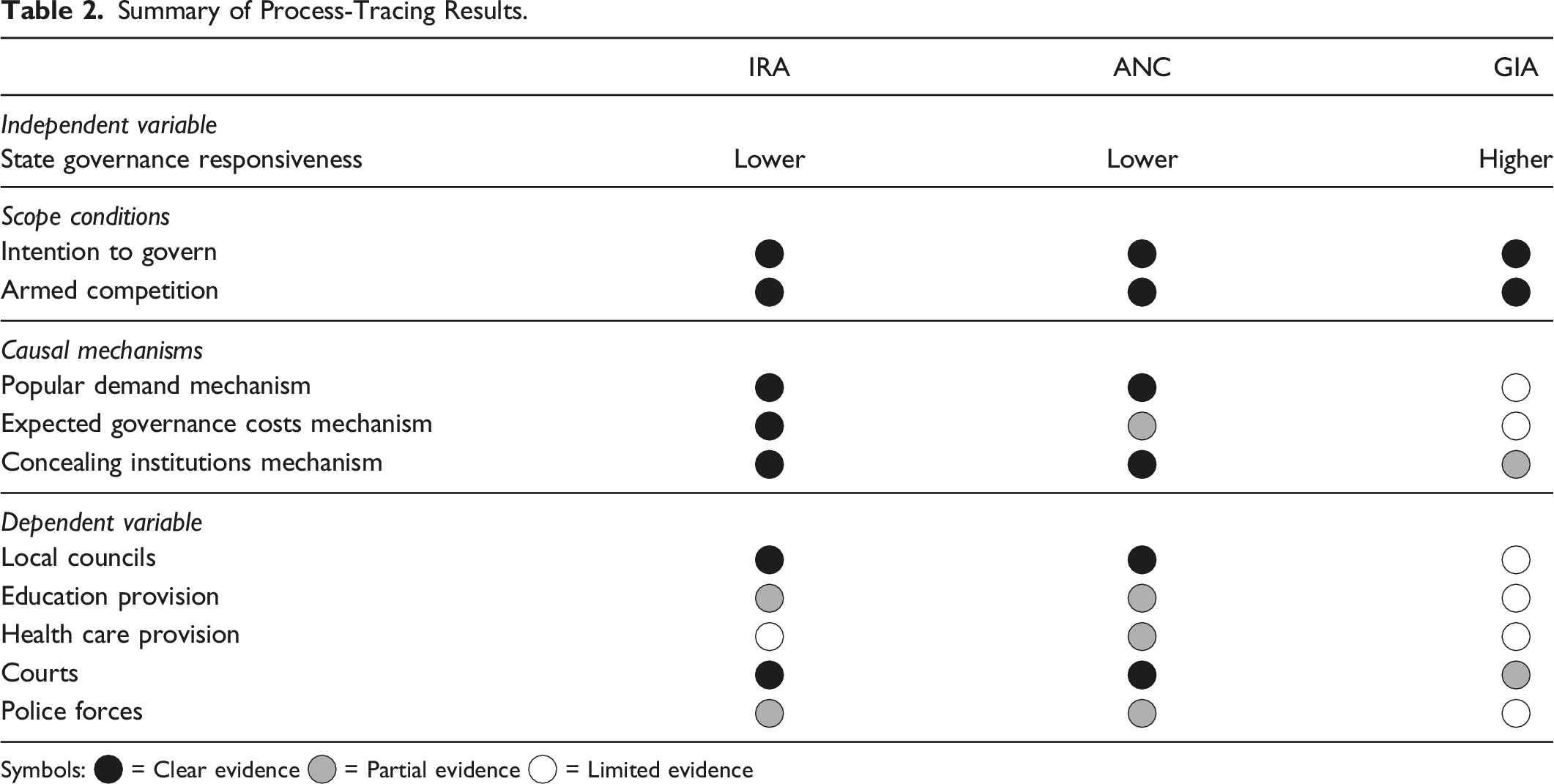
Symbols:  = Clear evidence
  = Partial evidence
  = Limited evidence
The findings come with important nuances that further contribute to theory-building. First, a critical concern is endogeneity: the possibility that low state responsiveness was a result of successful insurgency and rebel governance rather than the enabling factor. This concern is heightened by the observation that both the IRA and ANC actively sought to influence perceived state responsiveness: the IRA by discrediting state dispute resolution institutions through attacks on police stations and courtrooms (Mitchell, 1995, pp. 144–146), the ANC by denouncing the local state administration and making the country ungovernable (Herbst, 1988, p. 668). While further research is needed to address this endogenous relationship, several observations increase our confidence that the results are not only driven by endogeneity. For the IRA and ANC, we document low state responsiveness before the emergence of insurgent institutions. Moreover, although both the IRA and ANC sometimes prompted declines in state responsiveness, we also observe how insurgent institutions emerged in domains where state responsiveness was low due to exogenous variation driven by deep imperialist and racist sentiments within the British and South African governments. The ANC’s street committees, for example, took hold in large part because the apartheid government did not allow black South Africans to make their voices heard in any other way (Zunes, 1999, p. 156). Likewise, the IRA’s efforts to address disputes around land tenure responded to failures of British rural governance stretching back decades (Ferriter, 2015; Mitchell, 1995).
Second, we find preliminary evidence that indiscriminate insurgent violence against civilians can constitute an obstacle for establishing insurgent institutions in state-dominated areas. The Algerian case shows that the GIA’s brutal onslaught against civilians intervened in the hypothesized causal process and depleted popular appetite for its Caliphate-in-the-waiting (Martinez, 2000, p. 109). Similar dynamics—albeit to a lesser degree—also developed in South Africa, where the ANC’s harsh treatment of suspected fifth columnists tarnished the reputation of its people’s courts (Jeffery, 2009, pp. 110–111). This finding resonates with existing research that finds that repression and other violations of the implicit social contract between rebel rulers and civilians erode insurgent institutions (Revkin & Ahram, 2020).
Third, the analysis showcases that insurgents can also protect their institutions by operating through affiliated civil society organizations, a common practice when insurgent groups control territory as well (Mampilly & Stewart, 2021, p. 19). Such collusion between insurgents and civil society was enabled by popular demand for alternative governance, which inspired the creation of parallel institutions, and thus complements rather than contradicts our argument. Both the IRA and the ANC succeeded in extending institutions into state-dominated areas by supporting, co-opting, and cooperating with political organizations and social movements. In Ireland, the IRA collaborated with the Dáil to establish and maintain insurgent institutions (Mitchell, 1995, pp. 147–154). In South Africa, the state’s unwillingness to serve the black population galvanized the creation of civic institutions and allowed the ANC to collaborate with the UDF to oversee institutions without establishing a military foothold (Price, 1991, pp. 204, 216). In contrast, the GIA’s violent onslaught on civil society prevented it from maintaining any lasting societal alliances that could have helped it govern (Kepel, 2002, p. 273). This additional finding corroborates existing research that shows that insurgents’ social embeddedness enables them to build alliances and coordinate with other actors in state-dominated areas (Waterman, 2023).
Our main inferential leverage comes from within-case evidence rather than the comparative analysis. Nevertheless, it is worth noting differences between the cases that could influence our findings. One difference is that both the IRA and ANC challenged settler states and espoused an anti-colonial liberation agenda that garnered considerable international sympathy, while the GIA embraced a radical Islamist position that alienated even other jihadist groups. Although this lesser dependence on international support may have made the GIA more inclined to abandon its state-building project (Stewart, 2018), it is important to remember that both the IRA and ANC were viewed as terrorist organizations by powerful Western states. Additionally, even though jihadist rebel governance tends to be more repressive than non-jihadist rebel governance, insurgent institutions are deeply ingrained in the transnational jihadist cause (Lia, 2015). More successful jihadist rebel rulers, like the Taliban, demonstrate that advocating radical Islamist rule in itself does not constitute an obstacle to governing the shadows (Terpstra, 2022).
Conclusion
This study examines the establishment of functional insurgent institutions in state-dominated areas, where the incumbents exercise secure but incomplete military control. We argue that low state governance responsiveness towards rebel constituencies can enable insurgents to govern absent consolidated territorial control, and we identify three inter-linked mechanisms connecting low responsiveness to rebel governance. 4 In doing so, we contribute new knowledge on the determinants and dynamics of rebel governance in civil war. Our findings also underline the need to further interrogate how we conceive of and measure territorial control, and to divert more focus towards contested war zones and asymmetric civil wars (Jentzsch & Steele, 2023; Waterman, 2023). The case studies indicate that there is important variation across state-dominated areas: while the population has some access to both the state and the rebels in such zones (Kalyvas, 2006, p. 212), the degree and form of that access differ substantially. Putting state-dominated areas under the analytic lens may therefore also reveal other surprising dynamics of rebel governance, including greater collusion between civilians, state agents, criminals, and insurgents in the production of wartime order (Staniland, 2012).
The viability of insurgent governance in state-dominated areas has three central implications for future research. First, it suggests that we need to revise our understanding of how insurgents establish both territorial control and governance. Most existing theories view the creation of rebel rule as mirroring the “clear, hold, build” model of counterinsurgency: capture territory first, then organize civilians and provide services (Loyle et al., 2022, p. 20). The institution-building trajectories in Ireland and South Africa indicate that this model is but one of several possible routes towards rebel rule. Both the IRA and ANC operated more according to a “build, clear, hold” logic that entailed building alternative institutions and then attempting to control the area, or engaged in all three strategies simultaneously. Future research should continue to question the assumption that rebel governance mandates full territorial control, and instead direct attention towards understanding the dynamic relationship between territorial control and governance, as well as the conditions that allow insurgents to govern the shadows. Doing so will also demand further conceptual work on how territorial control—a central object in the study of civil war—should be understood and measured.
Second, our results speak to a growing literature on criminal governance (Barnes, 2017; Lessing, 2021; Magaloni et al., 2020). Gangs and drug trafficking organizations routinely provide public goods, punish petty crime, and resolve disputes in communities they influence. This type of governance is strikingly common, affecting up to 100 million people in the Americas alone, and is largely concentrated in the urban areas where state coercive might is most pronounced (Uribe et al., 2022). Our findings suggest a possible rationale for this phenomenon: like the insurgent groups we study, criminal organizations may capitalize on low state governance responsiveness to build and sustain governance institutions in epicenters of state power.
A final implication is that we may have to reconsider canonical accounts of state formation. Dominant state formation theories assert that territorial control is both a crucial precondition for and a defining feature of the modern state (Olson, 1993; Tilly, 1992). At the very least, our findings suggest that institutional infiltration constitutes an alternative pathway towards statehood. Though not all rebel organizations develop into recognized states, wartime institution-building often lays the foundation for outcomes just short of statehood, including one-party systems (Müller, 2012) and de facto states (Florea, 2017). Future research would do well to examine all possible state formation trajectories, including those that do not start with consolidated control over territory. A more profound possibility is that existing state formation research has overlooked institutional development as a precursor to coercive control over territory. Revisiting the historical record of modern states may thus reveal state formation trajectories that deviate from established theories. Should this be the case, we may need to rethink some of the core assumptions about the state that political science research rests on.
Footnotes
Acknowledgments
We thank Annekatrin Deglow, Kristine Eck, Kristine Höglund, Marcus Kurtz, Paul Staniland, Niels Terpstra, Megan Turnbull, and participants in the Research Paper Seminar at the Department of Peace and Conflict Research, Uppsala University for insightful comments on earlier drafts. We also thank three anonymous reviewers for their constructive feedback.
Declaration of Conflicting Interests
The authors declared no potential conflicts of interest with respect to the research, authorship, and/or publication of this article.
Funding
The authors disclosed receipt of the following financial support for the research, authorship, and/or publication of this article: The study was financed by the Swedish Research Council (Vetenskapsrådet VR2020-03936).

Data Availability Statement
Data sharing not applicable to this article as no datasets were generated or analyzed during the current study.