




Abstract
Does citizen belief in the non-instrumental principles of the political regime, such as strongman leadership, patriotism, or attachment to a charismatic leader, collectively known as normative support, help stabilize authoritarian regimes? While a large literature recognizes that authoritarian regimes depend on popular support to lower the costs of staying in power, existing research mainly views mass support for these regimes as instrumental, fuelled by performance. Using novel experimental evidence from two original online surveys fielded in Turkey and observational data, we find high levels of normative support for Turkey’s authoritarian rule. Further, our results demonstrate that instrumental and normative dimensions of support may be more closely related than previously theorized. Importantly, we show that both forms of support prevent voter defections in times of crisis. These findings, which revisit the importance of citizens’ support for regime resilience, have implications for research on mass opinion and defection cascades in electoral autocracies.
Introduction
Electoral autocracies, regimes that combine authoritarian practices with multi-party elections, are the dominant form of non-democracy today. 1 With the costs of brutal force and coercion rising, contemporary authoritarians find it increasingly important to persuade the masses that they are competent and need popular support to lower the costs of staying in power and win elections (Guriev & Treisman, 2020). Managing public opinion is a key challenge confronting contemporary authoritarian incumbents (e.g., Hale, 2015). A decline in popular support for authoritarian incumbents’ performance in office as well as a decline in trust in their regimes represent a key source of regime vulnerability and are a chief predictor of unrest (Geddes & Zaller, 1989; Guriev & Treisman, 2020; Magaloni, 2006; Mauk, 2020; Rosenfeld, 2020; Tertytchnaya, 2020).
Research in authoritarian politics has viewed citizen support for authoritarian rule as predominantly instrumental, based on the authorities’ performance and fuelled by the provision of economic growth and public goods. This scholarship, which can be summarized by the “authoritarian social contract” thesis (e.g., Desai et al., 2009), has generated the expectation that authoritarian regimes should be sustained when the economy grows and lose support when performance deteriorates. According to Hassan et al. (2022), while economic growth enables authoritarian incumbents to exchange patronage and public goods for loyalty and support, economic downturns make material resources difficult to mobilize. We know comparatively less about the consequences of citizens’ support for the ideals, norms, and principles of non-democratic regimes, broadly defined as normative support. This is especially the case in times of crises, when the authorities’ actual performance in office may no longer inspire support. To gain traction on this question, we investigate whether voters who share the ideals of non-democratic regimes, for example by supporting strongman rule, are less likely to abandon the incumbent during economic downturns.
Building on previous research regarding the origins and consequences of instrumental and normative support, developed mostly regarding democratic regimes (Claassen & Magalhães, 2021; Dalton, 1999; Norris, 1999a), we propose that a scholarly understanding of support for authoritarian rule as simply instrumental, i.e. as exclusively driven by performance, is perhaps narrow in scope. Like citizens in developed democracies, citizens in electoral autocracies may share the ideals of authoritarian regimes. They might not only support autocratic regimes because of how the authorities perform and what they provide, but also because they agree with what these regimes stand for, and share the norms and principles that they represent. We further anticipate that this normative support for authoritarian rule, involving commitment to the ideals of the regime, could be resilient to fluctuations in policy outputs and mitigate the electoral consequences of poor performance.
The expectation that support for non-democratic regimes may have normative, non-instrumental underpinnings that contribute to authoritarian resilience is motivated by the observation that, despite protracted periods of poor performance, mass support for authoritarian incumbents often remains resilient. For example, when Turkey’s Recep Erdogan returned to the presidency in 2023, securing 52% of the votes in the second round, the country was going through a protracted economic crisis. Dissatisfaction with the country’s refugee policies was also widespread.
We do not discount the importance of other factors in explaining the resilience of mass support for authoritarian leaders in times of crisis. Leaders’ successful blame-shifting strategies, efforts to dampen the salience of downturns, emphasizing foreign over domestic issues, or shifting the agenda altogether (e.g., Aytaç, 2021; Beazer & Reuter, 2019; Matovski, 2021; Rozenas & Stukal, 2019) could dampen the negative effect of economic downturns on incumbent approval. Our aim in this work is to explore whether, in addition to factors already discussed by the literature, support for the norms and principles of non-democratic regimes could also help sustain citizen loyalty and incumbent approval, contributing to the resilience of authoritarian regimes. Our research design allows us to isolate and causally investigate whether economic evaluations impact voter defections, conditional on citizens’ normative and instrumental forms of support.
We test our expectations regarding the consequences of instrumental and normative forms of citizen support using original experimental data from two well-powered online surveys in Turkey. Turkey, an electoral autocracy with strong personalist rule, provides a valuable setting for empirically testing theoretical expectations (Cleary & Öztürk, 2020; Yilmaz & Bashirov, 2018). We begin by building on prior research to select and adapt survey items that tap into each concept of interest - normative and instrumental forms of support. We argue that these concepts have not been adequately measured in authoritarian contexts, as existing indicators have almost exclusively been developed for democratic systems (e.g., Dalton, 1999; Norris 1999b). In addition, we design and field new survey items specifically tailored to the Turkish context. The ability to rely on survey measures specific to the local context is a distinct advantage of our approach. Using two experimental studies, we first explore the relationship between instrumental and normative support and how economic downturns impact them. Second, we examine the ability of instrumental and normative support to moderate the electoral consequences of poor performance. To probe the external validity of our experimental findings we conclude by leveraging evidence from a nationally representative survey of voting-age respondents conducted face-to-face in 2018.
To preview our findings, our exploratory results confirm that authoritarian regimes enjoy both normative and instrumental forms of support. This implies that support for authoritarian principles and not just performance evaluations may drive the vote for autocratic parties. We also find that, for the Erdogan regime, normative and instrumental forms of support are wrapped up together. This is an interesting finding in itself. Research in democracies suggests that instrumental and normative forms of support are both conceptually and empirically distinct dimensions of support (e.g., Auerbach & Petrova, 2022; Claassen & Magalhães, 2022; Dalton, 1999; Fuchs, 2007; Klingemann, 1999; Norris, 1999b). It is possible that in authoritarian settings, sustained periods of good performance may drive support for the norms and values of the regime, especially in the long run. It is also possible that normative attachments could shape instrumental support.
In our first experiment, we find that providing government voters with information about the country’s economic downturn reduces instrumental support more than normative support. This is in line with expectations that instrumental support is more elastic. Yet, we do not find support for the expectation that normative support reduces electoral punishment for economic downturns to a greater extent than instrumental support does. Experimental evidence from our second experiment suggests that instrumental and normative support equally condition the political consequences of economic downturns. Presented with information about poor economic performance, regime supporters with the highest levels of normative or instrumental support, accounting for as much as 45% of the AKP’s supporters, are more likely to remain loyal to the ruling regime party. This empirical regularity implies that across authoritarian regimes, the distribution of instrumental and normative support in the population may help shape the political consequences of poor performance. The larger the share of voters who espouse regime norms and principles or who approve of the regime’s performance, the more resilient we may expect authoritarian systems to be.
Our work joins several studies on the importance of popular support in democratic settings (Dalton, 1999; Klingemann and Fuchs 1995; Norris 1999b). In line with Mauk (2020), we extend this research agenda to non-democracies. We are of course not the first to emphasize the importance of normative support for authoritarian rule (see, already for example Geddes & Zaller, 1989), and several studies already recognize the importance of nationalism and religion for generating support for authoritarian regimes that rely on them as part of their legitimizing narratives (e.g., Dukalskis & Lee, 2020; Gill, 2019; Koesel et al., 2020; Kuzio, 2016). Yet, our study adds to existing scholarship in several ways. To begin with, we draw renewed attention to the importance of popular support for the values and principles of non-democratic regimes, beyond the role of religion and nationalism, and highlight their importance in preventing voter defections from the dominant party (e.g., Hale & Colton, 2017).
To empirically test our hypotheses, we also rely on tailored survey indicators that capture the principles, norms, and structures of contemporary electoral autocracies in general and those of the Turkish regime in particular. Our experimental approach helps alleviate threats to inference that are common with observational data typically used in studies of authoritarian regime support. Finally, we explicitly test the resilience of support in times of crisis. Findings have broader implications for our understanding of authoritarian stability and democratic transitions. Evidence that support for regime norms and principles helps prevent voter defections in the context of poor performance suggests another avenue that could hinder electoral punishment in authoritarian settings (e.g., Beazer & Reuter, 2019; Hale & Colton, 2017).
Forms of Support and Voting Behavior in Authoritarian Settings
Instrumental and Normative Forms of Support
Authoritarian politics scholarship agrees that managing public opinion is a key challenge confronting electoral authoritarian regimes (Hale, 2015) and shows that several authoritarian regimes are genuinely popular with citizens (Guriev & Treisman, 2020; Matovski, 2021). Novel survey techniques, including item count methods, have enabled scholars to show that, in certain contexts and periods, the popularity of authoritarian incumbents does indeed reflect public opinion. In a series of experiments that took place in Russia in 2015, for example, Tim Frye and his co-authors documented that Putin’s approval accurately reflects the views of ordinary Russians (Frye et al. 2017; 2023).
Political science research has for decades understood citizen support for authoritarian rule as primarily instrumental (Magaloni, 2006). Instrumental support hinges on a more short-term oriented quid-pro-quo relationship in which citizens support the political system as long as it delivers. According to Dalton (1999), instrumental support involves a judgment about the performance. While incumbents can remain securely in power when they deliver in socio-economic terms, their tenure is challenged when performance deteriorates. This line of research generates the expectation that when the system fails to deliver, or when its ability to meet citizen demands wavers, citizens update their evaluations of the regime downward and withdraw their support.
Previous research on public opinion in electoral authoritarian regimes shows evidence of instrumental forms of support, e.g., amid good economic performance citizens approve of the leadership (Treisman, 2014) and more generally express confidence in regime institutions (Mauk, 2020). The more limited research on popular support for various understandings of democracy that do not conform to the standard conceptualization of liberal democracy (Fuchs, 2007; Schedler & Sarsfield, 2007; Booth & Seligson, 2009; Hale, 2011; Carlin & Singer, 2011; Shin, 2021), and studies of mass support for authoritarian rule (Frye et al. 2017; Greene & Robertson, 2019; Mauk, 2020; Rose & Mishler, 1996) also suggests the potential for genuine popular support for authoritarian regimes. These studies, as well as research emphasizing the importance of religion and nationalism for generating sustained support for authoritarian rule (e.g., Dukalskis & Lee, 2020; Gill, 2019; Kuzio, 2016), form the starting point of our work on conceptualizing normative support.
The concept of “normative support” is a complex and multi-dimensional one and unites several components under one conceptual umbrella. 2 Normative support represents adherence, or attachment, to a particular set of non-instrumental values that the political regime embodies. Normative support, as we refer to it, aligns with what the regime stands for. It refers not to what the regime does, i.e., the instrumental performance evaluation of a regime, but to a normative concordance with what the regime stands for, in ideational terms. It is a more long-term-oriented attitude towards the norms and principles of a regime. It is not what the regime delivers in day-to-day politics, but rather what the regime is and a general normative agreement that is formed through processes of socialization, including regime indoctrination (Pop-Eleches & Tucker, 2017).
As existing research reminds us, normative support can be manifested as support for the political community, the institutions of the state, and the country’s leadership (Fuchs, 2007; Mauk, 2020). For example, individuals may share, and take pride in, a regime’s founding myths, or religious and nationalist ideology. Patriotism can also inspire normative support. Individuals can likewise agree with the way institutions are organized. In autocracies, people may share the view that majoritarianism, or unconstrained, strongman rule, as reflected in the country’s institutional setup, is the most appropriate for the country. Finally, normative support may stem from the belief that the country’s leadership, be it the personalist leader or the dominant party, has a sense of a mission, and is inspiring, uniquely suited to embody and even save the nation (O’Donell, 1994; Matovski, 2021, p. 65). 3
It has been suggested that normative support is more profound and long-term oriented. It is more resilient to short-term fluctuations. For example, patriotic feelings of attachment to the nation can help counteract the negative effects of poor performance and bolster loyalty to the dominant party (Koesel et al., 2020). Citizens’ democratic orientations can also help facilitate democratization by encouraging citizen compliance even with difficult policy decisions (Norris, 2011: Ch. 11). As shown elsewhere, strong partisan attachments can also dampen economic voting, the extent to which citizens reward or punish incumbents for changes to their pocketbook and the economy (Evans & Pickup, 2010; Gerber & Huber, 2010).
It is important to highlight that our concept of normative support goes beyond “mere” partisanship. It focuses more generally on the normative congruence between citizens and what the regime represents. We expect theoretically that normative supporters display a sense of loyalty and commitment to the political regime as a whole that can resist setbacks. Resilient normative support may function as a bulwark against short-term fluctuations in performance. Normative support represents a “reservoir of favorable attitudes or goodwill that helps members accept or tolerate outputs to which they are opposed to” Easton (1965, p. 273).
Resilience of Support and Voter Loyalty
Based on the conceptual distinction between normative and instrumental forms of support, we formulate theoretical expectations on two aspects. First, we explore the resilience of normative and instrumental forms of support in times of poor performance. Second, we study in more depth the relationship between these forms of support and electoral behavior, proxied by self-reported votes. 4 We start from the assumption that political support is distributed heterogeneously among voter groups. We introduce a broad distinction between government and non-government voters and set forth that government voters should have higher shares of both normative and instrumental support than non-governmental voters. We also ask whether political support inspires loyalty among government voters, dampening the probability that they would defect from the dominant party in times of crisis.
In the first step, we compare the extent to which instrumental and normative forms of support respond to deteriorating regime performance, e.g., during an economic crisis. While normative support is more profound and long-term oriented, instrumental support is fundamentally evaluative, tied to real-time fluctuations in performance.
5
As a result, existing research generates the theoretical expectation that instrumental support is more responsive to policy outputs than normative support. Yet, no tests exist that explore the differing resilience of normative and instrumental forms of support in non-democratic regimes. As such, our first hypothesis inquires if instrumental forms of support are indeed more responsive to economic performance than normative forms of support (
Next, we focus on the puzzle of how regimes can survive periods of poor performance. We explicitly disentangle the attitudinal dimension of support from its behavioral consequences and ask to what extent normative and instrumental forms of support prevent ruling party voters from defecting at the polls when performance is poor. As studies of economic voting show, when performance is poor, electoral support for incumbents in democracies (Lewis-Beck & Stegmaier, 2007) and non-democracies alike declines (e.g., Beazer & Reuter, 2019; Rosenfeld, 2020; Treisman, 2011). Understanding whether, and to what extent, instrumental and normative support can cushion the electoral consequences of poor performance is, therefore, an important task for studies of economic voting and authoritarian politics.
Altogether, we expect poor performance to reduce electoral support for the dominant party (
In extensions of this baseline proposition linking support to the probability of defections, we also investigate whether the form of support matters. We set forth that normative support may condition the effect of poor performance more strongly than instrumental support does (
To summarize our expectations, we test the theoretical proposition that poor performance in electoral autocracies reduces instrumental, but not normative forms of support. We also expect that, while poor performance may decrease electoral support for the dominant party, this effect could be conditional on political support. Finally, we posit that normative support may moderate the electoral consequences of poor performance more strongly than instrumental support does.
Research Design
In this study, we aim to test the impact of an economic crisis on the electoral support of the governing parties of an electoral autocracy, which we conceptualize as an intended behavioral outcome. We expect that the impact of the crisis is conditioned by an individual’s level of support for the regime, which is conceptualized as attitudinal support or a preference. We thereby acknowledge that these preferences of support for the regime and the behavioral support for the governing parties are somewhat endogenous. Voting for these parties can also impact preferences due to cognitive dissonance whereas individuals will bring their preferences in line with their behavior (Bølstad et al., 2013).
To tease out the hypothesized relationship between our concepts we rely on an experimental design, whereas we compare an experimental treatment group that gets primed on an economic crisis with a control group. To implement the experiment, we chose Turkey as a case study. In this section, we provide a rationale for our case selection as well as the details of our experimental design and measurements.
Case Selection: Background to the Turkish Context
We test our theoretical expectations using original public opinion data collected in Turkey in May 2021. Turkey is a paradigmatic example of an electoral authoritarian regime, in terms of both the origins and common practices of this regime type (Bermeo, 2016; Hellmeier et al., 2021; Matovski, 2021). Furthermore, the authoritarian regime in Turkey survived a protracted economic decline, from mid-2010s to 2023. This makes Turkey a “deviant case” from the perspective of “authoritarian social contract” literature (Levy, 2008).
Similar to other electoral autocracies, such as Russia, Venezuela, and India, authoritarianism in Turkey has emerged as a result of the gradual degeneration of electoral institutions under the rule of a personalistic authoritarian leader (Hellmeier et al., 2021; Lührmann et al., 2019; Svolik, 2019, p. 911). Recep Tayyip Erdogan and his Justice and Development Party (AKP) came to power through free and fair elections in 2002. Once in power, Erdogan skillfully took advantage of political and economic developments in the country to consolidate his power and dismantle democratic institutions (Cleary & Öztürk, 2020).
By 2022, the entire state apparatus in Turkey was largely under Erdogan’s control. The constitutional referendum of 2017 has formalized Turkey’s hyper-presidential institutional structure. While elections are still in place, they are neither free nor fair (Esen et al., 2024; Esen & Yardimci-Geyikçi, 2020). Throughout this process of democratic breakdown, Erdogan kept his popularity among the majority of Turkish citizens, as reflected in opinion polls and elections. Since 2007, the AKP maintained a vote share of over 40%. Erdogan won the presidential elections of 2014, 2018, and 2023, each time receiving more than 50% of the national vote. Regular opinion polls by reliable survey companies (as seen in Figure 1) and other studies (e.g. Laebens & Öztürk, 2021) also point to the fact that Erdogan and the AKP enjoy genuine political support. Erdogan’s approval and Turkish Lira exchange rate over time.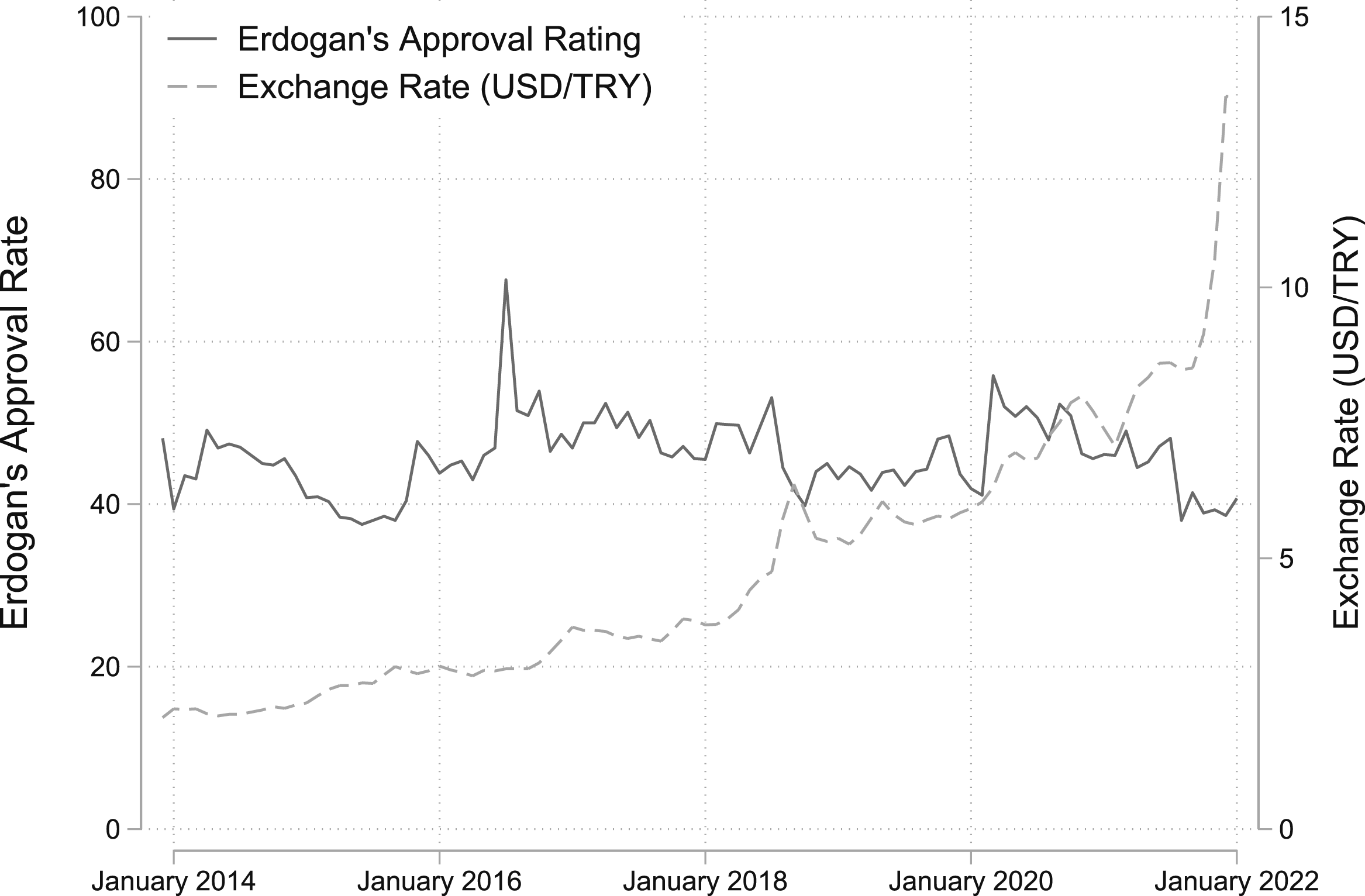
Erdogan’s and the AKP’s popular support is particularly puzzling given Turkey’s recent economic downturn, which started in 2013 but has worsened since 2018. In Figure 1, we present monthly public opinion surveys suggesting that recent economic difficulties Turkey experienced had little influence on support for Erdogan. Although a dramatic decline in the valuation of the Turkish Lira to the US Dollar caused severe economic problems, the approval rating of Erdogan remained unchanged between 40–50% throughout this period. Things went even worse for the Turkish economy after we completed our study, as the inflation rate climbed from 15% in 2019 to a historic rate of 72% in 2022. Despite these and other policy crises, Erdogan managed to win reelection in 2023.
Despite the protracted economic crisis, performance evaluations may still help explain the popularity of Erdogan to a certain extent. Erdogan benefited from the favorable international economic conditions of the early 2000s during his first two terms. Historically high growth rates and positive relations with neighboring countries and international organizations, such as the EU, helped Erdogan build the image of a competent leader. As these successes have constantly been promoted by Erdogan’s propaganda machine, the image of competency might still resonate with some voters. Furthermore, during the last decade, Erdogan and his government have been able to build general credibility based on foreign and security policies. Shifting the public’s focus to these issue areas, with the help of the authoritarian media power, can help sustain instrumental support for the government (Aytaç, 2021).
From the early years of his power, Erdogan also managed to establish connections with his voters that went beyond a transactional and instrumental relationship. The AKP and Erdogan adopted a populist discourse claiming to redress “grievances suffered by the conservative majority of the country throughout the Republican period” (Gürsoy, 2021; Yabanci, 2023). For many, the AKP rule became synonymous, not only with the representation of their interests but also with the guarantee of their social and economic status (Laebens & Öztürk, 2021; Yenigun, 2017). This allowed Edogan to build an emotional bond with his support base, reflected in strong partisan group identities. Like many other scholars, we accept the importance of partisan and emotional identification with Erdogan in Turkish politics. However, we argue that the broader normative alignment the AKP and Erdogan managed to build with its supporters goes well beyond this.
Erdogan explicitly distinguishes Turkey’s new political system from the previous one, calling the new system “New Turkey” (Aliriza, 2018). Through his speeches, educational reforms, and the media, he aims to instill norms, values, and affective attachments that legitimize his authority (Yilmaz, 2018). Erdogan’s “New Turkey” offers an alternative sense of community to the republican and secular nationalist identification of the previous political system in Turkey (Yabanci, 2020, p. 105). This alternative identification is rooted in the imperial nostalgia for the Ottoman Empire, predominant among Turkish-Islamist ideological groups (Elçi, 2021; Yavuz, 2020).
Legitimation of authoritarian regime practices also holds an important place within the government discourse. Although Erdogan and his system still describe Turkey as an “advanced democracy,” they also adopt rhetoric that legitimizes the rule by a strong leader, limitations on media freedom, and arrests of politicians from other parties. For example, “the need for a strong presidency for political stability and effective governance” was the main argument the AKP and Erdogan used in the campaign period of the 2017 constitutional referendum, which eventually turned Turkey’s parliamentary system into a hyper-presidential system (Esen & Gümüşçü, 2017). In the following 2018 presidential election, one of Erdogan’s official slogans was “[Building the] Great Turkey requires a strong leader.”
Finally, the personality cult around Erdogan has a central place in terms of the normative and affective foundations of the current political system in Turkey. As Yabanci (2020, p. 100) puts it, “New Turkey’s politics has been built on a mission which stands over and beyond the daily policy-making and aims at regenerating the country, the nation and society at large, and Erdogan is the venerated leader at the center of this long-term project.” Within the discourse of the regime, Erdogan is portrayed as a leader with extraordinary features and devotion to this long-term project for the nation. This discourse resonates with Erdogan’s voters as well, who use emotionally-laden concepts, such as love, affection, and loyalty when referring to him (Çelik & Balta, 2020, p. 168).
Data Collection
To empirically test our expectations, we ran two original online surveys in Turkey. Data collection was conducted between May 9 and 24, 2021. 7 Respondents to our surveys were recruited through paid Facebook advertisements, which invited Facebook users to participate in “a survey on current issues in Turkey”. We used twelve different advertisements, varying in the use of material incentives, advertisement text, and advertisement image. 8 Facebook users who clicked on the advertisements were directed to a survey page hosted on Qualtrics. Before taking the survey, respondents were informed about the purpose of the study, their rights, and the length of the survey (about 10 minutes). In total, we recruited 6111 respondents through Facebook advertisements, which is beyond the required sample size based on our power calculations. 9
Although our sample was formed through an online opt-in recruitment process, we used Facebook targeting tools and material incentives to increase the extent to which the sample is representative of the Turkish population (Neundorf & Öztürk, 2023). The distribution of respondents in the sample closely follows the population distribution to geographic regions, age categories, the proportion of non-college voters, and voting behavior. However, females and non-high school respondents are underrepresented. To correct these imbalances in our descriptive analyses, we created a post-stratification weight considering the Turkish population’s distribution according to cross-categories of sex, education, and geographical region based on 2020 official census data. Details of the original and weighted sample characteristics are presented in Table A.1 in the Appendix.
In our view, conducting online surveys offers an opportunity to deal with potential social desirability biases arising from Turkey’s authoritarian context, similar to the work by Maleki (2021) in Iran. Unlike respondents in face-to-face surveys, our respondents knew that we did not know their faces or home addresses, for example. Furthermore, an important source of social desirability bias in face-to-face surveys is that a significant portion of respondents mistakenly believe that the government sponsors the survey (Isani & Schlipphak, 2023). Online surveys conducted through paid social media advertisements make it easier to document who is behind the survey. For example, our surveys were delivered by the official, blue-ticked page of the University of Glasgow [REDACTED FOR PEER-REVIEW]. The first page of the Qualtrics survey included more information about the researchers behind the survey that demonstrated our linkages to non-Turkish universities.
Measuring Normative and Instrumental Support
The chief advantage of fielding our survey is the opportunity to design and field items that tap into all theoretical concepts of interest in a manner that best reflects the specific national ethno-religious and electoral authoritarian context of Turkey. In measuring political support, we aimed to cover the different forms of support as defined conceptually by Dalton (1999). We employed survey items that are commonly used (in democracies) to capture the two types of support. We add newly designed questions that directly derive from the theoretical concepts introduced in earlier sections. The full battery of survey items used is listed in Appendix 4.
To measure normative support, we combined ten survey items. Firstly, we rely on two items on national and religious pride and a question that taps into the government’s emphasis on a form of Turkish nationalism that primes the Ottoman past and Islam (Yavuz, 2020). To capture normative support for the regime principles we also designed new items that reflect the electoral authoritarian nature of the current Turkish regime along with characteristics of personalism and delegative democracy (O’Donell, 1994; Taş, 2015). As such, we include the question asking about support for strongman rule, commonly used in other electoral authoritarian contexts such as Russia (Hale, 2011). This item captures one of the defining characteristics of electoral authoritarianism which is a strong executive leader, or caudillismo (O’Donell, 1994) who can protect the country and ensure in times of crisis (Matovski, 2021). 10 To further capture support for regime principles which in democratic contexts would include freedom, tolerance of minorities, and pluralism, we created indicators that tap into support for majoritarianism which only allows religious and nationalist parties to compete in elections (Karagiannis, 2016) and limits free media (Waldman & Caliskan, 2017).
We further designed four items that capture normative support for the AKP, the main ruling party, and Erdogan. 11 The items were designed not to tap into any performance evaluation, but rather represent a more general commitment to the mission of the party and the leader. As such, they do not ask to what extent Erdogan and the AKP have delivered, but rather for what they stand for. For example, we asked whether respondents agree that “those who fight against the AKP fight against the Turkish nation and state” or that “Recep Tayyip Erdogan is a political leader with a sense of mission.
In contrast, our six items that tap into instrumental support were aimed at capturing a performance evaluation of the regime. 12 Firstly, we asked a very general question whether “Turkey is a country that provides a high-quality life for its citizens”. 13 Further, we directly asked respondents to evaluate the success of Erdogan and the economic minister, as two key political figures, and to assess three key policy areas - the economy, the fight against poverty, and internal security.
Responses to all survey items range on a scale from 0–4, with higher values denoting greater support or agreement with each of the statements provided. To construct the normative and instrumental support indices used in the analysis, we calculate the average score for each list of items and then multiply this value by 25. Using 0–100 scales allows us to interpret changes in percentage points. 14
Experimental Design
To explore how economic performance impacts system support (Hypothesis 1), and the extent to which political system support moderates the electoral consequences of poor performance (Hypotheses 2 and 3), we designed a priming experiment that manipulated information about the state of the Turkish economy, a salient performance indicator. The experiment consisted of two experimental groups, control and treatment. Respondents were randomly assigned to each of them. Across the two surveys, we achieved a good balance between the treatment and control groups in terms of pre-treatment variables. 15
The control group did not see any information about the economy, while we primed respondents in the treatment group on the ongoing economic crisis in Turkey focusing in particular on the exchange rate. 16 Our vignette read as follows:
“Turkey is dealing with an economic crisis for several years now. Since the beginning of 2020, the value of the dollar has increased from 6 TL (Turkish Liras) to 8.3 TL as the Turkish lira’s value decreased by around 25%. As a result of these economic problems, the Turkish economy has dropped three places in the ranking of the world’s biggest economies. Turkey’s economic problems reveal themselves in daily life too. Many citizens complain about the continuous increase in prices. Another issue is unemployment, which is especially common among the youth.”
After reading the vignette, respondents in the treatment condition were asked: “What do you think is the biggest economic problem in Turkey”? Response options included the decline of the Turkish lire, unemployment, increases in the cost of living, or any other issue that respondents could report. The goal of this question was to strengthen the treatment and make respondents think further about Turkey’s economic troubles. As shown in a manipulation check reported in Appendix 14, our treatment successfully shifted economic evaluations - those exposed to the vignette gave more negative evaluations. This is especially the case for government voters.
The priming experiment described here was included in both of the surveys we conducted online. 17 In the first survey, the respondents were exposed to the economic treatment just before they answered questions about their instrumental and normative support for the regime. By comparing differences in support between the control and treatment groups, we can test whether information on economic performance has less of an effect on normative support than instrumental support (Hypothesis 1). In the second survey, the priming experiment was done after respondents answered the support questions. This set-up allows us to test the direct consequences of poor performance on electoral support (Hypothesis 2), and whether political system support moderates these electoral consequences (Hypothesis 3).
To measure behavioral regime loyalty, we asked questions related to electoral support post-treatment. A question asks how likely respondents are to vote for each of the following: 18 (1) the AKP or the MHP, the two government parties; (2) the Nation Alliance (CHP and IYI), two of the opposition parties, (3) the HDP, another opposition party, 19 and (4) not vote at all. Respondents who voted for one of the government parties in 2018, the AKP or the MHP, were additionally asked about participation in different forms of pro-government electoral mobilization by joining rallies, campaign contributions, or other forms of pro-government agitation. 20 We create an index of these three items using the average score of responses to each question.
Results
We first descriptively explore the relationship between instrumental and normative forms of support and present general patterns of their distribution in our sample. Next, we experimentally test how responsive forms of support are to the economic crisis treatment (Hypothesis 1); how the treatment impacts respondents’ vote intention and likelihood to mobilize in support of AKP (Hypothesis 2); and, finally, whether the electoral consequences of poor performance are conditional on political support (Hypothesis 3). Across the study, we treat vote intention and AKP mobilization, as indicators of behavioral support for the government. We conclude by replicating key findings leveraging evidence from nationally representative survey data. While random treatment assignment is the key strength of the experimental design, observational data alleviate concerns about external validity.
Descriptive Analysis: Instrumental and Normative Support
We begin by exploring the relationship between the different items that tap into normative and instrumental forms of support. Findings suggest that contrary to theoretical expectations and empirical findings in democratic contexts (e.g., Dalton, 1999; Norris, 1999a), in the Turkish context, normative and instrumental support are wrapped up together. The overall correlation between the different items that tap into normative and instrumental support is very high, (R = 0.88). 21 Exploratory factor analysis of the items used to measure normative and instrumental support, presented in Table A.2 in the appendix, also suggests that normative and instrumental support load on one key dimension.
Evidence that, in the Turkish context, normative and instrumental support are intertwined is an important finding that deserves to be discussed carefully. Normative attachments might have instrumental foundations under authoritarian regimes as voters supporting the ruling party for instrumental reasons might become more receptive to the regime’s propaganda and develop normative support over time. The AKP propaganda in Turkey, for example, links references to regime principles with instrumental issues and promises. The strong leader rule is also presented as the only way to create an efficient government and deliver growth. For example, one of the official campaign slogans of Turkey’s 2018 general election was “Great Turkey needs a strong leader: Recep Tayyip Erdogan for new bridges, new airports, nation gardens.” Survey evidence suggests that this narrative resonates with the AKP supporters. In the last fifteen years, AKP voters became more supportive of the strong leader rule (Schafer, 2021). These observations from the Turkish context are also in line with comparative literature demonstrating that people who believe that the incumbent is managing the economy well, also update their regime preferences in a more authoritarian direction (Mazepus & Toshkov, 2021; Singer, 2018).
Given the intertwined relationship between normative and instrumental support, we proceed by presenting an analysis that relies on three separate indices of political support. The first of them combines survey questions that capture normative and instrumental support into a single scale. The other two indices rely on our theory to disaggregate the aggregate support items into their normative and instrumental components. While the construction of the normative and instrumental support indices is theoretically motivated, in the Turkish context normative support and instrumental support strongly overlap.
Descriptive (Weighted) Results: Average Levels of Combined, Normative, and Instrumental Support by 2018 Votes.
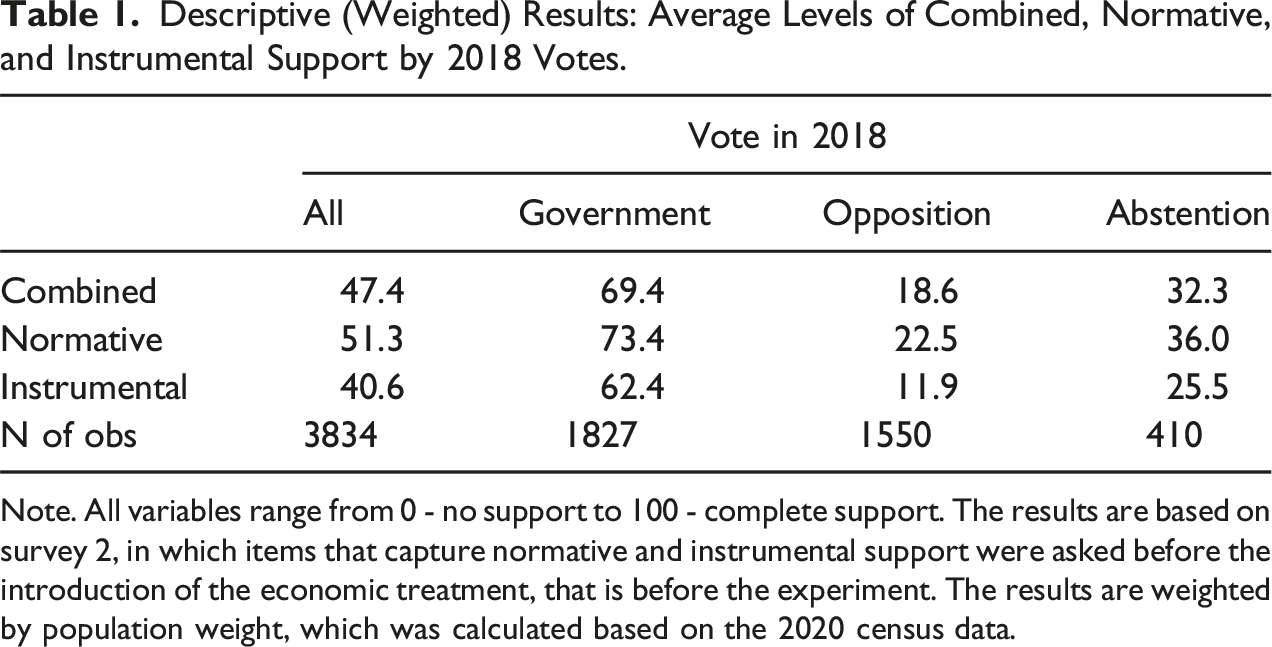
Note. All variables range from 0 - no support to 100 - complete support. The results are based on survey 2, in which items that capture normative and instrumental support were asked before the introduction of the economic treatment, that is before the experiment. The results are weighted by population weight, which was calculated based on the 2020 census data.
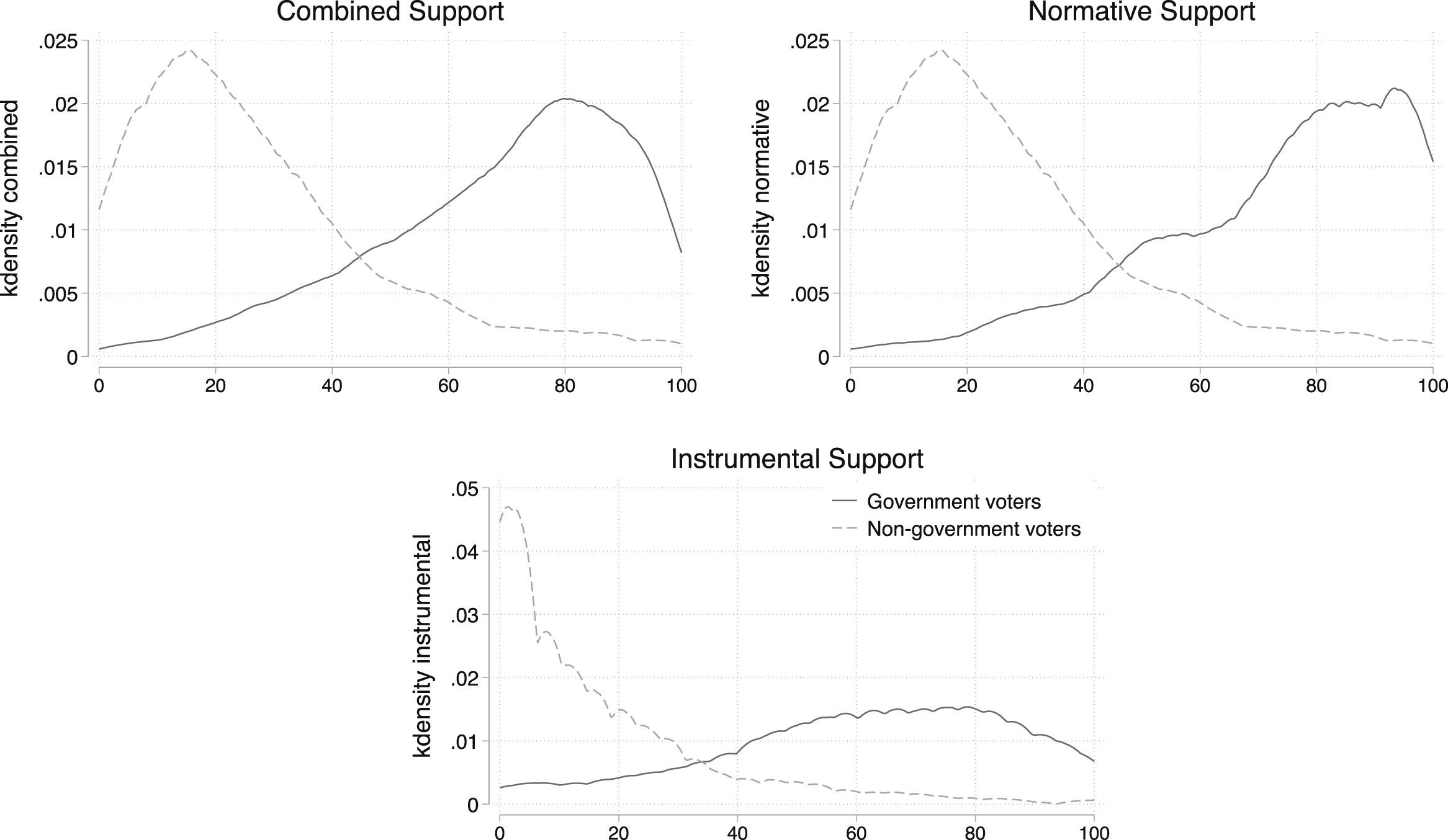
Autocratic system support by 2018 votes. Note. All variables range from 0 - no support to 100 - complete support. The results are based on survey 2, in which the regime support variables were asked before the introduction of the economic treatment. The results are weighted by a population weight.
Looking first at Table 1, we note that in the full sample, the average score for normative support is just over 50 points on a 0–100 scale, while instrumental support is approximately 10 points lower. This implies that, across the population at the time of the survey, support for regime norms and principles was higher than support for how the government was performing, which is not surprising given the ongoing economic crisis. It is also noteworthy that average levels of normative support are higher than levels of instrumental support across all voter groups. At the same time, both normative and instrumental support are well above the survey average among government voters. For this group of respondents, the average score for normative support is 73.4. Instrumental support is lower at 62.5. Compared to government voters, non-government voters (opposition voters and those who abstained) report lower levels of both normative and instrumental support. Normative support is lower among opposition than non-government voters (22.5 vs. 36.1). The same is true for instrumental support, which ranges around 12 points for opposition voters and 26 points for non-voters.
The distribution of support in Figure 2 provides additional evidence of attitudinal polarization in the Turkish electorate (e.g. Laebens & Öztürk, 2021). The largest share of non-government voters clusters along the lowest scores of normative (left-hand plot) and instrumental support (right-hand plot). The opposite is true for government voters. The evidence suggests that divisions in how government and opposition voters evaluate the authorities extend beyond instrumental support. Government and opposition voters also differ in how they assess the political system and in how closely they identify with the principles of the ruling political regime.
Forms of Support and Economic Performance
Relying on evidence from Survey 1, in which support measures were asked after the priming experiment, Figure 3 reports the regression coefficients and 95% confidence intervals of our treatment, which provides treated respondents with information about the economic performance in Turkey, on the different forms of political support for government (top panel) and non-government (bottom panel) voters. Each outcome was estimated separately using linear regressions and did not include any pre-treatment controls, given that we achieved a balanced sample between the treatment and control group for Survey 1 (see Appendix 6). The analysis presented here empirically tests Hypothesis 1, regarding the resilience or responsiveness of different forms of support to poor economic performance. Impact of crisis treatment on autocratic system support: Regression coefficients and 95% confidence intervals.Note. The graph displays the regression coefficient of the economic crisis treatment on system support - outcome variables. Support variables range from 0 - no support to 100 - complete support. The results are based on survey 1, in which the regime support variables were asked after the introduction of the economic treatment. The analyses are based on linear regression models with no control variables. Number of observations: 1126 (government voters) and 871 (non-government voters). Full results are available in Appendix 7.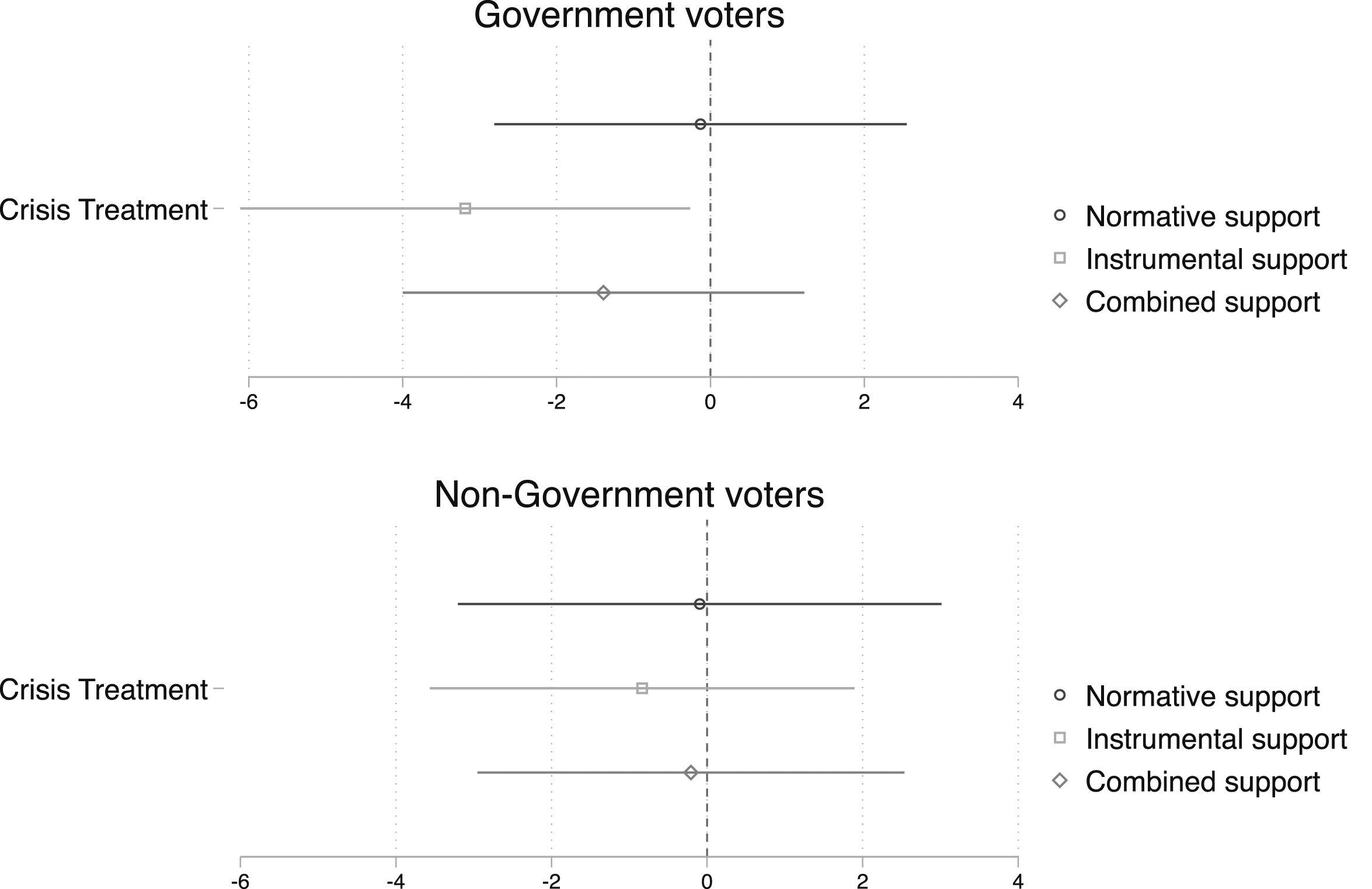
We theoretically anticipated that normative support for the political regime would be less responsive to policy outputs, here information about poor performance, than instrumental support. Figure 3 shows this to be the case for government voters. Government voters primed on the economy have 3.1 points lower instrumental support compared to the control group. This effect is significant on the 5% level. Normative support, as well as the measure of support that brings together normative and instrumental assessments, does not shift in response to information about poor economic performance. The same holds if we drop the items that tap into national and religious pride or that refer to the AKP and Erdogan from the index of normative support (see Appendix 13), but only keep items that refer to the core of the political regime (Ottoman nostalgia, strongman rule, no media freedom, and no minority representation).
The economic crisis treatment does not shift support among voters who did not vote for governing parties. To some extent, flooring effects may account for this finding. Non-government voters report low levels of instrumental, normative, and combined support to begin with and are not easily moved by the treatments. In a similar vein, the treatments may be revealing no new or helpful information for non-government voters, in a way that could help with attitudinal updating.
Figure A.2 in the Appendix additionally reports the results for each of the 16 survey items used in the analysis, only for the sub-sample of government voters. The only items that show a significant (on the 5% level) negative impact of the treatment relate to instrumental support items: the evaluation of the quality of life in Turkey, the rating of the economy minister, and the policy rating of the economy. Evaluations of Erdogan himself however seem to be resilient to the crisis treatment. None of the items that measure normative support is significantly moved by the economic crisis treatment.
Prior Support, Economic Performance, and Electoral Consequences for the Governing Parties
In this section, we test our second set of hypotheses. In the first step, we look at the direct effect of our crisis treatment on behavioral support for the regime. Figure 4 shows the coefficients of the treatment (compared to the control group) on the likelihood to vote for the governing parties - AKP or MHP, to abstain, to vote for the Nation Alliance (a group of opposition parties), or the HDP (the Kurdish opposition party). We further regress on the likelihood of mobilizing for the AKP in an upcoming election. The top panel of Figure 4 focuses on government voters and the bottom panel on non-government voters, as per their reported vote in the 2018 election. The results are based on linear regression and control for income in the sample of government voters, given the imbalance in income between the treatment and control group for Survey 2 (see Appendix 6). Impact of crisis treatment on vote likelihood and AKP mobilization: Regression coefficients and 95% confidence intervals. Note. The graph displays the regression coefficient of the economic crisis treatment on behavioral outcome variables of government or opposition support. All outcome variables range from 1 - not likely at all to 7 - very certain. The results are based on Survey 2, in which the system support variables were asked before the introduction of the economic treatment. The analyses are based on linear regressions, controlling for income (for gov. voters’ sample). Full results are available in Appendix 7.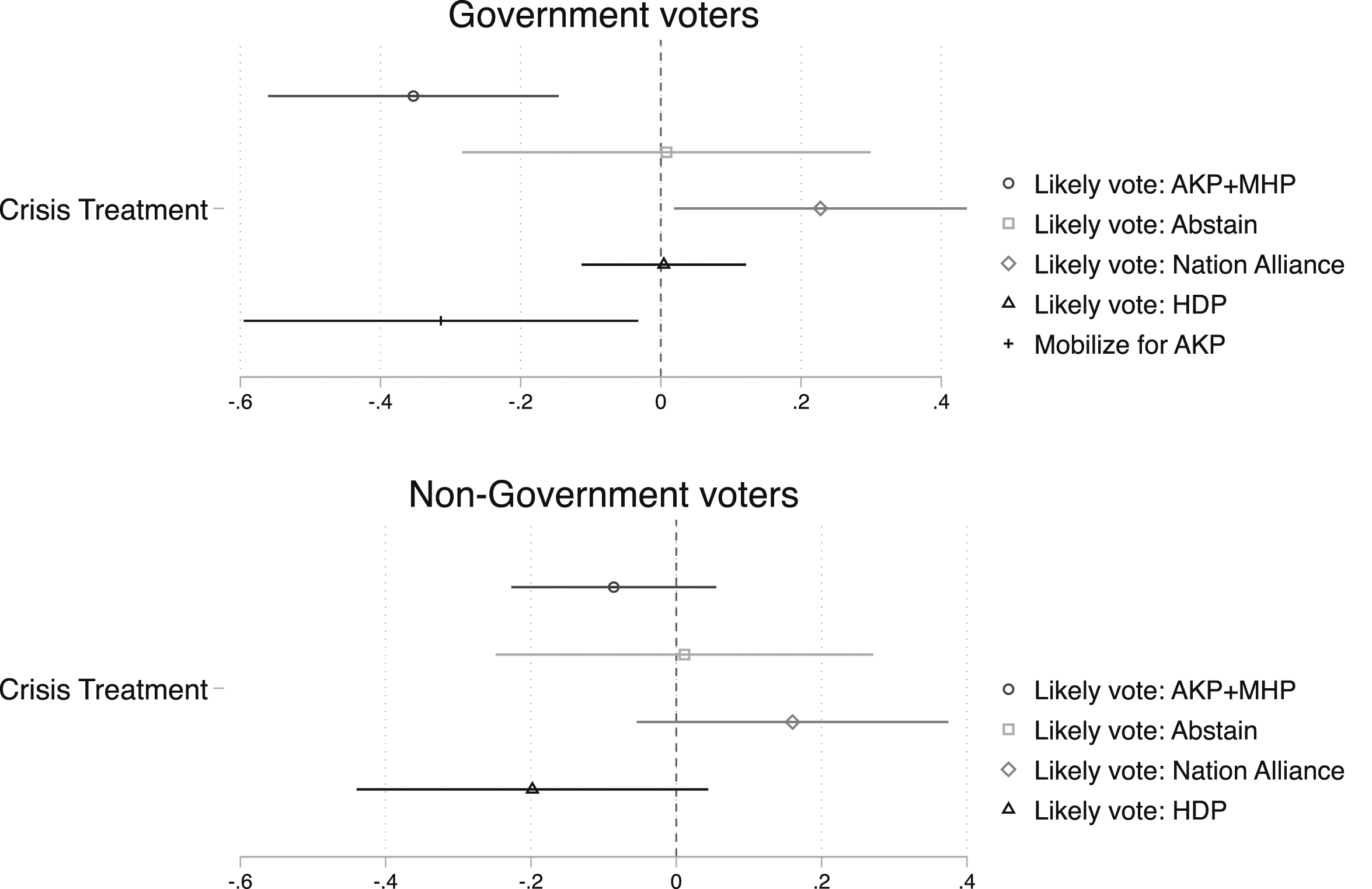
The results lend support to Hypothesis 2. Among government voters, information about poor performance significantly suppresses support for the AKP - reducing individuals’ willingness to vote for the AKP and to mobilize in support of the party. The treatment further significantly increases the likelihood of past AKP voters voting for the Nation Alliance. 23 We do not find behavioral changes for non-governmental voters. Altogether, findings confirm that electoral authoritarian regimes are at risk of losing electoral support among their voters and getting punished for bad economic performance. The results also show that opposition parties can win votes from government supporters in times of crisis. The evidence follows classic economic voting literature, established in advanced democracies, and agrees with research on economic voting under electoral authoritarianism (e.g., Lewis-Beck & Stegmaier, 2007; Rosenfeld, 2020; Treisman, 2011). While prior works rely primarily on observational data, ours is one of the first studies to causally identify the effect of poor performance on vote intention and pro-regime mobilization in a non-democracy.
At the same time, aggregate findings regarding the consequences of poor performance may mask important heterogeneity in the effects of the crisis. In line with theoretical expectations, we anticipate that system support could condition the electoral consequences of poor economic performance. In the next step, we therefore condition the economic crisis treatment on the different forms of support, using support items measured before respondents were exposed to the treatment. Figure 5 plots the marginal effects of the treatment and its impact on the likelihood of voting for the governing parties by the level of normative (left-hand plot), instrumental (middle plot), and combined (right-hand plot) support. Interaction between economic crisis treatment and system support on the likelihood to vote for government parties. Marginal effects and 95% confidence intervals. Sample: Government voters only. Note. The graph displays the marginal effect of the economic crisis treatment on the likelihood of voting for the government parties. The outcome ranges from 1 - not likely at all to 7 - very certain. The results are based on survey 2, in which the regime support variables were asked before the introduction of the economic treatment. The analyses are based on linear regression models, controlling for income. Full results are available in Appendix 7.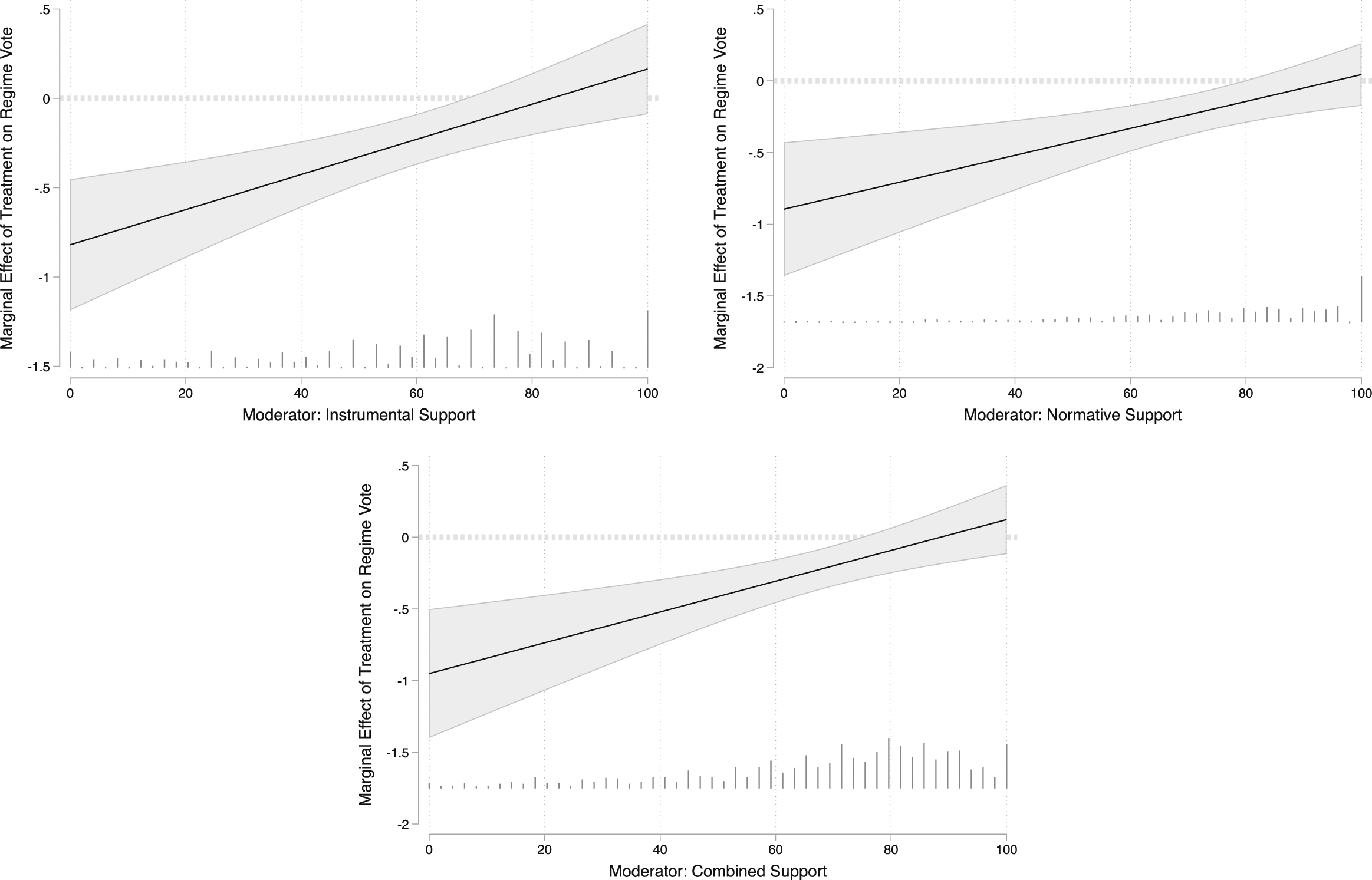
Findings suggest that support for the political regime has a resilience effect, yet only at the highest levels of the support values. For all forms of support - whether normative, instrumental, or a combination of the two - the crisis treatment does not have a significant impact at high levels of support, but is negative at low levels of support. For example, in the context of our study, 45% of government voters have normative support above 80, at which point the crisis treatment becomes insignificant. Similarly, 45% of government voters have instrumental support above 70, at which point the crisis treatment becomes insignificant. For every other group, poor economic performance is associated with a significant decrease in the probability of voting for the governing parties. For example, the treatment reduces the likelihood of AKP voters who report the lowest possible levels of normative support to vote for the governing parties by 1.2 points on a 1 to 7 scale. This is a considerably strong effect. 24
In sum, while the results show that the government is vulnerable to losing support due to poor economic performance, the threat of defections is mitigated at the highest levels of support for the political regime and its main actors. As such, the distribution of voters across the political support spectrum, which varies across authoritarian regimes, can influence the electoral consequences of poor performance. In contexts where only a minority of voters fit into the category of ’extreme’ supporters, defections from the ruling regime party will be of far greater extent.
Altogether, findings reported in Figure 5 lend support for Hypothesis 3a, which expects political support to condition the effect of poor performance on voter defections. However, the results do not provide evidence for Hypothesis 3b. We did not find a significant difference in the conditioning effect of normative and instrumental support, as we had theoretically expected. Comparing the marginal effects as well as the slope, there are no differences between the two forms of system support (Appendix). Given that, in the Turkish context, normative and instrumental support largely overlap, this finding is unsurprising.
One possible explanation for the finding in Figure 5 could relate to differences in how individuals assign blame for poor performance (Tilley et al., 2018). According to this argument, incumbents can eschew punishment for economic downturns if voters blame other factors and actors for the decline. For example, Rozenas and Stukal (2019) demonstrate that state-controlled media in Russia associate good economic news with Putin and the regime and negative economic developments with external factors.
Additional analyses, presented in Appendix 12, demonstrate that among voters with lower normative support, blame attribution for Erdogan mediates 45% of the relationship between the crisis treatment and the likelihood of voting for the AKP. It is therefore possible that, under conditions of economic decline, voters who have lower normative support become less likely to vote for the regime because they hold Erdogan responsible for the economic crisis. Yet, for voters with higher normative support, the crisis treatment does not even have a positive effect on blame assigned to Erdogan, hence no mediating effect as well. Instead, government voters with higher levels of normative support increase the blame assigned to external factors and become even more likely to vote for regime parties. These results help us to better understand the relationship between regime support and voter loyalty in times of crisis.
Evidence from Observational Data
The empirical analysis has so far relied on online surveys which are based on convenient samples and use a survey experiment to artificially frame the treatment of the economic crisis. To test whether experimental findings are generalizable, we replicate the analysis drawing on a face-to-face representative survey fielded after the 2018 General Election in Turkey. The survey was fielded as part of the Comparative Study of Election Studies (CSES) project.
2018 was a year of economic hardship for Turkish voters. One month before the election the official economic confidence index dropped to the lowest point of the last fifteen months as the value of Turkish lira continued to decline (see also Figure 1). CSES survey data demonstrates that only half of AKP voters, and a mere 6% of the remaining electorate, believed that the economy had improved compared to the previous year. Yet, the ruling AKP-MHP coalition won the 2018 General Election with 54% of the votes. 25
Our analysis, presented in Figure 6, explores whether political support, proxied through individuals’ attachments to the AKP, conditioned the relationship between sociotropic economic evaluations and vote choice in the 2018 General Election. In this context, we operationalize political support using feeling thermometer scores for the AKP. Feeling thermometers are widely used to capture voters’ affective attitudes toward political parties (Druckman & Levendusky, 2019). In contrast to more evaluative measures, which would tap into instrumental support, feeling thermometers may mainly, but not exclusively, capture normative attachments to the political regime. Following the experimental design, the sample is limited to respondents who voted for the AKP in the previous election in 2015. We hence model whether AKP voters remain loyal to the party in the subsequent 2018 election, which happened during a severe economic crisis. Impact of negative economic evaluations (marginal effects and 95% confidence interval) by feeling thermometer score for the AKP on 2018 vote for the AKP. Note. The graph displays the marginal effect of sociotropic economic evaluations, which ranges from 1 - the state of the economy has gotten much better over the past year to 5 - the state of the economy has gotten much worse over the past year. The analysis is based on a linear regression model, controlling for age, education, gender, and household income.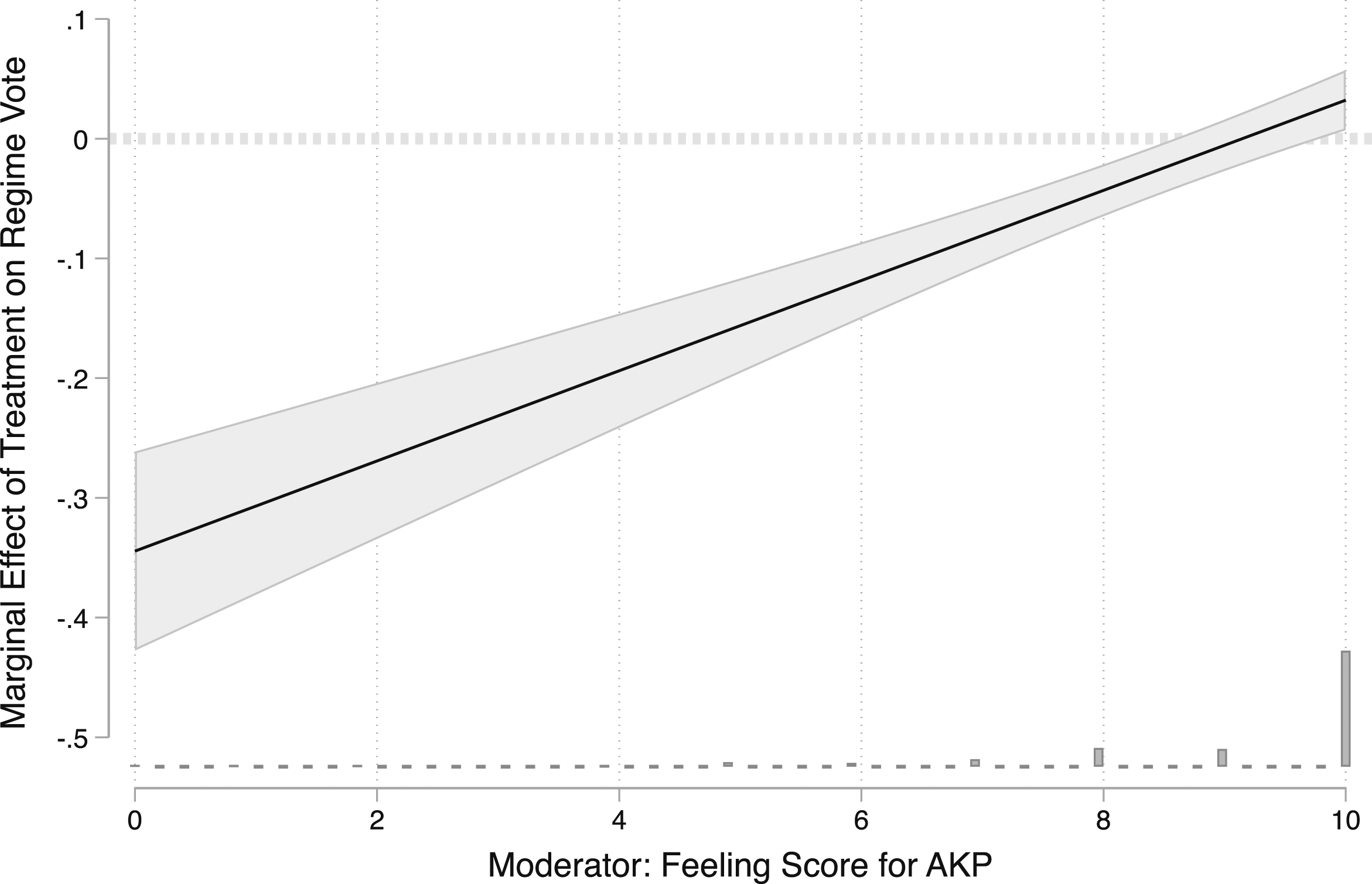
In line with the experimental findings, we find that normative considerations condition the relationship between economic perceptions and support for the governing parties. Negative economic evaluations do not lead to defections among AKP voters who “strongly like” the party. While negative economic evaluations decrease the likelihood of voting again for the AKP among voters who lack affective ties to the party, the strongest supporters remain unaffected. If anything, for respondents who most strongly like the party (score of 10), a negative economic evaluation even increases the probability of voting for the AKP again, leading to a kind of rallying effect. Thus, the AKP needs voters harboring strong affective attachments to the party to survive the economic crisis without losing crucial electoral support.
Conclusion
While influential literature recognizes that authoritarian regimes enjoy popular support (Frye et al., 2017), mass support for authoritarian rule is mainly viewed as performance-based or instrumental (Huhe & Tang, 2017). Autocrats are typically shown to earn support by delivering public and private goods (Desai et al., 2009). Non-instrumental or normative support for the political system is argued to mainly exist in democracies (Huhe & Tang, 2017) or to be restricted to national and religious identities (e.g., Kuzio, 2016). To some extent, data availability has limited our ability to test for congruence in the values and norms of citizens and those of authoritarian regimes. Existing survey data, available for a range of regimes, focus primarily on measuring support for the norms and principles of democratic, as opposed to authoritarian regimes (Booth & Seligson, 2009, p. 14). In a similar vein, partisanship items do not allow us to explore the role of values and principles in generating political support.
In this paper, we offer a conceptual distinction between normative and instrumental support; this framework is broad enough to apply to most authoritarian regimes. We then rely on a mix of established and new survey indicators to capture the different aspects of normative and instrumental support. Context-specific survey indicators have allowed us to go beyond the existing focus on partisanship in Turkey and to tap into principles and norms specific to the contemporary Turkish regime. Our exploratory analysis suggested that normative and instrumental support were intertwined in Turkey when we collected our data in 2021. The evidence also demonstrated that government voters reported high levels of both normative and instrumental support and that support for the political system was polarized between government and opposition voters.
Drawing on two experiments that prime respondents to consider the deterioration in national economic performance, we found that normative forms of political support are less influenced by poor economic performance than instrumental ones in the short term. Findings also suggested that the electoral consequences of economic downturns are conditional on prior political support: government voters who report the highest levels of support for the political regime are unaffected by negative economic performance and less likely to defect from the AKP. In other words, pre-existing political support acts ‘as a reservoir’ that can immunize a regime in poor economic times. Authoritarian regimes can rely on a group of core loyal voters who will continue to support the regime even if performance falters. Core supporters’ share across contexts may play an important role in determining the extent to which economic downturns or poor policy performance more broadly will have adverse political consequences.
The economic crisis deepened in Turkey after we finished the data collection in 2021. Still, Erdogan comfortably managed to get reelected in the 2023 presidential election, while his party lost the local elections in 2024. Post-election survey data from 2023, shared in Appendix 18, suggests that the authoritarian system still holds strong normative support among government voters, while instrumental support has largely vanished. Our theoretical framework helps us explain these developments. While the ongoing economic crisis in Turkey has finally eliminated instrumental support, as we would expect based on the experimental results in this paper (see Figure 3), it did not have a significant influence on normative support among incumbent voters. As we would expect based on the interaction analyses we presented throughout the paper, strong normative support helped Erdogan survive the presidential election, in which he and the entire authoritarian regime were on the ballot. However, the policy problems cost his party the local election, which, in Turkey, is much less about the issues of systemic significance and more about the daily troubles of the voters.
Our research and findings have several implications. Firstly, our work underscores the importance of relying on survey items that better capture the distinct principles, norms, and structures of contemporary authoritarian regimes. Second, findings suggest that political systems need citizens’ political support to tide them over in times when policy performance will inevitably suffer. Our design is limited to looking at the short-term electoral consequences of poor performance, however, our findings draw attention to the need for further research to better specify the length of time-frames over which regimes can survive poor performance - we show that in the case of Turkey, prior reservoirs of political support protect the regime against negative electoral consequences of additional information about poor performance even after a protracted period of poor performance. Furthermore, by emphasizing the importance of normative support for authoritarian rule, and highlighting its close relationship with instrumental assessments, our work identifies another avenue that could compromise electoral punishment in contemporary electoral autocracies. Based on our findings, high normative support among the public can help autocracies mitigate crises.
Finally, findings regarding the importance of high levels of support for the political regime may also help explain the revived interest in political education across many authoritarian regimes ranging from China to Russia and others. Education and political socialization consist of key channels through which incumbents may build and sustain normative support. Nevertheless, more research is needed to better understand the origins of instrumental and normative support in authoritarian regimes and the role that regime indoctrination and propaganda might play in sustaining them.
Supplemental Material
Supplemental Material - A Loyal Base: Support for Authoritarian Regimes in Times of Crisis
Supplemental Material for A Loyal Base: Support for Authoritarian Regimes in Times of Crisis by Anja Neundorf, Aykut Ozturk, Ksenia Northmore-Ball, Katerina Tertytchnaya, and Johannes Gerschewski in Comparative Political Studies
Footnotes
Declaration of Conflicting Interests
The author(s) declared no potential conflicts of interest with respect to the research, authorship, and/or publication of this article.
Funding
The author(s) disclosed receipt of the following financial support for the research, authorship, and/or publication of this article: This work was supported by the H2020 European Research Council (865305).
ORCID iDs

Data Availability Statement
Supplemental Material
Supplemental material for this article is available online.
Notes
Author Biographies
References
Supplementary Material
Please find the following supplemental material available below.
For Open Access articles published under a Creative Commons License, all supplemental material carries the same license as the article it is associated with.
For non-Open Access articles published, all supplemental material carries a non-exclusive license, and permission requests for re-use of supplemental material or any part of supplemental material shall be sent directly to the copyright owner as specified in the copyright notice associated with the article.
