




Abstract
Education is one of the strongest predictors of political participation at the individual level. However, the association between education and participation varies across countries, which previous studies attribute mainly to institutions like electoral systems. Drawing on policy feedback and political socialization theories, we suggest an alternative explanation: education policies generate powerful and lasting policy feedback effects in adolescence, which continue to influence patterns of participation among adults. More concretely, we argue that policies aimed at de-stratifying secondary education (i.e., promoting more comprehensive models of education) are associated with a decrease in political inequality. We empirically investigate our argument in Germany, where education policies vary across sub-national units (Länder) and over time. We leverage this variation by combining data on Land-level policies with data on individual’s participation. Our results show that de-stratifying education policies have reduced in inequality in various forms of political participation, interest, and efficacy, but not in turnout.
Introduction
A well-established finding in scholarship on political participation is that people with more education are politically more active than those with less education – a finding which holds across countries and over time (e.g., Marien et al., 2010; Smets & Van Ham, 2013; Verba & Nie, 1972; Wolfinger & Rosenstone, 1980). Moreover, this educational inequality in participation has further increased in recent decades (Dalton, 2017; Dassonneville & Hooghe, 2017; for Germany: Schäfer et al., 2020). This has far-reaching consequences, among others that there is diminishing responsiveness to the preferences of the less educated (Mathisen, 2023). Furthermore, research shows that the association between education and participation varies across countries (e.g., Dalton, 2017; Gallego, 2010, 2015; Garritzmann, 2021), which is typically believed to be related to cross-national differences in electoral systems (Gallego, 2010, 2015; Lijphart, 1997; Rosenstone & Wolfinger, 1978), party systems (Anderson & Beramendi, 2012; Pontusson & Rueda, 2010), or welfare states (Marx & Nguyen, 2016; Schneider & Makszin, 2014).
Our contribution adds an important aspect to these debates: we argue that education policies shape individuals’ resources for and attitudes towards political participation during their adolescence, thereby influencing patterns of participation in later adult life. Schools constitute an important political socialization environment for individuals: youths spend much time in schools during their politically formative, ‘impressionable’ years (Jennings & Niemi, 1968; Krosnick & Alwin, 1989; Stoker & Jennings, 2008), and in doing this, they have regular personal encounters with state officials, especially teachers (Bruch & Soss, 2018). Drawing on theories of policy feedback (Gingrich, 2019; Mettler & Soss, 2004; Pierson, 1993), we hypothesize that education policies matter for these socialization experiences.
We focus on ‘(de-)stratifying policies’, i.e., policies that shape the socio-economic composition of classrooms. Stratifying education policies imply an early sorting of students into different educational tracks (or school types), which goes along with more socio-economically homogenous classrooms and more differences between schools. De-stratifying policies – for example, comprehensive schooling – imply the opposite: a more heterogenous socio-economic composition of classrooms with reduced between-school differences. Regarding educational outcomes, an established literature shows that stratifying education policies (in particular early tracking) are causally associated with higher inequality in educational attainment (Brunello & Checchi, 2007; Hanushek & Wößmann, 2006). Much less research exists on how education policies shape patterns of political behavior.
We argue that stratifying education policies reinforce patterns of inequality also in the realm of political participation: under stratifying policies, students from lower socio-economic backgrounds are deprived of opportunities to interact with and learn from socio-economically advantaged peers (who are typically more politically resourceful and active), and their curricula may include fewer general subjects, such as civic education; with Pierson (1993), we call this a resource-based feedback effect. In addition, attending a lower or disadvantaged school is often attached with stigma, which negatively affects the social identities of disadvantaged youths as politically efficacious individuals; we call this an interpretive feedback effect. Thereby, stratifying education policies foster inequality in the resources for and attitudes towards political participation, developing long-lasting effects on political inequality.
We empirically investigate our claim exploiting sub-national variation in Germany. This case is well-suited to investigate our claims as there is a significant degree of subnational variation in education policies (across the Länder) and, more importantly for our purpose, within Länder over time (Garritzmann et al., 2021). Focusing on within-Länder variation in (de-)stratifying education policies allows for a rigorous empirical test of our argument: as the political and cultural context is largely the same within the Länder over time, many alternative macro-level explanations of inequalities in political behavior can be ruled out. We combine data on the education policies of the Länder over time (Helbig & Nikolai, 2015) with high-quality data on individuals from the German general social survey ALLBUS. We investigate in particular individuals’ political participation, but also consider their political interest and political efficacy, which are two important indicators of political engagement more generally.
In particular, we focus on political inequality between individuals with the highest and those with the lowest education. This comparison not only defines the maximum extent of (education-related) political inequality in a society, but it also is the inequality that has been rising the most in the past decades, as the participation of citizens with the lowest educational qualifications has dropped the most (Armingeon & Schädel, 2015; Dassonneville & Hooghe, 2017).
Methodologically, we use hybrid “between-within” models to analyze the moderating effect of de-stratifying policies on political inequality. These models allow us to differentiate between policy variation across and within the Länder (Bell et al., 2019). Our analyses focus on the dynamic aspect, i.e., changes over time, which provide for a more rigorous test of our argument. The results confirm that de-stratifying education policies foster the institutionalized and non-institutionalized political participation among individuals with low education, whereas the participation of those with high education is barely affected. While this pattern also shows for political interest and internal political efficacy, it, quite surprisingly, does not hold for turnout – an exception that we discuss in more detail below. Overall, we find that the implementation of de-stratifying education policies within a Land reduces inequality in important forms of participation, showing that education policies can develop enduring feedback effects on patterns of political engagement.
Our findings are relevant beyond the particular country context of Germany and beyond the case of the specific reforms: while we focus on (de-)stratifying policies related to tracking as one example, policies that regulate the private sector or parental school choice likely have similar effects. Our results thus shed light on how education policies more generally generate feedback effects on political participation patterns – a point we discuss in the concluding section.
Education and Political Participation
Education has the potential to shape individuals’ political attitudes and behavior. According to the OECD (2021), individuals spend a total of around 6.000–8.000 hours in school up to the end of secondary education. Schools are thus the place in which children and adolescents spend most of their time when they are outside their family. Importantly, individuals spend this time in schools particularly during their early politically formative years, which they start to experience in their youth (Jennings & Niemi, 1968; Prior, 2010; Stoker & Jennings, 2008). This formative, ‘impressionable years’-period starts at between age 7 and 12 and lasts until age 25 to 35 (Neundorf & Smets 2017). When individuals enter this period, they start to grasp abstract things such as politics, to question their parents’ attitudes and behaviors, and to develop their own political selves. Afterwards, their political attitudes and behavior become solidified, i.e., relatively stable over time (Kiley & Vaisey, 2020). This makes it plausible to assume that the experiences they make in schools, in particular in secondary schools, have a lasting imprint on their later political behavior.
But how could education matter for political participation? The strong positive association between education and participation is one of the most established findings in political science – and thus has attracted much scholarly interest. According to a first group of scholars, education fosters the skills needed for participation and thus has a direct, absolute effect on participation (e.g., Delli Carpini & Keeter, 1996). Such positive effects of education have been shown for a number of important predictors of political participation, for example, language skills (Condon, 2015), political knowledge (Torney-Purta, 2002; Verba et al., 1995), and grit (Holbein, 2017; Holbein & Hillygus, 2020). In line with this, several studies suggest that the link between education and participation is – at least partially – causal (e.g., Lindgren et al., 2017, 2019; Milligan et al., 2004).
A second group of researchers suggests that education relates to participation in a more indirect way, mediated via individuals’ SES: individuals’ educational attainment is associated with their jobs, income, and position in society as adults. Thereby, education influences individuals’ opportunities to practice and strengthen their general – politically relevant – skills at the workplace (Brady et al., 1995) as well as their social networks and positions within these networks as adults, which differ with regard to their political mobilization potential (Campbell, 2009; Nie et al., 1996; Persson, 2011).
A third group of scholars regards education merely as a proxy for pre-adult socialization (Highton, 2009; Kam & Palmer, 2008; Persson, 2014). As parents’ socio-economic (SES) background influences both educational attainment and participation, these studies suggest, parental SES explains a significant part of the association between education and political engagement. In a way, this argument relates to the large literature on processes of political socialization at home. Research in this area shows that students from higher SES homes are more likely to discuss politics with their parents and to see their parents turn out in elections, which enhances their own likelihood for political participation (Gidengil et al., 2016; Jennings & Niemi, 1968). Individuals from lower SES backgrounds lack such supportive political socialization at home. However, and in contrast to the “education as a proxy”-view, some studies show that education could potentially partly mitigate this lack of political socialization at home, as education can increase the resources for participation and participation among individuals from lower SES backgrounds (Campbell & Niemi, 2016; Garritzmann, 2021; Lindgren et al., 2017, 2019; Neundorf et al., 2016).
Overall, thus, education has been argued to influence political participation both directly – via an increase in resources for participation – and indirectly – via an effect on individuals’ SES and the associated social networks – but that parental influences account for a part of the association between education and participation. Furthermore, the effect of education on political resources and participation might be heterogenous and most visible among individuals from disadvantaged backgrounds.
Despite the extensive literature on the association between education and participation, one aspect remains significantly underdeveloped, namely the impact of education policies on patterns of participation. This lack of research is significant since it is well-known that education policies and institutions vary a lot across countries (e.g., Green et al., 2006; West & Nikolai, 2013) and, in many countries with multilevel governance systems, even within countries (e.g., Garritzmann et al., 2021). Furthermore, there is established research that education policies affect educational and socio-economic outcomes, including inequality (Brunello & Checchi, 2007; Hanushek & Wößmann, 2006; Heisig & Solga, 2015; Van de Werfhorst & Mijs, 2010).
Combining and extending these different literatures, we argue in the next section that education policies shape political inequality. From our point of view, existing work has largely failed to appreciate the moderating effect of education policies on the link between education and participation. To the best of our knowledge, only a handful of studies developed some arguments and analyses in this direction. However, these studies either concentrate on the cross-country level (Busemeyer & Goerres, 2014; Garritzmann, 2021; Janmaat, 2011; Witschge & van de Werfhorst, 2020) and/or analyze other outcomes, such as political knowledge or policy attitudes (Gingrich, 2019; Janmaat, 2011). We expand upon these studies in several ways: theoretically, we draw on policy feedback theory to explain how education policies shape participation patterns; and empirically, we provide more rigorous empirical evidence than previous research by focusing on within-Länder variation in Germany.
How Education Policies Shape Patterns of Political Participation
Our core claim is that education policies moderate the micro-level association between education and political participation. In developing our argument, we start by building on policy feedback theory, i.e., the notion that “policies shape politics” (Pierson, 1993, p. 595): policies are not only outcomes of the political process, but themselves structure subsequent political dynamics and processes by shaping the resources and social identities of political actors, both interest groups, elites, and the mass public. Building on the seminal work of Pierson (1993) and others, a large literature has evolved that studies policy feedback effects on individual-level attitudes and preferences (i.e., the “mass public”) (for reviews, see Campbell, 2012; Béland & Schlager, 2019; Larsen, 2019; Busemeyer et al., 2021). However, among those investigating the feedback effects of education policies, most studies focus on political attitudes and policy preferences (e.g., Busemeyer, 2013; Busemeyer & Garritzmann, 2017; Garritzmann, 2015; Gingrich, 2019; Rhodes, 2015). Only few studies analyze the feedback effects of education policies on patterns of political participation (exceptions – yet focused exclusively on the US context – are: Mettler, 2002; Mettler & Welch, 2004; Bruch & Soss, 2018). We build on the policy feedback literature at large, and contribute in particular to the literature on the feedback effects of education policies on participation.
What do we mean by ‘education policy’? Education policies capture a large variety of issues such as the level and distribution of education spending, the relationship between public and private financing and provision of education, the relative importance of vocational versus academic education, governance structures, the number and kind of school tracks, and requirements for private school operation. We posit that not all of these concrete policies are equally likely to develop feedback effects on patterns of political participation. To identify which policies are the most important in this regard, we follow findings from sociological and economic education research. These studies repeatedly show that education policies defining the stratification of an education system – i.e., the extent to which it reflects, reproduces, or creates social strata in a society (Allmendinger, 1989) – influence educational and socio-economic inequality (for many: Hanushek & Wößmann, 2006; Brunello & Checchi, 2007; Van de Werfhorst & Mijs, 2010; Bol et al., 2014).
Thus, and in line with Garritzmann (2021), we focus on education policies that promote or reduce stratification in education systems. One of the most strongly stratifying education policies is early tracking. Every education system differentiates between academic and vocational pathways at some point, and typically, tracking decisions are based on students’ academic performance. The main difference is the age at which tracking is implemented: while some countries implement early tracking around age 10 to 12, others have late-tracking policies and differentiate between educational pathways around age 16 (Green et al., 2006). This difference is of fundamental importance: the earlier tracking takes place, the stronger is the association between parental background and children’s academic performance – and thus their track placement (Brunello & Checchi, 2007; Hanushek & Wößmann, 2006). In consequence, early tracking results in socio-economically homogenous schools and classrooms (Jenkins et al., 2008; Strello et al., 2022). While we focus on tracking as arguably one of the most important stratifying policies, other education policies can also have (de-)stratifying effects and similarly influence political inequality. We discuss these in the conclusion.
How, then, do de-stratifying policies such as late tracking affect political inequality? Policy feedback theories suggest different mechanisms: effects of policies on individuals’ resources (resource effect), and effects on their social identity (interpretive or normative effect) (Bruch & Soss, 2018; Campbell, 2002, 2012; Mettler, 2002; Mettler & Soss, 2004; Pierson, 1993; Svallfors, 2010). Both of these, as we argue in the following, are strongest for individuals with low education, who disproportionally come from homes with low levels of political resources and thus can benefit the most from education (see also Campbell & Niemi, 2016; Garritzmann, 2021; Lindgren et al., 2017, 2019; Neundorf et al., 2016).
Resource Effects of De-Stratifying Education Policies
De-stratifying education policies can have feedback effects on resources through several pathways. Here, we discuss four of these. First, de-stratifying policies increase the political knowledge and abilities in particular of individuals with low education while they are in school. This mechanism plausibly operates via the classroom composition and, potentially, via curricular differences between tracks. With regard to classroom composition, children from different socio-economic backgrounds attend the same schools in a context characterized by de-stratifying education policies, resulting in more heterogeneous peer groups. This is particularly beneficial for students with low-SES backgrounds: they are more likely to discuss politics with classmates from politically active homes and therefore have more opportunities to increase their own political knowledge than in more homogeneous peer groups as created by stratifying policies, where low-SES children often attend the lowest track. Regarding curricula, some scholars suggest that under stratifying policies, the lowest track include less civics education than the highest track, thereby increasing pre-existing gaps in political knowledge among students (Dassonneville et al., 2012; Eckstein et al., 2012; Janmaat et al., 2014). Other scholars, however, contend that participatory teaching methods and practices are more important for the development of students’ political resources (e.g., Beaumont et al., 2006; Hoskins et al., 2012; Neundorf et al., 2013; Willeck & Mendelberg, 2022) – but it is unclear whether these vary across schools under stratifying polices. In any case, in contexts characterized by de-stratifying policies, all students are taught the same contents with the same methods, which arguably benefits those from low-SES backgrounds the most.
Secondly, similar compensation effects of de-stratifying policies are likely to emerge for other, more general types of abilities that foster political participation, such as language skills or perseverance. Education scientists have repeatedly documented positive effects of heterogeneous peer group composition on educational achievements and skills, in particular for individuals with lower ability or from low-SES backgrounds (Zimmer & Toma, 2000; Baumert et al., 2006; Burke & Sass, 2013; Chmielewski, 2014; but see Van de Werfhorst, 2019). Again, curricula and teaching methods might further contribute to these resource effects.
Thirdly, heterogeneous classrooms also increase the likelihood for children from low-SES homes to become part of more heterogeneous social networks (Engzell & Raabe, 2023; Lorenz et al., 2020). Due to the higher level of political mobilization of more advantaged peers, belonging to more heterogeneous networks could increase the motivation to participate politically (in the future) among individuals from low-SES backgrounds.
Fourthly, beyond their resource effects among adolescents, education policies can develop resource effects among adults via their effects on individuals’ educational attainment. De-stratifying policies enable individuals to decide upon their final educational degree at a later stage in their school careers. This is beneficial in particular for individuals from low-SES homes who can profit most from such new opportunities (Brunello & Checchi, 2007; Hanushek & Wößmann, 2006). Better educational qualifications, in turn, typically come with higher income and with jobs that offer more opportunities to practice one’s (politically relevant) general skills and more politically mobilizing networks, each of which positively influences individuals’ political resources (Brady et al., 1995; Nie et al., 1996). This corresponds to a resource effect of de-stratifying policies among adults that is mediated via opportunities for better jobs.
Interpretive Effects of De-Stratifying Education Policies
De-stratifying education policies can also have interpretive or normative effects. For Pierson (1993), interpretive feedback effects refer to the impact of policies on the “cognitive processes of social actors” (ibid.: 610), defining which policy options are deemed feasible and reasonable. Above and beyond that, we understand these effects also to have normative implications for social identities (see e.g., Svallfors, 2010), i.e., policies affect how individuals see and make sense of their place in society.
In the context of (de-)stratifying education policies, this refers to the relative prestige that certain schools or school types carry. This is particularly evident in contexts with early-tracking policies, where the lowest school track typically is regarded as less valuable, less prestigious, or even stigmatized, whereas the highest (academic) track has a very good reputation in society. This negatively influences the self-perception and social identity of individuals on the lowest tracks while they are in school: proceeding to “only” the lowest school type after primary education means being officially assigned to the group of not so smart students with few chances of achieving good education and highly valued jobs (Völcker & Hansen-Schaberg, 2016). In line with this, Groß (2000) finds education to be a stronger predictor of subjective social status in more stratified educational systems. The stigma and poor prospects attached to low education generate a negative self-perception (Stubager, 2009) and thereby inhibit those individuals’ motivation to engage in politics (Armingeon & Schädel, 2015).
De-stratifying policies, we suggest, can mitigate these negative interpretive effects via different pathways, of which we explain three in detail. Firstly, later tracking treats individuals equally for some more years during their formative phase, which reduces the duration of feeling stigmatized among those with low education. De-stratifying policies can also reduce the stigma attached to the lowest tracks more generally, for example by allowing lower school tracks to in addition offer higher school leaving certificates. By reducing experiences of stigma, de-stratifying policies can facilitate the development of a positively connotated social identity among the low-educated, which is an important political resource.
Secondly, de-stratifying policies might increase the perception of (educational) inequalities and unfairness. In more heterogenous classrooms it might simply be easier to observe instances of unequal treatment or achievement (Mijs, 2016; Shedd, 2015). Theoretically, perceptions of inequality could be politically demobilizing, but grievances have been shown to be politically mobilizing (Kern et al., 2015) – and perceptions of inequality could be understood as a form of grievances. Empirically, while there are some findings on how such perceptions of inequality decrease political trust in school (Abdelzadeh et al., 2015), we are unaware of research exploring under which conditions perceptions of inequality result in political (de-)mobilization.
Thirdly, while the interpretive effects related to school types and school experiences develop among adolescents, we expect that de-stratifying policies can in addition have interpretive effects among adults. As de-stratifying policies can positively influence individuals’ educational attainment, in particular among individuals from low-SES backgrounds, they may get jobs with a better societal reputation and overall acquire a higher SES. This will contribute to improving their self-perceptions, generating interpretive effects among adults.
To summarize, we argue that (de-)stratifying education policies shape the distribution of political resources – via resource feedback effects – as well as the social identity of individuals – via interpretive/normative feedback effects –, thereby influencing patterns of political participation. It goes beyond the scope of this paper to empirically disentangle these mechanisms. Yet, this is also not necessary to make our argument, since the interpretive and resource effects of (de-)stratifying policies point in the same direction: stratifying policies should reinforce political inequality between individuals with the highest and those with the lowest education, whereas de-stratifying policies should reduce this inequality. Nevertheless, as mentioned above, we expect the effects of (de-)stratifying policies to be stronger for those with low education (i.e., we expect an interaction effect): they disproportionally often have low-SES backgrounds and thus can profit more from school experiences (Campbell & Niemi, 2016; Garritzmann, 2021; Lindgren et al., 2017, 2019; Neundorf et al., 2016). Based on our theoretical considerations, our leading hypothesis is: The implementation of de-stratifying education policies decreases inequality in political participation among adults who experienced the impact of these policies in their ‘impressionable years’.
Figure 1 graphically illustrates our core argument (highlighted in bold black): de-stratifying policies shape the experiences that adolescents make in schools, thereby generating both resource and interpretive effects. These accrue in particular among adolescents with low education and increase their likelihood for participation as adults, resulting in lower political inequality at the macro level. Graphical illustration of the argument.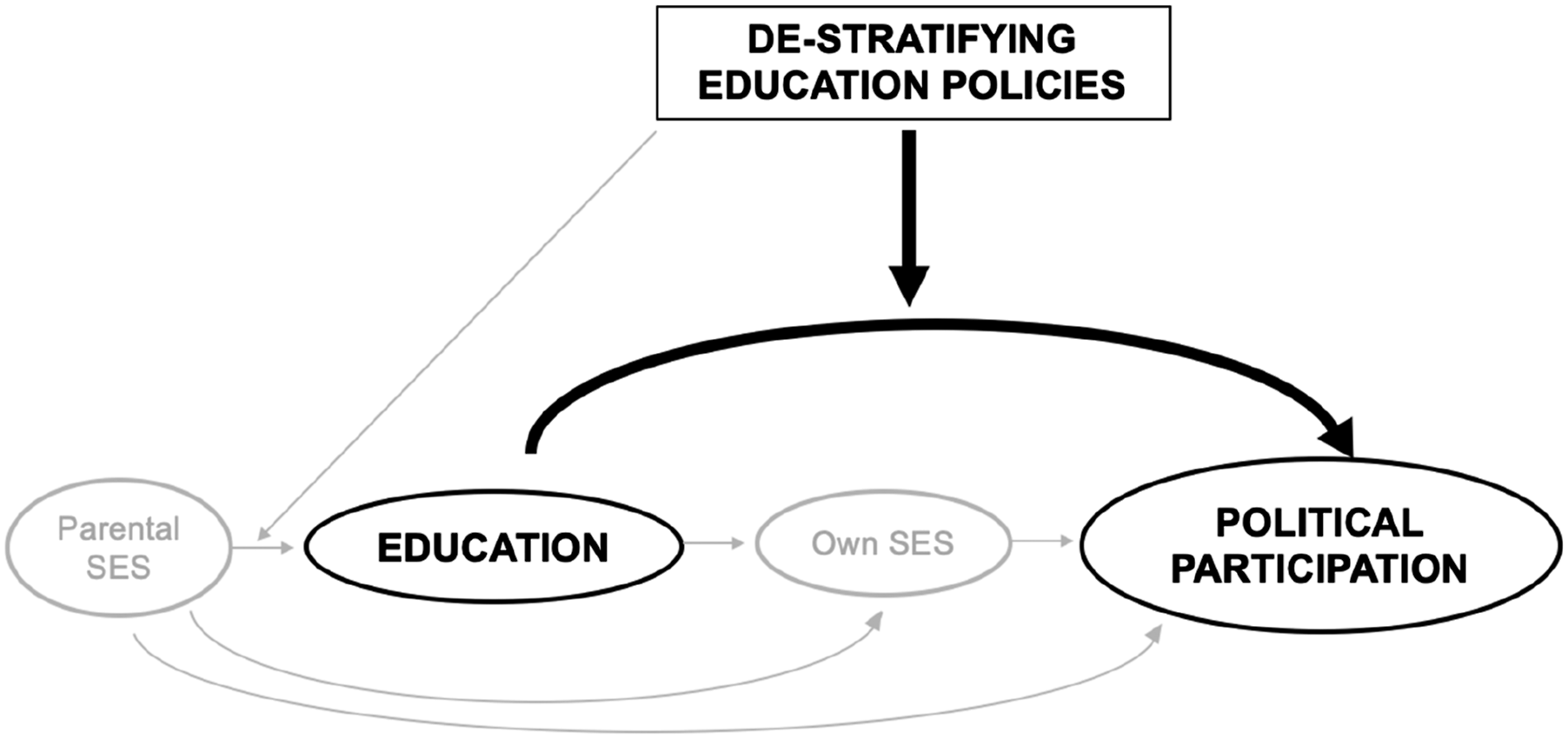
However, as discussed in the previous section, the association between individuals’ education and their political participation can also be driven by parents’ SES or mediated via individuals’ own SES (Brady et al., 1995; Persson, 2015). Parental SES affects both individuals’ education and their participation. As de-stratifying policies weaken the association between parental SES and individuals’ education, this could contribute to explain the effect of de-stratifying policies on the education-participation link (see grey arrow from de-stratifying policies to the individual-level link between parental SES and education). Furthermore, the impact of de-stratifying education policies on political participation could also be mediated by individuals’ SES (i.e., their jobs, incomes, and social networks) as adults 1 (see grey arrows from education to own SES resp. to participation). To test our core argument as precisely as possible, we will empirically disentangle these alternative mechanisms by accounting for the effects of parental SES and of individuals’ SES on political participation.
Research Design
To investigate whether de-stratifying education policies have the expected feedback effects on patterns of participation, we exploit subnational variation in education policies in Germany across the 16 Länder over time. 2 This context provides for a rigorous test of our argument. De-stratifying policies vary both between Länder at any given point in time and within Länder over time; for example, the Länder have different ages of tracking and different school types (some of which are more comprehensive than others). As the country context – and thereby major alternative explanations of political inequality – is constant, this allows us to single out the effect of de-stratifying policies on education-based political inequality.
It may be debatable whether this set-up provides for genuinely causal evidence since the variation in policies is not the result of a random process, but related to political and historical circumstances. From a comparative perspective, left governments are more likely to implement de-stratifying reforms (Österman, 2018). However, this does not seem to hold unambiguously in Germany, where de-stratifying reforms have also been implemented by conservative parties (Helbig & Nikolai, 2015, pp. 302–307), often to maintain schools in rural areas that faced declining numbers of pupils (ibid, 100f; see also Busemeyer & Haastert, 2017). To address challenges to causal inference, our empirical analysis distinguishes between “between” and “within” Länder variation in de-stratifying policies and then focuses on the dynamic aspect, i.e., on “within” Länder change in de-stratifying policies, additionally controlling for potential confounders that vary within Länder over time.
Empirical Approach: Exploiting Variation in Education Policies in Germany
In Germany, education policy largely falls under the authority of the Länder, and in fact is the policy area in which the Länder have more authority than in most other policy areas (Garritzmann et al., 2021). Education policy has been – and in many Länder still is – one of the most contested policy areas in Land-wide elections (Pappi & Seher, 2009; Schmidt, 1980; Wolf & Kraemer, 2012). As a consequence, there is substantial variation in education policies, including de-stratifying policies, both between Länder and over time within Länder. This makes Germany a suitable test case to analyze feedback effects of education policies on patterns of political participation in an empirically rigorous way. The overall trend in education policy has been to gradually weaken the overall level of stratification in the traditionally segmented German education system, albeit with differences in the timing and extent of de-stratifying reforms between the Länder (see below). Focusing on within-Länder change in de-stratifying education policies enables us to blend out the impact of most other, potentially confounding variables that are typically associated with political inequality such as electoral rules and cultural contexts.
Macro-Level Data on Education Policies
The main independent variable of interest is the respective Land’s de-stratifying education policies. This information is derived from Helbig and Nikolai’s (2015) meticulous systematic description of education systems in Germany. Based on education laws, public regulations, and other official documents, Helbig and Nikolai assembled information on a large number of education policies for all Länder of Germany, covering for example policies that regulate the duration of compulsory education, the age of tracking, and the existence of a comprehensive school type. Covering the schoolyears 1949/50 (resp. 1991/92 for the former Eastern German Länder) to 2009/10, this impressive data collection enables us to measure variation in de-stratifying education policies both between and within Länder.
Drawing on this rich information, we construct an index of de-stratifying education policies that combines information on three concrete policies: (1) The duration of primary education is a first core aspect of stratification in Germany as it regulates how long children share a classroom. Traditionally, children were allocated to different school tracks after four years of primary education, which is strongly stratifying. Many Länder have by now implemented de-stratifying policies by postponing the final decision on school track by up to two years. This comes in different degrees: in some Länder, primary education now encompasses six years; in others it still lasts four years, but a final recommendation for school tracks is given only (or again) after grade six (Orientierungsstufe / Förderstufe)
3
. Keeping more socio-economically heterogeneous classrooms longer and / or postponing the final decision on school track gives individuals from low-SES backgrounds more time to learn from more advantaged peers and treats individuals equally for a longer time, resp. institutionally acknowledges that track placement after primary school is not final, generating positive resource and interpretive effects. (2) The second de-stratifying policy included in our index is the existence of a comprehensive school form. Introduced first as pilot projects in a number of Länder in the late 1960s, comprehensive schools have by now been established as an additional track in most Länder. Since the comprehensive school form did not replace the other tracks, and as in particular the academic track (Gymnasium) remained untouched, socio-economic heterogeneity in the comprehensive schools is lower than it could be, if the tracked system was replaced by a fully comprehensive one. Nevertheless, the introduction of a comprehensive school form is clearly de-stratifying as it abolishes the rigid separation between school tracks and delays tracking by five to six years for adolescents in those schools. Thereby, it leads to on average more socio-economically heterogeneous classrooms. In addition, individuals who would otherwise attend the lowest track (Hauptschule) might have more civics and other general subjects in the comprehensive schools.
4
Furthermore, across Länder, individuals with the lowest educational degrees who went to a comprehensive school have experienced less stigma than if they had attended the Hauptschule, with ensuing beneficial interpretive effects. Finally, as comprehensive schools offer higher educational degrees, their introduction facilitates higher educational attainment for individuals who would otherwise attend the Hauptschule (which corresponds to the effect of de-stratifying policies on individuals’ education). On average, thus, the introduction of a comprehensive school form will benefit individuals with low education in terms of their political resources, and thereby contribute to reducing political inequality.
5
(3) The third component of our index is an indicator measuring the share of the academic school form (the Gymnasium) among all schools that lead to the Abitur (which is the educational degree granting access to university).
6
This indicator ranges from >95% (i.e., among all schools leading to the Abitur, 95% or more are Gymnasien) to below 60%. A lower share indicates a more de-stratifying policy: attending the academic school form then is relatively less important in gaining access to tertiary education, which decreases the reputational disadvantage of lower school forms. While this is primarily an interpretive effect, it can also lead to more socio-economically heterogenous classes (and thus generate resource effects) as high-SES parents might accept school forms other than the Gymnasium for their children. Furthermore, where more school forms offer the Abitur (reflected in a lower value in this indicator), children from low-SES backgrounds are more likely to pursue this degree.
Each of these indicators is standardized to range from zero for a stratifying policy to one for a de-stratifying policy in the German context and takes values in between for policies that fall on neither end point. We then construct the de-stratification index by generating the mean, i.e., we add the indicators for each school year and in each Land and divide by the number of indicators. The resulting index ranges from zero – indicating that more stratifying education policies are in place in this Land at this point in time – to one – indicating that (in the German context) significantly de-stratifying policies have been implemented.
7
Robustness checks in addition use a binary index to report effects of a larger change in de-stratifying education policies, on the one hand, and each single policy to report more fine-grained results, on the other. Figure 2 shows which Länder had which degree of de-stratifying education policies between 1949/50 and 2009/10. Appendix figures A3-A6 replicate Figure 2 for the individual parts and the binary version of the index. (De-)stratifying education policies in the German Länder, school years 1949/50-2009/10. Source: Helbig & Nikolai, (2015); own illustration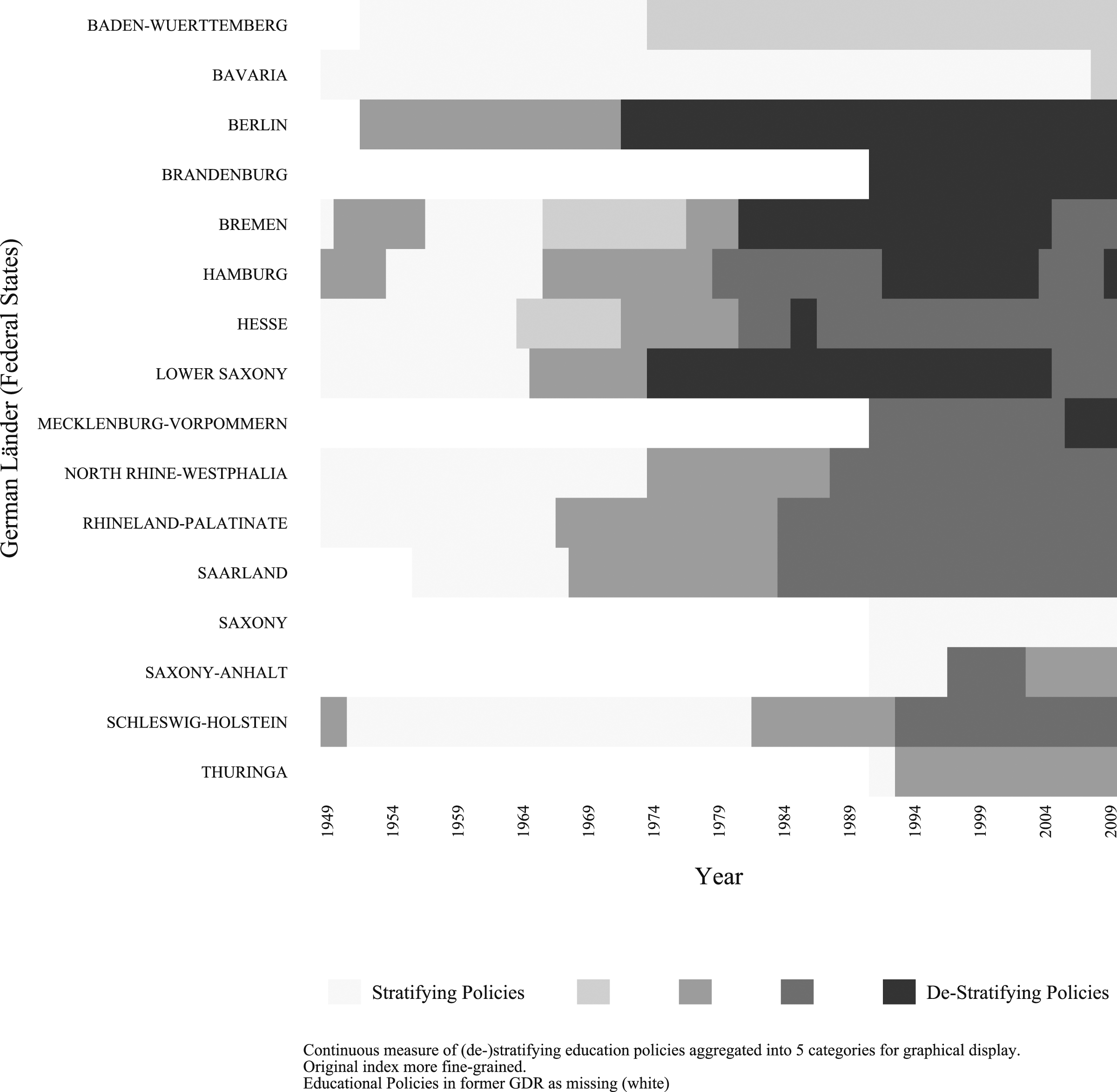
The Eastern German Länder are included in our analyses only after German reunification. Prior to German reunification, the Eastern German Länder had a communist education system that was used for purposes of propaganda. Experiencing education in an autocracy, however, has been shown to affect citizens’ attitudes towards democracy later in life (Neundorf et al., 2020; for communist regimes: Pop-Eleches & Tucker, 2013) and alters the link between education and participation (Croke et al., 2016). We thus exclude respondents who went to school in an East German Land before reunification from the analyses.
Individual-Level Data
We take our individual-level data from the ALLBUS (GESIS, 2021), which is the German general social survey and has been conducted every second year since 1980. The ALLBUS is known for high data quality and is a frequently used data source by social scientists. All German Länder are covered in proportion to their population. After German reunification, the survey has also covered the Eastern German Länder. The ALLBUS surveys respondents from all generations and includes a variety of indicators of political engagement (not each of which is included in each survey wave, though). For many respondents, we also know the Land in which they lived during their youth – which is crucial for precisely identifying the education policies they were socialized in. Our analyses are based on the cumulative file that includes information from all survey waves, and that is provided by GESIS (2021, version ZA5274 V1.1.0).
We study the effect of de-stratifying policies on inequality in political participation. The ALLBUS includes information on many different forms of participation, covering both conventional and unconventional forms. We focus on the ten single items asked most frequently, which also cover the most commonly used activities. The ALLBUS asks: “If you would like to voice your opinion or exert influence with regard to a political issue that you consider important: Which of the following activities have you (ever) participated in, which of these forms of participation have you used?”. We use information on the following forms of participation: - saying one’s political opinion among acquaintances or at work, - participation in an election, - participation in a public discussion, - participation in a citizen initiative, - working in a party, - participation in an unlawful demonstration, - participation in a lawful demonstration, - protest voting, - abstaining, - and signing a petition.
Our main analyses are based on a mean index of all those participatory activities combined. In additional analyses, we further distinguish between conventional and unconventional forms of participation to uncover potential differences between these (appendix figures A8-A9). We also replicate the analyses for each single participation item (appendix figures A11-A12, A15-A16).
An advantage of the ALLBUS is that it does not only offer information on actual participation but also on other crucial indicators of political engagement. We make use of this to test our argument in the broadest sense by adding two additional dependent variables: political interest and political efficacy. Both of these seem to be mutually related with political participation, that is, they both predict and are predicted by participation (Condon & Holleque, 2013; Finkel, 1985; Prior, 2019). While we stay agnostic with regard to the causality of the relationship between interest, efficacy, and participation, we do think that it offers interesting additional insights to include these important indicators of political engagement more generally in our analyses.
Political interest is measured with a straightforward question: “How strongly are you interested in politics – very strongly, rather strongly, medium, rather little, or not at all?”. Political efficacy is measured with agreement to a number of different statements that capture both internal and external efficacy: “Politicians do not care much about what people like me think”, “In general, politicians try to represent the interests of the people”,“I believe I can assume an active role in a group that deals with political issues”, “Politics is so complicated that people like me do not understand what is happening”, and “I know rather little about politics”, with the answer options “fully agree”, “rather agree”, “rather disagree”, or “fully disagree”. All items are coded such that higher values indicate more efficacy. Our main analyses are based on a mean index combining all of the above items regarding political efficacy. In additional analyses, the first two items are analyzed as measures of external efficacy, and the last three items as measures of internal efficacy; we also replicate the analyses for each single efficacy item (appendix figures A8, A10; A13-A14; A17-A18).
To facilitate comparability of coefficients across models, all dependent variables are recoded to range from zero to one. We use data for political participation and political efficacy from waves 2008 and 2018, and for political interest from waves 1991 and 2006 to 2018. These different observation periods reflect the availability of the variables in the ALLBUS, on the one hand, and of the information in which Land respondents grew up, on the other. The summary statistics and specific items for the dependent variables are shown in appendix tables A1-A5. Our main analyses are based on 3,376 individuals for political participation, 11,521 individuals for political interest, and 3,278 individuals for political efficacy.
Coding of Educational Categories.
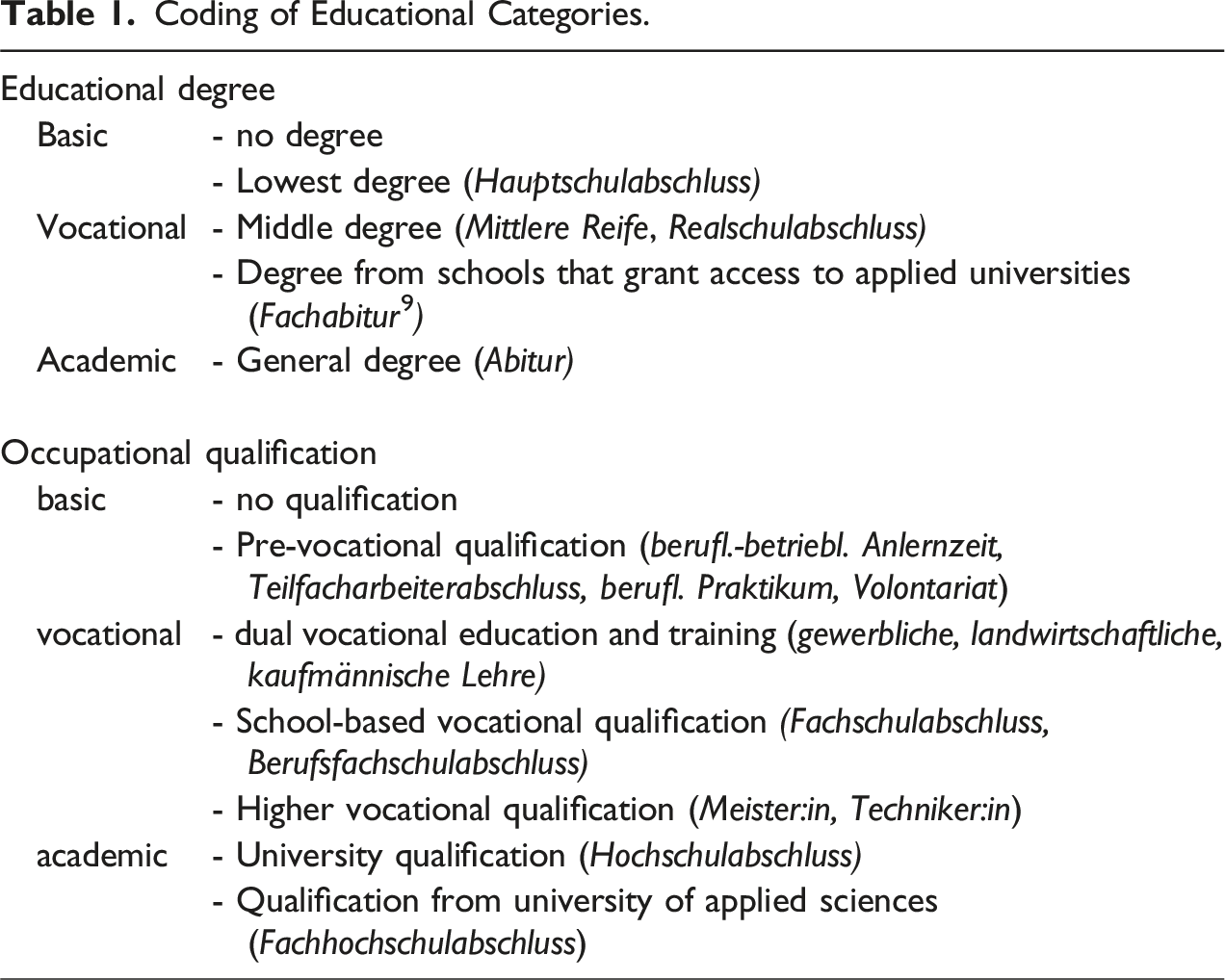
All models include the standard individual-control variables gender, age, age squared, German nationality, and parental SES (measured by parents’ educational degree and occupational qualification). In the robustness section, we present additional models that further include indicators of individuals’ SES as mediating variable, and we replicate our models only among employed respondents to ensure that results are not driven by respondents’ labor market status.
Modeling Strategy
To analyze the feedback effects of education policies on individuals’ political participation, we combine the macro-level information on education policies in the Länder with the micro-level data of the ALLBUS. An empirical challenge here is to ensure that each adult respondent is assigned to those education policies that shaped their school experiences as adolescents – even if they moved from one Land to another in between their adolescence and their survey participation. To achieve this, we combine the micro- and the macro-level data based on two pieces of information: first, we rely on the ALLBUS question “Where did you mainly live during your adolescence?”, with the German Länder as answer options. This question was asked in numerous survey waves (1991, 2006–2018) and allows us to assign respondents to the Land in which they presumably attended secondary school. The second information relates to the typical individual’s progress through the German education system: most individuals proceed from primary to secondary school with age ten. Combining these pieces of information, we assign every respondent to the education policies that were in place in the Land they lived in during their adolescence, and in the year they likely entered secondary school.
To estimate the effect of de-stratifying education policies, we rely on a comparison of individuals socialized under differently stratifying education policies. As can be seen in Figure 1, overall variation in education policies has two sources: 1) differences between Länder at any given school year, and 2) differences within the same Land over time. To avoid confounding by long-term economic, cultural, or political differences, we focus on over-time variation in education policies within the Länder by applying a within-between decomposition (Bell et al., 2019; Bell & Jones, 2015). These models decompose variation in education policies into its two components: the first is the over-time mean (at the level of the Länder in our case) and serves to capture variation between Länder, and the second is Land-year-specific deviation from the mean, which captures variation within the Länder over time. The within-component is equivalent to fixed effects estimators.
To address concerns regarding the endogeneity of de-stratifying reforms, our main analyses include additional time-varying indictors on the level of the Länder which we measure at the same time as the educational policies: first, we include an indicator of left cabinet power, i.e., the share of left (social democratic, green, and far left) ministries within Länder governments 10 to control for the possibility that left parties are more likely to implement de-stratifying reforms (Österman, 2018, but see Helbig & Nikolai, 2015, pp. 302–307) and to mobilize low educated voters (Anderson & Beramendi, 2012). Additional analyses replace left cabinet power with left vote share (data obtained from Christian Endt and cross-checked with the Federal Returning Officer). Second, we also include the number of unemployed individuals in each federal state and year (drawn from the Federal Employment Agency) to account for the possibility that the economic situation that individuals and their families experienced during their politically formative years influences patterns of participation and the implementation of educational policies. We decompose these additional control variables into their between-Länder and within-Land components, just like for education policies. In the robustness section, additional analyses implement interactive fixed effects – also referred to as random trend models or fixed effects with Land-specific slopes (Callaway & Karami, 2023; Ludwig & Brüderl, 2018; Wooldridge, 2005) – by including a linear time trend for each Land. While the inclusion of time-varying variables allows us to control for potentially non-linear trends in observed variables, Land-specific time trends allow us to control for unobserved linear time trends within each Land.
All main models are linear regressions with fixed effects for year of birth (= school cohorts) to control for the possibility of a general time trend from one generation to the next driving both education policy change and individuals’ participation. Furthermore, since individuals who entered secondary school in the same year are drawn from different ALLBUS waves, we add survey wave fixed effects to capture period effects. Standard errors are clustered at the level of Länder-school cohorts.
We are mainly interested in the effect of education policies on political inequality, and argued that de-stratifying policies are more positive for the political participation among individuals with low education than among those with high education. To identify such effect heterogeneity, we implement cross-level interactions between the respective indicator of individuals’ education and both the between- and the within-components of the policy indicators (see Giesselmann & Schmidt-Catran, 2019). The interaction of individual-level education and the within-component of education policies is the one we are most interested in; it shows whether a change towards more de-stratifying education policies within a Land affects the political participation of individuals with different levels of education differently.
Results: Education Policies Shape Political Inequality
Before delving into the discussion of the analytical results, Figure 3 presents the associations between our dependent political variables (political participation, interest, and efficacy) and individuals’ education (measured by educational degrees and occupational qualifications). Unsurprisingly, those with academic education are more likely to be politically engaged across all political indicators: the gaps in engagement between individuals with basic and those with academic education amount to between 13 %-points (for participation) and 20 %-points (for interest and efficacy) – which represent massive inequalities. Educational degrees, occupational qualifications, and political engagement.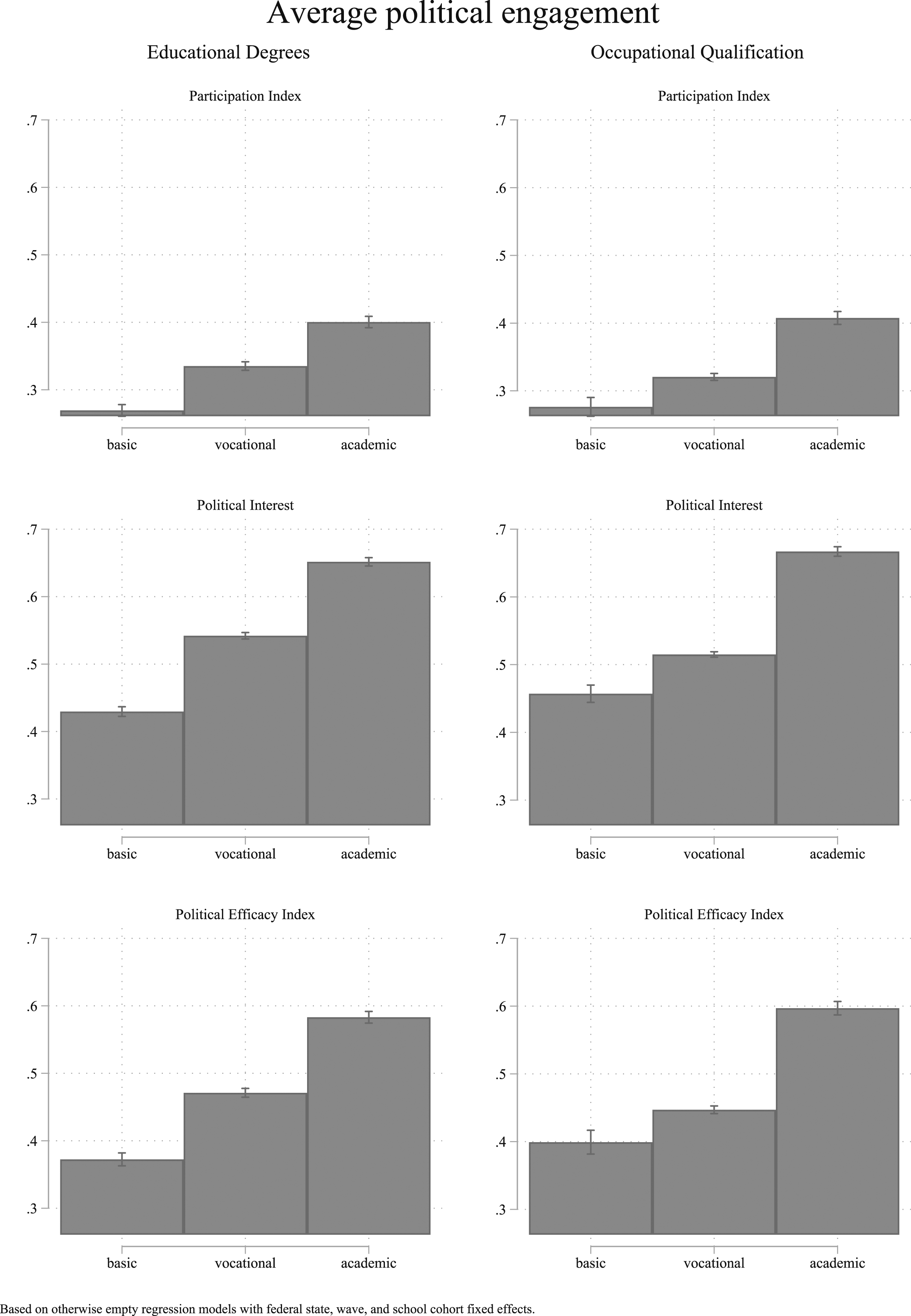
Turning to the empirical results, we start with the direct associations between macro-level education policies and micro-level political participation. We find that de-stratifying education policies do not affect political participation among the full sample (see also tabular results in appendix tables A6, A8, A10). As illustrated in Figure 4, neither the between- nor the within-component of the de-stratifying policies index show a statistically significant, direct association with individuals’ political participation, interest (although there is a negative coefficient on the between-component), or efficacy. That is, variation in de-stratifying education policies between and within Länder barely helps to explain variation in individuals’ political engagement. Since we expect effect heterogeneity – i.e., that individuals with low education profit more from de-stratifying policies – this finding does not come as a big surprise. We thus turn to the cross-level interaction between individuals’ education and within-Land change in education policies next. Main effects of de-stratifying education policies on political engagement.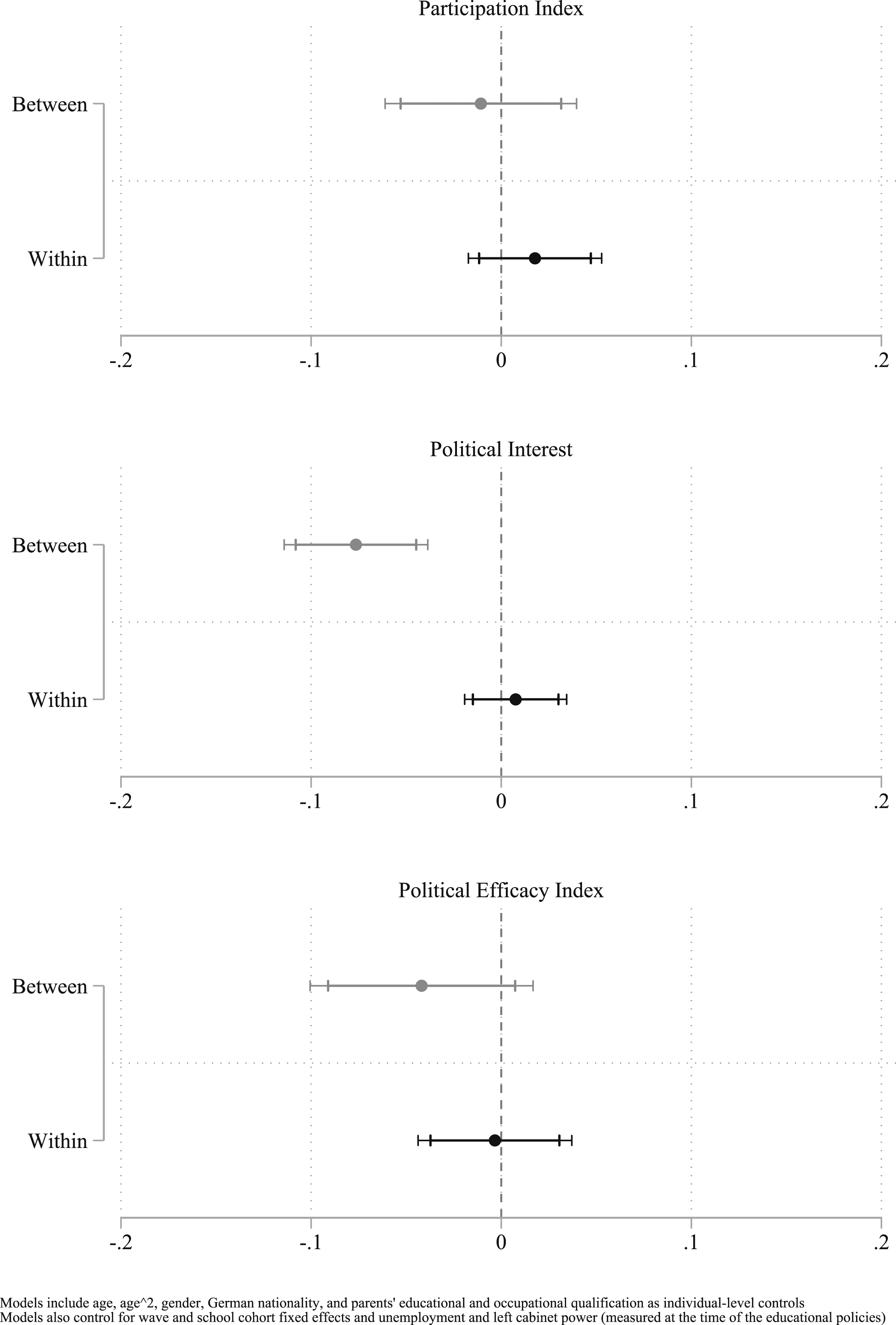
The cross-level interaction of within-Land change in education policies with individuals’ education shows whether the implementation of de-stratifying policies moderates the individual-level link between education and participation. The results support our hypothesis: they indicate that de-stratifying education policies benefit in particular individuals with basic education. Figure 5 shows the within-effects of de-stratifying education policies on political participation for individuals with different levels of education as measured by their educational degrees and occupational qualifications. The positive coefficients imply that individuals with basic education who went to school after the implementation of de-stratifying education policies in a given Land participate more in politics than individuals with low education who went to school in the same Land before de-stratifying policies were implemented. While the respective coefficient is strongly positive and significant for individuals’ occupational qualification, it is a bit smaller and just reaches conventional levels of statistical significance for the educational degree. One reason for this could be that the school leaving certificate lies further behind in individuals’ lives, in particular among those with basic education: they obtained their degree with age 15 or 16. Nevertheless, both indicators confirm that individuals with basic education profit from de-stratifying education policies in terms of their participation. De-stratifying policies thus reduce political inequality. Cross-level interaction: effects of de-stratifying education policies (within effects) on political engagement among citizens with different educational qualifications.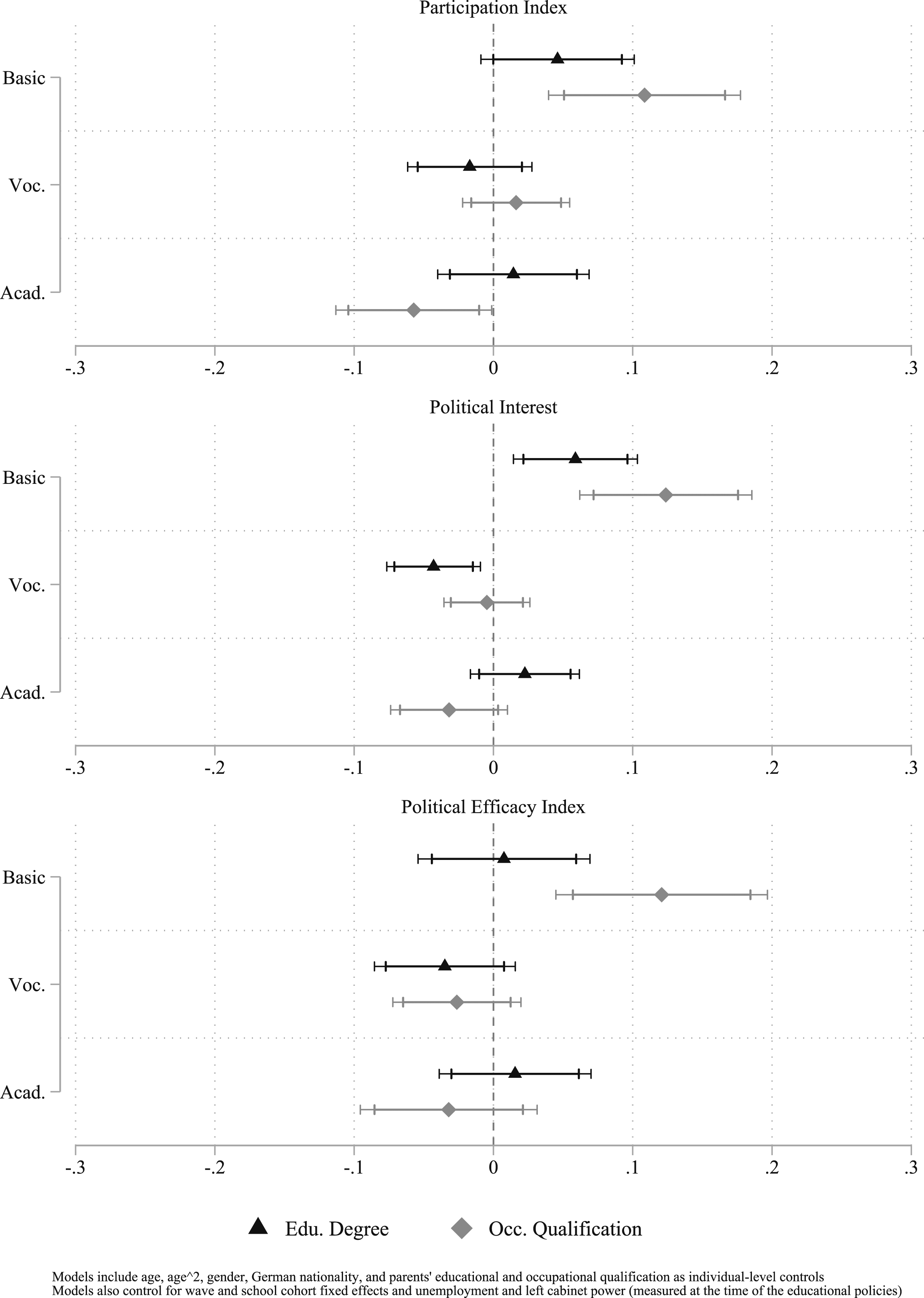
For individuals with academic education, in contrast, de-stratifying education policies are unrelated (when using educational degree) or negatively related (when using occupational qualification) to their political participation. Finding no effects of de-stratifying policies on political participation among those with academic educational degrees is in line with our theoretical arguments, according to which individuals with academic degrees likely come from more politicized homes and thus do not profit much from education in this regard. The (only just significant) negative effect for those with academic occupational qualifications, in turn, might point towards the existence of direct effects of de-stratifying policies on individuals’ occupational qualifications, and thus to compositional effects: as de-stratifying policies increase the likelihood of individuals from low-SES homes to acquire higher occupational qualifications, the academic group includes more such individuals after the implementation of de-stratifying reforms. While the political participation rates of those “newly academically qualified” individuals will be higher than the political participation rates of individuals with the same low-SES background but low occupational qualifications, they will remain at a lower level than those of the traditional academic group (individuals from high-SES homes with academic occupational qualifications). This interpretation is supported in further analyses (appendix figures A26-A27) that add individuals’ educational degree as additional control to the models that focus on occupational qualifications: the negative coefficient for those with academic occupational qualifications turns insignificant.
The inequality-mitigating effect of de-stratifying education policies extends to political interest and efficacy, which are important indicators of political engagement more generally. As shown in Figure 4, the relevant coefficients are positive and significant among individuals with basic educational degrees for their political interest (but fail to reach statistical significance for their efficacy); and positive and significant among individuals with basic occupational qualifications for their political interest and efficacy. Similarly, we see no or only small negative coefficients among those with academic education for both educational indicators. The pattern is thus the same as for political participation: after the implementation of de-stratifying policies, inequality in political interest and efficacy decreases; this effect is primarily driven by a positive effect of these policies on political engagement among individuals with basic education.
To summarize, the results provide evidence in support of the expected effect of de-stratifying education policies on political inequality: individuals with basic education who experienced their impressionable years under more de-stratifying education policies are more likely to participate in politics, to be more politically interested, and to have higher political efficacy than individuals with basic education who went to school under more stratifying policies. For those with academic education, in contrast, de-stratifying education policies barely alter their political engagement. In consequence, political inequality decreases after the implementation of de-stratifying education policies within a Land. 11 Appendix figures A1-A2 illustrate the inequality-mitigating effect of de-stratifying policies by plotting the predictive margins for the different educational groups over the de-stratification index. While de-stratifying policies do not eliminate political inequality (except for some predictions for very high values of within-country change in de-stratifying policies), they clearly reduce inequality in political participation, interest, and efficacy.
Robustness Checks
To corroborate the robustness of our results and to gain further insights, we conducted a large range of robustness tests, which further increased our trust in the findings. First, we decomposed the political engagement indices (see appendix tables A8-A10). For political participation, we differentiated between conventional and unconventional forms of participation. We find that the inequality-reducing effect is more pronounced for unconventional participation. Furthermore, de-stratifying education policies reduce inequality in internal efficacy, but not in external efficacy (appendix figure A10). De-stratifying policies thus seem to influence how low-educated individuals see their capacity to act within the system, but not their perspective on how the system reacts to their demands (see for related finding Rennwald & Pontusson, 2022).
Appendix figures A11-A18 show even more fine-grained results for the single variables that the political participation and efficacy indices are composed of. Reassuringly, most single variables show the same pattern as the main results. With regard to conventional forms, de-stratifying education policies reduce inequality the most for working in a party and protest voting. For turnout (appendix figures A11 & A15), however, the results are unexpected: although we see positive effects of de-stratifying policies among all educational groups, these are statistically insignificant among those with basic occupational qualifications (and a clear null-finding when using educational degrees), and significantly strongest among those with academic education. This suggests that turnout inequality even increases following the implementation of de-stratifying reforms – which clearly opposes our expectations as well as the findings for political interest, internal efficacy, various single forms of unconventional participation, and other conventional forms of participation. While explaining this surprising finding is a task for future research, it might relate to biased turnout overreporting in surveys: voters with academic education are more likely than those with low education to report having turned out while in fact they did not (Karp & Brockington, 2005). Another explanation could relate to turnout-specific determinants of turnout, which are not associated with other forms of participation. Civic duty would be an example: the feeling that turnout is an obligation of citizens is very stable within individuals and thus may be hardly malleable by school experiences (Feitosa & Galais, 2020). Besides overreporting among the high educated, this might also contribute to the unexpected – and, in comparison to all other results, exceptional – finding with regard to turnout. Turning to the single items in the indices of political efficacy, de-stratifying policies reduce inequality in almost each single indicator of internal efficacy, and in almost no single indicator of external efficacy.
We also replicated the analyses with regard to our main independent variable, using a binary index of de-stratifying education policies and the single policies (appendix figures A19-A20). These additional analyses demonstrate the robustness of the main findings: de-stratifying education policies – whether measured as a binary indicator, continuous measure, or each single policy – reduce inequality in political participation, interest, and efficacy. There are interesting differences regarding which policies are particularly important for decreasing inequality in participation: when using individuals’ educational degree as an indicator of their education, the duration of primary education appears to have particularly strong inequality-mitigating effects on participation. This makes sense: it is the only de-stratifying policy in the index that applies to all individuals in the given school-year cohorts without opt-out options for individuals with high-SES backgrounds. This is particularly beneficial for particular individuals with basic educational degrees. When using individuals’ occupational qualification as an indicator of their education, the share of the Gymnasium among all schools offering the Abitur helps most to explain changed patterns in participation. Again, this seems logical: having more opportunities to gain the highest educational degree increases individuals’ opportunities to acquire higher occupational qualifications; the politically mobilizing effects might thus in addition derive from post-secondary educational experiences.
In addition, we replicated the main models for indicators of parental SES (parental educational degrees and occupational qualifications) and individuals’ own SES (income and Oesch class classification (Oesch, 2006) based on ISCO-88 codes provided by the ALLBUS (Jann, 2019)). As appendix figure A21 shows, de-stratifying policies do not exert any influence on political engagement among any group defined by parental SES. In stark contrast, our main findings are largely replicated based on individuals’ own social class and income. This suggests that the weaker relation between parental SES and education under de-stratifying policies plays only a marginal role for our results, compared to mechanisms that develop in or after school.
Furthermore, we empirically analyzed the role of individuals’ SES as a potential mediator by estimating models that additionally include two different indicators of individuals’ SES: their income at the time of the survey (measured in three equally sized groups each survey year), and their social class (based on the Oesch classification, summarized in three groups). The point estimates remain very similar, and although confidence intervals increase, most effects remain statistically significant (appendix figures A26-A27). That is, although a part of the effect of de-stratifying policies is mediated via an effect on individuals’ SES, there remains a moderating effect of these policies on the link between education and participation. Additionally, we replicated the main models in a reduced sample, using only individuals in employment to ensure that our results are not driven by individuals’ labor market status. The results are mostly robust to this modification (appendix figures A24-A25).
Finally, we tested the robustness of our results to alternative modelling strategies, replicating the estimations using (1) Land fixed-effects, (2) Land fixed-effects with linear time trends (=state-specific slopes), (3) left vote shares instead of left cabinet power as an indicator of the political climate at the time of the reforms, (4) three-level models with individuals nested in Land school-year cohorts and in Länder. The results are very similar to our main findings (appendix figures A22-23).
To summarize, our results are highly robust to a large number of robustness checks. This paper thus presents strong evidence in support of the long-term feedback effects of education policies on political inequality: de-stratifying education policies reduce political inequality.
Conclusion
This paper argued and showed that education policies shape political inequality. Drawing on theories of policy feedback effects, we suggested that de-stratifying education policies increase the political resources of individuals with low education (resource effect) and facilitate the development of positive social identities among them (interpretive effect). Thereby, we argued, de-stratifying education policies reduce political inequality. We empirically tested our claim by exploiting variation in education policies within Länder in Germany. The results support our theoretical arguments: inequality in a multitude of (but not all) forms of political participation is lower among citizens who have spent their politically formative years in school after the implementation of de-stratifying education policies than among citizens who experienced more stratifying education policies in the same Land. Importantly, and in line with our expectations, this effect is driven by an increase in participation among individuals with low education. The inequality-mitigating effect of de-stratifying policies is particularly strong for individuals’ unconventional participation. For conventional participation, the effects differ more across the single participation forms and, surprisingly, do not hold for turnout. This unexpected and exceptional finding might relate to strong turnout overreporting among the highly educated or/and to turnout-specific determinants that are not affected in a similar way by de-stratifying policies. Contrary to this surprising null-finding for turnout, we find that de-stratifying policies are associated with a decrease in inequality in political interest and efficacy, showing that our argument also holds for important indicators of political engagement more generally.
Even though our findings do not extend to turnout, the reduction of inequality in various other forms of participation might equally lead to more equal policy responsiveness. According to Weisstanner and Jensen (2024), both parliamentary and extra-parliamentary mobilization of disadvantaged groups can increase policy responsiveness to these groups. Consequently, the inequality-mitigating effects of de-stratifying policies might increase policy responsiveness to the lower educated, even though these policies do not reduce inequality in each single form of participation.
From a comparative perspective, the de-stratifying policies implemented in the German Länder are modest at most. For example, in most Länder that have increased the duration of primary education, there remains an option for “high-achievers” to proceed to the academic track after four years of primary education; and where comprehensive schools were introduced, these never replaced the academic track. Therefore, the de-stratifying effects of these policies lag far behind their de-stratifying potential. Instead of introducing structural change, these reforms rather represent very small steps towards de-stratification, and could thus be interpreted as instances of institutional layering (Streeck & Thelen, 2005; see also Busemeyer & Haastert, 2017). This has two important implications. For one, our results are likely to be lower-bound estimates of the potential of de-stratifying education policies for reducing political inequality. De-stratifying education policies that would postpone tracking age for all school forms including the academic track, or that would replace the differentiated system by a comprehensive one, can be expected to have much larger inequality-mitigating effects. At the same time, however, our results show that even such gradual steps towards de-stratification can help to tackle (increases in) political inequality.
In general, our findings are relevant beyond the case of Germany. While we focused on (de-)stratifying education policies that relate to tracking, these are not the only education policies that affect the extent of stratification in education systems. Other policies are, for example, those that regulate the private sector, parental school choice, or school authority in student admission (Gingrich, 2019; Haberstroh, 2016). All of these policies can be (de-)stratifying. To illustrate: a sufficiently large private sector extracts primarily students with higher SES backgrounds from public schools and may teach other curricula (though the stratifying potential and curricular differences depend on official requirements, e.g., regarding fees) (West, 2006, 2014). Sweden, one of the Scandinavian countries known for its equalizing education policies, currently (re-)introduces stratification through private schools (ibid) and tracking (Busemeyer et al., 2020). This would be a good case for future research to investigate the stratifying impact of privatization and its consequences for political inequality. Furthermore, in countries such as the United States or England, strong residential segregation drives stratification in education (Gingrich, 2019; Gingrich & Ansell, 2014). Thus, our argument not only applies to countries with tracking policies, but could travel to many other countries and contexts.
One important limitation of our study is that we cannot test the mechanisms that we suggested to underly the effects of de-stratifying policies. This would require a design in which students at school are directly observed and followed over a long period of time in many geographical units with different (de-)stratifying policies or in a unit that saw changes in de-stratifying policies. Lacking such data, we were not able to empirically disentangle the different resource effects and interpretative effects, but future research might overcome this limitation.
By analyzing the link between education policies and political inequality, this paper makes several main contributions: while much of the policy feedback literature focuses on short- or mid-term effects, we are able to show that education policies have long-lasting feedback effects on patterns of political engagement. Although (most) individuals have experienced education policies as adolescents, those policies shape their political engagement as adults – long after their school experiences. Furthermore, we contribute to the comparative education literature in political science, sociology, and economics by showing that education policies not only affect educational and economic inequalities, but also political inequality; and to research on political behavior that education policies are an important factor shaping patterns of participation (see also Garritzmann, 2021). Taking a more abstract perspective, our results have implications beyond the case of education policies, as our logic could similarly extend to other redistributive policies, in particular those that are (de-)stratifying.
Given current debates about increasing (political) polarization with regard to both political participation patterns and attitudes, our research is highly relevant also from political and societal perspectives. The most important implication of our study is that de-stratifying education policies can help to counter trends of rising inequality in different forms of political participation. Reforming an established education system, however, is politically not always easy due to path dependencies and interest groups (e.g., Garritzmann & Garritzmann, 2023; Pierson, 2000). This also is reflected in political processes surrounding de-stratifying reforms in the German Länder: in many cases, the teachers’ union associated with the academic track (Philologenverband) mobilized the parents of their (prospective) students and – often successfully – countered governmental efforts to de-stratify (Busemeyer & Haastert, 2017; Helbig & Nikolai, 2015). Thus, de-stratifying policies that would attempt to introduce structural change might be politically infeasible as they incite backlash from parts of (certain) teachers’ unions and parents who fear to lose what they perceive to be their advantaged situation. Luckily for policy makers, though, our results suggest that even modestly de-stratifying policies can make a difference for political inequality. A strategy of gradual layering might thus be a more realistic political option in established education systems.
Supplemental Material
Supplemental Material - How Education Policies Shape Political Inequality: Analyzing Policy Feedback Effects in Germany
Supplemental Material for How Education Policies Shape Political Inequality: Analyzing Policy Feedback Effects in Germany by Susanne Garritzmann and Nadja Wehl in Comparative Political Studies
Footnotes
Acknowledgments
This article benefittet a lot from helpful and constructive feedback by the editors and anonymous reviewers as well as by Marius Busemeyer, Niccolo Durazzi, Julian Garritzmann, Anja Giudici, Thomas Kurer, Mikael Persson, Alexander Schmidt-Catran, Delia Zollinger, and the participants of the ESPAnet 2022, track 24 “The Politics of Education”.
Declaration of Conflicting Interests
The author(s) declared no potential conflicts of interest with respect to the research, authorship, and/or publication of this article.
Funding
The author(s) disclosed receipt of the following financial support for the research, authorship, and/or publication of this article: This work was supported by the Deutsche Forschungsgemeinschaft; (Germany’s Excellence Strategy) - EXC-2035/1 - 390681379

Supplemental Material
Supplemental material for this article is available online.
Notes
Author Biographies
References
Supplementary Material
Please find the following supplemental material available below.
For Open Access articles published under a Creative Commons License, all supplemental material carries the same license as the article it is associated with.
For non-Open Access articles published, all supplemental material carries a non-exclusive license, and permission requests for re-use of supplemental material or any part of supplemental material shall be sent directly to the copyright owner as specified in the copyright notice associated with the article.
