




Abstract
Competition law is a constitutive institution in capitalist markets, establishing the rules for when interfirm coordination is allowed and where competition is required (Paul, 2020). Yet comparativists have spent decades debating the varieties of capitalism framework—which places the issue of coordination at the center of the distinction between capitalist types—while paying virtually no attention to cross-national variation in antitrust rules. This article develops an original theoretical framework to conceptualize the relationship between competition law and the organization of capitalism. We go beyond the usual binaries (coordinated vs. liberal market economies, “restrictive” vs. “permissive” antitrust regimes) to disentangle two dimensions of the law that fundamentally shape patterns of coordination and competition both across regulatory jurisdictions and over time. Applying our framework to analyze the evolution of American and European competition law, we show how a comparative coordination rights framework can be used to conceptualize key institutional changes within contemporary capitalist systems.
Keywords
Introduction
Nearly a century and a half after the Sherman Antitrust Act of 1890, the ascent of mega-companies such as Amazon and Apple has put “monopoly power” and antitrust back in the headlines. Legal scholars and economists have begun to analyze recent developments in competition policy, but with the notable exception of a few EU scholars, students of the comparative political economy of the rich democracies have not had much at all to say about antitrust law and enforcement. 1 This is peculiar, because competition law is a key constitutive institution in capitalist markets, establishing the rules for where interfirm coordination is allowed and where competition is required. 2 Yet even the dominant varieties of capitalism literature – which famously distinguishes political economies according to the institutional features that support two distinct models of coordination – is strikingly silent when it comes to the role of competition law and policy in structuring markets.
This gap is consequential because both the American and European political economies have undergone massive structural changes over the past four decades that are linked to competition law changes, but have flown under the radar of dominant theories of CPE. Specifically, the US has diverged from fellow liberal market economies, migrating from a classically liberal model to become highly oligopolistic in a trend that tracks significant developments in American antitrust theory and jurisprudence that the CPE literature has largely ignored (Philippon, 2019). Meanwhile, Europe’s coordinated market economies have experienced a mix of changes that are also connected to competition law developments. Some of these, such as the liberalization of regulated industries and the greenlighting of transnational mergers, have brought European economies closer to the neoliberal model of capitalism (Buch-Hansen & Wigger, 2010). Other developments, however, such as legal protections for interfirm and worker coordination, and an increasingly proactive approach to economic dominance, are more consonant with coordinated market economies (Foster & Thelen, 2023).
In this article, we propose a general framework for analyzing changes in competition law and their impact, both across countries and within countries over time, that helps explain these developments. Building on the legal scholar Sanjukta Paul’s (2020) seminal reconceptualization of US antitrust law, we move beyond the usual binaries (liberal vs. coordinated market economies, “restrictive” vs. “permissive” antitrust regimes) to disentangle change along two distinct dimensions: in the rules governing horizontal coordination (between non-dominant economic actors) and those governing hierarchical coordination (controls imposed by dominant players). Based on these distinctions, we identify four ideal-typical competition models that reflect different combinations of coordination rights: cartelistic competition, oligopolistic competition, arm’s length competition, and cooperative competition. Furthermore, we show how this framework can be used to understand important recent and ongoing trajectories of change in the organization of capitalism.
We apply our framework to developments over the postwar period in the US and Europe to show how it yields insights of interest both to VOC scholars and to EU scholars—highlighting important blind spots in the VOC literature while also resolving longstanding debates in the EU literature. Specifically, we show how changes in the American competition regime since the 1970s and 1980s have moved the US away from the arm’s length relationships and fluid labor markets traditionally associated with the “liberal” model and toward highly concentrated oligopolistic product markets and significant labor market rigidities. Turning to Europe, we revisit – and revise – dominant accounts that emphasize convergence on the US by drawing attention to key dimensions along which competition rules have diverged sharply from American developments.
The paper is organized as follows. We begin our analysis by noting the striking absence in the comparative political economy literature of substantial discussion of competition law and its role in shaping the organization of capitalism cross nationally and over time. We contrast this with the attention paid to these issues by economists and legal scholars who attribute growing oligopoly power in American capitalism to changes in antitrust policy and enforcement since the 1970s. We turn then to unresolved debates among EU scholars about the extent to which European competition rules have embraced American practices in ways that undermine the cooperative arrangements that have long anchored Europe’s alternative model of CMEs.
We argue that contemporary debates relating both to the US and to Europe fail to distinguish two distinct dimensions of competition rules: those governing horizontal coordination between small and medium sized companies (SMEs) that individually lack market power, and those governing hierarchical controls by dominant players. We show that different combinations of coordination rights produce four ideal-typical models of competition, and we apply our framework to conceptualize the trajectories of competition law change in Europe and the United States. Disentangling the two distinct dimensions of coordination allows us to document important continuities in the US, alongside some convergence by the EU with respect to horizontal coordination, but also – more importantly – to highlight the ways in which the EU and US have diverged in their approaches to hierarchical coordination. A final section highlights the contribution of the framework we propose to the literature on the comparative political economy of the rich democracies and beyond.
Theories: Varieties of Competition Law in Political Economy and Legal Scholarship
The dominant “varieties of capitalism” framework famously distinguishes political economies according to the institutional features that support two distinct models of coordination. Liberal market economies, or LMEs, are those in which “firms coordinate their activities primarily via hierarchies and competitive market arrangements,” and in which coordination outside of the firm primarily occurs via “arm’s-length exchange of goods or services in a context of competition and formal contracting” (Hall & Soskice, 2001, p. 8). Coordinated market economies, or CMEs, by contrast, are characterized by heavier reliance on non-market institutions, and where firms are often embedded in arrangements that involve “more extensive relational or incomplete contracting, network monitoring based on the exchange of private information inside networks, and more reliance on collaborative, as opposed to competitive, relationships to build the competencies of the firm” (Ibid).
Given the centrality within the VOC framework of different modes of coordination—whether through corporate hierarchy and competitive market arrangements as in LMEs or through various nonmarket institutions as in CMES—it is surprising that competition policy has not been a major focus of comparative capitalism scholarship. Historical treatments of capitalist development underscored the central importance of competition law in conditioning national market structures and corporate organization in the late 19th and early 20th centuries (Berk, 2009; Chandler & Hikino, 2009; Djelic, 2001; Fligstein, 1993; Keller, 1981; Lamoreaux, 1988; Thelen, 2020, 2024). Yet the relationship between contemporary capitalist organization and competition law has not been a major theoretical or empirical focus within the VOC literature. The introduction to Hall and Soskice’s seminal volume mentions US antitrust policy in passing (2001: 31), and other chapters address the role of the law in structuring production regimes (Casper, 2001; Teubner, 2001), but competition law is not central to the framework and has been neglected by subsequent VOC scholars.
Critics of varieties of capitalism have paid somewhat more attention to the role of competition law. For example, studies emphasizing the common neoliberal trajectory of capitalist systems have sometimes portrayed competition law as a homogenizing force that reinforces processes of economic liberalization, financialization, and marketization that undermine producer group coordination and organized capitalism. In particular, the intensification of competition law at the EU level and its enforcement by the European Commission is often seen as contributing to the disorganization of capitalism and a gradual convergence on a common liberal model (Buch-Hansen & Wigger, 2010; Höpner & Schäfer, 2012; Wigger & Nölke, 2007). Such research has been important for drawing our attention to the ways American influence in the post WWII period shaped early developments in Europe, and how the more recent adoption of some elements of ‘law and economics’ theories (including elements of the so-called “Chicago school” of law and economics) has affected some areas of policy and enforcement (Bartalevich, 2016; Buch-Hansen & Wigger, 2010). However, in emphasizing liberalization, critics have often over simplified the effects of competition law on Europe’s coordinated market economies, missing important elements of continuity in European competition policy as well as new divergences that have intensified the enforcement of rules regulating the exploitation of economic power. Moreover, studies that conflate “liberalization” with “Americanization” often miss the extent to which the US is no longer itself particularly “liberal.”
In short, the current state of the debate – mostly absent from VOC scholarship and viewed primarily as a tool of liberalization among VOC’s critics – has led CPE scholars to overlook a number of important developments in the political economies of the advanced industrial countries on both sides of the Atlantic – developments that have been more central to discussions within the disciplines of economics and legal studies. In the United States there is growing evidence that the collapse of antitrust enforcement following the adoption of ‘Chicago School’ ideas in court jurisprudence and agency policy (R. A. Posner, 1979) has contributed to growing oligopolistic power and caused the American economy to drift away from the classic LME model. The U.S. economy is increasingly characterized not by competitive and contestable markets and arm’s-length contracting, but rather by oligopolistic market structures, where a handful of entrenched firms predominate (Azar et al., 2022; Grullon et al., 2019; Philippon, 2019). Profit rates have soared to historic highs, particularly in the most concentrated sectors and among firms with high numbers of patents, suggesting the presence of market power (Grullon et al., 2019; Gutiérrez & Philippon, 2018). As pure profits have increased, labor income shares have fallen, particularly in the most concentrated industries (Barkai, 2020).
In addition, labor markets have long since ceased to be characterized by the kind of fluidity that is a core defining feature of the classic liberal model; indeed, labor market mobility in the US is at the lowest rate since the Census Bureau began keeping track. 3 Increasing industrial concentration across a wide range of sectors means that declining regions are often dominated by a few monopsonistic employers (Azar et al., 2022; Naidu et al., 2018; E. A. Posner, 2021; Yeh et al., 2022). Workers are increasingly stuck in place by the lack of opportunity in the country’s most dynamic regions (Autor et al., 2020; Hafiz, 2022), declining employer-based benefits (Madrian, 1994), rising housing costs (Ansell & Cansunar, 2021; Coate & Mangum, 2021), and employers’ growing use of non-compete and no-poach agreements in employment contracts (Krueger & Ashenfelter, 2022; E. A. Posner, 2020; Staszak, 2020).
Meanwhile, European political economies have developed along a different trajectory. The trend toward greater employer market power observed in the United States is not observed in the United Kingdom, where labor market concentration has slightly declined over the last quarter century (CMA, 2024). A growing body of evidence also suggests that the secular trend toward increased concentration in product markets is less pronounced in many European countries. A number of close studies have concluded that economic concentration levels and markups in Europe have been either stable or characterized by modest decreases following the integration of the European single market (Cavalleri et al., 2019; Döttling et al., 2017; Gutiérrez & Philippon, 2018; Kalemli-Ozcan et al., 2024). 4 Other studies, using different data, have identified some secular trends similar to the US, toward lower labor shares (Autor et al., 2020; Piketty, 2014), increases in industrial concentration levels (Bajgar et al., 2023; Koltay et al., 2023), and a rise in consumer markups (De Loecker & Eeckhout, 2018) in many European countries. However, even in these studies, the observed changes are usually more modest in magnitude and starting from lower baselines than in the United States (De Loecker & Eeckhout, 2018; Koltay et al., 2023).
While Europe’s coordinated market economies have no doubt faced new pressures stemming from globalization and technological change, they nevertheless also continue to be characterized by much higher levels of nonmarket coordination. European trade unions have weakened but they still retain higher coverage rates than in the United States, particularly in the private sector (Darvas et al., 2023). European employer and trade associations have proven even more resilient, with membership levels remaining stable in most countries since the 1970’s even as their role in collective goods provision and advocacy has continually evolved (Brandl & Lehr, 2019). Compared to the United States, EU business associations are denser and less fragmented (Spillman, 2012; Traxler, 2004) and more actively involved in coordinating research, standard setting, skills development, and collective bargaining (Gooberman & Hauptmeier, 2022). 5 Comparative business demography studies clearly indicate that, across most major sectors of the economy, small and medium sized enterprises continue to play a more prominent role in European economies (Del Sorbo et al., 2018).
Existing frameworks have a difficult time accounting for both the shift toward oligopoly in the US and the mix of continuity and change observed in Europe. The broad distinction between “liberal” and “coordinated” capitalism used in VOC theory is not supple enough to capture these developments and assess their implications. Economic liberalization and convergence frameworks proposed by VOC critics better account for some elements of change in the EU, particularly the weakening of labor unions and the transnational consolidation of industry. However, they are less effective at explaining how and why the EU has continued to diverge from the US on other dimensions. And they have very little to say about the oligopolistic tendencies found in the American economy, or indeed about the dramatic differences in the treatment of dominant firms on the two sides of the Atlantic.
One of the core reasons for this oversight is the tendency of nearly all observers to view competition law in a unidimensional way. Both VOC theorists and VOC’s critics conflate the different targets of competition law—whether aimed at horizontal coordination or hierarchical restraints and mergers. So, any move by a jurisdiction on one dimension (whether procedural or substantive; whether relating to horizontal or hierarchical coordination; and whether the rules relate to cartels or abuse of dominance) is coded as signaling more or less stringent competition rules. As closely connected as these different dimensions are on some issues and at some times, nothing in the broader historical record suggests that they necessarily go together. In fact, variation on both dimensions is important for tracking key changes in the evolution of capitalist organizations over time.
A Comparative Coordination Rights Framework
Building on the work of Sanjukta Paul (2020) we propose a new framework for analyzing such changes. Among legal scholars of antitrust, Paul is distinctive in that she conceives of competition regimes not in terms of competition law stringency, but rather in terms of coordination rights. In doing so, she effectively flips the script of antitrust as it is typically presented: instead of thinking about competition law as concerned primarily with the regulation of anti-competitive practices (strict or permissive), she pushes us instead to consider how competition law allows, permits or even encourages certain kinds of coordination between firms and other producer groups, while preventing other kinds. As she puts it: “antitrust law’s core function is to allocate coordination rights to some economic actors and deny them to others” (382). Her key insight is that both coordination and competition are required in capitalism, but that the structure of coordination and competition—and in particular who gets to coordinate and who is forced to compete—will differ depending on the competition regime.
Although Paul did not conceive hers as a framework for comparative analysis, it can be fruitfully deployed to re-conceptualize cross-national differences as well as trajectories of change over time in competition regimes and in the organization of capitalism writ large. Adapting her framework, we distinguish between two main dimensions of economic coordination in capitalist economies, and use these to conceptualize four competition models that reflect different combinations of coordination rights. 6 The first dimension is horizontal coordination beyond the boundaries of the firm. This refers to restrictive agreements, practices, or mergers between firms that lack market power and that are operating in either the same market or adjacent markets. Horizontal coordination can thus include restrictive practices between direct competitors that sell the same or similar products or services. It can also include agreements between suppliers and distributors as long as none of the involved firms are economically dominant. In both cases, competition regimes vary in the extent to which they permit or forbid such arrangements.
This is distinct from a second dimension, which we term hierarchical coordination beyond the boundaries of the firm. This encompasses a range of unilateral practices, restrictive agreements or mergers involving large companies that have significant market shares, with the most extreme example being the establishment of a monopoly or the erection of a permanent barrier to entry. Here again, competition regimes vary from more permissive (“forbearing”) to more restrictive (limiting or restricting such coordination through state regulation). 7
Coordination Rules and Competition Models.
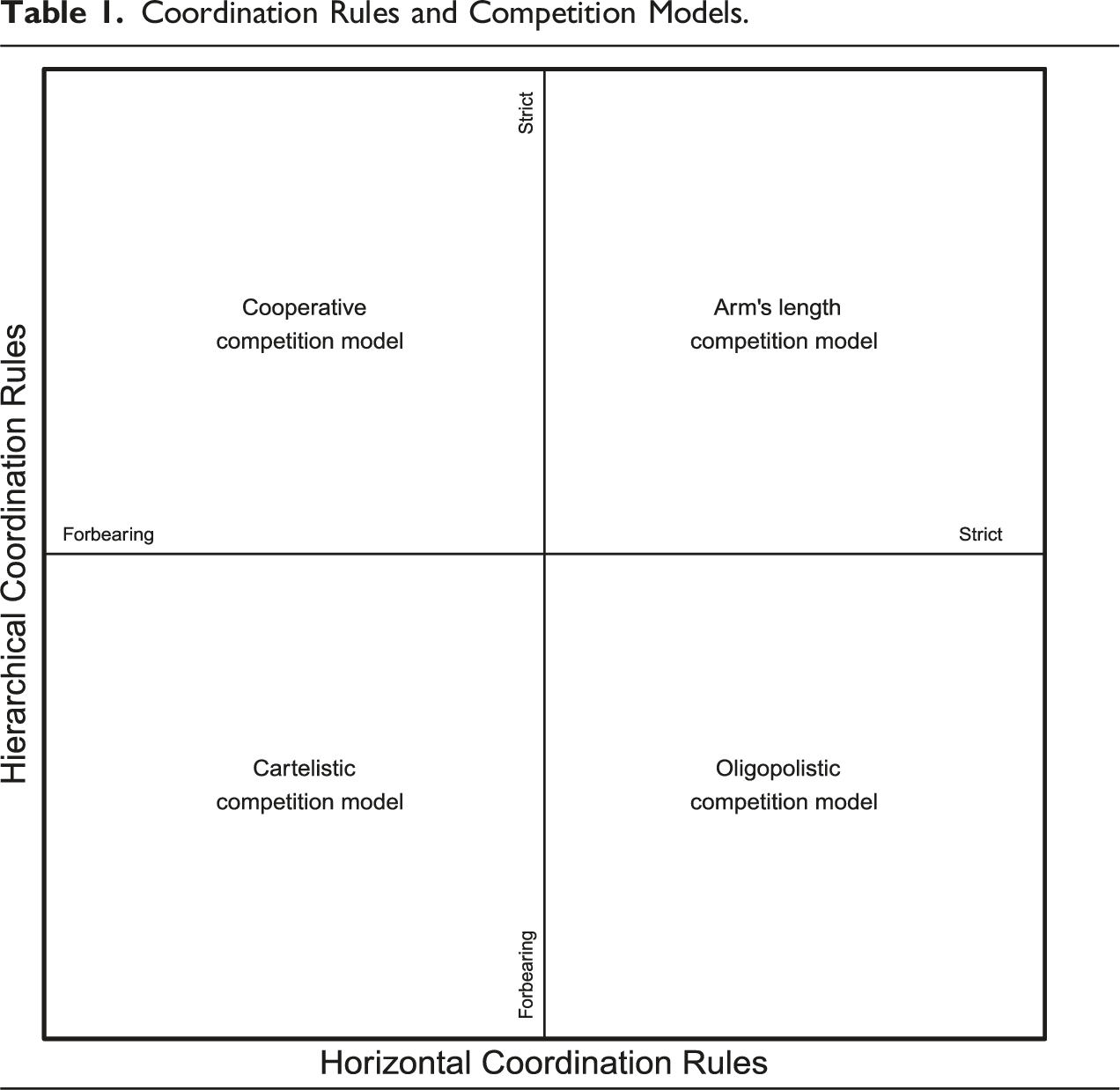
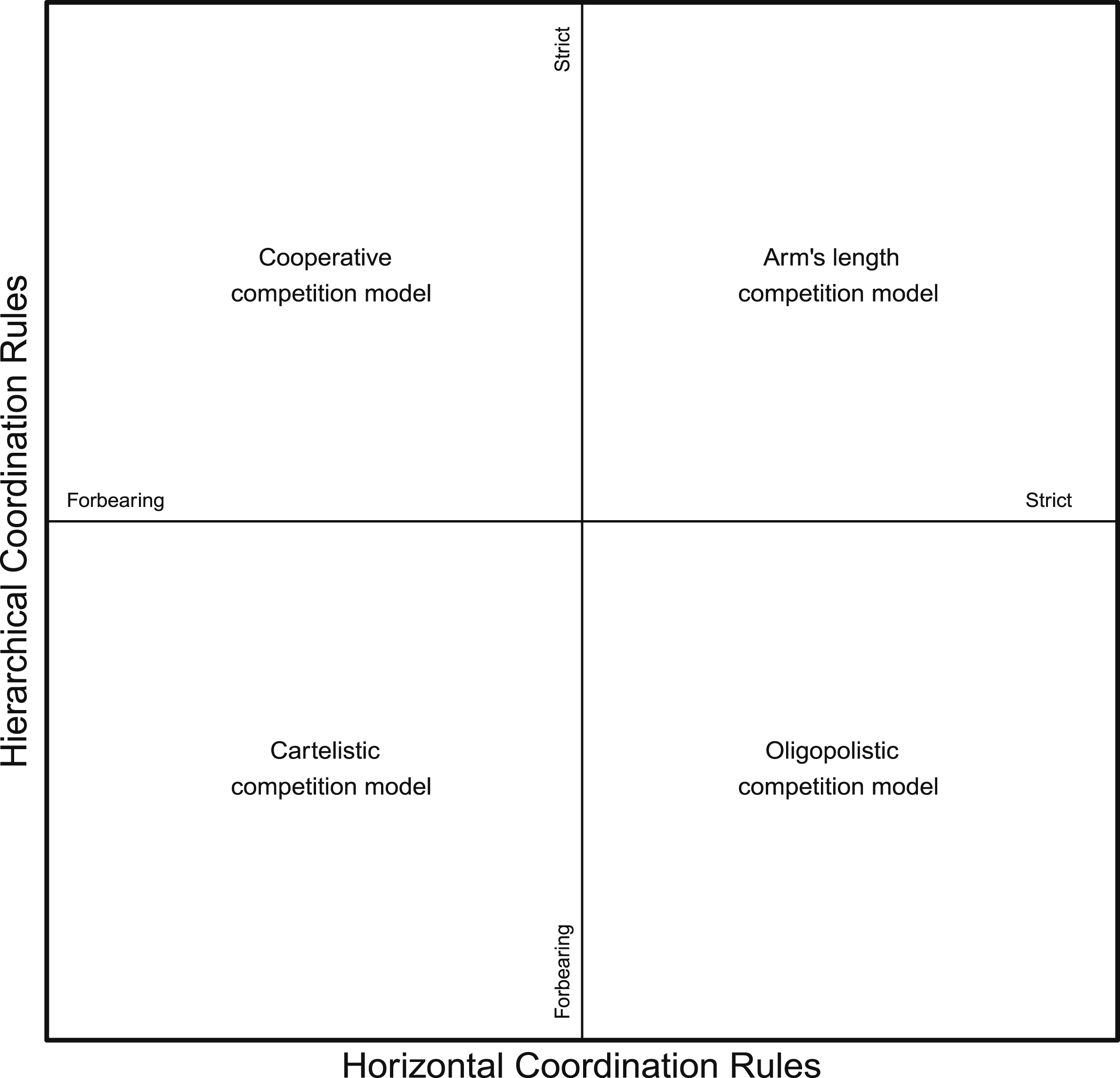
These distinctions yield the following four ideal types:
Cartelistic competition model
The regulatory regime in the lower left quadrant of Table 1 permits firms to coordinate on both the horizontal and hierarchical dimensions without being subject to state interference. Since firms are interested in stabilizing profit expectations by creating ‘market structures’ (Beckert, 2009), this regulatory regime tends to produce cartelized markets, where competition is partially restricted through private agreements between producers in the same industry (Schröter, 2013). Cartelistic market structures have historically facilitated economic stability and growth in some countries (Tilly, 1982; Webb, 1980), while simultaneously enabling horizontal nonmarket coordination institutions to develop (Thelen, 2020). But in the absence of regulation, the largest cartel members are free to leverage their economic power over other actors within the economy. This ideal-type is closest to Japan, Germany, and many other European countries prior to World II, when states not only permitted but often encouraged interfirm coordination and most industries were highly cartelized.
Oligopolistic Competition Model
The lower right quadrant of Table 1 indicates a regulatory regime where horizontal coordination between smaller companies is strictly prohibited, but dominant companies are given wide leeway to create barriers to entry and impose hierarchical controls on their suppliers and distributors. In contrast to the cartelized competition model, where the market is stabilized through horizontal agreements while maintaining firm independence, hierarchical coordination systems rely primarily on corporate hierarchy and economic concentration to stabilize market volatility (Lamoreaux, 1988; Sklar, 1988). This encourages the development of oligopolistic markets, characterized by a small number of large producers or sellers. Like cartelized competition, oligopolistic competition can reduce transaction costs and facilitate economic stability, scale economies, and long-term investment (Chandler & Hikino, 2009; Williamson, 1985). However, oligopolistic structures also enable economic exploitation, rent-seeking, and the entrenchment of incumbent players. This ideal-type is closest to the United States at the beginning of the 20th century when horizontal coordination between smaller firms and workers was limited by antitrust law while exclusionary practices by large companies were largely permitted as ‘reasonable’ restraints of trade.
Cooperative Competition Model
The regulatory regime in the top left quadrant allows competing firms to extensively cooperate while limiting the power of dominant companies to impose hierarchical restraints on other firms. Like cartelistic competition, firms and workers are permitted to establish robust trade associations and unions, which can be used to upgrade competition, and push the coordinates of competition away from price and toward quality. But unlike cartelistic competition, the state regulates both exclusionary private market structures as well as hierarchical controls by dominant companies (Ergen & Kohl, 2019). This ideal-type can facilitate the development of coordinated market structures, where competing firms engage in substantial nonmarket coordination to facilitate collective goods, reduce problems of free riding, and pool resources so that smaller firms can better compete against bigger ones (Crouch, 1993). Cooperative competition is best exemplified by many northern European countries during the second half of the 20th century, when companies were permitted to pursue extensive forms of horizontal coordination, but where the exploitation of economic power by large companies was strictly regulated by the state or held in check by countervailing corporatist institutions.
Arm’s-Length Competition Model
A regulatory regime characterized by strict rules limiting both horizontal and hierarchical coordination beyond the boundary of the firm will instantiate an arm’s length market regime (upper right quadrant). Chandlerian hierarchies are found within individual firms, but relationships beyond the boundaries of the firm, including with competitors, suppliers, distributors, creditors, and employees, are organized through formal contracts and competitive markets (Hall & Soskice, 2001, pp. 33–36). Crucially, the state not only enforces price competition between equally matched competitors, but also aggressively polices the exploitation of economic power by large corporations. Companies with market power not only are prevented from establishing barriers to entry, but are sometimes also required to actively facilitate entry. This ideal-type is best exemplified by the United States from the 1940’s until the 1970’s, when both horizontal cooperation and the exclusionary practices of dominant companies were limited by regulators.
Mapping Trajectories of Change
Opening up the analytic space to disentangle the complex (multi- not uni-dimensional) evolution of competition rules governing different types of market coordination allows us to move beyond the current terms of debate in both the VOC and EU literature. It forces us to think harder about how different competition regimes affect who exactly is allowed to coordinate with whom, and to do what, and about how differences in the answers to these questions drive variation in the trajectories of change in competition law on both sides of the Atlantic. By distinguishing movement related to horizontal versus hierarchical coordination we can identify with more precision the arenas in which American antitrust law continues to enforce arm's-length relations, and those where the law permits (or even encourages) hierarchical coordination. Similarly, we can also better evaluate where EU competition law and practice have converged with the United States, where they remain distinct (in degree if not in kind), and where they have diverged in new ways.
Figure 1 captures in a stylized way the overall trajectory of change in the rules governing market competition in the European Union and the United States since the 1970’s.
8
On the horizontal dimension, the US has maintained and even sharpened its traditionally strict policies toward almost all forms of interfirm (horizontal) coordination. Meanwhile, the EU has indeed moved in the direction of an arm’s length competition model, by developing stricter rules for both cartels and many other forms of horizontal coordination (Billows et al., 2021; Buch-Hansen & Wigger, 2010; Philippon, 2019). Nonetheless, especially compared to the US, EU competition law continues to allow substantial horizontal nonmarket coordination in certain areas, particularly for SMEs, workers, and interfirm cooperation agreements aimed at generating productive efficiencies – thus retaining significant elements that are historically characteristic of CMEs (Foster & Thelen, 2023). Trajectories of Change in Postwar US and EU Competition Regimes. Source: Authors’ characterization of competition law change, 1970–2020.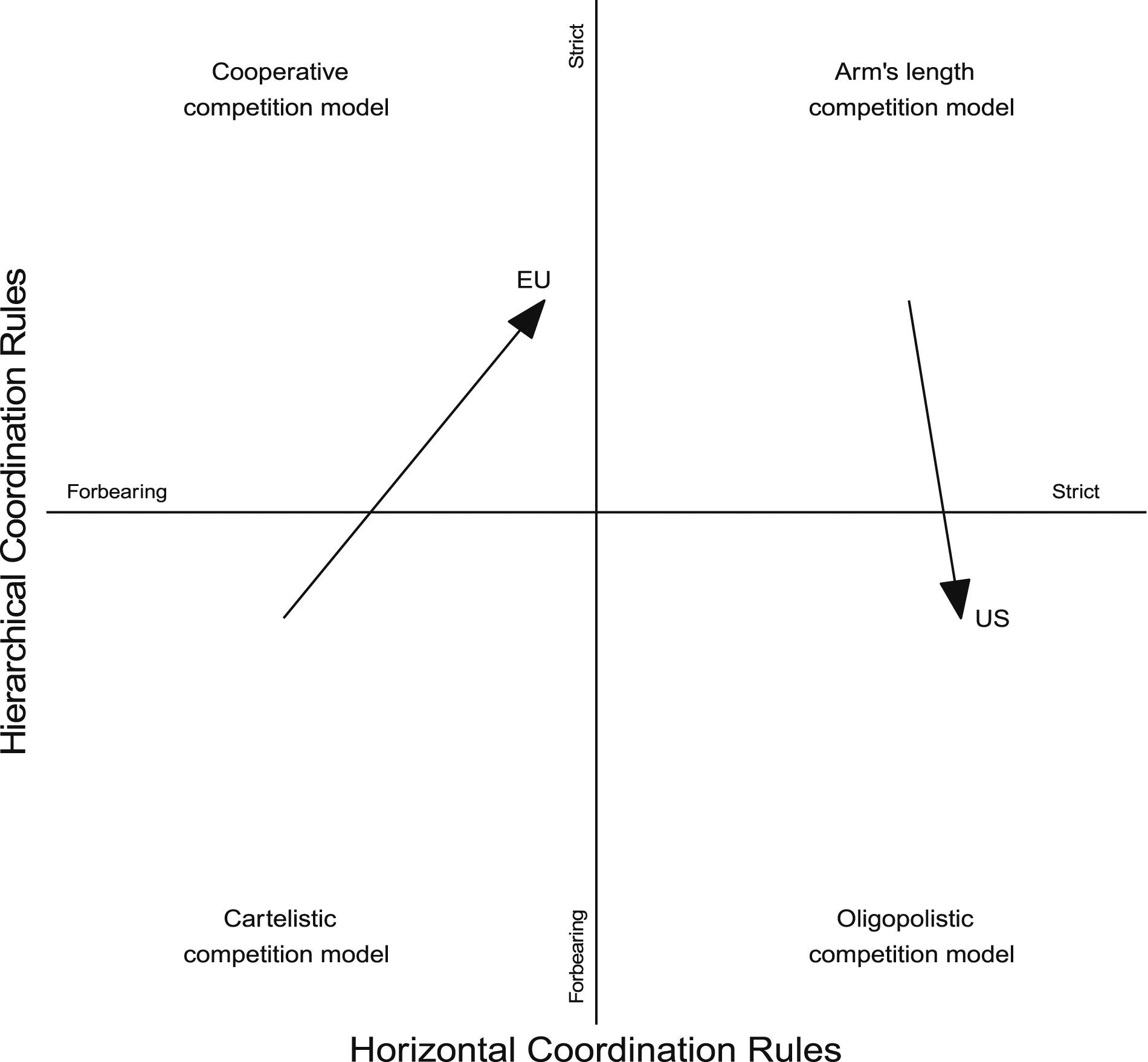
On the hierarchical dimension, however, the US and EU have sharply diverged, as the US has largely abandoned anti-monopoly, vertical restraint, and non-horizontal merger enforcement and the EU has intensified enforcement in each of these areas, particularly for dominant companies that control key infrastructures such as online platforms. In the EU, strengthening enforcement against abuse of dominance has helped protect nonmarket coordination by smaller firms from the exploitative and exclusionary practices of larger companies. Meanwhile, the move in the US toward hierarchical forbearance has pushed antitrust policy away from an arm's-length competition model characterized by extensive anti-dominance and horizontal enforcement to maintain market contestability, and toward an oligopolistic model where horizontal coordination continues to be aggressively policed, but large companies are given wide leeway to structure the marketplace through hierarchical coordination.
In the next two sections, we analyze how and why the trajectories of change have proceeded in this way, examining developments in policy and law, as well as patterns of enforcement in order to draw a connection between competition rules and the political economy. Our analysis builds on previous work by economists and legal scholars who have focused closely on changes to hierarchical rules in the US, alongside that by EU scholars who have tracked changes to horizontal rules in Europe and the effect on CMEs (e.g. Billows et al., 2021; Wigger & Nölke, 2007). However, we expand and refine both streams of analysis by distinguishing changes across both the horizontal and hierarchical dimensions, and by pointing out how the changes we document track the divergent trajectories of the American and European economies discussed above. While space precludes a full empirical test of the framework, these two case studies serve to illustrate the utility of our comparative coordination rights framework for better conceptualizing the co-evolution of regulatory institutions, producer group organization, and market structures within contemporary capitalist systems. 9
Coordination Rights and the Evolution of the American Political Economy
Historically, the US embraced what in comparative perspective was in fact a wholly unique approach to competition policy and jurisprudence (or what in American parlance is called antitrust). In the closing years of the 19th century, the political economies in both the US and Europe were upended by financial crises and deep economic depressions. Overcapacity across key markets set in motion vicious cutthroat competition among firms, provoking considerable market turmoil and industrial strife. American and European firms alike sought to stabilize markets by banding together into arrangements to defend against destructive competition and to restore industrial peace. European governments encouraged and often actively reinforced coordination among firms within industries, and judicial forbearance toward these forms of cooperation supported the flourishing of the dense associational landscape of producer group politics (trade associations, employer organizations, and labor unions) that we now associate with coordinated capitalism.
In the United States, by contrast, the passage of the Sherman Act, and the Supreme Court’s interpretation of that law, created strong prohibitions against what Paul calls “horizontal” coordination – i.e., coordination among non-dominant actors beyond the boundaries of the firm, including but not limited to labor (Paul, 2020, p. 383). 10 Large producers turned to alternative strategies to stabilize markets through corporate consolidation or the use of vertical restraints to restrict competition from above. These firms avoided antitrust prosecution by internalizing coordination functions – merging with their former rivals and swallowing up smaller competitors. This was the context that inspired the ‘great merger movement’ in the US at the turn of the century that resulted in a dramatic increase in industrial concentration and led to corporate hierarchy and arms-length exchange becoming the dominant modes of coordination (Lamoreaux, 1988; Sklar, 1988). 11 The strong binary between “pure” competition and corporate hierarchy that the American judiciary enforced and policed left a deep imprint on the American political economy (Berk, 1996). It also helped instantiate an oligopolistic competition model, where many industries were dominated by a small number of firms and large corporations had broad economic power to structure the marketplace in their interests (Chandler & Hikino, 2009; Sklar, 1988).
American competition policy continued to combine strict enforcement against horizontal combinations with more lenient (“rule of reason”) treatment of hierarchical coordination through the interwar period. 12 But the Great Depression and the accompanying dramatic increase in industrial concentration inspired a deep rethinking of American competition policy. A series of government studies assessing the impact of economic concentration on the economy in the late 1930’s delivered a scathing indictment of the behavior of the country’s dominant producers, contributing to an abrupt reversal on the American approach to hierarchical coordination (Peinert, 2023). Allying with populist Democrats in Congress, President Roosevelt expanded the Department of Justice’s (DOJ) Division of Antitrust budget five-fold, growing its staff from 58 lawyers to over 300 (Brinkley, 1996, p. 111). The new head of the Antitrust Division, Thurman Arnold, launched a period of reinvigorated enforcement, taking on some of the biggest names in American industry, including Paramount Studios, the Pullman Company, the Big Three car companies, and major steel and aluminum producers, during what in retrospect is now considered the “Golden Age” of American antitrust enforcement.
During his five-year tenure, Arnold pursued many major anti-monopoly cases, several of which resulted in the structural reorganization of dominant companies. 13 At the same time, he intensified horizontal enforcement, launching major cases against dairy producers, construction companies, oil refineries, and newspapers, among other industries. In many of these cases, the targets were large companies, but in others they were small firms or labor unions (Waller, 2004, pp. 600–603). Altogether, Arnold prosecuted more cases during his short (1938–43) tenure as head of the DOJ’s Antitrust Division than the previous fifty years of antitrust combined (Waller, 2004, p. 583). The combination of a strict approach to both hierarchical and horizontal coordination pushed the American antitrust system squarely toward the top right ‘arm’s length competition model’ in Table 1.
Following World War II, the arm’s length model was further institutionalized. The Celler-Kefauver Act in 1950 made it much easier for regulators to block mergers and acquisitions. From 1955–1969, the government challenged 167 combinations through litigation (R. A. Posner, 1970, p. 407). Although these enforcement actions did not always prevent aggregate consolidation via conglomerate mergers, they did slow down and occasionally reverse concentration trends within many industries. Careful economic studies from the period suggest that agency merger rules and litigation deterred or blocked numerous horizontal and vertical mergers, leading to a decline in the concentration rates of many sectors. 14
In addition to placing a new democratic check on mergers, the government also continued to limit hierarchical coordination beyond the boundaries of the firm through the active enforcement of anti-monopoly and vertical restraint rules. During the 1950’s and 1960’s, the DOJ and FTC successfully prosecuted dominant companies for monopoly violations in a variety of areas, from the exclusionary use of intellectual property to localized price cuts (Kovacic & Shapiro, 2000, pp. 9–12). Many of these prosecutions constrained the autonomy of the corporate monoliths of the era including Eastman Kodak, General Electric, Westinghouse, Procter & Gamble, and Bell Laboratories (Kovaleff, 1980; Watkins, 1961). Sometimes the mere threat of prosecution was sufficient to force powerful companies to show pricing restraint, as arguably occurred in the petroleum sector in response to ongoing DOJ investigations of the seven largest oil and gas companies (McFarland & Colgan, 2023). To be sure, regulators also continued to place limits on horizontal coordination by prosecuting Sherman Act cases against small firms. However, to a greater degree than in prior or future eras, the enforcement emphasis was on large companies. 15 Furthermore, courts and regulators largely avoided using antitrust to limit the coordination rights of workers, at least when coordination occurred in the context of labor unions. The result was a political economy that, while retaining many oligopolistic features, was also characterized by contestable markets and countervailing power in most industries (Galbraith, 1952).
Hierarchical Forbearance and the Move toward Oligopoly
The era, however, was short-lived. Already in the 1960s, American antitrust policy and practice had come under attack from both the left and right. Liberals such as Ralph Nader complained of corporate capture, while conservatives blasted an overweening bureaucracy. By the late 1960s, economists and legal scholars attached to the so-called “Chicago School” of law and economics had become vocally skeptical about the wisdom of the entire postwar antitrust regime. Robert Bork’s influential book, The Antitrust Paradox (published in 1978, but much longer in the works), had steadily gained influence in legal circles throughout the late 1960s and 1970s. Federal courts and regulators began to incrementally adjust existing precedents and policies in ways that led to more permissive hierarchical coordination rules. In several key cases at the end of the 1970’s, the Supreme Court reversed its own precedents by establishing a new ‘consumer welfare’ test as a requirement for prosecuting hierarchical restrictions (Orbach, 2011). In the aftermath of these decisions, most of the non-horizontal ‘per se’ rules that had been established during the post-war period were reversed and replaced with the more permissive ‘rule of reason’ (Khan, 2016; Kovacic & Shapiro, 2000). The change in jurisprudence made it much more difficult for US regulators to enforce hierarchical coordination rules, leading to a series of government losses in major merger and anti-monopoly cases (Kovacic & Shapiro, 2000, p. 54). 16 These changes gave large firms more autonomy to impose vertical restraints on their suppliers and distributors, erect barriers to entry, and pursue mergers that consolidated their market positions.
In 1981 Reagan elevated Chicago School thinking to government policy with his appointments of Borkian acolyte William F. Baxter to head the DOJ’s Antitrust Division and fellow Chicago schooler James Miller III as FTC chair. The new appointees presided over a sharp decline in all forms of antitrust enforcement against dominant market actors, while simultaneously intensifying horizontal enforcement, especially against smaller firms. Henceforth, antitrust policy and enforcement would fully embrace the Chicago school formula; the core criterion against which anti-competitive actions would be judged was whether they explicitly harmed consumer welfare, defined largely in terms of price (Khan, 2016). The shift toward a permissive approach to hierarchical coordination has only intensified since the early 2000’s, as the Supreme Court has ruled in favor of hierarchical controls by dominant firms – and against antitrust interventions – in almost all of its major cases (Wu, 2018).
Combined with the empowerment of economists relative to lawyers within US regulatory agencies, these court-led changes in coordination rights have contributed to a systematic collapse in anti-monopoly and hierarchical restraint enforcement (Berman, 2022; Ergen & Kohl, 2019). Figure 2 reports the pattern of DOJ enforcement before and after the adoption of the consumer welfare standard by courts in 1979. It shows that monopoly, vertical restraints, and non-horizontal merger cases made up only 2% of enforcement actions in the 1980’s and 1990’s, representing a dramatic decrease from the 1960’s and 1970’s when such actions represented one in five DOJ prosecutions. A similar pattern can be seen in merger enforcement. While in the 1960’s and 1970’s, the DOJ blocked a steady mix of horizontal and vertical measures, after 1980, merger challenges significantly declined. As can be seen in Figure 2, horizontal merger challenges became rarer after 1980, shifting from a quarter of total cases to just 8%. Meanwhile, non-horizontal merger enforcement almost entirely disappeared. DOJ enforcement before and after the adoption of ‘Chicago School’ ideas. Source: Gallo et al. 2000. Calculations by authors. Checkered (blue) areas indicate enforcement actions limiting hierarchical coordination; striped pattern (red) areas indicate enforcement actions limiting horizontal coordination.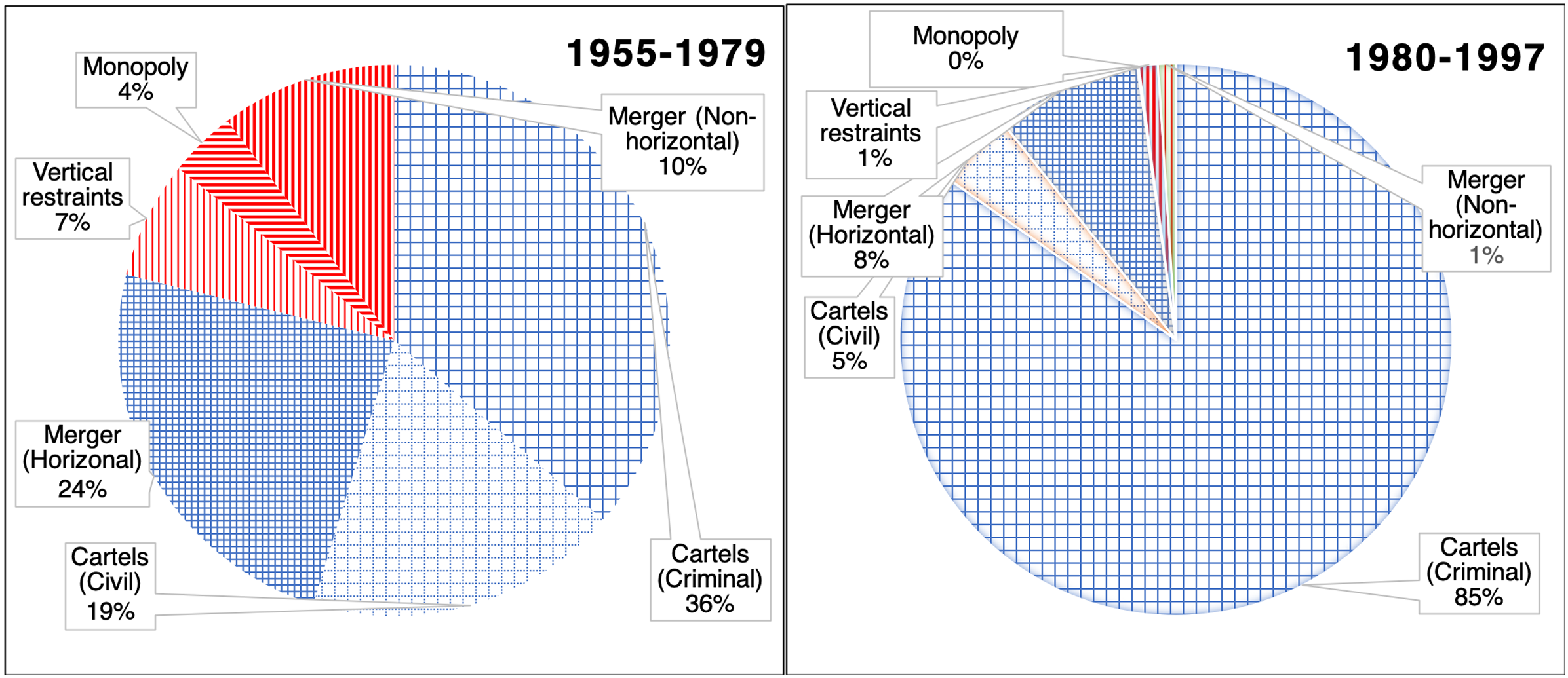
In response to this carte blanche, corporate America pursued an unprecedented merger boom. According to one study, the number and value of mergers and acquisitions dramatically increased in the years following the adoption of new merger guidelines in 1984 (Pryor, 2001). From 1985–2000, the annual volume of mergers and acquisitions tripled, with three-quarters of combinations occurring between firms operating in the same industry (Ibid, pp. 305–308). Over the same period, the average degree of industrial concentration in individual industries significantly increased—the reverse of the trend observed from 1960–1980, when hierarchical coordination rights were more restricted by US antitrust law (Ibid).
Even as U.S. regulators largely abandoned anti-monopoly and merger enforcement, they intensified enforcement of cartels and other forms of horizontal coordination, successfully prosecuting hundreds of cases (Gallo et al., 2000; Kovacic, 2003, pp. 415–420). Unlike the Golden Era of antitrust when large corporations were the main focus, the vast majority of these prosecutions were against small and medium-sized companies. 17 Within many industries, these prosecutions undermined the ability of domestic firms to effectively compete against foreign firms in Japan and Europe that enjoyed extensive horizontal coordination rights (Arslan, 2023). Workers and independent contractors seeking to pool their bargaining power were also more frequently targeted; these included, among others, groups of low-paid attorneys, piano teachers, ice skating instructors and church organists (Paul, 2020, pp. 391–392). Regulators not only prosecuted smaller firms, independent contractors and workers more frequently, but they did so with criminal sanctions. From 1980–1997, horizontal criminal cases constituted 85% of DOJ enforcement actions, compared to just 36% prior to 1980.
In the United States, the combination of weak enforcement against hierarchical coordination by dominant firms and intensified prosecution of horizontal collusion by smaller firms has allowed the US to drift toward the oligopolistic competition model in the bottom right quadrant of Figure 1. Scholars have identified clear links between specific changes to antitrust rules regulating mergers, hierarchical restraints, and independent contractors and the decline of worker power and increase in labor market rigidity described earlier (Azar et al., 2022; Callaci, 2021a, 2021b; Hafiz, 2022; Naidu et al., 2018). A growing number of economic studies have also provided evidence that the decline in anti-monopoly enforcement likely contributed to the trend toward oligopoly (Gutiérrez & Philippon, 2017, 2018) and that the largest American firms have supported this shift through the political process (Lancieri et al., 2022). Indeed, a competition regime that combines strict rules on horizontal coordination with permissive rules on hierarchical control beyond the boundaries of the firm allows dominant firms to effectively have their cake and eat it too. On the one hand, they are provided significant autonomy to structure the marketplace in their own interests, through extensive vertical contracting and exclusionary behavior. At the same, they are largely free from horizontally organized forms of countervailing power such as organized SMEs or workers that might limit this autonomy or provide a significant competitive challenge. Put differently, the largest firms in the United States are able to exploit the asymmetry in who has coordination rights in ways that lead to the predominance of hierarchical over horizontal forms of coordination (Paul, 2020).
Coordination Rights and the Evolution of the European Political Economy
In the formative period of industrial capitalism, many European industries were highly organized through cartels and other forms of business associations that relied heavily on both horizontal and hierarchical coordination beyond the boundaries of the firm. This placed European market structures in many countries clearly in the cartelistic competition model found in the bottom left of Table 1. Virtually all western and northern European countries – including not only Germany but also Austria, Belgium, Finland, the Netherlands, Norway, Sweden, Switzerland, Spain, Italy, and even the United Kingdom – took a much more permissive stance toward horizontal coordination than the United States (Schröter, 1996). Well into the postwar period, cartel organizations remained a prominent feature of many capitalist economies on the continent (Gerber, 1998; Shanahan & Fellman, 2022).
The creation of a supranational European competition law through the Treaties of Paris and Rome presented a direct challenge to the cartelistic competition model. American officials were heavily involved in designing the competition provisions of the European Coal and Steel Community and the U.S. experience with the Sherman Act provided a primary reference point for legal developments within the European Economic Community (EEC). The prohibition against anti-competitive agreements, enshrined in the Treaty of Rome, would have a lasting effect on the European economy, contributing to the decartelization of European industry and instantiating a more ‘arm’s length’ competition model within many sectors (Djelic, 2001; Harding & Joshua, 2010).
Yet across all six of the founding EEC countries, trade associations and labor unions had also expressed hesitation toward (in many cases outright opposition to) the establishment of a ‘Sherman Act’ in Europe, which they saw as undermining their ability to pursue the cooperative arrangements and long-term investments needed to rebuild the economy (Buch-Hansen & Wigger, 2011; Gillingham, 2004; Milward, 1984). The supranational European system established under the Treaties of Paris and Rome accommodated these concerns. The enactment of substantive rules that prohibited cartels while providing broad exemptions for ‘beneficial’ horizontal agreements reflected a compromise between “cross-national liberal modernizers” supportive of the American cartel prohibition model and European business associations and unions, which saw horizontal cooperation as essential for rationalization, standardization, and specialization in European industry (Djelic, 2001, pp. 232–235).
So, while US influence clearly made a mark on Europe’s postwar competition regime, Europe would never go so far as the US in prohibiting all forms of horizontal non-market coordination through rules that could be enforced by both private and public parties in the courts. 18 Indeed, EU competition law preserved a significant space for coordination beyond the boundaries of the firm. Thus, for example, the Treaty of Rome’s prohibition of restrictive practices included a broad exception for any agreement “which contributes to improving the production or distribution of goods or to promoting technical or economic progress” and did not run afoul of other general principles (Article 101[85]). One of the early laws enacted by the new EEC was Regulation 17/1962, which provided the Commission with the authority to permit restrictive agreements that fell within certain categories. A few years later, this power was expanded to include block exemptions, providing the Commission with a quasi-legislative role to determine what kinds of agreements were acceptable or unacceptable in the economy (Gerber, 1998, p. 351).
Over time, and in ongoing consultation with industry, these exemptions came to include a wide range of horizontal inter-firm collaborations and joint ventures seen as economically beneficial. This included cooperation in research and development and standard setting, joint licensing, and restrictive selling and purchasing contracts that involved two companies in different countries (Hawk, 1972). The Commission also encouraged coordination and technology transfer between small- and medium-sized enterprises (SMEs) by exempting companies with a level of economic activity below a certain threshold, covering an estimated 90% of all companies (Buch-Hansen & Wigger, 2011, p. 67). Indeed, the EEC competition authority actively sought to promote cooperation between SMEs as a way to allow them to more effectively compete against larger companies. By 1980, several thousand cooperation agreements between SMEs had been approved by the Commission (European Commission, 1980, p. 16). In the face of economic shocks or industrial difficulties, the EEC competition directorate even permitted the establishment of ‘crisis cartels’ designed to address excess capacity in an orderly manner (Fiebig, 1999).
At the same time, the EU also gradually strengthened hierarchical coordination rules that placed limits on the power of large companies to economically coerce less powerful ones: whether through trade associations, restrictive agreements, unilateral practices, or mergers (Büthe, 2007). In its first abuse of dominance investigation under Article 86 of the Treaty of Rome, which involved the American Continental Can Company, at the time the world’s largest producer of metal cans, the Commission charged the company with distorting the competitive process by creating barriers to entry and restricting the liberty of its smaller European distributors. In developing the case, the Commission drew directly from the ‘ordoliberal’ school of competition that had crystallized in Germany in the post war period and which called for a strong regulatory framework that limited the exploitation of private economic power (Gerber, 1994). The CJEU upheld the Commission’s decision, establishing the precedent that abuse of dominance covered not only exclusionary practices that directly harmed consumers but also those that caused indirect harm through “their impact on an effective competition structure” (Schweitzer, 2008). Subsequent cases and jurisprudence reinforced the ordoliberal paradigm, establishing a ‘special obligation’ on large companies not to exploit their economic power, and prohibiting a range of ‘unfair’ methods of competition. From 1971–1992, the Commission finalized 25 abuse of dominance decisions, with many decisions involving large penalties and behavioral remedies (Carree et al., 2010, p. 110).
The combination of moderate rules for horizontal coordination with increasingly strict rules on hierarchical coordination placed the EU framework squarely in the “cooperative competition model” found in the top left box of our typology. Significant exemptions for horizontal coordination created important space for firms to continue to pursue a range of cooperative strategies that allowed them to more effectively compete against bigger firms. As long as firms, workers and the associations that represented them did not clearly discriminate against economic actors located in other EEC member states or violate a limited number of hard-core prohibitions, they rarely faced a challenge from the Commission. Indeed, many forms of coordination were explicitly endorsed by the Commission, especially if they were seen as increasing economic productivity, encouraging economic cooperation across member states or facilitating industrial transformation. This legal structure facilitated long-term relationships and specialization in high value-added products long seen as at the core of CMEs (Wigger & Nölke, 2007, p. 490).
At the same time, the EEC’s abuse of dominance rules placed some constraints on dominant companies’ ability to exert economic power over other firms. While abuse of dominance enforcement remained modest during this period, it did contribute to an emerging legal framework aimed at constraining economic coercion by more powerful firms. By providing smaller companies with some protection from exploitative practices, EU competition law may have therefore helped to “stabilize ownership and control structures” in ways that reduced pressures for ‘hostile takeovers’ as well as other means of firm consolidation (Wigger & Nölke, 2007, p. 490). Thus, at least indirectly, the EU’s restrictions on hierarchical coordination helped sustain horizontal and coordinative non-market relations.
Liberalization and the Intensification of Hierarchical Enforcement
During the 1980’s and 1990’s, the European Community underwent major institutional and policy reforms that profoundly shaped the European coordination rights regime. As part of the broader economic liberalization program pursued under the Single European Act, the competition directorate initiated a number of high-profile enforcement actions against state-owned companies in the telecommunications, energy, and transportation sectors—sectors that previously had not been subject to a strict competition principle (Buch-Hansen & Wigger, 2010; Quack & Djelic, 2005). At the same time, the Commission received new authority to approve transnational mergers, providing a channel to facilitate corporate consolidation (and hierarchical coordination rights) over member state objections (Billows et al., 2021; Thatcher, 2014). Finally, the European Commission adopted institutional reforms that expanded the role of economic analysis in competition decisions – a move seen by many observers as aligning EU practices more closely with the consumer welfare standard in the United States (Bartalevich, 2016; Wigger & Nölke, 2007).
But what is equally striking (albeit less commented upon) is the extent to which policymakers also maintained and even reinforced core aspects of earlier arrangements conducive to CMEs. On the horizontal dimension, rules that facilitate and protect long-standing non-market forms of coordination were never directly supplanted and sometimes even expanded. On the hierarchical dimension, the EU not only continues to place limits on exclusionary practices by dominant companies, but actually has intensified enforcement. Even EU merger policy – which we agree bears some resemblance to the contemporary U.S. approach – is still comparatively stricter when it comes to dominant companies. Thus, even as the Commission articulated a “competition only vision” (Buch-Hansen & Wigger, 2010, p. 35) it maintained a number of policies and practices that are complementary to horizontal nonmarket coordination. As illustrated in Figure 1, elements of continuity – and continued divergence from the US – can be seen in the resilience of horizontal exemptions, while new elements of divergence can be seen in the EU approach to vertical restraints, abuse of dominance and mergers.
Examining first the horizontal dimension of coordination, we can see a mixed pattern of continuity and change. On the one hand, the Commission, along with national regulators, has tightened horizontal cartel rules and increased enforcement (Harding & Joshua, 2010; Ordóñez-De-Haro et al., 2018). On the other hand, regulators have continued to provide significant exemptions for horizontal cooperation in areas such as research and development, specialization, joint production and distribution, information sharing, standard setting, and collective labor agreements that it deems to be economically or socially beneficial. In its 2010 and 2022 reviews of the two Horizontal Block Exemption Agreements and the Horizontal Guidelines for Cooperation, the Commission repeatedly affirmed that horizontal cooperation between competitors is a necessary and important aspect of the European economy. 19 Furthermore, and contrary to predications of convergence theories, these block exemptions have if anything been widened not narrowed. Over the past three decades, the European Commission has gradually increased the market share threshold for many types of horizontal agreements, allowing more companies to fall under existing exemptions, while also developing new exemptions for cooperation in areas such as sustainability and digital markets. 20 Recent business surveys indicate that substantial portions of industry continue to use these exemptions to cooperate in key areas, especially for commercialization and purchasing, information exchange, specialization, and research and development (European Commission, 2021).
In the labor arena, the Commission also continues a broader European tradition of overall greater support. Not only does EU law explicitly include exemptions for both collective bargaining between workers and employers, and inter-firm collective bargaining agreements across sectors (Monti, 2021), but courts and regulators have extended protections to some types of independent contractors. In 2014, the ECJ extended established protections to cover agreements with workers who are formally self-employed but in fact dependent on a shared employer (so-called “false [or “fake”] self-employed”) (Ankersmit, 2015; Šmejkal, 2015). Following on these decisions, the Commission adopted new Guidelines that further clarify that European competition rules regulating horizontal coordination do not apply to independent contractors who seek to organize as long as they are “in a situation comparable to workers” and are in a “weak negotiating position” (European Commission, 2022).
When we turn to the second dimension of competition policy—hierarchical coordination beyond the bounds of the firm—a different picture emerges, one that points toward divergence and movement away from the (post-1980’s) American model. In the United States, contractual restraints imposed by dominant players on their suppliers, distributors, and franchisees have become increasingly important in the context of corporate strategies of fissurization, for as Callaci (2021a) and others have pointed out, contracting outside the firm is most attractive if you can impose constraints on other firms while simultaneously escaping responsibilities such as labor. The EU has partially resisted this trend. In addition to barring hard-core restrictions such as resale price maintenance and territorial restrictions in nearly all instances, EU competition law places significant limitations on certain franchising arrangements, parity requirements and non-compete clauses involving dominant firms (Nagy, 2016). Recent revisions to the Vertical Block Exemption Regulation (VBER) suggest that the EU is moving toward more restrictive rules for exclusionary agreements in some areas, particularly when one party to the agreement possesses market power. 21
In practice, the EU continues to vigorously enforce rules on vertical restraints when they involve dominant companies. Figure 3 reports the percentage of total infringement decisions between 2005–2022, after the modernization of competition law, compared to 1964–2004. We can see that vertical restraints enforcement, while slightly declining as a percentage of total enforcement actions, remains robust. In addition to Commission enforcement, national competition authorities also now actively enforce EU vertical restraint rules. From 2010–2019, national regulators completed 391 investigations involving vertical agreements, 257 of which resulted in a judgment (European Commission, 2020, pp. 46–48). A majority of these cases related to resale price maintenance agreements, while a significant number of investigations also dealt with exclusive or selective distribution, parity clauses that restricted price setting, or franchising/single branding agreements. European commission enforcement before and after competition law modernization. Source: Carree et al. 2010 and European Commission. Calculations by the authors. Checkered (blue) areas indicate enforcement actions limiting hierarchical coordination; striped (red) areas indicate enforcement actions limiting horizontal coordination.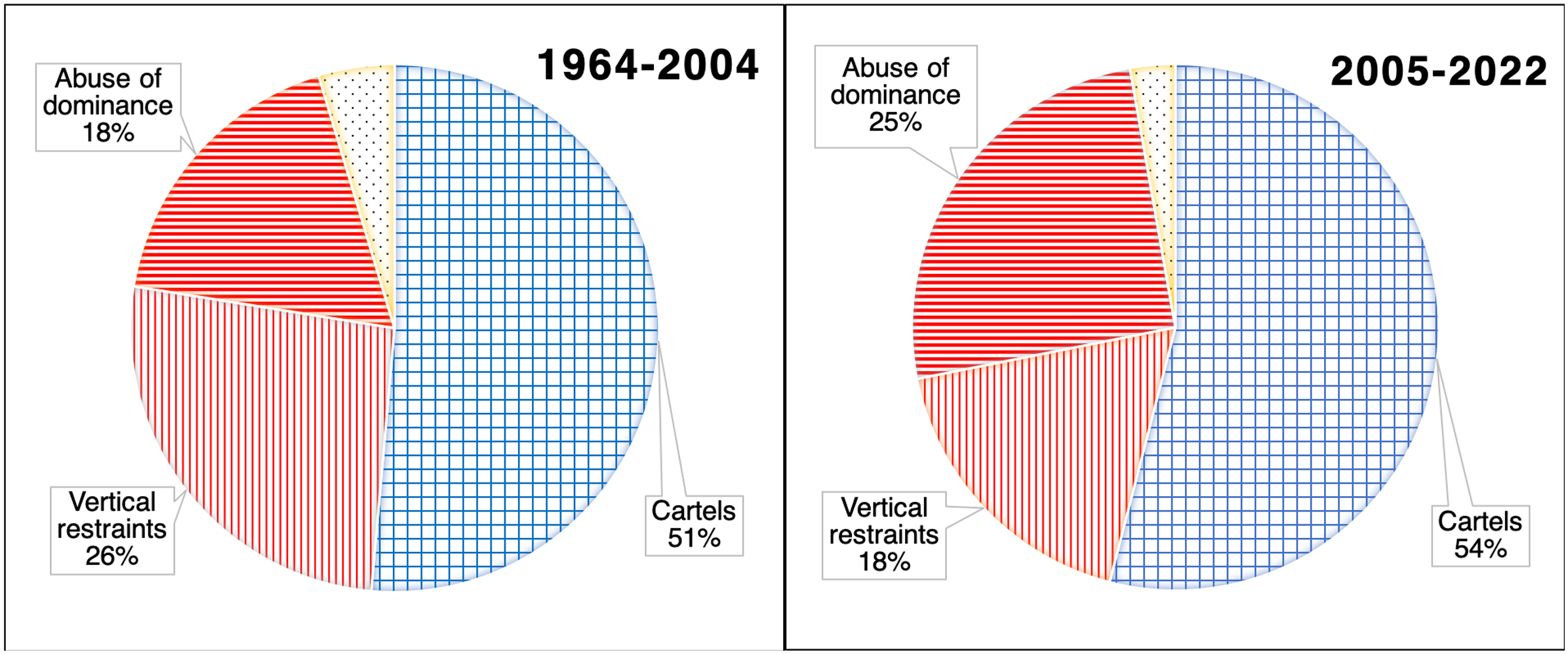
In addition to maintaining a stricter approach to vertical restraints, the EU has also strengthened abuse of dominance enforcement, which applies only to firms with substantial market shares. Even as the EU has hired economists and pursued a more “effects-based approach,” it has continued to employ an ordoliberal-inspired competition paradigm that places a ‘special responsibility’ on dominant companies not to abuse their power (Foster, 2022). This includes extensive rules, adopted into both hard and soft law, that prohibit dominant companies from engaging in a range of ‘abusive’ practices, including predatory pricing, margin squeezes, exclusive dealing, exclusive purchasing, exclusionary discounts, tying, refusals to deal, discrimination, and exploitative abuses. It also includes obligations for dominant companies to facilitate access to essential facilities, to provide interoperability information, and to license intellectual property.
Indeed, if anything, EU abuse of dominance rules have become stricter – and more intensely enforced – since the 1990’s. As can be seen in Figure 4, the European Commission’s emphasis on abuse of dominance enforcement has significantly increased during the 21st century. Since the year 2000, the European Commission has finalized more than 70 infringement and commitment decisions under this article across a wide range of industries. These decisions have generated more than EUR13 B in fines and mandated sweeping behavioral changes to some of the world’s most powerful companies. As can be seen in Figure 4, the number of annual cases finalized since 2004 is nearly twice as high as the number finalized in the earlier period. In addition to cases pursued by the Commission, national regulators have also ramped up enforcement against abuse of dominance. Since receiving the power (in 2004) to independently enforce EU rules in this area, national competition authorities have finalized more than 500 abuse of dominance decisions—or one third of all decisions— touching on many of the same concerns.
22
Abuse of dominance enforcement by the European Commission, 1970–2022. Source: European Commission reports.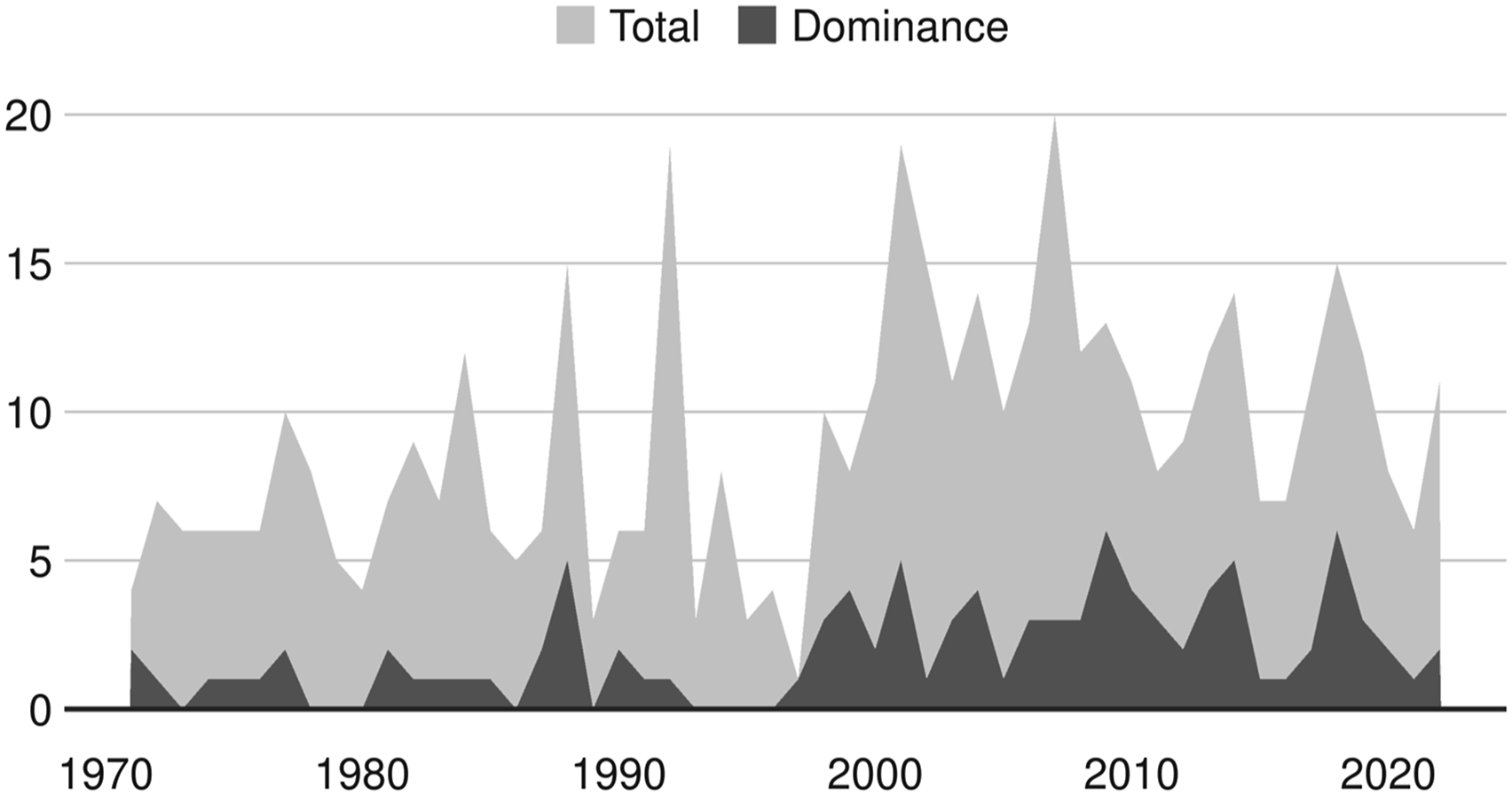
Most of these cases have sought to address power inequalities between larger and smaller firms. Of the 39 Commission abuse of dominance decisions finalized between 2009–2019, nearly half involved facilitating access for a competitor to an ‘essential facility,’ resource, or other infrastructure controlled by a dominant player; 21% involved stopping a dominant company from leveraging its power in one market over another one in a way that limited opportunities for competitors to compete; and 15% involved preventing predatory behavior that was seen as foreclosing the competitive process (Foster, 2022). Perhaps most notably, the European Commission has pursued major cases against dominant online platform companies such as Microsoft, Google, Amazon, Apple and Meta (Facebook), which required them not only to pay large fines in some cases but also to make major changes to their business models.
While these previous interventions were post hoc, stemming from investigations initiated long after violations have occurred and usually taking years to investigate and finalize, the new European Digital Markets Act (DMA) is more proactive and places even stricter rules on hierarchical coordination. This legislation designates a number of large online platforms as ‘gatekeeper’ firms and then subjects these firms to stringent requirements designed to ensure market fairness and contestability. Since it establishes hard, ex ante rules, many observers are hailing it as the world’s most sweeping platform economy regulation (Boyer, 2022; Cioffi et al., 2022; Larouche & de Streel, 2021). For instance, the DMA will obligate large platform companies to apply fair and non-discriminatory conditions to the ranking of services and products and allow business users to receive the data that they generate on the platform and to be able to conclude contracts outside of the platform.
The more proactive approach to economic dominance can also be seen in the merger arena. Empirical studies have shown that the vast majority of mergers are approved, and that this approach has contributed not only to increased economic consolidation but also to more liberalized and financialized corporate structures (Billows et al., 2021; Koltay et al., 2023). But if the EU has often facilitated hierarchical coordination by approving transnational mergers (Thatcher, 2014), these rights have been more conditional and limited than in the United States. Legal scholars have long noted that the EU takes a tougher line on vertical and conglomerate mergers, as evidenced in several high profile transatlantic disputes (Gifford & Kudrle, 2015, pp. 57–62). Recent empirical studies demonstrate that this tougher line is systematic: the EU has at least a 30% higher merger challenge rate in proposed mergers involving dominant firms when firm characteristics are equalized (Bergman et al., 2019). In recent years, EU merger decisions have prevented the creation of European champions (Nourry & Rabinowitz, 2020) and limited the consolidation of tech companies whose business models depend on the acquisition of current and potential competitors. 23
The combination of stricter enforcement against hierarchical coordination by dominant firms with a comparatively permissive approach to horizontal coordination by smaller firms has pushed EU policy toward the border between the cooperative and arm’s length competition models found in Figure 1. On the one hand, European competition law has clearly contributed to the decartelization of industry and the instantiation of price competition in product markets and formerly regulated sectors. It has also facilitated transnational corporate consolidation through its merger policy. On the other hand, these changes have been partially moderated by the maintenance of exemptions for significant nonmarket coordination by smaller players and the intensification of hierarchical coordination rules beyond the boundaries of the firm. The EU’s comparatively permissive approach to horizontal coordination has directly contributed to the durability of employer associations and labor unions that have long been central to nonmarket coordination. At the same time, restrictive hierarchical rules have provided some protection for nonmarket coordination by firms in the face of significant liberalization pressures.
Conclusion
Competition law is a ‘constitutive’ institution in capitalism, helping determine where coordination is allowed and where competition is required. In this article, we have built on Paul’s framework to highlight some of the important ways that competition regimes in Europe and the United States enable and protect different forms of economic coordination, with significant implications for capitalist market structures. In the US, a competition regime that now combines its traditionally strict rules on horizontal cooperation with a permissive approach to hierarchical coordination has produced a distinct drift away from the arm’s length contracting associated with LMEs, and fostered the development of oligopolistic markets in many sectors. In the EU, by contrast, a competition regime that continues to feature relatively more permissive horizontal rules for SMEs but combines this now with increasingly strict rules regarding abuse of dominance and vertical restraints has continued to support some of the coordinated market structures traditionally associated with CMEs.
Our study helps identify and explain important changes in the political economy of advanced capitalist countries that have so far flown under the radar of CPE scholars. Among other contributions, we have complicated the narrative that the EU mostly acts as a ‘neoliberal’ force that undermines coordinated market economies. Although European competition law has certainly bolstered economic liberalization in certain respects, in other ways it has helped to preserve longstanding forms of nonmarket coordination. Examining the extensive exemptions established in EU hard and soft law, we have shown that the law permits and encourages forms of interfirm horizontal coordination in areas such as research and development, licensing, specialization and labor relations that have long been at the heart of CME comparative advantage. Moreover, we have shown that EU hierarchical rules – which have increasingly emphasized abuse of dominance enforcement since the 1980’s – provide protection for nonmarket coordination, particularly when smaller firms are involved. By directing horizontal coordination away from the predatory and rent-seeking practices associated with cartels, and toward competition-enhancing activities such as innovation, standard-setting, technology transfer, research collaboration, and more relatively coordinated labor relations, EU competition rules may have even played an important role in shoring up coordinated market economies in the face of many challenges and convergence pressures.
Our study also has implications for the emerging field of American political economy (Hacker et al., 2022). The CPE literature has traditionally focused heavily on Europe and on CMEs, and sometimes operated with a static and somewhat stylized model of the American political economy. Within the “varieties of capitalism” literature, the US served as the paradigmatic case of a liberal market economy based on arm’s-length contracting and highly flexible markets (Hall & Soskice, 2001). Yet as we have shown, the US has been moving away from this ideal type for some time. For VOC’s critics, by contrast, the US has been seen as the end point of a universal trajectory of capitalist development toward which Europe is catastrophically careening (Streeck, 2009). Our analysis challenges such deterministic models as well, by delving more deeply into the specific historical cycles and political forces – including, centrally, competition law and antitrust – that have shaped and reshaped both American and European capitalism over time.
More broadly, our study points to the value of bringing competition law into comparative capitalism scholarship. Although many scholars recognize that competition rules must matter, few studies have sought to flesh out the concrete relationship between competition rules, coordination rights, and capitalist organization. This has led competition law to be addressed only fleetingly, if at all, in the varieties of capitalism literature. As we have sought to demonstrate, bringing competition law into the analysis of comparative capitalisms can shed new light on both the origins of distinct systems and on the contemporary changes many of them are undergoing. By providing a tractable way to distinguish between changes in the coordination rights of competing firms and workers from changes in the rules regulating the hierarchical exploitation of economic power from above, a comparative coordination rights framework clarifies both differences in the rules across systems as well as the trajectory of institutional evolution over time. Our dynamic, multi-dimensional framework provides a way to maintain the analytically useful premise that capitalism comes in distinct varieties while also recognizing that these varieties continuously evolve in response to historically contingent economic and political pressures (Deeg & Jackson, 2007; Hay, 2020).
As we have sought to show in this article, competition regimes fundamentally structure the relationships between producer groups in capitalist systems, with important implications for market structures and for the bargaining power between competing firms, suppliers and distributors, employers and employees, and workers across different firms. Consequently, competition law should be studied by political scientists as a site of political contestation that shapes the organization of capitalist systems. We hope this combination of theoretical innovation and empirical demonstration will stimulate further research into competition law and varieties of capitalism that more fully elaborates this complex relationship.
Supplemental Material
Supplemental Material - Coordination Rights, Competition Law and Varieties of Capitalism
Supplemental Material for Coordination Rights, Competition Law and Varieties of Capitalism by Chase Foster and Kathleen Thelen in Comparative Political Studies
Footnotes
Acknowledgments
We thank Melike Arslan, Tim Büthe, Cindy Cheng, Eugenía da Conceição-Heldt, Peter Hall, Catherine Hoeffler, Sebastian Kohl, Matthias Matthijs, Frédéric Mérand, Eric Peinert, Tobias Rommel and three anonymous reviewers for valuable comments on an earlier version. We thank Serene Archer and John Bradley for research assistance. The authors also gratefully acknowledge the institutional support of the Munich School of Politics and Public Policy at the Technical University of Munich.
Declaration of Conflicting Interests
The author(s) declared no potential conflicts of interest with respect to the research, authorship, and/or publication of this article.
Funding
The author(s) received no financial support for the research, authorship, and/or publication of this article.

Data Availability Statement
More information about data supporting the findings of this study is available in the online appendix.
Supplemental Material
Supplemental material for this article is available online.
Notes
Author Biographies
References
Supplementary Material
Please find the following supplemental material available below.
For Open Access articles published under a Creative Commons License, all supplemental material carries the same license as the article it is associated with.
For non-Open Access articles published, all supplemental material carries a non-exclusive license, and permission requests for re-use of supplemental material or any part of supplemental material shall be sent directly to the copyright owner as specified in the copyright notice associated with the article.
