




Abstract
Contrary to the established belief that low agricultural prices fuel peasant rebellion, our study investigates the surge in peasant unrest during a period of high agricultural prices. The transition to capital-intensive agriculture, characterized by reduced labor demand and heightened entry barriers, prompts landowners to expand into the agricultural frontier during periods of price increases. In these frontier regions, the soils, while comparatively less suitable, become economically viable for commercial agriculture when crop prices are high. This scenario sets the stage for heightened collective resistance, particularly where organizational capacities and subsistence communities provide peasants with symbolic and material resources to resist land encroachment. We provide evidence of this argument by using unique municipal-level data from Paraguay between 2000 and 2014, a period of rising yet fluctuating prices. Our study shows how the interplay between technological advancements in agriculture and global market forces reshape the geography of peasant rebellion.
Introduction
Scholarly studies suggest that low agricultural prices fuel peasant rebellion (Dube & Vargas, 2013; Guardado, 2018; Hidalgo et al., 2010; Scott, 1976). However, the 2000s surge in peasant unrest occurred during a period of booming prices. Peasants in the agricultural frontiers of Africa, Latin America, and Southeast Asia mobilized to resist the expansion of agroindustrial production (e.g., Clements & Fernandes, 2013; Grasse, 2022; Lapegna, 2016; Lund, 2018; Ondetti, 2008). This raises a critical question: What drives cycles of peasant unrest during times of high agricultural prices?
The prevailing assumption in the literature is that commercial agriculture is labor-intensive (Samuels & Thomson, 2021, 2022), an assumption held true for certain crops like coffee or rice. However, the recent shift towards capital-intensive agriculture reduces labor demand (Nin-Pratt et al., 2015) while raising the cost of entry to new producers of agricultural commodities (Gunderson et al., 2014). Additionally, capital-intensive agriculture facilitates the expansion of commercial farming activities to agricultural frontiers, where soils tend to be less suitable (Newell-McGloughlin & Burke, 2014; Rada, 2013).
This shift to capital-intensive agriculture has a profound impact on peasant livelihoods and patterns of peasant rebellion. First, capital-intensive agriculture requires costly technologies (e.g., mechanization) that reduce the need for farm labor and create barriers to entry for new producers. Excluded from commercial agriculture, peasants then become increasingly reliant on land access for survival, settling on agricultural frontiers where lands are available but less suitable for commercial production. Second, rising prices of capital-intensive crops makes frontier lands appealing for profit as new technologies allow commercial production in less suitable soils, hence incentivizing landowners to expand into the agricultural frontier where peasant cultivators are now settled. This expansion of capital-intensive crops generates distributive conflict over land that may prompt peasant resistance.
When confronted with land encroachment, peasants can either exit—by selling their land and migrating to cities—or engage in collective resistance. Resistance requires material and symbolic resources to coordinate contentious collective action. Local organizational capacities—i.e., peasant support groups such as leagues, cooperatives, or committees—provide leadership, skills, and frames (Brockett, 2005; Kurtz, 2004), whereas the communal practice of subsistence agriculture promote autonomy, solidarity, and reciprocity (Scott, 1976; Wolf, 1969), thus facilitating collective defensive behavior. Therefore, we expect increased peasant resistance against land encroachment during price hikes where organizational capacities and subsistence communities are prevalent.
We examine this argument in Paraguay during the 2000s commodities boom. In this period, Paraguay became a top producer of capital-intensive crops, especially soybeans, expanding commercial agriculture eastward into the country’s agricultural frontier, the Eastern Region, where peasants had settled in the 1960s and 1970s.
We collected unique municipal-level data on various types of rural unrest based on newspaper archives spanning 2000–2014, a time of high yet fluctuating agricultural prices (Kabundi & Zahid, 2023). We combine cross-sectional variation in land suitability, as determined by agroclimatic factors, for Paraguay’s most exported capital-intensive agricultural commodities—soybean, maize, and sugar—with exogenous annual variation in the international prices of these crops to asses how the expansion of capitalized agriculture sparks peasant resistance. Our regression models indicate that a rise in prices heightens the intensity of peasant resistance, especially in the Eastern Region’s municipalities. We also show that this differential effect is heightened in municipalities where organizational capacities and communal subsistence agriculture are prevalent. We supplement these econometric findings with qualitative evidence, including an anthropologist’s ethnographic account and semi-structured, in-depth interviews contextualized through hyperlinks—as suggested by Moravcsik (2010). 1
Two conditions delimit the scope of our argument. One is a geographic dualism in agricultural production (e.g., Duncan & Rutledge, 1978). That is, a frontier region separated from the modern, central belts of commercial agriculture and state presence, lacking integration into markets, property rights, access to credit, sparsely settled, and mostly dedicated to subsistence activities by a local peasantry. Critically, state weakness on the frontier—in particular, in the form of absent or ill-defined property rights—is what enables landowners to encroach on peasant lands. 2 A second condition is democracy (e.g., Brockett, 2005). Military dictatorships in the 1970s repressed, incarcerated, and killed peasant activists, forcing them to go underground. Democracies can resort to coercive means to dissuade disruptive contentious activities, but they are less likely to suppress peasants by employing violence in an unconfined manner. Thus, democracies afford aggrieved peasants the opportunity to collectively resist land encroachment.
Our argument on positive price shocks, capital-intensive crops, and organizational resources in the context of dual rural societies and democracy is not unique to Paraguay. Northeastern rural unions and the Landless Workers’ Movement stirred peasants in the Argentine Chaco (Lapegna, 2016) and Brazilian Amazon (Ondetti, 2008) frontiers, respectively, to fight the spread of soybean monoculture. Beyond Latin America, the kampungs, Indonesia’s communal subsistence hamlets, provided peasants on the Aceh frontier with a support structure to resist the expansion of oil palm plantations (Lund, 2018).
Our work primarily complements a vast scholarship studying how global agricultural markets shape peasant rebellion. Our focus on capital-intensive agriculture’s technological developments illuminates a path through which high prices create grievances that could foster rebellion: land encroachment. The high prices of capital-intensive crops ignite the rapacity of landowners who seek to encroach on peasant lands—already cleared for cultivation and lacking state-defined property rights—in the agricultural frontier. The expansion of capital-intensive agriculture to frontiers threatens peasants’ economic sustenance because it deprives them of their lands without increasing the demand for their labor or the opportunities for producing profitable crops for trade.
Additionally, our work complements case studies examining how land suitability shapes different patterns of rural conflict, including peasant rebellion. These studies commonly find a positive impact of land suitability, conditional on international prices, on rural conflict (e.g., Grasse, 2022; Guardado, 2018). Our focus on capital-intensive agriculture shows that the relationship between land suitability—which enables commercial production—and rural conflict is context-specific. Concretely, our work suggests that it hinges on the demographic trends and technological innovations of agricultural modernization. Where capital-intensive crops were introduced in the post-1960s, peasants migrated to become self-sufficient cultivators on agriculture frontiers not integrated into markets. The industrial, scientific, and managerial advancements of capital-intensive agriculture also allowed to attain greater yields in agricultural frontiers, whose soils were once considered less suitable—but not unfit—for large-scale production (Newell-McGloughlin & Burke, 2014; Rada, 2013), thus rendering them more profitable during price upswings. In these contexts, land suitability should be negatively correlated with rural conflict when prices grow, as landowners can now produce in agricultural frontiers where farmlands are cleared but occupied by peasants settlers.
Third, we dispute earlier writings suggesting that high agricultural prices favor peasants by boosting their income via free trade (e.g., Bates, 1981). The increasing production costs of capital-intensive agriculture, however, preclude peasants from being commodity producers and reaping the benefits of trade. On the contrary, we show that high prices foster land encroachment and force peasants to choose between exit or resistance, as capital-intensive agriculture makes peasants more dependent on land for subsisting. That is, capital-intensive agriculture changes the locus of peasant rebellion from income to land access in ways consistent with more recent analyses on land-related unrest (e.g., Boone, 2014; Borras Jr. et al., 2012; Grasse, 2022; Samuels & Thomson, 2022; Tellez, 2022).
Finally, we investigate a specific type of peasant rebellion: collective resistance. Following Tilly (1978), collective resistance is a reactive form of rebellion as peasants aim to defend established claims—in this case, their hold on land. Our view of peasant rebellion as collective resistance is different from that of the literature, as proactive mobilization. In times of low prices, peasants seek to capture contestable resources (e.g., crops, minerals) that they do not possess through armed insurgency. Instead, we show that peasants rebel against landowners when their hold on land is imperiled and engage in disruptive contentious repertoires that do not necessarily include armed struggle (e.g., Grasse, 2022; Trejo, 2016), such as land occupations, roadblocks, or the destruction of commercial harvests and agricultural machinery.
Capital-Intensive Agriculture and Peasant Rebellion
Peasant rebellion is defined as organized resistance to sudden moments of deprivation that erode peasants’ economic security (e.g., Lichbach, 1994; Scott, 1976; Trejo, 2016). Classic agrarian studies maintain that falling prices make peasants fight landowners and state officials who exact cash, labor, or crops from them (Scott, 1976). Political economists emphasize that negative price shocks lower the returns to rural labor and the opportunity cost of engaging in rebellion. This framework has been applied to armed insurrections (Dube & Vargas, 2013; Guardado, 2018) but also moderate forms of rural unrest such as land occupations (Hidalgo et al., 2010). Thus, according to the literature, peasants are more likely to revolt in times of low agricultural prices.
Although commercial agriculture had historically been labor-intensive, technological transfers such as mechanized equipment, agrochemicals, irrigation, high-yield seeds, and newer farming methods since the 1960s made it increasingly intensive in capital. Agricultural technologies allowed for greater incorporation of land into commercial production, especially unconventional soils that were deemed less suitable (Newell-McGloughlin & Burke, 2014, p. 75; Rada, 2013, p. 146), while reducing demand for agricultural workers (Nin-Pratt et al., 2015, pp. 52–53). The drop in labor demand created tensions between landowners and peasant laborers, who suffered evictions and layoffs (Bulmer-Thomas et al., 2006). Moreover, costly technologies and farming skill sets blocked peasants from participating in capital-intensive agriculture as producers. As a result, jobless peasants abandoned large commercial farms to live as independent, self-sufficient cultivators growing food crops for subsistence in agricultural frontiers where they resettled, clearing the land for cultivation through state colonization programs but also spontaneously.
Drawing on research on economic geography and factor endowments (e.g., Alston et al., 1999; Duncan & Rutledge, 1978; Engerman & Sokoloff, 2012), we distinguish between two types of rural regions. Central areas involve traditional belts of human settlement and export-oriented agriculture that emerged during the initial phases of state formation. Cities and infrastructure for trade, such as roads, railroads, and ports, were strategically located when these regions were included in world trade corridors facilitating integration into the export economy. Central lands feature high levels of suitability for commercial agriculture, clearer property rights, and proximity to agricultural markets. In these regions, peasants used to be wage laborers with tenancy agreements (e.g., sharecroppers or tenants) producing cash crops for trade. By the late 20th century, wage laborers had abandoned central areas, which became absorbed almost exclusively by capitalized agriculture. Examples of central areas include the Argentine Pampas and the Brazilian South.
Agricultural frontiers, by contrast, are areas that have not yet been incorporated into commercial agriculture. Peasants in the agricultural frontier are self-sufficient cultivators growing mostly food crops. Their access to land is de facto, characterized by squatter or communal rights. Agricultural frontiers resemble Saffon’s (2021, p. 14) “colono frontiers,” sparsely occupied lands outside the traditional areas of settlement and state presence where peasants hold ill-defined land rights. Frontiers are less amenable to commercial agriculture relative to central areas due to lower land suitability—though not infertile or hostile to cultivation and human settlement—and greater distance to cities and ports, and weaker property rights. Examples are the Brazilian Amazon and the Argentine Chaco.
The 2000s global price boom exposed peasants cultivating food crops on agricultural frontiers to land encroachment (Borras Jr. et al., 2012, p. 847). Soaring prices, coupled with the absence of state-defined defensible property rights, promoted rapacity by large commercial farmers and agribusiness firms over peasants’ lands. Positive price shocks in a context of high-yield agricultural technologies made commercial production in less suitable soils profitable. However, landowners did not need peasant labor (Samuels & Thomson, 2022), whereas costly technologies and skills excluded peasant cultivators from participating in commercial farming activities (Grasse, 2022). Borras Jr. et al. (2012, p. 846) point to lucrative “flex crops” as the paradigm of capital-intensive agriculture, which can be traded in various markets (e.g., foodstuff, feed, fiber, fuel) and need financial capital, technology, and know-how for production. They are harmful to peasant cultivators’ sustenance because they provide landowners with incentives for large-scale land grabs (e.g., Clements & Fernandes, 2013; Grasse, 2022; Lapegna, 2016; Lund, 2018; Ondetti, 2008).
Hence, peasant resistance to land encroachment is more pervasive in the less suitable agricultural frontier when the prices of capital-intensive crops increase, making production profitable in these areas while reducing labor demand and raising the cost of entry for peasants. Whereas these areas had not been incorporated into world markets, they are already cleared and peasants’ property rights are weak. Thus, we propose the following hypothesis:
As the prices of capital-intensive crops increase, peasant resistance to land encroachment should occur more frequently in areas with lower suitability for commercial agriculture. Peasants commonly face barriers to mounting collective resistance (Bates, 1981; Kurtz, 2004). They are numerous, poor, and geographically dispersed, while power asymmetries with respect to landowners put them in a weak bargaining position. Thus, “exit” via desertion, flight, or payoffs is often easier for them (Lichbach, 1994, p. 394). Sellars (2017) notes that exit options raise the individual cost of participation, lower the confidence that mobilization will be successful, and thus dampen peasant rebellion. Peasants could strike individual deals with landowners and sell their lands, whereas urbanization facilitates migration. Therefore, collective resistance against land encroachment requires organizational resources. Scholars studying peasant contentious politics highlight the significance of local organizational capacities and the communal traditions of subsistence agriculture in facilitating coordination and reducing the likelihood of individual exits. One vital resource is the “organizational capacity of the peasantry” Kurtz (2004, pp. 33–36), which decreases coordination costs by supplying leadership, skills, frames, and material support for rural collective action. In Latin America, the availability of organizational capacities has been tied to the presence of national peasant movements and their local support groups—rural workers’ unions, agrarian reform committees, and cooperatives (Brockett, 2005; Kurtz, 2004). These groups were, in turn, the legacy of the peasant leagues organized by Marxist intellectuals and progressive Catholic priests in the 1960s. These leagues denounced owners of extensive haciendas (latifundia) who threatened peasants with layoff and eviction and forced them to cultivate cash crops in exploitative working conditions. Peasant leagues educated rural populations, demanded agrarian reform, and some even trained militias. Although peasant leagues were gaining in organizational strength vis-á-vis landowners, military dictatorships in the 1970s crushed them, thus creating a political environment highly unfavorable for any kind of peasant collective action. However, after democratization, surviving cadres reemerged to found new peasant movements with their local support structures (Hetherington, 2011; Lapegna, 2016; Ondetti, 2008). In democratic contexts, these new structures provided aggrieved peasants with organizational capacities to overtly resist land encroachment. We thus suggest the following hypothesis:
As the prices of capital-intensive crops increase, peasant resistance to land encroachment should occur more frequently in areas with lower suitability for commercial agriculture, especially in locations where peasants are organized. A second resource is the communal practice of subsistence agriculture: densely-settled areas characterized by traditions of autonomy, solidarity, and reciprocity, which improve peasants’ ability to resist the threats of commercial agriculture (Scott, 1976; Wolf, 1969). These communal traditions promote community-level exchanges and independence from agricultural markets, thus facilitating rebellion when peasants’ daily lives are in peril. Wolf (1969, p. 291) writes that “peasants who retain access to subsistence plots possess greater tactical independence that can be used against the landowners.” For example, Saffon (2021) shows that coordinating resistance to dispossession in Mexico and Colombia during the 1880s commodities boom was greater in closely-knit subsistence communities, such as colono settlements or indigenous pueblos, where members decided community affairs autonomously and pooled resources to fight off evictions. Hence, the communal organization of subsistence agriculture, which involve solidarity and reciprocity, are crucial for coordinating resistance and decreasing the attractiveness of individual exit. Our third hypothesis is the following:
As the prices of capital-intensive crops increase, peasant resistance to land encroachment should occur more frequently in areas with lower suitability for commercial agriculture, especially in locations where subsistence settlements are present. Our interviews with peasant leaders indicate that these two mechanisms are complementary and at play when peasants collectively defend their lands from encroachment. To summarize, rising prices of capital-intensive crops incentivize landowners to expand commercial production to the frontier, where lands are less suitable relative to central areas but readily available. The expansion seeks to grab the land—not the labor—of peasants on the frontier while not offering them opportunities to becoming commodity producers. This generates grievances over land and not income, as peasants depend on land access for growing food crops for consumption. In turn, local organizational capacities and subsistence communities decrease the attractiveness of exit and make resistance more likely.
Background
Commercial Agriculture in Paraguay
Historically, commercial agriculture in Paraguay had been labor-intensive and limited to the Central Zone—central and southern rural areas endowed with some of the country’s most fertile lands and near the largest port in Asunción. Commercial agriculture was dominated by haciendas growing cotton, tobacco, and yerba mate, with trading in world markets and clearer property rights. Peasants in the Central Zone worked for landowners as sharecroppers in exchange for small plots called minifundios. The rest of Paraguay was not integrated into the country’s export agriculture (Nickson, 1981). This includes the Eastern Region, a vast frontier to the east of Asunción where lands were comparatively less suitable for commercial production, distant from Asunción, and sparsely occupied by indigenous populations, a few forestry companies, and Brazilian pioneers.
Rising population density and agricultural mechanization since the 1960s exacerbated frictions between large commercial farms and minifundios over scarcer land in the Central Zone, leading to the formation of the Christian Agrarian Leagues (LAC), a radical agrarian movement (Telesca, 2014). With Jesuit and Fransican leadership, the LAC sought to combat land tenure injustices through biblical teachings, rural schools, and invasions of unproductive estates. Some of their members also embraced Marxist ideas. The military government of Alfredo Stroessner, who ruled on behalf of the Colorado Party (1954–1989), confronted the LAC with a mix of repression and compensation. The government created the Rural Welfare Institute (IBR) in 1963 to resettle peasants in the Eastern Region’s new colonies. By promoting the “March to the East,” Stroessner mitigated class conflict and peasant demands for land reform in the Central Zone (Nickson, 1981, pp. 114–115).
Peasants resettled in eastern departments by clearing forests and preparing soils for cultivation (Rojas & Areco, 2017). Peasant settlers cultivated the land independently, producing subsistence crops, raising livestock for their households, and supplying food to local towns. High prices in the 1970s and low capital inputs prompted many peasants to commercialize cotton, reducing the farmland dedicated to subsistence farming. The area cultivated with cotton went from 81,000 hectares in 1973 to 312,000 hectares in 1979 (Rojas, 2016, p. 81). Despite modest income increases, cotton brought many peasant families into indebtedness. Many other peasants, however, continued to grow food for their families (Palau et al., 1986).
The policy of peasant resettlement undermined peasants’ property rights over colonized lands (Rojas & Areco, 2017). Land titles granted to peasants were provisional and not eligible as collateral. Numerous peasants also resettled spontaneously, overcrowding the IBR’s capacity to manage existing colonies and create new ones. Colonized areas lacked roads, technical assistance, and access to public services. As a result, peasant settlers had to rely on squatting. By the time of Paraguay’s 1989 democratization, as Hetherington (2011) notes, the Eastern Region was now home to masses of peasant cultivators whose tenure conditions remained precarious.
Since then, Paraguayan agriculture became more intensive in capital. The adoption of technologies reduced the demand for farm labor. According to the last agricultural census (Ministerio de Agricultura, 2008, pp. 94–98), the number of temporary agricultural workers fell 74.8%, from 946.040 in 1991 to 238.674 in 2008. Conversely, the number of agricultural machines—tractors and crop sprayers—increased in the same period, from 20,987 to 34,353 (63.7%). Moreover, capital investments and no-till farming techniques increased fixed costs, precluding agricultural workers from entering commercial production (Fogel & Riquelme, 2005). Whereas the overall number of farms fell between 1991 and 2008, farms operated as business firms increased from 566 to 1599 (182%) (Ministerio de Agricultura, 2008, p. 26).
A new landowning class made of large commercial farmers and agroindustrial establishments emerged, producing commodities for trade while forging ties with multinational companies to acquire inputs and contract stockpiling, trading, and food-processing services (Rojas, 2016). Following the agricultural busts of the 1990s, the 2000s offered unusual opportunities for Paraguay’s agricultural sector. Soaring international prices of flex crops, combined with the introduction of genetically-modified seeds in 1999—which rely heavily on agrochemicals—inaugurated an agricultural bonanza in the 21st century. Paraguay rose as one of the world’s top soybean producers while also increasing the agroindustrial production of maize and sugarcane (Fogel & Riquelme, 2005).
These exogenous changes generated a land rush toward the Eastern Region among landowners from the Central Zone and Brazilian entrepreneurs attracted by Paraguay’s lower taxes and land prices. Because eastern lands had been cleared by peasant settlers and lacked legal titles, landowners had additional incentives to expand capital-intensive agriculture eastward (Galeano, 2012). Soybean monoculture exemplifies this geographic and temporal trend. Soybeans in 1960–1961 were primarily found in central and southern departments—Caazapá, Guairá, and Paraguarí—with only 1300 planted hectares (Palau et al., 1986, pp. 75–77). In 2001–2002, soybeans had penetrated the borderlands of Alto Paraná, Canindeyú, and Itapúa, growing to 1.5 million planted hectares. By 2013, this number more than doubled. 3
Peasant Resistance in the Eastern Region
The 2000s commodities boom made peasants on the agricultural frontier vulnerable to encroachment. Landowners typically used forced evictions or targeted peasants with agrochemicals to displace them. In an interview, a peasant leader stressed that landowners “expel peasants from their communities… coercing people with poisonous chemicals, insecticides and herbicides massively [and] with outright repression, evictions, they kick people out.” 4 These incursions were backed by the two wealthiest landowner associations, the Farmers’ Union Syndicate (UGP) and the Paraguayan Rural Association (ARP).
Against this backdrop, peasants had the option to sell, abandon their lands, or resist encroachment. Despite evidence of peasant migration to urban areas (Fogel & Riquelme, 2005; Palau et al., 2007; Rojas & Areco, 2017), we recorded 902 events involving peasant resistance to land encroachment from 2000–2014.
5
Drawing on our press archives on rural unrest and data from FAO’s Statistical Database (FAOSTAT) and Global Agro-Ecological Zones (GAEZ), Figure 1 shows the annual variation in events of peasant resistance across municipalities with lower and higher suitability than its median value for Paraguay’s most exported capital-intensive crops (maize, soybeans, and sugar), and the average annual price in U.S. dollars for those crops, in 2000–2014. Peasant resistance peaked around the years of global price hikes—2004, 2008, and 2012. In that period, the bulk of peasant resistance occurred in municipalities with lower suitability, which are in the Eastern Region: 83% of total events. Agricultural Prices, Land Suitability, and Peasant Resistance (2000–2014). Note: The black line is the average annual producer price of a metric ton of maize, soybeans, and sugar in U.S. dollars. Higher suitability are municipalities whose average agroclimatic suitability for those crops exceeds its median value.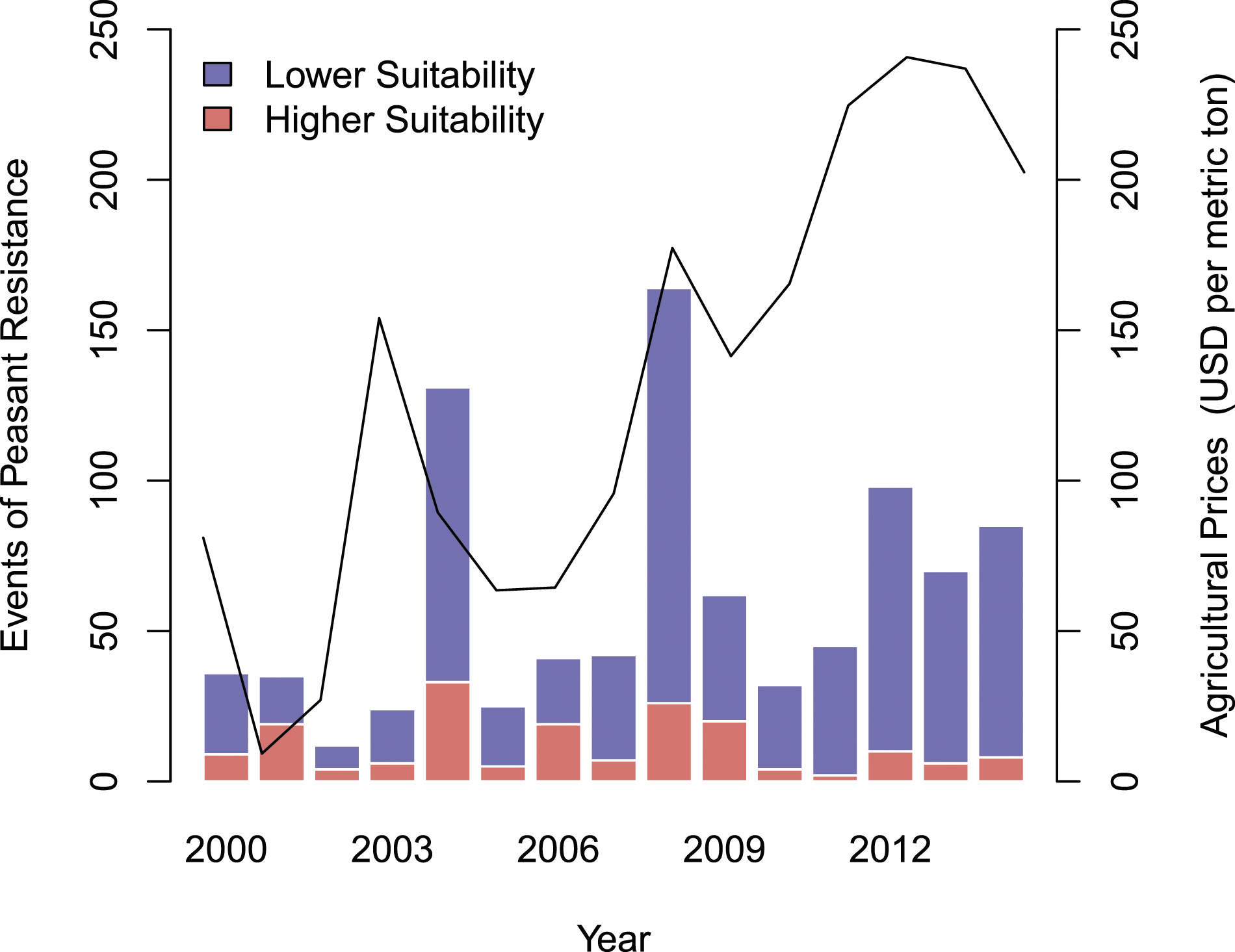
To resist, peasants clashed with landowners and their thugs or the police who tried to evict them, as the following episode from our archives illustrates: A dead man and more than 50 people arrested is the result of one of the most violent evictions ever recorded in the San Pedro department. It was yesterday, in the Cuapé ranch, whose lands were occupied by nearly 500 peasants… the police came in the settlement where landless peasants initially tried to confront them with machetes and clubs.
6
This resistance was staged by the Peasant Organizations National Committee Board (MCNOC), a national peasant movement. Our records also include instances of peasants fighting landowners who deliberately spray large doses of herbicides and pesticides. In these cases, peasants invaded the landowners’ estates and sabotaged the commercial harvests:
7
About 200 peasants from the MCNOC occupied the TZ property, in Toro Pirú, from the Guayabí district, of 2,700 hectares… they broke in through one of the adjacent gates to their community and set up a camp… Peasants made it clear that… they will not stop fighting for something they consider legitimate: “The fumigation they are carrying out is terrible… the landowner is leasing this property to Brazilian farmers who cultivate soybeans and corn [and] our crops are getting ruined because of the fumigation.”
8
Interviews with peasant leaders point to peasant movements providing support structures for collective resistance. According to a peasant general secretary, members’ political skills are crucial: “We share an activism with fellows with more political clarity, who always organize… a joint mobilization to stop the privatization of lands… we do have human resources that can be mobilized across Paraguay.” The secretary also referred to the LAC’s legacy of class struggle as a meaningful framing: “… our organization [is] a result of their struggle… of the LAC’s key principles, and one of those principles, which our fellow members already embrace, is social class” 9
After the LAC were suppressed in 1976, some of their surviving rank-and-file members regrouped to found local peasant committees that became active in the early days of democratic rule, eventually converging into the formation of national peasant federations (Hetherington, 2011). These federations provide logistical and financial assistance at the local level during land occupations and roadblocks and organize marches to Asunción to demand land titles. 10 Of special salience in the national arena are the MCNOC but also the National Peasant Federation (FNC), the Paraguayan Peasant Movement (MCP), and the Peasant and Indigenous Women National Committee (CONAMURI).
Our interviews also point to the importance of subsistence communities: “to resist in the countryside, there’s no other way but to cultivate our own food.” 11 A communal tradition of solidarity and reciprocity in peasant settlements is to support fellow peasants in distress. 12 This is relevant for occupying an encroaching estate, according to a pro-peasant party’s secretary: “fellow peasants from different settlements help each other during a land occupation.” 13 Furthermore, solidarity and autonomy allow peasants to pool material resources for launching protests, which are “funded by their own fellows… We bring our own produce, we sell it here [in Asuncion], and then fellows donate that to the organization; and there’re direct contributions to finance, for example, mass mobilizations.” 14
Empirical Strategy
To test our hypotheses empirically, we compiled a dataset that includes Paraguay’s 223 municipalities 15 for 2000–2014—the period known as the “commodities supercycle,” marked by short-term yet pronounced global rises in commodity prices (Kabundi & Zahid, 2023). Our unit of analysis is the municipality-year, and the number of observations is 3345.
Measurement
Dependent Variable
Our main dependent variable is the annual number of events of peasant resistance to land encroachment. We measure this variable by coding press archives from Última Hora, Paraguay’s top-selling newspaper and the only nationwide newspaper whose archives were available and complete. 16 We assembled a database that includes all the instances of rural unrest in the period, recording the municipality where they occurred, the actors involved, the issue under dispute, and the contentious repertoires. We distinguished issues between land access, agricultural income (e.g., wages, credit, transportation costs), and the environment. Our dependent variable includes resistance events by peasants or indigenous peoples in which land access is the key issue. These are instances of peasants collectively resisting a forced eviction by a landowner or an agribusiness firm, peasants invading an adjacent encroaching estate or an encroaching estate using hazardous agrochemicals, and peasants destroying commercial harvests, sabotaging agricultural machinery, blockading roads, and occupying an encroaching estate. Because landowners evicting peasants sometimes employ the police (e.g., Borras Jr. et al., 2012), we include land-related resistance events against police forces, too. 17
Our final dataset includes 902 distinct events of peasant resistance. Resistance events at the municipality-year level range from 0 to 15, with a mean of 0.27 and a standard deviation of 1.08. Because of zero values, we normalize this variable using the Inverse Hyperbolic Sine (IHS) transformation instead of the natural logarithm (Bellemare & Wichman, 2020). 18
Explanatory Variables
We collected price and satellite data on maize, soybeans, and sugar, three of the most established capital-intensive crops whose production requires technology and large-scale land grabs (Borras Jr. et al., 2012). They are also Paraguay’s most internationally-traded agricultural commodities, accounting for 30% of the country’s total exports in 2014. 19
We first examine the log of Paraguay’s average producer price for the those crops, in U.S. dollars per metric ton, sourced from FAOSTAT. 20 Paraguay’s prices for capital-intensive crops are exogenous. Despite being a significant producer, Paraguay remains a price-taker in global agricultural markets. In comparison to Brazil, the U.S., and Argentina, Paraguay cannot influence the overall supply. For context, the country is the fourth global producer of soybeans but only accounts for the three percent of the total output. 21 Prices capture landowners’ rapacity to expand the commercial production of capital-intensive crops to frontier lands.
Next, we leverage variation between central and frontier areas by examining satellite data on land suitability for commercial agriculture, as determined by climate, soil nutrients, and terrain ruggedness over the 1960–1991 period. The data come from GAEZ. Suitability is the log of the average potential yield for Paraguay’s main capital-intensive crops, in metric tons per hectare, for intermediate and high levels of input—i.e., commercial, market-oriented farming systems. 22 We identify frontier municipalities as those with lower soil suitability for commercial agriculture, a better proxy for gauging the potential for commercial agriculture than actual production. Land suitability closely conforms to our theoretical mechanism: we are interested in how landowners’ incentives to encroach on frontier lands trigger peasant resistance, not on whether landowners are able to expand production. Additionally, cultivating decisions may be endogenous to resistance, being correlated with unobserved or hard-to-measure factors, including ties between landowners and local politicians that shape peasant resistance. By contrast, land suitability is time-invariant and exogenous to local political dynamics, thus mitigating concerns about reverse causation and confounding.
Figure 2 presents the spatial distribution of peasant resistance in 2000–2014 in panel (a), next to the level of land suitability in panel (b). The maps show that peasant resistance and land suitability are inversely correlated, in line with our theoretical expectations. The cluster of municipalities in the Eastern Region shows high or moderately high levels of peasant resistance while exhibiting the lowest levels of land suitability. Conversely, southern and southeastern municipalities—the traditional Central Zone nearby Asunción—show low or nonexistent levels of peasant resistance and higher land suitability. Peasant resistance and land suitability by municipality. (a) Peasant resistance to land encroachment. (b) Land suitability for commercial agriculture.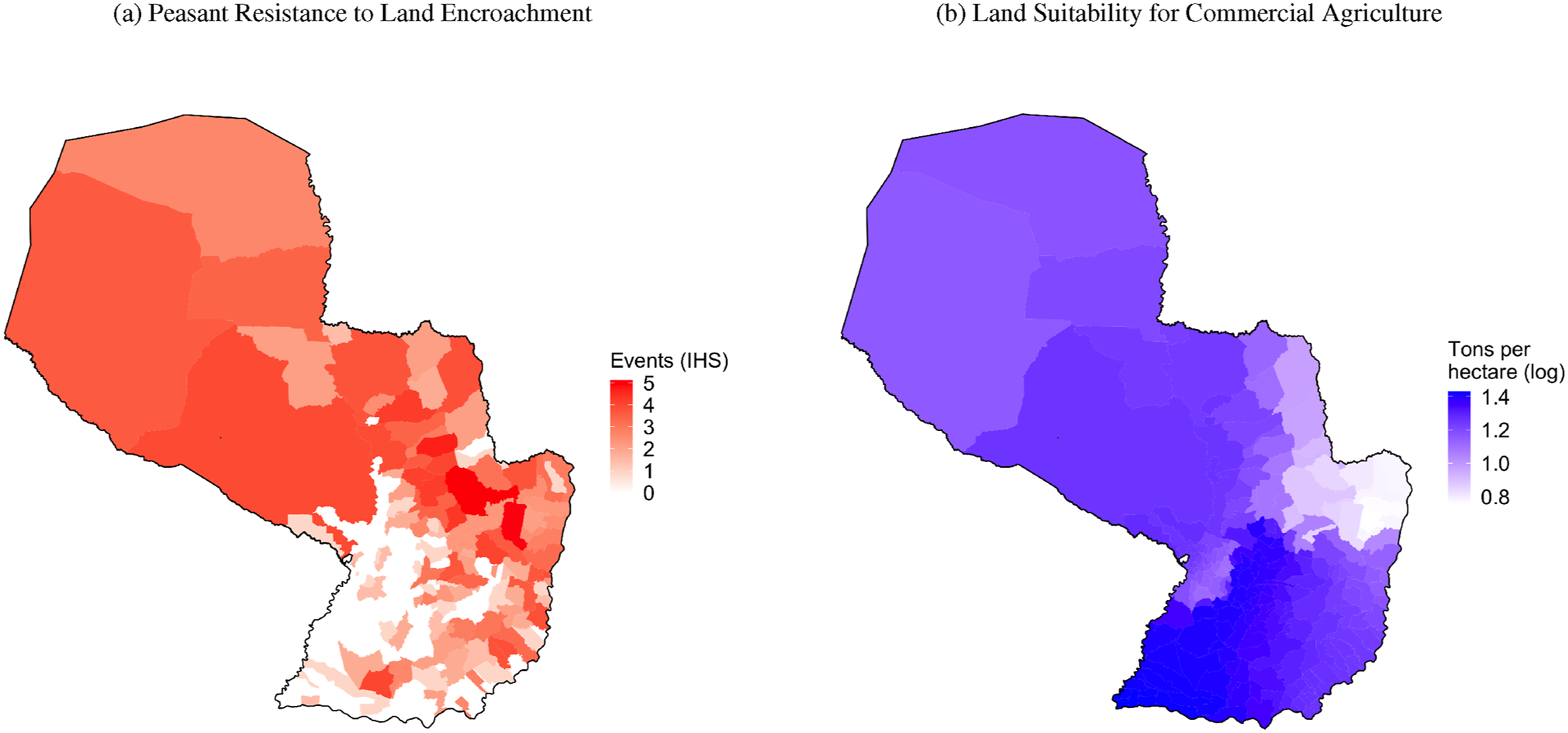
For peasants’ organizational resources, we first rely on satellite data on the number of subsistence settlements in 1990–1992. These communities are dense, vaguely-demarcated areas of human settlement (dubbed núcleos) in which subsistence agriculture is practiced. Guyra Paraguay, an environmental NGO, provided the maps. We also use data on local peasant committees from Dávalos and Rodríguez’s (1994) 1992–1993 guide. Peasant committees are national peasant federations’ lowest tier, with members operating within the community or neighborhood. This guide, while outdated, captures well the peasant organizational capacities that resurfaced during the democratic transition (1989–1992). These new support groups demanded land titling, access to public services, and rural credit. We rely on peasant committees at the onset of the democratic period as we do not know whether these organizations survived or if new ones were created in the 2000s. However, we know that peasant organizations were not formed in response to new grievances resulting from the 2000s commodities boom, as they predate price hikes. For both variables, we use dummies indicating whether the number of settlements and committees is greater than their respective median values.
Control Variables
We include two control variables that account for other dimensions of commercial agriculture, which could be correlated with peasant resistance. First, we measure weak property rights as the share of a municipality’s occupied farmland that is untitled. The data come from the 1991 agricultural census (Ministerio de Agricultura, 1991). Second, we measure the distance to markets as a municipality’s minimum distance, in kilometers, to any of the eight cities that are trading hubs where agricultural commodities are exported. In all our models, we also control for the log of the municipal population. The data for trading hubs and population come from the National Statistics Institute. 23
Estimation
Our main model is a two-way fixed effects (TWFE) that estimates changes in events of peasant resistance as a function of exogenous changes in the prices of capital-intensive crops and land suitability:

Our TWFE estimation exploits exogenous variation in international agricultural prices and land suitability, circumventing potential endogeneity concerns. Nevertheless, serially correlated errors may still arise because of time-varying omitted variables or misspecified persistence in the dependent variable. To deal with these potential misspecifications, Supplemental Table B.4 presents a range of alternative models that rely on alternative identification assumptions (Wilson & Butler, 2007). This includes two-way random-effects regression models, linear auto-regressive models, and fixed-effects models that interact department with year fixed effects. We also model peasant resistance using tobit models for censored data to account for the high number of observations without resistance events (87%). Finally, we report results from a hybrid, fixed-effects negative binomial estimator in which our dependent variable is measured as event counts. 25
To evaluate the interaction effect between prices, suitability, and organizational resources, we fit a three-way interaction linear model:

Results
Peasant Resistance to Land Encroachment, 2000–2014.
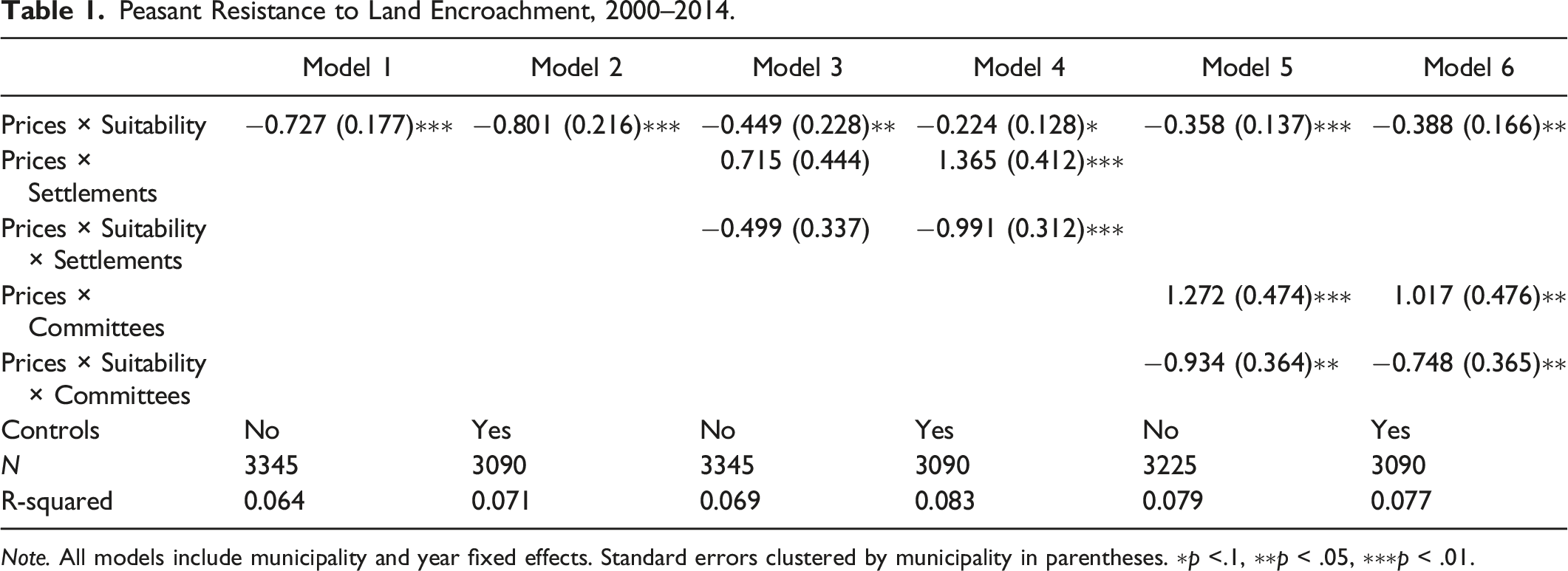
Note. All models include municipality and year fixed effects. Standard errors clustered by municipality in parentheses. ∗p <.1, ∗∗p < .05, ∗∗∗p < .01.
As predicted in Hypothesis 1, the negative signs of the coefficients for the interaction terms in models 1–2 indicate that land suitability moderates the impact of agricultural prices on peasant resistance. We illustrate the moderating effect of land suitability in Figure 3, which shows the linear marginal-effect estimate from model 1. The positive effect of prices on peasant resistance is concentrated in the municipalities with less suitable lands.
28
Holding all else constant, a 1% increase in prices in the least suitable municipalities is associated with nearly a 0.5% increase in the number of resistance events—a substantial effect, three times larger than the mean of 0.16%. The larger the price increase, the larger the effect on resistance. For example, a price increase of 169%—i.e., the positive shock of 2004 relative to 2003, as shown in Figure 1—is associated with a 60% increase in the number of resistance events. Price increases in the most suitable municipalities reduce resistance by less than 0.1%. However, this is not statistically significant at conventional levels. In other words, the international prices of capital-intensive crops have a differentially positive effect on resistance in the less suitable municipalities—i.e., agricultural frontier. This finding is consistent and statistically significant for both models, with and without controls.
29
Marginal Effect of Agricultural Prices on Peasant Resistance by Land Suitability. Note: Based on model 1, Table 1. The histogram represents the distribution of municipalities at different levels of land suitability. Red bands represent 95% confidence intervals.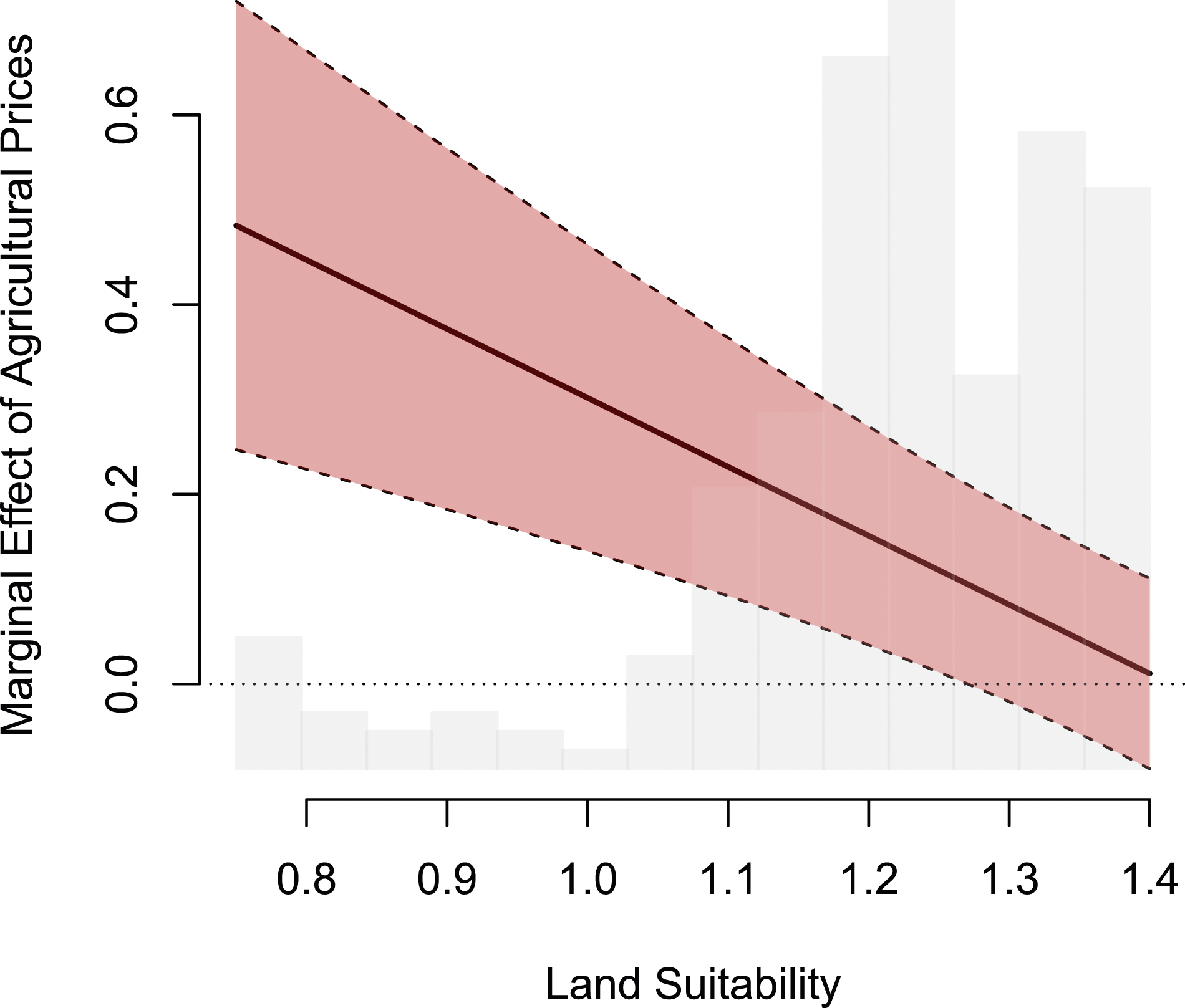
For Hypothesis 2 and 3, we report the differential effect of price increases on resistance by land suitability, contingent on communal subsistence farming and organizational capacities, in models 3–6. Figure 4 shows that higher prices have a larger and statistically significant effect on resistance in those municipalities with high levels—i.e., greater than the median—of subsistence settlements and peasant committees relative to municipalities with low levels—i.e., equal or less than the median—of subsistence settlements and peasant committees. This effect decreases as land becomes more suitable until it becomes negative and statistically insignificant. Increasing agricultural prices by 1% in municipalities with the least suitable soils and high levels of subsistence settlements increase peasant resistance to land encroachment by roughly 0.62%. As lands become more suitable, the effect of higher prices on resistance decreases until it loses statistical significance. The same is true in municipalities with low levels of subsistence settlements, but the estimated effects are twice as smaller and not statistically significant for most of the range in soil suitability. Marginal Effect of Agricultural Prices on Peasant Resistance by Land Suitability, Subsistence Agriculture, and Organizational Capacities. (a) Subsistence Settlements. (b) Peasant Committees. Note: Based on models 3 and 5 (Table 1). Municipalities with high levels are those whose number of subsistence settlements and peasant committees are greater than its median value. Red and blue bands represent 95% confidence intervals.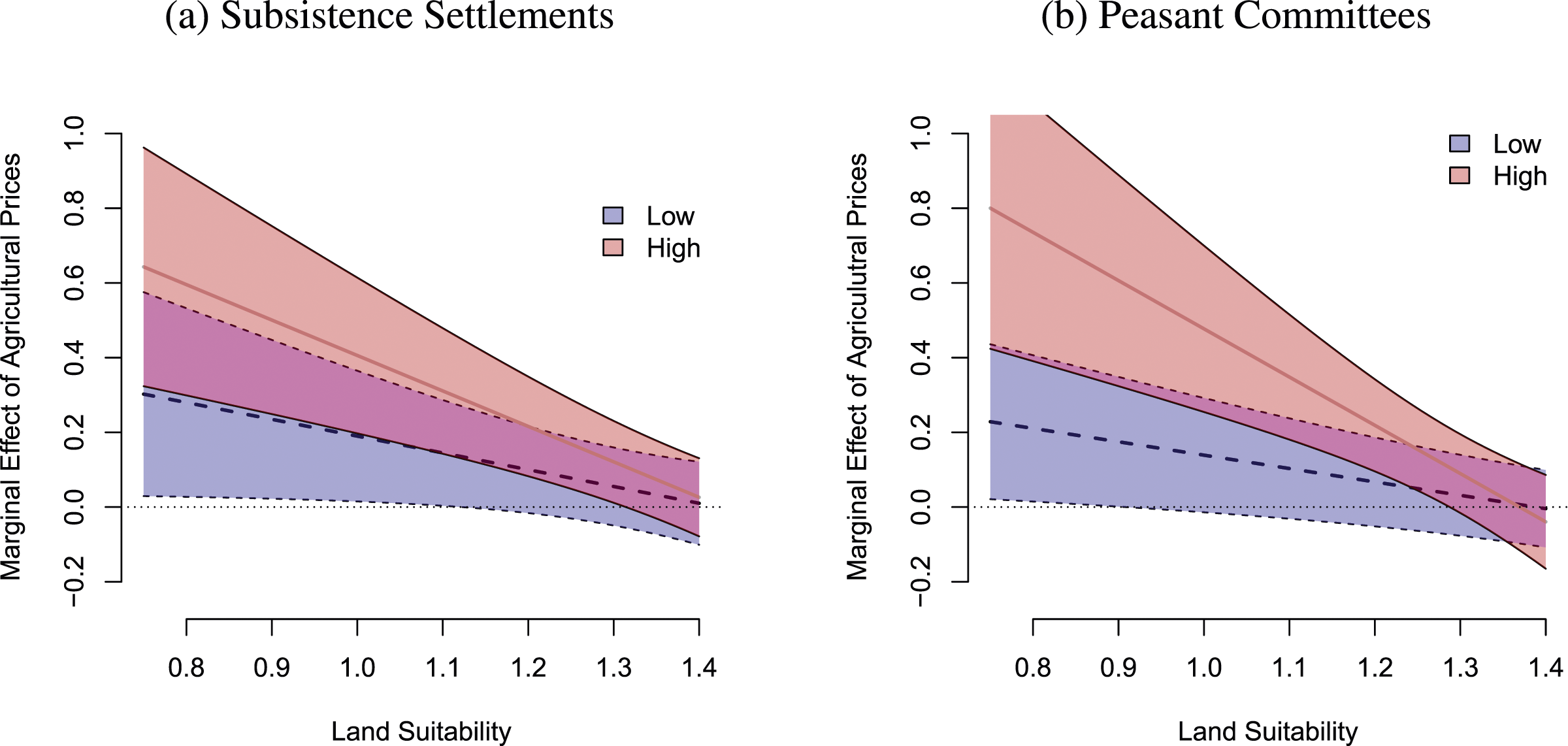
A similar pattern characterizes municipalities with high levels of peasant committees—an increase of prices by 1% in municipalities with the least suitable soil increases the number of episodes of peasant resistance by 0.8%. The same movement of prices in the most suitable regions is associated with a reduction in resistance but, again, this effect is not statistically significant. In municipalities with low levels of peasant committees, the estimated effects decrease on suitability but are indistinguishable from zero only for the lowest value of land suitability and nearly four times smaller.
To give more substantive interpretations around the quantities of interest, we also calculate adjusted predictions of peasant resistance for different combinations of prices, suitability, and organizational resources. Based on models 3 and 5 of Table 1, Figure 5 presents adjusted predicted values of resistance events with confidence intervals, in their IHS-transformed scale, for two reference values of suitability (minimum and maximum) and low (one standard deviation below the mean), mean, and high (one standard deviation above the mean) prices, conditional on organizational resources. Both panels cast additional support for Hypotheses 2 and 3. The predicted values of peasant resistance against land encroachment are greater, and statistically significant, in years of high prices in municipalities with minimum suitability when settlements and committees are prevalent (roughly 2.23 and 3.32 resistance events, respectively) relative to when they are not (1.68 and 1.45 resistance events). By contrast, all the predictions for municipalities with maximum suitability are indistinguishable from zero, regardless of the levels of settlements and committees. Conditional Adjusted Predictions. (a) Subsistence Settlements. (b) Peasant Committees. Note: Based on models 3 and 5, Table 1. Municipalities with high levels are those whose number of subsistence settlements and peasant committees are greater than its median value. Red and blue whiskers represent 95% confidence intervals.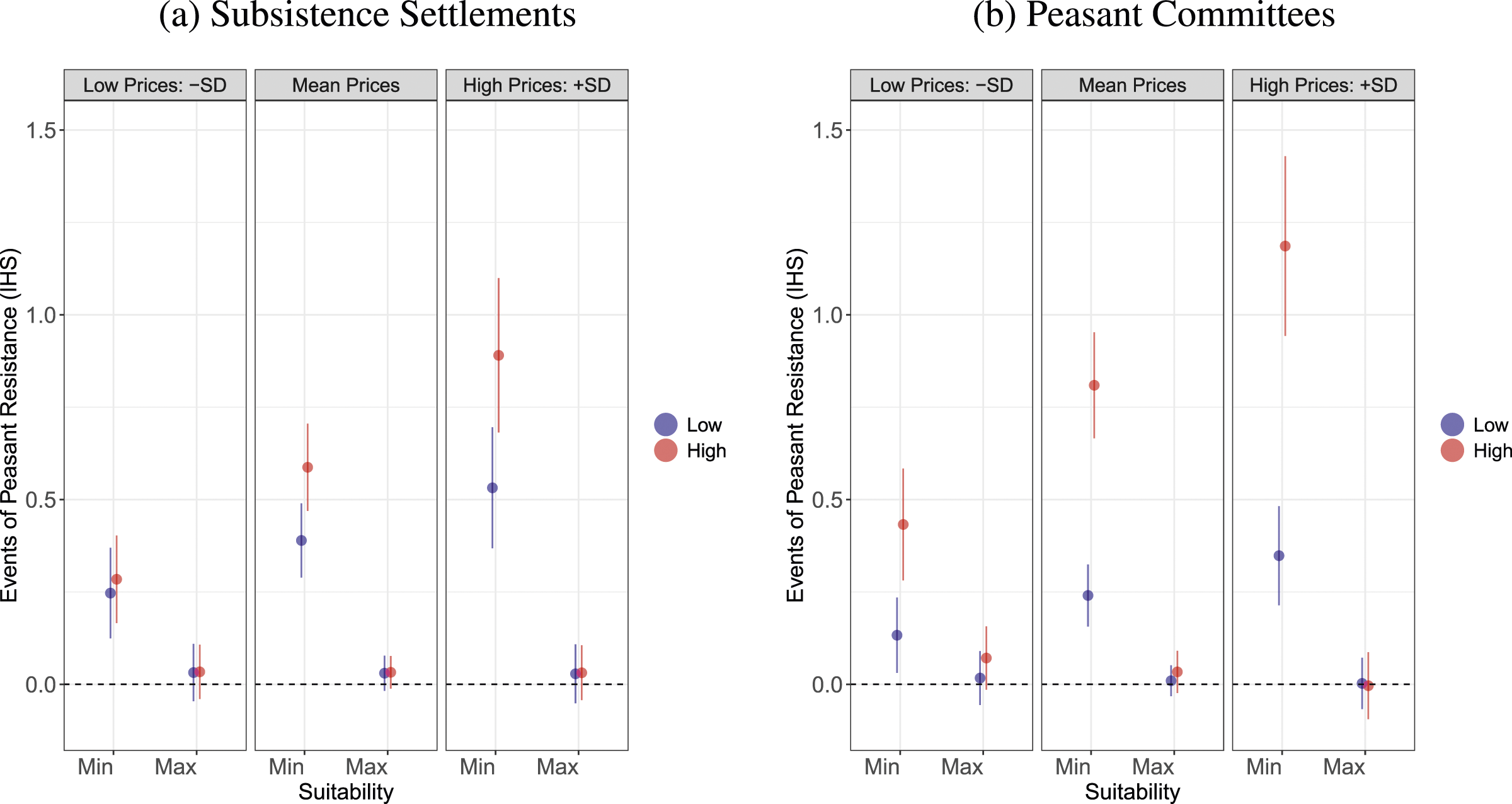
Supplemental Tables B.5–B.7 also report estimates from the binning model proposed by Hainmueller et al. (2019) by splitting the sample into two subsamples along the median value of the moderator. 30 Using the binning models allows us to further explore nonlinearities in the conditional effects and examine the existence of common support. The binning models yield results similar to those of the TWFE models.
In short, our results show support for our hypotheses about the effect that price hikes in capital-intensive agriculture has on peasant resistance to land encroachment. When the prices of capital-intensive crops grow, so does peasant resistance on the agricultural frontier where land suitability for commercial production is low (Hypothesis 1). That effect is heightened in areas where organizational capacities (Hypothesis 2) and communal subsistence farming (Hypothesis 3) are more prevalent.
Evidence on the Mechanisms
The key channel linking agricultural prices to peasant resistance against land encroachment is the geographic expansion of capital-intensive agricultural production to the less suitable agricultural frontiers, as these areas are now profitable for landowners growing these crops. 31 We resort to Paraguay’s 2008; 1991 agricultural censuses to assess this mechanism. The year 1991 precedes the commodities boom, a period that initiated a decade characterized by significant lower prices. In 1991, the average global prices per metric ton for maize, soybeans, and sugar were US$97. By 2008, at the peak of the boom, these prices had escalated to US$195, marking a 101% increase from 1991. Additionally, we acquired data for planted hectares of soybeans in 2014 from Paraguay’s Grains and Oilseeds Traders Association (CAPECO), when the commodities boom was concluding, providing further insight into the agricultural trends of this period.
In line with our previous findings, we anticipate an expansion of capital-intensive agriculture in municipalities with lower land suitability. Supplemental Table C.1 presents least squares estimates, with departmental fixed effects, on the relationship between land suitability and the percentage change in planted hectares for soybeans, maize, and sugar. We find a pronounced negative correlation between land suitability and the expansion of planted hectares in capital-intensive agriculture, particularly notable in the case of soybeans. For example, a one-percent reduction in suitability is associated with a 15% point increase in the planted hectares of these crops, and a 21% point increase for soybeans between 1991 and 2014 (p < .001). These associations are large and consistent with our main argument. Supplemental Figures C.1–C.2 also present LOESS plots, confirming a strong negative relationship between the geographic expansion of capital-intensive crops and suitability.
Similar to Grasse (2022) and (Tellez, 2022), we also expect that municipalities experiencing greater expansion of capital-intensive agriculture will exhibit more peasant resistance. Supplemental Table C.2 shows a positive and statistically significant correlation between the expansion of these crops and peasant resistance to land encroachment. A 1% point increase in planted hectares is associated with approximately a 7.25% increase in the number of resistance events, and a 15% increase for soybeans at the end of the boom. LOESS plots in Supplemental Figures C.1 and C.3 corroborate this positive relationship.
Finally, we show further evidence in favor of the proposed mechanism by conducting the following placebo exercises:
Types of Rural Unrest
Resistance during price booms is over land access and from peasants against landowners. Therefore, we would not expect rural unrest related to other issue or involving other actors. We re-run our main models using episodes of rural unrest where income is the peasant grievance (e.g., farm strikes against low wages or lack of credit); where peasants fight against indigenous peoples (e.g., clashes over land boundaries); and where landowners protest against the government (e.g., tractor roadblocks against export taxes) as the dependent variables. A fourth set of models includes all these instances together. We coded these instances from our archival database. Supplemental Figures C.4–C.9 show that the marginal effects are small, not statistically significant, or running in the opposite direction. 32
Labor-Intensive Crops
Peasant resistance may be a straightforward reaction to the expansion of commercial farming activities (e.g., Saffon, 2021) rather than capital-intensive farming activities. We carry out an additional test in which we use the average prices and land suitability of cotton, tobacco, and yerba mate—Paraguay’s primary cash crops until the 1990s (Hanratty & Meditz, 1990)—as explanatory variables. These are traditionally labor-intensive crops with fewer technological advancements, so prices should not provide the same incentives for commercial expansion to less suitable soils. Supplemental Figures C.10–C.11 show that the marginal effects are not statistically significant or running in the opposite direction.
Food Inflation
If capital-intensive crops are consumed domestically, global prices could be inflating food prices, thereby straining peasants excluded from commercial agriculture and whose livelihoods depend on food crops. McGuirk and Burke (2020) suggest that higher food prices can also provoke peasant rebellion in the form of “food riots” against commercial farmers. Using data from the World Bank, 33 we carry out an additional test where we use the consumer price index—annual change in the cost of a basic food basket—instead of international crop prices. Supplemental Figures C.12–C.13 show that marginal effects are small, have the opposite sign, and remain negative for the whole range of suitability.
Alternative Organizations
We also explore the impact of alternative forms of organization to subsistence settlements and peasant committees. We consider the effect of peasant commercial farming (e.g., Scott, 1976) using the number of peasant cotton farms, 34 the effect of state-led land distribution (e.g., Albertus, 2020) using the number of IBR peasant colonies, and the effect of landowner organizational capacities (e.g., Albertus et al., 2016) using the number of UGP and ARP locales. Estimated marginal effects in Supplemental Figures C.14–C.16 are not statistically significant, or are positive and significant for both groups of municipalities—with high and low levels—and with considerable overlap between the two confidence intervals.
Conclusions
During the 2000s commodities boom, developing countries experienced unparalleled economic growth, comparable only to the 1880s and post-WWII era. Paraguay benefited greatly from this period, growing at an average of 4.5% annually between 2000–2014, mainly driven by the agricultural sector, which saw agricultural exports rise from 40 to 70% of total exports during this period. 35
In this context, heightened peasant unrest warrants explanation. Existing studies argue that peasant incomes shrivel when prices plummet, thus stimulating rebellion. Conversely, price upswings raise rural wages and allow peasants to benefit from trade, thereby discouraging rebellion. This hearkens back to classic agrarian studies such as Scott (1976), who argued that the expansion of commercial agriculture makes peasants vulnerable to subsistence crises because their wages fluctuate with crop prices. While also emphasizing the expansion of commercial agriculture as a source of rural conflict, our work studies how positive price shocks can also engender peasant rebellion in the form of collective resistance to land encroachment. We center on the technological changes of capital-intensive agriculture, which decrease labor demand, raises entry costs, and expands commercial production to less suitable agricultural frontiers. Soaring prices of capital-intensive crops incite landowners to encroach on peasant cultivators’ lands on the frontier, thus engendering resistance.
Paraguayan peasants with ill-defined property rights inhabiting the Eastern Region’s less suitable lands were vulnerable during years of high prices. Large commercial farmers and agribusiness firms encroached on frontier lands and forced peasants to sell or abandon their homes and migrate to urban areas. However, when peasants were able to pull their resources, they engaged in collective resistance. In municipalities with subsistence settlements and peasant committees, peasants could draw on those resources to resist land encroachment.
Studying why the rural poor continue to engage in contentious politics in the 21st century is a critical area of research, given that 75% of the world poor reside in rural areas (Trejo, 2016, p. 775). Future research should explore how different aspects of capital-intensive agriculture—such as mechanization, biotechnology, or agrochemicals—impact peasants’ means of sustenance and their decision to resist. For example, Samuels and Thomson’s (2022) recent study finds that mechanization in Brazil reduces rural employment and pushes peasants to participate in land invasions. Grasse (2022) finds that oil palm—a cash crop requiring skills, capital, and vast amounts of land—in Indonesia incites conflict between local forest-dependent communities and commercial farmers over the appropriation of forests and fresh water (see also Tellez, 2022). Capital-intensive agriculture may also drive contentious collective action by landowner interests seeking to defend their copious profits, as these crops are highly profitable in world markets and can entice state authorities to tax them. Mangonnet and Murillo (2020) show that commercial farmers in the 2000s organized farm lockouts and roadblocks during years of rising prices as an outcry against the government’s attempts at taxing exports of soybean bushels, feed, and oil, the country’s most exported and lucrative commodities.
Our work builds on these recent contributions, suggesting that agricultural capitalization challenges the literature’s assumptions about commercial agriculture being labor-intensive and higher prices resulting in better wages and labor opportunities for the rural poor. While developing countries might gain from better terms of trade and greater fiscal surpluses, peasant and indigenous populations living in the agricultural frontiers—whose economic survival hinges on having land for cultivation—may suffer from negative externalities. Capital-intensive farming systems can result in land deprivation, deforestation, soil erosion, pollution, and biodiversity loss. In that regard, our work suggests a more nuanced view of the winners and losers of the 2000s commodities boom.
Supplemental Material
Supplemental Material - Peasant Resistance in Times of Economic Affluence: Lessons From Paraguay
Supplemental Material for Peasant Resistance in Times of Economic Affluence: Lessons From Paraguay by Liliana Rocío Duarte Recalde, Germán Feierherd, Jorge Mangonnet, and María Victoria Murillo in Comparative Political Studies
Footnotes
Acknowledgements
We are thankful to Alejandro Bonvecchi, Scott Desposato, Robert Kaufman, Horacio Larreguy, Virginia Oliveros, Alison Post, Kenneth Roberts, and three anonymous reviewers for thier helpful comments. We also benefited from conference and seminar presentations at Nuffield College (University of Oxford), UCSD, Berkeley, REPAL, ITAM, Universidad Comunera de Paraguay (“Paraguay: 30 Años de Democracia”), and Sociedad Argentina de Análisis Político. Elena Barham, Tanya Bettoni, Fernanda Ojeda, and Liz Soto provided terrific research assistance. Mangonnet gratefully acknowledges funding from the Institute of Latin American Studies at Columbia University and Nuffield College. This research was approved by the Columbia University Institutional Review Board under protocols IRB-AAAN7502 and IRB-AAAN4355.

Declaration of Conflicting Interests
The author(s) declared no potential conflicts of interest with respect to the research, authorship, and/or publication of this article.
Funding
The author(s) disclosed receipt of the following financial support for the research, authorship, and/or publication of this article: This work was supported by the Nuffield College, University of Oxford and Institute of Latin American Studies, Columbia University.
Supplemental Material
Supplemental material for this article is available online.
Notes
Author Biographies
References
Supplementary Material
Please find the following supplemental material available below.
For Open Access articles published under a Creative Commons License, all supplemental material carries the same license as the article it is associated with.
For non-Open Access articles published, all supplemental material carries a non-exclusive license, and permission requests for re-use of supplemental material or any part of supplemental material shall be sent directly to the copyright owner as specified in the copyright notice associated with the article.
