




Abstract
Despite growing evidence of pro-female bias in the electorate elsewhere, conventional wisdom holds that voters in the Middle East and North Africa (MENA) prefer male candidates, presumably due to sexism. We test this conventional wisdom using a conjoint experiment administered to over 30,000 respondents in six MENA countries. We find both male and female respondents are more likely to express support for female candidates and see them as more capable than their male counterparts, even in stereotypically male domains. We argue the increasing demand for political outsiders explains these results. In highlighting the importance of such changes, our study expands the application of gender congruity theory in the MENA and beyond by offering evidence that both changes in gender stereotypes (i.e., gender roles) and in what citizens desire in leaders (i.e., leader roles) reduce anti-female bias at the polls.
Keywords
Despite growing evidence of a turn toward pro-female bias in the electorate across much of the world (Schwarz & Coppock, 2022), conventional wisdom and existing studies suggest voters in the Middle East and North Africa (MENA) generally prefer male candidates (Benstead et al., 2015; Blackman & Jackson, 2021; Kao & Benstead, 2021; Shockley, 2018). Based on gender role congruity theory (Eagly, 1987; Eagly & Karau, 2002), these studies argue the gap between voters’ stereotypes over women’s traits and competencies (i.e., gender roles) and desirable leader traits (i.e., leader roles) lead them to prefer male candidates. Consequently, studies on the electability gender gap conclude that increasing support for female candidates requires reducing gender stereotypes pertaining to traits and competencies and/or enhancing female candidates’ abilities to make appeals consistent with stereotypes regarding what makes a good leader. These conclusions focus on ‘gender roles’ while overlooking ‘leader roles,’ an equally important factor affecting the gender gap in women’s access to traditionally male domains (Eagly & Karau, 2002).
However, there are reasons to believe the MENA region is witnessing changes in both stereotyped gender (Roche, 2023) and leader roles, thereby improving prospects for female politicians. Stereotypes about women may be changing for several reasons. The region has an overwhelmingly young population, 1 and youth are expected to hold more liberal views than older citizens (Alexander & Welzel, 2011; Moaddel, 2009; Moaddel & de Jong, 2017; Moaddel et al., 2011; UNDP, 2022). Increased global connectivity, combined with the expansion of electoral gender quotas, also means most MENA citizens have been exposed to higher numbers of women in leadership at home and abroad, thus potentially reshaping stereotypes about women’s competencies. What citizens want in a leader may be changing as well. The Arab uprisings demonstrated citizens’ demands for dignity and cleaner, more responsive governments, reflecting frustration with traditional (i.e., male) politicians and potentially increasing demand for political outsiders (e.g., women, social movement activists). Studies demonstrate that females are seen as political outsiders and less corrupt (Benstead & Lust, 2018); thus, it is plausible a pro-female bias is emerging in the MENA electorate. 2
In this article, we explore how gender shapes citizens’ support for female candidates and perceptions of their competencies. To do so, we employ a conjoint experiment administered to over 30,000 respondents in six MENA countries. We assess respondents’ stated willingness to vote for a hypothetical candidate, their assessment of whether others in their community would support the candidate, and their beliefs about whether the candidate, if elected, would be successful in activities stereotypically associated with male or female competencies (Huddy & Terkildsen, 1993). We further examine how and why attitudes vary, including how gender stereotypes affect electability and perceived competencies.
Our findings are striking, as they suggest gender stereotypes and ideas about what makes a good political leader may both be changing. Gender-based stereotypes, in general, remain prevalent, with substantial proportions of society expressing sexist attitudes. However, when it comes to elections, respondents overall are more likely to say they would support female candidates, even though, in most countries, they believe others in their community prefer male candidates. Moreover, we find evidence of changing gender stereotypes regarding competencies: respondents believe female candidates are more capable of performing leadership tasks, including those considered under men’s purviews – such as ensuring security, managing the economy, and raising constituency funds. However, other gender stereotypes remain robust and seem to foster support for female candidates. Those who see women as less corrupt (i.e., hold benevolent sexist views; Benstead & Lust, 2018) are more likely to support female candidates and see them as more competent.
In demonstrating increasing support for female candidates, the study extends the literature on gender, role congruity theory, and electability. It turns attention to the possibility that closing the gender gap may be accomplished by not only shifting gender stereotypes (i.e., gender roles) but also changing views on what makes a good leader (i.e., leader roles). Specifically, existing research on electability emphasizes the role gender stereotypes play in explaining women’s under-representation in politics but overlooks the role played by attitudes about what makes a good leader (cf. Bauer & Santia, 2022; Davidson-Schmich et al., 2023; Hollman, 2023; Schneider et al., 2022).
Studies in business management, the discipline in which gender role congruity theory was developed (Eagly, 1987), find that when notions of what makes a good business leader change (i.e., ‘feminize’), women are less likely to face discrimination as actual or potential occupants of executive positions. More recent literature on transformational leadership in business also demonstrates that this transformational leadership style increasingly favors leaders with many of women’s stereotyped competencies, such as seeking employee input in decision-making (Saint-Michel, 2018). Our study thus expands the application of gender congruity theory by suggesting that changing leader roles—i.e., what citizens look for in leaders — improves women’s political prospects.
Our study further contributes to the literature on gender and corruption. It departs from earlier studies that found an association between benevolent sexism – in the form of stereotyping women as less corrupt than men – and less support for female candidates in the MENA (Benstead & Lust, 2018; Jones et al., 2021). Instead, our study reveals individuals’ perceptions of women as cleaner, political outsiders may lead them to support female candidates. Stereotypes that previously appeared to hinder women, as they were seen as being at odds with notions of leadership, may help them succeed as beliefs about leader roles change.
Finally, our work helps elucidate one reason why women’s descriptive representation remains low, even as individuals’ willingness to support female candidates increases (Clayton et al., 2019; Fox & Lawless, 2004). The finding that individuals who express support for female candidates often believe others do not may be evidence that low representation may be driven by pragmatic bias (Bateson, 2020; Corbett et al., 2022), wherein citizens opt not to vote for a candidate perceived as unelectable due to the likelihood of others discriminating against them. The perception of electability may make it difficult for women to raise funds, receive party nominations, and win elections.
Our paper proceeds as follows. First, we examine the theoretical framework underlying research on gender and electability, considering why gender gaps in political leadership exist and how they might change. Second, we lay out our analytical approach, including the conjoint experiment design and the nature of our sample. Third, we present and discuss the results. Finally, we conclude by considering the theoretical and policy implications of our findings.
Changing Preferences over Gender and Political Leadership? Lessons from the Literature
Gender role congruity theory holds that bias against women in leadership stems not from sexist stereotypes (i.e., prejudice) but from the mismatch between traditional gender role stereotypes about men and women and notions about what makes a good leader (i.e., leader roles). A mismatch between gender and leader roles leads to a less favorable evaluation of actual and potential leaders in traditionally male domains like politics and business, resulting in discrimination (Eagly & Karau, 2002).
Regarding gender roles, sexism can be parsed into two types – hostile and benevolent. Hostile sexism refers to negative views of women, such as seeing women as immoral, incompetent, and inferior to men, while benevolent sexism values feminine-stereotyped qualities and behaviors, such as being nice, compliant, and morally pure. Importantly, benevolent sexism still views women as inherently different from men (Glick & Fiske, 1997) and, like other forms of prejudice, partially preserves the power and advantages of men over women (Begany & Milburn, 2002). Associated with men’s desire to “protect” women from roles that might be dangerous or difficult (often in male-dominated arenas) (Daniels & Leaper, 2011), benevolent sexism may reward women who accept a subordinate position.
Stereotypes about women’s traits and competencies can affect electability. Gender stereotypes generally derive from labor force gender segregation. Applied to elections, men are viewed as having denser networks in politics and business (Benstead, 2016; Bjarnegard, 2013), more capable of improving the national economy (Huddy & Terkildsen, 1993), and ensuring national security (Blackman & Jackson, 2021). In contrast, women are seen as more approachable, honest, sensitive, and capable in “compassion” issues, such as social policy and women’s rights (Benstead & Lust, 2018; Bush & Prather, 2020). In the US, studies find individuals holding benevolent sexist attitudes are less likely to view white female candidates as electable, and those holding hostile sexist attitudes are less likely to view black female candidates as electable (Britzman & Mehić-Parker, 2023). In the MENA, where race plays a less important role, studies find both hostile and benevolent sexism are linked to lower support for female candidates (Benstead et al., 2015; Blackman & Jackson, 2021), 3 as well as lower perceived credibility of women in media (Jones et al., 2021). Hostile sexism – such as seeing males as better political leaders – may undermine women’s electability, while benevolent sexism – such as seeing women as politically clean – could conceivably support women’s electability, as it aligns with shifting demand for honest political leaders.
Scholars working in different contexts, within and beyond the MENA, emphasize how those seeking to promote female representation can change gender role stereotypes by adjusting to existing views of leadership roles to improve women’s chances for election. For example, trait balancing theory explores how leaders can strategically emphasize feminine and masculine traits to increase electability (Bauer & Santia, 2002). Women leaders can thus shape communication strategies to leverage communal versus agentic traits, thereby improving their electoral prospects (Davidson-Schmich et al., 2023; Schneider et al., 2022).
Changing leader roles may also increase women’s electability. Studies applying gender role congruity theory to elections have neglected leader roles (cf. Bauer & Santia, 2022; Davidson-Schmich et al., 2023; Holman, 2023; Schneider et al., 2022), which have received much attention in the field of business management. The notion of what makes a good leader can change; as women have entered business leadership, their unique style has changed what it means to be an effective leader. Emerging modes of transformational leadership are based on more ‘feminine’ traits; organizations increasingly seek leaders who communicate a vision and make “emotional appeals to increase their followers’ awareness, encourage [employees] to envisage new ways of thinking and treat them differently but equitably on a one-to-one basis” (Saint-Michel, 2018, p. 945). Changing notions of what makes a good leader may also affect women’s political prospects. There appears to be a global surge in demand for political outsiders (Jungherr et al., 2019), whom many view as less corrupt (Ball, 1993). As citizens seek new types of leaders, stereotypes of women as cleaner candidates (e.g., Benstead & Lust, 2018; Shalaby, 2019) might enhance their electability.
Finally, greater visibility of women leaders may increase the electability of female candidates in the MENA region. Women now make up just under 20% of seats in the lower or unicameral legislatures in the Arab world (IPU Parline, 2022), and citizens have had more than 20 years to observe women as political leaders. There is evidence from the MENA and elsewhere that the larger number and increased visibility of women leaders increase the extent to which citizens see them as having the traits and competencies to be effective in a male-dominated domain (Alexander, 2012; Barnes & Burchard, 2013; Beaman et al., 2009; Clayton, 2018; Krook, 2006). This, combined with the rise in demands for cleaner government, may reduce discrimination against female politicians.
Expectations over Attitudes Toward Gender and Political Leadership
Drawing from the literature, we set forth three main sets of hypotheses regarding gender and electability. These hypotheses were pre-registered in the OSF registry (Lust & Benstead, 2022).
The first set of hypotheses evaluates the conventional wisdom over voters’ perceptions of gender and electability. Do voters prefer male or female candidates? Conventional expectations over gender and leadership hold that individuals will express greater support for male candidates and believe others will as well. Thus, we test whether respondents, on average, are more likely to express support for male candidates than female candidates.4
Second, we examine the extent to which stereotypes of gendered competencies may shape citizens’ attitudes toward candidates. Do individuals view candidates’ capabilities in accordance with male and female stereotypes? Do respondents view male candidates as more likely to receive support from influential people (i.e., better networked) 5 and more capable of performing activities in line with stereotyped male competencies? Specifically, we anticipate that, on average, respondents will view male candidates as a) having more influential networks in politics and being better able to b) improve the national economy, c) raise funds, d) ensure security, and e) foster local development. Respondents would be equally likely to see male and female candidates as willing to f) help others obtain services6 and g) more likely to view female candidates as better able to address social problems.7
Third, we consider the extent to which general attitudes toward gender – that is, hostile and benevolent sexism – are associated with support for female candidates. Are levels of hostile and benevolent sexism associated with individuals’ preferences over candidates? Based on extant research, we expect that respondents who hold hostile or benevolent sexist views – those who hold traditional gender roles and associate successful leaders with male traits – will be more likely to show support for male candidates and view them as more capable leaders. 8
Throughout our analyses, we explore how different demographic groups respond to female candidates. We pay particular attention to how respondents’ genders may shape the relationship between candidate gender, sexism, and electoral support, as we expect women, overall, to be more likely than men to support female candidates. We briefly consider the relationships between respondents’ age, education, and religiosity and their support for male versus female candidates. We examine these factors independently and interacted with one another, given the potential importance of intersectionality. 9
A Study in Six Countries
We examine attitudes toward candidate gender, stereotypes, and electability in six countries of the MENA, a region that seems particularly resistant to the current global movement toward pro-female bias. 10 These countries – Algeria, Egypt, Jordan, Libya, Morocco, and Tunisia – have societies in which patriarchal attitudes are widespread and female representation in the public sphere is limited. They also have experienced decades of regularly held elections contested by both male and female candidates. They are, thus, cases in which the study is both relevant and realistic.
Patriarchal attitudes are common in the six MENA countries studied here. For instance, the Arab Barometer (2022) found that a high percentage of respondents believed a man should have the final say in all decisions concerning the family, with such attitudes particularly prevalent in Egypt. Similarly, the World Values Survey (Haerpfer et al., 2022) found most citizens across these countries agreed with the statement: “Men make better executives than women” (see Figure 1). Perhaps not surprisingly, women are rarely appointed or elected to executive positions in the region (Jalalzai, 2008). Traditional Gender Values by Country. Note. Left panel: The data is from the online tool, Arab Barometer Wave VI-C, with question-wording: “The following questions are your personal opinions about the principles that should determine the behavior and situation of women in our society. For each of the statements listed below, please indicate whether you agree strongly, agree, disagree, or disagree strongly with it. A man should have final say in all decisions concerning the family.” Data from Algeria, Jordan, Libya, Morocco, and Tunisia = Wave VI_C (2021)|Egypt = Wave V (2018).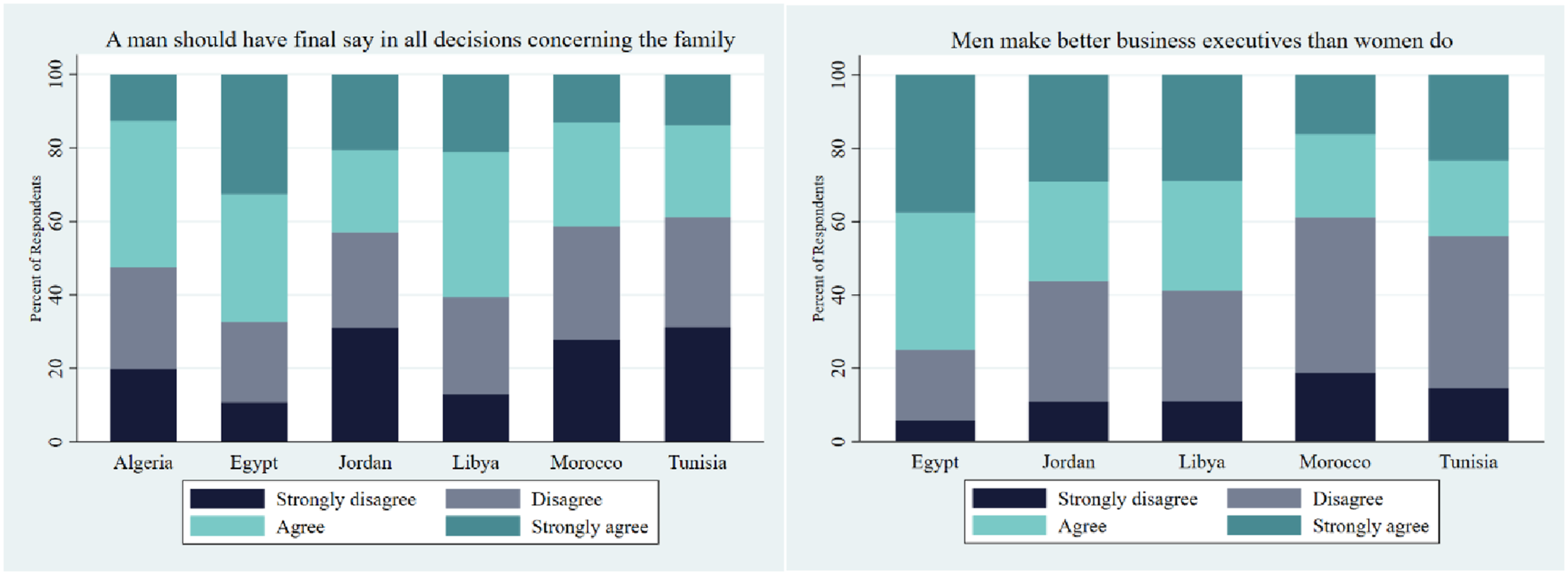
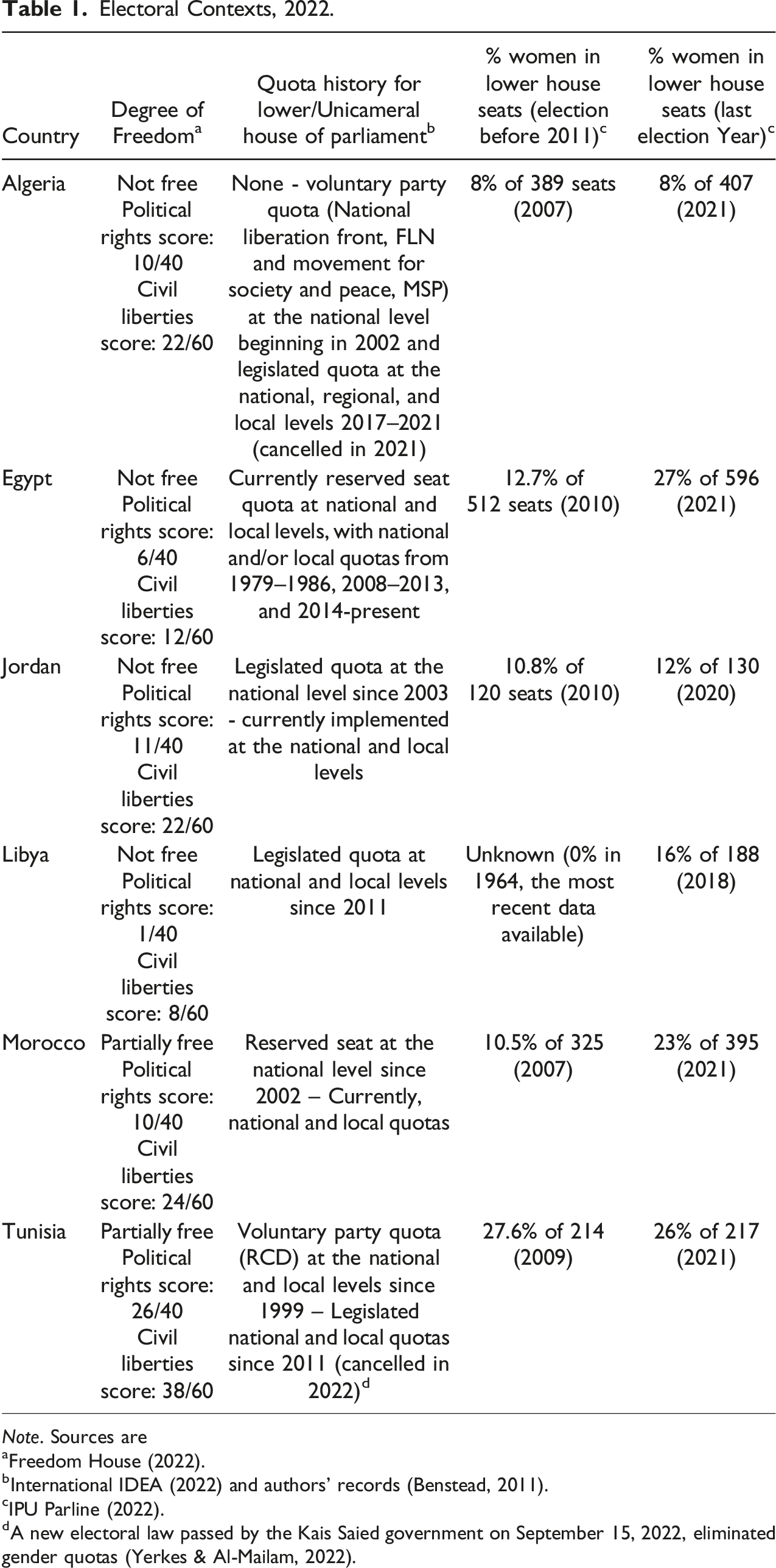
Electoral Contexts, 2022.
Note. Sources are
bInternational IDEA (2022) and authors’ records (Benstead, 2011).
dA new electoral law passed by the Kais Saied government on September 15, 2022, eliminated gender quotas (Yerkes & Al-Mailam, 2022).
Citizens have thus witnessed and often participated in elections that led to considerable, though varied, levels of female descriptive representation. At the time of this study, women held 26% of the national legislative seats in Tunisia, 23% in Morocco, and 27% in Egypt. In contrast, women held 16% of the seats in Libya, 12% in Jordan, and 8% in Algeria (see Table 1). The presence of women in political leadership may foster greater support for female candidates (Alexander, 2012; Beaman et al., 2009). Combined with global connectivity and increasing exposure to female leadership abroad, there is reason to believe that resistance to female candidates may be waning.
This may be particularly true as many citizens have lost faith in traditional (male), often corrupt politicians. The six cases we study have different regimes and political histories,
12
but citizens view corruption as a significant problem in all of them. According to the Arab Barometer, the majority of respondents in Algeria, Jordan, Libya, Morocco, and Tunisia
13
answered ‘to a great extent’ or ‘to a medium extent’ when asked, “To what extent do you think there is corruption within the national state agencies and institutions in your country?” (see Figure 2). Transparency International’s (TI) Global Perception Index also finds all countries in our sample rank high in corruption;
14
moreover, people view members of parliament, government officials, and heads of state as being the most corrupt (TI, 2022). Indeed, in 2019 Transparency International reported 44% of those surveyed in the MENA viewed members of parliament as corrupt (TI, 2019; see also TI, 2022). These countries thus see widespread demand for political change, with citizens expressing frustration toward political corruption and decreased trust in conventional (i.e., male) politicians. Perceptions of corruption.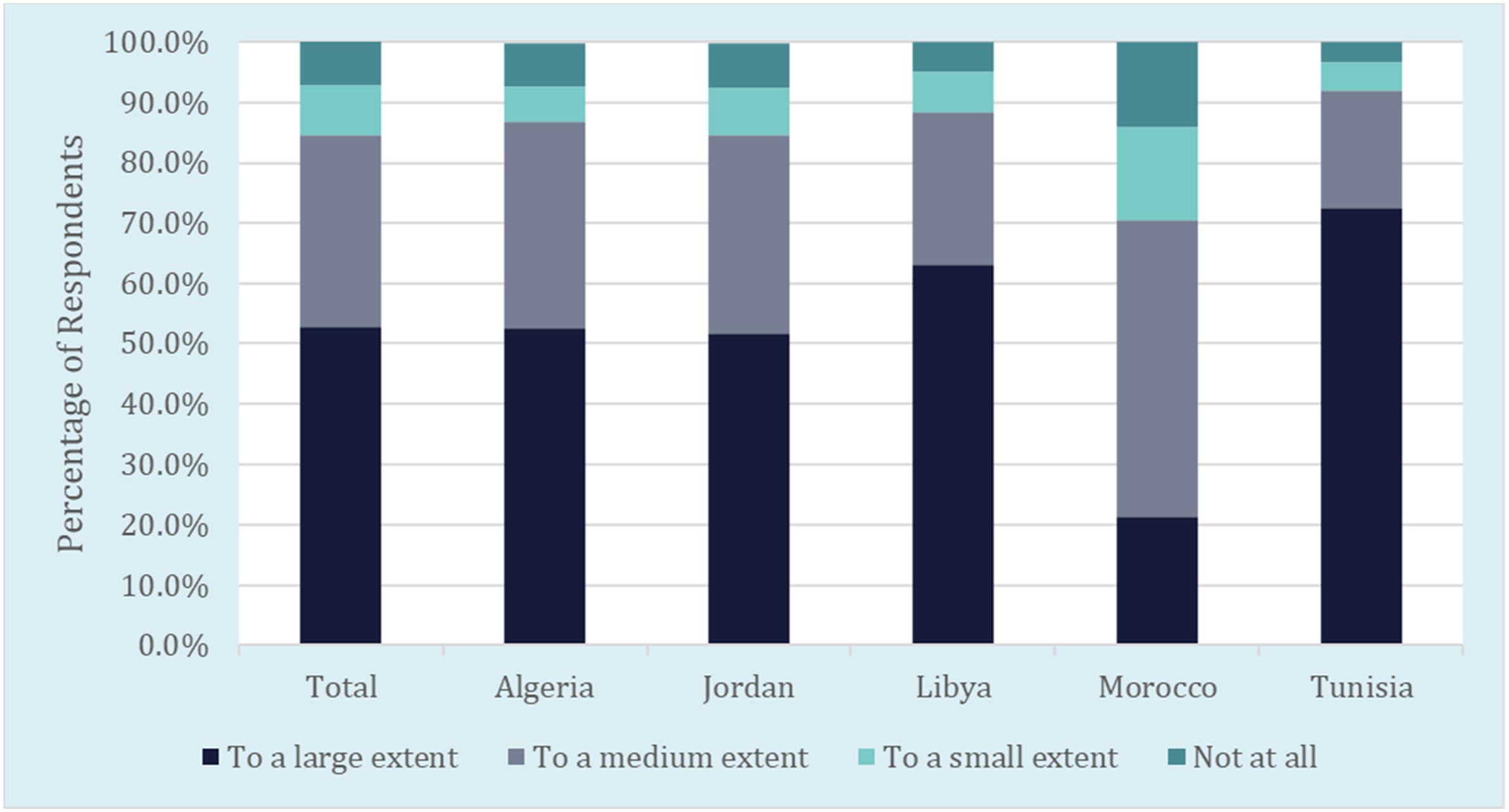
Data and Methods
We use a web-based survey to study how citizens in these six countries view male versus female candidates. Employing a web-based survey allowed us to reach a large sample of citizens across six countries while respecting the challenges of COVID-19 and climate change. We included a survey experiment that permits us to causally identify the impact of candidate gender on individuals’ attitudes toward the candidate and to examine the association between demographic characteristics, hostile and benevolent sexism, and the influence of candidate gender on electability. We must remember these are not nationally representative samples and thus consider the respondents’ attributes vis-à-vis populations at the national level and within the sampling frame. However, there is also evidence that voluntary samples from web-based surveys provide valid results (Liao & Hsieh, 2017).
Sample
The sample is drawn from members of Forsa, a Jordanian-based non-governmental organization dedicated to providing opportunities to youth in the Arab world. Forsa emailed all of their members in Algeria, Egypt, Jordan, Libya, Morocco, and Tunisia, inviting them to participate in a short survey on governance in the MENA. 15 To prevent multiple responses from individual respondents, we generated a dynamic link on our survey platform, SurveytoGo, which we then shared with Forsa. 16 The survey began by asking respondents their age, gender, and whether they were citizens of the country in which they resided. Only age was used to screen respondents; those who were under 18 years of age were thanked for their interest in the survey, and the survey ended. The rest were given a consent statement including information on the survey and that participants would be entered into a lottery to win a 50 gift card (see Appendix A, Table A1). The survey was available from August 19 to September 25, 2022. From the over 1.749 million Forsa members invited to participate, 17 31,619 completed surveys: Algeria (n = 5441), Egypt (n = 9447), Jordan (n = 5587), Libya (n = 1083), Morocco (n = 7833), and Tunisia (n = 2128).
Demographics of Population, Forsa Members, and Sample by Country.
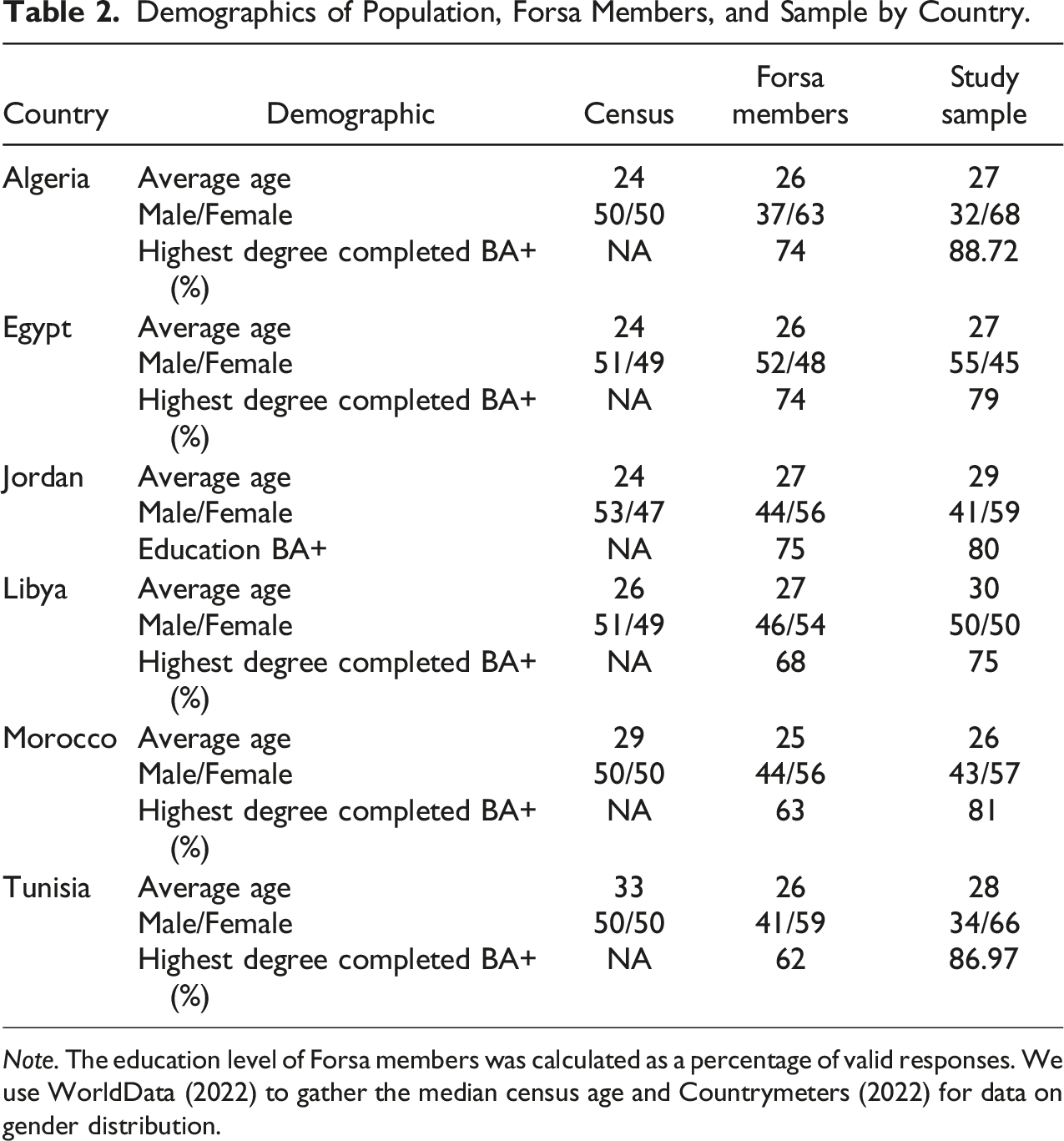
Note. The education level of Forsa members was calculated as a percentage of valid responses. We use WorldData (2022) to gather the median census age and Countrymeters (2022) for data on gender distribution.
Survey and Experimental Design
Treatments and Levels of Attributes.
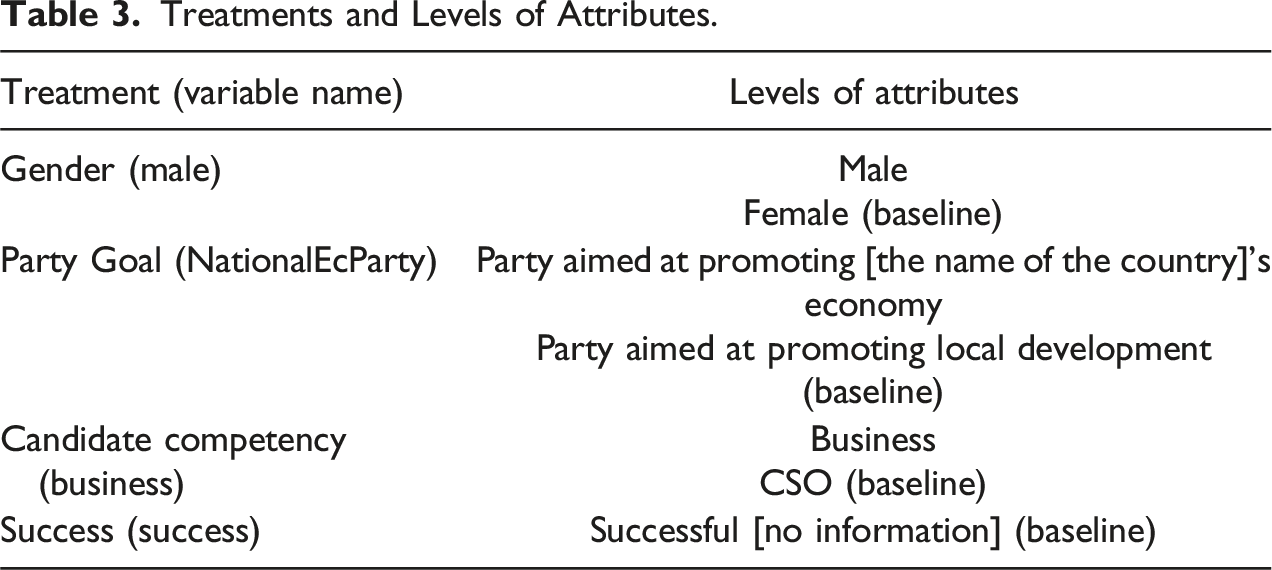
The experiment read, with randomized treatments in braces: Please imagine the following candidate running for parliament in your district. The candidate is a {woman/man} who heads a {successful/[no information]} {civil society organization/business}. The candidate is a member of a party aimed at {promoting local development/improving the country’s economy}.
Outcome Questions Aimed at Assessing Mechanisms.
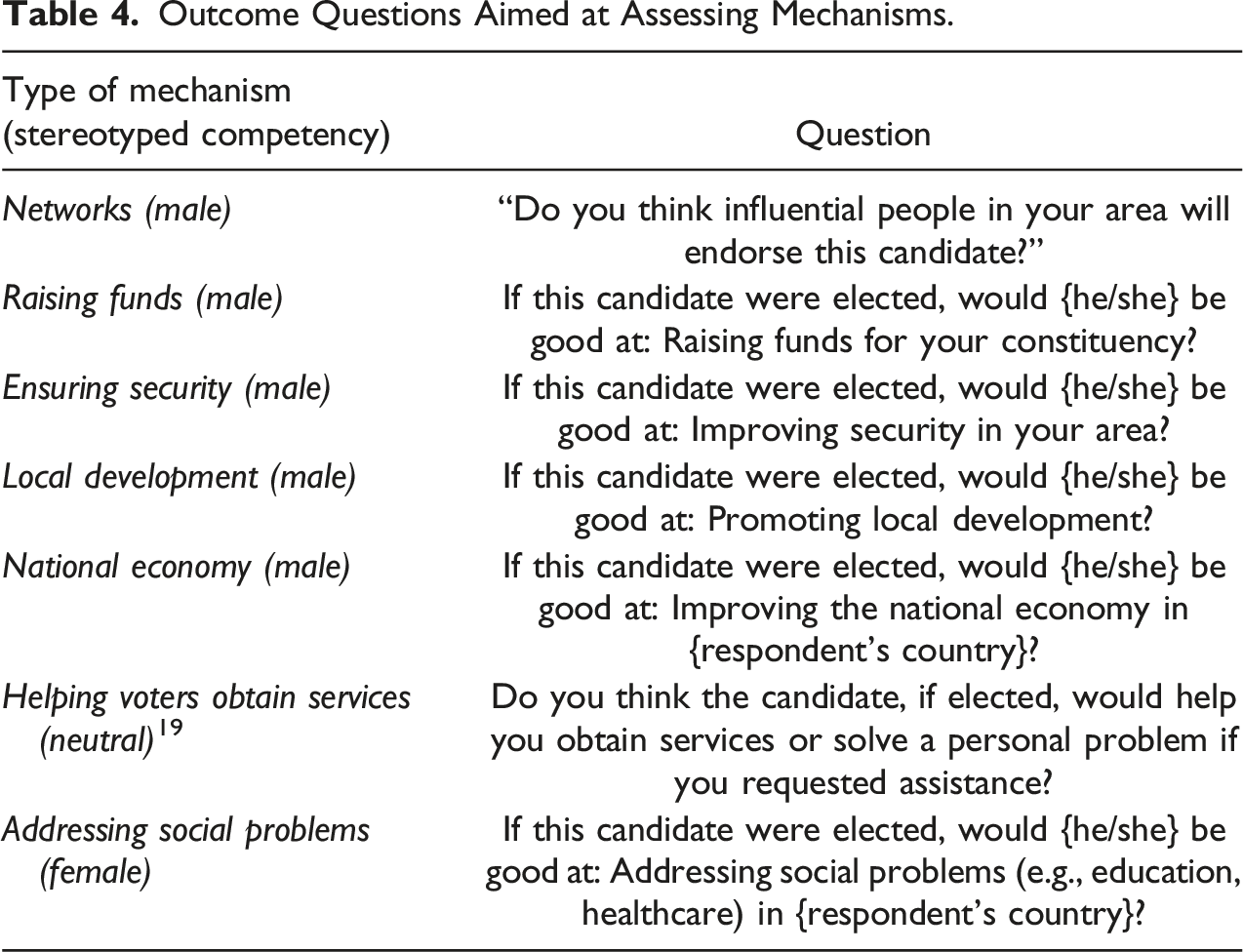
We concluded the survey with questions aimed at assessing the experiment’s validity. First, “How likely are you to see such a candidate in elections in {respondent’s country}?” We then asked respondents to recall the candidate’s gender 20 and whether the candidate had a background as a CSO, businessperson, or professor. For all questions, respondents were allowed to answer ‘don’t know’ or ‘refuse to answer.’ Finally, we asked an open-ended question inviting respondents to add any comments or reflections they wished to share regarding the survey; some respondents’ answers to this question directly related to views about candidate characteristics, including gender.
Analyses and Results
We discuss the analyses and results in three steps. First, we analyze the experiment, examining how a candidate’s gender affects citizens’ willingness to support the candidate. Second, we consider which factors explain support for female candidates. We explore how respondents view the relationship between candidate gender and their potential performance once in office. We then examine how hostile and benevolent sexism moderate the association between respondent characteristics and candidate support. We disaggregate analyses by respondent gender to determine the extent to which the association between benevolent and hostile sexism and support for male and female candidates differs. We also briefly explore how age, education, and religiosity are associated with views toward gender and electability. Throughout the text, we present results using conventional levels of significance for single hypothesis tests; however, given the large number of hypotheses analyzed, we implement multiple-comparison corrections to control familywise error rates (FWER) for multiple hypothesis tests, using both Bonferroni and Holm methods (see Appendix E, Table E1). 21
Does Candidate Gender Affect Support?
Following Hainmueller et al. (2014), we use OLS regression to estimate the average marginal component effect (AMCE) of candidate gender on respondents’ attitudes toward the candidate. 22 We estimate Model 1, combining all country samples. 23 We also run models separately by country for this and all subsequent analyses (see Appendix D for full results).
Model 1.
As summarized in Figure 3, we find that respondents generally appear more likely to support female versus male candidates.
24
The average rating of respondents’ willingness to vote for the candidate decreases by 1.34 points on the 10-point scale (p ≤ .001) for respondents presented with a male versus female candidate.
25
The average rating decreases another 0.294 points (p ≤ .01) if the male candidate was a businessperson versus one with a civil society background. However, respondents are more likely to show greater support for a male candidate from a party running on a platform of improving the nation’s economy than on local development and/or a male candidate described as successful (0.21, p ≤ .01, and 0.26, p ≤ .001, respectively). Average marginal component effects model with willingness to vote for the candidate and others willing to vote for the candidate as dependent variables.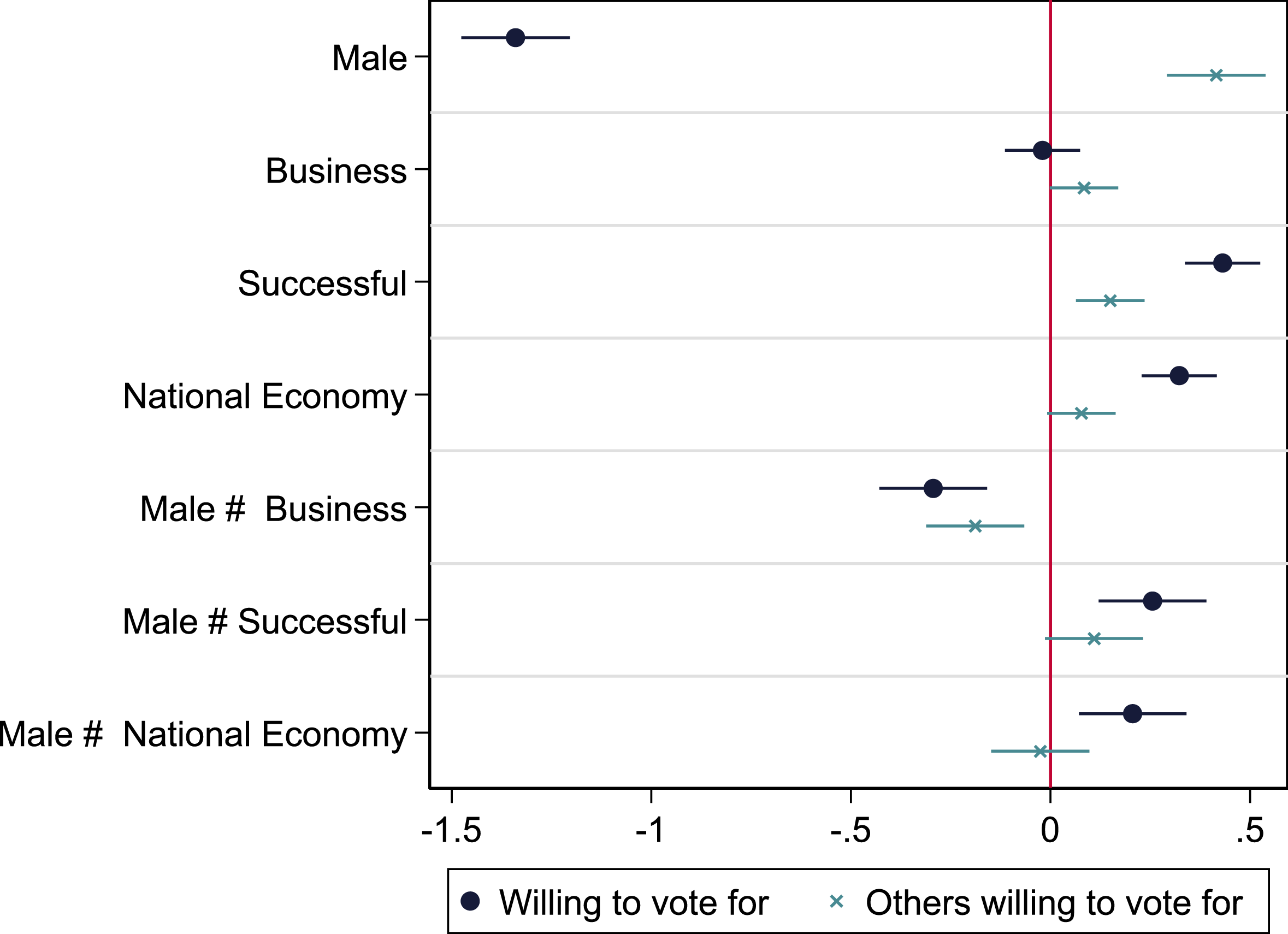
However, respondents presented a male candidate were more likely than those presented a female candidate to say they believed others would support the candidate. Those presented with a male candidate were, on average, 0.42 points (p ≤ .001) more likely to express a belief that others would vote for the candidate. The gender gap in expectations that others support the candidate decreases, on average, by 0.189 points (p ≤ .01) if the candidate was a male versus female businessperson. Both the interaction of gender and whether the candidate was described as successful, as well as the interaction of gender and party platform, are not significant. Notably, the magnitude of the effect of gender on the expectation others would vote for the candidate is also smaller than the effect of gender on the respondent’s stated willingness to support the candidate. As shown in Table D3 in Appendix D, results are not consistent across countries – it is not statistically significant in Jordan and Tunisia, slightly negative in Morocco (−0.280, p ≤ .05), and positive in Algeria, Egypt, and Libya (1.006, 0.94, and 1.35, respectively, all significant at the p ≤ .001 level).
Respondents presented with a male candidate are also more likely to believe influential people will support the candidate. Respondents who read about a male candidate are, on average, 0.73 points (p ≤ .001) more likely to think that influential people would support the candidate than those who read about a female candidate (see Appendix D, Table D4 for results of the full sample and by country).
Respondents are all, on average, more likely to state they would support a female versus male candidate, but men are less likely to do so than women. To explore the extent to which male and female respondents view candidate gender differently, we run a model including the experimental treatments, respondent gender, and the interaction of respondent gender and candidate gender. 26 Results from the pooled (with country-fixed effects) and individual country models show that, in all cases, men are significantly more likely than women to support a male candidate; however, importantly, they are still more likely to support a female candidate than a male one. The baseline general preference continues to lean towards female candidates, but for male respondents, the tendency is reduced to −0.785 points, calculated as the effect of the candidate being male (−1.799, p ≤ .001) plus the interaction effect of Candidate Gender and Respondent Gender (1.014, p ≤ .001). That is, across all countries, both men and women exhibit a bias in favor of the female candidate, but the bias is smaller for male respondents than female ones (see Appendix D, Table D5).
What Drives Support for Female Candidates?
Why do we find greater support for female versus male candidates, even when individuals believe other citizens are more likely to support male candidates? First, we consider the extent to which respondents’ expectations of a candidate’s competencies may differ from conventional wisdom and, consequently, explain support for female candidates. Second, we explore the association between sexist attitudes and differences in support for male versus female candidates. Given the differences in support from male and female respondents, we present results from male and female respondents separately.
Analyses of Model 1, using the outcome questions outlined in Table 4 as dependent variables, do not suggest expectations over any specific competencies explain the support for female candidates. We present the key results regarding the AMCEs of candidate gender, using each competency-dependent variable, in Figure 4. The results, run on a model with male and female respondents combined, show respondents presented a male candidate were, on average, less likely to believe the candidate would perform well if elected. Respondents who read a vignette about a male candidate were less likely to see them as good at raising funds (1.44 points, p ≤ .001), improving security (0.673 points, p ≤ .001), promoting local development (1.19 points, p ≤ .001), improving the national economy (1.41 points, p ≤ .001), solving social problems (2.045 points, p ≤ .001), and helping obtain services (1.80 points, p ≤ .001) (see Appendix D, Table D6.1). As shown in Figure 4, the results are stronger for female than male respondents. However, except for male respondents’ attitudes toward candidates’ abilities to provide security, respondents were all, on average, less likely to believe a male candidate would perform the task well. AMCEs of gender in analyses of model 1, with mechanisms from Table 4 as the dependent variables.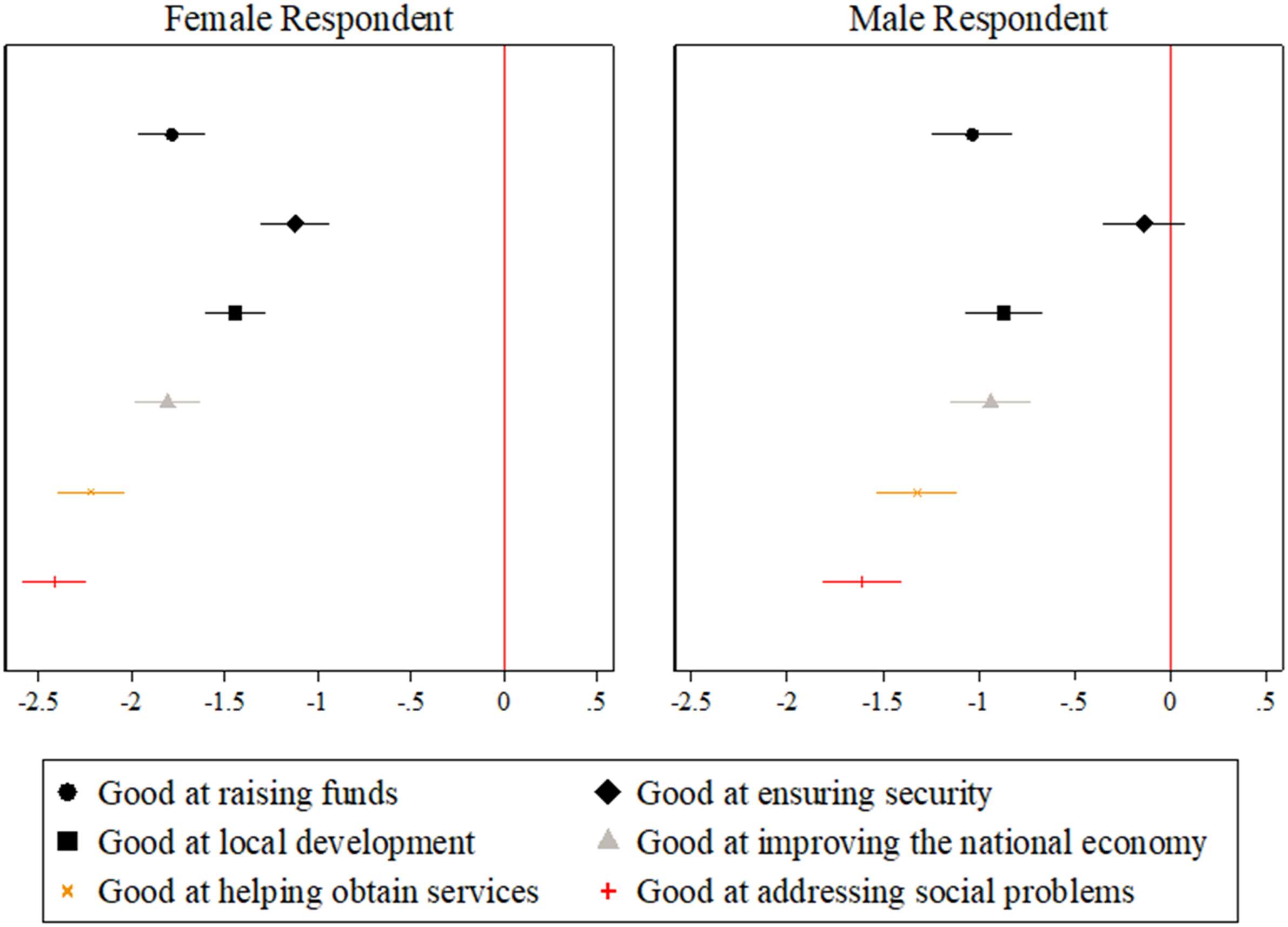
These results contrast with conventional wisdom and our expectations. We anticipated voters would see men as more capable of performing all activities apart from solving social problems and helping citizens access services. Yet, we find respondents were more likely to believe female candidates, if elected, would perform better than male candidates across all activities – including both male- and female-stereotyped competencies. The magnitude of the gap in expectations for male and female candidates’ future performance is smaller regarding male-stereotyped activities (e.g., raising funds, improving security, promoting development, and improving the national economy) than female-stereotyped ones (e.g., solving social problems or obtaining services), which suggests citizens see some competencies as stereotypically male and reward them for it, a finding consistent with Blackman and Jackson’s (2021) study of Tunisia. However, respondents generally have higher expectations of female politicians’ performances than male politicians’, contradicting conventional wisdom and existing research on Tunisia (Blackman & Jackson, 2021) and Qatar (Shockley, 2018).
Does a low prevalence of sexist attitudes explain why we find respondents are, on average, more likely to show support for female candidates? We examine direct questions that gauge respondents’ attitudes toward men’s and women’s capabilities. Before administering the experiment, we asked whether men or women are better able to head a business or CSO or if they are equally capable of doing so. About a third of respondents in Algeria, Egypt, Jordan, and Morocco say men were better equipped to run a business – in Libya, this is nearly half of respondents. Most of the remaining respondents in these countries, and the majority of those in Tunisia, feel men and women are equally capable of performing these activities. Individuals are more likely to see women as capable of heading a CSO, with about 15–25% of respondents in each country stating that women were superior to men in this area (see Appendix D, Tables D13.1-D13.4). We also find about 60% agree or strongly agree with the statement: “On the whole, men make better political leaders than women,” a measure of hostile sexism. Finally, we measure whether respondents hold benevolent sexist attitudes, asking, “How much do you agree with the statement below? Women, compared to men, tend to have a superior moral sensibility.” Nearly 75% of the sample agree or strongly agree with the statement (see Appendix D, Tables D14.1-D14.4 for full results).
We explore the role of sexism by analyzing models that include the benevolent and hostile sexism measures. We run two models; each includes all variables from Model 1 plus respondent gender, one of the sexism measures (i.e., hostile or benevolent sexism), and interactions of the sexism measure and all variables. This allows us to examine how candidate gender affects respondents with different views on our hostile and benevolent sexism measures.
We find that expressing sexist attitudes is related to support for female candidates and that the relationship varies by respondent gender. As shown in Figure 5, the likelihood of supporting a female versus male candidate is greater for respondents who express benevolent sexist attitudes. Further, the gap in the likelihood of expressing support for the female versus male candidate is greater for male than female respondents. Regarding stated willingness to vote for a female candidate, the predicted margin for female respondents who express benevolent sexist attitudes is 7.74 points, versus 7.60 points for female respondents who do not express such attitudes. In comparison, the predicted margin for male respondents expressing benevolent sexist attitudes is 6.87 points, versus 6.33 points for those not expressing such attitudes (see Appendix D, Tables D15-D16). Predicted stated support for male versus female candidates, given respondent gender and benevolent sexism.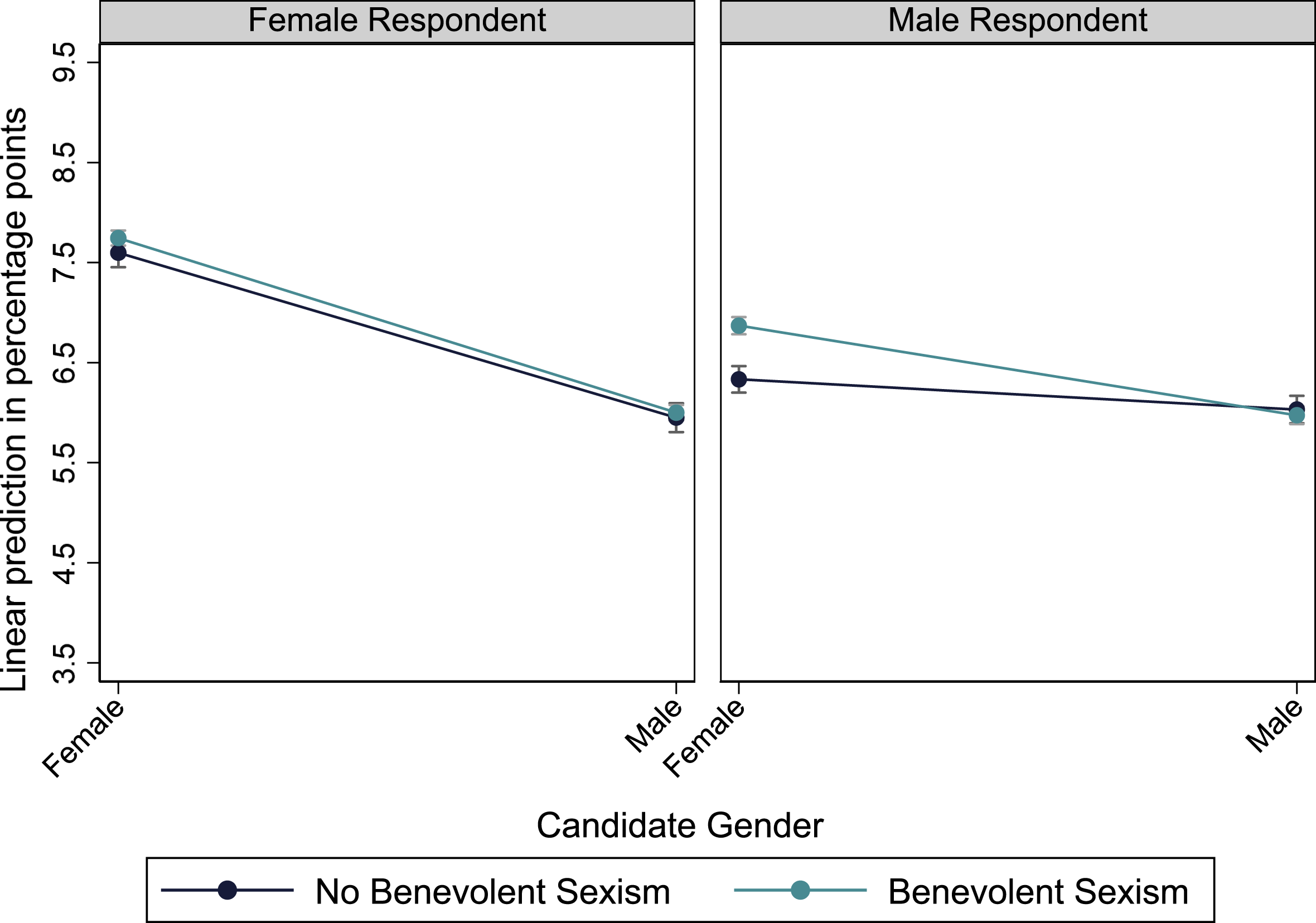
Respondents who express hostile sexism are significantly less likely than those who do not express such attitudes to state they would support a female candidate. The gap is again larger for male than female respondents. Considering willingness to vote for a female candidate, the predicted margin for female respondents who express hostile sexism is 7.05 points, versus 8.27 points for female respondents who do not express such attitudes. The predicted margin for male respondents who express hostile sexism is 6.19 points, versus 7.95 points for those who do not express such attitudes. Importantly, sexist attitudes do not appear to affect support for male candidates. As shown in Figure 6, even those respondents who expressed sexist attitudes stated they were less likely to support male candidates than female ones (see Appendix D, Tables D17-D18 for full results). Predicted stated support for male versus female candidates, given respondent gender and hostile sexism.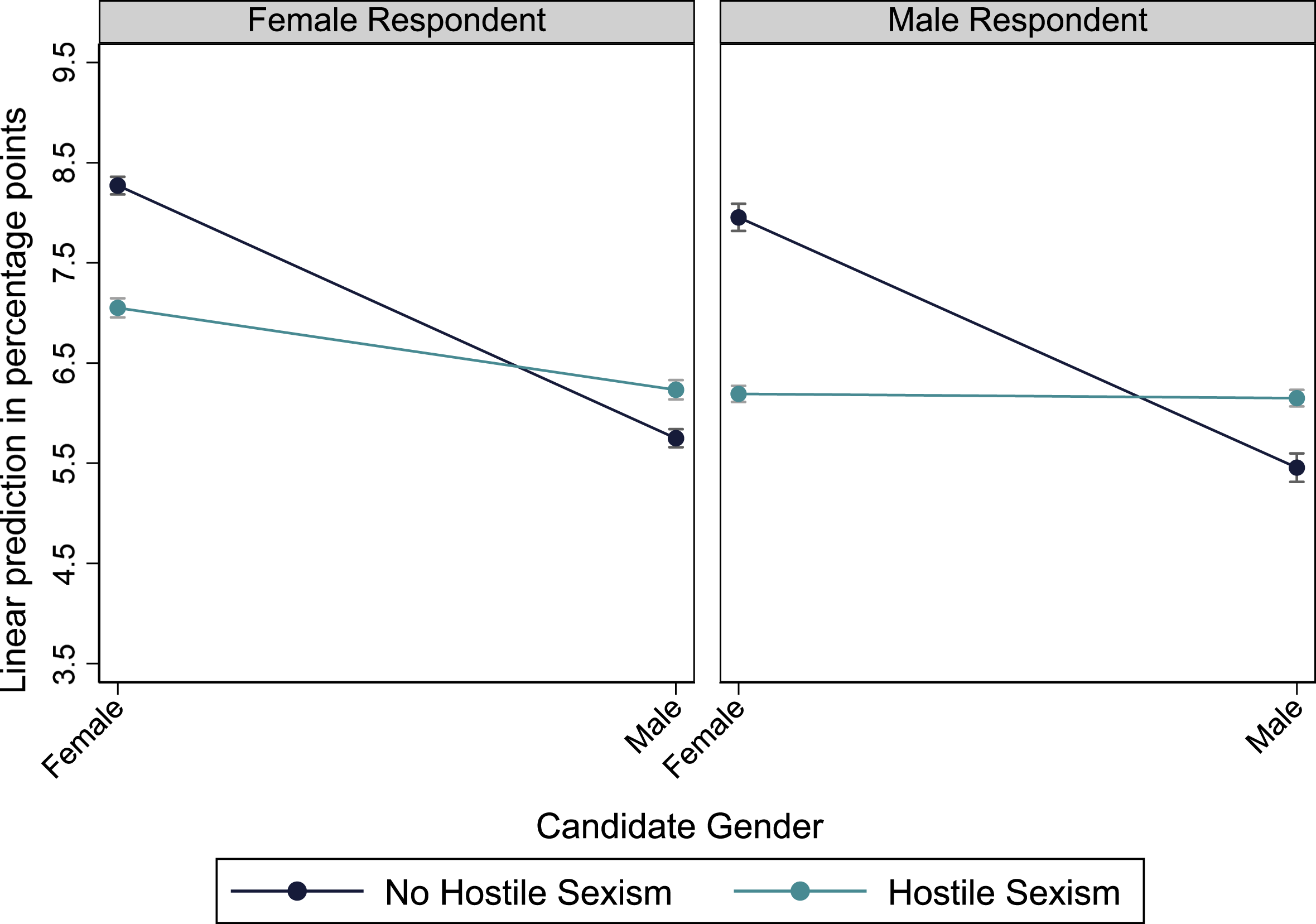
How Widespread is Support for Female Candidates?
Do different subsets of the population respond differently to male and female candidates, and might the high salience of female candidates among a subset of our respondents drive our results? As Abramson et al. (2022) show, the AMCEs in conjoint experiments can be influenced by a subset of individuals who strongly prefer candidates with a specific attribute – in our case, gender. One concern may be that a subset of countries drives the results. Another is that some demographic groups are more likely than others to express support for female leaders, potentially because they vary in the extent they embrace gender-based trait and competency stereotypes. We have already examined respondent gender, finding support for the well-established gender affinity effect (Benstead et al., 2015; Kao & Benstead, 2021; Sanbonmatsu, 2002; Schwarz & Coppock, 2022). However, we may expect that youth (Alexander & Welzel, 2011), the more highly educated, or more secular voters (Benstead et al., 2015) are more likely to express support for female candidates. Given our sample overrepresents educated youth, it is particularly important to explore how these demographic subgroups respond to male versus female candidates.
We first consider how attitudes towards female candidates differ across countries, and we do find cross-country variation in the extent of pro-female bias. The largest bias is found in Tunisia, followed by Morocco, and the smallest in Egypt (See Appendix D, Table D2). Interestingly, this aligns with the history of gender quotas and female representation in the sampled countries; Tunisia and Morocco have the longest sustained history of quota adoption and the highest percentage of female representatives in parliament. Nevertheless, pro-female bias is significant in all countries, suggesting no particular country sample drives the results.
We next examine whether respondents’ age, education level (on a four-level categorization), 27 and self-reported religiosity are associated with support for female candidates. To do so, we create Model 2, an extension of Model 1 that also includes these respondent characteristics as individual measures and their interactions with candidate gender. To explore potential intersectionalities, we also include all interactions between these characteristics (see Appendix D, Table D19). We do not find evidence that respondents’ education levels, either alone or in interaction with treatments of the various candidate attributes, are associated with their willingness to state they would support the candidate.
We find strong evidence, however, that religiosity is associated with stated support for candidates. Among both women and men, those who rate themselves as more religious are, on average, more likely to state support for the male candidate. However, there is no significant relationship between self-reported religiosity and support for female candidates (see Figure 7). These findings are interesting when compared to the results regarding gender, discussed above, where we find women are more inclined to support female candidates but equally likely to support male candidates. Taken together, the findings on gender and religiosity suggest different factors affect respondents’ willingness to support male and female candidates. Marginal Plots of Respondent Gender and Religiosity on Stated Willingness to Vote for the Male versus Female Candidate.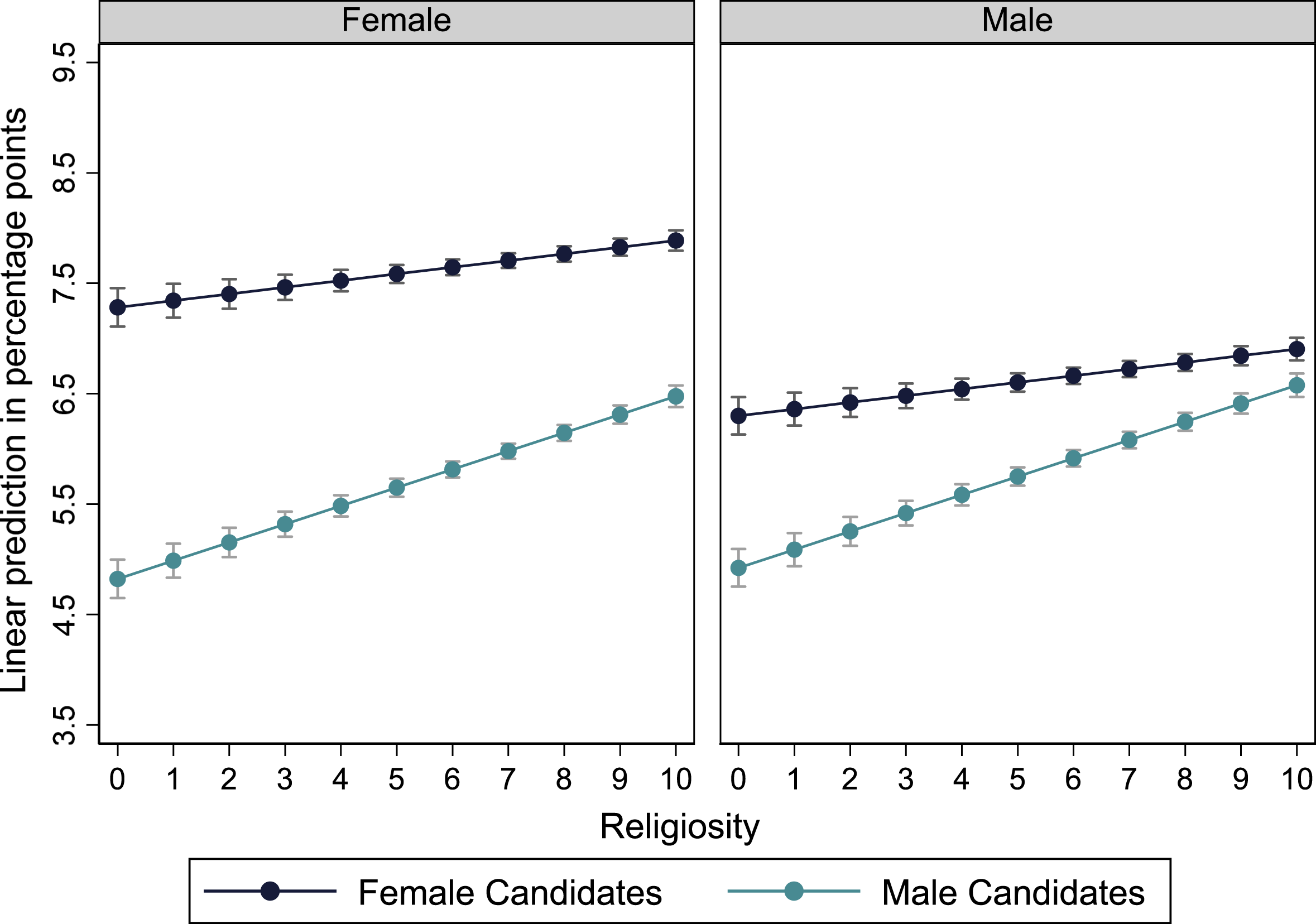
Finally, we consider whether age distinguishes how interviewees respond to male versus female candidates. Age is particularly important, given that both our sample and the populations in our countries of study are overwhelmingly young. Model 2 (see Appendix D, Table D19) shows that age is not significantly associated with support for male versus female candidates. However, could there be important interactions between age and religiosity or sexism that affect support for female candidates?
We do not find evidence that age and religiosity combine to explain support for female candidates. One might expect younger respondents to be less religious, in keeping with the global trend for older individuals to be more religious (Pew Research Center, 2018). However, recent Arab Barometer polls show increased religiosity in the MENA in recent years, particularly among younger citizens (Arab Barometer, 2023), and analyses exploring the relationship between age and religiosity in our data find a weak, negative correlation (−0.036, p ≤ .001). 28 Analyses of Model 1 plus candidate gender, religiosity, log of respondent age, and the triple interaction of candidate gender, religiosity, and the log of respondent age also do not yield statistically significant interaction term effects (see Appendix D, Table D21). More religious individuals appear more likely to support male candidates, but this does not appear to be age-driven.
We also do not find a significant relationship between age and hostile or benevolent sexism to explain support for female candidates. We uncover only a weak relationship between age and sexist attitudes. The Pearson Correlation coefficients between age and sexist attitudes suggest older respondents do not display significantly more sexist attitudes than younger ones in our sample. 29 Regression analyses of age, education, gender, and religiosity on sexism, with one model for hostile and one for benevolent sexism, find a small but significant negative relationship (−0.0221, p < .05) between age and hostile sexism and an insignificant relationship between age and benevolent sexism (see Appendix D, Tables D22 and D23). Finally, analysis of Model 3 – defined as Model 1 plus a log of respondent age, one measure of sexism (hostile or benevolent), and the triple interaction of candidate gender, sexism, and the log of age – finds the main effects for age and sexism and the interaction terms involving our variables of interest are not statistically significant (See Appendix D, Tables D24 and D25).
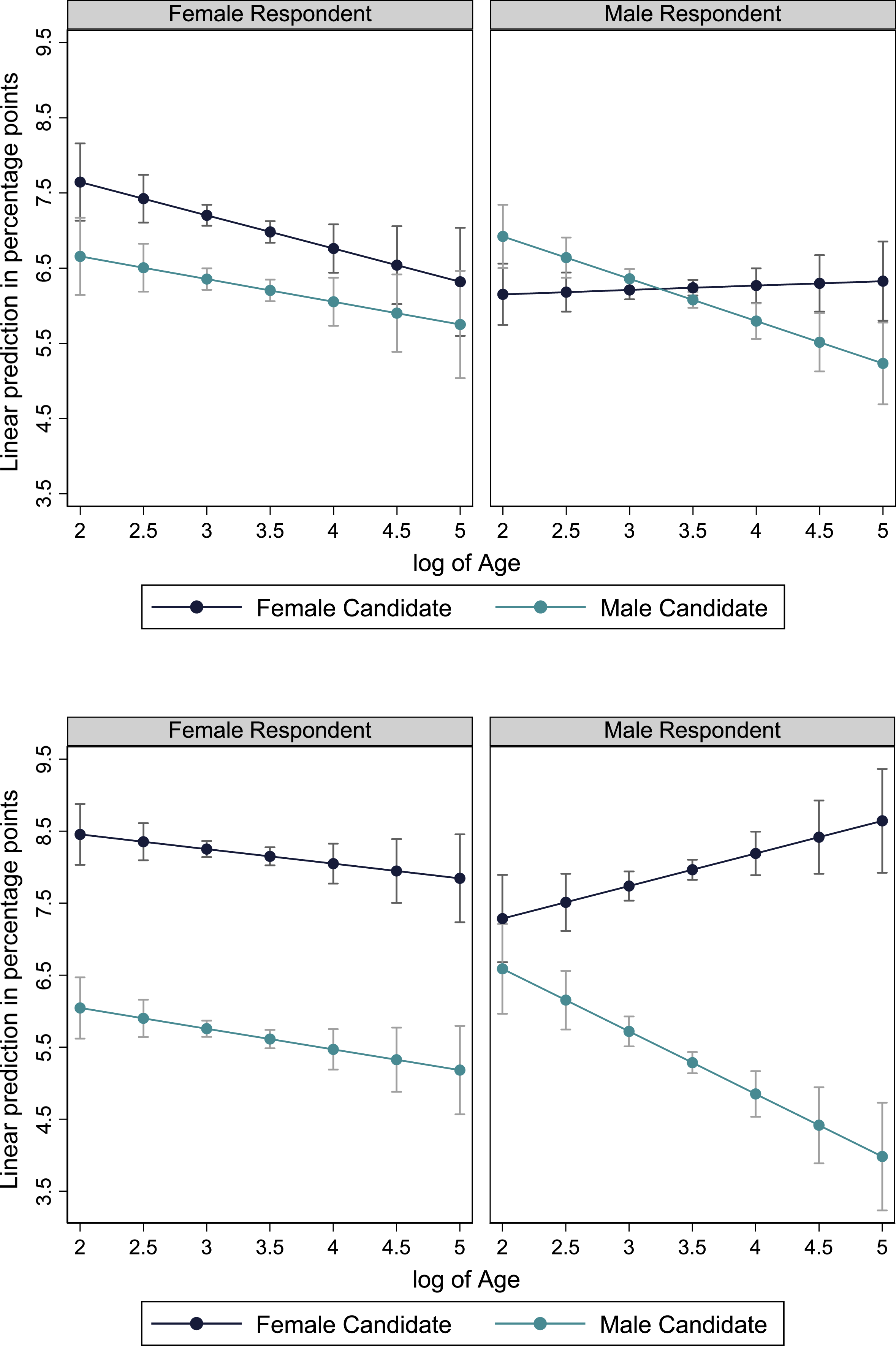
However, we do find interesting differences in how respondents of different ages react to candidate gender when respondent gender and sexism are included in the analyses. Women who express benevolent sexism are more likely to support female candidates regardless of age; meanwhile, the older men who hold benevolent sexist attitudes are, the more likely they are to support female candidates (see Figure 8). Interestingly, women who express hostile sexism are more likely to support female candidates regardless of age, while men who express hostile sexism are more likely to support female candidates the older they are. The results for those not holding hostile sexist attitudes are yet more striking. Males who do not express hostile sexist attitudes are even more likely to state support for female candidates the older they are, and significantly less likely to support male candidates. These results are far from suggesting support for female candidates is driven by women or youth; it is present among men and, if anything, fueled by older voters Figure 9. Marginal Plots of Respondent Gender and Age on Stated Willingness to Vote for Male versus Female Candidates, by Individuals Expressing Benevolent Sexism (upper panel) versus Not Expressing Benevolent Sexism (lower panel). Marginal Plots of Respondent Gender and Age on Stated Willingness to Vote for Male versus Female Candidates, by Individuals Expressing Hostile Sexism (upper panel) versus Not Expressing Hostile Sexism (lower panel).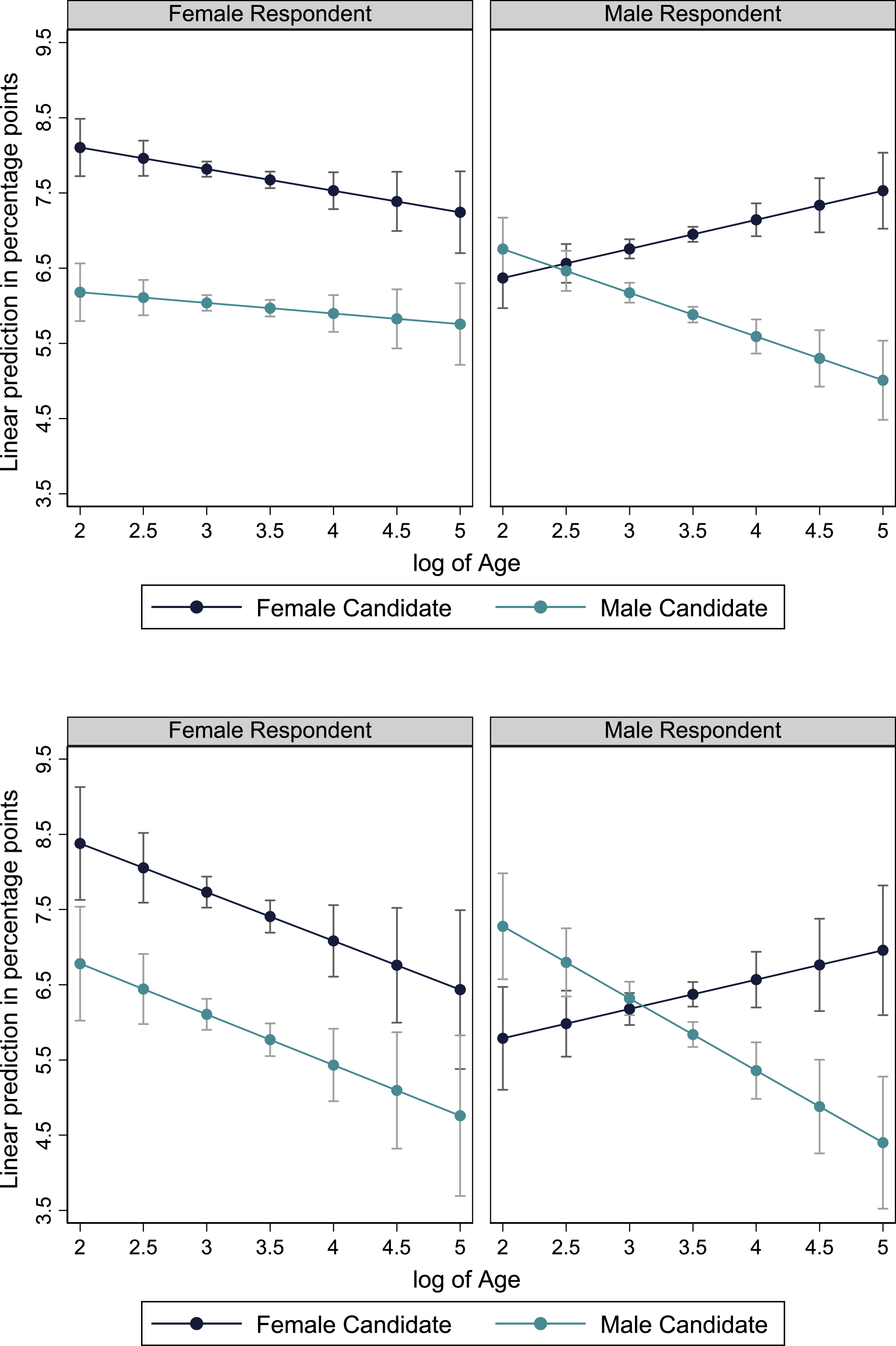
Discussion
The evidence that citizens support female candidates not only counters conventional wisdom but also sheds light on how changing attitudes toward leaders may narrow – and even reverse – the gender gap. One may have expected the gap between male and female candidates to narrow given changing attitudes toward gender and the demonstration effect of increasing numbers of women in leadership (Gray, 2003). However, our analyses show not just that the gender gap is narrowing but that respondents appear more willing to support female candidates than male ones. Furthermore, they seem to believe female candidates are more likely to succeed in different policy and service domains if elected, even those conventionally associated with male competencies. This prompts us to consider potential alternative explanations for these results and explore the theoretical implications of our study in more detail.
First, one might be concerned that responses reflect social desirability bias. Given the emphasis on gender and political representation in the past decades, individuals may be particularly reticent to express anti-feminist attitudes. Indeed, one might read the result that respondents say they support female candidates but their communities support male candidates as suggesting social desirability bias. We cannot rule out this explanation entirely, but we have good reason to believe social desirability bias does not fully drive our results. The experimental design helps mitigate social desirability bias, allowing respondents to obfuscate the reasons for their negative attitudes toward women in ways direct questions do not allow. We also expect that if social desirability drives individuals’ responses, they are unlikely to express sexism when answering direct questions. Yet, we find individuals are quite willing to state men would make better business leaders and, often, CSO leaders in response to direct questions. About 60% of respondents also agreed with the direct statement that men make better political leaders. We, therefore, do not find strong evidence that social desirability bias explains the results.
Another possibility is that respondents show greater support for women because they believe women must be of exceptional quality to run for office. There is some evidence of this. In follow-up comments, respondents noted women are well-equipped to perform in office but face higher barriers. This suggests they view those who run as being exceptionally qualified. The positive coefficient we find in the interaction between gender and the statements of the candidate’s professional success also points to this. As shown in Figure 3, respondents are 0.255 points (p ≤ .001) higher, on a 0–10-point scale, to state they would be willing to vote for male candidates described as successful over women described as successful (see Appendix D, Table D2). One explanation is that voters assume women are exceptional because they are running in the election, as barriers to women are high. In contrast, they make no such assumptions about male candidates.
The results point more strongly to how changes in attitudes about both female candidates’ capabilities and what makes a good leader are narrowing, and even reversing, the gender gap in electability. Female leadership has become more common in our case countries. Except for Algeria and Libya, the countries in our sample have legislated or reserved seat quotas for at least 20 years, resulting in some elections with the proportion of women in national or local legislatures exceeding thirty percent. When Model 1 is run with the dependent variable, “How likely would you be to see a candidate like this running in an election in your country?” respondents were overall no less likely to state that they would see female candidates than male candidates (see Appendix D, Table D20).
Citizens appear to increasingly accept, and even embrace, women’s engagement in political leadership. Since 2006, the Arab Barometer has registered a decline in agreement with the statement that men make better political leaders in every country other than Algeria, with the greatest pro-female shift in Tunisia (Roche, 2023). The World Values Survey has also seen a significant decrease in the percentage of respondents who agreed with the statement that men make better political leaders; from 2014 to 2021, the agreement percentage dropped 3 percentage points each in Egypt and Libya, 10 in Jordan, 18 in Tunisia, and 26 in Morocco. 30 Respondents commenting in our survey also recalled positive experiences with female politicians. Importantly, changes in attitudes toward gender roles do not appear across all dimensions; for example, the World Values Survey finds continued biases against women regarding employment in Tunisia and Egypt. 31 However, the reduction in anti-female bias seems particularly pronounced regarding electability, and the degree of change corresponds with countries’ sustained experience with quotas and female representation.
Changing gender stereotypes would explain a narrowing of the gender gap in electability, but not a reversal; thus, we expect changing leader roles to drive the emerging pro-female bias. Our experimental results are in line with other evidence that voters view women as outsiders (Clark & Clark, 2020), as respondents viewed male candidates as more likely to be endorsed by influential networks and supported by other voters (0.728 points, p ≤ .001 and .415 points, p ≤ .001, respectively). We also find evidence in the high degree of agreement with the statement that “Women, compared to men, tend to have a ‘superior moral sensibility’,” as discussed above. Moreover, comments in the final survey question provide qualitative evidence that respondents prefer women, at least in part, because they have lost faith in traditional parties and candidates. Many once viewed women’s status as outsiders or essentialized as less corrupt to be a barrier to their success, both in political life (Benstead et al., 2015; Blackman & Jackson, 2021) and in the media (Jones et al., 2021). In contrast, our results suggest outsider status may benefit women, particularly when citizens are frustrated by the corruption they associate with traditional (i.e., male) politicians.
Conclusion
Our study is the first to our knowledge to find that respondents in the MENA are, on average, more likely to state they would support female candidates and, more importantly, to point to how changes in notions of what makes a good leader (i.e., leader roles) may not just narrow, but even reverse the gender gap. The MENA region, often viewed as exceptionally patriarchal and resistant to social change, may be experiencing change, with current increases in anti-establishment and anti-corruption sentiments fueling citizens’ demands for political outsiders. Greater demands for outsiders may shift support toward female candidates, narrowing the gender gap even without changes in broader gender stereotypes.
The results differ in important ways from previous studies on gender and electability in the MENA. Existing research shows higher support for female candidates among women (cf. Benstead et al., 2015), yet we find that both male and female respondents, on average, are more likely to state greater support for female candidates. We also find citizens see females as competent across both stereotypically male and female areas of competence. Moreover, benevolent sexism is associated with higher confidence in or support for females, a finding in contrast to previous studies (Benstead & Lust, 2018; Jones et al., 2021).
Our findings provide important insights into how and why voters may accept and even prefer female candidates. Our study, combined with evidence from India (Beaman et al., 2009), suggests quotas and increasing women’s descriptive representation may help reduce gender bias, particularly in countries with lower gender inequality. Respondents in countries with sustained gender quotas and significant female representation (e.g., Tunisia and Morocco) expressed the strongest pro-female bias. Changing notions of leadership may also drive greater support for female candidates. Early studies suggested citizens equated leadership with men and male-stereotyped traits. More research needs to be done to confirm our conclusions, but evidence of consistently low support for male candidates and growing discontent over corrupt leaders suggests notions of the ideal leader may be changing. Seeing women as less corrupt, a form of benevolent sexism that once undermined women, may make female candidates increasingly appealing.
These findings have significant implications for the growing body of literature on female electability (Blackman & Jackson, 2021; Schwarz & Coppock, 2022) and changes in citizens’ attitudes toward gender equality (Alexander & Welzel, 2011; Shteiwi, 2015). Our study calls on scholars to expand the application of gender congruity theory in the MENA and worldwide by considering what citizens look for in leaders (i.e., leader roles). Changing perceptions of leader roles may reduce discrimination against female candidates, and even reverse it.
Of course, one might still question why we see a disjuncture between stated support for female candidates and their success at the polls. Clayton et al (2019) argue that citizens might support hypothetical female candidates, yet we still see low descriptive representation. Our study suggests strategic voting may play an important role. Respondents may see female candidates as more competent than male candidates but ultimately support a male because they believe influential people and other voters will do so (Bateson, 2020; Corbett et al., 2022; Sanbonmatsu, 2002). Female candidates thus often lack the resources to run, face party gatekeeping that keeps them off the ballot, or encounter sexist campaigning that affects their chances.
Our research points to several ways public policy and development programs may help level the playing field. If strategic discrimination helps explain low descriptive representation, then designing electoral systems to reduce the barriers to winning and providing voters information about individuals’ true preferences and the likelihood other citizens and influential elites will support women candidates may be critical to success (Corbett et al., 2022). Expanding civic engagement may also facilitate women’s success. Because our study used a web-based survey of individuals engaging with a civil society organization, our sample is drawn from a more female, educated, digitally literate population with high social capital. However, to the extent that this more highly engaged group may be more likely than the general population to welcome female leaders, the study suggests that governments’ and international organizations’ efforts to promote education, internet access, and civil society participation may have positive implications for female representation.
Of course, much work remains to better assess how and why attitudes toward female leaders may be changing. We believe our results on the impact of benevolent sexism on higher support for female candidates likely apply in other settings, but this must be tested. Our analyses of the impact of age and education suggest that female candidates are also supported by older, less educated, or less globally connected citizens than our sample provided. However, more research is needed to assess the extent to which the attitudes of older generations are shifting. Finally, our study should encourage researchers to learn more about the challenges other underrepresented groups (e.g., youth, minorities) face when seeking to serve as leaders. Our findings offer new evidence of societies in flux, but much remains to be learned about how and why citizens’ attitudes in the MENA – and elsewhere – are changing.
Supplemental Material
Supplemental Material - Is the Future Female? Lessons from a Conjoint Experiment on Voter Preferences in Six Arab Countries
Supplemental Material for Is the Future Female? Lessons from a Conjoint Experiment on Voter Preferences in Six Arab Countries
Footnotes
Declaration of Conflicting Interests
The author(s) declared no potential conflicts of interest with respect to the research, authorship, and/or publication of this article.
Funding
The author(s) disclosed receipt of the following financial support for the research, authorship, and/or publication of this article: This work was supported by the Vetenskapsradet (E0003801).

Data Availability Statement
Data sharing not applicable to this article as no datasets were generated or analyzed during the current study.
Supplemental Material
Supplemental material for this article is available online.
Notes
Author Biographies
References
Supplementary Material
Please find the following supplemental material available below.
For Open Access articles published under a Creative Commons License, all supplemental material carries the same license as the article it is associated with.
For non-Open Access articles published, all supplemental material carries a non-exclusive license, and permission requests for re-use of supplemental material or any part of supplemental material shall be sent directly to the copyright owner as specified in the copyright notice associated with the article.
