




Abstract
What explains ethnic minorities’ attachment to the state? Our current understanding has primarily considered structural factors, particularly access to political power and modernization. Diverging from existing explanations, I theorize that mundane experiences with the state, in street-level bureaucracy, can inform ethnic minorities’ attitudes toward the state. What they see and experience in street-level bureaucracy signals to ethnic minorities what their prospects might be in a country that is politically dominated by another ethnic group. Leveraging extensive fieldwork in Myanmar, I show that ethnic minorities who have had positive encounters with street-level bureaucrats express stronger attachment to the state. This is the case even when an ethnic group is in direct conflict with the state. I also find that service experiences are more relevant in explaining ethnic minorities’ attachment to the state compared to factors highlighted in existing research.
What explains ethnic minorities’ attachment to the state? 1 We expect ethnic minorities with collective rights (Kymlicka, 1995; Liu & Baird, 2012; McMurry, 2022), political representation (Elkins & Sides, 2007; Koter, 2019; Lijphart, 1969; Wimmer, 2017), or state-provided goods and services (Hechter, 2013; Wimmer, 2018) to have favorable views of the state. Yet there is a tremendous variation among ethnic minorities with the same socio-political characteristics. For example, according to existing survey data, 10% of Moros are “not proud” or “not proud at all” of being a citizen of the Philippines, but 64% are “very proud.” In a similar vein, 21% of Afrobrazilians are “not proud” or “not proud at all” of being a citizen of Brazil, but 52% are “very proud.” 2
Such within-group variation in ethnic minorities’ attitudes toward the state is no doubt a common phenomenon across the world in democracies and autocracies alike, as well as in developed and developing countries. For every ethnic minority who expresses positive attitudes toward their country of citizenship, we can imagine a coethnic who feels alienated from that same country. Given that coethnics are presumably treated with the same state policies and have the same level of political representation, what explains the varying attitudes toward the state among ethnic minorities?
It is important to study ethnic minorities’ attachment to the state because it can reveals their political loyalty to the state and the extent to which they affirm the state’s authority which have implications for a number of political outcomes. The literature on democracy argues that nationalism is a precondition for democratization and democratic processes (Dahl, 1989; Rustow, 1970). Recently, Hur (2022) shows that a sense of civic duty arises from national attachments. Scholars of political violence have also suggested that a feeling of alienation from the state can materialize into a motivation to organize armed rebellions, culminating in a violent rejection of the state (Gurr, 1970). Thus, it is no wonder that weak nationalism is commonly blamed for protracted civil wars, chronic political instability, and economic underdevelopment (Robinson, 2014).
To explain ethnic minorities’ attachment to the state, I propose a theory that focuses on ordinary citizens’ experiences with the state—specifically mundane interactions with the state, like getting a government-issued ID, a permit, or a vendor license, which requires the kinds of bureaucratic encounters we often overlook. I argue that ethnic minorities’ tangible experiences with the state inform their opinions of the state. What they see and experience in face-to-face encounters with agents of the state (i.e., street-level bureaucrats) signals to ethnic minorities what their prospects might be in a country that is politically dominated by another ethnic group. As such, ethnic minorities who have positive experiences with the state exhibit stronger attachment to the state. I evaluate this theory based on extensive fieldwork in Myanmar, including an original survey and a survey experiment.
While other settings are suitable for testing the aforementioned claim, subnational variation within Myanmar provides a unique opportunity to study minority-state relations. Myanmar is home to numerous ethnic groups among whom Bamar is the politically dominant ethnic group, accounting for nearly 70% of the country’s population. Myanmar is also home to a few well-known cases of protracted armed conflicts between ethnic rebels and the central government, but there are also “typical” cases of minority-state relations—i.e., ethnic minorities who experience discrimination but are not engaged in an armed conflict with the state. Situating this research in Myanmar allows me to examine whether positive experiences with the state can improve ethnic minorities’ attachment to the state in the typical as well as the most challenging cases of minority-state relations.
Using survey data collected in 2019, consisting of more than 800 respondents from 35 townships, I find that ethnic minorities who have had positive encounters with street-level bureaucrats report stronger attachment to the state. 3 These findings are consistent across four different measures of attachment to the state: national pride, national pride relative to ethnic pride, an index of survey items measuring positive affect for and identification with Myanmar, and a behavioral indicator. In addition to service experience, I also find that conflict status, being a religious majority, and support for the incumbent government as well as being male and urban residency are consistent correlates of attachment to the state. Religious majorities, those supportive of the incumbent government, and men reported a higher level of attachment to the state while urban residents reported a lower level of attachment to the state. Members of an ethnic group in direct conflict with the state are also less attached to the state; even among these disaffected minorities, their service experiences are positively correlated with their attachment to the state. Interestingly, findings regarding power-sharing, access to public goods, and modernization—factors emphasized in the literature as correlates of national pride and national identification—are mixed. Moreover, standardized coefficients indicate that service experience has a stronger predictive power compared to other correlates of attachment to the state. In fact, when the outcome examined is the index measure of attachment to the state, the standardized coefficient of service experience is twice as large as that of the next strongest predictor (being Buddhist).
Since the aforementioned findings are based on observational data, the direction of the effects is unclear. To evaluate whether ethnic minorities’ service experience informs their attachment to the state, I leverage a web-based survey experiment, fielded in 2022, in which participants were invited to imagine a positive or a negative service experience. Results indicate that those exposed to the positive treatment arm reported a higher national pride compared to those in the control group. However, I did not find that the negative treatment arm dampened attachment to the state.
Taking these analyses together, I conclude that ethnic minorities’ service experiences and their attachment to the state are positively and robustly correlated, but evidence of a casual relationship as hypothesized is suggestive. These findings are nonetheless valuable because they spotlight a previously overlooked factor—namely, service experiences in street-level bureaucracy— that is arguably more relevant in understanding ethnic minorities’ attachment to the state than factors highlighted in existing research.
This study makes theoretical and empirical contributions to the literature. First, the literature exploring national pride and related concepts have primarily focused on structural factors like power-sharing and modernization. Diverging from existing works, this study emphasizes bureaucratic interactions, specifically the interpersonal dimension. By focusing on such interactions, this study highlights the critical role of bureaucratic behavior as well as ethnic minorities’ tangible experiences with the state in shaping attachment to the state. This study also echoes the growing body of work that underscores the importance of interpersonal interactions in changing political attitudes, perceived state legitimacy, and other important political outcomes (Kalla & Broockman, 2020; Karim, 2020).
This study also contributes to the literature on bureaucracy by highlighting citizen-state encounters in comparative contexts. The comparative literature on bureaucracy tends to focus on the ways in which bureaucracy is politicized (Brierley et al., 2023) or factors affecting bureaucratic behavior (see Brierley, 2020, 2021; Gulzar & Pasquale, 2017). There has been very little attention on interactions between bureaucrats and citizens. While the American literature on bureaucracy does examine citizen-state encounters, the focus tends to be on interactions in the criminal justice system or with public assistance programs (see Barnes et al., 2023; Soss & Weaver, 2017). This study turns to the more mundane face of street-level bureaucracy which is also the primary interface between citizens and the state in much of the developing countries, and thus, expands our understanding of citizen-state encounters beyond interactions in welfare offices and policing in advanced democracies like the United States. By focusing on these mundane encounters, this study advances a theoretical perspective that citizens’ experiences with the state can be positive, and when citizen-state encounters are positive, they can facilitate favorable attitudes toward the state.
On the empirical front, this study surveys a population that had not been previously surveyed which includes inhabitants of highland Southeast Asia—an area Scott (2009, p. ix) argues “is the largest remaining region of the world whose people have not yet been fully incorporated into nation-states.” Moreover, this study examines attachment to the state based on a sample representative at the group level. This approach is rare and much needed in the survey-based research of national pride and related concepts, because existing works are almost exclusively based on survey samples representative at the country level, raising questions about whether the findings are driven by ethnic majorities. 4
The Imperative of Studying Citizen-State Encounters
Why turn to citizen-state encounters to explain ethnic minorities’ attachment to the state? The importance of understanding citizen-state encounters was first recognized 90 years ago and gained traction in the 1980s (Bartels, 2013; Finer, 1931). According to Lipsky (1980, p. 4), “street-level bureaucrats have considerable impact on peoples’ lives...They socialize citizens to expectations of government services and a place in the political community...Thus, in a sense street-level bureaucrats implicitly mediate aspects of the constitutional relationship of citizens to the state.” Although scholars have long recognized the imperative of examining citizen-state encounters, this phenomenon remains understudied in political science (Pepinsky et al., 2017; Soss & Weaver, 2017), and in particular, in the context of developing countries (Bertelli et al., 2020; Peeters & Campos, 2022).
Much of what we know about citizen-state encounters comes from the literature based in the American context. This scholarship primarily studies bureaucrats in the central government (i.e., those who do not directly interact with ordinary citizens) as opposed to those at the local level (Brierley et al., 2023). The scholarship that does study citizen-state encounters tend to focus on interactions with the criminal justice system (e.g., police encounters) and in welfare offices (see Michener, 2018; Soss & Weaver, 2017) which have been largely negative, coercive, predatory, and stigmatized—though Barnes et al. (2023) recently found that interactions with some public assistance programs have been neutral or positive. These citizen-state encounters are a “primary site of civic education” (Weaver & Lerman, 2010) and they thus have profound implications for democratic life (White, 2022). Michener (2018) for example shows that Medicaid enrollment is negatively correlated with political participation. Likewise, Weaver and Lerman (2010) find that encounters with the criminal justice system reduces likelihood of turning out in an election. While these interactions may constitute the bulk of citizen-state encounters in the United States and other similar contexts, street-level bureaucracy associated with the more mundane administrative services, like applying for permits and identification documents, are the primary interface between citizens and the state in developing countries. And this type of encounters has been largely overlooked in existing research on street-level bureaucracy.
The comparative literature on bureaucracy looks at local agencies beyond policing and welfare offices but tends to focus on how bureaucrats are selected, retained, and promoted, or how they are monitored (Brierley et al., 2023). These patterns are then linked to a performance outcome, including corruption, policy implementation, electoral politics, and service accessibility (Brierley, 2020; Gulzar & Pasquale, 2017; Slough, 2022; Toral, 2022). Face-to-face citizen-state encounters, though prevalent in comparative contexts, are rarely examined in this line of work. Recently, there is a growing body of work that probes face-to-face interactions between citizens and state agents (see Haim et al., 2021, 2023; Karim, 2020); they, however, primarily focus on policing.
Studying mundane interactions and their implications is important because of the increasing prevalence of these encounters. In the past few decades, scholars have documented a proliferation of sub-national administrative units across Southeast Asian (see Malesky, 2009; Pierskalla, 2016; Toha, 2021) and African countries (see Grossman & Lewis, 2014; Hassan, 2016; Lewis, 2014). This process has effectively brought the government and its services closer to ordinary citizens. Additionally, there is an attempt to streamline front-line service delivery, making street-level bureaucracy more accessible. For example, one-stop shops (OSS), which are consolidated local government agency offices, have become a major theme in the global development agenda and are supported by various international organizations including the United Nations Development Programme and the World Bank (Aziza et al., 2017). In Vietnam, OSS were first established in 1995, and by 2017, there were almost 13,000 OSS covering 98% of the country (Blunt et al., 2017). These offices conduct civil status registration, land administration, business licensing, construction permits, tax collection, and other basic administrative services. Such consolidated offices providing similar kinds of services were established in Myanmar in 2015 (UNDP, 2015). By 2019, OSS had been established in over 70 district-level capitals across Myanmar.
These trends underscore the extent to which everyday encounters with the state are becoming the norm, thereby making interactions in street-level bureaucracy citizens’ main experiences with the state. In the next section, I propose a theory that emphasizes this important phenomenon in answering an enduring question in our discipline regarding minority-state relations.
Explaining Ethnic Minorities’ Attachment to the State
Following Elkins and Sides, I perceive attachment to the state as “self-categorization as a member of that state and a positive affect for the state” (Elkins & Sides, 2007, p. 696). Conventional wisdom regarding minorities’ attachment to the state has primarily focused on power-sharing institutions (Lijphart, 1969; Nordlinger, 1972). Collective political representation is expected to offer material advantages such as access to government jobs and services as well as facilitate a sense of empowerment and symbolic ownership of the state, thereby incentivizing minorities to identify with the state.
However, existing works show mixed results. Elkins and Sides (2007) find that neither federalism nor proportional representation is consistently associated with increased attachment to the state among minorities. At the same time, Wimmer (2017) finds that members of ethnic groups included in the executive branch have more positive affect for the state, in the form of national pride. Similarly, Koter (2019) finds that citizens’ identification with the state increases when the president is their coethnic. However, Green (2020) finds that being in power does not appear to increase national identification of the members of the non-core ethnic groups.
Contemporary studies in this line of work have also extended classic literature on nationalism which emphasizes implications of modernization and collective experiences for national identity formation. The relationship between modernization and national identification appears to vary by the aspect of modernization scholars focus on. For instance, while Robinson (2014) finds that urbanization and formal education strengthen national identification, Choi et al. (2021) show that access to mobile internet reduces national identification. Relatedly, Depetris-Chauvin et al. (2020) show that collective experiences like national football teams’ victories can dampen ethnic identification (in relations to national identification).
I shift the focus from the aforementioned macro-level socio-political phenomena to an aspect of the state that is arguably most tangible to ordinary citizens, and thus, more relevant in explaining ethnic minorities’ individual-level attachment to the state: their service experiences in street-level bureaucracy.
The starting point for my theory is the concept of alien rule. According to Hechter (2009, p. 290) “alien rule exists whenever one or more culturally distinct groups are governed by individuals of a different cultural group.” Since the emergence of the norm of national self-determination, people prefer to be ruled by members of their own group and are generally hostile toward alien rule (Gellner, 1983; Hechter, 2013). This hostility is linked to the suspicion that the alien ruler—that is, the state dominated by an ethnic other—might be detrimental for one’s prospects, including the pursuit of wealth, security, power, and other interests. The alien ruler is thus “perceived as...potentially dangerous until their behavior suggests otherwise” (Hechter, 2013, p. 8). In other words, for those living under alien rule (i.e., members of politically nondominant ethnic groups), suspicion of the state can subside only when they have new and positive information about the state.
I argue that given ethnic minorities’ suspicion of the state, they are motivated to gather information about the state’s intentions toward them, and information gathering primarily occurs in street-level bureaucracy—local government offices where ordinary citizens submit applications for household registration documents, national registration cards, business licenses, and so on. That is because given that the state by default has a monopoly over basic services provided by street-level bureaucracy, ordinary citizens recognize street-level bureaucracy as a local manifestation of the state and street-level bureaucrats as representatives of the state.
What about these encounters matters for ethnic minorities’ attachment to the state? It is important to note that encounters in street-level bureaucracy are different from other types of state encounters (i.e., meeting or writing to representatives) in two aspects: how direct and personal the interactions are, and how frequently they occur (Lipsky, 1980). These encounters are personal not only because the information revealed is personal but also because they are conveyed face-to-face. In this setting, the state agents observe their clients’ discomfort, urgency, and/or despair while the clients observe affirmation, empathy, and/or judgment from their agents. As such, the interpersonal dimension of the interaction matters for people at the receiving end when evaluating their experiences (Bies, 2001; Tyler & Bies, 2015).
Everyday encounters with the state are primarily about how public goods and services are delivered rather than whether they are delivered. To conceptually disentangle service experiences from service outcomes, consider the following works, which compare tone and quality of responses constituents receive from public officials. Examining correspondence between service seekers and service providers in an American setting, scholars find that public housing officials respond to email requests from black and white service seekers at an equal rate but with substantial differences in tone (Einstein & Glick, 2017). Indeed, several works have noted the distinction between response rate and tone (see Giulietti et al., 2019; Hemker & Rink, 2017). Similar to citizen-state encounters examined in these works, in face-to-face interactions, the same service can be delivered to different clients in various manners and tone.
How bureaucrats perform their duties may be shaped by a number of factors. The literature on comparative bureaucracy indicates that recruitment, posting and promotion of bureaucrats are linked to electoral politics and politicians’ ambitions (Brierley 2020, 2021; Hassan, 2020), and the politicians’ needs and ambitions often shape bureaucratic incentives, thereby informing bureaucratic behavior. This means, bureaucrats may be incentivized to discriminate or privilege certain ethnic groups. Context specific factors like bureaucrat’s social connections and/or identity proximity to the service seekers, or service seekers personal connections to high-ranking officials, are also likely to shape their service delivery. For instance, bureaucrats’ demeanor, tone and duration of time they spend on a case may change when service seekers are their family members, friends, neighbors, coethnics, or co-religionists (Dubois, 2010). Beyond social connections and identity, service seekers’ behavior might also elicit a certain type of response from the bureaucrats. 5 As noted already, citizen-state encounters occur on a routine basis, and individuals come to street-level bureaucracy with memories of past experiences which likely inform their strategies on how to approach bureaucrats.
For service seekers, some experiences are more positive than others in that the bureaucrats are more attentive and make them feel taken care of. Such experiences also include instances when bureaucrats go the extra mile for service seekers, spend more time with the client, and sympathize with the client in the case of an unfavorable outcome. Bureaucrats might also provide service seekers with “privileged information,” enabling them to navigate the system better than others (Lipsky, 1980, p. 90). Positive experiences, I argue, ease ethnic minorities’ apprehension about the alien rule while negative experiences affirm their existing suspicion of the state.
An important first step in establishing the viability of the proposed theory should show that ethnic minorities with positive experiences in street-level bureaucracy exhibit a stronger attachment to the state compared to other ethnic minorities. In the sections that follow, I evaluate this observable implication using data from Myanmar.
Empirical Setting: Encountering the Myanmar State
Everyday encounters with the state in Myanmar occur within the context of the country’s public administration system. There are four tiers of administrative units below the national government. The country consists of seven “regions,” seven “states,” and the Union Territory; ethnic majorities are the dominant population in the regions, and each state is associated with a specific ethnic minority group. Each of these 15 subnational units are divided into districts, which are further divided into townships. The townships are divided into wards (urban) and village tracts (rural). The lowest tier at which most government departments and agencies operate is the township level (Saw & Arnold, 2014). Only the General Administration Department (GAD), which is the backbone of public administration in Myanmar, operates at the ward and village tract, or the locality, level. Given that the OSS offices also operate at the township level, the bulk of citizen-state encounters in Myanmar occur at this level of administrative units.
The qualitative interviews I conducted indicate that the people of Myanmar rarely make a distinction between different levels of government. When talking about what they think the state is, respondents resorted to describing restrictions they have experienced due to state authority. The state is primarily perceived as authority in a general sense. This is perhaps because Myanmar has been a unitary state for the last six decades with all authority emanating from the central government; the subnational governments were established just a decade ago in 2010. Furthermore, all township-level government agency offices, except the municipal office, are extensions of the central government’s ministries (Arnold et al., 2015). For instance, the office at which local residents register their household member list is the township office of the central government’s Ministry of Labour, Immigration and Population (LIP). Issues not resolved in this office may be passed up to the district level, then the regional level, and finally the national level office of this ministry. Thus, ordinary citizens in Myanmar are keenly aware that the township-level government offices are the local manifestation of the state.
The primary services that Myanmar’s street-level bureaucracy provides relate to the state’s legibility project—that is, making the state’s population and territory more governable through simplification, rationalization, and standardization (Scott, 1998). Some of the most sought-after services are application for a government-issued ID, request for reference letters, various kinds of registration, and permit or license applications. In other words, the motivation for visiting street-level bureaucracy is to obtain services over which the state has a monopoly. Abstaining from these services can result in travel restriction, losing property ownership, and much more.
There are three noteworthy features of bureaucratic encounters in Myanmar. First, nearly all citizen-state encounters occur face-to-face, because it is not yet possible to obtain information about bureaucratic services and procedures (e.g., documents and fees associated with a permit application) via telephone or online. As such, a large portion of service provision by street-level bureaucrats entails information provision.
Second, obtaining an official document requires several office visits and documents from various offices. For example, to apply for a small business or vendor license, required for opening a restaurant or a small house-front stall, one would need to bring reference letters from the Health Department, the Fire Department, and the ward/village tract General Administration office along with the license application to the municipal office. 6 Thus, individuals would have to collect these documents from relevant government offices, each of which may require several visits.
Given the iterative nature of obtaining an official document, the ultimate outcome one strives for (e.g., a vendor license) is different from “services” one seeks in each office visit. The latter is more mundane and achievable than the former. Consider the example introduced above. The first time an individual visits the municipal office may be to obtain information about documents necessary to apply for a vendor license. After collecting all the required documents, the service seeker would return to the municipal office with the aim of having their application be accepted for processing. As such, local residents often obtain the specific service they seek, though how the services are delivered to them vary from time to time and from person to person.
Third, some service seekers use brokers to help navigate the bureaucratic process, especially if they are unfamiliar with the office they need to visit. 7 Employing a broker, however, does not exempt service seekers from interacting with street-level bureaucrats. As mentioned already, obtaining official documents is an iterative process; and the brokers can stand in for the service seeker only in certain steps. For instance, the service seeker must show up for finger-printing or to sign a document.
Study 1: A Survey from Myanmar’s Reform Period
To evaluate whether ethnic minorities who have more positive encounters with the state hold stronger attachment to the state compared to other ethnic minorities, I constructed an original dataset based on a household survey from Myanmar, focusing on two minority groups. While the case coverage is narrow, this approach ensures that the results are not driven by sample skewness. Additionally, existing surveys from Myanmar have been enumerated primarily by members of the politically dominant group. 8 In contrast, the survey data I collected were enumerated by ethnic minorities. Given that face-to-face interviews themselves are social interaction and can result in interviewer effects (Adida et al., 2016), this approach is intended to level response bias stemming from interviewers’ ethnicity as well as to increase ethnic minority respondents’ comfort level. Bias can also arise if respondents think that the survey is sponsored by the government or political actors (Lupu & Michelitch, 2018), and in Myanmar, respondents can also be wary of certain local NGOs. To mitigate these concerns, the enumerators were trained to emphasize that the survey was sponsored and supervised by a graduate student.
Chin and Kachin ethnic minority groups were selected for this study because they are the two most similar groups with different conflict legacies. Chin has a relatively peaceful relationship with the central government compared to other ethnic groups, 9 and Kachin has a long legacy of armed conflict that is still on-going. 10 Selecting these two groups controls for several macro-level factors. Chin and Kachin are predominantly Christian and thus experience the most similar nation-building policies. Furthermore, at the time of survey implementation, both groups had a similar level of presence in the national government. Focusing on these two groups not only allowed for construction of a sample representative at the group level but also accounts for several structural explanations for minority-state relations. Furthermore, focusing on Chin and Kachin can also shed light on whether service experiences can have ameliorating effects on minority-state relations in conflict-affected societies.
The survey interviews were conducted in five local languages: Burmese (the official language), Jinghpaw, Falam, Hakha, and Tedim. The translations were prepared in advance so that the enumerators were not translating on the spot. All the enumerators were bilingual, fluent in their own ethnic language and Burmese. To ensure that ethnicity of the interviewers matched most respondents in the sample, only the Kachin enumerators conducted interviews in the Kachin townships and the Chin enumerators in the Chin townships.
The survey was implemented from February to November in 2019, which was a particularly optimistic year. There was a peaceful transfer of power to the main pro-democracy party in the country in 2015, and so, Myanmar was at the height of democratic transition when the survey was implemented. This milieu in the country contributed to the interest and openness with which respondents participated in the study.
The sample I work with consists of 822 respondents from 35 townships, twelve of which are hard to reach townships. The sample is 21% Bamar, 32% Chin, and 34% Kachin; the remaining 13% are other ethnic minorities. 11
Key Variables
Following many existing works that examine similar concepts (e.g., Elkins & Sides, 2007; Wimmer, 2017), attachment to the state is operationalized as pride in one’s citizenship: “How proud are you to be a citizen of Myanmar?” The variable national pride is coded on a four-point scale with zero corresponding to “not proud at all” and 3 to “very proud.” As Figure 1 shows, well over half of the sample reported to be “somewhat proud.”
12
It is possible the respondents’ reported national pride is reflective of their general disposition more so than their positive affect for the state. To mitigate this concern, I also calculated relative national pride, which is national pride minus ethnic pride (“How proud are you to be [ethnicity]?” measured on a four-point scale). As Figure 1 shows, a little over half of ethnic minorities in the sample reported similar levels of pride in their national and ethnic identities, but only 8% reported higher national pride while about 40% reported higher ethnic pride. Ethnic minorities’ national pride in Myanmar.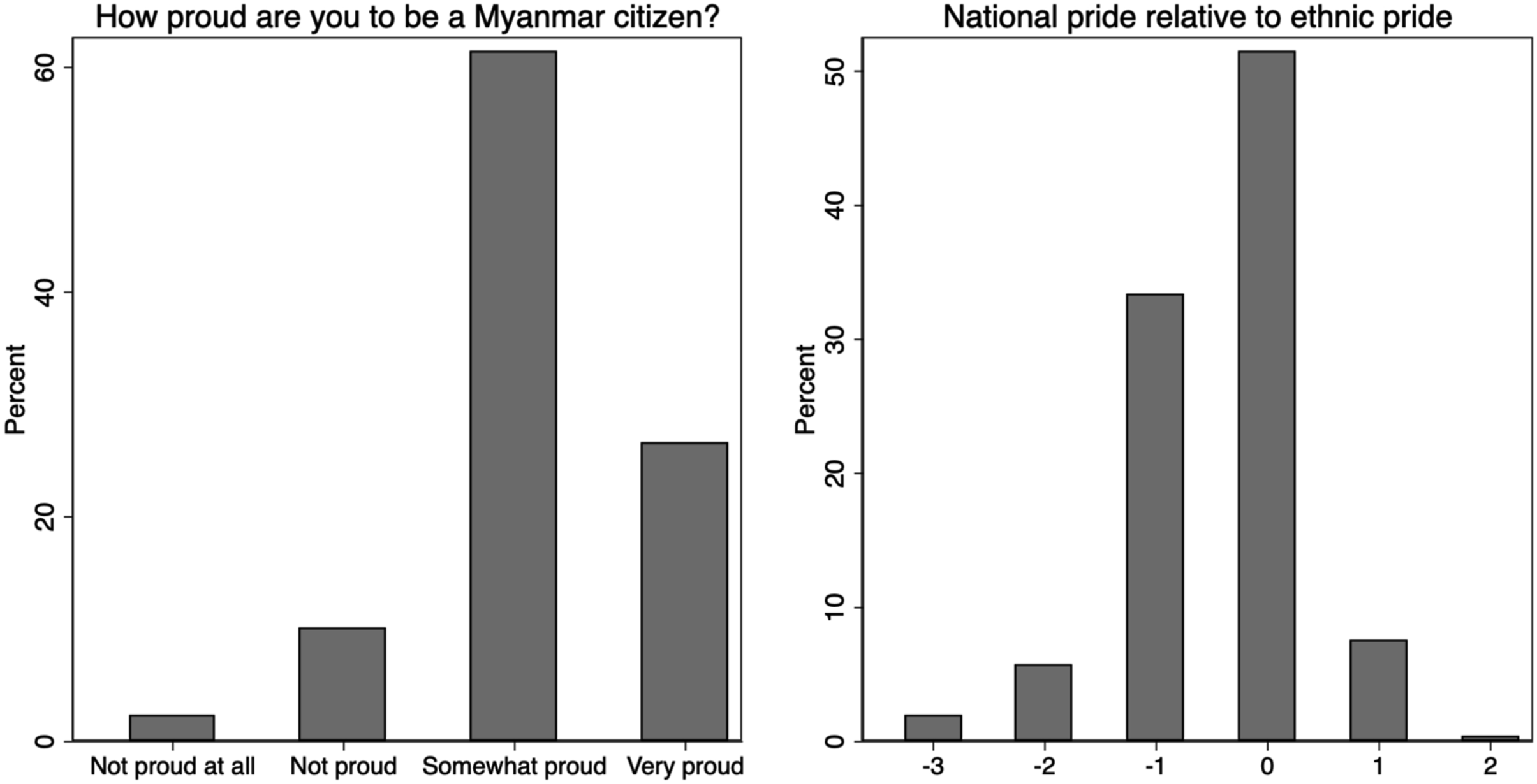
It is, however, ambiguous what pride actually measures, because respondents associate different aspects of national identity and citizenship when responding to the pride question Meitinger (2018). To mitigate limitations of reliance on the pride measure, I also operationalized it as an index of responses to several survey questions. These questions asked the extent to which respondents agree or disagree with the following statements: “I would support Myanmar even if it is in the wrong,” and “I would rather be a citizen of Myanmar than any other country in the world” (measured on a 0–3 scale). The variable attachment is an average of responses to these statements and the pride rating. 13
Attachment to the state was also assessed as a behavioral indicator, because the extent to which survey responses reveal respondents’ preferences can be compromised by a number of factors including social desirability bias, interviewer effects, and translation equivalence across languages (Pérez, 2009). A behavioral indicator offers an alternative measurement that might overcome some of the limitations of survey response validity. At the end of survey interviews, the respondents presented with two pens and asked to choose one. The pens were the same in all aspects except for the phrases written on them: “Thank you” with a smiley face on either side and “I  Myanmar” with the country’s flag on either side. To ensure that the respondents understood the phrases on each pen and were not selecting a pen at random, enumerators read a script with a translation of the phrases on each pen (full script in Appendix A.2). Choosing the second type is interpreted as an indication of a positive attitude toward Myanmar. The behavioral indicator is coded as 1 if the “I Myanmar” pen was chosen and zero if the other pen was chosen. These alternative measures of attachment to the state are moderately to highly correlated with national pride (see Table A1).
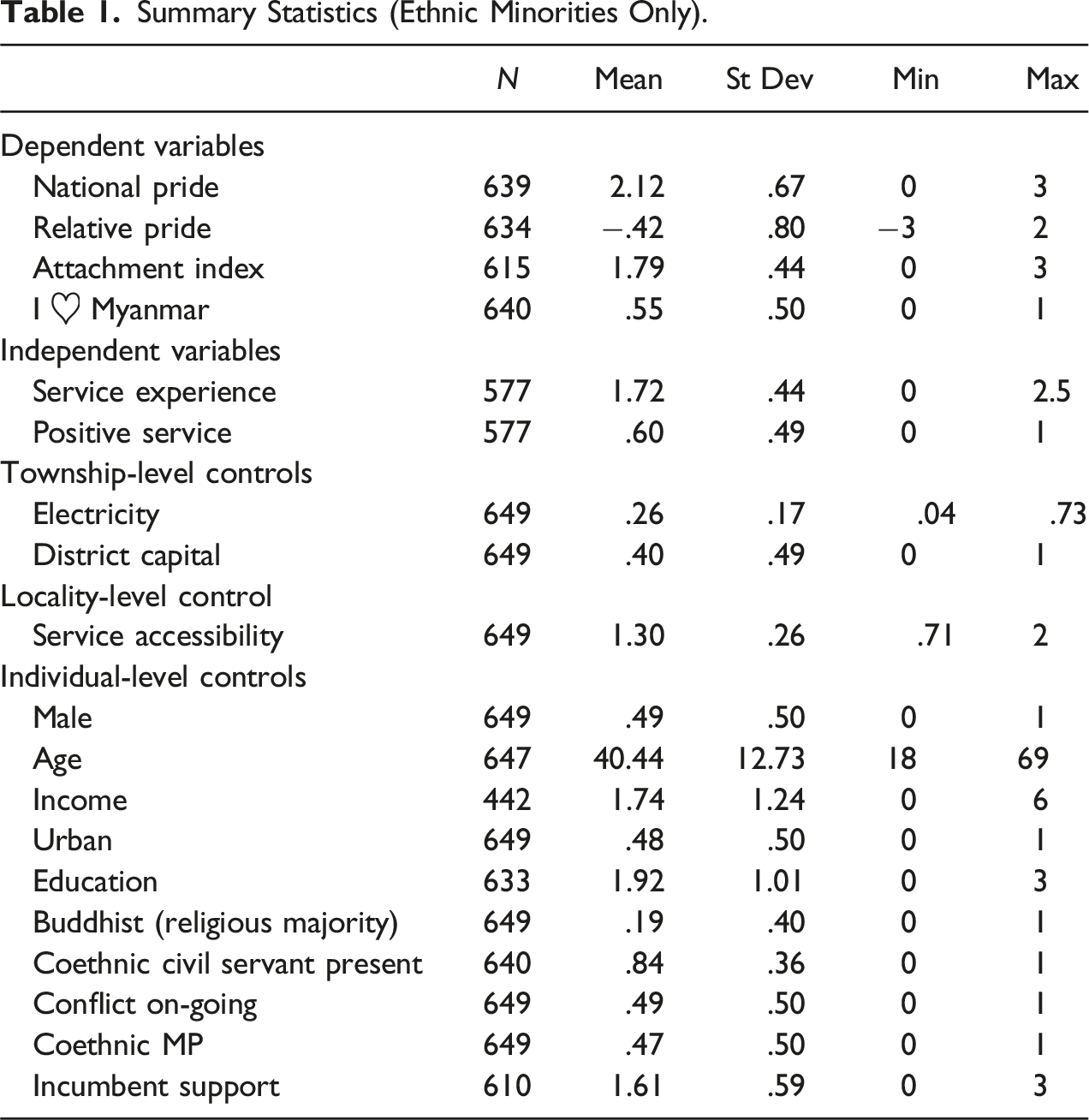
My measure of respondents’ service experiences focuses on their rating of how respectfully they were treated and their satisfaction. The respondents were asked the extent to which they agreed with this statement: “The local government officials and civil servants treat me with respect regardless of my economic status.“ 14 They were also asked: “How satisfied are you with your interactions with civil servants in the local government offices?” (measured on a 0–3 scale). The variable service experience is an average of responses to these questions. 15 Given that different agencies are not equally relevant for all respondents, these questions are deliberately vague in order to tap the service experiences that are most salient for the respondents.
As an alternative measure of service experience, I calculated whether the respondent reported a relatively positive service experience. The variable positive service is coded zero for the respondents whose service experience rating is below the mean (1.72) and 1 for the respondents whose service experience rating is above the mean.
Controls
The literature points to several alternative explanations of ethnic minorities’ attachment to the state: power-sharing, provision of public goods, and modernization. Moreover, encountering coethnic bureaucrats might also give the impression that minorities are employed in the bureaucracy, thereby improving the perception of the state; it could also improve the service experience itself. Attachment to the state could also be affected by support for the incumbent government, which at the time was led by Aung San Suu Kyi’s party, the National League for Democracy (NLD), as well as experiences with the country’s on-going conflict.
Variables corresponding to these explanations are included in the main analysis I present in the next section: whether the respondent’s electoral district is represented by a coethnic in the lower house of the national legislature; percent of township population with access to electricity which comes from the 2014 Census report; whether the respondent lives in an urban area as determined by the government’s GAD; whether there are coethnic civil servants in the offices they tend to visit; whether the respondent’s ethnic group is engaged in on-going conflict with the state; and the extent to which respondent supports the NLD, which was self-reported in the survey. 16
Summary Statistics (Ethnic Minorities Only).
Results and Discussion
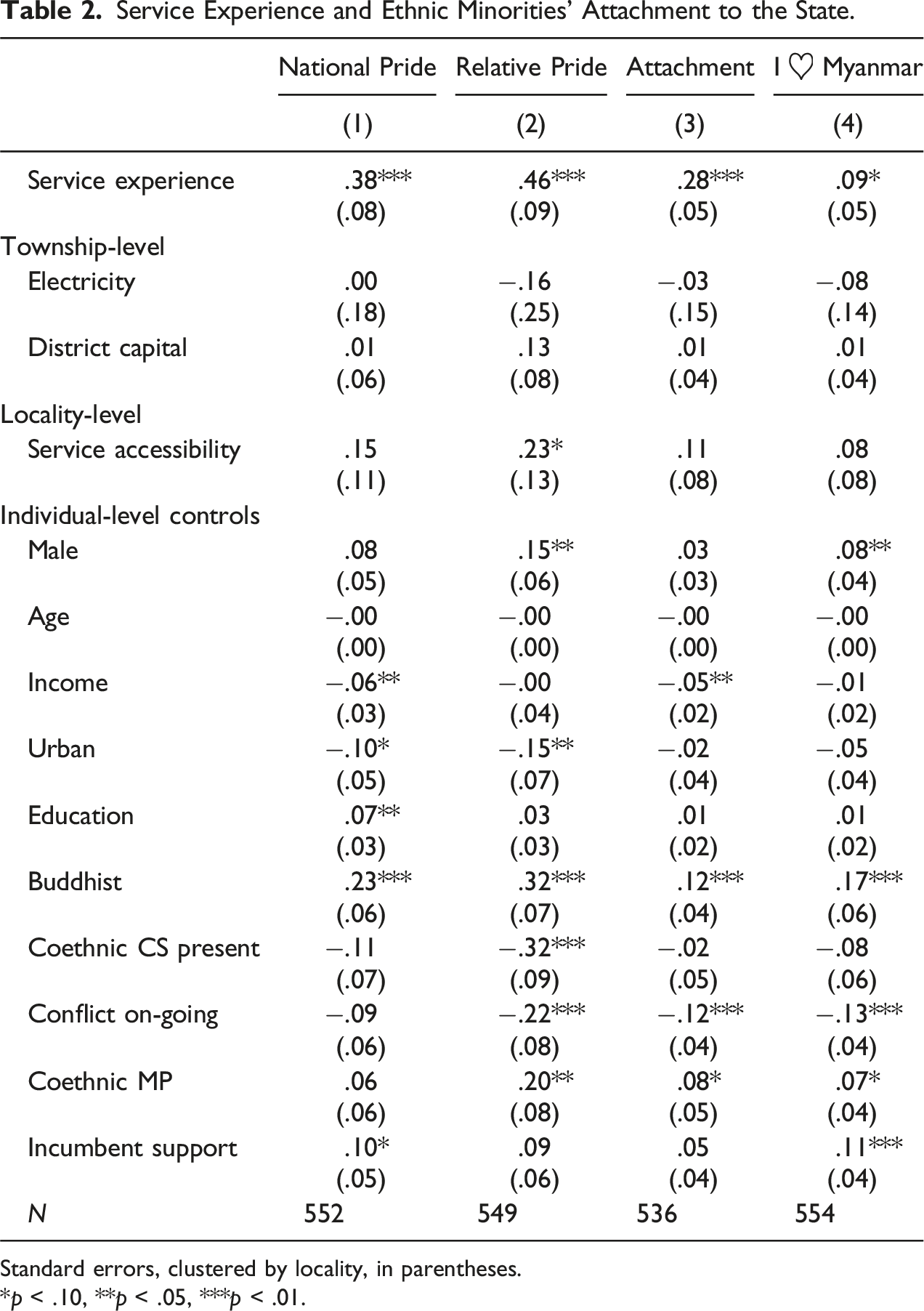
Service Experience and Ethnic Minorities’ Attachment to the State.
Standard errors, clustered by locality, in parentheses.
*p < .10, **p < .05, ***p < .01.
The results are substantively significant. The national pride of an average ethnic minority with an average service experience is estimated to be 2.14 while it is estimated to be 2.30 for an average ethnic minority who reported a service experience that is one standard deviation more positive than an average one (model 1 in Table 2); this is an increase of nearly 8% on the reported level of national pride. With the binary coding for service experience, the estimated level of national pride associated with positive service experiences is almost 16% higher than the pride level associated with negative service experiences (model 1 in Table A2). These findings are consistent with the theoretical expectation that better service experiences improve ethnic minorities’ attachment to the state.
These findings are substantively significant also because Myanmar is talked about in ethnic minority languages as a country that belongs to the politically dominant ethnic group. (Myanmar in many ethnic minority languages can be translated as “country of the Bamar.”) The findings thus imply that among ethnic minorities, positive service experiences can foster stronger attachment to a state that they explicitly and consciously associate with an ethnic other.
Other than service experiences and basic demographic characteristics, consistent correlates of attachment to the state are religious status, conflict status, political representation, and support for the incumbent government. As expected, members of the ethnic minority groups with on-going conflict with the state reported weaker attachment to the state while Buddhist ethnic minorities (i.e., religious majorities), ethnic minorities represented by a coethnic in the parliament, and ethnic minorities supportive of the incumbent government reported stronger attachment to the state.
To gauge how the explanatory power of the correlates of attachment to the state compare to one another, I examined standardized beta coefficients (see Table A6 in the Appendix). Results indicate that service experience is a stronger predictor of attachment to the state compared to all other variables included in the models in which the outcomes are national pride, relative pride, and attachment: with every increase of one standard deviation in service experience, these variables increase by .25, .25, and .28 standard deviations respectively (see Table A6). The next largest predictor for national pride and relative pride is being a Buddhist, while it is conflict status for attachment. When the outcomes are national pride, relative pride and attachment, the beta coefficients associated with the second strongest predictor are .14, .16 and .14, respectively—they are 36–51% weaker than the coefficients associated with service experience. Being Buddhist is also the strongest predictor of selecting the I Myanmar pen.
Other Correlates of Attachment to the State
Several empirical studies of national pride focus on the effect of power-sharing. Consistent with conventional wisdom, Table 2 shows that having political representation is positively associated with attachment to the state. Given the emphasis on power-sharing as a potential solution for managing divided societies, I further scrutinized this relationship with two alternative indicators of power-sharing: whether there is a coethnic minister in the executive’s cabinet and ethnic group’s seat share in the national parliament. Results, however, indicate negative and positive coefficients, suggesting an ambiguous relationship between power-sharing and attachment to the state (see Tables A7 and A8).
A possible explanation for this ambiguous finding is that power-sharing has a heterogeneous effect on ethnic majorities and minorities. What is perhaps the strongest evidence of the positive effect of power-sharing may be driven by ethnic majorities in the sample; for instance, minorities and majorities are pooled in the analysis by Wimmer (2017). Moreover, a recent study shows that being in power affects national identification of members of the core groups only (see Green, 2020). Another possibility is that the relationship between power-sharing and attachment to the state is contingent on the extent to which descriptive representation translates into symbolic and substantive representation (Pitkin, 1967). In other words, it may be that descriptive representation did not lead to symbolic and substantive representation in Myanmar.
Conventional wisdom has also suggested that those with access to public goods develop a stronger attachment to the state (see Hechter, 2009a; Wimmer, 2018). At the same time, a recent study by Harutyunyan (2020) finds that national identification and several indicators of public goods, including infrastructure quality, are negatively related. Table 2 indicates that the relationship between the township-level measure of access to electricity and attachment to the state is ambiguous. It is possible that there is no clear relationship between access to public goods and attachment to the state in Myanmar because the state lacks monopoly over provision of public goods. This phenomenon is not unique to Myanmar as much of public goods provision in many developing countries are increasingly provided by non-state actors, including community based organizations, political parties and INGOs (Cammett & MacLean, 2014; McCarthy, 2023).
Regarding the effects of modernization, results are mixed. Consistent with Robinson’s (2014) findings, formal education is positively correlated with attachment to the state. Compared to the national pride of an average ethnic minority without any formal education, that of an average ethnic minority with more than high school education is estimated to be almost 11% higher. However, contrary to Robinson’s findings, urban residents do not appear to be more attached to the state. If anything, urban residents reported lower national pride and relative pride compared to rural residents. This may be because urbanization in Myanmar is more localized and reinforces parochial attachments. Classic theories of nationalism expect urbanization to facilitate national identification “by breaking ties between mobile individuals and their tribal homelands and by creating a truly national arena in which citizens of different cultural backgrounds could interact” (Gellner, 1983; Robinson, 2014). However, urban centers in Myanmar developed within each subnational units, many of which are ethnic homelands. As such, it is not surprising that the effect of urban is contrary to what existing theories might predict.
Finally, contrary to what we might expect, coethnic presence is negatively correlated with attachment to the state in Table 2. This finding suggests that encountering coethnic bureaucrats may not lead to more positive service experiences. 18 Ethnic favoritism among ethnic minorities may be muted in Myanmar because here bureaucrats can largely remain ethnically anonymous to service seekers. “Ethnic visibility is not universal” (Robinson, 2023), and this is especially so in Myanmar where ethnicity is not primarily marked by phenotype which makes establishing coethnicity between strangers information intensive. 19 If bureaucrats can remain ethnically anonymous, then social sanctioning mechanisms that typically facilitate ethnic favoritism are likely to be fairly weak, significantly moderating instances of ethnic favoritism. 20 Another possible explanation is that ethnic minorities tend not to engage in ethnic favoritism. A recent study of judicial bias in Kenya conducts the analysis by ethnic group and shows that ethnic favoritism is primarily concentrated among judges belonging to the politically dominant group (Choi et al., 2022). 21 It also suggests the possibility of ethnic dis-favoritism among ethnic minority judges—a negative but not statistically significant coefficient for judicial bias.
Robustness Checks and Alternative Explanations
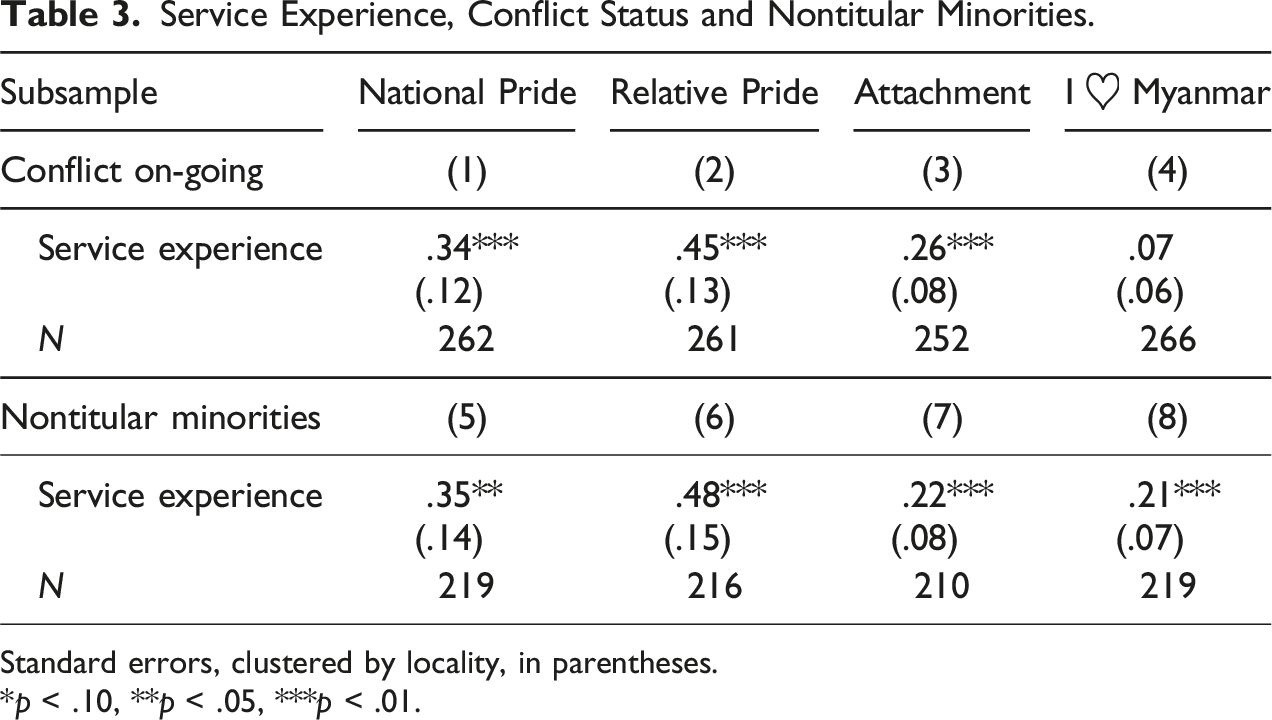
Service Experience, Conflict Status and Nontitular Minorities.
Standard errors, clustered by locality, in parentheses.
*p < .10, **p < .05, ***p < .01.
Another concern is selection bias—ethnic minorities without service experiences may have opted out of visiting street-level bureaucracy because they are especially suspicious of the Myanmar state. 23 To evaluate this concern, I examined the differences between those who visited and did not visit local government offices and the GAD. Specifically, I looked at whether the differences between the two groups regarding the four indicators of attachment to the state and a strong predictor of it (being Buddhist) are within an equivalence range, “the range within which differences are deemed inconsequential” (Hartman & Hidalgo, 2018). Results indicate that three of four indicators of attachment to the state and being Buddhist are inconsequential in determining who visits local government offices (see Figure A1), lending some confidence that the impact of selection bias on the results is negligible.
To evaluate whether the findings presented are driven by unobserved confounders, I conducted a sensitivity analysis following Cinelli and Hazlett (2020). This approach estimates how strong confounding would need to be in order to substantively alter the results. The analysis indicates that the confounder would not be strong enough to overturn the positive correlations between service experience and the indicators of attachment to the state even if it were three times as strong as the effect of being Buddhist (see Appendix A.7).
The analysis thus far shows a robust correlation between ethnic minorities’ service experiences in street-level bureaucracy and their attachment to the state. The correlation established, however, may be attributable to explanations other than the theory I laid out. One alternative explanation is the state manipulation of bureaucratic incentives, thereby facilitating certain kinds of bureaucratic behavior toward some groups. Leaders may do so with the aim of averting elite and popular threats to the regime (Hassan, 2020). In the Myanmar context, the threat posed by on-going ethnic rebellions has been a long-standing concern for the state and particularly for the military leaders. If the regime leaders repurpose the bureaucratic apparatus to manage this threat, we should observe bureaucrats being especially diligent at providing quality services in rebellious regions, but the data at hand do not indicate that to be the case (see Appendix A.8). State manipulation of bureaucratic incentives may not be evident here because regime leaders rely on different strategies to manage the threat posed by ethnic rebellions. Recently, Bertrand et al. (2022) argue that state exploitation of peace negotiation in Myanmar “neutralizes” the country’s ethnic minority groups.
Another alternative explanation—and perhaps the biggest concern of all—is reverse causality. The correlation between ethnic minorities’ service experiences and their attachment to the state is consistent with the theoretical expectation that positive service experiences lead to more positive views of the state, but Study 1 cannot convincingly rule out the possibility that ethnic minorities’ attachment to the state informs their service experiences. I now turn to Study 2 to further address this limitation.
Study 2: Survey Experiment from Post-Coup Myanmar
On February 1, 2021, the military staged a coup in Myanmar, annulling results from the 2020 general elections. Following the coup, there were nation-wide pro-democracy protests, and many civil servants went on strike, refusing to work for the new military regime. To clamp down on the opposition, the regime unleashed security forces particularly to the localities where protest organizers and the striking civil servants reportedly lived. Violent crackdowns increased, unevenly, across the country. In the post-coup survey I discuss below, 20% of the respondents reported that the presence of security forces increased in their area and 52% reported violence in their locality. In response to the crackdown, protests and demonstrations transformed into armed resistance movements.
In the midst of chaos, street-level bureaucracy continued to operate in Myanmar. In the post-coup survey, 40% of the respondents reported that they have not been to a local government office since the coup, indicating that the majority still engage with Myanmar’s street-level bureaucracy. Among those who have been to a government office, the most visited offices were the ward/village-level GAD office (35%), the electricity office (17%), the police station (10%), and the LIP office, aka the ID office (10%). These figures are consistent with new requirements the new junta announced, including guest registration at the ward GAD offices. These interactions provide genuine reference points for respondents as they engage with the treatment primes introduced in the study and the survey questions about their experiences in street-level bureaucracy.
Survey Data and Priming Experiment
The survey was implemented a year after the coup in March 2022. It was hosted on Qualtrics and self-administered in Burmese. The participants were recruited through Facebook advertisement; existing estimates suggest that about 40% of Myanmar’s population are Facebook users at the time of survey implementation. Given that a significant segment of the Myanmar population were offline, the resulting sample represents just the online users who tend to be younger, more educated, and urban compared to the country’s population as a whole. The sample consists of 3139 respondents who come from 264 of 330 townships across Myanmar. Nearly 40% of them self-identified as Bamar. Among the non-Bamar, the largest groups are Shan (21%), Karen (15%) and Rakhine (13%).
In the study, the battery of questions about street-level bureaucracy consisted of three items. First, all respondents were asked to think back on their past visits to local government offices and indicate the extent of their satisfaction with how bureaucrats treated them. Next, they were asked to indicate the government offices they have visited (if any) since the coup. Then, the participants were randomly assigned to three experimental conditions: (1) the control, (2) positive treatment, and (3) negative treatment. Those in the positive and negative treatment conditions were asked to read a version of the following vignette: “Imagine that you visit a local government office to apply for an official document, and the bureaucrat you encounter [treats you with respect/is condescending and rude]. When you ask questions about the requirements and procedure, they [patiently answer all your questions/scold you for not knowing such information].” These vignettes mention just the tone of the interaction and make no mention of the outcome of the interaction. This approach is intended to heighten the salience of how, rather than whether, services are delivered to service-seekers. After reading the assigned vignettes, respondents were asked how satisfied they would be with the service experience described. Those in the control group were not assigned a vignette to read. In essence, their “treatment” was to think about a routine service experience (as opposed to a hypothetical neutral interaction) which could serve as a baseline measure of service experiences.
A post-treatment manipulation check, reported in Figure B1, confirms that those receiving positive prime gave more positive service rating compared to those in the negative treatment group. The average rating of the positive treatment group is 2.20, on a scale of 0–3, .47 for the negative treatment group, and 1.25 for the control group. 24 The sample is also balanced with respect to most pre-treatment covariates (see Table B1).
As in Study 1, the outcome was national pride, measured on a scale of 0–3. After those assigned to the treatment groups were asked to report their level of satisfaction with the hypothetical service experience in vignette, they were asked to indicate their level of national pride. Since those in the control group were not assigned a vignette, they were asked to indicate their level of national pride immediately after they were asked to rate their past interactions. Well over the majority of ethnic minorities indicated that they were “somewhat proud” or “very proud” to be citizens of Myanmar, with the mean pride being 2.40. Such a high level of national pride a year after the coup while the country is in turmoil is puzzling. While preference falsification is a possibility, it may also be that “national pride is conceptually and empirically distinct from how individuals see their current government” (Wimmer, 2017, p. 608).
Results
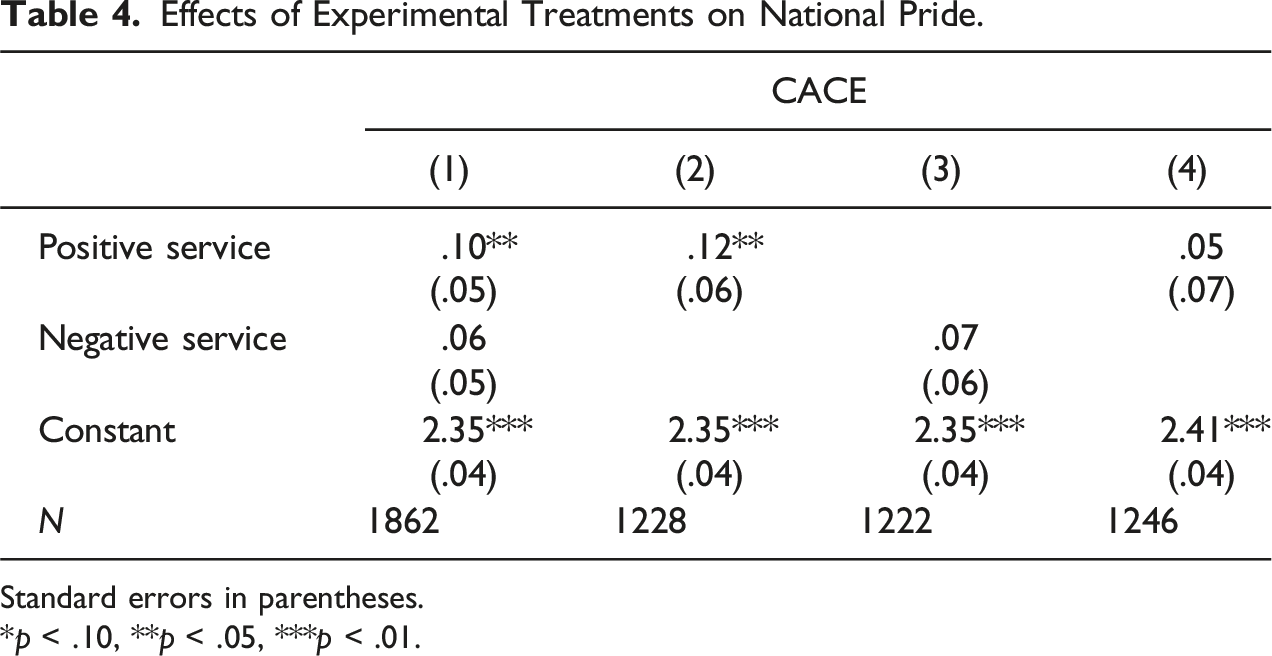
Effects of Experimental Treatments on National Pride.
Standard errors in parentheses.
*p < .10, **p < .05, ***p < .01.
To further probe the effect of the treatment on national pride, I next estimated the complier average causal effects (CACE) using a two-stage least squares regression where random assignment to treatment serves as an instrument for compliance in the first stage. Among those assigned to the positive prime, respondents were coded as compliers if they indicated service satisfaction (n = 506) and as non-compliers if they indicated dissatisfaction (n = 120). Likewise, among those assigned to the negative prime, respondents were coded as compliers if they indicated service dissatisfaction (n = 553) and as non-compliers if they indicated satisfaction (n = 67). Since the control group was intended to represent those with a routine service experience, all respondents were coded as compliers (n = 602). In Model 2, I compared those in the positive treatment group to those in the control group while in Model 3, I compared those in the negative treatment group to those in the control group. Results from these analyses concurs with those from Model 1. The effect of positive treatment is positive as expected, but the effect of negative treatment points in the positive direction.
This unexpected result raises the possibility that a systematic difference between the control and the two treatment conditions led to an improvement in national pride. For instance, given that the vignette texts ask respondents to imagine visit to a local government office in the present time, it is conceivable that the presence of the new junta might be especially salient on these respondents’ minds, prompting them to falsify their attitudes toward the state (i.e., report higher national pride). As such, in Model 4, I conducted another CACE analysis, comparing only those in the treatment groups (negative service as the baseline category). Results indicate that those primed on a positive treatment reported a slightly higher national pride compared to those primed on a negative treatment; however, the effect is not statistically significant at conventional levels.
While these null results do not provide evidence of a causal relationship between ethnic minorities’ service experience and their attachment to the state, they nevertheless suggest a causal relationship. This is especially so because attachment to the state is a relatively stable attitude (Elling et al., 2014), and thus, improving it may be a slow process, requiring several instances of the treatment. Moreover, the case of Myanmar arguably offers a hard test of the theory. Given Myanmar’s history of protracted conflicts between minority communities and the state, minorities’ attitudes toward the Myanmar state may be especially hard to change. Since the results above are based on a single hypothetical encounter, they underscore the potential of bureaucratic experiences in shaping minority-state relations.
Discussion and Conclusion
This study is motivated by a puzzling observation that ethnic minorities from the same ethnic group hold varying attitudes toward the state. Our current understanding of ethnic minorities’ attachment to the state has primarily considered structural factors, particularly the political power constellation and modernization, which is often accompanied by public goods provision. This study proposes an alternative explanation: inter-personal interactions between citizens and street-level bureaucrats. It advances a novel theoretical perspective that how public services are delivered matters for the individual-level minority-state relations. Using observational data, the study shows that individuals with positive service experiences have a stronger attachment to the state. This correlation is robust across a range of different modeling and sample specifications, including among ethnic minorities with an on-going conflict with the state. Based on a survey experiment, the study also indicates some suggestive evidence of a causal relationship between ethnic minorities’ service experiences and their attachment to the state.
While this study constitutes an important step going beyond existing frameworks, it has several limitations, in addition to lingering questions about causality. First, while the theory is about minority-state relations, the data used in the study primarily consist of minorities with some level of recognition by the state. As such, the findings may not extend to severely marginalized ethnic minorities like the Uighurs of China or the Rohingya people of Myanmar—groups that are particularly targeted with political, social, and economic exclusions, including limited or no citizenship rights. There are questions about whether they can access basic government services provided by street-level bureaucracy and if so, whether their interactions with street-level bureaucrats can be positive.
Second, this study takes the quality of service experiences as a given and focuses on its relationship to ethnic minorities’ attachment to the state. It is presumed that positive experiences—regardless of how the experiences came to be positive in the first place—can improve minority-state relations. As mentioned already, parts of service experiences could be endogenous to service seekers’ expectations and behavior. They may also be moderated by conflict dynamics in service seekers’ localities. Future studies should empirically probe these speculations and other potential determinants of positive experiences in street-level bureaucracy. This undertaking is particularly important as the current study shows that service experiences may be more relevant in explaining ethnic minorities’ attachment to the state compared to the factors emphasized in existing works.
Notwithstanding these limitations, this study makes a number of contributions. The findings hint at a mitigating role of street-level bureaucrats in countries affected by legacies of armed conflicts. They suggest an important policy implication: local government and service delivery reforms should be a priority in peace-building and national reconciliation processes. Service delivery reforms are already a major theme in the global development agenda. Such undertaking are even more pressing in post-conflict settings where street-level bureaucracy may be established for the first time in decades.
Finally, a takeaway from this study is the need to reconsider existing explanations of national pride and related concepts. Several explanations from conventional wisdom (e.g., access to political power), do not appear to hold in the case of Myanmar. While this inconsistency does not necessarily challenge existing generalized findings, it nevertheless implies that some explanations are more relevant in certain regions, in certain kinds of countries, or among certain kinds of ethnic groups. For instance, the effect of power-sharing on attachment to the state might be concentrated among ethnic majorities or in countries in which descriptive representation leads to symbolic and/or substantive representation. Future research in this line of work should pay close attention to the particularities that undergird the relationship between attachment to the state and its explanations. Specifically, they should examine not just the causal direction of the hypothesized relationships but also the mechanisms expected to facilitate the relationship between attachment to the state and factors explaining it.
Supplemental Material
Supplemental Material - Can Encounters With the State Improve Minority-State Relations? Evidence From Myanmar
Supplemental Material for Can Encounters With the State Improve Minority-State Relations? Evidence From Myanmar by Jangai Jap in Comparative Political Studies.
Footnotes
Acknowledgement
I thank Claire L. Adida, Ana Bracic, Henry Hale, Amoz Hor, Eric Kramon, Amy H. Liu, Harris Mylonas, Jacob I. Ricks, Marcel Roman, John Sides, Htet Thiha Zaw, and three anonymous reviewers for their valuable comments. Data for Study 2 were collected in collaboration with Isabel Chew. Prior versions of the paper were presented at the GWU Comparative Politics Workshop in March 2020, the American Political Science Association annual conference in 2020, and the Southeast Asia Reserch Group summer conference in August 2021.
Declaration of Conflicting Interests
The author declared no potential conflicts of interest with respect to the research, authorship, and/or publication of this article.
Funding
The author(s) disclosed receipt of the following financial support for the research, authorship, and/or publication of this article: This work was supported by the National Science Foundation - DDRIG (1841034) and the United States Institute of Peace.

Supplemental Material
Supplemental material for this article is available online.
Notes
Author Biography
References
Supplementary Material
Please find the following supplemental material available below.
For Open Access articles published under a Creative Commons License, all supplemental material carries the same license as the article it is associated with.
For non-Open Access articles published, all supplemental material carries a non-exclusive license, and permission requests for re-use of supplemental material or any part of supplemental material shall be sent directly to the copyright owner as specified in the copyright notice associated with the article.
