




Abstract
Existing research on the effects of women’s descriptive representation on citizens’ attitudes has mainly investigated potential positive effects, namely on political engagement or the legitimacy of outcomes. However, trends in representation have rarely been theorized as potential causes of resentment among women. While a male backlash to increasing representation has been theorized, this article argues that women may also be discontent with their trajectory of representation, if they perceive it as stagnating. Using a survey experiment fielded in Germany, the results show that a stagnating representation trajectory mobilizes women to vote for a progressive party, the German Greens. In contrast, the paper demonstrates that men do not lash back against women’s increasing representation, even if they realize that this means a lower standing for themselves. This article contributes to research on political behavior by highlighting that discontent with persisting inequality is a mobilizing factor for progressive parties.
Introduction
The representation of women compared to men has become much more equal in Western European parliaments in the past decades. Political science research has demonstrated the positive effects of a more representative gender composition of parliament on women’s and men’s political engagement (Barnes & Burchard, 2013; Schwindt-Bayer & Mishler, 2005), perceptions of legitimacy (Clayton et al., 2019), and attitudes towards women politicians (Neundorf & Shorrocks, 2021). However, the inclusion of women into politics has also fostered resistance in the form of a patriarchal backlash (Sanbonmatsu, 2008), indicated for example by the phenomenon of violence against women in politics (Krook, 2020). This is supported by empirical evidence for male resentment against changing gender relations in contexts like the labor market and education (Banaszak & Plutzer, 1993; Morgan & Buice, 2013).
The predominant focus on male discontent against rapid increases in gender equality means that research has neglected another important type of disaffected reaction to trends in descriptive representation. This study pays attention to discontent arising among women voters, sparked by their persisting underrepresentation and the slow progress towards equal representation. This is empirically and theoretically relevant. First, it is an empirically common trend in Western democracies that, after substantial increases of women members of Parliament (MPs), the last three decades have seen stagnation well below equal representation (Paxton & Hughes, 2014, p. 73). This means that women’s expectations rose, but remained unfulfilled, a scenario that has been shown to generate disaffection in the context of local labor markets (Newman, 2016). Second, the political implications of discontent around stagnating progress are far-reaching. In general, we do not know much about how voters with unfulfilled expectations of progress react, which parties they will support or whether they will become detached from politics.
To explain when, why and for whom discontent might arise, I argue that it is crucial to consider perceived trajectories of women’s representation, adding a dynamic dimension to the recent focus on its perceived levels (Stauffer, 2021). Varying perceptions of how descriptive representation came about and how it might evolve in the future can be attached to the same current level of the share of women in parliament. The trajectory should be influential for political behavior because the past and expected future provide the reference points against which the current situation is evaluated. This determines whether a perception of relative decline, persisting inequality, or ascent arises. From recent research on social status, we know that relative trajectories matter more strongly for resentment and radical right voting than absolute social positions (Engler & Weisstanner, 2021; Kurer, 2020; Kurer & van Staalduinen, 2022).
Thus, perceptions of women’s representation may affect political behavior differently, depending on which trajectory is salient. This paper assesses the consequences of perceived shifts in women’s representation in terms of their effects on political behavior among both women and men. I consider that strong shifts, but also recent stagnation, have the potential to cause discontent: Women should be discontent with persisting inequality, while men’s resentment could be triggered by a strong challenge to male dominance. To theorize the effect of discontent, I connect the literature on symbolic representation, that is, the effects of descriptive representation on citizen attitudes (Schwindt-Bayer & Mishler, 2005), with insights from the literature on social status, backlash and deprivation (Gest et al., 2018; Gidron & Hall, 2017). Thereby, I also contribute to the status literature by explicitly testing whether a progressive change towards gender equality leads to an individual-level male backlash, which is often implied but rarely tested on the level of individuals (for an exception see Anduiza & Rico, 2022). As an outcome of the individual-level reactions by men versus women, I will consider downstream effects on support for progressive and radical right parties. Since gender relations are an important aspect of contention on the sociocultural dimension of political conflict, assessing this individual-level mechanism can thereby also contribute to our understanding of transforming electoral politics.
To address these questions, a survey experiment is used to manipulate perceptions of shifting gender relations in parliament. I present respondents with different trajectories of the descriptive representation of women, with treatment conditions showing either strong increases in the share of women MPs or stagnation on a lower level. The treatment is adapted from Wetts and Willer (2018), who assess the impact of varying projections of the share of racial groups in the population on welfare attitudes. The preregistered experiment, which does not rely on deception but simply displays differing time windows, was fielded in an original survey in Germany in January 2022. An experimental setting allows me to manipulate how fundamental or stable shifts in women’s representations appear to respondents. This is an advantage over observational data, as perceptions of the rate of change may differ drastically. Furthermore, different trends in women’s representation go along with and are affected by other developments, such as the spread of socially progressive values, which can be more easily controlled for using an experimental design. The case of Germany is useful to assess the political implications of a more general Western European trend, where gender equality and women’s representation have increased over the long run but stagnated in the last two decades. Further, by now, Germany features both an established radical right party (the Alternative für Deutschland) and an even more established socioculturally progressive party, the Greens.
The results show that women are more likely to express support for the Green party when exposed to the current stagnation of women’s representation, indicating a progressive mobilization effect. While men perceive a lower social status when primed about women’s increasing representation, there are no downstream effects on men’s broader discontent or their propensity to vote for the radical right. Crucially, both women and men express concerns about boys’ opportunities when exposed to a prime of the future overrepresentation of women. However, not even this scenario triggers a backlash or discontent among men. The optimistic implications are that men, on average, do not resent women’s representation, even if they realize it means a relatively lower standing for themselves.
I contribute to previous studies by first conceptually highlighting the role of the perceived trajectory of women’s representation, going beyond levels of it. Second, my results shed light on the consequences of the perceived representation of women for political behavior, integrating both men’s and women’s reactions into a common framework revolving around social status dynamics. I show that men do not react with a backlash, but that socioculturally progressive parties like the Greens might be able to mobilize women voters by highlighting stagnation in women’s advances in politics. These results are consequential for research on both gender and politics as well as party politics. They show that it is important to consider the perspective of progressive discontent, not only a potential authoritarian backlash. Shifting perspective in this way implies that it is neither normatively nor strategically advisable to ignore remaining hurdles to gender equality. Instead, research and political actors should acknowledge that failing to reach equality is a factor that mobilizes voters, meaning there is a demand for dismantling inequality.
The Implications of Women’s Representation for Political Behavior
Over the past century, as women gained the right to vote, they also began to see increased representation in parliaments and governments worldwide. After being formally excluded, this gave them a political voice and the ability to influence outcomes in a variety of policy areas. There is a vast literature on the effect that the descriptive representation of women has on individual attitudes and political engagement, which is subsumed under the concept of symbolic representation or “the represented’s feelings of being fairly and effectively represented” (Schwindt-Bayer & Mishler, 2005, p. 407). Research in this strand theorizes and provides evidence of a positive effect on political attitudes first and foremost among women (Barnes & Burchard, 2013). However, even for men, many studies detect an equally positive effect of women’s presence in politics on efficacy and perceptions of legitimacy (Clayton et al., 2019; Schwindt-Bayer & Mishler, 2005; Stauffer, 2021). The proposed mechanism for this is a general signal of openness that the political system sends by including women.
Despite the overall confidence in the positive effects of women’s increasing representation, setbacks have also been considered (O’Brien & Piscopo, 2019). Resistance to the inclusion of women in politics may explain why inequality and stereotypes against women politicians still persist (Anzia & Bernhard, 2022; Huddy & Terkildsen, 1993). From this point of departure, Sanbonmatsu (2008) conceptualizes a backlash against women’s representation as an attempt by men and socially conservative women to preserve their group status. In line with this argument, studies have found evidence for an attitudinal backlash against feminism and women politicians as a reaction to women’s overall societal status gains (Banaszak & Plutzer, 1993; Morgan & Buice, 2013). More strikingly, research on the phenomenon of violence against women demonstrates the amount of resistance women politicians and activists still face. They are subjected to a specific and gendered form of abuse, harassment, and intimidation, which can be understood as one expression of a backlash against women’s representation (Collignon & Rüdig, 2021; Krook, 2020).
Recent literature on (anti)feminist attitudes, male resentment, and radical right voting even points to an increasing politicization of gender relations in the past years, indicating that resistance to gender equality has taken on a more organized shape. Although this research is not directly concerned with representation, it pays attention to broader structural and value changes in favor of gender equality. It indicates that sexism and male resentment are central to explaining current support for the radical right or, more generally, for a cultural backlash to progressive politics (Norris & Inglehart, 2019). There is strong evidence supporting the importance of sexism in the context of the 2016 election of Donald Trump as US president (Bracic et al., 2019; Cassese & Holman, 2019; Knuckey, 2019; Schaffner et al., 2018; Setzler & Yanus, 2018; Valentino et al., 2018). Furthermore, studies in the European context show that male resentment has played an important role in the case of Brexit (Green & Shorrocks, 2023), for the rise of the far right party Vox in Spain (Anduiza & Rico, 2022), and for radical right voting in Sweden (Off, 2023).
Whereas we have insights into why men might negatively react to shifts in women’s representation, it is less clear whether certain trajectories might also trigger discontent among women. However, an alternative, but equally accurate point of view to the optimistic story of increasing descriptive representation is to highlight the strong degree of underrepresentation of women that permeates politics in Western Europe and other regions to this day. There is reason to believe that discontent arises among a disadvantaged group as a reaction to unfulfilled promises, especially after some first steps have been made toward equality. Newman (2016) shows that women are more disillusioned and less likely to believe in meritocracy specifically where gender wage gaps are narrower. He explains this with rising expectations held by women, which cause discontent when not fulfilled, especially where equality seems in closer reach. I argue that this logic also applies to the realm of politics and representation. Being aware of the continued overrepresentation of men compared to women should cause discontent among women. We should expect this effect especially when advances toward the equal representation of men and women have been achieved, but stagnated.
Perceived Trajectories of Women’s Representation - A Framework
To make sense of when and for which voter groups discontent may arise, I propose a framework centering around perceived trajectories of women’s representation. This framework considers the social status dynamics around symbolic representation, meaning the link between descriptive representation and citizen attitudes. I argue that perceptions of the trajectory of women’s representation should be central for political behavior for two reasons: First, the rate of change, or how many women entered parliament in which amount of time, influences whether this development is perceived as a threat or not (Sanbonmatsu, 2008, p. 638), or alternatively, as sufficient or not. By contrast, the current levels of the share of women and men in parliament is not indicative of how this ratio came about or how it might evolve in the future. The trajectory thus adds a powerful dynamic dimension to the evaluation of the current state.
Second, the expected future trajectory should be especially influential for voters’ reactions in terms of attitudes and vote choice. Insights from the literature on social status show that the future threat of relative economic decline drives resentment and radical right voting, more so than low absolute levels of economic resources (Engler & Weisstanner, 2021; Häusermann et al., 2023; Kurer, 2020; Steenvoorden & Harteveld, 2018). Vice versa, though less acknowledged in this literature, expected future gains should increase satisfaction with the political system among low status groups. From theoretical and empirical research on symbolic representation, we know that the increasing descriptive representation of historically discriminated groups signals changing social norms about their competence to be politically active and increases the overall legitimacy of political outcomes (Mansbridge, 1999; Schwindt-Bayer & Mishler, 2005).
Crucially, this perspective implies paying attention to voters’ perceptions of shifts in women’s representation. How the current level is evaluated and whether it causes satisfaction or discontent will be shaped by the trajectory that is subjectively perceived by individuals. This can be detached from the objective development, as individual knowledge on it may be limited and because perceptions of time and the speed of a process may vary. Previous research has shown that perceptions of the level of the gender composition of parliament predict political efficacy, while their objective levels fail to do so (Stauffer, 2021). Thus, perceptions should also play a decisive role when evaluating the effects of trajectories of women’s descriptive representation.
To make sense of how differently perceived trajectories of women’s representation affect political behavior, I consider two potential perceptions of the trajectory of progress toward equal representation in the Western European context. One is the perspective of a strongly increasing presence of women in parliament, entailing a strong challenge to male hegemony. Especially when taking into account that formal barriers to women’s political participation existed for hundreds of years, the increasing share of women MPs since the mid-20th century can seem quite remarkable. The second interpretation relates to the stagnation towards gender equality in many parts of the world, where progress has slowed down after initial advances, especially in recent years (Klasen, 2020). For women’s representation, Paxton and Hughes (2014, pp. 72-73) show that periods of increase between roughly 1970 and 1990 did not continue in many Western countries. To support this, Figure A1 in the appendix plots trends in different world regions and within Europe using data compiled by the Inter-Parliamentary Union (2023). It becomes clear that women’s increasing representation has stagnated in Western Europe since the mid-2000s, after advances in the 1980s and 1990s. Other regions have also experienced stagnation, be it from a higher starting point (Northern Europe) or at a later point in time (Southern Europe). Thus, it is plausible that voters think of medium-to short-term trends in women’s representation in terms of stagnation and ongoing inequality, especially, but not only in Western Europe.
The perceived trajectory of women’s representation should affect where individuals position themselves in society, how politically central they feel, as well as which parties they support. The expectation of being more or less represented in the future should affect individual’s subjective social status (SSS), defined as the “level of social respect or esteem people believe is accorded them within the social order” (Gidron & Hall, 2017, p. S61). People deduce where groups stand in society (among other signals) from their perceived closeness to political power and presence in politics (Mendelberg, 2022, p. 63). Next to a more general perception of status, the sense of having a political voice should be affected. Political centrality captures how much power people perceive their own group to have and how much politicians care about people like them (Gest et al., 2018, pp. 1702-1703). Thus, it ranges from a group-based sense of political efficacy to one of political deprivation.
Regarding the downstream effects on electoral behavior, I argue that women’s representation trajectories primarily affect support for parties with marked positions on the second, sociocultural dimension of politics, namely progressive and radical right parties (see Kriesi et al., 2008). This relation has an ideological and a descriptive representation component: Individuals can ideologically favor the progressive/Green/new left parties that demonstrate support for gender equality in terms of their program, or alternatively, the radical right parties that oppose it ideologically (Campbell & Erzeel, 2018). Regarding the share of women politicians in the ranks of these parties, radical right and progressive parties differ strongly as well (Keith & Verge, 2018; Weeks et al., 2022).
Theoretical Framework on the Effects of Perceived Representation Trajectories.
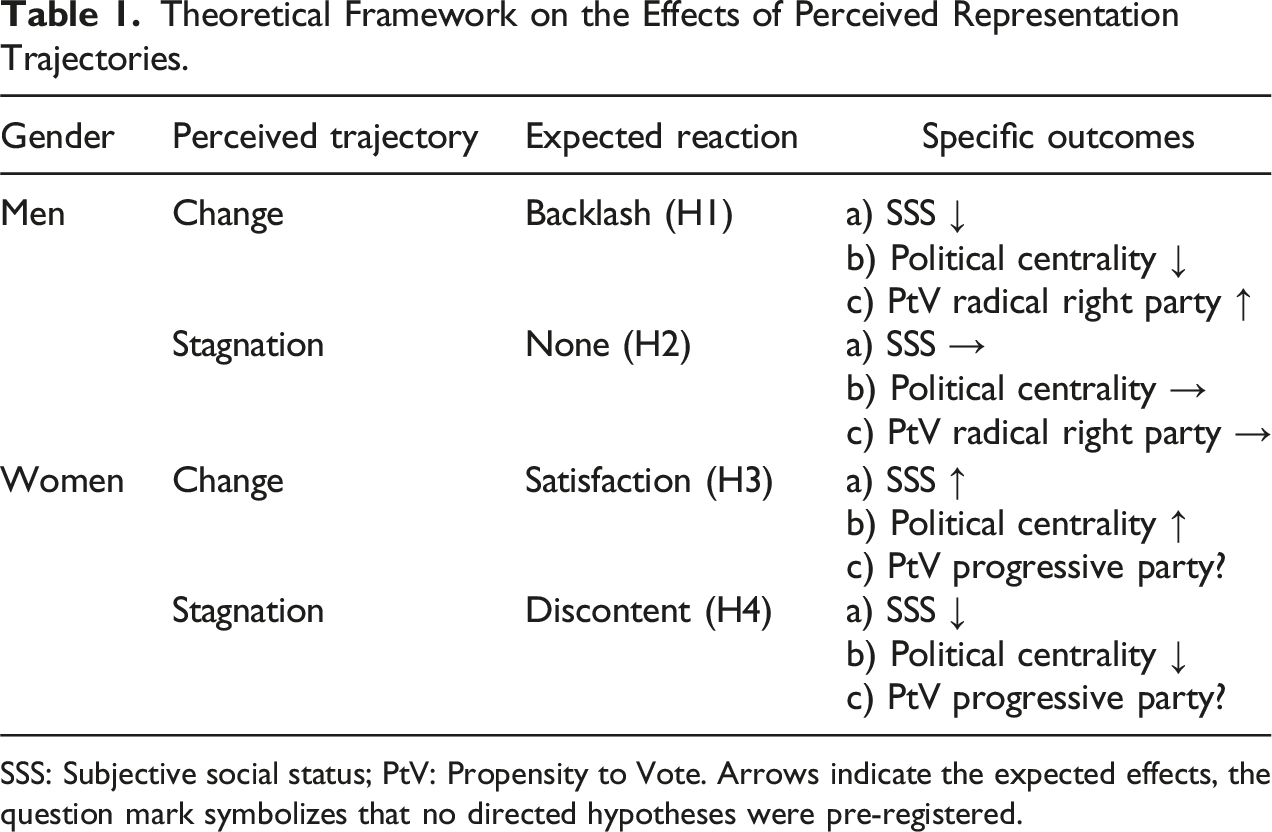
SSS: Subjective social status; PtV: Propensity to Vote. Arrows indicate the expected effects, the question mark symbolizes that no directed hypotheses were pre-registered.
As a reaction to the first perception of strong change, men are expected to feel threatened in their subjective social status and political centrality (H1). They are likely to feel increasingly marginalized in a society that used to benefit men more, and where momentum is now shifting strongly in favor of women. As shown by Green and Shorrocks (2023), perceptions of discrimination against men and nostalgia for times when unequal gender relations were not questioned are elements of a broader cultural backlash. As a consequence of these perceptions of threat, men may then react with a backlash in an attempt to curb the political power of the challenging group, leading to a higher propensity to vote (PtV) for the radical right. Radical right parties are likely to profit from perceived status threats and male resentment, as individuals may vote for them to voice discontent with mainstream parties and support for anti-egalitarian rejections of progressive change (Gest et al., 2018; Gidron & Hall, 2017). Furthermore, these parties campaign on and profit from gender-based resentment (Off, 2023), i.e., about gender quotas, gender-inclusive language or gender studies (Abou-Chadi et al., 2021).
By contrast, the second perception of stagnation is likely to affect men’s attitudes less (H2), as it does not threaten their higher representation level and is likely perceived as ‘politics as usual.’ Thus, neither SSS nor political centrality or the propensity to vote radical right should be affected.
Turning to reactions by women, their attitudes are likely positively influenced by the change perception, in terms of their perceived own standing and political centrality (H3). Being aware that more and more women are represented in parliament should signal to women voters that there is an overall societal norm that awards women political competence, and that the system is increasingly open to include historically discriminated groups (see also Neundorf & Shorrocks, 2021).
In contrast, if citizens perceive that women’s and men’s unequal access to politics has solidified, this might cause discontent especially among women (H4). A stable and lower level of descriptive representation is expected to signal marginalization and a lesser importance of their political voice to them. This should decrease their political centrality, as the system will not seem inclusive to their group. Discontent among women is likely to arise especially in contexts where initial advances have been made but where women’s representation remains well below parity, like in many Western European countries. In a context like this, rising expectations (Newman, 2016) of equal representation have remained unfulfilled.
Regarding women’s reaction in terms of voting behavior, it is plausible that they increase their support for socioculturally progressive parties in reaction to both perceptions. The somewhat competing mechanisms are the following: First, women with a boosted sense of status and political centrality in the change condition may reward progressive parties for having promoted gender equality in the past. 2 However, they could also perceive a lower urgency to vote progressively based on gender issues, as progress seems to run its due course without much more mobilization. Second, women who perceive to still be confined to a lower societal position and excluded from politics could be motivated to vote for a progressive party as a means to achieve more equality in the future. Progressive parties combine both feminist substantive and descriptive representation, making them an attractive choice for women who care about advances in, as well as dismantling remaining inequality in representation. Being made aware of stagnation could increase the salience of the gender issue or shift their priorities to lead to an increase in progressive voting.
In sum, I do not have fixed expectations about how the effects on voting propensities among women respondents will differ between the perceptions, but I will assess them especially for socioculturally progressive parties (as described in the pre-analysis plan). Depending on the context, either a Green or radical left or social democratic party could be most saliently connected to progressive gender positions and this mechanism should apply to this party. New left parties, especially the Greens, are the most opposing pole to the radical right on sociocultural (Bornschier et al., 2021; Kriesi et al., 2008), and even on core economic issues (Attewell, 2020).
Empirical Strategy
Case Selection and Survey
To manipulate the perceived trajectories of women’s representation, I conducted a survey experiment. It was embedded in an original online survey and fielded in Germany in January and February 2022. Overall, the German case is a rather typical example for Western Europe: Gender equality has increased in the long run but has stagnated in the last two decades. The remaining inequalities in Germany are even slightly more pronounced than in other countries because the conservative welfare regime tends to preserve status differentials (Esping-Andersen, 1990, pp. 26-28). Consequently, Germany scores relatively highly on indicators of inequality, including gender inequality, for example in the workplace. It has one of the highest gender pay gaps in Europe (19%, see Eurostat, 2023). Germany is also a typical example of a Western European party system, featuring an increasingly established radical right party. However, the AfD (Alternative für Deutschland) is relatively strongly stigmatized compared to its other Western European counterparts. This may make it harder to experimentally induce a higher voting propensity for it. Nonetheless, the AfD still gained a substantial share of votes at the last parliamentary elections in September 2021 (10%).
Respondents were recruited by a social research company (Respondi) from its online panel and sampled via quota sampling, including quotas matching the German population on age, gender, education, and federate state (see Table C1 in the appendix for descriptives). Respondi reimbursed respondents according to the length of the survey. A total of 3015 respondents participated in the survey and passed the attention check. 3 After excluding speeders (who took less than 5 min, with the median equal to 16 min), this resulted in 2947 respondents. For this design interested in heterogeneous effects between men and women, nonbinary respondents were excluded, resulting in 2940 respondents. This sample size gives statistical power of .83 to detect small effects among men and women, assuming Cohen’s f = .1, (see Cohen, 1992) and a Type-I error rate of .05. A pre-test (n of about 300) was conducted beforehand.
Experimental Treatment
The treatment is based on a design developed by Wetts and Willer (2018) to assess the impact of varying threats to white people’s racial standing on welfare attitudes in the US, but was adapted to display varying trajectories of women’s representation. The sample was divided into a control group and two treatment groups, using a block randomization strategy to assign individuals to the groups. 4
The control group did not receive a treatment or any prime on gender equality. Respondents in this condition went from the pre-treatment items education, gender, age, and a few attitudinal predispositions to the outcome items, described below. The two experimental groups saw a chart showing the historical and projected development of women’s political representation. One of the treatment conditions showed a strong change and overturn of men’s dominance, the other displayed relative stagnation (see Figure 1). The ratio of MPs of different genders is inherently zero sum (more women or nonbinary people in parliament mean fewer men, at least in relative terms), which means that the treatment should induce perceptions of women eventually politically overtaking men. Germany - Treatment conditions: Share of women and men in parliament. The darker lines show the actual representation trajectories in Germany up to the 2021 election. The lighter projection lines show how the share of women and men in parliament could evolve. Sources historical data: Inter-Parliamentary Union (2023) and Bundeszentrale für politische Bildung (2017).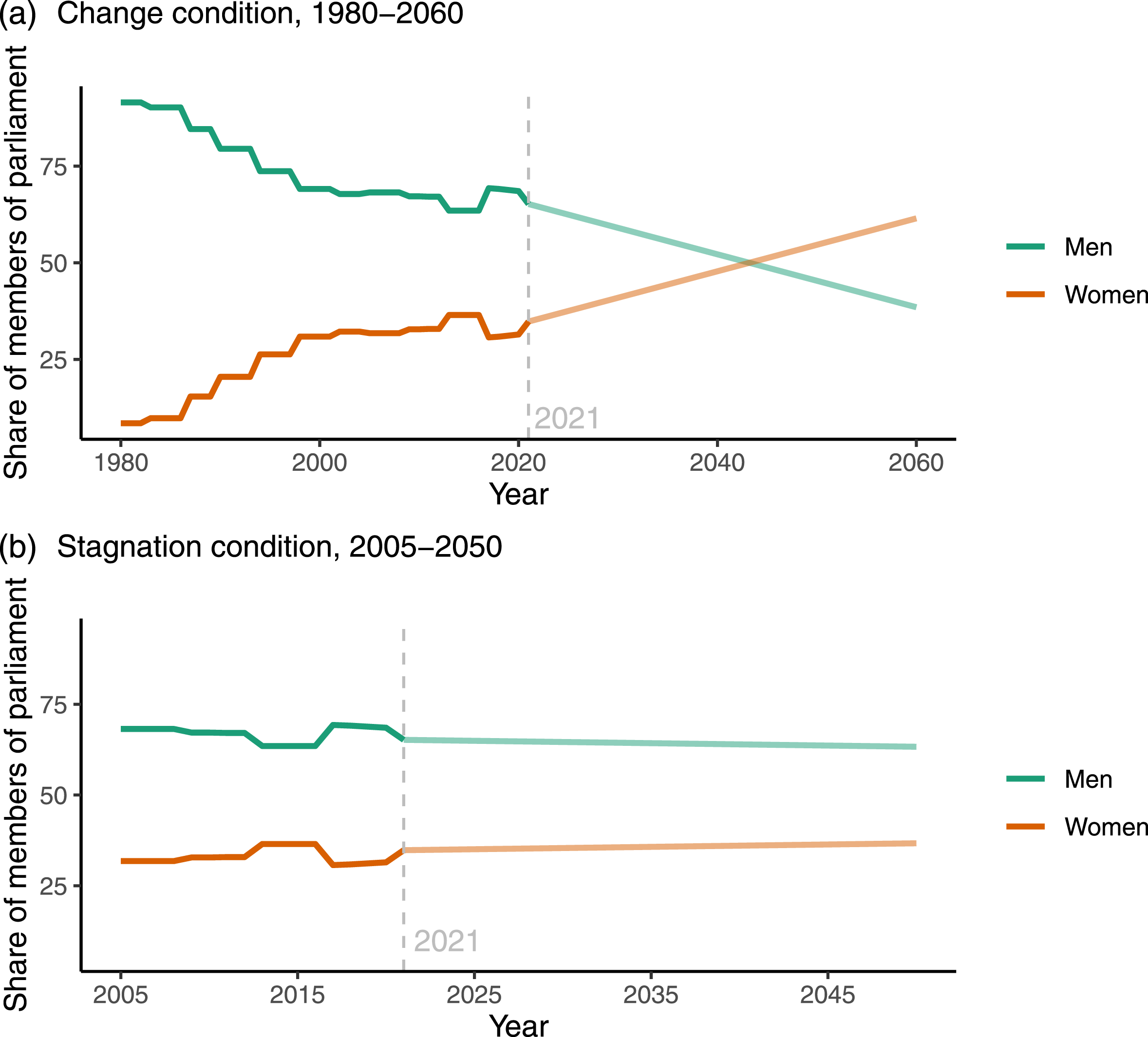
Crucially, the charts are based on the same data and indicator, only the time range on the x-axis and the slope of the projected development differ. Therefore, the experiment does not rely on deception, but displays the data in two different ways. 5 Respondents in condition a) with the longer time scale saw the share of men drop strongly and the share of women increase strongly from the 1980s to today. They received further information from the projected development until 2060, which was displayed in a lighter color and continued at the rate of the previous change. 6 These respondents saw the lines cross by 2045, indicating gender parity. For condition b), the projection was calculated based on the development since 2005. According to this trend, gender parity in the parliament is not expected to occur until the end of the shorter time scale.
Both treatment charts were accompanied by a short explanatory text (see Appendix C2) and a survey item to embed the treatment in a more subtle way. It asked respondents if they believe that the gender ratio in parliament makes a difference for the outcomes of political decision-making.
A manipulation check was included to test for the credibility of the treatment and for non-compliance: On the page directly after the treatment, respondents were asked to estimate the share of women in parliament in 2050. A t-test confirmed that respondents in the two treatment groups significantly differed in their estimate of women’s representation in the year 2050 (change treatment: mean of 50%, stagnation treatment: 44%, see Appendix C4).
Outcome and Covariate Measures
Outcome Items.
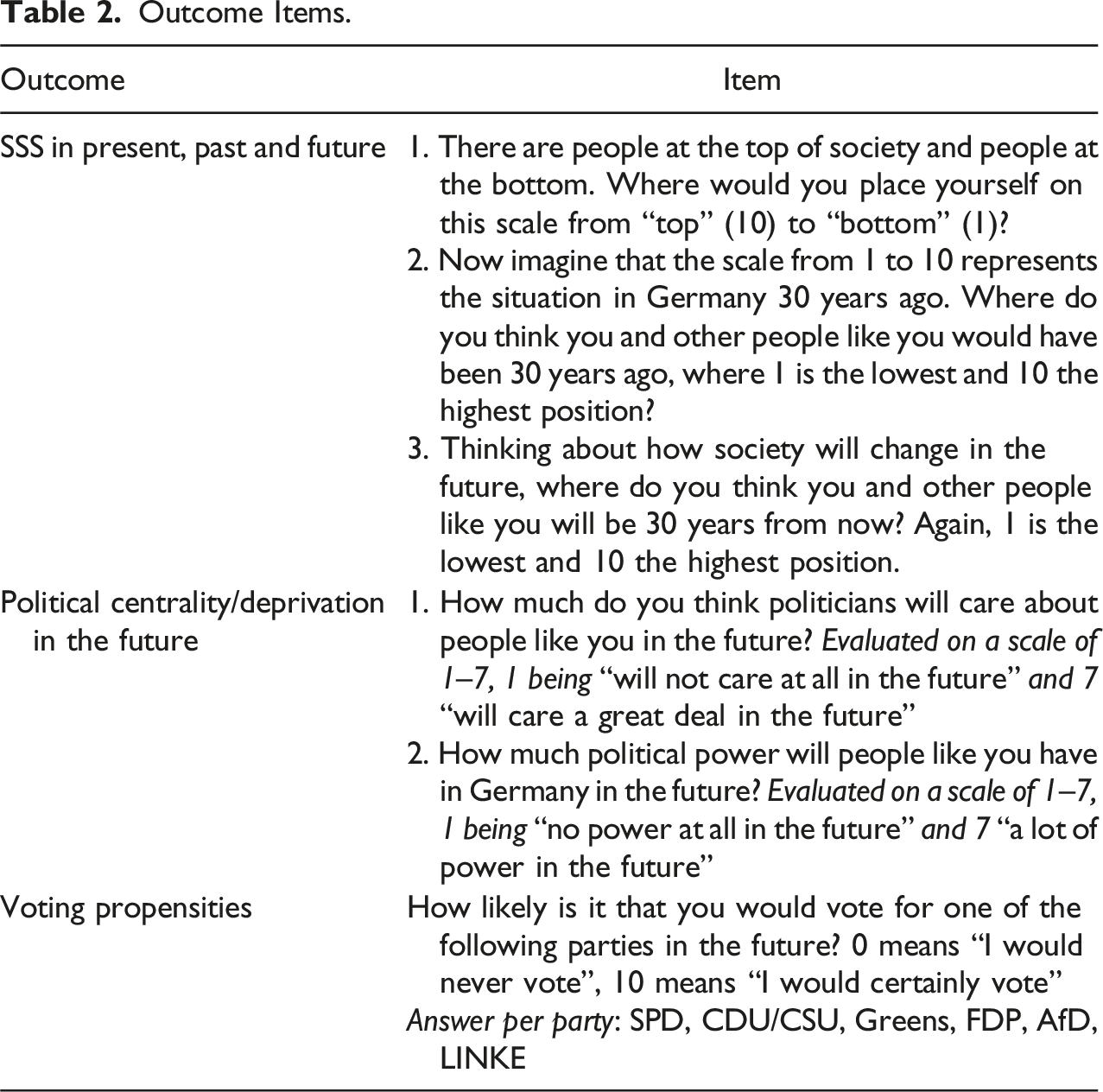
To measure SSS, I used the standard social ladder question (as i.e., Gidron & Hall, 2017) for present, past, and future status perceptions. I expected an effect on present SSS as well as on individuals’ perceptions of their status trajectory from past to future. To construct this variable, past SSS was subtracted from future SSS, so that positive values indicate expected status gains from the past to the future. Vice versa, negative values mean that losses are expected in the future, compared to respondents’ past. The items on political centrality (adapted from Gest et al., 2018) asked for perceptions about the future because the treatment primed a future development. Political centrality consists of two items, of which the mean was analyzed. Low values indicate perceptions of political deprivation, high values of political centrality.
The main covariate of interest is the gender of the respondent, as a heterogeneous effect was expected between men and women. It was surveyed pre-treatment.
Estimation
I modeled OLS regressions with robust standard errors (HC2, see Lin, 2013) to estimate the treatment effect on each outcome variable. The models include the effect of the treatment assignment and its interaction with respondent gender. The resulting Conditional Average Treatment Effects (CATE) are reported using predicted values by experimental group and gender. 7
I plot 83.4% confidence intervals around the predicted values for an easier visual interpretation of the significance of results. For the graphical presentation of predicted values in different experimental groups, assessing the (lacking) overlap in 95% confidence intervals does not relate to a type I error probability of .05 (Knol et al., 2011). Instead, non-overlapping 83.4% confidence intervals indicate statistical significance of a pairwise difference at the level of 95%, if the variance within subgroups is equal and if the effect estimates are independent (Knol et al., 2011). Both conditions are met here. 8 The OLS tables in Appendix D1 rely on the standard 95% confidence intervals. Furthermore, plots with 95% confidence intervals and respective t-tests are included in appendices D2 and D3.
Results
SSS and Political Centrality
The conditional average treatment effects on subjective social status are presented first. Figure 2 reports predicted values for both present SSS (top) and the trajectory from past to expected future SSS (bottom).
9
The results show that the current social status of men was affected by the treatment conditions, compared to the control group. As expected in H1b), men in the change condition reported significantly lower SSS.
10
In terms of substantial magnitude, this effect amounts to a change of .24 on the scale of 1 to 10. This is a similar effect size as the effect of gender on SSS and is considerable for a survey experiment. Seeing the representation of women compared to men change substantially led to a lower perceived standing in the present among men. However, even the stagnation condition seemed to suppress the status of men, albeit in a weaker and insignificant way. In both treatment conditions, the otherwise significant gender gap in SSS became insignificant. This effect was driven by male respondents. It suggests that simply priming men about the presence of women in politics led them to perceive their societal standing as lower, underlining the implications that political representation has for status politics. Conditional average treatment effects (CATE) on subjective social status (SSS). Top: Present SSS (“There are people at the top of society and people at the bottom. Where would you place yourself on this scale from ‘top’ (10) to ‘bottom’ (1)?”); Bottom: Future SSS minus Past SSS, each on a scale of 1-10 (“Thinking about how society will change in the future, where do you think you and other people like you will be 30 years from now?”, minus “Where do you think you and other people like you would have been 30 years ago?”), where negative values denote expected loss and positive values expected gain. The control group saw no graph or information on the trajectory of women’s representation. 83.4% confidence intervals around predicted values. See OLS Table D1 in the appendix.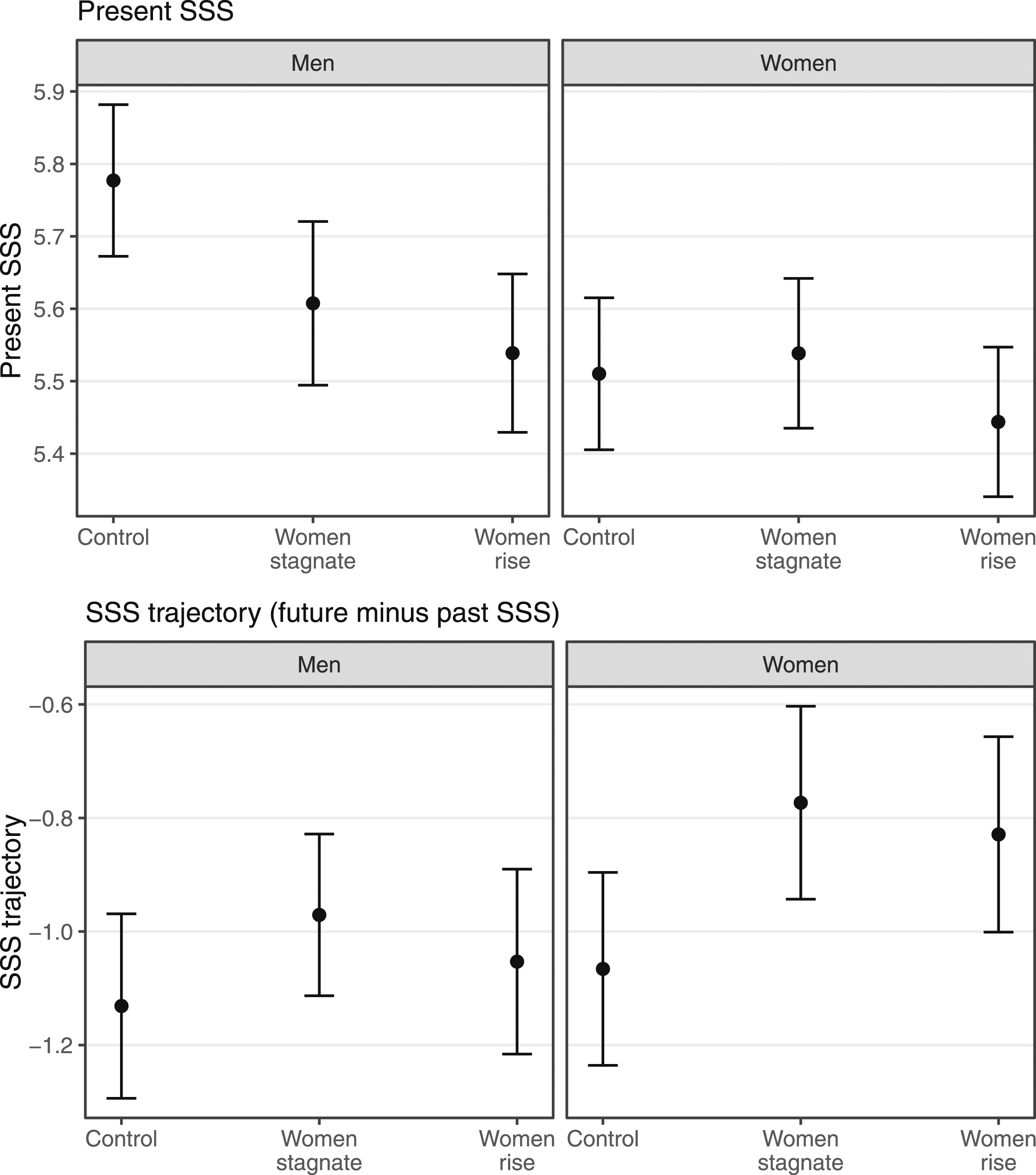
In exploratory subgroup analyses in the appendix, I also show that this negative effect on status perceptions among men is not only driven by low-educated men (Figure E5) or young men (Figure E6), two subgroups of men that are thought to be especially prone to backlash (Gidron & Hall, 2017; Off et al., 2022). Instead, men’s subjective status tends to decline across education levels and age groups, though some of these subgroup analyses have limited statistical power. Still, this supports that a gendered status perspective is at play that affects more than a specific subgroup of men.
For women, no difference was detected between the control and the stagnation condition regarding present SSS. Stagnating progress on descriptive representation did not lower women’s SSS, contrary to H4b). Interestingly, women in the change condition reported slightly lower SSS, although this difference was not significant. 11 Either way, this contradicts H3b): A strongly increasing representation of women MPs did not lead to a higher subjective social status among women. This finding raises the question of whether women in the change condition perceived that likely future progress toward equal representation has not materialized yet. The lower plot in Figure 2 suggests this. Women in both treatment conditions, compared to the control group, reported a somewhat more positive status trajectory, though both effects were only significant at the level of 90%. Notably, this holds across levels of (anti-)feminist attitudes and education levels (see Figures E4 and E5). This finding indicates that it was the overall prime of women’s presence in parliament that made women’s outlook on their status trajectory less negative.
In general, most of the respondents expected status losses in the future, as indicated by the negative values in the bottom plot. The SSS trajectory of men was not affected by the treatment conditions: the perceived decrease in standing appeared to be directly projected onto the present SSS.
Moving on to the outcome of political centrality, Figure 3 shows that the treatment conditions did not significantly affect this outcome, among neither men nor women. For men, the tendency is that the prime of stagnating gender relations in parliament increased men’s perceptions of their group’s political standing, even though the effect is insignificant. This effect is plausible in the sense that the stagnation treatment reassured men that their political status is not threatened. The exploratory subgroup analyses confirmed that men with conservative gender attitudes perceive higher political centrality in the stagnation condition, while men with feminist attitudes were not affected by the treatment (Figure E7). However, being presented with an overturning gender ratio in parliament did not change the baseline political centrality among men, not even among anti-feminist men. This result goes against the expectations in H1a): Losing political status in the future did not lead to expectations of political deprivation among men. Conditional average treatment effects (CATE) on political centrality. Scale from 1 to 7, where higher values indicate higher political centrality (mean of items: “In the future, politicians will care about people like me”, “In the future, people like me will have political power”). The control group saw no graph or information on the trajectory of women’s representation. 83.4% confidence intervals around predicted values. See OLS Table D1 in the appendix.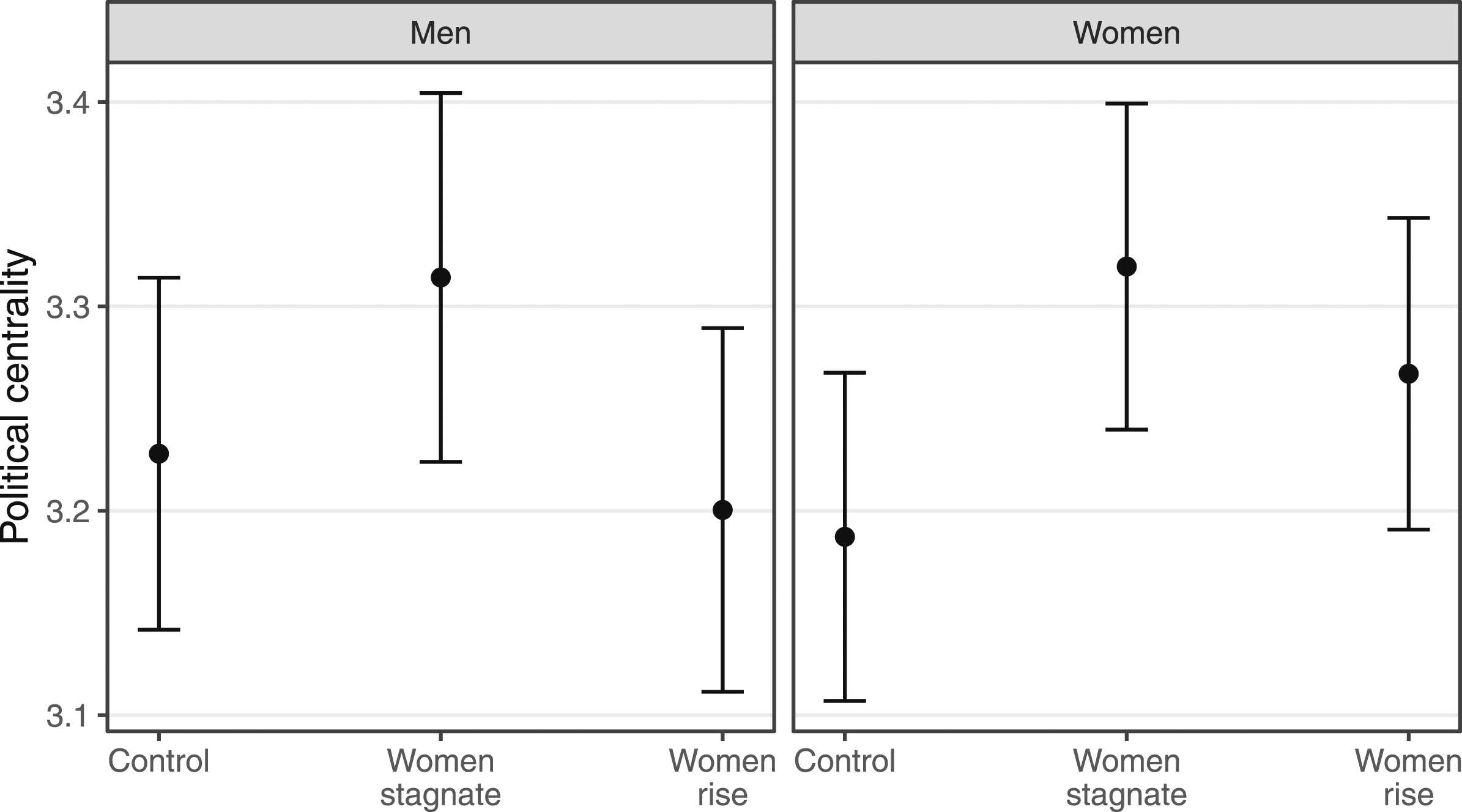
For women, a surprising tendency was found in the stagnation condition, although it is not significant at the 95-percent level: Compared to women in the control group, women in the stagnation condition tended to perceive higher future political centrality. This was driven by a significantly higher perception that politicians will care for women in the future, one of the two items of this measure (see Figure E1 in the appendix for disaggregated results). However, the change condition did not have a significant effect on women’s perception of their political standing, against the expectations. The trajectory of the overturning gender ratio did not lead to the expected boost in political efficacy for women (H3a). There is a tendency that women’s political centrality is increased and becomes higher than men’s in the change condition but this effect is not significant.
Do Voters Care About Descriptive Representation?
Before moving on to effects on voting propensities, I first present some exploratory analyses to provide a better understanding of these partly puzzling results. The unexpected findings for political centrality could be due to substantial reasons, but also due to issues with the experimental treatment. First, the stagnation treatment was likely more credible to respondents. The change condition may have failed to convince women (and men) that the shift would really be so drastic and that more women than men would be represented in 2050. Although the manipulation check after the treatment indicated that men and women estimate a significantly higher share of women in parliament in 2050 when assigned to the change instead of the stagnation condition, the mean estimate did not exceed 50% of MPs (see Figure C1 in the appendix for the distribution of estimates).
Second, the similarity of outcomes between the two treatment conditions could indicate that men and women do not strongly care about the specific trajectory of women’s representation, beyond a certain baseline level. Although there were some significant differences between the control and both treatment groups, I did not detect significant differences between the change and stagnation conditions in the outcomes of interest thus far. Hence, the prime of women’s representation appeared to matter more than the specific trajectory.
To investigate these possible explanations, I conducted additional exploratory analyses that were not preregistered. These provide evidence of a crucial significant difference between the treatment conditions, which speaks for their (partial) credibility and the importance of descriptive representation trajectories for citizen attitudes. Specifically, an attitude towards gender relations that focuses on boys’ opportunities was affected by the treatments in a different way. This post-treatment item stated: “In the meantime, what is needed above all are measures that specifically strengthen the self-confidence of boys”. It is interesting to find out whether there is a latent worry among voters that women’s advances in different societal arenas lead to disadvantages for boys compared to girls. Due to its salience in public debate (see i.e., NY Times, 2010 and the report by the UNESCO, 2022) it has become widespread knowledge that girls perform better than boys in school and partly also in university (Weaver-Hightower, 2003). If people think that the political promotion of women creates or affects this disparity, then the treatments should affect the level of support for this item. Crucially, the survey item asks about prioritizing measures that strengthen boy’s confidence, which means it is not simply an answer that reflects worries about boys, but specifically expresses the sentiment that some level of attention should be returned from girls to boys.
The change condition significantly increased both men’s and women’s concerns about boys’ opportunities, compared to the stagnation condition (Figure 4, see also the OLS Table D3 in the appendix). This effect was similar in size for men (.24 on a scale of 1 to 7) and women (.21) and corresponds to .15 of a standard deviation. This has three implications. First, on a design level, it means that the respondents found the treatment credible to some extent, as the future underrepresentation of men went along with greater support for prioritizing measures for boys. Second, this result could explain why women were rather skeptical about the change treatment. The change condition did not increase their political satisfaction, possibly because they worried that boys would suffer as a result of women’s advances beyond parity. Third, this means that men and women do care about descriptive representation and how it affects real life chances for boys and girls. An increasing overrepresentation of a group, possibly any group, is not regarded positively. Conditional average treatment effects (CATE) on prioritizing support for boys. Higher values on the scale from 1 to 7 mean support for the statement “In the meantime, what is needed above all are measures that specifically strengthen the self-confidence of boys”. The control group saw no graph or information on the trajectory of women’s representation. 83.4% confidence intervals around predicted values. See OLS Table D3 in the appendix.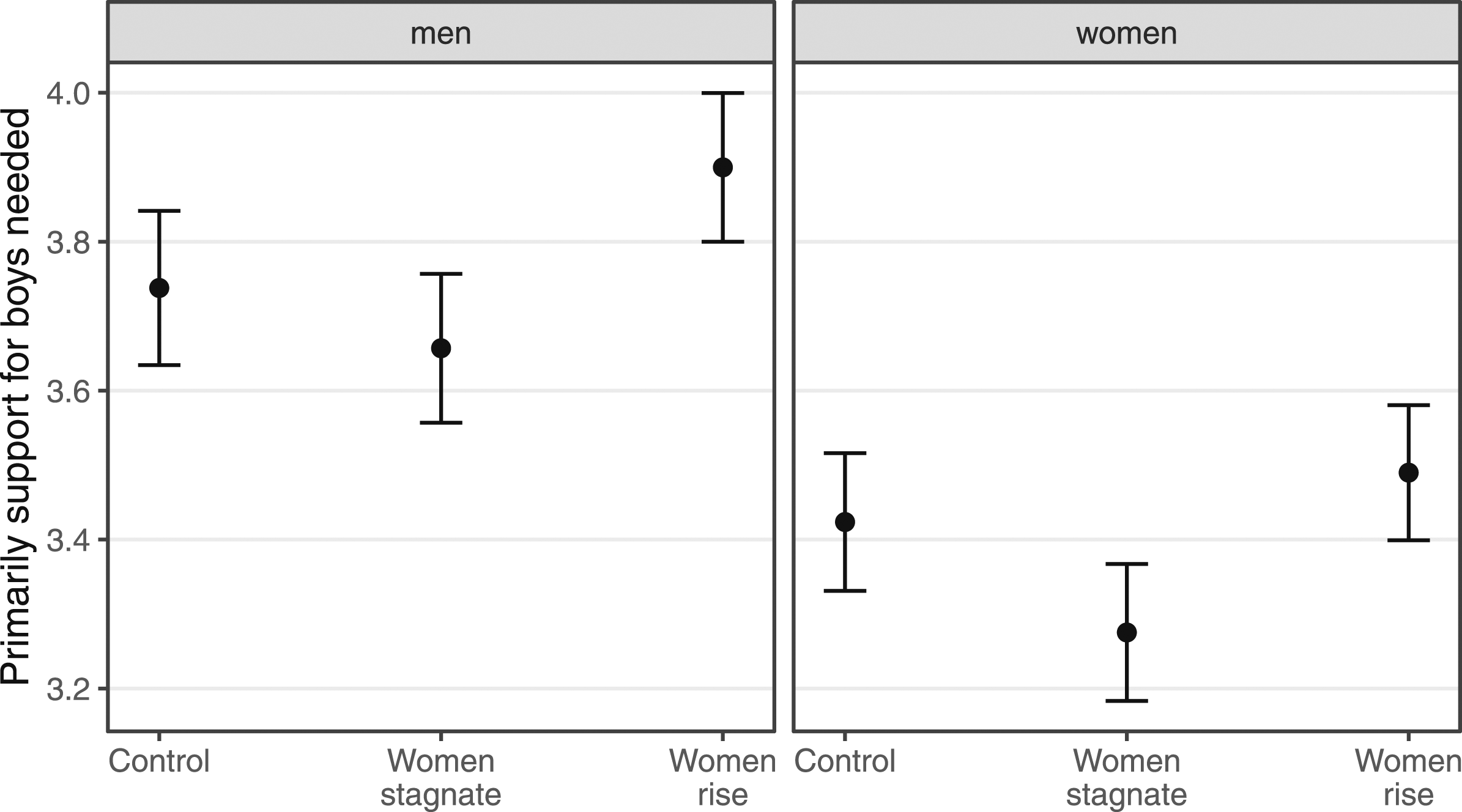
Voting Propensities
After having established this foundational importance of different representation trajectories, I move on to the preregistered analyses of how party support is affected by the experimental conditions. Voting propensities were surveyed separately for each main party in the German context.
12
The treatment effects reveal that the experiment did not induce a radical right backlash to women’s increasing representation. The plot at the top of Figure 5 shows that contrary to H1c), the change condition did not increase men’s propensity to vote for the radical right AfD. In contrast, for both treatment groups, it was even slightly lower than in the control group, although insignificantly. Connecting this with results from above, worrying about boys’ self-confidence thus did not translate into a broader backlash in terms of radical right voting. The effect of the change condition remained at a social status and issue-specific level. Conditional average treatment effects (CATE) on AfD and Green voting propensities. Scale goes from 0 to 10, where higher values indicate higher voting propensities (meaning the expressed likelihood of respondents to vote for the respective party in the future). 83.4% confidence intervals around predicted values. The control group saw no graph or information on the trajectory of women’s representation. See OLS Table D2 in the appendix.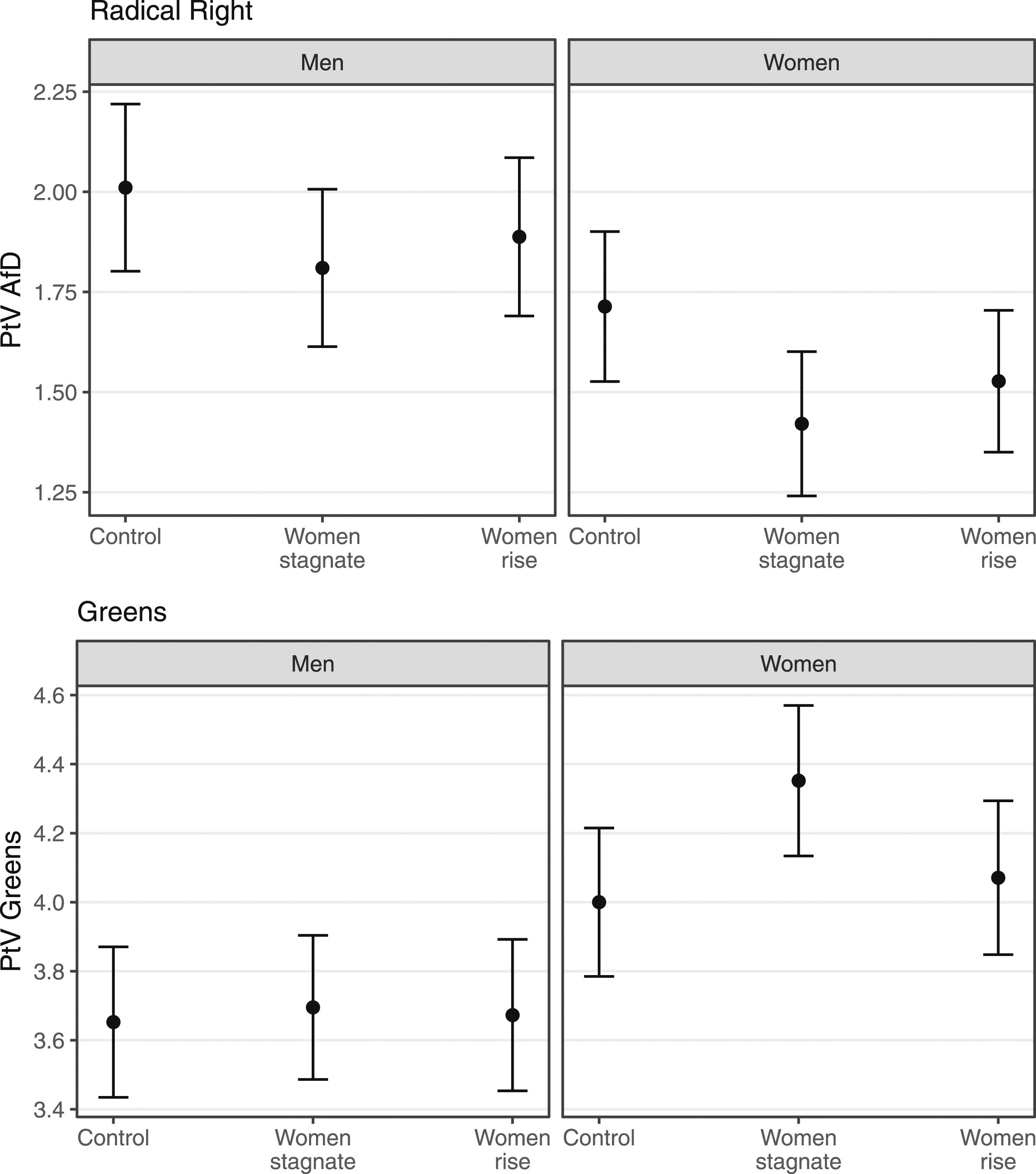
Further exploratory analyses confirmed this result by showing that even those male subgroups often deemed most susceptible to a backlash do not increase their radical right voting propensities. Neither anti-feminist men (Figure E10), nor men without a university degree (Figure E11) nor younger men (Figure E12) become more prone to vote for the AfD when presented with the change condition.
For women, the treatment conditions also tended to decrease their AfD endorsement, which was lower than men’s to begin with. The difference between men and women was significant at 95% in the stagnation condition, but not in the control group (t-tests in Tables D11 and D12). Priming respondents, especially women, about gender and representation in politics seems to deter them from radical right parties. This is likely due to the fact that parties like the AfD are known for their reactionary gender positions and the dominance of male politicians within them.
Turning to the analysis of progressive voting propensities, it becomes clear from Figure 5 that Green parties can profit from women’s perception of stagnating progress towards more equal representation. In the stagnation condition, women reported a significantly higher propensity to vote Green than men. This was not the case for the change or control condition. This finding indicates that women especially turn to Green parties as a means of further increasing women’s representation, as a reaction to stagnating progress towards equality. In contrast, when confronted with the information that the representation of women is already strongly increasing, women did not increase their propensity to vote Green as a reward. Notably, both treatment plots and the explanatory texts (Appendix C2) informed respondents about the same current share of women in parliament (35% after the 2021 election), meaning that the stagnating trajectory induced this progressive mobilization beyond the salience of the current underrepresentation of women. The fact that men’s support for the Greens was not affected by the treatments highlights that a gendered perspective is at play.
For the propensity to vote for the radical left (LINKE) or mainstream left (SPD), Figure E2 in the appendix shows that there were no substantial differences between men and women. Both groups were slightly more likely to vote for the SPD when assigned to the stagnation condition. Women were not more likely to vote radical left when exposed to either treatment. It is possible that the radical left would profit instead of the Greens in other countries. In Germany, the LINKE is often regarded as less socioculturally progressive than the Green party, or as less internally coherent on these questions. Therefore, it makes sense that it is the Green party to which women turn in this context.
To understand the increase in support for the Greens among women better, I further conducted an exploratory analysis to find out which women were most affected. This reveals an interesting pattern: Only women with conservative gender attitudes
13
were affected by the stagnation treatment, revealing a strong and significant effect (right panel in Figure 6). By contrast, women with feminist attitudes, who were already more likely to vote Green, were not affected (though this is not a ceiling effect, with predicted PtV values still far below the maximum value of 10). Thus, women’s descriptive representation is clearly not something that only feminists care about. Instead, highlighting stagnating progress motivates even anti-feminist women to support a progressive party like the Greens. The mobilizing effect of the stagnation condition on anti-feminist women was confirmed for the outcome of political centrality (see Figure E7 in the appendix). Conditional average treatment effects (CATE) on Green voting propensity, by gender and attitude towards gender equality. Scale goes from 0 to 10, where higher values indicate higher voting propensities. Attitudinal (pre-treatment) item reads: “The bottom line is that the family suffers when the woman works full time.“, on a scale of 1 to 7, where higher values indicate support. Those who tend to agree (values 5–7) are classified as having anti-feminist attitudes (n of 894), the rest as having feminist attitudes (n of 2034). 83.4% confidence intervals around predicted values. The control group saw no graph or information on the trajectory of women’s representation. See OLS Table D4 and t-tests D14 and D15 in the appendix.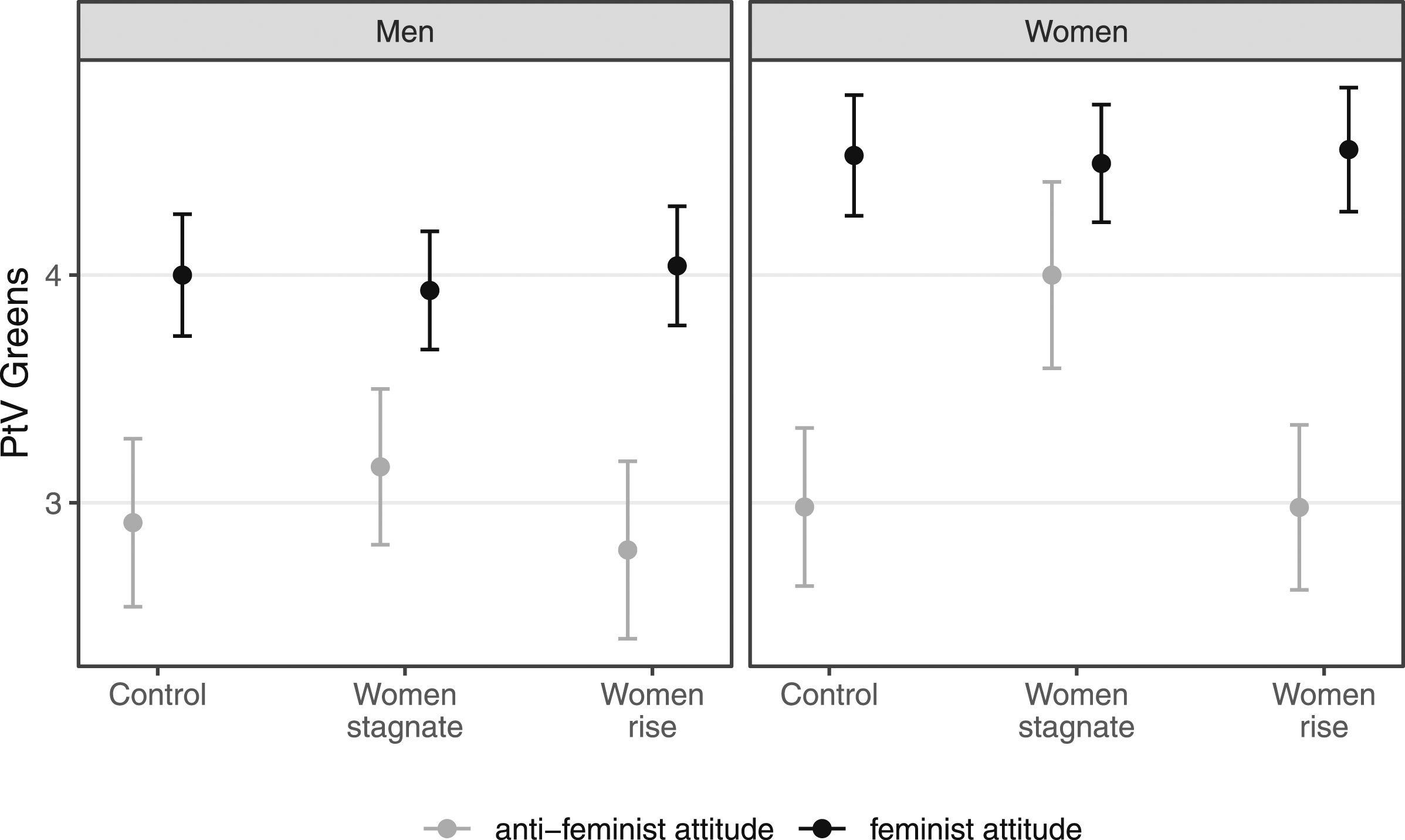
Conclusion
This paper relies on a survey experiment to assess reactions by men and women to trajectories of women’s representation. Taking into account asymmetric reactions between men and women, it argues that different trajectories have the potential to cause discontent, depending on whether they are perceived as going too far or not far enough. The experiment, conducted in Germany, manipulated information on trajectories of the descriptive representation of women compared to men from past to future. The expectations were that men who are primed about the increasing representation of women in parliament would perceive a threat, leading to a backlash and increased radical right voting. The expectations for women were that representation shifts in their favor would improve their political and social standing. In contrast, women primed about the stagnation of their descriptive representation were expected to react with a sense of political deprivation. How this discontent translates into women’s voting behavior is less established in existing research. This study paid special attention to the Green party, the most socioculturally progressive main party in the German context.
Overall, this study shows that increases in women’s representation do not trigger a backlash. Both men and women seem to overwhelmingly value descriptive representation and gender equality. For men, this appreciation even holds at the cost of a lower social standing for themselves. Priming men about the presence of women in parliament decreased their subjective social status, especially when presented with an overturning gender ratio in favor of women. However, men’s perception of a lower standing did not translate into other outcomes usually related to a backlash. Neither political deprivation nor their propensity to vote for the radical right AfD increased as a result of being exposed to the change treatment. If anything, their support for the AfD tended to decrease when primed about the gender ratio in parliament. These findings support earlier research on symbolic representation by Schwindt-Bayer and Mishler (2005), who found men to be sociotropic, meaning that they see women’s representation as good for society as a whole, just like women do. Thus, evidence is accumulating across both observational and experimental studies that men do not respond in an egotropic, negative way to increases in women’s representation. 14
A few interesting implications arise from the reactions of women voters to different representation trajectories. First, the stagnant representation trajectory did not cause a sense of generalized discontent among women. Moreover, a potential overrepresentation of women in the future was not more positively evaluated than the stagnating development. This result can be partly explained by the fact that both women and men worry about boys’ opportunities when exposed to a future overrepresentation of women. Together, these results point to a more complicated ‘psychology of the winners’ of structural shifts toward gender equality. Women, like men, seem to shy away from ‘going too far’ and do not view the underrepresentation of men positively. On a more abstract level, this confirms that voters value equal representation and worry about disadvantages to social groups that are less represented in parliament, even if these groups are still in an overall privileged position.
Second, the results indicate that while women were not too resentful about their unequal descriptive representation, they were still mobilized to vote for the Greens as a remedy against this stagnation. This pattern can be interpreted as a reaction by women to potentially increase their descriptive and substantive representation by supporting parties that advocate progressive sociocultural policies and have a high share of women MPs. The broader implications of this result are that progressive parties can appeal to and mobilize groups with upward social status trajectories by politicizing remaining inequalities. Strikingly, this was the case mostly for women with anti-feminist attitudes, showing a certain persuasion possibility for feminist actors. However, it seems that women’s potential mobilization is not rooted in generalized discontent but rather in a concrete demand for being politically represented. A recent study by Clayton et al. (2023) supports this by showing that being made aware of exclusion and its consequences can motivate women to develop political ambition themselves.
Regarding women’s progressive mobilization, future studies should evaluate more closely which contextual conditions favor this effect. Two factors of the German context seem especially relevant: First, the German empirical trend of stagnating advances towards gender equality in politics and beyond is common to Western European countries and other post-industrial contexts (von Wahl, 2006; Klasen, 2020). It is plausible that progressive discontent with inequality arises during times of stagnation in these contexts too, given the preconditions of initial advances and a certain politicization of gendered topics in the past. In contrast, a second factor may set Germany apart compared to some other Western European multi-party systems. With the Greens, it features only one paradigmatic progressive party that combines feminist substantive representation and a high descriptive representation of women, including in their ranks of leading figures. If such a clearly identifiable issue owner of gender equality exists (this could for example also be argued for the Austrian Greens or the Spanish radical left party Podemos and its electoral alliance Sumar), it is plausible that women’s discontent with inequality benefits them. It could also be the case that a mainstream left party mobilizes discontent with gender inequality in a two-party system. However, in other, more fragmented party systems in Western Europe, such as the Netherlands or Denmark, different new left/green/progressive parties exist, making it less clear whether one or multiple parties could mobilize around gender inequality, or whether the effect would dissipate.
Beyond these indications, it is an open question which types of parties can profit from discontent with persisting inequality under which conditions. Recent studies also highlight that right-wing parties, specifically radical right populist parties (RRPs) strategically appoint women MPs in an attempt to attract more women voters (Weeks et al., 2022). However, it is doubtful how believable women voters, specifically those who value equality, find these attempts, considering RRP parties’ often openly reactionary stances in matters of abortion, child care, and LGBTQ issues (Abou-Chadi et al., 2021; Off, 2023). In line with this, the results of this study indicated that women voters, even those with conservative gender attitudes, turned to progressive, not radical right parties when primed about continuing gender inequality. Nonetheless, perceptions of which parties drive increases versus stagnation in descriptive representation were not assessed in this study, but likely matter and should be addressed in future research.
Thinking about more general gender backlash dynamics beyond reactions to descriptive representation, this study also has some broader implications. First, the results speak to other recent studies questioning in how far the prototypical white male working class member has actually perceived status decline (Oesch & Vigna, 2022). This study adds that even when perceptions of status decline can be experimentally induced, there does not seem to be a direct link to resentment and other backlash outcomes.
Second, it is possible that discontent among both men and women is more likely to be induced by other gendered inequalities compared to descriptive representation. The results of this paper indicate that opportunities for children or educational discrepancies have this potential. In addition, increasing competition and remaining inequalities in the labor market may also be more contested (Kim & Kweon, 2022; Newman, 2016). The reason why descriptive representation may not trigger such a powerful reaction could be that voters regard MPs or other members of the political elite as quite removed from their lives and as different to themselves. A male worker may not perceive of a common fate with a male MP. While male respondents in this study did acknowledge a decline in status in reaction to the primes, the perceived shared fate may be too weak or indirect to cause generalized resentment. It could also be the case that men who perceive gendered threats in the labor market or education care more about the substantive representation of their interests by conservative or far right parties than about the descriptive representation of men. Therefore, future research should assess how the trajectories of other structural shifts toward gender equality affect political behavior, both in experimental and observational studies.
Third, another explanation for the finding of no male resentment could be traced back to the country context. It is possible that higher baseline levels of gender equality are necessary prerequisites for perceived threats among men (Donovan, 2023), as shown, for example, in the more gender-equal context of Sweden (Off, 2023). There, threats to men may be more believable. Nonetheless, the results from Germany suggest that gendered resentment may not be so easily triggered in other Western European countries with similar trajectories of women’s advancements.
Finally, this study implies that political elites likely play a crucial role in inducing gendered resentment. Recent studies with strong empirical evidence for a male backlash studied cases where far right political actors were openly campaigning on gender-based or at least broader societal grievances, including narratives that men are losing out at the expense of women. This includes the Spanish party Vox (Anduiza & Rico, 2022), the Sweden Democrats (Off, 2023), and Donald Trump (Schaffner et al., 2018). For the case of Brexit, Green and Shorrocks (2023) show that broader societal grievances, which were actively fostered by the Leave campaign, also spilled over in gender-based resentment. In contrast, for this study, the primes on trajectories of women’s representation were neither connected to a political actor, argument or directed narrative. If men view representation of and by women in an at least neutral light, as they seem to be doing, it is plausible that even men’s numerical loss in parliament is not seen too negatively. Thus, the results show that without the connection to an explicit narrative of men falling behind or an imposed ‘woke’ value change, priming women’s advancements did not trigger a male backlash. At least in the case of Germany, there does not seem to be a large demand-side sexist resentment against women’s representation absent an explicit elite mobilization.
Supplemental Material
Supplemental Material - Backlash or Progressive Mobilization? Voter Reactions to Perceived Trajectories of Women’s Representation
Supplemental Material for Backlash or Progressive Mobilization? Voter Reactions to Perceived Trajectories of Women’s Representation by Magdalena Breyer in Comparative Political Studies
Footnotes
Acknowledgements
I would like to thank Matthias Enggist, Delia Zollinger, Tabea Palmtag, Tarik Abou-Chadi, Silja Häusermann, Elisabeth Ivarsflaten, Denise Traber, Jana Schwenk, Valentin Daur, Andreas Jozwiak, Verena Reidinger, Michael Pinggera, Diane Bolet, David Attewell, Gefjon Off, Melanie Dietz, Dominika Tronina, Annika Lindholm, Lena Huber, the three anonymous reviewers and the editor Dawn Teele for very helpful comments on the experimental design and/or manuscript. This project was previously presented at the 2023 ECPR Joint Sessions Workshop on Group Politics in Toulouse, the 2021 ECPR Summer School on Political Parties in Aarhus, the GREC conference cycle at the University of Lausanne, the 2022 ECPR General Conference in Innsbruck, the Status Workshop at the University of Zurich (September 2022) and I would also like to thank audiences at these events for their generous feedback.
Declaration of Conflicting Interests
The author(s) declared no potential conflicts of interest with respect to the research, authorship, and/or publication of this article.
Funding
The author(s) disclosed receipt of the following financial support for the research, authorship, and/or publication of this article: This work was supported by the Swiss National Science Foundation (Grant Number 185204) and the University of Zurich (Research Priority Program ‘Equality of Opportunity’).

Data Availability Statement
Replication material can be found at: 10.7910/DVN/5AWTXE
Supplemental Material
Supplemental material for this article is available online.
Notes
Author Biography
References
Supplementary Material
Please find the following supplemental material available below.
For Open Access articles published under a Creative Commons License, all supplemental material carries the same license as the article it is associated with.
For non-Open Access articles published, all supplemental material carries a non-exclusive license, and permission requests for re-use of supplemental material or any part of supplemental material shall be sent directly to the copyright owner as specified in the copyright notice associated with the article.
